 Multispecies probiotic effects on juvenile tambaqui zootechnical performance and water bioremediation
Abstract
The objective of this work was to evaluate the effects of a multispecies commercial probiotic, at different concentrations and routes of administration, on water quality, zootechnical performance, and sediment bioremediation in rearing tanks of juvenile tambaqui (Colossoma macropomum). Six treatments were established during - PR 60 days: one without (control) and five with probiotic administration (in feed - PR; in water, at the recommended concentration by the manufacturer - PA1; in water, at a concentration three times the recommended - PA3; in water, at a concentration six times the recommended - PA6; and in water and feed - PRA). Four replicates were carried out per treatment. For the analysis of bioremediation, sediment from the fish farms was added to the experimental tanks. The administered doses and routes were proven safe. No significant differences were observed between treatments for water quality variables, except for turbidity. Multispecies probiotic enhanced sediment organic matter degradation at the bottom of the tanks in PA3 and PA6. The multispecies probiotic promotes the oxidation of organic matter, enhancing the rearing environment of tambaqui. The use of sediment from the bottom of fish farms is effective in emulating a production system in laboratory.
Index terms:
Colossoma macropomum; aquaculture; aquaculture health; sustainability; tank sediment.
Resumo
O objetivo deste trabalho foi avaliar o efeito de um probiótico comercial multiespécies, em diferentes doses e vias de aplicação, na qualidade da água, no desempenho zootécnico e na biorremediação de sedimentos em tanques de recria de juvenis de tambaqui (Colossoma macropomum). Seis tratamentos foram estabelecidos durante 60 dias: um sem (controle) e cinco com a administração do probiótico (na ração - PR; na água, em concentração recomendada pelo fabricante - PA1; na água, em concentração três vezes maior que a recomendada - PA3; na água, em concentração seis vezes maior que a recomendada - PA6; e na água e na ração - PRA). Foram realizadas quatro repetições por tratamento. Para a análise de biorremediação, o sedimento de viveiros de piscicultura foi adicionado aos tanques experimentais. As doses e as vias de aplicação mostraram-se seguras. Não foram observadas diferenças significativas entre os tratamentos em relação às variáveis de qualidade da água, exceto para turbidez. O probiótico multiespécies aumentou a degradação da matéria orgânica do sedimento no fundo dos tanques em PA3 e PA6. O probiótico multiespécies promove a oxidação da matéria orgânica, melhorando o ambiente de recria do tambaqui. O uso de sedimento do fundo de viveiros de piscicultura é eficaz para mimetizar um sistema de produção em laboratório.
Termos para indexação:
Colossoma macropomum; aquicultura; sanidade aquícola; sustentabilidade; sedimento no tanque.
Introduction
Global fish farming has remarkably increased in the last decades, and fish continue to be one of the most traded commodity items worldwide (FAO, 2022). Commercial issues have led to the intensification of fish production systems, with an increase in the incidence and severity of many diseases (Moraes & Moraes, 2009), such as bacterial ones (Marcusso et al., 2015).
The administration of chemical compounds and antibiotics to fight infections has gained momentum in fish production systems (Moraes & Moraes, 2009). However, the indiscriminate use of these products intensifies the selection of resistant microorganisms and causes serious environmental problems (Balcazar et al., 2006).
To mitigate the reliance on conventional antibiotics, several antimicrobial products are currently undergoing evaluation, such as herbal medicines (Yunis-Aguinaga et al., 2015), growth stimulators (Petrillo et al., 2017), immunomodulators (Salvador et al., 2022), vaccines (Marcusso et al., 2021), and probiotics (Mello et al., 2013).
Defined as live microorganisms, probiotics, when correctly administered, can improve animal and human health (Fuller, 1989). The probiotics industry has grown significantly in recent years and is projected to grow even further, with an increasing number of commercially available probiotics (Simone, 2019; Grume et al., 2020).
Despite the reports regarding the effectiveness of probiotics in aquaculture (Mello et al., 2013), results for freshwater and marine species are often controversial (Shariff et al., 2001). Additionally, it is important to note that the industry currently lacks specific products for aquaculture species with a lower global production spectrum, such as the neotropical species (Costa et al., 2021). A noteworthy example among these species is the tambaqui (Colossoma macropomum), a native Amazon species with significant economic importance in Asia, South, and Central America (FAO, 2022).
The objective of this work was to assess the effects on water quality, zootechnical performance, and sediment bioremediation in rearing tanks of juvenile tambaqui (Colossoma macropomum) submitted to a multispecies commercial probiotic at different concentrations and routes of administration.
Materials and Methods
The study was carried out at the Multiple Laboratory for the Production of Aquatic Organisms of Universidade Federal do Oeste do Pará, in the municipality of Santarém, in the state of Pará, Brazil. It was approved by the Comissão de Ética no Uso de Animais da Universidade Federal do Oeste do Pará, under the protocol 008577/12 CEUA-UFOPA 2022.
The 60-day experiment adopted the completely randomized design, with 24 experimental units, being six treatments and four replicates. The experimental unit was composed of one 5 m3 tank. The treatments consisted of: a control group with no probiotics, probiotics added to the feed (PR), probiotics added to the water at the concentration recommended by the manufacturer (PA1), probiotics added to the water at a concentration three times higher than recommended (PA3), probiotics added to the water at a concentration six times higher than recommended (PA6), and probiotics added to the feed and water at the concentration recommended by the manufacturer (PRA).
Juvenile tambaqui weighting 6.23±0.24 g were purchased from local producers, transported to the university laboratory, and acclimatized for 10 days in the tank. Water quality parameters were monitored and maintained within ideal conditions for the species accordingly to Cavero et al. (2009).
After acclimatization and fasting for 24 hours, the fish were subjected to analgesia in a 6 L bucket of water with an alcoholic solution of eugenol to facilitate handling and avoid animal stress. Three drops of pure eugenol were diluted in 0.5 mL of 96% ethanol per liter of water (159 mg L-1). Fish were weighed using an electronic scale and 10 fish per tank were maintained for 60 days at a stocking density of 125 fish m-3. The polyethylene tank with 100 L of capacity was filled up with 80 L of water. Fish were fed with 2.6 mm pellets commercial feed with 36% crude protein 3 times a day, at 8 a.m, 2 p.m, and 5 p.m. The amount of feed was 3% of the total biomass in the tank.
The commercial probiotic was designed to improve zootechnical performance and waste treatment, process known as bioremediation. It contains Bacillus subtilis at a concentration of 1.7×10⁹ CFU g-1; Bacillus licheniformis, 1.7×10⁹ CFU g-1; Lactobacillus plantarum, 1.2×10⁹ CFU g-1; and Pediococcus acidilactici, 1.2×10⁹ CFU g-1. The rate recommended by the manufacturer is 2.0 kg of probiotic per Mg of feed. The rate of 2 mg of probiotic diluted in 5 mL of water per gram of feed was used in the experiment. The feed with probiotic was used only in the third feeding of the day in treatments PR and PRA. Additions of probiotic in PA1, PA3, and PA6 were conducted weekly as recommended by the manufacturer, at a concentration of 1 kg of probiotic per 10,000 L of water. Therefore, the doses of probiotic for treatments PA1, PA3, and PA6 were 0.01, 0.03 and 0.06 g of probiotic per tank, respectively.
Temperature (°C), electrical conductivity (µS cm-1), dissolved oxygen (mg L-1), and pH were the physicochemical water parameters monitored daily. The portable multiparameter meter AK88 (AKSO, São Leopoldo, RS, Brazil) was used to guarantee parameters were maintained within optimal range for the species. Turbidity (NTU) and alkalinity (mg CaCO3 L-1) were measured weekly using a turbidimeter and titration, respectively. Total settleable solids were measured twice a week in mL L-1 using an Imhoff cone, and total ammonia and nitrite, both measured in mg L-1, were monitored three times a week (Costa et al., 2021).
In order to evaluate the probiotic effect on organic matter bioremediation, pond sediment was collected from a local fish farm, and added into experiment tanks. In each tank, a layer of 1 cm of sediment was laid down, followed by the addition of water and installation of the aeration system. Sediment samples from each tank were collected and frozen at the beginning and end of the 60-day experiment. After homogenization and weighing, organic matter concentrations were determined via the organic matter oxidation technique using potassium dichromate and sulfuric acid (Sá, 2015). Organic matter concentration was expressed in mg of CO2 per g of organic matter.
Zootechnical performance was evaluated by sampling five fish from each tank every 15 days. A digital scale was used to monitor growth and adjust feeding quantities. At the end of the experimental period, biometric data and live weight of all fishes were collected in order to calculate the following indexes: AFW, mean final weight (g); WG, weight gain (g), calculated as the difference between AFW and mean initial weight (IW); FB, final biomass (g), calculated as AFW multiplied by the number of fishes at the end of the experiment; P, productivity (g m-3), calculated dividing FB by the volume of water used in the experiment; S, survival rate (%), calculated as the final number of fish divided by the initial number of fish × 100; and SGR, specific growth rate (% per day), calculated according to the following equation:
Assumptions of normality, homoscedasticity and independence of residues were checked using Shapiro-Wilk’s, Cochran’s, and Durbin-Watson’s tests, respectively. Zootechnical performance indexes were analyzed using the non-parametric Kruskal-Wallis’ test. Water quality and organic matter data showed normal distributions, so one-way analysis of variance (ANOVA) was performed, and the differences were checked using the F-test (α = 0.05). A post-hoc mean comparison used Tukey’s test (α = 0.05). All statistical analyses were conducted using the R statistical language v.4.4.2 (R Core Team, 2024).
Results and Discussion
The adoption of probiotics in aquaculture activities has proven to be beneficial for aquatic animals in a production environment, as zootechnical performance and resistance to diseases usually increase, improving fish health and immune system (Mello et al., 2013). In this work, the association of B. subtilis, B. licheniformis, L. plantarum, and P. acidilactici, used as probiotics in C. macropomum was proven safe because a 100% survival rate was achieved for all treatments with the absence of clinical or behavioral changes during the experimental period. Furthermore, no zootechnical performance or physicochemical water parameter differences were noted.
There was no significant difference (p>0.05) between the water quality parameters of temperature, dissolved oxygen, pH, electrical conductivity, total ammonia, nitrite, and alkalinity (Table 1). Treatments PR and PRA, which administered probiotics in feed, led to higher turbidity rates compared to the control group (p<0.05). Furthermore, the absence of significant water quality parameter differences corroborates previous data reported for the same species supplemented with commercial probiotics (Costa et al., 2021).
Mean water quality parameters of rearing tanks of juvenile Colossoma macropomum subjected to different probiotic treatments and a control treatment after the 60-day experiment(1).
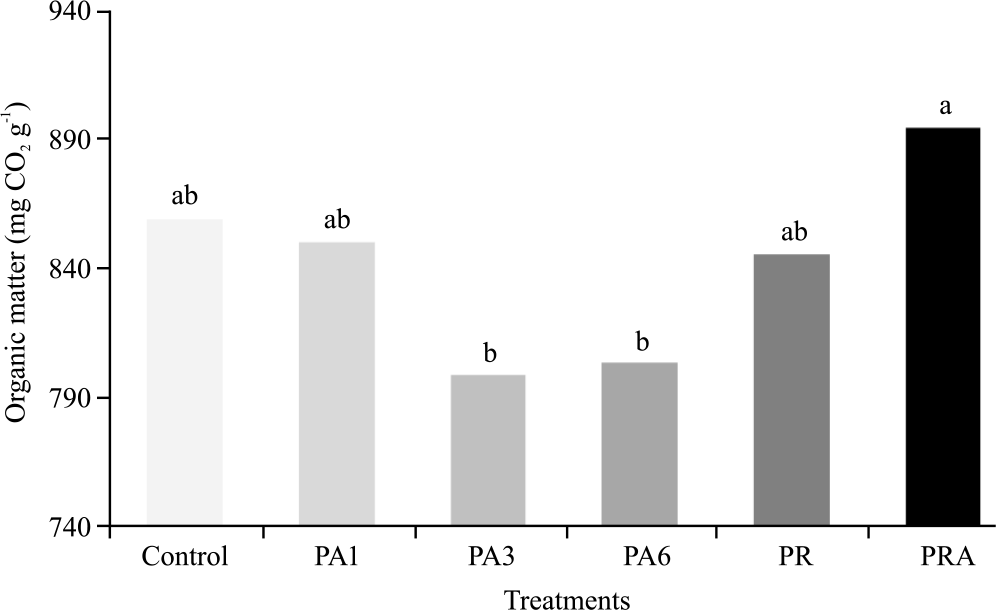
All treatments presented an initial organic matter concentration of 908.78 mg CO2 g-1. At the end of the experiment, PA3 and PA6 presented a significantly better degradation of organic matter in the sediment (p<0.05). PA3 and PA6 showed values of 798.16 and 803.08 mg CO2 g-1 of organic matter, respectively. Meanwhile, PRA led to significant worse results regarding organic matter degradation than other treatments (p<0.05). PRA presented 893.97 mg CO2 g-1 of organic matter (Figure 1). The organic matter in the sediment at the bottom of the tanks in treatments PA3 and PA6 suffered microorganism decomposition. These results highlight the need for further studies regarding the appropriate use of probiotics in specific aquatic organisms (Hai, 2015).
Mean concentration of organic matter in rearing tanks of juvenile Colossoma macropomum subjected to a control and five probiotic treatments after the 60-day experiment. PA1, probiotic added to the water at the concentration recommended by the manufacturer; PA3, probiotic added to the water at a concentration three times higher than recommended; PA6, probiotic added to the water at a concentration six times higher than recommended; PR, probiotic added to the feed; and PRA, probiotic added to the feed and water at the concentration recommended by the manufacturer. Means followed by different letters on top of the bar indicate significant differences according to Tukey’s test (α = 0.05).
The use of higher probiotic doses facilitated organic matter oxidation, improving the environment quality for tambaqui production, and showing an effect of probiotics as bioremediatory. This may be related to the greater number of Firmicutes phylum bacterium that plays an important role in the mineralization of wastes, reducing the quantity of organic compounds in water (Shariff et al., 2001; Wróbel et al., 2023). Additionally, certain bacterial genera e.g. Bacillus sp. are often associated with degradation of organic matter (Figure 1). These microorganisms secrete enzymes and degrade volatile fatty acids, proteins, carbohydrates, and amino acids (Rivière et al., 2009). They assist the degradation process of organic matter present in aquatic production systems (Farizky et al., 2020).
No significant zootechnical performance regarding final weight, weight gain, biomass, productivity, and SGR (p>0.05) differences were noted among treatments (Table 2). The survival rate was 100% at the end of the experiment, indicating favorable conditions for tambaqui rearing in all treatments, consequently, this data was ommited in Table 2. Furthermore, the addition of 1 cm of sediment from the bottom of commercial fish farms to the bottom of each experimental unit was effective in mimicking a production system in laboratory.
Mean zootechnical performance of juvenile Colossoma macropomum subject to five probiotic treatments and a control treatment after the 60-day experiment. No statistical differences were found for all traits according to F-test (α = 0.05).
The lack of zootechnical performance differences between treatments and control can be attributed to the lack of probiotic adhesion to the intestinal mucosa (Costa et al., 2021; Han et al., 2021). The gastrointestinal tract adhesion process is crucial for probiotics to interact adequately with their hosts (van Tassell & Miller, 2011). This process is considered a critical step in mucosa probiotic colonization, as probiotics are negatively affected by the resistance of commensal intestinal microbiota (Han et al., 2021). The lack of performance benefits observed in this work aligns with previous results observed by Costa et al. (2021), who also reported no significant improvements in tambaqui supplemented with other multispecies probiotics. This lack of efficacy may be due to a lack of synergism between the microorganism species in the probiotic mix used. In contrast, Dias et al. (2018) and Azevedo et al. (2016) found positive performance results with tambaqui under dietary supplementation based on Bacillus cereus at a 3.9x10⁶ CFU g-1 for 120 days, and B. subtilis at a 1.0x10¹⁰ CFU g-1 for 60 days. These discrepancies suggest an evident need for in vitro analyses of bacterial species and strains in commercial probiotics products in order to verify potential synergism or competition between the microbes in the mix.
Another explanation for the lack of beneficial effects at manufacturer recommended dosages may be related to the quality of the commercial probiotic containing non-autochthonous probiotic strains. There are studies that investigated the accuracy of the labeled information of commercial probiotics for animal use (Weese & Martin, 2011). Reported issues include inaccurate information (Ullah et al., 2019), failure to reach the reported active counts, and incorrect identification of the species or strains on the label (Di Pierro et al., 2019), among other factors.
The findings reported in this study show that the used multispecies commercial probiotic, even when administered in dosages exceeding manufacturer recommendations, is safe, and serves as a bioremediation agent by increasing organic matter oxidation in the tank bottom. However, different doses of the multispecies probiotic did not significantly alter the zootechnical performance of the juvenile tambaqui or the tank water quality. These findings indicate the need for in vivo tests to develop specific probiotics made for native fish species of commercial interest.
Conclusions
-
1. The concentration of probiotics exceeding manufacturer recommendations increases oxidation of organic matter at the tank bottom.
-
2. Higher probiotic dosages are safe and act as a bioremediation agent.
-
3. The use of multispecies probiotic does not improve the zootechnical performance of tambaqui (Colossoma macropomum) during rearing.
-
4. The addition of sediment from the bottom of fish farms effectively simulates production systems in the experiments tanks.
Disclaimer/Publisher’s note:
The statements, opinions, and data contained in all texts published in Pesquisa Agropecuária Brasileira (PAB) are solely those of the individual author(s) and not of the journal’s publisher, editor, and editorial team, who disclaim responsibility for any injury to people or property resulting from any referred ideas, methods, instructions, or products.
The mention of specific chemical products, machines, and commercial equipment in the texts published in this journal does not imply their recommendation by the publisher.
Declaration of use of AI technologies
No generative artificial intelligence (AI) was used in this study.
Acknowledgments
To Coordenação de Aperfeiçoamento de Pessoal de Nível Superior (CAPES), for financing, in part, this study (Finance Code 001), for the scholarship to Juliana do Nascimento Ferreira. To Fundação de Amparo à Pesquisa do Estado do Amazonas (FAPEAM), for the scholarship to Layana Aparecida Batista Pereira. To Conselho Nacional de Desenvolvimento Científico e Tecnológico (CNPq), for the scholarship to Gustavo da Silva Claudiano and Hortência Miranda Rocha, Research Project Grant No. 315157/2023-2 and No. 409609/2021-8.
Data availability statement
Data available upon request: research data are only available upon reasonable request to the corresponding author.
References
-
AZEVEDO, R.V. de; FOSSE FILHO, J.C.; PEREIRA, S.L.; CARDOSO, L.D.; VIDAL JÚNIOR, M.V.; ANDRADE, D.R. de. Suplementação com prebiótico, probiótico e simbiótico para juvenis de tambaqui a duas densidades de estocagem. Pesquisa Agropecuária Brasileira, v.51, p.9-16, 2016. DOI: https://doi.org/10.1590/S0100-204X2016000100002
» https://doi.org/10.1590/S0100-204X2016000100002 -
BALCAZAR, J.L.; BLAS, I. de; RUIZ-ZARZUELA, I.; CUNNINGHAM, D.; VENDRELL, D.; MÚZQUIZ, J.L. The role of probiotics in aquaculture. Veterinary Microbiology, v.114, p.173-186, 2006. DOI: https://doi.org/10.1016/j.vetmic.2006.01.009
» https://doi.org/10.1016/j.vetmic.2006.01.009 - CAVERO, B.A.S.; RUBIM, M.A.L.; PEREIRA, T.M. Criação comercial de tambaqui Colossoma macropomum (Cuvier, 1818). In: TAVARES-DIAS, M. (Org.). Manejo e sanidade de peixes em cultivo Macapá: Embrapa Amapá, 2009. p.33-46.
-
COSTA, L.F.A.; LIMA, J.S.; SIQUEIRA, A.M.A.; SILVA, E.C.C. da; LIMA, V.C.F.; SILVA, L.A. da; SILVA, S.R. da; SANTOS, T.F.; FUGIMURA, M.M.S.; VAZ, L.J.; MARCUSSO, P.F.; CLAUDIANO, G. da S. Effect of multi-species probiotic administration in Colossoma macropomum juvenile rearing: supplementation and bioremediation. Aquaculture Nutrition, v.27, p.1721-1729, 2021. DOI: https://doi.org/10.1111/anu.13309
» https://doi.org/10.1111/anu.13309 -
DI PIERRO, F.; POLZONETTI, V.; PATRONE, V.; MORELLI, L. Microbiological assessment of the quality of some commercial products marketed as Lactobacillus crispatus-containing probiotic dietary supplements. Microorganisms, v.7, art.524, 2019. DOI: https://doi.org/10.3390/microorganisms7110524
» https://doi.org/10.3390/microorganisms7110524 -
DIAS, J.A.R.; ABE, H.A.; SOUSA, N.C.; COUTO, M.V.S.; CORDEIRO, C.A.M.; MENESES, J.O.; CUNHA, F.S.; MOURIÑO, J.L.P.; MARTINS, M.L.; BARBAS, L.A.L.; CARNEIRO, P.C.F.; MARIA, A.N.; FUJIMOTO, R.Y. Dietary supplementation with autochthonous Bacillus cereus improves growth performance and survival in tambaqui Colossoma macropomum Aquaculture Research, v.49, p.3063-3070, 2018. DOI: https://doi.org/10.1111/are.13767
» https://doi.org/10.1111/are.13767 -
FAO. Food and Agriculture Organization of the United Nations. The State of World Fisheries and Aquaculture: toward blue transformation. Rome, 2022. 266p. DOI: https://doi.org/10.4060/cc0461en
» https://doi.org/10.4060/cc0461en -
FARIZKY, H.S.; SATYANTINI, W.H.; NINDARWI, D.D. The efficacy of probiotic with different storage to decrease the total organic matter, ammonia, and total Vibrio on shrimp pond water. IOP Conference Series: Earth and Environmental Science, v.441, art.012108, 2020. DOI: https://doi.org/10.1088/1755-1315/441/1/012108
» https://doi.org/10.1088/1755-1315/441/1/012108 -
FULLER, R. Probiotics in man and animals. Journal of Applied Microbiology, v.66, p.365-378, 1989. DOI: https://doi.org/10.1111/j.1365-2672.1989.tb05105.x
» https://doi.org/10.1111/j.1365-2672.1989.tb05105.x -
GRUMET, L.; TROMP, Y.; STIEGELBAUER, V. The development of high-quality multispecies probiotic formulations: from bench to market. Nutrients, v.12, art.2453, 2020. DOI: https://doi.org/10.3390/nu12082453
» https://doi.org/10.3390/nu12082453 -
HAI, N.V. The use of probiotics in aquaculture. Journal of Applied Microbiology, v.119, p.917-935, 2015. DOI: https://doi.org/10.1111/jam.12886
» https://doi.org/10.1111/jam.12886 -
HAN, S.; LU, Y.; XIE, J.; FEI, Y.; ZHENG, G.; WANG, Z.; LIU, J.; LV, L.; LING, Z.; BERGLUND, B.; YAO, M.; LI, L. Probiotic gastrointestinal transit and colonization after oral administration: a long journey. Frontiers in Cellular and Infection Microbiology, v.11, art.609722, 2021. DOI: https://doi.org/10.3389/fcimb.2021.609722
» https://doi.org/10.3389/fcimb.2021.609722 -
MARCUSSO, P.F.; CLAUDIANO, G. da S.; YUNIS-AGUINAGA, J.; MARINHO-NETO, F. de A.; ETO, S.F.; FERNANDES, D.C.; ROSOLEM, M.C.; SALVADOR, R.; MORAES, J.R.E de; MORAES, F.R. de. Immunogenicity in Oreochromis niloticus vaccinated with sonicated antigens against streptococcosis. Fish and Shellfish Immunology, v.115, p.134-141, 2021. DOI: https://doi.org/10.1016/j.fsi.2021.04.030
» https://doi.org/10.1016/j.fsi.2021.04.030 -
MARCUSSO, P.F.; ETO, S.F.; CLAUDIANO, G. da S.; VIEIRA, F.C.F.; SALVADOR, R.; MORAES, J.R.E. de; MORAES, F.R. de. Isolamento de Streptococcus agalactie em diferentes órgãos de tilápias do nilo (Oreochromis niloticus) criadas em tanques-rede. Bioscience Journal, v.31, p.549-554, 2015. DOI: https://doi.org/10.14393/BJ-v31n2a2015-22504
» https://doi.org/10.14393/BJ-v31n2a2015-22504 -
MELLO, H. de; MORAES, J.R.E.; NIZA, I.G.; MORAES, F.R. de; OZÓRIO, R.O.A.; SHIMADA, M.T.; ENGRACIA FILHO, J.R.; CLAUDIANO, G.S. Efeitos benéficos de probióticos no intestino de juvenis de Tilápia-do-Nilo. Pesquisa Veterinária Brasileira, v.33, p.724-730, 2013. DOI: https://doi.org/10.1590/S0100-736X2013000600006
» https://doi.org/10.1590/S0100-736X2013000600006 - MORAES, F.R. de; MORAES, J.R.E. de. Nutracêuticos na inflamação e cicatrização de peixes de interesse zootécnico. In: TAVARES-DIAS, M. (Org.). Manejo e sanidade de peixes em cultivo Macapá: Embrapa Amapá, 2009. p.625-723.
-
PETRILLO, T.R.; CLAUDIANO, G. da S.; YUNIS-AGUINAGA, J.; MANRIQUE, W.G.; CASTRO, M.P. de; BELO, M.A. de A.; MORAES, J.R.E. de; MORAES, F.R. de. Influence of dexamethasone and levamisole on macrophage recruitment, giant cell formation and blood parameters in the tropical fish Piaractus mesopotamicus Bioscience Journal, v.33, p.1015-1027, 2017. DOI: https://doi.org/10.14393/BJ-v33n4a2017-33016
» https://doi.org/10.14393/BJ-v33n4a2017-33016 - R CORE TEAM. R: a language and environment for statistical computing. Vienna: R Foundation for Statistical Computing, 2024.
-
RIVIÈRE, D.; DESVIGNES, V.; PELLETIER, E.; CHAUSSONNERIE, S.; GUERMAZI, S.; WEISSENBACH, J.; LI, T.; CAMACHO, P.; SGHIR, A. Towards the definition of a core of microorganisms involved in anaerobic digestion of sludge. The ISME Journal, v.3, p.700-714, 2009. DOI: https://doi.org/10.1038/ismej.2009.2
» https://doi.org/10.1038/ismej.2009.2 - SÁ, M.V. do C. e. Manual de Práticas Laboratoriais em Limnocultura: água e solo. Fortaleza: Expressão Gráfica, 2015. 56p.
-
SALVADOR, R.; MARCUSSO, P.F.; CLAUDIANO, G.S.; MARINHO-NETO, F.A.; YUNIS-AGUINAGA, J.; RAMOS-ESPINOZA, F.C.; CUEVA-QUIROZ, V.A.; MORAES, J.R.E. de. Thymomodulin enhances vaccination responses against Streptococcus agalactiae in Nile tilapia. Revista de Ciências Agroveterinárias, v.21, p.282-289, 2022. DOI: https://doi.org/10.5965/223811712132022282
» https://doi.org/10.5965/223811712132022282 -
SHARIFF, M.; YUSOFF, F.M.; DEVARAJA, T.N.; RAO, P.S.S. The effectiveness of a commercial microbial product in poorly prepared tiger shrimp, Penaeus monodon (Fabricius), ponds. Aquaculture Research, v.32, p.181-187, 2001. DOI: https://doi.org/10.1046/j.1365-2109.2001.00543.x
» https://doi.org/10.1046/j.1365-2109.2001.00543.x -
SIMONE, C. de. The unregulated probiotic market. Clinical Gastroenterology and Hepatology, v.17, p.809-817, 2019. DOI: https://doi.org/10.1016/j.cgh.2018.01.018
» https://doi.org/10.1016/j.cgh.2018.01.018 -
ULLAH, M.; RAZA, A.; YE, L.; YU, Z. Viability and composition validation of commercial probiotic products by selective culturing combined with next-generation sequencing. Microorganisms, v.7, art.188, 2019. DOI: https://doi.org/10.3390/microorganisms7070188
» https://doi.org/10.3390/microorganisms7070188 -
VAN TASSELL, M.L.; MILLER, M.J. Lactobacillus adhesion to mucus. Nutrients, v.3, p.613-636, 2011. DOI: https://doi.org/10.3390/nu3050613
» https://doi.org/10.3390/nu3050613 - WEESE, J.S.; MARTIN, H. Assessment of commercial probiotic bacterial contents and label accuracy. The Canadian Veterinary Journal, v.52, p.43-46, 2011.
-
WRÓBEL, M.; ŚLIWAKOWSKI, W.; KOWALCZYK, P.; KRAMKOWSKI, K.; DOBRZYŃSKI, J. Bioremediation of heavy metals by the genus bacillus. International Journal of Environmental Research and Public Health, v.20, art.4964, 2023. DOI: https://doi.org/10.3390/ijerph20064964
» https://doi.org/10.3390/ijerph20064964 -
YUNIS-AGUINAGA, J.; CLAUDIANO, G.S.; MARCUSSO, P.F.; MANRIQUE, W.G.; MORAES, J.R.E. de; MORAES, F.R. de; FERNANDES, J.B.K. Uncaria tomentosa increases growth and immune activity in Oreochromis niloticus challenged with Streptococcus agalactiae Fish & Shellfish Immunology, v.47, p.630-638, 2015. DOI: https://doi.org/10.1016/j.fsi.2015.09.051
» https://doi.org/10.1016/j.fsi.2015.09.051
Edited by
-
Chief editor:
Edemar Corazza
-
Edited by:
Daniel Kinpara