 Decomposition kinetics and nutrient release in winter pastures under grazing with legume intercropping and supplementation
Abstract
The objective of this work was to evaluate feces decomposition and residual biomass, as well as nutrient release dynamics, in grazed winter pastures under legume intercropping and animal supplementation. The experiment was carried out in a randomized complete block design with three treatments: black oat + ryegrass + supplementation, black oat + ryegrass + vetch, and black oat + ryegrass + vetch + supplementation. Supplementation increased the labile fraction of fecal dry matter and nitrogen, accelerating their decomposition and favoring a faster nutrient turnover. The inclusion of vetch enhanced nitrogen release from feces and biomass, although its contribution was partially reduced when combined with supplementation likely due to changes in grazing dynamics. Potassium release from feces and biomass was rapid and little affected by the treatments, indicating that most of this nutrient returns to the soil via urine deposition. Supplementation and legume intercropping are complementary strategies: supplementation accelerates fecal decomposition, while legumes improve nitrogen cycling from residual biomass. This integration enhances nutrient recycling efficiency and reduces the need for external fertilization.
Index terms:
fecal decomposition; legumes; nutrient cycling; potassium.
Resumo
O objetivo deste trabalho foi avaliar a decomposição de fezes e da biomassa residual, bem como a dinâmica de liberação de nutrientes, em pastagens de inverno sob consórcio com leguminosa e suplementação animal. O experimento foi conduzido em delineamento de blocos ao acaso, com três tratamentos: aveia-preta + azevém + suplementação, aveia-preta + azevém + ervilhaca e aveia-preta + azevém + ervilhaca + suplementação. A suplementação aumentou a fração lábil da matéria seca e do nitrogênio fecal, acelerando a decomposição e favorecendo o retorno mais rápido de nutrientes. A inclusão de ervilhaca intensificou a liberação de nitrogênio a partir das fezes e da biomassa, embora sua contribuição tenha sido parcialmente reduzida quando associada à suplementação, possivelmente em função de alterações no pastejo. A liberação de potássio a partir das fezes e da biomassa foi rápida e pouco influenciada pelos tratamentos, o que indica que a maior parte desse nutriente retorna ao solo por meio da urina. A suplementação e o consórcio com leguminosas são estratégias complementares: a suplementação acelera a decomposição fecal, enquanto as leguminosas favorecem a ciclagem de nitrogênio proveniente dos resíduos vegetais. Essa integração aumenta a eficiência da reciclagem de nutrientes e reduz a necessidade de fertilização externa.
Termos para indexação:
decomposição fecal; leguminosas; ciclagem de nutrientes; potássio.
Introduction
Nutrient cycling in pastures arises from the dynamic exchange of elements among plants, animals, soil, and microorganisms, regulated by complex biogeochemical processes (Carvalho et al., 2018; Peterson et al., 2020). Ruminants play a central role in this cycle by redistributing nutrients through excreta, which directly affects soil fertility, microbial activity, and system sustainability (Nascimento et al., 2024). Furthermore, well-managed grazing systems increase carbon and nitrogen stocks, improve phosphorus and potassium recycling, while sustaining a higher forage productivity (Carvalho et al., 2018; Schön et al., 2024).
In Southern Brazil, winter pastures based on black oat (Avena strigosa Schreb.) and ryegrass (Lolium multiflorum Lam.) are widely used due to their capacity to recycle nutrients from deeper soil layers, reduce nitrogen leaching, and improve soil fertility for subsequent crops (Schön et al., 2024). Intercropping these grasses with legumes such as vetch (Vicia sativa L.) further enhances forage quality, increasing crude protein content, stimulating biological nitrogen fixation, and providing a more balanced nutrient supply (Assmann et al., 2014; Boddey et al., 2020).
Despite these advantages, the efficiency of nutrient cycling in grazed pastures depends strongly on pasture composition, grazing intensity, and climatic conditions (Peterson et al., 2020). Another important factor is nutritional supplementation, which alters intake and nutrient partitioning between feces and urine, modifying residue quality and influencing decomposition and mineralization rates (Correa-Luna et al., 2020; Nascimento et al., 2024).
Previous studies have shown that legumes accelerate residue decomposition and nitrogen release (Schön et al., 2024), whereas supplementation modifies nutrient excretion patterns (Chuan et al., 2020). However, in most of these researches, these strategies have been evaluated separately, and little is known about their combined effects under grazing conditions in subtropical pastures. Legume intercropping would enhance nitrogen release from residual biomass, while supplementation would accelerate fecal decomposition, with complementary effects on nutrient cycling. This approach contributes to a better understanding of how botanical diversity and nutritional strategies can optimize nutrient recycling, reduce dependence on external fertilizers, and enhance the sustainability of grazing systems in subtropical regions.
The objective of this work was to evaluate feces decomposition and residual biomass, as well as nutrient release dynamics, in grazed winter pastures under legume intercropping and animal supplementation.
Materials and Methods
The experiment was conducted from May to October, 2020, at Universidade Tecnológica Federal do Paraná, located at the Dois Vizinhos campus, in the state of Paraná, Brazil (25°33'S, 51°29'W, at an altitude of 500 m). The climate of the region is classified as Cfa, humid subtropical mesothermal, according to Köppen-Geiger, with an average annual precipitation ranging from 1,600 to 2,000 mm (Alvares et al., 2013). During the experimental period, minimum and maximum temperatures ranged from 2 to 29°C, with an average monthly rainfall of approximately 220 mm, according to data recorded by the weather station of the experimental farm of Universidade Tecnológica Federal do Paraná. The soil is classified as a Latossolo Vermelho Distroférrico (Santos et al., 2018), i.e., a Rhodic Ferralsol (IUSS Working Group WRB, 2015). Before establishing the experimental treatments, the area was cultivated with black oat as a winter crop, followed by corn (Zea mays L.) under a no-tillage system.
All procedures involving animals were conducted in accordance with ethical standards and approved by the Animal Ethics Committee of Universidade Tecnológica Federal do Paraná, under protocol number 008/2013.
The experiment followed a randomized complete block design with three treatments: black oat + ryegrass + animal supplementation, black oat + ryegrass + vetch, and black oat + ryegrass + vetch + animal supplementation. The experimental area of 6.3 ha was divided into nine plots of 0.7 ha each. Pastures were established using a seed mixture of 30 kg ha-1 ryegrass, 60 kg ha-1 black oat, and 30 kg ha-1 vetch. Fertilization at sowing consisted of 200 kg ha-1 of the N-P-K 5-20-10 formula (equivalent to 10 kg ha-1 N, 40 kg ha-1 P2O5, and 20 kg ha-1 K2O), in addition to 120 kg ha-1 nitrogen applied in four split rates during pasture growth.
Grazing was managed continuously using a variable stocking rate to maintain a forage allowance equivalent to 10% of the animals’ body weight. Animal supplementation consisted of ground corn (1.0 mm particle size) mixed with 1% mineral salt, offered once daily at 1:00 p.m. at a rate of 10 g kg-1 body weight. Animals that did not receive energy supplementation were provided mineral salt in salt shakers. The composition of the mineral mixture was: 100, 45, 4.1, 205, 0.025, 0.450, 1.5, 0.05, 1.0, 0.009, 2.52, and 0.45 g kg-1 calcium, phosphorus, sulfur, sodium, cobalt, copper, iron, iodine, manganese, selenium, zinc, and fluorine, respectively. All animals had free access to water.
Residual biomass samples were collected after grazing using the double-sampling method (Wilm et al., 1944), and fecal samples were collected directly after defecation. Composite samples from each plot were dried in a forced-air oven, at 60°C, until reaching a constant weight and then ground to 2.0 mm for analysis. Nitrogen content was determined using the Kjeldahl method (Horwitz, 2000), and potassium was analyzed following the protocol of Tedesco et al. (1995).
Decomposition and nutrient release were assessed using the litterbag method. Nylon litterbags (20x20 cm, 2.0 mm mesh) containing 20 g dried residual biomass or feces were placed on the soil surface of each plot. The litterbags were retrieved at intervals of 0, 8, 15, 22, 29, 45, 60, 90, 120, 150, and 180 days, then dried to a constant weight at 60°C. The difference between initial and final weights was used to calculate dry matter decomposition, and nutrient release was determined by comparing the initial and final nitrogen and potassium concentrations.
Data were fitted to single and double exponential models to describe decomposition and nutrient release (Wider & Lang, 1982). These models estimate both the easily decomposable fraction and the recalcitrant fraction, as well as their respective degradation rates (kdA and kdB). Half-life times (t1/2) were calculated using the Paul & Clark (1996) equation. Statistical analyses were performed using the PROC NLIN and PROC NLMIXED procedures of the SAS, version 9.3, software (SAS Institute Inc., Cary, NC, USA). Treatment effects were compared by Fisher’s LSD test, considering a significance level of (p≤0.05), with tendencies noted at 0.05<p<0.10.
Results and Discussion
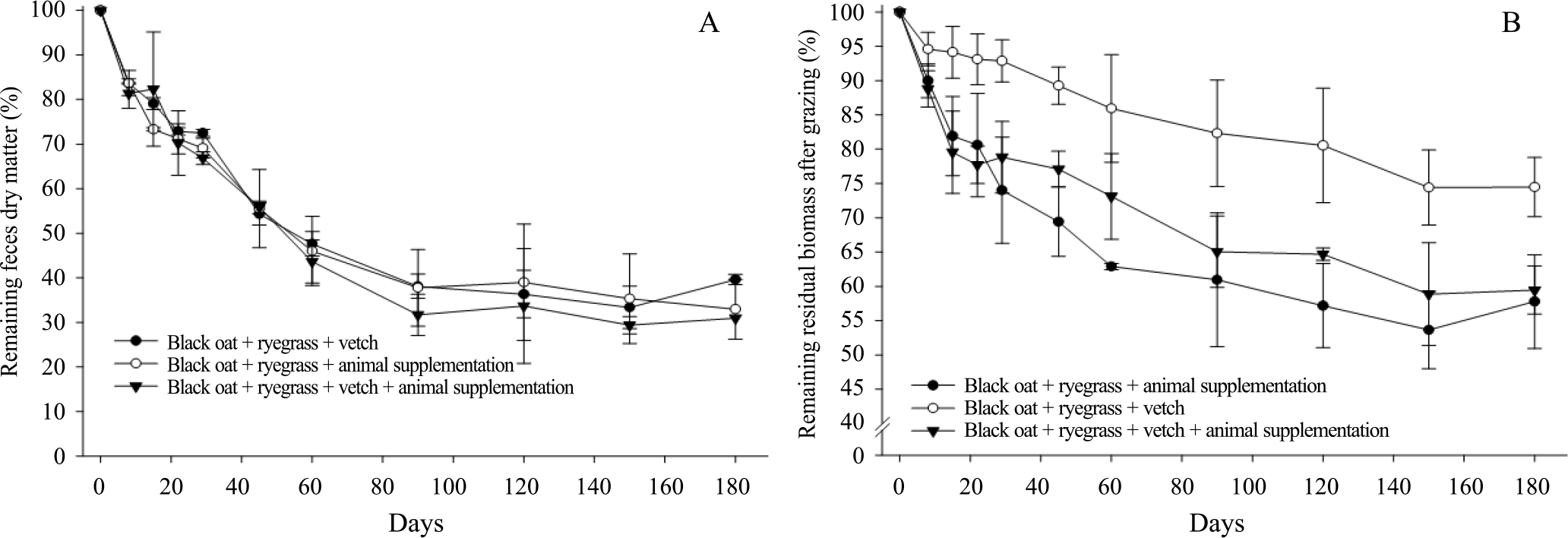
The decomposition dynamics of feces and residual biomass were influenced by both supplementation and legume intercropping, although the magnitude of the observed responses differed between organic material sources. In the case of feces, supplementation increased the proportion of easily decomposable dry matter, accelerating its degradation rate and reducing its half-life (Table 1 and Figure 1 A). These results indicate that supplementation improved fecal quality, favoring a faster decomposition and nutrient turnover. This finding is associated with the intake of more digestible carbohydrates and protein, which reduces fiber and lignin concentration in feces and increases labile organic matter, stimulating microbial decomposition (Chuan et al., 2020; Nascimento et al., 2024).
Parameters of the exponential model fitted to dry matter, nitrogen and potassium release rates, half-life of residual biomass after grazing, and stocking rate of beef cattle feces in pasture under no-tillage.

Percentage of feces (A) and residual biomass after grazing (B) throughout 180 days of decomposition.
Nitrogen release from feces was also strongly affected by supplementation, which increased the labile fraction of the nutrient, but was faster in the treatments containing vetch despite the smaller labile pool. These complementary effects show that supplementation increases the availability of labile nitrogen, while legumes accelerate the rate at which this nutrient is released.
The contribution of legumes is linked to the lower carbon/nitrogen ratio and lignin concentration in their residues, which favors mineralization (Assmann et al., 2014). The lower fecal nitrogen content in vetch treatments may be explained by the fact that animals under continuous stocking often prefer legumes, leading to a decrease in their relative contribution to residual biomass (Boddey et al., 2020; Schön et al., 2024).
Differences in residue quality are known to affect soil microbial activity. The more easily decomposed residues from supplemented animals, for example, stimulate microbial growth and enzyme production, accelerating nutrient release in the short term (Denoncourt et al., 2025). This effect may increase carbon and nitrogen cycling and explain the faster decomposition observed in the supplemented treatments.
Potassium dynamics showed a distinct pattern. Although supplementation increased the labile fraction of this nutrient in feces, degradation rates and half-life values did not differ among treatments. These findings suggest that fecal material contributes little to overall potassium cycling, since most of the ingested nutrient is excreted through urine (Nascimento et al., 2024). This supports the interpretation that supplementation influences potassium cycling by increasing stocking rate and urine deposition rather than by altering fecal composition.
For residual biomass, the proportion of easily decomposable dry matter ranged from 66 to 72.3% across treatments and was not significantly affected by supplementation (Table 2 and Figure 1 B). This result is an indicative that biomass decomposition is more dependent on the intrinsic chemical composition of plant tissues, such as lignin and the carbon/nitrogen ratio, than on dietary effects (Prescott & Vesterdal, 2021).
Parameters of the exponential model fitted to dry matter, nitrogen and potassium release rates, and half-life of residual biomass after grazing in pasture under no-tillage.
Nitrogen release from biomass was sensitive to legume inclusion. Vetch alone promoted faster release rates and shorter half-lives, whereas the combination of this legume and supplementation slowed the process. This suggests that supplementation may have reduced the persistence of vetch in the sward, decreasing its contribution to the biomass pool, a mechanism observed in other subtropical pastures where supplementation altered the botanical composition of residues and affected nutrient release (Assmann et al., 2017; Mganga et al., 2021).
Potassium release from biomass was rapid in the initial phase of decomposition and did not differ among treatments. This finding is consistent with the reported high solubility and mobility of this nutrient, confirming that its cycling in grazed systems is primarily regulated by leaching and urine deposition rather than by botanical composition or supplementation (Peterson et al., 2020; Bortolli et al., 2024).
From a management perspective, the faster fecal decomposition induced by supplementation and the enhanced nitrogen cycling promoted by legumes can contribute to reduce dependence on external nitrogen fertilization. This is particularly relevant in subtropical systems, where fertilizer costs and environmental concerns about N2O emissions are major challenges (Ferreira et al., 2022). By accelerating nutrient recycling, the combined use of supplementation and legumes provides an opportunity to sustain forage production while minimizing the need for synthetic inputs, which adds both economic and ecological value to grazing systems.
When comparing the present findings with those of other studies in Southern Brazil, the half-life values for dry matter and nitrogen decomposition are similar to those found for oat-ryegrass pastures under grazing management (Assmann et al., 2014; Bortolli et al., 2024). In addition, the rapid release of potassium observed in the present work is in alignment with earlier reports that indicate that more than 80% of the nutrient in plants is released within the first weeks of decomposition (Giacomini et al., 2003). Such consistency reinforces the validity of the obtained results and highlights the robustness of the patterns verified under subtropical grazing conditions.
Overall, the results show that animal supplementation and legume intercropping play complementary roles in nutrient cycling. Supplementation accelerates the decomposition of feces, increasing the release of labile dry matter, nitrogen, and potassium, while legumes promote a faster nitrogen release from biomass residues. In addition, potassium recycling occurs rapidly and is largely independent of treatments, with urine deposition being the main pathway of return to the soil. These complementary mechanisms indicate that combining supplementation and legumes improves nutrient cycling efficiency, reduces the need for external fertilization, and contributes to the sustainability of pasture-based livestock systems in subtropical regions.
Conclusions
-
1. Animal supplementation increases the labile fraction and accelerates the decomposition of feces in grazed pastures.
-
2. Legume intercropping enhances the rates of nitrogen release from residues, even when the initial proportion of this nutrient in the labile fraction is reduced.
-
3. Potassium recycling occurs predominantly through urine, with minor contributions from fecal and biomass residues.
-
4. Residual biomass decomposition is determined mainly by organic matter quality and is less affected by animal supplementation.
-
5. The integration of legumes and animal supplementation optimizes nutrient cycling and improves the sustainability of crop-livestock systems in subtropical conditions.
Declaration of use of AI technologies
No generative artificial intelligence (AI) was used in this study.
Acknowledgments
To Coordenação de Aperfeiçoamento de Pessoal de Nível Superior (CAPES), for financing, in part, this study (Finance Code 001).
Disclaimer/Publisher’s note
The statements, opinions, and data contained in all texts published in Pesquisa Agropecuária Brasileira (PAB) are solely those of the individual author(s) and not of the journal’s publisher, editor, and editorial team, who disclaim responsibility for any injury to people or property resulting from any referred ideas, methods, instructions, or products.
The mention of specific chemical products, machines, and commercial equipment in the texts published in this journal does not imply their recommendation by the publisher.
Data availability statement
Data in article: research data are available in the published article.
References
-
ALVARES, C.A.; STAPE, J.L.; SENTELHAS, P.C.; GONÇALVES, J.L. de M.; SPAROVEK, G. Köppen’s climate classification map for Brazil. Meteorologische Zeitschrift, v.22, p.711-728, 2013. DOI: https://doi.org/10.1127/0941-2948/2013/0507
» https://doi.org/10.1127/0941-2948/2013/0507 -
ASSMANN, J.M.; MARTINS, A.P.; ANGHINONI, I.; DENARDIN, L.G. de O.; NICHEL, G. de H.; COSTA, S.E.V.G de A.; SILVA, R.A.P. e; BALERINI, F.; CARVALHO, P.C. de F.; FRANZLUEBBERS, A.J. Phosphorus and potassium cycling in a long-term no-till integrated soybean-beef cattle production system under different grazing intensities in subtropics. Nutrient Cycling in Agroecosystems, v.108, p.21-33, 2017. DOI: https://doi.org/10.1007/s10705-016-9818-6
» https://doi.org/10.1007/s10705-016-9818-6 -
ASSMANN, T.S.; BORTOLLI, M.A. de; ASSMANN, A.L.; SOARES, A.B.; PITTA, C.S.R.; FRANZLUEBBERS, A.J.; GLIENKE, C.L.; ASSMANN, J.M. Does cattle grazing of dual-purpose wheat accelerate the rate of stubble decomposition and nutrients released? Agriculture, Ecosystems & Environment, v.190, p.37-42, 2014. DOI: https://doi.org/10.1016/j.agee.2014.01.011
» https://doi.org/10.1016/j.agee.2014.01.011 -
BODDEY, R.M.; CASAGRANDE, D.R.; HOMEM, B.G.C.; ALVES, B.J.R. Forage legumes in grass pastures in tropical Brazil and likely impacts on greenhouse gas emissions: a review. Grass and Forage Science, v.75, p.357-371, 2020. DOI: https://doi.org/10.1111/gfs.12498
» https://doi.org/10.1111/gfs.12498 -
BORTOLLI, M.A. de; ASSMANN, T.S.; BORTOLLI, B.B. de; MACCARI, M.; BERNARDON, A.; JAMHOUR, J.; FRANZLUEBBERS, A.J.; SOARES, A.B.; SEVERO, I.K. Nutrient dynamics in integrated crop-livestock systems: effects of stocking rates and nitrogen system fertilization on litter decomposition and release. Agronomy, v.14, art.2009, 2024. DOI: https://doi.org/10.3390/agronomy14092009
» https://doi.org/10.3390/agronomy14092009 -
CARVALHO, P.C. de F.; PETERSON, C.A.; NUNES, P.A. de A.; MARTINS, A.P.; SOUZA FILHO, W. de; BERTOLAZI, V.T.; KUNRATH, T.R.; MORAES, A. de; ANGHINONI, I. Animal production and soil characteristics from integrated crop-livestock systems: toward sustainable intensification. Journal of Animal Science, v.96, p.3513-3525, 2018. DOI: https://doi.org/10.1093/jas/sky085
» https://doi.org/10.1093/jas/sky085 -
CHUAN, X.; CARLYLE, C.N.; BORK, E.W.; CHANG, S.X.; HEWINS, D.B. Extracellular enzyme activity in grass litter varies with grazing history, environment and plant species in temperate grasslands. Science of the Total Environment, v.702, art.134562, 2020. DOI: https://doi.org/10.1016/j.scitotenv.2019.134562
» https://doi.org/10.1016/j.scitotenv.2019.134562 -
CORREA-LUNA, M.; DONAGHY, D.; KEMP, P.; SCHUTZ, M.; LÓPEZ-VILLALOBOS, N. Efficiency of crude protein utilization in grazing dairy cows: a case study comparing two production systems differing in intensification level in New Zealand. Animals, v.10, art.1036, 2020. DOI: https://doi.org/10.3390/ani10061036
» https://doi.org/10.3390/ani10061036 -
DENONCOURT, C.; CHANTIGNY, M.H.; ANGERS, D.A.; MAILLARD, É.; HALDE, C. Animal manure application promotes nitrogen and organic carbon accumulation in soil organic matter fractions: a global meta-analysis. Science of the Total Environment, v.996, art.180097, 2025. DOI: https://doi.org/10.1016/j.scitotenv.2025.180097
» https://doi.org/10.1016/j.scitotenv.2025.180097 -
FERREIRA, P.A.A.; CERETTA, C.A.; LOURENZI, C.R.; DE CONTI, L.; MARCHEZAN, C.; GIROTTO, E.; TIECHER, T.L.; PALERMO, N.M.; PARENT, L.-É.; BRUNETTO, G. Long-term effects of animal manures on nutrient recovery and soil quality in acid Typic Hapludalf under no-till conditions. Agronomy, v.12, art.243, 2022. DOI: https://doi.org/10.3390/agronomy12020243
» https://doi.org/10.3390/agronomy12020243 -
GIACOMINI, S.J.; AITA, C.; VENDRUSCULO, E.R.O.; CUBILLA, M.; NICOLOSO, R.S.; FRIES, M.R. Matéria seca, relação C/N e acúmulo de nitrogênio, fósforo e potássio em misturas de plantas de cobertura de solo. Revista Brasileira de Ciência do Solo, v.27, p.325-334, 2003. DOI: https://doi.org/10.1590/S0100-06832003000200012
» https://doi.org/10.1590/S0100-06832003000200012 - HORWITZ, W. (Ed.). Official Methods of Analysis of AOAC International 17th ed. Gaithersburg: AOAC International, 2000.
- IUSS WORKING GROUP WRB. World Reference Base for Soil Resources 2014: international soil classification system for naming soils and creating legends for soil maps: update 2015. Rome: FAO, 2015. (FAO. World Soil Resources Reports, 106).
-
MGANGA, K.Z.; NDATHI, A.J.N.; WAMBUA, S.M.; BOSMA, L.; KAINDI, E.M.; KIOKO, T.; KADENYI, N.; MUSYOKI, G.K.; VAN STEENBERGEN, F.; MUSIMBA, N.K.R. Forage value of vegetative leaf and stem biomass fractions of selected grasses indigenous to African rangelands. Animal Production Science, v.61, p.1476-1483, 2021. DOI: https://doi.org/10.1071/AN19597
» https://doi.org/10.1071/AN19597 -
NASCIMENTO, D.B. do; LOPES, M.L.S.; IZIDRO, J.L.P.S.; BEZERRA, R.C.A.; GOIS, G.C.; AMARAL, T.N.E. de; DIAS, W. da S.; BARROS, M.M.L. de; OLIVEIRA, A.R. da S.; FARIAS SOBRINHO, J.L. de; COÊLHO, J.J. Nitrogen, phosphorus, and potassium cycling in pasture ecosystems. Brazilian Animal Science, v.25, art.76743E, 2024. DOI: https://doi.org/10.1590/1809-6891v25e-76743e
» https://doi.org/10.1590/1809-6891v25e-76743e - PAUL, E.A.; CLARK, F.E. Soil microbiology and biochemistry 2nd ed. San Diego: Academic Press, 1996.
-
PETERSON, C.A.; DEISS, L.; GAUDIN, A.C. Commercial integrated crop-livestock systems achieve comparable crop yields to specialized production systems: a meta-analysis. PLoS ONE, v.15, e0231840, 2020. DOI: https://doi.org/10.1371/journal.pone.0231840
» https://doi.org/10.1371/journal.pone.0231840 -
PRESCOTT, C.E.; VESTERDAL, L. Decomposition and transformations along the continuum from litter to soil organic matter in forest soils. Forest Ecology and Management, v.498, art.119522, 2021. DOI: https://doi.org/10.1016/j.foreco.2021.119522
» https://doi.org/10.1016/j.foreco.2021.119522 - SANTOS, H.G. dos; JACOMINE, P.K.T.; ANJOS, L.H.C. dos; OLIVEIRA, V.Á. de; LUMBRERAS, J.F.; COELHO, M.R.; ALMEIDA, J.A. de; ARAÚJO FILHO, J.C. de; OLIVEIRA, J.B. de; CUNHA, T.J.F. Sistema Brasileiro de Classificação de solos 5.ed. rev. e ampl. Brasília: Embrapa, 2018. 35 6p.
-
SCHÖN, J.; GENTSCH, N.; BREUNIG, P. Cover crops support the climate change mitigation potential of agroecosystems. PLoS ONE, v.19, e0302139, 2024. https://doi.org/10.1371/journal.pone.0302139
» https://doi.org/10.1371/journal.pone.0302139 - TEDESCO, M.J.; GIANELLO, C.; BISSANI, C.A.; BOHNEN, H.; VOLKWEISS, S.J. Análise de solo, plantas e outros materiais 2.ed. rev. e ampl. Porto Alegre: UFRGS, Departamento de Solos, 1995. (Boletim técnico, 5).
-
WIDER, R.K.; LANG, G.E. A critique of the analytical methods used in examining decomposition data obtained from litter bags. Ecology, v.63, p.1636-1642, 1982. DOI: https://doi.org/10.2307/1940104
» https://doi.org/10.2307/1940104 -
WILM, H.G.; COSTELLO, D.F.; KLIPPLE, G.E. Estimating forage yield by the double-sampling method. Agronomy Journal, v.36, p.194-203, 1944. DOI: https://doi.org/10.2134/agronj1944.00021962003600030003x
» https://doi.org/10.2134/agronj1944.00021962003600030003x
Edited by
-
Chief editor:
Edemar Corazza
-
Edited by:
Mírian Baptista