 Exploring the influence of abiotic factors on growth and phenology in Gypsophila paniculata L. ‘Overtime®’
Abstract
The aim of this research was to characterize the phenology and phenometric variables of Gypsophila paniculata L. ‘Overtime®’ in managed field conditions, as well as to determine the correlation between abiotic factors (mean temperature, relative humidity, vapor pressure deficit, growing degree days) and phenometric variables (stem length and diameter, number of nodes, internodes, leaves and shoots and dry matter) and to calculate growth rates absolute and relative. To collect field data, a randomized complete block design with six blocks was employed, each block contained four to five plants, which served as experimental units. The crop cycle of G. paniculata was evaluated from transplanting to the senescence phase, for a total duration of 132 days after transplanting. The developmental stages of the species were characterized in detail, with the commercial harvest stage reached at 91 days after transplanting during flowering, corresponding to a cumulative growing degree of 1255.1 °C day. A sigmoid growth pattern was observed throughout the successive phenological stages, with the maximum absolute growth rate occurring between 60 - 75 days after transplanting, during this period, exogenous factors were integrated, including supplemental artificial lighting and gibberellic acid treatment, to enhance growth and induce flowering. After 75 days after transplanting, the relative growth rate declines as assimilates shift toward flowering. Among the phenometric variables, only stem length was significantly affected by temperature, relative humidity, and vapor pressure deficit, indicating that these environmental factors modulate growth dynamics throughout the crop cycle. These findings provide new insights into the growth dynamics and developmental responses of the species and contribute to the refinement of agronomic management practices under variable environmental conditions.
Keywords:
Correlation; developing; dry matter; growth rate
Resumo
O objetivo desta pesquisa foi caracterizar a fenologia e fenometria da Gypsophila paniculata L. ‘Overtime®’ em condições de campo, bem como determinar a correlação entre os fatores abióticos (temperatura média e umidade relativa do ar, déficit de pressão de vapor e graus-dia) e as variáveis fenométricas (comprimento e diâmetro do caule, número de nós, entrenós, folhas e brotos e matéria seca). Também foram determinadas as taxas de crescimento absoluta e relativa. Para a coleta dos dados de campo, se utilizou um delineamento em blocos casualizados, cada bloco contendo de quatro a cinco plantas, constituindo a unidade experimental. O ciclo de cultivo da G. paniculata foi avaliado desde o transplante até a fase de senescência, com duração total de 132 dias após o transplante. As fases de desenvolvimento da espécie foram caracterizadas em detalhe, atingindo a fase da colheita comercial aos 91 dias após o transplante, durante a floração, o que correspondeu a soma térmica de 1255,1 °C dia. Observou-se um padrão de crescimento sigmóide ao longo dos estágios fenológicos sucessivos, atingindo a taxa absoluta máxima de crescimento entre os 60 - 75 dias após o trasplante. Durante este peróodo, fatores exógenos foram integrados ao sistema, incluido luz artificial suplementar e de ácido giberélico, para aumentar o crescimento e induzir o florescimento. Além disso, 75 dias após o transplante a taxa de crescimento absoluto diminui à medida que os assimilados deslocam-se para o processo do florescimento. Entre as variáveis fenométricas, apenas o comprimento do caule foi significativamente influenciado pela temperatura, umidade relativa e o déficit de pressão de vapor, indicando que esses fatores ambientais modulam a dinâmica de crescimento ao longo do ciclo da cultura. Estas descobertas fornecem novos conhecimentos sobre as respostas no crescimento e no desenvolvimento da espécie e contribuem para o aprimoramento das práticas de manejo agronômico em condições ambientais variáveis.
Palavras-chave:
Correlação; desenvolvimento; matéria seca; taxa de crescimento
Introduction
Floriculture has become an important commercial activity in the agriculture sector in the post globalization era. This area Floriculture industry comprises flower trade, production of nursery plants and potted plants, seed and bulb production and micro propagation. In Ecuador, it is the fourth most important export sector, with sales of nearly USD 1 billion annually and the main Ecuadorian flowers exported include Rosa spp., Gypsophila paniculata, Dianthus caryophyllus, and Alstroemeria spp.; all are considered high-quality products in international markets (Rosales et al., 2023). G. paniculata with European and Asian origins bears delicate, light pink or white flowers in groups on skinny stems. Baby’s breath gives bouquets a delicate, airy texture and ethereal touch. It frequently appears in floral arrangements for weddings and pairs well with a variety of flowers (Meghana et al., 2024).
Although G. paniculata is not native to Ecuador, it has successfully adapted to the country’s equatorial climate, which is characterized by minimal seasonal variation and the presence of only two main seasons: a rainy season from June to September and a dry season from October to May. Plants are intimately linked to climatic variations, especially air temperature, humidity, and solar radiation. These environmental factors interact complexly and directly influence the sequence of morphological and physiological events that determine plant growth and development (Chaudhry and Sidhu, 2022).
Ambient temperature plays a fundamental role in plant metabolism. Optimal temperatures within a specific range favor vegetative growth and the accumulation of fresh matter. However, extreme temperatures, both above and below the optimal range, can inhibit growth and even cause irreparable damage (Bhattacharya, 2022). Relative air humidity is a critical environmental factor influencing plant development. Optimal humidity levels enhance nutrient uptake and regulate transpiration, both of which are essential for sustaining plant growth and physiological function. However, excessive relative humidity beyond optimal thresholds can suppress transpiration rates and create favorable conditions for the proliferation of phytopathogens, thereby increasing the risk of disease incidence (Wright and Francia, 2024). Solar radiation is one of the most important ingredients for healthy plant growth and is a vital energy source for plants through photosynthesis. The quantity and quality of sunlight influence plant health, productivity, and architecture (Neo et al., 2022).
Understanding crop responses to environmental conditions is essential for effective agricultural planning. In Ecuador, G. paniculata is an economically important species widely cultivated for export; however, there is no quantitative framework linking abiotic factors with its phenological development and growth dynamics, which limits production optimization. It was hypothesized that the interaction between developmental stages and abiotic environmental factors significantly influences crop performance, and that optimizing these conditions can enhance productivity under Ecuadorian conditions. Therefore, this study aims to generate knowledge to support decision-making for floriculture producers at different scales.
The objective of this research was to characterize the phenometry and phenology of G. paniculata ‘Overtime®’ under field conditions with supplementary artificial lighting, as well as to determine the correlation between abiotic factors and phenometric variables.
Material and Methods
The experiment was conducted under managed field conditions with supplementary artificial lighting at El Quinche parish, San Miguel de Atalpamba neighborhood, geographically located at longitude 78°18′48.9″W and latitude 0°04′40.0″S, at an altitude of 2.472 m.a.s.l., which is characterized by an andean temperate highland climate (Cwb) according to the Koppen-Geiger classification (Beck et al., 2018). This region featuring well defined wet and dry seasons with an average annual temperature of 15 °C. The edaphic conditions are characterized by and a sandy clay loam soils, classified as Andisols (Espinosa et al., 2018). These soils, originated from volcanic ash, provide high porosity and organic matter content, which are suitable for G. paniculata production.
Growing conditions throughout the crop cycle; data of air temperature and relative humidity (RH) were recorded 24 hours a day, at hourly intervals, using a wireless temperature/humidity/Barometric Pressure Smart Sensor (SensorPush HTP.xw) located in the study area. Using the provided air temperature (T) and relative humidity (RH) data, the daily average and vapor pressure deficit (VPD) were calculated (Rosenberg et al., 1983).
mT: Mean air temperature
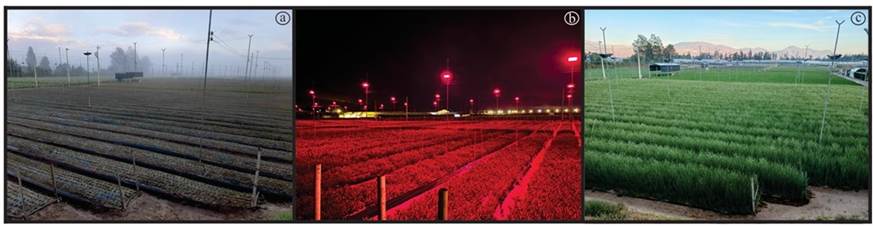
Additionally, the distribution of photosynthetic photon flux density (PPFD) from the LED light implemented in the crop was recorded at approximately 9:00 p.m. using a DLI-500 meter (Fig. 1).
Experimental area of G. paniculata ‘Overtime®’ in Ecuador. (a) Crop establishment; (b) Nighttime artificial lighting, implemented from the 28 to the 98 DAT; (c) Beginning of the floral opening at 91 DAT.
Experimental design and management
G. paniculata L. variety ‘Overtime®’ plants were selected for its phenotypic characteristics which are required by the market, as well as for the adaptability of the crop in the region. Prior to transplanting seedlings, organic matter (produced from crop residues) was incorporated into the soil. Black plastic was spread over the plots, and two galvanized wire meshes were installed along the beds to guide the vertical growth of the plants. Finally, G. paniculata seedlings of eight weeks of age were manually transplanted at a density of 22 plants m-2.
Sprinkler irrigation was applied after transplanting to ensure seedling survival. During the first 13 days after transplanting (DAT), sprinkler irrigation to ensure that seedlings do not experience water stress until they are fully acclimated, thereby reducing mortality. From the second week (14 DAT) towards, fertigation was initiated using a nutrient solution supplied by the flower farm, adjusted to a final electrical conductivity (EC) of 0.5 dS m-1; with ammonium nitrate, potassium nitrate, calcium nitrate, magnesium sulfate, manganese sulfate, zinc sulfate, copper sulphate, sodium tetraborate, iron chelate and phosphoric acid. Two to three irrigation events were applied per day, three times per week, each lasting eight minutes; this regime was maintained throughout the crop cycle.
A weekly fumigation program was implemented to control fungi such as Alternaria spp. and Botrytis cinerea, bacteria such as Fusarium spp. and Rhizoctonia sp., and insects such as Frankliniella occidentalis, Liriomyza spp., and Tetranychus urticae, following the integrated pest management program established by the technician from floriculture area. The specific protocols and exact dosages for organic matter, fertilizers, and pesticides could not be disclosed, as they are considered confidential by the flower farm where the research was conducted.
In the fourth week (28 DAT), 150W LED lights with IP66 rating were installed, which were turned on from 6:30 p.m. to 6:00 a.m. The lights were removed in week 14 (98 DAT), and gibberellic acid (GA3) diluted in alcohol was applied from week five to week nine with a total concentration of 1350 ppm (270 ppm per week) during that period.
In the ninth week, the first removal of lower lateral shoots of each stem (25 cm from the plant neck) was carried out, keeping an average of three upper lateral shoots.
To collect field data, a randomized complete block design with six blocks was employed to minimize the coefficient of variation. Each block contained four to five plants, which served as experimental units.
Environmental calculations
To calculate growing degree days (GDD), the minimum and maximum temperature were determined daily with the data obtained in the field, and the base temperature used was 7 °C, as recommended for ornamental species (Reid et al., 1991), using the formula proposed by (Russelle et al., 1984).
GDD = - Tbase
Tmax: Daily maximum air temperature
Tmin: Daily minimum air temperature
Tbase: Base temperature of the species
To calculate the cumulative growing degree days (CGDD), we accumulated the daily GDD values for each day within the phenological phase being evaluated.
Determination of phenological stages
The phenological stage was determined by observing five plants per block (two stems per plant) three times per week, based on the characteristics described by the Biologische Bundesanstalt, Bundessortenamt und Chemische Industrie (BBCH) scale (Meier, 2018). The main stages observed during the cycle of G. paniculata were leaf development (stage 1); lateral shoot formation (stage 2); longitudinal growth (stage 3); emergence of the inflorescence (stage 5), flowering (stage 6), and senescence (stage 9). A stage was deemed to have been reached when 50% of individuals exhibited the characteristics of this stage.
Phenometric evaluations
For phenometric evaluations in the field, five plants per block (two stems per plant) were evaluated three times per week according to the following metrics: stem length from the base to the apex of the stem (cm), stem diameter at 15 cm from the base of the stem (mm), number of nodes and internodes, and number of green leaves (aged or discolored leaves were excluded from the count). For the dry weight of the plants, sampling was done on four plants per block every 15 days. The plant parts were separated and weighed individually. The samples were then dried in a convection oven at 68 °C for 72 hours before determining dry weight.
Calculation of growth rates
The dry weight data of the collected samples were used to calculate the absolute growth rate (AGR) and the relative growth rate (RGR) (Hunt, 1990).
W2: Final weight
W1: Initial weight
T1: Initial time
T2: Final time
Ln W2: Natural logarithm of final weight
Ln W1: Natural logarithm of initial weight
T2: Final time
T1: Initial time
Statistical analysis
Standard deviations for stem length and diameter (measured throughout the plant life cycle) and dry weights of plant organs were calculated. Plant growth data were analyzed to evaluate the influence of abiotic variables on plant growth dynamics. Plant growth was measured over a 14-week period, and mean abiotic variables were recorded for each interval; to model the non-linear growth trajectory over time, a natural cubic spline was used on the time variable with five degrees of freedom, allowing flexibility in capturing complex growth patterns. The model also included an interaction term between the spline basis functions and abiotic variables to assess how the effect of time on growth varied across temperature levels.
A linear mixed-effects model (LMM) was fitted using the lme function from the nlme package in R version 4.1.3. The individual plant was defined as the experiment unit. To account for the hierarchical structure of the data and the longitudinal nature of the study, random intercepts were included for blocks and for plants nested within blocks (random= ≈ 1 │block/plant). Time (DAT) was treated as a fixed effect and as the basis for repeated measures. To account for autocorrelation between successive measurements over time, a first-order autoregressive (AR(1)) correlation structure was imposed at the plant level. Model assumptions were verified through residual diagnostics and autocorrelation function (ACF) plots. Statistical significance of fixed effects was evaluated using Type III ANOVA with Satterthwaitte´s approximation for degrees of freedom, and interaction terms were examined to determine stage-specific effects of temperature on plant growth, and significance was set at p < 0.05. Graphs were generated using Sigma Plot® software (version 11.0).
Results
Throughout the cultivation cycle, the average temperature ranged from 19.8 to 22.7 °C, with average minimum temperatures varying between 7.9 and 11.2 °C, while maximum temperatures reached around 35.6 °C. The daily average relative humidity was 65.7%; at 56 DAT, a minimum value of 56.4% was recorded. Throughout the cultivation cycle, the weekly VPD remained within a range of 0.59 -1.08 kPa. During the night, the LED lights (150W-IP66) emitted between 0.7 and 1.7 µmol m-2 s-1 of PPFD, depending on plant height (Table 1).
Phenological Phases
During the initial phase of leaf development (main stage 1), the leaves were lanceolate in shape and the nodes were close together along the stem, as the plant had not yet experienced significant elongation. From transplanting (0 DAT) to 7 DAT, the plants accumulated 92.4 °C day, but the number of leaves did not change, remaining at 14 (secondary stage 17). The development of 30 leaves at 56 DAT (secondary stage 19) required an accumulation of 790.3 °C day (Table 2).
Lateral shoot formation (main stage 2) began with the accumulation of 290.7 °C day, as the first primary apical lateral bud (secondary stage 21) became visible at 21 DAT. By 63 DAT, 12 shoots, 21 shoot nodes and 20 internodes had formed; the process of removing lateral shoots commenced at 70 DAT (Table 2).
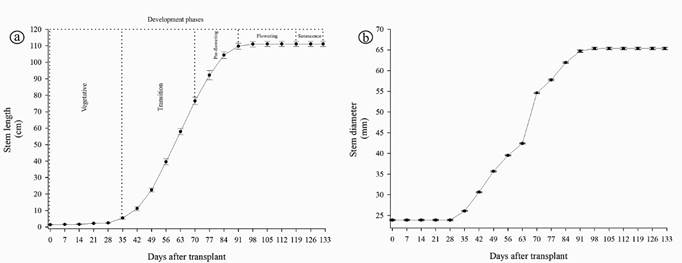
During the longitudinal growth stage (main stage 3), the plants grew from an average height of 1.53 cm at 7 DAT (secondary stage 30) to a final height of 111.11 cm at 98 DAT (secondary stage 39), with the accumulation of 1347.5 °C day (Table 2). As the plant developed, the stem diameter gradually increased from 2.39 mm at 7 DAT to 6.54 mm at 98 DAT (and thereafter). Over this same period, the lower leaves began to wilt and show signs of aging, while the upper leaves retained their green color.
During the emergence of the inflorescences (main stage 5) beginning at 70 DAT, the buds became visible (secondary stage 51) upon accumulating 976.5 °C day. Subsequently, the inflorescences took on a compact and closed appearance, indicating that the flowers had not yet reached full development. This process continued until the panicles were completely developed at 84 DAT, accumulating an additional 188.6 °C day (Table 2).
The flowering stage (main stage 6) was initiated at 91 DAT, when the panicle exhibited three open flowers and five swollen flower buds (secondary stage 60), corresponding to a cumulative thermal time of 1255.1 °C day (Table 2).
During this phase (119 DAT and thereafter), the leaves and flowers showed evident signs of decay and decomposition (secondary stage 97). The leaves acquired a yellowish tone, wilted, and eventually detached from the plant. The flowers, once vibrant and colorful, began to wilt, losing their characteristic shape and color. The stems became weak and brittle, and the plant experienced a decrease in vigor and vitality.
The CGDD from transplanting until the end of the growing cycle was measured at 1707.5 °C day. It is worth noting that the phenological phase that required the most CGDD was the elongation and induction to flowering phase, measured at 476.8 °C day (Table 3).
Phenometrics
The phenometric variables had slow growth during the first 28 DAT. From 35 DAT onwards, the increase in size was constant at a uniform rate for all variables (Fig. 2).
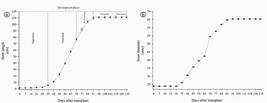
Dynamics of growth (a) stem length (cm) and (b) stem diameter (mm) of G. paniculata ‘Overtime®’. Describe the developmental phases only in the (a) graphic.
The emergence of shoots in the basal part of the productive stems can result in a decrease in the quality of stems. Therefore, the elimination of basal branches (i.e., a 75% reduction of shoots) was carried out between 63 and 70 DAT. This management practice favors the maintenance of exponential longitudinal growth and stem diameter, which contributes to the quality of productive stems.
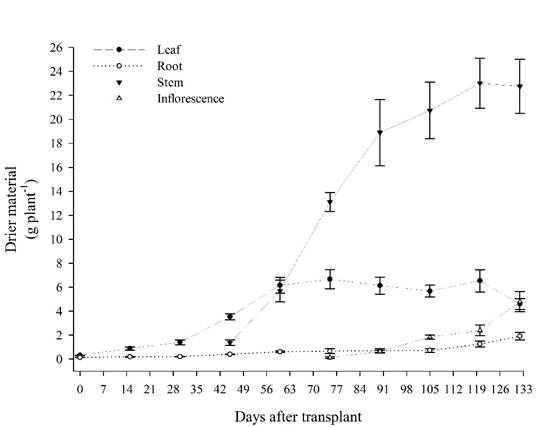
The total dry weight increased throughout the growing cycle from 0.46 g at 0 DAT to 34,06 g at 132 DAT (Table 4). In the cultivation of G. paniculata, the highest percentages of dry biomass accumulate in the stems and leaves, followed by the flowers; the root generally contains the least dry matter (Fig. 3).
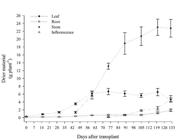
The G. paniculata plant reaches its maximum absolute growth rate (AGR) value at 60, 75 and 90 DAT. The relative growth rate (RGR) reached its maximum value at 45 and 60 DAT, indicating high efficiency in the production of new biomass. The RGR decreased drastically from 90 DAT to 120 DAT (Table 4).
Total dry matter, absolute growth rate and relative growth rate throughout the life cycle of G. paniculata ‘Overtime®’.
Relationship between abiotic factors and phenometric variables
No significant correlations were found between abiotic factors and most phenometric variables or growth rates throughout the crop cycle; however, stem length showed significant correlations with several abiotic factors, indicating that these factors modulate the shape of the growth curve (Table 5). A positive correlation between stem length and average temperature demonstrates that temperatures accelerated growth during the early developmental stages (p = 0.0090), while it had a negative influence in the subsequent phase (p = 0.0205).
On the other hand, it was observed that minimum temperature and relative humidity showed a significant correlation with stem growth only during the final stages of the crop cycle. Similarly, VPD exhibited a negative influence starting from the third stage of plant development (Table 5).
Discussion
This study characterized the phenology of G. paniculata ‘Overtime®’ under managed field conditions of Ecuador with supplementary artificial lighting and application of gibberellic acid. It was observed the four phenological phases described for G. paniculata, which include the vegetative phase, elongation and induction of flowering, floral initiation and flowering, and senescence (Höhn et al., 2023 and Meier, 2018). The relationship between GDD and phenology is crucial for understanding crop development at various growth stages, enabling predictions of the time required for plants to reach specific phenological phases. Accurate GDD calculations help in modeling crop growth and managing agricultural practices effectively (Łysiak; Szot, 2023). Developmental stages generally manifest when the same degree day value is accumulated, regardless of the sowing date and year, changes in temperature directly affect GDD and, therefore, the duration of each phenological stage. Research demonstrate that GDD offer a practical approach to monitoring temperature-dependent growth in horticultural crops. As climate change progresses, mastering GDD dynamics across flowering and fruit development will be vital for sustaining quality and long-term production viability (Fotouo and Zude-Sasse, 2025). Such thermal responses remain poorly documented in G. paniculata, in the present study, commercial harvest point was reached at CGDD of 1255.1 °C day, after which stems required an additional 8 - 11 days of artificial flower opening under postharvest conditions. These findings help address an important knowledge gap by providing flower growers with a predictive framework for optimizing crop management and harvest scheduling under fluctuating temperature conditions.
During the longitudinal growth stage, plants undergo dramatic height increases driven by significant internode elongation. Strengthening the stem is vital during this phase to support future floral structures and ensure inflorescences are elevated above the foliage. Quantifying the spatiotemporal distribution of growth within a tissue or organ is a key step toward understanding its morphogenesis (Hilty et al., 2021). In G. paniculata, commercial quality is largely determined by stem length and weight; therefore, identifying the period of exponential growth is of major agronomic importance. Determining this stage allows the optimization of management practices, including the removal of basal branches and lateral shoots, targeted fertilization, and gibberellin applications, with the aim of producing more robust stems and increasing their commercial value.
At the end of the cycle, the plant enters the senescence stage (main stage 9), is characterized by the natural process of aging and deterioration of the plant’s cells and tissues as it reaches the end of its life cycle; loss of chlorophyll, decomposition of cellular components, changes in texture and turgor, changes in chemical composition and development of storage structures (Miryeganeh, 2021). In the production system, this developmental stage is not completed, since harvesting is carried out when only 3 to 15 inflorescences are open, before the lower bracts begin to separate. Nevertheless, for the purposes of this research, it was essential to record the senescence stage in order to document the complete biological cycle of the crop.
In the phenometric evaluations, stem length and stem diameter exhibited a sigmoidal growth pattern, characteristic of living organisms. This trajectory reflects the typical dynamics of plant development, where growth proceeds slowly during the initial and final stages of the cultivation period, while the intermediate phase is marked by accelerated expansion (Gachoki et al., 2022). In the present study, the exponential growth phase of G. paniculata was accelerated by the integration of exogenous factors, specifically supplemental artificial lighting (28 - 98 DAT) and hormonal treatment via gibberellic acid (35 - 63 DAT). Throughout the cultivation cycle, plant morphogenesis and development were significantly modulated by these management practices. Importantly, Gypsophila sp. is a long-day species in which photoperiodic responses are governed by the circadian clock, consistent with both external- and internal-coincidence models. This emphasizes that a self-sustained circadian rhythm is essential for the precise measurement of day length (Proietti et al., 2022; Yang et al., 2024). Furthermore, the application of gibberellic acid plays a pivotal role in modulating plant development, specifically by promoting seed germination, stem elongation, and the critical transition from vegetative to reproductive growth (Chandel et al., 2023), collectively, these results underscore a robust interaction between photoperiodic manipulation and hormonal regulation in optimizing the developmental performance of this species.
Furthermore, the growth curves of G. paniculata exhibit distinct developmental phases, reflecting the dynamic changes in biomass accumulation and physiological activity throughout the crop cycle; during the initial growth is limited due to the reduced leaf area and underdeveloped root system, which constrain the plant’s capacity for photosynthesis and nutrient uptake. This is followed by an exponential growth phase, characterized by a rapid increase in biomass and enhanced assimilation capacity, driven by the progressive development of photosynthetic organs. This phase is largely sustained by the activity of apical and lateral meristems, where active cell division occurs. The active growth phase is critical for successful plant establishment, as it determines the efficiency with which the plant acquires and utilizes environmental resources (Fang et al., 2022). Additionally, removing basal branches and lateral shoots that compete with the main stems for nutrients and water promotes stem thickening. The goal of pruning is to encourage healthy growth and to maintain a proper balance between vegetative and reproductive development (Kumar et al., 2023). Finally, after the start of flowering, growth slows down until it stabilizes. At this stage, the plant prioritizes energy and nutrients for the formation of reproductive organs, significantly reducing vegetative growth.
When studying the dynamics of dry mass in G. paniculata, the stems accumulate more dry matter than the other plant organs, on the other hand, the leaf area in this species is low and does not constitute a determining factor in commercialization; the leaves are removed from the stems, and the weighing process for assembling the bunches is carried out considering only the stems and their inflorescences. The distribution of dry matter between the aerial part and the root system of plants can vary significantly depending on factors such as plant density, environmental conditions, and species (Laurans et al., 2024; Wang et al., 2023). Generally, plants allocate a certain proportion of their biomass to roots to support water and nutrient uptake, while the aerial part is crucial for photosynthesis and reproduction. This balance is essential for optimizing growth and resource use efficiency (Postma et al., 2021). In G. paniculata, the aerial parts account for 96% of the plant, while the roots make up only 4%, the observed dry matter partitioning pattern responds to the intensive crop management. The constant availability of resources (water and nutrients) promoted the development of the aerial part, limiting the need for root system expansion.
The AGR indicates the amount of biomass that the plant produces per time and this growth rate can be applied to any organ of the plant or the whole plant. The maximum AGR value in G. paniculate (60, 75, and 90 DAT) coincides with the phenological phase of final stem elongation and floral initiation. During this period, the plant concentrates its resources on the development of future reproductive structures. Higher AGR in plants is often associated with several factors, including optimal environmental conditions, efficient resource allocation, and favorable genetic traits, when plants experience adequate light, water, and nutrients, they can photosynthesize more effectively, leading to increased biomass accumulation (Postma et al., 2021). At 105 DAT, the plant enters the flowering phase and growth speed decreases, this phase typically occurs after the plant has reached a certain level of maturity and environmental conditions are favorable for reproduction (Vyshnavi et al., 2024). In this experiment, resources previously allocated to vegetative growth are now reallocated to support reproductive processes, including flower formation.
The size of an individual plant after a short time interval compared to its size at the start of the interval, whether in its logged or unlogged form, is referred to as its relative growth rate (RGR). The RGR is the aboveground biomass gain per unit aboveground biomass per time which allows to compare the growth rate of species and individuals that differ in size (i.e., biomass) (Matsuo et al., 2024). The RGR is closely related to the processes of photosynthesis and respiration, where a plant that respires efficiently is able to optimally utilize the energy captured during photosynthesis, which can promote greater growth and, consequently, an increase in the RGR (Matsuo et al., 2024). In G. paniculata, the RGR reached its maximum between 45 and 60 DAT, coinciding with the stem elongation phase, during the plant allocates most of its resources for the future growth of reproductive structures, which is characteristic of the transition to the reproductive stage in ornamental crops. The meristematic activity and cell elongation are key factors determining vegetative growth. Likewise, total plant biomass production largely depends on photosynthetic efficiency, which supplies the assimilates required for growth and strongly influences RGR (Salinas et al., 2022). At the end of the crop cycle under study, during the flowering phase, assimilates and energy are preferentially allocated to flower development, resulting in a reduction in RGR (after 75 DAT), as previously reported in Solidago canadensis and Delphinium elatum(Collaguazo-Lita et al., 2022).
The positive significance between the average temperature and G. paniculata stem length at early stage (stage 1) indicates healthy and active plant growth and reflects the ability of plants to efficiently capture and use available resources such as sunlight, water, and soil nutrients. Temperature significantly influences photosynthesis in crops through various mechanisms, as temperature increases, enzyme activity, particularly that of rubisco, initially rises, enhancing photosynthetic rates (Moore et al., 2021). Likewise, during lateral shoot formation (stage 2), a significant negative correlation was observed, suggesting that temperature conditions were not within the optimal range for physiological performance during this developmental stage when assimilates are preferentially allocated to lateral branching rather than stem elongation. This response agrees with previous findings showing that exotic annual species are more sensitive to temperature fluctuations than native perennials (Stuble et al., 2021). Although Ecuadorian environmental conditions generally favor species growth, suboptimal temperatures during critical phenological stages may still limit development by deviating from the species’ climatic requirements.
Relative humidity showed a positive correlation during the final developmental stages (5 and 6), with values ranging from 59% to 7%. These conditions likely favored plant morphology by reducing atmospheric evaporative demand and maintaining adequate tissue hydration. Relative humidity near 60% can enhance cellular turgor, a key driver of cell expansion and stem elongation (Krahmer et al., 2024). In contrast, vapor pressure deficit negatively affected stem elongation (stage 3), inflorescence emergence (stage 5), and flowering (stage 6). VPD regulates plant water relations by influencing stomatal conductance, transpiration, and photosynthetic activity (Grossiord et al., 2020). Although moderate VPD values (~0.4-1.6 kPa) are generally considered adequate for crop growth, lower VPD conditions (< 0.8 kPa), commonly associated with high relative humidity, may reduce transpiration efficiency and increase susceptibility to fungal diseases (Devi et al., 2022). During reproductive stages, particularly flowering, slightly higher VPD values (1.0 - 1.6 kPa) are often recommended to maintain optimal physiological performance. In the present study, VPD values during the productive phase (stages 3 - 6) remained between 0.59 and 0.98 kPa, which may have limited transpiration dynamics and partially explain the negative response observed in these stages.
Taken together, these findings highlight the importance of environmental conditions in regulating growth dynamics and developmental responses in the species.
Conclusions
This study provides a detailed phenological framework and identifying GDD as a reliable predictor of developmental timing in G. paniculata under Ecuadorian managed field conditions. The use of CGDD allows for precise harvest scheduling and synchronization of supplementary lighting to ensure the floral initiation threshold is met. Growth dynamics follow a sigmoid pattern where identify development stages: leaf development, lateral shoot formation, longitudinal growth, emergence of the inflorescence, flowering and senescent leaves. Additionally, this study characterized the dynamics of biomass partitioning, demonstrating that the stem consistently served as the primary carbon sink throughout the developmental cycle. The identification of the maximum AGR establishes a precise physiological window for intensive fertilization and growth regulator applications. In contrast, during the flowering phase, assimilates and energy are preferentially allocated to flower development, resulting in a reduction in RGR. Abiotic factors showed limited effects on most growth variables of G. paniculata; however, stem length was significantly influenced by temperature, relative humidity, and VPD, indicating that these environmental factors modulate growth dynamics throughout the crop cycle. Therefore, continuous monitoring of these abiotic factors throughout the crop cycle is recommended to mitigate transpirational stress and ensure stem quality is maintained, as this is the trait with the greatest commercial value.
These results contribute to a better understanding the growth dynamics and phenology of G. paniculata and its responses to environmental conditions, providing a basis for improving crop management strategies through more precise timing of agronomic practices, planting and harvesting schedules, integrated pest and disease management, and resource and labor optimization while reducing plant stress. Future research should further investigate species-specific environmental thresholds and validate these findings under different environmental conditions and production systems.
Acknowledgments
Our sincere thanks to Facultad de Ciencias Agrícolas - Universidad Central del Ecuador, Utopía Farms UTF S.A.S.
References
-
BECK, H.E.; ZIMMERMANN, N.E.; MCVICAR, T.R.; VERGOPOLAN, N.; BERG, A.; WOOD, E.F. Present and future Köppen-Geiger climate classification maps at 1-km resolution. Scientific Data, vol.5, n.1, p.1-12, 2018. https://doi.org/10.1038/sdata.2018.214
» https://doi.org/https://doi.org/10.1038/sdata.2018.214 -
BHATTACHARYA, A. Effect of low-temperature stress on germination, growth, and phenology of plants: a review. In: Physiological processes in plants under low temperature stress. Singapore: Springer Singapore, 2022. 106 p. https://doi.org/10.1007/978-981-16-9037-2_1
» https://doi.org/https://doi.org/10.1007/978-981-16-9037-2_1 -
CHANDEL, A.; THAKUR, M.; SINGH, G.; DOGRA, R.; BAJAD, A.; SONI, V.; BHARGAVA, B. Flower regulation in floriculture: an agronomic concept and commercial use. Journal of Plant Growth Regulation, vol.42, n.4, p.2136-2161, 2023. https://doi.org/10.1007/s00344-022-10688-0
» https://doi.org/https://doi.org/10.1007/s00344-022-10688-0 -
CHAUDHRY, S.; SIDHU, G.P.S. Climate change regulated abiotic stress mechanisms in plants: a comprehensive review. Plant Cell Reports, vol.41, n.1, p.1-31, 2022. https://doi.org/10.1007/s00299-021-02759-5
» https://doi.org/https://doi.org/10.1007/s00299-021-02759-5 -
COLLAGUAZO-LITA, N.M.; SOTO, E.E.S.; ACERO, S.W.T.; AYALA-AYALA, M.; ÁVILA-SALEM, M.E.; YUMBLA-ORBES, M. Phenology of Solidago canadensis L. and Delphinium elatum cultivated under greenhouse conditions and association with micro-climate variables. Ornamental Horticulture, vol.28, n.3, p.359-370, 2022. https://doi.org/10.1590/2447-536X.v28i3.2512
» https://doi.org/https://doi.org/10.1590/2447-536X.v28i3.2512 -
DEVI, M. J.; REDDY, V.R.; TIMLIN, D. Drought-induced responses in maize under different vapor pressure deficit conditions. Plants, v.11, n.20, p.2771, 2022. https://doi.org/10.3390/plants11202771
» https://doi.org/https://doi.org/10.3390/plants11202771 - ESPINOSA, J.; MORENO, J.; BERNAL, G. Suelos del Ecuador: Clasificación, Uso y Manejo. Quito: Instituto Geográfico Militar (IGM), 1st ed, Quito, Ecuador, 2022.
-
FANG, S.-L.; KUO, Y.-H.; KANG, L.; CHEN, C.-C.; HSIEH, C.-Y.; YAO, M.-H.; KUO, B.-J. Using sigmoid growth models to simulate greenhouse tomato growth and development. Horticulturae, v.8, n.11, p.1021, 2022. https://doi.org/10.3390/horticulturae8111021
» https://doi.org/https://doi.org/10.3390/horticulturae8111021 -
FOTOUO, M.H.; ZUDE-SASSE, M. Advances in growing degree days models for flowering to harvest: optimizing crop management with methods of precision horticulture-A Review. Horticulturae , v.11, n.12, p.1415, 2025. https://doi.org/10.3390/horticulturae11121415
» https://doi.org/https://doi.org/10.3390/horticulturae11121415 -
GACHOKI, P.; MURAYA, M.; NJOROGE, G. Modelling plant growth based on gompertz, logistic curve, extreme gradient boosting and light gradient boosting models using high dimensional image derived maize (Zea mays L.) phenomic data. American Journal of Applied Mathematics and Statistics, v.10, n.2, p.52-64, 2022. https://doi.org/10.12691/ajams-10-2-3
» https://doi.org/https://doi.org/10.12691/ajams-10-2-3 -
GROSSIORD, C.; BUCKLEY, T.N.; CERNUSAK, L.A.; NOVICK, K.A.; POULTER, B.; SIEGWOLF, R.T.W.; SPERRY, J.S.; MC DAYOWELL, N.G. Plant responses to rising vapor pressure deficit. New Phytologist, v.226, n.6, p.1550-1566, 2020. https://doi.org/10.1111/nph.16485
» https://doi.org/https://doi.org/10.1111/nph.16485 -
HILTY, J.; MULLER, B.; PANTIN, F.; LEUZINGER, S. Plant growth: the what, the how, and the why. New Phytologist , v.232, n.1, p.25-41, 2021. https://doi.org/10.1111/nph.17610
» https://doi.org/https://doi.org/10.1111/nph.17610 -
HÖHN, D.; PEIL, R.M.N.; MARCHI, P.M.; GROLLI, P.R.; PERIN, L. Phenology, consumption and water use efficiency of gypsophila grown on rice husk-based substrates. IRRIGA, v.28, n.1, p.176-189, 2023. https://doi.org/10.15809/irriga.2023v28n1p176-189
» https://doi.org/https://doi.org/10.15809/irriga.2023v28n1p176-189 - HUNT, R. Basic growth analysis: plant growth analysis for beginners. Springer Science and Business Media, 1990.
-
KRAHMER, J.; FANKHAUSER, C. Environmental control of hypocotyl elongation. Annual Review Plant Biology, v.75, p.489-519, 2024. https://doi.org/10.1146/annurev-arplant-062923-023852
» https://doi.org/https://doi.org/10.1146/annurev-arplant-062923-023852 - KUMAR, A., P.; NINAMA, N.; BAGUL, H.B. Canopy management of horticultural crops. In: MANGROLIYA, R.; VIJAYSINGHMORI, C.; BAGUL, H.; KUMAR, C. (orgs.). Revolutionizing Horticulture: The Green Path. New Delhi: Elite Publishing House, 1st Edition, 2023. p.118-136.
-
LAURANS, M.; MUNOZ, F., CHARLES-DOMINIQUE, T.; HEURET, P.; FORTUNEL, C.; ISNARD, S.; SABATIER, S.A.; CARAGLIO, Y.; VIOLLE, C. Why incorporate plant architecture into trait-based ecology? Trends in Ecology & Evolution, v.39, n.6, p.524-536, 2024. https://doi.org/10.1016/j.tree.2023.11.011
» https://doi.org/https://doi.org/10.1016/j.tree.2023.11.011 -
ŁYSIAK, G.P.; SZOT, I. The use of temperature based indices for estimation of fruit production conditions and risks in temperate climates. Agriculture, v.13, n.5, p.960, 2023. https://doi.org/10.3390/agriculture13050960
» https://doi.org/https://doi.org/10.3390/agriculture13050960 -
MATSUO, T.; MARTÍNEZ-RAMOS, M.; ONODA, Y.; BONGERS, F.; LOHBECK, M.; POORTER, L. Light competition drives species replacement during secondary tropical forest succession. Oecologia, v.205, n.1, p.1-11, 2024. https://doi.org/10.1007/s00442-024-05551-w
» https://doi.org/https://doi.org/10.1007/s00442-024-05551-w - MEGHANA, B.S.; AKSHYA, A.; KUMAR, A.P.; BARATH, S.; REDDY, P.S.K. Advances in production technology and importance of cut greens and fillers. In: REDDY, P. SUDHEER K.; MAHESH, U.; RAMMOHAN, Y.; VIGNESH, K.; ARUNKUMAR, R. (org.). Trends in Horticulture. cap. 12, 2023, p.191-208.
-
MEIER, U. Growth stages of mono- and dicotyledonous plants: BBCH Monograph. Open Agrar Repositorium, Quedlinburg, 2018. https://doi.org/10.5073/20180906-074619
» https://doi.org/https://doi.org/10.5073/20180906-074619 -
MIRYEGANEH, M. Senescence: the compromised time of death that plants may call on themselves. Genes, v.12, n.2, p.143, 2021. https://doi.org/10.3390/genes12020143
» https://doi.org/https://doi.org/10.3390/genes12020143 -
MOORE, C.E.; MEACHAM-HENSOLD, K.; LEMONNIER, P.; SLATTERY, R.A.; BENJAMIN, C.; BERNACCHI, C.J.; LAWSON, T.; CAVANAGH, A.P. The effect of increasing temperature on crop photosynthesis: from enzymes to ecosystems. Journal of Experimental Botany, v.72, n.8, p.2822-2844, 2021. https://doi.org/10.1093/jxb/erab090
» https://doi.org/https://doi.org/10.1093/jxb/erab090 -
NEO, D.C.J.; ONG, M.M.X.; LEE, Y.Y.; TEO, E.J.; ONG, Q.; TANOTO, H.; XU, J.; ONG, K. S.; SURESH, V. Shaping and tuning lighting conditions in controlled environment agriculture: A Review. ACS Agricultural Science & Technology, v.2, n.1, p.3-16, 2022. https://doi.org/10.1021/acsagscitech.1c00241
» https://doi.org/https://doi.org/10.1021/acsagscitech.1c00241 -
POSTMA, J. A.; HECHT, V. L.; HIKOSAKA, K.; NORD, E. A.; PONS, T. L.; POORTER, H. Dividing the pie: A quantitative review on plant density responses. Plant, Cell & Environment, v.44, n.4, p.1072-1094, 2021. https://doi.org/10.1111/pce.13968
» https://doi.org/https://doi.org/10.1111/pce.13968 -
PROIETTI, S.; SCARIOT, V.; DE PASCALE, S.; PARADISO, R. Flowering mechanisms and environmental stimuli for flower transition: bases for production scheduling in greenhouse floriculture. Plants, v.11, n.3, p.432, 2022. https://doi.org/10.3390/plants11030432
» https://doi.org/https://doi.org/10.3390/plants11030432 -
REID, M.S. Effects of low temperatures on ornamental plants. Acta Horticulturae, v.298, p.215-224, 1991. https://doi.org/10.17660/ActaHortic.1991.298.26
» https://doi.org/https://doi.org/10.17660/ActaHortic.1991.298.26 - ROSALES, V.Q.; LEVERONE, R.B.; ORTEGA, M.M.; HONORES, M.S. Characterization and importance of the agricultural sector in the Ecuadorian economy. Journal of Namibian Studies, v.34, p.3028, 2023.
- ROSENBERG, N.J.; BLAD, B.L.; VERMA, S.B. Microclimate: The Biological Environment, 2nd ed, 1983. 482p.
- RUSSELLE, M.P., WILHELM, W., OLSON, R.A. Growth Analysis Based on Degree Days. USDA-ARS / UNL Faculty. 28-32, 1984.
-
SALINAS, M.; HAKIM, G.; GANDOLFO, E.; DE LOJO, J.; GIARDINA, E.; DI BENEDETTO, A. Response of the ornamental bedding plant Impatiens walleriana to plug cell volume on a floating system during nursery. Ornamental Horticulture , v.28, N.2, p.266-275, 2022. https://doi.org/10.1590/2447-536X.v28i2.2461
» https://doi.org/https://doi.org/10.1590/2447-536X.v28i2.2461 -
STUBLE, K.L.; BENNION, L.D.; KUEBBING, S.E. Plant phenological responses to experimental warming-A synthesis. Global Change Biology, v.27, n.17, p.4110-4124, 2021. https://doi.org/10.1111/gcb.15685
» https://doi.org/https://doi.org/10.1111/gcb.15685 -
VYSHNAVI, R.G.; SAMAIYA, R.K.; RAMAKRISHNAN, R.S.; BABBAR, A.; BEHERA, K.; UPADHYAY, A.; NAYAK, P.S. Genotypic variation studies in biomass partitioning patterns during post-flowering stages under the late sown conditions of chickpea (Cicer arietinum L.) germplasm. International Journal of Environment and Climate Change, v.14, n.2, p.883-893, 2024. https://doi.org/10.9734/ijecc/2024/v14i24002
» https://doi.org/https://doi.org/10.9734/ijecc/2024/v14i24002 -
WANG, H.; HU, J.Q.; GOU, CH. Asymmetric growth of belowground and aboveground tree organs and their architectural relationships: a review. Canadian Journal of Forest Research. v.53 n.5, p.315-327, 2023. https://doi.org/10.1139/cjfr-2022-0216
» https://doi.org/https://doi.org/10.1139/cjfr-2022-0216 -
WRIGHT, A.J.; FRANCIA, R.M. Plant traits, microclimate temperature and humidity: A research agenda for advancing nature based solutions to a warming and drying climate. Journal of Ecology, v.112, n.11, p.2462-2470, 2024. https://doi.org/10.1111/1365-2745.14313
» https://doi.org/https://doi.org/10.1111/1365-2745.14313 -
YANG, M.; LIN, W.; XU, Y.; XIE, B.; YU, B.; CHEN, L.; HUANG, W. Flowering-time regulation by the circadian clock: From Arabidopsis to crops. The Crop Journal, v.12, n.1, p.17-27, 2024. https://doi.org/10.1016/j.cj.2023.09.002
» https://doi.org/https://doi.org/10.1016/j.cj.2023.09.002
-
Data Availability Statement
Data will be made available upon request to the authors.
-
Declaration of generative AI and AI-assisted technologies in the writing process
The authors declare they have not used any of the Generative AI tools in creating this article.
-
Funding
This study was funded by the Faculty of Agricultural Sciences at the Central University of Ecuador, with additional support from Utopía Farms UTF S.A.S.
Data will be made available upon request to the authors.