 Postharvest quality retention of Etlingera elatior cultivars under refrigeration conditions
Abstract
Torch ginger (Etlingera elatior) is a tropical cut flower native to Southeast Asia with high ornamental value and strong production potential in tropical regions of the Americas. Commercialization of this species is limited by its relatively short shelf life, which restricts distribution to distant markets. This study evaluated the quality retention in torch ginger cultivars (‘Red Torch’, ‘Pink Torch’, ‘Porcelana’, and ‘Tulipa’) under four storage temperatures (15 ± 3, 18 ± 3, 21 ± 3, and 24 ± 3 °C) over four storage durations (1, 4, 7, and 10 days). The experiment was conducted in a completely randomized design using a split-plot arrangement over time, with four replications and five stems per experimental unit. Fresh mass, inflorescence stem diameter, water uptake, and inflorescence visual quality were evaluated using a scoring scale. Data were subjected to analysis of variance, and means were compared using Tukey’s test at the 5% significance level. Refrigerated storage reduced fresh mass loss and water uptake compared with the control treatment (24 °C). Pronounced senescence symptoms in floral stems were observed at 7 and 10 days of storage, resulting in visual quality scores below 2. Storage at 15 °C resulted in greater postharvest longevity than the other temperatures evaluated, exceeding the control treatment by more than 30%, regardless of cultivar. Refrigerated storage extended the shelf life of torch ginger floral stems by reducing fresh mass loss and maintaining higher visual quality compared with the control.
Keywords:
Cut flowers; longevity; senescence; storage temperature; Torch ginger
Resumo
O bastão-do-imperador (Etlingera elatior) é uma flor de corte tropical nativa do Sudeste Asiático, com elevado valor ornamental e grande potencial produtivo em regiões tropicais do das Américas. A comercialização dessa espécie é limitada por sua vida pós-colheita relativamente curta, o que restringe sua distribuição para mercados distantes. Este estudo avaliou a retenção da qualidade em cultivares de bastão-do-imperador (‘Red Torch’, ‘Pink Torch’, ‘Porcelana’ e ‘Tulipa’) sob quatro temperaturas de armazenamento (15 ± 3, 18 ± 3, 21 ± 3 e 24 ± 3 °C) ao longo de quatro períodos de armazenamento (1, 4, 7 e 10 dias). O experimento foi conduzido em delineamento inteiramente casualizado, em esquema de parcelas subdivididas no tempo, com quatro repetições e cinco hastes por unidade experimental. Foram avaliadas a massa fresca, diâmetro da haste da inflorescência, absorção de água e qualidade visual das inflorescências, por meio de escala de notas. Os dados foram submetidos a análise de variância, e as médias foram comparadas pelo teste de Tukey a 5% de significância. O armazenamento refrigerado reduziu a perda de massa fresca e a absorção de água em comparação ao tratamento controle (24 °C). Sintomas acentuados de senescência nas hastes florais foram observados aos 7 e 10 dias de armazenamento, resultando em notas de qualidade visual inferiores a 2. O armazenamento a 15 °C proporcionou maior longevidade pós-colheita em relação às demais temperaturas, superando o controle em mais de 30%, independente da cultivar. O armazenamento refrigerado prolonga a vida de prateleira de hastes florais de bastão-do-imperador ao reduzir a perda de massa fresca e manter maior qualidade visual em comparação ao controle.
Palavras-chave:
Bastão-do-imperador; flores de corte; longevidade; senescência; temperatura de armazenamento
Introduction
Torch ginger (Etlingera elatior, Zingiberaceae) is a tropical cut flower native to Southeast Asia (Choon and Ding, 2016; Jitjum et al., 2025) with high ornamental value and attributes such as rusticity, transport resistance, and durability after harvest (Ismail and Ridzuan, 2023). However, these attributes are insufficient for distribution to distant locations, thereby limiting production in regions far from major consumer centers.
Cut flowers generally have short postharvest longevity and typically senesce within a few days after harvest, requiring the use of technologies to extend vase life (Nirmala et al., 2023). Quality loss in cut flowers results from senescence, a natural process that occurs after harvest that directly affects metabolic processes in plant tissues, thereby requiring appropriate storage methods to extend longevity.
Refrigerated storage is widely used after harvest due to its practicality and effectiveness. Low-temperature storage enables distribution to distant markets and scheduled delivery during periods of higher demand (Skutnik et al., 2020; Demasi et al., 2021; Seibert et al., 2022). This technique reduces metabolic processes associated with senescence, including respiration and transpiration (Carrera-Alvarado et al., 2021). Shelf life of cut flowers is associated with biochemical changes such as lipid peroxidation, increased cell membrane permeability, and oxidative stress (Jhanji et al., 2025).
Low temperatures reduce respiration and internal tissue degradation, extending shelf life by limiting water loss, wilting, and ethylene production in cut flowers, thus allowing additional time for handling, packaging, and marketing (Cunha Neto et al., 2023; Kalinowski and Dole, 2024). However, storage of tropical flowers at 0 and 2 °C, commonly used for roses and chrysanthemums, is not recommended due to the risk of chilling injury, such as bract depression and darkening, which reduce quality (Carrera-Alvarado et al., 2021).
Refrigerated storage delays senescence in cut flowers and directly influences transport and supply to consumer markets (Carrera-Alvarado et al., 2021; Negrelli et al., 2023; Kalinowski and Dole, 2024). Evaluating the response of torch ginger to different storage temperatures is essential for optimizing its commercial distribution. Although refrigeration generally provides benefits, low temperatures can cause chilling injury in tropical flowers. Therefore, this study evaluated the quality retention in torch ginger cultivars (‘Red Torch’, ‘Pink Torch’, ‘Porcelana’, and ‘Tulipa’) under four storage temperatures (15 ± 3, 18 ± 3, 21 ± 3, and 24 ± 3 °C) over four storage durations (1,4,7, and 10 days).
Materials and Methods
Plant Material and Experimental Design
Floral stems of torch ginger (Etlingera elatior) cultivars ‘Red Torch’, ‘Pink Torch’, ‘Porcelana’, and ‘Tulipa’, grown under full sunlight, were evaluated separately. The experiment was conducted in a completely randomized design using a split-plot arrangement over time, with four replications and five stems per experimental unit. The plots consisted of storage temperatures (15 ± 3, 18 ± 3, 21 ± 3 °C, and ambient conditions at 24 ± 3 ° C), and the subplots consisted of storage duration (1, 4, 7, and 10 days).
Longevity of floral stems was evaluated using a 4 × 4 factorial arrangement in a completely randomized design, with four replications and five stems per experimental unit. The factors consisted of cultivars and storage temperatures.
Experimental Setup and Procedures
Floral stems of torch ginger cultivars were harvested in the morning. Stems were cut 20 cm above the ground level, immediately placed in buckets containing water, and transported to the laboratory. In the laboratory, all stems were standardized to a length of 60 cm and classified as the bud stage, with semi-open bracts and absence of flowers.
Groups of five stems (experimental units) were placed in 3 L glass containers with 100 mL of distilled water. Containers were stored in a cold chamber with temperature control (± 3 °C) and 80% relative humidity according to the established storage temperatures. In the control treatment, floral stems in distilled water were maintained at ambient temperature with daily monitoring; the mean recorded temperature was 24 ± 3 °C.
Evaluations
Fresh mass was measured on days 1, 4, 7, and 10 using an analytical balance (g) and expressed as a percentage of the initial value (relative fresh mass). Inflorescence stem diameter (mm) was measured on the same days at the midpoint of the stem using a digital caliper. Water absorption was quantified at 4, 7, and 10 days by measuring, in a graduated cylinder, the volume of water remaining on each evaluation day, and subsequently calculating the difference relative to the initial volume (1000 mL).
Visual quality during storage was assessed using a 1 - 5 scoring scale. A score of 5 indicated excellent quality, with turgid stems and inflorescences and bracts exhibiting characteristic color and surface gloss. A score of 4 indicated good quality, with initial loss of turgidity detectable only by touch, with or without discoloration and/or wilting of bracts and stem margins. A score of 3 indicated fair quality, with visible loss of turgidity and surface gloss of bracts, inflorescence, and stems, along with dry bract margins. A score of 2 indicated poor quality, with pronounced loss of turgidity in bracts and/or stems and dry bract margins. A score of 1 indicated very poor quality, with soft, dry, and/or water-soaked bracts, rotting of the inflorescence center, and bract abscission. Stems with scores of 1 or 2 were considered unmarketable.
Longevity (days) was defined as the number of days from harvest until inflorescences reached a score of 2. Inflorescences were maintained under the respective storage temperatures until classified as unmarketable.
Statistical Analysis
Data were analyzed using R software and the ExpDes.pt package (Ferreira et al., 2021). Residual normality was evaluated using the Shapiro-Wilk test at the 5% significance level. Variables with normally distributed residuals were subjected to analysis of variance (ANOVA). When the F-test was significant (p < 0.05), means were compared using Tukey’s test at the 5% significance level.
Results
Significant interactions between temperature and storage duration
Water uptake data for the cultivars ‘Porcelana’ and ‘Tulipa’ did not meet normality assumptions according to the Shapiro-Wilk test, even after transformation, and were excluded from the analysis of variance. All remaining variables exhibited normally distributed residuals. The interaction between temperatures and storage duration was significant (p < 0.01) for inflorescence visual quality in all cultivars. Significant interactions (p < 0.01) for relative fresh mass and water uptake were observed for the cultivars ‘Red Torch’ and ‘Pink Torch’. Storage duration had a significant main effect (p < 0.05) on relative fresh mass for ‘Tulipa’. Storage temperature and storage duration had significant main effects (p < 0.01) on inflorescence stem diameter for ‘Porcelana’.
Quality Attributes of Torch Ginger Cultivars during Storage
Relative fresh mass of the cultivar ‘Red Torch’ differed significantly only at 24 °C on day 10, with values lower than those at the other temperatures (Table 1) and a 3.32% loss compared with the initial value. Significant differences were observed for ‘Pink Torch’ on day 4, when relative fresh mass at 15 °C (98.28%) was lower than that at 24 °C (105.67%) and 21 °C (105.61%). On day 10, only the value at 24 °C differed significantly from the others, showing a 6.72% reduction compared with the initial value. Relative fresh mass initially increased and subsequently decreased during storage. This pattern was not observed for ‘Pink Torch’ at 15 °C, which exhibited an initial reduction in fresh mass loss, although values did not differ significantly from those at subsequent evaluation times.
Relative fresh mass of floral stems of ‘Tulipa’ increased during storage, reaching 103.06% of the initial value on day 10, with no significant difference compared with day 1 (Fig. 1).

Relative fresh mass (%) of floral stems of the torch ginger (Etlingera elatior) cultivar ‘Tulipa’ evaluated at 1, 4, 7, and 10 days of storage. Bars with different letters differ significantly according to Tukey’s test at the 5% level.
Water uptake was zero on day 1 (Table 2) because measurements were initiated at the beginning of storage. For ‘Red Torch’ no significant differences were observed between 24 and 21 °C on days 4 and 7. On day 10, water uptake was highest at 24 °C (22.52 mL) and was significantly greater than that at the lower temperatures. Values at 21, 18, and 15 °C did not differ significantly, ranging from 15.50 mL (21 °C) to 10.43 mL (15 °C).
Water uptake of ‘Pink Torch’ on day 10 was significantly lower than those on days 4 and 7 (Table 3). Values on day 10 ranged from 16.41 mL at 24 °C to 11.58 mL at 18 °C, with no significant effect of storage temperature. On days 4 and 7 no significant differences were observed between 18 and 15 °C; however, values were lower than those at 24 and 21 °C.
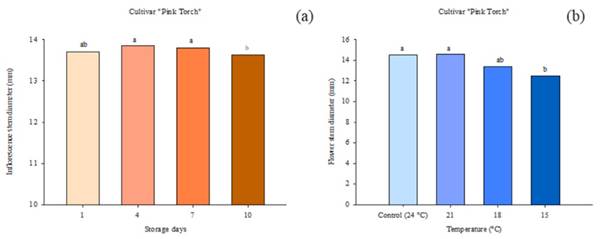
The lowest inflorescence stem diameters in ‘Pink Torch’ were observed on day 10; however, the values did not differ significantly from those on day 1 (Fig. 2a). Across storage temperatures, the smallest diameters were recorded at 15 °C, although they did not differ significantly from those at 18 °C (Fig. 2b). Values ranged from 14.52 mm at 24 °C to 12.51 mm at 15 °C, with significant differences among temperatures.

Inflorescence stem diameter (mm) of torch ginger (Etlingera elatior) cultivar ‘Pink Torch’ (a) evaluated at 1, 4, 7, and 10 days of storage and (b) at storage temperatures of 15± 3, 18 ± 3, 21 ± 3 °C , and 24 ± 3 °C (ambient conditions). Bars with different letters differ significantly according to Tukey’s test at the 5% level.
Inflorescence Visual Quality
Inflorescence visual quality did not differ significantly among storage temperatures from day 1 to day 4 (Table 3), with all treatments receiving the maximum score of 5. Scores at 24 °C were lowest on day 10 and differed significantly from those at the other temperatures for all cultivars, with mean values ranging from 1.83 for ‘Tulipa’ to 1.30 for ‘Pink Torch’. The cultivar ‘Tulipa’ also exhibited scores below 3 on day 10 at 21 and 18 °C.
Visual quality scores on days 4 and 7 did not differ significantly from day 1 for ‘Red Torch’ at 24 °C, ‘Pink Torch’ and ‘Tulipa’ at 21 °C, and ‘Porcelana’ at 18 °C, remaining above 4 on day 7. Scores for all cultivars at 15 °C except ‘Red Torch’, as well as ‘Porcelana’ at 18 °C, did not differ significantly between days 7 and 10.
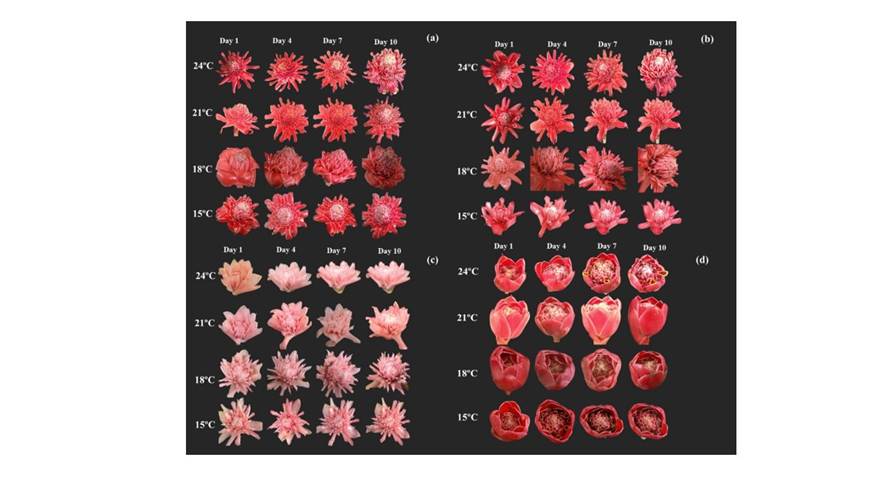
More pronounced symptoms of senescence were observed in inflorescences after 7 and 10 days of storage (Fig. 3). Cultivars ‘Red Torch’ and ‘Pink Torch’ exhibited advanced senescence after 10 days under ambient conditions (24 °C). ‘Pink Torch’ and ‘Porcelana’ exhibited delayed senescence at 15 and 18 °C.

Inflorescence visual quality of torch ginger (Etlingera elatior) cultivars: (a) ‘Red Torch’, (b) ‘Pink Torch’, (c) ‘Porcelana’, and (d) ‘Tulipa’ stored at 15 ± 3, 18 ± 3, 21 ± 3 °C, and ambient conditions (24 ± 3 °C) and evaluated at 1, 4, 7, and 10 days of storage.
Longevity of Floral Stems
Longevity of floral stems differed among cultivars and storage temperatures (Table 4). At 15 °C, ‘Red Torch’ exhibited the lowest longevity (15.10 days), differing significantly from ‘Porcelana’, which showed the highest longevity (18.80 days). Longevity did not differ significantly among cultivars at 24 °C, ranging from 8.25 to 10.65 days. ‘Tulipa’ differed significantly from the other cultivars at 18 °C, whereas ‘Red Torch’ and ‘Pink Torch’ differed significantly from ‘Porcelana’ and ‘Tulipa’ at 21 °C.
Longevity of ‘Red Torch’ and ‘Pink Torch’ did not differ significantly among temperatures of 15, 18, and 21 °C, ranging from 13.45 to 16.65 days. ‘Porcelana’ and ‘Tulipa’ showed the highest values at 15 °C (18.80 and 15.20 days, respectively), differing significantly from those at the other temperatures. The control (24 °C) exhibited the lowest longevity, with values ranging from 8.25 to 10.65 days.
‘Pink Torch’ and ‘Tulipa’ exhibited significantly greater longevity than the other cultivars at 15 °C. Values for ‘Red Torch’ and ‘Pink Torch’ did not differ significantly among temperatures of 21, 18, and 15 °C, ranging from 15.45 to 16.65 days.
Discussion
Postharvest longevity of cut flowers depends on water uptake, retention, and loss; imbalances among these processes can lead to wilting when transpiration exceeds water uptake (Gupta and Dubey, 2018). According to Costa et al. (2021), carbohydrates present in floral stems are rapidly consumed after harvest due to high respiratory rates and the absence of storage reserve structures.
Temperature influences metabolic activity in fruits, vegetables, and flowers after harvest. Lower temperatures reduce processes such as respiration, thereby extending the shelf life of agricultural products (Jahnke et al., 2022; Sun et al., 2022, Kalinowski and Dole, 2024). In the present study, refrigerated storage reduced metabolic activity in floral stems, resulting in lower water uptake rates compared with the control and relative fresh mass ranging from 98.28% to 105.67%. Under ambient conditions (24 ± 3 °C), relative fresh mass decreased by 7.62% after 10 days of storage in ‘Pink Torch’ and by 3.62% in ‘Red Torch’, with the latter differing significantly from values observed on days 1, 4, and 7.
Storage temperatures had no significant effect on ‘Tulipa’; relative fresh mass after 10 days did not differ significantly from 100%. These results are consistent with those reported by Carrera-Alvarado et al. (2021) for stems of Heliconia wagneriana Petersen treated with 1 mM salicylic acid and stored at 13 °C for five days, which exhibited a fresh mass loss of 3.52% two days after refrigeration. Cunha Neto et al. (2024) reported that fresh mass and water uptake in floral stems of the torch ginger cultivar ‘Porcelana’ stored at 21 °C varied over time, with a sharp increase on day 3 followed by decreases on days 6 and 9.
Water uptake under refrigerated storage at 15 and 18 °C was approximately 50% lower than that at 21 and 24 °C, with significant differences on days 4 and 7. On day 10, mean uptake did not differ among temperatures, indicating reduced values at 21 and 24 °C due to advanced senescence. Nogueira et al. (2023) reported a relationship between fresh mass and water uptake in floral stems of the cultivar ‘Red Torch’ stored at 21 °C under different starch-based biofilms, suggesting that reduced water uptake leads to fresh mass loss, a pattern consistent with the present study. Rios-Florida et al. (2024) observed reduced uptake in floral stems of Lilium sp. after two weeks of refrigerated storage at 7 °C and 92% relative humidity, attributing this effect to loss of stomatal functionality.
Water uptake may also have influenced inflorescence stem diameter in ‘Pink Torch’. Storage at 15 °C resulted in smaller diameters than at 24 and 21 °C, with significantly different values. These results are consistent with those of Skutnik et al. (2020), who reported increased stem diameter in Paeonia sp. stored at 20 °C and reduced diameter at 0 °C. Refrigerated storage reduced metabolism in plant tissues and consequently affected inflorescence visual quality among torch ginger cultivars. Carrera-Alvarado et al. (2021) observed that refrigerated storage directly affects the floral stem quality by reducing metabolic activity and, consequently, respiration and transpiration rates in plant tissues.
After 10 days at ambient conditions (24 °C), torch ginger cultivars exhibited visual quality scores below 2, indicating very poor appearance, with loss of turgidity and dry bracts. Under refrigerated storage, stems maintained scores above 3 during the same period, indicating fair visual quality characterized by initial loss of turgidity and surface gloss, except for ‘Tulipa’, which showed mean values of 2.70 and 2.74 at 21 and 18 °C, respectively.
Carrera-Alvarado et al. (2020) reported maintenance of quality in floral stems of tropic fleur (Heliconia psittacorum × H. spathocircinata cv. ‘Tropics’) stored dry at 13 ± 2 °C for up to 4.40 days after refrigeration. Cunha Neto et al. (2024) reported that the torch ginger cultivar ‘Porcelana’ stored at 22 °C maintained a score of 3 until day 6, with day 9 representing the commercialization limit.
Refrigerated storage at 15 °C resulted in the longest longevity, regardless of cultivar. Values ranged from 15.10 days (‘Red Torch’) to 18.80 days (‘Porcelana’), whereas under ambient conditions they were more than 30% lower. These results indicate that refrigeration extends the vase life of torch ginger floral stems, with ‘Porcelana’ showing the greatest duration. Refrigerated storage has proven effective in maintaining floral stem quality and extending the longevity of cut flowers (Carrera-Alvarado et al., 2020; Skutnik et al., 2020; Cunha Neto et al., 2024). The present data indicate that storage temperatures between 15 and 21 °C effectively preserve visual quality and prolong performance in different torch ginger cultivars.
Conclusion
Refrigerated storage extended the postharvest longevity of torch ginger floral stems and preserved visual quality for more than 10 days by reducing metabolic activity, resulting in lower water uptake rates, and reduced fresh mass loss. Among the evaluated cultivars, ‘Porcelana’ exhibited the longest duration (18 days).
Acknowledgments
The authors thank the Brazilian Coordination for the Improvement of Higher Education Personnel (CAPES) for granting a scholarship to the first author, the students of the Botany Laboratory of the Agricultural. Research and Development Center (CPEDA) at the State University of Mato Grosso (UNEMAT) for their field assistance; and the Graduate Program in Genetics and Plant breeding at the State University of Mato Grosso (UNEMAT).
References
-
CARRERA-ALVARADO, G.; ARÉVALO-GALARZA, M.L.; VELASCO-VELASCO, J.; DE-LA-CRUZ-GUZMÁN, G.H.; SALINAS-RUÍZ, J.; BALTAZAR-BERNAL, O. Treatments to prolong the postharvest life of Heliconia wagneriana Petersenp. Ornamental Horticulturae, v.27, n.4, p.476-484, 2021. https://doi.org/10.1590/2447-536X.v27i4.2376
» https://doi.org/https://doi.org/10.1590/2447-536X.v27i4.2376 -
CARRERA-ALVARADO, G.; ARÉVALO-GALARZA, M.L.; VELASCO-VELASCO, J.; RUIZ-POSADAS, L.D. M.; SALINAS-RUÍZ, J.; BALTAZAR-BERNAL, O. Postharvest management of Heliconia psittacorum x H. spathocircinata cv. Tropics. AGRO productividad, v.13, n.12, p.99-106, 2020. https://doi.org/10.32854/agr op.v13i12.1926
» https://doi.org/https://doi.org/10.32854/agr op.v13i12.1926 - CHOON, S.Y.; DING, P. Growth stages of Torch Ginger (Etlingera elatior) plant. Sains Malaysiana, v.45, n.4, 507-515, 2016.
-
COSTA, L.C.; ARAUJO F.F.; RIBEIRO, W.S.; SANTOS, M.N.S.; FINGER, F.L. Postharvest physiology of cut flowers. Ornamental Horticulturae , v.27, n.3, p.374-385, 2021. https://doi.org/10.1590/2447-536X.v27i3.2372
» https://doi.org/https://doi.org/10.1590/2447-536X.v27i3.2372 -
CUNHA NETO, A.R.; PAIVA, P.D.O.; NOGUEIRA, M.R.; NASCIMENTO, A.M.P.; TIMÓTEO, C.O.; REIS, M.V. Physiological effects of pulsing on torch ginger stems. Ornamental Horticulturae , v.30, e242709, 2024. https://doi.org/10.1590/2447-536X.v30.e242709
» https://doi.org/https://doi.org/10.1590/2447-536X.v30.e242709 -
CUNHA NETO, A.R.; PAIVA, P.D.O.; PONCE, M.M.; CALVELLI, J.V.B.; BARBOSA, S. Meta-analysis of new technologies in post-harvest of tropical flowers. Ornamental Horticulturae , v.29, n.2, p.224-237, 2023. https://doi.org/10.1590/2447-536X.v29i2.2643
» https://doi.org/https://doi.org/10.1590/2447-536X.v29i2.2643 -
DEMASI, S.; MELLANO, M.G.; FALLA, N.M.; CASER, M.; SCARIOT, V. Sensory profile, shelf life, and dynamics of bioactive compounds during cold storage of 17 edible flowers. Horticulturae, v.7, n.166, p-1-26, 2021. https://doi.org/10.3390/horticulturae7070166
» https://doi.org/https://doi.org/10.3390/horticulturae7070166 -
FERREIRA, E.B.; CAVALCANTI, P.P.; NOGUEIRA, D.A. ExpDes.pt: Pacote experimental designers (Português). R package version 1,22, 2021. Available at: <Available at: https://CRAN.R-project.org/package=ExpDes.pt >. Accessed on: May 6th, 2025.
» https://CRAN.R-project.org/package=ExpDes.pt -
GUPTA, J.; DUBEY J.K. Factors affecting post-harvest life of flower crops. International Journal of Current Microbiology and Applied Sciences, v.7, n.1, p.548-557, 2018. https://doi.org/10.20546/ijcmas.2018.701.065
» https://doi.org/https://doi.org/10.20546/ijcmas.2018.701.065 -
ISMAIL, N.A.; RIDZUAN, R. Medicinal potential and health benefits of torch ginger (Etlingera elatior). Notulae Scientia Biologicae, v.15, n.4, 2023. https://doi.org/10.55779/nsb15411489
» https://doi.org/https://doi.org/10.55779/nsb15411489 -
JHANJI, S.; KAUR, G.; CHUMBER, M. Deciphering flower senescence physiology: advancements in post-harvest storage and preservation techniques for enhancing longevity. The Journal of Horticultural Science and Biotechnology, v.100, n.2, p.164-195, 2025. https://doi.org/10.1080/14620316.2024.2404039
» https://doi.org/https://doi.org/10.1080/14620316.2024.2404039 -
JAHNKE, N. J.; KALINOWSKI, J.; DOLE, J.M. Postharvest handling techniques for long-term storage of cut Tulip and Dutch Iris. HortTechnology, v.32, n.3, p.263-274, 2022. https://doi.org/10.21273/HORTTECH05010-21
» https://doi.org/https://doi.org/10.21273/HORTTECH05010-21 -
JITJUM, S.; YINCHAROEN; K.; HAYEEYAHYA, W.; CHEMORE, A.; RUANGRIT, T.; LAOHAPRAPANON, S. Wisdom of utilizing Zingiberaceae plants by traditional healers in Nakhon Si Thammarat Province, Thailand. Plant Science Today, v.12, n.1, p.1-9, 2025. https://doi.org/10.14719/pst.4215
» https://doi.org/https://doi.org/10.14719/pst.4215 -
KALINOWSKI, J.; DOLE, J. M. Extended storage of cut flowers using sub-zero temperature. HortTechnology , v.34, n.1, p.101-105, 2024. https://doi.org/10.21273/HORTTECH05315-23
» https://doi.org/https://doi.org/10.21273/HORTTECH05315-23 -
NEGRELLI, W.S.; LIMA, C.S.M.; LEANDRINI, J.A.; OLIVEIRA, R.J.; BALDIN, B.K. Ácido salicílico, temperatura e períodos de armazenamento na conservação de hastes florais de gladíolo provenientes do sistema de plantio direto orgânico. Revista de Ciências Agroveterinárias, v.22, n.2, p.274-284, 2023. https://doi.org/10.5965/223811712222023274
» https://doi.org/https://doi.org/10.5965/223811712222023274 - NIRMALA, A.; VIJAYALAKSHMI, M.; KUMARI, J.A. Packaging materials and storage temperatures on Shelf life of flower crops: A review. The Pharma Innovation Journal, v.12, n.7, p.1096-1099, 2023.
-
NOGUEIRA, M.R.; PAIVA, P.D.O.; CUNHA NETO, A.R.; REIS, M.V.; NASCIMENTO, A.M.P.; TIMOTEO, C.O. Starch-based films for Red Torch ginger inflorescences postharvest conservation. Ciência e Agrotecnologia, v.47, e017822, 2023. https://doi.org/10.1590/1413-7054202347017822
» https://doi.org/https://doi.org/10.1590/1413-7054202347017822 -
RIOS-FLORIDA, L.G.; AREVALO-GALARZA, M.L.; MARTINEZ-HERNANDEZ, A.; CRUZ-HUERTA, N. Pre and postharvest treatments to reduce the chilling injury in Lilium stems. Agro Productividad, v.7, n.9, p.115-123, 2024. https://doi.org/10.32854/agro p.v17i9.3051
» https://doi.org/https://doi.org/10.32854/agro p.v17i9.3051 - SEIBERT, E.; PEREIRA, P.A.; RAUPP, D.T.; CERBARO, P.F.; SANTOS, O.J.; AMORIM, C.; TOMAZELLI, D. Conservação pós-colheita de cultivares de amoreira-preta (Rubus sp.) em bandejas plásticas sob armazenamento refrigerado. Revista Iberoamericana de Tecnología Postcosecha, v.23, n.1, p.47-55, 2022.
-
SUN, J.; GUO, H.; TAO, J. Effects of harvest stage, storage, and preservation technology on postharvest ornamental value of cut peony (Paeonia lactiflora) flowers. Agronomy, v.12, n.230, p.1-16, 2022. https://doi.org/10.3390/agronomy12020230
» https://doi.org/https://doi.org/10.3390/agronomy12020230 -
SKUTNIK, E.; RABIZA-ŚWIDER, J.; JĘDRZEJUK, A.; ŁUKASZEWSKA, A. The effect of the long-term cold storage and preservatives on senescence of cut herbaceous peony flowers. Agronomy , v.10, n.1631, p.1-14, 2020. https://doi.org/10.3390/agronomy10111631
» https://doi.org/https://doi.org/10.3390/agronomy10111631