 Nutrient allocation and growth responses of Oncidium baueri to different Bokashi application methods
Abstract
Orchids require tailored fertilization protocols, yet the high-potential native Brazilian species Oncidium baueri Lindley lacks a validated cultivation protocol. This study evaluated the effects of Bokashi organic fertilizer on its growth, nutrient allocation, and photosynthetic activity to establish the first standardized protocol for this species. The experiment was conducted in a completely randomized design, comparing a conventional chemical fertilizer with five Bokashi application strategies (substrate-incorporated, surface-applied, and foliar sprays) at two doses: 10 g L-1 and 20 g L-1. Over a 12-month period, we monitored phytometric parameters (growth and biomass), chlorophyll a fluorescence, and the macronutrient and micronutrient content in different plant tissues (leaves, pseudobulbs, and roots). All Bokashi treatments outperformed the chemical control in promoting vegetative growth, with the substrate-incorporated 20 g L-1 dose yielding the greatest increases in shoot length (359%), pseudobulb number (138%), and total biomass. The application method directly influenced nutrient partitioning; foliar sprays enhanced potassium (K) absorption in aerial tissues, while substrate-based methods were more effective for sulfur (S) and zinc (Zn). Photosynthetic efficiency (Fv/Fm) remained optimal across all treatments, indicating no physiological stress. Principal Component Analysis (PCA) confirmed these distinct tissue-specific nutrient accumulation patterns. We conclude that substrate-incorporated Bokashi is a highly effective and sustainable alternative to chemical fertilizers. This study provides a scientifically validated protocol for optimizing O. baueri cultivation, contributing to both the advancement of sustainable horticultural practices and the commercial valuation of this native ornamental species.
Keywords:
bokashi; chloriphyll fluorescence; nutrient allocation; orchid fertilization; sustainable horticulture
Resumo
Orquídeas exigem protocolos de fertilização específicos, mas a espécie brasileira de alto potencial ornamental, Oncidium baueri Lindley, carece de um protocolo de cultivo validado. Este estudo avaliou os efeitos do fertilizante orgânico Bokashi no crescimento, alocação de nutrientes e atividade fotossintética, visando estabelecer o primeiro protocolo padronizado para a espécie. O experimento foi conduzido em delineamento inteiramente casualizado, comparando um fertilizante químico convencional com cinco estratégias de aplicação de Bokashi (incorporado ao substrato, em superfície e via foliar) em duas doses: 10 g L-1 e 20 g L-1. Durante 12 meses, foram monitorados parâmetros fitométricos (crescimento e biomassa), a fluorescência da clorofila a e o teor de macro e micronutrientes nos tecidos (folhas, pseudobulbos e raízes). Todos os tratamentos com Bokashi superaram o controle químico no estímulo ao crescimento vegetativo, sendo que a dose de 20 g L-1 incorporada ao substrato gerou os maiores incrementos no comprimento da parte aérea (359%), número de pseudobulbos (138%) e biomassa total. O método de aplicação influenciou diretamente a partição de nutrientes; a pulverização foliar otimizou a absorção de potássio (K) nos tecidos aéreos, enquanto os métodos via substrato foram mais eficazes para enxofre (S) e zinco (Zn). A eficiência fotossintética (Fv/Fm) permaneceu ótima em todos os tratamentos, indicando ausência de estresse fisiológico. A Análise de Componentes Principais (PCA) confirmou os distintos padrões de acúmulo de nutrientes específicos para cada tecido. Concluímos que o Bokashi incorporado ao substrato é uma alternativa sustentável e altamente eficaz. Este estudo fornece um protocolo cientificamente validado para otimizar o cultivo de O. baueri, contribuindo para o avanço de práticas hortícolas sustentáveis e para a valorização comercial desta espécie nativa.
Palavras-chave:
alocação de nutrientes; bokashi; fertilização de orquídeas; fluorescência da clorofila; horticultura sustentável
Introduction
The fertilization of orchids is a determining factor for their successful cultivation, as these plants are renowned for their exotic and diverse flowers. Unlike other species, orchids possess delicate root systems and limited absorption capacity, demanding balanced and less concentrated nutrition. An appropriate nutritional management promotes vigorous growth, abundant flowering, and greater resistance to diseases, requiring protocols tailored to the specific needs of each species (Hoshino et al., 2023).
Within this context, Oncidium baueri Lindley, a native Brazilian species with vibrant flowers and considerable hardiness, emerges as a promising candidate for commercial cultivation. However, its ongoing domestication process requires in-depth knowledge of its ecological and nutritional requirements to unlock its full ornamental potential (Cunha et al., 2024). Establishing specific cultivation protocols, particularly regarding fertilization, is therefore essential.
Given the sensitivity of orchids, organic fertilizers that promote slow nutrient release represent a promising approach. Among them, Bokashi - an organic compost derived from the fermentation of materials with beneficial microorganisms - is known to enhance soil quality, nutrient availability, and overall plant health (Tong et al., 2021; Vilcherrez-Atoche et al., 2022). Its benefits, such as improved soil structure and increased microbial activity, align well with the delicate needs of epiphytic plants.
Despite these potential advantages, a significant knowledge gap exists, as there is no standardized protocol for the application of Bokashi in orchid cultivation. Key questions regarding the optimal dosage, frequency, and application method remain unanswered, highlighting the need for scientific investigation to maximize its benefits without causing harm (Hoshino et al., 2021; Netto et al., 2021; Hoshino et al., 2023).
Nonetheless, this study aimed to identify the best dosage and application method for Bokashi by analyzing its effects on the vegetative growth, nutritional status, and Photosystem II activity in Oncidium baueri Lindley.
Material and Methods
The experiment was conducted with Oncidium baueri Lindley plants, which had undergone 12 months of acclimatization and originated from asymbiotic germination in a tissue culture laboratory. For the experimental setup, seedlings with a total length of 12 ± 0.98 cm and three pseudobulbs were used. These seedlings were planted in 14 cm diameter pots (measured at the upper edge). The substrate consisted of a 1:1 (v v-1) mixture of pine bark and charcoal.
The treatments consisted of: (CTRL) a chemical control with a 20:20:20 fertilizer applied at a dose of 2 g L-1; (BOK-CL) a burlap bag containing 10 g Bokashi placed on the substrate surface on the day of the experiment setup; (BOK-10S) 10 g Bokashi per liter of substrate, incorporated on the setup day; (BOK-20S) 20 g Bokashi per liter of substrate, also incorporated on the setup day; (BOK-10F) 10 g Bokashi diluted in one liter of water; and (BOK-20F) 20 g Bokashi diluted in one liter of water. For treatments involving dilution (BOK-10F, BOK-20F), The solutions were prepared and kept in the dark for 6 hours; after this period, the solution was filtered through paper filters before application. For treatments (CTRL), (BOK-10F), and (BOK-20F), 30 mL of the solution was applied via foliar spray every 15 days between 6:00 PM and 7:00 PM from February 2023 to February 2024, ensuring that the spray covered the entire plant. The Bokashi used contained castor bean cake, rice bran, wheat bran, bone meal, basalt rock powder, and strains of Bacillus subtilis, Bacillus licheniformis, Bacillus pumilus, Lactobacillus plantarum, Lactobacillus acidophilus, and Saccharomyces cerevisiae.
The plants were maintained in a greenhouse with 70% shade netting, an average temperature of 25 ± 0.4 °C, and relative humidity ranging from 60% to 70%. Irrigation was automated by sprinklers, adjusted to the plants’ needs during different seasons, with daily irrigation during warmer months and every other day during colder months.
After one year of cultivation, phytometric data were collected, including: number of leaves (NL), shoot length (SL), number of pseudobulbs (NP), number of shoots (NS), length of the longest root (LLR), fresh shoot mass (FSM), fresh root mass (FRM), dry shoot mass (DSM), dry root mass (DRM), and the sum of fresh and dry masses, represented by total fresh mass (TFM) and total dry mass (TDM). To obtain dry mass, samples were placed in kraft paper bags and dried in a forced-air oven at 65 °C until a constant mass was reached, over the course of one week.
On the day the experiment was dismantled, the youngest fully expanded leaves were selected for physiological analyses. Chlorophyll a fluorescence variables were measured using a portable OS1p fluorometer (OptiSciences, Hudson, NY, USA). The leaves were dark-adapted for 30 minutes using FL-DC clips, and basal fluorescence (F0) was measured with diffuse modulated light for 0.1 s (10% intensity). Subsequently, the leaves were exposed to a saturating light pulse (8250 µmol m-2 s-1) for 0.8 s to measure the maximum quantum yield of Photosystem II (Fᵥ/Fm). The effective quantum yield of Photosystem II (ΦPSII = ∆F/Fm′) was measured at 10:00 AM on light-adapted leaves exposed to photosynthetically active radiation (PAR) of 50 µmol m-2 s-1, quantified at the time of analysis. Basal fluorescence (F′) and maximum fluorescence (Fm′) of light-adapted leaves were determined before and after exposure to the saturating light pulse (8250 µmol m-2 s-1) for 0.8 s, respectively, and ∆F was calculated as the difference between Fm′ and F′.
Macronutrient content in different plant parts (leaves, pseudobulbs, and roots) was determined from dried tissues. These tissues were ground using an analytical mill (IKA VR A11 model), and macronutrients (N, P, K, Ca, Mg, and S) and micronutrients (Fe, Mn, Zn) were quantified. The nitro-perchloric acid digestion method was used to quantify P and S by colorimetry; Ca, Mg, Fe, Mn, and Zn were quantified by atomic absorption spectrophotometry, while K was measured by flame photometry. N content was obtained through sulfuric digestion and quantified using the Kjeldahl method, as described by Silva (2009). Macronutrient results were expressed in g kg-1, while micronutrient results were expressed in mg kg-1.
The pH and electrical conductivity were determined using a 1:5 (v v-1) extraction ratio of substrate and deionized water, with measurements taken using portable pH and conductivity meters after 60 minutes of agitation on a shaker table.
The experiment was arranged in a completely randomized design with 10 replicates per treatment, each replicate represented by one pot containing a single plant. Phytometric data were collected from all 10 replicates. Photosystem II activity data were collected from seven plants per treatment as described previously. Nutritional data were collected from five plants per treatment, with each plant divided into leaves, pseudobulbs, and roots before the drying process, allowing separate analysis of these three regions.
All collected data were subjected to normality (Shapiro-Wilk) and homogeneity of variance (Levene) tests, followed by analysis of variance (ANOVA) to identify significant differences among treatments. Tukey’s test at a 5% significance level was used to determine significant differences among treatments and for nutrient analyses in different plant parts. Principal Component Analysis (PCA) was performed after data preprocessing (mean centering) to identify similarities and correlations within the dataset, including treatments, plant structures (root, leaf, and pseudobulb), and nutrients.
Results and Discussion
Bokashi treatments had a significant impact on phytometric variables compared to chemical fertilizer (T1), demonstrating the efficacy of organic fertilizer in promoting the growth of Oncidium baueriTable 1. The mean values for the number of leaves (NL), shoot length (SL), and number of pseudobulbs (NP) were consistently higher in treatments T3 and T4, both involving Bokashi incorporated into the substrate. BOK-20S showed the best results, with an average of 31.14 leaves and 7.14 pseudobulbs, representing an increase of 138% in NP and 359% in SL compared to the initial values.
This performance can be attributed to the gradual nutrient release promoted by Bokashi and its contribution to increasing organic matter in the substrate, improving water retention and the availability of essential nutrients (Hata et al., 2020). These factors are crucial for epiphytic orchids, whose root systems are adapted to efficiently capture nutrients in limited environments. According to Hoshino et al. (2023), organic fertilizers can enhance the activity of beneficial microorganisms, such as Bacillus subtilis and Lactobacillus plantarum, which assist in the production of plant hormones like auxins and in making nutrients available. This microbial activity is fundamental: the microorganisms break down complex organic matter, mineralizing nutrients like nitrogen and phosphorus and chelating micronutrients, which makes them readily available for root absorption over an extended period (Subedi, 2025). This avoids the salinity stress that can be caused by high concentrations of soluble salts from chemical fertilizers, a critical factor for sensitive orchid roots. Furthermore, microorganisms like Bacillus subtilis are known to produce siderophores, which enhance iron uptake, and solubilize phosphates, directly contributing to the vigorous root and shoot development observed in the substrate-incorporated treatments (Jalal et al., 2023).
BOK-20S had the longest root length (LRL), with an average of 23.66 cm, indicating that Bokashi incorporated into the substrate can promote better root development (Fig. 1). Although no statistical difference was observed for the number of shoots (NS), the numerical increase in BOK-10S and BOK-20S may suggest a tendency towards greater development under these treatments, indicating an efficient nutritional response, though not statistically significant in this parameter.

baueriorchid plants at the end of the experimental period showing treatment effects. Plants were photographed at the conclusion of the experiment to document treatment responses. (A) Control treatment. (B) Controlled-release fertilizer sachets. (C) Bokashi organic fertilizer at 10 g per liter of substrate. (D) Bokashi organic fertilizer at 20 g per liter of substrate. (E) Foliar application of Bokashi at 10 g per liter of water. (F) Foliar application of bokashi at 20 g per liter of water.
Regarding biomass data, BOK-20S outperformed the other treatments in all parameters, including shoot fresh mass (SFM), root fresh mass (RFM), and total fresh mass (TFM, the sum of shoot and root fresh mass), with averages of 215.45 g, 121.19 g, and 336.64 g, respectively. This suggests that Bokashi incorporated into the substrate provides a continuous nutrient source, promoting greater biomass accumulation, as shown in Table 2.
For dry mass data, differences were observed in shoot dry mass (SDM) and total dry mass (TDM), with BOK-20S (20 g Bokashi incorporated into the substrate) being superior to all other treatments, with averages of 26.32 g and 46.64 g, respectively. The lowest values were observed in T6 for both SDM and TDM, with 13.74 g and 24.13 g, respectively. Netto et al. (2021) emphasizes the importance of combining foliar applications with organic matter-rich substrates to maximize orchid growth.
In terms of photosynthetic data, the initial fluorescence (F0) was highest in BOK-10F, with an average of 213, surpassing all other treatments, as was the maximum fluorescence (Fm) (Fig. 2). No differences were observed for Fv/Fm and Fv/F0, indicating that the light absorption efficiency by reaction centers was consistent, with all values corresponding to plants with properly functioning photosystems. As reported by Taiz et al. (2021), photosynthetic efficiency is often preserved in well-nourished plants, provided that critical nutrients for Photosystem II function, such as Mg and Fe, are adequately supplied. The stability of Fv/Fm across all treatments, including the high-dose Bokashi application (BOK-20S), is a significant finding. It suggests that organic fertilization promoted vigorous growth without inducing photochemical stress, which can occur with nutrient over-supply or imbalance (Maxwell and Johnson, 2000). The slow-release nature of Bokashi likely maintained a balanced nutrient environment, preserving the integrity and repair capacity of the photosynthetic apparatus.

Graphs showing the means and standard deviations of analysis parameters for photosystem II activity inOncidium bauerisubjected to different bokashi doses and application methods
In the leaf nutrient analysis, significant differences were observed for K, Ca, S, and Zn. For potassium (K), foliar application (BOK-10F and BOK-20F) outperformed other forms of Bokashi application and chemical fertilization (CTRL). The highest value was recorded in BOK-20F, with 26 g kg-1. This result is consistent with the high mobility of potassium within the plant and its efficient absorption through the leaf surface. Foliar sprays provide immediate availability of K+ ions to the photosynthetic tissues, where it plays a crucial role as an enzymatic cofactor and in regulating stomatal function (Fageria et al., 2009). For calcium (Ca), the best averages were obtained with Bokashi incorporated into the substrate at the lower dose (BOK-10S) and with foliar application at the higher concentration (BOK-20F), with the highest value recorded in T3 (40.096 g kg-1). In contrast to potassium, calcium is primarily absorbed by young roots and transported via the xylem with very low mobility in the phloem. This explains why substrate-based application (BOK-10S) was more effective for Ca accumulation than foliar sprays, as the nutrient was directly available to the primary absorption sites (White and Broadley, 2003). For sulfur (S) and zinc (Zn), Bokashi incorporated into the substrate stood out compared to foliar application, with T4 showing the highest S value (0.788 g kg-1) and BOK-10S the highest Zn value (14.09 mg kg-1) (Table 3).
It is also noteworthy that certain nutrients, such as N, P, and Mg in leaves, did not show statistically significant differences across treatments, indicating that their supply was adequate regardless of the Bokashi application method or the chemical control, or that their concentrations were maintained within optimal ranges for Oncidium baueri
Nutritional analysis ofOncidium baueriunder different fertilization treatments, showing macronutrient and micronutrient concentrations in plant tissues (leaves, pseudobulb, leaves + pseudobulb, and root). Values represent mean concentrations per treatment and tissue for nitrogen (N), phosphorus (P), potassium (K), calcium (Ca), magnesium (Mg), sulfur (S), iron (Fe), manganese (Mn), and zinc (Zn).
In pseudobulbs, known for their storage capacity, nutrients such as P, K, Mg, S, Fe, and Zn showed significant differences. As critical storage organs for water and nutrients in sympodial orchids like Oncidium, pseudobulbs reflect the plant’s long-term nutritional status, making them excellent indicators of nutrient allocation efficiency (Zhang et al., 2021). Biweekly foliar application was superior for most nutrients, except for sulfur, where BOK-CL had the highest value (0.825 g kg-1). The highest phosphorus (P) and magnesium (Mg) averages were recorded in BOK-10F, with 2.01 g kg-1 and 4.15 mg kg-1, respectively. For potassium (K), iron (Fe), and zinc (Zn), T6 showed the highest values, indicating that dosage and application method directly influence nutrient absorption.
It is also noteworthy that certain nutrients, such as N, P, and Mg in leaves, did not show statistically significant differences across treatments, indicating that their supply was adequate regardless of the Bokashi application method or the chemical control, or that their concentrations were maintained within optimal ranges for O. baueri.
In root analysis, BOK-20F stood out for K, Ca, and Mn, demonstrating the superiority of foliar application with a 20 g L-1 Bokashi solution in promoting the fixation and absorption of these elements. For iron (Fe), treatments BOK-CL, BOK-20S, and BOK-20F were the most effective, indicating that this element can be well absorbed through both foliar application and substrate incorporation of Bokashi at 20 g L-1 or through slow-release Bokashi (BOK-CL).
When analyzing the total nutrient concentration in the shoot (leaves + pseudobulbs), biweekly foliar application (BOK-10F and BOK-20F) was more efficient than other application methods, outperforming conventional mineral fertilization. Sulfur was the only nutrient whose absorption was not optimized by foliar application, with the highest values observed in BOK-CL.
The results of this study confirm the efficacy of Bokashi as a sustainable alternative to chemical fertilizers in orchid cultivation. Bokashi treatments not only promoted greater vegetative growth but also ensured adequate nutrition levels while preserving the plants’ photosynthetic efficiency.
These findings corroborate previous studies, such as those by Hoshino et al. (2021), which highlight the potential of Bokashi to optimize the development of ornamental plants through slow nutrient release and the promotion of microbial activity in the substrate. Furthermore, the diverse responses among foliar and substrate treatments suggest that combining both strategies may be the most efficient approach to maximizing Bokashi’s benefits. This points towards an integrated nutrient management (INM) strategy, where substrate application of Bokashi builds soil health and provides a baseline of slow-release nutrition, while targeted foliar applications can supplement key mobile nutrients during critical phenological stages, such as flowering or active vegetative growth (Aulakh and Malhi, 2005).
From a commercial perspective, the use of Bokashi in Oncidium baueri not only contributes to environmental sustainability but also enhances the value of this native species as a high-potential ornamental plant in the market. Standardizing application protocols, based on studies like this, could drive its large-scale adoption.
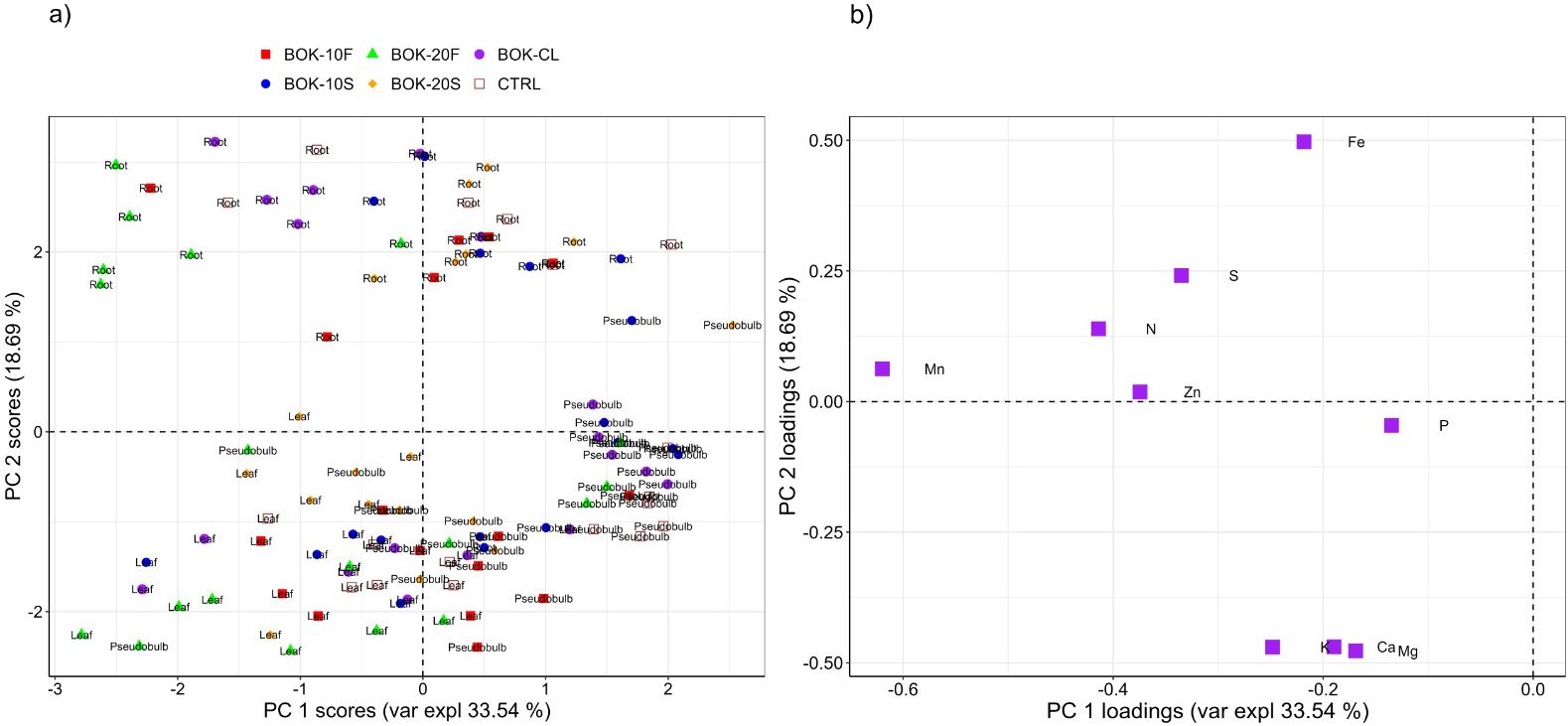
Principal Component Analysis (PCA) revealed the influence of treatments on the nutritional composition of plant structures. In the score plot, samples were differentiated by tissue and treatment, while the loading plot showed the nutrients’ influence on the principal components. Roots clustered in the lower-left quadrant of the score plot, indicating lower nutritional variability, while leaves and pseudobulbs showed greater variation. PC1 (33.5%) was negatively influenced by Mn, N, Zn, and S, indicating higher concentrations of these nutrients in roots, while PC2 (18.7%) was positively impacted by K, Ca, and Mg, associating leaves and pseudobulbs with these macronutrients. This distribution reflects the functional specialization of tissues in nutrient absorption and allocation (Fig. 3).

Principal component analysis (PCA) of nutrient distribution in different plant tissues (leaf, pseudobulb, root) and treatments. PC1 explains 33.5% of the variance and PC2 explains 18.7%.
The accumulation of K, Ca, and Mg in the aerial parts is linked to osmotic regulation, photosynthesis, and cellular stability. K regulates stomatal opening and photoassimilate transport, controlling water and gas flux (Hasanuzzaman et al., 2018). Mg is essential for chlorophyll synthesis and enzymatic activation, driving carbon fixation and light energy conversion (Tränkner et al., 2018). Ca contributes to cell wall structuring and signaling, providing mechanical resistance to plant tissues (Xie et al., 2021).
Conversely, the higher concentration of Mn, Zn, Fe, N, and S in roots is due to the low mobility of these nutrients in the phloem and their importance in root metabolism. Fe and Mn are predominantly transported via the xylem and accumulate in roots and older leaves due to the formation of insoluble complexes, hindering their redistribution to aerial parts (Page and Feller, 2015). Zn, despite its intermediate mobility, tends to remain in roots due to its association with proteins and metabolic enzymes essential for root function (Gupta et al., 2016). Additionally, N and S are crucial for amino acid and sulfur compound synthesis, being initially metabolized in roots before translocating to other tissues (Zayed et al., 2023). This distribution pattern highlights the role of roots as a reservoir of micronutrients, optimizing their absorption and primary metabolism, while leaves and pseudobulbs prioritize photosynthetic and structural functions, ensuring balanced plant growth (Chao and Chao, 2024).
Treatments directly influenced nutrient absorption and accumulation in plant tissues, reflecting distinct patterns according to the application method. The “10 g L-1 foliar spray” treatment favored the absorption of K, Ca, and Mg predominantly in leaves and pseudobulbs, optimizing photosynthesis, osmotic regulation, and assimilate transport, resulting in greater biomass and vegetative growth (Hata et al., 2020). Conversely, the “10 g incorporated” and “burlap bag” treatments promoted higher concentrations of Mn, Zn, N, and S in roots due to the low mobility of these nutrients in the phloem and the enhanced availability provided by soil microbiota, which increased root absorption (Keitan and Hadi, 2023). These results indicate that application methods directly modulate nutrient partitioning. Crucially, while foliar sprays efficiently delivered mobile nutrients to aerial parts, the superior overall growth and biomass in the substrate-incorporated treatment (T4) suggests that for O. baueri, establishing a robust nutritional foundation in the root zone - rich in S, Zn, and other microelements - is the primary driver for achieving maximum vegetative potential.
Conclusions
Fertilization with substrate-incorporated Bokashi at a dose of 20 g L-1 proved to be the most efficacious treatment for promoting vegetative growth and biomass accumulation in Oncidium baueri, outperforming conventional chemical fertilization and other organic application methods. This method promoted a continuous and balanced supply of nutrients directly to the root system without inducing photosynthetic stress. Therefore, our findings establish the use of substrate-incorporated Bokashi as the first scientifically validated, sustainable, and high-yielding protocol for the vegetative development of O. baueri. Future research should build upon this foundation, investigating the long-term impacts of this protocol on the flowering cycle and commercial value of the plants, as well as exploring potential synergies with other organic inputs.
Acknowledgments
We thank UEL, CAPES and CNPq (308788/2021-4) for providing the funding necessary for the execution of this project
Data availability statement
Data will be made available upon request to the authors.
References
-
AULAKH, M.S.; MALHI, S.S. Interactions of nitrogen with other nutrients and water: a review. Advances in Agronomy, v.86, p.341-409, 2005. https://doi.org/10.1016/S0065-2113(05)86007-9
» https://doi.org/10.1016/S0065-2113(05)86007-9 -
CHAO, Z-F.; CHAO, D-Y. Barriers and carriers for transition metal homeostasis in plants. Plant Communications, v.6, n.2, p.101235, 2024. https://doi.org/10.1016/j.xplc.2024.101235
» https://doi.org/10.1016/j.xplc.2024.101235 -
CUNHA, T.B.; SOUSA, S.M.; REIS, A.C.; MATOS, E.M.; VICCINI, L.F. Synthetic tetraploid of Oncidium crispum Lodd. (Orchidaceae). Methods in Molecular Biology, v.2827, p.267-278, 2024. https://doi.org/10.1007/978-1-0716-3954-2_18
» https://doi.org/10.1007/978-1-0716-3954-2_18 -
FAGERIA, N.K.; FILHO, M.B.; MOREIRA, A.; GUIMARÃES, C.M. Foliar fertilization of crop plants. Journal of Plant Nutrition, v.32, n.6, p.1044-1064, 2009. https://doi.org/10.1080/01904160902872826
» https://doi.org/10.1080/01904160902872826 -
GUPTA, N.; RAM, H.; KUMAR, B. Mechanism of zinc absorption in plants: uptake, transport, translocation and accumulation. Reviews in Environmental Science and Bio/Technology, v.15, p.85-109, 2016. https://doi.org/10.1007/s11157-016-9390-1
» https://doi.org/10.1007/s11157-016-9390-1 -
HASANUZZAMAN, M.; BHUYAN, M.H.M.B.; NAHAR, K.; HOSSAIN, M.S.; MAHMUD, J.A.; HOSSEN, M.S.; CHOWDHURY, A.A.C.M.; MOUMITA, M.; FUJITA, M. Potassium: a vital regulator of plant responses and tolerance to abiotic stresses. Agronomy, v.8, n.3, p.31, 2018. https://doi.org/10.3390/agronomy8030031
» https://doi.org/10.3390/agronomy8030031 -
HATA, F.T.; SPAGNUOLO, F.A.; PAULA, M.T.; MOREIRA, A.A.; VENTURA, M.U.; FREGONEZI, G.A.F.; OLIVEIRA, A.L.M. Bokashi compost and biofertilizer increase lettuce agronomic variables in protected cultivation and indicates substrate microbiological changes. Emirates Journal of Food and Agriculture, v.32, n.9, p.640-646, 2020. https://doi.org/10.9755/ejfa.2020.v32.i9.2142
» https://doi.org/10.9755/ejfa.2020.v32.i9.2142 -
HOSHINO, R.T.; ALVES, G.A.C.; BERTONCELLI JÚNIOR, D.; ZEFFA, D.M.; STULZER, G.C.G.; TAKAHASHI, L.S.A.; FARIA, R.T. Bokashi, simple superphosphate, and fertigation for the growth and nutrition of hybrid Cattleya (Orchidaceae). Agronomy Science and Biotechnology, v.9, p.1-11, 2021. https://doi.org/10.33158/ASB.r178.v9.2023
» https://doi.org/10.33158/ASB.r178.v9.2023 -
HOSHINO, R.T.; SOUZA JUNIOR, H.; TEJO, D.P.; PEDRO JUNIOR, S.; SCHERER, A.; FARIA, R.T. Mineral nutrition in orchids. Agronomy Science and Biotechnology, v.9, p.1-11, 2023. https://doi.org/10.33158/ASB.r178.v9.2023
» https://doi.org/10.33158/ASB.r178.v9.2023 -
JALAL, R.S.; AL-AMERI, A.M.; GHANIM, A.M.; AL-ANSI, A.A.; AL-KAABI, S.D.; FADHALI, O.A.; AL-KAYSI, M.A. Plant growth-promoting rhizobacteria: mechanisms and applications. Life (Basel), v.13, n.1, p.211, 2023. https://doi.org/10.3390/life13010211
» https://doi.org/10.3390/life13010211 - KEITAN, M.; HADI, A. Response of three American grape cultivars (Vitis vinifera L.) to em Bokashi and foliar spraying with some plant extracts. Euphrates Journal of Agricultural Science, v.15, n.3, p.387-399, 2023.
-
MAXWELL, K.; JOHNSON, G.N. Chlorophyll fluorescence-a practical guide. Journal of Experimental Botany, v.51, n.345, p.659-668, 2000. https://doi.org/10.1093/jexbot/51.345.659
» https://doi.org/10.1093/jexbot/51.345.659 -
NETTO, L.A.; VILLA, F.; DA SILVA, D.F.; DA SILVA, L.S.; DA SILVA, G.M.; DA SILVA, E. C. Mineral and organic fertilizer combined with doses of Azospirillum brasilense in an orchid hybrid. Comunicata Scientiae, v.12, p.e3406-e3406, 2021. https://doi.org/10.14295/CS.v12.3406
» https://doi.org/10.14295/CS.v12.3406 -
PAGE, V.; FELLER, U. Heavy metals in crop plants: Transport and redistribution processes on the whole plant level. Agronomy, v.5, n.3, p.447-463, 2015. https://doi.org/10.3390/agronomy5030447
» https://doi.org/10.3390/agronomy5030447 - SILVA, F.C. (ed.). Manual de análises químicas de solos, plantas e fertilizantes. 2. ed. Brasília: Embrapa Informação Tecnológica, 2009.
-
SUBEDI, K. Transforming waste: A review on Bokashi’s impact on soil health, crop growth, and pest and disease management. Journal of Wastes and Biomass Management, v. 7, n. 1, p. 13-15,2025.https://doi.org/10.26480/jwbm.01.2025.13.15
» https://doi.org/10.26480/jwbm.01.2025.13.15 - TAIZ, L.; ZEIGER, E.; MOLLER, I. M.; MURPHY, A. Fundamentos de fisiologia vegetal. 1a.ed. Porto Alegre: Artmed, 2021. 558p.
-
TONG, R.C.; WHITEHEAD, C.S.; FAWOLE, O.A. Effects of conventional and Bokashi hydroponics on vegetative growth, yield and quality attributes of bell peppers. Plants, v.10, n.7, p.1281, 2021. https://doi.org/10.3390/plants10071281
» https://doi.org/10.3390/plants10071281 -
TRÄNKNER, M.; TAVAKOL, E.; JÁKLI, B. Functioning of potassium and magnesium in photosynthesis, photosynthate translocation and photoprotection. Physiologia Plantarum, v.163, n.3, p.414-431, 2018. https://doi.org/10.1111/ppl.12747
» https://doi.org/10.1111/ppl.12747 -
VILCHERREZ-ATOCHE, J.A.; IIYAMA, C.M.; CARDOSO, J.C. Polyploidization in orchids: from cellular changes to breeding applications. Plants (Basel), v.11, n.4, p.469, 2022. https://doi.org/10.3390/plants11040469
» https://doi.org/10.3390/plants11040469 -
WHITE, P.J.; BROADLEY, M.R. Calcium in plants. Annals of Botany, v.92, n.4, p.487-511, 2003. https://doi.org/10.1093/aob/mcg164
» https://doi.org/10.1093/aob/mcg164 -
XIE, K.; CAKMAK, I.; WANG, S.; ZHANG, F.; GUO, S. Synergistic and antagonistic interactions between potassium and magnesium in higher plants. The Crop Journal, v.9, n.2, p.249-256, 2021. https://doi.org/10.1016/j.cj.2020.10.005
» https://doi.org/10.1016/j.cj.2020.10.005 -
ZAYED, O.; HEWEDY, O. A.; ABDELMOTELEB, A.; ALI, M.; YOUSSEF, M. S.; ROUMIA, A. F.; SEYMOUR, D.; YUAN, Z.-C. Nitrogen journey in plants: from uptake to metabolism, stress response, and microbe interaction. Biomolecules, v.13, n.10, p.1443, 2023.https://doi.org/10.3390/biom13101443
» https://doi.org/10.3390/biom13101443 -
ZHANG, W.; ZHANG, S.; FAN, Z. Quantifying the nitrogen allocation and resorption for an orchid pseudobulb in relation to nitrogen supply. Scientia Horticulturae, v.291, p.110580, 2021. https://doi.org/10.1016/j.scienta.2021.110580
» https://doi.org/10.1016/j.scienta.2021.110580
Edited by
-
Editor:
Raissa Rachel Salustriano da Silva-Matos (Universidade Federal do Maranhão, Brasil)