
 Preliminary assessment of microplastic pollution in surface waters of the Santos Basin: abundance and diversity in the most important oil and gas exploration hub in Brazil
Abstract
Microplastics (Mps) are pervasive in the surface waters of the Santos Basin, a critical maritime zone along the Southeast coast of Brazil, vital to both fishing and oil production. This study sought to assess potential disparities in the abundance, types, colors, and sizes of microplastics in various locations and seasons near oil and gas exploration areas. Seven stations were sampled using Van Dorn-type bottles during two campaigns, in June 2020 and January 2021, encompassing winter and summer seasons. Concurrently, wind, current, and wave data were recorded to investigate their impact on microplastic distribution. Microparticles were meticulously assessed by counting, classifying, measuring, and photographing using an optical microscope. The results unveiled a considerable concentration of putative microplastics in the Santos Basin surface waters, identifying and collecting a total of 1,006 particles. All sampled stations exhibited some degree of microparticles contamination, with counts ranging from 67 to 272 particles per station. The average particulate concentration stood at 159.7 microparticles per liter (Mp/L). While concentrations varied across sampling points, statistical analysis indicated no significant differences (p = 0.5062 – ANOVA test p < 0.05). Fragmented pieces constituted most (51.8%) of putative microplastics, followed by films (24%) and fibers (16.4%), displaying diverse colors, with blue (31.11%) and transparent (27.63%) being the most prevalent. Particles measuring 50 μm or less comprised over 30%, while those smaller than 400 µm constituted about 90% of the total sampled microparticles. The microparticle concentration for the Santos Basin, 10.6 – 43.17 Mp/L, was surprisingly similar to other regions without oil and gas exploration. This study underscores the high prevalence of microparticles in the Santos Basin and highlights the role of oceanographic factors, including wind, waves, and currents, in shaping the dynamics of microplastic contamination in this economically and ecologically significant region.
Keywords:
Marine pollution; Southwest Atlantic; Particle characterization; Oil producing basin
INTRODUCTION
Microplastics (Mps) are present in all marine environments, in the coastal zone, in the open ocean, on sandy beaches, and in the deep sea (Turra et al., 2014; Jung et al., 2021; Zhang S. et al., 2022). Coastal waters are affected by microplastics from human activities. The extent of this pollution depends on the location of these sources and on the environmental factors, including the water dynamic patterns (Cózar et al., 2014; Aigars et al., 2021). The unique physical properties and dynamic biological processes of microplastics including their complex movements in water such as subsidence, deposition, and suspension, cause them to spread unevenly across surface waters in open oceans, coastal regions, and remote areas worldwide (Sun, Y. et al., 2022).
Marine currents play a crucial role in transporting microplastics in open ocean waters, allowing plastic particles to be moved from one area to another and distributed around the world (Ershova et al., 2021; Liu et al., 2021; Gérigny et al., 2022). Some convergent surface currents are capable of trapping floating plastic particles for decades (Markic et al., 2022). Winds also contribute to the transport of microplastics in these environments, scattering plastic particles across the surface of the water and in the air, which causes them to travel great distances (Gérigny et al., 2022; Xu, A. et al., 2022a).
Simultaneously, wave and undertow movements together play an important role in the translocation of these microparticles in surface water towards the coast, where they can be carried back to the sea or deposited in deeper layers of the oceans (Turra et al., 2014; Aigars et al., 2021; Bajon et al., 2023). Precipitation can increase the burden of plastic-contaminated wastewater, which in turn can increase the amount of microplastics in marine ecosystems (Kobayashi et al., 2021; Vibhatabandhu and Srithongouthai, 2022). Finally, the ingestion of microplastics by aquatic organisms, from zooplankton to whales, can carry these microparticles to other locations through the trophic level and food chain or after the death of these animals (Rochman et al., 2015; Gao et al., 2023).
Faced with this alarming prospect, the growing presence of microplastics in surface waters of the oceans has become a priority concern for the health of ecosystems and marine life. Microplastics, when mistaken for food by animals can cause potential long-term toxic effects (Narloch et al., 2022; Simantiris et al., 2022). Plastic waste is recognized as highly harmful to marine life, especially to filter feeding organisms (mollusks, crustaceans, plankton) (Berlino et al., 2021; Gérigny et al., 2022). This waste can be harmful to human and animal health in cases of toxic substances absorption, such as organic pollutants, pesticides, and heavy metals (Bakir et al., 2012; Bikker et al., 2020; Ferreira and Lôbo-Hajdu, 2023).
The presence of microplastics in surface waters of the sea in Brazil is also a growing and worrying problem. Several studies have already demonstrated contamination by microplastics along the Brazilian coast in different areas, such as the Western Equatorial Atlantic, from the State of Ceará to the coast of Maranhão (Garcia et al., 2020); Fernando de Noronha (Ivar do Sul et al., 2014; Carvalho et al., 2021); Baía de Todos os Santos (Paes et al., 2022); Abrolhos and Trindade (Ivar do Sul et al., 2014); Espírito Santo (Macieira et al., 2021); Guanabara Bay (Castro et al., 2016, 2020; Baptista Neto et al., 2019; Silva et al., 2019); Santos Basin (Fontes et al., 2021); Santa Catarina (Monteiro et al., 2022); and Paraná (Mengatto and Nagai, 2022).
Considering the complexity of the pollution caused by microplastics, research should be carried out to quantify and characterize microplastics using physical-chemical methods. This study aims to determine the possible presence, abundance, and distribution of potential microplastics in surface waters collected in different regions of the Santos Basin, as well as to associate them with oil and gas exploration activities. Santos Basin is a key oil and gas exploration hub on Brazil’s Southeast coast. Null Hypothesis (H0): oil and gas exploration activities are not associated with the presence and high abundance of microplastics in marine environments, Alternative Hypothesis (H1): oil and gas exploration activities contribute significantly to the presence and high abundance of microplastics in marine environments. There is growing evidence that oil and gas exploration activities can contribute significantly to the presence and high abundance of microplastics in marine environments. Microplastics can enter the environment through various means associated with the oil and gas industry, such as the use of microplastic-containing drilling fluids and industrial abrasives (Duis and Coors, 2016; Sharma and Chatterjee, 2017; Saeed et al., 2023). These microplastics are then transported by ocean currents, leading to widespread distribution in both coastal and open ocean waters (Sharma and Chatterjee, 2017). This research is innovative because it addresses aspects of this region, which, despite its economic importance and wide diversity of marine ecosystems, still has a significant gap in knowledge about the distribution, concentration, and types of microplastics.
Methods
Study Area: Santos Basin
The Santos Basin is located in the southeastern region of Brazil and covers the coasts of the states of Rio de Janeiro, São Paulo, Paraná, and Santa Catarina (Figures 1A-C). With an area of approximately 350,000 km² and a bathymetric elevation of 3,000 meters, it contains sedimentary thicknesses greater than 10 km in the main depocenters (point of maximum subsidence and/or sedimentation in a sedimentary basin; Dos Santos Filho et al., 2022). These multiple layers of sedimentary rocks, over 100 million years old, consist of sandy, clayey, and limestone deposits, rich in minerals and oil (Souza et al., 2022).
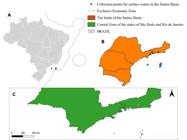
Map of the location and geographic boundary of the Santos Basin highlighting the sampling points.
Geologically, the Santos Basin is bounded to the north by the Campos Basin, separated by the Cabo Frio High, and to the south by the Pelotas Basin, separated by the Florianópolis High. The western limit of the basin is represented by the coastal mountain ranges (Maciço da Carioca, Serra do Mar, and Serra da Mantiqueira), and to the east the basin extends to the foothills of the São Paulo Plateau (Figueiredo Jr. et al., 2023). The Santos Basin has unique geographic and environmental characteristics. The basin is known for hosting a great diversity of marine ecosystems, including coral reefs, seamounts, and areas of great biodiversity (Bendia and Carrerette, 2022; Perez et al., 2023). The preservation of these ecosystems is of fundamental importance for the environmental sustainability of the region and for the conservation of marine fauna and flora (Bendia and Carrerette, 2022; Perez et al., 2023).
It is an area of great importance for the oil industry, its exploration began in the 1970s, however, it was after the creation of the Petroleum Law, in 1997, that the Santos Basin received new exploratory investments from Petrobrás – Petróleo Brasileiro S.A. (a state-owned company with a mixed economy) and foreign companies that culminated in the discovery of new deposits. Together with seismic surveys partnering with the private sector, the exploratory potential of the existing pre-salt in the region was discovered. The Santos Basin, together with the Campos Basin, emerges as one of the main oil producing basins in Brazil (Dickson et al., 2019).
The presence of oil rigs and other vessels in the Santos Basin has a significant impact on the country’s economy and local marine life. However, there are also environmental concerns related to oil and gas exploration in the region, as it can negatively affect marine biodiversity and water quality, in addition to increasing the risk of oil spills (Romero et al., 2013).
Field Sampling
For the collection, a Platform Supply Vessel (PSV, support vessel) was used. During sampling, the vessel was placed in Dynamic Positioning (DP) mode, a system that automatically controls the vessel position and orientation.
A total of seven (07) stations were sampled (Figure 1C). The choice was based on the vessel logistics and its established routes, in addition to consider the area sensitivity to contamination by microplastics. Sampling stations in the Santos Basin are close to oil platforms, located an average of 150 nautical miles, or approximately 280 km, from the Guanabara Bay, the main support base for offshore operations in the Santos Basin.
Van Dorn-type bottles with a capacity of five liters were used for sample collection, an approach that has been used in several scientific studies for the analysis of microplastics in marine environments (Bagaev et al., 2017, 2018; Courtene-Jones et al., 2017; Di Mauro et al., 2017). A total of 30 water samples were collected in two campaigns that took place in June 2020 and January 2021. Two sampling points were sited during winter and summer, which allowed a comparison between collections in more than one season of the year. Table S1 (Supplementary Material) demonstrates the points at which sampling was carried out in both seasons of the year and which were not.
To minimize contamination with possible particles present in the vessel in the storage bottles or in the collection bottle, the first sample was completely discarded, and the bottle was lowered again to perform a new sampling. Then, the glass bottle used to store the aliquot was cleaned three times with the water from the collection itself. Only then, the container was filled with 300 mL of sample contained in the bottle, stored in a thermal bag and taken to the cooling chamber at -20°C until the filtration and analysis stage. This entire procedure was repeated three times at each point, composing a total of three samples per station. Before collection, the colors of the ship deck and the material of the researcher’s clothing were recorded on a form, so that later, in the laboratory, when carrying out the analyses, possible sources of contamination could be confronted regarding the microplastics found in the samples (Bagaev et al., 2017, 2018).
Wind, current, and wave data were recorded to be studied regarding the influence of these variables on the microplastics distribution. Wind intensity was computed using anemometers installed on the last deck of the vessel, coupled to the DP system, which stores this information, and plotted together with measurements of the drift current in the WRPLOT View software, version 8.0.2. Drift current data were verified in the Santos Basin by vessel drift test. The waves were measured by visual estimation, observed from the main deck of the ship.
Separation of microplastics
Samples were thawed in a refrigerator at an average temperature of 4°C, and filtered on fiberglass membranes (GF50A), 0.22 µm in size and 47 mm in diameter, operating a vacuum and electric pressure pump with a capacity of 26 liters per minute (Biomec brand - model ECO-206LAB). The filtration system was entirely made of glass. Next, the filters were deposited in glass Petri dishes duly sterilized with distilled water and ultrapure Milli-Q water, and then stored in a freezer at -20°C, wrapped in aluminum foil.
A pre-screening for raising the main characteristics of the particles and conditions of the samples was carried out in a Zeiss stereoscope with a maximal magnification capacity of 32 times. The device was conected to a universal eyepiece adapter for cell phones, which allows the smartphone camera to be used to photograph the microparticles. Then, they were separated by size, color, and shape (Supplementary Material, Tables S2, S3 and S4).
Physical characterization of the collected microplastics
The microparticles were counted, classified, measured, and photographed with an OMAX 5MP A3590U/A3RDF50 digital camera coupled to the Omax digital optical microscope linked to the ToupView software. The classification criteria regarding type and color considered the most common methods described in Gago et al. (2019). In summary, putative microplastics were categorized as: 1. pellet; 2. fragment; 3. fiber; 4. film; 5. sponge/foam, and the coloring was grouped as: black, blue, white, transparent, red, green, multicolor, and others. In the case of multicolor, microparticles with more than one color were considered. White and transparent were differentiated, as white is opaque and transparent is translucent (Pham et al., 2017).
The available Fourier-transform Infrared Spectroscopy with an Attenuated Total Reflectance diamond crystal (FTIR-ATR), a PerkinElmer model Frontier FTIR was not suitable for microparticles smaller than 500 μm (Castro et al., 2020). In this work, 90% of the total microparticles sampled were smaller than 400 μm, therefore the use of a micro-FTIR (μFTIR) is essential for analyzing these particles (GESAMP, 2019). Therefore, the polymeric composition of the putative microplastics was not yet determined.
Avoidance of laboratory contamination
All materials selected for handling the filtering, classification, and measurement process of the samples are made of glass, aluminum foil, and metal, and were properly washed with special washing soap and cleaned in distilled water and ultrapure Milli-Q water. In addition, identical glass Petri dishes containing filters were allocated during the filtering and pre-screening process alongside those with samples and analyzed by optical microscopy for potential airborne contamination and possible cross-contamination (Gago et al., 2019). A particle should be excluded if a similar one was present in the control filter exposed to the environment in optical microscopy analyses.
Based on these analyses, we formulated the following hypotheses: 1) Hypothesis for microplastic color between seasons: Null Hypothesis (H0) – the color of microplastics does not vary significantly between seasons (winter and summer) in the Santos Basin; Alternative Hypothesis (H1) – the color of microplastics varies significantly between seasons (winter and summer) in the Santos Basin. Justification: evaluating the variation in microplastic color between seasons can provide insights into potential seasonal changes in their origin or degradation in the region, impacting their distribution and ecology; 2) Hypothesis for microplastic abundance between different sampling points: Null Hypothesis (H0) – the abundance of microplastics does not differ significantly between different sampling points in the Santos Basin; Alternative Hypothesis (H1) – the abundance of microplastics differs significantly between different sampling points in the Santos Basin. Justification: comparing the abundance of microplastics between different sampling points allows understanding the spatial distribution of microplastics in the studied area and identifying potential specific sources of contamination.
Data analysis
We performed descriptive statistics based on the number, type, color, and size of microparticles. All data were aggregated into a spreadsheet in Microsoft Excel 2021, in which it was possible to generate histograms to compare and assess whether or not there were differences in the abundance, types, colors, and sizes of putative microplastics related to those collected at different points and seasons of the year (winter and summer) in the Santos Basin. Using the Past 04 statistical software, the normality test (Shapiro-Wilk index) was used for all data in the spreadsheet. H0 – data follow a normal distribution > 0.05; H1 – data do not follow a normal distribution < 0.05. Using the same statistical software, one-way analysis of variance (ANOVA) – parametric test (normal data) or the non-parametric Kruskal-Wallis test (for non-normal data) was used, both with a significance level set at ≤ 0.05.
RESULTS
Characterization of meteoceanographic conditions during collection
The meteoceanographic conditions recorded during the collection process were predominantly mild, with light to moderate winds, ranging between 5 and 15 knots (2.5 to 7.7 m/s) and with gentle waves and crystalline waters. The water depth at the time of sampling ranged around 2,000 meters. It is recorded that, during the 2020 collection, the predominant winds were from the northeast and/or southeast, with an average speed of 12.25 knots (6.3 m/s) (Figure S1A), while in the collections carried out in 2021, the predominant wind directions were from the northeast and/or northwest, with an average speed of 14 knots (7.2 m/s) (Figure S1B).
Regarding the drift current, a rate of 0.8 knots (0.41 m/s) and 1.06 knots (0.54 m/s) was observed, with current directions going southwest and southwest/northwest, respectively, during the 2020 and 2021 samplings (Figure S2A and B, Supplementary Material).
It is noted that the predominant direction of wave height verified was northeast, which reflects the main direction of swells in that region (Figure S3A, Supplementary Material). Furthermore, an average wave height of 2.3 meters was observed, suggesting that the samples were collected in relatively calm waters (Figure S3B, Supplementary Material).
Pre-selection of collected microplastics
Pre-screening showed the presence of microparticles in samples collected in the Santos Basin. The physical characterization of these particles by optical microscopy allowed the description of the quantity, shape, size, and colors of the putative microplastics found in the superficial waters of the region.
Abundance and distribution of microplastics in the environment
This study results indicate that the surface waters of the Santos Basin have a high concentration of microparticles, with a total of 1,006 particles identified and collected at seven sampling points. All sampling stations were found to have some degree of microparticle contamination, with particle counts ranging from 67 (minimum) to 272 (maximum) particles per sampling station (Figure S4, Supplementary Material).
The average concentration of particulate matter was 159.7 microparticles per liter (Mp/L), with the highest concentrations of putative microplastics being recorded at stations SB4 (43.2 Mp/L), SB6 (32.1 Mp/L), and SB5 (24.8 Mp/L). The SB7 sampling site had the lowest amount of microparticles per liter, totaling 10.6 Mp/L (Figure S5, Supplementary Material). The concentrations of microparticles in surface water showed variations between the different sampling points, however, as pointed out by the analysis of variance (ANOVA), such discrepancies did not reach statistical significance (p = 0.5062 – ANOVA test p < 0.05).
It is observed that the microplastics accumulation may be seasonal, possibly influenced by ocean phenomena such as wind, rain, and light (Zhang, K. et al., 2017). With the objective of evaluating the potential for variability, samples were collected at two different points and in different seasons of the year (winter and summer) for analysis. The results revealed that the average pollution in the area is 24.92 Mp/L, with the highest Mp/L value being recorded at the SB2S sampling point (39 Mp/L) during the summer and the lowest value (13 Mp/L L) in winter at SB3W station (Figure 2).
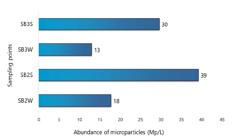
Abundance of putative microplastics in surface water collected in the Santos Basin in the period of 2020–2021, during winter and summer.
The results obtained suggest that the abundance of putative microplastics in the study area is remarkably stable, regardless of the season of the year, since no significant difference was identified between the cross sections of microparticles abundance collected at different times of the year, winter or summer (p = 0.3815 – ANOVA test p < 0.05). It is worth mentioning that all of our airborne contamination control filters did not show the presence of microparticles.
Characterization regarding the form of microplastics
The collected samples were categorized into several predefined classes, namely: fragments, films, foams, fibers, and pellets. The analysis of the samples allowed us to verify that the number of putative microplastic particles consists predominantly of rigid and irregular fragments, followed by films, fibers, pellets, and foams, each containing, respectively, 521 (51.8%); 241 (24%); 165 (16.4%); 61 (6%); and 18 (1.8%) particles (Figure 2).
The results obtained indicated that the fragments were found in high concentration in sampling points SB5 (69.23%), SB6 (55.94%), and SB4 (54.04%). In addition, films and fibers were also detected with frequency above 20% at sampling stations SB1 (35.65%), SB2 (29.46%), SB3 (29.27%), and SB5 (23.08%), while pellets were found in greater numbers at stations SB7 (19.4%) and SB6 (9.41%). In contrast, foam was identified with frequency below 10% at stations SB7 (7.46%) and SB1 (3.48%) (Figure S6, Supplementary Material).
Despite having verified a difference in the quantitative abundance of microparticles in each sampling point, no significant difference was observed in the variation of the types of microparticles collected in different transects (p = 0.5062 – ANOVA test p < 0.05). Furthermore, the amounts of microparticles detected were very similar between the two periods, both in winter and in summer (p = 0.3815 – ANOVA test p < 0.05). However, foam-like microparticles were only found at sampling stations SB2 and SB3 during the winter period (Figure S7, Supplementary Material).

Number of particles according to the shape in the collection areas of the Santos Basin, Brazil.
Characterization regarding the colors of microplastics
Microparticles were categorized into eight distinct colors: black, blue, white, transparent, red, green, multicolored, and others. The results of the analysis revealed a wide variety of colors, the most frequent tones being blue (31.11%), followed by transparent (27.63%), others (14.41%), black (8.45%), red (6.76%), and multicolored (5.47%). Other colors, such as green (1.59%) and white (4.57%), were less common (Figure 4).

Color distribution of microparticles collected in surface waters in the Santos Basin in the period of 2020–2021.
From the data presented in Table 1, it is possible to observe a great variability of colors depending on the type of microparticle. Of all particles in the colors blue (94.25%), black (89.41%), red (86.76%), multicolored (69.23%), and green (56.25%), the predominant form is that of rigid body fragments. On the other hand, films and fibers are mostly transparent, representing 56.83% and 38.13%, respectively. Bleaching is most common in fibers and pellets, accounting for 26.09% and 50% of these types of microparticles.
Variability of colors found in microparticles collected in surface waters in the Santos Basin.
The graphical representation shown in Figure S8 (Supplementary Material) illustrates the distribution of the abundance of different colors at each sampling point. The shade of blue was the most frequent color at all points, however, with greater predominance at stations SB5 (42.67%) and SB3 (39.02%). Transparent was the second most observed, present in all samples, standing out especially in stations SB1 (40%) and SB7 (32.84%).
Kruskal-Wallis test was performed on the color data that did not follow a normal distribution. From these results, we can conclude that the microparticles are evenly distributed among the sampling points and that there is no significant difference in particle color between seasons (p = 0.271, Kruskal-Wallis test p < 0.05). Furthermore, regardless of winter and summer seasons, the color frequencies of all sampled microparticles were similar (p = 0.2498, Kruskal-Wallis test p < 0.05) (Figure S9, Supplementary Material).
Characterization regarding the size of microplastics
The average size of the collected microparticles is 183.70 μm. Most particles had dimensions between 1 and 50 μm (30.6%), followed by 50 to 100 μm (22.9%), 100 to 200 μm (19.8%), and 200 to 400 μm (14.8%) (Figure 5).

Categorization according to the size of microparticles collected in surface waters in the Santos Basin in the period of 2020–2021.
Smaller particles were detected in SB5 (49.36%), SB6 (32.18%), and SB3 (28.05%), while larger particles were identified in SB2 (6.25%) and SB1 (3.48%), see Figure S10 (Supplementary Material). No statistically significant discrepancies were observed regarding the dimensions of the particles between the collection sites (p=0.555, Kruskal-Wallis test with p < 0.05).
Larger microparticles consisted mainly of fibers (10.3%), while those with smaller dimensions were characterized as rigid fragments (53.74%). The smallest particle detected in the analysis was a 1.28 µm fragment, while the largest consisted of a 1,984.03 µm long fiber. No particles larger than 2,000 µm were identified in the seven areas analyzed (Table 2).
The discrepancy related to the size of particles collected during winter and summer was not significant, as evidenced by the p-value equal to 0.4248, obtained in the Kruskal-Wallis test with established significance level of < 0.05. Nevertheless, samples of microparticles with dimensions greater than 2000 μm were found in the SB3 summer samples, in a very low percentage, 0.53% (Figure S11, Supplementary Material). In short, this study results denote no significant variation in the size of particles, depending on the time of year.
DISCUSSION
Pre-screening demonstrated the presence of microparticles in samples collected in the Santos Basin. Based on these observations, a detailed analysis was carried out to determine the amount, shape, size, and colors of putative microplastics found in surface waters in the region. The distribution of different types of plastic particles in the area allowed us to raise hypotheses about possible meteoceanographic and anthropic influences of oil and gas exploration activities on the concentration of microplastics in the Santos Basin. These investigations are critical to understanding microplastic contamination in surface waters and to providing important insights into the global fluxes and distribution of microplastics in the ocean.
Abundance and distribution of microplastics in the environment
This investigation represents the first study to examine the presence of microplastics in the oceanic coastal waters of the Santos Basin. Information on microplastic pollution in South Atlantic waters is still limited, but the current analysis confirms previous research that documented the occurrence of microplastics on beaches in the coastal region of the state of São Paulo (Vedolin et al., 2018; Izar et al., 2019, 2022; Balthazar-Silva et al., 2020; Ribeiro et al., 2021). The average accumulated concentration of microplastics and the presence of these particles in all collection sites reinforce and attest to the contamination of the Santos Basin by microplastics.
The microparticles concentration obtained in this study for the Santos Basin, 10.6–43.17 Mp/L (see comparative Table S5, Supplementary Material), show striking similarities with the findings of the research by Courtene-Jones et al. (2022) carried out in the North Atlantic region, which used Niskin-type bottles and trawl nets to assess the concentration of microplastics in water. The results indicated the presence of microplastics in the North Atlantic anticyclonic subtropical gyre; in coastal waters, and offshore ocean areas, with average concentrations of 0.62 ± 0.52 Mp/m3, 0.40 ± 0.37 Mp/m3, and 0.19 ± 0.19 Mp/m3, respectively. The presence of microplastics in the Santos Basin is also consistent with the pollution rates recorded in the North Atlantic (Pan et al., 2022) with an average concentration of 0.51 Mp/m³ of microplastics.
On the other hand, in the study by Bagaev et al. (2018) using Niskin bottles, the concentration of microplastics found was 0.40 ± 0.58 items per liter. This value is lower than the average found in our study, which can be explained by the fact that the authors used a glass filter with a 174 μm mesh to filter the samples. Very large meshes can release smaller particles and produce readings with lower concentrations of microplastics than those present in the environment (Di Mauro et al., 2017; Figueiredo and Vianna, 2018; Zhu L. et al., 2018; Lindeque et al., 2020).
Still in the Atlantic, a study analyzed the density and characteristics of microplastics in the Brazilian Equatorial Margin (Garcia et al., 2020). The results of that study indicate that the collected samples contained a large amount of microplastics, with an average of 52 particles per cubic meter. Most of the microplastics found consisted of fibers, followed by fragments and granules. Using two mesh nets (120 and 300 μm) to collect microplastics between the coast of Ceará and Maranhão, it was found that the density was statistically higher in a 120 μm mesh net (0.14 ± 0.11 items·m−3) than in a 300 μm mesh net (0.02 ± 0.01 items m−3), with most microplastics consisting of fibers/filaments, styrofoam, hard and soft fragments, paint, and glass/acrylic (Garcia et al., 2020). The density of microplastics identified in this research, using 120 μm mesh netting, is similar to that found in our own observations. The researchers also observed that the distribution of microplastics varied according to the depth of the water, suggesting that the entry of microplastics into the region may be related to the vertical mixing of water.
A study carried out by Baptista Neto et al. (2019) revealed the presence of microplastics on the inner continental shelf of Rio de Janeiro and the influence of dredging disposal areas and of the submarine outfall on contamination. The researchers collected sediment samples in five different areas of the inner continental shelf and found that microplastic concentrations were higher in locations close to the dredged sediment disposal areas and the submarine outfall. This suggests that these human activities can have a significant impact on microplastic contamination in the region (Baptista Neto et al., 2019).
form and distribution of microplastics
Another noteworthy aspect is the significant presence of fragments, which represented more than half of the particles found in our study. Such data corroborate previous research, in which the fragment constituted the most frequent form of microplastic in seawater samples collected at the surface (Ivar do Sul et al., 2013; Bikker et al., 2020; Ramírez-Álvarez et al., 2020; Kobayashi et al., 2021; Li et al., 2022; Russell and Webster, 2021). Fragments origin is mainly attributed to the decomposition of industrial products and bulky waste, resulting from coastal and open ocean hydrodynamic processes, which cause the degradation and fragmentation of larger particles of solid plastics (Zhou Q. et al., 2018; D’Hont et al., 2021; Ding Y. et al., 2022b).
In 2013, Ivar do Sul and collaborators conducted a study investigating the presence and distribution of microplastics on the ocean surface around the São Pedro and São Paulo Archipelago, located in the Equatorial Atlantic. At a total of 17 collection points around the archipelago, the researchers collected water samples and analyzed them for the presence of microplastics. The results pointed to the presence of these particles in all samples, with an average concentration of 0.12 microplastic particles per liter of seawater. The most common types of microplastics found were fragments and fibers (Ivar do Sul et al., 2013). Subsequently, in 2014, Ivar do Sul and other scientists investigated the presence of microplastics in pelagic waters around oceanic islands in the Western Tropical Atlantic, including Fernando de Noronha, Abrolhos, and Trindade. The researchers collected water samples from 14 different points in a remote region of the ocean, far from sources of direct land-based pollution. Results showed that all samples contained microplastics, with an average concentration of 0.27 microplastic particles per liter of seawater. The most common types of microplastics found were again fibers and fragments, and the presence of microplastics in the region has been attributed to factors such as global ocean pollution and the degradation of larger plastic waste (Ivar do Sul et al., 2014).
Still, during the study conducted by Kanhai et al. (2017), an analysis of the presence, distribution, and composition of microplastics was performed in water samples collected along a latitudinal gradient of the Atlantic Ocean. It was found that most microplastics were fibers (n = 165) and fragments (n = 10). In addition, it was found that 72% of the microplastics were blue, 9% were transparent, 8% were pink, and 11% were of other colors such as purple, brown, red, green, gray, black, yellow, and white. The final model used to assess the abundance of microplastics in the Atlantic Ocean considered six explanatory variables: latitude, longitude, water temperature, salinity, as well as wind direction and speed.
The fragmented microparticles found in the Santos Basin have an irregular shape, which suggests that these objects have a secondary origin and arise by the fragmentation of consumer products, such as bags, bottles, and containers (Russell and Webster, 2021). However, some of the microplastics classified as fragments may originate from cosmetic products, as their production is not limited to the use of spheres, but may also include fragments with an indeterminate shape as cosmetic ingredients, for instance facial soaps and toothpastes (Ballent et al., 2016). Thus, one cannot rule out the possibility that the fragmented microparticles found in Santos Basin may also originate from cosmetic products.
Simultaneously, a large number of microparticles classified as films were found in the samples collected at the Santos Basin. These particles are a type of waste produced by the degradation and decomposition of secondary packaging, such as plastic bags, films, and packaging used in agriculture and industry (Sun X. et al., 2018; Wang T. et al., 2019; Ding Y. et al., 2022a; Al Nahian et al., 2023). Due to their low density and two-dimensional shape, these microplastics tend to float on the water surface (Wang T. et al., 2019). Furthermore, these particles are especially dangerous because they are too small to be detected and removed by traditional physical means such as rubber filters, sand filters, and screens (Al Nahian et al., 2023).
Fibers constituted the third most frequent type of microplastic in the mass of plastic debris present in surface waters of the Santos Basin. Microfibers are also a type of microplastic commonly found in coastal waters of Portugal (Rodrigues et al., 2020), on the Amazon platform in Brazil (Queiroz et al., 2022), in Hangzhou Bay in China (Qu et al., 2022), as well as in the Arctic (Huang et al., 2022). These types of microplastics come from the improper disposal of fishing artifacts, clothing, rugs, sporting goods, footwear, interior finishes, toys, plastic packaging, household utensils, or derived from effluents discarded in the coastal zone and/or sewage discharges from vessels, transported mainly by sea currents and prevailing breezes (Hidalgo-Ruz et al., 2012; Pan et al., 2019; Kutralam-Muniasamy et al., 2021; Ding Y. et al., 2022a; Al Nahian et al., 2023).
Pellets and foams were the least frequent types of microparticles present in the mass of plastic waste in the Santos Basin. Microspheres are not always detected in studies and represent the least common form of microplastics (Al Nahian et al., 2023). Such types of microplastics mostly originate from cosmetic products (Lassen et al., 2015; D’Hont et al., 2021), being accidentally released into marine waters as waste from industrial production, in addition to coastal and vessel sewage (Al Nahian et al., 2023). Foam-type microplastics are usually found in fenders on ships and oil platforms, as well as in fishing equipment, which can also contribute to these residues arrival in marine surface waters (Lassen et al., 2015; Al Nahian et al., 2023). Table S5 (Supplementary Material) presents a comparison between the data from this study and the cited works on microplastics in surface water.
Origins of microplastics at Santos Basin
Given this scenario, considering that the collection sites are located close to the fixed oil platforms, with a large flow of offshore support vessels, ships, and fishing boats, it is possible to infer that contamination by microplastics in the Santos Basin originates, in large part, from the waste generated in the Brazilian coastal zone, but also, albeit in a smaller amount, from the oil platforms and vessels navigating in the region.
The International Convention for the Prevention of Pollution from Ships (MARPOL), to which Brazil is a signatory, prohibits the discharge of plastic waste in all maritime protected areas and by any ship, regardless of its flag, traveling in international waters (Borrelle et al., 2017; Gacutan et al., 2022). Despite the existence of universal disputes regarding the legal legitimacy of MARPOL, a number of studies have documented its effectiveness in reducing plastic waste from ships in the ocean (Long et al., 2022). Therefore, the MARPOL Convention is an important international legal instrument that aims to protect the marine environment and human health. However, currently, there is no international maritime legislation that directly mentions microplastic pollution in the oceans caused by maritime vessels (Waller et al., 2017; Tobin and Urban-Rich, 2022).
Ultimately, the presence of microplastics of different colors in Santos Basin may be indicative of different types and origins of microplastics. This is due to the varied properties and colors of plastics, which are manufactured, used, and disposed of in different ways (Kabir et al., 2020). In this study, blue and transparent particles were the most common, in agreement with the results of several other publications (Kanhai et al., 2017; Huang Y. et al., 2019; Zhang D. et al., 2020b; Forero-López et al., 2021; Zhu J. et al., 2021; Queiroz et al., 2022; Shu et al., 2023).
The predominance of blue and transparent microplastics can be explained by the fact that these colors are often used in plastics from fishing equipment (Possatto et al., 2011; Wang W. et al., 2017). In addition, transparent microplastics are also associated with the production and use of lightweight plastic products, such as food packaging (Wang T. et al., 2019). Another possible explanation for the abundance of blue and transparent microplastics is the fact that these colors are more resistant to aging and photodegradation, which may facilitate their presence in marine surface waters (Hossain et al., 2019; Aliko et al., 2022). These colors adhere more easily to the surface of the water, which allows microplastics to remain longer in the water, thus being more prevalent (Prata et al., 2020).
It is important to remember that colored particles are more attractive to visual predators such as fish, birds, and turtles, and the potential bioavailability of these particles in Santos Basin can severely impact the local marine fauna (Wright et al., 2013; Vianello et al., 2018; Aliko et al., 2022; Li et al., 2022). On the other hand, white and transparent particles are difficult to distinguish, resulting in higher levels of accidental ingestion (Zhang T. et al., 2021). The environmental impact is further compounded by the fact that microplastics can act as vectors for other pollutants, potentially increasing their bioavailability and toxicity to marine organisms (Duis and Coors, 2016).
Size and distribution of microplastics
At the same time, the size of microplastics in ocean surface waters is also a major concern, as this attribute can modify the distribution, toxicity, and biodegradability of these fragments in the marine environment, as well as influence the frequency of accidental ingestion of microplastics by marine animals (Wright et al., 2013; Koelmans et al., 2016). In the samples collected at Santos Basin, particles of 50 μm or less represented more than 30%, while the ones smaller than 400 µm represented about 90% of the total sampled microparticles. It should be noted that smaller microplastics can be more toxic to marine organisms (Kögel et al., 2020; Zhou N. et al., 2023) and can be easily mixed with food and consumed by fish along with plankton (Critchell and Hoogenboom, 2018). Experiments with the mussel Perna viridis have shown that the smaller the size of the microplastic used in a bioassay, the greater the immune-related impact on the organisms (Jong et al., 2022). On the other hand, tests carried out to evaluate the residence time of fibers of different sizes in the crustacean species Nephrops norvegicus found that larger particles can remain longer in the body of this species (Joyce et al., 2020).
Due to the complexity of the physical-chemical structure of microplastics, their distribution when related to the size of microplastics is directly influenced by geographic, climate, ocean circulation, navigation routes, and microplastics origin factors (Adamopoulou et al., 2021). Places with strong currents, such as ocean gyres, ocean fronts, and areas close to the coast, tend to accumulate smaller microplastics, as they are easily transported by currents. Contradictorily, places with weak currents, such as sheltered bays and estuaries, tend to accumulate medium and large debris, and, as they are not easily transported, they are more likely to settle on the ocean floor or run aground on coasts, and/or they can get stuck in eddies and gyres (Maximenko et al., 2012; Law and Thompson, 2014; Lebreton et al., 2017).
As a result, large amounts of microplastics are concentrated in the subtropical gyres of the North and South Atlantic, the North and South Pacific, and the Indian Ocean, accounting for about half of the floating microplastics in the open ocean. In these areas, the amount of microplastics can be up to a million times greater than in other regions of the Pacific and Southern Oceans (GESAMP, 2015, 2016). That is why the heterogeneous presence of microplastics at large and mesoscale, in fields that extend across tens of kilometers, makes it difficult to extrapolate local monitoring data to larger areas (Nerland et al., 2014; Egger et al., 2022).
However, it should be noted that the collection method used in this study may have had a significant impact on the computation of the size distribution of microplastic particles present in the surface waters of the Santos Basin. As found in other studies, such as those by Covernton et al. (2019) and Courtene-Jones et al. (2022), the use of collection bottles tends to capture smaller microplastics when compared to other methods, such as trawl nets. On the other hand, the use of trawl nets is an effective method for collecting larger microplastics but may underestimate the number of smaller particles (Lindeque et al., 2020; Pasquier et al., 2022). Given this perspective, it is essential to carry out different sampling approaches to investigate microplastics in marine surface waters, considering that different collection methods can affect the reading of the size distribution of microplastic particles in the sea (Xu H., et al., 2022b). Nevertheless, the analysis findings revealed that there were no notable discrepancies in the levels, categories, dimensions, and shades of microparticles between the different sampled locations and times of the year, which suggests that other elements may be interfering with the propagation of microplastics in the Santos Basin.
For a more in-depth understanding of the dynamics of microplastic contamination in the Santos Basin, it is advisable to carry out a systematic analysis of the abundance and distribution of these materials throughout all seasons of the year. Such an approach considers that the conditions of sea currents, winds, and waves in the Santos Basin are influenced by climatic factors, such as seasonal variations in atmospheric conditions, including high- and low-pressure systems and frontal systems, as well as other local climatic conditions (da Silveira et al., 2023).
The process of coastal upwelling caused by wind is linked to the Ekman transport (90° to the left of the incident wind direction, in the Southern Hemisphere, and to the right in the Northern Hemisphere). It consists of the removal of surface water close to the coast by windshear, causing upward movements of water from layers just below or even hundreds of meters deep (Cushman-Roising and Beckers, 2009). As a result, the northern platform of the Santos Basin is influenced by a coastal upwelling driven by Ekman transport and pumping (Dos Santos Filho et al., 2022). It is important to highlight that the Brazil Current (BC) is the main responsible for the flow of surface waters in the Santos Basin since it flows to the south (Goes et al., 2019). The BC effect is associated with the western boundary current of the Anticyclonic South Atlantic Subtropical Gyre, with the wind pattern influenced by the presence of the South Atlantic Convergence Zone (SACZ) with predominant northeast winds (Gordon, 1989; Campos et al., 2000; De Almeida et al., 2015) (Figure 6). Such information is essential to monitor the transport of plastics between continents and oceans, and thus minimize the impacts of the introduction of microplastics in the Santos Basin.

Gorman et al. (2020) used a combination of Particle Tracking Models (PTMs) and seasonal rainfall data to explain inputs of microplastic pellets to the ocean beaches of Santos City. To study the dispersal of microplastic pellets in the estuarine and coastal waters of the Santos region, authors considered mainly the terrestrial source of microplastics (but recognize the importance of the release of particles from ships as a persistent source of marine litter), and also the fact that a considerable proportion of microplastics are buoyant (Gorman et al., 2020). Although their results were focused on a much smaller area in km2 (river mouth, inshore and offshore areas of Santos Bay, not wider than 50 km2), they showed that pellet inputs vary both seasonally and with distance from the river mouth, reflecting beach morphology and the level of terrestrial inputs.
CONCLUSIONS
This investigation findings reveal the presence of microplastic pollution in surface waters across the Santos Basin, with all seven sampled locations displaying some level of contamination. Previous studies have shown that areas with intense industrial activities, including oil and gas exploration, often have higher concentrations of microplastics due to the direct disposal of waste and the fragmentation of larger plastic items used in these operations (Duis and Coors, 2016). However, in this study the particle concentration for the Santos Basin, 10.6 – 43.17 Mp/L (Table S5, Supplementary Material), was surprisingly similar to other regions without oil and gas exploration.
Although microplastic concentrations varied between sampling points, these differences did not reach statistical significance. Notably, different types of microparticles were randomly distributed at the Santos Basin: high concentrations of fragments were identified at sampling points SB5, SB6, and SB4, while films and fibers were consistently detected at stations SB1, SB2, SB3, and SB7. The predominant form of microplastics was observed in the fragment category, followed by films and fibers, with a greater abundance in the 1–50 µm size range.
The small size range of the microparticles found in this study, 90% smaller than 400 μm, made it difficult to determine their polymeric composition. The available FTIR-ATR equipment has a minimum size limit of 500 μm for reliable determination, and it was not possible to analyze all types of microparticles. As recommendations for future investigations, we suggest the use of a micro-FTIR (μFTIR).
The coastal region of the Santos Basin is experiencing microplastic contamination influenced by oceanographic factors such as wind-induced upwelling, wave direction and intensity, and the Brazil Current. Despite the absence of differences in microplastic quantities at sampling points close to oil and gas exploration, it is imperative to conduct further research. As perspectives for future approaches in this type of study, it would be interesting to collect samples along different depths in the water column from the coast to regions close to oil exploration. A deeper understanding of the dynamics of this pollution is crucial to implementing effective measures aimed at mitigating microplastic contamination in the Santos Basin.
Data availability statement
All data are available on ‘Supplementary Material’.
Supplementary material
Supplementary material for this article is available via hyperlinks to the Zenodo service.
Funding
This study was partially financed by FAPERJ, Brazil, Project SEI-260003/002213/2021 - APQ1, ef. Proc. E-26/210.444/2021. GLH thanks Programa de Incentivo a Produção Científica, Técnica e Artística, Prociência–UERJ for grants and fellowships. H.C.F. gratefully acknowledge Fundação Carlos Chagas Filho de Amparo à Pesquisa do Estado do Rio de Janeiro (FAPERJ), Brazil, which granted his Master scholarship (Mestrado Nota Dez) from 2016 to 2018.
Acknowledgments
This work was conducted as part of H.C.F.’s PhD at the Graduate Program in Oceanography (PPGOCN), State University of Rio de Janeiro (UERJ). Authors thanks BSc. Erik Lôbo-Hajdu for infographic edition. We warmly thank two anonymous reviewers for their helpful comments and suggestions to improve our work.
REFERENCES
-
Adamopoulou, A., Zeri, C., Garaventa, F., Gambardella, C., Ioakeimidis, C. & Pitta, E. 2021. Distribution patterns of floating microplastics in open and coastal waters of the eastern Mediterranean Sea (Ionian, Aegean, and Levantine seas), Frontiers of Marine Sciences, 8, 699000. DOI: https://doi.org/10.3389/fmars.2021.699000
» https://doi.org/10.3389/fmars.2021.699000 -
Aigars, J., Barone, M., Suhareva, N., Putna-Nimane, I. & Dimante-Deimantovica, I. 2021. Occurrence and spatial distribution of microplastics in the surface waters of the Baltic Sea and the Gulf of Riga. Marine Pollution Bulletin, 172, 112860. DOI: https://doi.org/10.1016/j.marpolbul.2021.112860
» https://doi.org/10.1016/j.marpolbul.2021.112860 -
Aliko, V., Beqiraj, E. G., Qirjo, M., Cani, M., Rama, A., Bego, K., Reka, A. & Faggio, C. 2022. Plastic invasion tolling: First evaluation of microplastics in water and two crab species from the nature reserve lagoonary complex of Kune-Vain, Albania. Science of The Total Environment, 849, 157799. DOI: https://doi.org/10.1016/j.scitotenv.2022.157799
» https://doi.org/10.1016/j.scitotenv.2022.157799 -
Al Nahian, S., Rakib, R. J., Kumar, R., Haider, S. M. B., Sharma, P. & Idris, A. M. 2023. Distribution, characteristics, and risk assessments analysis of microplastics in shore sediments and surface water of Moheshkhali Channel of Bay of Bengal, Bangladesh. Science of The Total Environment, 855, 158892. DOI: https://doi.org/10.1016/j.scitotenv.2022.158892
» https://doi.org/10.1016/j.scitotenv.2022.158892 -
Bagaev, A., Mizyuk, A., Khatmullina, L., Isachenko, I. & Chubarenko, I. 2017. Anthropogenic fibres in the Baltic Sea Water Column: field data, laboratory and numerical testing of their motion. Science of The Total Environment, 599-600, 560-571. DOI: https://doi.org/10.1016/j.scitotenv.2017.04.185
» https://doi.org/10.1016/j.scitotenv.2017.04.185 -
Bagaev, A., Khatmullina, L. & Chubarenko, I. 2018. Anthropogenic microlitter in the Baltic Sea water column. Marine Pollution Bulletin, 129(2), 918-923. DOI: https://doi.org/10.1016/j.marpolbul.2017.10.049
» https://doi.org/10.1016/j.marpolbul.2017.10.049 -
Bajon, R., Huck, T, Grima, N., Maes, C., Blanke, B., Richon, C. & Couvelard, X. 2023. Influence of waves on the three-dimensional distribution of plastic in the ocean. Marine Pollution Bulletin, 187, 114533. DOI: https://doi.org/10.1016/j.marpolbul.2022.114533
» https://doi.org/10.1016/j.marpolbul.2022.114533 -
Bakir, A., Rowland, S. J. & Thompson, R. C. 2012. Competitive sorption of persistent organic pollutants onto microplastics in the marine environment. Marine Pollution Bulletin, 64(12), 2782-2789. DOI: https://doi.org/10.1016/j.marpolbul.2012.09.010
» https://doi.org/10.1016/j.marpolbul.2012.09.010 -
Ballent, A., Corcoran, P. L., Madden, O., Helm, P. A. & Logstaffe, F. J. 2016. Sources and sinks of microplastics in Canadian Lake Ontario nearshore, tributary and beach sediments. Marine Pollution Bulletin, 110(1), 383-395. DOI: https://doi.org/10.1016/j.marpolbul.2016.06.037
» https://doi.org/10.1016/j.marpolbul.2016.06.037 -
Balthazar-Silva, D., Turra, A., Moreira, F. T., Camargo, R. M., Oliveira, A. L., Barbosa, L. & Gorman, D. 2020. Rainfall and tidal cycle regulate seasonal inputs of microplastic pellets to sandy beaches. Frontiers in Environmental Science, 8, 123. DOI: http://doi.org/10.3389/fenvs.2020.00123
» https://doi.org/10.3389/fenvs.2020.00123 -
Baptista Neto, J. A., Carvalho, D. G., Medeiros, K., Drabinski, T. L., Melo, G. V., Silva, R. C., Silva, D. C. P., Batista, L. S., Dias, G. T. M., Fonseca, E. M. & Santos Filho, J. R. 2019. The impact of sediment dumping sites on the concentrations of microplastic in the inner continental shelf of Rio de Janeiro/Brazil. Marine Pollution Bulletin, 149, 110558. DOI: https://doi.org/10.1016/j.marpolbul.2019.110558
» https://doi.org/10.1016/j.marpolbul.2019.110558 -
Bendia, A. G. & Carrerette, O. 2022. A multidisciplinary approach for studying deep-sea habitats in Santos Basin. Ocean and Coastal Research, 70(suppl 2), e22052. DOI: https://doi.org/10.1590/2675-2824070.22161agb .
» https://doi.org/10.1590/2675-2824070.22161agb. -
Berlino, M., Mangano, M. C., De Vittor, C. & Sarà, G. 2021. Effects of microplastics on the functional traits of aquatic benthic organisms: A global-scale meta-analysis. Environmental Pollution, 285, 117174. DOI: https://doi.org/10.1016/j.envpol.2021.117174
» https://doi.org/10.1016/j.envpol.2021.117174 -
Bikker, J., Lawson, J., Wilson, S. & Rochman, C. M. 2020. Microplastics and other anthropogenic particles in the surface waters of the Chesapeake Bay. Marine Pollution Bulletin, 156: 111257. DOI: https://doi.org/10.1016/j.marpolbul.2020.111257
» https://doi.org/10.1016/j.marpolbul.2020.111257 -
Borrelle, S. B., Rochman, C. M., Liboiron, M. & Provencher, J. F. 2017. Why we need an international agreement on marine plastic pollution. Proceedings of the National Academy of Sciences, 114(38), 9994-9997. DOI: https://doi.org/10.1073/pnas.1714450114
» https://doi.org/10.1073/pnas.1714450114 -
Campos, E. J. D., Velhote, D. & Silveira, I. C. A. 2000. Shelf Break Upwelling Driven by Brazil Current Cyclonic Meanders. Geophysical Research Letters, 27(6), 751-754. DOI: https://doi.org/10.1029/1999GL010502
» https://doi.org/10.1029/1999GL010502 -
Carvalho, J. P. S., Silva, T. S. & Costa, M. F. 2021. Distribution, characteristics and short-term variability of microplastics in beach sediment of Fernando de Noronha Archipelago, Brazil. Marine Pollution Bulletin, 166, 112212. DOI: https://doi.org/10.1016/j.marpolbul.2021.112212
» https://doi.org/10.1016/j.marpolbul.2021.112212 -
Castro, R. O., Silva, M. L., Marques, M. R. C. & Araújo, F. V. 2016. Evaluation of microplastics in Jurujuba Cove, Niterói, RJ, Brazil, an area of mussels farming. Marine Pollution Bulletin, 110(1), 555-558. DOI: http://doi.org/10.1016/j.marpolbul.2016.05.037
» https://doi.org/10.1016/j.marpolbul.2016.05.037 -
Castro, R. O., Silva, M. L., Marques, M. R. C. & Araújo, F. V. 2020. Spatio-temporal evaluation of macro, meso and microplastics in surface waters, bottom and beach sediments of two embayments in Niterói, RJ, Brazil. Marine Pollution Bulletin, 160, 111537. DOI: https://doi.org/10.1016/j.marpolbul.2020.111537
» https://doi.org/10.1016/j.marpolbul.2020.111537 -
Courtene-Jones, W., Quinn, B., Gary, S. F., Mogg, A. O. M. & Narayanaswany, B. E. 2017. Microplastic pollution identified in deep-sea water and ingested by benthic invertebrates in the Rockall Trough, North Atlantic Ocean. Environmental Pollution, 231(1), 271-280. DOI: https://doi.org/10.1016/j.envpol.2017.08.026
» https://doi.org/10.1016/j.envpol.2017.08.026 -
Courtene-Jones, W., van Gennip, S., Penicaud, J., Penn, E. & Thompson, R. C. 2022. Synthetic Microplastic Abundance and Composition along a Longitudinal Gradient Traversing the Subtropical Gyre in the North Atlantic Ocean. Marine Pollution Bulletin, 185(Part B), 114371. DOI: https://doi.org/10.1016/j.marpolbul.2022.114371
» https://doi.org/10.1016/j.marpolbul.2022.114371 -
Covernton, G. A., Pearce, C. M., Gurney-Smith, H. J., Chastain, S. G., Ross, P. S., Dower, J. F. & Dudas, S. E. 2019. Size and shape matter: a preliminary analysis of microplastic sampling technique in seawater studies with implications for ecological risk assessment. Science of The Total Environment, 667, 124-132. DOI: https://doi.org/10.1016/j.scitotenv.2019.02.346
» https://doi.org/10.1016/j.scitotenv.2019.02.346 -
Cózar, A., Echevarría, F., González-Gordillo, Irigoien, X., Úbeda, B., Hernández-Léon, A., Palma, Á. T., Navarro, S., García-De-Lomas, J., Ruiz, A., Fernández-De-Puelles & Duarte, C. M. 2014. Plastic debris in the open ocean. Proceedings of the National Academy of Sciences, 111(28): 10239-10244. DOI: https://doi.org/10.1073/pnas.1314705111
» https://doi.org/10.1073/pnas.1314705111 -
Critchell, K. & Hoogenboom, M. O. 2018. Effects of microplastic exposure on the body condition and behaviour of planktivorous reef fish (Acanthochromis polyacanthus). PLoS One, 13(3), e0193308. DOI: https://doi.org/10.1371/journal.pone.0193308
» https://doi.org/10.1371/journal.pone.0193308 - Cushman-Roising, B. & Beckers. J. M. 2009. Introduction to Geophysical Fluid Dynamics: Physical and Numerical Aspects. Amsterdam, Academic Press.
-
Cui, Y., Liu, M., Sel Cui am, S., Ding, Y., Wu, Q., Pitchaimani, V. S., Huang, P., Ke, H., Zheng, H., Liu, F., Luo, B., Wang, C. & Cai, M. 2022. Microplastics in the surface waters of the south China Sea and the Western Pacific Ocean: different size classes reflecting various sources and transport. Chemosphere, 299, 134456. DOI: https://doi.org/10.1016/j.chemosphere.2022.134456
» https://doi.org/10.1016/j.chemosphere.2022.134456 -
Da Silveira, I. C., Bernardo, P. S., Lazaneo, C. Z., Amorim, J. P. M., Borges-Silva, M., Martins, R. C., Santos, D. M. C., Dottori, M., Belo, W. C., Martins, R. P., Guerra, L. A. A. & Moreira, D. L. 2023. Oceanographic conditions of the continental slope and deep waters in Santos Basin: the SANSED cruise (winter 2019). Ocean and Coastal Research, 71(Suppl. 3). DOI: http://doi.org/10.1590/2675-2824071.2206icas
» https://doi.org/10.1590/2675-2824071.2206icas -
D’hont, A., Gittenberger, A, Leuven, R. S. E. W. & Hendriks, A. J. 2021. Dropping the microbead: source and sink related microplastic distribution in the Black Sea and Caspian Sea Basins. Marine Pollution Bulletin, 173, 112982. DOI: https://doi.org/10.1016/j.marpolbul.2021.112982
» https://doi.org/10.1016/j.marpolbul.2021.112982 -
De Almeida, F. K., Mello, R. M., Costa, K. B. & Toledo, F. A. L. 2015. The response of deep-water benthic foraminiferal assemblages to changes in paleoproductivity during the Pleistocene (last 769.2 kyr), western South Atlantic Ocean. Palaeogeography, Palaeoclimatology, Palaeoecology, 440, 201-212. DOI: https://doi.org/10.1016/j.palaeo.2015.09.005
» https://doi.org/10.1016/j.palaeo.2015.09.005 -
Dickson, W., Schiefelbein, C. & Odegard, M. 2019. Defining a supergiant petroleum system in Brazil’s Santos Basin with multidisciplinary methods: One template for exploration success. Interpretation, 7(4), SH133-SH152. DOI: https://doi.org/10.1190/INT-2018-0204.1
» https://doi.org/10.1190/INT-2018-0204.1 -
Di Mauro, R., Kupchik, M. J. & Benfield, M. C. 2017. Abundant plankton-sized microplastic particles in shelf waters of the Northern Gulf of Mexico. Environmental Pollution, 230, 798-809. DOI: https://doi.org/10.1016/j.envpol.2017.07.030
» https://doi.org/10.1016/j.envpol.2017.07.030 -
Ding, R., Ouyang, F., Peng, D., You, J., Ding, L., Ouyang, Z., Liu, P. & Guo, X. 2022. A Case study of distribution and characteristics of microplastics in surface water and sediments of the seas around Shenzhen, Southern coastal area of China. Science of The Total Environment, 838, 156063. DOI: https://doi.org/10.1016/j.scitotenv.2022.156063
» https://doi.org/10.1016/j.scitotenv.2022.156063 -
Ding, Y., Zou, X., Chen, H., Yuan, F., Liao, Q., Feng, Z., Fan, Q., Wang, Y., Fu, G. & Yu, W. 2022. Distribution pattern and influencing factors for the microplastics in continental shelf, slope, and deep-sea surface sediments from the South China Sea. Environmental Pollution, 309, 119824. DOI: https://doi.org/10.1016/j.envpol.2022.119824
» https://doi.org/10.1016/j.envpol.2022.119824 -
Dos Santos Filho J. R., Figueiredo Jr., A. G., Carneiro, J. C., Dias, G. T. M. & Ramalho, A. S. 2022. Mesophotic bioclastics and bioconstructions at the continental shelf of Santos Basin, Brazil. Sedimentary Geology, 442, 106294. DOI: https://doi.org/10.1016/j.sedgeo.2022.106294
» https://doi.org/10.1016/j.sedgeo.2022.106294 -
Duis, K. & Coors, A. 2016. Microplastics in the aquatic and terrestrial environment: sources (with a specific focus on personal care products), fate and effects. Environmental Sciences Europe, 28(1), 2. DOI: https://doi.org/10.1186/s12302-015-0069-y
» https://doi.org/10.1186/s12302-015-0069-y -
Egger, M., Schilt, B., Wolter, H., Mani, T., de Vries, R., Zettler, E. & Niemann, H. 2022. Pelagic distribution of plastic debris (> 500 µm) and marine organisms in the upper layer of the North Atlantic Ocean. Scientific Reports, 12(1), 13465. DOI: https://doi.org/10.1038/s41598-022-17742-7
» https://doi.org/10.1038/s41598-022-17742-7 -
Ershova, A., Makeeva, I., Malgina, E., Sobolev, N. & Smolokurov, A. 2021. Combining citizen and conventional science for microplastics monitoring in the White Sea Basin (Russian Arctic). Marine Pollution Bulletin, 173, 112955. DOI: https://doi.org/10.1016/j.marpolbul.2021.112955
» https://doi.org/10.1016/j.marpolbul.2021.112955 -
Ferreira, H. C. & Lôbo-Hajdu, G. 2023. Microplastics in coastal and oceanic surface waters and their role as carriers of pollutants of emerging concern in marine organisms. Marine Environmental Research, 106021. DOI: https://doi.org/10.1016/j.marenvres.2023.106021
» https://doi.org/10.1016/j.marenvres.2023.106021 -
Figueiredo, G. M. & Vianna, T. M. P. Suspended microplastics in a highly polluted bay: abundance, size, and availability for mesozooplankton. Marine Pollution Bulletin, 135, 256-265. 2018. DOI: https://doi.org/10.1016/j.marpolbul.2018.07.020
» https://doi.org/10.1016/j.marpolbul.2018.07.020 -
Figueiredo Jr, A. G., Carneiro, J. C. & Santos Filho, J. R. 2023. Santos Basin continental shelf morphology, sedimentology, and slope sediment distribution. Ocean and Coastal Research, 71, e23007. DOI: http://doi.org/10.1590/2675-2824071.22064agfj
» https://doi.org/10.1590/2675-2824071.22064agfj -
Fontes, M. K., Campos, B. G., Cortez, F. S., Pusceddu, F. H., Nobre, C. R., Moreno, B. B., Lebre, D. T., Maranho, L. A. & Pereira, C. D. S. 2021. Mussels Get Higher: A study on the occurrence of cocaine and benzoylecgonine in seawater, sediment and mussels from a subtropical ecosystem (Santos Bay, Brazil). Science of The Total Environment, 757, 143808. DOI: https://doi.org/10.1016/j.scitotenv.2020.143808
» https://doi.org/10.1016/j.scitotenv.2020.143808 -
Forero-López, A. D., Rimondino, G. N., Truchet, D. M., Colombo, C. V., Buzzi, N. S., Malanca, F. E., Spetter, C. V. & Fernández-Severini, M. D. 2021. Occurrence, distribution, and characterization of suspended microplastics in a highly impacted estuarine wetland in Argentina. Science of The Total Environment, 785, 147141. DOI: https://doi.org/10.1016/j.scitotenv.2021.147141
» https://doi.org/10.1016/j.scitotenv.2021.147141 -
Frias, J. P. G. L., Lyashevska, O., Joyce, H., Pagter, E. & Nash, R. 2020. Floating microplastics in a coastal embayment: a multifaceted issue. Marine Pollution Bulletin, 158, 111361. DOI: https://doi.org/10.1016/j.marpolbul.2020.111361
» https://doi.org/10.1016/j.marpolbul.2020.111361 -
Gacutan, J. Foulsham, E., Turnbull, J. W., Smith, S. D. A. & Clark, G. F. 2022. Mapping marine debris risk using expert elicitation, empirical data, and spatial modelling. Environmental Science e Policy, 138, 44-55. DOI: https://doi.org/10.1016/j.envsci.2022.09.017
» https://doi.org/10.1016/j.envsci.2022.09.017 -
Gago, J., Filgueiras, A., Pedrotti, M. L., Caetano, M. & Frias, J. 2019. Standardised protocol for monitoring microplastics in seawater. Bruxelles, JPI-Oceans. Available from: https://repository.oceanbestpractices.org/bitstream/handle/11329/1077/mafiadoc.com_standardised-protocol-for-monitoring-microplastics_5c8d88c5097c47605c8b45d0.pdf?sequence=1 . Access date: 2023 12 28
» https://repository.oceanbestpractices.org/bitstream/handle/11329/1077/mafiadoc.com_standardised-protocol-for-monitoring-microplastics_5c8d88c5097c47605c8b45d0.pdf?sequence=1 -
Garcia, T. M., Campos, C. C., Mota, E. M. T., Santos, N. M. O., Campelo, R. P. S., Prado, L. C. G., Melo Jr., M. & Soares, M. O. 2020. Microplastics in Subsurface Waters of the Western Equatorial Atlantic (Brazil). Marine Pollution Bulletin, 150, 110705. DOI: https://doi.org/10.1016/j.marpolbul.2019.110705
» https://doi.org/10.1016/j.marpolbul.2019.110705 -
Gao, S., Yan, K., Liang, B., Shu, R., Wang, N. & Zhang, S. 2023. The different ways microplastics from the water column and sediment accumulate in fish in Haizhou Bay. Science of The Total Environment, 854, 158575. DOI: http://dx.doi.org/10.1016/j.scitotenv.2022.158575
» https://doi.org/10.1016/j.scitotenv.2022.158575 -
Gérigny, O., Pedrotti, M.-L., El Rakwe, M., Brun, M., Pavec, M., Henry, M., Mazeas, F., Garreau, P. & Galgani, F. 2022. Characterization of floating microplastic contamination in the Bay of Marseille (French Mediterranean Sea) and its impact on zooplankton and mussels. Marine Pollution Bulletin, 175, 113353. DOI: https://doi.org/10.1016/j.marpolbul.2022.113353
» https://doi.org/10.1016/j.marpolbul.2022.113353 - GESAMP (Group of Experts on the Scientific Aspects of Marine Environmental Protection). 2015. Sources, fate and effects of microplastics in the marine environment: a global assessment. Part 1. London, IMO.
- GESAMP (Group of Experts on the Scientific Aspects of Marine Environmental Protection). 2016. Sources, fate and effects of microplastics in the marine environment: a global assessment. Part 2. London, IMO.
- GESAMP (Group of Experts on the Scientific Aspects of Marine Environmental Protection). 2019. Guidelines for the monitoring and assessment of plastic litter and microplastics in the ocean. London, IMO.
-
Goes, M., Cirano, M., Mata, M. M. & Majumder, S. 2019. Long‐term monitoring of the Brazil Current transport at 22°S from XBT and altimetry data: Seasonal, interannual, and extreme variability. Journal of Geophysical Research: Oceans, 124(6). DOI: https://doi.org/10.1029/2018JC014809
» https://doi.org/10.1029/2018JC014809 -
Gordon, A. L. 1989. Brazil-Malvinas Confluence–1984. Deep Sea Research Part A. Oceanographic Research Papers, 36(3), 359-384. DOI: https://doi.org/10.1016/0198-0149(89)90042-3
» https://doi.org/10.1016/0198-0149(89)90042-3 -
Gorman, D., Gutiérrez, A. R., Turra, A., Manzano, A. B., Balthazar-silva, D., Oliveira, N. R. & Harari, J. 2020. Predicting the dispersal and accumulation of microplastic pellets within the estuarine and coastal waters of south-eastern Brazil using integrated rainfall data and Lagrangian Particle Tracking Models. Frontiers in Environmental Science, 8, 559405. DOI: https://doi.org/10.3389/fenvs.2020.559405
» https://doi.org/10.3389/fenvs.2020.559405 -
Hidalgo-Ruz, V., Gutow, L., Thompson, R. C. & Thiel, M. 2012. Microplastics in the marine environment: a review of the methods used for identification and quantification. Environmental Science e Technology, 46(6), 3060-3075. DOI: https://doi.org/10.1021/es2031505
» https://doi.org/10.1021/es2031505 -
Hossain, M. S., Sobhan, F., Uddin, M. N., Sharifuzzaman, S. M., Chowdhury, S. R., Sarker, S. & Chowdhury, M. S. N. 2019. Microplastics in fishes from the Northern Bay of Bengal. The Science of the Total Environment, 690, 821-830. DOI: https://doi.org/10.1016/j.scitotenv.2019.07.065
» https://doi.org/10.1016/j.scitotenv.2019.07.065 -
Huang, Y., Yan, M., Xu, K., Nie, H., Gong, H. & Wang, J. 2019. Distribution characteristics of microplastics in Zhubi Reef from South China Sea. Environmental Pollution, 255, 113133. DOI: https://doi.org/10.1016/j.envpol.2019.113133
» https://doi.org/10.1016/j.envpol.2019.113133 -
Huang, Y., Zhang, W., Zhang, S., Jin, F., Fang, C., Ma, X. Wang, J. & Mu, J. 2022. Systematical insights into distribution and characteristics of microplastics in near-surface waters from the East Asian Seas to the Arctic Central Basin. Science of The Total Environment, 814, 151923. DOI: https://doi.org/10.1016/j.scitotenv.2021.151923
» https://doi.org/10.1016/j.scitotenv.2021.151923 -
Ivar Do Sul, J. A., Costa, M. F. & Fillmann, G. 2014. Microplastics in the pelagic environment around oceanic islands of the Western Tropical Atlantic Ocean. Water, Air, & Soil Pollution, 225(7). DOI: https://doi.org/10.1007/s11270-014-2004-z
» https://doi.org/10.1007/s11270-014-2004-z -
Ivar Do Sul, J. A., Costa, M. F., Barletta, M. & Cysneiros, F. J. 2013. Pelagic microplastics around an archipelago of the equatorial Atlantic. Marine Pollution Bulletin, 75(1), 305-309. DOI: https://doi.org/10.1016/j.marpolbul.2013.07.040
» https://doi.org/10.1016/j.marpolbul.2013.07.040 -
Izar, G. M., Gimiliani, G. T., Nobre, C. R., Takada, H., Fontes, R. F. C. & Abessa, D. M. S. 2022. Can the colors of beach-stranded plastic pellets in beaches provide additional information for the environmental monitoring? A case study around the Port of Santos, Brazil. International Aquatic Research, 14(1), 23-40. DOI: https://doi.org/10.22034/IAR.2022.1943050.1205
» https://doi.org/10.22034/IAR.2022.1943050.1205 -
Izar, G. M., Morais, L. G., Pereira, C. D. S., Cesar, A., Abessa, D. M. S. & Christofoletti, R. A. 2019. Quantitative analysis of pellets on beaches of the São Paulo coast and associated non-ingested ecotoxicological effects on marine organisms. Regional Studies in Marine Science, 29, 100705. DOI: https://doi.org/10.1016/j.rsma.2019.100705
» https://doi.org/10.1016/j.rsma.2019.100705 -
Jong, M. C., Li, J., Noor, H. M., He, Y. & Gi, K. Y.-H. 2022. Impacts of size-fractionation on toxicity of marine microplastics: Enhanced integrated biomarker assessment in the tropical mussels, Perna viridis. Science of The Total Environment, 835, 155459. DOI: https://doi.org/10.1016/j.scitotenv.2022.155459
» https://doi.org/10.1016/j.scitotenv.2022.155459 -
Joyce, H., Frias, J., Kavanagh, F., White, J. & Nash, R. 2020. Nephrops and Microplastics. Oranmore, Marine Institute. Available from: https://oar.marine.ie/bitstream/handle/10793/1781/EMFF%20REPORT%202022%20Nephrops%20and%20Microplastics.pdf?sequence=5 Access date: 2023 12 28.
» https://oar.marine.ie/bitstream/handle/10793/1781/EMFF%20REPORT%202022%20Nephrops%20and%20Microplastics.pdf?sequence=5 -
Jung, J.-W., Park, J.-W., Eo, S., Choi, J., Song, Y. K., Cho, Y., Hong, S. H. & Shim, W. J. 2021. Ecological risk assessment of microplastics in coastal, shelf, and deep sea waters with a consideration of environmentally relevant size and shape. Environmental Pollution, 270, 116217. DOI: https://doi.org/10.1016/j.envpol.2020.116217
» https://doi.org/10.1016/j.envpol.2020.116217 -
Kabir, A. H. M. E., Sekine, M., Imai, T. & Yamamoto, K. 2020. Microplastics pollution in the Seto Inland Sea and Sea of Japan surrounded Yamaguchi Prefecture areas, Japan: Abundance, characterization and distribution, and potential occurrences. Journal of Water and Environment Technology, 18(3), 175-194. DOI: https://doi.org/10.2965/jwet.19-127
» https://doi.org/10.2965/jwet.19-127 -
Kanhai, L. D. K., Officer, R., Lyashevska, O., Thompson, R. C. & O’Connor, I. 2017. Microplastic abundance, distribution and composition along a latitudinal gradient in the Atlantic Ocean. Marine Pollution Bulletin, 115(1), 307-314. DOI: https://doi.org/10.1016/j.marpolbul.2016.12.025
» https://doi.org/10.1016/j.marpolbul.2016.12.025 -
Kobayashi, T., Yagi, M., Kawaguchi, T., Hata, T. & Shimizu, K. 2021. Spatiotemporal variations of surface water microplastics near Kyushu, Japan: a quali-quantitative analysis. Marine Pollution Bulletin, 169, 112563. DOI: https://doi.org/10.1016/j.marpolbul.2021.112563
» https://doi.org/10.1016/j.marpolbul.2021.112563 -
Koelmans, A. A., Bakir, A. Burton, G. A. & Janssen, C. R. 2016. Microplastic as a vector for chemicals in the aquatic environment: critical review and model-supported reinterpretation of empirical studies. Environmental science & technology, 50(7), 3315-3326. DOI: https://doi.org/10.1021/acs.est.5b06069
» https://doi.org/10.1021/acs.est.5b06069 -
Kögel, T., Bjoroi, O., Toto, B., Bienfait, A. M. & Sanden, M. 2020. Micro- and nanoplastic toxicity on aquatic life: determining factors. Science of The Total Environment, 709, 136050. DOI: https://doi.org/10.1016/j.scitotenv.2019.136050
» https://doi.org/10.1016/j.scitotenv.2019.136050 -
Kutralam-Muniasamy, G., Pérez-Guevara, F., Martínez-Elizalde, I. & Shruti, V. C. 2021. How well-protected are protected areas from anthropogenic microplastic contamination? Review of analytical methods, current trends, and prospects. Trends in Environmental Analytical Chemistry, 32, e00147. DOI: https://doi.org/10.1016/j.teac.2021.e00147
» https://doi.org/10.1016/j.teac.2021.e00147 -
Lassen, C., Hansen, S. F., Magnusson, K., Norén, F., Hartmann, N. I. B., Jensen, P. R., Nielsen, T. G. & Brinch, A. 2015. Microplastics: occurrence, effects and sources of releases to the environment in Denmark. Copenhagen, Danish Environmental Protection Agency. Available from: https://www.tilogaard.dk/Miljostyrelsens_rapport_om_mikroplast_978-87-93352-80-3.pdf Access date: 2023 12 28.
» https://www.tilogaard.dk/Miljostyrelsens_rapport_om_mikroplast_978-87-93352-80-3.pdf -
Law, K. L. & Thompson, R. C. 2014. Microplastics in the seas. Science, 345(6193), 144-145. DOI: https://doi.org/10.1126/science.1254065
» https://doi.org/10.1126/science.1254065 -
Lebreton, L. C., van der Zwet, Damsteeg, J.-W., Slat, B., Andrady, A & Reisser, J. 2017. River plastic emissions to the world’s oceans. Nature communications, 8(1), 15611. DOI: https://doi.org/10.1038/ncomms15611
» https://doi.org/10.1038/ncomms15611 -
Li, C., Wang, X., Liu, K., Zhu, L., Wei, N., Zong, C. & Li, D et al. 2021. Pelagic microplastics in surface water of the Eastern Indian Ocean during monsoon transition period: Abundance, distribution, and characteristics. Science of the Total Environment, 755(Part 2),: 142629. DOI: https://doi.org/10.1016/j.scitotenv.2020.142629 .
» https://doi.org/10.1016/j.scitotenv.2020.142629. -
Li, C., Zhu, L., Wang, X., Liu, K. & Li, D. 2022. Cross-oceanic distribution and origin of microplastics in the subsurface water of the South China Sea and Eastern Indian Ocean. Science of The Total Environment, 805, 150243. DOI: https://doi.org/10.1016/j.scitotenv.2021.150243
» https://doi.org/10.1016/j.scitotenv.2021.150243 -
Lindeque, P. K., Cole, M., Coppock, R. L., Lewis, C. N., Miller, R. Z., Watts, A. J. R., Wilson-Mcneal, A., Wright, S. L. & Galloway, T. S. 2020. Are we underestimating microplastic abundance in the marine environment? A comparison of microplastic capture with nets of different mesh-size. Environmental Pollution, 265, 1147212. DOI: https://doi.org/10.1016/j.envpol.2020.114721
» https://doi.org/10.1016/j.envpol.2020.114721 -
Liu, M., Ding, Y., Huang, P., Zheng, H., Wang, W., Ke, H., Chen, F., Liu, L. & Cai, M. 2021. Microplastics in the Western Pacific and South China Sea: spatial variations reveal the impact of Kuroshio intrusion. Environmental Pollution, 288, 117745. DOI: https://doi.org/10.1016/j.envpol.2021.117745
» https://doi.org/10.1016/j.envpol.2021.117745 -
Long, Z., Pan, Z., Jin, X., Zou, Q., He, J., Li, W., Waters, C. N>, Turner, S. D., Ivar do Sul, J. A., Yu, X., Chen, J., Lin, H. & Ren, J. 2022. Anthropocene microplastic stratigraphy of Xiamen Bay, China: a history of plastic production and waste management. Water Research, 226, 119215. DOI: https://doi.org/10.1016/j.watres.2022.119215
» https://doi.org/10.1016/j.watres.2022.119215 -
Macieira, R. M., Oliveira, L. A. S., Cardozo-Ferreira, G. C., Pimentel, C. R., Andrades, R., Gasparini, J. L., Sarti, F., Chelazzi, D., Cincinelli, A., Gomes, L. C. & Giarrizzo, T. 2021. Microplastic and artificial cellulose microfibers ingestion by reef fishes in the Guarapari Islands, Southwestern Atlantic. Marine Pollution Bulletin, 167, 112371. DOI: https://doi.org/10.1016/j.marpolbul.2021.112371
» https://doi.org/10.1016/j.marpolbul.2021.112371 -
Markic, A., Bridson, J. H., Morton, P., Hersey, L., Maes, T. & Bowen, M. 2022. Microplastic pollution in the surface waters of Vava’u, Tonga. Marine Pollution Bulletin, 185, 114243. DOI: https://doi.org/10.1016/j.marpolbul.2022.114243
» https://doi.org/10.1016/j.marpolbul.2022.114243 -
Maximenko, N., Hafner, J. & Niiler, P. 2012. Pathways of marine debris derived from trajectories of Lagrangian drifters. Marine Pollution Bulletin, 65(1-3), 51-62. DOI: https://doi.org/10.1016/j.marpolbul.2011.04.016
» https://doi.org/10.1016/j.marpolbul.2011.04.016 -
Mengatto, M. F. & Nagai, R. H. 2022. A first assessment of microplastic abundance in sandy beach sediments of the Paranaguá estuarine complex, south Brazil (RAMSAR Site). Marine Pollution Bulletin, 177, 113530. DOI: https://doi.org/10.1016/j.marpolbul.2022.113530
» https://doi.org/10.1016/j.marpolbul.2022.113530 -
Monteiro, I. B., Dantas, D. V., Makrekis, M. C., Lorenzi, L., Ribeiro, S. A., Pezzin, A. P. T., Silveira, V. F. & Gentil, E. 2022. Composition and spatial distribution of floating plastic debris along the estuarine ecocline of a subtropical coastal lagoon in the Western Atlantic. Marine Pollution Bulletin, 179, 113648. DOI: https://doi.org/10.1016/j.marpolbul.2022.113648
» https://doi.org/10.1016/j.marpolbul.2022.113648 -
Narloch, I., Gackowska, A. & Wejnerowska, G. 2022. Microplastic in the Baltic Sea: a review of distribution processes, sources, analysis methods and regulatory policies. Environmental Pollution, 315, 120453. DOI: https://doi.org/10.1016/j.envpol.2022.120453
» https://doi.org/10.1016/j.envpol.2022.120453 -
Nerland, I. L., Halsband, C., Allan, I. & Thomas, K. V. 2014. Microplastics in marine environments: Occurrence, distribution and effects. Oslo, Norwegian Institute for Water Research. Available from: https://niva.brage.unit.no/niva-xmlui/bitstream/handle/11250/283879/6754-2014_72dpi.pdf?sequence=4 Access date: 2023 12 28.
» https://niva.brage.unit.no/niva-xmlui/bitstream/handle/11250/283879/6754-2014_72dpi.pdf?sequence=4 -
Paes, E. S., Gloaguen, T. V., Silva, H. A. C., Duarte, T. S., Almeida, M. C., Costa, O. D. V., Bomfim, M. R. & Santos, J. A. G. 2022. Widespread microplastic pollution in mangrove soils of Todos os Santos Bay, Northern Brazil. Environmental Research, 210, 112952. DOI: https://doi.org/10.1016/j.envres.2022.112952
» https://doi.org/10.1016/j.envres.2022.112952 -
Pan, Z., Liu, Q., Sun, Y., Sun, X. & Lin, H. 2019. Environmental implications of microplastic pollution in the Northwestern Pacific Ocean. Marine Pollution Bulletin, 146, 215-224. DOI: https://doi.org/10.1016/j.marpolbul.2019.06.031
» https://doi.org/10.1016/j.marpolbul.2019.06.031 -
Pan, Z., Liu, Q., Sun, X., Li, W., Zou, Q., Cai, S. & Lin, H. 2022. Widespread occurrence of microplastic pollution in open sea surface waters: evidence from the mid-north Pacific Ocean. Gondwana Research, 108, 31-40. DOI: https://doi.org/10.1016/j.gr.2021.10.024
» https://doi.org/10.1016/j.gr.2021.10.024 -
Pasquier, G. 2022. Manta net: the golden method for sampling surface water microplastics in aquatic environments. Frontiers in Environmental Science, 10, 811112. DOI: https://doi.org/10.3389/fenvs.2022.811112
» https://doi.org/10.3389/fenvs.2022.811112 -
Perez, J. A. A., Barros Neto, H. M. C., Arantes, R. C. M., Gaurisas, D. Y., Silva, C. F., Alvez, F. M. M., Costa, J. A., Eloi, P. D. C., Fonseca, T. S., Gavazzoni, L., Lonskis, I. S., Nardi, R. U., Nascimento, P. O., Rodrigues, J. V. M., Santos, A. L. F., Santos, E. C., Schroeder, R., Silva, L. C., Souza, F. S. S., Bernardino, A. F., Cavalcanti, G. H., Lindner, A., Mahiques, M. M., Millo, C., Reis, P., Sweetman, A. K. & Roberts, J. M. 2023. Deep sea ecosystem exploration and ‘health check’: sampling strategy and methods applied during the iAtlantic_BR10_Petrobras cruise in the Santos Basin, Southwest Atlantic. Ocean and Coastal Research, 71, e23046. DOI: http://doi.org/10.1590/2675-2824071.23069jaap
» https://doi.org/10.1590/2675-2824071.23069jaap -
Pham, C. K., Rodríguez, Dauphin, A. Carriço, R. Frias, J. P. G. L., Vandeperre, F., Otero, V., Santos, M. R., Martins, H. R., Bolten, A. B. & Bjorndal, K. A. 2017. Plastic ingestion in oceanic-stage loggerhead sea turtles (Caretta caretta) off the North Atlantic Subtropical Gyre. Marine Pollution Bulletin, 121(1-2), 222-229. DOI: https://doi.org/10.1016/j.marpolbul.2017.06.008
» https://doi.org/10.1016/j.marpolbul.2017.06.008 -
Possatto, F. E., Barletta, M., Costa, M. F., Ivar do Sul, J. A. & Dantas, D. V. 2011. Plastic debris ingestion by marine catfish: an unexpected fisheries impact. Marine Pollution Bulletin, 62(5), 1098-1102. DOI: https://doi.org/10.1016/j.marpolbul.2011.01.036
» https://doi.org/10.1016/j.marpolbul.2011.01.036 -
Prata, J. C., Reis, V., Paço, A., Martins, P., Cruz, A., Costa, J. P., Duarte, A. C. & Rocha-Santos, T. 2020. Effects of spatial and seasonal factors on the characteristics and carbonyl index of (micro)plastics in a sandy beach in Aveiro, Portugal. Science of The Total Environment, 709, 135892. DOI: https://doi.org/10.1016/j.scitotenv.2019.135892
» https://doi.org/10.1016/j.scitotenv.2019.135892 -
Qu, J., Wu, P., Pan, G., Li, J. & Jin, H. 2022. Microplastics in seawater, sediment, and organisms from Hangzhou Bay. Marine Pollution Bulletin, 181, 113940. DOI: https://doi.org/10.1016/j.marpolbul.2022.113940
» https://doi.org/10.1016/j.marpolbul.2022.113940 -
Queiroz, A. F. S., Conceição, A. S., Chelazzi, D., Rollnic, M., Cincinelli, A., Giarrizzo, T. & Martinelli Filho, J. E. 2022. First assessment of microplastic and artificial microfiber contamination in surface waters of the Amazon Continental Shelf. Science of The Total Environment, 839, 156259. DOI: https://doi.org/10.1016/j.scitotenv.2022.156259
» https://doi.org/10.1016/j.scitotenv.2022.156259 -
Ramírez-Álvarez, N., Mendoza, L., M., R., Macías-Zamora, J. V., Oregel-Vázquez, L., Alvarez-Aguilar, A., Hernández-Guzmán, F. A., Sánchez-Osorio, J. L., Moore, C. J., Silva-Jiménez, H. & Navarro-Olache, L. F. 2020. Microplastics: sources and distribution in surface waters and sediments of Todos Santos Bay, Mexico. Science of The Total Environment, 703, 134838. DOI: https://doi.org/10.1016/j.scitotenv.2019.134838
» https://doi.org/10.1016/j.scitotenv.2019.134838 -
Ribeiro, V., Harayashiki, C. A. Y., Ertas, A. & Castro, I. B. 2021. Anthropogenic litter composition and distribution along a chemical contamination gradient at Santos Estuarine System—Brazil. Regional Studies in Marine Science, 46, 101902. DOI: https://doi.org/10.1016/j.rsma.2021.101902
» https://doi.org/10.1016/j.rsma.2021.101902 -
Rochman, C. M., Tahir, A., Williams, S. L., Baxa, D. V., Lam, R., Miller, J. T. Teh, F.-C., Werorilangi, S. & Teh, S. J. 2015. Anthropogenic debris in seafood: plastic debris and fibers from textiles in fish and bivalves sold for human consumption. Scientific Reports, 5(1), 14340. DOI: https://doi.org/10.1038/srep14340
» https://doi.org/10.1038/srep14340 -
Rodrigues, S. M., Almeida, C. M. R. & Ramos, S. 2020. Microplastics contamination along the coastal waters of NW Portugal. Case Studies in Chemical and Environmental Engineering, 2, 100056. DOI: https://doi.org/10.1016/j.cscee.2020.100056
» https://doi.org/10.1016/j.cscee.2020.100056 -
Romero, A. F., Abessa, D. M. S., Fontes, R. F. C. & Silva, G. H. 2013. Integrated assessment for establishing an oil environmental vulnerability map: Case study for the Santos Basin region, Brazil. Marine Pollution Bulletin, 74(1), 156-164. DOI: https://doi.org/10.1016/j.marpolbul.2013.07.012
» https://doi.org/10.1016/j.marpolbul.2013.07.012 -
Russell, M. & Webster, L. 2021. Microplastics in sea surface waters around Scotland. Marine Pollution Bulletin, 166, 112210. DOI: https://doi.org/10.1016/j.marpolbul.2021.112210 .
» https://doi.org/10.1016/j.marpolbul.2021.112210 -
Saeed, A., Parnum, B. & Fichera, M. 2023. Environmental considerations around in-situ decommissioning of oil and gas pipeline infrastructure in marine environments. Journal of Australian Energy Producers, 63(2), S321–S324. DOI: https://doi.org/10.1071/AJ22127
» https://doi.org/10.1071/AJ22127 -
Sharma, S. & Chatterjee, S. 2017. Microplastic pollution, a threat to marine ecosystem and human health: a short review. Environmental Science and Pollution Research, 24, 21530-21547. DOI: https://doi.org/10.1007/s11356-017-9910-8 .
» https://doi.org/10.1007/s11356-017-9910-8. -
Shu, X., Xu, L., Yang, M., Qin, Z., Zhang, Q. & Zhang, L. 2023. Spatial distribution characteristics and migration of microplastics in surface water, groundwater and sediment in karst areas: The case of Yulong River in Guilin, Southwest China. Science of The Total Environment, 868, 161578. DOI: https://doi.org/10.1016/j.scitotenv.2023.161578
» https://doi.org/10.1016/j.scitotenv.2023.161578 -
Silva, M. M., Maldonado, G. C., Castro, R. O., Felizardo, J. S.,Cardoso, R. P., Anjos, R. M. & Araújo, F. V. 2019. Dispersal of potentially pathogenic bacteria by plastic debris in Guanabara Bay, RJ, Brazil. Marine Pollution Bulletin, 141, 561-568. DOI: https://doi.org/10.1016/j.marpolbul.2019.02.064
» https://doi.org/10.1016/j.marpolbul.2019.02.064 -
Simantiris, N., Avlonitis, M. & Theocharis, A. 2022. Simulation of the transport of marine microplastic particles in the Ionian Archipelago (NE Ionian Sea) using a Lagrangian model and the control mechanisms affecting their transport. Journal of Hazardous Materials, 437, 129349. DOI: https://doi.org/10.1016/j.jhazmat.2022.129349
» https://doi.org/10.1016/j.jhazmat.2022.129349 -
Souza, I. V., Ellis, G. S., Ferreira, A. A., Guzzo, J, V. P., Díaz, R. A., Albuquerque, A. L. S. & Amrani, A. 2022. Geochemical characterization of natural gases in the pre-salt section of the Santos Basin (Brazil) focused on hydrocarbons and volatile organic sulfur compounds. Marine and Petroleum Geology, 144, 105763. DOI: https://doi.org/10.1016/j.marpetgeo.2022.105763
» https://doi.org/10.1016/j.marpetgeo.2022.105763 -
Sun, X., Liang, J., Zhu, M., Zhao, Y. & Zhang, B. 2018. Microplastics in seawater and zooplankton from the Yellow Sea. Environmental Pollution, 242, 585-595. DOI: https://doi.org/10.1016/j.envpol.2018.07.014
» https://doi.org/10.1016/j.envpol.2018.07.014 -
Sun, Y., Cao, L., Wang, Y., Chen, W., Li, Y. & Zhao, X. 2022. Sources and distribution of microplastics in the East China Sea under a three-dimensional numerical modelling. Environmental Pollution, 311, 119910. DOI: https://doi.org/10.1016/j.envpol.2022.119910
» https://doi.org/10.1016/j.envpol.2022.119910 -
Tobin, C. & Urban-Rich, J. The fiber microparticle pipeline in the marine water column - from source to mitigation strategies. Environmental Advances, 7, 100133. 2022. DOI: https://doi.org/10.1016/j.envadv.2021.100133
» https://doi.org/10.1016/j.envadv.2021.100133 -
Tunçer, S., Artüz, O. B., Demirkol, M. & Artüz, M. L. 2018. First report of occurrence, distribution, and composition of microplastics in surface waters of the Sea of Marmara, Turkey. Marine Pollution Bulletin, 135, 283-289. DOI: https://doi.org/10.1016/j.marpolbul.2018.06.054
» https://doi.org/10.1016/j.marpolbul.2018.06.054 -
Turra, A., Manzano, A. B., Dias, R. J. S., Mahiques, M. M., Barbosa, L., Balthazar-Silva, D. & Moreira, F. T. 2014. Three-dimensional distribution of plastic pellets in sandy beaches: shifting paradigms. Scientific Reports, 4(1), 4435. DOI: https://doi.org/10.1038/srep04435
» https://doi.org/10.1038/srep04435 -
Vedolin, M. C., Teophilo, C. Y. S., Turra, A. & Figueira, R. C. L. 2018. Spatial variability in the concentrations of metals in beached microplastics. Marine Pollution Bulletin, 129(2), 487-493. 2018. DOI: http://doi.org/10.1016/j.marpolbul.2017.10.019
» https://doi.org/10.1016/j.marpolbul.2017.10.019 -
Vianello, A., Da Ros, L., Boldrin, A., Marceta, T. & Moschino, V. 2018. First evaluation of floating microplastics in the Northwestern Adriatic Sea. Environmental Science and Pollution Research, 25, 28546-28561. DOI: https://doi.org/10.1007/s11356-018-2812-6
» https://doi.org/10.1007/s11356-018-2812-6 -
Vibhatabandhu, P. & Srithongouthai, S. 2022. Influence of seasonal variations on the distribution characteristics of microplastics in the surface water of the inner gulf of Thailand. Marine Pollution Bulletin, 180, 113747. DOI: https://doi.org/10.1016/j.marpolbul.2022.113747
» https://doi.org/10.1016/j.marpolbul.2022.113747 -
Waller, C. L., Griffiths, H. J., Waluda, C. M., Thorpe, A. E., Loaiza, I., Moreno, B., Pacherres, C. O. & Hughes, K. A. 2017. Microplastics in the Antarctic Marine System: an emerging area of research. Science of The Total Environment, 598, 220-227. DOI: https://doi.org/10.1016/j.scitotenv.2017.03.283
» https://doi.org/10.1016/j.scitotenv.2017.03.283 -
Wang, T., Zou, X., Li, B., Yao, Y., Zang, Z., Li, Y., Yu, W. & Wang, W. 2019. Preliminary study of the source apportionment and diversity of microplastics: taking floating microplastics in the South China Sea as an example. Environmental Pollution, 245: 965-974. DOI: https://doi.org/10.1016/j.envpol.2018.10.110
» https://doi.org/10.1016/j.envpol.2018.10.110 -
Wang, W., Ndungu, A. W., Li, Z. & Wang, J. 2017. Microplastics pollution in inland freshwaters of China: A case study in urban surface waters of Wuhan, China. Science of the Total Environment, 575, 1369-1374. DOI: https://doi.org/10.1016/j.scitotenv.2016.09.213
» https://doi.org/10.1016/j.scitotenv.2016.09.213 -
Wright, S. L., Thompson, R. C. & Galloway, T. S. 2013. The physical impacts of microplastics on marine organisms: a review. Environmental Pollution, 178, 483-492. DOI: https://doi.org/10.1016/j.envpol.2013.02.031
» https://doi.org/10.1016/j.envpol.2013.02.031 -
Xu, A., Shi, M., Xing, X., Su, Y., Li, X., Liu, W. Mao, Y., Hu, T. & Qi, X. 2022. Status and prospects of atmospheric microplastics: a review of methods, occurrence, composition, source and health risks. Environmental Pollution, 303, 119173. DOI: https://doi.org/10.1016/j.envpol.2022.119173 .
» https://doi.org/10.1016/j.envpol.2022.119173 -
Xu, H., Nakano, H., Tokai, T., Miyazaki, T., Hamada, H. & Arakawa, H. 2022. Contamination of sea surface water offshore the Tokai Region and Tokyo Bay in Japan by small microplastics. Marine Pollution Bulletin, 185(Part A), 114245. DOI: https://doi.org/10.1016/j.marpolbul.2022.114245
» https://doi.org/10.1016/j.marpolbul.2022.114245 -
Zhang, C., Wang, S., Sun, D., Pan, Z., Zhou, A., Xie, S., Wang, J. & Zou, J. 2020. Microplastic pollution in surface water from east coastal areas of Guangdong, South China and preliminary study on microplastics biomonitoring using two marine fish. Chemosphere, 256, 127202. DOI: https://doi.org/10.1016/j.chemosphere.2020.127202
» https://doi.org/10.1016/j.chemosphere.2020.127202 -
Zhang, D., Cui, Y., Zhou, H., Jin, C., Yu, X., Xu, Y., Li, Y. & Zhang, C. 2020. Microplastic pollution in water, sediment, and fish from artificial reefs around the Ma’an Archipelago, Shengsi, China. Science of the Total Environment, 703, 134768. DOI: https://doi.org/10.1016/j.scitotenv.2019.134768
» https://doi.org/10.1016/j.scitotenv.2019.134768 -
Zhang, K., Xiong, X., Hu, H., Wu, C., Bi, Y., Wu, Y., Zhou, B., Lam, P. K. S. & Liu, J. 2017. Occurrence and characteristics of microplastic pollution in Xiangxi Bay of Three Gorges Reservoir, China. Environmental Science & Technology, 51(7), 3794-3801. DOI: https://doi.org/10.1021/acs.est.7b00369
» https://doi.org/10.1021/acs.est.7b00369 -
Zhang, S., Zhang, W., Ju, M., Qu, L., Chu, X., Huo, C., & Wang, J. 2022. Distribution characteristics of microplastics in surface and subsurface Antarctic Seawater. Science of The Total Environment, 838(Part 3), 156051. DOI: https://doi.org/10.1016/j.scitotenv.2022.156051
» https://doi.org/10.1016/j.scitotenv.2022.156051 -
Zhang, T., Sun, Y., Song, K., Du, W., Huang, W., Gu, Z. & Feng, Z. 2021. Microplastics in different tissues of wild crabs at three important fishing grounds in China. Chemosphere, 271, 129479. DOI: https://doi.org/10.1016/j.chemosphere.2020.129479
» https://doi.org/10.1016/j.chemosphere.2020.129479 -
Zhou, N., Wang, Z., Yang, L., Zhou, W., Qin, Z. & Zhang, H. 2023. Size-dependent toxicological effects of polystyrene microplastics in the shrimp Litopenaeus vannamei using a histomorphology, microbiome, and metabolic approach. Environmental Pollution, 316, 120635. DOI: https://doi.org/10.1016/j.envpol.2022.120635
» https://doi.org/10.1016/j.envpol.2022.120635 -
Zhou, Q., Zhang, H., Fu, C., Zhou, Y., Dai, Z., Li, Y., Tu, C. & Luo, Y. 2018. The distribution and morphology of microplastics in coastal soils adjacent to the Bohai Sea and the Yellow Sea. Geoderma, 322: 201-208. DOI: https://doi.org/10.1016/j.geoderma.2018.02.015
» https://doi.org/10.1016/j.geoderma.2018.02.015 -
Zhu, J., Zhang, Q., Huang, Y, Jiang, Y., Li, J., Michal, J. J., Jiang, Z., Xu, Y. & Lan, W. 2021. Long-term trends of microplastics in seawater and farmed oysters in the Maowei Sea, China. Environmental Pollution, 273, 116450. DOI: https://doi.org/10.1016/j.envpol.2021.116450
» https://doi.org/10.1016/j.envpol.2021.116450 -
Zhu, L., Bai, H., Chen, B., Sun, X., Qu, K. & Xia, B. 2018. Microplastic pollution in North Yellow Sea, China: observations on occurrence, distribution and identification. Science of The Total Environment, 636, 20-29. DOI: https://doi.org/10.1016/j.scitotenv.2018.04.182
» https://doi.org/10.1016/j.scitotenv.2018.04.182
Edited by
-
Editor:
Rubens Lopes

 Caption: (A) map of the Brazilian coast showing the limits of the Exclusive Economic Zone (EEZ). (B) highlights four Brazilian states included in the limits of the Santos Basin: Santa Catarina, Paraná, São Paulo, and Rio de Janeiro. (C) position of the collection points in relation to the coast of the states of São Paulo and Rio de Janeiro. The blue dots correspond to collection sites. km - kilometers.
 Caption: SB, Santos Basin. S, Summer. W, Winter. Mp/L – microparticles per liter.
 Caption: (A) fragment. (B) foam. (C) film. (D) fiber. (E) pellet. μm – microns.
 Caption: (A) red fragment; (B) and (C), blue fragments; (D) blue foam; (E) yellow/aged film; (F) blue fiber; (G) red fiber. μm – microns.
 Captions: μm – microns.
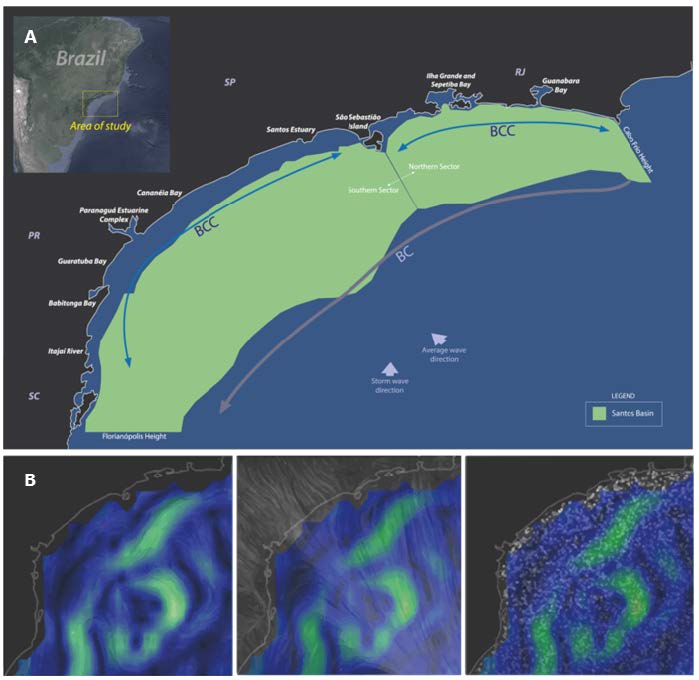 Caption: (A) Map of the Santos Basin (SB) detailing the passage of the Brazilian Current (BC), the Brazilian Coastal Current (BCC), and the direction of the winds; (B) Images of ocean currents, winds and waves, respectively, acting in the Santos Basin, on the afternoon of July 7, 2023. Source: (A) Modified from Dos Santos Filho et al. (