Influence of Tubastraea spp. coverage (Scleractinia: Dendrophylliidae) on mollusc assemblage structure of artificial substrata in Brazil
ABSTRACT
The conservation of marine biodiversity faces significant challenges, especially with the introduction of exotic species such as Tubastraea corals, which can significantly impact ecosystems. This study was conducted in Todos-os-Santos Bay, Brazil, between 2019 and 2023 and investigated how different Tubastraea coverage levels influence the diversity and composition of molluscan micro- and macrofauna. Ten subtidal sampling stations with artificial substrates were surveyed, and Tubastraea coverage was classified into four categories: “Absent”, “Low”, “Medium”, and “High”, using quadrats for evaluation. We collected all organisms that could easily be removed from substrates within quadrats, and the delimited area was scraped. After quantifying and identifying the organisms in the laboratory, we used ecological descriptors involving univariate and multivariate analyses to verify the influence of coral cover on mollusc assemblages. We collected 9,085 specimens belonging to 81 taxa and 46 families of Bivalvia, Gastropoda, and Polyplacophora, with greater diversity and abundance of bivalves and gastropods such as Chama, Isognomon, and Caecum. Although the generalized linear mixed model showed no significant variations in ecological descriptors across categories, PERMANOVA analysis revealed differences in mollusc assemblage structures based on composition and abundance. Despite the expected negative impact of sun coral on benthic invertebrate diversity, no significant changes were observed in mollusc species richness, abundance, or diversity. While community structure was altered, the presence of Tubastraea spp. did not appear to have affected the malacofauna, which possibly benefited from the heterogeneity of the substrate provided by the corals. However, space competition among sessile species could intensify long-term threats to bivalves. We also highlight the need to define clear metrics to assess the impact of sun coral on local biodiversity and to adopt diversified methodological approaches that account for marine invertebrate groups with different lifestyles and sizes.
Keywords:
Sun coral; Invasive species; Malacofauna; Community structure
INTRODUCTION
Biodiversity conservation has become an urgent challenge due to increasing environmental disturbances that directly and indirectly impact oceans and, consequently, marine biota (Chen, 2021). Growing coastal urbanization and the increasing demand for ecosystem services in coastal areas have led to numerous degradation processes, including habitat destruction, pollution, and overexploitation of marine resources, resulting in biodiversity loss (Sala & Knowlton, 2006; Todd et al., 2019). Biological invasions, often linked to anthropic activities, alter biodiversity and ecosystem services in invaded areas (Corrales et al., 2020; Hobbs et al., 2009; Lolis et al., 2023). Such events occur when species establish populations outside their original distribution area; due to the reproductive success, high abundances, and fast range expansion, non-native organisms can generate multiple negative impacts on regional ecology, economy, and public health (Carlton, 2002). Well-defined metrics of these impacts are essential to characterize bioinvaders.
The introduction of exotic species into new geographical areas may gradually alter and reshape the pre-existing structure of local communities (Ojaveer et al., 2018; Pires-Teixeira et al., 2021). In other words, it may trigger cascade effects by displacing native species, causing population declines, and altering the composition of recipient communities (Lolis et al., 2023; Molnar et al., 2008).
The Brazilian coast (South Tropical Atlantic), has one of the highest global rates of non-native species introduction, with around 140 non-native marine species - 19 of which are considered invasive (Ferreira et al., 2009; Teixeira & Creed, 2020). In recent decades, exotic scleractinians of the genus Tubastraea (sun corals) have become widespread in the Atlantic Ocean, raising concerns and gaining prominence in ecological and taxonomic research (Bastos et al 2022; Dutra et al., 2023; Serra et al 2023). Originally from the Indo-Pacific, they were first recorded in Brazil in the late 1980s on oil and gas platforms in colder waters off the southeastern coast. They are now distributed along a ~3,400km of coastline, occurring in natural shallow-water environments such as rocky and coral reefs, as well as in biofouling on artificial substrates (Castro & Pires, 2001; Miranda et al., 2022). Based on thorough morphological investigations, Serra et al. (2024) described four new sun coral species from Brazil: T. columnata, T. ramosa, T. grandidentata, and T. megalostoma. Given the ecological relevance of sun corals, understanding their impact and role in artificial ecosystems is crucial.
Interaction patterns of Tubastraea with native species communities along the Brazilian coast remain controversial, as studies indicate both negative impacts on benthic diversity and maintenance of richness on artificial substrates (Guilherm et al., 2020; Luz & Kitahara, 2017; Miranda et al., 2016; Tanasovici et al., 2022). Research on the impacts of sun corals on native communities have so far focused on sessile invertebrates, while information on major biofouling groups remains scarce, particularly for mobile organisms (Silva et al., 2023; Silva et al., 2019). Therefore, this study provides pioneer data on sun coral cover in subtidal malacofauna environments, encompassing molluscs of different body sizes (micro- and macro-molluscs) and mobility (sessile and vagile organisms). Molluscs are valuable functional groups for evaluating ecosystem changes caused by natural or anthropogenic events, also being good indicators of biodiversity and used as monitoring tools worldwide (Appeltans et al., 2012; Bedulli et al., 2002).
To determine whether different levels of sun coral cover (0%=absence, 1-20%=low, 40-60%=medium, and 80-100%=high) influenced the richness, density, and composition of malacofauna, we tested two hypotheses: (1) increasing Tubastraea cover would decrease the richness and diversity of mollusc species, and (2) the composition of mollusc species would vary according to Tubastraea cover.
METHODS
STUDY AREA AND FIELD SAMPLING
Todos-os-Santos Bay (TSB), the largest bay in Brazil, has an area of 1,233 km² and encompasses mangroves, coral reefs, estuaries, and tidal flats. Due to its high biodiversity and ecological importance, the TSB Environmental Protection Area (APA) was created in 1999; however, no management plan has been developed to date. The bay is under increasing anthropic pressure, housing several ports and petrochemical shipyards (Hatje & Barros, 2021).
With a reduced fresh water supply caused by a large dam on the Paraguaçu River, TSB exhibits predominantly marine characteristics, with water circulation dominated by tides. The climate is humid tropical with a well-defined seasonal cycle: high salinity and water temperatures, with easterly and northeasterly winds during the summer, while winter is marked by heavier rainfall, lower salinity and water temperatures, and southerly and southeasterly winds (Cirano & Lessa, 2007; Santana et al., 2018).
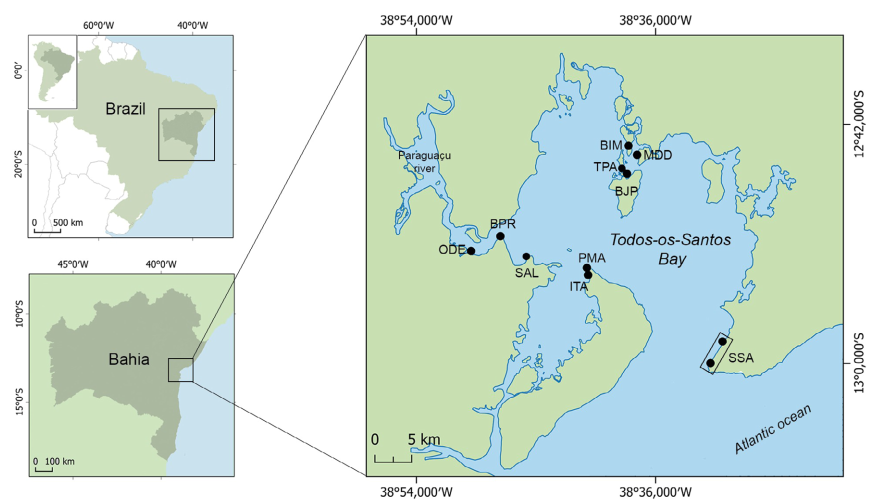
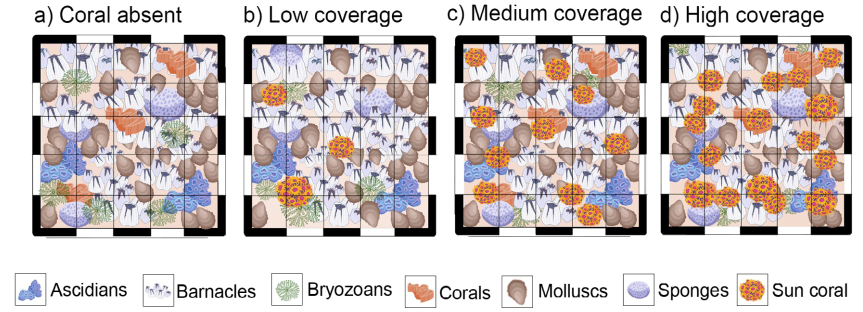
Sampling was conducted between 2019 and 2023 at ten sampling stations distributed throughout TSB (Figure 1, Table 1), using SCUBA diving exclusively during daytime. Tidal conditions varied on sampling days and were adjusted to ensure optimal visibility at each site, in accordance with available logistics. Mapping of the area indicated that the main sun coral populations occurred on artificial substrates, including piers, marinas, and shipyards of variable materials (e.g., wood, concrete, polymer fibers). To select sampling areas, we used sun coral coverage on artificial structures, categorized as “absent”, “low”, “medium”, and “high.” Coverage was determined using a PVC quadrat (0.25m²) divided into 25 equal subunits. We counted subunits containing coral colonies (Figure 2) and classified them as follows: (1) ‘low’ - up to five subunits (1-20%), (2) ‘medium’ - 10-15 subunits (40-60%), and (3) ‘high’ - over 20 subunits (80-100%). We also classified quadrats without sun coral colonies as ‘absent‘ (0%) (Figure 2).
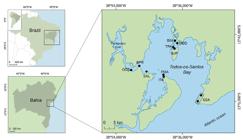
Sampling sites in Todos-os-Santos Bay, Bahia, Brazil. BIM: Bimbarras Island; BJP: Bom Jesus dos Passos Island; BRP: Barra do Paraguaçú Island; ITA: Marina de Itaparica, Itaparica Island; MDD: Madre de Deus Island; PMA: Magnetic Measurement Station, Itaparica Island; ODE: Private shipyard, Maragogipe; TPA: Terminal dos Passos; SAL: Salinas das Margaridas; SSA: Private Terminal, Salvador
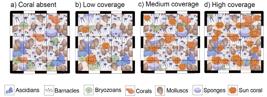
Schematic drawing of sun coral coverage at sampling stations in TSB. a) Coral absent; b) Low coverage; c) Medium coverage; d) High coverage. Symbols exemplify the main taxonomic groups identified, without detailing total area diversity.
Quadrats were placed either vertically (upright) or inverted (upside down), depending on the type of artificial structure, within the sublittoral region at depths ranging from 0m for floating piers to 10m for pier columns. At each site, coverage categories were recorded in triplicate whenever possible; however, in some areas, one or more coverage categories could not be replicated.
After selecting and delimiting the area according to the coverage category, PVC quadrats were photographed, and all sun coral colonies were removed using a hammer and chisel. Other sessile organisms (i.e., corals, molluscs, sponges, ascidians, and bryozoans) surrounding the colonies within the same quadrat were removed and stored separately. The entire area delimited by the quadrat was then scraped. All individualized sessile organisms were immediately labelled, photographed, and fixed in absolute alcohol, while the scraped material was fixed in a 4% formalin solution.
The sampling stations exhibited different abiotic characteristics depending on their location within the bay. For example, proximity to river mouths and pollution sources influences water parameters such as turbidity, salinity, pH, and dissolved organic matter. Nevertheless, our goal was to maximize sampling in areas where sun corals occur in TBS.
LABORATORY PROCEDURES
In the laboratory, we washed samples under a 100 µm mesh sieve, covering a wide range of shell sizes, including macro- and micro-molluscs. Organisms retained on the sieve were then sorted under a stereoscopic microscope and stored in jars with 70% alcohol for subsequent identification.
Species identification was based on specialized literature, including identification keys (i.e., Mikkelsen & Bieler, 2021; Rios, 2009), and the support of expert taxonomists. Corals and molluscs were deposited in scientific collections of the Natural History Museum of the Federal University of Bahia (UFBA), the National Museum of the Federal University of Rio de Janeiro (MN/UFRJ), and the Zoology Museum of the University of Sao Paulo (MZUSP).
STATISTICAL ANALYSIS
To assess malacofauna diversity, we used three traditional ecological descriptors: Abundance (N), Richness (S or total number of taxa), and Shannon-Wiener Diversity (H’ using natural logarithms), calculated from absolute abundance values. Richness was estimated using the ’specnumber’ function, and the Shannon index using the ‘diversity’ function, both from the ‘vegan’ package (Oksanen et al., 2013).
We employed a Generalized Linear Mixed Model (GLMM) to evaluate differences in diversity parameters across sun coral cover categories, which were treated as a fixed factor, while the sampling site was treated as a random factor. Due to high heteroscedasticity, we used a negative binomial distribution to model data for richness and abundance. A Gaussian distribution was applied to the Shannon diversity index, incorporating a variance modeling term. All mixed-effect models were performed with the glmmTMB package (Brooks et al., 2017) in the R platform (R Core team 2024).
Two-Way Permutational Multivariate Analysis of Variance (PERMANOVA) (Anderson, 2001) was conducted to assess significant differences in mollusc assemblage structure across sun coral cover levels and among sampling sites. A Hellinger-transformed distance matrix was employed for the analysis. Since this study focused on differences among cover scenarios rather than sampling sites, we conducted pairwise comparisons using 9,999 permutations to identify which specific pairs differed significantly. PERMANOVA was conducted using the ‘vegan’ package (Oksanen et al., 2013), while pairwise comparisons were conducted using the ‘pairwiseAdonis’ package (R Package Documentation, 2017) in the R software.
We also used SIMPER similarity percentages analysis (Clarke, 1993) to identify which species contributed most to the dissimilarity between groups identified in pairwise comparisons. To visualize the contribution of relative abundance to species dissimilarity, we generated nMDS bubble plots based on the Bray-Curtis similarity matrix, after transforming abundance data into log (x+1). This analysis is performed using PRIMER v. 7 (Anderson et al., 2008).
RESULTS
A total of 9,085 mollusc specimens, belonging to 81 taxa across 46 families and three classes - Bivalvia, Gastropoda, and Polyplacophora - were collected in the four sun coral categories at all sampling stations in TSB (Supplementary Material).
Regarding abundance, bivalves were the most numerous, totaling 4,770 individuals (52.5% of the overall count), followed by Gastropods with 4,309 individuals (47.4%), and polyplacophorans with only six individuals (0.1%). As for species richness, gastropods were the most diverse with 56 taxa, bivalves included 24 taxa, and polyplacophorans were represented by a single species.
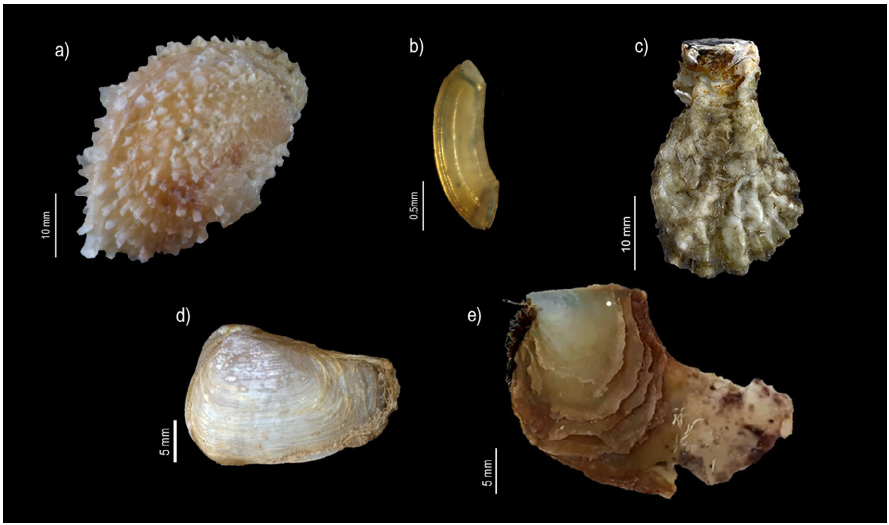
The gastropod Caecum ryssotitum (Folin, 1867) was the most abundant species, with 2,406 individuals, followed by the bivalves Chama congregata (Conrad, 1833) (1,134 individuals), Sphenia fragilis (H. Adams & A. Adams, 1854) (742 individuals), Isognomon bicolor (C. B. Adams, 1845) (728 individuals), and Saccostrea cuccullata (Born, 1778) (578 individuals) (Figure 3). These five species accounted for over half of the total abundance (61.5%).

Abundant mollusc species found on artificial substrate in Todos-os-Santos Bay. a) Chama congregata; b) Caecum ryssotitum; c) Saccostrea cuccullata; d) Sphenia fragilis; e) Isognomon bicolor.
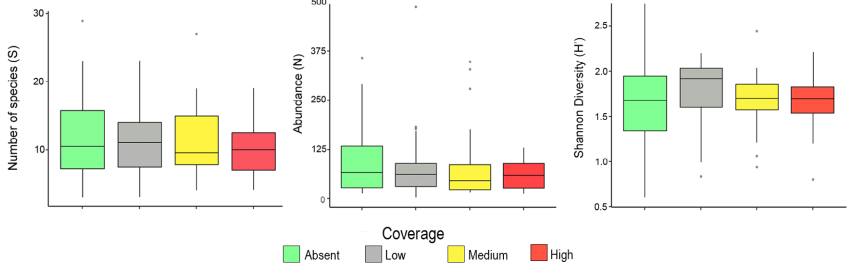
The highest average richness and abundance values were recorded in the 0% cover category, while the lowest occurred in the 80-100% category. Conversely, Shannon diversity was highest in the 1-20% category (Table 2, Figure 4). However, no statistically significant differences were identified among ecological descriptors in the four Tubastraea coverage categories.
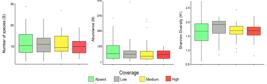
Diversity and abundance of mollusc assemblages in different sun coral covers on artificial structures in Todos-os-Santos Bay. (A) Species richness; (B) Abundance; (C) Shannon diversity
The two-factor PERMANOVA revealed significant differences in mollusc assemblage structure among the four coral categories (F=2.69, df=3; p=0.000) (Table 2). Pairwise comparisons indicated differences in composition and abundance between absent and medium cover categories (p=0.028) and between absent and high cover categories (p=0.012).
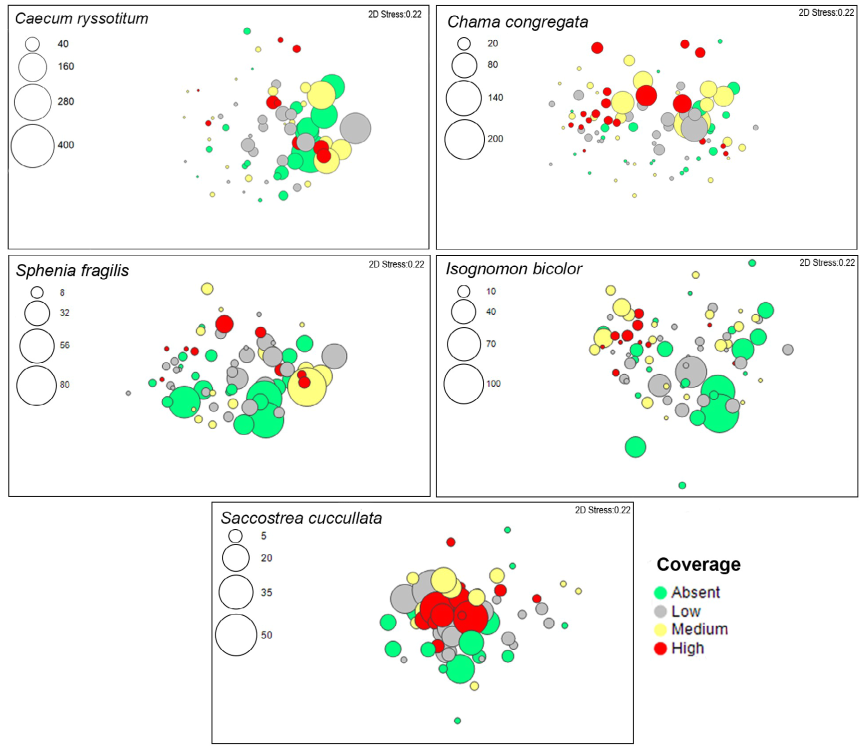
The five most abundant species were also the primary contributors (accumulated percentage of approximately 40%) to group dissimilarity indicated by pairwise PERMANOVA comparisons (Table 2). SIMPER analysis revealed that C. ryssotitum was the main species driving dissimilarity. This gastropod was present in all coverage categories, with considerably higher abundance in the absent category compared to medium and high coverages (Table 3, Figure 5). Similar patterns were observed for the bivalves I. bicolor and S. fragilis. For the bivalve C. congregata, the second most important contributor to dissimilarity, the highest average abundances occurred in the 80-100% and 40-60% cover categories. The oyster S. cuccullata also contributed to group dissimilarity, with lower abundance in the 0% cover category compared to the 80-100%, and higher abundance in the 40-60% category. Abundance distributions for these five species are shown in Figure 5.
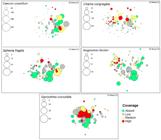
Non-metric multidimensional scaling (nMDS) bubble plots showing the contribution of species abundance (five previously selected by the SIMPER analysis) to dissimilarity patterns observed between coral coverages. The size of each bubble represents species abundance.
SIMPER analysis results showing average abundances and similarity of species that most contributed to group dissimilarity. Abund., average abundance; Av. Diss., average dissimilarity; Cum. %, cumulative percentage contribution to group similarity. (Cum%+-40% cut-off).
DISCUSSION
In this study, we examined the relationship between Tubastraea cover and mollusc assemblages on multiple artificial structures situated in the largest bay in the South Atlantic. Several studies have demonstrated that exotic species can negatively impact the abundance and distribution of native species, broadly influencing the functioning of ecosystems (Gallardo et al., 2015; Pires-Teixeira et al., 2021; Ruiz et al., 1997). Accordingly, the increasing density of an exotic organism is generally expected to reduce benthic invertebrate diversity, including molluscs (Mizrahi et al., 2017; Silva et al., 2019). However, our results did not support this expectation, as malacofauna richness, abundance, and diversity did not differ significantly among sun coral coverage categories. Nevertheless, differences in community structure were detected.
Our results are supported by previous studies showing that some community descriptors are not negatively affected by sun coral, with diversity, richness, and evenness indices remaining neutral or even increasing at high sun coral densities (Lages et al., 2011; Tanasovici et al., 2022; Vançato et al., 2023). These studies have highlighted that ecosystem-engineering species, such as Tubastraea, can create microhabitats (Guilhem et al., 2020). Additionally, it has been stated that such ecological descriptors may be sensitive to the invasion stage (Tanasovici et al., 2022). In contrast, Silva et al. (2019), investigating the effects of sun coral coverage on mobile invertebrates inhabiting natural substrata, including molluscs, reported that species richness is significantly lower in areas close to sun coral saturation. While some crustacean species were likely excluded under these conditions, no effect was observed on gastropods or bivalves.
Variation in the composition of mollusc species among different cover categories suggests that the malacofauna structure can be influenced by small-scale substrate heterogeneity. As Tubastraea colonies coverage intensifies, invertebrate groups that serve as secondary substrate are replaced, which can directly and indirectly impact associated benthic fauna (Lages et al., 2011; Tanasovici et al., 2022). In the ‘absent’ cover category, we found great diversity of other sessile invertebrates, such as sponges, octocorals, bryozoans, and ascidians (pers. observ.), which provide greater heterogeneity and structural complexity to the consolidated substrate, favoring the establishment of other organisms (Chin et al., 2020; Galván-Villa et al., 2023; Lombardi et al., 2020). The variety of architectures and body plans offers associated fauna food resources, protection from predators, and shelter from extreme physical conditions (Pádua et al., 2022; Sedano et al., 2020).
Several mollusc species, especially micro-molluscs, are associated with biofouling. The microgastropod Caecum ryssotitum, with a body size ranging of 1-5mm, was the most abundant and influential species in shaping malacofauna structure on artificial structures in TSB. Laboratory analysis revealed that C. ryssotitum was often associated with the octocoral Carijoa riisei and various sponge and bryozoan species, which were more frequent and occurred at higher densities in the absence of sun corals. With an elongated and tubular shell, this species belongs to the Caecidae family, has herbivorous and detritivorous feeding habits, and exhibits a wide distribution in tropical regions, inhabiting the interstices of unconsolidated substrates, mangrove roots, and coral and sandstone reefs (Mello & Maestrati, 1986; Rios, 2009; Silva & Castro, 2014; Costa et al., 2021). High abundances of C. ryssotitum have also been reported in macroalgae, indicating that the species benefits from microhabitats and sediments accumulated on algal stalks (Bandeira, 2019; Leite et al., 2009; Oliveira et al., 2003).
The bivalve Isognomon bicolor, a well-established invasive species on the Brazilian coast (Brahim et al., 2024), was also abundant, especially in the absence of sun corals. Although this species is known for forming extensive banks (Bezerra et al., 2022), it did not form large aggregations on artificial structures in TSB, but was frequently associated with other invertebrates, including Tubastraea colonies.
Space is a limiting resource for sessile epibenthic species; however, sessile bivalves Chama congregata and Saccostrea cuccullata contributed more in the medium and high coverage categories of Tubastraea. Nonetheless, both species occurred across all coral coverage levels. Known as the jewel box bivalve, Chama congregata, the most abundant bivalve, is frequently found in shallow-water environments and is often dominant on artificial substrates (Bezerra et al., 2022; Lira et al., 2010; Rios, 2009). The invasive oyster Saccostrea cuccullata was recently recorded in TBS, living in epibiotic association with Tubastraea species (Brahim et al., 2024). Coexisting invasive species that interact or compete with each other can be difficult to identify (Hoeksema et al., 2024). In TSB, sun corals show high adaptability by exploiting other species, such as barnacles and oyster shells, as alternative substrate (Brahim et al., 2024). It is likely that biofilm formed on the shells of calcifying organisms provides a favorable settlement cue for larvae, promoting sun coral epibiosis. Moreover, the coral epibiont may protect the basibiont from predators, characterizing a mutualistic interaction.
Conversely, where corals and bivalves overlapped at the highest densities, competition is expected. Competition among sessile invertebrates is a complex phenomenon that affects ecological dynamics and species interactions, influencing biodiversity patterns (Chang & Marshall, 2016). Given Tubastrea’s high competitive efficiency (Lages et al., 2011; Sammarco et al., 2015), it is expected that increased coral cover would cause the exclusion of sessile bivalves by means of space competition, but this was not observed. Although Tubastraea demonstrates competitive dominance over other sessile organisms such as native corals (Barbosa et al., 2019; Creed, 2006; dos Santos et al., 2013) and zoanthids (Luz & Kitahara, 2017), we observed no interference in mollusc settlement or growth.
Therefore, despite potential effects of environmental variability, our investigation of malacofauna on various artificial structures in TSB indicates that different Tubastraea coverages (i.e., spatial area occupied) do not influence mollusc diversity.
CONCLUSION
Our results provide unprecedented data on mollusc assemblages in response to Tubastraea colonies in artificial environments. Although sun coral has been suggested to cause ecological changes in invaded areas, its long-term effects remain unclear. Another important and often overlooked aspect is the ecological interaction among exotic organisms. Given the contradictory findings in the literature, metrics to assess whether sun corals and other non-native invertebrates lead to competitive exclusion or biodiversity loss must be clearly defined. Regarding Tubastraea, it is necessary to adopt different methodological approaches and consider multiple taxonomic groups with varied lifestyles, mobility, and body sizes to better understand interactions with native fauna (e.g., empty niche hypothesis, epibiotic behavior) and the ongoing positive or negative impacts on biodiversity.
DATA AVAILABILITY STATEMENT
The data that support the findings of this study are available from the corresponding author.
SUPPLEMENTARY MATERIAL
Supplementary data to this article (Table S1. Molluscs species and average abundance in the “Absent”, “Low”, “Medium” and “High” sun coral coverage) can be found online at Zenodo. https://doi.org/10.5281/zenodo.17159938
Table S1
ACKNOWLEDGMENTS
We thank the LABIMAR team for their support in sampling and laboratory procedures, and Dr. Alexandre D. Pimenta and Dr. Vanessa S. Amaral for their assistance in identifying the organisms. We also express our gratitude to the reviewers for their valuable comments and suggestions, which significantly improved this manuscript.
REFERENCES
-
Anderson, M. J. 2001. Permutation tests for univariate or multivariate analysis of variance and regression. Canadian Journal of Fisheries and Aquatic Sciences, 58(3), 626-639. DOI: https://doi.org/10.1139/f01-004
» https://doi.org/10.1139/f01-004 - Anderson, M. J., Gorley, R. N. & Clarke, R. K. 2008. PERMANOVA+for PRIMER: guide to software and statistical methods. Ivybridge, PRIMER-E.
-
Appeltans, W., Ahyong, S. T., Anderson, G., Angel, M. V., Artois, T., Bailly, N., ... & Costello, M. J. 2012. The magnitude of global marine species diversity. Current Biology, 22(23), 2189-2202. DOI: https://doi.org/10.1016/j.cub.2012.09.036
» https://doi.org/10.1016/j.cub.2012.09.036 - Bandeira, Ê. V. P. 2019. Malacofauna associada a rodolitos da plataforma continental na costa oeste do estado do Ceará, Brasil (Mestrado em Ciências Marinhas Tropicais). Fortaleza: Universidade Federal do Ceará.
-
Barbosa, A. C. C., Vinagre, C., Kitahara, M. V. & Flores, A. A. V. 2023. Priority effects, environmental filtering and neutral coexistence explain large-to small-scale distribution of invasive sun corals in the SW Atlantic. Marine Ecology Progress Series, 707, 31-42. DOI: https://doi.org/10.3354/meps
» https://doi.org/10.3354/meps -
Bastos, N., Calazans, S. H., Altvater, L., Neves, E. G., Trujillo, A. L., Sharp, W. C., Hoffman, E. & Coutinho, R. 2022. Western Atlantic invasion of sun corals: incongruence between morphology and genetic delimitation among morphotypes in the genus Tubastraea. Bulletin of Marine Science, 98(2), 187-210. DOI: http://dx.doi.org/10.5343/bms.2021.0031
» http://dx.doi.org/10.5343/bms.2021.0031 -
Bedulli, D., Bassignani, F. & Bruschi, A. 2002. Use of biodiversity hotspots for conservation of marine molluscs: A regional approach. Mediterranean Marine Science, 3(2), 113-121. DOI: http://dx.doi.org/10.12681/mms.250
» http://dx.doi.org/10.12681/mms.250 - Bezerra, D. F., Franklin Jr, W., Spotorno, P. & Rocha-Barreira, C. D. A. 2022. Molluscan assemblages on artificial structures: A bioinvasion perspective from Northeast Brazilian ports. Aquatic Invasions, 17(4), 494-515.
- Brahim, S., Amaral, V. S., Johsson, R. & Neves, E. G. 2024. Interaction of non-native bivalves and exotic dendrophylliid corals (Scleractinia, Dendrophylliidae) in the Brazilian Northeast coast. Pan-American Journal of Aquatic Sciences, 19(2), 69-81.
-
Brooks, M. E., Kristensen, K., van Benthem, K. J., Magnusson, A., Berg, C. W., Nielsen, A. & Bolker, B. M. 2017. glmmTMB balances speed and flexibility among packages for zero-inflated generalized linear mixed modeling. The R Journal, 9(2), 378-400. DOI: https://doi.org/10.32614/RJ-2017-066
» https://doi.org/10.32614/RJ-2017-066 - Carlton, J. T. 2002. Bioinvasion ecology: assessing invasion impact and scale. In: Leppäkoski, E., Gollasch, S., Olenin, S. (Ed.). Invasive aquatic species of Europe. Distribution, impacts and management (pp. 7-19). Dordrecht: Springer Netherlands.
- Castro, C. B. & Pires, D. O. 2001. Brazilian coral reefs: What we already know and what is still missing. Bulletin of Marine Science, 69(2), 357-371.
-
Chang, C. Y. & Marshall, D. J. 2016. Spatial pattern of distribution of marine invertebrates within a subtidal community: Do communities vary more among patches or plots? Ecology and Evolution, 6(22), 8330-8337. DOI: https://doi.org/10.1002/ece3.2462
» https://doi.org/10.1002/ece3.2462 -
Chen, E. Y. S. 2021. Often overlooked: Understanding and meeting the current challenges of marine invertebrate conservation. Frontiers in Marine Science, 8, 690704. DOI: https://doi.org/10.3389/fmars.2021.690704
» https://doi.org/10.3389/fmars.2021.690704 -
Chin, Y. Y., Prince, J., Kendrick, G. & Wahab, M. A. A. 2020. Sponges in shallow tropical and temperate reefs are important habitats for marine invertebrate biodiversity. Marine Biology, 167(164). DOI: https://doi.org/10.1007/s00227-020-03771-1
» https://doi.org/10.1007/s00227-020-03771-1 -
Cirano, M. & Lessa, G. C. 2007. Oceanographic characteristics of Baía de Todos os Santos, Brazil. Revista Brasileira de Geofísica, 25(4), 363-387. DOI: https://doi.org/10.1590/S0102-261X2007000400002
» https://doi.org/10.1590/S0102-261X2007000400002 -
Clarke, K. R. 1993. Non‐parametric multivariate analyses of changes in community structure. Australian Journal of Ecology, 18(1), 117-143. DOI: https://doi.org/10.1111/j.1442-9993.1993.tb00438.x
» https://doi.org/10.1111/j.1442-9993.1993.tb00438.x - Corrales, X., Katsanevakis, S., Coll, M., Heymans, J. J., Piroddi, C., Ofir, E. & Gal, G. 2020. Advances and challenges in modelling the impacts of invasive alien species on aquatic ecosystems. Biological Invasions, 22(3), 907-934.
-
Costa, F. M. P., Pires-Vanin, A. M. S. & Lima, S. F. B. 2021. Caecidae (Gastropoda: Truncatelloidea) associated with unconsolidated carbonate substrates of the Abrolhos coral bank (Bahia State, Brazil). American Malacological Bulletin, 38(2), 10-15. DOI: http://dx.doi.org/10.4003/006.038.0202
» http://dx.doi.org/10.4003/006.038.0202 - Creed, J. C. 2006. Two invasive alien azooxanthellate corals, Tubastraea coccinea and Tubastraea tagusensis, dominate the native zooxanthellate. Mussismilia hispida in Brazil. Coral Reefs, 25(3), 350-350.
- Dutra, B. S. V. M., Carlos-Júnior, L. A. & Creed, J. C. 2023 When species become invasive, research becomes problem-oriented: A synthesis of knowledge of the stony coral Tubastraea. Biological Invasions, 25, 2069-2088.
- Ferreira, C. E. L., Junqueira, A. O. R., Villac, M. C. & Lopes, R. M. 2009. Marine bioinvasions in the Brazilian coast: Brief report on history of events, vectors, ecology, impacts and management of non-indigenous species. In: Rilov, G. & Crooks, J. A. (Ed.). Biological invasions in marine ecosystems: Ecological, management, and geographic perspectives (pp. 459-477). Berlim: Springer.
-
Gallardo, B., Clavero, M., Sánchez, M. I. & Vilà, M. 2016. Global ecological impacts of invasive species in aquatic ecosystems. Global Change Biology, 22(1), 151-163. DOI: https://doi.org/10.1111/gcb.13004
» https://doi.org/10.1111/gcb.13004 -
Galván-Villa, C. M., Tovar-Hernández, M. A., Rodríguez-Zaragoza, F. A., Esqueda-González, M. D. C., Sánchez-Rodríguez, J. & Ríos-Jara, E. 2023. Effect of the alien octocoral Carijoa riisei on benthic fauna assemblages on natural and artificial substrates. Marine Ecology, 44(4), e12756. DOI: https://doi.org/10.1111/maec.12756
» https://doi.org/10.1111/maec.12756 -
Guilhem, I. F., Masi, B. P. & Creed, J.C. 2020. Impact of invasive Tubastraea spp. (Cnidaria: Anthozoa) on the growth of the space-dominating tropical rocky-shore zoantharian Palythoa caribaeorum (Duchassaing and Michelotti, 1860). Aquatic Invasions, 15(1), 19-29. DOI: http://dx.doi.org/10.3391/ai.2020.15.1.07
» http://dx.doi.org/10.3391/ai.2020.15.1.07 -
Hatje, V. & Barros, F. 2012. Overview of the 20th century impact of trace metal contamination in the estuaries of Todos os Santos Bay: Past, present and future scenarios. Marine Pollution Bulletin, 64(11), 2603-2614. DOI: https://doi.org/10.1016/j.marpolbul.2012.07.009
» https://doi.org/10.1016/j.marpolbul.2012.07.009 -
Hobbs, R. J., Higgs, E. & Harris, J. A. 2009. Novel ecosystems: Implications for conservation and restoration. Trends in Ecology & Evolution, 24(11), 599-605. DOI: https://doi.org/10.1016/j.tree.2009.05.012
» https://doi.org/10.1016/j.tree.2009.05.012 -
Hoeksema, B. W., Samimi-Namin, K. & Vermeij, M. J. 2024. Neutral interactions among three nonindigenous coral species in a tropical marine fouling community. Ecology, 105(8), e4371. DOI: https://doi.org/10.1002/ecy.4371
» https://doi.org/10.1002/ecy.4371 -
Lages, B. G., Fleury, B. G., Menegola, C. & Creed, J.C. 2011. Change in tropical rocky shore communities due to an alien coral invasion. Marine Ecology Progress Series, 438, 85-96. DOI: http://dx.doi.org/10.3354/meps09290
» http://dx.doi.org/10.3354/meps09290 - Leite, F. P., Tambourgi, M. R. & Cunha, C. M. 2009. Gastropods associated with the green seaweed Caulerpa racemosa, on two beaches of the Northern coast of the State of São Paulo, Brazil. Strombus, 16(1/2), 1-10.
-
Lira, S. M. D. A., Farrapeira, C. M. R., Amaral, F. M. D. & Ramos, C. A. C. 2010. Sessile and sedentary macrofauna from the Pirapama Shipwreck, Pernambuco, Brazil. Biota Neotropica, 10(4), 155-165. DOI: https://doi.org/10.1590/S1676-06032010000400021
» https://doi.org/10.1590/S1676-06032010000400021 -
Lolis, L. A., Miranda, R. J. & Barros, F. 2023. The effects of an invasive soft coral on the structure of native benthic communities. Marine Environmental Research, 183, 105802. DOI: https://doi.org/10.1016/j.marenvres.2022.105802
» https://doi.org/10.1016/j.marenvres.2022.105802 -
Lombardi, C., Taylor, P. D. & Cocito, S. 2020. Bryozoans: The ‘forgotten’ bioconstructors, In: Rossi, S., Bramanti, L. (Ed.). Perspectives on the marine animal forests of the world (pp. 193-217). Berlim: Springer. DOI: https://doi.org/10.1007/978-3-030-22283-7_10
» https://doi.org/10.1007/978-3-030-22283-7_10 - Luz, B. L. P. & Kitahara, M. V. 2017. Could the invasive scleractinians Tubastraea coccinea and T. tagusensis replace the dominant zoantharian Palythoa caribaeorum in the Brazilian subtidal? Coral Reefs, 36(3), 875.
- Mello, R. D. L. S. & Maestrati, P. 1986. A família Caecidae Gray, 1850 no nordeste do Brasil. Revista Brasileira de Zoologia, 3(1), 1-10.
- Mikkelsen, P. M. & Bieler, R. 2021. Seashells of southern Florida: living marine molluscs of the Florida Keys and adjacent regions: bivalves. Princeton, Princeton University Press.
- Miranda, R. J., Cruz, I. C. & Barros, F. 2016. Effects of the alien coral Tubastraea tagusensis on native coral assemblages in a southwestern Atlantic coral reef. Marine Biology, 163, 1-12.
-
Miranda, R. J., Pinto, T. K., Lopes, R. V., Santos, J. W., Sampaio, C. L., Santos, R. G., Pereira, P. H. C., Cardoso, A. T. C., Malhado, A. C. M. & Ladle, R. J. 2022. Oil spill disaster in Southwest Atlantic Coast: an evaluation of short-term effects on coral reef benthic assemblages. Anais da Academia Brasileira de Ciências, 94(suppl 2), e20210401. DOI: https://doi.org/10.1590/0001-3765202220210401
» https://doi.org/10.1590/0001-3765202220210401 - Mizrahi, D., Kitahara, M. V., Barbosa, A. C. & Flores, A. A. 2017. Possible interference competition involving established fish and a sun coral incursion. Marine Biodiversity, 47, 369-370.
-
Molnar, J. L., Gamboa, R. L., Revenga, C. & Spalding, M. D. 2008. Assessing the global threat of invasive species to marine biodiversity. Frontiers in Ecology and the Environment, 6(9), 485-492. DOI: https://doi.org/10.1890/070064
» https://doi.org/10.1890/070064 -
Ojaveer, H., Galil, B. S., Carlton, J. T., Alleway, H., Goulletquer, P., Lehtiniemi, M., Marchini, A., Miller, W., Occhipinti-Ambrogi, A., Peharda, M., Ruiz, G. M., Willliams, S. L. & Zaiko, A. 2018. Historical baselines in marine bioinvasions: Implications for policy and management. PLOS ONE, 13(8), e0202383. DOI: https://doi.org/10.1371/journal.pone.0202383
» https://doi.org/10.1371/journal.pone.0202383 - Oksanen, J., Blanchet, F. G., Kindt, R., Legendre, P., Minchin, P. R., O’Hara, R. B., ... & Oksanen, M. J. 2013. Package ‘vegan’. Community ecology package version, 2(9), 1-295.
- Oliveira, C. R. F., Matos, C. H. C. & Rocha, C. M. C. 2003. Microgastrópodes Caecidae associados às macroalgas Padina gymnospora (Kuetzing) Sonder e Hypnea musciformis (Wulfen) Lamouroux na praia de Candeias (Jaboatão dos Guararapes, PE). Revista Brasileira de Zoociências, 5(2).
-
Pádua, S. M. F., Botter-Carvalho, M. L., Gomes, P. B., Oliveira, C. S., Santos, J. C. P. & Pérez, C. D. 2022. The alien octocoral Carijoa riisei is a biogenic substrate multiplier in artificial Brazilian shipwrecks. Aquatic Ecology, 56(1), 183-200. DOI: https://doi.org/10.1007/s10452-021-09908-8
» https://doi.org/10.1007/s10452-021-09908-8 - Pires-Teixeira, L. M., Neres-Lima, V. & Creed, J.C. 2021. How do biological and functional diversity change in invaded tropical marine rocky reef communities? Diversity, 13(8), 353.
- Rios, E. C. 2009. Compendium of Brazilian Sea Shells. Rio de Janeiro, Evangraf.
-
R Package Documentation. 2020. pairwiseAdonis: Pairwise multilevel comparison using adonis. Available from: Available from: https://rdrr.io/github/gauravsk/ranacapa/man/pairwise_adonis.html Access date: 2025 Sep 7.
» https://rdrr.io/github/gauravsk/ranacapa/man/pairwise_adonis.html - Ruiz, G. M., Carlton, J. T., Grosholz, E. D. & Hines, A. H. 1997. Global invasions of marine and estuarine habitats by non-indigenous species: mechanisms, extent, and consequences. American Zoologist, 37(6), 621-632.
-
Sala, E. & Knowlton, N. 2006. Global marine biodiversity trends. Annual Review of Environment and Resources, 31, 93-122. DOI: https://doi.org/10.1146/annurev.energy.31.020105.100235
» https://doi.org/10.1146/annurev.energy.31.020105.100235 -
Sammarco, P. W., Porter, S. A., Genazzio, M. & Sinclair, J. 2015. Success in competition for space in two invasive coral species in the western Atlantic - Tubastraea micranthus and T. coccinea. PLOS ONE, 10(12), e0144581. DOI: https://doi.org/10.1371/journal.pone.0144581
» https://doi.org/10.1371/journal.pone.0144581 -
Santana, R., Teixeira, C. & Lessa, G. 2018. The impact of different forcing agents on the residual circulation in a tropical estuary (Baía de Todos os Santos, Brazil). Journal of Coastal Research, 34(3), 544-558. DOI: https://doi.org/10.2112/JCOASTRES-D-17-00044.1
» https://doi.org/10.2112/JCOASTRES-D-17-00044.1 -
Santos, L. A. H., Ribeiro, F. V. & Creed, J.C. 2013. Antagonism between invasive pest corals Tubastraea spp. and the native reef-builder Mussismilia hispida in the southwest Atlantic. Journal of Experimental Marine Biology and Ecology, 449(3), 69-76. DOI: http://dx.doi.org/10.1016/j.jembe.2013.08.017
» http://dx.doi.org/10.1016/j.jembe.2013.08.017 -
Sedano, F., Navarro-Barranco, C., Guerra-García, J. M. & Espinosa, F. 2020. Understanding the effects of coastal defence structures on marine biota: The role of substrate composition and roughness in structuring sessile, macro and meiofaunal communities. Marine Pollution Bulletin, 157, 111334. DOI: https://doi.org/10.1016/j.marpolbul.2020.111334
» https://doi.org/10.1016/j.marpolbul.2020.111334 -
Serra, S., Bastos, N., Coutinho, R., Schizas, N. V., Johnsson, R. & Neves, E. 2024. Four new species of Tubastraea (Scleractinia, Dendrophylliidae) from the Brazilian Coast, Southwestern Atlantic. Pan-American Journal of Aquatic Sciences, 19(2), 113-135. DOI: https://doi.org/10.1016/j.marpolbul.2020.111334
» https://doi.org/10.1016/j.marpolbul.2020.111334 - Serra, S., Neves, E. G., Alves, J. & Johnsson, R. 2023. A new blue Astrangia coral (Scleractinia) from the Southwestern Atlantic. Marine Biodiversity, 53(6), 78.
- Silva, A. R., Creed, J. C. & Tavares, M. 2023. Species diversity and abundance of mobile crustaceans associated with living and dead colonies of the invasive sun coral Tubastraea. Aquatic Ecology, 57(2), 529-541.
- Silva, C. C. D. & Castro, G. A. D. 2014. Caecidae gastropods found in beds of the mussel Perna perna (Bivalvia: Mytilidae), on the rocky shores of Benevente Bay, Espírito Santo State. Revista Brasileira de Zoologia, 31(1), 1-8.
- Silva, R., Vinagre, C., Kitahara, M. V., Acorsi, I. V., Mizrahi, D. & Flores, A. A. 2019. Sun coral invasion of shallow rocky reefs: Effects on mobile invertebrate assemblages in Southeastern Brazil. Biological Invasions, 21, 1339-1350.
-
Tanasovici, R. M., Dias, G. M., Kitahara, M. V. & Vieira, E. A. 2022. Enduring regardless of the conditions: Plasticity in modular growth as a strategy to cope with hydrodynamic variation by the invasive sun coral (Tubastraea spp.). Marine Environmental Research, 174, 105563. DOI: https://doi.org/10.1016/j.marenvres.2022.105563
» https://doi.org/10.1016/j.marenvres.2022.105563 - Teixeira, L. M. & Creed, J.C. 2020. A decade on: An updated assessment of the status of marine non-indigenous species in Brazil. Aquatic Invasions, 15(1), 30-43.
- Todd, P. A., Heery, E. C., Loke, L. H., Thurstan, R. H., Kotze, D. J. & Swan, C. 2019. Towards an urban marine ecology: Characterizing the drivers, patterns and processes of marine ecosystems in coastal cities. Oikos, 128(9), 1215-1242.
-
Vançato, Y. C. D. S. F., Creed, J. & Fleury, B. G. 2023. Community structure of shallow tropical reefs undergoing invasion by Tubastraea spp. in a Brazilian Marine Protected Area. Aquatic Invasions, 18(1), 39-57. DOI: https://doi.org/10.3391/ai.2023.18.1.102938
» https://doi.org/10.3391/ai.2023.18.1.102938
-
AI USE DISCLOSURE
The authors declare that no generative artificial intelligence (AI) tools were used in the preparation, writing, or editing of this manuscript.
-
FUNDING
This study is part of the project “Assessment and research of sun coral in Todos-os-Santos Bay”, a cooperation agreement between UFBA and PETROBRAS (No. 5850.0107361.18.9) regulated by RD&I investments clauses of the Brazilian Agency of Petroleum, Natural Gas and Biofuels (ANP Resolution 05/2015).