Strengthening ITF and weakening AMOC: time series evidence of trends and causal pathways to Agulhas variability
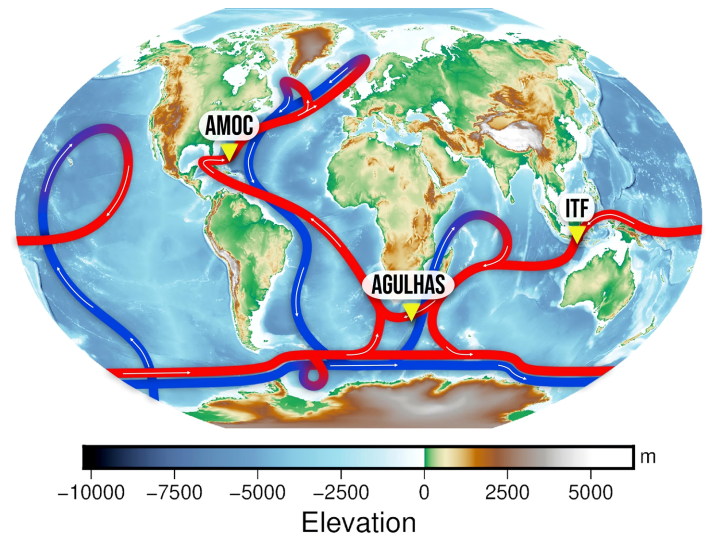
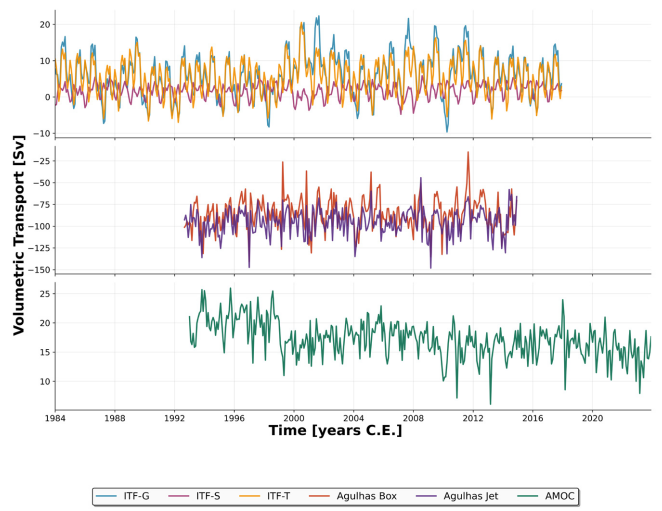
Multi-decadal observations and reanalysis products of major ocean circulation systems reveal contrasting trends and complex inter-basin connectivity patterns that challenge traditional conceptualizations of global ocean circulation. Using non-parametric trend analysis, multi-method causality testing, and wavelet coherence techniques, we analyzed volume transport time series spanning 1984-2023 for the Indonesian Throughflow (ITF), Agulhas Current system, and Atlantic Meridional Overturning Circulation (AMOC). The ITF demonstrates statistically significant strengthening, with geostrophic (ITF-G) and salinity (ITF-S) components increasing by 0.79 and 0.28 Sv decade-1, respectively (p<0.05). The temperature component (ITF-T) shows a positive but non-significant trend. Conversely, the AMOC at 26ºN from reanalysis exhibits robust weakening of -1.61 Sv decade-1 (p<0.0001), while satellite-derived Agulhas transport proxies show no significant long-term trends despite substantial interannual variability. Causality analysis reveals four statistically significant pathways linking ITF components to Agulhas variability with lag times of 0-18 months, supported by consensus across maximum cross-correlation, convergent cross mapping, and transfer entropy methods. However, no direct causal connections emerge between either Indo-Pacific system and the AMOC at 26ºN, indicating regional forcing dominance over global-scale coupling on observable timescales. Wavelet coherence analysis identifies dominant annual-scale coupling (0.87-1.30 years) in ITF-Agulhas relationships, with enhanced coherence during major climate events including the 1997-98 El Niño. These findings suggest that contemporary ocean circulation responds primarily to regional forcing mechanisms - intensified Maritime Continent rainfall driving ITF strengthening and weakened North Atlantic convection controlling AMOC decline - rather than operating as a tightly coupled global conveyor belt. The identified statistical relationships provide critical observational constraints for ocean circulation models and highlight the need for sustained monitoring as anthropogenic forcing continues to reshape ocean gateway dynamics.
Keywords:
Agulhas Current; Atlantic Meridional Overturning circulation; Indonesian throughflow; Ocean transport variability; Statistical causality
 Thumbnail
 Thumbnail
 Thumbnail
 Thumbnail
 Thumbnail
 Thumbnail