Way beyond its primary goal: a decade of scientific contributions from the world’s largest systematic beach survey program
ABSTRACT
The Projeto de Monitoramento de Praias (PMPs) in Brazil is the world’s largest marine tetrapod stranding monitoring program, covering over 3000 km of coastline. PMPs are organized as four monitoring programs, executed by a number of institutions, with the primary aim of assessing possible impacts of the oil and gas industry (O&G) on marine tetrapods. Since 2015, data recorded by all PMPs have been stored in a single database with public access. We undertook a literature review to gather all peer-reviewed publications from 2010-2023 using data from PMPs. We summarized 139 publications to investigate: (i) temporal trends in the number of publications; (ii) subject areas from those publications; (iii) taxonomic groups and species studied; (iv) the participation of non-executing institutions based on author affiliations. In addition, we explored whether species ranked higher in conservation assessments were more represented in the publications. Overall, the PMPs have a high number of publications considering their relatively recent implementation when compared to longer stranding monitoring programs. The open-access nature of the PMP database seems to be a catalyst for research, including one-third of publications being authored only by non-executing institutions. The program with the most publications was the PMP-BS (Bacia de Santos), which may result from a larger monitored area, higher numbers of strandings and research institutions than other monitoring programs, and higher mortality due to higher human density. The number of publications was similar across taxonomic groups (sea turtles, seabirds, and marine mammals), which together studied 61 species. Notably, the studies addressed a variety of topics, suggesting that PMPs contribute not only to monitor the impacts of the O&G, but also to increase our understanding of the distribution, ecology, and health of several species. Therefore, continuing PMPs is essential to monitor long-term trends, inform strategies, and support effective management of marine tetrapods.
Keywords:
Projeto de monitoramento de praias; Marine mammals; Sea turtles; Seabirds; Strandings
INTRODUCTION
Long-term biodiversity monitoring data play a crucial role in enhancing the understanding and management of ecological systems (Azzellino et al., 2017; Lindenmayer and Likens, 2009). These data can be used for detecting and assessing responses to disturbances and ecosystem changes (Gaiser et al., 2020) and exploring temporal patterns at the level of ecosystems, communities, populations, and genes (Magurran et al., 2010). Due to changes in major marine ecosystems caused by human activities (McCauley et al., 2015), such as bycatch, overexploitation, acoustic and chemical pollution, marine debris, and physical habitat destruction (Hooker and Gerber, 2004), there are growing concerns about marine life and its health (Claro et al., 2019). Therefore, monitoring human impacts as well as the environmental changes on wildlife has become increasingly urgent (IJsseldijk et al., 2020).
Marine tetrapods, such as sea turtles, seabirds, and marine mammals, have been used as sentinel species to assess ecosystem health (Hazen et al., 2019). Due to their primary oceanic habits, however, monitoring these species in situ can be costly. One strategy is to monitor stranded animals and carcasses, which provides a low-cost alternative to gather data on these oceanic species (Peltier et al., 2014; Pyenson, 2011) and allows great spatiotemporal coverage (IJsseldijk et al., 2020; Prado et al., 2023).
Systematically recording strandings can provide information on species richness and abundance (Coombs et al., 2019), diversity patterns (Pyenson, 2011), species distributions (Snell et al., 2023), mortality rates (Ijsseldijk et al., 2020), and population status (Paterson et al., 2021). These records also enable the comparison of time series (Prado et al., 2016, 2023), helping to identify unusual mortality events (Norman et al., 2004), and possible environmental threats (Pyke and Szabo, 2018). Additionally, stranding data can guide the establishment of conservation initiatives (Mghili et al., 2023) by determining ecological impacts, which subsequently inform and support the implementation of mitigation measures for local populations (Dudhat et al., 2022; Fernández et al., 2012; Gulland et al., 2025; Peltier et al., 2014). Gulland et al. (2025), for instance, summarized examples of scientific advances resulting from stranding studies that contributed to implementing conservation strategies of marine mammals, such as the ban on naval exercises in the Canary Islands following the detection of gas bubble disease in stranded beaked whales (Fernández et al., 2005, 2012). Therefore , systematic surveys are valuable tools for identifying patterns and trends of strandings (e.g., Prado et al., 2016, 2023), supporting the understanding of their underlying causes, and guiding the development of management proposals and conservation measures for marine tetrapods (Chou et al., 2024; Lennon et al., 2025).
Strandings result from a complex interplay of three major components on a regional-to-local scale: (i) biological, related to relative abundance and mortality rate (including both natural and anthropogenic causes); (ii) physical, which encompasses processes that determine carcass transport (e.g., tides, wind, currents, carcass buoyancy); and (iii) societal, which influences stranding reports (Azzellino et al., 2017; Norman et al., 2004; Peltier and Ridoux, 2015). Interpreting stranding records is challenging because observed results stem from multiple interacting processes among these components. Despite these limitations, analyzing strandings over large spatial scales and long time series can smooth down any skewed effects that one of these components might cause in the dataset, yielding insightful results (Peltier and Ridoux, 2015; Prado et al., 2023; Pyenson, 2010; Vianna et al., 2016). In addition, regardless of the scale of the analysis, accounting for effort within the spatial-temporal grain is arguably crucial to provide unbiased results based on stranding data (Authier et al., 2014; Prado et al., 2023).
In Brazil, long-term monitoring projects have contributed to academic research and the development of human resources (Cordeiro et al., 2022). The “Projetos de Monitoramento de Praias” (PMPs; acronym in Portuguese for Beach Monitoring Projects) are part of environmental monitoring programs required by the Brazilian Federal Institute for the Environment and Renewable Natural Resources (IBAMA) to grant permission for oil and gas exploration and production by PETROBRAS across four sedimentary basins (Brasil, 2011). The PMPs main goal is to assess the impacts of this commercial activity on marine tetrapods by systematically monitoring for carcasses and providing veterinary care for live stranded animals (Petrobras, 2023). The target fauna of the monitoring are tetrapods that occupy or depend on the marine environment for at least part of their life cycle, which includes sea turtles, seabirds, and marine mammals (Petrobras, 2023). The total area monitored by PMPs spans over 3000 km, monitored daily, weekly, or fortnightly, making it the largest systematic monitoring program of stranded animals in the world (Rosário et al., 2022). Although not yet considered a long-term project, their large-scale coverage over a decade represents an important initiative for monitoring marine tetrapods. Aiming to standardize the data collected by all institutions, since 2015, all records from PMPs are stored in the “Sistema de Informação de Monitoramento da Biota Aquática” (SIMBA; acronym in Portuguese for Aquatic Biota Monitoring Information System) (Petrobras, 2023). SIMBA works as a central repository for the data on individual records, specimens, laboratory analyses, and veterinary procedures (Petrobras, 2023). Noteworthy, SIMBA is freely and openly accessible to the public at https://simba.petrobras.com.br/simba/web/.
Brazil is home to several marine tetrapod species classified as nationally threatened, including four sea turtles, 25 seabirds, and nine marine mammals (ICMBio, 2025). Understanding spatiotemporal patterns of mortality is essential to assess the impacts on these species’ populations (IJsseldijk et al., 2020), and is recognized as key information for the “Planos de Ação Nacionais” (PANs; acronym in Portuguese for National Action Plans for the Conservation of Threatened Species) in Brazil (Rosário et al., 2022). In this context, PMPs can provide crucial data on threatened species, such as Pontoporia blainvillei and Sotalia guianensis, classified as Critically Endangered and Vulnerable nationally, respectively (ICMBio, 2025). These species are consistently reported among the most frequently stranded species (Martinelli et al., 2024; Pontalti et al., 2023; Prado et al., 2023; Tavares et al., 2021; Vianna et al., 2016). In addition, PMPs can also generate valuable information on poorly studied species, for which limited knowledge hampers accurate extinction risk assessments (Tiongson et al., 2021). Thus, the data from PMPs can help fill these gaps, enhancing our ability to assess population status and threats, and contributing directly to national conservation efforts (e.g., ICMBio, 2018).
In this study, we carried out a literature review to find scientific articles published in peer-reviewed journals that used data from the PMPs. Our objectives were to quantify and classify these studies according to the monitoring programs from which the data originated, the taxonomic group studied, and subject area. In addition, we analyze whether the number of publications is associated with the species’ category on the Red List of the International Union for Conservation of Nature (hereafter IUCN) and the Official National List of Endangered Fauna from the Brazilian Ministry of Environment (ICMBio, 2025; hereafter ICMBio). Given that species ranked higher in these lists are prioritized to get more incentive to be studied (e.g., Betts et al., 2020; Collar, 1996), we hypothesized that the higher the threat category, the greater their contribution to the number of published articles. We also evaluated the participation of executing and non-executing institutions in the published articles. Although involvement from executing institutions is expected - particularly because most of them undertake research activities -, the SIMBA database is openly accessible and was designed to promote its broader use. Thus, we anticipate that there will be publications without the participation of institutions directly involved in the PMPs. Assessing institutional participation is important to understand whether the accessibility of SIMBA is effectively supporting wider scientific engagement beyond the executing institutions. Moreover, we discuss trends in data usage and emphasize the potential of PMPs to generate additional information beyond their initial purpose of assessing the impacts of the oil and gas industry. We hope that the results presented here can provide insights into the contributions of PMPs to the scientific knowledge and conservation of stranded marine tetrapods in Brazil.
METHODS
STUDY AREA
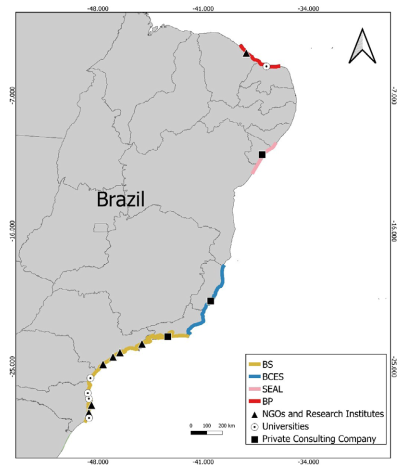
The PMPs are designed to fulfill environmental licensing processes related to the oil and gas industry and thus are designed to cover different sedimentary basins. Although the name “PMP” is universal to the program, there are four distinct programs along the Brazilian coast, each associated with a specific sedimentary basin: Sergipe/Alagoas Basin (SEAL), initiated in February 2010, covering 259 km of monitored beaches; Campos/Espírito Santo Basin (BCES), initiated in October 2010, covering 707 km; Potiguar Basin (BP), initiated in May 2013, covering 330 km; and Santos Basin (BS), initiated in August 2015, covering 2015 km (Petrobras, 2019, 2021a, 2021b, 2023) (Figure 1). Hereafter, these four monitoring programs are separately referred to as SEAL, BCES, BP and, BS or collectively as PMPs. Institutions such as non-governmental organizations (NGOs), public foundations, private companies, and universities are responsible for monitoring specific beach stretches (Petrobras, 2023).
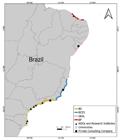
Distribution of the survey area from the Projetos de Monitoramento de Praias (PMPs), which cover different sedimentary basins (see main text for details) and their executing institutions. South to north: BS=Santos Basin, BCES=Campos/Espírito Santo Basin, SEAL=Sergipe/Alagoas Basin, and BP=Potiguar Basin.
SEARCH STRATEGIES
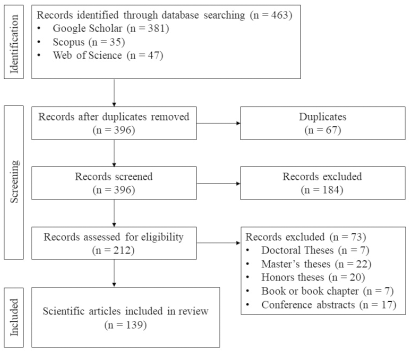
The review followed the Preferred Reporting Items for Systematic Reviews and Meta-Analysis (PRISMA) framework (Figure 2; Page et al., 2021). The bibliographic search was carried out on Google Scholar, Scopus, and Web of Science databases (between 14-20 January 2025). The search string “Beach Monitoring Project” OR “Projeto de Monitoramento de Praias” was applied in each database to identify scientific articles containing these strings in any part of the text. It was assumed that all scientific articles using data from the PMPs had appropriately mentioned the source of the data, and therefore, the use of these strings should be representative of peer-reviewed publications.
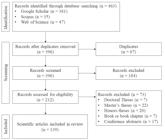
Summary of the process of identification, screening, and inclusion of scientific articles conducted systematically according to the PRISMA framework.
INCLUSION CRITERIA AND DATA SUMMARIZATION
this review included studies that used data collected by at least one of the PMPs (BS, BCES, SEAL, and/or BP), after the implementation of the monitoring program (from 1 February 2010 to 31 December 2023). Moreover, only peer-reviewed journal articles written in English or Portuguese were included. Gray literature (such as Honors, Master’s or Doctoral theses, books or book chapters, and abstracts published in conference proceedings) were not considered.
The retained scientific articles were categorized based on the monitoring program (BS, BCES, SEAL, and/or BP), the taxonomic group studied (sea turtles, seabirds, marine mammals, or “tetrapods” when the article focused on two or more groups), and subject area (“Biochemistry and Genetics”, “Ecology, Conservation and Management”, “Human Interactions”, and “Pathology and Health”). Scientific articles that used data from more than one monitoring program were categorized multiple times, as a record for each corresponding program. The categorization into subjects was based on the main topic addressed in the objectives and results of the scientific article. The “Biochemistry and Genetics” subject included research on enzyme activity, genetic diversity, biochemical parameters, and antimicrobial resistance. “Ecology, Conservation and Management” encompassed studies on spatiotemporal patterns of diversity and distribution, the influence of environmental variables on these patterns, trophic ecology, and extinction risk assessment. “Human Interactions” covered topics such as ingestion of anthropogenic solid waste, contamination and ecotoxicology, pollution, bycatch, and impacts of oil spills. “Pathology and Health” included studies reporting on diseases, diagnostic techniques and imaging, treatments and alternative therapies, and general pathological findings.
DATA ANALYSIS
Data analyses were conducted in R (R Core Team, 2022), mainly using the dplyr (Wickham et al., 2023) and tidyr (Wickham et al., 2024) packages for data wrangling, base R’s stats package for analysis, and ggplot2 (Wickham, 2016) for data visualization. All analyses were performed using a significance level of 0.05. Data, code, and Supplementary Material can be found at https://doi.org/10.5281/zenodo.17437776.
To compare the proportions of scientific articles across categories (PMPs, taxonomic groups, and subject areas), a chi-squared test was performed using the ‘chisq.test’ function to evaluate if there were significant differences in the observed frequencies. Following this, a pairwise proportion comparison test was conducted using the ‘pairwise.prop.test’ function. The test was performed considering the observed quantities for each group, with p-values adjusted using the Bonferroni method (Quinn and Keough, 2002).
To assess the participation of executing and non-executing institutions on the scientific articles, the affiliation of all authors was considered, identifying their institution, country, and, in the case of Brazilian institutions, their Federal State was additionally recorded. Each scientific article was summarized according to their coauthors’ institutions and descriptive statistics were extracted to explore coauthorship patterns.
To test whether the IUCN and ICMBio categories influence the number of publications, each studied species (i.e., those for which a formal statistical analysis was provided; n=61; see Results) was first classified according to their category based on the IUCN and ICMBio criteria. Under the criteria of both IUCN and ICMBio, species were categorized as critically endangered (CR), endangered (EN), vulnerable (VU), near threatened (NT), least concern (LC), data deficient (DD), or not evaluated (NE) - the latter corresponding to “not applicable” in the ICMBio criteria. Although DD and NE are not strictly conservation categories, for simplicity, all categories are collectively referred as “conservation category” from hereon. Considering that the conservation category of species may have changed over the years included in this study, the species were assigned to the category that was valid at the time (year) each article was published. A chi-squared test of independence was then performed, using the ‘chisq.test’ function, to investigate the relationship between categories and the number of scientific articles. While the chi-squared test is expected to indicate differences between categories (i.e., a statistically significant result), one could expect the contribution of higher-ranked classes (categories) to be overrepresented and lower-ranked to be underrepresented. To verify this, a residual analysis was conducted to identify which category contributed to the observed relationships. For that, the standardized residuals were extracted using the ‘stdres’ component of the object returned by ‘chisq.test’, and those values were then plotted by category. Categories with positive residuals indicated overrepresentation, while categories with negative residuals indicated underrepresentation in the number of publications (Haberman, 1973).
Due to the high number of scientific articles studying Chelonia mydas (see Results), this species could bias the results of this analysis. Therefore, the procedure explained above (chi-squared test followed by residual analysis) was conducted separately for both including and excluding C. mydas from the analysis. Also, the entire procedure was repeated considering only the most frequently studied species (n=11; see Results), defined as being studied in at least 10 scientific articles. Thus, this analytical framework was performed eight times (with/without C. mydas x IUCN/ICMBio categories x all species/most frequently studied species).
RESULTS
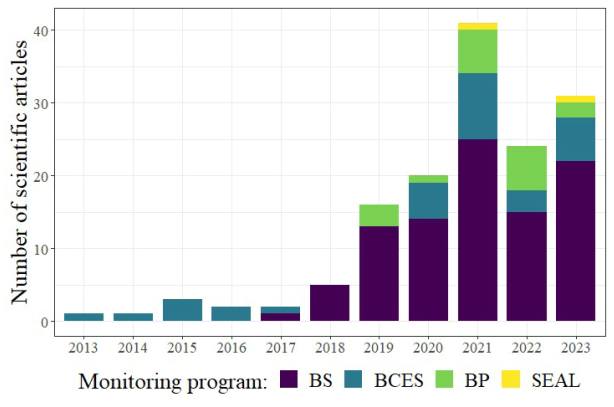
We identified 139 scientific articles published between 2013 and 2023 (Figure 3, Table S1). No scientific articles were published between 2010 and 2012. The yearly average number of scientific articles was 12.6±13.3, which was highly influenced by the number of publications in recent years. The highest number of publications was observed in 2021 (n=41).
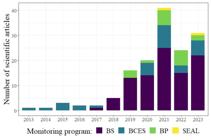
Number of scientific articles published per year according to each Projetos de Monitoramento de Praias (PMPs). South to north: BS=Santos Basin, BCES=Campos/Espírito Santo Basin, SEAL=Sergipe/Alagoas Basin, BP=Potiguar Basin. No scientific articles were published between 2010 and 2012.
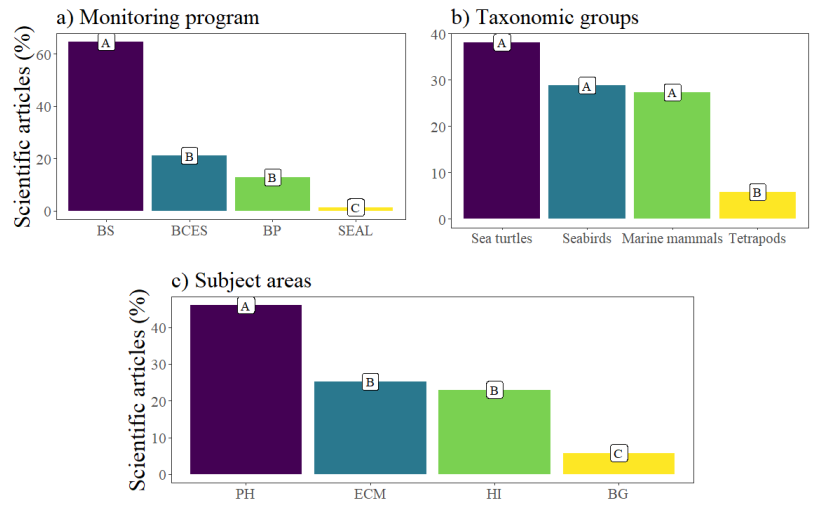
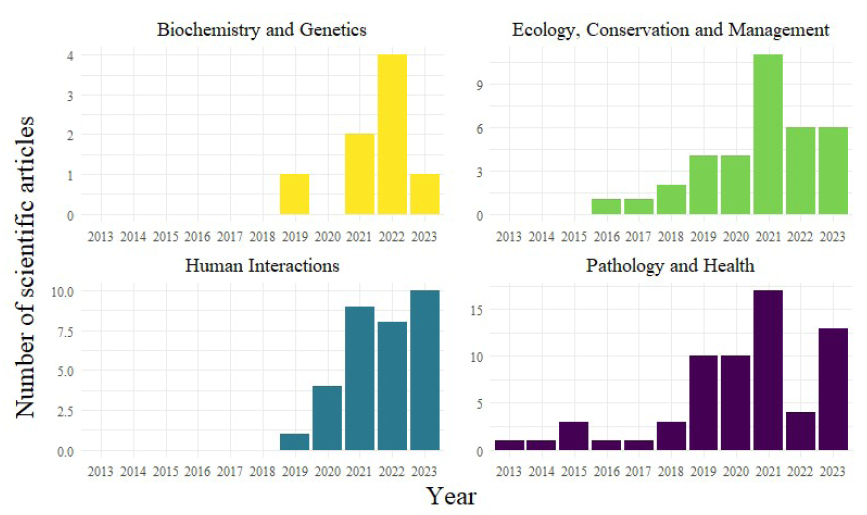
The chi-squared test and pairwise proportion comparisons revealed significant differences in the proportions of scientific articles for all categories tested (PMPs: χ2=134.66, p<0.01; Taxonomic groups: χ2=31.27, p<0.01; Subject areas: χ2=45.43, p<0.01) (Table 1). The monitoring program with the highest number of publications was BS (64.6%; n=95), followed by BCES (21.1%; n=31), BP (12.9%; n=19) and SEAL (1.3%; n=2) (Figure 4a). Studies encompassing data from more than one monitoring program represented 5% (n=7). Scientific articles published on sea turtles (38.1%; n=53), seabirds (28.8%; n=40), and marine mammals (27.3%; n=38) had similar proportions (Figure 4b). Scientific articles analyzing more than one group (“Tetrapods”) were less represented (Figure 4b), which influenced the overall chi-squared test result. Almost half of the studies were published on the “Pathology and Health” subject area (46%; n=64), while “Ecology, Conservation and Management” and “Human Interactions” were similar in numbers (25.2%; n=35 and 23%; n=32, respectively), and only a few studies were published on “Biochemistry and Genetics” (5.8%; n=8) (Figure 4c). Furthermore, “Pathology and Health” was the only subject area with at least one scientific article published in every year since 2013, while “Ecology, Conservation and Management” had its first study published in 2016, and “Human Interactions” and “Biochemistry and Genetics”, in 2019 (Figure 5). Notably, only one article focused directly on the impacts of oil and gas activities on marine tetrapods (Oliveira et al., 2021). Regardless of the subject area, it is noteworthy that the number of publications started to increase since 2018.
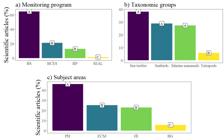
Proportion of scientific articles identified considering every monitoring program (a), taxonomic group studied (b), and subject area (c). In (a): BS=Santos Basin, BCES=Campos/Espírito Santo Basin, BP=Potiguar Basin, SEAL=Sergipe/Alagoas Basin. In (c): PH=Pathology and Health, ECM=Ecology, Conservation and Management, HI=Human Interactions, BG=Biochemistry and Genetics. Different letters represent significant differences between proportions based on the chi-squared test and pairwise comparisons.
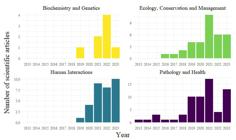
Number of scientific articles published per year according to each subject area. No scientific articles were published between 2010 and 2012.
Results of chi-squared tests and Bonferroni-adjusted pairwise comparisons of the proportions of selected scientific articles using PMP data from 2010 to 2023, considering monitoring program, taxonomic groups, and subject areas. The acronyms correspond to: BS=Santos Basin, BCES=Campos/Espírito Santo Basin, BP=Potiguar Basin, SEAL=Sergipe/Alagoas Basin.
Authors from the scientific articles were affiliated to 166 institutions from 20 countries (Argentina, Australia, Brazil, Chile, Cuba, France, Gabon, Germany, Italy, Lithuania, New Zealand, Norway, Poland, Portugal, South Africa, Spain, Switzerland, United Kingdom, United States of America, Uruguay) (Table S2); 119 (71.7%) institutions were from Brazil. The majority of the Brazilian institutions are from the South and Southeast regions (Table S3). From the 139 scientific articles, nine (6.5%) were authored only by researchers affiliated with PMPs executing institutions and 43 (30.9%) only by authors affiliated with non-executing institutions. From 1097 authors (non-exclusive; i.e., the same author in different publications counted multiple times), 687 were from non-executing institutions, 302 were from executing institutions, and 108 had mixed affiliation with both executing and non-executing institutions (Table S2). On average, there were 7.9±4.6 authors per article, where 2.2±2.6 authors were affiliated with executing institutions and 4.9±4.1 with non-executing institutions. Overall, most studies included at least one author affiliated with a monitoring executing institution, with the highest proportion in SEAL (100%), followed by BP (89.47%), BS (82.11%), and BCES (58.07%) (Table 2).
Frequency of authorship of scientific articles published using PMP data for each monitoring program, considering the presence (i.e., “yes/no”) of authors from executing institutions or only non-executing institutions. BS=Santos Basin, BCES=Campos/Espírito Santo Basin, SEAL=Sergipe/Alagoas Basin, BP=Potiguar Basin.
Two scientific articles did not directly investigate biological aspects of the species (Dias et al., 2021; Rosário et al., 2022). From the other 137 scientific articles, we identified 61 species that were subject of study. In total, five species of sea turtles, 30 of seabirds, and 26 of marine mammals were studied (Table S4). From these 61 species, 17 (27.8%) were classified as threatened according to either IUCN or ICMBio criteria (Table S4). The LC category was the most frequently observed, under both IUCN and ICMBio criteria (IUCN: 42, 67%; ICMBio: 29 species, 42%; Table S5). Chelonia mydas was the most frequently studied species, appearing in 45 articles (32.8%), followed by Caretta caretta (n=19; 13.8%), Lepidochelys olivacea (n=18; 13.1%), Spheniscus magellanicus (n=17; 12.4%), Sotalia guianensis (n=15; 10.9%), Eretmochelys imbricata (n=14; 10.1%), Pontoporia blainvillei (n=12; 8.7%), Puffinus pfffinus (n=12; 8.7%), Larus dominicanus (n=11; 8%), Dermochelys coriacea (n=10; 7.2%), and Tursiops truncatus (n=10; 7.2%). Among these 11 most frequently studied species, seven (63.6%) are classified as threatened according to IUCN or ICMBio criteria (Table S4).
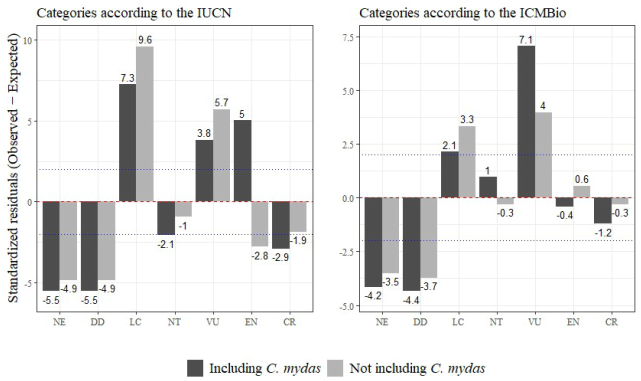
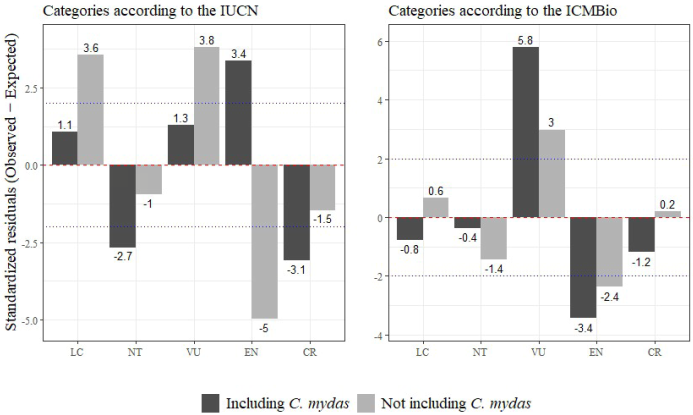
The chi-squared test revealed a significant association between conservation category and the number of studies for both the 61 species (including C. mydas: IUCN: χ2=142.67, df=6, p<0.05; ICMBio: χ2=79.848, df=6, p<0.05; excluding C. mydas: IUCN: χ2=157.83, df=6, p<0.05; ICMBio: χ2=46.079, df=6, p<0.05) and the 11 most frequently studied species (including C. mydas: IUCN: χ2=24.681, df=4, p<0.05; ICMBio: χ2=37.879, df=4, p<0.05; excluding C. mydas: IUCN: χ2=44.081, df=4, p<0.05; ICMBio: χ2=13.569, df=4, p<0.05). In both cases, residual analyses did not show an increasing representation towards higher-ranked categories. For all 61 species, residual analysis revealed a similar pattern whether C. mydas was included or not, with the LC and VU categories as overrepresented in both the IUCN and ICMBio classifications, while the NE, DD, and CR were underrepresented (Figure 6). The inclusion of C. mydas resulted in overrepresentation for EN (IUCN) and NT (ICMBio), which became underrepresented when C. mydas was excluded. For the 11 most-studied species, with or without the inclusion of C. mydas, the NT category was underrepresented, while VU was overrepresented (Figure 7). The inclusion of C. mydas resulted in overrepresentation for EN (IUCN) and underrepresentation for LC and CR (ICMBio).
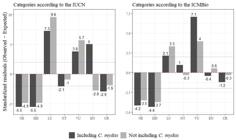
Residual analysis from the chi-squared test indicating the association between the conservation categories of 61 species that were subject of study and the number of scientific articles. The left panel shows species conservation categories based on the international Red List (IUCN) criteria, whereas the right panel shows conservation categories based on the Brazilian ICMBio criteria. CR=Critically Endangered; EN=Endangered; VU=Vulnerable; NT=Near Threatened; LC=Least Concern; DD=Data Deficient; and NE=Not Evaluated. The dark bars represent the residuals (observed minus expected values) for each conservation category when the analysis included the Chelonia mydas, and the light bars show the residuals when C. mydas was not included; positive values indicate overrepresentation and negative indicate underrepresentation.
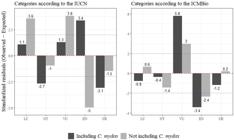
Residual analysis from the chi-squared test indicating the association between the conservation categories of the 11 most frequently studied species and the number of scientific articles. The left panel shows species conservation categories based on the international Red List (IUCN) criteria, whereas the right panel shows conservation categories based on the Brazilian ICMBio criteria. CR=Critically Endangered; EN=Endangered; VU=Vulnerable; NT=Near Threatened; LC=Least Concern; DD=Data Deficient; and NE=Not Evaluated. The dark bars represent the residuals (observed minus expected values) for each conservation category when the analysis included the Chelonia mydas, and the light bars show the residuals when C. mydas was not included; positive values indicate overrepresentation and negative indicate underrepresentation.
DISCUSSION
Data from PMPs have been continuously and increasingly used over the last 14 years. The PMPs contributed to extensive academic production, covering a range of taxa and various subject areas, representing an important source of data for research on marine tetrapods, including several threatened species. The accumulation of information is fundamental to supporting temporal trend investigations and representative analyses, which resulted in the increased number of publications on all subjects over the past decade. Approximately a third of the scientific articles were produced by authors from non-executing institutions, highlighting the research potential that SIMBA can foster.
The public availability and ease of access to records by the PMP database (SIMBA) seems to be a key feature that may have contributed to scientific production. The extensive dataset, including photographs, geographic locations, and necropsy information, enables analyses and approaches such as diagnosing marine debris ingestion (Baes et al., 2024), quantifying carrion biomass (Tavares et al., 2021), and identifying patterns and trends that are essential for understanding the causes and consequences of strandings (Prado et al., 2023). In a systematic review on the use of stranding databases globally, Chan et al. (2017) reported difficulties regarding access to raw data in databases that restricts public access, limiting the autonomy of researchers. In another review on marine mammal stranding in Mexico, Gómez-Hernández et al. (2020) found 95 documents over a 24-year period, most of which were derived from gray literature, with only 12% being peer-reviewed scientific articles. Despite the existence of the Mexican Stranding Network and a relatively high number of research institutions in the region, these authors reported a delay in the compilation of stranding data. Response groups were formed in the 1990s in Mexico, but the compilation of information by the Mexican National Stranding Network did not occur until 2012 (Gómez-Hernández et al., 2020). In contrast, in our review, approximately 12 times more scientific articles were identified in a time span less than half of that analyzed by Gómez-Hernández et al. (2020). Additionally, it is important to highlight that the PMPs operate over a large spatial scale with daily systematic beach surveys, generating a substantial volume of data. Large-scale and long-term sampling allows stranding data to more accurately reflect communities of adjacent waters (Pyenson, 2010). Thus, the scale and consistency of the PMPs are crucial in producing high-quality data in a relatively short time frame, offering insights that might otherwise remain inaccessible or take much longer to obtain by more occasional or non-systematic efforts. Nonetheless, there are few studies investigating the reliability of the database. Prado et al. (2023) showed that species identification has an overall high percentage of reliability, likely due to the historical expertise of the institutions involved, but other information provided on SIMBA still need to be audited.
The high number of scientific articles using data from BS, the most recently implemented program, is likely due to many factors. As our results showed, there is a higher number of research institutions involved on publications from this region compared to others. The South and Southeast regions of Brazil host a larger number of research and higher education institutions compared to other regions of the country (Marega-Imamura et al., 2020). Given that the higher the number of research institutions, the higher the expected scholarly output (Marega-Imamura et al., 2020), our results align with this rationale. Furthermore, in regional assessments, the larger the area covered by the surveys and the more intense the effort is, the more strandings would be expected to be recorded (Authier et al., 2014; Prado et al., 2023). BS has by far the largest extent in the monitoring area, which also contributes to detecting a higher number of strandings. The Southeast and South regions are also known as hotspots for marine megafauna (Daudt, 2019; Di Tullio et al., 2016; Tittensor et al., 2010), which may influence in higher stranding rates due to natural mortalities and debilitated individuals (Monteiro et al., 2016; Prado et al., 2023). In addition, because the northern region is less populated than the southern region, there might be less anthropogenic pressure on marine tetrapods and, consequently, lower mortality rates. Therefore, considering all these factors, it is expected that the highest number of articles will come from data of the BS monitoring program.
Although the primary aim of the PMPs is to assess the impacts of the oil and gas industry on marine tetrapods, only one study was directly associated with this theme: Oliveira et al. (2021) documented the rehabilitation of a sea turtle affected by an oil spill in Rio Grande do Norte in 2019. Thus, there seems to be a shortage of articles focusing on cases directly related to the main goal of the PMP program. Nevertheless, the variety of additional data collected for each specimen enables research in several other subject areas. The “Pathology and Health” subject was identified as the most prevalent in the reviewed studies. For example, Costa-Silva et al. (2023) and Groch et al. (2020) investigated the presence of cetacean morbillivirus; Silva-Júnior et al. (2019), Rossi et al. (2021), and Vanstreels et al. (2023b) studied fibropapillomatosis in sea turtles; and Ewbank et al. (2021) and Sato et al. (2022) reported cases of parasitic diseases in seabirds. These studies support the idea of how suitable data provided by stranded animals is useful for investigating the health of wildlife (Norman et al., 2004; Vanstreels et al., 2023a, 2023b) and, consequently, of the oceans (Chou et al., 2024; Hazen et al., 2019). Moreover, detailed examinations undertaken by veterinarians allow the identification of impacts and remediation of threats associated with other human activities (under the subject “Human Interactions”), such as bycatch (e.g., Tagliolatto et al., 2019), ingestion of solid debris (e.g., Gallo Neto et al., 2021), and contaminants (e.g., Montone et al., 2023). In addition, data generated by PMPs enable research on the ecology and conservation of various marine tetrapods species, providing insights to develop effective conservation strategies and management actions. For instance, Meirelles et al. (2022) assessed the extinction risk of manatees, Pontalti et al. (2023) identified causes of death in cetaceans, and Guimarães et al. (2021) evaluated factors contributing to sea turtle mortality. Altogether, these studies demonstrate that stranding records can provide data to a broad range of research areas, way beyond their initial purpose.
The wide range of subjects studied using data from PMPs seems to contribute to the high number of institutions recorded. Most studies included at least one author affiliated with a monitoring executing institution. However, when examining author affiliations, we found that the majority were affiliated with non-executing institutions. This indicates that, despite the strong participation of external authors, there is still a certain degree of dependence on contributors affiliated with executing institutions. Although the SIMBA database provides a solid interface to get stranding records, detailed information to address several research questions are not quantitative on the platform. For instance, data on pathological findings, stomach content, and human interactions are mostly qualitative on SIMBA. Thus, it may be mandatory to contact executing institutions to request the raw data or specific details. Consequently, researchers from executing institutions are more likely to coauthor a paper as data providers. Nonetheless, the openness of SIMBA allows public access to a variety of information that, even though qualitative, can help understand the big picture of several topics (e.g., seabird plastic ingestion; Baes et al., 2024).
Although the conservation category of species was significantly associated with the number of identified studies, the overall results did not support our hypothesis that higher-ranked threat levels would have a larger number of published articles. On the contrary, the results suggest that certain categories, especially those including more species with higher stranding numbers, concentrate most of the scientific attention. When considering all studied species, the number of studies focused on species classified as LC was disproportionately high (this category encompassed 68% of the studied species), indicating that factors such as wide geographic distribution and relative number of stranding records may influence research decisions more strongly than its conservation category. In parallel, the high number of representatives of LC included in the analysis may be by itself biasing the results. Thus, it appears that both sample size and conservation category are playing a role in the selection of the studied species. The overrepresentation of C. mydas was probably a coupled effect of these two factors: approximately 90% of sea turtle strandings recorded by PMPs corresponds to this species (Cantor et al., 2020; Prado et al., 2023) and its category is EN on the IUCN (IUCN, 2024), despite being nationally re-classified from VU to NT recently (ICMBio, 2025). Even when analyzing only the 11 most frequently studied species, of which 63.6% are threatened, the CR category remained underrepresented. The underrepresentation of species in the DD, NE, and CR categories may simply occur because of the challenges in obtaining data from those species. The difficulties associated with gathering data likely reflect their lower natural abundance (and therefore lower number of strandings) for species listed as CR, or their oceanic habits for species listed as DD or NE. Species in these categories typically exhibit lower stranding rates and limited information on their distribution and abundance (ICMBio, 2018; Prado et al., 2023). Filling knowledge gaps for species classified as DD, for instance, is particularly important to enable better and more robust conservation assessments (Tiongson et al., 2021). Therefore, continuing these survey programs is essential to increase the sample size of species with limited information available either because of their natural rarity or higher threat category.
At the regional and national level, data from PMPs can support the development of PANs (ICMBio, 2018). In Brazil, PANs are public policy and management tools developed by a participatory process aimed at organizing and prioritizing actions for the conservation of biodiversity and its natural habitats (Brasil, 2018). More than one-quarter of all analyzed species are in some threat category under at least one of the assessment criteria (national and/or international). Previous studies have indicated the importance of PMPs in generating useful information for conservation (Attademo et al., 2021; Bomfim et al., 2021; Cutrim and Araújo, 2021; Pontalti et al., 2023; Tagliolatto et al., 2019). For example, the analysis of strandings of S. guianensis and P. blainvillei, threatened species frequently studied, provides information into spatiotemporal stranding patterns and anthropogenic impacts such as pollution and bycatch that affect these species (Miranda et al., 2021; Prado et al., 2023). PMPs have also proven to be a source of new information on the occurrence of Thalassarche chlororhynchos and Procellaria aequinoctialis, generating spatially and temporally extensive distribution datasets that are relevant in the context of the PAN Albatrosses and Petrels (ICMBio, 2018). Due to its large scale and systematic effort, thus, PMPs can be instrumental in identifying threats and monitoring the effects of management decisions by analyzing trends in strandings (Prado et al., 2023), which is particularly helpful for threatened species.
PMPs have provided data for a significant number of publications and have played a key role in helping the Brazilian scientific community understand the distribution of various biological and ecological patterns and health-related issues (Oliveira et al., 2020). Chou et al. (2024) demonstrated that the Cetacean Stranding Network establishment in Taiwan since 1996 provides robust data to support effective regulations and conservation measures in the country, and facilitated a shift in the perception of cetaceans from fishing targets to conservation priorities. Likewise, PMPs can be a key component in stakeholder engagement, such as supporting management decisions by informing conservation agencies alongside advancing scientific knowledge. Ensuring access to results and the appropriation of knowledge by society and decision-makers should be a primary goal of monitoring projects (Cordeiro et al., 2022; Nichols and Williams, 2006). Data from PMPs have been feeding valuable information into PANs and other conservation tools such as Protected Areas (Dias et al., 2021; ICMBio, 2018). Nonetheless, the data generated could arguably be even better translated into policy-making (Oliveira et al., 2024), although this analysis is out of the scope of our study.
CONCLUSION
This study revealed that data from PMPs are frequently used beyond their primary purpose (i.e., oil and gas impact assessments), providing biological information in several areas of knowledge. PMP data have generated a high number of scientific articles compared to other stranding programs. The extent and systematicity of PMPs, as well as the high number of stranding records, may be important factors contributing to the number of publications. In addition, the open-access storage of their datasets on the SIMBA platform is essential to ensure accessibility to these records, also allowing external researchers from non-executing institutions to leverage the datasets to advance scientific findings. As a consequence of its design, PMPs have supported data to study a wide range of taxa (61 species), including several threatened species. Both conservation category and sample size appear to play a role in deciding which species is mostly studied. In particular, for threatened species, PMPs are providing information for the national PANs and Protected Areas. Therefore, the continuity of the program would be beneficial to increase the sample size of rare or critically endangered taxa, scholarly outputs, support management and foster collaboration between research institutions and, consequently, contribute to conservation efforts of marine tetrapods in Brazil. We also encourage periodic literature reviews every five to ten years to guide, identify, and discuss how PMP data are being used, their potential contributions to policy, and paths for improvement in the monitoring program and its scholarly outputs.
DATA AVAILABILITY STATEMENT
Data, code, supplementary tables and images can be found at https://doi.org/10.5281/zenodo.17437776.
SUPPLEMENTARY MATERIAL
Supplementary Material can be found at https://doi.org/10.5281/zenodo.17437776.
ACKNOWLEDGMENTS
We thank MSc. Gustavo Ramos Arrial for his assistance in producing the study area map. We also thank Prof. Dr. Paulo César de Azevedo Simões Lopes, Prof. Dr. Guilherme R. R. Brito and Prof. Dr. André S. Barreto for their contributions, for the reviewers for their constructive comments, which helped improve the clarity and quality of this manuscript, and for the careful type-setting assistance of the Ocean and Coastal Research personnel.
REFERENCES
-
Attademo, F. L. N., Luna, F. O., Oliveira, R. E. M., Freire, A. C. B., Lima, S. A. & Silva, F. J. L. 2021. O estado do Rio Grande do Norte como área estratégia para conservação de peixe-boi-marinho (Trichechus manatus) no Brasil. Revista Brasileira de Meio Ambiente, 9(1), 201-209. DOI: https://doi.org/10.5281/zenodo.4558405
» https://doi.org/10.5281/zenodo.4558405 -
Authier, M., Peltier, H., Dorémus, G., Dabin, W., Van Canneyt, O. & Ridoux, V. 2014. How much are stranding records affected by variation in reporting rates? A case study of small delphinids in the Bay of Biscay. Biodiversity and Conservation, 23, 2591-2612. DOI: https://doi.org/10.1007/s10531-014-0741-3
» https://doi.org/10.1007/s10531-014-0741-3 -
Azzellino, A., Airoldi, S., Lanfredi, C., Podestà, M. & Zanardelli, M. 2017. Cetacean response to environmental and anthropogenic drivers of change: results of a 25-year distribution study in the northwestern Mediterranean Sea. Deep Sea Research Part II: Topical Studies in Oceanography, 146, 104-117. DOI: https://doi.org/10.1016/j.dsr2.2017.02.004
» https://doi.org/10.1016/j.dsr2.2017.02.004 -
Baes, L., Santiago, C. D., Roman, L., Costa, P. C. S., Pugliesi, É. & Reigada, C. 2024. Beached seabirds as plastic biomonitors in Brazil from the Beach Monitoring Project of the Santos Basin (PMP-BS). Marine Pollution Bulletin, 199, 115847. DOI: https://doi.org/10.1016/j.marpolbul.2023.115847
» https://doi.org/10.1016/j.marpolbul.2023.115847 -
Betts, J., Young, R. P., Hilton‐Taylor, C., Hoffmann, M., Rodríguez, J. P., Stuart, S. N. & Milner‐Gulland, E. J. 2020. A framework for evaluating the impact of the IUCN Red List of threatened species. Conservation Biology, 34, 632-643. DOI: https://doi.org/10.1111/cobi.13454
» https://doi.org/10.1111/cobi.13454 -
Bomfim, A. D. C., Farias, D. S. D., Silva, F. J. L., Rossi, S., Gavilan, S. A., Santana, V. G. S. & Pontes, C. S. 2021. Long-term monitoring of marine turtle nests in northeastern Brazil. Biota Neotropica, 21, e20201159. DOI: https://doi.org/10.1590/1676-0611-BN-2020-1159
» https://doi.org/10.1590/1676-0611-BN-2020-1159 -
Brasil. Ministério do Meio Ambiente. 2011. Portaria n. 422, de 26 de outubro de 2011. Available from: Available from: https://www.mprs.mp.br/media/areas/gapp/arquivos/atualizacao_intra/dou/port_422.pdf Access date: 2026 Jan. 8.
» https://www.mprs.mp.br/media/areas/gapp/arquivos/atualizacao_intra/dou/port_422.pdf -
Brasil. Ministério do Meio Ambiente. 2018. Instrução Normativa n. 21, de 18 de dezembro de 2018. Available from: Available from: https://www.gov.br/icmbio/pt-br/assuntos/biodiversidade/pan/saiba-mais/documentos-e-downloads/01_-_in_icmbio_no_21_de_18_de_dez_de_2018_retificada-1.pdf Access date: 2026 Jan. 8.
» https://www.gov.br/icmbio/pt-br/assuntos/biodiversidade/pan/saiba-mais/documentos-e-downloads/01_-_in_icmbio_no_21_de_18_de_dez_de_2018_retificada-1.pdf -
Cantor, M., Barreto, A. S., Taufer, R. M., Giffoni, B., Castilho, P. V., Maranho, A., Beatriz, C., Kolesnikovas, C., Godoy, D., Rogério, D. W., Dick, J. L., Groch, K. R., Rosa, L., Cremer, M. J., Cattani, P. E., Valle, R. R. & Domit, C. 2020. High incidence of sea turtle stranding in the southwestern Atlantic Ocean. ICES Journal of Marine Science, 77, 1864-1878. DOI: https://doi.org/10.1093/icesjms/fsaa073
» https://doi.org/10.1093/icesjms/fsaa073 -
Chan, D. K., Tsui, H. C. & Kot, B. C. 2017. Database documentation of marine mammal stranding and mortality: current status review and future prospects. Diseases of Aquatic Organisms, 126(3), 247-256. DOI: https://doi.org/10.3354/dao03179
» https://doi.org/10.3354/dao03179 -
Chou, L. S., Yao, C. J., Wang, M. C., Chi, W. L., Ho, Y. & Yang, W. C. 2024. Cetacean stranding response program and spatial-temporal analysis in Taiwan, 1994-2018. Animals, 14(12), 1823. DOI: https://doi.org/10.3390/ani14121823
» https://doi.org/10.3390/ani14121823 -
Claro, F., Fossi, M. C., Ioakeimidis, C., Baini, M., Lusher, A. L., Mc Fee, W., McIntosh, R. R., Pelamatti, T., Sorce, M., Galgani, F. & Hardesty, B. D. 2019. Tools and constraints in monitoring interactions between marine litter and megafauna: insights from case studies around the world. Marine Pollution Bulletin, 141, 147-160. DOI: https://doi.org/10.1016/j.marpolbul.2019.01.018
» https://doi.org/10.1016/j.marpolbul.2019.01.018 -
Collar, N. J. 1996. The reasons for Red Data Books. Oryx, 30(2), 121-130. DOI: https://doi.org/10.1017/S0030605300021505
» https://doi.org/10.1017/S0030605300021505 -
Coombs, E. J., Deaville, R., Sabin, R.C., Allan, L., O’Connell, M., Berrow, S., Smith, B., Brownlow, A., Doeschate, M. T., Penrose, R., Williams, R., Perkins, M. W., Jepson, P. D. & Cooper, N. 2019. What can cetacean stranding records tell us? A study of UK and Irish cetacean diversity over the past 100 years. Marine Mammal Science, 35, 1527-1555. DOI: https://doi.org/10.1111/mms.12610
» https://doi.org/10.1111/mms.12610 -
Cordeiro, C. A. M. M., Aued, A. W., Barros, F., Bastos, A. C., Bender, M., Mendes, T. C., Creed, J. C., Cruz, I. C. S., Dias, M. S., Fernandes, L. D. A., Coutinho, R., Gonçalves, J. E. A., Floeter, S. R., Mello-Fonseca, J., Freire, A. S., Gherardi, D. F. M., Gomes, L. E. O., Lacerda, F., Martins, R. L., Longo, G. O., Mazzuco, A. C., Menezes, R., Muelbert, J. H., Paranhos, R., Quimbayo, J. P., Valentin, J. L. & Ferreira, C. E. L. 2022. Long-term monitoring projects of Brazilian marine and coastal ecosystems. PeerJ, 10, e14313. DOI: https://doi.org/10.7717/peerj.14313
» https://doi.org/10.7717/peerj.14313 -
Costa-Silva, S., Sacristán, C., Soares, R. M., Carvalho, V. L., Castilho, P. V., Cremer, M. J., Ewbank, A. C., Duarte-Benvenuto, A., Faita, T., Navas-Suárez, P. E., Vieira, J. V., Pereira, L. G., Alves, C. F., Souza, G. C., Lemos, G. G., Silvestre-Perez, N., Catão-Dias, J. L. & Keid, L. B. 2023. Short-finned pilot whale strandings associated with pilot whale morbillivirus, Brazil. Emerging Infectious Diseases, 29(1), 214-217. DOI: https://doi.org/10.3201/eid2901.221549
» https://doi.org/10.3201/eid2901.221549 -
Cutrim, C. H. G. & Araújo, V. A. 2021. Sea turtle strandings and the importance of the restinga de Jurubatiba National Park in loggerhead (Caretta caretta) nesting sites. Nature and Conservation, 14(4), 34-46. DOI: https://doi.org/10.6008/CBPC2318-2881.2021.004.0004
» https://doi.org/10.6008/CBPC2318-2881.2021.004.0004 -
Daudt, N. W. 2019. Padrões de distribuição espacial de aves marinhas no Brasil (Dissertação de mestrado). Rio Grande: Universidade Federal do Rio Grande. Available from: Available from: https://sistemas.furg.br/sistemas/sab/arquivos/bdtd/0000013069.pdf Access date: 2026 Jan. 8.
» https://sistemas.furg.br/sistemas/sab/arquivos/bdtd/0000013069.pdf -
Di Tullio, J. C., Gandra, T. B., Zerbini, A. N. & Secchi, E. R. 2016. Diversity and distribution patterns of cetaceans in the subtropical southwestern Atlantic outer continental shelf and slope. PLoS One, 11(5), e0155841. DOI: https://doi.org/10.1371/journal.pone.0155841
» https://doi.org/10.1371/journal.pone.0155841 -
Dias, R. B., Rabinovici, A., De Godoy, D. F. 2021. Projeto de monitoramento de praias (PMP): potencialidades e limites para a conservação costeira e marinha. Journal of Integrated Coastal Zone Management, 21(1), 55-63. DOI: https://doi.org/10.5894/rgci-n410
» https://doi.org/10.5894/rgci-n410 -
Dudhat, S., Pande, A., Nair, A., Mondal, I., Srinivasan, M. & Sivakumar, K. 2022. Spatio-temporal analysis identifies marine mammal stranding hotspots along the Indian coastline. Scientific Reports, 12, 4128. DOI: https://doi.org/10.1038/s41598-022-06156-0
» https://doi.org/10.1038/s41598-022-06156-0 -
Ewbank, A. C., Duarte-Benvenuto, A., Zamana-Ramblas, R., Navas-Suárez, P. E., Gattamorta, M. A., Santos-Costa, P. C., Catão-Diaz, J. L. & Sacristán, C. 2021. Case report of respiratory aspergillosis and candidiasis in wild Magellanic penguins (Spheniscus magellanicus), Brazil. Brazilian Journal of Microbiology, 52(2), 967-975. DOI: https://doi.org/10.1007/s42770-021-00438-x
» https://doi.org/10.1007/s42770-021-00438-x -
Fernández, A., Edwards, J. F., Rodríguez, F., de los Monteros, A. E., Herráez, P., Castro, P., Jaber, J. R., Martín, V. & Arbelo, M. 2005. “Gas and fat embolic syndrome” involving a mass stranding of beaked whales (family Ziphiidae) exposed to anthropogenic sonar signals. Veterinary pathology, 42(4), 446-457. DOI: https://doi.org/10.1354/vp.42-4-446
» https://doi.org/10.1354/vp.42-4-446 -
Fernández, A., Sierra, E., Martín, V., Méndez, M., Sacchini, S., Bernaldo de Quirós, Y., Andrada, M. A., Rivero, M., Quesada, O., Tejedor, M. & Arbelo, M. A. 2012. Last “atypical” beaked whales mass stranding in the Canary Islands (July, 2004). Journal of marine science: research & development, 2, 1-3. DOI: https://doi.org/10.4172/2155-9910.1000107
» https://doi.org/10.4172/2155-9910.1000107 -
Gaiser, E. E., Bell, D. M., Castorani, M. C., Childers, D. L., Groffman, P. M., Jackson, C. R., Kominoski, J. S., Peters, D. P. C., Pickett, S. T. A., Ripplinger, J. & Zinnert, J. C. 2020. Long-term ecological research and evolving frameworks of disturbance ecology. BioScience, 70(2), 141-156. DOI: https://doi.org/10.1093/biosci/biz162
» https://doi.org/10.1093/biosci/biz162 -
Gallo Neto, H. G., Bantel, C. G., Browning, J., Della Fina, N., Ballabio, T. A., de Santana, F. T., Britto, M. K. & Barbosa, C. B. 2021. Mortality of a juvenile Magellanic penguin (Spheniscus magellanicus, Spheniscidae) associated with the ingestion of a PFF-2 protective mask during the Covid-19 pandemic. Marine Pollution Bulletin, 166, 112232. DOI: https://doi.org/10.1016/j.marpolbul.2021.112232
» https://doi.org/10.1016/j.marpolbul.2021.112232 -
Gómez-Hernández, G., Seingier, G., Elorriaga-Verplancken, F. & Heckel, G. 2020. Status and scope of marine mammal stranding research in Mexico. Journal of Coastal Conservation, 24, 1-6. DOI: https://doi.org/10.1007/s11852-019-00725-8
» https://doi.org/10.1007/s11852-019-00725-8 -
Groch, K. R., Díaz-Delgado, J., Santos-Neto, E. B., Ikeda, J. M., Carvalho, R. R., Oliveira, R. B., Guari, E. B., Flach, L., Sierra, E., Godinho, A. I., Fernández, A., Keid, L. B., Soares, R. M., Kanamura, C. T., Favero, C., Ferreira-Machado, E., Sacristán, C., Porter, B. F., Bisi, T. L., Azevedo, A. F., Lailson-Brito, J. & Catão-Dias, J. L. 2020. The pathology of cetacean morbillivirus infection and comorbidities in Guiana dolphins during an unusual mortality event (Brazil, 2017-2018). Veterinary Pathology, 57(6), 845-857. DOI: https://doi.org/10.1177/0300985820954550
» https://doi.org/10.1177/0300985820954550 - Guimarães, S. M., Almeida, L. G., Nunes, L. A., Lacerda, P. D., Amorim, C. E. S., Burato, M., Baldassin, P. & Werneck, M. 2021. Distribution and potential causes of sea turtle strandings in the State of Rio de Janeiro, Southern Brazil. Herpetological Conservation and Biology, 16(2), 225-237.
-
Gulland, F. M. D., Asmutis‐Silvia, R., Boehm, J., DiGiovanni Jr., R. A., Goertz, C. E. C., Huggins, J. L., Lovewell, G. N., Moore, K. M. & West, K. 2025. Marine mammal stranding networks in the 21st century: whence and whither? Marine Mammal Science, 41, e70016. DOI: https://doi.org/10.1111/mms.70016
» https://doi.org/10.1111/mms.70016 -
Haberman, S. J. 1973. The analysis of residuals in cross-classified tables. Biometrics, 29(1), 205-220. DOI: https://doi.org/10.2307/2529686
» https://doi.org/10.2307/2529686 -
Hazen, E. L., Abrahms, B., Brodie, S., Carroll, G., Jacox, M. G., Savoca, M. S., Scales, K. L., Sydeman, W. J. & Bograd, S. J. 2019. Marine top predators as climate and ecosystem sentinels. Frontiers in Ecology and the Environment, 17(10), 565-574. DOI: https://doi.org/10.1002/fee.2125
» https://doi.org/10.1002/fee.2125 -
Hooker, S. K. & Gerber, L. R. 2004. Marine reserves as a tool for ecosystem-based management: the potential importance of megafauna. BioScience, 54(1), 27-39. DOI: https://doi.org/10.1641/0006-3568(2004)054[0027:MRAATF]2.0.CO;2
» https://doi.org/10.1641/0006-3568(2004)054[0027:MRAATF]2.0.CO;2 - ICMBio (Instituto Chico Mendes de Conservação da Biodiversidade). 2018. Nota Técnica nº9/2018/CMA/DIBIO/ICMBio. Análise consolidada e avaliação dos dados e relatórios dos Programas de Monitoramento de Praias - PMPs (PMP-BP, PRMEA, PMP-BC/ES, PMP-BS (Fase 2), PMP-BS (Fase 1). Santos.
-
ICMBio (Instituto Chico Mendes de Conservação da Biodiversidade). 2025. Sistema de Avaliação do Risco de Extinção da Biodiversidade - SALVE. Available from: Available from: https://salve.icmbio.gov.br/ Accessed date: 2025 Feb. 6.
» https://salve.icmbio.gov.br/ -
IJsseldijk, L. L., ten Doeschate, M. T. I., Brownlow, A., Davison, N. J., Deaville, R., Galatius, A., Gilles, A., Haelters, J., Jepson, P. D., Keijl, G. O., Kinze, C. Chr., Olsen, M. T., Siebert, U., Thøstesen, C. B., van den Broek, J., Gröne, A. & Heesterbeek, H. 2020. Spatiotemporal mortality and demographic trends in a small cetacean: Strandings to inform conservation management. Biological Conservation, 249, 108733. DOI: https://doi.org/10.1016/j.biocon.2020.108733
» https://doi.org/10.1016/j.biocon.2020.108733 -
IUCN (International Union for Conservation of Nature). 2024. The IUCN red list of threatened species. Available from: Available from: https://www.iucnredlist.org Accessed date: 2024 Oct. 17.
» https://www.iucnredlist.org -
Lennon, R. L., Williams, R. S., Allan, K. J., ten Doeschate, M. T., Davison, N. J., Babayan, S. A. & Brownlow, A. C. 2025. An approach to using stranding data to monitor cetacean population trends and guide conservation strategies. Scientific Reports, 15(1), 28417. DOI: https://doi.org/10.1038/s41598-025-12928-1
» https://doi.org/10.1038/s41598-025-12928-1 -
Lindenmayer, D. B. & Likens, G. E. 2009. Adaptive monitoring: a new paradigm for long-term research and monitoring. Trends in Ecology & Evolution, 24(9), 482-486. DOI: https://doi.org/10.1016/j.tree.2009.03.005
» https://doi.org/10.1016/j.tree.2009.03.005 -
Magurran, A. E., Baillie, S. R., Buckland, S. T., Dick, J. M., Elston, D. A., Scott, E. M., Smith, R. I., Somerfield, P. J. & Watt, A. D. 2010. Long-term datasets in biodiversity research and monitoring: assessing change in ecological communities through time. Trends in Ecology & Evolution, 25(10), 574-582. DOI: https://doi.org/10.1016/j.tree.2010.06.016
» https://doi.org/10.1016/j.tree.2010.06.016 -
Marega-Imamura, M., Michalski, F., Silva, K., Schiavetti, A., Le Pendu, Y. & Oliveira, L. C. 2020. Scientific collaboration networks in research on human threats to cetaceans in Brazil. Marine Policy, 112, 103738. DOI: https://doi.org/10.1016/j.marpol.2019.103738
» https://doi.org/10.1016/j.marpol.2019.103738 -
Martinelli, A., de Godoy, D. F., Wiener, Y. L., Júnior, C. D. S. V., do Nascimento, C. C., de Mello, D. S., Louzada, C. N. & Taufer, R. M. 2024. Occurrence of cetacean strandings on the coast of São Paulo, Brazil: a spatio-temporal assessment from 2017 to 2021. Latin American Journal of Aquatic Mammals, 19(2), 190-201. DOI: https://doi.org/10.5597/lajam00327
» https://doi.org/10.5597/lajam00327 -
McCauley, D. J., Pinsky, M. L., Palumbi, S. R., Estes, J. A., Joyce, F. H. & Warner, R. R. 2015. Marine defaunation: animal loss in the global ocean. Science, 347(6219), 1255641. DOI: https://doi.org/10.1126/science.1255641
» https://doi.org/10.1126/science.1255641 -
Meirelles, A. C. O., Lima, D. S., Alves, M. D. O., Borges, J. C. G., Marmontel, M., Carvalho, V. L. & Santos, F. R. 2022. Don’t let me down: West Indian manatee, Trichechus manatus, is still critically endangered in Brazil. Journal for Nature Conservation, 67, 126169. DOI: https://doi.org/10.1016/j.jnc.2022.126169
» https://doi.org/10.1016/j.jnc.2022.126169 -
Mghili, B., Benhardouze, W., Aksissou, M. & Tiwari, M. 2023. Sea turtle strandings along the Northwestern Moroccan coast: Spatio-temporal distribution and main threats. Ocean & Coastal Management, 237, 106539. DOI: https://doi.org/10.1016/j.ocecoaman.2023.106539
» https://doi.org/10.1016/j.ocecoaman.2023.106539 - Miranda, A. V., Fruet, P. F., Torres-Florez, J. P., Souza, G. P., Soares, M. L. & Luna, F. O. 2021. Stranding monitoring programmes on Brazilian coast: Analysis of reports. In: Visser, I. N., Cazenave, J. (Ed.). Contributions to the global management and conservation of marine mammals (pp. 52-58). Curitiba: Artemis.
-
Monteiro, D. S., Estima, S. C., Gandra, T. B., Silva, A. P., Bugoni, L., Swimmer, Y., Seminoff, J. A. & Secchi, E. R. 2016. Long-term spatial and temporal patterns of sea turtle strandings in southern Brazil. Marine Biology, 163, 1-19. DOI: https://doi.org/10.1007/s00227-016-3018-4
» https://doi.org/10.1007/s00227-016-3018-4 -
Montone, R. C., Alonso, M. B., Santos, M. C. O., Méndez-Fernandez, P., Taniguchi, S., Barbosa, A. P. M., Gonçalves, R. M., Padilha, J. A., Bertozzi, C., Silva, J., Marigo, J., Pereira, A. D. S. & Lourenço, R. A. 2023. Temporal trends of persistent organic pollutant contamination in Franciscana dolphins from the Southwestern Atlantic. Environmental Research, 216, 114473. DOI: https://doi.org/10.1016/j.envres.2022.114473
» https://doi.org/10.1016/j.envres.2022.114473 -
Nichols, J. D. & Williams, B. K. 2006. Monitoring for conservation. Trends in Ecology & Evolution, 21(12), 668-673. DOI: https://doi.org/10.1016/j.tree.2006.08.007
» https://doi.org/10.1016/j.tree.2006.08.007 -
Norman, S. A., Bowlby, C. E., Brancato, M. S., Calambokidis, J., Duffield, D., Gearin, P. J., Gornall, T. A., Gosho, M. E., Hanson, B., Hodder, J., Jeffries, S. J., Lagerquist, B., Lambourn, D. M., Mate, B., Norberg, B., Osborne, R. W., Rash, J. A., Riemer, S. & Scordino, J. 2004. Cetacean strandings in Oregon and Washington between 1930 and 2002. Journal of Cetacean Research and Management, 6(1), 87-100. DOI: https://doi.org/10.47536/jcrm.v6i1.795
» https://doi.org/10.47536/jcrm.v6i1.795 - Oliveira, B. S. S. P., Efe, M. A., Santos, R. G., Vital, M. V. C., Bonfim, W. A. G., Silva, L. C. S., Medeiros, L. S., Marques, O. K. L., Santos, S. M., Lopes, U. H., Santos, C. R. M. & Jacintho, B. T. 2020. Projeto de monitoramento de praias em Alagoas com esforço sistemático diário: principais resultados e a importância dos PMPs para o fomento da conservação e pesquisa. In: Barbosa, A. F., Owens, A. L. (Ed.). Ibama e Indústria de Pesquisa Sísmica: em busca do conhecimento e sustentabilidade através do licenciamento ambiental (pp. 95-101). Rio de Janeiro: Mind Duet Comunicação e Marketing.
-
Oliveira, R. E. M., Attademo, F. L. N., Galvincio, J. S., Freire, A. C. B., Silva, A. S., Pires, J. M. L., Lima, L. R. P., Aguiar, J. M. F., Moreira, A. B., Melo, L. I. S., Gavilan, S. A., Lima, S. A., Lima, M. A., Silva, F. J. L. & Oliveira, M. F. 2021. Successful rehabilitation of an oiled sea turtle (Lepidochelys olivacea) affected by the biggest oil spill disaster in Brazil. Veterinární Medicína, 66(7), 313-319. DOI: https://doi.org/10.17221/81/2020-VETMED
» https://doi.org/10.17221/81/2020-VETMED -
Oliveira, B. S. P., Santos, R. G. & Santos, B. A. 2024. Improving the knowledge management of marine megafauna strandings. Journal of Environmental Management, 351, 119815. DOI: https://doi.org/10.1016/j.jenvman.2023.119815
» https://doi.org/10.1016/j.jenvman.2023.119815 -
Page, M. J., McKenzie, J. E., Bossuyt, P. M., Boutron, I., Hoffmann, T. C., Mulrow, C. D., Shamseer, L., Tetzlaff, J. M. & Moher, D. 2021. Updating guidance for reporting systematic reviews: development of the PRISMA 2020 statement. Journal of Clinical Epidemiology, 134, 103-112. DOI: https://doi.org/10.1016/j.jclinepi.2021.02.003
» https://doi.org/10.1016/j.jclinepi.2021.02.003 -
Paterson, J. E., Carstairs, S. & Davy, C. M. 2021. Population-level effects of wildlife rehabilitation and release vary with life-history strategy. Journal for Nature Conservation, 61, 125983. DOI: https://doi.org/10.1016/j.jnc.2021.125983
» https://doi.org/10.1016/j.jnc.2021.125983 -
Peltier, H., Jepson, P. D., Dabin, W., Deaville, R., Daniel, P., Van Canneyt, O. & Ridoux, V. 2014. The contribution of stranding data to monitoring and conservation strategies for cetaceans: developing spatially explicit mortality indicators for common dolphins (Delphinus delphis) in the eastern North-Atlantic. Ecological Indicators, 39, 203-214. DOI: https://doi.org/10.1016/j.ecolind.2013.12.019
» https://doi.org/10.1016/j.ecolind.2013.12.019 -
Peltier, H. & Ridoux, V. 2015. Marine megavertebrates adrift: a framework for the interpretation of stranding data in perspective of the European Marine Strategy Framework Directive and other regional agreements. Environmental Science & Policy, 54, 240-247. DOI: https://doi.org/10.1016/j.envsci.2015.07.013
» https://doi.org/10.1016/j.envsci.2015.07.013 - Petrobras. 2019. Projeto de Monitoramento de Praias da Bacia Sergipe-Alagoas - PMP-SEAL. Revisão 05.
- Petrobras. 2021a. Projeto Executivo do Programa de Monitoramento de Praias da Bacia Potiguar e Cearense (PMP-BP). Revisão 01.
-
Petrobras. 2021b. Projeto de Monitoramento de Praias das Bacias de Campos e Espírito Santo (PMP BC/ES). 11º Relatório anual. Revisão 00. Available from: Available from: https://comunicaespiritosanto.petrobras.com.br/projeto-de-monitoramento-de-praias-das-bacias-de-campos-e-espirito-santo-pmp-bc-es Access date: 2026 Jan. 8.
» https://comunicaespiritosanto.petrobras.com.br/projeto-de-monitoramento-de-praias-das-bacias-de-campos-e-espirito-santo-pmp-bc-es -
Petrobras. 2023. Projeto de Monitoramento de Praias da Bacia de Santos (PMP-BS). Projeto Executivo Integrado Volume único. Revisão 01. Available from: Available from: https://comunicabaciadesantos.petrobras.com.br/projeto-de-monitoramento-de-praias-pmp- Access date: 2026 Jan. 8.
» https://comunicabaciadesantos.petrobras.com.br/projeto-de-monitoramento-de-praias-pmp- -
Pontalti, M., Barreto, A. S., Almeida, L. G., Valle, R. D. R., Chupil, H. & Castilho, P. V. 2023. Causas de morte e reabilitação de cetáceos no sudeste-sul do Brasil registrados através do monitoramento sistemático de praias. Brazilian Journal of Aquatic Science and Technology, 27(1), 34-46. DOI: https://doi.org/10.14210/bjast.v27n1.19193
» https://doi.org/10.14210/bjast.v27n1.19193 -
Prado, J. H., Mattos, P. H., Silva, K. G. & Secchi, E. R. 2016. Long-term seasonal and interannual patterns of marine mammal strandings in subtropical western South Atlantic. PLoS One, 11, e0146339. DOI: https://doi.org/10.1371/journal.pone.0146339
» https://doi.org/10.1371/journal.pone.0146339 -
Prado, J. H., Daudt, N. W., Perez, M. S., Castilho, P. V. & Monteiro, D. S. 2023. Intensive and wide-ranging beach surveys uncover temporal and spatial stranding patterns of marine megafauna. ICES Journal of Marine Science, 80(3), 492-506. DOI: https://doi.org/10.1093/icesjms/fsac119
» https://doi.org/10.1093/icesjms/fsac119 -
Pyenson, N. D. 2010. Carcasses on the coastline: measuring the ecological fidelity of the cetacean stranding record in the eastern North Pacific Ocean. Paleobiology, 36(3), 453-480. DOI: https://doi.org/10.1666/09018.1
» https://doi.org/10.1666/09018.1 -
Pyenson, N. D. 2011. The high fidelity of the cetacean stranding record: insights into measuring diversity by integrating taphonomy and macroecology. Proceedings of the Royal Society B: Biological Sciences, 278(1724), 3608-3616. DOI: https://doi.org/10.1098/rspb.2011.0441
» https://doi.org/10.1098/rspb.2011.0441 -
Pyke, G. H. & Szabo, J. K. 2018. Conservation and the 4 Rs, which are rescue, rehabilitation, release, and research. Conservation Biology, 32(1), 50-59. DOI: https://doi.org/10.1111/cobi.12937
» https://doi.org/10.1111/cobi.12937 - Quinn, G. P. & Keough, M. J. 2002. Experimental design and data analysis for biologists. Cambridge, Cambridge University Press.
- R Core Team. 2022. R: A language and environment for statistical computing. R Foundation for Statistical Computing, Vienna, Austria.
-
Rosário, D. D. A. P., Carpeggiani, B. P., de Senna, C. A. P., Pianca, N. D. C., Alves, T. O. C. & de Oliveira, J. I. R. 2022. Projetos de Monitoramento de Praias: contribuições e limitações para o gerenciamento de impactos sobre a fauna costeira e marinha. In: Rio Oil & Gas Expo and Conference. DOI: https://doi.org/10.48072/2525-7579.rog.2022.324
» https://doi.org/10.48072/2525-7579.rog.2022.324 -
Rossi, S., Zamana, R. R., Santos, P. P. D. A., Bomfim, A. D. C., Farias, D. S. D. D., Freire, A. C. D. B., Oliveira, R. M., Gattamorta, M. A., Matushima, E. R., Pires, J. M. L., Sacristán, C., Silva-Júnior, E. S., Silva, F. J. L. & Gavilan, S. A. 2021. Visceral neoplasms and Chelonid alphaherpesvirus 5 in green turtles with fibropapillomatosis. Archives of Veterinary Science, 26(1), 63-79. DOI: https://doi.org/10.5380/avs.v26i1.76435
» https://doi.org/10.5380/avs.v26i1.76435 -
Sato, A. P., Silva, T. C. E., Pontes, T. P., Sanches, A. W. D., Prakas, P. & Locatelli-Dittrich, R. 2022. Molecular characterization of Sarcocystis spp. in seabirds from southern Brazil. Parasitology International, 90, 102595. DOI: https://doi.org/10.1016/j.parint.2022.102595
» https://doi.org/10.1016/j.parint.2022.102595 -
Silva-Júnior, E. S. D., Farias, D. S. D., Bomfim, A. D. C., Freire, A. C. D. B., Revorêdo, R. Â., Rossi, S., Matushima, E. R., Grisi-Filho, J. H. H., Silva, F. J. L. & Gavilan, S. A. 2019. Stranded marine turtles in northeastern Brazil: incidence and spatial-temporal distribution of fibropapillomatosis. Chelonian Conservation and Biology, 18(2), 249-258. DOI: https://doi.org/10.2744/CCB-1359.1
» https://doi.org/10.2744/CCB-1359.1 -
Snell, M., Baillie, A., Berrow, S., Deaville, R., Penrose, R., Perkins, M., Williams, R. & Simmonds, M. P. 2023. An investigation into the effects of climate change on baleen whale distribution in the British Isles. Marine Pollution Bulletin, 187, 114565. DOI: https://doi.org/10.1016/j.marpolbul.2022.114565
» https://doi.org/10.1016/j.marpolbul.2022.114565 -
Tagliolatto, A. B., Giffoni, B., Guimarães, S., Godfrey, M. H. & Monteiro‐Neto, C. 2019. Incidental capture and mortality of sea turtles in the industrial double‐rig‐bottom trawl fishery in south‐eastern Brazil. Aquatic Conservation: Marine and Freshwater Ecosystems, 30(2), 351-363. DOI: https://doi.org/10.1002/aqc.3252
» https://doi.org/10.1002/aqc.3252 -
Tavares, M., Alvares, D. J. & Borges-Martins, M. 2021. Spatiotemporal patterns of carrion biomass of marine tetrapods at the ocean-land interface on the southern Brazilian coastline. Marine Ecology Progress Series, 672, 57-72. DOI: https://doi.org/10.3354/meps13812
» https://doi.org/10.3354/meps13812 -
Tiongson, A. J. C., Utzurrum, J. A. & de la Paz, M. E. L. 2021. Patterns of research effort and extinction risk of marine mammals in the Philippines. Frontiers in Marine Science, 8, 607020. DOI: https://doi.org/10.3389/fmars.2021.607020
» https://doi.org/10.3389/fmars.2021.607020 -
Tittensor, D. P., Mora, C., Jetz, W., Lotze, H. K., Ricard, D., Berghe, E. V. & Worm, B. 2010. Global patterns and predictors of marine biodiversity across taxa. Nature, 466, 1098-1101. DOI: https://doi.org/10.1038/nature09329
» https://doi.org/10.1038/nature09329 -
Vanstreels, R. E., Piccinin, I. N., Maraschin, M., Gallo, L., Serafini, P. P., Pereira, A., Santos, A. P., Egert, L. & Uhart, M. M. 2023a. Phthalate esters (plasticizers) in the uropygial gland and their relationship to plastics ingestion in seabirds along the coast of Espirito Santo, eastern Brazil. Journal of Zoo and Wildlife Medicine, 53(4), 733-743. DOI: https://doi.org/10.1638/2022-0053
» https://doi.org/10.1638/2022-0053 -
Vanstreels, R. E., Durant, A., Santos, A. P., Santos, R. G., Sarmiento, A. M., Rossi, S., Setim, F. E., Gattamorta, M. A., Matushima, E. R., Mayorga, L. F. S. P. & Uhart, M. M. 2023b. Exploring the relationship between environmental drivers and the manifestation of fibropapillomatosis in green turtles (Chelonia mydas) in eastern Brazil. PLoS One, 18, e0290312. DOI: https://doi.org/10.1371/journal.pone.0290312
» https://doi.org/10.1371/journal.pone.0290312 -
Vianna, T. D. S., Loch, C., Castilho, P. V. D., Gaidzinski, M. C., Cremer, M. J. & Simões-Lopes, P. C. 2016. Review of thirty-two years of toothed whale strandings in Santa Catarina, southern Brazil (Cetacea: Odontoceti). Zoologia (Curitiba), 33(5), e20160089. DOI: https://doi.org/10.1590/S1984-4689zool-20160089
» https://doi.org/10.1590/S1984-4689zool-20160089 -
Wickham, H. 2016. ggplot2: Elegant Graphics for Data Analysis, Springer-Verlag New York. Available from: Available from: https://ggplot2.tidyverse.org Access date: 2026 Jan. 8.
» https://ggplot2.tidyverse.org -
Wickham, H., François, R., Henry, L., Müller, K. & Vaughan, D. 2023. dplyr: A Grammar of Data Manipulation. Available from: Available from: https://doi.org/10.32614/CRAN.package.dplyr Access date: 2026 Jan. 8.
» https://doi.org/10.32614/CRAN.package.dplyr -
Wickham, H., Vaughan, D. & Girlich, M. 2024. tidyr: Tidy Messy Data. Available from: Available from: https://doi.org/10.32614/CRAN.package.tidyr Access date: 2026 Jan. 8.
» https://doi.org/10.32614/CRAN.package.tidyr