Incidental capture of sea turtles in fishing gears along the Guyana coast
ABSTRACT
The incidental capture of sea turtles by fishing gear is a significant global threat to sea turtle populations. The increasing demand for seafood and seafood products raises the risk of sea turtle entanglement in fishing gear. Our study documented the encounter rate of sea turtles with fishing gear in Guyana, South America. Semi-structured interviews were conducted with fishers at key landing sites along the coast of Guyana. A total of 76 fishers participated in this study. Most fishers encountered sea turtles in their fishing gear at least once annually during fishing trips. Most turtles were captured in gillnet fisheries, and leatherbacks were the most caught species. Encounters were more frequent in August, aligning with the February-to-August nesting period. Most turtles were alive when encountered on the fishing nets, but the post-release mortality of the turtles is unknown. We also found that fishers knew that sea turtles are an endangered and protected species. However, they doubt that much can be done to prevent sea turtle bycatch without compromising their target catch. Our findings highlight the crucial role of collaboration between scientists, fishery managers, and fishers to understand sea turtle bycatch and develop and implement successful bycatch reduction strategies to conserve sea turtles.
Keywords:
Sea Turtles; Bycatch; Fishers; Artisanal fishing; Threatened species; Conservation; Chelonia
INTRODUCTION
Global marine resources are under immense pressure from rising demand for seafood, leading to overfishing (Pham et al., 2023). At the forefront of the issues threatening fish stocks is bycatch, which causes significant ecological and socioeconomic challenges (Lakenarine et al., 2024). Bycatch contributes to the declining populations of many marine species, including threatened ones (Senko et al., 2014; Pingo et al., 2017). A universal definition of bycatch remains elusive. However, it typically refers to marine organisms caught but not targeted (Zeller et al., 2018). Species distributed across broad geographic areas, such as sea turtles, sharks, and marine mammals, are particularly susceptible (Wallace et al., 2013a).
The global decline in sea turtle populations is alarming, with most species listed as threatened on the IUCN Red List of Threatened Species (IUCN, 2023). Such decline has been linked to the accidental entrapment in fishing gear (Peckham et al., 2007; Alfaro-Shigueto et al., 2011). Most sea turtle bycatch stems from the use of gears such as trawls, gillnets, and longlines (Lucchetti et al., 2017; Pingo et al., 2017). Wallace et al. (2010) estimate that over 85,000 sea turtles were captured globally in longlines, gillnets, and trawls from 1990 to 2008. The amount of sea turtle bycatch is likely underestimated due to data gaps, especially in small-scale fisheries (Lucchetti et al., 2017).
Overall, four of the seven sea turtle species nests along the beaches of Guyana: the leatherback turtle (Dermochelys coriacea - vulnerable), the Olive Ridley turtle (Lepidochelys olivacea - vulnerable), the hawksbill turtle (Eretmochelys imbricata - critically endangered), and the green turtle (Chelonia mydas- least concerned) (Abreu-Grobois and Plotkin, 2008; Mortimer and Donnelly, 2008; Wallace et al., 2013b; Wallace and Broderick, 2025). The increased movement of fishing vessels to the northwest of Guyana, driven by perceived better catches, increases the potential for sea turtle bycatch, significantly threatening sea turtle populations (Kalamandeen, 2006). The decline in the leatherback turtle population in the Guianas has been linked to bycatch (WWF, 2020). Bycatch of subadult and adult females can significantly affect populations by reducing egg production and hatchling numbers, thereby directly impacting population growth (Kalamandeen, 2006).
We studied the interactions between fishers and sea turtles, focusing on the incidental capture of sea turtles using different fishing gear in Guyana, South America. This information is essential for formulating effective bycatch reduction strategies and enhancing conservation efforts for sea turtles.
METHOD
STUDY SITES
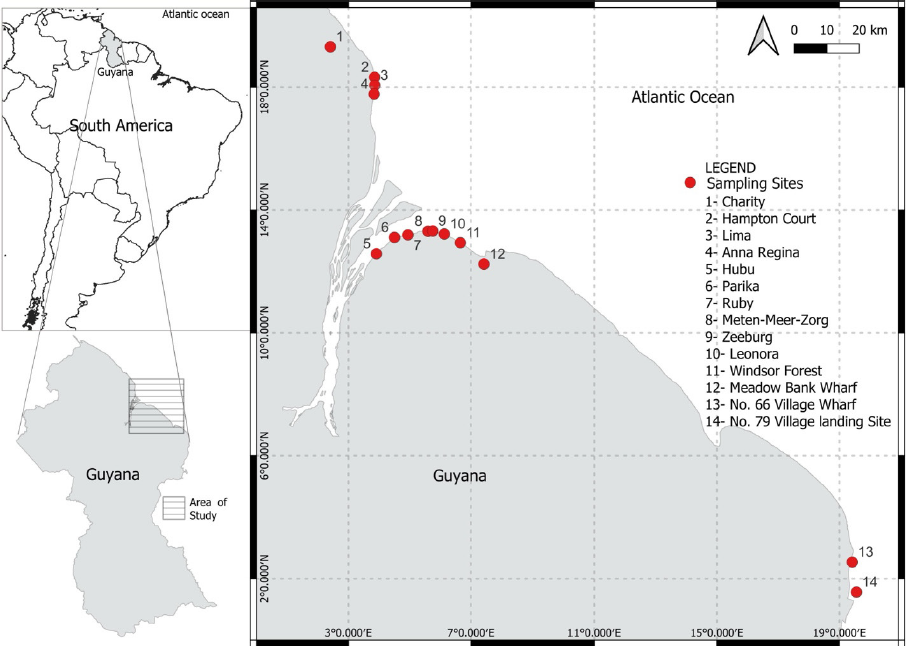
Surveys were conducted at 14 landing sites in administrative regions two, three, four, and six in Guyana, South America (Figure 1) from January to February 2018: the Anna Regina, Lima, Hampton Court, and Charity landing sites in administrative region two; Leonora, Meten-Meer-Zorg, Ruby, Zeeburg, Windsor Forest, Parika, and Hubu landing sites in administrative region three; Meadow Bank Wharf in administrative region four; and Number 66 Village wharf and Number 79 village landing site in administrative region six.
DATA COLLECTION
Purposive sampling was used to select participants from landing sites across selected fishing regions in Guyana, targeting individuals with specific characteristics relevant to this study. Purposive sampling is a widely used non-probability sampling technique that involves selecting participants based on specific characteristics, experiences, or knowledge (Etikan et al., 2015). Specifically, participants were current or past boat captains on marine fishing vessels engaged in artisanal or trawl fisheries. Participants were recruited based on their availability at the landing sites during the study period. They were immediately interviewed in a semi-private space at the sites. They were assured of the confidentiality of their responses and were required to provide neither names nor identifying information. Oral consent was required before participation. Overall, 76 fishers participated in this study. Interviews averaged 15 minutes. Participants were shown photographs of sea turtle species in Guyana to aid in species identification. The asked questions included: Is fishing your primary source of income? Why do you fish? How long have you been fishing? How often do you fish? Which fishing industry are you involved in? What type of fishing vessel do you fish with? Have you ever encountered sea turtles? How often do you encounter sea turtles? What time of the year do you encounter sea turtles? What species of sea turtles do you most often encounter? Which species of sea turtles are most often entangled in the fishing gear? In what conditions do you often find sea turtles when they are trapped in fishing gear? Are fishing gears modified to prevent sea turtle capture? How can we reduce sea turtle bycatch?
DATA ANALYSIS
The data were examined to determine fishers’ perceptions and interactions with sea turtles and analyzed using simple descriptive analysis. The Kruskal-Wallis test was used to determine whether the annual number of sea turtles captured differed significantly between landing sites. A P-value of <0.05 was considered statistically significant. All analyses were conducted on R Studio (Version 4.5.0).
RESULTS
FISHING TRENDS
Fishing was the primary source of income for 88% (n=67) of participants. The remaining 12% (n=9) had other jobs, including welding, farming, and retailing fish. Most (97%; n=74) fishers fished to support commercial markets, whereas the remainder (3%; n=2) only fished for subsistence. Most (70%; n=53) have been fishing for more than 10 years, whereas 30% (n=23) have been fishing for less than 10 years. The frequency of fishing was weekly (55%; n=42), monthly (26%; n=20), and daily (17%; n=13). In total, 2% (n=2) of participants failed to indicate how frequently they fished. Most (96%; n=73 fishers worked in artisanal fisheries, whereas 4% (n=3) worked on trawls. The dominant vessels were outboard motorized boats (78%; n=59), followed by inboard motorized boats (18%; n=14), and trawls (4%; n=3).
The primary gear used was gillnets (78%; n=59), with a mesh size ranging from 2.75 to 8 inches. Fyke nets (Chinese seine) were the second most popular gear (11%; n=8), with mesh size ranging from 6 inches at the mouth to 0.5 inches at the funnel. Trawls were less common (4%; n=3), followed by pin seine/small beach seines (4%; n=3), made from fine mesh material. In total, 3% (n=2) fished with longlines (cadell lines), with approximately 80 dangling lines and baited hooks two meters apart, and handlines (1%; n=1). Fishing occurs day and night, and the nets are checked every 15 minutes to 6 hours throughout the operation.
Gillnet fishers primarily target grey snapper (Cynoscion acoupa), sea trout (Cynoscion virescens), bangamary (Macrodon ancylodon), and butterfish (Nebris microps); Fyke nets or Chinese seine fishers target seabob (Xiphopenaeus kroyeri) and the whitebelly shrimp (Nematopalaemon schmitti); Trawls target seabob (Xiphopenaeus kroyeri); and longlines (Cadell lines) target gillbacker (Sciades parkeri) and other sea catfish. Pin seines (small beach seines) have broader targets, including small catfish (Arius sp.), and mullet (Mugil sp.).
INTERACTIONS WITH SEA TURTLES
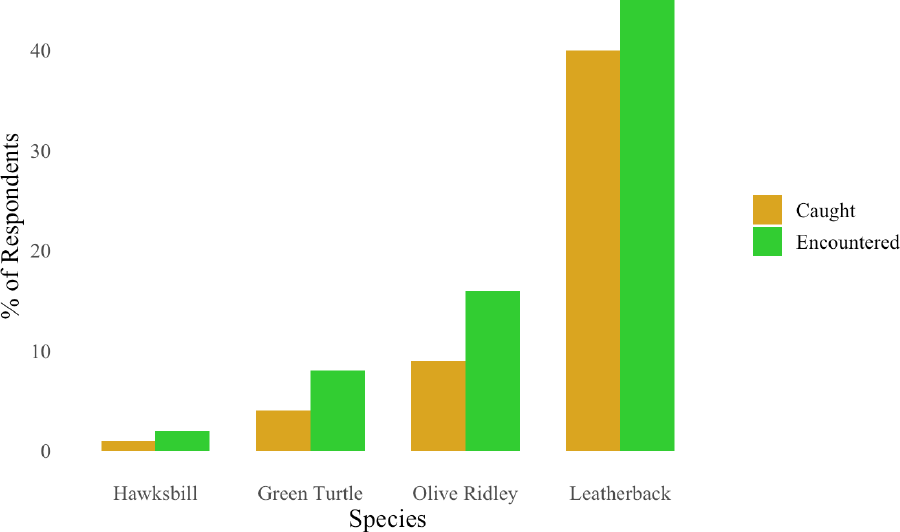
Fishers (87%; n=66) reported encountering sea turtles during fishing trips by seeing them swim or become entangled in the fishing gear. A few fishers (13%; n=10) reported no interactions with sea turtles. Sea turtles were more frequently encountered in August (34%; n=22), from June to December (27%; n=18), and from February to May (12%; n=8). A few participants (27%; n=18) reported being unsure of what time of the year they saw sea turtles. Most interactions with sea turtles occurred offshore (62%; n=41) and nearshore (30%; n=20), with some occurring offshore and nearshore (8%; n=5). Interactions included sighting, releasing sea turtles entangled in the fishing gear, and rescuing stranded sea turtles. Most encounters (85%; n=56) referred to entanglement in the fishing gear, with 84% (n=47) of sea turtles entangled in gillnets, followed by fyke nets (Chinese seine) (9%; n=5), trawls (5%; n=3), and pin seine (2%; n=1). The leatherback turtle (Dermochelys coriacea) was the most encountered species, followed by the Olive Ridley turtle (Lepidochelys olivacea) and the green sea turtle (Chelonia mydas) (Figure 2). The hawksbill turtle (Eretmochelys imbricata) was the least encountered and caught (Figure 2). There was no statistically significant difference (p = 0.11) between the sea turtles caught and the landing sites.
The majority (47%; n=26) of fishers indicated that the sea turtles caught in fishing gear were alive, 28% (n=16) said they had minor injuries, and 7% (n=4) reported that they were alive but critically injured. A few (18%; n=10) indicated that the sea turtles died when removed from the fishing gear.
The greater number of fishers in this study (61%; n=46) were aware that sea turtles are threatened marine organisms, and 75% (n=57) knew that there are laws protecting them. Over half of the fishers (54%; n=41) indicated that the primary strategy to release entangled sea turtles was untangling them from the net or cutting the net. The remaining fishers were unsure of how to prevent sea turtle bycatch. Only a few fishers (4%; n=3) had modifications to their fishing gear, such as the turtle excluder devices (TEDs).
DISCUSSION
Bycatch is perhaps the most significant global threat to sea turtle populations (Wallace et al., 2011). Sea turtles are particularly vulnerable to bycatch due to their movement patterns (Wallace et al., 2013). However, the reported numbers are likely underestimated due to insufficient reporting, data, and unreliable self-reported information. While high bycatch rates are observed in large-scale fisheries such as trawls, the cumulative impacts of small-scale fisheries might be just as concerning.
Gillnet fisheries, in particular, are responsible for high sea turtle bycatch globally (Gautama et al., 2022). We found that the sea turtles encountered and captured were most abundant in gillnet fisheries. While this may be a result of the large number of gillnet fishers participating in the study, it was consistent with the findings of Pingo et al. (2017), who reported that most sea turtles were incidentally captured in gillnets in Sechura Bay, Peru. Lum (2006) also reported that an estimated 3,000 adult sea turtles were accidentally captured in the gillnet fishery in Trinidad and Tobago. The gillnet fisheries comprise the largest small-scale fishery in Guyana, with over 800 vessels in the fleet, raising significant conservation concerns for sea turtles. The frequency of interactions with gillnets is often influenced by the overlap between fishing grounds and critical sea turtle habitats (Wallace et al., 2010).
The leatherback sea turtle (Dermochelys coriacea) was most frequently encountered, especially in August, which aligns with Guyana’s nesting period (February - August). The major nesting site for the Leatherback turtle in Guyana is the Shell Beach protected area (Figure 1). Sea turtles will likely encounter active fishing grounds as they navigate to the Shell Beach protected area, increasing their chances of becoming entangled in fishing nets. WWF (2020), in their ‘Living Planet Report’ of 2020, reported that the leatherback turtles have been declining at alarming rates in the Guianas, with the number of nests reaching the lowest levels in decades. In Suriname, nesting declined by 95% between 2001 and 2018; in Guyana, by 90%; and in French Guiana, by 84%. While no scientific reason was given for the decline in turtle populations, bycatch was identified as a possible cause, consistent with global trends.
The Olive Ridley (Lepidochelys olivacea) and green sea turtles (Chelonia mydas) were also encountered, but less commonly. While the populations of these turtles are low and declining globally, they are relatively stable in the Guianas when compared to those of the leatherback turtle (WWF, 2020). The hawksbill turtle (Eretmochelys imbricata) was least encountered, likely because of its small population, given its critically endangered status on the IUCN Red List, or because the fishing sites did not overlap with its habitat.
The post-release survival status of the sea turtles is uncertain, as many may become injured while trying to escape from the nets. Sea turtle mortality is reported to be high in the gillnet fishery due to long soak times (Murray, 2009). Lum (2006) estimated that over 65% of all captured leatherback sea turtles were released alive in the gillnet fishery of Trinidad and Tobago. However, given the population’s critical status, any decline is cause for concern. There is also a risk of high mortality in trawl fisheries, especially when fishing trips exceed the physiological capacity of turtles (Lewison et al., 2013; Guimarães et al., 2018).
Most fishers in our study reported keeping no sea turtles. This contrasts with neighboring Venezuela, in which all marine sea turtles reported from the Gulf of Venezuela were used (Barrios-Garrido et al., 2017). Consumption was linked to Indigenous people’s traditions and beliefs with the use of sea turtles, such as in traditional medicine (Barrios-Garrido et al., 2017). While all protocols were followed to ensure confidentiality, the possibility that fishers may refrain from indicating whether they keep sea turtles should be considered.
Although most fishers recognize that sea turtles are declining, awareness of their ecological importance and of the need for bycatch mitigation remains limited. Fishers play a fundamental role in reporting sea turtle encounters. However, these are often underreported due to a fear of reactive fishing restrictions (Lucchetti et al., 2017). When fishers were informed of simple mitigation strategies to reduce bycatch, such as checking nets more frequently, they were reluctant to adopt them because of fear of reduced catch and income. This highlights the socio-ecological complexities of bycatch mitigation and underscores the need for collaborative research and information sharing between scientists, managers, and fishers. Successful sea turtle bycatch reduction strategies such as net illumination (Gautama et al., 2022; Senko et al., 2022), buoyless nets (Peckham et al., 2016), and turtle excluder devices (Brewer et al., 2006) were studied. However, significant gaps remain, especially in developing countries. In Guyana, turtle excluder devices are required for trawl fisheries. However, there is no official requirement for small-scale fisheries.
Future research should focus on addressing the significant gaps in our understanding of fisher-turtle interactions. A more detailed study is needed to quantify the extent of sea turtle bycatch, particularly in gillnet fisheries, and to assess the spatial and temporal overlap of fishing activities with critical sea turtle habitats. Collaborative efforts between scientists, fishers, and fishery management organizations could help to design and test culturally and economically viable bycatch reduction methods and explore policy measures to improve fishery management. Targeted education and outreach programs for fishers can increase awareness of the ecological importance of sea turtles and the long-term benefits of sustainable fishing practices. Prioritizing integrating traditional ecological knowledge with scientific research could foster greater community engagement, leading to effective conservation outcomes for sea turtles and fisheries.
DATA AVAILABILITY STATEMENT
Data will be made available upon reasonable request by the corresponding author.
SUPPLEMENTARY MATERIAL
No supplementary materials are provided.
ACKNOWLEDGMENTS
We would like to thank the fishers who participated in this study, Joanna Porte and Nolle Readie for assisting with data collection, and Devya Hemraj-Naraine for creating the map. Gratitude is also expressed to our reviewers for their invaluable feedback.
REFERENCES
-
Abreu-Grobois, A. & Plotkin, P. (IUCN SSC Marine Turtle Specialist Group). 2008. Olive Ridley Turtle (Lepidochelys olivacea). Red List. DOI: https://dx.doi.org/10.2305/IUCN.UK.2008.RLTS.T11534A3292503.en
» https://dx.doi.org/10.2305/IUCN.UK.2008.RLTS.T11534A3292503.en -
Alfaro-Shigueto, J., Mangel, J., Bernedo, F., Dutton, H. P., Seminoff, A. J. & Godley, J. B. 2011. Smallscale fisheries of Peru: a major sink for marine turtles in the Pacific. Journal of Applied Ecology, 48(6), 1432e1440. DOI: https://doi.org/10.1111/j.1365-2664.2011.02040.x
» https://doi.org/10.1111/j.1365-2664.2011.02040.x -
Barrios-Garrido, H., Espinoza-Rodríguez, N., Rojas-Cañizales, D., Palmar, J., Wildermann, N., Montiel-Villalobos, G. M. & Hamann, M. 2017. Trade of marine turtles along the Southwestern Coast of the Gulf of Venezuela. Marine Biodiversity Records 10, 15. DOI: https://doi.org/10.1186/s41200-017-0115-0
» https://doi.org/10.1186/s41200-017-0115-0 -
Brewer, D., Heales, D., Milton, D., Dell, Q., Fry, G., Venables, B. & Jones, P. 2006. The impact of turtle excluder devices and bycatch reduction devices on diverse tropical marine communities in Australia’s northern prawn trawl fishery. Fisheries Research, 81(2-3), 176-188. DOI: https://doi.org/10.1016/j.fishres.2006.07.009
» https://doi.org/10.1016/j.fishres.2006.07.009 -
Etikan, I., Sulaiman, A. M. & Rukayya, S. A. 2015. Comparison of Convenience Sampling and Purposive Sampling. American Journal of Theoretical and Applied Statistics, 5(1), 1-4. DOI: https://doi.org/10.11648/j.ajtas.20160501.11
» https://doi.org/10.11648/j.ajtas.20160501.11 -
Gautama, D. A., Susanto, H., Riyanto, M., Wahju, R. I., Osmond, M. & Wang, J. H. 2022. Reducing sea turtle bycatch with net illumination in an Indonesian small-scale coastal gillnet fishery. Frontiers in Marine Science, 9, 1036158. DOI: https://doi.org/10.3389/fmars.2022.1036158
» https://doi.org/10.3389/fmars.2022.1036158 -
Guimarães, S. M., Tavares, D. C., & Monteiro-Neto, C. 2018. Incidental capture of sea turtles by industrial bottom trawl fishery in the Tropical South-western Atlantic. Journal of the Marine Biological Association of the United Kingdom, 98(6), 1525-1531 1525-1531. DOI: https://doi.org/10.1017/S0025315417000352
» https://doi.org/10.1017/S0025315417000352 -
IUCN. 2023. The IUCN Red List of Threatened Species. Version 2023-1. Available from: Available from: https://www.iucnredlist.org Access date: 2025 Dec. 1.
» https://www.iucnredlist.org - Kalamandeen, M. 2006. Assessment of Sea Turtle Bycatch in Guyana. World Wildlife Fund Technical Report.
-
Lakenarine, R., Chhetri, N., Chhetri, N. & Senko, J. 2024. Characterization of small-scale net fisheries off the coast of Guyana. PLOS ONE, 19(6), e0306332. DOI: https://doi.org/10.1371/journal.pone.0306332
» https://doi.org/10.1371/journal.pone.0306332 -
Lewison, R., Wallace, P. B., Alfaro-Shigueto, J., Mangel, C. J., Maxwell, M. S. & Hazen, L. E. 2013. Fisheries bycatch of marine turtles. lessons learned from decades of research and conservation. In: Wyneken, J., Lohmann, K. J. & Musick, J. A. (Ed.). The biology of sea turtles (pp. 329-352). New York: CRC Press. DOI: http://dx.doi.org/10.1201/b13895-13
» http://dx.doi.org/10.1201/b13895-13 -
Lucchetti, A., Vasapollo, C. & Virgili, M. 2017. An interview-based approach to assess sea turtle bycatch in Italian waters. PeerJ, 5. DOI: https://doi.org/10.7717/peerj.3151
» https://doi.org/10.7717/peerj.3151 -
Lum, L. L. (2006). Assessment of incidental sea turtle catch in the artisanal gillnet fishery in Trinidad and Tobago, West Indies. Applied Herpetology, 3(4), 357-368. DOI: https://doi.org/10.1163/157075406778905081
» https://doi.org/10.1163/157075406778905081 -
Mortimer, J. A. & Donnelly, M. (IUCN SSC Marine Turtle Specialist Group). 2008. Eretmochelys imbricata. Red List. DOI: https://dx.doi.org/10.2305/IUCN.UK.2008.RLTS.T8005A12881238.en
» https://dx.doi.org/10.2305/IUCN.UK.2008.RLTS.T8005A12881238.en -
Murray, K. T. 2009. Characteristics and magnitude of sea turtle bycatch in US mid-Atlantic gillnet gear. Endangered Species Research, 8, 211-224. DOI: https://doi.org/10.3354/esr00211
» https://doi.org/10.3354/esr00211 -
Peckham, S. H., Diaz, D. M., Walli, A., Ruiz, G., Crowder, L. B. & Nichols, W. J. (2007). Small-scale fisheries bycatch jeopardizes endangered Pacific loggerhead turtles. PLOS ONE , 2(10), e1041. DOI: https://doi.org/10.1371/journal.pone.0001041
» https://doi.org/10.1371/journal.pone.0001041 -
Peckham, S. H., Lucero-Romero, J., Maldonado-Díaz, D., Rodríguez-Sánchez, A., Senko, J., Wojakowski, M. & Gaos, A. (2016). Buoyless nets reduce sea turtle bycatch in coastal net fisheries. Conservation Letters, 9(2), 114-121. DOI: https://doi.org/10.1111/conl.12176
» https://doi.org/10.1111/conl.12176 -
Pham, C., Wang, H., Chen, S. & Lee, J. 2023. The threshold effect of overfishing on global fishery outputs: international evidence from a sustainable fishery perspective. Fishes, 8(2), 71. DOI: https://doi.org/10.3390/fishes8020071
» https://doi.org/10.3390/fishes8020071 -
Pingo, S., Jimenez, A., Alfaro - Shigueto. J. & Mangel, J.C. 2017. Incidental capture of sea turtles in the artisanal gillnet fishery in Sechura Bay, Northern Peru. Latin American Journal of Aquatic Research, 45(3). DOI: http://dx.doi.org/10.3856/vol45-issue3-fulltext-10
» http://dx.doi.org/10.3856/vol45-issue3-fulltext-10 -
Senko, F. J., Peckham, H. S., Aguilar-Ramirez, D. & Wang, H. J. 2022. Net illumination reduces fisheries bycatch, maintains catch value and increases operational efficiency. Current Biology, 34(4), 911-918. DOI: https://doi.org/10.1016/j.cub.2021.12.050
» https://doi.org/10.1016/j.cub.2021.12.050 -
Senko, J., White, E. R., Heppell, S. S. & Gerber, L. R. 2014. Comparing bycatch mitigation strategies for vulnerable marine megafauna. Animal Conservation, 17(1), 5-18. DOI: https://doi.org/10.1111/acv.12051
» https://doi.org/10.1111/acv.12051 -
Wallace, B. P., DiMatteo, A. D., Bolten, A. B., Chaloupka, M. Y., Hutchinson, B. J., Abreu-Grobois, F. A., Mortimer, J. A., Seminoff, J. A., Amorocho, D., Bjorndal, K. A., Bourjea, J., Bowen, B. W., Dueñas, R. B., Casale, P., Choudhury, B. C., Costa, A., Dutton, P. H., Fallabrino, A., Finkbeiner, E. M., Girard, A., Girondot, M., Hamann, M., Hurley, B. J., López-Mendilaharsu, M., Marcovaldi, M. M.M., Musick, J. A., Nel, R., Pilcher, N. J., Troëng, S., Witherington, B. & Mast, R. B. 2011. Global Conservation priorities for marine turtles. PLOS ONE , 6(9), e24510. DOI: https://doi.org/10.1371/journal.pone.0024510
» https://doi.org/10.1371/journal.pone.0024510 -
Wallace, B. P., Kot, C. Y., DiMatteo, A. D., Lee, T., Crowder, L. B., & Lewison, R. L. 2013a. Impacts of fisheries bycatch on marine turtle populations worldwide: Toward conservation and research priorities. Ecosphere, 4(3), 1-49. DOI: https://doi.org/10.1890/ES12-00388.1
» https://doi.org/10.1890/ES12-00388.1 -
Wallace, B. P., Tiwari, M. & Girondot, M. 2013b. Dermochelys coriacea. Red List . DOI: https://dx.doi.org/10.2305/IUCN.UK.2013-2.RLTS.T6494A43526147.en
» https://dx.doi.org/10.2305/IUCN.UK.2013-2.RLTS.T6494A43526147.en -
Wallace, B. P., Lewison, R. L., McDonald, S. L., McDonald, R. K., Kot, C. Y., Kelez, S., Bjorkland, R. K., Finkbeiner, E. M. & Crowder, L. B. 2010. Global patterns of marine turtle bycatch. Conservation Letters , 3(3), 131-142. DOI: https://doi.org/10.1111/j.1755-263X.2010.00105.x
» https://doi.org/10.1111/j.1755-263X.2010.00105.x -
Wallace, B. P. & Broderick, A. C. 2025. Chelonia mydas. Red List . DOI: https://dx.doi.org/10.2305/IUCN.UK.2025-2.RLTS.T4615A285108125.en
» https://dx.doi.org/10.2305/IUCN.UK.2025-2.RLTS.T4615A285108125.en -
WWF. 2020. Living Planet Report 2020 - Bending the curve of biodiversity loss. Almond, R.E.A., Grooten M. and Petersen, T. (Eds). WWF, Gland, Switzerland. Available from: Available from: https://www.wwf.org.uk/sites/default/files/2020-09/LPR20_Full_report.pdf Access date: 2025 Dec. 1.
» https://www.wwf.org.uk/sites/default/files/2020-09/LPR20_Full_report.pdf -
Zeller, D., Cashion, T., Palomares, M. & Pauly, D. 2018. Global marine fisheries discards: a synthesis of reconstructed data. Fish and Fisheries, 19(1), 30-39. DOI: https://doi.org/10.1111/faf.12233
» https://doi.org/10.1111/faf.12233