Microplastics invading corals: first scientific evidence from the Philippine Coral Triangle
ABSTRACT
Microplastic pollution has become an urgent threat to marine ecosystems, but its effects on coral reefs, especially in highly biodiverse areas such as the Philippines remain largely unknown. This is the first report on the microplastic contamination in the coral reef ecosystem in Lawigan, Bislig, Surigao del Sur, Philippines. Seawater, sediment, fish, and corals (including Acropora and Pocillopora species) were analyzed for microplastics according to standardized methodology. These samples were subjected to chemical digestion (10% KOH), density separation (NaCl), and filtration, and the particles were characterized by microscopy and FTIR spectroscopy. Seawater was noted to contain 60 microplastic particles (0.17 MP particles m-3) with the dominance of polypropylene (PP, 21.7%) and polyethylene (PE-HD, 18.3%), and 83.9% of reef fish had microplastics in their digestive tract (mean: 1.5 particles/individual), with films and fibers being the most prevalent shape. Corals contained up to 5 particles/individual, including particles embedded in tissues, whereas reef sediments contained larger fragments (>1000 μm) at 0.037 particles g-1. The dominance of fishing gear polymers (PP/PE) suggests local anthropogenic origins. The microplastics in Philippine coral reefs may add to the burden on these ecosystems, which are already in danger from climate change and overfishing. This study sets baseline data that can be critically used to reduce the impact of anthropogenic factors (such as the use of non-eco-friendly fisheries practices) and to promote community-based monitoring.
Keywords:
Microplastics; Coral reef; Philippines Coral Triangle
The increase in plastic pollution has become one of the greatest environmental concerns of the 21st century, and microplastics have been recognized as a major and widespread threat to marine ecology. Microplastics are conventionally defined as particles <5 mm in size (Arthur et al., 2009; GESAMP, 2015). They are commonly categorized by shape, including fibers, fragments, films, beads, and foams, which can originate from several sources such as textiles, packaging, fishing gear, and consumer products (Cowger et al., 2020; Hidalgo-Ruz et al., 2012). These particles are formed by processes such as the degradation of larger pieces of plastic, the shedding of synthetic fibers from clothing, and the release of microplastics from personal care products (Ashrafy et al., 2023). Once in the ocean, microplastics are virtually impossible to remove, being eaten by a variety of marine creatures, from plankton to whales (Burkhardt-Holm and N’Guyen, 2019; Torres et al., 2023). One of the most vulnerable but least studied of these is coral reef systems, which are susceptible to ongoing threats such as climate change, overfishing, and ocean acidification (Reichert et al., 2019).
Corals, the primary framework builders of the coral reefs, are no exception to microplastic pollution (Reichert et al., 2021). Corals are particularly susceptible to microplastic exposure due to several biological and ecological traits (Rades et al., 2022). Their particle-capture feeding behavior increases the likelihood of their accidental ingestion of suspended microplastics that mimic natural prey (Hankins et al., 2022; Reichert et al., 2024). Being sessile organisms, corals are unable to avoid exposure in contaminated waters. Moreover, corals produce mucus that can act as an adhesive surface, enhancing microplastic entrapment and ingestion (Hierl et al., 2021; Reichert et al., 2019). Such ingestion could impair these organisms in multiple ways, from the direct interference with internal feeding and digestive structures (e.g., obstruction of the gastrovascular cavity and abrasion of tissues) to altered functions such as reduced feeding rates, depletion of energy reserves, increased mucus production, and, in severe cases, necrosis of tissue and deformation of the skeleton (Chapron et al., 2018; Corinaldesi et al., 2021; Isa et al., 2025; Pantos, 2022). Moreover, microplastics might carry toxic compounds or pathogens, causing additional threats to coral health (Soares et al., 2020). Such stressors can negatively impact coral colonies and reef resilience and biodiversity (Soares et al., 2020).
Coral reefs have faced growing pressure from microplastic pollution (Rahman et al., 2023). Research in areas such as Australia, Indonesia, and the Maldives has confirmed the presence of microplastics in the sediments, tissues, and overlying waters of coral reefs on various levels of scale (Islam et al., 2023; Patti et al., 2020; Raguso et al., 2022). These investigations have highlighted the need to understand the impact of microplastics on corals, particularly in areas in which coral reefs are critical to ecological health and local economies. However, despite these developments, the degree of microplastics pollution on many tropical coral reefs remains poorly understood, including in archipelagic nations such as the Philippines.
As a country right at the center of the Coral Triangle, the Philippines hosts one of the most diverse and largest coral reef systems, which provide livelihood to millions of people via fisheries, tourism, and coast protection (Licuanan et al., 2019). Yet, their existence is continuously challenged by plastics, with the Philippines being one of the top marine plastic polluters in the world (Arumdani et al., 2021; Mai et al., 2023a). Although research has shown evidence of microplastics in coastal sediments, water columns, and marine organisms such as fish and mollusks (Espiritu et al., 2019; Osorio et al., 2021), reports about microplastic contamination in corals from the Philippines have been scarce.
This lack of understanding represents a critical barrier to determining the extent to which local plastic pollution pressures translate itself into reef impacts. Without knowledge of how much of this material is present in coral tissue or reef sediments to start with, it is challenging to make interventions, and it will be impossible to gauge the effectiveness of the waste interventions in place. Moreover, the lack of coral-specific microplastic research may underestimate the extent of the threat and, consequently, the effectiveness of conservation strategies, ultimately undermining the resilience of the coral ecosystem in the face of multiple stressors (Good and Bahr, 2021).
This research describes the first known evidence of microplastics in Philippine corals, focusing on the coral reef ecosystem of Lawigan, Bislig, Surigao del Sur. Situated within the globally significant Coral Triangle, this reef system is ecologically important; yet it remains understudied. This study aimed to (i) identify and quantify microplastics in coral tissues of Acropora, Porites, and Favia species and (ii) examine their distribution in associated reef compartments, including seawater, reef fishes, and sediment.
This report, along with other studies that show the ubiquity of microplastics in tropical ecosystems in the Philippines, adds to the accumulating evidence that microplastics configure an emerging and daunting global threat to reef ecosystems. Most significantly, this highlights the importance of integrated evidence-based research in improving our understanding of microplastic impacts on coral reef ecosystems and the associated communities that depend on them.
Scleractinian coral colonies were obtained from three common reef-building genera (Acropora, Porites, and Favia) in Lawigan Reef, Bislig, Surigao del Sur, Philippines-a habitat in the Coral Triangle with high biodiversity and rapidly increasing anthropogenic influence. The sampling sites were located at the following coordinates: 8.233851° N, 126.423710° E; 8°14′05″ N, 126°25′33″ E; 8°13′53″ N, 126°25′23″ E; and 8°13′54″ N, 126°25′21″ E. Sampling was carried out in June 2023 under license from the Department of Environment and Natural Resources, Philippines, and local authorities. Colonies were sampled at depths from one to six m via SCUBA and the anterior five-seven fragments were carefully clipped from colonies identified as healthy based on the absence of visible tissue necrosis, bleaching, or excessive algal overgrowth following sterilization of stainless-steel chisel. Fragments were carefully placed in identified sterile glass containers and/or in aluminum foil to avoid contamination with man-made materials. Simultaneous collections of nearby seawater, reef fish, and benthic sediments samples were made as environmental reference samples. Seawater samples (1L) were collected 0.5 m above coral colonies using pre-rinsed glass bottles, filtered through 25-µm mesh plankton nets. Reef fish specimens were captured using hand nets within the reef area and immediately placed on ice. Benthic sediment samples were collected from the seafloor in immediate proximity to sampled coral colonies (within 5 m radius). Using a stainless-steel shovel, sediment was gathered from the top 5-10 cm of the seafloor. In total, three replicates of approximately 300 g each were collected. All samples were packed in ice-chilled containers and stored at −20°C in the laboratory.
Coral tissues were separated from the skeletons with filtered seawater and dried as suggested by the reported procedure (Dehaut et al., 2016) with 500 mL 10% KOH (three-five days at room temperature). The solvent was then heated (40 °C, 40 h) with occasional stirring to desorb skeletal-bound microplastics according to a reported protocol (Ding et al., 2019). Filtered samples were acetone-dried on a fiberglass filter (GF/F) and subjected to density separation in a NaCl solution (1.2 g/cm³). The buoyant fraction was re-filtered and re-analyzed for a fraction of the skeletons, which were dried at 60°C. Their surface area was calculated by the simple geometry method in a previously described protocol (Naumann et al., 2009) to standardize microplastic abundances for coral surface area.
Seawater (1 L) samples were vacuum filtered in pre-combusted GF/F filters (0.7 µm) that were dried and stored on Petri dishes. Sediments (500 g) were dried in an oven at 90°C for 24 h, sieved using a five-mm sieve, and digested in 10% KOH (150 mL, 40°C, 40 h) (Felicitas et al. 2025; Karami et al. 2017; Keleste et al., 2025). The supernatant was thrice subjected to density separation in NaCl (1.2 g cm−3, 24 h) (Claessens et al. 2013). The entire floating fraction was collected onto GF/F filters for subsequent microscopic and FTIR analysis.
Reef fish sampling was conducted at the same sites as the coral collection. A total of 30 specimens were collected using hand casting fishing nets, including the following species: Scarus sp., Siganus sp1., Siganus sp2., Acanthurus sp., Scolopsis sp., Lutjanus sp., Chlorurus sp., Ctenochaetus sp., and Naso sp. The gastrointestinal tract (GIT) of the sampled fish was dissected and soaked in 10% KOH at a volume four-times the weight of the GIT) for three-five days (Lusher et al., 2015). The digested solution was then vacuum filtered to extract ingested microplastics.
Sediment samples were oven-dried at 90 °C for 24 h and weighed using a pre-weighed glass beaker. The dried samples were sieved through a 5-mm stainless-steel mesh to remove large debris. The particles retained on the sieve were discarded. The sieved sediment then underwent digestion of organic matter according to the method by Karami et al. (2017). After digestion, the supernatant was decanted and vacuum filtered. It should be noted that drying sediment samples at 90 °C may affect heat-sensitive microplastic particles, potentially altering their abundance or characteristics. Future studies may consider using lower drying temperature or alternative drying methods to minimize these effects.
Density separation was conducted with a saturated NaCl solution, and the supernatant was collected after filtration of the suspected microplastics through Whatman GF/F filters using a vacuum filtration system (Banda et al., 2024). The filters were washed with distilled water and dried in an oven at 40°C until completely dry. All filtered particles from coral, seawater, reef fish, and benthic sediment samples were examined under a stereomicroscope, and the suspected microplastics were identified, counted, and sorted by shape, color, and size, with a lower size threshold set at 1.0 µm. For polymer identification, particles were analyzed by Fourier-transform infrared (FTIR) spectroscopy.
Microplastic particles isolated from seawater, fish GIT, sediments, and corals were evaluated under a stereomicroscope (iScope Series Euromex, Holland) at 10×-40× magnification. Then, these particles were gently prepared with forceps or needles onto clean glass slides, labeled, and prepared for polymer confirmation by FTIR spectroscopy. Their dimensions were measured using a microscope with a camera, and particles were classified according to shape and color, as in Hidalgo-Ruz et al. (2012). The initial identification was visually done, as in Norén (2007). Then, the FTIR analyses were carried out to assess the type of polymer.
Procedural controls were implemented, including glass containers, ethanol-cleaned workstations, and cotton/nitrile personal protective equipment. All experiments were performed as quickly as possible to minimize exposure to airborne microplastics. Moreover, three procedural blanks were analyzed to detect potential contamination during the preparation and analysis of the samples.
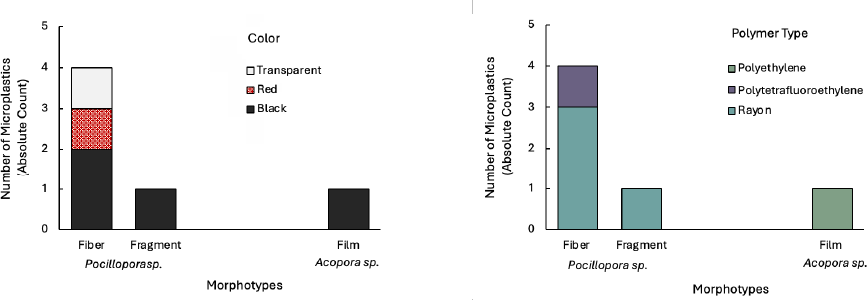
Microplastic pollution in coral species in the Lawigan Reef, Bislig Bay, Philippines, was detected. Among the analyzed coral species, Pocillopora and Acropora contained microplastics, whereas no particles were detected in Favia. Pocillopora sp. showed more contamination, with a mean value of five microplastic particles per individual (1.3 items g⁻¹ dry coral tissue), mainly fibers (n = 4) and one fragment. Black fibers were the most abundant (three of five particles). In contrast, Acropora sp. contained a single microplastic particle, which was identified as a film. By FTIR spectroscopy, the identified polymers were rayon and polytetrafluoroethylene (PTFE) in microplastic particles collected from Pocillopora sp., and polyethylene (PE) in Acropora sp. (Figure 1). The presence of rayon, PTFE, and PE, usually associated with cookware, textile, and packaging material, suggests predominantly local land-based urban sources (Zambrano et al., 2019; Qiu et al., 2020) such as domestic sewage (Mai et al., 2023b; Xu et al., 2021) and fishing debris (Samal et al., 2024) . This implies that household and small-scall fisheries are relevant microplastic (MP) sources in coastal areas. Lawigan, along the eastern coastline of Mindanao, is characterized by human settlements and tourism-driven economic activities. Evidence from comparable coastal environments indicates that plastic inputs in such settings are frequently associated with surface runoff, mismanaged waste, and recreational or fishing activities (Abreo et al., 2020; Escañan et al., 2025; Perpetua et al., 2025). Therefore, it is plausible that the observed microplastics in the corals from Lawigan reflect a combination of these anthropogenic sources.
Morphotypes of microplastics identified in coral fragments. (a) Distribution of microplastic colors (transparent, red, and black) across morphotypes (fiber, fragment, film) and coral species (Pocillopora sp. and Acropora sp.). (b) Distribution of microplastic polymer types (Rayon, Polyethylene, and Polytetrafluoroethylene) among morphotypes and coral species. Data are presented as the mean absolute count of microplastics per species.
While it is renowned for its pristine white sand beaches and clear waters (making it a popular destination for locals and tourists), its proximity to human settlements and economic activities contributes to microplastic contamination. Anthropogenic sources include runoff from nearby communities, improper waste disposal, and direct deposition from fishing and tourism-related activities. These contributors likely play a part in the presence of microplastics in the area.
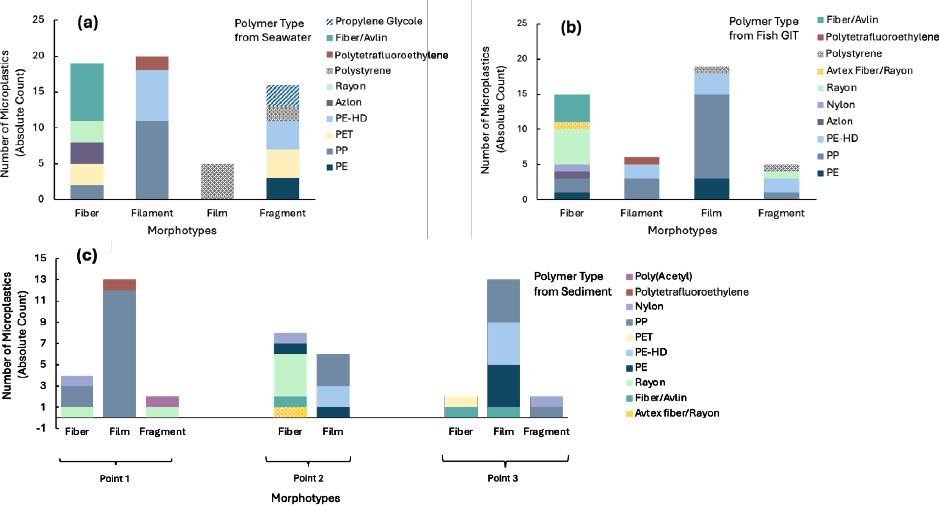
The abundance and morphotypes of microplastics in seawater, fish GIT, and sediment samples are shown in Figure 2. A total of 60 microplastic particles (0.17 MP particles m-3) were observed in the seawater samples of Bislig Bay. Filaments (33.33%) and fibers (31.67%) were the most prevalent morphotypes among these microplastic particles, followed by fragments (26.37%) and films (8.33%). White-colored particles were the most predominant (31.67%), followed by red (28.33%), black (20%), and green (13.33%). Polymer composition analysis shows that the most abundant polymer was polypropylene (PP; 21.67%), followed by high-density polyethylene (PE-HD; 18.33%) and polyethylene terephthalate (PET; 11.67%). Most (64.8%) particles spanned 20-330 μm, suggesting a large fraction of fine microplastic particles in the water column. These results indicate widespread contamination, with potential sources including fishing gear deterioration, textile fibers, and domestic plastic waste. Such origins are consistent with observations in other tropical marine environments (Baalkhuyur et al., 2018; Hansani et al., 2023; Sulistiowati et al., 2023).
Abundance and type of microplastics extracted from (a) reef seawater, (b) reef fish GIT, and (c) reef sediment samples at three points along a transect: Point 1 (start), Point 2 (middle), and Point 3 (End). The data are shown as the absolute counts of confirmed microplastics by morphotype for each sample type.
A total of 26 (83.9%) of the 30 analyzed reef fish were positive for ingested microplastics, and 45 microplastics were found in their GITs. Films (42.22%) and fibers (33.33%) constituted the most common ingested morphotypes, the prevalent colors of which were brown (31.11%) and white (28.89%). FTIR analysis confirmed that PP (40%) and PE-HD (15.56%) were the common polymers. The color of microplastics may influence coral interaction as certain hues could resemble planktonic prey and increase ingestion likelihood (Hierl et al., 2021). High uptake and morphotype diversity indicate the bioavailability of microplastics in reef habitats, which adds to concerns over possible trophic transfer and sublethal physiological effects on reef-associated organisms. While this study directly assessed no physiological effects on reef-associated organisms, its findings agree with reports from other coral reef systems, in which microplastic ingestion has been linked to altered feeding behavior and intestinal damage in fish (Costa et al., 2023; Justino et al., 2023; Santana et al., 2021).
An average of 50 microplastic particles was recorded in the reef sediment samples at a mean concentration of 0.037 items g⁻¹. Plastics distribution in the sediment microplastic profile was dominated by films (64%), followed by fibers (28%) and fragments (8%). The most common colors were brown (50%) and white (22%). PP (44%) was still the dominant polymer type, followed by PE (12%) and rayon (12%). In particular, 66% of particles were greater than 1000 μm, indicating that sediment serves as a sink for macro-sized microplastics via hydrodynamic settling and finite mobility.
The relatively similar distribution of particulate types across the sampling sites suggests that diffuse and chronic pollution loads may be important contributors. These patterns could be influenced by discharges from human settlements along the coast and uncontrolled solid waste dumping, although further statistical analysis would be required to confirm spatial homogeneity and establish stronger linkages.
The presence of microplastics in Pocillopora sp., a key reef-building coral, is particularly alarming. Fibers, due to their shape and persistence, can become tangled with or abrasive to coral tissue, impede photosynthetic efficiency of the coral’s symbiotic algae, and become a vector for deleterious microorganism (Lamb et al., 2018). Moreover, PP, which is identified as the most dominant polymer in the samples in this study, has been shown to alter coral-associated microbial communities, potentially weakening their resistance (Isa et al., 2023). The presence of microplastic particles within coral polyps not only indicates environmental pollution but also imposes direct biological stress on the corals, independent of other chronic stressors such as elevated sea surface temperatures and ocean acidification.
This study established the presence of microplastic contamination in Philippine corals for the first time, which occurred in the Lawigan coral reef ecosystem. The presence of microplastics across seawater, fish, sediment, and corals implies the contamination of various environmental compartments. Besides, the abundance of polymer types, including PP, PE, and PE-HD, which are commonly used in fishing equipment, packaging, and textile products, further supports the notion that local anthropogenic sources from offshore activities play a significant role as a major source. The occurrence of microplastics in reef organisms also lends weight to the possibility of an ecosystem-level impact via bioaccumulation and trophic transfer.
These results emphasize the immediate requirement for solutions with integrated pollution management, ranging from waste minimization at source and coastal sanitation to a more rigorous implementation of regulations regarding the disposal of plastics. Although additional studies are certainly needed to better evaluate long-term ecological impacts and the modes of action of MP toxicity in reef organisms, this study provides a starting point for future monitoring and policy development. Its evidence should encourage preemptive measures by local governments and communities to secure one of the richest and most threatened marine resources in the Philippines.
DATA AVAILABILITY STATEMENT
The datasets generated and analyzed during this study are available from the corresponding author upon reasonable request.
SUPPLEMENTARY MATERIAL
No supplementary material is associated with this article.
ACKNOWLEDGEMENT
We sincerely appreciate the thoughtful feedback from the reviewers, which greatly helped us to improve the clarity and quality of this paper.
REFERENCES
-
Abreo, N. A. S., Siblos, S. K. V., & Macusi, E. D. 2020. Anthropogenic marine debris (AMD) in mangrove forests of Pujada Bay, Davao Oriental, Philippines. Journal of Marine and Island Cultures, 9(1). DOI: https://doi.org/10.21463/jmic.2020.09.1.03
» https://doi.org/10.21463/jmic.2020.09.1.03 -
Arthur, C., Baker, J., & Bamford, H. (Ed.). 2009. Proceedings of the International Research Workshop on the Occurrence, Effects, and Fate of Microplastic Marine Debris. NOAA Technical Memorandum NOS-OR&R-30. Available from: Available from: https://repository.library.noaa.gov/view/noaa/2509 Access date: 2026 Feb. 4.
» https://repository.library.noaa.gov/view/noaa/2509 -
Arumdani, I. S., Puspita, A. S., & Budihardjo, M. A. 2021. MSW handling of top 5 leading waste-producing countries in Southeast Asia. IOP Conference Series: Earth and Environmental Science, 896(1), 012003. DOI: https://doi.org/10.1088/1755-1315/896/1/012003
» https://doi.org/10.1088/1755-1315/896/1/012003 -
Ashrafy, A., Liza, A. A., Islam, M. N., Billah, M. M., Arafat, S. T., Rahman, M. M., & Rahman, S. M. 2023. Microplastics pollution: a brief review of its source and abundance in different aquatic ecosystems. Journal of Hazardous Materials Advances, 9, 100215. DOI: https://doi.org/10.1016/j.hazadv.2022.100215
» https://doi.org/10.1016/j.hazadv.2022.100215 -
Baalkhuyur, F. M., Bin Dohaish, E.-J. A., Elhalwagy, M. E. A., Alikunhi, N. M., AlSuwailem, A. M., Røstad, A., Coker, D. J., Berumen, M. L., & Duarte, C. M. 2018. Microplastic in the gastrointestinal tract of fishes along the Saudi Arabian Red Sea coast. Marine Pollution Bulletin, 131(A), 407-415. DOI: https://doi.org/10.1016/j.marpolbul.2018.04.040
» https://doi.org/10.1016/j.marpolbul.2018.04.040 -
Banda, M. H. T., Olayon, M. C. C., Inocente, S. A. T., Segovia, J. L. M., Bedoya, N. A., Bigcas, E. V., Lomantong, A.-N. D., Bacsarpa, C. Y., Aporbo, J. C. C., Reble, D. M., Bacosa, H. P., Lubguban, A. A., & Capangpangan, R. Y. 2024. Microplastic Pollution in Mindanao’s Taguibo River watershed forest reserve: characterization, and distribution patterns, and implications for freshwater ecosystem. Applied Science and Engineering Progress, 17(3), 7416. DOI: https://doi.org/10.14416/j.asep.2024.06.007
» https://doi.org/10.14416/j.asep.2024.06.007 -
Burkhardt-Holm, P., & N’Guyen, A. 2019. Ingestion of microplastics by fish and other prey organisms of cetaceans, exemplified for two large baleen whale species. Marine Pollution Bulletin , 144, 224-234. DOI: https://doi.org/10.1016/j.marpolbul.2019.04.068
» https://doi.org/10.1016/j.marpolbul.2019.04.068 -
Chapron, L., Peru, E., Engler, A., Ghiglione, J. F., Meistertzheim, A. L., Pruski, A. M., Purser, A., Vétion, G., Galand, P. E., & Lartaud, F. 2018. Macro and microplastics affect coldwater corals growth, feeding and behaviour. Scientific Reports, 8. DOI: https://doi.org/10.1038/s41598-018-33683-6
» https://doi.org/10.1038/s41598-018-33683-6 -
Claessens, M., Van Cauwenberghe, L., Vandegehuchte, M. B., & Janssen, C. R. 2013. New techniques for the detection of microplastics in sediments and field collected organisms. Marine Pollution Bulletin , 70(1-2), 227-233. DOI: https://doi.org/10.1016/j.marpolbul.2013.03.009
» https://doi.org/10.1016/j.marpolbul.2013.03.009 -
Corinaldesi, C., Canensi, S., Dell’Anno, A., Tangherlini, M., Di Capua, I., Varrella, S., Willis, T. J., Cerrano, C., & Danovaro, R. (2021). Multiple impacts of microplastics can threaten marine habitat-forming species. Communications Biology, 4(431). DOI: https://doi.org/10.1038/s42003-021-01961-1
» https://doi.org/10.1038/s42003-021-01961-1 -
Costa, I. D., Costa, L. L., & Zalmon, I. R. 2023. Are fishes selecting the trash they eat? Influence of feeding mode and habitat on microplastic uptake in an artificial reef complex (ARC). Science of The Total Environment, 904. DOI: https://doi.org/10.1016/j.scitotenv.2023.166788
» https://doi.org/10.1016/j.scitotenv.2023.166788 -
Cowger, W., Booth, A. M., Hamilton, B. M., Thaysen, C., Primpke, S., Munno, K., Lusher, A. L., Dehaut, A., Vaz, V. P., Liboiron, M., Devriese, L. I., Hermabessiere, L., Rochman, C., Athey, S. N., Lynch, J. M., De Frond, H., Gray, A., Jones, O. A. H., Brander, S., … & Nel, H. 2020. Reporting guidelines to increase the reproducibility and comparability of research on microplastics. Applied Spectroscopy, 74(9), 1066-1077. DOI: https://doi.org/10.1177/0003702820930292
» https://doi.org/10.1177/0003702820930292 -
Dehaut, A., Cassone, A. L., Frere, L., Hermabessiere, L., Himber, C., Rinnert, E., Riviere, G., Lambert, C., Soudant, P., Huvet, A., Dufos, G., & Paul-Pont, I. 2016. Microplastics in seafood: Benchmark protocol for their extraction and characterization. Environmental Pollution, 215, 223-233. DOI: https://doi.org/10.1016/j.envpol.2016.05.018
» https://doi.org/10.1016/j.envpol.2016.05.018 -
Ding, J., Jiang, F., Li, J., Wang, Z., Sun, C., Wang, Z., Fu, L., Ding, N. X., He, C. 2019. Microplastics in the coral reef systems from Xisha Islands of South China Sea. Environmental Science & Technology, 53(14), 8036-8046. DOI: https://doi.org/10.1021/acs.est.9b01452
» https://doi.org/10.1021/acs.est.9b01452 -
Escañan, A. S., Wang, M. H., Acot, F. T., Perpetua, Z. D., Sajorne, R. E., Albarico, F. P. J. B., Chen, C. W., Dong, C. D., & Bacosa, H. P. 2025. Spatiotemporal variations in rural and urban beach microplastics accumulation in sediment along Sarangani Bay Protected Seascape, Mindanao, the Philippines. Environmental Monitoring and Assessment, 197(6). DOI: https://doi.org/10.1007/s10661-025-14106-2
» https://doi.org/10.1007/s10661-025-14106-2 - Espiritu, E. Q., Dayrit, S. A. S., Coronel, A. S. O., Paz, N. S. C., Ronquillo, P. I. L., Castillo, V. C. G., & Enriquez, E. P. 2019. Assessment of Quantity and Quality of Microplastics in the Sediments, Water, Oysters, and Selected Fish Species in Key Sites Along the Bombong Estuary and the Coastal Waters of Ticalan in San Juan, Batangas. Philippine Journal of Science, 148, 789-801.
-
Felicitas, G., Jumawan, J. C., Burdeos, R. C. B., Delara, R. G. D., Seronay, R. A., Vales, T. P., Latayada, F. S., Inocente, S. A. T., Banda, M. H. T., Capangpangan, R. Y. 2025. Microplastics in Surface Water and Gastrointestinal Tracts of Demersal Fishes (Oreochromis niloticus and Cyprinus carpio) in the Largest Wetland of the Philippines. International Journal of Environmental Research, 19. DOI: https://doi.org/10.1007/s41742-025-00768-w
» https://doi.org/10.1007/s41742-025-00768-w - GESAMP (Joint Group of Experts on the Scientific Aspects of Marine Environmental Protection). 2015. Sources, fate and effects of microplastics in the marine environment: A global assessment. London, IMO.
-
Good, A. M., & Bahr, K. D. 2021. The coral conservation crisis: integrating local and global stressors reduce reef resiliency and create challenges for conservation solutions. SN Applied Science, 3. DOI: https://doi.org/10.1007/s42452-021-04319-8
» https://doi.org/10.1007/s42452-021-04319-8 -
Hankins, C., Raimondo, S., & Lasseigne, D. 2022. Microplastic ingestion by coral as a function of the interaction between calyx and microplastic size. The Science of The Total Environment , 810, 152333. DOI: https://doi.org/10.1016/j.scitotenv.2021.152333
» https://doi.org/10.1016/j.scitotenv.2021.152333 -
Hansani, K. U. D. N., Thilakarathne, E. P. D. N., Koongolla, J. B., Gunathilaka, W., Perera, B. I. G., Weerasingha, W. M. P. U., & Egodauyana, K. P. U. T. 2023. Contamination of microplastics in tropical coral reef ecosystems of Sri Lanka. Marine Pollution Bulletin , 194(A), 115299. DOI: https://doi.org/10.1016/j.marpolbul.2023.115299
» https://doi.org/10.1016/j.marpolbul.2023.115299 -
Hidalgo-Ruz, V., Gutow, L., Thompson, R. C., & Thiel, M. 2012. Microplastics in the marine environment: A review of the methods used for identification and quantification. Environmental Science & Technology , 46(6), 3060-3075. DOI: https://doi.org/10.1021/es2031505
» https://doi.org/10.1021/es2031505 -
Hierl, F., Wu, H. C., & Westphal, H. 2021. Scleractinian corals incorporate microplastic particles: identification from a laboratory study. Environmental Science and Pollution Research, 28(37), 37882-37892. DOI: https://doi.org/10.1007/s11356-021-13240-x
» https://doi.org/10.1007/s11356-021-13240-x -
Isa, V., Becchi, A., Napper, I. E., Ubaldi, P. G., Saliu, F., Lavorano, S., & Galli, P. 2023. Effects of polypropylene nanofibers on soft corals. Chemosphere, 327, 138509. DOI: https://doi.org/10.1016/j.chemosphere.2023.138509
» https://doi.org/10.1016/j.chemosphere.2023.138509 -
Isa, V., Saliu, F., Becchi, A., Spadaccino, G., Quinto, M., Veronelli, M., Lasagni, M., Galli, P., & Lavorano, S. 2025. Impacts of microplastics on reef-building corals: Disentangling the contribution of the chain scission products released by weathering. Science of The Total Environment , 975, 179239. DOI: https://doi.org/10.1016/j.scitotenv.2025.179239
» https://doi.org/10.1016/j.scitotenv.2025.179239 -
Islam, M. S., Islam, A. R. M. T., Ismail, Z., Ahmed, M. K., Ali, M. M., Kabir, M. H., Ibrahim, K. A., Al-Qthanin, R. N., & Idris, A. M. 2023. Effects of microplastic and heavy metals on coral reefs: A new window for analytical research. Heliyon, 9(11), e2262. DOI: https://doi.org/10.1016/j.heliyon.2023.e22692
» https://doi.org/10.1016/j.heliyon.2023.e22692 -
Justino, A. K. S., Ferreira, G. V. B., Fauvelle, V., Schmidt, N., Lenoble, V., Pelage, L., & Lucena-Frédou, F. 2023. Exploring microplastic contamination in reef-associated fishes of the Tropical Atlantic. Marine Pollution Bulletin , 192, 115087. DOI: https://doi.org/10.1016/j.marpolbul.2023.115087
» https://doi.org/10.1016/j.marpolbul.2023.115087 -
Karami, A., Golieskardi, A., Choo, C. K., Romano, N., Ho, Y. B., & Salamatinia, B. 2017. A high-performance protocol for extraction of microplastics in fish. Science of The Total Environment , 578, 485-494. DOI: https://doi.org/10.1016/j.scitotenv.2016.10.213
» https://doi.org/10.1016/j.scitotenv.2016.10.213 -
Keleste, E. P., Fedelis, J. S., Opusa, W. F. T., Inocente, S. A. T., Banda, M. H. T., Latayada, F. S., Jumawan, J. C., Vales, T. P., Seronay, R. A., Capangpangan, R. Y. 2025. Assessment of microplastic pollution load and ecological risk index in surface water and sediment matrices in the mangrove ecosystem along Butuan Bay, Southern Philippines. Environment and Natural Resources Journal, 23(3), 196-210. DOI: https://doi.org/10.32526/ennrj/23/20240122
» https://doi.org/10.32526/ennrj/23/20240122 -
Lamb, J. B., Willis, B. L., Fiorenza, E. A., Couch, C. S., Howard, R., Rader, D. N., True, J. D., Kelly, L. A., Ahmad, A., Jompa, J., & Harvell, C. D. 2018. Plastic waste associated with disease on coral reefs. Science, 359(6374), 460-462. DOI: https://doi.org/10.1126/science.aar3320
» https://doi.org/10.1126/science.aar3320 -
Licuanan, W. Y., Robles, R., & Reyes, M. 2019. Status and recent trends in coral reefs of the Philippines. Marine Pollution Bulletin , 142, 544-550. DOI: https://doi.org/10.1016/j.marpolbul.2019.04.013
» https://doi.org/10.1016/j.marpolbul.2019.04.013 -
Lusher, A. L., Hernandez-Milian, G., O’Brien, J., Berrow, S., O’Connor, I., & Officer, R. 2015. Microplastic and macroplastic ingestion by a deep diving, oceanic cetacean: the True’s beaked whale Mesoplodon mirus. Environmental Pollution , 199, 185-191. DOI: https://doi.org/10.1016/j.envpol.2015.01.023
» https://doi.org/10.1016/j.envpol.2015.01.023 -
Mai, L., Sun, X., & Zeng, E. Y. 2023a. Country-specific riverine contributions to marine plastic pollution. Science of The Total Environment , 874, 162552. DOI: https://doi.org/10.1016/j.scitotenv.2023.162552
» https://doi.org/10.1016/j.scitotenv.2023.162552 -
Mai, H., Bui, V. H., Dao, T. D., Nguyen, T. D., Nguyen, D. T., Vu, T. K., Chu, N. H. A., Tran, M. Q., Stragy, E. 2023b. Distribution of microplastics in surface water of tropical urban lakes: A case study in Ha Noi, Vietnam. Vietnam Journal of Earth Sciences, 45(3), 388-404. DOI: https://doi.org/10.15625/2615-9783/18595
» https://doi.org/10.15625/2615-9783/18595 -
Naumann, M. S., Niggl, W., Laforsch, C., Glaser, C., & Wild, C. 2009. Coral surface area quantification-evaluation of established techniques by comparison with computer tomography. Coral Reefs, 28(1), 109-117. DOI: https://doi.org/10.1007/s00338-008-0459-3
» https://doi.org/10.1007/s00338-008-0459-3 - Norén, F. 2007. Small plastic particles in coastal Swedish waters. Lysekil, KIMO Sweden Report.
-
Osorio, E. D., Tanchuling, M. A. N. & Diola, M. B. L. 2021. Microplastics occurrence in surface waters and sediments in five river mouths of Manila Bay. Frontiers in Environmental Science, 9, 719274. DOI: https://doi.org/10.3389/fenvs.2021.719274
» https://doi.org/10.3389/fenvs.2021.719274 -
Pantos, O. 2022. Microplastics: impacts on corals and other reef organisms. Emerging Topics in Life Sciences, 6(1), 81-93. DOI: https://doi.org/10.1042/etls20210236
» https://doi.org/10.1042/etls20210236 -
Patti, T. B., Fobert, E. K., Reeves, S. E., & Silva, K. B. 2020. Spatial distribution of microplastics around an inhabited coral island in the Maldives, Indian Ocean. Science of The Total Environment , 748, 141263. DOI: https://doi.org/10.1016/j.scitotenv.2020.141263
» https://doi.org/10.1016/j.scitotenv.2020.141263 -
Perpetua, Z. D., Albarico, F. P. J. B., Capangpangan, R. Y., Shiu, R.-F., Lim, Y. C., Chen, C.-W., & Bacosa, H. P. 2025. Meso- and microplastics accumulation and ecological risks in Philippine urban and rural sandy beaches. Estuarine, Coastal and Shelf Science, 323, 109414. DOI: https://doi.org/10.1016/j.ecss.2025.109414
» https://doi.org/10.1016/j.ecss.2025.109414 -
Qiu, R., Song, Y., Zhang, X., Xie, B., He, D. 2020. Microplastics in urban environments: sources, pathways, and distribution. In: He, D., Luo, Y. (Ed.). Microplastics in Terrestrial Environments. The Handbook of Environmental Chemistry (v. 95, pp. 41-61). Springer, Cham. DOI: https://doi.org/10.1007/698_2020_447
» https://doi.org/10.1007/698_2020_447 -
Rades, M., Schubert, P., Wilke, T., & Reichert, J. 2022. Reef-building corals do not develop adaptive mechanisms to better cope with microplastics. Frontiers in Marine Science, 9. DOI: https://doi.org/10.3389/fmars.2022.863187
» https://doi.org/10.3389/fmars.2022.863187 -
Raguso, C., Saliu, F., Lasagni, M., Galli, P., Clemenza, M., & Montano, S. 2022. First detection of microplastics in reef-building corals from a Maldivian atoll. Marine Pollution Bulletin , 180, 113773. DOI: https://doi.org/10.1016/j.marpolbul.2022.113773
» https://doi.org/10.1016/j.marpolbul.2022.113773 -
Rahman, M. N., Shozib, S. H., Akter, M. Y., Islam, A. R. M. T., Islam, M. S., Sohel, M. S., Kamaraj, C., Rakib, M. R. J., Idris, A. M., Sarker, A., & Malafaia, G. 2023. Microplastic as an invisible threat to the coral reefs: Sources, toxicity mechanisms, policy intervention, and the way forward. Journal of Hazardous Materials, 454, 131522. DOI: https://doi.org/10.1016/j.jhazmat.2023.131522
» https://doi.org/10.1016/j.jhazmat.2023.131522 -
Reichert, J., Arnold, A. L., Hoogenboom, M. O., Schubert, P., & Wilke, T. 2019. Impacts of microplastics on growth and health of hermatypic corals are species-specific. Environmental Pollution , 254(B), 113074. DOI: https://doi.org/10.1016/j.envpol.2019.113074
» https://doi.org/10.1016/j.envpol.2019.113074 -
Reichert, J., Arnold, A. L., Hammer, N., Miller, I. B., Rades, M., Schubert, P., Ziegler, M., & Wilke, T. 2021. Reef-building corals act as long-term sink for microplastic. Global change biology, 28(1), 33-45. DOI: https://doi.org/10.1111/gcb.15920
» https://doi.org/10.1111/gcb.15920 -
Reichert, J., Tirpitz, V., Oponczewski, M., Lin, C., Franke, N., Ziegler, M., & Wilke, T. 2024. Feeding responses of reefbuilding corals provide species and concentrationdependent risk assessment of microplastic. Science of The Total Environment , 913,. DOI: https://doi.org/10.1016/j.scitotenv.2023.169485
» https://doi.org/10.1016/j.scitotenv.2023.169485 -
Samal, K., Samal, S. R., Mishra, S., & Nayak, J. K. 2024. Sources, transport, and accumulation of synthetic microfiber wastes in aquatic and terrestrial environments. Water, 16(16), 2238. DOI: https://doi.org/10.3390/w16162238
» https://doi.org/10.3390/w16162238 -
Santana, M. F. M., Dawson, A., Motti, C. A., van Herwerden, L., Lefevre, C., & Kroon, F. J. 2021. Ingestion and depuration of microplastics by a planktivorous coral reef fish, Pomacentrus amboinensis. Frontiers in Environmental Science , 9. DOI: https://doi.org/10.3389/FENVS.2021.641135
» https://doi.org/10.3389/FENVS.2021.641135 -
Soares, M. O., Matos, E., Lucas, C., Rizzo, L., Allcock, L., & Rossi, S. 2020. Microplastics in corals: An emergent threat. Marine Pollution Bulletin , 161(A), 111810. DOI: https://doi.org/10.1016/j.marpolbul.2020.111810
» https://doi.org/10.1016/j.marpolbul.2020.111810 -
Sulistiowati Zamani, N. P., Bengen, D. G., & Cordova, M. R. 2023. Microplastic contamination around coral reefs diving spot in Tidung Island, Kepulauan Seribu, Jakarta. Carpathian Journal of Earth and Environmental Sciences, 18(2), 333-341. DOI: https://doi.org/10.26471/cjees/2023/018/263
» https://doi.org/10.26471/cjees/2023/018/263 -
Torres, L. G., Brander, S. M., Parker, J. I., Bloom, E. M., Norman, R., Van Brocklin, J. E., Lasdin, K. S., & Hildebrand, L. 2023. Zoop to poop: Assessment of microparticle loads in gray whale zooplankton prey and fecal matter reveal high daily consumption rates. Frontiers in Marine Science , 10. DOI: https://doi.org/10.3389/fmars.2023.1201078
» https://doi.org/10.3389/fmars.2023.1201078 -
Xu, Y., Chan, F. K. S., Stanton, T., Johnson, M. F., Kay, P., He, J., Wang, J., Kong, C., Wang, Z., Liu, D., & Xu, Y. 2021. Synthesis of dominant plastic microfibre prevalence and pollution control feasibility in Chinese freshwater environments. Science of The Total Environment , 783, 146863. DOI: https://doi.org/10.1016/j.scitotenv.2021.146863
» https://doi.org/10.1016/j.scitotenv.2021.146863 -
Zambrano, M. C., Pawlak, J. .J., Daystar, J., Ankeny, M., Cheng, J. .J., & Venditti, R. A. 2019. Microfibers generated from the laundering of cotton, rayon, and polyester based fabrics and their aquatic biodegradation. Marine Pollution Bulletin , 142, 394-407. DOI: https://doi.org/10.1016/j.marpolbul.2019.02.062
» https://doi.org/10.1016/j.marpolbul.2019.02.062