Rocky shore wars: an ecological resistance for survival in a Brazilian Hope Spot
Abstract
Biological invasions are a major driver of biodiversity loss, altering community structure and ecosystem functions in marine environments. The sun coral (Tubastraea spp.), an Indo-Pacific invasive alien species, has successfully colonized Brazilian rocky shores, displacing native species and disrupting ecological interactions. This study documents 11 ecologically interacting species engaging in biotic resistance against sun coral in a Brazilian Hope Spot. Field surveys and photographic records revealed interactions between Tubastraea spp. and native species, suggesting their potential role in limiting the spread of this invasive coral. While active management strategies, including manual removal, have proven effective in controlling Tubastraea spp., the role of natural competitors in mitigating the invasion remains underexplored. This study provides new insights on interactions of native species with sun coral and thus, contributes to the understanding of natural ecological resistance mechanisms against biological invasions in the marine environment.
Keywords:
Biological invasions; South Atlantic; Ecological Resilience; Marine Protected Area; Ocean Management
Biological invasions pose a significant threat to global biodiversity and human livelihoods and have been occurring at an alarming rate on a global scale over the past years (Bailey et al., 2020; Bax et al., 2003). The establishment of invasive alien species (IAS) negatively impacts native biodiversity (Schulze et al., 2018), often altering the structure and function of natural systems (Lopez et al., 2022; Ruiz et al., 1997). Understanding how IAS affects ecosystem processes is crucial for managing biological invasions, nonetheless it remains a challenge in marine conservation (Albins and Hixon, 2008; Coles and Eldredge, 2002). In Brazil, the introduction of marine species grows exponentially, increasingly accumulating non-native species (NNS) and considerably increasing the richness of IAS ( Teixeira and Creed, 2020). The extensive Brazilian coastline (~8000 km), spanning both subtropical and tropical ecosystems, provides a suitable environment for NNS establishment (Ferreira et al., 2009), posing serious risks to marine biodiversity. According to the Brazilian Bioinvasion Platform (Casares et al., 2019) and Teixeira and Creed (2020), dozens of NNS have been recorded along the Brazilian coast.
Among the marine IAS in the Brazilian coastline, Tubastraea spp. (commonly known as sun coral) is native to the Indo-Pacific Ocean and was likely introduced in the late 1980s (Castro and Pires, 2001). Since then, it has rapidly spread across reef environments from Santa Catarina (southern Brazil) to Ceará (northeastern Brazil) (Creed et al., 2017; Soares et al., 2018). Beyond Brazil, the Tubastraea genus has also been reported as invasive in the Caribbean, Florida, the Gulf of Mexico, and the Canary Islands (Brito et al., 2017; Fenner, 2001; Figueroa et al., 2019). In this context, since it arrived in Brazil, the sun coral has been reported to cause necrosis in the native coral Mussismilia hispida (Creed, 2006) and to negatively affect reef fish communities (Machado et al., 2023; Miranda et al., 2018).
In southeastern Brazil, the Marine Protected Area of Cagarras Islands Natural Monument (MONA Cagarras) and its surrounding coastal islands represent an area where sun coral is widespread (Silva et al., 2022). MONA Cagarras is a no-take zone comprising the islands of Cagarra, Palmas, Comprida, and Redonda, as well as islets (Redonda and Cagarra) and a 10 m off each island. These islands harbor high marine biodiversity, including seaweed, invertebrates and vertebrates (Bertoncini et al., 2019; Machado et al., 2022). Due to its richness, abundance and proximity to the coast, MONA Cagarras and its surrounding waters were designated a Hope Spot (HS) by Mission Blue Organization in 2021 (https://missionblue.org/hope-spots/). Despite its importance, MONA Cagarras continues to face threats from biological invasions, especially from Tubastraea spp., which demands periodical control and a huge effort for eradication.
Aligned with the 2030 Targets set by signatory countries of the Convention of Biological Diversity (CBD), Target 6 calls for a 50% reduction in IAS introductions and mitigation of their impacts (https://www.cbd.int/gbf/targets). In Brazil, scientists recommend control measures to prevent/reduce the future spread of sun coral and minimize its impact on native marine biodiversity (Creed et al., 2017; Santos et al., 2013). Previous studies (Creed et al., 2021) have reported the efficiency of manual removal combined with other methods in controlling spread of the genus Tubastraea. Additionally, native species were observed interacting with Tubastraea spp. and may represent another form of resistance to the introduction and dispersion of these corals (Sampaio et al., 2012; Silva et al., 2017). In this context, this study documents native species competing ecologically against Tubastraea spp. within a Brazilian Hope Spot.
Field surveys were conducted between January (2024) and July (2025) in the coastal islands of Rio de Janeiro, southeastern Brazil (Figure 1). From East to West, data were collected at Comprida and Redonda islands, which are part of the Cagarras Islands Natural Monument, located ~5 km off Ipanema beach, as well as Pontuda Island rocky shores, situated ~1.7 km off Barra da Tijuca beach.
Underwater visual censuses were performed to assess Tubastraea spp. distribution and ecological interaction with native species. Two scientific divers in pairs conducted 60-minute SCUBA diving surveys along rocky shores from the intertidal zone to 18 meters deep, which is the depth range of the sun coral previously reported by Machado et al. (2023). During each dive, the first 30 minutes were spent surveying areas between 10 and 20 meters in depth, and the remaining time was devoted to progressively shallower zones (0-10 meters), covering, as much as possible, the rocky shore area. High-resolution photographs (i.e. Canon 5D mark IV) were taken to document ecological interactions. Additionally, records of native species competing for space with sun coral and potential consumers were compiled from existing literature for this area. Maps were elaborated using QGIS 3.16 (QGIS Development Team, 2022).

Map of the coastal islands of Rio de Janeiro, indicating the sampling sites. Dive flag icons represent surveyed sites. Green square denotes islands within MONA Cagarras protected area.
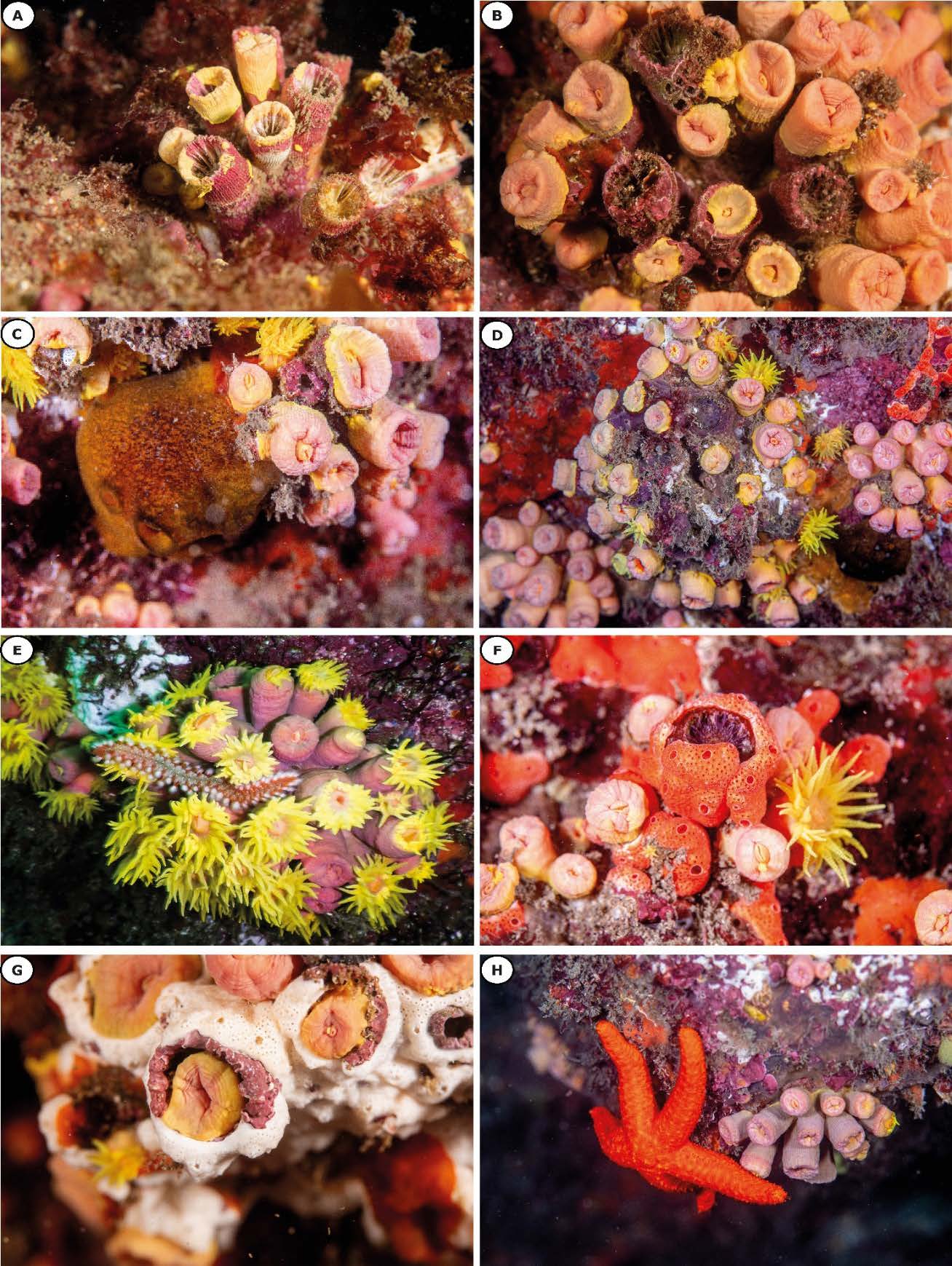
A total of 11 taxa were observed and photographed interacting through competition for space (CS) and predator-prey (PP) with Tubastraea spp. (Table 1). Turf algae, Crustose red alga Peyssonnelia sp., Crustose coralline algae (CCA) Hydrolithon sp., Guitar sponge Guitarra sepia and sea sponge Haliclona vansoesti. The ascidians Didemnum granulatum and Didemnum rodriguesi were documented overgrowing Tubastraea spp. colonies at Redonda and Pontuda Islands. The Bearded fireworm Hermodice carunculata was observed moving across sun coral colonies. The red swim crab Cronius ruber was identified as a potential consumer of the invading corals in Comprida Island. The Starfish Echinaster brasiliensis was observed interacting with Sun Coral.
During field work, a total of 22 colonies of Tubastraea spp. on Redonda Island and 10 colonies on Pontuda Island were covered by turf algae, whereas 12 sun coral colonies were overgrown by crustose coralline algae (Figure 2A/B). Peyssonnelia sp. was observed over three colonies on Redonda Island, including one case where the alga completely covered the sun coral colony. These interactions adversely affected the sun coral, including cases of partial and complete colony mortality. Guitar sponge was recorded partially covering four Tubastraea spp. colonies, whereas Haliclona vansoesti was observed over two colonies (Figure 2C, D). Three bearded fireworm were observed on sun coral colonies at Pontuda Island (8 m deep) and two at Redonda Island (14 m deep) (Figure 2E). The colonial sea squirt Didemnum rodriguesi was recorded covering four sun coral colonies, whereas Didemnum granulatum was detected over 12 colonies along the Redonda island rocky shores, mainly between 10 and 14 meters deep (Figure 2F/G). The starfish Oreaster reticulatus was observed along the coastal islands of Rio de Janeiro near a sun coral colony and was once reported preying on sun coral through personal observation (Pires-Teixeira et al., 2024). The Starfish Echinaster brasiliensis was observed above three Tubastraea spp. colonies; however here we only highlight an undetermined interaction (Figure 2H).
Inventory of potential Tubastraea spp. competitors along the coastal islands of Rio de Janeiro. (*1) Recorded in scientific literature (Pires-Teixeira et al., 2024). (*²) Starfish observed above Tubastraea spp. Undetermined (ND), competition for space (CS) and Predator-Prey (PP).

Ecological interactions observed in the study area. A. Crustose coralline algae covering sun coral colony. B. Turf algae. C. Guitar sponge - Guitarra sepia and D. Sea sponge - Haliclona vansoesti. E. Bearded fireworm - Hermodice carunculata. F. Colonial sea squirt - Didemnum rodriguesi. G. Ascidians - Didemnum granulatum. H. Starfish - Echinaster brasiliensis interacting with sun coral. Photos: Áthila A. Bertoncini (A-D; F-H) and Augusto A. Machado (E).
This study provides new evidence of native competitors and potential consumers of Tubastraea corals in a Brazilian Hope Spot. The documented interactions suggest a local biotic resistance that may play a role in mitigating the spread of this invasive taxon. However, more in-depth studies are required to elucidate the precise competitive mechanisms employed by these native species. IAS often outcompete native organisms, disrupting food webs and modifying habitat complexity (Albins and Hixon, 2008; Gallardo et al., 2016). The sun coral is a well-documented marine invader in Brazil, thriving on artificial and natural substrates, displacing native reef species (Creed et al., 2017). In this context, the presence of native competitors for space represents a response against the invader, for instance the crustose coralline algae, sea sponges and potential consumers, such as bearded fireworm, observed here. Despite this, Silva et al. (2022), studying coral-algae interactions, reported the importance of CCA as a functional group for the recruitment and colonization of sun coral. Their experiments demonstrated that planulae preferred to settle and metamorphose on live Lithophyllum spp.
Successful control strategies for marine invasive species often integrate both natural and human interventions. The effectiveness of manual removal of Tubastraea spp. has been shown in multi-site studies, reducing colony densities and allowing native species to recolonize affected areas (Creed et al., 2021). Similar efforts have been reported for other invasive species, such as lionfish (Pterois volitans (Linnaeus, 1758)), where targeted removals have mitigated their impact on Caribbean reefs (Frazer et al., 2012). According to isotopic composition analyses presented by Pires-Teixeira et al. (2024), the red swim crab (Cronius ruber) recorded in Comprida Island has been identified as a potential consumer of the invasive Tubastraea corals. Moreover, recent findings by Tâmega et al. (2024) also described a coral-killing syndrome caused by nongeniculate coralline algae overgrowing Tubastraea colonies in Brazil, further supporting evidence of natural biotic resistance mechanisms against this invasive species. Additionally, previous studies have evidenced that native marine sponges, such as Desmapsamma anchorata (Carter, 1882) and Iotrochota arenosa Rützler, Maldonado, Piantoni & Riesgo, 2007 caused damage to these invaders at Ilha Grande Bay in southeastern Brazil (Silva et al., 2017).
Finally, the stock recovery of native species, such as herbivorous fish in macroalgae-invaded reefs, has proven effective in reestablishing ecological balance (Vermeij et al., 2010). Our findings highlight the role of different native competitors in interacting with sun coral expansion, reinforcing the importance of ecological interactions in invasion dynamics. For example, mobile animals such as sea stars may interact with Tubastraea spp. only briefly due to their frequent movement, whereas when overgrowth occurs, by algae and marine sponges, the effect is persistent and can last the entire lifespan of the coral colony. These interactions altogether highlight the importance of biotic factors in invasion dynamics.
Hope Spots represent priority areas for conservation, fostering awareness and scientific initiatives aimed at ecosystem protection (https://missionblue.org/hope-spots/). Despite their ecological significance, many HSs face biological invasions that threaten their biodiversity, such as the impact of Botrylloides violaceus Oka, 1927 in southern British Columbia (Simkanin et al., 2013) and Gracilaria vermiculophylla Papenfuss, 1967 in the Chesapeake Bay (Thomsen et al., 2013). Lessons can be drawn from other HSs where invasive species have been successfully controlled, such as the restoration of kelp forests in California following the removal of invasive sea urchins (Miller et al., 2022). At MONA Cagarras, the presence of this invasive coral emphasizes the need for effective management actions, especially in the no-take zones where its negative effects were evidenced on the fish community, which includes a significant number of threatened species (Machado et al., 2023, 2024). Active monitoring and strategic intervention strategies, including the protection of native predators and mechanical removal, could improve conservation outcomes for MONA Cagarras and similar sites.
Management strategies should integrate scientific research, local stakeholder involvement, and adaptive control measures to address marine invasions effectively. Application of integrative approaches combining manual removal with biological control mechanisms could be a viable strategy for long-term success (Simberloff et al., 2013). For example, the presence of herbivorous fish has been linked to controlling invasive algae in coral reefs (Burkepile and Hay, 2006). In this regard, studies that allow detection and continuous monitoring should be encouraged, such as those carried out by Machado et al. (2021) on the coast of Rio de Janeiro, which involved citizen scientists who contributed to detecting and monitoring invasive alien species, especially the sun coral. Further investigations into the ecological role and effectiveness in controlling invasive corals are needed. Future research should also explore potential synergies between conservation initiatives and sustainable management practices to enhance protection in HSs globally.
Due to the increased dispersal of sun coral (known in Brazil as coral-sol) along the Brazilian coast, and the concern regarding the current and potential environmental impacts associated with this invasion process, the Ministry of the Environment (MMA) listed the sun coral (Tubastraea spp.) as a priority invasive exotic species for preparing and implementing the National Plans for Prevention, Control, and Monitoring. Since 2018, Brazil has a specific Ordinance No. 3642 entitled National Plan for Prevention, Control, and Monitoring of the Sun Coral (Tubastraea coccinea and Tubastraea tagusensis) in Brazil, known as Plano Coral-sol (ICMBio, 2018). Several Marine Protected Areas have adopted the plan and have been monthly performing campaigns to manually remove the sun coral, which includes the ICMBio’s staff of MONA Cagarras, who removed approximately four tons in the past three years.
The persistent competitive interactions between native and invasive species exemplifies a classic ecological contestation in Brazilian rocky shores (Creed, 2006; Machado et al., 2023). The documented interactions of native competitors with invasive corals (Tubastraea spp.) suggest potential biotic resilience mechanisms within local benthic communities, though the pronounced invasiveness of sun corals warrants cautious interpretation. Nevertheless, continued intervention and conservation efforts are necessary to support these ecological interactions and mitigate the impact of invasive species.
As HSs are meant to symbolize the potential for marine conservation, the integration of effective management strategies against IAS is essential to uphold their mission. By integrating natural ecological processes with active human intervention, there is potential for conserving biodiversity and reestablishing equilibrium in marine ecosystems.
Acknowledgments
We thank the Instituto Chico Mendes de Conservação da Biodiversidade (ICMBio) for research permits (SISBio 74219-1).
Data Availability:
All data are available from the corresponding author upon reasonable request.
Supplementary material:
No supplementary material is provided for this article.
REFERENCES
-
Albins, M. A. & Hixon, M. A. 2008. Invasive Indo-Pacific lionfish Pterois volitans reduce recruitment of Atlantic coral-reef fishes. Marine Ecology Progress Series, 367, 233-238. DOI: http://dx.doi.org/10.3354/meps07620
» https://doi.org/10.3354/meps07620 -
Bailey, S. A., Brown, L., Campbell, M. L., Canning‐Clode, J., Carlton, J. T., Castro, N., Chainho, P., Chan, F. T., Creed, J. C., Curd, A., Darling, J., Fofonoff, P., Galil, B. S., Hewitt, C. L., Inglis, G. J., Keith, I., Mandrak, N. E., Marchini, A., McKenzie, C. H., Occhipinti-Ambrogi, A., Ojaveer, H., Pires-Teixeira, L. M., Robinson, T. B., Ruiz, G. M., Seaward, K., Schwindt, E., Son, M. O., Therriault, T. W. & Zhan A . 2020. Trends in the detection of aquatic non‐indigenous species across global marine, estuarine and freshwater ecosystems: A 50‐year perspective. Diversity and Distributions, 26(12), 1780-1797. DOI: https://doi.org/10.1111/ddi.13167
» https://doi.org/10.1111/ddi.13167 -
Bax, N., Williamson, A., Aguero, M., Gonzalez, E. & Greeves, W. 2003. Marine invasive alien species: a threat to global biodiversity. Marine Policy, 27(4), 313-323. DOI: https://doi.org/10.1016/S0308-597X(03)00041-1
» https://doi.org/10.1016/S0308-597X(03)00041-1 - Bertoncini, A. A., Moraes, F. C., Borgonha, M., Aguiar, A. & Duarte, B. 2019. Marine biodiversity and diving guide to the islands of Rio Rio de Janeiro, Museu Nacional.
- Brito, A., Lopez, C., Ocana, O., Herrera, R., Moro, L., Monterroso, O. & Rodrígues, A. 2017. Colonizacion y expansion en Canarias de dos corales potencialmente invasores introducidos por las plataformas petrolíferas. Vieraea, 45, 65-82.
-
Burkepile, D. E. & Hay, M. E. 2006. Herbivore vs. nutrient control of marine primary producers: context-dependent effects. Ecology, 87(12), 3128-3139. DOI: https://doi.org/10.1890/0012-9658(2006)87[3128:HVNCOM]2.0.CO;2
» https://doi.org/10.1890/0012-9658(2006)87[3128:HVNCOM]2.0.CO;2 - Castro, C. B. & Pires, D. O. 2001. Brazilian coral reefs: what we already know and what is still missing. Bulletin of Marine Science, 69, 357-371.
-
Casares, F. A., Creed, J. C. & Oigman-Pszczol, S. S. 2019. Plataforma brasileira de bioinvasão. Available from: Available from: www.bioinvasaobrasil.org.br Access date: 2025 Mar. 27.
» www.bioinvasaobrasil.org.br -
Coles, S. L. & Eldredge, L. G. 2002. Nonindigenous species introductions on coral reefs: a need for information. Pacific Science, 56(2), 191-209. DOI: http://dx.doi.org/10.1353/psc.2002.0010
» https://doi.org/10.1353/psc.2002.0010 -
Creed, J. C. 2006. Two invasive alien azooxanthellate corals, Tubastraea coccinea and Tubastraea tagusensis, dominate the native zooxanthellate Mussismilia hispida in Brazil. Coral Reefs, 25, 350. DOI: https://doi.org/10.1007/s00338-006-0105-x
» https://doi.org/10.1007/s00338-006-0105-x -
Creed, J. C., Junqueira, A. O. R., Fleury, B. G., Mantelatto, M. C. & Oigman-Pszczol, S. S. 2017. The Sun-Coral Project: the first social-environmental initiative to manage the biological invasion of Tubastraea spp. Brazil. Management of Biological Invasions, 8, 181-195. DOI: https://doi.org/10.3391/mbi.2017.8.2.06
» https://doi.org/10.3391/mbi.2017.8.2.06 -
Creed, J. C., Casares, F. A., Oigman-Pszczol, S. S. & Masi, B. P. 2021. Multi-site experiments demonstrate that control of invasive corals (Tubastraea spp.) by manual removal is effective. Ocean & Coastal Management, 207, 105616. DOI: https://doi.org/10.1016/j.ocecoaman.2021.105616
» https://doi.org/10.1016/j.ocecoaman.2021.105616 - Fenner, D. 2001. Biogeography of three Caribbean coral (Scleractinia) and a rapid range expansion of Tubastraea coccinea into the Gulf of Mexico. Bulletin of Marine Science, 69, 1175-1189.
-
Ferreira, C. E. L., Junqueira, A. O. R., Villac, M. C. & Lopes, R. M. 2009. Marine bioinvasions in the Brazilian coast: brief report on history of events, vectors, ecology, impacts and management of non-indigenous species. Biological Invasions in Marine Ecosystems, 204, 459-477. DOI: https://doi.org/10.1007/978-3-540-79236-9_27
» https://doi.org/10.1007/978-3-540-79236-9_27 -
Figueroa, D. F., McClure, A., Figueroa, N. J. & Hicks, D. W. 2019. Hiding in plain sight: invasive coral Tubastraea tagusensis (Scleractinia:Hexacorallia) in the Gulf of Mexico. Coral Reefs, 38, 395-403. DOI: https://doi.org/10.1007/s00338-019-01807-7
» https://doi.org/10.1007/s00338-019-01807-7 -
Frazer, T. K., Jacoby, C. A., Edwards, M. A., Barry, S. C. & Manfrino, C. M. 2012. Coping with the lionfish invasion: can targeted removals yield beneficial effects? Reviews in Fisheries Science, 20(4), 185-191. DOI: https://doi.org/10.1080/10641262.2012.700655
» https://doi.org/10.1080/10641262.2012.700655 -
Gallardo, B., Clavero, M., Sánchez, M. I. & Vilà, M. 2016. Global ecological impacts of invasive species in aquatic ecosystems. Global Change Biology, 22(1), 151-163. DOI: https://doi.org/10.1111/gcb.13004
» https://doi.org/10.1111/gcb.13004 -
ICMBio. 2018. Plano nacional de prevenção, controle e monitoramento do coral-sol (Tubastraea coccínea e Tubastraea tagusensis) no Brasil. Available from: Available from: https://www.gov.br/icmbio/pt-br/assuntos/biodiversidade/unidade-de-conservacao/unidades-de-biomas/marinho/lista-de-ucs/esec-de-tamoios/pesquisa-manejo-e-monitoramento-da-biodiversidade/20190802PlanoNacionaldePrevencaoControleeMonitoramentodoCoralsolTubastraeasppnoBrasil.pdf Access date: 2025 Mar. 27.
» https://www.gov.br/icmbio/pt-br/assuntos/biodiversidade/unidade-de-conservacao/unidades-de-biomas/marinho/lista-de-ucs/esec-de-tamoios/pesquisa-manejo-e-monitoramento-da-biodiversidade/20190802PlanoNacionaldePrevencaoControleeMonitoramentodoCoralsolTubastraeasppnoBrasil.pdf -
Lopez, B. E., Allen, J. M., Dukes, J. S. & Bradley, B. A. 2022. Global environmental changes more frequently offset than intensify detrimental effects of biological invasions. Proceedings of National Academy of Sciences of the United States of America, 119(22), e2117389119. DOI: https://doi.org/10.1073/pnas.2117389119
» https://doi.org/10.1073/pnas.2117389119 -
Machado, A. A., Bertoncini, A. A., Santos, L. N., Creed, J. C. & Masi, B. P. 2021. Participatory monitoring of marine biological invaders: a novel program to include citizen. Journal of Coastal Conservation, 25, 1-8. DOI: https://doi.org/10.1007/s11852-021-00814-7
» https://doi.org/10.1007/s11852-021-00814-7 -
Machado, A. A., Moraes, F. C., Aguiar, A. A., Hostim-Silva, M., Santos, L. N. & Bertoncini, A. A. 2022. Rocky reef fish biodiversity and conservation in a Brazilian hope spot region. Neotropical Ichthyology, 20(3), e220032. DOI: https://doi.org/10.1590/1982-0224-2022-0032
» https://doi.org/10.1590/1982-0224-2022-0032 -
Machado, A. A., Masi, B. P., Aguiar, A. A., Ozorio, M. E. C., Salles, C. N., Hostim-Silva, M. & Bertoncini, A. 2023. Rocky reef incursions: challenges faced by reef fishes in a Brazilian hope spot region. Marine Pollution Bulletin, 193, 115240. DOI: https://doi.org/10.1016/j.marpolbul.2023.115240
» https://doi.org/10.1016/j.marpolbul.2023.11524 -
Machado, A. A., Aguiar, A. A., Abieri, M. L., Masi, B. P., Hostim-Silva, M. & Bertoncini, A. A. 2024. No-take zone in check: An ecological assessment of the management role in reef fish conservation in a Brazilian hope spot region. Ocean & Coastal Management, 259, 107469. DOI: https://doi.org/10.1016/j.ocecoaman.2024.107469
» https://doi.org/10.1016/j.ocecoaman.2024.107469 -
Miller, K. I., Blain, C. O. & Shears, N. T. 2022. Sea urchin removal as a tool for macroalgal restoration: a review on removing “the spiny enemies”. Frontiers in Marine Science, 9, 831001. DOI: https://doi.org/10.3389/fmars.2022.831001
» https://doi.org/10.3389/fmars.2022.831001 -
Miranda, R. J., Nunes, J. A. C. C., Mariano-Neto, E., Sippo, J. Z. & Barros, F. 2018. Do invasive corals alter coral reef processes? An empirical approach evaluating reef fish trophic interactions. Marine Environmental Research, 138, 19-27. DOI: https://doi.org/10.1016/j.marenvres.2018.03.013
» https://doi.org/10.1016/j.marenvres.2018.03.013 -
Pires-Teixeira, L. M., Neres-Lima, V., Barbosa, P. C., Creed, J. C. 2024. Trophic structure and isotopic niche of invaded benthic communities on tropical rocky shores. Biology, 13(12), 1023. DOI: https://doi.org/10.3390/biology13121023
» https://doi.org/10.3390/biology13121023 -
QGIS Development Team (3.16 version). 2022. QGIS Geographic Information System. Open Source Geospatial Foundation Project. Available from: Available from: http://qgis.osgeo.org Access date: 2025 Mar. 27.
» http://qgis.osgeo.org -
Ruiz, G. M., Carlton, J. T., Grosholz, E. D. & Hines, A. 1997. Global invasions of marine and estuarine habitats by non-indigenous species: mechanisms, extent and consequences. American Zoologist, 37(6), 621-632. DOI: https://doi.org/10.1093/icb/37.6.621
» https://doi.org/10.1093/icb/37.6.621 -
Sampaio, C. L. S., Miranda, R. J., Maia-Nogueira, R. & Nunes, J. C. C. 2012. New occurrences of the nonindigenous orange cup corals Tubastraea coccinea and T. tagusensis (Scleractinia: Dendrophylliidae) in Southwestern Atlantic. Check List, 8(3), 528-530. DOI: https://doi.org/10.15560/8.3.528
» https://doi.org/10.15560/8.3.528 -
Santos, L. A. H., Ribeiro, F. & Creed, J. C. 2013. Antagonism between invasive pest corals Tubastraea spp. and the native reef-builder Mussismilia hispida in the Southwest Atlantic. Journal of Experimental Marine Biology and Ecology, 449, 69-76. DOI: https://doi.org/10.1016/j.jembe.2013.08.017
» https://doi.org/10.1016/j.jembe.2013.08.017 -
Schulze, K., Knights, K., Coad, L., Geldmann, J., Leverington, F., Eassom, A., Marr, M., Butchart, S. H. M., Hockings, M. & Burgess, N. D. 2018. An assessment of threats to terrestrial protected areas. Conservation Letters, 11(3), e12435. DOI: https://doi.org/10.1111/conl.12435
» https://doi.org/10.1111/conl.12435 -
Silva, A. G., Fortunato, H. F. M., Lôbo-Hajdu, G. & Fleury, B. G. 2017. Response of native marine sponges to invasive Tubastraea corals: a case study. Marine Biology, 164(4), 78. DOI: https://doi.org/10.1007/s00227-017-3112-2
» https://doi.org/10.1007/s00227-017-3112-2 -
Silva, M. D. M., Moraes, F. C., Batista, D., Bahia, R. D., Bertoncini, A. A., Machado, A. A. & Muricy, G., Karez, C. S., Pereira-Filho, G. H., Salgado, L. T. & Pereira R. C . 2022. Distribution, population structure and settlement preference of Tubastraea spp. (Cnidaria: Scleractinia) on rocky shores of the Cagarras Islands Natural Monument and surroundings, Rio de Janeiro, Brazil. Regional Studies in Marine Science, 52, 1-14. DOI: https://doi.org/10.1016/j.rsma.2022.102245
» https://doi.org/10.1016/j.rsma.2022.102245 -
Simberloff, D., Martin, J. L., Genovesi, P., Maris, V., Wardle, D. A., Aronson, J. & Courchamp, F., Galil, B., García-Berthou, E., Pascal, M., Pysek, P., Sousa, R., Tabacchi, E. & Vilà, M. 2013. Impacts of biological invasions: what’s what and the way forward. Trends in Ecology & Evolution, 28(1), 58-66. DOI: https://doi.org/10.1016/j.tree.2012.07.013
» https://doi.org/10.1016/j.tree.2012.07.013 -
Simkanin, C., Dower, J., Filip, N., Jamieson, G. & Therriault, T. W. 2013. Biotic resistance to the infiltration of natural benthic habitats: Examining the role of predation in the distribution of the invasive ascidian Botrylloides violaceus Journal of Experimental Marine Biology and Ecology, 439, 76-83. DOI: https://doi.org/10.1016/j.jembe.2012.10.004
» https://doi.org/10.1016/j.jembe.2012.10.004 -
Soares, M. O., Davis, M. & Carneiro, P. B. M. 2018. Northward range expansion of the invasive coral (Tubastraea tagusensis) in the southwestern Atlantic. Marine Biodiversity, 48, 1651-1654. DOI: https://doi.org/10.1007/s12526-016-0623-x
» https://doi.org/10.1007/s12526-016-0623-x -
Tâmega, F. T., Batista, D., Gonçalves, A. A., Calazans, S. & Coutinho, R. 2024. A coral-killing syndrome of nongeniculate coralline algae over the invasive sun coral in Brazil. Aquatic Conservation: Marine and Freshwater Ecosystems, 34(5), e4208. DOI: https://doi.org/10.1002/aqc.4208
» https://doi.org/10.1002/aqc.4208 -
Teixeira, L. M. & Creed, J. C. 2020. A decade on: an updated assessment of the status of marine non-indigenous species in Brazil. Aquatic Invasions, 15, 30-43. DOI: https://doi.org/10.3391/ai.2020.15.1.03
» https://doi.org/10.3391/ai.2020.15.1.03 -
Thomsen, M. S., Staehr, P. A., Lars, N. & Schiel, D. R. 2013. Effects of the invasive macroalgae Gracilaria vermiculophylla on two co-occurring foundation species and associated invertebrates. Aquatic Invasions, 8(2), 133-145. DOI: http://dx.doi.org/10.3391/ai.2013.8.2.02
» https://doi.org/10.3391/ai.2013.8.2.02 -
Vermeij, M. J. A., Moorselaar, I. V., Engelhard, S., Hörnlein, C., Vonk, S. M. & Visser, P. M. 2010. The effects of nutrient enrichment and herbivore abundance on the ability of turf algae to overgrow coral in the Caribbean. PLOS One, 404, 37-46. DOI: https://doi.org/10.1371/journal.pone.0014312
» https://doi.org/10.1371/journal.pone.0014312