person Pedro Ivo C. C. Figueiredo
Conceptualization · Data curation · Formal analysis · Methodology · Writing-original draft · Writing-review and editing
schoolPrograma de Pós-Graduação em Genética e Biologia Molecular, Instituto de Biociências, Universidade Federal do Rio Grande do Sul, 91501-970 Porto Alegre, RS, Brazil. (PICCF) pedrocampani@gmail.com, (ALSZ) zani.andre@yahoo.com.br, (MV) maikelvaral@yahoo.com.br, (NJRF) nelson.fagundes@ufrgs.br (corresponding author).Universidade Federal do Rio Grande do SulBrazilPorto Alegre, RS, BrazilPrograma de Pós-Graduação em Genética e Biologia Molecular, Instituto de Biociências, Universidade Federal do Rio Grande do Sul, 91501-970 Porto Alegre, RS, Brazil. (PICCF) pedrocampani@gmail.com, (ALSZ) zani.andre@yahoo.com.br, (MV) maikelvaral@yahoo.com.br, (NJRF) nelson.fagundes@ufrgs.br (corresponding author).
person Diogo T. Hashimoto
Methodology · Resources · Writing-review and editing
schoolCentro de Aquicultura da UNESP, Jaboticabal Campus, Universidade Estadual de São Paulo, 14884-900 Jaboticabal, SP, Brazil. (DTH) diogo.hashimoto@unesp.br, (RBA) raquel.ariede@gmail.com.Universidade Estadual de São PauloBrazilJaboticabal, SP, BrazilCentro de Aquicultura da UNESP, Jaboticabal Campus, Universidade Estadual de São Paulo, 14884-900 Jaboticabal, SP, Brazil. (DTH) diogo.hashimoto@unesp.br, (RBA) raquel.ariede@gmail.com.
person Raquel B. Ariede
Data curation · Methodology
schoolCentro de Aquicultura da UNESP, Jaboticabal Campus, Universidade Estadual de São Paulo, 14884-900 Jaboticabal, SP, Brazil. (DTH) diogo.hashimoto@unesp.br, (RBA) raquel.ariede@gmail.com.Universidade Estadual de São PauloBrazilJaboticabal, SP, BrazilCentro de Aquicultura da UNESP, Jaboticabal Campus, Universidade Estadual de São Paulo, 14884-900 Jaboticabal, SP, Brazil. (DTH) diogo.hashimoto@unesp.br, (RBA) raquel.ariede@gmail.com.
person André L. S. Zani
Formal analysis · Writing-review and editing
schoolPrograma de Pós-Graduação em Genética e Biologia Molecular, Instituto de Biociências, Universidade Federal do Rio Grande do Sul, 91501-970 Porto Alegre, RS, Brazil. (PICCF) pedrocampani@gmail.com, (ALSZ) zani.andre@yahoo.com.br, (MV) maikelvaral@yahoo.com.br, (NJRF) nelson.fagundes@ufrgs.br (corresponding author).Universidade Federal do Rio Grande do SulBrazilPorto Alegre, RS, BrazilPrograma de Pós-Graduação em Genética e Biologia Molecular, Instituto de Biociências, Universidade Federal do Rio Grande do Sul, 91501-970 Porto Alegre, RS, Brazil. (PICCF) pedrocampani@gmail.com, (ALSZ) zani.andre@yahoo.com.br, (MV) maikelvaral@yahoo.com.br, (NJRF) nelson.fagundes@ufrgs.br (corresponding author).
person Maikel Varal
Formal analysis · Writing-review and editing
schoolPrograma de Pós-Graduação em Genética e Biologia Molecular, Instituto de Biociências, Universidade Federal do Rio Grande do Sul, 91501-970 Porto Alegre, RS, Brazil. (PICCF) pedrocampani@gmail.com, (ALSZ) zani.andre@yahoo.com.br, (MV) maikelvaral@yahoo.com.br, (NJRF) nelson.fagundes@ufrgs.br (corresponding author).Universidade Federal do Rio Grande do SulBrazilPorto Alegre, RS, BrazilPrograma de Pós-Graduação em Genética e Biologia Molecular, Instituto de Biociências, Universidade Federal do Rio Grande do Sul, 91501-970 Porto Alegre, RS, Brazil. (PICCF) pedrocampani@gmail.com, (ALSZ) zani.andre@yahoo.com.br, (MV) maikelvaral@yahoo.com.br, (NJRF) nelson.fagundes@ufrgs.br (corresponding author).
person Luiz R. Malabarba
Conceptualization · Funding acquisition · Resources · Writing-review and editing
schoolPrograma de Pós-Graduação em Biologia Animal, Instituto de Biociências, Universidade Federal do Rio Grande do Sul, 91501-970 Porto Alegre, RS, Brazil. (LRM) malabarb@ufrgs.br.Universidade Federal do Rio Grande do SulBrazilPorto Alegre, RS, BrazilPrograma de Pós-Graduação em Biologia Animal, Instituto de Biociências, Universidade Federal do Rio Grande do Sul, 91501-970 Porto Alegre, RS, Brazil. (LRM) malabarb@ufrgs.br.schoolDepartamento de Zoologia, Instituto de Biociências, Universidade Federal do Rio Grande do Sul, 91501-970 Porto Alegre, RS, Brazil.Universidade Federal do Rio Grande do SulBrazilPorto Alegre, RS, BrazilDepartamento de Zoologia, Instituto de Biociências, Universidade Federal do Rio Grande do Sul, 91501-970 Porto Alegre, RS, Brazil.
person Nelson J. R. Fagundes
Conceptualization · Formal analysis · Funding acquisition · Writing-original draft · Writing-review and editing
schoolPrograma de Pós-Graduação em Genética e Biologia Molecular, Instituto de Biociências, Universidade Federal do Rio Grande do Sul, 91501-970 Porto Alegre, RS, Brazil. (PICCF) pedrocampani@gmail.com, (ALSZ) zani.andre@yahoo.com.br, (MV) maikelvaral@yahoo.com.br, (NJRF) nelson.fagundes@ufrgs.br (corresponding author).Universidade Federal do Rio Grande do SulBrazilPorto Alegre, RS, BrazilPrograma de Pós-Graduação em Genética e Biologia Molecular, Instituto de Biociências, Universidade Federal do Rio Grande do Sul, 91501-970 Porto Alegre, RS, Brazil. (PICCF) pedrocampani@gmail.com, (ALSZ) zani.andre@yahoo.com.br, (MV) maikelvaral@yahoo.com.br, (NJRF) nelson.fagundes@ufrgs.br (corresponding author).schoolPrograma de Pós-Graduação em Biologia Animal, Instituto de Biociências, Universidade Federal do Rio Grande do Sul, 91501-970 Porto Alegre, RS, Brazil. (LRM) malabarb@ufrgs.br.Universidade Federal do Rio Grande do SulBrazilPorto Alegre, RS, BrazilPrograma de Pós-Graduação em Biologia Animal, Instituto de Biociências, Universidade Federal do Rio Grande do Sul, 91501-970 Porto Alegre, RS, Brazil. (LRM) malabarb@ufrgs.br.schoolDepartamento de Genética, Instituto de Biociências, Universidade Federal do Rio Grande do Sul, 91501-970 Porto Alegre, RS, Brazil.Universidade Federal do Rio Grande do SulBrazilPorto Alegre, RS, BrazilDepartamento de Genética, Instituto de Biociências, Universidade Federal do Rio Grande do Sul, 91501-970 Porto Alegre, RS, Brazil.
Edited-by
Hernán López-Fernández
Correspondence
Nelson J. R. Fagundes nelson.fagundes@ufrgs.br
Competing Interests
The author declares no competing interests.

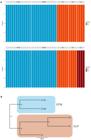
 Population genomics of Gymnogeophagus labiatus and G. lacustris reinforces the role of hydrographic isolation between evolutionary lineages (Cichlidae: Geophagini)
 Thumbnail
 Thumbnail
 Thumbnail