Hidden diversity of the catfish genus Trachelyichthys (Siluriformes: Auchenipteridae): a revisionary study with description of four new species from the Amazon basin
Abstract
Auchenipteridae is widely distributed across South America and encompasses 129 valid species. Trachelyichthys is diagnosed from all remaining auchenipterids by 14 morphological synapomorphies and comprises six species, T. decaradiatus from the upper Rupununi and upper Takutu rivers in Guyana, T. exilis from the Río Nanay in eastern Amazon of Peru, and four new species described herein: one from the main channel of the Amazon and lower portion of its tributaries, one from the upper rio Negro, one from the middle rio Negro, and one from the rio Madeira. Species differ in body proportions, number of fin rays, body coloration, and several osteological features. The phylogenetic relationships and divergence times of the species are presented and discussed. The discovery and description of four new species of Trachelyichthys presented in this study significantly expand the known diversity and distribution of the genus. An identification key, a map of distribution, and illustrations are given for the species.
Keywords:
Driftwood catfish; Identification key; Molecular; Systematics; Taxonomy
Resumo
A família Auchenipteridae é amplamente distribuida na América do Sul e abrange 129 espécies válidas. Trachelyichthysé diagnosticado dos demais auchenipterídeos por 14 sinapomorfias morfológicas e compreende seis espécies: T. decaradiatus, dos rios Rupununi e Takutu superiores, na Guiana; T. exilis, do Río Nanay, na Amazônia oriental do Peru; e quatro novas espécies descritas aqui: uma do canal principal do rio Amazonas e da porção inferior de seus afluentes, uma do alto rio Negro, uma do médio rio Negro, e uma do rio Madeira. As espécies diferem em proporções corporais, número de raios das nadadeiras, coloração corporal e diversas características osteológicas. As relações filogenéticas e os tempos de divergência das espécies são apresentados e discutidos. A descoberta e a descrição de quatro novas espécies de Trachelyichthys apresentadas neste estudo ampliam significativamente a diversidade e a distribuição conhecidas para o gênero. Uma chave de identificação, um mapa de distribuição e ilustrações são fornecidos para as espécies.
Palavras-chave:
Chave de identificação; Molecular; Morfologia; Sistemática; Taxonomia
INTRODUCTION
Auchenipteridae is a diverse family of Neotropical catfishes, comprising 129 valid species allocated in 26 genera, and widely distributed across South America and southern Central America. Among all freshwater ecoregions, the Amazon Basin harbors the highest diversity of auchenipterid species (Fricke et al., 2025; Calegari et al., 2026). Over the past three decades, the taxonomy of the family has advanced significantly through several comprehensive revisionary studies of its genera, such as Auchenipterus Valenciennes, 1840 (Ferraris, Vari, 1999), Pseudepapterus Steindachner, 1915 (Ferraris, Vari, 2000), Auchenipterichthys Bleeker, 1862 (Ferraris et al., 2005), Entomocorus Eigenmann, 1917 (Reis, Borges, 2006), Tetranematichthys Bleeker, 1858 (Vari, Ferraris, 2006), Tatia Miranda Ribeiro, 1911 (Sarmento-Soares, Martins-Pinheiro, 2008), Liosomadoras Fowler, 1940 (Birindelli, Zuanon, 2012), Tympanopleura Eigenmann, 1912 (Walsh et al., 2015), and Ageneiosus Lacepède, 1803 (Ribeiro et al., 2017). Despite these efforts, several genera still require more comprehensive taxonomic work to evaluate their monophyly and assess the validity of their nominal species. One such case is Trachelyichthys Mees, 1974, a genus comprising two nominal species: T. decaradiatus Mees, 1974, from the Rupununi River, Essequibo basin in Guyana, and T. exilis Greenfield & Glodek, 1977, from the Río Nanay in the upper Amazon basin of Peru. Trachelyichthys is generally poorly known regarding life history, but a recent study described the feeding habitats as predominantly carnivorous tending to piscivorous (Freitas, Zuanon, 2022).
Trachelyichthys was originally diagnosed based on a combination of non-exclusive morphological features, including absence of an adipose fin, a short head, a laterally compressed body, and an elongated anal fin (Mees, 1974). The genus was further distinguished from its presumed closest relative, Trachelyopterus Valenciennes, 1840, by the possession of a truncate caudal fin, relatively large eyes, and ten pelvic-fin rays. Subsequent phylogenetic analyses have questioned that relationship. Birindelli (2014) recovered Trachelyichthys as sister to a clade composed of Auchenipterichthys, Trachelyopterichthys, Trachelyopterus, and Trachycorystes Bleeker, 1858. More recently, Calegari et al. (2019), in a broader phylogenetic study, proposed a different topology with Auchenipterichthys as sister to the clade formed by Trachelyopterichthys and Trachelyichthys, representing the tribe Auchenipterichthyini (Calegari et al., 2026).
The phylogenetic relationships and divergence times of the two species currently described and the four additional new species being described herein, were examined by Calegari et al. (2026). That study hypothesized the ancestor of Trachelyichthys split from the common ancestor with Trachelyopterichthys in the Early Miocene and diversified between the Middle Miocene and the Late Pliocene (Fig. 1). Trachelyichthys exilis, from the upper Amazon, is sister to one unnamed species from the main channel of the middle and lower Amazon. That pair is sister to another clade composed of T. decaradiatus from the upper Rupununi and upper Branco basins in Guyana and another unnamed species from the Jufari River in middle rio Negro, Brazil. Then, two additional unnamed species, well separated geographically, are subsequent sister-groups to the former four, one in the upper rio Negro in Brazil and other in the rio Madeira basin.
Trachelyichthys decaradiatus, the type species of the genus, was originally described based solely on the holotype from the Rupununi River, Guyana and, to date, only one additional individual has been documented from a tributary to the Takutu River, near the type locality. The only other named species, T. exilis, from the upper Amazon basin of Peru was described from only three specimens and very few additional specimens have been collected. The extreme rarity of available material for both species in ichthyological collections worldwide has hindered comparative analyses with distinct morphotypes recorded across the Brazilian Amazon basin, posing challenges to the recognition and delimitation of valid species within the genus.
Recent fieldwork has yielded new specimens of Trachelyichthys from several tributaries of the Amazon basin in Brazil, revealing the existence of multiple undescribed species. Herein, we describe four new species: one from the main channel of the Amazon, one from the upper rio Negro, one from the middle rio Negro, and one from the rio Madeira. To support these taxonomic decisions, we present a comprehensive revision involving comparative morphological analyses across all known Trachelyichthys morphotypes.

Phylogeny and time of diversification of the tribe Auchenipterichthyini. Modified from Calegari et al. (2026).
MATERIAL AND METHODS
Morphometric data were obtained point-to-point to the nearest 0.1 mm using digital calipers, preferably on the left side of the specimen. All counts and measurements were conducted under a stereomicroscope. Measurements follow Vari, Calegari (2014). All measurements are presented as percent of standard length (SL), except for head subunits, which are expressed as percent of head length (HL). Lot was not measured when SL is not provided in material examined. Specimens were cleared and counterstained (c&s) for skeletal examination following the method of Taylor, Van Dyke (1985) and accessed through high resolution X-ray computed tomography (HRXCT). The HRXCT was used to visualize the skeletal elements of the head and body of the whole preserved specimen of T. decaradiatus (USNM 224807). The individual was scanned on a Skyscan 1173 microfocus X-ray CT scanner operated by the Institute of Petroleum and Natural Resources of PUCRS. The region was scanned twice: first the whole-body, and subsequently in higher detail from the snout tip to the end of the dorsal-fin base. The specimen was scanned at 37 kV and 52 µA generating 2209 slices of 5.9 µm each. The dataset was rendered in three dimensions using SkyScanner. The skeletal elements were inspected digitally by semi-automatic and manual methods using CTvox v. 3.1.1. Amiro-Avizo 3D 2023.2 was used to recreate 3D model. Digital edition was made in Adobe Photoshop v. 2025. Lateral images and most of the bones were pictured from the left side of the specimen.
Fin-ray counts include all elements; the two posteriormost dorsal- and anal-fin rays articulating on a single pterygiophore of each fin were counted as separate rays. Caudal-fin ray counts report the principal rays (branched rays and the first unbranched ray of the dorsal and ventral lobes). Dorsal- and anal-fin rays after the leading unbranched ray are reported as soft rays, as branched and unbranched rays variably occur in those fins. Vertebral counts, based on cleared and stained specimens, include all elements of the Weberian complex (i.e., the compound centrum encompasses up to the seventh centrum in Trachelyichthys). The complex caudal centrum (PU1 + U1) is counted as a single vertebral element. Counts for the holotype are indicated by an asterisk when varying within the species, and the number of specimens examined for each count is provided in parentheses, except for the anal fin, for which a range is provided. Examined specimens are listed in the comparative material section, and institutional abbreviations follow Fricke, Eschmeyer (2025). Specimens with tissue samples are marked with TS.
The species distribution map was generated using the HydroSHEDS database (http://www.hydrosheds.org) in Quantum GIS v. 3.16.14 (2022). GenSeq nomenclature for the new species followed Chakrabarty et al. (2013), and coI sequences for secondary types are listed below the type material, when available. Total genomic DNA extraction and the PCR amplification of 522 bp of cytochrome c oxidase subunit I (coI) was performed following Calegari et al. (2019) using primers LCO1490 (forward) and HCO2198 (reverse; Folmer et al., 1994). Amplicons were purified and sequenced bidirectionally at Functional Biosciences®, Inc. (WI, USA). Consensus sequences were edited and assembled using Geneious® v. 9.1.8 (http://www.geneious.com\tnew), and subsequently deposited in GenBank. Comparative sequences for genetic distance analysis were obtained from Calegari et al. (2019) and include Trachelyopterichthys taeniatus (Kner, 1858) (MCP 46032; MF 595278). The time-calibrated phylogeny in Fig. 1 is a reproduction of that in Calegari et al. (2026), based on a total evidence analysis with morphological data for all species and molecular sequences available only for Trachelyichthys exilis.
RESULTS
TrachelyichthysMees, 1974
Trachelyichthys Mees, 1974:111 (type species: Trachelyichthys decaradiatus Mees, 1974; type by original designation. Gender: masculine).
Included species:Trachelyichthys decaradiatus, T. exilis, T. displicatus n. sp., T. epachrus n. sp., T. gaiophanes n. sp., and T. varii n. sp.
Phylogenetic diagnosis. Trachelyichthys is diagnosed by 14 morphological synapomorphies, as follows (more details in Calegari et al., 2019): (1) outer pair of mental barbels long, surpassing posterior margin of coracoid process; (2) anterior cranial fontanel rounded to oval (among Auchenipterinae convergent in Spinipterus Akama & Ferraris, 2011); (3) dorsal margin of lateral ethmoid not exposed on dorsal surface of cranium; (4) lateral margin of frontal not participating in orbital margin (among Auchenipterinae convergent in Entomocorus, Tocantinsia Mees, 1974, and Trachycorystes trachycorystes (Valenciennes, 1840)); (5) posterior process of epioccipital bifurcated; (6) posterior process of epioccipital and parapophyses of compound centrum connected by suture; (7) coronomeckelian bone separated from anguloarticular (among Auchenipterinae convergent in Pseudauchenipterus jequitinhonhae (Steindachner, 1877), P. nodosus (Bloch, 1794),and Pseudepapterus); (8) adductor crest of hyomandibula absent or indistinguishable; (9) suprapreopercle elongate, tubular in shape, much longer than wide; (10) second hypobranchial cartilaginous; (11) postzygapophysis of compound centrum extends to seventh vertebra; (12) seventh vertebra included in compound centrum; (13) posterior nuchal plate narrower than base of dorsal-fin spine; and (14) distal vesicle present on anterior margin of anal-fin rays in mature males (among Auchenipterinae convergent in Asterophysus Kner, 1858, Pseudauchenipterus Bleeker, 1862,and Pseudepapterus).
Comparisons: Trachelyichthys is diagnosed from remaining Auchenipteridae, except the Ageneiosini, Trachelyopterichthys, Auchenipterus, Epapterus Cope, 1878, and Pseudepapterus, by an elongated anal-fin base, at least half of SL (vs. short to moderate anal-fin base, not surpassing one third of SL), and except for Trachelyopterichthys, Epapterus, and Trachelyopterus coriaceus Valenciennes, 1840,by the lack of an adipose fin (vs. adipose fin present). It is further distinguished from all Auchenipterinae, except Spinipterus, by having the anterior fontanel rounded to oval (vs. fontanel elliptical or elongated). It differs from Trachelyopterichthys by having the outer pair of mental barbel long, surpassing posterior margin of the coracoid process (vs. outer pair of mental barbel not reaching posterior process of coracoid), anteromedial process of basipterygium separated from each other (vs. anteromedial process sutured to each other anteriorly); posterior margin of the dorsal-fin spine bearing serrations (vs. posterior margin of dorsal-fin spine smooth, lacking serrations); interopercle thin and elongated (vs. interopercle large, plate-shaped); posteromesial portion of premaxilla lacking a process (vs. posteromesial portion of premaxilla bearing a process); and antorbital smooth, without spines (vs. antorbital bearing spines). Finally, it differs from Epapterus by having the anterior modified anal-fin rays fully attached to remaining rays in mature males (vs. gap between modified anterior rays and the remaining rays present in nuptial males) (Calegari et al., 2019).
Trachelyichthys decaradiatusMees, 1974
Trachelyichthys decaradiatus Mees, 1974:112 (Type locality: Karanambo area, Rupununi, Guyana. Holotype: BMNH 1971.7.29.30).

Trachelyichthys decaradiatus. A. Holotype, BMNH 1971.7.29.30, 56.5 mm SL, Rupununi River, Karanambo area, Essequibo basin, Guyana (photo propriety of The Trustees of the Natural History Museum, London); B. USNM 224807, 27.1 mm SL, Pirara River, Takutu River basin, Guyana.
Morphometric data for Trachelyichthys exilis, n = 5, and single specimen of T. decaradiatus (USNM 224807). SD = Standard deviation.
Diagnosis.Trachelyichthys decaradiatus differs from T. gaiophanes and T. displicatus by having three free pterygiophores supporting the dorsal-fin soft rays (vs. four free pterygiophores). Trachelyichthys decaradiatus differs from T. gaiophanes and T. epachrus by having the posterior nuchal plate not expanded lateroventrally (vs. posterior nuchal plate expanded lateroventrally); and by having dark brown to black blotches along the entire trunk (vs. uniform dark brown coloration without any spots). Trachelyichthys decaradiatus further differs from T. displicatus by having a sharp pointed posterior portion of transformator process of tripus (Fig. 3; vs. rounded posterior portion of transformator process of tripus, Fig. 4A). Trachelyichthys decaradiatus differs from T. exilis by having the transformator process of tripus extending to the proximal portion of parapophysis of fifth vertebra (vs. transformator process of tripus reaching to the end or slightly surpassing the base of Müllerian ramus, never reaching the proximal portion of parapophysis of fifth vertebra). Trachelyichthys decaradiatus differs from T. varii by lacking a midlateral black stripe on the body (vs. black spots forming a conspicuous wide stripe on lateral line region reaching posteriorly almost to the caudal peduncle) and by having a wider body (width at antero-lateral cleithrum 26.3 vs. 24.0–25.0% SL).

HRXCT of Trachelyichthys decaradiatus, USNM 224807, 27.1 mm SL. A. lateral view of body. B. Head, dorsal view. C. Head, lateral view. D. Head, ventral view. Abbreviations: AA, anguloarticular; ACF, anterior cranial fontanel; ANP, anterior nuchal plate; ANT, antorbital; CLE, cleithrum; CO, coracoid; CV, complex vertebra; DEN, dentary; D-SP, dorsal-fin spine; EPO, epioccipital; FRO, frontal; LE, lateral ethmoid; HYO, hyomandibular; MES, mesethmoid; MET, metapterygoid; MNP, middle-nuchal plate; MU, Müllerian ramus; OP, opercle; Pa-5, paraphophysis of fifth vertebra; Pa-6, paraphophysis of sixth vertebra; PP-CLE, posterior process of cleithrum; PP-EP, posterior process of epioccipital; PMA, premaxilla; PNP, posterior nuchal plate; POP, preopercle; P-SCL, posttemporal–supracleithrum; P-SOC, parieto-supraoccipital; Pt, pterygiophores; PTO, pterotic; QUA, quadrate; SPH, sphenotic; SPN, spinelet: TRI, tripus;7V, seventh vertebra. Arrow indicates the pointed posterior portion of the transformator process of tripus.

Vertebral compound centrum of Trachelyichthys in ventral view. A.T. displicatus, MZUSP 92829, paratype, 44.9 mm SL. B.T. exilis, ANSP 190499, paratype, 61.2 mm SL. C.T. epachrus, MCP 55800, paratype, 36.7 mm SL. Ba, basioccipital; CV, complex centrum; Mr, Müllerian ramus; OS, os suspensorium; Pa-5V, parapophysis of fifth vertebra; Pa-6V, parapophysis of sixth vertebra; PP-Ep, posterior process of epioccipital; Tri, tripus; TrP, transcapular process. Scale bar = 1 mm.
Description. See original description in Mees (1974). Dorsal-fin rays II,5(1). Pectoral-fin rays I,6(1). Pelvic-fin rays i,9(1). Anal fin with 35 total rays. Caudal-fin rays i,7,8,i(1). Vertebrae, 40(1); ribs 5(1).
Coloration in alcohol. The holotype and only additional specimen identified as T. decaradiatus (USNM 224807) are entirely faded with no coloration preserved. Mees (1974; fig. 31) described that coloration as: “pinkish brown, darker on head and back, with an irregular longitudinal series of ill-defined blackish or brownish blotches on the sides, and some fainter ones scattered elsewhere on head and body and on the tail”.
Geographical distribution. Trachelyichthys decaradiatus is only known from the holotype from the upper Rupununi River, Essequibo basin and a single additional specimen from a tributary to the upper Takutu, upper rio Branco basin in Guyana, both clearwater streams (Fig. 5).
Conservation status. Trachelyichthys decaradiatus is globally assessed as Data Deficient (DD) by Usma et al. (2022). It is known from two localities only, but the species possibly has a broader distribution occurring in other tributaries of the Rupununi and upper Takutu rivers. Nothing is known on abundance or population tendencies, consistent with the DD assessment.
Remarks. The single specimen in the lot USNM 224807 was collected in 1953, and had imprecise locality notes. Despite a more recent label had very precise coordinates (03°45’50.66”N 59°21’10.48”W), these are not original and were certainly estimated at a later occasion. Also, the label reads “Guyana, Rupununi, Puara River, Amazon basin”. Apparently, there is no such river in the region, but indeed we found a “Pirara River” very close to those coordinates. Puara could easily be misspelled from Pirara in the former, manuscript label or field notes of the collector. With the help of the staff at the Fish Division of the USNM, we traced the original collecting data as “South America; Guyana; Amazon drainage: Pirara River; Edward C. Migdalski, Yale South America Expedition (YASA) 1953; 1953-01-31”. The Pirara River, a tributary to the Muá, itself a tributary to the Takutu, upper rio Branco, Amazon basin is not far from the headwaters of Rupununi River, a tributary to the Essequibo River of Guyana, the type locality of T. decaradiatus. This region is well known as a semipermeable barrier between the Rupununi and Branco rivers, allowing fish passage from time to time (Lujan, 2008; Souza et al., 2012, 2020). For this reason, we assume the species occurs in both the upper Rupununi and the Takutu rivers.

Distribution of the species of Trachelyichthys. Symbols may represent more than one locality; stars represent holotype of each species.
Material examined. BMNH 1971.7.29.30, holotype, 56.5 mm SL, Rupununi River, Karanambo area, Guyana, 03°44’59.43”N 59°18’30.42”W, 10–11 Apr 1957, R. H. McConnell. USNM 224807, 1, 27.1 mm SL, Pirara River, a tributary to Muá River, upper Takutu basin, Amazon drainage, Guyana, 03°45’50”N 59°21’10”W, 31 Jan 1953, E. C. Migdalski.
Trachelyichthys exilisGreenfield & Glodek, 1977
Trachelyichthysexilis Greenfield, Glodek, 1977:49 (Type locality: Río Mamón, a tributary of Río Nanay, about 25 kilometers west of Iquitos, Peru, 03°42’S 73°16’W. Holotype: FMNH 80476).
Diagnosis.Trachelyichthys exilis differs from all congeners by having the transformator process of the tripus reaching to the end or slightly surpassing the base of Müllerian ramus, not reaching the parapophysis of the fifth vertebra (Fig. 4B; vs. transformator processextending well past the end of the base of Müllerian ramus, sometimes reaching or surpassing the proximal portion of the parapophysis of the fifth vertebra); and the color pattern of the body in adults composed of blurred brown blotches irregularly distributed on most of the dorsolateral portion of the trunk, and never forming a black stripe in adults (vs. conspicuous dark brown to black spots along of entire trunk in juveniles and adults of T. displicatus and T. decaradiatus; uniform brown coloration without spots in T. gaiophanes and T. epachrus; or black spots forming a conspicuous wide stripe on the lateral line region reaching posteriorly almost to the caudal peduncle in T. varii). Trachelyichthys exilis is also distinguished from congeners, except T. displicatus, by having a deeper body (depth at anterior nuchal plate 22.9–27.9 vs. 16.7–20.2% SL; distance from dorsal-fin origin to pectoral-fin origin 26.0–30.7 vs. 21.5–25.6% SL). Trachelyichthys exilis further differs from T. gaiophanes and T. displicatus by the presence of three free pterygiophores supporting the dorsal-fin soft rays (vs. four free pterygiophores). Trachelyichthys exilis further differs from T. gaiophanes, T. displicatus, and T. epachrus by having the dorsal procurrent rays of the caudal fin reaching to the tip of the neural spine of the fourth vertebra anterior to the caudal complex centrum (vs. dorsal procurrent rays of the caudal fin reaching to the tip of the neural spine of the sixth vertebra anterior to the caudal complex centrum).

Trachelyichthys exilis, MUSM 12842, 81.5 mm SL, male, Río Nanay, comunidad Anguilla, Maynas, upper Amazon basin, Loreto, Peru.
Description. Morphometric data in Tab. 1; additional body proportions given in Greenfield, Glodek (1977). Body slender, relatively elongate, distinctively compressed and deep, especially between dorsal- and caudal-fin origins. Body depth greatest between pelvic- and anal-fin origins; width greatest at pectoral-fin origin and increasingly compressed posteriorly. Ventral profile of body convex from snout to caudal-fin origin. Head profile strongly convex from snout tip to above eye, slightly concave and elevating from eye to dorsal-fin origin. Head widely rounded in dorsal view; snout very short with rounded margin. Anterior fontanel oval formed by mesethmoid and frontals; posterior margin reaching to transverse line through middle of orbits.
Mouth terminal; premaxilla with filiform teeth distributed along almost entire length of bone; dentigerous portion of premaxilla positioned anteriorly, slightly curved at posterior end. Dentary with approximately four irregular rows of filiform teeth, more aligned in posterior portion of dentigerous patch. Eye large, antero-laterally positioned, prominently more visible dorsally. Suborbital groove present. Maxillary barbel of adults slender and thread-like reaching dorsal-fin origin; in juveniles barbel extends up to end of dorsal-fin base. Two pairs of mental barbels without fleshy processes; innermost barbel much shorter than posterolateral pair, which reaches to vertical of dorsal-fin spine.
Lateral line midlateral, complete, not bifurcated; lateral line ossifications reaching caudal-fin base and unossified tubules surpassing caudal-fin origin; lateral line sinusoidal for anterior half and almost straight more posteriorly. Pseudotympanum present and large, located immediately posterior to posttemporo-supracleithrum and of approximately same length as posterior process of cleithrum. Transverse rows of free neuromasts on lateral portion of body, more evident dorsally and distributed along eight or nine transverse rows.
Dorsal-fin rays II,4(3) or II,5(2), with three free pterygiophores supporting dorsal-fin soft rays. Tip of adpressed dorsal fin extending beyond vertical through end of pelvic fin. Anterior soft dorsal-fin rays longer than spine. Spine robust, with blunt tip. Anterior margin of dorsal-fin spine with tiny serrae on proximal portion, and about seven large serrae along distal half of spine. Posterior margin of dorsal-fin spine with tiny, somewhat globular and truncated serrae along its length. Adipose fin absent. Pectoral-fin rays I,6(5) with spine reaching to or slightly surpassing pelvic-fin origin. Anterior margin of pectoral-fin spine with large antrorse serrae and posterior margin with large retrorse serrae, both serrations increasing in size towards distal tip of spine. Posterior process of cleithrum rugose. Pelvic-fin rays i,9(5), with tips of longest adpressed rays surpassing anal-fin origin; posterior margin of pelvic fin rounded, with outer rays longer than inner ones. Anal fin with 36–38(5) total rays, obliquely positioned in body, relatively long with ventral border straight; anal-fin base ending at limit of caudal-fin peduncle and its rays reaching to ventral procurrent caudal-fin rays through a membrane. Principal caudal-fin rays, i,7+8,i(2), or i,8+8,i(3); caudal fin deep and truncate, asymmetrical, with dorsal lobe somewhat longer than ventral lobe; profile of caudal fin approximately rectangular with posterior margin almost straight. Total vertebrae, 38(1); ribs 5(1).
Coloration in alcohol. We refer the reader to the original description in Greenfield, Glodek (1977; figs. 2, 5) for a very detailed description of coloration of both adult and young specimens.
Geographical distribution. Trachelyichthys exilis is known from blackwater tributaries of the Río Nanay, upper Amazon basin, Peru (Fig. 5).
Conservation status. Trachelyichthys exilis was globally assessed as Least Concern (LC) by Del Aguila(2016). The species is known from few localities in the Río Nanay basin near Iquitos, Peru, but possibly has a broader distribution occurring in other tributaries of the upper Río Amazonas. Data on abundance or population tendencies are unknown at present. Possible impacts on the species are related to urbanization, deforestation, and pollution and we recommend the species to be reassessed.
Material examined. All from Peru, Loreto, upper Amazon basin:FMNH 80476, holotype, 68.8 mm SL (photography and X-ray), Río Mamón, a tributary of Río Nanay, ca. 25 km W of Iquitos, approx. 03°42’S 73°16’W. FMNH 80477, paratype, 42.3 mm SL, CAS 39168, paratype, 42.4 mm SL, collected with holotype. USNM 273577, 1, 39.6 mm SL, Quistococha, Iquitos, Maynas, 03°49’33”S 73°19’11”W. MUSM 12842, 2, 74.6–81.5 mm SL, Río Nanay, comunidad Anguilla, Maynas, approx. 03°46’S 73°20’W. ANSP 190499, 1, 77.1 mm SL + 1 c&s, 61.2 mm SL + 1 TS, Caño Shirui (= Santa Rita), right bank of tributary to Río Nanay, 5 km W of Iquitos near village of Pampa Chica, Maynas, 03°45’05”S 73°17’24.8”W. ANSP 178212, 2 + 1 TS, Caño Shirui (= Santa Rita), right bank of tributary to Río Nanay, ca. 5 km NW of Iquitos near village of Pampa Chica, Maynas, 03°45’23”S 73°17’28”W.
GenSeq-4 coI. ANSP 178212 (tissue 1525);Genbank Accession NumberMF595277.
Trachelyichthys gaiophanes,new species
urn:lsid:zoobank.org:act:0BC7E358-59CE-4384-8E3C-BC8154935414
Trachelyichthys sp. 1. —Calegari et al., 2019 (phylogeny).
Trachelyichthys “Rio Negro”. —Calegari et al., 2026 (phylogeny).

Trachelyichthys gaiophanes. A. Holotype, MZUSP 57485, 61.7 mm SL, female, Santa Isabel do Rio Negro, Paricatuba, lake at bank of rio Negro, Amazon basin, Amazonas, Brazil. B. Live specimen collected at upper rio Negro, São Gabriel da Cachoeira, rio Daraá, lago do Nêgo Pina, 27 Feb 2013 by Rupert A. Collins and Emanuell D. Ribeiro (photo by Rupert Collins). Specimens probably at INPA.
Morphometric data for Trachelyichthys gaiophanes, n = 10, range includes holotype (Hol). SD = Standard deviation.
Holotype. MZUSP 57485, 61.7 mm SL, female, Brazil, Amazonas, Santa Isabel do rio Negro, Paricatuba, lake at bank of rio Negro, Amazon basin, approx. 00°31’S 65°01’W, 11 Nov 1972, EPA-MZUSP Permanent Amazon Expedition.
Paratypes. Brazil, Amazonas State, Amazon basin:MZUSP 131374, 14, 22.1–55.1 mm SL, MCP 55781, 4, 34.3–55.1 mm SL + 1 c&s, 53.2 mm SL, collected with holotype. MZUSP 30600, 25 + 2 c&s, rio Urubaxi near mouth into rio Negro, approx. 00°31’S 64°50’W, 7 Feb 1980, M. Goulding. MZUSP 30602, 1, rio Negro, Tamaquaré island, Amazonas, approx. 00°30’S 64°55’W, 7 Feb 1980, M. Goulding. MZUSP 30601, 7, rio Negro, Buiu-Açu island, approx. 00°31’S 64°50’W, 7 Feb 1980, M. Goulding. MZUSP 31074, 1, rio Negro, central lake at Buiu-Açú island near rio Urubaxi River, approx. 00°31’S 64°50’W, 6 Feb 1980, M. Goulding. MZUSP 58329, 3, MZUSP 62209, 1, river channel between lakes in São João, near Tapurucuara, Santa Isabel do Rio Negro, approx. 00°24’S 65°02’W, 24 Oct 1972, EPA-Permanent Amazon Expedition. MZUSP 62186, 7, river channel between lakes in São João, near Tapurucuara, Santa Isabel do Rio Negro, approx. 00°24’S 65°02’W, 23 Oct 1972, EPA-Permanent Amazon Expedition. MZUSP 95244, 2, lake at rio Negro bank, Paricatuba, Santa Isabel do Rio Negro, 00°31’S 65°01’W, EPA-Permanent Amazon Expedition.
Diagnosis. Trachelyichthys gaiophanes differs from all congeners, except T. epachrus, by the uniform brown coloration of the body (vs. light brown ground color with darker brown to black irregular spots on the body); and a lateroventrally expanded posterior nuchal plate (Figs. 8A, C; vs. posterior nuchal plate without any lateroventral expansion; Fig. 8B); and from all congeners, except by T. displicatus, by the possession of four free pterygiophores supporting the dorsal-fin soft rays (Fig. 8A; vs. three free pterygiophores).The new species further differs from T. decaradiatus, T. exilis, and T. varii, by having dorsal procurrent caudal-fin rays reaching anteriorly to the neural spine of the sixth vertebra anterior to the caudal complex centrum (vs. dorsal procurrent rays reaching anteriorly to the fourth vertebra anterior to the caudal complex centrum).Trachelyichthys gaiophanes is further distinguished from T. epachrus by having 37–41 total anal-fin rays (vs. 42–45) and a narrower body (width at antero-lateral cleithrum 20.6–23.5 vs. 24.1–25.2% SL). Trachelyichthysgaiophanes differs from T. displicatus by having a shorter posterior process of the cleithrum that extends slightly past the mid-length of the adpressed pectoral-fin spine (vs. long posterior process of cleithrum reaching almost the length of the pectoral-fin spine); and by having a shorter posterior process of the coracoid reaching the end of the pectoral-fin base (vs. long posterior process of coracoid, distinctly surpassing the end of pectoral-fin base or extending approximately to one-third of the pectoral-fin spine length). The new species further differs from T. epachrus by having the snout tip short and abruptly truncated, with anterior margin of orbit at the limit of the lateral border of snout (vs. snout larger and rounded, its length corresponding to twice the anterior naris diameter).
Description. Morphometric data in Tab. 2. Body slender, relatively elongate, distinctively compressed. Body width greatest anteriorly and more compressed posterior to pectoral-fin insertion, increasingly so posteriorly. Body depth approximately constant between dorsal- and caudal-fin origins, tapering towards caudal fin; greatest at anal-fin origin. Ventral profile of body convex from chin to below pectoral fin, almost straight from to anal-fin origin, slightly elevating from that point. Head profile strongly convex from snout tip to above eye, straight to slightly convex and elevated from eye to dorsal-fin origin. Head widely rounded in dorsal view; snout extremely short and truncated, anterior margin of snout very close to anterior margin of orbit in lateral view. Anterior fontanel irregularly oval, formed by mesethmoid and frontals; posterior margin reaching transverse line through middle of orbit.

Dorsal-fin skeleton in lateral view. A.Trachelyichthys gaiophanes, MCP 55781, paratype, 53.2 mm SL, left side; B.T. varii, MZUSP 112983, paratype, 39.4 mm SL, left side; C.T. epachrus, MCP 55800, paratype, 36.7 mm SL, left side. DS, dorsal-fin spine; MNP, middle nuchal plate; PNP, posterior nuchal plate; Pt, pterygiophores; Sn, supraneural; Sp, dorsal-fin spinelet. Scale bar = 1 mm.
Mouth terminal, but snout extending slightly beyond margin of lower jaw when mouth closed. Premaxilla with filiform teeth, distally pointed, posteriorly curved, and irregularly arranged along most of dentigerous surface of bone. Dentary with filiform teeth of approximately same size as those on premaxilla, and distributed in three irregular rows along dentigerous patch. Suborbital groove present. Orbital margin not free. Eye large, prominent in dorsal view, but slightly visible in ventral view; eye oriented antero-laterally.
Maxillary barbel slender and thread-like, barely reaching to dorsal-fin origin. Two pairs of mental barbels, without fleshy processes. Anteromedial barbel much shorter than posterolateral, which reaches to vertical of dorsal-fin spine.
Lateral line midlateral, complete, not bifurcated; lateral line ossifications reaching caudal fin and unossified tubules extending onto caudal fin rays; lateral line with anterior half particularly sinuous and almost straight more posteriorly. Pseudotympanum present and large located immediately posterior to posttemporo-supracleithrum occupying approximately same length of posterior process of cleithrum. Transverse rows of free neuromasts on lateral portion of body, not visible externally. Posterior process of cleithrum with globular ossified projections along all extension of the process.
Dorsal-fin rays, II,5(10), with four free pterygiophores supporting dorsal-fin soft rays. Tip of adpressed dorsal fin extending beyond vertical through end of pelvic fin. Dorsal-fin spine straight and pungent, continued distally as soft membrane almost reaching one third of spine length and attached to first soft ray. Anterior margin of dorsal-fin spine smooth, lacking serrae, except for few almost imperceptible ones near base. Posterior margin of dorsal-fin spine bearing conical serrae along its entire length, more conspicuous distally. Adipose fin absent. Pectoral-fin rays I,5(10). Anterior margin of pectoral-fin spine with large serrae oriented transversally to axis to antrorse; posterior margin with large retrorse serrae. Serrae on both margins increasing in size distally. Pelvic-fin rays i,9(10), adpressed fin reaching to anal-fin origin; margin rounded with outer rays longer than remaining. Anal-fin origin located approximately at middle of SL; anal fin positioned obliquely to body. Anal-fin rays of approximately same size forming straight border. Form of anal fin of mature males comparable to that in juveniles and females, except for elongated first rays (see more details in sexual dimorphism section). Anal fin with 37*–41 rays. Principal caudal-fin rays, i,7,8,i(10); caudal fin truncate, asymmetrical, with dorsal lobe longer than ventral lobe; profile of caudal fin approximately square with posterior margin almost straight. Total vertebrae 41(1); ribs 5(1).
Coloration in alcohol. Ground color of head and body uniformly light to medium brown. Medium brown melanophores regularly distributed all over body surface, except for ventral portions of head and abdomen. Head typically with uniform medium brown background; some smaller individuals with more conspicuous dark melanophores, particularly on snout and postorbital regions. Lateral portion of head, mainly on postorbital region, less pigmented with fewer sparse melanophores; area near insertion of maxillary barbel without pigmentation. Lateral portion of body with uniform brown pigmentation reaching to base of anal fin, without distinction between dorsal and ventral halves. Ventral portion of head and body abruptly whitish to cream; with several melanophores across anterior border of mandibles, more concentrated on dentary; fewer, relatively evenly spaced, melanophores extending to isthmus. Maxillary barbel with dorsal surface densely covered with brown melanophores, its base entirely pigmented; inner and outer mental barbels without pigmentation, except for few brown melanophores sometimes present near to base of outer barbel.
Dorsal fin with varying degrees of pigmentation, dorsal-fin spine and fin base entirely dark brown; larger specimens (> 55 mm SL) with sparse melanophores on all fin, usually less concentrated on posterior two rays; smaller specimens typically with only anterior third of dorsal-fin base pigmented and fading posteriorly. Pectoral-fin spine pigmented darker brown; posterior serrae of spine sparsely covered by melanophores. Pectoral-fin rays mostly hyaline with few scattered melanophores, more numerous on first soft ray. Pelvic fin usually pigmented near to base with sparse melanophores and gradually fainting distally. Anal-fin rays and membranes with sparse pigmentation near base, with dark pigmentation concentrated on distal half; smaller individuals with pigmentation pattern restricted to base of anal fin, with distal margin similar to adults, but less pigmented. Caudal fin in larger specimens with uniform brown pigmentation; smaller individuals with sparse and tiny melanophores less concentrated than in adults. Color in life darker, grey to greyish black (Fig. 7B).
Sexual dimorphism. Trachelyichthys gaiophanes has no evident sexually dimorphic modifications in maxillary barbel of mature, nuptial males. Mature males have the dorsal-fin spine enlarged and sinuous; females, juveniles, and non-nuptial males have a straight dorsal-fin spine, proportionally smaller than that of nuptial males. Trachelyichthys gaiophanes has the usual anal-fin modification in mature nuptial males of other members of the Auchenipterinae, in which the intromittent organ is formed by the genital tube attached to anterior-most anal-fin rays. During the reproductive season, the anterior fourth anal-fin ray of mature males is elongated forming a rigid structure, but the bones are not fused to other rays.
Geographical distribution.Trachelyichthys gaiophanes is known from the upper rio Negro drainage, Amazon basin in Brazil (Fig. 5).
Conservation status. Trachelyichthys gaiophanes is known from few localities around Santa Isabel do Rio Negro, Amazonas State, Brazil. Despite the restricted range, the species occurs in an area not densely sampled and possibly has a broader distribution, being more widespread in the upper rio Negro basin. Data on abundance or population tendencies are unknown but no specific threats were identified. Consequently, we recommend T. gaiophanes is categorized as Least Concern (LC) (IUCN, 2024).
Etymology. The specific epithet of Trachelyichthys gaiophanes is from the Greek gaiophanes (gaiophanes), earth-colored, in allusion to the ground color of the species.
Remarks. Specimens of Trachelyichthys from two additional localities in the Río Atabapo, Amazonas, Venezuela, were examined (lots listed in Comparative Material section). Despite having a more uniform brown coloration similar to that of T. gaiophanes those specimens show differences in body and head shape and size. Since we are uncertain whether that population is conspecific with T. gaiophanes or represents a closely related but distinct species, we are herein referring to them as Trachelyichthys aff. T. gaiophanes until additional material is obtained and allows to resolve their taxonomic status.
Trachelyichthys varii,new species
urn:lsid:zoobank.org:act:CD461B45-CD5F-4CCD-9474-7968D1648446
Trachelyichthys “Roraima”. —Calegari et al., 2026 (phylogeny).
Holotype. MZUSP 113570, 40.7 mm SL, male, Brazil, Roraima, Caracaraí, igarapé Tubana, tributary to rio Jufari, rio Negro drainage, 01°04’57”S 62°07’45”W, 29 Aug 2011, O. Oyakawa, M. Loeb, H. Varella, and others.
Paratypes. All from Brazil, Roraima, Caracaraí, rio Negro drainage, Amazon basin: MZUSP 131373, 5, 18.2–29.6 mm SL, MZUSP 112590, 2, MCP 55782, 1, 38.4 mm SL + 1 c&s, 32.8 mm SL, INPA 61814, 2, 25.7–28.0 mm SL, collected with holotype. MZUSP 27647, 1, rio Jufari, Baía Grande, São Bento, approx. 01°10’S 62°00’W, 10 Nov 1982, L. P. S. Portugal. MZUSP 112377, 1, MZUSP 112626, 1, rio Jufari, Anari beach, 01°06’23”S 62°04’59”W, 30 Aug 2011, O. Oyakawa, M. Loeb, H. Varella & J. C. Nolasco. MZUSP 112520, 3, igarapé do Campo, tributary to rio Jufari near Caicubi village, 01°04’01”S 62°07’40”W, 28 Aug 2011, O. Oyakawa, M. Loeb, H. Varella & J. C. Nolasco. MZUSP 112613, 1, rio Jufari, Anari beach, 01°06’22.93”S 62°04’59.30”W, 29 Aug 2011, O. Oyakawa, M. Loeb, H. Varella & J. C. Nolasco. MZUSP 112614, 2, MZUSP 113248, 2, Sobradinho beach, rio Jufari, approx. 01°01’S 62°10’W, 5 Sep 2011, O. Oyakawa, M. Loeb, H. Varella & J. C. Nolasco. MZUSP 112760, 1, Acurau beach, rio Jufari, 01°04’31”S 62°05’51”W, 30 Aug 2011, O. Oyakawa, M. Loeb, H. Varella & J. C. Nolasco. MZUSP 112902, 5, MZUSP 113608, 1, Paricá beach, rio Jufari, 01°08’41”S 61°59’57”W, 10 Sep 2011, O. Oyakawa, M. Loeb, H. Varella & J. C. Nolasco. MZUSP 112983, 10, 19.9–34.4 mm SL + 1 c&s, 39.4 mm SL, Anari beach, rio Jufari, 01°02’03”S 62°06’08”W, 7 Sep 2011, O. Oyakawa, M. Loeb, H. Varella & J. C. Nolasco. MZUSP 113676, 6, Anari beach, rio Jufari, 01°02’03”S 62°06’08”W, 7 Sep 2011, O. Oyakawa, M. Loeb, H. Varella & J. C. Nolasco. MZUSP 113036, 4, igarapé do Campo, tributary to rio Jufari, 01°03’54”S 62°07’46”W, 4 Sep 2011, O. Oyakawa, M. Loeb, H. Varella & J. C. Nolasco. MZUSP 113333, 1, igarapé Branquinho, tributary to igarapé Pretinho, rio Caicubi, 00°56’24”S 62°06’13”W, 31 Aug 2011, O. Oyakawa, M. Loeb, H. Varella & J. C. Nolasco. MZUSP 113415, 1, igarapé Santa Fé, tributary to rio Jufari, 01°00’19”S 62°12’11”W, 1 Sep 2011, O. Oyakawa, M. Loeb, H. Varella & J. C. Nolasco.

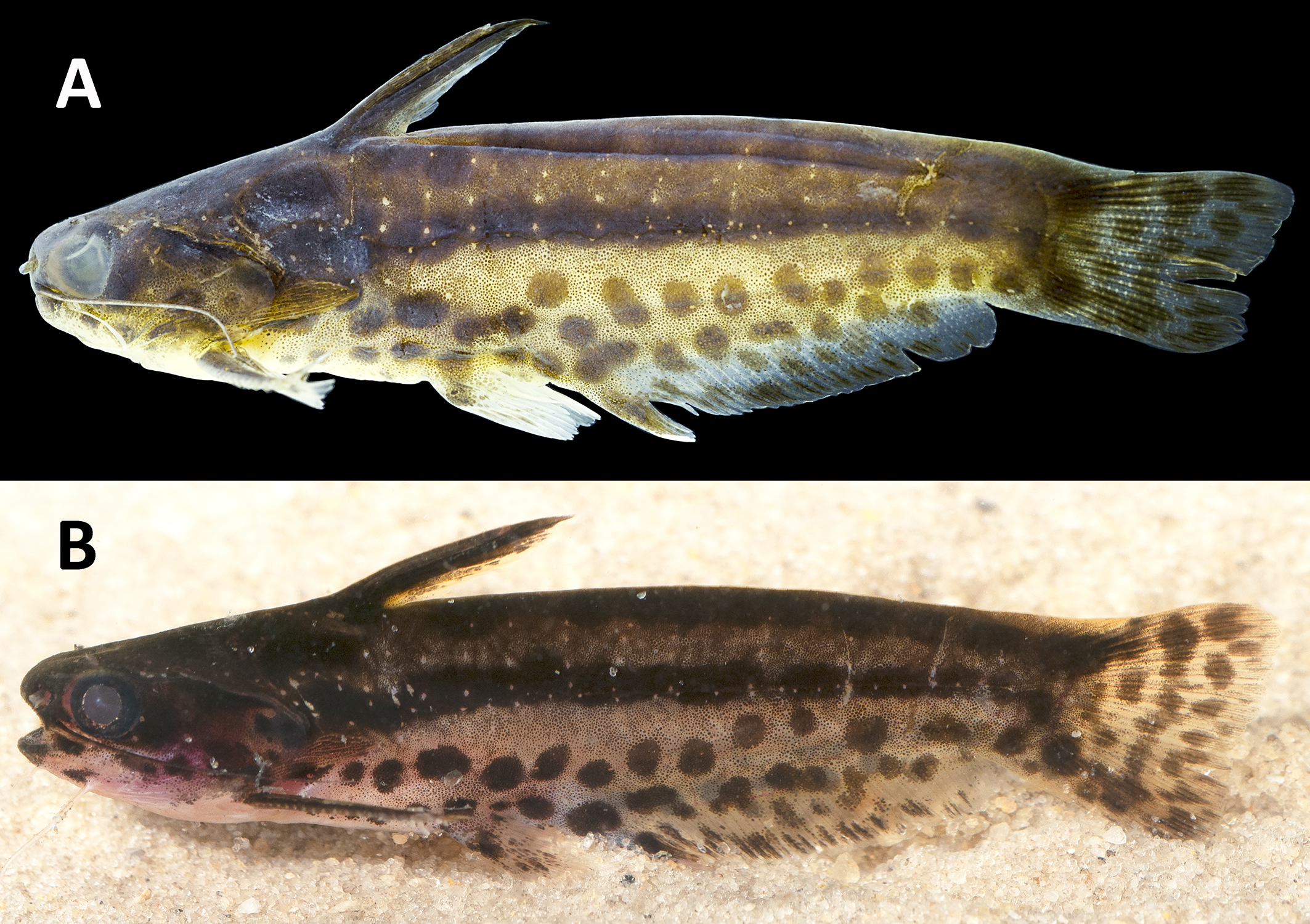
Trachelyichthys varii. A. Holotype, MZUSP 113570, 40.7 mm SL, male, Caracaraí, igarapé Tubana, tributary to rio Jufari, rio Negro drainage, Roraima, Brazil. B. Live specimen collected at type locality (photo by José Cézar Nolasco).
Morphometric data for Trachelyichthys varii, n = 5, range includes holotype (Hol). SD = Standard deviation.
Diagnosis. Trachelyichthys varii differs from all congeners by having a dense concentration of black spots that form a conspicuous midlateral dark stripe reaching to the caudal peduncle (vs. no midlateral dark stripe; uniform brown coloration in T. gaiophanes and T. epachrus; or when black or brown spots present, never forming a continuous stripe, although sometimes horizontally aligned, but still disconnected from each other in T. exilis, T. decaradiatus, and T. displicatus). Additionally, the new species differs from T. gaiophanes and T. displicatus, by the possession of three free pterygiophores supporting the dorsal-fin soft rays (Fig. 8B; vs. four free pterygiophores). The new species further differs from T. gaiophanes and T. epachrus by having the posterior nuchal plate not expanded lateroventrally (Fig. 8B; vs. posterior nuchal plate expanded lateroventrally); and from T. epachrus by having fewer total anal-fin rays, 36–38 (vs. 42–45). Trachelyichthys varii is further distinguished from T. decaradiatus by having a narrower body (width at antero-lateral cleithrum 24.0–25.0 vs. 26.3% SL).
Description. Morphometric data in Tab. 3. Body approximately cylindrical from rear of head through abdomen and increasingly compressed towards caudal fin. Body depth slightly greater at pelvic-and anal-fin origins than at dorsal-fin origin. Body width greatest at pectoral-fin origin and tapering progressively towards caudal fin. Dorsal and ventral profiles of body slightly convex from snout tip to caudal peduncle. Head profile strongly convex from snout tip to above eye, straight to slightly convex and elevating from eye to dorsal-fin origin. Head rounded in dorsal view; snout very short with rounded margin. Opercular margin wide and attached to isthmus. Anterior fontanel oval, situated between mesethmoid and frontals; its posterior margin surpassing vertical through middle of orbit, but not reaching posterior border of orbit.
Mouth terminal, wide, fleshy portion of jaws ending at vertical through middle of eye. Jaws extending equally in size. Premaxillary teeth villiform and curved posteriorly, distributed in about four irregular rows along dentigerous patch. Dentary teeth villiform, similar in size to those on premaxilla, and distributed along three irregular series.
Eye large, centered at middle of head depth. Eye prominent in dorsal view, but only slightly visible in ventral view. Suborbital groove present. Orbit round, covered by integument, without free margin. Anterior naris tubular, anterior positioned in snout and surrounded by short, anteriorly directed tube. Posterior naris smaller and located at vertical through middle of orbit, bearing small fleshy flap anteriorly.
Maxillary barbel slender and thread-like, reaching approximately end of dorsal-fin base. Basal portion of maxillary barbel sheltered in deep suborbital groove. Two pairs of mental barbels present, without fleshy processes. Anterior mental barbel positioned medial to posterior pair and much shorter, and extending posteriorly slightly beyond vertical through posterior margin of eye. Posterior pair reaching end of dorsal-fin base.
Lateral line midlateral, complete, not bifurcated; lateral line ossifications reaching caudal fin and unossified tubules surpassing caudal-fin origin. Lateral line sinusoidal for anterior half and almost straight more posteriorly. Pseudotympanum present and large, located immediately posterior to posttemporo-supracleithrum and of approximately same length as posterior process of cleithrum. Posterior process of cleithrum reaching to vertical through first two soft dorsal-fin rays; process with grooved stripes and globular ossified projections along all extension. Free neuromasts primarily on dorsolateral portion of trunk, conspicuous due to depigmentation, and distributed in about eight evident transverse rows; smaller number of pores ventral of lateral line.
Dorsal-fin rays II,4(5), with three free pterygiophores supporting dorsal-fin soft rays. Tip of adpressed dorsal fin extending beyond vertical through anal-fin origin. Dorsal-fin spine straight and pungent, continued distally as soft membrane and attached to first soft ray. Anterior margin of dorsal-fin spine lacking large serrae, with few tiny globular serrae at base of spine or up to midlength in larger individuals, but hidden beneath skin. Posterior margin of dorsal-fin spine bearing very small serrae along entire length, larger on distal one-third of spine. Adipose fin absent. Pectoral-fin rays I,6(5); tip of adpressed fin extending beyond vertical through pelvic-fin origin. Anterior margin of pectoral-fin spine with large antrorse serrae and posterior margin with large retrorse serrae, both serrations increasing in size towards distal tip of spine. Pelvic-fin rays i,9(5). Pelvic-fin origin just posterior to vertical through end of dorsal-fin base. Fin margin rounded and falling short of first anal-fin rays; outer rays longer than inner ones. Anal-fin origin approximately at middle of SL; anal fin positioned slightly obliquely to body. Anal-fin rays 36–38*, rays of approximately same length, forming straight border, except in nuptial males bearing enlarged anterior rays. Principal caudal-fin rays i,7,8,i(5); caudal fin truncate, asymmetrical, with dorsal lobe longer than ventral lobe; profile of caudal fin approximately square with posterior margin almost straight. Total vertebrae, 40(1) or 42(1); ribs 5(1) or 6(1).
Coloration in alcohol. Ground color of head medium brown and body cream in midventral portion to medium brown mid-dorsally (Fig. 9A). Various degrees of brown pigmentation, usually dark brown, with irregular round, large patches distributed over ventral portion of body and head, extending along anal- and caudal-fin rays; dark patches less abundant and evident on dorsal surface. Pigmentation in smaller individuals with more homogeneous coloration and patches less evident. Head and humeral region typically with dark brown pigmentation, with some irregular smaller spots on postorbital area. Lateral portion of trunk dark brown dorsally and whitish to cream ventrally, separated by conspicuous wide black midlateral stripe formed by dense concentration of black spots, extending from vertical through dorsal-fin base to caudal peduncle or end of anal fin. Upper jaw darkly pigmented, and lower jaw with several melanophores across anterolateral border of lip. Maxillary and mental barbels without evident pigmentation.
Dorsal-fin spine and first two soft rays darkly pigmented from base to tip of rays; remaining rays hyaline. Pectoral-fin spine and first two soft rays with brown pigmentation. Pelvic fin mostly hyaline, but pigmentation present on base of fin extending to middle of rays. Anal fin hyaline with irregular brown large spots over all fin, reaching near to distal margin. Mature males with first elongated unbranched rays pigmented. Caudal fin hyaline with large brown spots over entire length, except on distal border; spots on caudal-fin rays distributed in three irregular vertical rows, near to base, at middle and close to distal border. Two conspicuous darker blotches at base of caudal fin, at base of each caudal-fin lobe.
Coloration in life. Overall coloration pattern similar to that described for specimens preserved in alcohol, but with increased contrast between ground color and spots (Fig. 9B). Conspicuous wide black stripe at midlateral line formed by dense concentration of black spots, sometimes slightly interrupted near caudal fin due to disconnected black spots.
Sexual dimorphism. Trachelyichthys varii has no evident sexually dimorphic modifications in the maxillary barbel of nuptial males, and no apparent modification in the size of the dorsal-fin spine or rays. The new species has the usual anal-fin modification of nuptial males as for remaining Auchenipterinae members, in which the intromittent organ is formed by the genital tube attached to the anterior-most anal-fin rays. Mature males in reproductive season showing first unbranched elongated anal-fin rays that form the intromittent structure organ not united by membrane from remaining soft rays.
Ecological notes. Trachelyichthys varii was collected in drift wood, syntopically with other auchenipterids, including Auchenipterichthys sp. and Tatia strigata (Fig. 10).
Geographical distribution. The new species is known from the rio Jufari and its tributaries, a blackwater affluent of the north bank of rio Negro, upstream from the confluence with rio Branco, Amazon basin, Roraima, Brazil (Fig. 5).
Conservation status. Trachelyichthys varii is known from few localities in the rio Jufari, a tributary to the middle rio Negro, Amazonas State, Brazil. Despite the restricted range, the species occurs in an area not densely sampled and possibly has a broader distribution, being more widespread in the middle rio Negro basin. Data on abundance or population tendencies are unknown but no specific threats were identified. Consequently, we recommend T. varii is categorized as Least Concern (LC) (IUCN, 2024).
Etymology. Trachelyichthys varii is named in honor of our dear friend Richard P. Vari, who prematurely passed away during the early process of preparing this manuscript. This tribute is in recognition for his great devotion and contributions to the study of the Neotropical auchenipterid fishes, and for his unlimited willingness to help young ichthyologists to develop their careers. A noun in the genitive case.

Piece of driftwood where type series of Trachelyichthys varii was collected. Caracaraí, igarapé Tubana, tributary to rio Jufari, rio Negro basin, Roraima, Brazil. Note adult of Tatia strigata (far left) coexisting in the same log.
Trachelyichthys epachrus,new species
urn:lsid:zoobank.org:act:3E1EF398-0073-4945-AA73-F633AFE44241
Trachelyichthys “brown Madeira”. —Calegari et al., 2026 (phylogeny).
Holotype. UFRO 28802, 39.7 mm SL, male, Brazil, Amazonas, rio Marmelos upstream igarapé Escondido, rio Madeira basin, 06°13’25.9”S 61°54’03.4”W, 19 Sep 2012, B. Barros.
Paratypes. All from Brazil:UFRO 19663, 1, 32.2 mm SL, MCP 55800, 1, 40.7 mm SL + 1 c&s, 36.7 mm SL, collected with holotype. UFRO 15820, 1, 35.6 mm SL, Nove de Janeiro Indian Reserve, road to Apuí, Manicoré, Amazonas, 07°33’22”S 62°42’59”W, 10 Aug 2012, Universidade de Rondônia laboratory team.

Trachelyichthysepachrus, holotype, UFRO 28802, 39.7 mm SL, male, rio Marmelos upstream of igarapé Escondido, rio Madeira basin, Amazonas, Brazil.
Diagnosis.Trachelyichthys epachrus differs from all congeners by having the posterior process of the epioccipital as a simple spine, not in contact with the parapophysis of the fifth vertebra (Fig. 4C; vs. posterior process of epioccipital bifurcated, with the mesial ramus sutured to the parapophysis of the fifth vertebra, Figs. 4A, B). In addition, the new species differs from all congeners, except T. gaiophanes, by the uniform brown coloration of the body (vs. light brown ground color with darker brown to black irregular spots on body), and a lateroventrally expanded posterior nuchal plate (Fig. 8C; vs. posterior nuchal plate without lateroventral expansions). Trachelyichthys epachrus is further distinguished from T. gaiophanes by having 42–45 total anal-fin rays (vs. 37–41) and a wider body (width at antero-lateral cleithrum 24.1–25.2 vs. 20.6–23.5% SL). The new species further differs from T. displicatus and T. gaiophanes by having three free pterygiophores supporting the dorsal-fin soft rays (Fig. 8C; vs. four free pterygiophores).
Description. Morphometric data in Tab. 4. Body approximately cylindrical from head through terminus of abdomen and increasingly compressed towards caudal fin. Body depth slightly greater at pelvic- and anal-fin origins than at dorsal-fin origin. Body width greatest at pectoral-fin origin, and tapering progressively towards caudal fin. Dorsal and ventral profiles of body similarly convex from snout tip to caudal fin peduncle. Head profile strongly convex from snout tip to above eye, slightly convex and elevating from eye to dorsal-fin origin. Head broadly rounded in dorsal view; snout very short and rounded. Anterior fontanel oval, formed by mesethmoid and frontals, ending just anterior of transverse line through end of orbit.
Mouth terminal, wide; lower jaw slightly included below the upper jaw. Premaxillary teeth villiform, uniform in size, and irregularly distributed in about four rows along dentigerous area. Dentary teeth villiform, distributed along three irregular series; outer series of teeth largest.
Eye large, centered at middle of head depth. Eye prominent in dorsal view, but only slightly visible in ventral view. Suborbital groove present. Orbit round, covered by integument, i.e. orbital margin not free. Anterior naris tubular, anterolaterally positioned on snout and extending anteriorly by short tube. Posterior naris smaller and located behind origin of orbit, bearing a small fleshy flap anteriorly.
Morphometric data for Trachelyichthys epachrus, n = 4, range includes holotype (Hol). SD = Standard deviation.
Maxillary barbel slender and thread-like, extending to dorsal-fin origin. Basal portion of maxillary barbel sheltered in deep suborbital groove. Two pairs of mental barbels present, without fleshy processes. Anterior mental barbel positioned medial to posterior pair and greatly shorter in length. Posterior barbel surpassing one third of pectoral-fin length. Branchiostegal membranes broadly attached posteriorly to isthmus. Gill openings restricted to posterior border.
Lateral line midlateral, complete, not bifurcated; lateral line ossifications reaching to caudal fin, continued by unossified tubules on caudal-fin rays. Lateral line particularly sinusoidal on anterior half and almost straight posteriorly. Free neuromasts present but not evident due to dark background coloration of body. Pseudotympanum situated on posterodorsal portion of posterior process of cleithrum and reaching to vertical through middle of dorsal-fin base. Posterior process of cleithrum reaching to vertical through middle of dorsal fin; process with grooved white stripes and globular ossified projections along entire extent of process.
Dorsal-fin rays II,4(4), with three free pterygiophores supporting soft dorsal-fin rays. Tip of adpressed fin reaching beyond vertical through anal-fin origin. Dorsal-fin spine straight and pungent. Anterior margin of dorsal-fin spine with few tiny globular serrae only on basal one-third of spine, serrae hidden beneath skin. Posterior margin of dorsal-fin spine bearing small globular serrae along entire length. Adipose fin absent. Pectoral-fin rays I,5(4); tip of adpressed fin extending beyond vertical through pelvic-fin origin. Anterior margin of pectoral-fin spine with large antrorse serrae and posterior margin with large retrorse serrae, both serrations increasing in size towards distal tip of spine. Pelvic-fin rays i,10(4). Pelvic-fin origin located at vertical through middle of dorsal-fin length. Anal-fin base long, originating at approximately middle of SL; anal fin positioned slightly obliquely to body axis. Anal-fin rays of approximately uniform in size forming straight border, except for enlarged anterior rays in nuptial males. Anal fin with 42*–45 total rays. Principal caudal-fin rays, i,7,8,i(3*) or i,6,8,i(1); caudal fin truncate, asymmetrical, with dorsal lobe slightly longer than ventral lobe; profile of caudal fin approximately square with posterior margin almost straight. Total Vertebrae, 42(1), ribs 6(1).
Coloration in alcohol. Ground color of body uniform light brown to yellowish brown. Medium brown melanophores regularly distributed all over body surface, except for ventral portions of head and abdomen. Uniform brown pigmentation on lateral side of body extending over origin of anal-fin rays. Pseudotympanum area covered by pigmentation slightly darker than remaining lateral portions of head. Head typically with uniform light to medium brown background covered by scattered fine melanophores. Lateral portions of head, mainly on postorbital region, darker than remaining areas. Narrow area ventral to eye, from end of upper jaw to pectoral-fin origin, with more evident sparse chromatophores, fading ventrally. Ventral portion of head and body whitish cream. Maxillary barbel pigmented dorsally on proximal half, distal half pigmented on both dorsal and ventral surfaces. Mental barbels white with no evident pigmentation; except for few melanophores near base.
Dorsal fin with brown pigmentation along spine and first soft ray; dorsal-fin base with dark inverted triangle. Pectoral-fin spine with sparse brown melanophores; pectoral-fin rays mostly hyaline with few scattered, randomly distributed, melanophores. Pelvic fin pigmented only on dorsal base of rays. Anal fin mostly hyaline with wide stripe of sparse small brown melanophores at base of fin extending up to one-fourth of anal-fin depth. Caudal fin bearing tiny light brown melanophores along entire length of fin, fading towards dorsal, ventral and posterior margins.
Sexual dimorphism. Trachelyichthys epachrus displays the usual anal-fin modification in nuptial males of remaining Auchenipterinae members, in which the intromittent organ is formed by the genital tube attached to the anteriormost anal-fin rays. Trachelyichthys epachrus has no evident sexual dimorphic modifications in the maxillary barbel or dorsal fin of nuptial males.
Geographical distribution. The new species is known from blackwater tributaries to the middle rio Madeira, rio Amazonas basin, Brazil (Fig. 5).
Conservation status. Trachelyichthys epachrus is known from five specimens in two localities of the middle/low rio Madeira, Amazonas State, Brazil. Despite the restricted range, the species occurs in an area not densely sampled and possibly has a broader distribution, being more widespread in the middle rio Madeira basin. Data on abundance or population tendencies are unknown but no specific threats were identified. Consequently, we recommend T. epachrus is categorized as Least Concern (LC) (IUCN, 2024).
Etymology. The specific epithet of Trachelyichthys epachrus is from the Greek epakros (epakros), masculine, meaning pointed at the end, in reference to the pointed posterior process of the epioccipital. An adjective.
Trachelyichthys displicatus,new species
urn:lsid:zoobank.org:act:F7657AB1-9BFD-4383-9C57-A5EECBC0FA71
Trachelyichthys exilis. —Freitas, Zuanon, 2022 (data on ecology and reproductive biology).
Trachelyichthys “amazonas”. —Calegari et al., 2026 (phylogeny).
Holotype. INPA 61812,68.8 mm SL, male, Brazil, Pará, Santarém, igarapé Juá, 7 km W of Santarém, 13 Nov 2007, 02°26’00”S 54°46’52”W, purchased from ornamental fish collector by L. M. Sousa and J. L. Birindelli.
Paratypes. All from Brazil, Amazon basin: INPA 26519, 1, 65.4 mm SL, collected with holotype. INPA 44333, 308, and MCP 55799, 24, 32.2–77.6 mm SL, igarapé Juá Grande, tributary to lago Amanã, rio Japurá drainage, Tefé, Amazonas, 02°28’34”S 64°48’53”W, 8 Nov 2002, M. Catarino. MCP 29678, 1, 49.4 mm SL + 1 c&s, 41.0 mm SL, rio Tefé, Ilha Martelo, rio Solimões drainage, Tefé, Amazonas, 03°46’49”S 64°59’29”W, 13 Aug 1999, W. Crampton. MCP 29679, 1, 57.5 mm SL, rio Tefé, Tefé, Amazonas, 03°38’56”S 64°59’37”W, 15 Feb 2001, W. Crampton. MCP 29680, 2, 37.3–54.5 mm SL, headwater of lago Tefé, rio Solimões drainage, Tefé, Amazonas, 03°34’35”S 64°59’19”W, 25 Jun 1998, W. Crampton. INPA 44334, 140, 20 measured 32.5–75.2 mm SL, igarapé Juá Grande, tributary to lago Amanã, rio Japurá drainage, Tefé, Amazonas, 02°27’21”S 64°48’27”W, 11 Aug 2002, M. Catarino. INPA 44335, 202, 16 measured 28.0–55.8 mm SL, igarapé Juá Grande, tributary to lago Amanã, rio Japurá drainage, Tefé, Amazonas, 02°28’34”S 64°48’54”W, 8 Aug 2002, M. Catarino. MCP 29681, 1, 40.2 mm SL, lago Amanã, mouth of igarapé Juá Grande, Maraã, Amazonas, 02°26’53”S 64°47’34”W, 1 Nov 1998, W. Crampton. MZUSP 6830, 163, 20 measured 29.4–59.8 mm SL+ 3 c&s, creek number 2, tributary to rio Tarumãzinho, rio Negro drainage N of Manaus, Manaus, Amazonas, approx. 03°10’S 60°00’W, 18 Nov 1967, EPA-Permanent Amazon Expedition. MCP 54095, 3, 45.1–61.1 mm SL, creek tributary to rio Caru 24 km NW from Itacoatiara on road AM-010, rio Urubu basin, Itacoatiara, Amazonas, 03°02’36.1”S 58°35’41.0”W, 27 May 2017, S. Santos. MCP 51530, 8 (2 TS), 26.9–43.6 mm SL, igapó creek tributary to rio Arapiuns near Acará Village, Santarém, Pará, 02°33’38.3”S 55°28’44.0”W, 9 Oct 2016, W. Crampton, B. Calegari & A. Orfinger. MCP 51583, 1, 61.8 mm SL, rio Arapiuns near Acará Village, Santarém, Pará, 02°35’31.6”S 55°28’21.6”W, 7 Oct 2016, W. Crampton, B. Calegari & J. Oliveira. MCP 50006, 2 (2 TS), 27.9–34.4 mm SL, igarapé Dominguinho, Piquiatuba Village, Tapajós drainage, Belterra, Pará, 03°00’48”S 55°06’21”W, 15 Nov 2015, F. Lima; W. Crampton, B. Calegari & J. Oliveira. MZUSP 92829, 111, 21 measured 27.8–68.6 + 2 c&s, 44.9–69.6 mm SL, igarapé Juá, 7 km W of Santarém on airport road, Santarém, Pará, 02°26’00”S 54°46’52”W, 13 Nov 2006, L. M. Sousa & J. L. Birindelli. NMBE 1152259 to 1152270, 12, 25.3–77.6 mm SL, lago Juá, rio Tapajós basin, Santarém, Pará, 02°25’58.9”S 54°46’32.4”W, 20 Aug 2023, B. Calegari, A. Akama & L. Hahn. ANSP 197702, 9, 28.4–58.8 mm SL + 1 c&s, 49.6 mm SL + 2 TS, rio Acaraí, tributary to rio Xingu, ca. 70 km SSW of Porto de Moz, Pará, 02°20’13.2”S 52°31’13.2”W, 15 Nov 2014, M. H. Sabaj Pérez, L. M. Sousa, A. P. Gonçalves, and others.

Trachelyichthys displicatus. A. Holotype, INPA 61812, 68.8 mm SL, male, igarapé Juá, 7 km W of Santarém, Pará, Brazil. B. Paratype, ANSP 197702, 49.8 mm SL, Xingu River, Pará, Brazil.
Morphometric data for Trachelyichthys displicatus, n = 19, range includes holotype (Hol). SD = Standard deviation.
GenSeq-2 coI. MCP 50006(tissue V.160);Genbank Acession NumberMF595203.
GenSeq-2 coI. ANSP 197702 (tissue 3912);Genbank Acession NumberPX843247.
Diagnosis.Trachelyichthys displicatus differs from all congeners except T. gaiophanes, by having four free pterygiophores supporting the dorsal fin (vs. three free pterygiophores supporting the dorsal fin). The new species differs from all congeners, except T. exilis, by having a long posterior process of the coracoid, distinctly surpassing the end of the pectoral-fin base, to approximately one-third of the adpressed pectoral-fin spine (vs. short posterior process of the coracoid reaching approximately to the end of the pectoral-fin base); and from T. exilis by having the transformator process of the tripus extending well past the end of the Müllerian-ramus base, reaching to the proximal portion of the parapophysis of the fifth vertebra (Fig. 4A; vs. transformator process reaching to the end or slightly surpassing the base of the Müllerian ramus, never reaching the parapophysis of the fifth vertebra; Fig. 4B). Trachelyichthys displicatus is also distinguished from congeners, except T. exilis, by having a deeper body (depth at anterior nuchal plate 22.9–27.9 vs. 16.7–20.2% SL; distance from dorsal-fin origin to pectoral-fin origin 26.0–30.7 vs. 21.5–25.6% SL). The new species further differs from T. decaradiatus, T. exilis, and T. varii, by having dorsal procurrent caudal-fin rays reaching anteriorly to the tip of the neural spine of the sixth vertebra anterior to the caudal complex centrum (Fig. 13; vs. procurrent rays reaching anteriorly to the tip of the fourth vertebra anterior to the caudal complex centrum). Trachelichthys displicatus further differs from T. gaiophanes and T. epachrus by lacking a ventrolateral expansion of the posterior nuchal plate (vs. posterior nuchal plate ventrolaterally expanded); and by the color pattern composed of a pale cream to light brown ground color with large darker irregular spots on the body (vs. uniform brown coloration of the body).
Description. Morphometric data in Tab. 5. Body slender, relatively elongate, distinctive compressed. Body depth greatest at dorsal-fin origin or at pelvic-fin origin. Body width greatest at pectoral-fin origin and increasingly compressed from pelvic-fin origin towards caudal fin. Dorsal profile of body inclined from snout tip to dorsal-fin origin and nearly straight from that point to caudal peduncle; slightly elevated at dorsal surface of caudal peduncle. Ventral profile of body gently convex from chin to caudal-fin origin. Head profile strongly convex from snout tip to above eye, straight or slightly concave and elevated from eye to dorsal-fin origin. Head widely rounded in dorsal view; snout very short and rounded. Anterior fontanel oval formed by mesethmoid and frontals; posterior margin reaching to transverse line of posterior margin of orbital.
Mouth terminal; premaxilla with filiform teeth irregularly distributed along almost entire dentigerous area of bone. Premaxillary teeth slightly curved distally and outer series larger than inner ones. Dentary with about three irregular rows of filiform teeth; teeth curved distally and of uniform size. Eye large, antero-laterally positioned, prominently more visible dorsally. Suborbital groove present. Maxillary barbel slender and thread-like reaching dorsal-fin origin. Two pairs of mental barbels without fleshy processes; anteromedial barbel much shorter than posterolateral, and falling short of base of latter; posterolateral barbel reaching to vertical through dorsal-fin origin.
Lateral line midlateral, complete, not bifurcated; lateral line ossifications reaching caudal-fin base, and unossified tubules surpassing caudal-fin origin; lateral line sinusoidal for anterior half and almost straight more posteriorly. Pseudotympanum large, located posterior to posttemporo-supracleithrum process. Free neuromasts forming 9–10 transverse rows dorsally to lateral midline of trunk, and less numerous and randomly distributed ventral of lateral line.

Caudal-fin skeleton in lateral view: Trachelyichthys displicatus, MZUSP 92829, 44.9 mm SL, paratype. BCR, branched caudal-fin rays; Ep, epural; Hy3–4, hypural 3 and hypural 4 fused; Hy5, hypural 5; NS, neural spine; Ph + Hy1–2, parhypural and hypural 1 and hypural 2 fused; PCR, principal caudal-fin ray; ProC, procurrent caudal-fin rays; PU1 + U1, first preural and first ural centra fused into complex centrum; Un, uroneural. Arrow indicates neural spine of sixth ultimate vertebra (NS-6UV) anterior to caudal complex centrum. Scale bar = 0.2 mm.
Dorsal-fin rays II,5(18*) or II,4(1), with four free pterygiophores supporting dorsal-fin soft rays. Tip of adpressed fin surpassing vertical through anal-fin origin, reaching to approximately one-fifth of anal fin. Dorsal-fin spine robust, sharp. Anterior margin of dorsal-fin spine with serrae on first proximal third. Posterior margin of dorsal-fin spine with large serrae along its entire length, visibly longer on distal third. First soft dorsal-fin ray longer than spine. Adipose fin absent. Pectoral-fin rays I,6(17*) or I,7(2), with spine reaching pelvic-fin origin. Anterior margin of pectoral-fin spine with large antrorse serrae and posterior margin with large retrorse serrae, both serrations increasing in size towards distal tip of spine. Posterior process of cleithrum with globular ossified projections along all extension of process forming rugosity. Pelvic-fin rays i,9(8), i,10(9*) or i,11(2), adpressed rays surpassing anal-fin origin; posterior margin of pelvic fin rounded. Anal-fin base relatively long, obliquely positioned in body; anal-fin base ending at origin of caudal fin. Anal fin with 34–37 total rays (holotype with 36 rays). Principal caudal-fin rays, i,7,8,i(18*) or i,7,9,i(1); caudal fin truncated, asymmetrical, with dorsal lobe somewhat longer than ventral lobe; profile of caudal fin approximately rectangular with posterior margin almost straight. Total vertebrae 41(3), ribs 6.
Coloration in alcohol. Ground color of head and body yellowish brown to whitish cream. Head and trunk covered by irregularly shaped, large dark brown to black spots. Body pigmentation usually with pupil- to eye-sized spots evenly spaced just dorsal to lateral line, with one or two dorsal and two or three irregular rows of spots dorsal and ventral to the main row, respectively, markedly delimited by unpigmented midlateral stripe between posterior process of cleithrum and caudal peduncle. Ventral-most row of spots extending to anal-fin base. Dorsal region of body more darkly pigmented, sometimes making spots inconspicuous. Head densely pigmented with irregular brown to black spots, more concentrated on cephalic shield region. Preserved individuals from rio Xingu with darker pigmentation dorsally. Dark pigmentation in posterior region of head forming two large, oval blotches ventrally to posterior nuchal plate and at pseudotympanum, later sometimes composed of two smaller spots (more frequent in individuals from population close to mouth of rio Tapajós). Upper jaw darkly pigmented and lower jaw only slightly darkened. Maxillary barbel sometimes dorsally pigmented along entire length. Mental barbels without evident pigmentation.
Dorsal-fin spine and two anterior soft rays dark pigmented from base to tip of rays, forming vertical conspicuous band (more marked in rio Xingu population); remaining rays with little or no pigmentation. Pectoral-fin spine entirely pigmented by melanophores dorsally, without evident spots. Pelvic fin with pigmentation more concentrated on base of fin and fading to middle length of rays. Anal fin hyaline with irregular brown to black large spots over base of rays, and narrow pigmented subdistal stripe. Caudal fin background hyaline with two large dark spots on fin base; dorsal spot continuing as stripe, sometimes discontinuous, along dorsalmost rays toward distal margin of fin and ventralmost rays bearing one to two irregular dark blotches towards distal margin. Mid-portion of caudal fin with faded spots, forming two irregular, incomplete dark bands at mid length of fin. Caudal fin with terminal dark band.
Coloration in life. Overall coloration pattern strongly contrasting dark spots and light coloration, similar to preserved specimens, but body somewhat translucent.
Sexual dimorphism. Trachelyichthys displicatus has the usual anal-fin modification of nuptial males of remaining Auchenipterinae members, in which the intromittent organ is formed by the genital tube attached to anteriormost anal-fin rays. The new species has no evident sexual dimorphic modifications of the maxillary barbel, but some nuptial males have the dorsal fin slightly elongated compared to females and non-nuptial males.
Geographical distribution. The new species is known from several blackwater tributaries along the main channel of the rio Amazonas basin and lower portions of the Xingu, Tapajós, Negro and Tefé rivers, near their confluences with the rio Amazonas.
Conservation status. Trachelyichthys displicatus is known from several localities along the rio Amazonas, in Amazonas and Pará States of Brazil. Despite data on abundance or population tendencies are unknown, no specific threats were identified, and we recommend T. displicatus is categorized as Least Concern (LC) (IUCN, 2024).
Etymology. The specific epithet of Trachelyichthys displicatus is from the Latin displicos, masculine, meaning spread, well distributed, in allusion to the wider distribution of the species compared to congeners. An adjective.
Key to adult specimens of Trachelyichthys
1a. Body deep, depth at anterior nuchal plate 22.9–27.9% SL; distance from dorsal-fin origin to pectoral-fin origin 26.0–30.7% SL.................... 2
1b. Body shallow, depth at anterior nuchal plate 16.7–20.2% SL; distance from dorsal-fin origin to pectoral-fin origin 21.5–25.6% SL.................... 3
2a. Head and trunk with blurred brown blotches irregularly distributed on most of the mid-dorsal surface in adults (Fig. 6); three free pterygiophores supporting dorsal-fin soft rays (Figs. 8B, C); dorsal procurrent rays of caudal fin reaching to tip of neural spine of fourth vertebra anterior to caudal complex centrum .................... T. exilis (upper Amazon basin, Río Nanay, Peru)
2b. Head and trunk covered with conspicuous, pupil- to eye-sized dark dots in adults (Fig. 12); four free pterygiophores supporting dorsal-fin soft rays (Fig. 8A); dorsal procurrent rays of caudal fin reaching to tip of neural spine of sixth vertebra anterior to caudal complex centrum (Fig. 13).................... T. displicatus (main channel of middle and lower Amazon basin, Brazil)
3a. Body coloration plain, medium to dark brown, without dark dots or blotches in adults (Figs. 7, 10); pectoral fin-ray formula I,5; posterior nuchal plate expanded lateroventrally (Figs. 8A, C) 4
3b. Body coloration with variable patterns of dark dots or blotches in adults (Figs. 2, 8); pectoral fin-ray formula I,6; posterior nuchal plate not expanded lateroventrally (Fig. 8B).................... 5
4a. Total anal-fin rays 37–41; body narrow, width at antero-lateral cleithrum 20.6–23.5% SL; four free pterygiophores supporting dorsal-fin soft rays (Fig. 8A).................... T. gaiophanes (upper rio Negro, Amazon basin, Brazil)
4b. Total anal-fin rays 42–45; body wide, width at antero-lateral cleithrum 24.1–25.2% SL; three free pterygiophores supporting dorsal-fin soft rays (Figs. 8B, C).................... T. epachrus (middle rio Madeira, Amazon basin, Brazil)
5a. Head and trunk brown, darker on head and back, with irregular longitudinal series of ill-defined darker blotches on sides, and some fainter ones scattered elsewhere in adults (Fig. 2); body wide, width at antero-lateral cleithrum 26.3% SL; total anal-fin rays 35.................... T. decaradiatus (Rupununi River, Essequibo basin and Takutu River, upper Branco basin, Guyana)
5b. Head and trunk with dense concentration of black blotches forming a conspicuous dark stripe on lateral line, body dark brown above and creamy yellow below, with many smaller-than-eye brown dots in adults (Fig. 9); body narrow, width at antero-lateral cleithrum 24.0–25.0% SL; total anal-fin rays 36–38.................... T. varii (rio Jufari, middle rio Negro basin, Brazil)
DISCUSSION
The discovery and description of four new species of Trachelyichthys presented in this study significantly expand the known diversity and distribution of the genus. Previously known from only two nominal species (T. decaradiatus and T. exilis), Trachelyichthys was considered a species poor lineage within Auchenipteridae. However, our findings reveal that the genus is both more widespread and morphologically diverse than previously recognized, with species occurring across major sub-basins of the Amazon, the Essequibo and the Orinoco systems.
The four new Trachelyichthys species exhibit clear morphological differentiation, although body coloration remains similar between two species pairs. Trachelyichthys gaiophanes and T. epachrus both possess a uniform brown color; however, they are not sister taxa and are geographically disjunct, inhabiting the upper rio Negro and rio Madeira, respectively. A similar pattern is observed in T. displicatus and T. varii, both of which possess a trunk covered in dark blotches. However, T. varii is distinguished from T. displicatus by a prominent black lateral stripe, as well as several osteological and morphometric differences. Notably, T. displicatus exhibits intraspecific variation across its broad range, with the rio Tefé population characterized by a deeper head and snout, while the rio Xingu population shows lower pelvic-fin ray counts (i,9).
Water color in the Amazon basin reflect the distinct geomorphological origins of its major sub-basins. The basin’s main river systems originate from three primary geological sources: the Andes, which give rise to sediment-rich whitewater rivers; the Guiana and Brazilian Shields, which produces nutrient-poor clearwater rivers, and the lowland Amazon forest, associated with acidic blackwater rivers (Sioli, 1984; Goulding et al., 2003; Bogota-Gregory et al., 2020). In this context, river water color serves as a valuable proxy for present-day abiotic conditions and provides insight into the biogeographic patterns in which Amazonian aquatic fauna have lived and evolved (Beheregaray et al., 2015). In our study, most Trachelyichthys species are associated with blackwater environments. This includes T. varii and T. gaiophanes from the rio Negro, T. exilis from the Río Nanay, T. displicatus, which occurs in blackwater tributaries flowing into the main Amazon channel, and T. epachrus, which inhabits small blackwater environments embedded within the predominantly whitewater rio Madeira system. In contrast, T. decaradiatus, from the upper Rupununi and upper Takutu rivers, is restricted to clearwater systems, suggesting a novel ecological adaptation within the evolutionary history of Trachelyichthys. The strong association of Trachelyichthys species with blackwater environments suggests that water type represents a key ecological filter. The disjunct distribution of Trachelyichthys species inhabiting blackwater systems occurring within predominantly whitewater drainages may indicate that whitewater rivers acted as historical dispersal pathways, allowing ancestral populations to expand their distributions and colonize blackwater habitats in different basins. Subsequent isolation within distinct blackwater systems would then have promoted lineage divergence and speciation during the Late Miocene and the Pliocene. In this context, blackwater-associated ecotypes appear to reflect repeated episodes of dispersal followed by ecological isolation.
This aligns with previous studies indicating the water color of Amazonian rivers as a set of evolutionary and ecological filters for fish geographic distribution and diversification (Bogotá-Gregory et al., 2020; Borges et al., 2023). Abiotic filters can indirectly drive habitat specialization among fish species (Borges et al., 2023). The availability and distribution of these habitats are often linked to river water types. For instance, rocky outcrops and waterfalls are more frequently found in blackwater and clearwater systems, both water color habitats for Trachelyichthys species (Goulding et al., 2003; Piedade et al., 2010). The role of water chemistry in shaping habitat preferences, sensory adaptation, and reproductive isolation remains a promising area for further investigation, particularly in groups like auchenipterids that show inseminating reproductive strategy and ecological behavior of living inside driftwood and substrate galleries, reflecting in ecological specificity for some groups.
Trachelyichthys is more diverse than previously thought, and its current species richness likely underestimates true diversity due to ongoing gaps in sampling, particularly in remote and underexplored areas. Except for Trachelyichthys displicatus that is more widely distributed along the main channel of the rio Amazonas and is relatively abundant, the other species are rather known from a few localities and fewer individuals, apparently being naturally rare. Continued fieldwork, ecological data, and integrative taxonomic approaches will be essential to fully understand the drivers of diversification and the biogeographic history of this and other groups of auchenipterid catfishes.
Comparative material examined. Brazil. Auchenipterichthys coracoideus: MCP 46293, 2 (1 c&s), Pará, Itupiranga, rio Tocantins basin, upstream of Marabá hydroeletric dam. MCP 46992, 3, Amazonas, lago Catalão, in front of flutuante INPA, rio Negro basin. MCP 30606, 1, lago Tefé at Nogueira community, rio Solimões basin. MCP 29218, 1, rio Solimões basin. UFRO-I 6298, 1, Rondônia, Porto Velho, São Carlos, lago Cuniã, rio Madeira basin. Auchenipterichthys longimanus: MCP 46593, 4 (1 c&s), Roraima, Santa Maria do Baiaçú, igarapé Cambeua, tributary to rio Jauaperi. MCP 47750, 3, rio Xingu at Belo Monte Power Plant, rio Amazonas basin. Auchenipterichthys punctatus: MZUSP 43137, 1 c&s, Amazonas, lago Curinama, four hours upstream from rio Caurés. MZUSP 92350, 1 of 2, Amazonas, Poço Pirarara community, rio Tiquié basin. LBP 4442, 1, Amazonas, Barcelos, igarapé Zalala, rio Negro basin. Auchenipterichthys thoracatus: MCP 36399, 7 (1 c&s), Rondônia, Jaci-Paraná, road BR-364 between Porto Velho and Jaci-Paraná. MCP 46988, 1, Amazonas, lago Catalão, in front of flutuante INPA, rio Negro basin. MCP 46443, 2, Rondônia, Jaciparaná, at mouth of rio Jaciparaná, rio Madeira basin. MCP 46593, 2, igarapé Cambeua, rio Jauaperi, tributary to rio Amazonas. UFRO-I 9569, 1, Rondônia, Porto Velho, igarapé Arara, near bridge of road BR-425, rio Madeira basin. Trachelyopterichthys taeniatus: MCP 46032, 4 (1 c&s), Amazonas, igarapé Apanha-Luz, 20 km downstream Barcelos, rio Negro basin. MCP 46592, 4, Amazonas, Santa Maria do Baiaçu, igarapé Cambeua, rio Jauaperi. UFRO-I 8373, 1, Rondônia, Porto Velho, São Carlos, rio Madeira basin. Venezuela. Trachelyichthys aff. T. gaiophanes: BMNH 1997.4.4.5-6, 2, MNHN 1996-0680, 2, Amazonas, tributary at mouth of Río Atabapo, Atabapo, Orinoco basin. ANSP 192338, 4, Caño Canami, at community of Santa Maria, ca. 51 km SW of San Fernando de Atabapo, Orinoco basin. Trachelyopterichthys anduzei: UF 107153, 2, Amazonas, Río Emoni, near mouth ca. 3 km upstream of Río Siapa, rio Negro basin. ANSP 195853, 1 c&s, no data. ANSP 188778, 5, Amazonas, Río Ventuari, Raudales Tencua, 56 km ESE of San Juan de Manapiare, Río Orinoco basin. Trachelyopterichthys taeniatus: ANSP 188786, 3, Amazonas, mouth of Caño Guapa Sucia, 2.27 km N of San Fernando de Atabapo.
ACKNOWLEDGEMENTS
We are grateful to the following colleagues and their institutions for the loan or donation of specimens, both fish and tissue samples, under their care and/or hospitality and technical assistance to the first author during visits to museums and collections, and other information: Jeffrey Clayton and Lynne Parenti (USNM, Washington), Mark Sabaj and Mariangeles Arce (ANSP, Philadelphia), Diego Vaz and Rupert Collins (NHM, London), Lucia Py-Daniel, Marcelo Rocha, Rafaela Ota and Douglas Bastos (INPA, Manaus), Osvaldo Oyakawa and Michel Gianetti (MZUSP, São Paulo), Frank Ribeiro and André Canto (UFOPA), Carolina Doria, Aline Andriolo and Bruno Barros (UFRO, Porto Velho), Rob Robbins, Lawrence Page (UF, Gainesville), Jeff Clayton, Kris Murphy, Lynne Parenti and Diane Pitassy (USNM) helped to resolve the correct locality of the second specimen known of Trachelyichthys decaradiatus. We thank the collaboration of the iXingu Project (NSF DEB-1257813) and Aquatic Faunal Survey of the Lower Amazon Project (NSF DEB-1146374) and their respective coordinators, Mark Sabaj (ANSP) and William Crampton (UCF). We are grateful to Maria Laura Delapieve for the original drawings of figures of the dorsal fin and complex vertebral centrum and to Lucie Goodayle (NHM photo Unit) for the photo of the holotype of Trachelyichthys decaradiatus.
REFERENCES
-
Beheregaray LB, Cooke GM, Chao NL, Landguth EL. Ecological speciation in the tropics: insights from comparative genetic studies in Amazonia. Front Genet. 2015; 5(477):1–19. https://doi.org/10.3389/fgene.2014.00477
» https://doi.org/10.3389/fgene.2014.00477 -
Birindelli JLO. Phylogenetic relationships of the South American Doradoidea (Ostariophysi: Siluriformes). Neotrop Ichthyol. 2014; 12(3):451–564. https://doi.org/10.1590/1982-0224-20120027
» https://doi.org/10.1590/1982-0224-20120027 -
Birindelli JLO, Zuanon J. Systematics of the Jaguar catfish genus Liosomadoras Fowler, 1940 (Auchenipteridae: Siluriformes). Neotrop Ichthyol. 2012; 10(1):1–11. https://doi.org/10.1590/S1679-62252012000100001
» https://doi.org/10.1590/S1679-62252012000100001 -
Bogotá-Gregory JD, Lima FC, Correa SB, Silva-Oliveira C, Jenkins DG, Ribeiro F et al. Biogeochemical water type influences community composition, species richness, and biomass in megadiverse Amazonian fish assemblages. Sci Rep. 2020; 10:15349. https://doi.org/10.1038/s41598-020-72349-0
» https://doi.org/10.1038/s41598-020-72349-0 -
Borges SH, D’Aquino DD, Cruz MV, Souza RF. Turnover in fish species composition is related to water colour of Amazonian rivers. J Trop Ecol. 2023; 39:e7. https://doi.org/10.1017/S0266467422000451
» https://doi.org/10.1017/S0266467422000451 - Calegari BB, Carvalho TP, Reis RE. Biogeography and evolution of Auchenipteridae: A molecular and morphological perspective. In: Arratia G, Reis RE, editors. Catfishes, a Highly diversified group. Volume 2: Evolution and phylogeny. Boca Raton: CRC Press; 2026. p.289–310.
-
Calegari BB, Vari RP, Reis RE. Phylogenetic systematics of the driftwood catfishes (Siluriformes: Auchenipteridae): a combined morphological and molecular analysis. Zool J Linn Soc. 2019; 187(3):661–773. https://doi.org/10.1093/zoolinnean/zlz036
» https://doi.org/10.1093/zoolinnean/zlz036 -
Chakrabarty P, Warren M, Page LM, Baldwin CC. GenSeq: An updated nomenclature and ranking for genetic sequences from type and non-type sources. Zookeys. 2013; 346:29–41. https://doi.org/10.3897/zookeys.346.5753
» https://doi.org/10.3897/zookeys.346.5753 -
Del Aguila MH. Trachelyichthys exilis [Internet]. The IUCN Red List of Threatened Species 2016: e.T49829784A53817398; 2016. Available from: https://dx.doi.org/10.2305/IUCN.UK.2016-1.RLTS.T49829784A53817398.en
» https://dx.doi.org/10.2305/IUCN.UK.2016-1.RLTS.T49829784A53817398.en -
Ferraris CJ Jr., Vari RP. The South American catfish genus Auchenipterus Valenciennes, 1840 (Ostariophysi: Siluriformes: Auchenipteridae): monophyly and relationships, with a revisionary study. Zool J Linn Soc. 1999; 126(4):387–450. https://doi.org/10.1111/j.1096-3642.1999.tb00156.x
» https://doi.org/10.1111/j.1096-3642.1999.tb00156.x - Ferraris CJ Jr., Vari RP. The deep-water South American catfish genus Pseudepapterus (Ostariophysi: Auchenipteridae). Ichthyol Explor Freshw. 2000; 11(1):97–112.
-
Ferraris CJ Jr., Vari RP, Raredon SJ. Catfishes of the genus Auchenipterichthys (Osteichthyes: Siluriformes: Auchenipteridae). Neotrop Ichthyol. 2005; 3(1):89–106. https://doi.org/10.1590/S1679-62252005000100005
» https://doi.org/10.1590/S1679-62252005000100005 - Folmer O, Black M, Hoeh W, Lutz R, Vrijenhoek R. DNA primers for amplification of mitochondrial cytochrome c oxidase subunit I from diverse metazoan invertebrates. Mol Mar Biol Biotechnol. 1994; 3(5):294–99.
-
Freitas TMS, Zuanon J. Filling gaps in the ecological knowledge on Auchenipteridae catfishes (Ostariophysi: Siluriformes): first data for Trachelyichthys exilis Acta Amazon. 2022; 52(2):158–61. https://doi.org/10.1590/1809-4392202102582
» https://doi.org/10.1590/1809-4392202102582 -
Fricke R, Eschmeyer WN. Eschmeyer’s catalog of fishes: guide to fish collections [Internet]. San Francisco: California Academy of Sciences; 2025. Available from: http://researcharchive.calacademy.org/research/ichthyology/catalog/collections.asp
» http://researcharchive.calacademy.org/research/ichthyology/catalog/collections.asp -
Fricke R, Eschmeyer WN, Van der Laan R. Eschmeyer’s Catalog of Fishes: genera, species, references [Internet]. San Francisco: California Academy of Sciences; 2025. Available from: https://researcharchive.calacademy.org/research/ichthyology/catalog/fishcatmain.asp
» https://researcharchive.calacademy.org/research/ichthyology/catalog/fishcatmain.asp - Goulding M, Barthem R, Ferreira E. The Smithsonian atlas of the Amazon. Washington: Smithsonian Books; 2003.
- Greenfield DW, Glodek GS Trachelyichthys exilis, a new species of catfish (Pisces: Auchenipteridae) from Peru. Fieldiana Zool. 1977; 72(3):47–58.
-
IUCN Standards and Petitions Committee. Guidelines for Using the IUCN Red List Categories and Criteria. Version 16 [Internet]. Gland; 2024. Available from: https://www.iucnredlist.org/documents/RedListGuidelines.pdf
» https://www.iucnredlist.org/documents/RedListGuidelines.pdf -
Lujan NK. Description of a new Lithoxus (Siluriformes: Loricariidae) from the Guayana Highlands with a discussion of Guiana Shield biogeography. Neotrop Ichthyol. 2008; 6(3):413–18. https://doi.org/10.1590/S1679-62252008000300014
» https://doi.org/10.1590/S1679-62252008000300014 - Mees GF. The Auchenipteridae and Pimelodidae of Suriname (Pisces, Nematognathi). Zool Verh. 1974; 132:1–256.
-
Piedade MTF, Junk W, D’Ângelo SA, Wittmann F, Schöngart J, Barbosa KMN et al. Aquatic herbaceous plants of the Amazon floodplains: state of the art and research needed. Acta Limnol Bras. 2010; 22(2):165–78. https://doi.org/10.4322/actalb.02202006
» https://doi.org/10.4322/actalb.02202006 -
Reis RE, Borges TAK. The South American catfish genus Entomocorus (Ostariophysi: Siluriformes: Auchenipteridae), with the description of a new species from the Paraguay river basin. Copeia. 2006; 2006(3):412–21. https://doi.org/10.1643/0045-8511(2006)2006[412:TSACGE]2.0.CO;2
» https://doi.org/10.1643/0045-8511(2006)2006[412:TSACGE]2.0.CO;2 -
Ribeiro FRV, Py-Daniel LHR, Walsh SJ. Taxonomic revision of the South American catfish genus Ageneiosus (Siluriformes: Auchenipteridae) with the description of four new species. J Fish Biol. 2017; 90(4):1388–1478. https://doi.org/10.1111/jfb.13246
» https://doi.org/10.1111/jfb.13246 -
Sarmento-Soares LM, Martins-Pinheiro RF. A systematic revision of Tatia (Siluriformes: Auchenipteridae: Centromochlinae). Neotrop Ichthyol. 2008; 6(3):495–542. https://doi.org/10.1590/S1679-62252008000300022
» https://doi.org/10.1590/S1679-62252008000300022 - Sioli H. The Amazon and its main affluents: Hydrography, morphology of the river courses, and river types. In: Sioli H, editor. The Amazon: limnology and landscape ecology. Boston: Dr Junk W Publishers; 1984. p.127–65.
-
Souza LS, Armbruster JW, Werneke DC. The influence of the Rupununi portal on distribution of freshwater fish in the Rupununi district, Guyana. Cybium. 2012; 36(1):31–43. https://doi.org/10.26028/cybium/2012-361-004
» https://doi.org/10.26028/cybium/2012-361-004 -
Souza LS, Armbruster JW, Willink PW. Connectivity of Neotropical river basins in the central Guiana Shield based on fish distributions. Front Glob Change. 2020; 3(8):1–15. https://doi.org/10.3389/ffgc.2020.00008
» https://doi.org/10.3389/ffgc.2020.00008 - Taylor WR, Van Dyke GC. Revised procedures for staining and clearing small fishes and other vertebrates for bone and cartilage study. Cybium. 1985; 9(2):107–19.
-
Usma S, DoNascimiento C, Mojica JI, Herrera-Collazos EE, Taphorn DC, Rodríguez-Olarte D. Trachelyichthys decaradiatus [Internet]. The IUCN Red List of Threatened Species 2022: e.T175716840A175716855; 2022. Available from: https://dx.doi.org/10.2305/IUCN.UK.2022-1.RLTS.T175716840A175716855.en
» https://dx.doi.org/10.2305/IUCN.UK.2022-1.RLTS.T175716840A175716855.en -
Vari RP, Calegari BB. New species of the catfish genus Tatia (Siluriformes: Auchenipteridae) from the rio Teles Pires, upper rio Tapajós basin, Brazil. Neotrop Ichthyol. 2014; 12(4):667–74. https://doi.org/10.1590/1982-0224-20130193
» https://doi.org/10.1590/1982-0224-20130193 -
Vari RP, Ferraris CJ Jr. The catfish genus Tetranematichthys (Auchenipteridae). Copeia. 2006; 2006(2):168–80. https://doi.org/10.1643/0045-8511(2006)6[168:TCGTA]2.0.CO;2
» https://doi.org/10.1643/0045-8511(2006)6[168:TCGTA]2.0.CO;2 -
Walsh SJ, Ribeiro FRV, Rapp Py-Daniel LH. Revision of Tympanopleura Eigenmann (Siluriformes: Auchenipteridae) with description of two new species. Neotrop Ichthyol. 2015; 13(1):1–46. https://doi.org/10.1590/1982-0224-20130220
» https://doi.org/10.1590/1982-0224-20130220
Data Availability Statement
The authors confirm that the data supporting the findings of this study are available within the article or from the corresponding author upon reasonable request.
-
Funding Information
BBC was partially funded during PhD study by CNPq (process #140439/2011–0), CAPES (grant #3918/13–0), and the National Museum of Natural History (NMNH) of Smithsonian Institution with a Fellowship Award as Short Term Visitor (2015); and currently by an Open Round_2023-2_UNIBE Grant to conduct fieldwork and the project “Diminuindo déficits Linneano e Wallaceano da família Auchenipteridae (Ostariophysi: Siluriformes) na Bacia Amazônica” (CNPq PROTAX– grant 445552/2024–7); RER is partially funded by CNPq (processes # 302760/2022–9 and # 402665/2023–6).
-
Zoobank Register
https://zoobank.org/2764F3FB-FE2F-4C8D-A06B-04FF70B1BB3B
-
Ethical Statement
This study did not require authorization from the Animal Ethics Committees or collection licenses.
-
AI Statement
The authors did not use any AI-assisted technologies in the preparation of this manuscript or its figures.
-
Peer Review Report
Reviewers:Anonymous reviewer #1Anonymous reviewer #2The peer review report is available at: Neotropical Ichthyology
-
HOW TO CITE THIS ARTICLE
Calegari BB, Akama A, Ferraris, Jr. CJ, Reis RE. Hidden diversity of the catfish genus Trachelyichthys (Siluriformes: Auchenipteridae): a revisionary study with description of four new species from the Amazon basin. Neotrop Ichthyol. 2026; 24(2):e250200. https://doi.org/10.1590/1982-0224-2025-0200
-
Associate Editor:
Marcelo Britto https://orcid.org/0000-0002-0611-6923
-
Section Editor:
William Crampton https://orcid.org/0000-0002-1416-4351
-
Editor-in-chief:
José Birindelli https://orcid.org/0000-0001-9646-9636
Data citations
Fricke R, Eschmeyer WN. Eschmeyer’s catalog of fishes: guide to fish collections [Internet]. San Francisco: California Academy of Sciences; 2025. Available from: http://researcharchive.calacademy.org/research/ichthyology/catalog/collections.asp
Fricke R, Eschmeyer WN, Van der Laan R. Eschmeyer’s Catalog of Fishes: genera, species, references [Internet]. San Francisco: California Academy of Sciences; 2025. Available from: https://researcharchive.calacademy.org/research/ichthyology/catalog/fishcatmain.asp