 Contribution to the knowledge of terrestrial isopods of the Macaronesia region, with the description of three new species
ABSTRACT
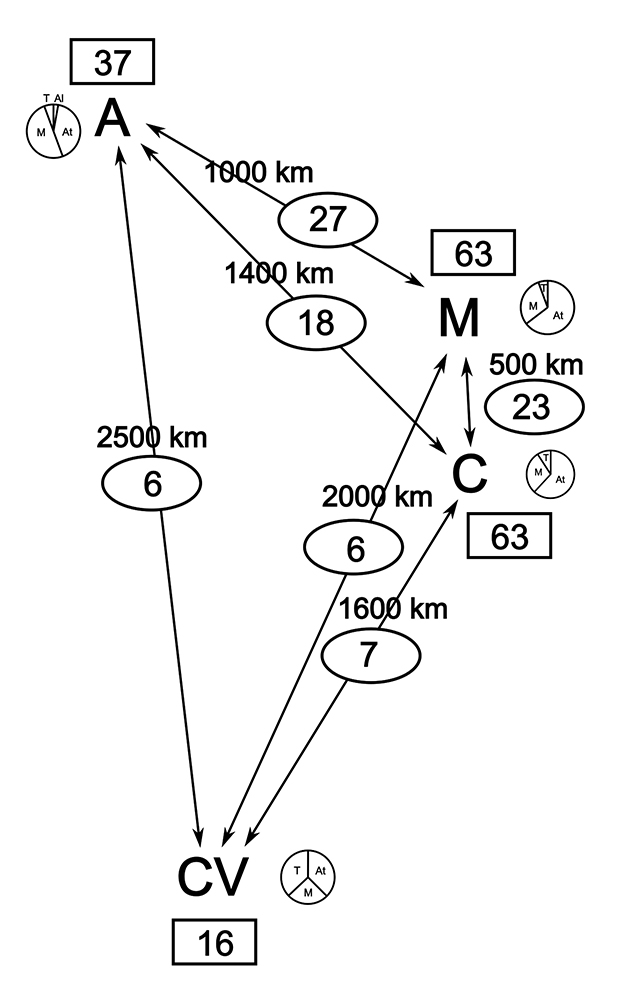
The Macaronesia region, in the east Atlantic Ocean off the northwest coast of Africa, consists of five oceanic archipelagos and is known for its high levels of endemism. However, its terrestrial isopod fauna has received very uneven attention. In this study, we document five species newly recorded from the Macaronesia archipelagos: Ctenorillo atlanticus and Littorophiloscia culebrae in Cabo Verde; Porcellionides cingendus and Styloniscus spinosus in both the Azores and Madeira, and Trichorhina tomentosa in Madeira. Additionally, three new species are described: Miktoniscus atlanticus Cifuentes and Da Silva n. sp., and Trichoniscus furnaensis Cifuentes and Da Silva n. sp. from the Azores, and Soteriscus caboverdiensis Cifuentes and Da Silva n. sp. from Cabo Verde. This study also reports the first record of Armadilloniscus candidus on mainland Portugal. We compiled and updated the list of terrestrial isopod species recorded from the Macaronesia region to 120, with 60 endemic species, of which 71 belong to genera of Atlantic origin, including 46 endemic species. Furthermore, 34 species belong to genera of Mediterranean origin, of which eight are endemic, 14 species of tropical origin, of which six are endemic, and one species is of alpine origin. These patterns suggest this fauna shares a closer affinity with the Atlantic and Mediterranean faunas of Europe and North Africa than with the tropical fauna of Africa. The terrestrial isopod fauna of the Macaronesia region currently comprises 37 species in the Azores (three endemic), 16 species in Cabo Verde (four endemic), 63 species in the Canary Islands (28 endemic), 63 species in Madeira (25 endemic), and only three species are known from the Selvagens Islands.
KEYWORDS:
Atlantic Archipelagos; Cabo Verde; Portugal; Spain; Woodlice
INTRODUCTION
The Macaronesia region comprises five North Atlantic archipelagos: Azores, Cabo Verde, Canary Islands, Madeira, and Selvagens Islands. These archipelagos have volcanic origins and are isolated from the mainland and each other (Hontoria et al., 2012; Desiderato et al., 2019; García-Talavera, 1999; Castro et al., 2022). Due to their oceanic origin, these archipelagos have never been connected to the mainland. However, it is known that several volcanic seamounts located between the African continent, Canary Islands, Selvagens Islands, and Madeira, currently less than 100 meters below sea level, are at least 67 million years old (Geldmacher et al., 2001), and may have formed a chain of islands, facilitating the stepping-stone dispersal of terrestrial species between these archipelagos and Africa (García-Talavera, 1999). The Macaronesia region is ideal for island ecology and evolution research due to its unique geological layout of 40 islands and islets over 1 km², with varying geological ages, climates, topography, vegetation, and isolation (Florencio et al., 2021). The climate is mostly oceanic in the Azores, Mediterranean in the Canary Islands, Madeira, and the Selvagens Islands, and arid and warm in Cabo Verde. However, the wide variation in size, climate, latitude, and altitude among the different islands allows for a great diversity of habitats, from humid forests in the Azores, Madeira, and the western Canary Islands (El Hierro, La Palma, La Gomera, Tenerife, Gran Canaria), to vegetation adapted to arid conditions due to low rainfall in Cabo Verde, the eastern Canary Islands (Fuerteventura, Lanzarote, La Graciosa, and the associated islets), and Madeira (Desertas Islands and Porto Santo) (Hontoria et al., 2012; García-Talavera, 1999; Florencio et al., 2021). The isolation from any mainland ranges from 96 km between Fuerteventura (Canary Islands) and Morocco (Africa) to over 1,800 km between Flores (Azores) and mainland Portugal (Europe).
There is extensive information on numerous taxonomic groups from many of these islands, with high levels of endemism described, particularly in terrestrial taxa (Florencio et al., 2021). However, knowledge across the different archipelagos is uneven, and the knowledge regarding terrestrial isopod fauna (Oniscidea) is no exception. This study aims to update the current knowledge of terrestrial isopods in the Macaronesia region, describe three new species, and discuss their relationships with closely related species.
MATERIAL AND METHODS
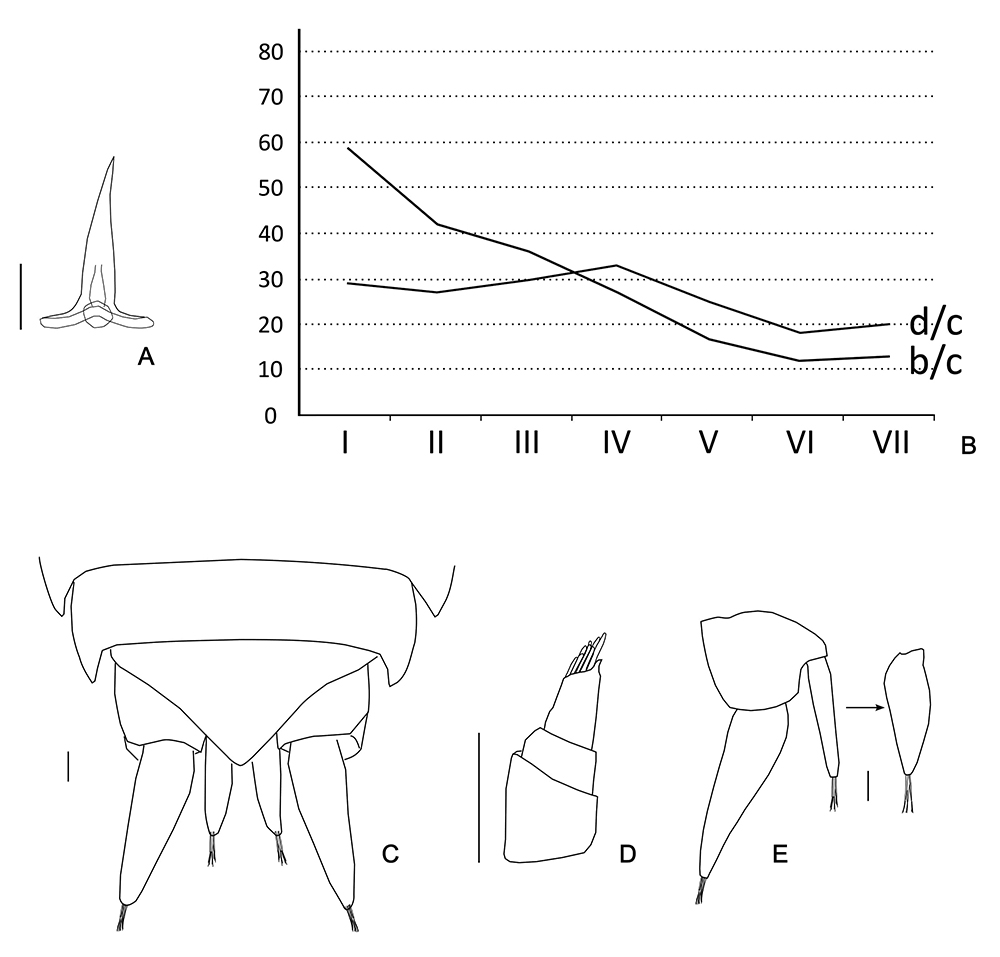
Most specimens studied in this work were collected by hand through direct searches by the authors in suitable microhabitats for various Oniscidea species, including litter, beneath tree bark, dead trunks, and rocks (Cifuentes and Da Silva, 2023 a ; 2023b; 2023c). Larger specimens are preserved in 96% ethanol, while smaller specimens (less than 5 mm) are preserved in 70% ethanol due to the difficulty in dissecting intact pieces necessary for accurate taxonomic assignment. Specimens were identified based on morphological characters. Non-permanent glass slide preparations were made using water as the mounting medium to avoid altering the morphology of the studied structures (Cifuentes and Da Silva, 2024). These structures were later stored in small Eppendorf tubes together with their respective specimens. To represent the position of the lateral noduli, the b/c and d/c ratios on the pereonites were calculated following Vandel (1960 a) , where: b is the distance from the nodule to the posterior edge of the pereonite; c, the pereonite width; and d, the distance from the nodule to the lateral edge. The b/c and d/c ratios, known as Vandel coordinates, were then multiplied by 100 for graphical representation. Spine terminology for the genus MiktoniscusKesselyák, 1930, follows Vandel (1960a) and Schultz (1976) . Several figures were included to facilitate identification and comparison of the studied species. Images were captured using a Gundlach stereomicroscope equipped with a 12 MP digital camera (C2CMOS), and edited with the free graphic editor software, Inkscape (https://inkscape.org/). The describers of the new species are J. Cifuentes and L.P. Da Silva.
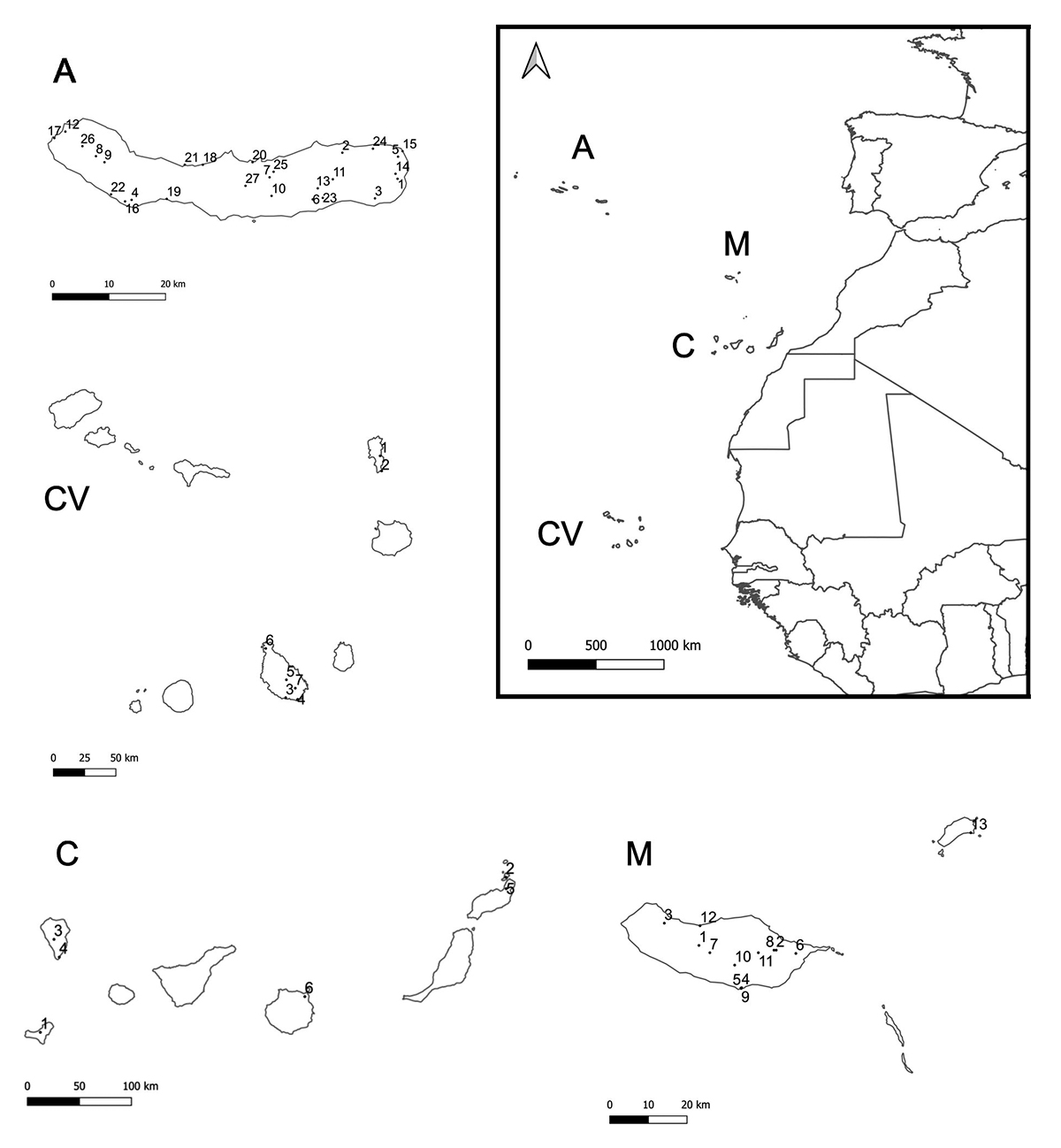
Sampling took place between October 13 and 20, 2023, in Santiago and Sal Islands (Cabo Verde); between November 23 and 25, 2023, and June 1 to 6, 2024, in São Miguel Island (Azores); and between July 5 and 11, 2024, in Madeira and Porto Santo Islands (Madeira) (Fig. 1). In addition, specimens deposited in the Museo Nacional de Ciencias de Madrid (MNCN) from the study region were also analyzed, along with some specimens from the University of La Laguna (UN La Laguna) and the Instituto de Productos Naturales y Agrobiología of the Spanish National Research Council (INPA-CSIC). Field codes for specimens collected in Cabo Verde start with OCV, specimens from São Miguel with ASM, and specimens from Madeira with OM. The specimens from Azores and Madeira are deposited at Centro de Investigação em Biodiversidade e Recursos Genéticos (CIBIO), University of Porto, while those from Cabo Verde are housed at the Natural History Museum of Cabo Verde. Exceptions are noted for specimens held in the collection of the first author (JC) and at the Museo Nacional de Ciencias de Madrid (MNCN). Coordinates were recorded for all collected specimens. For the specimens not collected by the authors, and deposited at the MNCN, UN La Laguna and INPA-CSIC, coordinates were obtained by searching on Google Maps (https://www.google.com/maps/) using the available label data. The map of sampled locations was created using the Free and Open Source QGIS Desktop 3.22.2. Several figures were included to aid in the identification of the studied species.
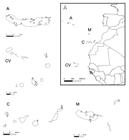
Location of the three archipelagos along the west coasts of Africa and Europe. Azores (A), only São Miguel Island was sampled, with numbers corresponding to sampled locations: 1, Água Retorta; 2, Cascata da Ribeira dos Caldeirões; 3, Faial da Terra; 4, Gruta do Carvão; 5, Jardim Botânico da Ribeira do Guilherme; 6, Lagoa das Furnas; 7, Lagoa de São Brás; 8, Lagoa do Canario; 9, Lagoa do Carvão; 10, Lagoa do Congro; 11, Miradouro do Salto do Cavalo; 12, Mosteiros; 13, near Terra Nostra hotel, Furnas; 14, Nordeste; 15, Piscina Natural Da Boca De Ribeira; 16, Ponta Delgada; 17, Ponta do Escalvado; 18, Praia de Santa Barbara; 19, Praia do Pópulo; 20, Praia dos Moinhos; 21, Rabo de Peixe; 22, Relva; 23, Ribeira Quente; 24, Santo António de Nordestinho; 25, São Brás; 26, Sete Cidades; 27, Vale das Lombadas; 28. Cabo Verde (CV), with specimens from Santiago and Sal islands: 1, Murdeira; 2, Santa Maria; 3, Cidade Velha; 4, Praia; 5, São Jorge dos Orgãos; 6, Tarrafal; 7, Veneza, São Domingos. Canary Islands (C), with specimens from La Graciosa, La Palma and Gran Canaria islands: 1, Frontera; 2, La Graciosa; 3, El Paso; 4, Los Arenales; 5, Haría, Bco. Elvira Sánchez; 6, Las Palmas. Madeira (M), with specimens from Madeira and Porto Santo islands: 1, Bico da Cana; 2, Caminho dos Lamaceiros; 3, Fanal; 4, Funchal; 5, Funchal Marine Biological Station; 6, Furnas do Cavalum; 7, Lombo do Moleiro; 8, Posto Florestal dos Lamaceiros; 9, Praia do Gorgulho, Funchal; 10, Ribeira da Lapa; 11, Ribeiro Frio; 12, São Vicente; 13, beach East of the port.
SYSTEMATICS
Family Armadillidae Brandt, 1831
Genus Ctenorillo Verhoeff, 1942 a
Ctenorillo atlanticus Cifuentes and Da Silva, 2023 b
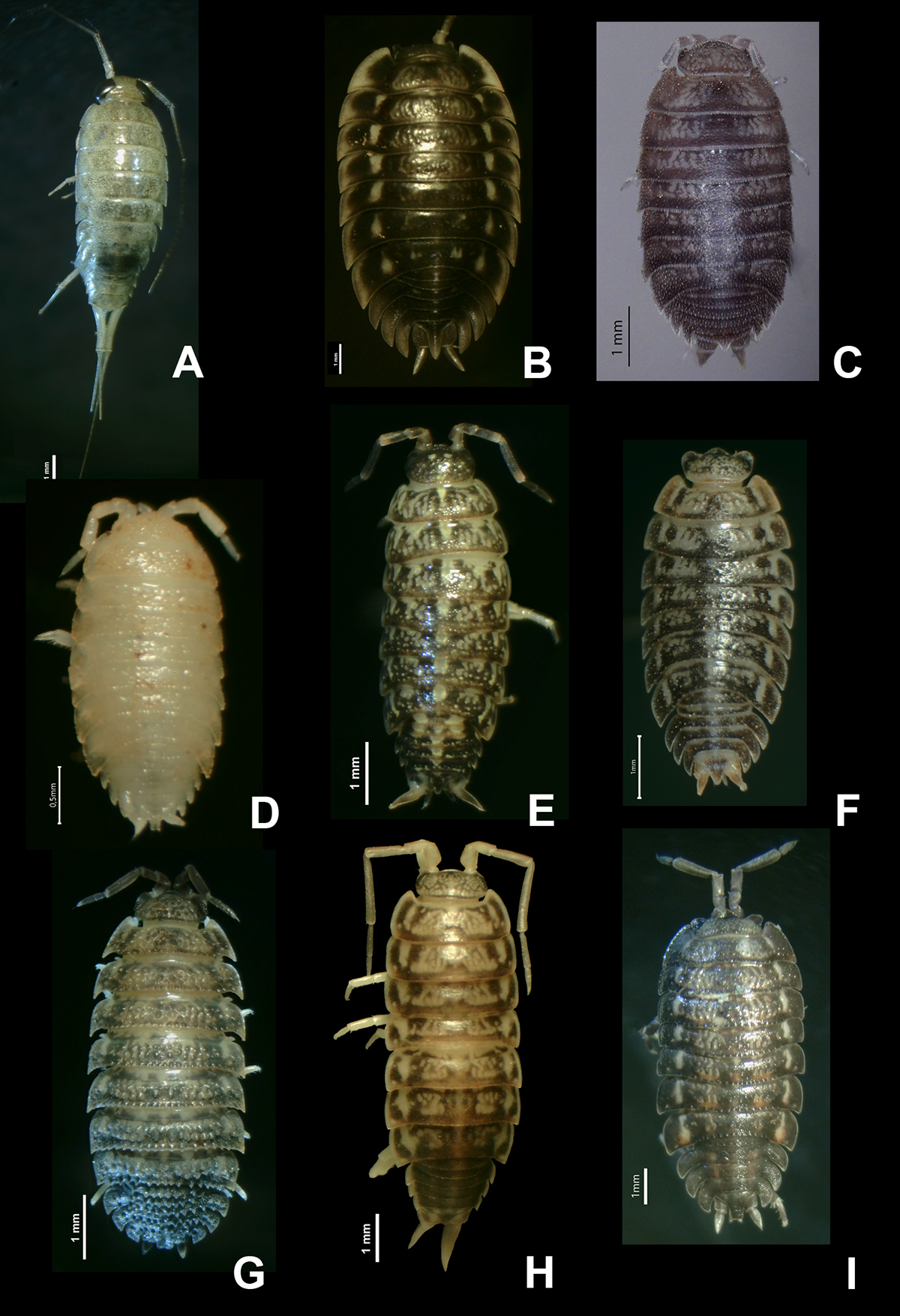
(Fig. 2 A )
Material examined. 12 males (OCV24a), Cabo Verde, Sal, Murdeira, 16°40’35”N 22°56’07”W, 19 Oct 2023, coll. L.P. Da Silva; 9 females (OCV24b), same data as preceding; 1 male (OCV02a), Cabo Verde, Santiago, Cidade Velha, 14°54’58”N 23°36’16”W, 13 Oct 2023, coll. L.P. Da Silva; 3 females (OCV02b), same data as preceding; 2 males (OCV04a), same data as preceding; 12 females (OCV04b), same data as preceding; 1 female (OCV31), Cabo Verde, Santiago, Tarrafal, 15°16’53”N 23°45’04”W, 20 Oct 2023, coll. L.P. Da Silva; 2 males (OCV32a) Cabo Verde, Santiago, Tarrafal, 15°16’42”N 23°45’04”W, 20 Oct 2023, coll. L.P. Da Silva; 1 female (OCV32b), same data as preceding.
Remarks. Described from the Democratic Republic of São Tomé and Príncipe (Cifuentes and Da Silva, 2023 b ), volcanic islands located approximately 4,000 km from Cabo Verde. This is the first record in Cabo Verde where it is most likely introduced.
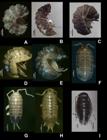
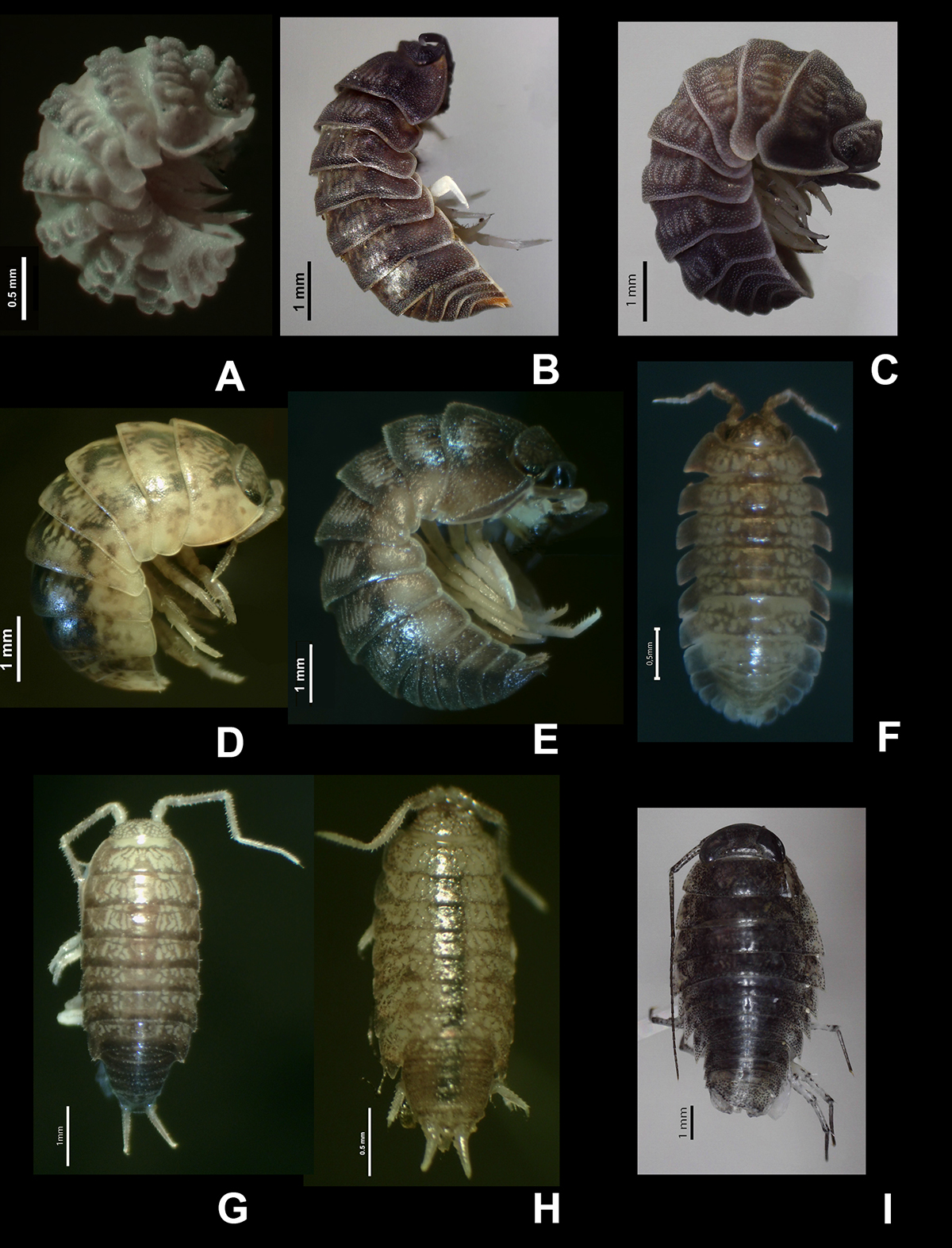
Habitus. A, Ctenorillo atlanticus (OCV31); B, Cubaris murina (OCV19a); C, Venezillo trifolium (OCV10); D, Armadillidium vulgare (ASM06); E, Eluma caelata (ASM22); F, Armadilloniscus candidus (ASM75); G, Halophiloscia couchii (OM062b); H, Littorophiloscia culebrae (OCV15b); I, Ligia gracilipes (OCV27b). Scale bars: A, F, 0.5 mm; B-E, G-I, 1 mm.
Genus Cubaris Brandt, 1833
Cubaris murina Brandt, 1833
(Fig. 2 B )
Material examined. 1 male (OCV19a), Cabo Verde, Santiago, São Jorge dos Orgãos, 15°02’55”N 23°36’02”W, 16 Oct 2023, coll. L.P. Da Silva; 3 males (OCV19b), same data as preceding; 6 females, 2 mancae (OCV19c), same data as preceding.
Remarks. Pantropical species, recorded in Africa, America, Australia, Brazil, India, New Zealand (Van Name, 1936; Schmalfuss, 2003), and Democratic Republic of São Tomé and Príncipe (Cifuentes and Da Silva, 2023 b ). In the Republic of Cabo Verde, it was previously cited by Paulian De Félice (1946), Vandel (1954a) , and Schmalfuss (1982).
Genus Venezillo Verhoeff, 1928
Venezillo trifolium ( Dollfus, 1890 )
(Fig. 2 C )
Material examined. 1 male (JC976 [ex. OCV08]), Cabo Verde, Santiago, Veneza, São Domingos, 14°59’08”N 23°32’02”W, 13 Oct 2023, coll. L.P. Da Silva; 1 female (OCV10), same data as preceding.
Remarks. Endemic to Cabo Verde, cited by Dollfus (1890; 1899b), Budde-Lund (1904), Paulian De Félice (1946), Vandel (1954a) , and Schmalfuss (1982).
Family Armadillidiidae Brandt, 1833
Genus Armadillidium Brandt in Brandt and Ratzburg, 1831
Armadillidium vulgare ( Latreille, 1804 )
(Fig. 2 D )
Material examined. 2 females (ASM01), Portugal, Azores, São Miguel, Ponta Delgada, 37°44’42”N 25°41’59”W, 23 Nov 2023, coll. L.P. Da Silva; 3 females (ASM06), Portugal, Azores, São Miguel, Ponta Delgada, 37°44’45”N 25°39’49”W, 23 Nov 2023, coll. L.P. Da Silva; 2 females (ASM07), Portugal, Azores, São Miguel, Ponta Delgada, 37°44’47”N 25°40’13”W, 23 Nov 2023, coll. L.P. Da Silva; 1 female (OM006), Portugal, Madeira Archipelago, Madeira Island, Praia do Gorgulho, 32°38’12”N 16°56’07”W, 5 Jul 2024, coll. L.P. Da Silva; 1 female (OM028), Portugal, Madeira Archipelago, Madeira Island, São Vicente, 32°48’31”N 17°02’52”W, 6 Jul 2024, coll. L.P. Da Silva; 1 female, 3 immatures (MNCN 20.04/12171), Spain, Canary Islands, La Palma, El Paso, 18 Jun 1999, coll. T. Domingo-Quero; 1 female (MNCN 20.04/12170), Spain, Canary Islands, La Palma, El Paso, 20 Sep 1999, coll. A. Sánchez-Ruiz; 1 female (MNCN 20.04/12193), Spain, Canary Islands, La Palma, El Paso, 27 Mar 2000, coll. T. Domingo-Quero; 4 males, 2 female (MNCN 20.04/12187), Spain, Canary Islands, La Palma, El Paso, 1 May 2000, coll. T. Domingo-Quero; 1 male (MNCN 20.04/12189), same data as preceding; 1 female (MNCN 20.04/12169), Spain, Canary Islands, La Palma, El Paso, 16 Jan 2001, coll. T. Domingo-Quero; 1 female (MNCN 20.04/12165), Spain, Canary Islands, La Palma, El Paso, 22 Jan 2001, coll. T. Domingo-Quero; 1 female (MNCN 20.04/12184), Spain, Canary Islands, La Palma, El Paso, 25 Jan 2001, coll. T. Domingo-Quero; 2 males, 1 female (MNCN 20.04/12163), Spain, Canary Islands, La Palma, El Paso, 6 Feb 2001, coll. T. Domingo-Quero; 1 male (MNCN 20.04/12185), Spain, Canary Islands, La Palma, El Paso, 11 Mar 2001, coll. T. Domingo-Quero; 1 female (MNCN 20.04/12194), same data as preceding; 1 female (MNCN 20.04/12181), Spain, Canary Islands, La Palma, El Paso, 23 Mar 2001, coll. T. Domingo-Quero and A. García-Valdecasas; 1 female (MNCN 20.04/12176), Spain, Canary Islands, La Palma, El Paso, 23 Mar 2001, coll. T. Domingo-Quero; 1 male, 1 female (MNCN 20.04/12179), Spain, Canary Islands, La Palma, El Paso, 26 Mar 2001, coll. A. Sánchez-Ruiz and T. Domingo-Quero; 1 male, 1 female (MNCN 20.04/12164), same data as preceding; 2 males, 5 females, 12 immatures (MNCN 20.04/12198), Spain, Canary Islands, La Palma, El Paso, 26 Mar 2001, coll. A. Sánchez-Ruiz; 2 specimens (MNCN 20.04/12186), Spain, Canary Islands, La Palma, El Paso, 30 Mar 2001, coll. A. Sánchez-Ruiz; 1 male, 1 female (MNCN 20.04/12173), Spain, Canary Islands, La Palma, El Paso, 12 May 2001, coll. T. Domingo-Quero; 6 immatures (MNCN 20.04/12191), Spain, Canary Islands, La Palma, El Paso, 23 Jun 2001, coll. T. Domingo-Quero; 2 females (MNCN 20.04/12197), Spain, Canary Islands, La Palma, El Paso, 10 Aug 2001, coll. T. Domingo-Quero.
Remarks. Species from the Mediterranean region and introduced to other parts of the world (Schmalfuss, 2003). It was cited from Azores (Morelet, 1860; Dollfus, 1889b ; Dollfus in Norman, 1899; Paulian De Félice, 1946; Vandel, 1956a ; 1968; Schmölzer, 1971; Taiti, 2010), Cabo Verde (Paulian De Félice, 1946), Canary Islands (Dollfus, 1889b; 1893; 1898; Ferrer Galdiano, 1923; Arcangeli, 1930; 1958; Paulian De Félice, 1946; Vandel, 1954b; Schmölzer, 1971; Dalens, 1984; Hoese, 1984b ; Rodríguez Santana, 1996; Arechavaleta et al., 1999; Arndt and Mattern, 2005; López and Taiti, 2010), and Madeira (Budde-Lund, 1885; Dollfus, 1889b; Norman, 1899; Paulian De Félice, 1939b; 1946; Arcangeli, 1958; Vandel, 1960b; Schmölzer, 1971; Hoese, 1978; Taiti, 2010).
Genus Eluma Budde-Lund, 1885
Eluma caelata ( Miers, 1878 )
(Fig. 2 E )
Material examined. 1 female (ASM22), Portugal, Azores, São Miguel, Lagoa do Canario, 37°50’07”N 25°45’31”W, 24 Nov 2023, coll. L.P. Da Silva; 1 female (ASM27), Portugal, Azores, São Miguel, Mosteiros, 37°50’08”N 25°49’11”W, 24 Nov 2023, coll. L.P. Da Silva; 1 female (OM043), Portugal, Madeira Archipelago, Madeira Island, Bico da Cana, 32°45’12”N 17°03’05”W, 8 Jul 2024, coll. L.P. Da Silva; 1 male (OM026), Portugal, Madeira Archipelago, Madeira Island, Fanal, 32°48’34”N 17°08’40”W, 6 Jul 2024, coll. L.P. Da Silva; 1 male (OM027a), same data as preceding; 3 females (OM027b), same data as preceding;1 female (OM036), Portugal, Madeira Archipelago, Madeira Island, Ribeiro Frio, 32°44’02”N 16°53’14”W, 7 Jul 2024, coll. L.P. Da Silva.
Remarks. It occurs from northwest Africa to the British Isles and is introduced in other parts of the world (Schmalfuss, 2003). It was cited from Azores (Dollfus, 1889a , 1889b; Paulian De Félice, 1946; Vandel, 1956a ; 1968; Ashmole et al., 1996; Taiti, 2010), Canary Islands (Dollfus, 1889b; 1893; Ferrer Galdiano, 1923; Arcangeli, 1930; 1958; Paulian De Félice, 1946; Vandel, 1954b; 1956a; Schmölzer, 1971; Dalens, 1984; Hoese, 1984b ; Rodríguez Santana, 1996; Arechavaleta et al., 1999; Macias et al., 2004; Arndt and Mattern, 2005; López and Taiti, 2010; Jorge et al., 2016; Fernández-Palacios et al., 2018), and Madeira (Budde-Lund, 1885; Dollfus, 1889b; Norman, 1899; Paulian De Félice, 1939b; 1946; Vandel, 1956a; 1960b; Arcangeli, 1958; Schmölzer, 1971; Hoese, 1978; Borges et al., 2008; Taiti, 2010; Hughes, 2024).
Family Detonidae Budde-Lund, 1904
Genus Armadilloniscus Uljanin, 1875
Armadilloniscus candidus Budde-Lund, 1885
Material examined. 3 females (ASM75), Portugal, Azores, São Miguel, Praia do Pópulo, 37°45’00”N 25°37’02”W, 6 Jun 2024, coll. L.P. Da Silva; 1 female (JC1203 [ex. ASM75]), same data as preceding; 4 females (ASM76), same data as preceding; 1 female (LPS890), Portugal, Faro, Praia dos Rebolinhos, 37°21’19”N 8°55’15”W, 21 Mar 2023, coll. L.P. Da Silva; 2 females (LPS891), same data as preceding; 3 males (LPS892a), same data as preceding; 1 male (LPS892b), same data as preceding; 6 females (LPS892c), same data as preceding.
Remarks. Dollfus (1889a) described Armadilloniscus tuberculatus Dollfus, 1889a, based on a single female collected in Capellas (São Miguel, Azores). Later, Vandel (1956 a ; 1962), after studying Dollfus’s (1889a) specimen, determined that it was a juvenile of An. candidus. Additionally, Norman (1899) reported An. tuberculatus from Gorgulho, near Funchal (Madeira), but this is likely a misidentification, as Armadilloniscus ellipticus (Harger, 1878) is known to occur at that locality, as discussed below. Armadilloniscus ellipticus has been reported from the Azores in Faial, Pico, Santa Maria, São Miguel, and Terceira by Arcangeli (1958), Vandel (1956a; 1960b; 1968), and Taiti (2010); and from Madeira in Funchal by Arcangeli (1958), Vandel (1960b; 1962; 1968), and Borges et al. (2008).
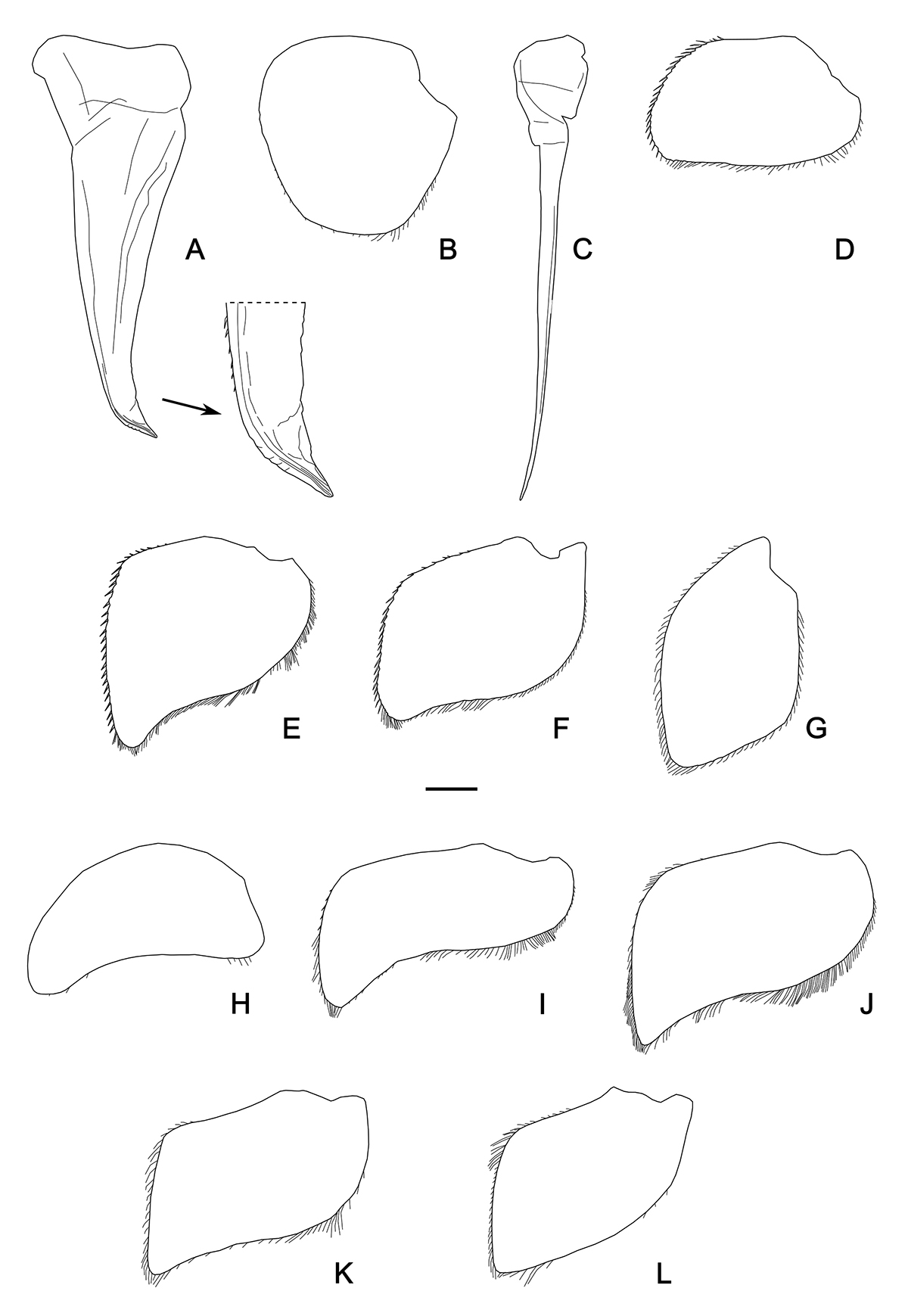
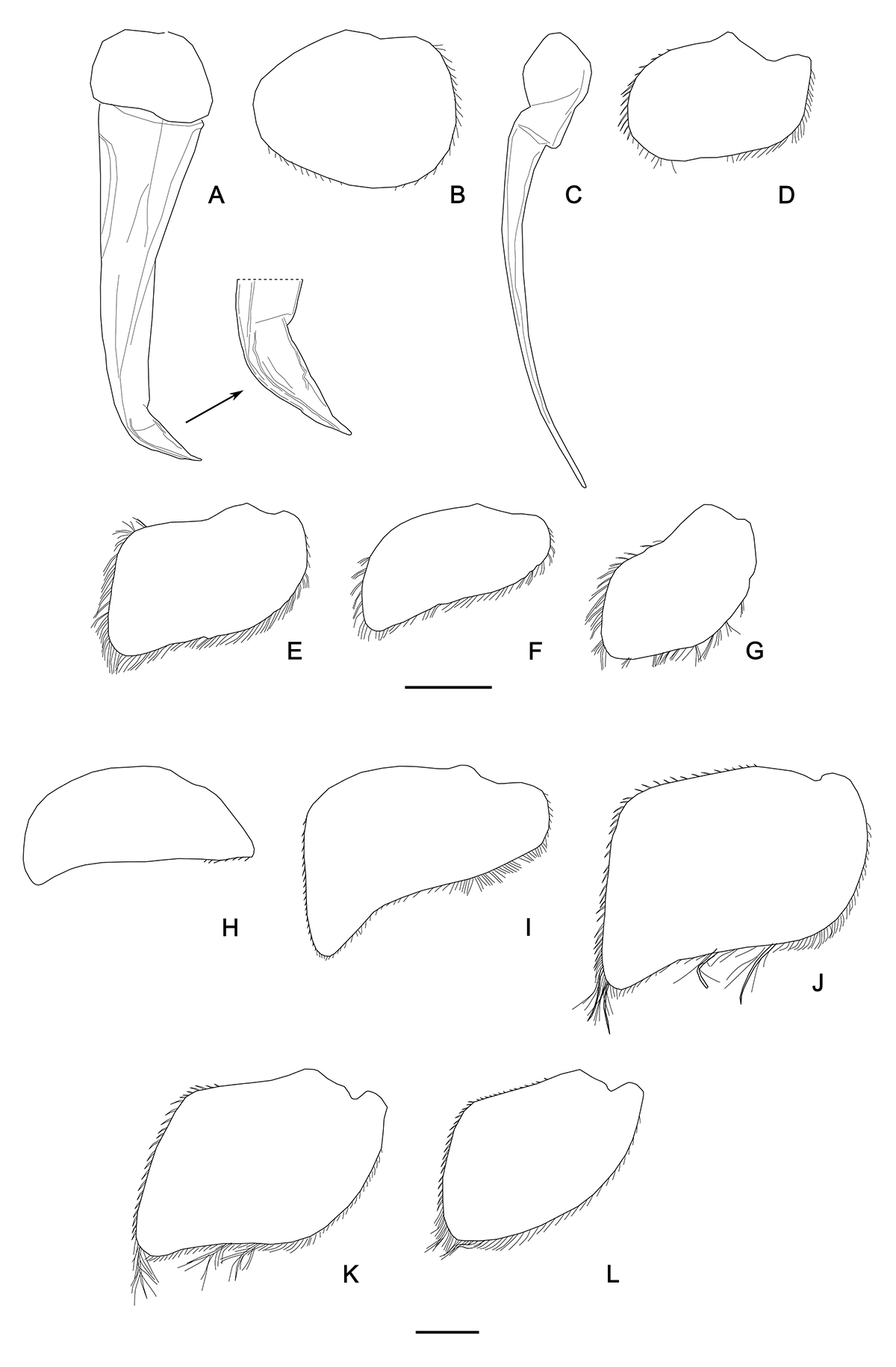
Vandel (1962) provided a table to distinguish Armadilloniscus litoralisBudde-Lund, 1885 [= An. ellipticus (Schmalfuss, 2003)], from An. candidus. This table highlights differences in the shape of the median lobe, the frontal line, the cephalon ornamentation, and the outer margin of the uropod protopod. Although we did not collect An. ellipticus during the present study in the Macaronesia archipelagos, we examined specimens from mainland Portugal, 3 females (LPS924), Portugal, Setubal, Seixal, 38°39’18”N 9°27’40”W, 16 May 2024, coll. L.P. Da Silva, and Cádiz, southern Spain (JC198; Cifuentes, 2021a ), as well as the 13 specimens of An. candidus from southern Portugal mentioned above. These specimens allowed us to compare the two species. Our analysis of An. candidus and An. ellipticus confirmed the differences noted by Vandel (1962) regarding the ornamentation of the cephalon, although the other differences he described were less clear. Vandel (1962) also described An. candidus as having a white coloration with a very faint pigment network visible only under a binocular microscope. The lack of pigmentation has also been noted by Garcia and Robla (2021) as a characteristic of An. candidus that distinguishes it from An. ellipticus. In contrast, some of our specimens from the Azores and mainland Portugal have a brownish-violet coloration, with very prominent muscle insertions (Fig. 2F). Vandel (1962) indicates differences in integument ornamentation between these species. In An. ellipticus, each pereonite has one pair of very prominent submedian tubercles and 3 to 5 elongated tubercles along the sides, whereas in An. candidus, there are 4 or 5 pairs of tubercles on each pereonite. In our specimens, the tubercles are very faint or poorly defined, especially on the posterior half, and can also be elongated in both species. Garcia and Robla (2021) indicate that the most reliable distinguishing characteristic between the two species is the first two pairs of male pleopods (Taiti and Ferrara, 1996; Garcia and Robla, 2021). However, differences are also observed in the other pleopods, when comparing An. candidus (Fig. 3) and An. ellipticus (Fig. 4). The ornamentation of the integument also differs between the two species. In An. ellipticus, the granules are small and conical, whereas in An. candidus, they are elongated, following the anterior-posterior axis. The presence of An. candidus, a halophilic species (Vandel, 1962), in Praia dos Rebolinhos, Faro, in southern Portugal, is the first record of this species on mainland Portugal. Furthermore, this finding helps to clarify the dispersal route of this species from its colonies in the Mediterranean (Algeria, France, Italy, Malta, and Tunisia) (Budde-Lund, 1885; Verhoeff, 1918; Vandel, 1962; Taiti and Ferrara, 1996; Schmalfuss, 2003; Messina et al., 2012; Séchet and Noël, 2015; De Matthaeis et al., 2019), towards Villaviciosa (Asturias, Spain) in the northern Iberian Peninsula (Garcia and Robla, 2021) and Saint-Jean-de-Luz (Pyrénées-Atlantiques) on the southern Atlantic coast of France (Cherpitel et al., 2019). This dispersal may have occurred naturally, as in many other species of halophilic isopods, along the coastline (Vandel, 1946; 1960). However, its presence in Azores (Dollfus, 1889 a ; Vandel, 1956a, 1962) is more likely the result of human-mediated introduction.
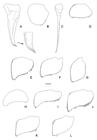
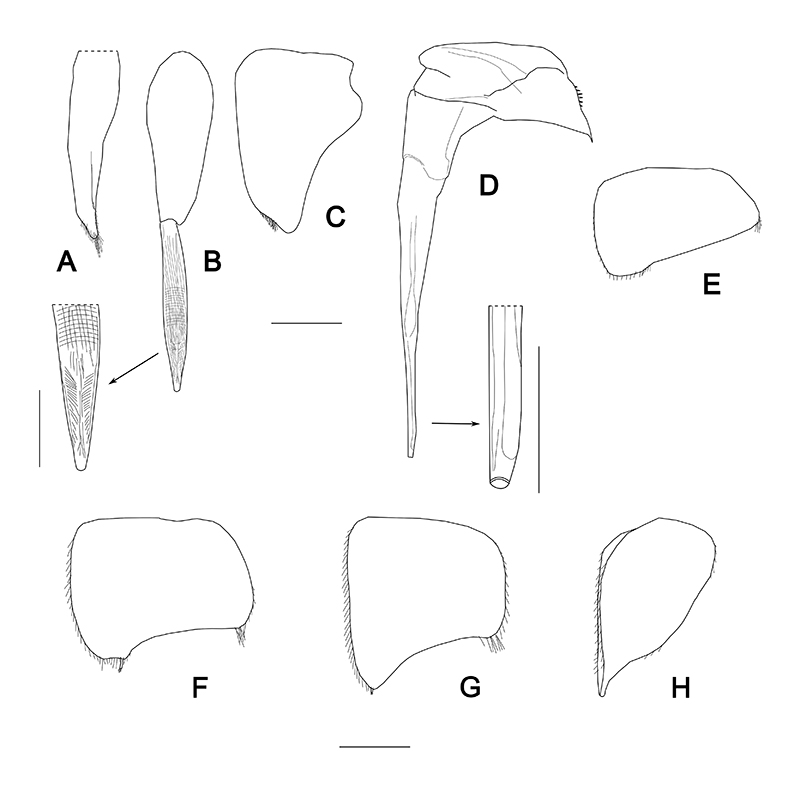
Armadilloniscus candidus , male (LPS892b). A, Endopod of pleopod I; B, exopod of pleopod I; C, endopod of pleopod II; D, exopod of pleopod II; E, exopod of pleopod III; F, exopod of pleopod IV; G, exopod of pleopod V. Armadilloniscus candidus, female (LPS892c). H, Exopod of pleopod I; I, exopod of pleopod II; J, exopod of pleopod III; K, exopod of pleopod IV; L, exopod of pleopod V. Scale bars: A-L, 0.1 mm.
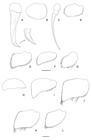
Armadilloniscus ellipticus , male (JC198). A, Endopod of pleopod I; B, exopod of pleopod I; C, endopod of pleopod II; D, exopod of pleopod II; E, exopod of pleopod III; F, exopod of pleopod IV; G, exopod of pleopod V. Armadilloniscus ellipticus, female (LPS924). H, Exopod of pleopod I; I, exopod of pleopod II; J, exopod of pleopod III; K, exopod of pleopod IV; L, exopod of pleopod V. Scale bars: A-L, 0.1 mm.
Family Halophilosciidae Verhoeff, 1908 a
Genus Halophiloscia Verhoeff, 1908 a
Halophiloscia couchii ( Kinahan, 1858 )
(Fig. 2 G )
Material examined. 1 female (ASM42), Portugal, Azores, São Miguel, Piscina Natural da Boca de Ribeira, 37°50’43”N 25°08’49”W, 2 Jun 2024, coll. L.P. Da Silva; 2 females (ASM43), same data as preceding; 1 male (ASM74), Portugal, Azores, São Miguel, Praia do Pópulo, 37°45’00”N 25°37’02”W, 6 Jun 2024, coll. L.P. Da Silva; 1 female (OM060), Portugal, Madeira Archipelago, Porto Santo, beach east of the port, 33°03’46”N 16°18’19”W, 9 Jul 2024, coll. L.P. Da Silva; 7 males (OM061a), same data as preceding; 13 females (OM061b), same data as preceding; 1 male (OM062a), Portugal, Madeira Archipelago, Porto Santo, beach east of the port, 33°03’46”N 16°18’22”W, 9 Jul 2024, coll. L.P. Da Silva; 4 females (OM062b), same data as preceding; 1 female (OM009), Portugal, Madeira Archipelago, Madeira Island, Praia do Gorgulho, 32°38’12”N 16°56’07”W, 6 Jul 2024, coll. L.P. Da Silva.
Remarks. In the Macaronesia region, this species has been reported from the Azores, specifically from Faial, Flores, Graciosa, Santa Maria, São Miguel and Terceira (Dollfus, 1889 b ; 1889c; Paulian De Félice, 1946; Vandel, 1956a , 1960b, 1968; Schmölzer, 1971; Taiti, 2010). In Cabo Verde, Vandel (1954a) reported Hl. couchii with some uncertainty, likely based on a reference by Dollfus (1899, p. 251): “Par contre, Tylos, Armadillo et Philoscia couchii, trouvés au Sénégal et au Cap Vert.” This sentence could suggest that all three species were found in Cabo Verde. However, Dollfus himself (1899, p. 256) later specifies Senegal as the only locality for Philoscia couchii, indicating Vandel’s (1954a, 1956a, 1962) citation of Hl. couchii for the archipelago cannot be considered valid. In Madeira it has been reported from Funchal, Ponta de São Lourenço, Porto Novo, São Vicente and Porto Santo Island (Arcangeli, 1958; Vandel, 1960b; 1968; Schmölzer, 1971). In Canary Islands, it had been recorded from El Hierro, Fuerteventura, Gran Canaria, La Gomera, La Graciosa, Lanzarote, La Palma, Montaña Clara and Tenerife (Dollfus, 1889b; 1893; Arcangeli, 1930; 1958; Paulian De Félice, 1946; Vandel, 1956a; 1958; Schmölzer, 1971; Dalens, 1984; Rodríguez Santana and Barrientos, 1993 c ; García et al., 1995; Rodríguez Santana, 1996; Macías et al., 2004; Taiti and López, 2008; López and Taiti, 2010; Fernández-Palacios et al., 2018). In their work on the Halophilosciidae of the Canary Islands, Taiti and López (2008) described two new species: Halophiloscia microphthalma Taiti and López, 2008 from La Palma, and Halophiloscia rodriguezi Taiti and López, 2008 from El Hierro, La Gomera, La Palma, and Tenerife. The authors reassigned several previous records of Hl. couchii in the Canary Islands to one of these two new species, or Halophiloscia canariensis Dalens, 1973, indicating that the remaining records should be re-evaluated. According to Taiti and López (2008), López and Taiti (2010), and Bidegaray-Batista et al. (2015), Hl. couchii is currently known only from Gran Canaria and Tenerife in the Canary Islands, where it is considered a recent introduction (Bidegaray-Batista et al., 2015).
Genus Littorophiloscia Hatch, 1947
Littorophiloscia culebrae ( Moore, 1901 )
(Fig. 2 H )
Material examined. 1 male (OCV12c), Cabo Verde, Santiago, Cidade Velha, 14°54’52”N 23°36’17”W, 14 Oct 2023, coll. L.P. Da Silva; 3 females (OCV14), Cabo Verde, Santiago, Praia, 14°54’16”N 23°31’16”W, 15 Oct 2023, coll. L.P. Da Silva; 1 male (OCV15a), Cabo Verde, Santiago, Praia, 14°54’17”N 23°31’17”W, 15 Oct 2023, coll. L.P. Da Silva; 5 males (OCV15b), same data as preceding; 2 males (JC979 [ex. OCV15b]), same data as preceding; 15 females (OCV15c), same data as preceding.
Remarks. Circumtropical species (Schmalfuss, 2003) previously cited from the Canary Islands (Rodríguez Santana and Barrientos, 1993c ; Taiti and López, 2008; López and Taiti, 2010). It is recorded for the first time from Cabo Verde.
Family Ligiidae Leach, 1814
Genus Ligia Fabricius, 1798
Ligia gracilipes Budde-Lund, 1885
(Fig. 2 I )
Material examined. 1 male (JC980 [ex. OCV26a]), Cabo Verde, Sal, Santa Maria, 16°35’43”N 22°53’41”W, 19 Oct 2023, coll. L.P. Da Silva; 3 females, 6 immatures (OCV26b), same data as preceding; 1 male (OCV27a), same data as preceding; 2 females, 1 immature (OCV27b), same data as preceding.
Remarks. The shape of the male pleopods, particularly endopod II, which ends in a slender, pointed tip, allows one to distinguish Lg. gracilipes from Ligia italicaFabricius, 1798 and Ligia oceanica (Linnaeus, 1767). Found from Cabo Verde to Congo (Dollfus, 1899; Vandel, 1960a ). In Cabo Verde, it has been cited by Dollfus (1899), Vandel (1960a) and Schmalfuss (1982).
Ligia italica Fabricius, 1798
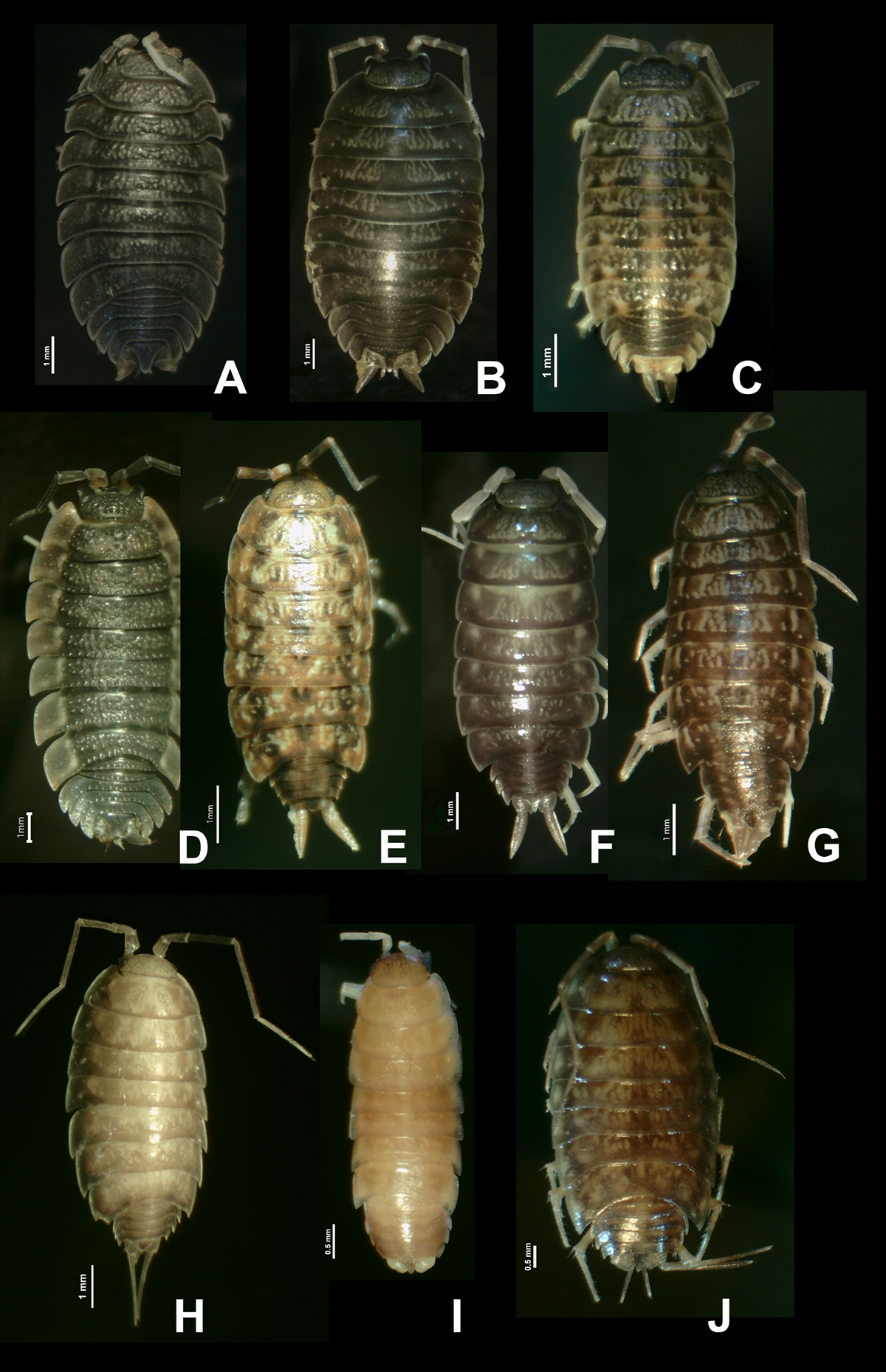
(Fig. 5 A )
Material examined. 2 females (ASM44), Portugal, Azores, São Miguel, Piscina Natural da Boca de Ribeira, 37°50’43”N 25°08’49”W, 2 Jun 2024, coll. L.P. Da Silva; 2 males (ASM17a), Portugal, Azores, São Miguel, Ponta Delgada, 37°44’21”N 25°40’02”W, 23 Nov 2023, coll. L.P. Da Silva; 2 females (ASM17b), same data as preceding; 1 female (ASM77), Portugal, Azores, São Miguel, Praia do Pópulo, 37°44’60”N 25°37’02”W, 6 Jun 2024, coll. L.P. Da Silva; 1 male (ASM29), Portugal, Azores, São Miguel, Rabo de Peixe, 37°49’05”N 25°34’52”W, 24 Nov 2023, coll. L.P. Da Silva; 1 female (OM001), Portugal, Madeira Archipelago, Madeira Island, Praia do Gorgulho, 32°38’11”N 16°56’05”W, 5 Jul 2024, coll. L.P. Da Silva; 3 females (OM002), same data as preceding; 1 female (OM005), Portugal, Madeira Archipelago, Madeira Island, Praia do Gorgulho, 32°38’12”N 16°56’07”W, 5 Jul 2024, coll. L.P. Da Silva.
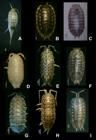
Habitus. A, Ligia italica (ASM17b); B, Oniscus asellus (ASM33a); C, Niambia squamata (OCV25b); D, Trichorhina tomentosa (OM079a); E, Acaeroplastes melanurus (ASM12a); F, Agabiformius lentus (OM080a); G, Porcellio atlantidum (OM019); L, Porcellio cadenati (OCV20a); I, Porcellio cataractae (OM045a). Scale bars: A, C, E-I, 1 mm; B, D, 0.5 mm.
Remarks. Found in the circum-Mediterranean region and the Atlantic archipelagos. It has been cited from the Azores (Dollfus, 1889b ; 1889c; Paulian De Félice, 1946; Vandel, 1956a ; 1968; Schmölzer, 1971; Ashmole et al., 1996; Taiti, 2010), the Canary Islands (Dollfus, 1889b; 1893; Koelbel, 1892; Arcangeli, 1930; 1958; Paulian De Félice, 1946; Vandel, 1956a; Schmölzer, 1971; Dalens, 1984; Hoese, 1984 b ; Macias et al., 2004; López and Taiti, 2010; Ramírez and Riera, 2013; Fernández-Palacios et al., 2018), and Madeira (Dollfus, 1889b; Norman, 1899; Paulian De Félice, 1939b; 1946; Vandel, 1956a; 1960b; Arcangeli, 1958; Schmölzer, 1971; Borges et al., 2008; Taiti, 2010). Vandel (1954a) mentioned it with some doubts from Cabo Verde because he did not examine males, but later (Vandel, 1956a; 1960a) indicated that it could be found on these islands. At present, its presence in the archipelago is considered uncertain.
Family Oniscidae Latreille, 1802
Genus Oniscus Linnaeus, 1758
Oniscus asellus Linnaeus, 1758
(Fig. 5 B )
Material examined. 1 female (ASM54), Portugal, Azores, São Miguel, Faial da Terra, 37°45’04”N 25°12’09”W, 3 Jun 2024, coll. L.P. Da Silva; 2 females (ASM56a), same data as preceding; 1 female (ASM67), Portugal, Azores, São Miguel, Furnas, near Terra Nostra hotel, 37°46’14”N 25°18’57”W, 4 Jun 2024, coll. L.P. Da Silva; 1 female (ASM63), Portugal, Azores, São Miguel, Lagoa do Congo, 37°45’20”N 25°24’30”W, 4 Jun 2024, coll. L.P. Da Silva; 1 male (ASM33a), Portugal, Azores, São Miguel, Miradouro do Salto do Cavalo, 37°47’21”N 25°17’10”W, 25 Nov 2023, coll. L.P. Da Silva; 1 female (ASM33b), same data as preceding; 1 female (ASM28), Portugal, Azores, São Miguel, Mosteiros, 37°53’08”N 25°49’11”W, 24 Nov 2023, coll. L.P. Da Silva; 1 male (ASM41), Portugal, Azores, São Miguel, Piscina Natural da Boca de Ribeira, 37°50’42”N 25°08’50”W, 2 Jun 2024, coll. L.P. Da Silva; 8 females (ASM59), Portugal, Azores, São Miguel, Ribeira Quente, 37°45’06”N 25°18’24”W, 3 Jun 2024, coll. L.P. Da Silva; 1 female (ASM14), Portugal, Azores, São Miguel, Nordeste, 37°48’00”N 25°09’39”W, 23 Nov 2023, coll. L.P. Da Silva; 1 female (ASM39), Portugal, Azores, São Miguel, Nordeste, 37°49’53”N 25°08’42”W, 1 Jun 2024, coll. L.P. Da Silva; 1 female (ASM15), Portugal, Azores, São Miguel, Ponta Delgada, 37°44’40”N 25°40’03”W, 23 Nov 2023, coll. L.P. Da Silva; 1 female (OM042c), Portugal, Madeira Archipelago, Madeira Island, Bico da Cana, 32°45’14”N 17°03’04”W, 8 Jul 2024, coll. L.P. Da Silva; 1 female (OM070), Portugal, Madeira Archipelago, Madeira Island, Caminho dos Lamaceiros, 32°44’27”N 16°50’20”W, 10 Jul 2024, coll. L.P. Da Silva; 1 male (OM071), same data as preceding; 1 female (OM073), Portugal, Madeira Archipelago, Madeira Island, Caminho dos Lamaceiros, 32°44’28”N 16°50’19”W, 10 Jul 2024, coll. L.P. Da Silva; 1 male (OM024), Portugal, Madeira Archipelago, Madeira Island, Fanal, 32°48’32”N 17°08’38”W, 6 Jul 2024, coll. L.P. Da Silva; 5 females (OM025), same data as preceding; 2 females (OM014), Portugal, Madeira Archipelago, Madeira Island, Lombo do Moleiro, 32°44’02”N 17°01’15”W, 6 Jul 2024, coll. L.P. Da Silva; 1 female (OM015), same data as preceding; 1 female (OM076), Portugal, Madeira Archipelago, Madeira Island, Posto Florestal dos Lamaceiros, 32°44’23”N 16°50’50”W, 10 Jul 2024, coll. L.P. Da Silva; 1 female (OM004), Portugal, Madeira Archipelago, Madeira Island, Ribeira da Lapa, 32°41’58”N 16°57’10”W, 5 Jul 2024, coll. L.P. Da Silva; 2 females (OM035), Portugal, Madeira Archipelago, Madeira Island, Ribeiro Frio, 32°44’01”N 16°53’14”W, 5 Jul 2024, coll. L.P. Da Silva.
Remarks. The species is of Atlantic origin (Vandel, 1960 b ) and has spread throughout Western Europe and was introduced into other parts of the world (Schmalfuss, 2003). It was reported from Azores (Morelet, 1860; Budde-Lund, 1885; Dollfus, 1889a ; 1889b; Paulian De Félice, 1946; Vandel, 1956a; 1968; Ashmole et al., 1996; Schmalfuss, 2003; Taiti, 2010) and Madeira (Vandel, 1960b; Schmölzer, 1971; Hoese, 1978; Schmalfuss, 2003; Borges et al., 2008; Taiti, 2010).
Family Platyarthridae Verhoeff, 1949
Genus Niambia Budde-Lund, 1904
Niambia squamata ( Budde-Lund, 1885 )
(Fig. 5 C )
Material examined. 2 males (OCV25a), Cabo Verde, Sal, Murdeira, 16°40’35”N 22°56’07”W, 19 Oct 2023, coll. L.P. Da Silva; 1 female (OCV25b), same data as preceding.
Remarks. Known from Angola, Ivory Coast, Nigeria, Democratic Republic of São Tomé and Príncipe, Senegal, and Zaire (Schmalfuss, 2003; Cifuentes and Da Silva, 2023 b ), and is considered introduced in Brazil (Schmalfuss, 2003). It was previously cited from Cabo Verde (Schmalfuss, 1982).
Genus Trichorhina Budde-Lund, 1908
Trichorhina tomentosa ( Budde-Lund, 1893 )
(Fig. 5 D )
Material examined. 1 female (OM031), Portugal, Madeira Archipelago, Madeira Island, Praia do Gorgulho, 32°38’13”N 16°56’08”W, 7 Jul 2024, coll. L.P. Da Silva; 2 females (OM032), same data as preceding; 4 females (OM33a), same data as preceding; 1 female (OM33b), same data as preceding; 1 male (JC1199 [ex. OM079a]), Portugal, Madeira Archipelago, Madeira Island, Praia do Gorgulho, 32°38’13”N 16°56’08”W, 11 Jul 2024, coll. L.P. Da Silva; 3 females, 4 immatures (OM079b), same data as preceding.
Remarks. Tropical species introduced worldwide, with its use as food for terrarium animals further facilitating its spread (Schmalfuss, 2003; Cifuentes et al., 2022). It was only recorded from the Macaronesia region from São Miguel in the Azores (Vandel, 1968; Taiti, 2010). It is recorded for the first time from Madeira.
Family Porcellionidae Brandt, 1831
Genus Acaeroplastes Verhoeff, 1918
Acaeroplastes melanurus ( Budde-Lund, 1885 )
(Fig. 5 E )
Material examined. 1 female (ASM11), Portugal, Azores, São Miguel, Ponta Delgada, 37°44’46”N 25°40’19”W, 23 Nov 2023, coll. L.P. Da Silva; 1 male (ASM08), Portugal, Azores, São Miguel, Ponta Delgada, 37°44’48”N 25°40’14”W, 23 Nov 2023, coll. L.P. Da Silva; 2 males (ASM12a), same data as preceding; 1 female (ASM12b), same data as preceding.
Remarks. Species from the Western Mediterranean and present in Azores (Dollfus, 1889a ; 1899; Paulian de Félice, 1946; Vandel, 1956 a ; 1968; Schmalfuss, 2003; Taiti, 2010).
Genus Agabiformius Verhoeff, 1908 b
Agabiformius lentus ( Budde-Lund, 1885 )
(Fig. 5 F )
Material examined. 1 female (OM008), Portugal, Madeira Archipelago, Madeira Island, Marine Biological Station, 32°38’12”N 16°56’08”W, 5 Jul 2024, coll. L.P. Da Silva; 1 female (OM080a), Portugal, Madeira Archipelago, Madeira Island, Praia do Gorgulho, 32°38’13”N 16°56’10”W, 11 Jul 2024, coll. L.P. Da Silva; 1 female (OM080b), same data as preceding.
Remarks. Species native to the Mediterranean region and introduced into other parts of the world (Schmalfuss, 2003). In the Macaronesia region, it is known from São Miguel in Azores; El Hierro, Fuerteventura, Gran Canaria, La Gomera, and La Palma in the Canary Islands, as well as from Funchal in Madeira (Arcangeli, 1930; 1958; Paulian De Félice, 1946; Vandel, 1954 b ; 1960b; 1968; Dalens, 1984; Hoese, 1984 b ; Arndt and Mattern, 2005; Borges et al., 2008; López and Taiti, 2010; Taiti, 2010).
Genus Porcellio Latreille, 1804
Porcellio atlantidum Paulian de Félice, 1939b
(Fig. 5 G )
Material examined. 1 male (OM019), Portugal, Madeira Archipelago, Madeira Island, Fanal, 32°48’54”N 17°08’46”W, 6 Jul 2024, coll. L.P. Da Silva; 2 females (OM022), Portugal, Madeira Archipelago, Madeira Island, Fanal, 32°48’53”N 17°08’45”W, 6 Jul 2024, coll. L.P. Da Silva; 1 female (JC1194 [ex. OM022]), same data as preceding; 1 female (OM023a), Portugal, Madeira Archipelago, Madeira Island, Fanal, 32°48’51”N 17°08’58”W, 6 Jul 2024, coll. L.P. Da Silva; 1 male (OM023b), same data as preceding; 1 male (JC1195 [ex. OM023b]), same data as preceding; 1 female (OM023c), same data as preceding.
Remarks. Species is endemic to Madeira and has been reported from Caldeirão do Inferno, Caldeirão Verde, Chão dos Pessegueiros, Encumeada to Pico Ruivo, Fajã de Nogueira, Quedas, Quemadas, Rabaçal, Ribeira da Janela, and Fanal (road), Ribeiro Frio, São Antonio da Serra, São Jorge to Levada de Casinhas (road), and São Vicente (Paulian De Félice, 1939b ; 1946; Arcangeli, 1958; Schmölzer, 1971; Vandel, 1960 b ; Borges et al., 2008).
Porcellio cadenati Vandel, 1954 a
(Fig. 5 H )
Material examined. 1 male (OCV20a), Cabo Verde, Sal, Murdeira, 16°42’26”N 22°54’17”W, 17 Oct 2023, coll. L.P. Da Silva; 2 males (OCV20b), same data as preceding; 1 male (JC978 [ex. OCV20b]), same data as preceding; 1 female (OCV20c), same data as preceding; 1 female (OCV22), Cabo Verde, Sal, Murdeira, 16°42’25”N 22°54’16”W, 17 Oct 2023, coll. L.P. Da Silva; 1 male (OCV23), same data as preceding.
Remarks. Endemic to Cabo Verde, recorded on Sal Island by Vandel (1954 a ) and Schmalfuss (1982).
Porcellio cataractae Vandel, 1960
(Fig. 5 I )
Material examined. 1 female (OM040), Portugal, Madeira Archipelago, Madeira Island, Bico da Cana, 32°45’14”N 17°03’04”W, 8 Jul 2024, coll. L.P. Da Silva; 1 male (OM041a), same data as preceding; 1 female (OM041b), same data as preceding; 1 male (OM042a), same data as preceding; 5 females (OM042b), same data as preceding; 1 female (OM044), Portugal, Madeira Archipelago, Madeira Island, Bico da Cana, 32°45’12”N 17°03’04”W, 8 Jul 2024, coll. L.P. Da Silva; 1 male (OM045a), same data as preceding; 2 females (OM045b), same data as preceding; 1 female (OM049), Portugal, Madeira Archipelago, Madeira Island, Bico da Cana, 32°45’17”N 17°03’10”W, 8 Jul 2024, coll. L.P. Da Silva; 1 male (OM050), Portugal, Madeira Archipelago, Madeira Island, Bico da Cana, 32°45’19”N 17°03’11”W, 8 Jul 2024, coll. L.P. Da Silva; 1 male (OM052), same data as preceding; 1 male (OM053), same data as preceding; 1 female (OM054), Portugal, Madeira Archipelago, Madeira Island, Bico da Cana, 32°45’20”N 17°03’12”W, 8 Jul 2024, coll. L.P. Da Silva; 1 male (JC1197 [ex. OM057a]), same data as preceding; 2 females (OM057b), same data as preceding; 1 female (JC1198 [ex. OM057b]), same data as preceding.
Remarks. Species is endemic to Madeira and has been reported from Caldeirão Verde, Encumeada, Pico Ruivo, Ponta Delgada, Quemadas, Ribeira de Santa Luzia, São Jorge, São Jorge to Levada de Casinhas (road), and São Vicente (Vandel, 1960 b ).
Porcellio dilatatus Brandt, 1833
(Fig. 6 A )
Material examined. 1 male (ASM65a), Portugal, Azores, São Miguel, Furnas, near Terra Nostra hotel, 37°46’14”N 25°18’57”W, 04 Jun 2024, coll. L.P. Da Silva; 1 female (ASM65b), same data as preceding; 1 male (ASM04), Portugal, Azores, São Miguel, Ponta Delgada, 37°44’43” N 25°41’59” W, 23 Nov 2023, coll. L.P. Da Silva; 1 female (ASM13), Portugal, Azores, São Miguel, Ponta Delgada, 37°44’47”N 25°40’13” W, 23 Nov 2023, coll. L.P. Da Silva; 1 female (ASM32), Portugal, Azores, São Miguel, Praia de Santa Barbara, 37°49’01”N 25°32’49”W, 24 Nov 2023, coll. L.P. Da Silva;
Remarks. Considered native to Western Europe and introduced in other parts of the world (Schmalfuss, 2003). It was cited from Azores (Morelet, 1860; Dollfus, 1889 a ; 1889b; Paulian De Félice, 1946; Vandel, 1956 a ; 1968; Taiti, 2010) and from Madeira (Dollfus, 1889b; Norman, 1899; Paulian De Félice, 1946; Arcangeli, 1958; Vandel, 1960b; Borges et al., 2008; Taiti, 2010).
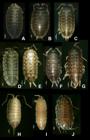
Habitus. A, Porcellio dilatatus (ASM32); B, Porcellio laevis (ASM24); C, Porcellio lamellatus (ASM31); D, Porcellio scaber (ASM38); E, Porcellionides cingendus (OM059); F, Porcellionides pruinosus (ASM18); G, Porcellionides sexfasciatus (ASM03); H, Soteriscus bremondi (OM038); I, Soteriscus disimilis (UN La Laguna-42558); J, Soteriscus stricticauda (INPA-CSIC-42553). Scale bars: A-H, 1 mm; I-J, 0.5 mm.
Porcellio laevis Latreille, 1804
(Fig. 6 B )
Material examined. 2 females (ASM24), Portugal, Azores, São Miguel, Ponta do Escalvado, 37°52’16”N 25°50’28”W, 24 Nov 2023, coll. L.P. Da Silva; 1 male (ASM25a), same data as preceding; 1 female (ASM25b), same data as preceding.
Remarks. Recorded from Europe and North Africa and considered introduced in other parts of the world (Schmalfuss, 2003). It was cited from the Azores (Morelet, 1860; Dollfus, 1889 a , 1889b; Vandel, 1956 a ; Taiti, 2010), Cabo Verde (Dollfus, 1890; 1897; Paulian De Félice, 1938; 1946; Schmalfuss, 1982), Canary Islands (Dollfus, 1889b; 1893; 1898; Koelbel, 1892; Kraepelin, 1895; Ferrer Galdiano, 1923; Arcangeli, 1930; 1958; Paulian De Félice, 1946; Vandel, 1954b; Schmölzer, 1971; Dalens, 1984; Hoese, 1984 a ; 1984b; Rodríguez Santana and Vicente, 1992a ; López and Taiti, 2010) and Madeira (Budde-Lund, 1885; Norman, 1899; Paulian De Félice, 1939b; 1946; Arcangeli, 1958; Vandel, 1960b; Schmölzer, 1971; Hoese, 1978; Taiti, 2010).
Porcellio lamellatus Budde-Lund, 1885
(Fig. 6 C )
Material examined. 1 male (ASM30), Portugal, Azores, São Miguel, Praia de Santa Barbara, 37°49’04”N 25°32’41”W, 24 Nov 2023, coll. L.P. Da Silva; 3 males (ASM31), Portugal, Azores, São Miguel, Praia de Santa Barbara, 37°49’03”N 25°32’45”W, 24 Nov 2023, coll. L.P. Da Silva; 1 female (OM030), Portugal, Madeira Archipelago, Madeira Island, São Vicente, 32°48’32”N 17°02’54”W, 6 Jul 2024, coll. L.P. Da Silva.
Remarks. Reported from the Mediterranean coasts to the Black Sea and the islands of Macaronesia, and considered to be introduced in other parts of the world according to Schmalfuss (2003). It was cited from Azores (Dollfus, 1889 b ; 1889c; Paulian De Félice, 1946; Vandel, 1956 a ; 1968; Schmölzer, 1971; Ashmole et al., 1996; Taiti, 2010), Cabo Verde (Vandel, 1954a; 1956a; Schmalfuss, 1982), Canary Islands (Dollfus, 1893; Arcangeli, 1930; 1958; Paulian De Félice, 1946; Vandel, 1956a; Schmölzer, 1971; Dalens, 1984; Hoese, 1984b ; López and Taiti, 2010; Fernández-Palacios et al., 2018), Madeira (Arcangeli, 1934b; 1958; Vandel, 1956a; 1960b; Schmölzer, 1971; Borges et al., 2008; Taiti, 2010), and from Selvagens Islands (Arcangeli, 1934b; 1958; Vandel, 1956a; Hoese, 1984b).
Porcellio ovalis Dollfus, 1893
Material examined. 1 female (MNCN 20.04/7548), Spain, Canary Islands, Las Palmas.
Remarks. Endemic to the Canary Islands, exclusively known from the island of Gran Canaria (Dollfus, 1893; Arcangeli, 1930; 1958; Paulian De Félice, 1946; Vandel, 1954b ; Schmölzer, 1971; Dalens, 1984; Hoese, 1984b ; 1985; López and Taiti, 2010).
Porcellio scaber Latreille, 1804
(Fig. 6D )
Material examined. 12 females (ASM61), Portugal, Azores, São Miguel, Lagoa das Furnas, 37°45’04”N 25°19’39”W, 3 Jun 2024, coll. L.P. Da Silva; 2 males (ASM72), Portugal, Azores, São Miguel, São Brás, 37°48’16”N 25°24’13”W, 5 Jun 2024, coll. L.P. Da Silva; 1 female (ASM37), Portugal, Azores, São Miguel, Nordeste, 37°49’53”N 25°08’42”W, 1 Jun 2024, coll. L.P. Da Silva; 2 females (ASM38), same data as preceding; 1 male (ASM68), Portugal, Azores, São Miguel, Vale das Lombadas, 37°46’33”N 25°27’36”W, 5 Jun 2024, coll. L.P. Da Silva.
Remarks. This species is widely reported across Europe and has been introduced to other parts of the world (Schmalfuss, 2003). In the Macaronesia region, it has been recorded from Azores, Canary Islands, and Madeira (Dollfus, 1889 b ; 1893; Koelbel, 1892; Arcangeli, 1930; 1958; Paulian De Félice, 1946; Vandel, 1954b ; 1956a; 1968; Schmölzer, 1971; Dalens, 1984; Martín et al., 1985; López and Taiti, 2010; Taiti, 2010).
Porcellio spinipes Dollfus, 1893
Material examined. 2 males (MNCN 20.04/7956), Spain, Canary Islands, La Graciosa, coll. Alluand.
Remarks. Only known from Canary Islands (Dollfus, 1893; Arcangeli, 1930; Paulian De Félice, 1946; Rodríguez Santana and Vicente, 1992 a ; Macias et al., 2004; López and Taiti, 2010; Fernández-Palacios et al., 2018).
Genus Porcellionides Miers, 1878
Porcellionides cingendus ( Kinahan, 1857 )
(Fig. 6 E )
Material examined. 1 female (ASM60), Portugal, Azores, São Miguel, Lagoa das Furnas, 37°44’58”N 25°19’34”W, 3 Jun 2024, coll. L.P. Da Silva; 1 female (ASM62), Portugal, Azores, São Miguel, Lagoa das Furnas, 37°44’03”N 25°19’39”W, 3 Jun 2024, coll. L.P. Da Silva; 5 females (OM059), Portugal, Madeira Archipelago, Madeira Island, Bico da Cana, 32°45’24”N 17°03’33”W, 8 Jul 2024, coll. L.P. Da Silva; 1 male (OM063), Portugal, Madeira Archipelago, Madeira Island, Funchal, 32°41’10”N 16°54’55”W, 10 Jul 2024, coll. L.P. Da Silva; 2 males (OM064a), same data as preceding; 4 females (OM064b), same data as preceding; 1 male (OM065a), same data as preceding; 2 females (OM065b), same data as preceding; 1 male (OM066), same data as preceding; 1 female (OM067), same data as preceding; 1 male (OM010), Portugal, Madeira Archipelago, Madeira Island, Lombo do Moleiro, 32°44’02”N 17°01’15”W, 6 Jul 2024, coll. L.P. Da Silva; 1 female (OM034), Portugal, Madeira Archipelago, Madeira Island, Ribeiro Frio, 32°44’01”N 16°53’16”W, 7 Jul 2024, coll. L.P. Da Silva.
Remarks. According to Vandel (1946), it is a species with an Atlantic distribution, having been reported from Spain, France, England, Ireland, and Portugal (Vandel, 1946; Schmalfuss, 2003; Cifuentes and Da Silva, 2024). It is reported for the first time from the Azores and from Madeira.
Porcellionides pruinosus ( Brandt, 1833 )
(Fig. 6 F )
Material examined. 1 immature (ASM09), Portugal, Azores, São Miguel, Ponta Delgada, 37°44’48”N 25°40’15”W, 23 Nov 2023, coll. L.P. Da Silva; 1 male (ASM010), same data as preceding; 1 male (ASM16), Portugal, Azores, São Miguel, Ponta Delgada, 37°44’38” N 25°40’02”W, 23 Nov 2023, coll. L.P. Da Silva; 1 male (ASM18), Portugal, Azores, São Miguel, Ponta Delgada, 37°44’23”N 25°39’44”W, 23 Nov 2023, coll. L.P. Da Silva; 1 female (OCV21), Cabo Verde, Sal, Murdeira, 16°42’25”N 22°54’16”W, 17 Oct 2023, coll. L.P. Da Silva; 1 male (OCV05a), Cabo Verde, Santiago, Cidade Velha, 14°54’58”N 23°36’16”W, 13 Oct 2023, coll. L.P. Da Silva; 3 males (OCV06a), same data as preceding; 1 female (OCV06b), same data as preceding; 2 females (OCV16), Cabo Verde, Santiago, São Jorge dos Orgãos, 15°02’54”N 23°36’02”W, 16 Oct 2023, coll. L.P. Da Silva; 1 male (OCV18), Cabo Verde, Santiago, São Jorge dos Orgãos, 15°02’56”N 23°36’04”W, 16 Oct 2023, coll. L.P. Da Silva; 2 females (OCV30), Cabo Verde, Santiago, Tarrafal, 15°16’50”N 23°45’08”W, 20 Oct 2023, coll. L.P. Da Silva; 1 female (MNCN 20.04/12196), Spain, Canary Islands, La Palma, El Paso, 25 Sep 1999, coll. T. Domingo-Quero; 1 female (MNCN 20.04/12195), Spain, Canary Islands, La Palma, El Paso, 9 Feb 2000, coll. T. Domingo-Quero; 6 females (MNCN 20.04/12174), Spain, Canary Islands, La Palma, El Paso, 26 Jun 2001, coll. T. Domingo-Quero; 2 males, 1 female (MNCN 20.04/12162), Spain, Canary Islands, La Palma, El Paso, 19 Oct 2000, coll. T. Domingo-Quero; 1 female (MNCN 20.04/12188), Spain, Canary Islands, La Palma, El Paso, 22 Jan 2001, coll. T. Domingo-Quero; 2 females (MNCN 20.04/12175), Spain, Canary Islands, La Palma, El Paso, 23 Mar 2001, coll. T. Domingo-Quero; 1 female (MNCN 20.04/12183), same data as preceding; 1 female (MNCN 20.04/12178), Spain, Canary Islands, La Palma, El Paso, 23 Mar 2001, coll. A. Sánchez-Ruiz; 1 female (MNCN 20.04/12206), Spain, Canary Islands, La Palma, El Paso, 26 Mar 2001, coll. A. Sánchez-Ruiz and T. Domingo-Quero; 1 female (MNCN 20.04/12180), same data as preceding; 1 female (MNCN 20.04/12199), Spain, Canary Islands, La Palma, El Paso, 26 Mar 2001, coll. A. Sánchez-Ruiz; 1 specimen (MNCN 20.04/12192), Spain, Canary Islands, La Palma, El Paso, 30 Mar 2001, coll. A. Sánchez-Ruiz; 1 male (MNCN 20.04/12204), Spain, Canary Islands, La Palma, El Paso, 1 May 2000, coll. T. Domingo-Quero; 2 females (MNCN 20.04/12166), same data as preceding; 1 female (MNCN 20.04/12182), Spain, Canary Islands, La Palma, El Paso, 21 Jun 2001, coll. T. Domingo-Quero; 1 female (MNCN 20.04/12172), Spain, Canary Islands, La Palma, Los Arenales, 22 Feb 2000, coll. Rafael G.B.; 1 male (OM007), Portugal, Madeira Archipelago, Madeira Island, Marine Biological Station, 32°38’12”N 16°56’08”W, 5 Jul 2024, coll. L.P. Da Silva; 1 female (OM029), Portugal, Madeira Archipelago, Madeira Island, São Vicente, 32°48’31”N 17°02’52”W, 6 Jul 2024, coll. L.P. Da Silva.
Remarks. Species of Mediterranean origin, considered to be introduced in other parts of the world (Schmalfuss, 2003). It was cited from Azores (Dollfus, 1889 a ; 1889b; Paulian De Félice, 1946; Vandel, 1956 a ; Schmölzer, 1971; Ashmole et al., 1996; Taiti, 2010), Cabo Verde (Dollfus, 1897; 1899; Paulian De Félice, 1946; Schmalfuss, 1982), Canary Islands (Dollfus, 1898; 1893; 1898; Ferrer Galdiano, 1923; Arcangeli, 1930; 1958; Paulian De Félice, 1946; Vandel, 1954b; Schmölzer, 1971; Dalens, 1984; Hoese, 1984 b ; Cruz, 1991; López and Taiti, 2010), and Madeira (Paulian De Félice, 1939b; 1946; Arcangeli, 1958; Vandel, 1960b; Schmölzer, 1971; Hoese, 1978; Taiti, 2010).
Porcellionides sexfasciatus ( Budde-Lund, 1885 )
(Fig. 6 G )
Material examined. 1 female (ASM02), Portugal, Azores, São Miguel, Ponta Delgada, 37°44’42”N 25°41’59”W, 23 Nov 2023, coll. L.P. Da Silva; 2 males (ASM03), same data as preceding; 1 female (ASM05), same data as preceding; 1 female (ASM19), Portugal, Azores, São Miguel, Relva, 37°45’33”N 25°43’39”W, 24 Nov 2023, coll. L.P. Da Silva; 2 females (MNCN 20.04/12168), Spain, Canary Islands, La Palma, El Paso, 27 Mar 2001, coll. A. Sánchez-Ruiz and T. Domingo-Quero; 1 male (OM003), Portugal, Madeira Archipelago, Madeira Island, Funchal, 32°38’17”N 16°56’02”W, 5 Jul 2024, coll. L.P. Da Silva; 1 male (OM068), Portugal, Madeira Archipelago, Madeira Island, Funchal, 32°40’32”N 16°55’07”W, 10 Jul 2024, coll. L.P. Da Silva.
Remarks. Species of Mediterranean origin introduced in other parts of the world (Schmalfuss, 2003). It was cited from Azores (Dollfus, 1889 a ; Paulian De Félice, 1946; Vandel, 1956 a ; 1968; Schmölzer, 1971), Cabo Verde (Paulian De Félice, 1946; Schmalfuss, 1982), Canary Islands (Dollfus, 1893; 1898; Ferrer Galdiano, 1923; Arcangeli, 1930; 1934b; 1958; Paulian De Félice, 1946; Vandel, 1954b; Schmölzer, 1971; Dalens, 1984; Hoese, 1984 b ; Martín et al., 1985; Rodríguez Santana, 1996; López and Taiti, 2010), Madeira (Budde-Lund, 1885; Norman, 1899; Paulian De Félice, 1946; Arcangeli, 1958; Vandel, 1960b; Schmölzer, 1971; Hoese, 1978; Taiti 2010; Hughes, 2024), and Selvagens Islands (Arcangeli, 1934b; 1958).
Genus Soteriscus Taiti and Rossano, 2015
Soteriscus bremondi ( Vandel, 1960 b )
(Fig. 6 H )
Material examined. 1 female (OM038), Portugal, Madeira Archipelago, Madeira Island, Furnas do Cavalum, 32°43’57”N 16°47’01”W, 7 Jul 2024, coll. L.P. Da Silva.
Remarks. Species endemic of Madeira, previously known only from Caldeirão Verde (Vandel, 1960 b ) and Furnas do Cavalum (Hughes, 2024).
Soteriscus disimilis ( Rodríguez Santana, 1990 )
(Fig. 6 I )
Material examined. 3 males and 1 female (UN La Laguna-42558), Spain, Canary Islands, Lanzarote, Haría, Bco. Elvira Sánchez, 28 Nov 2005, GIET leg., R. Orihuela-Rivero det.
Remarks. Species endemic to the Canary Islands, where it has been reported from Fuerteventura, Lanzarote, and Lobos (Rodríguez Santana, 1990; López and Taiti, 2010; Fernández-Palacios et al., 2018).
Soteriscus stricticauda ( Dollfus, 1893 )
(Fig. 6 J )
Material examined. 1 male (INPA-CSIC-42553), Spain, Canary Islands, El Hierro, Frontera, 23 June 2011, P. Oromí leg., R. Orihuela-Rivero det.
Remarks. Species reported from El Hierro, Gran Canaria, La Gomera, La Palma, and Tenerife in the Canary Islands (Dollfus, 1893; 1898; Vandel, 1954 b ; Arcangeli, 1930; 1958; Paulian De Félice, 1946; Schmölzer, 1971; Dalens, 1984; Hoese, 1984b ; Arndt and Mattern, 2005; López and Taiti, 2010), and from Santa Luzia in Madeira (Arcangeli, 1958).
Soteriscus caboverdiensis Cifuentes and Da Silva n. sp.
Zoobank: urn:lsid:zoobank.org:act:751D0436-323B-4757-9930-9182760D2233
Type material. Holotype: Male (MNCN 20.04/21277 [ex. OCV01b]), Cabo Verde, Santiago, Praia, 14°54’09”N 23°31’06”W, 13 Oct 2023, coll. L.P. Da Silva. - Paratypes: 1 female (OCV05b), Cabo Verde, Santiago, Cidade Velha, 14°54’58”N 23°36’16”W, 13 Oct 2023, coll. L.P. Da Silva; 2 males (OCV12a), Cabo Verde, Santiago, Cidade Velha, 14°54’52”N 23°36’17”W, 14 Oct 2023, coll. L.P. Da Silva; 1 male (MNCN 20.04/21279 [ex. OCV12a]), same data as preceding; 2 females (OCV12b), same data as preceding; 1 female (MNCN 20.04/21279 [ex. OCV12b]), same data as preceding; 1 male (OCV01a), same data as holotype; 2 males (OCV01b), same data as holotype; 1 male (JC1192 [ex. OCV01b]), same data as holotype; 6 females (OCV01c), same data as holotype; 1 female (MNCN 20.04/21278 [ex. OCV01c]), same data as holotype; JC1193 [ex. OCV01c]), same data as holotype; 3 males (OCV13a), Cabo Verde, Santiago, Praia, 14°54’23”N 23°31’32”W, 15 Oct 2023, coll. L.P. Da Silva; 2 females (OCV13b), same data as preceding; 1 female (OCV17), Cabo Verde, Santiago, São Jorge dos Orgãos, 15°02’54”N 23°36’01”W, 16 Oct 2023, coll. L.P. Da Silva; 1 female (OCV28), Cabo Verde, Santiago, Tarrafal, 15°16’49”N 23°45’11”W, 20 Oct 2023, coll. L.P. Da Silva; 3 females (OCV29), Cabo Verde, Santiago, Tarrafal, 15°16’50”N 23°45’09”W, 20 Oct 2023, coll. L.P. Da Silva; 4 females (OCV07), Cabo Verde, Santiago, Veneza, São Domingos, 14°59’08”N 23°32’02”W, 13 Oct 2023, coll. L.P. Da Silva; 3 females (OCV09), same data as preceding.
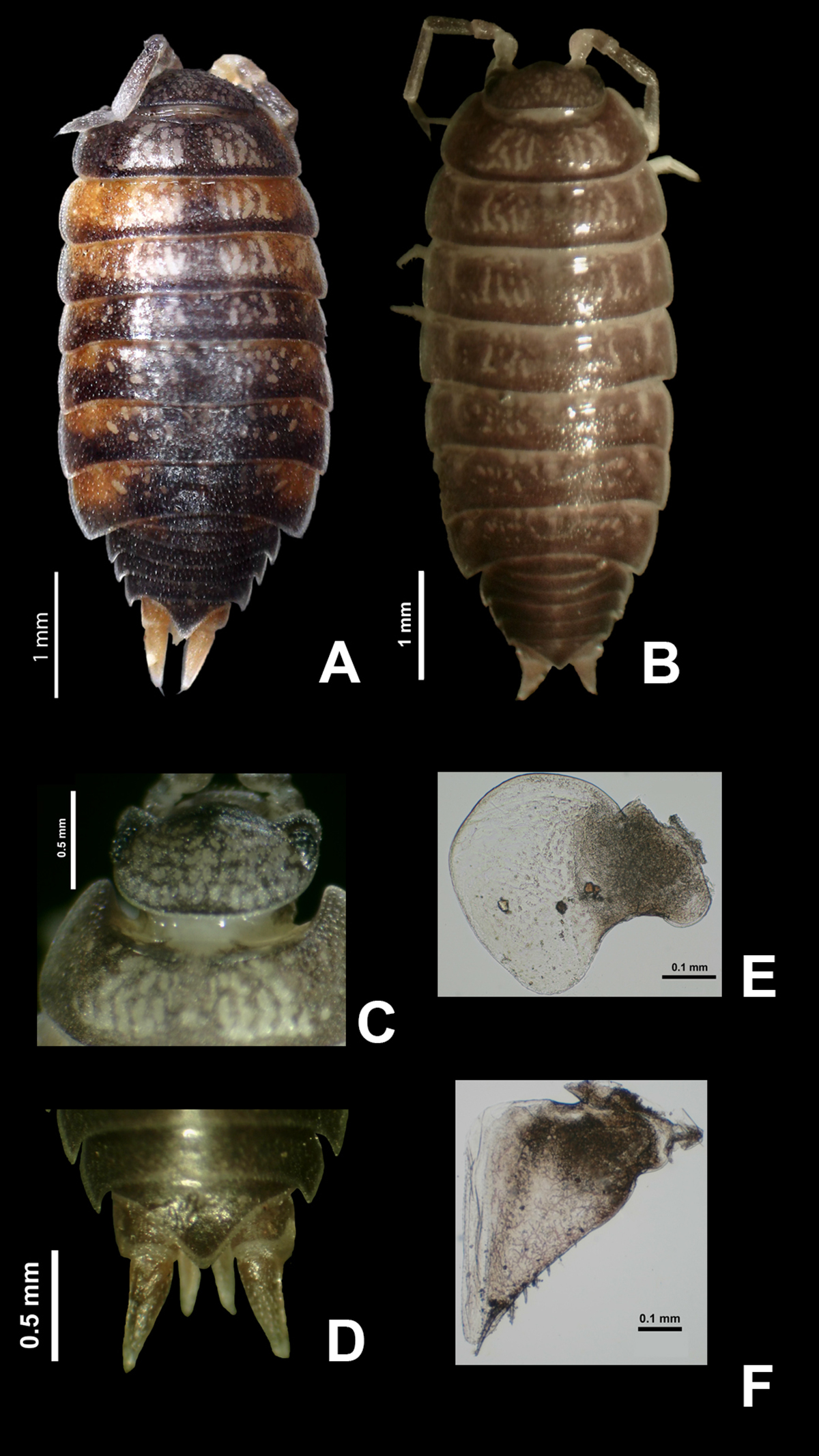
Diagnosis. Marked sexual dichromatism. Smooth body without scales. Very reduced glandular fields. Cephalon without supra-antennal line, small middle and lateral lobes. Pereon with posterior edge of tergites I to III rounded. Pleon retracted in relation to pereon. Very short telson barely surpassing uropod basipods. Uropods with endopods much longer than telson and short, conical exopods. In males, pereopods I to III with brush-like setae on merus and carpus; pereopod VII without special characters; exopod of pleopod I with triangular posterior-internal tip with rounded end.
Description. Maximum observed size: female: 7.5 mm, 8 mm including uropods. Male: 5 mm, 5.8 mm including uropods.
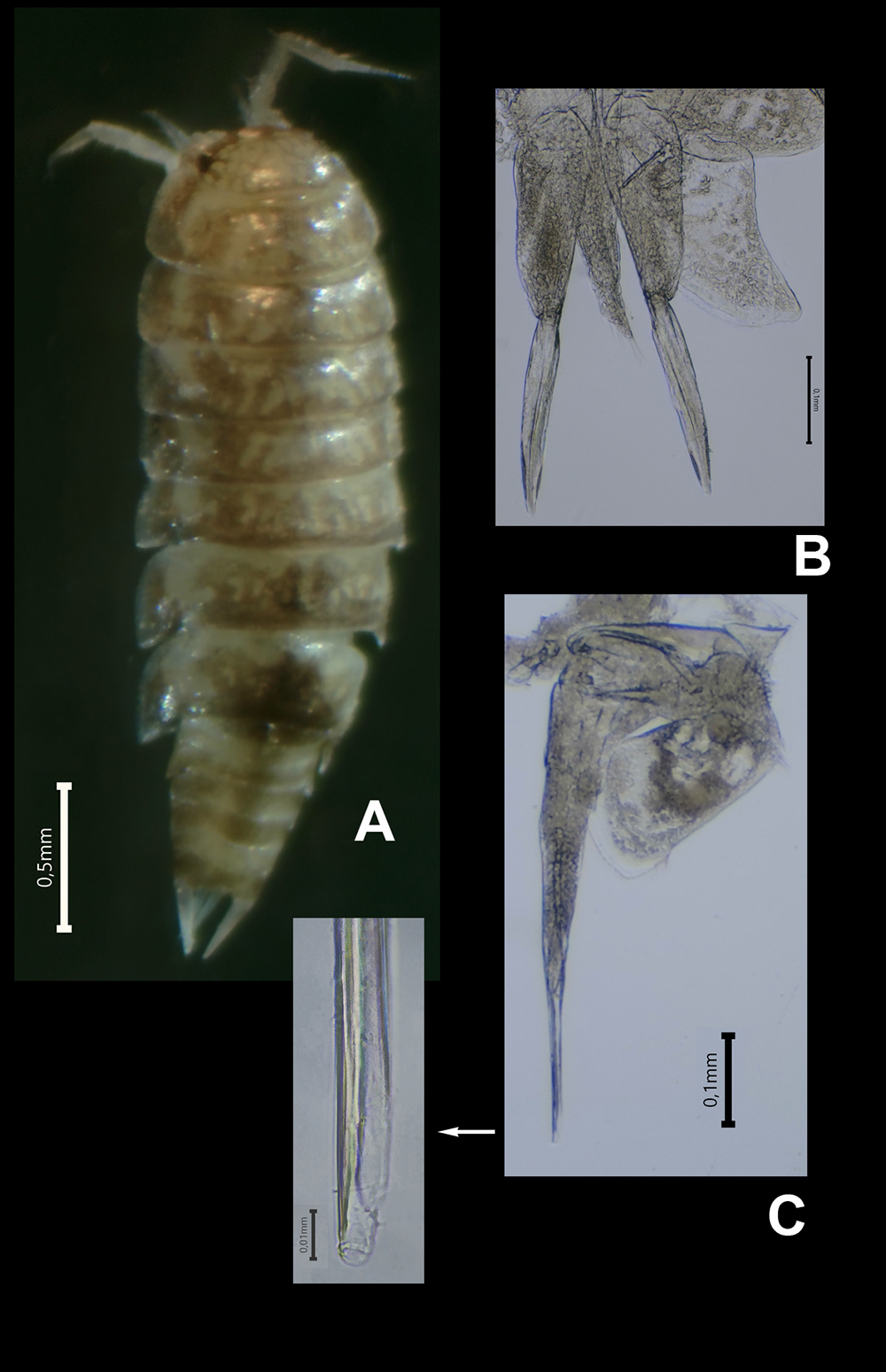
Coloration: Specimens with very marked sexual dichromatism. Males (Fig. 7 A ) brown with large areas of light yellowish-brown on pereon, with very pronounced muscle insertions; cephalon and pleon darker, telson, uropods, and antennae yellowish. Females (Fig. 7 B ) dark brownish-purple, with very pronounced muscle insertions; white-yellowish first two segments of the antennae, other segments brownish-purple, fifth segment tip depigmented; light uropods.
Integumentary characters: Smooth body, without granulations or small cuticular scales, but with overlapping scales (Fig. 7 A, B ). Highly reduced glandular fields, two glandular pores on pereonite I near anterior angle, and three or four scattered pores in glandular fields of remaining pereonites within lateral groove. No tergal glandular pores present. Triangular setae-scales (Fig. 8 A ), with wide central branch. Noduli laterales in small depigmented areas; on first pereonites, located in middle area and near lateral edge, shifting posteriorly on other pereonites but still very close to lateral edge, as in Fig. 8 B .
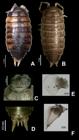
Soteriscus caboverdiensis Cifuentes and Da Silva n. sp. A, Habitus, male (OCV01b); B, habitus, female (OCV12b); C, cephalon (OCV28); D, telson and uropods (OCV12b); E, male exopod of pleopod I (OCV01a); F, male exopod of pleopod II (OCV01a). Scale bars: A-B, 1 mm; C-D, 0.5 mm; E-F, 0.01 mm.
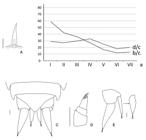
Soteriscus caboverdiensis Cifuentes and Da Silva n. sp. A, Scale-setae (OCV05b); B, noduli laterales (OCV01a); C, telson and uropods (OCV12b); D, Antennula (OCV28); E, Uropods, bottom view (OCV09). Scale bars: A, 0.01 mm; C, 0.5 mm; D-E, 0.1 mm.
Somatic characters: Ocular apparatus formed by 12 ommatidia. Cephalon (Fig. 7 C, D ) lacks supra-antennal line; middle lobe small and rounded-triangular; lateral lobes small. Pereon (Fig. 7 A, B ) with posterior edge rounded from pereonite I to III, from pereonite IV to VII with small posterior-lateral tip; pleuroepimera with narrow lateral groove; tergites without transverse impression. Pleon retracted in relation to pereon (Fig. 7 A, B ). Telson (Figs. 7A, B, D; 8C) very short, barely surpassing uropod basipods, with almost non-existent base, separated from tip by slightly convex sides, very wide and triangular tip.
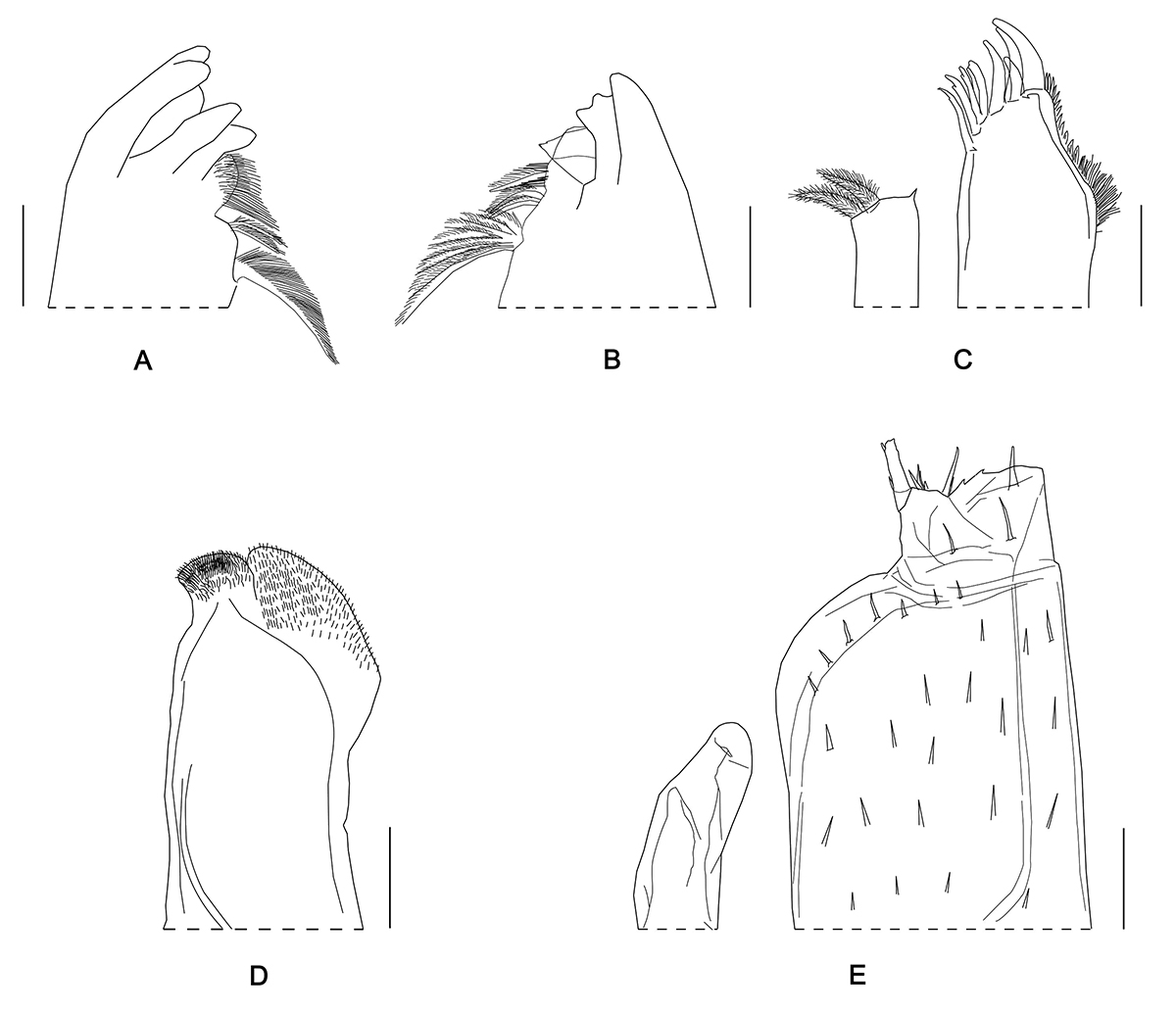
Appendages: Antennula (Fig. 8 D ) with three segments, second very short, third with 8 small aesthetascs at tip. Short antennae (Fig. 7 A, B ) barely surpassing pereonite II posterior edge. Uropods (Figs. 7A, B, D; 8C, E) with posterior edge of basipods straight and transverse; endopods much longer than telson, oval-shaped and flattened; short and conical exopods in both sexes. Mandibles (Fig. 9 A, B ) with molar penicil dichotomized; left mandible with 2 free penicils, right mandible, with 1+2 free penicils. Maxillule (Fig. 9 C ) with 9 teeth on outer ramus, two short and thick penicils on inner ramus. Maxilla (Fig. 9 D ) bilobed with setae at tip. Maxilliped as in Fig. 9 E .
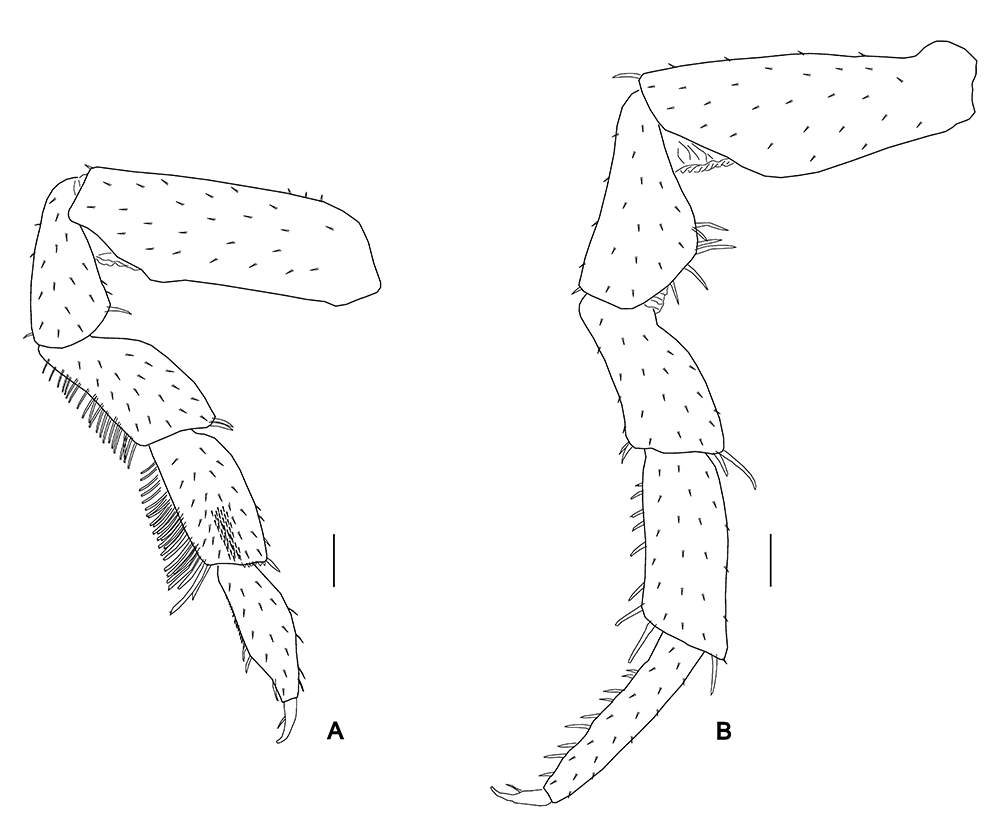
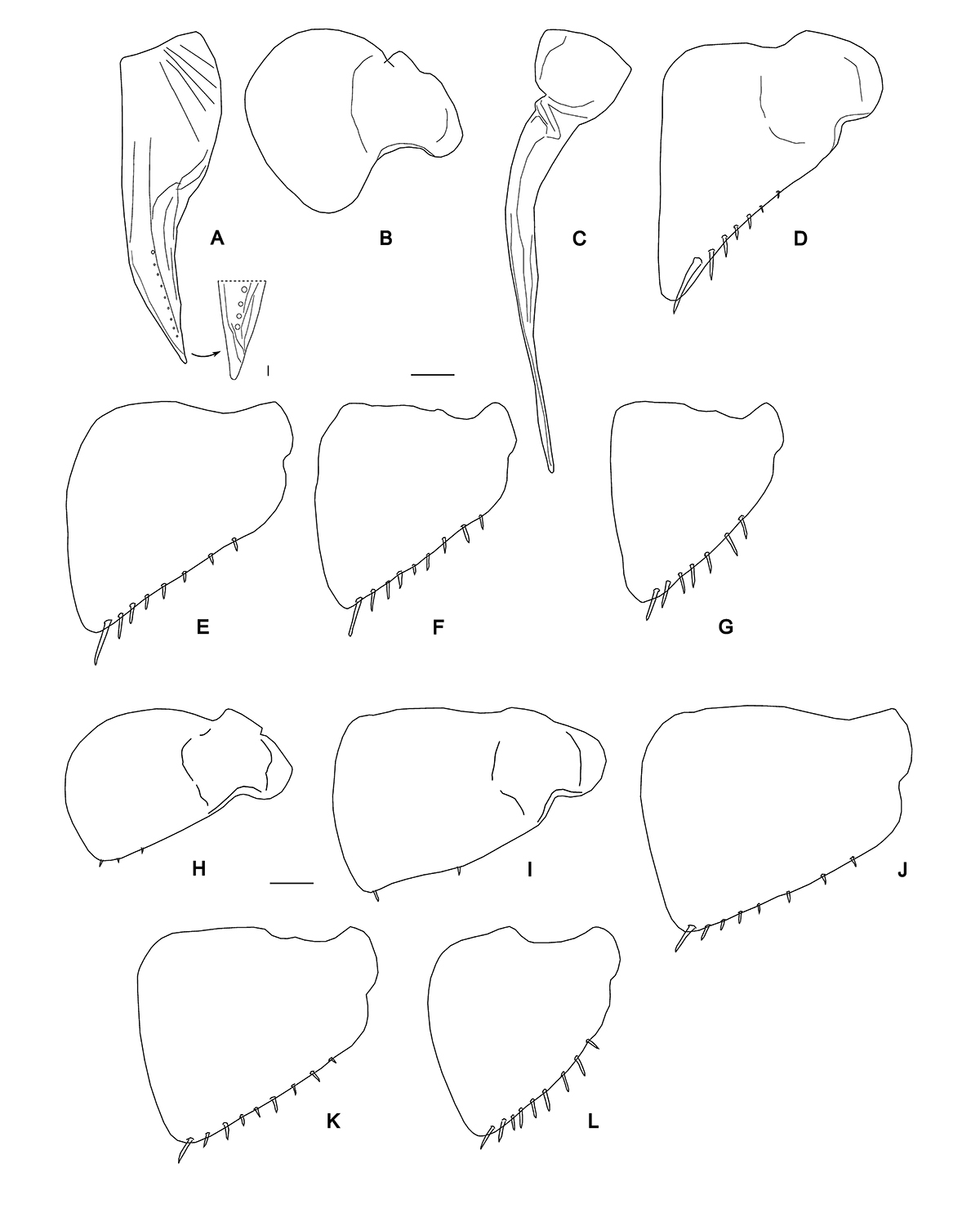
Sexual characters: Very marked sexual dichromatism. Male pereopods I to III (Fig. 10 A ) with setae brushes on merus and carpus, denser on carpus, decreasing density from pereopod I to III. Pereopod VII (Fig. 10 B ) lacks distinctive characters. Male pleopod I (Fig. 11 A, B ) with slightly outward-curved endopod; exopod wider than long, triangular posterior-internal tip with rounded tip and concave tracheal field. Male pleopod II (Fig. 11C, D) with endopod slightly longer than exopod; exopod triangular, with indentation, similar to exopods III to V (Fig. 11 E-G ), and those of the female (Fig. 11 H-L ).
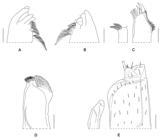
Soteriscus caboverdiensis Cifuentes and Da Silva n. sp. (OCV01c). A, Left mandible; B, right mandible; C, maxillule; D, maxilla; E, Maxilliped. Scale bars: A-E, 0.1 mm.
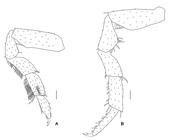
Soteriscus caboverdiensis Cifuentes and Da Silva n. sp. (OCV01a). A, Male pereopod I; B, male pereopod VII. Scale bars: A-B, 0.1 mm.
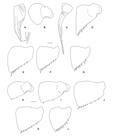
Soteriscus caboverdiensis Cifuentes and Da Silva n. sp., male (OCV01a). A, Endopod of pleopod I; B, exopod of pleopod I; C, endopod of pleopod II; D, exopod of pleopod II; E, exopod of pleopod III; F, exopod of pleopod IV; G, exopod of pleopod V. Soteriscus caboverdiensis Cifuentes and Da Silva n. sp., female (OCV05b). H, Exopod of pleopod I; I, exopod of pleopod II; J, exopod of pleopod III; K, exopod of pleopod IV; L, exopod of pleopod V. Scale bars: A-L, 0.1 mm.
Etymology. The specific epithet refers to the archipelago, Cabo Verde, where the species was discovered.
Ecology. Soteriscus caboverdiensis n. sp. is an epigean species. It was found across Santiago Island, extending from beaches to the central mountain region. The species was discovered beneath rocks across various habitats, including agricultural fields, urbanized areas, and natural landscapes.
Remarks.Vandel (1956 b ) established the subgenus Soteriscus within the genus MetoponorthusBudde-Lund, 1879 for his species Metoponorthus (Soteriscus) gaditanusVandel, 1956b. Currently, the genus Metoponorthus is considered a synonym of Porcellionides (see Schmalfuss, 2003; Boyko et al., 2025). Vandel and Matsakis (1959) considered it appropriate to elevate Soteriscus to the genus level, which was adopted in later publications by Vandel (1960b) and Schmalfuss (2003). Taiti and Rossano (2015) pointed out that Vandel and Matsakis (1959) or later publications had not formally designated a type species for the genus, so they designated Metoponorthus (Soteriscus) gaditanus as the type species and established the genus SoteriscusTaiti and Rossano, 2015. The species described by Vandel is now referred to as Soteriscus gaditanus (Vandel, 1956b).
Vandel (1956 b ; 1960) defined the genus with the following characteristics: generally smooth and shiny integuments with overlapping scales but no pruinosity or small scales; large, prominent lateral noduli arranged in two groups, pereonites I to IV and V to VII; pleuroepimera with or without a lateral groove delimiting the glandular field; pleuroepimeral and tergal glandular pores present or absent depending on the species; cephalon with a straight frontal line and no median lobe; lateral lobes small or very small, not projecting forward except in Soteriscus porcellioniformis (Vandel, 1960), supra-antennal line is well visible, faint, or absent depending on species; pereonites without a transverse impression; pleon weakly retracted or not in relation to the pereon; well-developed neopleurons; triangular telson with a short tip and curved sides; long or fusiform uropods depending on species; and in males, anterior pereopods have a carpal brush in most species.
Soteriscus caboverdiensis n. sp. has most of these characters, except the cephalon median line forms a small protrusion or rounded triangular median lobe. This is broadly rounded in So. bremondi and Soteriscus jandiensisCifuentes and Prieto, 2023, less pronounced in So. disimilis and So. stricticauda (Dollfus, 1893), and very small in Soteriscus fuscovariegatus (Lucas, 1849). The species also has small lateral lobes that do not extend beyond the median lobe, whereas in So. fuscovariegatus and So. porcellioniformis these lobes are more developed. Another distinguishing trait is the shape and length of the uropod exopods, which are shorter than in other species of the genus, except possibly So. fuscovariegatus and Soteriscus mateui (Vandel, 1957 a ). However, this may be due to the small size of the specimens studied. Based on these characteristics, we consider So. caboverdiensis n. sp. to belong within the genus Soteriscus. This genus comprises 18 species (Cifuentes and Prieto, 2023; Boyko et al., 2025), which can be divided into three groups based on various morphological criteria (Vandel, 1960b). Although these traits have proven useful for species comparison, without phylogenetic analyses, this classification remains hypothetical and should be interpreted cautiously. One of these three groups is the North African group, with five species characterized by a large number of pores in the glandular fields on pleuroepimera, an elongated exopod of the uropod, and the male exopod of pleopod I with a very elongated inner tip, except in Soteriscus virescens (Budde-Lund, 1885). This group includes So. fuscovariegatus from Algeria (Lucas, 1849; Verhoeff, 1917, 1918), and Spain (Ceuta) (Schmölzer, 1971), So. gaditanus (Vandel, 1956b), from Spain, particularly the province of Cádiz (Vandel, 1956b; Garcia and Rojas, 2021) and Ceuta (Schmölzer, 1971), and from Morocco (Vandel, 1956b; Schmölzer, 1971; Achouri et al., 2008 a ; 2008b), Soteriscus gibbosusTaiti and Rossano, 2015, Soteriscus laouensis Taiti and Rossano, 2015, and So. virescens, which are only known from Morocco (Budde-Lund, 1885; Taiti and Rossano, 2015). Another group, with another five species, is the Madeiran group, characterized by their representatives lacking glandular fields or pores, an elongated exopod of the uropod, and the male exopod of pleopod I with a triangular posterior-internal tip and a laterally situated tracheal field. The species in this group are So. bremondi, Soteriscus fructuosi (Vandel, 1960b), So. porcellioniformis, Soteriscus relictus (Vandel, 1960b), and Soteriscus wollastoni (Paulian de Félice, 1939b), all from the Madeira archipelago (Paulian De Félice, 1939 b ; 1946; Arcangeli, 1958; Vandel, 1960b; Schmölzer, 1971; Borges et al., 2008; Hughes, 2024). The last group is the Atlantic group, with the remaining eight species. They are distinguished by a reduced number of pores in the glandular fields on the pleuroepimera, an elongated exopod of the uropod, except in So. mateui, and a broadly rounded posterior-internal tip on the male exopod of pleopod I. This group has three species present in Madeira: Soteriscus brumdocantoi (Vandel, 1960b), Soteriscus desertarum (Vandel, 1960b), and Soteriscus madeirae (Arcangeli, 1958), which is also present in Morocco (Arcangeli, 1958; Vandel, 1960b; Schmölzer, 1971). There are four species from the Canary Islands: So. disimilis, So. stricticauda, Soteriscus trilineatus (Rodríguez and Vicente, 1992), and S. jandiensis (see Dollfus, 1893; Paulian De Félice, 1946; Vandel, 1954b; Schmölzer, 1971; Rodríguez Santana, 1990; Rodríguez Santana and Vicente, 1992b; Cifuentes and Prieto, 2023). Finally, So. mateui is only known from the Cabo Verde archipelago (Vandel, 1957a; see also Cifuentes and Prieto, 2023).
The new species described in this work, So. caboverdiensis n. sp., belongs to the Atlantic group. Within this group, three species, So. brumdocantoi, So. desertarum, and So. madeirae have an indentation in the tracheal field on the male exopod of pleopod I, which is absent in the rest of the group, including the new species. In four species, the exopod of the uropod is elongated, and the male exopod of pleopod I lacks a posterior-internal tip, as in So. disimilis, or is very small as in So. stricticauda, So. trilineatus, and So. jandiensis. However, in So. caboverdiensis n. sp. the exopod of the uropod is small, and the male exopod of pleopod I presents a large posterior-internal tip. Finally, in So. mateui, the exopod of the uropod is short, the male exopod of pleopod I has a poorly developed and truncated posterior-internal tip, it lacks lateral lobes on the cephalon, and the tergites exhibit numerous glandular pores among the setae-scales. In So. caboverdiensis n. sp., the male exopod of pleopod I has a large and triangular posterior-internal tip, the lateral lobes of the cephalon are small but clearly visible, and the tergites lack glandular pores among the setae-scales.
Family Rhyscotidae Budde-Lund, 1904
Genus Rhyscotoides Schmalfuss and Ferrara, 1978
Rhyscotoides silvestrii Arcangeli, 1949
(Fig. 12 A )
Material examined. 2 males (OCV11a), Cabo Verde, Santiago, Cidade Velha, 14°54’50”N 23°35’42”W,14 Oct 2023, coll. L.P. Da Silva; 1 male (JC977 [ex. OCV11a]), same data as preceding; 2 females (OCV11b), same data as preceding.
Remarks. Known from Angola, Senegal, and Zaire according to Schmalfuss (2003), and from Cabo Verde (Schmalfuss, 1982).
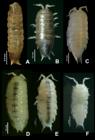
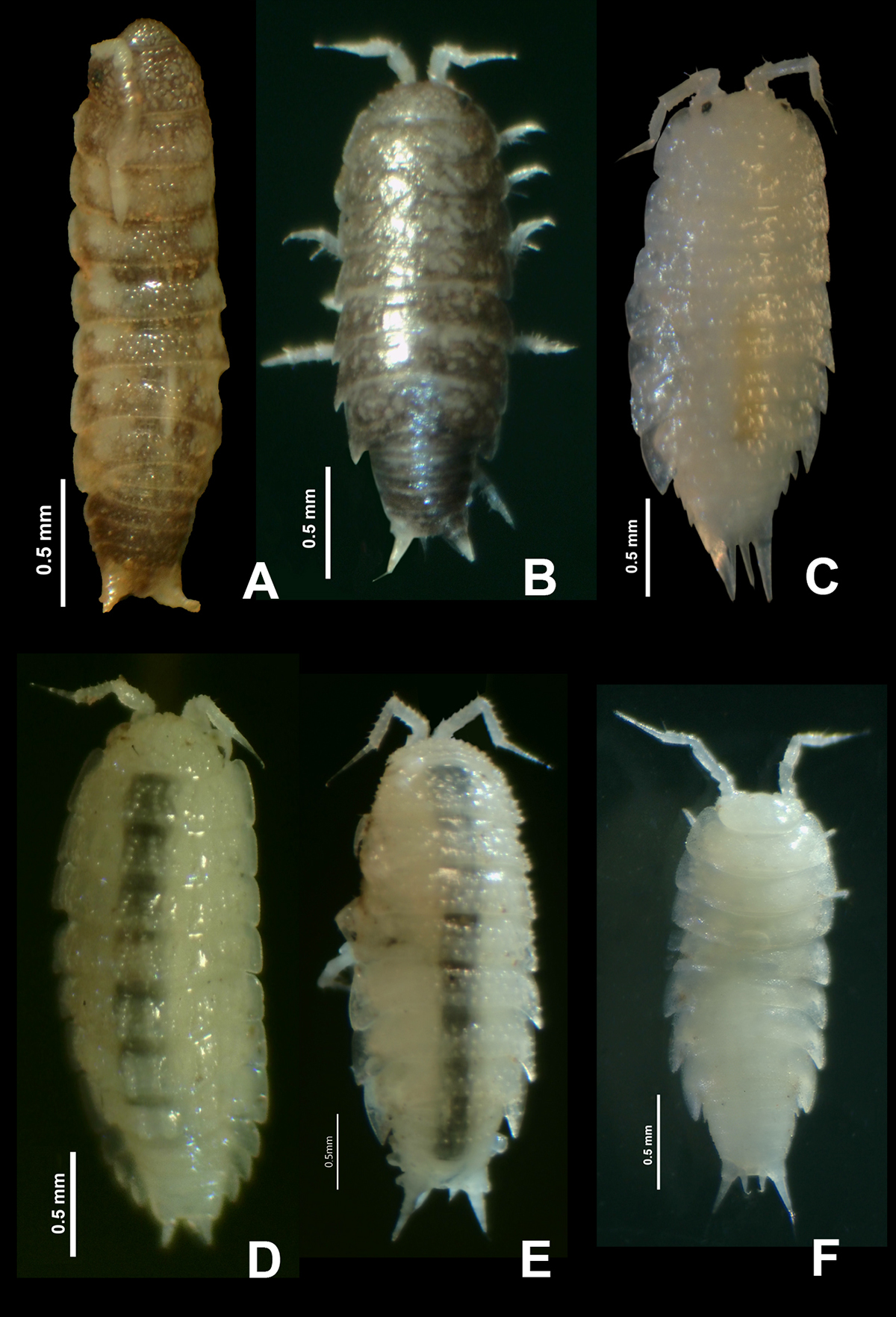
Habitus: A, Rhyscotoides silvestrii (OCV11a); B, Styloniscus spinosus (OM017); C. Androniscus dentiger (ASM34); D, Haplophthalmus danicus (ASM26b); E, Miktoniscus arcangelii (OM039b); F, Trichoniscus bassoti (OM039a). Scale bars: A-F, 0.5 mm.
Family Styloniscidae Vandel, 1952
Genus Styloniscus Dana, 1853
Styloniscus spinosus ( Patience, 1907 )
(Fig. 12 B )
Material examined. 1 female (ASM51), Portugal, Azores, São Miguel, Água Retorta, 37°47’24”N 25°09’25”W, 3 Jun 2024, coll. L.P. Da Silva; 1 female (ASM55f), Portugal, Azores, São Miguel, Faial da Terra, 37°45’04”N 25°12’09”W, 3 Jun 2024, coll. L.P. Da Silva; 1 male (ASM49a), Portugal, Azores, São Miguel, Jardim Botânico da Ribeira do Guilherme, 37°50’02”N 25°09’21”W, 3 Jun 2024, coll. L.P. Da Silva; 2 females (ASM49b), same data as preceding; 2 males (ASM69a), Portugal, Azores, São Miguel, Lagoa de São Brás, 37°47’36”N 25°24’43”W, 5 Jun 2024, coll. L.P. Da Silva; 1 female (ASM69b), same data as preceding; 1 female (ASM70), same data as preceding; 1 female (ASM71), same data as preceding; 1 male (ASM21a), Portugal, Azores, São Miguel, Lagoa do Canario, 37°50’07”N 25°45’30”W, 24 Nov 2023, coll. L.P. Da Silva; 2 females (ASM21b), same data as preceding; 2 females (ASM20), Portugal, Azores, São Miguel, Lagoa do Carvão, 37°49’24”N 25°44’28”W, 24 Nov 2023, coll. L.P. Da Silva; 4 females, 7 immatures (ASM64), Portugal, Azores, São Miguel, Lagoa do Congro, 37°45’19”N 25°24’31”W, 4 Jun 2024, coll. L.P. Da Silva; 1 male (ASM40a), Portugal, Azores, São Miguel, Piscina Natural da Boca de Ribeira, 37°50’41”N 25°08’50”W, 2 Jun 2024, coll. L.P. Da Silva; 1 male (JC1200 [ex. ASM40a]), same data as preceding; 3 females, 1 immature (ASM40b), same data as preceding; 1 female (ASM50), Portugal, Azores, São Miguel, Piscina Natural da Boca de Ribeira, 37°50’37”N 25°08’52”W, 3 Jun 2024, coll. L.P. Da Silva; 1 male (ASM46a), Portugal, Azores, São Miguel, Santo António de Nordestinho, 37°51’00”N 25°12’23”W, 2 Jun 2024, coll. L.P. Da Silva; 1 female (ASM46b), same data as preceding; 1 female (ASM47), same data as preceding; 5 females (ASM58), Portugal, Azores, São Miguel, Ribeira Quente, 37°45’06”N 25°18’24”W, 3 Jun 2024, coll. L.P. Da Silva; 1 female (OM046), Portugal, Madeira Archipelago, Madeira Island, Bico da Cana, 32°45’12”N 17°03’03”W, 8 Jul 2024, coll. L.P. Da Silva; 1 female (OM047), Portugal, Madeira Archipelago, Madeira Island, Bico da Cana, 32°45’17”N 17°03’09”W, 8 Jul 2024, coll. L.P. Da Silva; 5 females (OM048), Portugal, Madeira Archipelago, Madeira Island, Bico da Cana, 32°45’17”N 17°03’10”W, 8 Jul 2024, coll. L.P. Da Silva; 1 female (OM051), Portugal, Madeira Archipelago, Madeira Island, Bico da Cana, 32°45’19”N 17°03’12”W, 8 Jul 2024, coll. L.P. Da Silva; 1 female (OM055), Portugal, Madeira Archipelago, Madeira Island, Bico da Cana, 32°45’21”N 17°03’12”W, 8 Jul 2024, coll. L.P. Da Silva; 2 females (OM058), Portugal, Madeira Archipelago, Madeira Island, Bico da Cana, 32°45’38”N 17°03’28”W, 8 Jul 2024, coll. L.P. Da Silva; 1 male (OM069a), Portugal, Madeira Archipelago, Madeira Island, Caminho dos Lamaceiros, 32°44’27”N 16°50’19”W, 10 Jul 2024, coll. L.P. Da Silva; 2 female (OM069b), same data as preceding; 1 female (OM072), same data as preceding; 1 female (OM011), Portugal, Madeira Archipelago, Madeira Island, Lombo do Moleiro, 32°44’02”N 17°01’15”W, 6 Jul 2024, coll. L.P. Da Silva; 1 female (OM012), same data as preceding; 1 female (OM013), same data as preceding; 2 female, 5 immatures (OM016), same data as preceding; 1 female (OM017), same data as preceding; 3 females (OM018), same data as preceding; 14 females (OM074a), Portugal, Madeira Archipelago, Madeira Island, Posto Florestal dos Lamaceiros, 32°44’28”N 16°50’41”W, 10 Jul 2024, coll. L.P. Da Silva; 1 male (OM074b), same data as preceding; 1 female (OM075), Portugal, Madeira Archipelago, Madeira Island, Posto Florestal dos Lamaceiros, 32°44’23”N 16°50’50”W, 10 Jul 2024, coll. L.P. Da Silva; 7 females (OM077), Portugal, Madeira Archipelago, Madeira Island, Posto Florestal dos Lamaceiros, 32°44’22”N 16°50’50”W, 10 Jul 2024, coll. L.P. Da Silva; 3 females (OM078), Portugal, Madeira Archipelago, Madeira Island, Posto Florestal dos Lamaceiros, 32°44’23”N 16°50’50”W, 10 Jul 2024, coll. L.P. Da Silva.
Remarks. Described by Patience (1907) from a greenhouse in Glasgow (Scotland), and is currently known from Brazil, Great Britain (greenhouses), Hawaii, Madagascar, Mauritius, mainland Portugal, and La Réunion (Vandel, 1952; Edney, 1953; Ferrara and Taiti, 1979; Taiti and Howarth, 1996; Schmalfuss, 2003; Campos-Filho et al., 2017; Cifuentes et al., 2025). It is recorded for the first time from the Azores and Madeira.
Family Trichoniscidae Sars, 1899
Genus Androniscus Verhoeff, 1908 c
Androniscus dentigerVerhoeff, 1908c
(Fig. 12 C )
Material examined. 1 male (ASM34), Portugal, Azores, São Miguel, Gruta do Carvão, 37°44’53”N 25°41’14”W, 1 Jun 2024, coll. L.P. Da Silva; 1 female (ASM35), same data as preceding; 1 male (ASM36a), same data as preceding; 1 female (ASM36b), same data as preceding.
Remarks. It is found in Europe and North Africa and has been introduced to other parts of the world (Schmalfuss, 2003). Within the Macaronesia region, it has been reported from the Azores, namely Faial and São Miguel (Vandel, 1968; Taiti, 2010).
Genus Haplophthalmus Schöbl, 1860
Haplophthalmus danicus Budde-Lund in Meinert, 1880
(Fig. 12 D )
Material examined. 1 male (ASM48), Portugal, Azores, São Miguel, Cascata da Ribeira dos Caldeirões, 37°50’30”N 25°16’02”W, 2 Jun 2024, coll. L.P. Da Silva; 3 males (ASM52a), Portugal, Azores, São Miguel, Faial da Terra, 37°45’04”N 25°12’09”W, 3 Jun 2024, coll. L.P. Da Silva; 13 females (ASM52b), same data as preceding; 1 female (ASM56b), same data as preceding; 2 males (ASM26a), Portugal, Azores, São Miguel, Mosteiros, 37°53’02”N 25°49’10”W, 24 Nov 2023, coll. L.P. Da Silva; 6 females (ASM26b), same data as preceding; 1 female (ASM73), Portugal, Azores, São Miguel, Praia dos Moinhos, 37°49’24”N 25°26’44”W, 5 Jun 2024, coll. L.P. Da Silva; 1 male (ASM45a), Portugal, Azores, São Miguel, Santo António de Nordestinho, 37°51’00”N 25°12’23”W, 2 Jun 2024, coll. L.P. Da Silva; 1 male (ASM45b), same data as preceding; 1 female (ASM23), Portugal, Azores, São Miguel, Sete Cidades, 37°51’17”N 25°47’05”W, 24 Nov 2023, coll. L.P. Da Silva.
Remarks. Native to Europe and introduced into other parts of the world (Schmalfuss, 2003). It was cited from Azores (Dollfus, 1889 a ; 1889b; 1889c; Paulian De Félice, 1946; Vandel, 1956a; 1968; Taiti, 2010), Canary Islands (Vandel, 1954b; 1956a; Arcangeli, 1958; Schmölzer, 1971; Dalens, 1984; Hoese, 1984b; Arechavaleta et al., 1999; Arndt and Mattern, 2005; López and Taiti, 2010), and Madeira (Paulian De Félice, 1938; 1946; Vandel, 1956a; 1960b; Arcangeli, 1958; Schmölzer, 1971; Taiti, 2010).
Genus Miktoniscus Kesselyák, 1930
Miktoniscus arcangelii Vandel, 1960 b
(Fig. 12 E )
Material examined. 1 female (OM056), Portugal, Madeira Archipelago, Madeira Island, Bico da Cana, 32°45’21”N 17°03’12”W, 8 Jul 2024, coll. L.P. Da Silva; 2 males (OM039b), Portugal, Madeira Archipelago, Madeira Island, Furnas do Cavalum, 32°43’57”N 16°47’01”W, 7 Jul 2024, coll. L.P. Da Silva; 1 male (JC1196) [ex. OM039b]), same data as preceding; 2 females (OM039c), same data as preceding.
Remarks. Species endemic to Madeira, previously recorded from Pico Ruivo and Rabaçal (Vandel, 1960 b ).
Miktoniscus atlanticus Cifuentes and Da Silva n. sp.
Zoobank: urn:lsid:zoobank.org:act:BF5E6C2A-4F56-4565-B273-D47B2EB69F04
Type material. Holotype: Male (MNCN 20.04/21275 [ex. ASM55d]), Portugal, Azores, São Miguel, Faial da Terra, 37°45’04”N 25°12’09”W, 3 Jun 2024, coll. L.P. Da Silva. Paratypes: 1 female (ASM53), same data as holotype; 1 female (JC1201 [ex. ASM53]), same data as holotype; 1 male (ASM55a), same data as holotype; 1 male (ASM55b), same data as holotype; 1 female (ASM55c), same data as holotype; 1 male (ASM55d), same data as holotype; 1 male (JC1202 [ex. ASM55d]), same data as holotype; 1 female (ASM55e), same data as holotype; 1 female (ASM56c), same data as holotype; 1 female (MNCN 20.04/21276 [ex. ASM57]), Portugal, Azores, São Miguel, Ribeira Quente, 37°45’08”N 25°18’23”W, 3 Jun 2024, coll. L.P. Da Silva.
Diagnosis. Ocular apparatus with single ocellus. Dorsal integument with scales containing palm-like reinforcements and prominent spinous granulations. Left mandible with two free penicils, right mandible with one. Antennae short, with segments with strong spines, flagellum with four segments. In males, pereopod I without sexual differentiation, pereopod VII very distinct from females. Pleopod I, endopod with striated and curved tip, exopod with large rounded basal internal projection, smaller external projection near base and long, triangular and curved outward posterior-internal tip. Pleopod II, endopod very long and sharp pointed tip, exopod trapezoidal with broad, triangular and rounded posterior-internal tip.
Description. Maximum observed size: female: 3.5 mm; male: 2.8 mm.
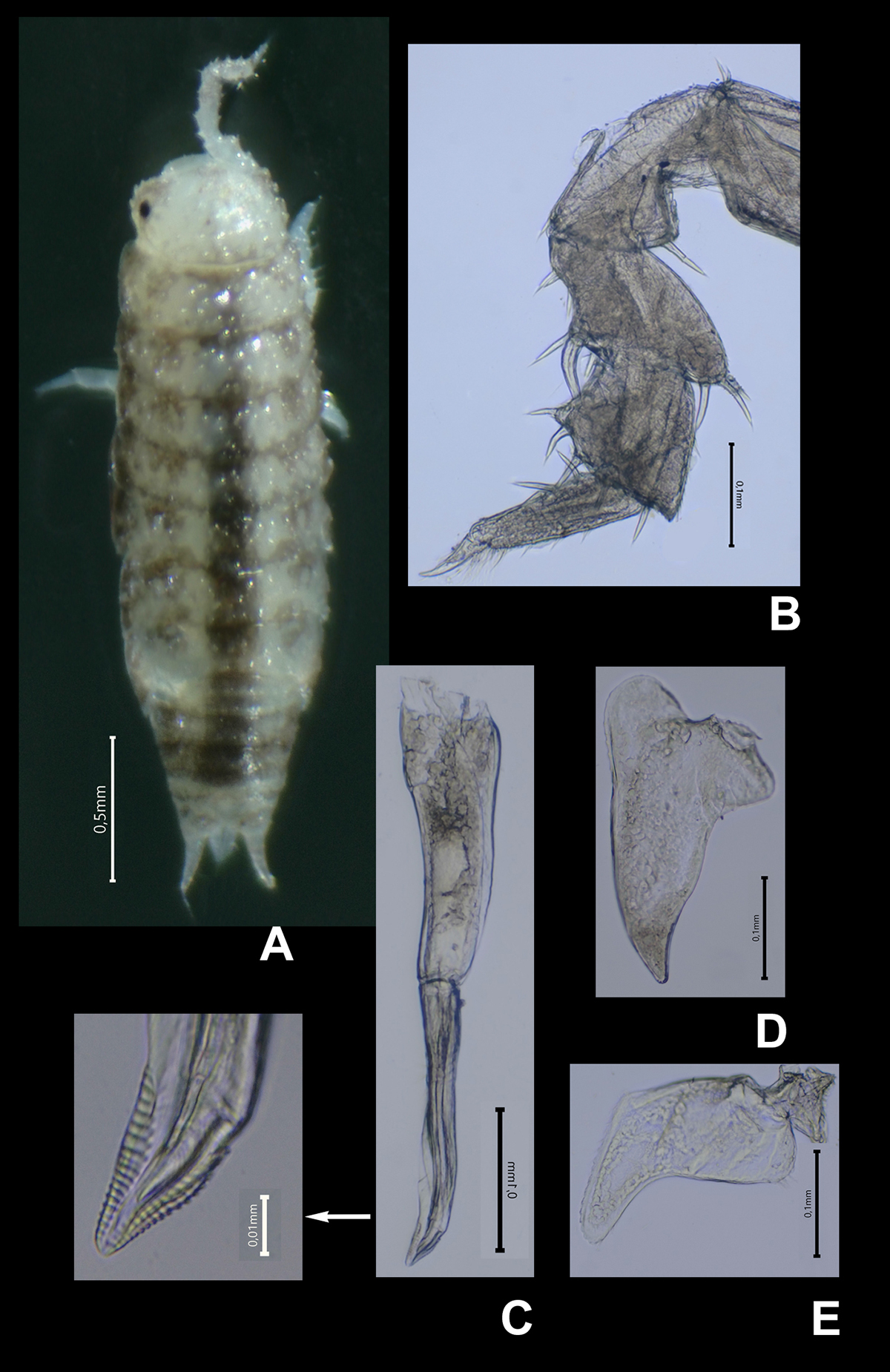
Coloration: Faint brown-violet coloration (Fig. 13 A ); cephalon with lateral coloration; pereon with large white area from muscle insertions, interrupted by dark central line of digestive tract. Faintly colored spot on both sides of muscle insertions in anterior tergite zone, separated by wide clear band from colored pleuroepimera zone; pleon with similar pattern to pereon; pleon and antennas almost white.
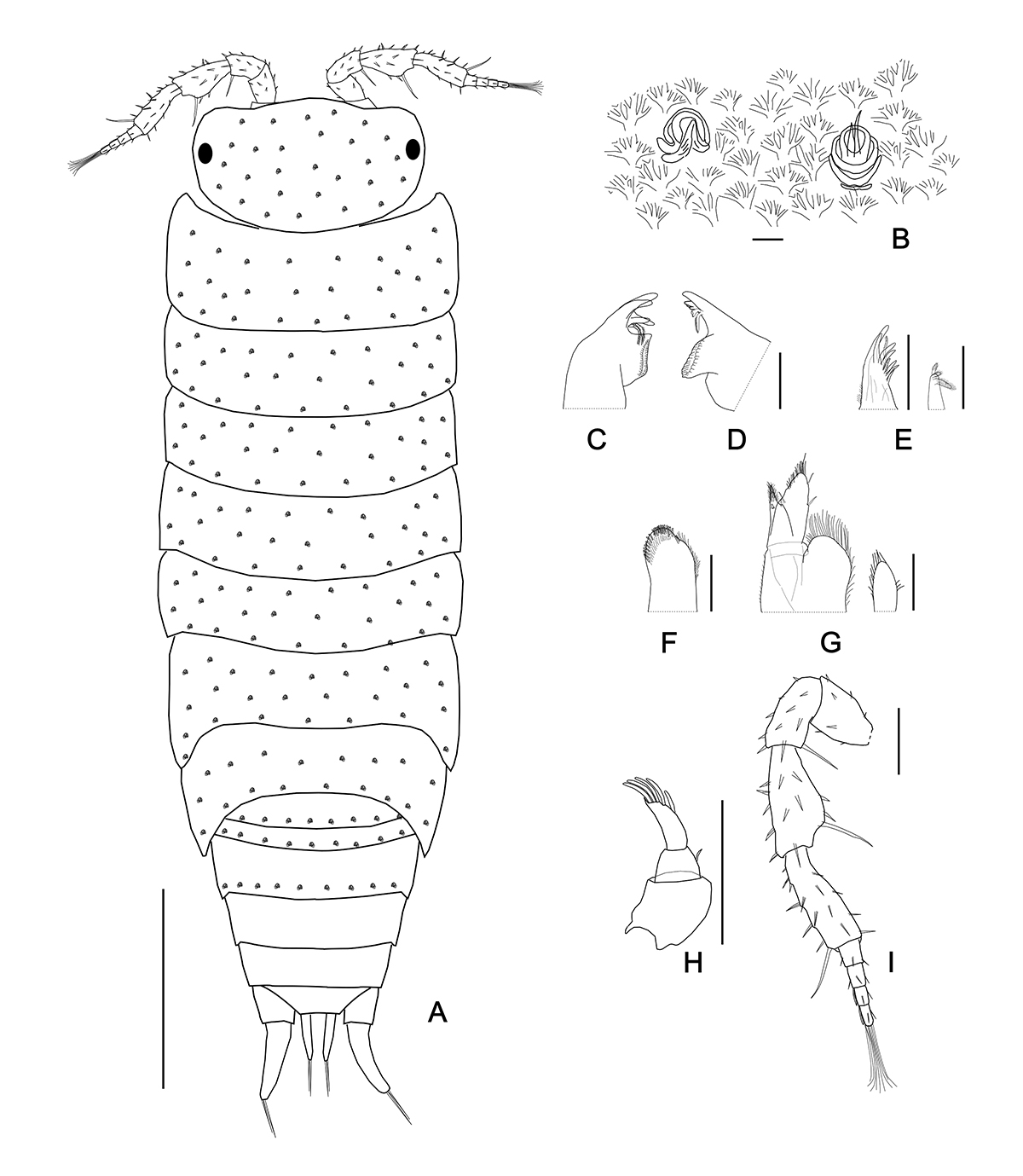
Integumentary characters: Dorsal integument with scales containing palm-like reinforcements and prominent spinous granulations formed by scale-setae surrounded by large circular scales (Figs. 13A; 14A, B); granulations arranged in five transverse rows on cephalon, three rows on pereonites I to VI, two rows pereonite VII, and one row on pleonites I to III.
Somatic characters: Ocular apparatus with single black ocellus (Figs. 13A; 14A). Body very elongated relative to width (Figs. 13A; 14A). Posterior margin of pereonites I to III rounded, from IV to VII with gradually increasing posterior tip. Telson trapezoidal with slightly curved sides and slightly concave posterior margin directed downward.
Appendages: Left mandible with two free penicils, right with one (Fig. 14 C, D ). Maxillula with three free penicils on inner endite and eight teeth on outer endite (Fig. 14 E ). Maxilla and maxilliped as in Fig. 14 F, G . Antennula with three segments, second very short, third with five long setae and lateral spine (Fig. 14 H ). Short antennae (Fig. 14 I ), barely extending beyond cephalon posterior margin, segments with strong spines, flagellum with four segments and two groups of long setae located at tip of second and third segments.
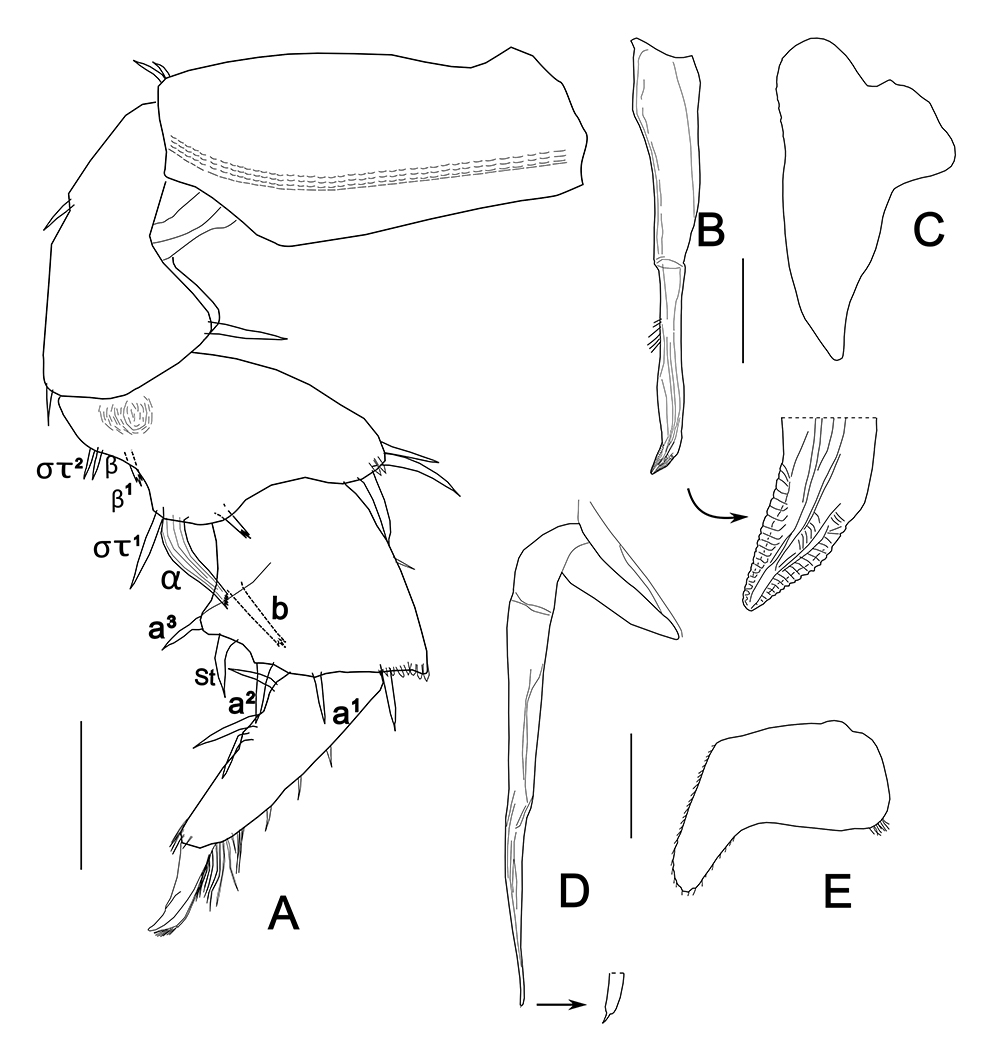
Sexual characters: Pereopod I without sexual differentiation. Pereopod VII with strong sexual differentiation (Figs. 13B; 15A); ischium recurved, with convex sternal margin; merus very wide with small β and στ2 spines; στ1 spine long; β1 spine inserted directly on segment between στ2 and στ1 spines, α ramus very thick and recurved; carpus very wide, a2 spine inserted like a1 and a2 directly on segment, without carpal lobe; a3 spine inserted on carpal lobe; St spine as thick as a1, a2 and a3 spines, curving towards distal margin of segment, nearly parallel to axis. Pleopod I endopod ending in striated tip (Figs. 13C; 15B), curved inward with rounded tip; exopod with large rounded extension at internal basal area (Figs. 13D; 15C), internal margin curved, external margin sinuous, with large extension near base; posterior-internal tip long, triangular, curved outward, with rounded tip. Pleopod II endopod very long, with thin, very sharp tip (Fig. 15 D ); exopod trapezoidal with triangular posterior-internal tip (Figs. 13E; 15E), wide, with rounded end.
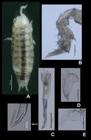
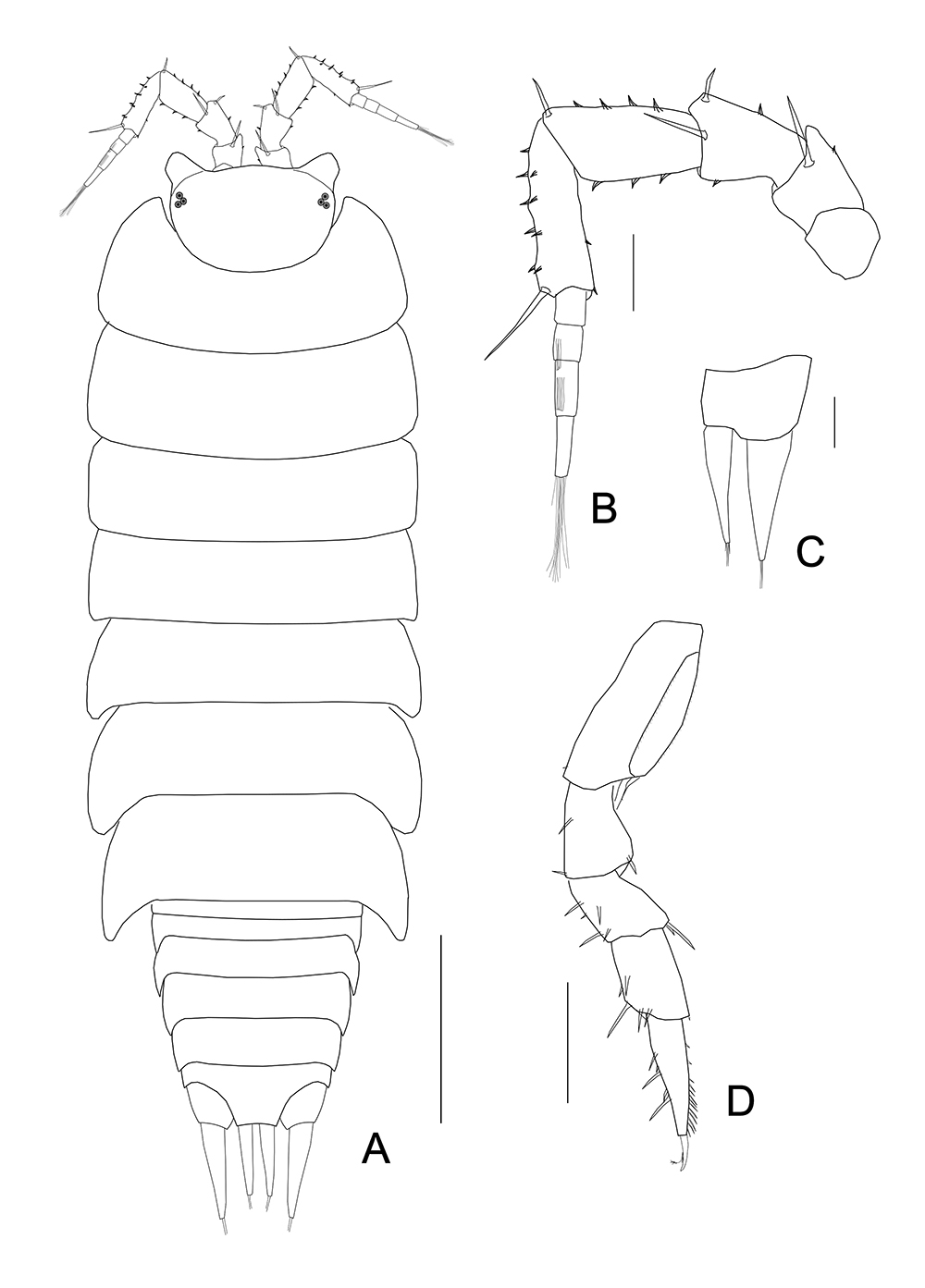
Miktoniscus atlanticus Cifuentes and Da Silva n. sp., male (ASM55a). A, Habitus; B, pereopod VII; C, endopod of pleopod I; D, exopod of pleopod I; E, exopod of pleopod II. Scale bars: A, 0.5 mm; B-E, 0.1 mm.
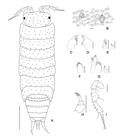
Miktoniscus atlanticus Cifuentes and Da Silva n. sp., male (ASM55a). A, Habitus; B, scale-setae; C, left mandible; D, right mandible; E, maxillule; F, maxilla; G, maxilliped; H, antennula; I, antennae. Scale bars: A, 0.5 mm; B, 0.01 mm; C-I, 0.1 mm.
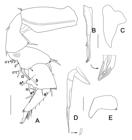
Miktoniscus atlanticus Cifuentes and Da Silva n. sp., male (ASM55a). A, Pereopod VII; B, endopod of pleopod I; C, exopod of pleopod I; D, endopod of pleopod II; E, exopod of pleopod II. Scale bars: A-E, 0.1 mm.
Etymology. The specific epithet refers to the Atlantic Ocean, which surrounds the island where this species was discovered.
Ecology. Miktoniscus atlanticus n. sp. is an epigean species. Most specimens were found beneath dead wood and on very moist soil. In Faial da Terra, where most individuals were observed and collected, they were concentrated in a single pile of fallen trunks. Additional specimens were discovered between the bark of decaying trunks and within the rotting wood itself.
Remarks. This genus is characterized by an ocular apparatus consisting of a large black ocellus (except in Miktoniscus racovitzaiVandel, 1950); an elongated body with parallel sides, a pleon retracted relative to the pereon, and very small neopleurons folded toward the ventral side; the dorsal integument surface with spinous granulations; the left mandible with two free penicils and the right mandible with one; sexual differentiation in male pereopods restricted to the seventh pair, primarily involving the chaetotaxy of the merus and carpus; in male pleopods I and II, triangular exopods with a more or less developed posterior-internal side and a rounded or pointed tip; and the endopod of pleopod II consisting of two segments, with the distal segment being longer than the basal (Vandel, 1946; 1960b).
The genus Miktoniscus currently comprises 16 species (Boyko et al., 2025), which can be grouped into three categories based on their known distribution (Vandel, 1960b). Although this grouping helps organize and compare species, it remains speculative without biogeographic or phylogenetic analyses. The Alpine group includes Miktoniscus melitensisCaruso and Lombardo, 1982, found in Italy and Malta (Caruso and Lombardo, 1982; Caruso et al., 1987), Miktoniscus patriziiBrian, 1950, known from Italy (Schmölzer, 1965; Vandel, 1965; Argano et al., 1982; 1995; Schmalfuss, 2003), and Miktoniscus vandeliBonnefoy, 1945, found in Spain and France (Vandel, 1946; 1949; 1960a; 1965; Schmölzer, 1965; 1971; Schmalfuss, 2003). The American group consists of six species present in North America, Miktoniscus barri Vandel, 1965, Miktoniscus mammothensisMuchmore, 1964, Miktoniscus morganensisSchultz, 1976, M. racovitzai, Miktoniscus spinosus (Say, 1818), and one species in Brazil, Miktoniscus medcofiVan Name, 1940 (Vandel, 1933; 1946; 1949; 1950; 1965; Van Name, 1936; 1940; Muchmore, 1957; 1964; Schultz, 1962; 1976; 2002; Leistikow and Wägele, 1999; Schmalfuss, 2003). The Atlantic group includes the remaining seven species, M. arcangelii, from Madeira (Vandel, 1960b; 1965); Miktoniscus bisetosus Vandel, 1946, from Spain and Portugal (Vandel, 1946; 1949; 1960b; 1965; Schmölzer, 1955; 1965; 1971; Schmalfuss, 2003); Miktoniscus chavesi (Dollfus, 1889a), from the Azores, and Madeira (Dollfus, 1889a; 1889b; Carl, 1908; Paulian De Félice, 1946; Vandel, 1946; 1949; 1956a; 1960b; 1968; Arcangeli, 1958; Schmölzer, 1965, 1971; Schmalfuss, 2003; Borges et al., 2008; Taiti, 2010); Miktoniscus deharvengiDalens, 1976, from Spain (Dalens, 1976); Miktoniscus linearis (Patience, 1908), known from a few greenhouses in England and Germany (Patience, 1908; Kesselyák, 1930; Vandel, 1933; 1946; 1949; 1957a; 1965; Gruner, 1966; Harding and Sutton, 1985; Schmalfuss, 2003), North America (Schultz, 1964), and the record from Madeira reported by Borges et al. (2008) could not be confirmed; Miktoniscus longispinaReboleira and Taiti in Roboleira et al. 2015, from Portugal (Reboleira et al., 2015); and Miktoniscus patiencei Vandel, 1946, from Scotland, France, England, Ireland, and tentatively Madeira (Vandel, 1946; 1949; 1960a; 1960b; 1965; Schmölzer, 1965; Oliver and Sutton, 1982; Harding and Sutton, 1985; Schmalfuss, 2003). The species described in this work, M. atlanticus n. sp., should also be included in the Atlantic group.
The main characters used to distinguish species, as highlighted by Vandel (1946; 1965) and Schultz (1976), include integument ornamentation, the morphology of male pleopods I and II, and the chaetotaxy of the male merus and carpus of pereopod VII. Different authors used various letters to differentiate the spines, and even Vandel applied inconsistent terminology across his works on this genus (Vandel, 1946; 1960b; 1965). Therefore, the nomenclature has been standardized following Vandel (1960b) and Schultz (1976). Accordingly, the spines labeled as x and y of Vandel (1946) and Schmölzer (1965) have been referred to as α and St, respectively. The α spine on the male merus is straight and relatively long, oriented either transversely at an angle close to 90°, at 45°, or even parallel to the axis of the segment in species from the Alpine group (M. melitensis, M. patrizii, and M. vandeli), the American group (M. barri, M. mammothensis, M. medcofi, M. morganensis, M. racovitzai, and M. spinosus), and certain species from the Atlantic group (M. arcangelii, M. linearis, and M. patiencei). Conversely, in other species of the genus, all belonging to the Atlantic group, the α spine on the male merus is curved and lies more or less parallel to the segment axis, as observed in M. bisetosus, M. chavesi, M. deharvengi, M. longispina, and M. atlanticus n. sp. (Figs. 13B; 15A). In M. bisetosus, M. chavesi, and M. deharvengi, the male exopod of pleopod I has a long, rectangular posterior-internal side with a rounded tip. Conversely, in M. atlanticus n. sp., this structure is triangular and curved outward (Figs. 13D; 15C). In the male of M. longispina, the ischium has a prominent spine, which gives the species its name. Additionally, the St spine on the carpus is straight and long, the pleopod I exopod is triangular with straight internal and external edges, and the exopod II is triangular with a long, narrow, triangular posterior-external side. In contrast, in the male of M. atlanticus n. sp. (Figs. 13B; 15A), the ischium has a very small spine that does not stand out from the rest of the segment. The St spine on the carpus is small and curved. The pleopod I exopod is triangular (Figs. 13D; 15C), with a convex internal edge and a sinuous, concave external edge near the base. The exopod II is trapezoidal, with a wide, triangular posterior-external side (Figs. 13E; 15E).
Genus Trichoniscus Brandt, 1833
Trichoniscus bassoti Vandel, 1960 b
(Fig. 12 F )
Material examined. 1 female (OM037), Portugal, Madeira Archipelago, Madeira Island, Furnas do Cavalum, 32°43’57”N 16°47’05”W, 7 Jul 2024, coll. L.P. Da Silva; 1 male (OM039a), Portugal, Madeira Archipelago, Madeira Island, Furnas do Cavalum, 32°43’57”N 16°47’01”W, 7 Jul 2024, coll. L.P. Da Silva.
Remarks. This species is known from its type locality, Furnas do Cavalum in Madeira (Vandel, 1960b), and from the islands of La Palma and Tenerife in Canary Islands (Dalens, 1984; Oromí et al., 1990; García et al., 1995; Rodríguez Santana, 1996; Arechavaleta et al., 1999; López and Taiti, 2010; Oromí and Socorro, 2021; Oromí et al., 2021).
Trichoniscus furnaensis Cifuentes and Da Silva n. sp.
Zoobank: urn:lsid:zoobank.org:act:1078DAC2-22B0-440F-84DA-A1161DA7A3BA
Type material. Holotype: Male (MNCN 20.04/21281 [ex. ASM66]), Portugal, Azores, São Miguel, Furnas, near Terra Nostra hotel, 37°46’14”N 25°18’57”W, 4 Jun 2024, coll. L.P. Da Silva.
Diagnosis. Elongated body with parallel sides. Cephalon with large lateral lobes. Ocular apparatus with three ommatidia in triangle. Dorsal integument with very fine granulations and short, thick setae. Antenna flagellum with four segments. Male pleopod I, endopod with striated, rounded tip, exopod triangular, projection near external base, rounded tip curved outward, with setae group. Male pleopod II, endopod ends in a thin, cylindrical, hollow tip.
Description. Maximum observed size: 3.2 mm.
Coloration: Light brown-violet, with very prominent muscle insertions on cephalon and pereon; clear line separates dark epimera from lighter pereonite; pleon with large, depigmented areas (Fig. 16 A ).
Integumentary characters: Dorsal integument with very fine granulations, smoothing toward posterior region, with few short, thick setae (Fig. 16 A ).
Somatic characters: Ocular apparatus with three ommatidia in triangle within black pigmented area (Figs. 16A; 17A). Cephalon with large, rectangular lateral lobes, strongly divergent. Elongated body with parallel sides of pereon. Posterior margin of pereonites I and II rounded, pereonite III almost straight, and from pereonite IV to VII with gradually increasing posterior tip. Telson trapezoidal with curved sides and slightly concave posterior margin.
Appendages: Antennula with three segments, second shorter, third with group of long setae. Short antennae (Fig. 17 B ) not extending beyond posterior margin of pereonite II; segments 3 to 5 with strong geminated spines; flagellum with four segments, with group of long aesthetascs on second and third. Uropods with conical, short endopods and exopods (Fig. 17 C ).
Sexual characters: Pereopods without sexual differentiation. Genital apophysis ending in rounded tip with long cilia (Fig. 18 A ). Pleopod I endopod with thick distal segment that narrows near tip, ending in striated, rounded tip (Figs. 16B; 18B); exopod triangular with rounded protrusion near base on external side, tip rounded and curved outward, with group of setae near tip (Figs. 16B, 18C). Pleopod II endopod very long, gradually tapering to slender, cylindrical, hollow tip (Figs. 16C, 18D); exopod trapezoidal (Figs. 16C; 18E). Pleopods III to V as in Fig. 18 F-H .

Trichoniscus furnaensis Cifuentes and Da Silva n. sp., male (ASM66). A, Habitus; B, endopod and exopod of pleopod I; C, endopod and exopod of pleopod II. Scale bars: A, 0.5 mm; B, C, 0.1 mm.
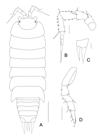
Trichoniscus furnaensis Cifuentes and Da Silva n. sp., male (ASM66). A, Habitus; B, antennae, C, uropods; D, pereopod VII. Scale bars: A, 0.5 mm; B-D, 0.1 mm.
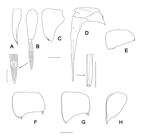
Trichoniscus furnaensis Cifuentes and Da Silva n. sp., male (ASM66). A, Genital apophysis; B, endopod of pleopod I; C, exopod of pleopod I; D, endopod of pleopod II; E, exopod of pleopod II; F, exopod of pleopod III; G, exopod of pleopod IV; H, exopod of pleopod V. Scale bars: A-H, 0.1 mm.
Etymology. The specific epithet refers to the species’ type locality, Furnas.
Ecology. Trichoniscus furnaensis n. sp. is an epigean species. It was collected in the moist area between a wooden board and the pavement surrounding an abandoned house.
Remarks. The genus Trichoniscus, with 105 species, including one fossil, is the most diverse in the family Trichoniscidae (see Boyko et al., 2025). Most species of this genus are found in Europe, particularly in the Mediterranean region, with a few in Western Asia, North Africa, and North America, such as the introduced species Trichoniscus pusillusBrandt, 1833, and Trichoniscus pygmaeus G.O. Sars, 1898, that also occur in Cuba, Hawaii, and Mexico (Schmalfuss, 2003). Species differentiation within this genus depends on the presence of glandular-piliferous organs in males of certain species and, more importantly, on the morphology of the first two pairs of male pleopods (Vandel, 1951b; 1960a). However, these structures are often very similar across species, making their distinction challenging.
In the Macaronesia region, four species are known: Tn. bassoti, reported from Madeira by Vandel (1960b) and from the Canary Islands (Tenerife) by Dalens (1984); Trichoniscus provisoriusRacovitza, 1908, reported from the Azores by Vandel (1956a; Taiti, 2010); Tn. pusillus, reported from the Azores (Dollfus, 1889a; 1889b; 1889c; Paulian de Félice, 1946; Vandel, 1956a; 1968; Ashmole et al., 1996; Taiti, 2010) and Madeira (Vandel, 1960b); and Tn. pygmaeus, reported from Azores, Canary Islands, and Madeira (Vandel 1960b; 1968; Schmalfuss, 2003; Arndt and Mattern, 2005; López and Taiti, 2010; Taiti, 2010). All four species have a triangular exopod of the first male pleopod, with a pointed tip in Tn. bassoti, and a rounded tip with setae on the outer margin in the other three. In contrast, in Tn. furnaensis n. sp., the tip curves outward and has setae on the inner margin and the endopod of the male pleopod II does not end in a sharp point but forms a cylindrical tube.
Two other species, Trichoniscus gachassini (Giard, 1899) and Trichoniscus verhoeffiDahl, 1919, share similarities in the shape of the exopod of the male pleopod I with Tn. furnaensis n. sp. Trichoniscus gachassini is a species from the mountainous region of Djurdjura in northern Algeria, exclusively collected in caves, at their entrances and in snow holes (“trous à neige”) (Giard, 1899; Racovitza, 1908; Vandel, 1955). Giard (1899), did not describe the species, which he named Titanethes gachassini, and only noted some differences compared to Titanethes albus (Koch, 1841). The species was later described by Racovitza (1908), who noted its oval body, much narrower in the anterior and posterior regions than in the middle pereon, short lateral lobes on the cephalon, and in specimens with eyes, an ocular apparatus formed by three ommatidia arranged in a line. Additionally, he mentioned the long uropods, and in males, the endopod of pleopod I has a thin tip, while the endopod of pleopod II has a sharp tip. Vandel (1955) classified Tn. gachassini as a subspecies of Tn. pusillus, noting that it differs from Tn. pusillus provisorius (now Tn. provisorius) in the male exopod of pleopod I, which has only a few setae and barely noticeable indentations. These setae and indentations are found on the outer margin near the pleopod tip in Tn. provisorius and Tn. pusillus. Trichoniscus furnaensis n. sp., although seeming similar to Tn. gachassini, differs in its elongated body with parallel sides, large lateral lobes on the cephalon, and an ocular apparatus formed by three ommatidia arranged in a triangle. The uropods are short, and in males, the endopod of pleopod I ends in a lanceolate tip. The exopod of pleopod I has a group of long setae near the tip on the inner face, and the endopod of pleopod II ends in a hollow cylindrical tube. Trichoniscus verhoeffi is a species from northern Italy (Schmalfuss, 2003). Although the illustrations by Dahl (1919) and Verhoeff (1931) of this species are schematic, both the illustrations and the characters mentioned by Verhoeff (1931), such as the tapered tip of the male endopod of pleopod II, allow it to be easily distinguished from Tn. furnaensis n. sp.
Other species cited in the Macaronesia archipelagos
In addition to the species mentioned above, other species have been reported from the islands comprising Macaronesia, these include (Tab. 1).
List of species from the Macaronesia region. E indicates endemic species; O indicates the potential origin based on the known distribution of genera: Al = Alpine; At = Atlantic; M = Mediterranean; T = Tropical. Archipelagos arranged from north to south: AZ = Azores: MA = Madeira; SE = Selvagens Islands; CA = Canary Islands; CV = Cabo Verde. A indicates species analysed in this study; A* indicates new archipelago records. B = bibliographic references. Species in bold indicate newly described species.
Azores - Family Armadillidiidae Brandt, 1833: Armadillidium albumDollfus, 1887; Armadillidium amicorumRodríguez and Vicente, 1993; Armadillidium assimileBudde-Lund, 1885; Armadillidium granulatum Brandt, 1833; Armadillidium sulcatum H Milne Edwards, 1840. Family Philosciidae Kinahan, 1857: Chaetophiloscia guernei (Dollfus in de Guerne, 1887). Family Platyarthridae Verhoeff, 1949: Platyarthrus schoblii Budde-Lund, 1885. Family Porcellionidae Brandt, 1831: Leptotrichus panzerii (Audouin, 1826); Porcellio laevissimus Dollfus, 1898; Porcellio variabilisLucas, 1849. Family Styloniscidae Vandel, 1952: Cordioniscus stebbingi (Patience, 1907). Family Trichoniscidae G.O. Sars, 1899: Haplophthalmus mengii (Zaddach, 1844); Trichoniscus insularis Dollfus, 1889b. Family Tylidae Dana, 1852: Tylos europaeusArcangeli, 1938; Tylos latreillii Audouin, 1826 (Morelet, 1860; Dollfus, 1889b; Paulian De Félice, 1946; Vandel, 1956a; 1966; 1968; Arcangeli, 1958; Schmölzer, 1971; Rodríguez and Vicente, 1993; Ashmole et al., 1996; Schmalfuss, 2003; Taiti, 2010).
Cabo Verde - Family Porcellionidae Brandt, 1831: Le. panzerii. Family Tylidae Dana, 1852: Tylos armadilloLatreille, 1829; Ty. europaeus (see Dollfus, 1899; Paulian De Félice, 1946; Vandel, 1954a; 1956a; Schmalfuss, 1982; Schmalfuss and Vergara, 2000).
Canary Islands - Family Armadillidae Brandt, 1831: Armadillo officinalisDumeril, 1816; Ctenorillo ausseli (Dollfus, 1893); Venezillo canariensis (Dollfus, 1893); Venezillo fillolaeRodríguez and Barrientos, 1993b; Venezillo tenerifensisDalens, 1984. Family Armadillidiidae Brandt, 1833: Ad. album; Ad. granulatum. Family Halophilosciidae Verhoeff, 1908a: Hl. canariensis; Hl. microphthalma; Hl. rodriguezi; Stenophiloscia glarearum Verhoeff, 1908. Family Ligiidae Leach, 1814: Ligia exotica Roux, 1828; Lg. oceanica. Family Philosciidae Kinahan, 1857: Chaetophiloscia sicula Verhoeff, 1908a; Ctenoscia minima (Dollfus, 1892). Family Platyarthridae Verhoeff, 1949: Platyarthrus aiasensisLegrand, 1954; Platyarthrus caudatusAubert and Dollfus, 1890; Platyarthrus parisiiArcangeli, 1930; Pl. schoblii; Trichorhina anophthalma Arcangeli, 1935. Family Porcellionidae Brandt, 1831; Leptotrichus leptotrichoides (Arcangeli, 1942); Le. panzerii; Porcellio aguerensisOrihuela-Rivero et al., 2025; Porcellio albinusBudde-Lund, 1885; Porcellio alluaudi Dollfus, 1893; Porcellio anagaeHoese, 1985; Porcellio ancararum Rodríguez and Vicente, 1992; Porcellio babilonus Rodríguez and Barrientos, 1993a; Porcellio calderensisVandel, 1954b; Porcellio canariensis Dollfus, 1893; Porcellio centralis Vandel, 1954b; Porcellio eserensis Rodríguez and Vicente, 1992; Po. laevissimus; Porcellio martini Dalens, 1984; Porcellio medinae Rodríguez and Barrientos, 1993a; Porcellio meridionalis Vandel, 1954b; Porcellio ombrionis Vandel, 1954b; Porcellio palmae Hoese, 1985; Porcellio septentrionalis Vandel, 1954b; Porcellio simulator Budde-Lund, 1885; Porcellio strinatii Vandel, 1960c; Porcellio studienstiftius Hoese, 1895; Porcellionides mateui Vandel, 1954b; Soteriscus gomerae (Schmölzer, 1971); Soteriscus jandiensisCifuentes and Prieto, 2023; So. mateui; So. trilineatus. Family Stenoniscidae Budde-Lund, 1904: Stenoniscus carinatusSilvestri, 1897. Family Trichoniscidae G.O. Sars, 1899: Hp. mengii; Miktoniscus canariensis Schmölzer, 1971. Family Tylidae Dana, 1852: Ty. europaeus; Tylos ponticusGrebnitzky, 1873 (Dollfus 1893; 1898; Ferrer Galdiano, 1923; Arcangeli, 1924; 1930; 1934b; Paulian De Félice, 1946; Vandel, 1951a; 1954b; 1956a; 1957c; 1960c; 1968; Arcangeli, 1958; Caruso, 1970; Schmölzer, 1971; Dalens, 1973; 1984; Hoese, 1984b; 1985; Hernández et al., 1986; Martín and Oromí, 1986; Rodríguez and Vicente, 1992a; 1992b; 1992c; Rodríguez and Barrientos, 1993a; 1993b; 1993c; Rodríguez Santana, 1996; Arechavaleta et al., 1998; 1999; Zimmer and Topp, 1999; Schmalfuss, 2003; Macias et al., 2004; Arndt and Mattern, 2005; Taiti and López, 2008; López and Taiti, 2010; Ramírez and Riera, 2013; Fernández-Palacios et al., 2018; Moro et al., 2018; Oromí and Socorro, 2021; Oromí et al., 2021; Cifuentes and Prieto, 2023; Orihuela-Rivero et al., 2025).
Madeira - Family Armadillidiidae Brandt, 1833: Ad. album; Ad. assimile; Ad. granulatum; Armadillidium tigrisBudde-Lund, 1885. Family Oniscidea incertae sedis: Buchnerillo litoralisVerhoeff, 1942b. Family Platyarthridae Verhoeff, 1949: Platyarthrus aiasensisLegrand, 1954; Platyarthrus maderensisVandel, 1960b; Pl. parisii; Pl. schoblii; Trichorhina hoestlandti Vandel, 1960b. Family Porcellionidae Brandt, 1831: Atlantidium barretoiArcangeli, 1936a; Atlantidium mateui Vandel, 1957b; Atlantidium secundum Arcangeli, 1936b; Le. leptotrichoides; Le. panzerii; Lucasius myrmecophilus (Lucas, 1853); Lucasius scitus Budde-Lund, 1885; Po. calderensis; Porcellio ferroi Paulian de Félice, 1939b; Porcellio garciaiHughes, 2024; Porcellio gruneriHoese, 1978; Porcellio maculipes Budde-Lund, 1885; Porcellio normani (Dollfus in Norman, 1899); Porcellio scitus Budde-Lund, 1885; Porcellio xavieri Arcangeli, 1958; Porcellio zarcoi Vandel, 1960b; So. brumdocantoi; So. desertarum; So. madeirae. Family Stenoniscidae Budde-Lund, 1904: Stenoniscus pleonalisAubert and Dollfus, 1890. Family Tylidae Dana, 1852: Ty. europaeus; Tylos madeirae Arcangeli, 1938; Ty. ponticus (see Budde-Lund, 1885; Dollfus, 1889b; Norman, 1899; Arcangeli, 1936a; 1938; 1958; Paulian De Félice, 1939b; 1946; Vandel, 1956a; 1960b; Schmölzer, 1971; Hoese, 1978; Schmalfuss and Vergara, 2000; Schmalfuss, 2003; Borges et al., 2008; Hughes, 2024).
Doubtful species in the Macaronesia archipelagos
Family Armadillidiidae Brandt, 1833
Armadillidium granulatum Brandt, 1833
Remarks.Schmölzer (1971) lists the presence of this species in the Canary Islands in a summary table (p. 119) of terrestrial isopods from North Africa; however, in the main text, he only refers to the locality of Al Hoceima, which is in Morocco.
Armadillidium sulcatum H. Milne Edwards, 1840
Remarks. This species was reported from the Azores by Morelet (1860), but this record was considered erroneous by Dollfus (1889b), and therefore it is not included in the list of Macaronesian species.
Armadillidium tigris Budde-Lund, 1885
Remarks. This species has only been reported from Madeira by Budde-Lund (1885), and this record has been repeated by later authors (Dollfus, 1889b; Norman, 1899; Arcangeli, 1958; Borges et al., 2008). The brief description provided by Budde-Lund (1885), which was common practice at the time, has likely made species identification difficult. Only a revision of the type specimen could clarify its validity.
Family Ligiidae Leach, 1814
Ligia oceanica ( Linnaeus, 1767 )
Remarks. It was reported from Las Palmas in the Canary Islands by Ramírez and Riera (2013), but this record corresponds to Ligia exotica Roux, 1828, according to Moro et al. (2018).
Family Porcellionidae Brandt, 1831
Lucasius myrmecophilus (Lucas, 1853 )
Remarks. Borges et al. (2008) reported this species from Madeira; however, Lucas (1853) did not describe this species in his work, so this is undoubtedly an error, likely referring instead to Lucasius myrmecophilus Kinahan, 1859. According to Schmalfuss (2003), this species is known from Algeria, Spain, and Morocco, but it has not been reported from Madeira.
Lucasius scitus Budde-Lund, 1885
Remarks.Borges et al. (2008) reported this species from Madeira, but according to Schmalfuss (2003) and Boyko et al. (2025), it is a synonym of Porcellio scitusBudde-Lund, 1885.
Porcellio albinus Budde-Lund, 1885
Remarks.This species has been reported from the Canary Islands, specifically from Fuerteventura, La Graciosa, La Gomera, Lanzarote, and Lobos (Arcangeli, 1958; Dalens, 1984; Schmölzer, 1971). However, Hoese (1984b) and Rodríguez Santana and Vicente (1992a) consider that Po. albinus does not occur in the Canary Islands, and that these records refer to Po. spinipes.
Porcellio simulator Budde-Lund, 1885
Remarks. Native to Algeria and Tunisia (Schmalfuss, 2003). Arcangeli (1934b) described the subspecies Porcellio simulator sublaevis Arcangeli, 1934b, based on a female specimen from Montaña de Fuego (Lanzarote) in the Canary Islands. Rodríguez Santana and Vicente (1992a) considered this subspecies to be a synonym of Porcellio alluaudiDollfus, 1893. Schmalfuss (2003) also questioned its subspecific identity, and the taxon has not been cited or included in the catalog by López and Taiti (2010). Therefore, we consider the presence of this species in the Canary Islands to be doubtful.
Porcellio variabilis Lucas, 1849
Remarks. This species is found in Algeria, Morocco, and Tunisia (Lucas, 1849; Paulian De Félice, 1939a; Medini-Bouaziz and Charfi-Cheikhrouha, 1998; Schmalfuss, 2003; Medini-Bouaziz et al., 2006; Khemaissia et al., 2012, 2016, 2017). It was reported from the Azores by Morelet (1860), although Dollfus (1889b) suggested that the specimen was probably Pn. sexfasciatus. Therefore, the species is not included in the list of Macaronesian species.
Soteriscus gomerae ( Schmölzer, 1971 )
Remarks. As Schmölzer (1971) and his subsequent publications lack a description of this species, Boyko et al. (2025) consider it a nomen nudum.
Family Trichoniscidae Sars, 1899
Miktoniscus canariensis Schmölzer, 1971
Remarks. As Schmölzer (1971) and his subsequent publications lack a description of this species, Boyko et al. (2025) consider it a nomen nudum.
Trichoniscus insularisDollfus, 1889b
Remarks. Species cited from Azores by Dollfus (1889b) and Paulian De Félice (1946). However, Schmalfuss (2003) and Boyko et al. (2025) consider it nomen dubium. Vandel (1956a, 1960b) suggests that although the type specimen of Tn. insularis was lost, this species is likely a synonym of Miktoniscus chavesi (Dollfus, 1889a). In the original description by Dollfus (1889a), he notes that the cephalon and pereon have strong and conical granulations, the eyes are simple, and the antenna flagellum has four segments. Later, Dollfus (1889b) describes Tn. insularis and indicates that the body shows stronger granulations on the cephalon and the anterior region of the pereon compared to the posterior region. He also describes the eyes as small, though not simple, and the antenna flagellum as having three segments. Additionally, Dollfus (1889b) says that the two species differ in body shape, being broader in Tn. insularis and narrower in M. chavesi, and the antenna flagellum, with three segments in Tn. insularis and four in M. chavesi. In the Azores, Sl. spinosus is relatively common and it has a body that is wide relative to its length, granulations on the cephalon and pereon that soften towards the posterior region, an ocular apparatus with three ommatidia, and the antenna flagellum with three segments. These characters align more closely with the description of Tn. insularis than with M. chavesi, suggesting that Sl. spinosus might be a synonym of Tn. insularis. However, the brevity of the original description of Tn. insularis and, above all, the absence of the type specimen, as Vandel (1956a, 1960b) already indicated, prevent this synonym from being conclusively established.
Family Tylidae Dana, 1852
Tylos armadillo Latreille, 1829
Remarks.Dollfus (1899) mentioned this species for Cabo Verde. However, Schmalfuss and Vergara (2000) consider this the same species as Ty. ponticus or Ty. europaeus. Later Schmalfuss (2003) and Boyko et al. (2025) consider Ty. armadillo as nomen dubium.
Tylos latreillii Audouin, 1826
Remarks. Paulian de Félice (1946) cited this species from Azores and Canary Islands. Vandel (1954a) mentioned it from Cabo Verde, probably considering the record of Ty. armadillo by Dollfus (1899) as Ty. latreillii. However, the description of Ty. latreillii does not allow differentiation from T. ponticus or Ty. europaeus according to Schmalfuss and Vergara (2000). It is also considered nomen dubium by Schmalfuss (2003) and Boyko et al. (2025).
DISCUSSION
The Macaronesia region terrestrial isopod fauna has received very uneven attention from carcinologists. Currently, 120 species are known from the Macaronesia archipelagos, and this study presents new data on 39 of them (Tab. 1). Additionally, the presence of An. candidus at Praia dos Rebolinhos, in southern Portugal, is the first record of this species on mainland Portugal.
The isopod fauna of Madeira archipelago is best represented in studies led by 16 authors (Budde-Lund, 1885; Dollfus, 1889b; Norman, 1899; Arcangeli, 1936a; 1938; 1958; Paulian de Félice, 1938; 1939b; 1946; Vandel, 1956a; 1960b; 1968; Schmölzer, 1971; Hoese, 1978; Oromí et al., 1990; 2021; Schmalfuss and Vergara, 2000; Schmalfuss, 2003; Borges et al., 2008; Taiti, 2010; Reboleira et al., 2011; Reboleira, 2012; Hughes, 2024). This study presents new data for 15 species, three reported for the first time from Madeira: Pn. cingendus, Sl. spinosus, and Tr. tomentosa. As a result, 63 species are now known from Madeira, including 25 endemic species. The most diverse family is Porcellionidae with 33 species, comprising 15 species from the genus Porcellio and nine from the genus Soteriscus, followed by the family Trichoniscidae with seven species, and Armadillidiidae with six species (Tab. 1).
The isopod fauna of Azores archipelago has been the subject of studies led by 14 authors (Morelet, 1860; Budde-Lund, 1885; Dollfus, 1889a; 1889b; 1889c; Norman, 1899; Carl, 1908; Paulian De Félice, 1946; Vandel, 1956a; 1962; 1966; 1968; Arcangeli, 1958; Schmölzer, 1971; Rodríguez Santana and Vicente, 1993; Ashmole et al., 1996; Schmalfuss, 2003; Borges et al., 2008; Taiti, 2010). This study presents new data for 19 species, including two new species: M. atlanticus n. sp. and Tn. furnaensis n. sp., and the first records of Pn. cingendus and Sl. spinosus. Consequently, the current list of terrestrial isopods includes 37 species, with only Ad. amicorum and the two new species described in this work, being endemic to the Azores (Tab. 1). The family Porcellionidae is the most diverse, with 11 species, followed by Trichoniscidae with nine species, and Armadillidiidae with five species.
The Cabo Verde archipelago has only been referenced by six authors (Dollfus, 1890; 1897; 1899; Budde-Lund, 1904; Paulian De Félice, 1938; 1946; Vandel, 1954a; 1956a; 1957a; 1960a; Arcangeli, 1958; Schmalfuss, 1982; Schmalfuss and Vergara, 2000). Three species are added to this archipelago in this study: Ct. atlanticus, Li. culebrae, and So. caboverdiensis n. sp. Of the original 16 species, belonging to eight families, four are endemic (Tab. 1). The most diverse family is Porcellionidae with eight species, followed by Armadillidae with three species.
The Canary Islands it is by far the most studied archipelago. Their terrestrial isopod fauna was studied by many authors (Dollfus, 1889b; 1893; 1898; Koelbel, 1892; Kraepelin, 1895; Norman, 1899; Arcangeli, 1930; 1934a; 1934b; 1958; Paulian De Félice, 1938; 1939b; 1946; Vandel, 1954a; 1954b; 1956a; 1957c; 1960b; 1960c; 1966; 1968; Schmölzer, 1971; Dalens, 1973; 1977; 1984; Hoese, 1978; 1984a; 1984b; 1985; Schmalfuss, 1982; Martín et al., 1985; Hernández et al., 1986; Martín and Oromí, 1986; Oromi et al., 1990; 2021; Rodríguez Santana, 1990; 1996; Rodríguez Santana and Vicente, 1992a; 1992b; 1992c; 1993; Rodríguez Santana and Barrientos, 1993a; 1993b; 1993c; García et al., 1995; Ashmole et al., 1996; Arechavaleta et al., 1998; 1999; Zimmer and Topp, 1999; Schmalfuss and Vergara, 2000; Schmalfuss, 2003; Macias et al., 2004; Arndt and Mattern, 2005; Taiti and López, 2008; López and Taiti, 2010; Ramírez and Riera, 2013; Jorge et al., 2016; Fernández-Palacios et al., 2018; Moro et al., 2018; Oromí and Socorro, 2021; Cifuentes and Prieto, 2023; Orihuela-Rivero et al., 2025). The list of terrestrial isopods in the Canary Islands comprises 63 species, belonging to 10 families, with 28 endemic species. This study did not yield any new records. The most diverse family is Porcellionidae with 33 species, including 23 Porcellio and four Soteriscus species, followed by the family Halophilosciidae with six species, Armadillidae with five species, and Trichoniscidae with four species (Tab. 1).
In Selvagens Islands, the least studied archipelago, only three species of terrestrial isopods were recorded, all from the family Porcellionidae (Arcangeli, 1934b; Vandel, 1956a; Dalens, 1977; Tab. 1).
Overall, the Macaronesia archipelagos have now 120 species of terrestrial isopods recorded, 60 (50%) are endemic to a single archipelago. Located nearly 1,000 km from Madeira, the Azores share 27 species with this archipelago, which represent 73% of the Azorean isopod fauna but only 43% of Madeira’s isopod fauna. With the Canary Islands, 1,400 km away, the Azores share 18 species, accounting for 49% of their known fauna but only 29% of the isopod fauna in the Canary Islands. With Cabo Verde, nearly 2,500 km away, the Azores share just six species, which represent 16% of their fauna and 38% of Cabo Verde’s isopod fauna. The Canary Islands and Madeira have 63 recorded isopod species. Despite being approximately 500 km apart, these two archipelagos share only 23 species, representing 37% of the isopod species in the Canary Islands and Madeira. These data suggest a closer similarity in terrestrial isopod fauna between the Azores and Madeira than between either of these two archipelagos and Cabo Verde or the Canary Islands. This similarity is likely driven by both environmental factors, such as higher rainfall in these islands, and historical factors, including greater connectivity over time, which facilitated the dispersal of numerous species linked to human activities. Cabo Verde has recorded 16 isopod species, six of which are also found in the Azores, as previously mentioned, six with Madeira (2000 km away), and seven with the Canary Islands, located 1,600 km away (Fig. 19).
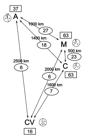
Macaronesia archipelagos (A = Azores, CV = Cabo Verde, C = Canary Islands, M = Madeira). Rectangles indicate the number of species, ovals the number of shared species, and pie charts the percentages of potential origin of species based on the known distribution of genera (Al = Alpine; At = Atlantic; M = Mediterranean; T = Tropical).
In the Gulf of Guinea, where the other archipelagos on the eastern Atlantic are located, previous studies indicated that the known fauna of isopods from Cameroon consists of 57 species, 18 of which have been cited from Bioko Island and 6 from Annobón Island, both part of Equatorial Guinea, and 17 from São Tomé Island, part of the Democratic Republic of São Tomé and Príncipe (Cifuentes, 2021b; Cifuentes and Da Silva, 2023b). These territories have 79 species compared to the 120 found in the Macaronesia archipelagos. Of these, only the widespread Pn. pruinosus is found in the Macaronesia region (Azores, Cabo Verde, Canary Islands, Madeira) and the Gulf of Guinea (Annobón in the Republic of Equatorial Guinea, Cameroon, and Democratic Republic of São Tomé and Príncipe). Three other species are found in Cabo Verde and Democratic Republic of São Tomé and Príncipe: Ct. atlanticus, Cu. murina, and N. squamata; and finally, Lg. gracilipes is found in Cabo Verde, Bioko, and Cameroon. Thus, Cabo Verde shares five of its 16 known species with the islands of the Gulf of Guinea, over 3,600 km away, but only six with Azores and Madeira and seven with the Canary Islands of the Macaronesia archipelagos, which are between 1,600 and 2,500 km apart (Fig. 19).
The current knowledge of many terrestrial isopod species does not allow for the precise determination of their origin. However, by considering the known distribution ranges of species within each genus, it is possible to cautiously infer their potential origin (Schmalfuss, 2003). This approach enables us to identify potential colonization routes for the species present in the Macaronesia archipelagos. Thus, out of the 120 species (Fig. 19; Tab. 1), 71 (59%), are associated with genera of Atlantic origin: 14 in the Azores, representing 38% of their isopod inventory; 37 in the Canary Islands (59%); and 38 in Madeira (60%). Another 34 species (28%) belong to genera of Mediterranean origin: 20 in the Azores (54%), 20 in the Canary Islands (32%), and 22 in Madeira (35%). Fourteen species (12%) have a tropical origin: two in the Azores (5%), six in the Canary Islands (10%), and three in Madeira (5%). In contrast, the southernmost archipelago, Cabo Verde, hosts six species of Atlantic origin (38%), four of Mediterranean origin (25%), and six species of tropical origin (38%). The sole remaining species, Ac. dentiger, is considered to have an Alpine origin, as suggested by Vandel (1960a). This indicates a considerably greater similarity of terrestrial isopods in the Macaronesia region with the Atlantic and Mediterranean fauna of Europe and North Africa than with the tropical African fauna.
According to García Talavera (1999), the Macaronesia islands have experienced major climatic fluctuations over time, including periods of intense erosion, shifts in wind and ocean current patterns, sea level oscillations, and corresponding changes in island altitude and extent due to glaciation, volcanic activity, and large-scale landslides. Additional disturbances, such as fires, including those caused by human activity, such as the one that devastated Madeira after its colonization in the 15th century, have also had lasting impacts. All these factors have shaped these insular ecosystems (García Talavera, 1999). The terrestrial isopod fauna of the Macaronesia region includes endemic species with proportions varying by archipelago. In the Azores, only three of the 37 known terrestrial isopod species are endemic (8%), in Madeira, 25 of 63 (40%), in Selvagens Islands, none of the three recorded species are endemic, in Canary Islands, 28 of 63 (44%), and Cabo Verde, 4 of 16 (25%). The family Porcellionidae has the highest number of endemic species in the Macaronesia region, with 43 out of 60 recorded species. Within this family, the genus Porcellio is particularly noteworthy, with 27 endemic species out of 35 known from the region: 17 in Canary Islands, nine in Madeira, and one in Cabo Verde. Interestingly, North Africa (Algeria, Morocco, and Tunisia) hosts 52 species of Porcellio (Budde-Lund, 1885; Dollfus, 1896; Arcangeli, 1958; Cruz, 1991; Schmalfuss, 2003), and 48 are known from the Ibero-Balearic region (based on our own compilation). However, only three species (Po. alluaudi, Po. dilatatus, and Po. lamellatus) are shared between the Macaronesia region and North Africa, and only four (Po. dilatatus, Po. laevis, Po. lamellatus, and Po. scaber) occur both in the Macaronesia region and the Ibero-Balearic area. This limited overlap suggests that Porcellio species may have limited colonization capacity. The genus Soteriscus is also well represented in the Macaronesia region, with 14 of its 19 known species occurring here, 13 of which are endemic: eight in Madeira, three in the Canary Islands, and two in Cabo Verde. Porcellionides is the third genus in this family, with 4 species in the region. Among them, only Pn. mateui is endemic to the Canary Islands. Porcellionides pruinosus and Pn. sexfasciatus occur in the Macaronesia region, the Ibero-Balearic region, and North Africa, and have been introduced to other parts of the world (Budde-Lund, 1885; Vandel, 1946; Schmalfuss, 2003; Cifuentes and Da Silva, 2024). Porcellionides cingendus is restricted to the Macaronesia region and the Ibero-Balearic area. The other families with endemic species in the Macaronesia region are: Trichoniscidae (3 endemics/12 species), Platyarthridae (2/9), Armadillidae (5/8), Armadillidiidae (2/7), Halophilosciidae (3/6), and Tylidae (1/3) (Tab. 1).
ACKNOWLEDGEMENTS
We want to thank Begoña Sánchez Chillón for helping us with the material deposited in Museo Nacional de Ciencias Naturales de Madrid (MNCN). We are also grateful to Dinis Girão, Elisabeth Stur, Ines Orfão, Marta Monteiro, Pedro Mónica Ribeiro, Pedro Raposeiro, Rui Andrade, Samuel Patinha, Sergio Doutor, and Torbjørn Ekrem for their help during the sampling in the Portuguese archipelagos. We would also like to thank Raúl Orihuela-Rivero from the University of La Laguna (Tenerife, Canary Islands) for providing several specimens for study. We also wish to acknowledge Raquel Vasconcelos for coordinating logistics and fieldwork in Cabo Verde. We are also grateful to the two reviewers and the handling editor, whose valuable comments greatly helped us improve the original manuscript.
REFERENCES
-
Achouri MS; Charfi-Cheikhrouha F and Zimmer M 2008a. Reproductive patterns in syntopic terrestrial isopod species (Crustacea, Isopoda, Oniscidea) from Morocco. Pedobiologia, 52: 127-137. https://doi.org/10.1016/j.pedobi.2008.05.002
» https://doi.org/10.1016/j.pedobi.2008.05.002 -
Achouri MS ; Medini-Bouaziz L; Hamaied S and Charfi-Cheikhrouha F 2008b. Diversity of terrestrial isopods at the Oued Laou region (Northeast of Morocco): preliminary results. Travaux de l’Institut Scientifique Rabat, 5: 75-79. http://www.israbat.ac.ma/wp-content/uploads/2015/02/08%20Achouri%20et%20al%20mep%20final%20080310.pdf
» http://www.israbat.ac.ma/wp-content/uploads/2015/02/08%20Achouri%20et%20al%20mep%20final%20080310.pdf -
Arcangeli A. 1924. Contributo alla conoscenza degli isopodi della Catalogna. Trabajos del Museo de Ciencias naturales de Barcelona, 4 (12): 3-29. https://museucienciesjournals.cat/other/tmcnb/volum-iv-entomologia/contributo-alla-conoscenza-degli-isopodi-della-catalogna-museo-de-ciencias-naturales-trabajos-del-museo-de-ciencias-naturales-de-barcelona
» https://museucienciesjournals.cat/other/tmcnb/volum-iv-entomologia/contributo-alla-conoscenza-degli-isopodi-della-catalogna-museo-de-ciencias-naturales-trabajos-del-museo-de-ciencias-naturales-de-barcelona - Arcangeli A 1930. Isopodi terrestri raccolti nelle isole Canarie dal Prof. Filippo Silvestri (con aggiunte). Bollettino del Laboratorio di Zoologia generale e agraria della R. Scuola superiore d’Agricoltura in Portic, 24: 82-91.
- Arcangeli A 1934a. Nuovi contributi alla conoscenza della fauna delle isole dell’Egeo. III. Isopodi terrestri. Bollettino del Laboratorio di Zoologia generale e agraria della R. Scuola superiore d’Agricoltura in Portici , 28: 37-69.
-
Arcangeli A 1934b. Trois Porcellio (Crust. Isopodes) de la Grande Salvage et des Canaries (Note préliminaire). Bulletin du Muséum national d’Histoire naturelle de Paris, 2e série, 6: 250-251. https://dn720004.ca.archive.org/0/items/biostor-270111/biostor-270111.pdf
» https://dn720004.ca.archive.org/0/items/biostor-270111/biostor-270111.pdf - Arcangeli A 1935. Gli isopodi terrestri del Portogallo. Bollettino del Laboratorio di Zoologia Generale e Agraria del R. Istituto Superiore Agrario in Portici, 29: 1-39.
- Arcangeli A 1936a. Atlantidium barretoi isopodo terrestre dell’Isola di Madera. Rassegna Faunistica, 3 (1): 44-66.
- Arcangeli A 1936b. Atlantidium, nuovo genere della famiglia Armadillidiidae (isopodi terrestri). Bollettino dei Musei di Zoologia ed di Anatomia comparata della R. Università di Torino, 45 (64): 219-254.
- Arcangeli A 1938. Tylos Latreillii Aud. et Sav., suoi biotopi, sua area di diffusione. Bollettino dei Musei di Zoologia ed Anatomia comparata della reale Università di Torino, 46: 139-151, pls. 1-6.
- Arcangeli A 1942. Porcellio (Lucasius) leptotrichoides, nuova specie di crostaceo isopodo terrestre dell’Isola Grande Salvage. Bollettino dei Musei di Zoologia e di Anatomia Comparata della R. Università di Torino, serie 4, 49 (128): 223-225, pl. 1.
- Arcangeli A 1949. La famiglia Rhyscotidae, Crostacei Isopodi terrestri. Bollettino dell’Istituto e Museo di Zoologia dell’Università di Torino, 2: 5-36, pl. 1.
- Arcangeli A 1958. La fauna isopodologica degli arcipelaghi di Madera e delle Canarie: la sua importanza per la sistematica e la biogeografia. Memórias e Estudos de Museu zoológico da Universidade de Coimbra, 255: 1-108.
-
Arechavaleta M; Zurita N; Camacho A and Oromi P 1998. La fauna invertebrada de tres cavidades volcanicas del parque nacional del Tedie (Tenerife): los Roques, cuevas Negras y Chavao. Revista Academia Canaria de las Ciencias, 10 (4): 65-78. https://www.biodiversitylibrary.org/partpdf/139713
» https://www.biodiversitylibrary.org/partpdf/139713 -
Arechavaleta M ; Sala L and Oromí P 1999. La fauna invertebrada de la Cueva de Felipe Reventón (Icod de los Vinos, Tenerife, Islas Canarias). Vieraea, 27: 229-244. https://islandlab.uac.pt/fotos/publicacoes/publicacoes_Vieraea_27_1999_23.pdf
» https://islandlab.uac.pt/fotos/publicacoes/publicacoes_Vieraea_27_1999_23.pdf -
Argano R; Baldari F and Manicastri C 1982. Isopodi sotterranei italiani (Crustacea, Malacostraca). Lavori della Societa’Italiana di Biogeografia, 7: 119-137. https://www.museoscienzebergamo.it/wp-content/uploads/2015/09/VII-1978_10_Argano.pdf
» https://www.museoscienzebergamo.it/wp-content/uploads/2015/09/VII-1978_10_Argano.pdf - Argano R ; Ferrara F; Guglielmo L; Riggio S and Ruffo S 1995. Checklist delle specie della fauna italiana. 30. Crustacea Malacostraca II. Bologna. 52 p.
-
Arndt E and Mattern D 2005. Ecological data of isopods (Crustacea: Oniscidea) in laurel forests from the Western Canary Islands. Vieraea, 33: 41-50. https://www.ibigbiology.com/fotos/publicacoes/publicacoes_Vieraea _33_2005_4.pdf
» https://www.ibigbiology.com/fotos/publicacoes/publicacoes_Vieraea _33_2005_4.pdf -
Ashmole N; Oromí P ; Ashmole M and Martín J 1996. The invertebrate fauna of early successional volcanic habitats in the Azores. Boletim do Museu municipal do Funchal, História natural, 48: 5-39. http://dspace.cm-funchal.pt:8080/jspui/handle/100/953
» http://dspace.cm-funchal.pt:8080/jspui/handle/100/953 - Aubert AJM and Dollfus A 1890. Notice sur les isopodes terrestres de Marseille et de Salon avec descriptions et figures d’espéces nouvelles. Bulletin de la Société d’Études Scientifiques de Paris, 13 (2): 61-70, pl. 1.
-
Audouin V 1826. Explication sommaire des planches de Crustacés de l’Égypte et de la Syrie, publiées par Jules-César Savigny, membre de l’Institut; offrant un exposé des caractères naturels des genres, avec la distinction des espèces. p. 77-98, pls. 1-13. In: Savigny JC, Description de l’Égypte, ou recueil des observations et des recherches qui ont été faites en Égypte pendant l’expédition de l’armée française, publiée par les ordres de sa Majesté l’Empereur Napoléon le Grand. Histoire naturelle. Imprimerie impériale, Paris. Animaux invertébrés. https://www.marinespecies.org/aphia.php?p=sourceget&id=10376
» https://www.marinespecies.org/aphia.php?p=sourceget&id=10376 -
Bidegaray-Batista L; Taiti S; López H; Ribera C and Arnedo MA 2015. Endemism and evolution in the littoral woodlouse Halophiloscia Verhoeff, 1908 (Crustacea, Isopoda, Oniscidea) from the Canary Islands: implications for conservation policies. Insect Conservation and Diversity, 8: 1-30. https://doi.org/10.1111/icad.12079
» https://doi.org/10.1111/icad.12079 - Bonnefoy F 1945. Note sur quelques Trichoniscidae (Isopodes terrestres) des Alpes francaises. Bulletin Societe Zoologique de France, 70: 3-7.
-
Borges PAV; Abreu C; Aguiar AMF; Carvalho P; Jardim R; Melo I; Oliveira P; Sérgio C; Serrano ARM and Vieira P (Eds.) 2008. A list of the terrestrial fungi, flora and fauna of Madeira and Selvagens archipelagos. Direcção Regional do Ambiente da Madeira and Universidade dos Açores, Funchal and Angra do Heroísmo, 440 p. https://ifcn.madeira.gov.pt/images/Doc_Artigos/Divulgacao/publicacoes/livros/ListfunffterrMadSel.pdf
» https://ifcn.madeira.gov.pt/images/Doc_Artigos/Divulgacao/publicacoes/livros/ListfunffterrMadSel.pdf -
Boyko CB; Bruce NL; Hadfield KA; Merrin KL; Ota Y; Poore GCB and Taiti S (Eds.) 2025. World Marine, Freshwater and Terrestrial Isopod Crustaceans database. Porcellionidae Brandt, 1831. Available at: Available at: https://www.marinespecies.org/aphia.php?p=taxdetails&id=248310 Accessed on 14 June 2025.
» https://www.marinespecies.org/aphia.php?p=taxdetails&id=248310 -
Brandt JF 1833. Conspectus monographiae crustaceorum oniscodorum Latreillii. Bulletin de la Société Impériale des Naturalistes de Moscou, 6: 171-193, pl. 4. https://www.biodiversitylibrary.org/page/45989307
» https://www.biodiversitylibrary.org/page/45989307 -
Brandt JF and Ratzeburg JTC 1831. Isopoda. Gleichfüßler. Medizinische Zoologie oder getreue Darstellung und Beschreibung der Thiere die in der Arzneimittellehre in Betracht kommen, in systematischer Folge herausgegeben 2 (3-4): 70-84, pls. 12, 13. https://www.biodiversitylibrary.org/page/51578631
» https://www.biodiversitylibrary.org/page/51578631 -
Brian A 1950. Descrizione di una specie nuova del gen. Miktoniscus Kesselyak (1930) e di una sottospecie nuova del gen. Haplophthalmus Schöbl (1860) (Crustacei Isopodi Cavernicoli) . Doriana, 1 (4): 1-11. https://www.biodiversitylibrary.org/page/63657028#page/33/mode/1up
» https://www.biodiversitylibrary.org/page/63657028#page/33/mode/1up -
Budde-Lund G. 1879. Prospectus generum specierumque crustaceorum isopodum terrestrium. Copenhagen, 10 p. https://www.marinespecies.org/isopoda/aphia.php?p=sourceget&id=44272
» https://www.marinespecies.org/isopoda/aphia.php?p=sourceget&id=44272 -
Budde-Lund G 1885. Crustacea Isopoda terrestria per familias et genera et species descripta. Copenhagen, 319 p. https://doi.org/10.5962/bhl.title.109769
» https://doi.org/10.5962/bhl.title.109769 -
Budde-Lund G1893. Landisopoder fra Venezuela, insamlede af Dr. F. Meinert. Entomologiske Meddelelser, 4 (2): 111-129. https://www.marinespecies.org/aphia.php?p=sourceget&id=44274
» https://www.marinespecies.org/aphia.php?p=sourceget&id=44274 -
Budde-Lund G1904. A revision of Crustacea Isopoda terrestria, with additions and illustrations. 2. Spherilloninae. 3. Armadillo. Copenhagen, p. 33-144, pls. 6-10. https://doi.org/10.5962/bhl.title.9883
» https://doi.org/10.5962/bhl.title.9883 -
Budde-Lund G 1908. Isopoda von Madagaskar und Ostafrika mit Diagnosen verwandter Arten. p. 265-308, pls. 12-18. In: Voeltzkow A (Ed.), Reise in Ostafrika in den Jahren 1903-1905. Vol. 2. Stuttgart, Wissenschaftliche Ergebnisse. https://doi.org/10.5962/bhl.title.12989
» https://doi.org/10.5962/bhl.title.12989 -
Campos- Filho IS; Montesanto G; Araujo PB and Taiti S 2017. New species and new records of terrestrial isopods (Crustacea, Isopoda, Oniscidea) from Brazil. Iheringia, Série Zoologia, 107: e2017034. https://doi.org/10.1590/1678-4766e2017034
» https://doi.org/10.1590/1678-4766e2017034 -
Carl J 1908. Étude sur les Trichoniscides (Isopodes terrestres) de la collection de M. A. Dollfus. La feuille des jeunes Naturalistes Sér. IV, 453: 169-172; 454: 193-197; 220-223; 15-21. https://www.marinespecies.org/isopoda/aphia.php?p=sourceget&id=44302
» https://www.marinespecies.org/isopoda/aphia.php?p=sourceget&id=44302 - Caruso D 1970. Su alcune specie del genere Platyarthrus Bollettino delle sedute della Accademia gioenia di scienze naturali in Catania, Ser. IV, 10(3): 267-274.
-
Caruso D and Lombardo BM 1982. Isopodi terrestri delle isole Maltesi. Animalia 9 (1/3): 5-52. https://www.um.edu.mt/library/oar/bitstream/123456789/88045/1/198300.pdf
» https://www.um.edu.mt/library/oar/bitstream/123456789/88045/1/198300.pdf - Caruso D; Baglieri C; Di Maio MC and Lombardo BM 1987. Isopodi terrestri di Sicilia ed isole circumsiciliane (Crustacea, Isopoda Oniscoidea). Animalia, Suppl., 14: 5-211.
-
Castro N; Carlton JT; Costa AC; Marques CS; Hewitt CL; Cacabelos E; Lopes E; Gizzi F; Gestoso I; Monteiro JG; Costa JL; Parente M; Ramalhosa P; Fofonoff P; Chainho P; Haroun R; Santos RS; Herrera R; Marques TA; Ruiz GM and Canning‐Clode J 2022. Diversity and patterns of marine non‐native species in the archipelagos of Macaronesia. Diversity and Distributions, 28 (4): 667-684. https://doi.org/10.1111/ddi.13465
» https://doi.org/10.1111/ddi.13465 -
Cherpitel T; Filipe M and Braud Y 2019. À propos de quelques Arthropodes (Dermaptera, Isopoda, Geophilomorpha) découverts sur la plage de Lafitenia à Saint-Jean-de-Luz (Pyrénées-Atlantiques, France). L’Entomologiste, 75 (2): 77-83. https://lentomologiste.fr/wp-content/uploads/lentomologiste_2019_75_2.pdf
» https://lentomologiste.fr/wp-content/uploads/lentomologiste_2019_75_2.pdf -
Cifuentes J 2021a. Los isópodos terrestres de Andalucía, España (Crustacea: Isopoda, Oniscidea). Graellsia, 77 (1): e133. https://doi.org/10.3989/graellsia.2021.v77.276
» https://doi.org/10.3989/graellsia.2021.v77.276 -
Cifuentes J 2021b. Contribución al conocimiento de los isópodos terrestres de Guinea Ecuatorial (Isopoda: Oniscidea). Boletín de la Sociedad Entomológica Aragonesa, 69: 45-50. https://www.researchgate.net/publication/357537891_Contribucion_al_conocimiento_de_los_isopodos_terrestres_de_Guinea_Ecuatorial_Isopoda_Oniscidea
» https://www.researchgate.net/publication/357537891_Contribucion_al_conocimiento_de_los_isopodos_terrestres_de_Guinea_Ecuatorial_Isopoda_Oniscidea -
Cifuentes J and Da Silva LP 2023a. A new epigean species of Trichoniscoides (Isopoda: Oniscidea: Trichoniscidae) from the northwest of the Iberian Peninsula. Nauplius, 31: e2023016. https://doi.org/10.1590/2358-2936e2023016
» https://doi.org/10.1590/2358-2936e2023016 -
Cifuentes J and Da Silva LP 2023b. Terrestrial isopods (Isopoda, Oniscidea) of São Tomé Island, with the description of two new Armadillidae Brandt, 1831 species. Zoosystema, 45 (21): 635-652. https://doi.org/10.5252/zoosystema2023v45a21
» https://doi.org/10.5252/zoosystema2023v45a21 -
Cifuentes J and Da Silva LP 2023c. The genus Eluma in the Iberian Peninsula, with the description of a new terrestrial isopod: Eluma matae sp. nov. (Oniscidea, Armadillidiidae, Eluminae). European Journal of Taxonomy, 860: 27-41. https://doi.org/10.5852/ejt.2023.860.2047
» https://doi.org/10.5852/ejt.2023.860.2047 -
Cifuentes J and Da Silva LP 2024. Revision of the genus Porcellionides Miers, 1877 (Isopoda: Porcellionidae) in the Ibero-Balearic region. European Journal of Taxonomy , 939: 1-51. https://doi.org/10.5852/ejt.2024.939.2573
» https://doi.org/10.5852/ejt.2024.939.2573 -
Cifuentes J and Prieto CE 2023. Una nueva especie del género Soteriscus Taiti & Rossano, 2015 de Fuerteventura (islas Canarias, España): Soteriscus jandiensis n. sp. (Isopoda, Oniscidea, Porcellionidae). Boletín Asociación española de Entomología, 47 (1-2): 23-33. https://www.entomologica.es/publicaciones-boletin/art1983
» https://www.entomologica.es/publicaciones-boletin/art1983 -
Cifuentes J; Gilgado JD and Bobbitt I 2022. The woodlice of Switzerland (Crustacea, Isopoda, Oniscidea), with 6 new records from heated greenhouses. Revue suisse de Zoologie, 129 (2): 343-367. https://doi.org/10.35929/RSZ.0081
» https://doi.org/10.35929/RSZ.0081 -
Cifuentes J ; Gilgado JD ; Hernández-Barbero J and Da Silva LP 2025. The family Styloniscidae (Isopoda: Oniscidea) in the Iberian Peninsula, with the first records of two exotic species. Entomological News, 132 (2): 165-173. https://doi.org/10.3157/021.132.0205
» https://doi.org/10.3157/021.132.0205 -
Cruz A 1991. Isópodos terrestres de la colección del Museu de Zoologia de Barcelona (Crustacea, Oniscidea). Miscelánea zoológica, Barcelona, 15: 81-102. https://raco.cat/index.php/Mzoologica/article/view/90539/169063
» https://raco.cat/index.php/Mzoologica/article/view/90539/169063 -
Dahl F 1919. Reihenfänge und die Ökologie der deutschen Landisopoden. Zoologischer Anzeiger, 50: 193-203, 209-218. https://www.zobodat.at/pdf/ZoologischerAnzeiger_50_0209-0218.pdf
» https://www.zobodat.at/pdf/ZoologischerAnzeiger_50_0209-0218.pdf - Dalens H 1973. Sur une Halophiloscia nouvelle des Iles Canaries: (H. Halophiloscia) canariensis n. sp. (Isopoda, Oniscoïdea). Bulletin de la Société d’Histoire naturelle de Toulouse, 109: 248-250.
- Dalens H 1976. Une nouvelle espèce de Miktoniscus du sud de l’Espagne Miktoniscus deharvengi n. sp. (Crustacé, Isopode terrestres). Revue Écologie Biologie Sol, 13 (4): 667-669.
- Dalens H 1977. Le mâle de Leptotrichus (Atlantotrichus) leptotrichoides (Arcangeli) (Isopoda Oniscoidea). Bulletin de la Société d’Histoire naturelle de Toulouse, 113: 293-297.
-
Dalens H 1984. Isopodes terrestres rencontres dans les cavités volcaniques de l’ile de Ténérife. Travaux du Laboratoire d’Écobiologie des Arthropodes édaphiques, 5: 12-19, 7 pls. https://islandlab.uac.pt/fotos/publicacoes/publicacoes_Dalens84_lsopodesTerrestresRecontresDansLesCavitesVolcaniquesIlleTenerife.pdf
» https://islandlab.uac.pt/fotos/publicacoes/publicacoes_Dalens84_lsopodesTerrestresRecontresDansLesCavitesVolcaniquesIlleTenerife.pdf - Dana JD 1852. On the classification of the Crustacea Choristopoda or Tetradecapoda. The American Journal of Science and Arts, 14: 297-316.
-
Dana JD 1853. Crustacea, Part II. Isopoda. United States exploring expedition during the years 1838, 1839, 1840, 1841, 1842 under the command of Charles Wilkens, U.S.N., Vol. 14, p. 696-805, pls. 46-53. Philadelphia, C. Sherman. https://www.biodiversitylibrary.org/item/124951
» https://www.biodiversitylibrary.org/item/124951 -
Desiderato A; Costa FO; Serejo CS; Abbiati M; Queiroga H and Vieira P E 2019. Macaronesian islands as promoters of diversification in amphipods: The remarkable case of the family Hyalidae (Crustacea, Amphipoda). Zoologica Scripta, 48 (3): 359-375. https://doi.org/10.1111/zsc.12339
» https://doi.org/10.1111/zsc.12339 -
de Guerne J 1887. Notes sur la faune des Açores. Diagnoses d’un mollusque, d’un rotifère et de trois crustacés nouveaux. Le Naturaliste, série 2, 1 (16): 194-195. https://www.marinespecies.org/isopoda/aphia.php?p=sourceget&id=19566
» https://www.marinespecies.org/isopoda/aphia.php?p=sourceget&id=19566 -
De Matthaeis E; Ronci L; Davolos D; Campanaro A and Zapparoli M 2019. Faunistic assemblage of the supralittoral zone in the Thyrrhenian coast (Central Italy): the invertebrates inhabiting the Posidonia oceanica banquette. p. 121-123. In: Capanna E; Caputo M; Carlo B; Mottana A and Orombelli G. (Eds.), XIX Giornata Mondiale dell’acqua: Gestione e Difiesa Delle Costa. Accademia Nazionale Dei Lince, 143 p. https://www.sindacatobalneari.it/sites/default/files/2019-03/Fascicolo_abstract_acqua%202019.pdf
» https://www.sindacatobalneari.it/sites/default/files/2019-03/Fascicolo_abstract_acqua%202019.pdf -
Dollfus A 1887. Diagnoses d’espèces nouvelles de la tribu des Armadilliens. Bulletin de la Société d’Études Scientifiques de Paris , 9 (2): 89-95. https://www.marinespecies.org/isopoda/aphia.php?p=sourceget&id=44411
» https://www.marinespecies.org/isopoda/aphia.php?p=sourceget&id=44411 - Dollfus A 1889a. Isopodes terrestres recueillis aux Açores en 1887,1888 et 1889 par Mm. Dr. Th. Barrois et le Lieutenant Chaves. Revue biologique du Nord de la France, 1: 306-308, 391-392.
-
Dollfus A 1889b. Liste préliminaire des isopodes extramarins recueillis aux Açores pendant les campagnes de l’Hirondelle (1887-1888) par M. Jules De Guerne. Bulletin de la Société Zoologique de France, 14: 124-132. https://www.marinespecies.org/Isopoda/aphia.php?p=sourceget&id=454397
» https://www.marinespecies.org/Isopoda/aphia.php?p=sourceget&id=454397 - Dollfus A 1889c. Liste supplémentaire d’isopodes des Açores. Revue Biologique du Nord de la France 1 (10): 391-392.
- Dollfus A 1890. Isopodes terrestres du “Challenger”. Bulletin de la Societé d‘Études scientifiques de Paris, 12: 63-70, pls. 1-2.
-
Dollfus A 1892. Catalogue raisonné des isopodes terrestres de l’Espagne. Anales de la Sociedad española de Historia natural, 21: 161-190. https://www.marinespecies.org/aphia.php?p=sourceget&id=44417
» https://www.marinespecies.org/aphia.php?p=sourceget&id=44417 -
Dollfus A 1893. Voyage de M. Ch. Alluaud aux iles Canaries (Novembre 1889-Juin1890). Isopodes terrestres. Mémoires de la Société zoologique de France, 6: 46-56. https://marinespecies.org/traits/aphia.php?p=sourceget&id=44420
» https://marinespecies.org/traits/aphia.php?p=sourceget&id=44420 - Dollfus A 1896. Les isopodes terrestres du nord de l’Afrique du Cap Blanc à Tripoli. Mémoires de la Société zoologique de France , 9: 523-553.
- Dollfus A 1897. Notes de géographie zoologique. Les crustacés isopodes terrestres a grande dispersion. Feuille des jeunes Naturalistes, 3e Série, 27: 205-212.
-
Dollfus A 1898. Voyage de M. Gaston Buchet aux iles Canaries et sur les cotes méridionales du Maroc (1896-1897) Isopodes Terrestres. Bulletin societé Zoologique de France, 23 (12): 131-135. https://doi.org/10.5962/bhl.part.3476
» https://doi.org/10.5962/bhl.part.3476 - Dollfus A 1899. Sur la distribution géographique des Isopodes terrestres dans l’Afrique septentrionale, du Sénégal à Obock. Cambridge, Proceedings of the 4th International Zoological Congress, p. 250-260.
-
Dumeril AMC 1816. Armadille (entom.), Armadillo p. 115-117. In: Cuvier, F. (Ed.), Dictionnaire des Sciences Naturelles, dans Llequel on Traite Méthodiquement des Différens êtres de la Nature, Considérés soit en Eux-Mêmes, d’Après l’État Actuel de nos Connoissances, soit Relativement à l’Utilité qu’en Peuvent Retirer la Médecine, l’Agriculture, le Commerce et les Artes. Suivi d’une Biographie des plus Célèbres Naturalistes Vol. 3. Strasbourg et Paris: F.G. Levrault et Le Normant. https://www.biodiversitylibrary.org/item/95054
» https://www.biodiversitylibrary.org/item/95054 -
Edney E 1953. The woodlice of Great Britain and Ireland - a concise systematic monograph. Proceedings of the Linnean Society in London, 164: 49-98. https://doi.org/10.1111/j.1095-8312.1953.tb00668.x
» https://doi.org/10.1111/j.1095-8312.1953.tb00668.x -
Fabricius JC 1798. Supplementum Entomologiae Systematicae. Hafniae, Proft et Storck. 572 p. https://www.biodiversitylibrary.org/page/25565932
» https://www.biodiversitylibrary.org/page/25565932 -
Fernández-Palacios JM; Negrín Z; Lugo SF; Arévalo JR and de Nascimento L 2018. Terrestrial biota checklist of the Chinijo Archipelago and Lobos (Canary Islands). Revista Scientia Insularum, 1: 51-86. http://doi.org/10.25145/j.SI.2018.01.005
» http://doi.org/10.25145/j.SI.2018.01.005 -
Ferrara F and Taiti F 1979. A check-list of terrestrial isopods from Africa (south of the Sahara). Monitore Zoologico Italiano, Supplemento, 12, 10: 89-215. https://doi.org/10.1080/03749444.1979.10736595
» https://doi.org/10.1080/03749444.1979.10736595 - Ferrer Galdiano M 1923. Sobre unos isópodos de Tenerife. Boletín Real sociedad española Historia Natural, 23: 65-66.
-
Florencio M; Patiño J; Noguè S; Traveset A: Borges PAV ; Schaefer H; Amorim IR; Arnedo M; Ávila SP; Cardoso P; Gonçalves V: Haroun R ; Illera JC; López-Darias M; Martínez A; Martins GM; Neto A I ; Nogales M; Oromi O; Rando JC; Raposeiro PM; Rigal F; Romeiras MM: Silva L; Valido A; Vanderpoorten A; Vasconcelos R and Santos AMC 2021. Macaronesia as a Fruitful Arena for Ecology, Evolution, and Conservation Biology. Frontiers in Ecology and Evolution, 9: 718169. https://doi.org/10.3389/fevo.2021.718169
» https://doi.org/10.3389/fevo.2021.718169 -
García-Talavera F 1999. La Macaronesia. Consideraciones geológicas. biogeográficas y paleoecológicas. p. 39-63. In: Fernández-Palacios FJ; Bacallado JJ and Belmonte JA (Eds.), Ecología y Cultura en Canarias. Organismo Autónomo: Complejo Insular de Museos y Centros, Tenerife (Canarias. España). https://www.macaronesian.org/es/show/la-macaronesia-consideraciones-geologicas-biogeograficas-y-paleoecologicas
» https://www.macaronesian.org/es/show/la-macaronesia-consideraciones-geologicas-biogeograficas-y-paleoecologicas -
Garcia L and Robla J 2021. First record of Armadilloniscus candidus Budde-Lund, 1885 in the coastal areas of the Iberian Peninsula (Crustacea: Oniscidea: Detonidae). Bolleti Societat Historia Natural Balears, 64: 39-46. https://raco.cat/index.php/BolletiSHNBalears/article/view/399230
» https://raco.cat/index.php/BolletiSHNBalears/article/view/399230 -
Garcia L and Rojas D 2021. Isópodos terrestres (Crustacea: Oniscidea) de Andalucía. Nuevas citas y especies interesantes. Revista Sociedad Gaditana Historia Natural, 15: 47-52. https://sociedadgaditanahistorianatural.com/sghn/wp-content/uploads/2021/11/Isopodos-de-Andalucia-2021.pdf
» https://sociedadgaditanahistorianatural.com/sghn/wp-content/uploads/2021/11/Isopodos-de-Andalucia-2021.pdf -
García R; González AJ and Govantes F 1995. Distribución de artrópodos en las cavidades A y B del sistema de tubos lávicos del Salto de Tigalate en la isla de La Palma (Islas Canarias). Vieraea , 24: 127-141. https://www.macaronesian.org/assets/files/file-958bd01fc00d37.pdf
» https://www.macaronesian.org/assets/files/file-958bd01fc00d37.pdf -
Geldmacher J; Hoernle K; van der Bogaard P; Zankl G and Garbe-Schönberg D 2001. Earlier history of the 70-Ma-old Canary hotspot based on the temporal and geochemical evolution of the Selvagem Archipelago and neighbouring seamounts in the eastern North-Africa. Journal of Volcanology and Geothermal Research, 111: 55-87. https://doi.org/10.1016/S0377-0273(01)00220-7
» https://doi.org/10.1016/S0377-0273(01)00220-7 - Giard A 1899. Sur un isopode cavernicole du Djurjura (Titanethes gachassini, n. sp.). Comptes rendus de l’Association française pour l’Avancement des Sciences, 27: 172-173.
-
Grebnitzky NA 1873. Materialy dlya fauna Novorossiskogo kraya. Karzinoloiseskiya zamyetki [Materials for the fauna of the Novorossiysk region. Carcinological notes]. Zapiski Noborosuyskago Obshchestva Estyestvoispytatyelyey (Odessa), 2 (2): 230-272, pls. 1-4. https://www.marinespecies.org/aphia.php?p=sourceget&id=382242
» https://www.marinespecies.org/aphia.php?p=sourceget&id=382242 - Gruner H 1966. 53. Teil. Krebstiere oder Crustacea. V. Isopoda, 2. Lieferung, p. 151-380. In: Schellenberg A, Die Tierwelt (Eds.), Deutschlands und der angrenzenden Meeresteile. Jena, VEB Gustav Fischer Verlag.
-
Harding PT and Sutton S 1985. Woodlice in Britain and Ireland: distribution and habitat. Institute of Terrestrial Ecology. Huntingdon, Natural Environment Research Council, 151 p. https://nora.nerc.ac.uk/id/eprint/5276/1/Woodlice.pdf
» https://nora.nerc.ac.uk/id/eprint/5276/1/Woodlice.pdf -
Harger O 1878. Descriptions of new genera and species of Isopoda, from New England and adjacent regions. American Journal of Science and Arts Series 3, 15 (89): 373-379. https://www.biodiversitylibrary.org/item/51409#
» https://www.biodiversitylibrary.org/item/51409# -
Hatch MH 1947. The Chelifera and Isopoda of Washington and adjacent regions. University of Washington Publications in Biology, 10 (5): 155-274. https://research.nhm.org/pdfs/16839/16839.pdf
» https://research.nhm.org/pdfs/16839/16839.pdf -
Hernández JJ; Martín J L and Medina AL 1986. Fauna subterránea de Canarias. La fauna de las cuevas volcánicas en Tenerife (Islas Canarias). Barcelona, Proceeding IX International Congress of Speleology, 2: 139-142. https://www.researchgate.net/publication/283491378_La_fauna_de_las_cuevas_volcanicas_en_Tenerife_Islas_Canarias
» https://www.researchgate.net/publication/283491378_La_fauna_de_las_cuevas_volcanicas_en_Tenerife_Islas_Canarias -
Hoese B 1978. Über eine isopodensammlung von Madeira und eine neue Porcellio-art: Porcellio gruneri n. sp. (Isopoda, Oniscoidea). Bocagiana, 44: 1-7. https://publications.cm-funchal.pt/jspui/bitstream/100/1518/1/Boc044-1978.pdf
» https://publications.cm-funchal.pt/jspui/bitstream/100/1518/1/Boc044-1978.pdf - Hoese B 1984a. Ein beitrag zur tiergeographie der terrestrischen isopoden der Kanarischen inseln (Crustacea: Isopoda: Oniscoidea). Courier Forschungs-Institut Senckenberg, 71: 39-44.
-
Hoese B 1984b. Checkliste der terrestrischen Isopoden der Kanarischen Inseln (Crustacea; Isopoda; Oniscoidea). Courier Forschungsinstitut Senckenberg, 71: 27-37. https://islandlab.uac.pt/fotos/publicacoes/publicacoes_Hoese84_CheklisteTerrestrischenIsopodenKananschenlnselnCrustecaeIsopodaOniscoidea.pdf.pdf
» https://islandlab.uac.pt/fotos/publicacoes/publicacoes_Hoese84_CheklisteTerrestrischenIsopodenKananschenlnselnCrustecaeIsopodaOniscoidea.pdf.pdf -
Hoese B 1985. Drei neue Porcellio-Arten [Isopoda: Oniscidea] von den westkanarischen Inseln. Stuttgarter Beiträge zur Naturkunde, Serie A (Biologie), 381: 1-12. https://www.zobodat.at/pdf/Stuttgarter-Beitraege-Naturkunde_381_A_0001-0012.pdf
» https://www.zobodat.at/pdf/Stuttgarter-Beitraege-Naturkunde_381_A_0001-0012.pdf -
Hontoria F; Redón S; Maccari M; Varó I; Navarro JC; Ballell L and Amat F 2012. A revision of Artemia biodiversity in Macaronesia. Aquatic Biosystems, 8: 1-7. https://doi.org/10.1186/2046-9063-8-25
» https://doi.org/10.1186/2046-9063-8-25 -
Hughes TD 2024. A new terrestrial isopod species from Madeira (Isopoda, Oniscidea, Porcellionidae). Boletim Museu de história natural do Funchal, 74, Art. 340: 39-46. https://publications.cm-funchal.pt/xmlui/handle/100/1731
» https://publications.cm-funchal.pt/xmlui/handle/100/1731 -
Jorge A; Baez M and Oromi P 2016. Analisis de la diversidad de artropodos en las comunidades de tarajales de la costa norte de Tenerife. Revista de la Academia Canaria de Ciencias, 28: 143-164. https://mdc.ulpgc.es/files/original/ 9fc5c6e155608f70a05d27ea3b05b8c88db2fa4d.pdf
» https://mdc.ulpgc.es/files/original/ 9fc5c6e155608f70a05d27ea3b05b8c88db2fa4d.pdf - Kesselyák A 1930. Über Isopoden. Zoologischer Anzeiger , 91: 50-66.
-
Khemaissia H; Jelassi R: Souty-Grosset C and Nasri-Ammar K 2017. Faunistic data and biogeography of terrestrial isopods from Tunisian wetlands. African Journal of Ecology, 56 (1): 38-50. https://doi.org/10.1111/aje.12415
» https://doi.org/10.1111/aje.12415 -
Khemaissia H ; Jelassi R ; Touihri M; Souty-Grosset C and Nasri-Ammar K 2016. Diversity of terrestrial isopods in the northern Tunisian wetlands. African Journal of Ecology , 55: 176-187. https://doi.org/10.1111/aje.12337
» https://doi.org/10.1111/aje.12337 -
Khemaissia H ; Touihri M ; Jelassi R ; Souty-Grosset C and Nasri-Ammar K 2012. A preliminary study of terrestrial isopod diversity in coastal wetlands of Tunisia. Vie et milieu - Life and environment, 62 (4): 203-211. https://doi.org/10.1111/aje.12337
» https://doi.org/10.1111/aje.12337 -
Kinahan JR 1857. Analysis of certain allied genera of terrestrial Isopoda; with description of a new genus and a detailed list of the British species new genus and a detailed list of the British species of Ligia, Philougria, Philoscia, Porcellio, Oniscus and Armadillidium The Natural History Review, 4: 258-282, 302-305, pls. 19-22. https://www.marinespecies.org/isopoda/aphia.php?p=sourceget&id=44566
» https://www.marinespecies.org/isopoda/aphia.php?p=sourceget&id=44566 -
Kinahan JR 1858. On the genera Philoscia (Latreille); Itea (Koch); Philougria (Kinahan); comprising descriptions of new British species. The Natural History Review , 5: 194-200, pl. 23. https://vliz.be/vmdcdata/narms/narms.php?p=sourceget&id=44567
» https://vliz.be/vmdcdata/narms/narms.php?p=sourceget&id=44567 -
Koch CL 1841. Deutschlands Crustaceen, Arachniden und Myriopoden, 34. Regensburg, 34 p. https://www.marinespecies.org/isopoda/aphia.php?p=sourceget&id=245044
» https://www.marinespecies.org/isopoda/aphia.php?p=sourceget&id=245044 -
Koelbel K 1892. Beiträge zur Kenntnis der Crustaceen der Canarischen Inseln. Annalen des Naturhistorischen Museums in Wien, 7: 105-116. https://www.jstor.org/stable/41767706
» https://www.jstor.org/stable/41767706 -
Kraepelin K 1895. Zoologische Ergebnisse einer Frühjahrs-Excursion nach Madeira und den Canarischen Inseln. Verhandlungen des Naturwissenschaftlichen Vereins in Hamburg, 2: 6-17. https://www.zobodat.at/pdf/Verh-Naturwiss-Ver-Hamburg_2_0006-0017.pdf
» https://www.zobodat.at/pdf/Verh-Naturwiss-Ver-Hamburg_2_0006-0017.pdf -
Latreille, A. 1802. Histoire naturelle, generale et particuliere des crustaces et des insects, Tome III. Paris, L’Imprimeria de F. Dufart, 380 p. https://www.biodiversitylibrary.org/item/80057
» https://www.biodiversitylibrary.org/item/80057 -
Latreille PA 1804. Histoire naturelle, générale et particulière, des Crustacés et Insectes: ouvrage faisant suite aux oeuvres de Leclerc de Buffon, et partie du Cours complet d’Histoire naturelle. Vol. VII. Paris, L’Imprimeria de F. Dufart, 413 p. http://biodiversitylibrary.org/page/24884876
» http://biodiversitylibrary.org/page/24884876 -
Latreille PA 1829. Le Règne Animal Distribué d’Après son Organisation, pour Servir de Base a l’Histoire Naturelle des Animaux et d’Introduction a l’Anatomie Comparée par M. Le Baron Cuvier, Nouvelle Édition, Revue et Augmentée, Tome IV, Crustacés, Arachnides et Partie des Insectes. Paris, Chez Déterville & Chez Crochard, 584 p. https://www.biodiversitylibrary.org/page/33374495
» https://www.biodiversitylibrary.org/page/33374495 -
Leach WE 1814. Crustaceology. p. 406. In: Brewster D (Ed.), The Edinburg Encyclopaedia. Vol. VII. Edinburg: William Blackwood, John Waugh, John Murray, Baldwin & Cradock, J.M. Richardson and other proprietors. https://www.biodiversitylibrary.org/page/37187640
» https://www.biodiversitylibrary.org/page/37187640 -
Legrand JJ 1954. Les isopodes terrestres du Poitou et du littoral Charentais. Contribution a l’étude du peuplement atlantique. Mémoires du Museum Nationale d’Histoire Naturelle, nouvelle série, série A, Zoologie, 6 (3): 139-180. https://dn721805.ca.archive.org/0/items/biostor-247987/biostor-247987.pdf
» https://dn721805.ca.archive.org/0/items/biostor-247987/biostor-247987.pdf -
Leistikow A and Wagele JW 1999. Checklist of the terrestrial isopods of the new world (Crustacea, Isopoda, Oniscidea). Revista brasileira Zoologia 16 (1): 1-72. https://doi.org/10.1590/S0101-81751999000100001
» https://doi.org/10.1590/S0101-81751999000100001 -
Linnaeus C 1758. Systema naturae per regna tria naturae: secundum classes, ordines, genera, species, cum characteribus, differentiis, synonymis, locis. Tomus I. Editio Decima. Holmiae, Impensis Direct, Laurentii Salvii, p. 637. https://biodiversitylibrary.org/page/726886
» https://biodiversitylibrary.org/page/726886 -
Linnaeus C 1767. Systema naturae per regna tria naturae: secundum classes, ordines, genera, species, cum characteribus, differentiis, synonymis, locis. Ed. 12. 1., Regnum Animale. 1 and 2. Holmiae [Stockholm], Laurentii Salvii, p. 1-532 [1766] p. 533-1327 [1767]. http://www.biodiversitylibrary.org/item/83650
» http://www.biodiversitylibrary.org/item/83650 -
López H and Taiti S 2010. Isopoda. p. 215-216. In: Arechavaleta M ; Rodríguez S; Zurita N and García A (Coord.) Lista de especies silvestres de Canarias. Hongos, plantas y animales terrestres, 2009. Gobierno de Canarias. 579 p. https://islandlab.uac.pt/fotos/publicacoes/publicacoes_Lista_Especies_Silvestres_Canarias2010.pdf
» https://islandlab.uac.pt/fotos/publicacoes/publicacoes_Lista_Especies_Silvestres_Canarias2010.pdf -
Lucas H 1849. Zoologie, 1, Crustacés. Troisième Famille. Les Cloportides. p. 67-73, 2 pls. In: Lucas H., Exploration scientifique de l’Algerie, pendant les années 1840, 1841, 1842. Sciences physiques Zoologie, vol. 1. Paris, 403 p. https://www.biodiversitylibrary.org/item/173610
» https://www.biodiversitylibrary.org/item/173610 -
Lucas H 1853. Essai sur les animaux articulés qui habient l’île de Crète. Revue et Magasin de Zoologie pure et appliquée Série 2, 5: 418-424. https://biostor.org/reference/61342
» https://biostor.org/reference/61342 -
Macias N; Perez AJ; Lopez H and Oromi P 2004. Fauna de artropodos de Montaña Clara (islas Canarias) III: arácnidos, miriápodos y crustáceos terrestres. Revista Academia Canaria Ciencias, 15 (3-4) [for 2003]: 53-68. https://mdc.ulpgc.es/files/original/ae3ce193178440a5204d85b8c0ee2aa1b45bcd73.pdf
» https://mdc.ulpgc.es/files/original/ae3ce193178440a5204d85b8c0ee2aa1b45bcd73.pdf -
Martín JL and Oromí P 1986. An ecological study of cueva de los Roques lava tube (Tenerife, Canary Islands). Journal of Natural History 20 (2): 375-388. https://doi.org/10.1080/00222938600770281
» https://doi.org/10.1080/00222938600770281 -
Martín JL ; Oromí P and Barquín J 1985. Estudio ecológico del ecosistema cavernícola de una sima de origen volcánico: La sima Robada (Tenerife, Islas Canarias). Endins, 10-11: 37-46. https://ibdigital.uib.es/greenstone/collect/endins/archives/Endins_1/985v10_1/1p037.dir/Endins_1985v10_11p037.pdf
» https://ibdigital.uib.es/greenstone/collect/endins/archives/Endins_1/985v10_1/1p037.dir/Endins_1985v10_11p037.pdf -
Medini-Bouaziz L and Charfi-Cheikhrouha F 1998. Redescription er répartition géographique de Porcellio variabilis Lucas, 1846 (Isopoda, Oniscidea). Crustaceana, 71 (8): 833-844. https://doi.org/10.1163/156854098X00851
» https://doi.org/10.1163/156854098X00851 -
Medini-Bouaziz L ; Montesante G; Charfi-Cheikhrouha F ; Caruso D and Lombardo BL 2006. Genetic and morphological analysis of Tunisian populations of Porcellio variabilis Lucas (Crustacea, Isopoda, Oniscidea). Italian Journal of Zoology 73 (2): 173-178. https://doi.org/10.1080/11250000600679991
» https://doi.org/10.1080/11250000600679991 -
Meinert F 1880. Crustacea Isopoda, Amphipoda et Decapoda Daniae: Forteguelse over Danmarks isopode, amphipode og decapode krebsdyr. Naturhistorisk Tidsskrift Ser. III 12 (3): 465-512. https://www.marinespecies.org/isopoda/aphia.php?p=sourceget&id=9414
» https://www.marinespecies.org/isopoda/aphia.php?p=sourceget&id=9414 -
Messina G; Pezzino E; Montesanto G ; Caruso D and Lombardo BM 2012. The diversity of terrestrial isopods in the natural reserve “Saline di Trapani e Paceco” (Crustacea, Isopoda, Oniscidea) in northwestern Sicily. In: Štrus J, Taiti S , Sfenthourakis S (Eds.), Advances in Terrestrial Isopod Biology. ZooKeys, 176: 215-230. https://doi.org/doi:10.3897/zookeys.176.2367
» https://doi.org/doi:10.3897/zookeys.176.2367 -
Miers EJ 1878. On a collection of Crustacea, Decapoda and Isopoda, chiefly from South America, with descriptions of new genera and species. Proceedings of the Zoological Society of London, 1877 (IV): 653-679. https://www.marinespecies.org/isopoda/aphia.php?p=sourceget&id=46570
» https://www.marinespecies.org/isopoda/aphia.php?p=sourceget&id=46570 -
Milne-Edwards H. 1840. Histoire naturelle des Crustacés, comprenant l’anatomie, la physiologie et la classification de ces animaux. Tome 3. Paris, Roret, 638 p.. https://www.biodiversitylibrary.org/item/54604#page/11/mode/1up
» https://www.biodiversitylibrary.org/item/54604#page/11/mode/1up -
Moore HF 1901. Report on Porto Rican Isopoda. Bulletin of the United States Fish Commission, 20 (2): 161-176, pls. 7-11. https://repository.si.edu/server/api/core/bitstreams/7bb683fd-adbb-4a5c-a8cf-7196492154a8/content
» ttps://repository.si.edu/server/api/core/bitstreams/7bb683fd-adbb-4a5c-a8cf-7196492154a8/content -
Morelet A 1860. Iles Açores. Notice sur l’histoire naturelle des Açores suivie d’une description des mollusques terrestres de cet archipel. Paris, J.-B. Baillière et Fils., 216 p., 5 pls. https://doi.org/10.5962/bhl.title.11867
» https://doi.org/10.5962/bhl.title.11867 -
Moro L; Herrera R ; Aiza O, Cozzi S; de La Paz JC; Bacallado JJ and Ortea J 2018. Primeros registros de invertebrados marinos para las islas Canarias (III). Revista Academia Canaria Ciencias , XXX: 157-178. https://www.researchgate.net/publication/331560185_Primeros_registros_de_invertebrados_marinos_para_las_islas_Canarias_III
» https://www.researchgate.net/publication/331560185_Primeros_registros_de_invertebrados_marinos_para_las_islas_Canarias_III -
Muchmore WB 1957. Some exotic terrestrial isopods (Isopoda: Oniscoidea) from New York State. Journal of the Washington Academy of Sciences, 47: 78-83. https://www.jstor.org/stable/24534518
» https://www.jstor.org/stable/24534518 -
Muchmore WB 1964. New terrestrial isopods of the genus Miktoniscus from eastern United States (Crustacea: Isopoda: Oniscoidea). The Ohio Journal of Science, 64(1): 51-57. https://kb.osu.edu/server/api/core/bitstreams/54bd0ba2-0a7c-5b17-b86e-1118519bd581/content
» https://kb.osu.edu/server/api/core/bitstreams/54bd0ba2-0a7c-5b17-b86e-1118519bd581/content -
Norman A 1899. The land Isopoda of Madeira. Annals and Magazine of natural History, Series 7 (3): 66-70, pl. 6. https://doi.org/10.1080/00222939908678078
» https://doi.org/10.1080/00222939908678078 -
Oliver P and Sutton S 1982. Miktoniscus patiencei Vandel, 1946 (Isopoda: Oniscoidea) a redescription with notes on its occurrence in Britain and Eire. Journal of Natural History (London), 16: 201-208. https://doi.org/10.1080/00222938200770161
» https://doi.org/10.1080/00222938200770161 -
Orihuela-Rivero R; Balibrea C; Noguerales V; López H andOromí P . 2025. A new species of woodlouse (Isopoda, Oniscidea) from the Canarian laurel forest. ZooKeys ,1225: 49-63. https://doi.org/10.3897/zookeys.1225.124521
» https://doi.org/10.3897/zookeys.1225.124521 -
Oromí P and Socorro S 2021. Biodiversity in the Cueva del Viento Lava Tube System (Tenerife, Canary Islands). Diversity 13 (6): 226. https://doi.org/10.3390/d13060226
» https://doi.org/10.3390/d13060226 -
Oromi P ; Martí JL; Ashmole NP and Ashmole MJ 1990. A preliminary report on the cavernicolous fauna of the Azores. Mémoires de Biospèologie, 17: 97-105. https://islandlab.uac.pt/fotos/publicacoes/publicacoes_OROMI90_ApreliminaryreportonthecavernicolousfaunaoftheAzores_A00048.pdf
» https://islandlab.uac.pt/fotos/publicacoes/publicacoes_OROMI90_ApreliminaryreportonthecavernicolousfaunaoftheAzores_A00048.pdf -
Oromí P ; Arechavaleta M ; de la Cruz S; García R ; Izquierdo I; López H ; Macías-Hernández N; Martín JL; Martín S; Martínez A ; Medina AL ; Naranjo M; Pérez AJ and Zurita N 2021. Diversidad faunística en el medio subterráneo volcánico, con especial énfasis en las Islas Canarias. Sociedad española de espeleología y ciencias del karst, 16: 25-50. https://www.researchgate.net/publication/355848126_Diversidad_faunistica_en_el_medio_subterraneo_volcanico_con_especial_enfasis_en_las_Islas_Canarias_Animal_diversity_in_the_volcanic_subterranean_environment_with_special_emphasis_on_the_Canary_Islands
» https://www.researchgate.net/publication/355848126_Diversidad_faunistica_en_el_medio_subterraneo_volcanico_con_especial_enfasis_en_las_Islas_Canarias_Animal_diversity_in_the_volcanic_subterranean_environment_with_special_emphasis_on_the_Canary_Islands -
Patience A 1907. On a new British terrestrial isopod. Annals of Scottish natural History, 1907: 85-88, pl. 3. https://www.marinespecies.org/isopoda/aphia.php?p=sourceget&id=44666
» https://www.marinespecies.org/isopoda/aphia.php?p=sourceget&id=44666 -
Patience A 1908. On a new British terrestrial isopod (Trichoniscus linearis sp. n.). Annals and Magazine of natural History , Ser. 8, 1: 280-282. https://doi.org/10.1080/00222930808692401
» https://doi.org/10.1080/00222930808692401 -
Paulian De Félice L 1938. Isopodes terrestres des Îles du Cap-Vert rapportés par M. le Professeur A. Chevalier. Bulletin du Muséum national d’Histoire naturelle (Paris), 2e Série, 10: 391-395. http://www.biodiversitylibrary.org/bibliography/5943
» http://www.biodiversitylibrary.org/bibliography/5943 - Paulian De Félice L 1939a. Récoltes de R. Paulian et A. Villiers dans le haut Atlas marocain, 1938. Bulletín de la Société des Sciences Naturelles du Maroc, 19: 191-213.
-
Paulian De Félice L 1939b. Isopodes terrestres récoltés aux Îles Madère par M. Ch. Alluaud. Bulletin du Muséum national d’Histoire naturelle (Paris), 2e Série, 11: 388-393. https://archive.org/details/biostor-270273
» https://archive.org/details/biostor-270273 -
Paulian De Félice L 1946. Les isopodes Oniscoides des archipels atlantiques (Note préliminaire). Société de Biogéographie, 8: 245-250. https://www.macaronesian.org/assets/files/file-0e02b7b60b3298.pdf
» https://www.macaronesian.org/assets/files/file-0e02b7b60b3298.pdf - Racovitza E 1908. Biospéologica. IX. Isopodes terrestres (seconde série). Archives de Zoologie expérimentale et générale, 4e Série, 9: 239-415.
-
Ramírez R and Riera R 2013. First record of Ligia oceanica (Linnaeus, 1767) (Isopoda: Ligiidae) in the Canary Islands. Arquipelago Life and Marine Sciences, 30: 75-77. https://repositorio.uac.pt/handle/10400.3/2086
» https://repositorio.uac.pt/handle/10400.3/2086 - Reboleira AS 2012. Biodiversity and conservation of subterranean fauna of Portuguese karst. Aveiro, Universidade de Aveiro, Doctoral dissertation, 346 p.
-
Reboleira AS; Gonçalves F; Oromí P and Taiti S 2015. The cavernicolous Oniscidea (Crustacea: Isopoda) of Portugal. European Journal of Taxonomy , 161: 1-61. https://doi.org/10.5852/ejt.2015.161
» https://doi.org/10.5852/ejt.2015.161 -
Reboleira AS ; Borges PAV ; Gonçalves F ; Serrano A and Oromí P 2011. The subterranean fauna of a biodiversity hotspot region - Portugal: an overview and its conservation. International Journal of Speleology 40 (1), 23-37. https://digitalcommons.usf.edu/cgi/viewcontent.cgi?article=1022&context=ijs
» https://digitalcommons.usf.edu/cgi/viewcontent.cgi?article=1022&context=ijs -
Rodríguez S Santana R 1990. Algunas consideraciones sobre el género Soteriscus en las Islas Canarias con la descripción de una nueva especie: Soteriscus disimilis n. sp. (Crustacea: Isopoda: Oniscidea). Boletín de la Asociación española de Entomologia, 14: 115-126. https://www.entomologica.es/publicaciones-boletin/art460
» https://www.entomologica.es/publicaciones-boletin/art460 -
Rodríguez S Santana R 1996. Algunos datos sobre la fauna de isópodos terrestres cavernícolas en el archipiélago canariop. p. 97-100. In: Oromí P . (Eds.), Proceedings of the 7th International Symposium on Vulcanospeleology. Federación Española de Espeleología and Federación Canaria de Espeleología 1996., 173 p. http://www.vulcanospeleology.org/sym07/ISV7x15.pdf
» http://www.vulcanospeleology.org/sym07/ISV7x15.pdf -
Rodríguez S Santana R and Barrientos JA 1993a. Dos nuevas especies de isópodos terrestres de las Islas Canarias: Porcellio babilonus n. sp. y Porcellio medinae n. sp. (Oniscidea: Porcellionidae). Vieraea , 22: 79-87. https://islandlab.uac.pt/fotos/publicacoes/publicacoes_Vieraea _22_1993_7.PDF
» https://islandlab.uac.pt/fotos/publicacoes/publicacoes_Vieraea _22_1993_7.PDF -
Rodríguez S Santana R and Barrientos JA 1993b. Venezillo fillolae n. sp. aux iles Canaries (Isopoda: Oniscidea: Armadillidae). Revue suisse de Zoologie , 100 (1): 39-45. https://doi.org/10.5962/bhl.part.82498
» https://doi.org/10.5962/bhl.part.82498 -
Rodríguez S Santana R and Barrientos JA 1993c. Las familias Halophilosciidae y Philosciidae en el Archipiélago canario (Crustácea: Isopoda: Oniscidea). Boletín Asociación española Entomología, 17 (1): 183-195. https://www.entomologica.es/publicaciones-boletin/art533
» https://www.entomologica.es/publicaciones-boletin/art533 -
Rodríguez S Santana R and Vicente MC 1992a. Las especies de Porcellio Latreille, 1804 del grupo laevis en las islas Canarias con la descripción de Porcellio ancararum n. sp. (Oniscidea, Porcellionidae). Boletín Asociación española Entomología , 16: 227-241. https://www.entomologica.es/publicaciones-boletin/art521
» https://www.entomologica.es/publicaciones-boletin/art521 - Rodríguez S Santana R and Vicente MC 1992b. Soteriscus trilineatus n. sp. de isópodo terrestre de las Islas Canarias (Oniscidea, Porcellionidae). Zoologica baetica, 3: 191-198.
-
Rodríguez S Santana R and Vicente MC 1992c. Porcellio eserensis n. sp. of terrestrial isopod from the Canary Islands (Isopoda: Oniscidea: Porcellionidae). Bocagiana , 162: 1-7. https://publications.cm-funchal.pt/jspui/bitstream/100/1632/1/Boc162-1992.pdf
» https://publications.cm-funchal.pt/jspui/bitstream/100/1632/1/Boc162-1992.pdf -
Rodríguez S Santana R and Vicente MC 1993. Nouvelle espèce d’ìsopode terrestre des Açores: Armadillidium amicorum n. sp. (Isopoda, Oniscidea, Armadillidiidae). Revue suisse de Zoologie , 100: 913-919. https://doi.org/10.5962/bhl.part.79891
» https://doi.org/10.5962/bhl.part.79891 -
Roux P 1828-1830. Crustacés de la Méditerranée et de son Littoral, Décrits et Lithographiés. i-iv + 1-176 pp., pls. 1-45. Paris & Marseille, Chez Levrault. http://www.biodiversitylibrary.org/page/9283448
» http://www.biodiversitylibrary.org/page/9283448 -
Sars GO 1896-1899. An account of the Crustacea of Norway, with short descriptions and figures of all the species. Vol. II. Isopoda. Bergen, Bergen Museum, 270 p., pls. 1-104. http://biodiversitylibrary.org/page/32173012
» http://biodiversitylibrary.org/page/32173012 -
Sars GO 1899. Isopoda, Tribe 5. Oniscoidea. p. 153-192, pls. 70-83. In: Sars GO, An account of the Crustacea of Norway, with short descriptions and figures of all the species. Bergen. https://doi.org/10.5962/bhl.title.1164
» https://doi.org/10.5962/bhl.title.1164 -
Say T 1818. An account of the Crustacea of the United States, part 7. Journal of the Academy of Natural Sciences of Philadelphia 1: 374-401. https://www.biodiversitylibrary.org/page/24680503
» https://www.biodiversitylibrary.org/page/24680503 - Schmalfuss H 1982. Die Landisopoden der Kapverdischen Inseln. Courier Forschungs-Institut Senckenberg 52: 131-136.
-
Schmalfuss H 2003. World catalog of terrestrial isopods (Isopoda: Oniscidea). Stuttgarter Beiträge zur Naturkunde Serie A, 654: 1-341. https://www.biodiversitylibrary.org/page/60882444
» https://www.biodiversitylibrary.org/page/60882444 - Schmalfuss H and Ferrara F 1978. Terrestrial isopods from West Africa part 2: families Tylidae, Ligiidae, Trichoniscidae, Styloniscidae, Rhyscotidae, Halophilosciidae, Philosciidae, Platyarthridae, Trachelipidae, Porcellionidae, Armadillidae. Monitore Zoologico Italiano, Supplemento, 11 (2): 15-97.
- Schmalfuss H and Vergara K 2000. The isopod genus Tylos (Oniscidea: Tylidae) in Chile, with bibliographies of all described species of the genus. Stuttgarter Beiträge zur Naturkunde , Serie A, 612: 42 p.
-
Schmölzer K 1955. Isopoda terrarum mediterranearum. 1. Mitteilung: Über neue und bekannte Landasseln der Pyrenaenhalbinsel. Eos, 31: 155-215. https://digital.csic.es/bitstream/10261/154616/1/1955-31-1_2-006.pdf
» https://digital.csic.es/bitstream/10261/154616/1/1955-31-1_2-006.pdf - Schmölzer K 1965. Bestimmungsbücher zur Bodenfauna Europas. Ordnung Isopoda (Landasseln). Berlin, 468 p.
- Schmölzer K 1971. Die Landisopoden der Iberischen Halbinsel. Madrid. Monografias de Ciencia Moderna, 1971. 80: 161 p.
-
Schöbl J 1860. Haplophthalmus, eine neue Gattun g der Isopoden, mit besonderer Berücksichtigung der Mundtheile untersucht. Zeitschrift für Wissenschaftliche Zoologie, 10 (4): 449-466, pls. 25-26. https://www.marinespecies.org/isopoda/aphia.php?p=sourceget&id=455987
» https://www.marinespecies.org/isopoda/aphia.php?p=sourceget&id=455987 -
Schultz G 1962. Miktoniscus grayi, a new species of terrestrial isopod Crustacea from North Carolina. Journal of the Elisha Mitchell Scientific Society, 78: 47-51. https://www.jstor.org/stable/24334662
» https://www.jstor.org/stable/24334662 -
Schultz G 1964. Two additional data on terrestrial isopod crustaceans: Ligidium blueridgensis, sp. nov. from Georgia and a North Carolina cave location for Miktoniscus linearis (Patience, 1908). Journal of the Elisha Mitchell Scientific Society , 80: 90-94. https://www.jstor.org/stable/24334860
» https://www.jstor.org/stable/24334860 -
Schultz G 1976. Miktoniscus halophilus Blake, M. medcofi (Van Name) and M. morganensis n. comb., reconsidered with notes on New World species of the genus (Crustacea, Isopoda, Trichoniscidae). American Midland Naturalist, 95: 28-41. https://doi.org/10.2307/2424231
» https://doi.org/10.2307/2424231 -
Schultz G 2002. Miktoniscus spinosus (Say, 1818) nov. comb. for Miktoniscus halophilus Blake, 1931, and Philoscia spinosa Say, 1818, from eastern United States (Isopoda, Oniscidea, Trichoniscidae). Crustaceana , 74: 1397-1399. https://doi.org/10.1163/15685400152885336
» https://doi.org/10.1163/15685400152885336 -
Séchet E and Noël F 2015. Catalogue commenté des Crustacés Isopodes terrestres de France métropolitane (Crustacea, Isopoda, Oniscidea). Mémoires de la Société Linnéenne de Bordeaux, 16: 156. https://www.researchgate.net/publication/286035641_Catalogue_commente_des_Crustaces_Isopodes_terrestres_de_France_metropolitaine_Crustacea_Isopoda_Oniscidea_Annotated_catalogue_of_the_terrestrial_isopod_Crustaceans_of_metropolitan_France_Crustacea_Iso
» https://www.researchgate.net/publication/286035641_Catalogue_commente_des_Crustaces_Isopodes_terrestres_de_France_metropolitaine_Crustacea_Isopoda_Oniscidea_Annotated_catalogue_of_the_terrestrial_isopod_Crustaceans_of_metropolitan_France_Crustacea_Iso -
Silvestri F 1897. Descrizione di alcune nuove specie di isopodi della fauna Mediterranea. Annali del Museo Civico di Storia Naturale di Genova, Serie 2, 18: 413-416, http://biodiversitylibrary.org/page/7785635
» http://biodiversitylibrary.org/page/7785635 -
Taiti S 2010. Isopoda. p. 206. In: Borges PAV ; Costa A; Cunha R; Gabriel R: Gonçalves V ; Martins AF; Melo I ; Parente M ; Raposeiro P; Rodrigues P; Santos RS ; Silva L ; Vieira P and Vieira V (Eds.), A list of the terrestrial and marine biota from the Azores. Princípia, Cascais, 432 p. https://islandlab.uac.pt/fotos/publicacoes/publicacoes_Listagem_ml.pdf
» https://islandlab.uac.pt/fotos/publicacoes/publicacoes_Listagem_ml.pdf -
Taiti S and Ferrara F 1996. The terrestrial Isopoda of Corsica (Crustacea, Oniscidea). Bulletin du Museum national d’Histoire naturelle, 4e série, 18 (3-4): 459-545. https://www.biodiversitylibrary.org/page/59176378
» https://www.biodiversitylibrary.org/page/59176378 -
Taiti S and Howarth F 1996. Terrestrial isopods (Isopoda: Oniscidea) from the Hawaiian Islands. Occasional Papers of the Bishop Museum, 45: 59-71. http://hbs.bishopmuseum.org/pdf/op45-59-71.pdf
» http://hbs.bishopmuseum.org/pdf/op45-59-71.pdf -
Taiti S and López H 2008. New records and species of Halophilosciidae (Crustacea, Isopoda, Oniscidea) from the Canary Islands (Spain). p. 43-58. In: Zimmer M , Charfi-Cheikhrouha F and Taiti S (Eds.), Proceedings of the International Symposium of Terrestrial Isopod Biology - ISTIB-07. Aachen, Shaker-Verlag, 198p. https://www.researchgate.net/publication/256422154_New_records_and_species_of_Halophilosciidae_Crustacea_Isopoda_Oniscidea_from_the_Canary_Islands_Spain
» https://www.researchgate.net/publication/256422154_New_records_and_species_of_Halophilosciidae_Crustacea_Isopoda_Oniscidea_from_the_Canary_Islands_Spain -
Taiti S and Rossano C 2015. Terrestrial isopods from the Oued Laou basin, north-eastern Morocco (Crustacea: Oniscidea), with descriptions of two new genera and seven new species. Journal of Natural History , 49 (33-34): 2067-2138. https://doi.org/10.1080/00222933.2015.1009512
» https://doi.org/10.1080/00222933.2015.1009512 -
Uljanin VN 1875. Crustacea. p. 61 + iv, pls. 1-13 In: Fedtschenko AP (Ed.), Reise in Turkestan von Alexis Fedtschenko auf Veranlassung des General-Gouverneurs von Turkestan, General von Kauf-mann. Tom. II (Zoologischer Theil), Part 3 [issued also in: Memoires dela Societe imperiale des Amis des Sciences naturelles, d’Anthropologie et d’Ethnographie, Moscou, 11 (6)]. https://www.marinespecies.org/copepoda/aphia.php?p=sourceget&id=118154
» https://www.marinespecies.org/copepoda/aphia.php?p=sourceget&id=118154 -
Van Name W 1936. The American land and freshwater isopod Crustacea. Bulletin of the American Museum of natural History, 71: 1-535. https://archive.org/download/bulletin-american-museum-natural-history-71-001-535/bulletin-american-museum-natural-history-71-001-535.pdf
» https://archive.org/download/bulletin-american-museum-natural-history-71-001-535/bulletin-american-museum-natural-history-71-001-535.pdf -
Van Name W 1940. A supplement to the American land and freshwater isopod Crustacea. Bulletin of the American Museum of natural History , 77 (2): 109-142. https://research.nhm.org/pdfs/10350/10350.pdf
» https://research.nhm.org/pdfs/10350/10350.pdf - Vandel A 1933. Liste des espèces de Trichoniscidae (crustacés - isopodes) signalées jusqu‘ici en France. Archives de Zoologie expérimentale et générale , 75: 35-54.
-
Vandel A. 1946. Crustacés isopodes terrestres (Oniscoïdea) épigés et cavernicoles du Portugal. Anaïs da Faculdade de Ciências do Porto, 30: 135-427. https://www.fc.up.pt/fa/index.php?p=nav&f=books.0066.W_0066_000001#faimg
» https://www.fc.up.pt/fa/index.php?p=nav&f=books.0066.W_0066_000001#faimg - Vandel A 1949. La faune nord-atlantique. Revue française d’Entomologie, 16: 1-12.
- Vandel A 1950. Biospeologica LXXI. Campagne spéologique de C. Bolivar et R. Jeannel dans l’Amerique du Nord (1928). Isopodes terrestres recueillis par C. Bolivar et R. Jeannel (1928) et le Dr. Henrot (1946). Archives de Zoologie expérimentale et générale , 87: 183-210.
-
Vandel A 1951a. Le genre Porcellio (crustacés; isopodes: Oniscoidea). Évolution et systématique. Mémoires du Muséum national d’Histoire naturelle (Paris), Série A, 3: 81-192. https://archive.org/details/biostor-247950
» https://archive.org/details/biostor-247950 - Vandel A 1951b. Étude des caracteres sexuels secondaires de Trichoniscus Brandt (crustacés isopodes oniscoïdes) suivie d’un essai de groupement des espèces appartenant a ce genre. Archives de Zoologie expérimentale et générale, Notes et Revue, 87: 116-133.
-
Vandel A 1952. Les trichoniscides (crustacés - isopodes) de l’hémisphère Austral. Leur place systématique. Leur intérêt biogéographique. Mémoires du Muséum national d’Histoire naturelle , Série A, 6 (1): 1-116. https://www.biodiversitylibrary.org/page/57221015#page/11/mode/1up
» https://www.biodiversitylibrary.org/page/57221015#page/11/mode/1up - Vandel A 1954a. Mission J. Cadenat aux Îles du Cap-Vert. Isopodes terrestres. Bulletin de l’Institut français d’Afrique noire , Série A, 16: 466-478.
-
Vandel A 1954b. Étude des isopodes terrestres recueillis aux Îles Canaries par J. Mateu en mars-avril 1952. Mémoires du Muséum national d’Histoire naturelle (Paris ), Série A, 8: 1-60. https://www.biodiversitylibrary.org/item/260727#page/1/mode/1up
» https://www.biodiversitylibrary.org/item/260727#page/1/mode/1up - Vandel A 1955. La fauna isopodique cavernicole de l’Afrique du nord (Berbérie). Notes biospéologiques, 10: 63-80.
- Vandel A 1956a. Les isopodes terrestres des Açores. Mémoires du Muséum national d’Histoire naturelle (Paris), Sér. A, VIII (7): 249-264. https://www.biodiversitylibrary.org/page/57265633#page/3/mode/1up
- Vandel A 1956b. Sur un nouveau sous-genre de Metoponorthus et son intérét biogéographique (Crustacés; Isopodes Terrestres). Revue française Entomologie, 23: 21-30.
- Vandel A 1957a. Sur un nouvelle espèce de Metoponorthus appartenant au sous-genre Soteriscus (Isopodes terrestres). Bulletin Muséum national d’Histoire naturelle, 29 (2): 159-162.
- Vandel A 1957b. Le genre Atlantidium (crustacés; isopodes); sa genèse, son intérêt évolutif et biogéographique. Comptes Rendus Hebdomadaires des Séances de l’Académie des Sciences, 245: 773-777.
-
Vandel A 1957c. Sur la position systématique des Leptotrichus (Atlantotrichus N.S.G.) leptotrichoides (Arcangeli 1942) (Crustacés; Isopodes terrestres). Bulletin Muséum national d’Histoire naturelle Paris, 29 (5): 418-420. https://www.biodiversitylibrary.org/page/54852000#page/442/mode/1up
» https://www.biodiversitylibrary.org/page/54852000#page/442/mode/1up -
Vandel A 1960a. Faune de France, vol. 64. Isopodes terrestres (première partie). Paris, Lechevalier, 416 p. https://faunedefrance.org/bibliotheque/docs/VANDEL(FdeFr64)IsopodeTerrestre.pdf
» https://faunedefrance.org/bibliotheque/docs/VANDEL(FdeFr64)IsopodeTerrestre.pdf - Vandel A 1960b. Les isopodes terrestres de l’Archipel Madérien. Mémoires du Muséum national d’Histoire naturelle (Paris ), Série A, 22: 1-155.
-
Vandel A 1960c. Sur un nouveau porcellion primitif de la Gran Canaria, Porcellio strinatii n. sp. (crustacés; isopodes terrestres). Bulletin du Muséum national d’Histoire naturelle (Paris), 2e Série, 32: 112-114. https://www.biodiversitylibrary.org/page/54887066#page/116/mode/1up
» https://www.biodiversitylibrary.org/page/54887066#page/116/mode/1up -
Vandel A 1962. Faune de France, 66. Isopodes terrestres (deuxième partie). Paris, Paul Lechevalier, p. 417-931. https://faunedefrance.org/bibliotheque/docs/VANDEL(FdeFr66)IsopodeTerrestreVol2.pdf
» https://faunedefrance.org/bibliotheque/docs/VANDEL(FdeFr66)IsopodeTerrestreVol2.pdf - Vandel A 1965. Les “Trichoniscidae” cavernicoles (Isopoda terrestria; Crustacea) de l’Amérique du Nord. Annales de Spéléologie, 20: 347-389.
-
Vandel A 1966. Sur un porcellion très primitif, Porcellio laevissimus Dollfus ((crustacés - isopodes terrestres). Bulletin du Muséum national d’Histoire naturelle (Paris), 2e Série, 38: 174-172. https://www.biodiversitylibrary.org/page/55121406#page/180/mode/1up
» https://www.biodiversitylibrary.org/page/55121406#page/180/mode/1up -
Vandel A 1968. The terrestrial Isopoda of the Azores. Boletim do Museu Municipal do Funchal, 22: 5-29. https://publications.cm-funchal.pt/jspui/bitstream/100/1258/1/Bolmmf-1968-art098.pdf
» https://publications.cm-funchal.pt/jspui/bitstream/100/1258/1/Bolmmf-1968-art098.pdf - Vandel A and Matsakis J 1959. Sur l’application de méthodes biométriques a la recherche des affinités entre groupes zoologiques. Comptes Rendus Hebdomadaires des Séances de l’Académie des Sciences , 248: 336-340.
-
Verhoeff K 1908a. Neue Isopoden-Gattungen. Zoologischer Anzeiger , 33 (15): 520-525. https://www.marinespecies.org/isopoda/aphia.php?p=sourceget&id=258174
» https://www.marinespecies.org/isopoda/aphia.php?p=sourceget&id=258174 -
Verhoeff K 1908b. Über Isopoden. 12. Aufsatz. Neue Oniscoidea aus Mittel- und Südeuropa und zur Klärung einiger bekannter Formen. Archiv für Naturgeschichte, 74 (1): 163-198, pls. 4, 5. https://www.marinespecies.org/isopoda/aphia.php?p=sourceget&id=257851
» ttps://www.marinespecies.org/isopoda/aphia.php?p=sourceget&id=257851 -
Verhoeff K 1908c. Über isopoden. Androniscus n. g. 13. Aufsatz. Zoologischer Anzeiger , 33(5/6): 129-148. https://www.marinespecies.org/isopoda/aphia.php?p =sourceget&id=45048
» https://www.marinespecies.org/isopoda/aphia.php?p =sourceget&id=45048 -
Verhoeff K 1917. Zur Kenntnis der Entwicklung der Trachealsysteme und der Untergattungen von Porcellio und Tracheoniscus Sitzungsberichte der Gesellschaft naturforschender Freunde zu Berlin, 1917 (3): 195-223. https://www.marinespecies.org/isopoda/aphia.php?p=sourceget&id=258180
» https://www.marinespecies.org/isopoda/aphia.php?p=sourceget&id=258180 -
Verhoeff K 1918. Zur Kenntnis der Ligiiden, Porcellioniden und Onisciden. Archiv für Naturgeschichte , 82A (10): 108-169. https://www.marinespecies.org/isopoda/aphia.php?p=sourceget&id=258188
» https://www.marinespecies.org/isopoda/aphia.php?p=sourceget&id=258188 - Verhoeff K 1928. Über einige Isopoden der zoologischen Staatssammlung in München. 38. Isopoden-Aufsatz. Zoologischer Anzeiger , 76: 25-36, 113-123.
- Verhoeff K 1931. Über Isopoda terrestria aus Italien. Zoologische Jahrbücher, Abteilung für Systematik, Ökologie und Geographie der Tiere, 60: 489-572, pls. 6-8.
- Verhoeff K . 1942a. Äthiopische Isopoda terrestria des Hamburger Zoologischen Museums. 84. Isopoden-Aufsatz. Zoologischer Anzeiger , 140: 1-163.
-
Verhoeff K 1942b. Sphaeromiden-Studien und Buchnerillo n.g. 83. Isopoden-Aufsatz. Zeitschrift für Morphologie der Tiere, 39: 153-175. https://doi.org/10.1007/BF00684465
» https://doi.org/10.1007/BF00684465 - Verhoeff K W 1949. Über Land-Isopoden aus der Türkei, III. Revue Faculte des Sciences Universite d’Istanbul (Series B) Sciences Naturelles, 14: 21-48.
-
Zaddach EG 1844. Synopseos Crustaceorum Prussicorum Prodromus. Dissertatio Zoologica, quam Scripsit et ex Auctoritate Amplissimi Phiposophorum Ordinis in Academia Albertina pro Facultate Docendi Adipiscenda. Regiomonti, E.J. Daljowski, 39p. https://biodiversitylibrary.org/page/11825149
» https://biodiversitylibrary.org/page/11825149 -
Zimmer M and Topp W 1999. Phenology and life history of the cavernicolous isopod, Venezillo tenerifensis, endemic to Tenerife (Isopoda, Armadillidae). Vieraea , 27: 159-164. https://islandlab.uac.pt/fotos/publicacoes/publicacoes_Vieraea_27_1999_16.pdf
» https://islandlab.uac.pt/fotos/publicacoes/publicacoes_Vieraea_27_1999_16.pdf
- Zoobank:
-
Consent for publication
All authors declare that they have reviewed the manuscript’s content and consented to submit the document.
-
Data availability
All study data are included in the article.
-
Funding and grant disclosures
LPS and SF benefit from individual research contracts (CEECIND/02064/2017, https://doi.org/10.54499/CEECIND/02064/2017/CP1423/CP1645/CT0009; 2020.03526.CEECIND, https://doi.org/10.54499/2020.03526.CEECIND/CP1601/CP1649/CT0007) funded through Fundação para a Ciência e a Tecnologia (FCT/MEC). Cabéolica S.A. funded the trip to Cabo Verde. Fieldwork in Madeira Archipelago and São Miguel Island in 2024 benefited from funds of the Biodiversity Genomics Europe (Grant no.101059492) that is funded by Horizon Europe under the Biodiversity, Circular Economy and Environment call (REA.B.3); co-funded by the Swiss State Secretariat for Education, Research and Innovation (SERI) under contract number 22.00173 and 24.00054; and by the UK Research and Innovation under the Department for Business, Energy and Industrial Strategy’s Horizon Europe Guarantee Scheme.
-
Study association
Not applicable.
-
Study permits
This study was conducted under permits Nº 07/IFCN/2024, Nº 10/IFCN/2024, CCIR-RAA/2023/62, CCIR-RAA/2024/37, 028/DNA/2023 and Nº 641/2023/CAPT.
All study data are included in the article.