 An ethogram of the fiddler crab Xeruca formosensis (Rathbun, 1921) (Brachyura: Ocypodidae), with emphasis on its social behaviors
Abstract
Xeruca formosensis is the sole species in the genus and is endemic to Taiwan. It inhabits the high intertidal zone of open mudflats with clay sediment along the western coast of Taiwan. While previous studies have highlighted its extraordinary mating behaviors, there has been no detailed research into other behaviors, especially social behaviors, such as waving and agonistic behaviors. Understanding the comprehensive behavioral repertoire is crucial for ecological research and conservation efforts. In this study, we recorded the behaviors of X. formosensis in their natural habitat, noting the reactions of other fiddler crabs and the surrounding circumstances. We performed frame-by-frame analyses of the footage using software. Twenty distinct behaviors were identified and used to establish an ethogram. We observed two types of waving in X. formosensis: Type I, characterized by stronger, faster actions, and Type II, typified by more continuous and complex movements. It is suggested that Type I is used for territorial display, while Type II is used as a courting signal. The contingency of agonistic behavior in X. formosensis was also analyzed. Based on correlations between the observed behaviors, we were able to conclude the sequences of behaviors. This study provides a comprehensive ethogram with a focus on social behaviors, offering a valuable framework for assessing behavioral completeness and informing future ecological and conservation research on intertidal crab populations.
Keywords:
Agonistic behaviors; behavioral repertoire; mating behaviors; Taiwanese endemic fiddler crab; waving behaviors
INTRODUCTION
An ethogram is a formal description of a species’ behavioral repertoire or a significant portion of it, which may either encompass all behaviors or focus on specific functional classes of behaviors (Lehner, 1998; McDonnell and Poulin, 2002). It assists in clarifying each behavior’s boundary, mitigating ambiguity (Ghaskadbi et al., 2016). Additionally, ethograms can be employed in the studies of ecology and conservation, e.g., the anthropogenic influence on the behavioral language of the Cook Inlet beluga whales (Delphinapterus leucas (Pallas) (see Howe et al., 2015), and conservation efforts for the Himalayan musk deer (Moschus leucogaster Hodgson) by constructing the ethogram associated with their latrines (see Singh et al., 2022). Ethograms have been featured in several studies on crab behaviors, including the combat actions in the fiddler crabs Leptuca pugilator (Bosc, 1801) and Minuca pugnax (Smith, 1870) (Hyatt and Salmon, 1978), the mating behaviors in the snow crab Chionoecetes bairdiRathbun, 1924 (Donaldson and Adams, 1989), the fighting behaviors in the xanthid Lybia edmondsoniTakeda & Miyake, 1970 (Karplus et al., 1998), the time allocation of the freshwater crab Poppiana dentata (Randall, 1840) (Singh et al., 2021), and the activity budget of the fiddler crab Leptuca uruguayensis (Nobili, 1901) (Colpo and Jiménez, 2023). Ethograms are not only useful tools to understand a species’ behaviors, but they are also employed in long-term population conservation and management through monitoring their behaviors (Smart et al., 2014; Baker et al., 2017; Bamber et al., 2020).
Fiddler crabs play a critical ecological function to serve as ecosystem engineers in mangrove and intertidal habitats. Their bioturbatory action contributes to aerating of sediment, increase of the redox potential, and enhancement of nutrient cycles through stimulating microbial and geochemical processes such as the reduction of iron and the degradation of organic matter (Chatterjee et al., 2014; Mokhtari et al., 2016). The bioturbatory processes significantly impact structure and functioning of the sediment, affecting the primary productivity and stabilization of the sediment (Gribsholt et al., 2003; Thomas and Blum, 2010). Moreover, since they are sensitive to environmental variation and anthropogenic disturbances, fiddler crabs are also useful bioindicators of the habitat’s quality, and their behavior is crucial to study for both ecological understanding and conservation planning purposes (DiNuzzo et al., 2020; Chumsri et al., 2023; Rodriguez et al., 2024).
In previous studies, several non-social behaviors of fiddler crabs have been documented. These include feeding, a motion in which a crab uses its minor chela (both chelae in females) to scoop the substrate into its mouthparts (Crane, 1975; Shih, 1994). The feeding rate is higher in females than in males due to the presence of two minor chelae (Weissburg, 1992; Yamaguchi, 2000; Weis and Weis, 2004; Mokhlesi et al., 2011; Xiang et al., 2020). Grooming is where a crab uses the minor chela to remove attached mud or stains on the major chela surface and the eyestalks. Males spend more time grooming than females (Tina et al., 2016, 2018). A well-groomed chela is more attractive to females (McCullough, 2020). Walking is where a crab moves on the sediment surface, which may sometimes cause intense interactions with other crabs (Weis and Weis, 2004; Xiang et al., 2020). For example, during the breeding season, walking females may become targets of courtship by males (Salmon, 1984; Shih et al., 1999; How and Hemmi, 2008). Burrowing is where a crab uses walking legs to carry sediment out of the burrow, a behavior that helps maintain burrow cleanliness and structural stability. Burrows are crucial resources for fiddler crabs, serving as shelters from predators, sites for molting, copulating, or brooding for females, and a refuge against desiccation (Crane, 1975; Zeil and Layne, 2002). Plugging is where a crab digs up sediment near the burrow entrance and uses it to plug the entrance. This is believed to prevent burrow collapse during submersion and to preserve internal air, facilitating respiration (Demboski, 1926; Crane, 1975; Iglesia, 1993; Skov and Hartnoll, 2001; Weis and Weis, 2004; Mokhlesi et al., 2011). Posing, a behavior in which a crab remains still, or moves minimally, for an extended period, is thought to be related to water and ion regulation (Jansen, 1970), though some researchers describe this motionless status as “vigilance”, an anti-predator behavior (Tina et al., 2016; Chumsri et al., 2023). Water-sponging is where a crab lowers and tilts its body backward so that the setal tufts (also known as Müller’s aperture) located between the second and third pairs of walking legs touch the sediment. Through capillary action, water is drawn into the gill chamber (branchial chamber) (Wolcott, 1976; Thompson et al., 1989; Matsuoka and Suzuki, 2011), where it is later used for flotation deposit-feeding to separate ingested organic matter from sediment grains (Miller, 1961).
Social behaviors in fiddler crabs primarily pertain to courtship and agonistic behaviors, both associated with mating opportunities and territorial delimitation (Crane, 1975). Courtship behaviors include color and size display, vibration production, chela waving, and construction of structures beside burrows (Greenspan, 1980; Detto, 2007; Mowles et al., 2017; Pardo et al., 2020; Murai et al., 2022). Of these, chela waving is the most conspicuous visual signal, potentially displayed during territory defense or courtship, the latter always accompanied by stereotypical movement (How et al., 2007). Agonistic behavior can be divided into aggressive and defensive behaviors, with the former involving threat displaying and fighting, and the latter encompassing defending and retreating (Schöne, 1968). The intensity of agonistic behaviors in fiddler crabs varies, specifically with or without contact, and the method of contact. Undeniably, crabs may expend more energy and time on higher-intensity behaviors, which may easily lead to injury and autotomy (Booksmythe et al., 2010; Callander et al., 2012; Fogo et al., 2019).
Xeruca formosensis (Rathbun, 1921) is an endemic species of fiddler crab from Taiwan (Shih et al., 1999, 2016), and the males of this species build tall chimneys near the burrow entrance, after successful pairing, a feature unique among the world’s fiddler crabs (Shih et al., 2005). Behavioral studies about this species are relatively limited. The earliest study by Takahashi (1935) described the population in the Danshuei River estuary, including their habitat, food preferences, and fighting behaviors. Li (1991) described several behaviors of the population in Shengang, Changhua. Shih (1999) and Shih et al. (2005) conducted exhaustive observations focused on mating behaviors. Following pairing with a female, a male broadens and deepens its burrow by excavating and removes mud balls to pile them into a chimney. The function of chimneys is hypothesized to be by-products of burrow renovation and act as an entrance-obscuring structure.
Apart from the aforementioned studies, other behavioral studies of X. formosensis are still lacking, particularly regarding waving behaviors and agonistic behaviors. The main aim of our study is to construct an ethogram of this endemic species, which may contribute to its conservation (see Chang et al., 2023). In this study, we provide an ethogram that includes behavioral categories, description and schematic line drawings; comparison of the discrepancy of components of waving behavior under different circumstances; and the analysis of contingency between agonistic behaviors.
MATERIALS AND METHODS
Observation time and location
Xeruca formosensis inhabits open, high intertidal mudflats, which are composed of very fine sand, silt, and clay, located between the south of the Danshuei River and the north of the Gaoping River, Taiwan (Shih et al., 1999; Liao et al., 2008; Chang et al., 2023). Field observations and video recordings were conducted in Danshuei, Siangshan, Shengang, Siansi, Dacheng, Mailiao, Cigu, and An-nan from March 2018 to July 2022 (Fig. 1). The habitats studied were high tidal mudflats and mudflats in derelict and abandoned fish farms.

Recording behavioral videos
A camera (Sony DSC-RX10M4 or JVC GZ-HD520BU) mounted on a tripod at a height of 20 cm was set up in the observation area. Observations were conducted from a distance of about 2 m from the focal crab and filmed at a low angle of view (< 5°). Filming started after a period of 10-15 minutes to ensure that all crabs had resumed their surface activities following any disturbance. The “Behavior Sampling” method was chosen as the sampling rule, and the “Continuous Recording” method was implemented as the recording rule (Bateson and Martin, 2021). The behavior types, the audiences of other crabs, timing, and accompanied movements were annotated for the construction of the ethogram and the inference of behavioral ecology. In addition to this data, videos filmed by HTS in Shengang in 1995 using Video Hi8 were also analyzed.
Classification of behaviors
Behaviors in the ethogram of X. formosensis were classified by consulting studies from other fiddler crabs and intertidal brachyurans (e.g., Miller, 1961; Crane, 1975; Salmon, 1984; Maitland, 1990; Shih, 1999; Shih et al., 1999; Takeda, 2003; Yamaguchi and Tabata, 2005; How et al., 2007, 2009; How and Hemmi, 2008; Booksmythe et al., 2010; Matsuoka and Suzuki, 2011).
Quantification of waving behaviors
A single waving was defined as when a male lifts its major cheliped to an apex, then drops it back to the original position. A total of 34 waving videos from male crabs were examined frame-by-frame using VirtualDub build 44282, and the timings of each stage of waving were precisely captured in milliseconds. The timings of 801 wavings and 765 intervals from 34 males were quantified for further statistical analyses. Using ImageJ (Abràmoff et al., 2004), a waving angle was measured as the included angle made by the baseline (the connection between the chela base and fingertip) in the original position and when at the apex (Fig. 2A ). A sum of 68 angles from 11 crabs were included. The body elevation amplitude refers to the difference in the height of the individual’s carapace above the ground during waving. It was calculated as the difference in height between the highest point (Ht) and the original position (H0), expressed as a ratio relative to the original height ([Ht-H0]/H0) (Fig. 2B ). An aggregate of 61 amplitudes was obtained from 10 crabs.

Schematic line drawings for quantifying waving behavior. (A) Waving angle (θ). The dashed line represents the resting position before waving, while the straight solid lines indicate the connection from the tip of the immovable finger to the base of the major chela. (B) The resting position (left) and the waving at the apex (right). Arrows depict the waving pathway of the major chela, and dashed lines indicate the height from the top of carapace to the ground.
Analysis of agonistic behavior sequences
To analyze agonistic behavior, the behavioral recording software ETHOM (Shih and Mok, 2000) was used. Various behaviors were logged into ETHOM during the recording of agonistic behavior videos, and the frequency and duration of each behavior were calculated. The behavioral sequence of the agonistic acts and the responding acts between the attacker and the victim was then output as a contingency table, showing frequency associations.
Statistical analysis
For various parameters related to the chela waving behavior, including single waving duration, waving interval, waving angle, and body elevation amplitude, all data are presented as mean ± S.E. To determine if there are significant differences, a One-Way ANOVA (α = 0.05) was conducted using Palaeontological Statistics (PAST) v.4.03 (Hammer et al., 2001). The results of the agonistic behaviors were then analyzed using a χ2 test (α = 0.05) in the STS program (part of ETHOM; Shih and Mok, 2000).
RESULTS
Ethogram of Xeruca formosensis
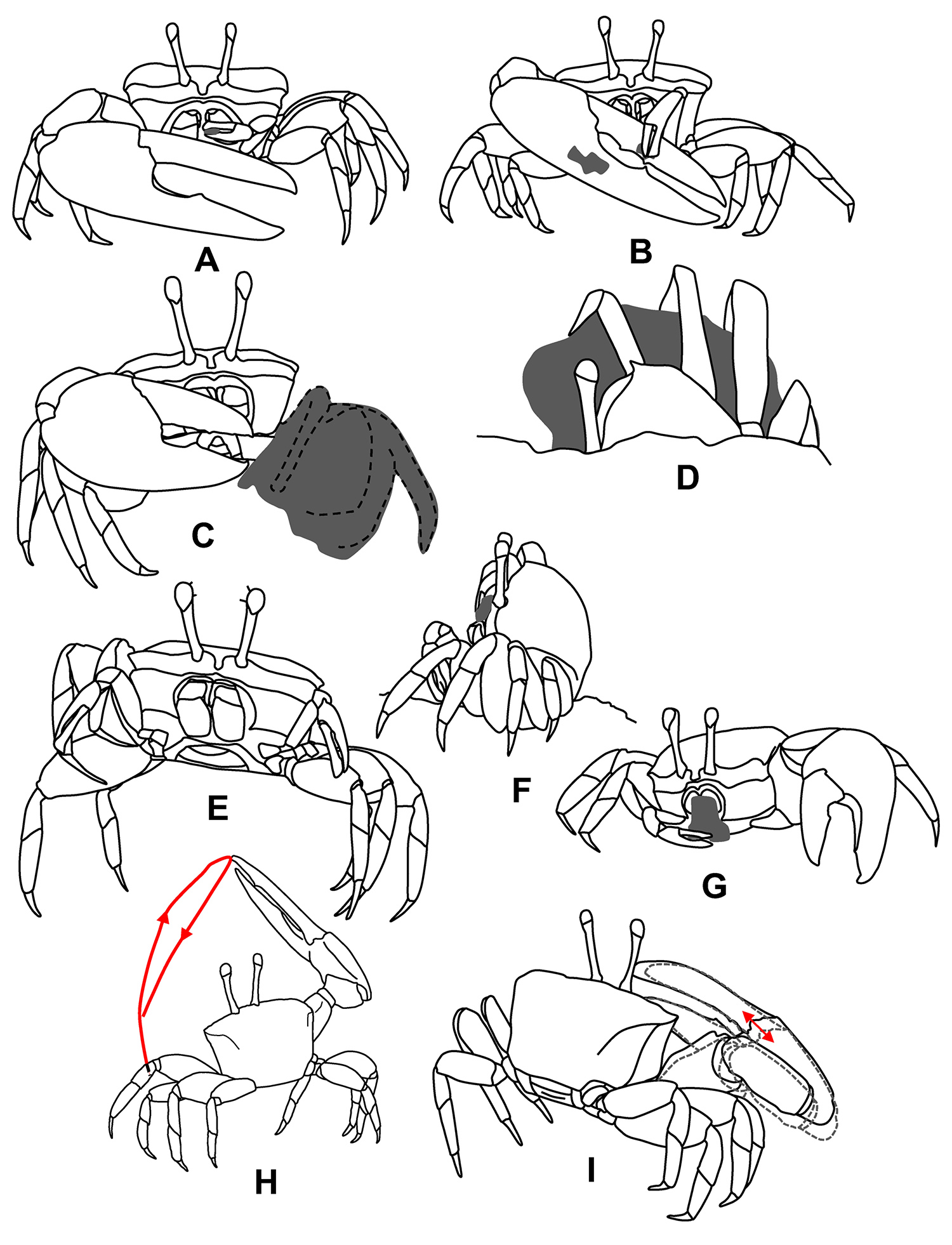
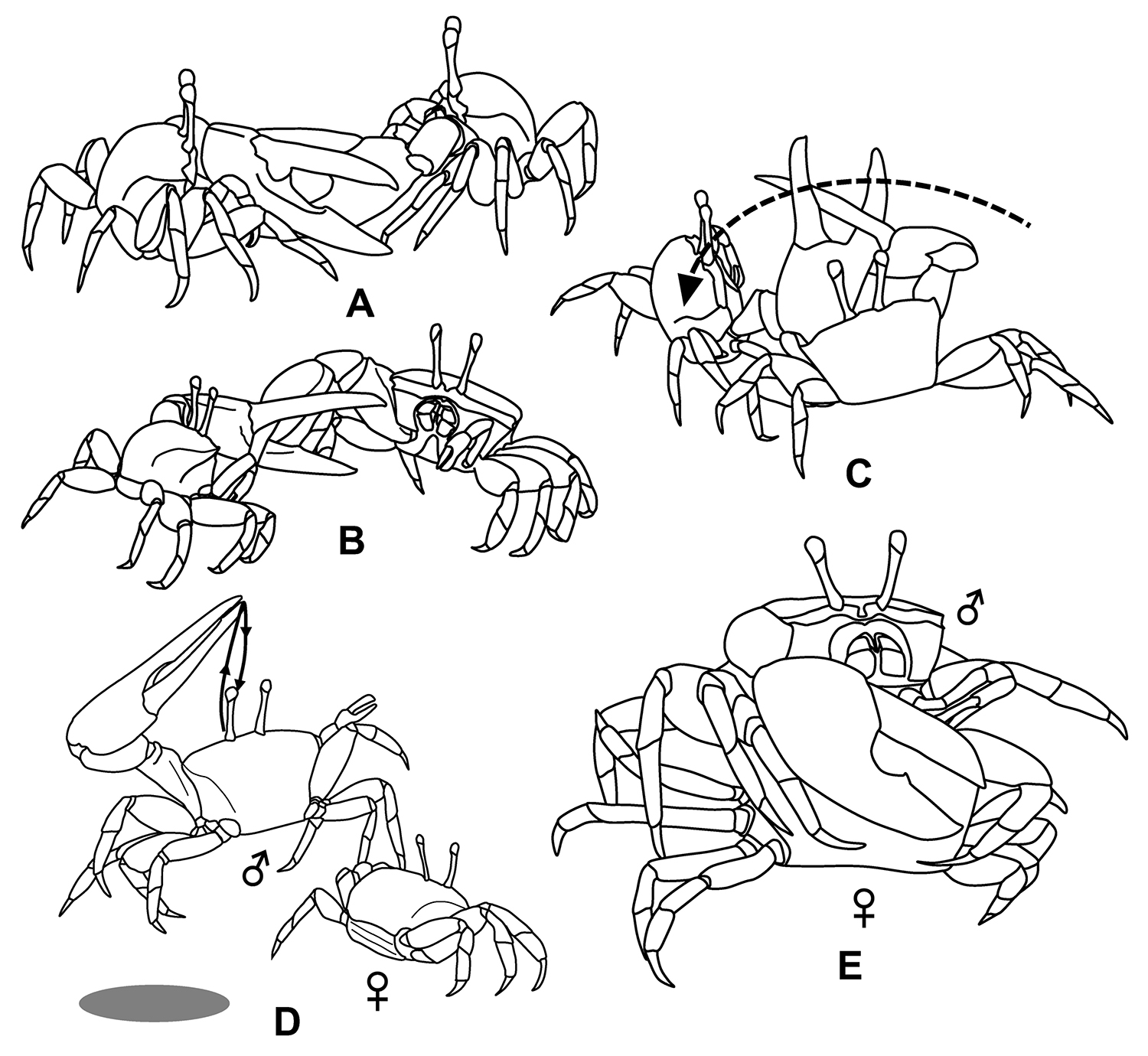
After analyzing the behavioral videos of X. formosensis, we identified a total of 20 distinct behaviors, which were subsequently categorized into three types (Tab. 1). These behaviors are described and accompanied by illustrations (Figs. 3, 4) or photographs (Fig. 5). Non-social behaviors are defined as those occurring frequently without a specific timing or audience; they include feeding, moving, grooming, burrowing, plugging, posing, water-sponging, and water-dumping. Agonistic behaviors involve interactions related to aggression and defense, including major chela waving, major chela quivering, approaching, retreating, touching, pushing, grappling, and flicking. Mating behaviors pertain to pairing and courtship, which include waving, major chela quivering, herding, copulating, chimney building, and pyramid building.

Schematic line drawings for behaviors of Xeruca formosensis. (A) Foraging. (B) Grooming. (C) Burrowing. (D) Plugging. (E) Posing. (F) Water-sponging. (G) Water-dumping. (H) Waving. (I) Quivering of the major cheliped. Solid color patches in B, C, D, F and G represent the substrate (mud). Red arrows in H and I depict the moving pathway of the major cheliped.

Schematic line drawings for behaviors of Xeruca formosensis. (A) Touching and pushing. (B) Grappling. (C) Flicking, with the dashed arrow showing the flicking pathway. (D) Herding, with the solid arrow and solid ellipse showing the waving pathway and the position of burrow entrance respectively. (E) Copulating.
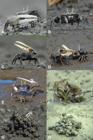
Photographs of Xeruca formosensis. (A) Male. (B) Female. (C) Type I waving. (D) Grappling. (E) Type II waving and herding. (F) Surface copulating. (G) Chimney building. (H) Pyramid building.
Two types of waving
The results showed that the waving behavior of X. formosensis is characterized by vertical waving, where the major chela is slowly lifted and quickly dropped without any pause at the apex. Major chela waving can be divided into two types based on audience and accompanying stereotypical movements. In Type I, there was no specific audience and the action only involved body lifting as a stereotypical movement. In Type II, the waving was displayed exclusively toward females and was accompanied by the waving of minor chela, the elevation of the body, and the raising of the second pair of walking legs as stereotypical movements. Further analyses of the quantitative data for the two types of waving revealed that in single waving duration, Type I was measured to be 0.95 ± 0.01 s, while Type II was 1.06 ± 0.01 s. Type II was significantly longer than Type I (ANOVA: F = 81.82, df = 800, p < 0.001, Fig. 6A). For waving interval, Type I had intervals of 5.77 ± 0.54 s, whereas Type II had those of 4.05 ± 0.16 s. Type I was significantly longer than Type II (ANOVA: F = 9.44, df = 764, p = 0.002, Fig. 6B). Regarding waving angle, Type I had angles of 46.57 ± 3.38°, while Type II had angles of 23.28 ± 2.00°. Type I exhibited a significantly greater value than Type II (ANOVA: F = 35.18, df = 67, p < 0.001, Fig. 6C). For body elevation amplitude, Type I had amplitudes of 18.83 ± 1.73%, and Type II had amplitudes of 19.01 ± 0.88%. There was no significant difference between the two types (ANOVA: F = 0.01, df = 60, p = 0.92, Fig. 6D).

Comparisons between Type I and Type II waving. (A) Duration of a single waving. (B) Interval between two wavings. (C) Waving angle. (D) Amplitude of body lifting. ***, p < 0.001 in ANOVA; NS (not significant), p > 0.05 in ANOVA.
Sequences of agonistic behaviors
After analyzing 14 videos of the agonistic behaviors, we identified a total of 6 agonistic behaviors (approaching, retreating, waving, touching, pushing, grappling) and 3 non-social behaviors (water-dumping, grooming, feeding), as well as the result of χ2 test (Tab. 2) by combining the frequency table. A χ2 test of independence revealed a significant deviation from independence (χ2 = 338.30, df = 64, p < 0.001). In Table 2, if the observed value was higher than the expected values and the χ2 test result was significant, it indicated a higher correlation among these behaviors. Consequently, the following behavioral sequences can be concluded: (1) One individual’s approaching leads to the retreating of another (χ2 = 12.95, p < 0.001). (2) One individual’s retreating triggers another to approach (χ2 = 30.72, p < 0.001). (3) One individual’s waving leads to the waving of another (χ2 = 25.47, p < 0.001). (4) One individual engaging in touching behavior result in a touching back from another (χ2 = 36.61, p < 0.001). (5) Both individuals pushing each other often causes constant pushing (χ2 = 60.75, p < 0.001) or escalates into more intense grappling (χ2 = 15.07, p < 0.001). Major chela quivering and flicking in agonistic interactions were not included in the comparison because the former occurred infrequently, and the latter was only observed in interspecific interactions between X. formosensis and the sympatric species Tubuca arcuata (De Haan, 1835).
Combination of contingency tables of agonistic and accompanying non-social behavioral elements between the attacker (vertical column) and the victim (horizontal column). The values shown are the observed results with the expected value in parentheses. Values in bold represent statistically significant based on the χ2 test result.
DISCUSSION
Ethogram of Xeruca formosensis
Based on our results, a comprehensive ethogram of X. formosensis was established, comprising 20 behavioral elements categorized into three types (Tab. 1). The ethogram may serve as an important reference for subsequent behavioral analysis and discrimination, preventing behavioral identification from becoming ambiguous (Ghaskadbi et al., 2016). Ethograms have been widely studied across various taxa, such as mammals (McDonnell and Poulin, 2002), birds (Schleidt et al., 1984), fish (Clayton and Vaughan, 1988), and crabs (Hyatt and Salmon, 1978; Karplus et al., 1998). In addition, it can be further applied to research on relevant topics, such as assessing the response levels to stimuli in amphibians (Meza-Parral et al., 2020), exploring social behaviors in ant colonies (Wilson, 1976), analyzing behavioral evolution among tortoise populations (Ruby and Niblick, 1994), and planning conservation management programs (Gokula, 2011). These applications support the wide applicability of the ethogram.
Other studies have shown that anthropogenic disturbances can influence the behaviors of crabs. For instance, male fiddler crabs, L. pugilator, have been observed to decrease their waving time under conditions of higher anthropogenic disturbance. As the waving behaviors of fiddler crabs are associated with mating and social behaviors, such disturbance indirectly has negative impacts on mating success and interspecific interactions (DiNuzzo et al., 2020). In the case of ghost crabs, Ocypode cordimanaLatreille, 1818 showed significantly fewer burrows in high intertidal zones on urban beaches compared to non-urban beaches (Barros, 2001). Moreover, Ocypode saratan (Forskål, 1775), inhabiting beaches with more tourists, constructs fewer and lower pyramids, which serve as reproductive signals for female crabs (Yosef et al., 2022). In such circumstances, ethograms can be used to evaluate whether a population is influenced by external factors by observing the completeness of behaviors, especially reproductive behaviors.
Two types of waving
When comparing the two types of waving, Type I waving does not target a specific audience, and the accompanying stereotypical movements simply involve elevating the body. It has a shorter waving duration (Fig. 6A), a longer waving interval with significant individual variation (Fig. 6B), and a larger waving angle (Fig. 6C), which visually appears “strong and fast”. On the other hand, Type II waving is specifically directed towards females of the same species. The accompanying stereotypical movements include elevating the body, waving the minor chela as well as the major chela, and lifting the second pair of walking legs (Figs. 4D, 5E). It has a longer waving duration (Fig. 6A), a shorter and more consistent waving interval (Fig. 6B), and a narrower waving angle (Fig. 6C), which visually appears “continuous and complex”.
The narrow-fronted (NF) X. formosensis has close phylogenetic relationship with other NF genera (Tubuca and Gelasimus) in the Indo-West Pacific (Shih et al., 2016). To further understand the behavior of X. formosensis, we reviewed other studies on the chela-waving behavior, accompanied stereotypical movements, and behavioral ecology of Tubuca and Gelasimus. (1) Waving mode: X. formosensis and the other two NF genera all exhibit the typical vertical waving, although a few species (e.g., Tubuca longidigitum (Kingsley, 1880) and Gelasimus hesperiae (Crane, 1975)) have additional semi-lateral waving (Crane, 1975). (2) Waving stages: All genera basically show lifting and finally dropping. Some species (e.g., Tubuca coarctata (H. Milne Edwards, 1852) and Tubuca rosea (Tweedie, 1937)) pause at apex (Crane, 1975). The lifting and dropping stages may include jerking (only in Tubuca species, but absent in Gelasimus species). The waving in X. formosensis involves slow lifting and rapid dropping, without jerking or pause at apex. The movements are similar to the majority of species in the other two NF genera. (3) Movements of body parts other than the major cheliped: In both types of waving performed by X. formosensis, the body is elevated. In Type II waving of X. formosensis, there are additional movements such as waving the minor chela and lifting the second pair of walking legs (Figs. 4D, 5E), making the waving process more complex. Among the other two NF genera, elevating the body is the most common characteristic movement. Additionally, there is the behavior of lifting the minor chela without additional movement (e.g., T. arcuata and Tubuca seismella (Crane, 1975)) (Crane, 1975; Booksmythe et al., 2008), and lifting the anterior two or three pairs of walking legs (e.g., Tubuca demani (Ortmann, 1897)) (Crane, 1975). However, the waving of the minor chela seen in X. formosensis was not mentioned in the studies of these two NF genera, but observed in the broad-fronted Austruca perplexa (H. Milne Edwards, 1852) instead (How et al., 2007). (4) Differences and functions of waving under different circumstances: The two types of waving can be found in X. formosensis, and more than one type can also be seen in some species of the other two NF genera. The waving behavior of most species in Tubuca and Gelasimus is considered to be associated with courtship (Crane, 1975; Murai, 1992; Murai et al., 1995; Goshima et al., 1996; Weis and Weis, 2004; Booksmythe et al., 2008; How and Hemmi, 2008; Detto and Backwell, 2009; How et al., 2009; Wada et al., 2011; Dyson and Backwell, 2016). Apart from attracting females, waving sometimes serves functions such as territory displaying or showing male quality. For example, male Tubuca elegans (George and Jones, 1982) employs different types of waving during courtship at different stages. Broadcast waving occurs when females are far away, and it is more conspicuous and often leads to fights between males. It is speculated that the function of this waving type is to attract distant females and assert territorial ranges. Another type of waving occurs during herding and is characterized by reduced, less conspicuous movements. This weaker form of waving may serve to avoid startling the nearby females due to their close proximity, or may result from the male being in constant motion during herding, which makes it difficult to perform full waving gestures (How and Hemmi, 2008). Type II waving in X. formosensis (Figs. 4D, 5E) is very similar to this type of waving in T. elegans, as both are directed towards females and exhibit reduced intensity. Tubuca arcuata also exhibits two types of waving: directed waving targeting females and undirected waving without a specific target. Males perform undirected waving when there are no females nearby, and they switch to directed waving, which increases the success rate of underground copulating when a female approaches. It is suggested that undirected waving functions to attract females far away, while directed waving serves courtship purposes (Wada et al., 2011).
Type II waving in X. formosensis occurs under specific circumstances and is directed exclusively towards females. It is additionally accompanied by stereotypical movements such as waving the minor chela and lifting the second pair of walking legs (Figs. 4D, 5E). The anterior two pairs (in some individuals, the first three pairs) of walking legs in X. formosensis have prominent white spots that contrast with the body color (Fig. 5E). Shih et al. (1999) mentioned that these white patches may aid in attracting females when males wave their backs at them. Similar behavior is described in a study on A. perplexa, where males raise their minor chelae and second pair of walking legs synchronously during lateral waving, and these movements enhance the visibility of individuals (How et al., 2007). However, these movements are not observed in waving used for territory display.
In our study, we suggest that X. formosensis exhibits two types of waving with different behavioral significance. It is hypothesized that Type I waving (Figs. 3H, 6C) represents a more intense and conspicuous signal, serving the purpose of territorial display like the broadcast waving in T. elegans and T. acuata (How and Hemmi, 2008; Wada et al., 2011). On the other hand, Type II waving (Figs. 4D, 5E) is more complex and continuous, used for courtship to increase the success rate of copulating as in T. elegans (How and Hemmi, 2008).
Sequences of agonistic behaviors
In the analysis of behavioral associations in X. formosensis, the significant result of the chi-square test suggested the strong associations between certain behavioral transitions. Considering each behavioral element, it was found that approaching and retreating were highly correlated and often occurred consecutively (Tab. 2). For male fiddler crabs, territory is crucial as it serves as both their feeding range and a region for courtship display (Fayed et al., 2008). From the perspective of another individual, approaching is seen as an intrusion into their territory. Consequently, X. formosensis often retreats in response to approaching. Rarely does the touching escalate to higher-intensity behaviors like pushing and grappling. This phenomenon may be explained by the “dear enemy effect”, where individuals engage in less aggressive behavior towards familiar neighbors (Temeles, 1994). Similar observations have been made in studies on Leptuca leptodactyla (Rathbun in Rankin, 1898) and L. uruguayensis, where high-intensity fights are almost non-existent between the two species and are unaffected by whether they are conspecific or not (Fogo et al., 2019). The same phenomenon has been observed in L. pugilator (Pratt and McLain, 2006), and Austruca occidentalis (Naderloo, Schubart and Shih, 2016) has even developed behaviors to assist neighbors in repelling intruders (Detto et al., 2010). Agonistic behaviors involving physical contact, in increasing order of intensity, include touching, pushing, grappling (Fig. 4A), and flicking (Figs. 4B, 5D). However, flicking is only observed in interactions between individuals of X. formosensis and T. arcuata (Chang, 2022). The occurrence of touching, pushing and grappling is highly correlated with the preceding stage (Tab. 2). Individuals of X. formosensis usually separate from each other after pushing, rarely engaging in grappling or doing so only for a short duration. However, its sympatric species, T. arcuata, is more prone to high-intensity agonistic behaviors (Chang, 2022), which may be related to species-specific characteristics that require further investigation. Waving may be elicited by the same behavior of another individual (Tab. 2), similar to synchronous waving. However, previous studies on Austruca mjoebergi (Rathbun, 1924) synchronous waving have shown common characteristics among species that exhibit this behavior, including small body size, high population density, and a simple waving pattern (Reaney et al., 2008; Perez et al., 2015; Harrison et al., 2021). Moreover, synchronous waving in those species is a byproduct of male competition for leadership during courtship. Except for a simple waving pattern, these conditions do not align with the characteristics of X. formosensis. Aside from territorial displaying, waving in X. formosensis may also signal individual quality to deter opponents (Muramatsu, 2011), thereby avoiding contact-based agonistic behaviors. This not only reduces the risk of injury but also conserves energy, resembling a type of ritualized combat (Crane, 1975).
CONCLUSIONS
Upon examination and analysis of the behavioral traits displayed by X. formosensis in the field, a total of 20 behaviors were identified. These were subsequently categorized into an ethogram, based on their type and function, and divided them into three main categories: non-social, agonistic, and mating behaviors. An intriguing observation was that chela waving was a common character across both agonistic and mating behaviors, with distinctions made between Type I and Type II. Type I waving, characterized by its rapid and pronounced movements, appears to function primarily as a display of territorial assertion. Conversely, Type II waving, distinguished by its continuity and complexity, is suggested to play a potential role in courtship behavior. The sequences of agonistic behaviors were determined through the analysis of contingency tables and χ2 statistical testing. Under anthropogenic disturbances, crab behaviors could be reduced in their repertories or become atypical. The results of our study on X. formosensis offer foundational ecological insights into this species and can be applied to evaluate the completeness of its behavioral repertoire. These findings not only enhance our understanding of the species’ social dynamics but also provide a critical reference point for future behavioral and conservation research involving intertidal crustaceans.
ACKNOWLEDGEMENTS
This study was supported by a grant from the National Science and Technology Council (NSTC 112-2313-B-005-051-MY3), Executive Yuan, Taiwan, to HTS. Thanks are also given to the Hsinchu City Government and the Forestry Bureau for their assistance with the application and approval of permits. Special thanks go to Ming-Yi Wu, Si Shih, Wei-Sien Chen, Yin-Ru Yang, Sin-De Yang, and Jyuan-Ru Cai for providing observation sites for X. formosensis. Members of HTS’s Lab are acknowledged for their help with fieldwork. We acknowledge two referees who greatly improved this manuscript.
REFERENCES
-
Abràmoff, MD; Magalhães, PJ and Ram, SJ. 2004. Image processing with ImageJ. Biophotonics International, 11(7): 36-42. https://imagej.net/ij/docs/pdfs/Image_Processing_with_ImageJ.pdf
» https://imagej.net/ij/docs/pdfs/Image_Processing_with_ImageJ.pdf -
Baker I, O’Brien J, McHugh K and Berrow S 2017. An ethogram for bottlenose dolphins (Tursiops truncatus) in the Shannon Estuary, Ireland. Aquatic Mammals, 43(6): 594-613. https://research.thea.ie/handle/20.500.12065/2312
» https://research.thea.ie/handle/20.500.12065/2312 -
Bamber JA, Shuttleworth CM and Hayward MW 2020. Do differing levels of boldness influence the success of translocation? A pilot study on red squirrels (Sciurus vulgaris). Animals, 10(10): 1748. https://doi.org/10.3390/ani10101748
» https://doi.org/10.3390/ani10101748 -
Barros F 2001. Ghost crabs as a tool for rapid assessment of human impacts on exposed sandy beaches. Biological Conservation, 97(3): 399-404. https://doi.org/10.1016/S0006-3207(00)00116-6
» https://doi.org/10.1016/S0006-3207(00)00116-6 -
Bateson M and Martin P 2021. Measuring Behaviour: An Introductory Guide. Cambridge, Cambridge University Press, 246p. https://doi.org/10.1017/9781108776462
» https://doi.org/10.1017/9781108776462 -
Booksmythe I, Detto T and Backwell PRY 2008. A field guide to the fiddler crabs of East Point Reserve, Darwin, Northern Territory. Northern Territory Naturalist, 20: 26-33. https://search.informit.org/doi/10.3316/informit.339970914600148
» https://search.informit.org/doi/10.3316/informit.339970914600148 -
Booksmythe I, Jennions MD and Backwell PRY 2010. Investigating the ‘dear enemy’ phenomenon in the territory defense of the fiddler crab, Uca mjoebergi Animal Behaviour, 79(2): 419-423. https://doi.org/10.1016/j.anbehav.2009.11.020
» https://doi.org/10.1016/j.anbehav.2009.11.020 - Bosc LAG 1801. Histoire Naturelle des Crustacés, Contenant leur Description et leurs Moeurs; avec Figures Dessinées d’Après Nature. Tome premier. Suite à Boffon, Paris. Deterville, Paris. 258p.
-
Callander S, Bolton J, Jennions MD and Backwell PRY 2012. A farewell to arms: Males with regenerated claws fight harder over resources. Animal Behaviour, 84(3): 619-622. https://doi.org/10.1016/j.anbehav.2012.06.017
» https://doi.org/10.1016/j.anbehav.2012.06.017 - Chang K 2022. Ethogram and social behaviors of the Taiwanese fiddler crab Xeruca formosensis Taichung, Taiwan, National Chung Hsing University, Master’s thesis, 65p. [Unpublished; in Chinese] Available at https://hdl.handle.net/11296/y8kwkx. Accessed on 15 Dec 2025.
-
Chang K, Zhang YC, Hsu JW, Shih HT, Shih CH and Hsu HL 2023. Distribution and population size of Taiwanese fiddler crab Xeruca formosensis National Park Journal, 33(1): 1-10. [In Chinese] https://tpl.ncl.edu.tw/NclService/JournalContentDetail?SysId=A2023017437
» https://tpl.ncl.edu.tw/NclService/JournalContentDetail?SysId=A2023017437 -
Chatterjee S, Mazumdar D and Chakraborty SK 2014. Ecological role of fiddler crabs (Uca spp.) through bioturbatory activities in the coastal belt of East Midnapore, West Bengal, India. Journal of the Marine Biological Association of India, 56(2): 1-25. https://www.mbai.org.in/jmbai-details/MjMyNg==/MTEx
» https://www.mbai.org.in/jmbai-details/MjMyNg==/MTEx -
Chumsri A, Tina FW, Vongkok A, Chinnanon M, Chuaytanee N, Angajchariya A and Sujarit C 2023. Human disturbance affects behavioural time allocation in a fiddler crab (Austruca annulipes) in Southern Thailand. Journal of Animal Behaviour and Biometeorology , 11(3): e2023025. https://doi.org/10.31893/jabb.23025
» https://doi.org/10.31893/jabb.23025 - Clayton DA and Vaughan TC 1988. Ethogram of Boleophthalmus boddarti (Pallas) (Teleostei, Gobiidae), a mudskipper found on the mudflats of Kuwait. Kuwait Journal of Science, 15: 115-140.
-
Colpo KD and Jiménez LMR 2023. Changes in the activity budget of the fiddler crab Leptuca uruguayensis throughout the reproductive period in temperate estuaries. Zoology, 159: 126104. https://doi.org/10.1016/j.zool.2023.126104
» https://doi.org/10.1016/j.zool.2023.126104 - Crane J 1975. Fiddler Crabs of the World (Ocypodidae: Genus Uca). New Jersey, Princeton University Press. 766p.
- De Haan, W 1833-1850. Crustacea. i-xxxi, ix-xvi, 1-243, pls. A-J, L-Q, 1-55. In: von Siebold, PF (Ed.), Fauna Japonica sive Descriptio Animalium, quae in Itinere per Japoniam, Jussu et Auspiciis Superiorum, qui Summum in India Batava Imperium Tenent, Suscepto, Annis 1823-1830 Collegit, Notis, Observationibus et Adumbrationibus Illustravit. Lugduni-Batavorum.
-
Dembowski JB. 1926. Notes on the behavior of the fiddler crab. The Biological Bulletin, 50(3): 179-201. https://doi.org/10.2307/1536668
» https://doi.org/10.2307/1536668 -
Detto T 2007. The fiddler crab Uca mjoebergi uses colour vision in mate choice. Proceedings of the Royal Society of London, Series B, 274(1627): 2785-2790. https://doi.org/10.1098/rspb.2007.1059
» https://doi.org/10.1098/rspb.2007.1059 -
Detto T and Backwell PRY 2009. Social monogamy in a fiddler crab, Uca capricornis Journal of Crustacean Biology, 29(1): 283-289. https://doi.org/10.1651/08-3126.1
» https://doi.org/10.1651/08-3126.1 -
Detto T, Jennions MD and Backwell PRY 2010. When and why do territorial coalitions occur? Experimental evidence from a fiddler crab. American Naturalist, 175(5): E119-E125. https://doi.org/10.1086/651588
» https://doi.org/10.1086/651588 -
DiNuzzo ER, Anderson III L, Walker A, Sasso HK Christensen B and Griffen BD 2020. Human influences on male waving behavior in the fiddler crab Leptuca pugilator Marine and Freshwater Behaviour and Physiology, 53(2): 43-57. https://doi.org/10.1080/10236244.2020.1758561
» https://doi.org/10.1080/10236244.2020.1758561 -
Donaldson WE and Adams AE 1989. Ethogram of behavior with emphasis on mating for the Tanner crab Chionoecetes bairdi Rathbun. Journal of Crustacean Biology, 9(1): 37-53. https://doi.org/10.1163/193724089X00188
» https://doi.org/10.1163/193724089X00188 -
Dyson ML and Backwell PRY 2016. Alternative mating tactics and male mating success in two species of fiddler crab. Behaviour, 153(2): 1403-1418. https://doi.org/10.1163/1568539X-00003386
» https://doi.org/10.1163/1568539X-00003386 -
Fayed SA, Jennions MD and Backwell PRY 2008. What factors contribute to an ownership advantage? Biology Letters, 4(2): 143-145. https://doi.org/10.1098/rsbl.2007.0534
» https://doi.org/10.1098/rsbl.2007.0534 -
Fogo BR, Sanches FH and Costa TM 2019. Testing the dear enemy relationship in fiddler crabs: Is there a difference between fighting conspecific and heterospecific opponents? Behavioural Processes, 162: 90-96. https://doi.org/10.1016/j.beproc.2019.02.001
» https://doi.org/10.1016/j.beproc.2019.02.001 - Forskål P 1775. Descriptiones Animalium, Avium, Amphibiorum, Piscium, Insectorum, Vermium; quae in Itinere Orientali Observavit Petrus Forskål. Post Mortem Auctoris editit Carsten Niebuhr. Adjuncta est materia Medica Kahirina. Mölleri, Hafniae. 19 + xxxiv + 164p.
- George RW and Jones DS 1982. A revision of the fiddler crabs of Australia (Ocypodinae: Uca). Records of the Western Australian Museum, Supplement, 14: 1-99.
-
Ghaskadbi P, Habib B and Qureshi Q 2016. A whistle in the woods: An ethogram and activity budget for the dhole in central India. Journal of Mammalogy, 97(6): 1745-1752. https://doi.org/10.1093/jmammal/gyw141
» https://doi.org/10.1093/jmammal/gyw141 -
Gokula V 2011. An ethogram of spot-billed pelican (Pelecanus philippensis). Chinese Birds, 2(4): 183-192. https://doi.org/10.5122/cbirds.2011.0030
» https://doi.org/10.5122/cbirds.2011.0030 -
Goshima S, Koga T and Murai M 1996. Mate acceptance and guarding by male fiddler crabs Uca tetragonon (Herbst). Journal of Experimental Marine Biology and Ecology, 196(1-2): 131-143. https://doi.org/10.1016/0022-0981(95)00127-1
» https://doi.org/10.1016/0022-0981(95)00127-1 -
Greenspan BN 1980. Male size and reproductive success in the communal courtship system of the fiddler crab Uca rapax Animal Behaviour , 28(2): 387-392. https://doi.org/10.1016/S0003-3472(80)80047-9
» https://doi.org/10.1016/S0003-3472(80)80047-9 -
Gribsholt B, Kostka JE and Kristensen E 2003. Impact of fiddler crabs and plant roots on sediment biogeochemistry in a Georgia saltmarsh.Marine Ecology Progress Series, 259: 237-251. https://doi.org/10.3354/meps259237
» https://doi.org/10.3354/meps259237 -
Hammer Ø, Harper DA and Ryan PD 2001. PAST: Paleontological statistics software package for education and data analysis. Palaeontologia Electronica, 4(1):1-9. https://palaeo-electronica.org/2001_1/past/issue1_01.htm
» https://palaeo-electronica.org/2001_1/past/issue1_01.htm -
Harrison LM, Melo GC, Perez DM and Backwell PRY 2021. Why signal if you are not attractive? Courtship synchrony in a fiddler crab. Behavioral Ecology, 32(6): 1224-1229. https://doi.org/10.1093/beheco/arab088
» https://doi.org/10.1093/beheco/arab088 -
How MJ and Hemmi JM 2008. Courtship herding in the fiddler crab Uca elegans Journal of Comparative Physiology A, 194: 1053-1061. https://doi.org/10.1007/s00359-008-0376-5
» https://doi.org/10.1007/s00359-008-0376-5 -
How MJ, Zeil J and Hemmi JM 2007. Differences in context and function of two distinct waving displays in the fiddler crab, Uca perplexa (Decapoda: Ocypodidae).Behavioral Ecology and Sociobiology , 62: 137-148. https://doi.org/10.1007/s00265-007-0448-5
» https://doi.org/10.1007/s00265-007-0448-5 -
How MJ, Zeil J and Hemmi JM 2009. Variability of a dynamic visual signal: the fiddler crab claw-waving display. Journal of Comparative Psychology, 195: 55-67. https://doi.org/10.1007/s00359-008-0382-7
» https://doi.org/10.1007/s00359-008-0382-7 - Howe M, Castellote M, Garner C, McKee P, Small RJ and Hobbs R 2015. Beluga, Delphinapterus leucas, ethogram: a tool for Cook Inlet beluga conservation. Marine Fisheries Review, 77(1): 32-40.
-
Hyatt GW and Salmon M 1978. Combat in the fiddler crabs Uca pugilator and U. pugnax: A quantitative analysis. Behaviour, 65(1-2): 182-211. https://doi.org/10.1163/156853978X00602
» https://doi.org/10.1163/156853978X00602 -
Iglesia HO de la, Rodríguez EM and Dezi RE 1994. Burrow plugging in the crab Uca uruguayensis and its synchronization with photoperiod and tides. Physiology & Behavior, 55(5): 913-919. https://doi.org/10.1016/0031-9384(94)90079-5
» https://doi.org/10.1016/0031-9384(94)90079-5 - Jansen P 1970. Physiologisch-okologisch Untersuchungen zum “Posen” von Uca tangeri Forma et Functio, 2: 58-100.
- Karplus I, Fiedler GC and Ramcharan P 1998. The intraspecific fighting behavior of the Hawaiian boxer crab, Lybia edmondsoni fighting with dangerous weapons? Symbiosis, 24: 287-302.
- Kingsley JS 1880. Carcinological notes, no. II.- Revision of the Gelasimi Proceedings of the Academy of Natural Sciences of Philadelphia, 32(1-2 ): 135-155.
- Latreille PA 1818. Ocypode, Ocypode Fab. Nouveaux Dictionaire d’Histoire Naturelle, appliquee aux arts, à l’Agriculture, à l’’economie rurale et domestique, à la Medicine, etc. Par une Societe de Naturalistes et d’agriculteurs Nouvelle Edition 23: 194-199.
- Lehner PN 1998. Handbook of Ethological Methods 2nd edition. New York, Cambridge University Press, 694p.
- Li SY 1991. Ecology and behavior of Uca formosensis in Taiwan. Kaohsiung, Taiwan, National Sun Yat-Sen University, Master’s thesis, 58p. [Unpublished; in Chinese] Available at https://hdl.handle.net/11296/545462. Accessed on 15 Dec 2025.
-
Liao SW, Chang WL and Lin SW 2008. Status and habitat preferences for endemic inhabitants of fiddler crab Uca formosensis in Hsiang-Shan wetland, Taiwan. Environmental Monitoring and Assessment, 143: 203-214. https://doi.org/10.1007/s10661-007-9969-7
» https://doi.org/10.1007/s10661-007-9969-7 -
Maitland DP 1990. Carapace and branchial water circulation, and water-related behaviours in the semaphore crab Heloecius cordiformis (Decapoda: Brachyura: Ocypodidae). Marine Biology, 105: 275-286. https://doi.org/10.1007/BF01344297
» https://doi.org/10.1007/BF01344297 -
Matsuoka T and Suzuki H 2011. Setae for gill-cleaning and respiratory-water circulation of ten species of Japanese ocypodid crabs. Journal of Crustacean Biology , 31(1): 9-25. https://doi.org/10.1651/10-3339.1
» https://doi.org/10.1651/10-3339.1 -
McCullough EL, Chou CC and Backwell PRY 2020. Cost of an elaborate trait: a trade-off between attracting females and maintaining a clean ornament. Behavioral Ecology , 31(5): 1218-1223. https://doi.org/10.1093/beheco/araa072
» https://doi.org/10.1093/beheco/araa072 -
McDonnell SM and Poulin A 2002. Equid play ethogram. Applied Animal Behaviour Science , 78(2-4): 263-290. https://doi.org/10.1016/S0168-1591(02)00112-0
» https://doi.org/10.1016/S0168-1591(02)00112-0 -
Meza-Parral Y, García-Robledo C, Pineda E, Escobar F and Donnelly MA 2020. Standardized ethograms and a device for assessing amphibian thermal responses in a warming world. Journal of Thermal Biology, 89: 102565. https://doi.org/10.1016/j.jtherbio.2020.102565
» https://doi.org/10.1016/j.jtherbio.2020.102565 -
Miller DC 1961. The feeding mechanism of fiddler crabs, with ecological considerations of feeding adaptations. Zoologica, 46(8): 80-101. https://biostor.org/reference/194076
» https://biostor.org/reference/194076 - Milne Edwards H 1852. Observations sur les affinités zoologiques et la classification naturelle des crustacés. Annales des Sciences Naturelles, Zoologie, ser. 3, 18: 109-166.
- Mokhlesi A, Kamrani E, Backwell PRY and Sajjadi M 2011. Sexual differences in foraging behavior of fiddler crab, Uca sindensis (Decapoda: Ocypodidae). Journal of the Persian Gulf (Marine Science), 2(6): 37-44.
-
Mokhtari M, Abd Ghaffar M, Usup G and Che Cob Z 2016. Effects of fiddler crab burrows on sediment properties in the mangrove mudflats of Sungai Sepang, Malaysia.Biology, 5(1): 7. https://doi.org/10.3390/biology5010007
» https://doi.org/10.3390/biology5010007 -
Mowles SL, Jennions MD and Backwell PRY. 2017. Multimodal communication in courting fiddler crabs reveals male performance capacities. Royal Society Open Science, 4(3): 161093. https://doi.org/10.1098/rsos.161093
» https://doi.org/10.1098/rsos.161093 -
Murai M 1992. Courtship activity of wandering and burrow‐holding male Uca arcuata Ethology, 92(2): 124-134. https://doi.org/10.1111/j.1439-0310.1992.tb00953.x
» https://doi.org/10.1111/j.1439-0310.1992.tb00953.x -
Murai M, Henmi Y, Matsumasa M, Backwell PRY and Takeshita F 2022. Attraction waves of male fiddler crabs: A visual display designed for efficacy. Journal of Experimental Marine Biology and Ecology , 546: 151665. https://doi.org/10.1016/j.jembe.2021.151665
» https://doi.org/10.1016/j.jembe.2021.151665 -
Murai M, Koga T, Goshima S and Poovachiranon S 1995. Courtship and the evolution of underground mating in Uca tetragonon (Decapoda: Ocypodidae). Journal of Crustacean Biology , 15(4): 655-658. https://doi.org/10.1163/193724095X00055
» https://doi.org/10.1163/193724095X00055 -
Muramatsu D 2011. The function of the four types of waving display in Uca lactea: effects of audience, sand structure, and body size. Ethology, 117(5): 408-415. https://doi.org/10.1111/j.1439-0310.2011.01884.x
» https://doi.org/10.1111/j.1439-0310.2011.01884.x -
Naderloo R, Schubart CD and Shih HT 2016. Genetic and morphological separation of Uca occidentalis, a new East African fiddler crab species, from Uca annulipes (H. Milne Edward, 1837) (Crustacea: Decapoda: Brachyura: Ocypodidae). Zoologischer Anzeiger-A Journal of Comparative Zoology, 262: 10-19. https://doi.org/10.1016/j.jcz.2016.03.010
» https://doi.org/10.1016/j.jcz.2016.03.010 - Nobili G 1901. Decapodi raccolti dal Dr. Filippo Silvestri nell’America meridionale. Bollettino dei Musei di Zoologia ed Anatomia Comparata della Regia, Università di Torino, 16(402): 1-16.
- Ortmann AE 1897. Carcinologische Studien. Zoologische Jahrbücher, Abteilung für Systematik, Geographie und Biologie der Thiere, 10(3): 258-372.
-
Pardo JC, Stefanelli-Silva G, Christy JH and Costa TM 2020. Fiddler crabs and their above-ground sedimentary structures: a review. Journal of Ethology , 38: 137-154. https://doi.org/10.1007/s10164-020-00647-1
» https://doi.org/10.1007/s10164-020-00647-1 -
Perez DM, Heatwole SJ, Morrell LJ and Backwell PRY 2015. Handedness in fiddler crab fights. Animal Behaviour , 110: 99-104. https://doi.org/10.1016/j.anbehav.2015.09.012
» https://doi.org/10.1016/j.anbehav.2015.09.012 -
Pratt AE and McLain DK 2006. How dear is my enemy: Intruder-resident and resident-resident encounters in male sand fiddler crabs (Uca pugilator). Behaviour, 143(5): 597-617. https://doi.org/10.1163/156853906776759501
» https://doi.org/10.1163/156853906776759501 - Randall JW 1840. Catalogue of the Crustacea brought by Thomas Nutall and J.K. Townsend, from the West Coast of North America and the Sandwich Islands, with descriptions of such species as are apparently new, among which are included several species of different localities, previously existing in the collection of the Academy. Journal of the Academy of Natural Sciences at Philadelphia, 8: 106-147.
- Rankin WM 1898. The Northrop collection of Crustacea from the Bahamas. Annals of the New York Academy of Science, 11(12): 225-258.
- Rathbun MJ 1921. New species of crabs from Formosa. Proceedings of the Biological Society of Washington, 34: 155-156.
- Rathbun MJ 1924. New species and subspecies of spider crabs. Proceedings of the United States National Museum, 64(2504): 1-5.
- Rathbun MJ 1924. Results of Dr. E. Mjöberg’s Swedish scientific expeditions to Australia 1910-1913. 37. Brachyura, Albuneidae and Porcellanidae. Arkiv för Zoologi Utgivet av Kungliga Svenska Vetenskapsakademien, 16(23): 1-33.
-
Reaney LT, Sims RA, Sims SW, Jennions MD and Backwell PRY 2008. Experiments with robots explain synchronized courtship in fiddler crabs. Current Biology, 18(2): R62-R63. https://doi.org/10.1016/j.cub.2007.11.047
» https://doi.org/10.1016/j.cub.2007.11.047 -
Rodriguez GB, Costa TM, Culot L and Sobral G 2024. Fiddler crabs from highly disturbed beaches are more sensitive to human presence. Anais da Academia Brasileira de Ciências, 96(3): e20230675. https://doi.org/10.1590/0001-3765202420230675
» https://doi.org/10.1590/0001-3765202420230675 -
Ruby DE and Niblick HA 1994. A behavioral inventory of the desert tortoise: development of an ethogram. Herpetological Monographs, 8: 88-102. https://doi.org/10.2307/1467073
» https://doi.org/10.2307/1467073 -
Salmon M 1984. The courtship, aggression and mating system of a “primitive” fiddler crab (Uca vocans: Ocypodidae). Transactions of the Zoological Society of London, 37: 1-50. https://doi.org/10.1111/j.1096-3642.1984.tb00067.x
» https://doi.org/10.1111/j.1096-3642.1984.tb00067.x -
Schleidt WM, Yakalis G, Donnelly M and McGarry J 1984. A proposal for a standard ethogram, exemplified by an ethogram of the bluebreasted quail (Coturnix chinensis). Zeitschrift für Tierpsychologie, 64: 193-220. https://doi.org/10.1111/j.1439-0310.1984.tb00360.x
» https://doi.org/10.1111/j.1439-0310.1984.tb00360.x -
Schöne H 1968. Agonistic and sexual display in aquatic and semi-terrestrial brachyuran crabs.American Zoologist, 8(3): 641-654. https://doi.org/10.1093/icb/8.3.641
» https://doi.org/10.1093/icb/8.3.641 - Shih HT 1994. Fiddler Crabs Pingtung, Taiwan, National Museum of Marine Biology & Aquarium. 190p. [In Chinese]
- Shih HT 1999. Systematics of Uca formosensis Rathbun, 1921 (Crustacea: Decapoda: Ocypodidae), an Endemic Fiddler Crab from Taiwan, based on Morphological, Genetic and Ecological Evidence. Kaohsiung, Taiwan, National Sun Yat-sen University, Doctoral dissertation, 165p. [Unpublished; in Chinese] Available at https://hdl.handle.net/11296/83j38v. Accessed on 15 Dec 2025.
-
Shih HT and Mok HK 2000. ETHOM: Event-recording computer software for the study of animal behavior. Acta Zoologica Taiwanica, 11(1): 47-61. https://doi.org/10.6576/AZT.2000.11.(1).4
» https://doi.org/10.6576/AZT.2000.11.(1).4 -
Shih HT, Mok HK and Chang HW. 2005. Chimney building by male Uca formosensis Rathbun, 1921 (Crustacea: Decapoda: Ocypodidae) after pairing: a new hypothesis for chimney function. Zoological Studies, 44(2): 242-251. https://zoolstud.sinica.edu.tw/issue.php?id=1490
» https://zoolstud.sinica.edu.tw/issue.php?id=1490 -
Shih HT, Mok HK, Chang HW and Lee SC 1999. Morphology of Uca formosensis Rathbun, 1921 (Crustacea: Decapoda: Ocypodidae), an endemic fiddler crab from Taiwan, with notes on its ecology. Zoological Studies , 38(2): 164-177. https://zoolstud.sinica.edu.tw/issue.php?id=1778
» https://zoolstud.sinica.edu.tw/issue.php?id=1778 -
Shih HT, Ng PKL, Davie PJF, Schubart CD, Türkay M, Naderloo R, Jones DS and Liu MY 2016. Systematics of the family Ocypodidae Rafinesque, 1815 (Crustacea: Brachyura), based on phylogenetic relationships, with a reorganization of subfamily rankings and a review of the taxonomic status of Uca Leach, 1814, sensu lato and its subgenera. Raffles Bulletin of Zoology, 64: 139-175. https://lkcnhm.nus.edu.sg/wp-content/uploads/sites/11/app/uploads/2017/06/64rbz139-175.pdf
» https://lkcnhm.nus.edu.sg/wp-content/uploads/sites/11/app/uploads/2017/06/64rbz139-175.pdf -
Singh DS, Alkins-Koo M, Rostant LV and Mohammed A 2021. Behavioural repertory of juveniles of the freshwater crab Poppiana dentata (Randall 1840) under laboratory conditions. Ethology Ecology and Evolution , 34(1): 82-96. https://doi.org/10.1080/03949370.2021.1882581
» https://doi.org/10.1080/03949370.2021.1882581 -
Singh PB, Saud P, Jiang Z, Zhou Z, Hu Y and Hu H 2022. Himalayan musk deer (Moshcus leucogaster) behavior at latrine sites and their implications in conservation. Ecology and Evolution, 12(4): e8772. https://doi.org/10.1002/ece3.8772
» https://doi.org/10.1002/ece3.8772 -
Skov MW and Hartnoll RG 2001. Comparative suitability of binocular observation, burrow counting and excavation for the quantification of the mangrove fiddler crab Uca annulipes (H. Milne Edwards). Hydrobiologia, 449: 201-212. https://doi.org/10.1023/A:1017598616178
» https://doi.org/10.1023/A:1017598616178 -
Smart U, Deepak V and Vasudevan K 2014. Preliminary ethogram and in situ time-activity budget of the enigmatic cane turtle (Vijayachelys silvatica) from the western Ghats, south India. Herpetological Conservation and Biology, 9(1): 116-122. https://www.herpconbio.org/Volume_9/Issue_1/Smart_etal_2014.pdf
» https://www.herpconbio.org/Volume_9/Issue_1/Smart_etal_2014.pdf - Smith SI 1870. Notes on American Crustacea. Number I. Ocypodoidea. Transactions of the Connecticut Academy of Arts and Sciences, 2(1): 113-176.
- Takahashi S 1935. Ecological notes on the ocypodian crab (Ocypodidae) in Formosa, Japan. Annotationes Zoologicae Japonenses, 15(1): 78-87.
-
Takeda S 2003. Mass wandering in the reproductive season by the fiddler crab Uca perplexa (Decapoda: Ocypodidae). Journal of Crustacean Biology , 23(3): 723-728. https://doi.org/10.1651/C-2352
» https://doi.org/10.1651/C-2352 - Takeda M and Miyake S 1970. Lybia edmondsoni sp. nov., a new anemone crab from the Hawaiian Islands. Proceedings of the Japanese Society of Systematic Zoology, 6: 11-15.
-
Temeles E 1994. The role of neighbours in territorial systems: When are they “dear enemies”? Animal Behaviour , 47(2): 339-350. https://doi.org/10.1006/anbe.1994.1047
» https://doi.org/10.1006/anbe.1994.1047 -
Thomas CR and Blum LK 2010. Importance of the fiddler crab Uca pugnax to salt marsh soil organic matter accumulation.Marine Ecology Progress Series, 414: 167-177. https://doi.org/10.3354/meps08708
» https://doi.org/10.3354/meps08708 -
Thompson WE, Molinaro PJ, Greco TM, Tedeschi JB and Holliday CW 1989. Regulation of hemolymph volume by uptake of sand capillary water in desiccated fiddler crabs, Uca pugilator and Uca pugnax Comparative Biochemistry and Physiology Part A: Physiology, 94(3): 531-538. https://doi.org/10.1016/0300-9629(89)90134-5
» https://doi.org/10.1016/0300-9629(89)90134-5 -
Tina FW, Jaroensutasinee M and Jaroensutasinee K 2016. Sex and size affecting time allocations for activities in Uca annulipes (H. Milne Edwards, 1837). Crustaceana, 89(6-7): 759-773. https://doi.org/10.1163/15685403-00003555
» https://doi.org/10.1163/15685403-00003555 -
Tina FW, Jaroensutasinee M, Keeratipattarakarn K and Jaroensutasinee K 2018. Sex and burrow/chimney ownership affecting time allocation for surface activities in Uca rosea (Tweedie, 1937) (Brachyura, Ocypodidae). Crustaceana, 91(1): 51-62. https://doi.org/10.1163/15685403-00003731
» https://doi.org/10.1163/15685403-00003731 - Tweedie MWF 1937. On the crabs of the family Ocypodidae in the collection of the Raffles Museum. Bulletin of the Raffles Museum, 13: 140-170.
-
Wada K, Watanabe Y and Kamada M 2011. Function of vertical claw-waving in the fiddler crab Uca arcuata Journal of Crustacean Biology , 31(3): 413-415. https://doi.org/10.1651/10-3441.1
» https://doi.org/10.1651/10-3441.1 -
Weis JS and Weis P 2004. Behavior of four species of fiddler crabs, genus Uca, in southeast Sulawesi, Indonesia. Hydrobiologia, 523: 47-58. https://doi.org/10.1023/B:HYDR.0000033093.84155.1d
» https://doi.org/10.1023/B:HYDR.0000033093.84155.1d -
Weissburg M 1992. Functional analysis of fiddler crab foraging: Sex-specific mechanics and constraints in Uca pugnax (Smith). Journal of Experimental Marine Biology and Ecology , 156(1): 105-124. https://doi.org/10.1016/0022-0981(92)90019-7
» https://doi.org/10.1016/0022-0981(92)90019-7 -
Wilson EO 1976. A social ethogram of the neotropical arboreal ant Zacryptocerus varians (Fr. Smith). Animal Behaviour , 24(2): 354-363. https://doi.org/10.1016/S0003-3472(76)80043-7
» https://doi.org/10.1016/S0003-3472(76)80043-7 -
Wolcott TG 1976. Uptake of soil capillary water by ghost crabs. Nature, 264: 756-757. https://doi.org/10.1038/264756a0
» https://doi.org/10.1038/264756a0 -
Xiang H, Li K, Cao L, Zhang Z and Yang H 2020. Impacts of pollution, sex, and tide on the time allocations to behaviours of Uca arcuata in mangroves. Science of the Total Environment, 742: 140609. https://doi.org/10.1016/j.scitotenv.2020.140609
» https://doi.org/10.1016/j.scitotenv.2020.140609 -
Yamaguchi T 2000. Sexual differences in feeding by the fiddler crab, Uca lactea (De Haan). Crustacean Research, 29: 121-132. https://doi.org/10.18353/crustacea.29.0_121
» https://doi.org/10.18353/crustacea.29.0_121 -
Yamaguchi T and Tabata S 2005. Territory usage and defense of the fiddler crab, Uca lactea (De Haan) (Decapoda, Brachyura, Ocypodidae). Crustaceana, 77(9): 1055-1080. https://www.jstor.org/stable/20107415
» https://www.jstor.org/stable/20107415 -
Yosef R, Spivak V, Edelman S and Kosicki JZ 2022. Anthropogenic beach-activities influences the endemic Red Sea ghost crab (Ocypode saratan). Marine Policy, 138: 104986. https://doi.org/10.1016/j.marpol.2022.104986
» https://doi.org/10.1016/j.marpol.2022.104986 -
Zeil J and Layne J 2002. Path integration in fiddler crabs and its relation to habitat and social life. p. 227-246. In: Wiese K. (ed.), Crustacean Experimental Systems in Neurobiology. Berlin, Heidelberg, Springer. https://doi.org/10.1007/978-3-642-56092-7_13
» https://doi.org/10.1007/978-3-642-56092-7_13
- Zoobank:
-
Consent for publication
All authors declare that they have reviewed the content of the manuscript and gave their consent to submit the document.
-
Funding and grant disclosures
This study was supported by a grant from the National Science and Technology Council (NSTC 112-2313-B-005-051-MY3), Executive Yuan, Taiwan.
-
Study association
This study constitutes part of the M.Sc. thesis of KC submitted to the Department of Life Sciences, National Chung Hsing University, Taichung, Taiwan.
-
Data availability
All data are archived within the data repository of Lab of Invertebrates, Department of Life Sciences, National Chung Hsing University and available on request from the authors.
-
Study permits
No permits were required for the activities conducted in this study.
All data are archived within the data repository of Lab of Invertebrates, Department of Life Sciences, National Chung Hsing University and available on request from the authors.