
 Characterization and Application of Spodumene Flotation Tailing in the Production of Whiteware Ceramic
Abstract
The valorization of mineral sector tailings can reduce environmental impacts and create economic opportunities, aligning with the concept of responsible mining. This study proposes using spodumene concentration tailings combined with white clay for ceramic production. The clay sample was chemically characterized (XRF), while the tailings sample was characterized chemically (ICP-OES and XRF), mineralogically (XRD), and physically. Test specimens with varying tailings percentages (0–30%) were pressed at 28 MPa, dried at 110°C, and sintered at 1100°C. The clay primarily consists of Si and Al, while the tailings feature particles with an average diameter of 81.2 µm, a surface area of 2.25 m2/g, and a mineralogical composition of silicates and aluminosilicates, with 1.44% thermogravimetric decomposition up to 1000°C. Incorporating tailings showed an inverse relationship with water absorption and a direct relationship with apparent density and mechanical strength, likely due to feldspars acting as fluxing agents during sintering. Mineralogical analysis of ceramic bricks revealed that tailings incorporation promoted phase transformations, reducing quartz content while increasing mullite and cristobalite due to fluxing agents (e.g., albite, spodumene) and partial feldspar decomposition at sintering temperatures. These findings support the feasibility of using these tailings to produce high-quality ceramics.
Keywords:
Lithium tailing; Spodumene flotation; Whiteware; Ceramic materials
1. Introduction
The international ceramics market is experiencing significant growth, with projections indicating an annual increase of 5% from 2021 to 2025, reaching 4.5 billion square meters of production by 2025, according to the MECS Study Center1. According to the same report, China is the leading producer, with 9.3 billion square meters, and the largest consumer, with 8.7 billion square meters.
According to the National Association of Ceramic Manufacturers, this expansion is driven by the growing demand for high-quality and innovative design products, the growth of the construction and renovation sectors, the popularity of sustainable designs, and the adoption of advanced production technologies. The construction ceramics sector is projected to grow by 2.3%1.
Among the raw materials for the production of special ceramic materials, lithium-based compounds stand out for imparting properties such as mechanical strength, thermal resistance, and durability to products. According to the United States Geological Survey (USGS), over 180,000 metric tons of lithium were produced in 2023, marking a 23% increase compared to 2022. The USGS reports that while lithium uses vary by region, it is widely used in batteries, ceramics and glass, lubricating greases, air treatment, flux powders for continuous casting molds, medicinal applications, and other industries. Lithium consumption for batteries has grown significantly due to its increasing use in electric vehicles, portable electronic devices, power tools, and grid energy storage. Additionally, lithium minerals are directly used as concentrates in ceramics and glass2.
Lithium ores are economically exploitable from brine deposits, pegmatites, and hectorite clays3.Although brine deposits represent larger reserves, pegmatite deposits have attracted attention from the mining sector due to their geographically dispersed occurrence. Regarding the extraction of pegmatite ores, physical concentration processes involve dense media separation or flotation. In this case, approximately 80% of the material becomes tailings from this physical process, resulting in a concentrate with about 6% lithium oxide4.
Although the ceramics and lithium industries are rapidly growing, both face significant socio-environmental challenges that demand innovative solutions to ensure sustainable development. To mitigate environmental impacts, the United Nations Sustainable Development Goals (SDGs) were created, which include initiatives such as eliminating lithium mining waste, reusing all water in the process, and reducing carbon emissions. Additionally, these initiatives prioritize dialogue and collaboration with local communities, ensuring their rights and needs are respected5.
Based on this information, this study seeks to integrate waste generated from lithium production into ceramic manufacturing, aiming to reduce the socio-environmental impacts of lithium mining and add value to mineral waste, generating new business opportunities and fostering social development.
2. Materials and Methods
For the development of this work, two raw materials were used in the preparation of ceramic test bodies. The clay, from the fluvial valley of the Mucuri and Jequitinhonha rivers, in the municipality of Novo Cruzeiro (Minas Gerais – Brazil), was previously characterized, according to data presented by Silva et al.6, however, no information was provided regarding the chemical analysis of this material. The characterization of the tailings from the flotation concentration of lithium ore and the chemical analysis of the clay sample, as well as the characterization of the obtained ceramic bodies will be presented in this work.
2.1 Clay characterization
Based on the work of Silva et al.6, a sample of approximately 15 kg underwent homogenization and quartering stages to generate aliquots for the characterization of this material. Table 1 summarizes the main indices of this characterization. The clay characterization indicates suitable properties for use in structural ceramics. Due to the high natural moisture content (28%), a drying stage (100°C – 24 hours) was required prior to subsequent processing steps. Furthermore, the predominance of fine particles (smaller than 0.01 mm) facilities conformation for pressing, while ensuring composition cohesion during thermal processing8. The moderate thermal decomposition aligns with the mineralogical composition (kaolinite and quartz), which, in turn, contributes to the stability and mechanical strength of the fired products. The density (2.67 g/cm3) and medium plasticity index (12.60%) further reinforce its viability for pressing processes9. Data related to the chemical composition of the clay sample were quantified by X-ray fluorescence analysis (S2 Puma, Bruker, EUA).
2.2 Spodumene flotation tailing characterization
The lithium tailings sample used in this study originates from a lithium-bearing deposit located in the pegmatitic province of São João Del-Rei (situated in the state of Minas Gerais, Brazil) and was obtained through the flotation concentration process. The particle size distribution was obtained by sieving was conducted using the wet method with a Tyler series (0,3 – 0,038 mm), and particles smaller than 0,038 mm were later analised with a laser granulometer (1064, Cilas, France). The parameter density was quantified using a helium pycnometer (Ultrapyc 1200e, Quantachrome, EUA). The nitrogen adsorption throught BET analysis (Nova 1200e, Quantachrome, EUA) was used for determinate the specific surface area.
Mineralogical analysis was performed using an X-ray diffractometer equipped with a copper anode tube (X’Pert3 Powder, PanAnalytical, Netherlands), operated at 45 kV and 40 mA, with a scanning angle range of 5–90° (2θ). After data acquisition, the results were processed using the HighScore Plus 4.1 software (PANalytical, Netherlands), and mineral phase identification was carried out by comparing the diffraction patterns with reference standards from the COD (Crystallography Open Database) provided by the ICDD (International Centre for Diffraction Data). Quantification of the mineral phases was achieved through Rietveld refinement, based on the fitting of peak profile functions, using the HighScore Plus 4.1 software (PANalytical, Netherlands). The chemical composition was analyzed by an optical emission spectrometer with inductively coupled plasma (Agilent 725 ICP/OES, Agilent Technologies, EUA). To validate the results obtained from the mineralogical and chemical characterization, an elemental mapping was performed using scanning electron microscopy coupled with energy-dispersive X-ray spectroscopy (Vega3, Tescan, Czech Republic). Thermogravimetric analysis (TGA) was performed on both raw materials (TGA Q50, TA Instruments, EUA), with a gas flow of 100 mL/min. The tests began at 23°C and reached 1000°C, with a heating rate of 10°C/min.
2.3 Conformation of ceramic bricks and technological characterization
Ceramic bricks were fabricated using compaction pressure of 28MPa10, drying condition of 110°C for 24 hours11 and firing temperature of 1100°C for 2 hours10. The influence of incorporating different contents of tailings in the manufacturing of ceramic bricks (0, 5, 10, 20, and 30%) was evaluated. For each experimental condition, three ceramic bricks were produced, allowing for triplicate testing of technological properties.
Prior to shaping the specimens, the humidity of the ceramic mass was adjusted to a range of 10-15%. The material was then evenly distributed into prismatic molds measuring 70 mm x 20 mm x 10 mm. Following compaction (by pressing at 28 MPa) and drying (110°C for 24 hours), the firing stage commenced (1100°C, using a heating rate of 5°C/min). Technological tests were conducted in accordance with NBR 15270-212, and the following response variables were assessed: drying and firing linear shrinkage, specific weight after firing, loss to fire, uniaxial compressive strength, and water absorption. Figure 1 presents a flowchart summarizing all the steps and methods outlined in the methodology section. Table 2 presents the equations used to quantify the mentioned technological parameters.

Equations to calculate the technological parameters of ceramic bricks, according to NBR 15270-212
To analyze the development of crystalline structures after thermal processing, a mineralogical analysis was conducted on the ceramic products obtained under conditions with 0% and 30% incorporation of lithium-bearing tailings. The technique employed was X-ray diffraction (XRD), using the total powder method and a copper tube (X’Pert3 Powder, PanAnalytical, United Kingdom).
3. Results and Discussion
3.1 Clay characterization
The chemical composition of the clay sample employed in the ceramic body fabrication was determined by X-ray fluorescence spectroscopy. The quantitative results, expressed as oxide percentages, are summarized in Table 3. The presence of SiO2 and Al2O3 oxides in the raw material formulation is fundamental for ceramic material production, as these oxides play a key role in the formation of the vitreous phase, while also improving the mechanical strength and thermal stability of the final ceramic products13. Magnesium oxide (MgO) is an important component associated with raw materials used in ceramic development, acting as a refractory agent and contributing to increased density and thermal resistance in the final products14. On the other hand, K2O is typically associated with minerals from the feldspar group, acting as a fluxing agent by lowering the sintering temperatures, promoting the formation of a glassy phase, and enhancing both densification and the mechanical strength of the final product15.
3.2 Characterization of spodumene flotation tailing
Particle size analysis of the lithium ore flotation tailings sample revealed that 80% of the particles were finer than 167.36 µm, with approximately 10% being sub-5 µm particles (Figure 2). The granulometry of the waste sample used is justified by the granulometry normally used in flotation processes (10 - 300µm16), since it is a waste originated in the mentioned concentration process. Moreover, Pracidelli and Melchiades8 highlighted that non-plastic additives used in ceramics should exceed 60 µm and be incorporated at moderate levels.

The mineralogical composition of the flotation tailings was determined through X-ray diffraction analysis. The obtained diffractogram (Figure 3) reveals that the sample is primarily composed of albite (NaAlSi3O8)17, quartz (SiO2)18, biotite (KFeMg2AlSi3O10(OH)2)19, spodumene (LiAl(SiO3)2)20, microcline (KAlSi3O8)21, clinoptilolite-Na (Na2.4Ca1.76K0.52Al8.16Si27.84O75.72)22, diposide-ferrian (CaFe0.267Mg0.857O6Si1.876)23 and muscovite (KAl2(AlSi3O10)(OH)2)24. These minerals were identified based on their characteristic diffraction patterns. Figure 3 also presents the residual plot obtained from the Rietveld refinement, and the quantification of the identified mineral phases is shown in Table 4.

In ceramic processing, minerals such as albite, microcline and muscovite serve as essential fluxes13. Their presence lowers the melting temperature of the raw mix, facilitating efficient sintering. They also help control shrinkage during firing, preventing deformations and cracks, and are crucial for the formation of a glassy phase that imparts strength and durability to the final product.
Quartz acts as a refractory material and controls thermal expansion in ceramics, remaining stable during firing. This imparts mechanical strength, prevents deformations, and controls thermal expansion, reducing the risk of cracks and deformations during cooling25. Despite the polymorphic transformations of quartz and the consequent volumetric expansion of its phases, several strategies were employed to mitigate the effects of potential structural defects in the ceramic products. The cooling rate after sintering was carefully controlled, not exceeding 50 °C per hour26. Additionally, fluxes and phase modifiers, such as feldspar group minerals, were incorporated. According to the work of Aydin and Kara27, the addition of these minerals promotes the formation of a transient liquid phase, facilitating the dissolution of quartz crystals and their recrystallization into thermally more stable phases, such as cristobalite, thereby reducing internal strain-induced stresses in the quartz phases
The presence of spodumene in the ceramic body reduces the melting temperature of the ceramic components during sintering, which facilitates the manufacturing process and improves the final product quality28. Studies conducted by Aydin and Kara27 and Shakhova et al.29 demonstrated that lithium aluminosilicate contributes to a more homogeneous distribution of the glassy phase within the ceramic matrix. This behavior is associated with the reduction in melt viscosity during the sintering stage, which facilitates the uniformity of the final microstructure and enhances the functional performance of the material. Another important mineral phase for the development of structures with greater mechanical strength is muscovite, which recrystallizes into more stable phases after heat treatment30.
The other identified crystalline phases also play complementary roles in the development of ceramic materials, contributing to specific properties and enhancing the overall performance of the final products. Biotite, a micaceous mineral rich in iron and magnesium, acts as a source of alkali and alkaline earth oxides, which facilitate the formation of glassy phases and promote liquid-phase sintering, thereby improving densification and the mechanical strength of the ceramic products31. Diopside, a calcium- and magnesium-rich pyroxene, contributes to the thermal stability and chemical resistance of the ceramics, in addition to serving as a structural reinforcement due to its high hardness32. Zeolites, in turn, are microporous aluminosilicates that assist in the sintering process by promoting the formation of intermediate phases and enabling controlled gas release during firing, which helps reduce defects such as porosity and cracking33.
The chemical composition analysis of the material indicated the predominant presence of the following elements as oxides: silicon (SiO2: 71.87%), aluminum (Al2O3: 15.15%), iron (Fe2O3: 1.95%), sodium (Na2O: 3.74%), potassium (K2O: 1.91%), and calcium (CaO: 0.99%). Lithium (Li2O: 0.69%), rubidium, tantalum, strontium, and niobium were also identified as trace elements. The chemical composition is consistent with both the mineralogical composition and the content of identified crystalline phases. The sample consists predominantly of aluminosilicates, along with sodium and potassium associated with feldspar group minerals. The presence of SiO2 and Al2O3 oxides in the composition of raw materials used in ceramic materials development is essential, as they directly contribute to glassy phase formation while enhancing the mechanical strength and thermal resistance of the resulting products13. Li2O functions as a fluxing agent, effectively lowering sintering temperatures and enhancing densification in ceramic systems. Within ternary systems (Li2O-Al2O3-SiO2), it promotes crystalline phase nucleation, thereby improving the mechanical properties and thermal stability of the resultant materials34.
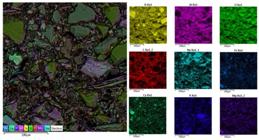
Based on the elemental map (Figure 4), it is evident that silicon is commonly associated with oxygen, indicating the presence of quartz. In other instances, aluminum is also associated with these elements, along with the presence of sodium (suggesting the occurrence of albite) or potassium (suggesting the presence of microcline and muscovite). These observations are consistent with the results obtained from the mineralogical and chemical analyses.
The sample in question had an average density of 2.771 g/cm3. The density value obtained is in line with the density values of the identified mineral phases: quartz (2.65 g/cm3), albite (2.55 – 2.74 g/cm3), microcline (2.54 – 2.57 g/cm3), muscovite (2.76 – 2.88 g/cm3), biotite (2.7 – 3.3g/cm3), diopside-ferrian (3.2 – 3.3g/cm3), clinoptilolite-Na (2.25g/cm3) and spodumene (3.18 g/cm3)35. From the thermogravimetric analysis, the thermogram presented in Figure 5 was obtained. The peaks observed between 100°C and 200°C are characteristic of the presence of free water and moisture loss in the sample30. The smaller peak between 150°C and 200°C may be associated with the loss of water coordinated to the cations36. Zhang et al.37 indicate that between 500°C and 700°C the structural transition from quartz-α to quartz-β occurs. However, differences of more than 50°C in relation to this temperature are frequently observed, being attributed to the genesis or origin, shape and formation temperature of the crystals38. The dehydroxylation of muscovite occurs simply in the temperature range between 820°C and 920°C30. The spodumene peak was not observed, as its dehydroxylation occurs at 1200°C, while the test, as mentioned in the previous chapter, was carried out up to the limit of 1000°C. Feldspars do not undergo a dehydroxylation process due to their mass stability and the absence of volatile elements in their chemical composition39.

The results of specific surface area analysis using the BET method indicated that the sample has a surface area of 2.250 m2/g, characterizing it as a low-porosity material when compared to the parameters of the raw materials used in the production of ceramic materials9. This result classifies the material as a non-plastic raw material (1.0–2.5 m2/g)9.
3.3 Technological characterization of ceramic bricks
Figure 6 schematically presents photos of the ceramic bricks (with incorporation levels of 0 and 30% of tailing) after each of the forming, drying and sintering stages. The test specimens obtained under all conditions did not show significant values for linear drying shrinkage, with results ranging from 0.16% to 0.10%. These values are possibly associated with the relatively low moisture content during the forming process40.

Ceramic bricks with 0 and 30% of waste incorporation obtained after each of the stages: conformation, drying and firing.
Regarding linear firing shrinkage (LFS), values ranged between 1.5% and 1.2%. The sintering temperature is a variable that directly influences the firing shrinkage index, with higher indices observed at higher temperatures41. In this case, since sintering temperature was not analyzed as a variable, the firing shrinkage response variable did not show significant changes in the obtained values. Figure 7 presents the values obtained for linear drying shrinkage and firing shrinkage as a function of the waste incorporation content.

Linear drying shrinkage and firing shrinkage indices as a function of the tailing incorporation content
A correlation between the incorporation content of the reject and the loss to fire revealed an inverse relationship. With the increasing waste content in the raw material blend, the loss to fire of the final ceramic products exhibited a corresponding decrease. This trend can be attributed to the decreasing clay content in the mixtures, consequently reducing the associated organic matter. The loss to fire is a physical property that indicates the presence of volatile substances and organic matter within the ceramic mixture11. The measured loss to fire values ranged from 7.5 to 10.5% and are illustrated in Figure 8.

The apparent specific mass (ASM) values ranged from 1.630 kg/m3 (0% and 5% tailing incorporation) to 1.720 kg/m3 (30% tailing incorporation), demonstrating a directly proportional relationship between the waste content and the evaluated physical index. This increase can be attributed to the fluxing action of the feldspars present in the analyzed waste. At high temperatures, minerals from the feldspar group enter a fluid phase, filling the pores between grains and promoting greater densification of the resulting ceramic bodies42.
The obtained products exhibited uniaxial compressive strength (UCS) values ranging from 30 MPa (0% tailing incorporation) to 55 MPa (30% tailing incorporation). Conditions with tailing incorporation levels between 0% and 20% met the requirements for stoneware and earthenware production, exhibiting strength above 25 MPa. Conditions with 30% waste incorporation can be used even for porcelain production, achieving mechanical strength of up to 80 MPa43.
The ceramic products obtained had water absorption values between 8.3% (0% waste incorporation) and 5.4% (30% waste incorporation). The filling of intergranular pores due to the formation of a fluid phase resulting from the thermal decomposition of feldspars contributes to the reduction of this index, as previously mentioned. Technically, all conditions meet the requirements for earthenware production43. Figures 9 and 10 present contour plots that relate the waste incorporation content and water absorption to the specific mass and mechanical strength indices, respectively. This further reinforces that the introduction of the tailing resulted in products with improved mechanical strength and water absorption indices.

Relationship between tailing incorporation content, water absorption, and specific mass based on a contour plot

Relationship between tailing incorporation content, water absorption, and mechanical resistence based on a contour plot
The observed results, such as the reduction in water absorption, increased densification, and enhancement of mechanical strength with higher percentages of incorporated tailings, are consistent with trends previously reported in the literature (Table 5). For example, the studies by Yang et al.44 and Bragança et al.45 demonstrated similar behaviors when using spodumene tailings and spodumene-bearing rock in ceramic formulations, where the increase in the content of natural fluxing agents promoted the formation of glassy phases and improved both the mechanical and physical properties of the ceramic bodies. Furthermore, the work by Bragança et al.45 revealed that, despite containing a lower content of alkali oxides, the spodumene-bearing rock exhibited a higher diffusion coefficient due to the smaller ionic radius of lithium ions (Li+) compared to K+ and Na+, thereby accelerating densification through viscous flow.
Technological characterization based on the key physical indices obtained under the optimized condition indicated by the works of [46] and [45], compared to the data obtained in this study.
Based on the test specimens produced under extreme conditions (with tailings incorporation levels of 0% and 30%), a mineralogical analysis was conducted to evaluate the development of crystalline structures following thermal treatment (Figure 11). In the condition without tailings incorporation (0%), the quartz and mullite phases were identified. In contrast, the condition with 30% tailings incorporation revealed the presence of quartz, mullite, albite, and cristobalite phases.

Phase quantification was performed through Rietveld refinement and the results are presented in Table 6. In the 0% incorporation condition, quartz was the majority fraction (94,6%), followed by mullite (5.4%). However, in the 30% incorporation condition, quartz content was reduced to 50%, accompanied by the emergence of mullite (~33%) and cristobalite (~4%). This reduction in quartz content is likely attributable to the formation of a liquid phase induced by the presence of albite and spodumene in the tailings. These fluxing agents may have facilitated the partial dissolution of quartz crystals, followed by recrystallization into more thermally stable phases27.
The presence of albite in the ceramic product containing 30% tailings (approximately 12.5%) is likely related to the partial thermal decomposition of this feldspar. The melting point of albite can range between 1100 and 1134 °C, depending on the heating rate and soda volatilization48. The sintering temperature employed in this study (1100 °C) was close to the melting point of albite, which likely resulted in partial melting of its crystals.
4. Conclusions
Based on the characterization of the raw materials, it is concluded that the clay sample is primarily composed of silicon and aluminum, with magnesium, iron, potassium, and titanium also present in its composition.
The spodumene flotation tailings exhibited particles with an average diameter of 81.2 µm and a specific surface area of 2.25 m2/g. Mineralogically, these tailings are composed of albite (40.8%), quartz (31.5%), biotite (10%), spodumene (6.7%), microlcine (5.2%) clinoptilolite-Na (2.9%), diposide-ferrian (2.3%) and muscovite (0.5%). The mineralogical characterization is consistent with the chemical analysis, which identified silicon and aluminum as the major elements, alongside iron, sodium, potassium, and lithium. A mass loss of 1.44% was observed based on thermogravimetric decomposition up to 1000°C, consistent with the decomposition of the identified minerals.
The incorporation of tailings into the ceramic formulation led to notable improvements in the physical and mechanical properties of the final products. The specimens showed minimal linear drying shrinkage (from 0.1% to 0.16%) and limited firing shrinkage (between 1.22% and 1.49%), likely influenced by the processing conditions and the constant sintering temperature. An inverse relationship was observed between tailings content and loss on ignition (from 7.8% to 10.49%), due to the reduced clay and organic matter content in the mixtures. Apparent specific mass increased with higher tailings incorporation (between 1.63 g/cm3 and 1.74 g/cm3), attributed to the fluxing action of feldspars, which enhanced densification by filling intergranular pores during sintering. This densification also contributed to reduced water absorption (between 5.34% and 8.32%), with values meeting the standards for earthenware production in all tested conditions. Moreover, the compressive strength improved progressively with tailings incorporation (varied from 29.09 MPa to 55.9 MPa), with the 30% condition reaching strength levels suitable even for porcelain production. These results confirm the positive contribution of the tailings to the overall performance of the ceramic materials.
Mineralogical analysis of the sintered specimens revealed significant changes in phase composition due to tailings incorporation. While the sample without tailings (0%) predominantly contained quartz and minor mullite, the addition of 30% tailings resulted in a more complex mineralogy, with the presence of quartz, mullite, albite, and cristobalite. Rietveld refinement showed a reduction in quartz content and an increase in mullite and cristobalite, likely due to the formation of a liquid phase promoted by fluxing agents such as albite and spodumene present in the tailings. The detection of albite in the final product suggests partial thermal decomposition of this feldspar, as the sintering temperature approached its melting range, contributing to the observed phase transformations.
As for the effect of incorporating the tailings into the ceramic matrix, it was observed that its content has an inverse relationship with water absorption and a direct relationship with apparent density and mechanical strength. These findings suggest that the feldspars present in the tailings likely acted as fluxing agents during sintering. These results reinforce the feasibility of using lithium tailings in the production of high-quality ceramics, standing out as an economically viable and sustainable alternative.
5. ACKNOWLEDGMENTS
The authors thank the support and encouragement of the Federal University of Ouro Preto, including the Department of Mining Engineering and the Graduate Program in Mineral Engineering, as well as the funding agencies CNPq, Fapemig, FINEP, and Capes.
Data Availability
The entire dataset supporting the results of this study was published in the article itself.
6. REFERENCES
-
1 MECS: Manufacturing Economic Studies [Internet]. Ceramic tile market forecast analysis: trend 2021-2025. Baggiovara: MECS; 2021 [cited 2024 Dec 31]. Available from: https://www.aspacer.com.br/wp-content/uploads/2022/02/brochure_ceramic_tile_market_forecast_analysis_trend_2021-2025.pdf
» https://www.aspacer.com.br/wp-content/uploads/2022/02/brochure_ceramic_tile_market_forecast_analysis_trend_2021-2025.pdf - 2 Jaskula BW. Lithium. In: U.S. Geological Survey, editor. Mineral commodity summaries 2024: U.S. geological survey. Reston: U.S. Geological Survey; 2024. p. 110-11. https://doi.org/10.3133/mcs2024.
- 3 Bowell RJ, Lagos L, De Los Hoyos CR, Declercq J. Classification and characteristics of natural lithium resources. Elements. 2020;16(4):259-64.
- 4 Meng F, Mcneice J, Zadeh SS, Ghahreman A. Review of lithium production and recovery from minerals, brines, and lithium-ion batteries. Miner Process Extr Metall Rev. 2021;42(2):123-41.
- 5 United Nations. The sustainable development goals report 2016. New York: United Nations; 2016.
- 6 Silva MCA, Leão VA, Reis EL. Incorporation of quartzite fines in the production of red ceramics. J Clean Prod. 2021;288:125098.
- 7 Silva MCA, Martins FL, Martins MG, Silva VG, Reis EL. Characterization of a clay sample from the northern region of Minas Gerais for industrial purposes. In: National Meeting Of Mineral Processing And Extractive Metallurgy; 2022 Sept 26-29; Armação dos Búzios. Rio de Janeiro: CETEM; 2022.
- 8 Pracidelli S, Melchiades FG. Importance of particle size distribution in red ceramic masses. Ind Ceram. 1997;2(1-2):1-10.
- 9 Santos PS. Clay technology, applied to brazilian clays. São Paulo: University of São Paulo; 1975. vol. 2. (in Portuguese).
- 10 Albuquerque FR, Santos IMGD, Lima SJG, Cássia-Santos MR, Soledade LEB, Souza AGD, et al. Experimental planning applied to the optimization of ceramic masses containing natural raw materials. Ceramica. 2007;53:300-98.
- 11 Brito IP, Almeida EP, Neves GA, Menezes RR, Silva VJ, Santana LNL. Evaluation of new clay deposits in the State of Paraíba for application as ceramic raw materials. Ceramica. 2015;61:391-8.
- 12 ABNT: Associação Brasileira de Normas Técnicas. ABNT NBR 15270-2: Ceramic Components. Part 2: Ceramic blocks for structural masonry – Terminology and requirements. Rio de Janeiro: ABNT; 2005. (in Portuguese).
- 13 Schneider H, Schreuer J, Hildmann B. Structure and properties of mullite: A review. J Eur Ceram Soc. 2008;28(2):329-44.
- 14 Lee JS, Kim JW, Park JS, Lee MH, Lee H. The effect of the MgO/Al2O3 ratio on the thermal and refractory behaviors of cordierite ceramics. Materials. 2025;18(1):168.
- 15 Dondi M. Feldspathic fluxes for ceramics: Sources, production trends and technological value. Resour Conserv Recycling. 2018;133:191-205.
- 16 Lima NP, Valadão GE. Avaliação do efeito da granulometria no processo de flotação. Rev. Esc. Minas. 2008;61(4):473-7.
-
17 Cristallography Open Database [Internet]. CIF card: Albite (NaAlSi3O8), COD ID 969000702. Vilnius: Vilnius University Institute of Biotechnology; 2024 [cited 2024 Dec 31]. Available from: https://www.crystallography.net/cod/9000702.html
» https://www.crystallography.net/cod/9000702.html -
18 Cristallography Open Database [Internet]. CIF card: Quartz (SiO2), COD ID 969013322. Vilnius: Vilnius University Institute of Biotechnology; 2024 [cited 2024 Dec 31]. Available from: https://www.crystallography.net/cod/archives/2024/PANalytical/
» https://www.crystallography.net/cod/archives/2024/PANalytical/ -
19 Cristallography Open Database [Internet]. CIF card: Biotite (KFeMg2AlSi3O10(OH)2), COD ID 969001267. Vilnius: Vilnius University Institute of Biotechnology; 2024 [cited 2024 Dec 31]. Available from: https://www.crystallography.net/cod/9001267.html
» https://www.crystallography.net/cod/9001267.html -
20 Cristallography Open Database [Internet]. CIF card: Spodumene (LiAl(SiO3)2), COD ID 969006911. Vilnius: Vilnius University Institute of Biotechnology; 2024 [cited 2024 Dec 31]. Available from: https://www.crystallography.net/cod/9006911.html
» https://www.crystallography.net/cod/9006911.html -
21 Cristallography Open Database [Internet]. CIF card: Microcline (KAlSi3O8), COD ID 969000702. Vilnius: Vilnius University Institute of Biotechnology; 2024 [cited 2024 Dec 31]. Available from: https://www.crystallography.net/cod/archives/2024/PANalytical/
» https://www.crystallography.net/cod/archives/2024/PANalytical/ -
22 Cristallography Open Database [Internet]. CIF card: Clinoptilolite-Na (Na2.4Ca1.76K0.52Al8.16Si27.84O75.72), COD ID 969001396. Vilnius: Vilnius University Institute of Biotechnology; 2024 [cited 2024 Dec 31]. Available from: https://www.crystallography.net/cod/archives/2024/PANalytical/
» https://www.crystallography.net/cod/archives/2024/PANalytical/ -
23 Cristallography Open Database [Internet]. CIF card: Dioppside-ferrian (CaFe0.267Mg0.857O6Si1.876), COD ID 969005337. Vilnius: Vilnius University Institute of Biotechnology; 2024 [cited 2024 Dec 31]. Available from: https://www.crystallography.net/cod/9005337.html
» https://www.crystallography.net/cod/9005337.html -
24 Cristallography Open Database [Internet]. CIF card: Muscovite (KAl2(AlSi3O10)(OH)2), COD ID 961011050. Vilnius: Vilnius University Institute of Biotechnology; 2024 [cited 2024 Dec 31]. Available from: https://www.crystallography.net/cod/archives/2024/PANalytical/
» https://www.crystallography.net/cod/archives/2024/PANalytical/ - 25 Romero M, Pérez JM. Relation between the microstructure and technological properties of porcelain stoneware: a review. Mater Constr. 2015;65(320):e065.
- 26 Dal Bó M, Gilabert FA, Boschi AO, Sánchez E, Cantavella V, Hotza D. Quartz particle size and cooling rate effects on microstructural defects and mechanical properties of feldspar-based ceramic materials. J Eur Ceram Soc. 2023;43(14):6590-8.
- 27 Aydin T, Kara A. Effect of spodumene addition on pyroplastic deformation of porcelain stoneware. J Ceram Process Res. 2014;15(6):486-91.
- 28 Coelho JM, Suslick SB, Souza MCA. An approach to the feldspar industry in Brazil. Ind Ceram. 2000;5(1):37-42.
- 29 Shakhova VN, Berezovskaya AV, Pikalov ES, Selivanov OG, Sysoev EP. Development of self-glazing ceramic facing material based on low-plasticity clay. Glass Ceram. 2019;76:11-5.
- 30 Földvári M. Handbook of thermogravimetric system of minerals and its use in geological practice. Budapest: Geological Institute of Hungary; 2011. (Occasional Papers of the Geological Institute of Hungary, vol. 213).
- 31 Conte S, Zanelli C, Molinari C, Guarini G, Dondi M. Glassy wastes as feldspar substitutes in porcelain stoneware tiles: thermal Behaviour and effect on sintering process. Mater Chem Phys. 2020;256:123613.
- 32 Kingery WD, Bowen HK, Uhlmann DR. Introduction to ceramics. Hoboken: John Wiley & Sons; 1976.
- 33 Kang B, Kang S. Crystal growth behavior, nanometer microstructure, and mechanical properties of diopside-based glass-ceramics. J Nanosci Nanotechnol. 2020;20(1):183-9.
- 34 Shi JZ, Zhu XL, Li L, Chen XM. Zeolite ceramics with ordered microporous structure and high crystallinity prepared by cold sintering process. J Am Ceram Soc. 2021;104(11):5521-8.
- 35 Holand W, Beall GH. Glass-ceramic technology. Hoboken: John Wiley & Sons; 2019.
- 36 Klein C, Dutrow B. Manual of mineral science. Hoboken: John Wiley & Sons; 2007.
- 37 Zhang H, Guo S, Wu J, Wu D, Wei K, Ma W. Effect of quartz crystal structure transformations on the removal of iron impurities. Hydrometallurgy. 2021;204:105715.
- 38 Hu J, Tao H, Chen M, Zhang Z, Cao S, Shen Y, et al. Interstitial water improves structural stability of iron hexacyanoferrate for high-performance sodium-ion batteries. ACS Appl Mater Interfaces. 2022;14(10):12234-42.
- 39 Lřnvik K, Smykatz-Kloss W. Comparative studies of structural transformations of carbonate and silica minerals by means of thermosonimetry and differential thermal analysis. Thermochim Acta. 1984;72(1-2):159-63.
- 40 Melchiades FG, Del Roveri C, Sotério J, Silva LL, Boschi AO. Dimensional and shape control of ceramic tiles; part 1: dimensions. Ind Ceram. 2001;6(5):27-33.
- 41 Carter CB, Norton MG. Ceramic materials: science and engineering. New York: Springer New York; 2007.
- 42 Frizzo RG, Zaccaron A, Nandi VN, Bernardin AM. Pyroplasticity on porcelain tiles of the albite-potassium feldspar-kaolin system: A mixture design analysis. J Build Eng. 2020;31:101432.
- 43 Cruz RT, Pedrassani J, Bragança SR. Faianças, Grês e porcelanas: matérias-primas, moagem, conformação, secagem, queima, esmaltação, decoração, defeitos e propriedades gerais. Porto Alegre: Científika; 2022.
- 44 Yang J, Xu LH, Wu HQ, Wang ZJ, Shu KQ, Xu YB, et al. Sintering behavior and mechanical properties of sintered ceramics based on spodumene tailings. J Cent South Univ. 2021;28(6):1637-51.
- 45 Bragança SR, Lengler HCM, Bergmann CP. Spodumene-bearing rock as flux for triaxial ceramic bodies. Adv Appl Ceramics. 2011;110(5):293-300.
-
46 Cristallography Open Database [Internet]. CIF card: Mullite (Al2O3(SiO2)), COD ID 969001622. Vilnius: Vilnius University Institute of Biotechnology; 2024 [cited 2024 Dec 31]. Available from: https://www.crystallography.net/cod/archives/2024/PANalytical/
» https://www.crystallography.net/cod/archives/2024/PANalytical/ -
47 Cristallography Open Database [Internet]. CIF card: Cristobalite (SiO2), COD ID 969001578. Vilnius: Vilnius University Institute of Biotechnology; 2024 [cited 2024 Dec 31]. Available from: https://www.crystallography.net/cod/archives/2024/PANalytical/
» https://www.crystallography.net/cod/archives/2024/PANalytical/ - 48 Johnson LA, Mccauley RA. The thermal behavior of albite as observed by DTA. Thermochim Acta. 2005;437(1-2):134-9.
Edited by
-
Associate Editor:
Eliana Muccillo.
-
Editor-in-Chief:
Luiz Antonio Pessan.


