Microstructural Evolution of PBF-LB AlSi10Mg under Different Heat Treatment Conditions
Abstract
Laser-based powder bed fusion (PBF-LB) of AlSi10Mg alloys faces non-equilibrium solidification, resulting in a microstructure of α-aluminum phase matrix and an interconnected, fibrous α-silicon-rich phase network. The development of heat treatment (HT) routes tailored specifically for PBF-LB parts are essential, as standardized procedures may not yield optimal results. This study investigates the effect of different HTs on the microstructural characteristics and hardness of AlSi10Mg parts. Analyses revealed that the as-built (AB) microstructure exhibited a typical cellular-dendritic solidification structure. The eutectic α-Si-rich network partially degenerated after direct aging (DA) and stress relieving (SR), while solution annealing (SA), and solution annealing + aging HT erased the solidification microstructure, producing α-Si-rich precipitates dispersed within the α-Al matrix. Columnar grains exhibited preferential epitaxial growth along {001} planes in the <001> direction, with no significant changes observed after HTs. The AB sample displayed a hardness of 122 HV, increasing up to 149 HV after DA. Conversely, SR and SA led to a hardness reduction between 61 and 77 HV. While the DA HT maintains the AB microstructural characteristics with a hardness increase, SR and SA HTs modify the solidification microstructure, reducing hardness.
Keywords:
PBF-LB; Aging; Solution Annealing; Aluminum Alloys; Heat Treatments
1. Introduction
Additive manufacturing (AM) has transformed industrial production by enabling the creation of complex components with higher efficiency and less material waste. Among AM technologies, powder bed fusion using a laser beam as a heat source (PBF-LB) stands out for its ability to produce metal parts with high dimensional accuracy and competitive mechanical properties. However, the process presents challenges1,2, such as residual stresses and microstructural heterogeneities, due to rapid solidification, which can impact the mechanical performance of the produced parts3,4. Aluminum alloys are usually among the main candidates to produce different structural components due to their optimal mechanical strength-to-weight ratio and excellent corrosion resistance5. AlSi10Mg is one of the most studied aluminum alloys within AM due to its high processability3,6-9, caused by the reduced solidification interval and good fluidity, which reduce the risk of forming defects such as hot cracks. It also combines low density, good mechanical strength, and excellent thermal conductivity10 — key characteristics in industries like aerospace and automotive. Primarily composed of aluminum, with a significant fraction of silicon and magnesium, this alloy offers an aluminum matrix reinforced by a uniform dispersion of silicon particles, contributing to its high stiffness and dimensional stability. However, the microstructure of parts produced by PBF-LB is inherently influenced by the rapid thermal cycle of the process, resulting in refined structures but also a characteristic fibrous pattern. The solidification conditions generate in the AlSi10Mg parts a highly refined supersaturated microstructure composed of Al grains surrounded by a Si + Al eutectic network9-11. These features demand effective heat treatment strategies to optimize mechanical performance and overcome limitations like porosity formation and residual stresses.
Heat treatments (HT) play a crucial role in improving the properties of AlSi10Mg parts manufactured via PBF-LB. Processes such as stress relief (SR) and direct aging (DA) are commonly applied to modify the microstructure, reducing internal stresses and optimizing properties like hardness and fatigue resistance11,12. Direct aging, for example, promotes the precipitation of strengthening phases within the aluminum matrix, significantly increasing the mechanical strength and hardness13. SR, on the other hand, is used to minimize distortion and improve ductility14, although in some cases this may reduce mechanical strength. The proper combination of these treatments can mitigate the negative effects of the microstructure inherent to the PBF-LB process, promoting better distribution of silicon particles and reducing material brittleness15,16.
Recently, several studies have examined the effects of heat treatments on aluminum alloys processed by PBF-LB12-19, showing the as-built (AB) mechanical properties can be tailored to achieve better performance on tensile and fatigue tests. A combination of solution annealing and artificial aging could enhance the ductility/fracture toughness and even increasing hardness16-18. However, a detailed understanding of how these treatments influence the microstructure and hardness of AlSi10Mg still presents significant gaps. In particular, the relationship between microstructural changes induced by specific heat treatments and the final hardness of the manufactured parts is an area that requires further investigation. This study aims to address this issue by comparatively analyzing the microstructure and hardness of the AlSi10Mg alloy under different HTs, offering new insights for optimizing the performance of this alloy in demanding industrial applications.
2. Experimental Methodology
Commercial AlSi10Mg metal powders used in this study were supplied by EOS GmbH. Its chemical composition is shown in Table 1. Particle size distribution was carried out by laser diffraction technique in the Fraunhofer approximation (Malvern MS-S, Long Bench-MAM 5005).
The samples were manufactured in an EOS M280 machine equipped with a Yb-YAG fiber laser source (400 W, λ = 1060 nm), and the process parameters used are presented in Table 2. Cylinders of 6 mm diameter and 100 mm length were built with 0°, 45°, and 90° inclination in relation to the substrate for the initial characterization.
The T5-based direct aging heat treatments were performed at temperatures of 155 °C and 170 °C at different intervals between 0 h and 10 h. Annealing heat treatments, such as stress relief (SR) and solubilization (SHT) conditions, were carried out at temperatures between 350 °C and 540 °C, respectively, during 2 h and 6 h. Finally, T6-based heat treatments, i.e., SHT + artificial aging, were carried out by using the suggested conditions obtained in this study.
The bulk density of AB samples was measured by pycnometric tests in He gas (Micromeritics, Accupyc 1330), and determined by Archimedes method (Gehaka, BK40II) using distilled water at room temperature (25 °C). The samples were previously sanded with # 600 sandpaper and kept in liquid medium for 12 h. Porosity was measured by computational tomography (Carl Zeiss, Metrotom 800) applying a voltage of 120 kV, current of 80 µA, a Cu filter of 0.25 mm, and an integration time of 1 second. A detector of 1456x1840 pixels and a voxel size of 21 µm3 was applied. The data obtained was analyzed in VG StudioMAX 2.2 software.
The metallographic procedure used in this study consisted of manual roughing using sandpaper with particle sizes #400, #600, and #1200, followed by mechanical polishing in 1 µm and ¼ µm diamond paste, and colloidal silica. Chemical etching was carried out with Keller reagent applying immersion periods between 12 – 20 seconds. Microstructural characterization was performed by visible light microscopy (VLM - Leica, DM IL LED) and scanning electron microscopy (SEM - Zeiss, EVO MA15) equipped with EDX detector. EBSD analyses were performed at a Thermo Fisher Quanta 650 FEG operating at 20 kV, equipped with an Oxford Nordlys detector (map step sizes: 0.3-0.4 μm). EBSD data was processed using Channel5 suite. The microstructure of the different samples was analyzed by visual light microscope (VLM) and SEM using ImageJ software. Vickers hardness measurements by micro-indentation were performed in a Future-Tech. FV-800 equipment, applying a load of 300 gf for 15 s. At least 20 measurements were performed per sample. The characterization of the crystalline phases was determined by X-ray diffraction (XRD - PANalytical, X'Pert 3 Power System, Cu-kα radiation). Thermodynamic calculations, using Thermo-Calc 2023b software and TCAL8 database, were performed to understand the phase stability at room temperature and phase formation during non-equilibrium solidification, using a Scheil solidification with solute trapping model (which considers solute trapping only in the primary solid phase; solidification speed calculated from the scanning speed is also considered).
3. Results and Discussion
The particle size distribution (PSD) of the powder sample is presented in Figure 1(a). The results demonstrate an optimal PSD, with values of D10 = 27.1 ± 0.7 µm, D50 = 48.9 ± 0.4 µm, D90 = 79.4 ± 0.2 µm, and a mean particle value of D[4,3] = 51.3 ± 0.3 µm. SEM analyses reveal a predominantly spherical morphology, as seen in Figure 1(b) with the presence of satellites of size less than 6.7 ± 2.5 µm. The morphological characteristics of the metal powders are consistent with those published by Riener et al.20, where it is explained that the presence of agglomerates is due to the collision of particles during atomization and solidification of the material. Figure 1(c, d) shows the presence of dendrites and cells composed of the primary phase α-Al, which are formed at the beginning of solidification and surrounded by a eutectic network composed of Si + Al, coming from the remaining liquid present during the final phase of solidification21.

Physical characterization of AlSi10Mg powder samples. a) Particle size distribution (PSD). b) SEM-SE image showing the morphology of the metal particles. c) VLM image showing the internal microstructure of a powder particle. A more detailed image of the internal microstructure was obtained by SEM-SE technique as shown in d). The internal solidification microstructure shows small α-Al cells surrounded by eutectic laminar regions composed by α-Al + Si.
Bulk density measurements by pycnometry revealed an average density 2.6440 ± 0.0004 g·cm-3, while the values obtained by Archimedes method and micro-computed tomography (µCT) techniques are presented in Table 3 and Figure 2. The different samples produced show a mean density of 2.65 ± 0.02 g·cm-3, i.e., 98.8% of the theoretical density22. Nevertheless, the analyses performed by µCT revealed that the building inclination presents a significant influence on the internal porosity of the material. The samples printed with an inclination of 0° presented a pore volume of 0.609%, while the parts built at 45° and 90° presented values of 0.297% and 0.192%, respectively. The different conditions reveal a porosity lower than 1%, being slightly smaller than the density values obtained. It can also be observed that the 90°-built samples present a lower pore volume with a smaller size, which may favor a higher mechanical performance of the parts. Similar results were obtained by Rashid et al.23 for Al12Si PBF-LB parts obtaining a relative density of 96.5%, 99.5%, and 99.8% for cylinders built at 0°, 45°, and 90° inclination. The authors explain that porosity changes can be caused by variations in the energy distribution per layer during the construction process. Consequently, the samples produced at 0° presented an energy per layer of 5500 J, while the samples at 45° and 90° presented values of 1266 J and 895 J, respectively. Therefore, considering that the samples built at 90° orientation presented a lower density of defects, i.e., lower porosity, microstructural and hardness analysis were performed on the samples produced in AB and HT condition.
Density measurements obtained by Archimedes and pore size statistics obtained by µCT. Relative porosity was obtained considering the theoretical density of AlSi10Mg as 2.68 g·cm-3.

Density measurements of AlSi10Mg PBF-LB samples produced at 0°, 45°, and 90° inclination from build platform. µCT reconstructed images showing the internal pore distribution in AlSi10Mg PBF-LB cylindric samples. The scale on the left side of the figure represents the volume in mm3 of each pore detected by this technique
AB microstructure shows a typical “fish-scale” morphology along the build direction, Figure 3(a), typical of PBF-LB manufactured parts, caused by the superposition of adjacent laser-molten tracks24,25. The different molten pools show an average width (W) and depth (D) of 255 ± 38 µm and 118 ± 17 µm, respectively. Thus, the aspect ratio (D/W) is 0.46, showing a transition mode microstructure26. Generally, transition mode occurs between the aspect ratio of 0.5 and 0.7. However, this value is highly alloy-dependent: for AA1100 this value is around 0.227, while for AA7050, it lies between 0.5 – 1.228. Also, the top view, shown in Figure 3(b), reveals that the track width was 186 µm and a laser rotation angle of 67°. SEM analysis revealed a cellular and dendritic microstructure arranged towards the heat extraction direction, Figure 3(c). EDX mapping shown in Figure 3(d) revealed that these cells are composed of the primary phase α-Al (Figure 3(e)) surrounded by an eutectic α-Si-rich network (Figure 3(f)). The high thermal gradients and rapid solidification rates lead to a highly refined and supersaturated microstructure. Additionally, the cellular structure can retain a high concentration of dislocations, precipitates, and low-angle grain boundaries, which could lead to a significant residual stress density29. These microstructural features contribute to the elevated hardness of the AB AlSi10Mg PBF-LB parts (122 ± 5 HV), compared to parts manufactured using conventional methods, such as cast samples in graphite molds (68 HV)30.

Microstructural characterization of AlSi10Mg PBF-LB sample in AB condition. a) Typical “fish-scale” solidification structure. b) Top view highlighting the molten tracks and rotation angle of 67°. c) SEM-BSE image showing the internal microstructure of the PBF-LB part, composed of cells and dendrites. The region shown in d) was analyzed by EDX mapping technique: e) Al (red) and f) Si (green).
As described previously, the AB structure contains a predominant supersaturated α-Al cellular matrix and an eutectic α-Si-rich network, which is consistent with previous studies25,31-33. This characteristic results in an advantage present in this condition, compared to those produced by conventional methods where SHT steps are required to generate an oversaturated matrix previous to aging stages: the supersaturated microstructure present in as-built PBF-LB parts allow the direct application of aging routes25. Therefore, the PBF-LB samples produced at 90° from the build platform were subjected to direct aging heat treatment at 155 °C and 170 °C at different time intervals, with the respective microstructures presented in Figure 4. No significant changes in the microstructure were observed for the different conditions analyzed, i.e., the heat treatments performed at 155 °C and 170 °C were unable to rearrange the α-Si network surrounding the α-Al cells, maintaining cell sizes ranging between 0.5 µm to 1.6 µm.

Effect of the direct aging heat treatment on the microstructure of AlSi10Mg PBF-LB samples built at 90°. In a – d) samples heat treated at 155 °C, and in e – h) samples heat treated at 170 °C.
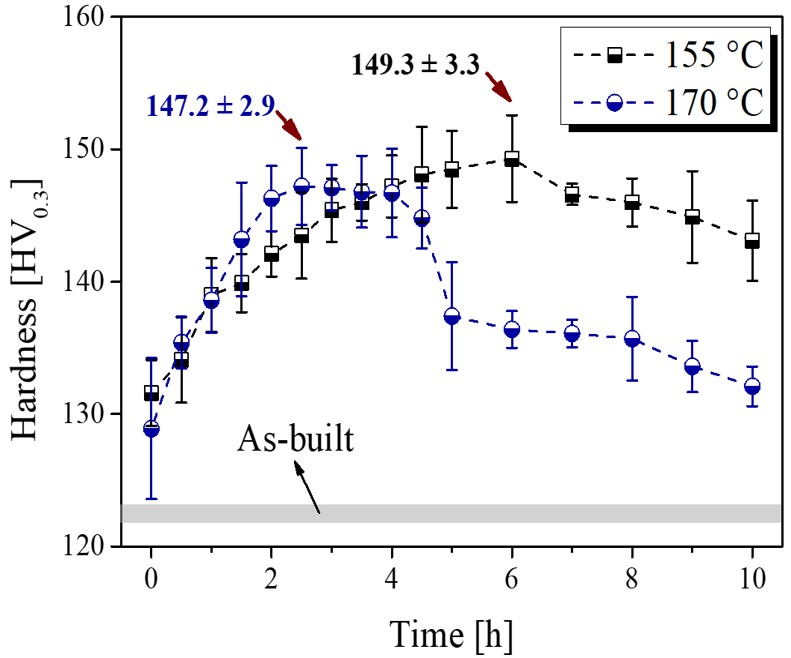
Nevertheless, at higher magnifications (Figure 5) it can be observed that the aging treatment partially degenerates the α-Si network, while small reinforcement precipitates around 31.9 ± 0.8 nm and 39.3 ± 0.7 nm for samples directly aged at 155°C/6 h and 170°C/2 h, respectively, are formed inside the cells. The formation and growth of Si nanoprecipitates without degrading the α-Si lattice has also been found in AlSi10Mg PBF-LB samples heat-treated at 190 °C for 0.5 h, and they were reported to promote strengthening34. Hardness curves show that the application of DA HT generates a strengthening effect as shown in Figure 6. During the aging HT, part of the Si present in the supersaturated α-Al cells and in the eutectic α-Si-rich network is released to form nano-sized reinforcing precipitates that increase the hardness35. Nonetheless, increasing the exposure time to HT tends to change its microstructural characteristics to a more stable condition, partially degrading the Si-rich network to form blocky Si particles, as well as further precipitate coarsening, generating an over-aging effect and causing softening. For instance, samples aged at 170 °C/10 h show precipitates with a larger size (48.5 ± 0.6 nm) and a degraded Si-rich network, similar to that observed in AlSi10Mg PBF-LB parts aged at 240 °C for 3 h34. Therefore, as the temperature and exposure time of the heat treatment increases, the precipitates coarse and lose their reinforcing effect.

High magnification SEM images showing the formation of small precipitates in the α-Al cells after direct aging heat treatment in AlSi10Mg PBF-LB samples built at 90°. a) DA at 155 °C for 6 h, b) DA at 170 °C for 2 h, and c) DA at 170 °C for 10 h.

Vickers hardness curves for AlSi10Mg PBF-LB samples built at 90° and directly aged at 155 °C (black) and 170 °C (blue). The gray bar represents the average hardness of PBF-LB samples in as-built condition. Peak hardness is indicated by red arrows.
The microstructure of the samples subjected to SR (350 °C for 2 h) and SHT (540 °C) for 2 h and 6 h are presented in Figure 7. SR HT maintains much of the typical microstructure of PBF-LB parts, and a similar behavior has been reported in AlSi10Mg PBF-LB parts heat treated at 300 °C for 1 minute and 2 h36. But after 6 h, the edges of the melt pools are partly degenerated by the Si particle rearrangement, indicating SR annealing accelerates the α-Si-rich network dissolution33. Upon application of SHT, the Si network surrounding the α-Al cells is partially dissolved and becomes disconnected, generating small Si precipitates randomly dispersed in the matrix. These results agree with microstructural changes observed for AlSi10Mg PBF-LB parts heat treated in similar conditions36-39. With increasing treatment time these precipitates coarsen. Samples processed at 540 °C/2 h presented an average precipitate size of 4.3 ± 0.4 µm, while samples processed at 540 °C/6 h presented sizes of 6.4 ± 0.3 µm, respectively. Consequently, the dissolution of the highly refined microstructure obtained during PBF-LB and the formation of coarse precipitates generate a slight drop in the average hardness values.

VLM images showing the effect of SR (a, b) and SHT (c, d) on the microstructure of AlSi10Mg PBF-LB samples built at 90°. In a) 350 °C during 2 h, b) 350 °C during 6 h, c) 540 °C during 2 h, and d) 540 °C during 6 h.
Based on these results, samples were subjected to T6 heat treatment, i.e., SHT + artificial aging, at 540 °C/2 h or 540 °C/6 h followed by aging at 170 °C at different time intervals. As shown in Figure 8(a), artificial aging treatments generate a strengthening effect, reaching peak hardness after 8 h for parts treated at 540 °C/6 h, and after 14 h for parts treated at 540 °C/2 h. SHT breaks and partially dissolves the α-Si-network produced during PBF-LB, promoting a monophasic structure composed of the supersaturated α-Al. The microstructure loses its fish-scale-like structure, the columnar grains begin to thicken, and the Si network breaks down25,36, which leads to stress relief. With increased exposure time to SHT, the grains undergo a columnar-to-equiaxed transformation, while the formed Si particles thicken, as observed in the SEM-EBSD maps shown in Figure 8(b - d). Consequently, a microstructure with a high volume of coarse, globular Si precipitates are formed. The application of longer aging times generates an over-aging effect, decreasing the hardness values. The EBSD images also reveal that the samples solubilized at 540 °C/6 h and aged at 170 °C/8 h presented larger grains and Si particles than those observed in samples treated at 540 °C/2 h and aged at 170 °C/14 h, which justifies the difference between the hardness peaks obtained. The strengthening due to the application of aging heat treatments allows achieving hardness values close to those observed in AB conditions.

Vickers hardness behavior and microstructure of AlSi10Mg PBF-LB samples built at 90° and heat treated in T6 condition. a) Hardness curves of PBF-LB samples solubilized at 540 °C during 2 h (black) and 6 h (blue) followed by artificial aging at 170 °C. The microstructures (α-Al matrix + α-Si-rich particles in black) of samples highlighted in red arrows are shown in for b) as-built, c) 540 °C/2 h + 170 °C/8 h and d) 540 °C/6 h + 170 °C/14 h.
The X-ray diffraction patterns obtained for the SR and SRH, along with the initial conditions, are presented in Figure 9. The metal powder and the AB samples present characteristic peaks of the α-Al (ICSD No. 44321; #225, FCC) and α-Si (ICSD No. 43403; #227, FCC/diamond) phases. Upon application of the SR HT (350 °C/2 h), the crystalline Mg2Si phase begins to form (ICSD No. 182692; #227, FCC). In contrast, samples subjected to T6 heat treatment only show characteristic peaks of the α-Al and α-Si phases, similar to that observed in as-built samples. Thermodynamic simulations shown in Figure 10(a) suggest that other intermetallic phases could also be present in the AB condition, such as Mg2Si, Al9Fe2Si2 and Al3Ti. However, their small phase fraction (< 1% vol) is below the typical detection limit of the XRD technique. The calculations also show that the Si-rich particles/network start to precipitate during the non-equilibrium solidification (Figure 10(b)) about 17 °C below the first solid matrix formation.

XRD patterns for AlSi10Mg powder and PBF-LB parts built at 90° in AB condition and heat treated by SR at 350 °C for 2 h and T6 condition at 540 °C/2 h + 170 °C/8 h and at 540 °C/6 h + 170 °C/14 h. The crystalline phase indexing reveals the presence of α-Al (ICSD No. 44321), α-Si (ICSD No. 43403), and Mg2Si (ICSD No. 182692).

a) Phase fraction in thermodynamic equilibrium, and b) phase formation during non-equilibrium solidification.
4. Conclusion
PBF-LB AlSi10Mg samples were successfully manufactured in three building directions relative to the substrate (0 °, 45 °, and 90 ° inclination). The produced samples were subjected to different heat treatments in order to identify the effects on the microstructure and mechanical behavior. The AB condition presents a highly refined and supersaturated microstructure due to the high thermal gradients and high solidification rates generated during the printing process. The application of direct aging treatments at 155 °C and 170 °C favors an increase in hardness values due to the formation of nanometer-sized precipitates in the matrix, without degrading the typical PBF-LB “fish-scale” microstructure. The application of longer aging times generates an over-aging effect due to precipitates coarsening and matrix desaturation, thus decreasing hardness. The application of stress relief and solubilization heat treatment generates a substantial drop in hardness values due to i) relief of internal stresses; ii) grain coarsening; and iii) degeneration of the silicon network, favoring blocky precipitates that have little or no reinforcing effect on the matrix. These phenomena increase with the temperature and time of the heat treatment. The subsequent application of heat treatment on previously solubilized samples, i.e., T6-based heat treatments, allows a further increase in hardness to values close to the as-built condition due to the controlled formation of reinforcing precipitates. These results allowed acquiring a broader knowledge on the effect of different heat treatments on the microstructure and mechanical performance of AlSi10Mg PBF-LB parts, promoting the development of new post-processing routes to guarantee adequate microstructural characteristics and mechanical properties of AM parts.
5. Acknowledgements
The authors thank LNNano/CNPEM for providing access to the SEM (proposal SEM–20210437), and Luis Umbelino dos Santos (SENAI-ISI Advanced Manufacturing and Microfabrication) for providing access to μCT tomography. This work was supported by Companhia Brasileira de Alumínio (CBA), and was financed by the Fundação de Amparo à Pesquisa do Estado de São Paulo – FAPESP (Project Grant number: 2018/06045-0) and the Conselho Nacional de Desenvolvimento Científico e Tecnológico – CNPq (Project Grant number: 165208/2019-8 and 383215/2024-2).
6. References
- 1 Yang H, Sha J, Zhao D, He F, Ma Z, He C, et al. Defects control of aluminum alloys and their composites fabricated via laser powder bed fusion: a review. J Mater Process Technol. 2023;319:118064.
- 2 Martucci A, Aversa A, Lombardi M. Ongoing challenges of laser-based powder bed fusion processing of Al alloys and potential solutions from the literature: a review. Materials (Basel). 2023;16(3):1084.
- 3 Aboulkhair NT, Simonelli M, Parry L, Ashcroft I, Tuck C, Hague R. 3D printing of Aluminium alloys: additive Manufacturing of Aluminium alloys using selective laser melting. Prog Mater Sci. 2019;106:100578.
- 4 DebRoy T, Wei HL, Zuback JS, Mukherjee T, Elmer JW, Milewski JO, et al. Additive manufacturing of metallic components – Process, structure and properties. Prog Mater Sci. 2018;92:112-224.
- 5 Jayakumar A, Radoor S, Kim JT, Rhim JW, Parameswaranpillai J, Siengchin S. Lightweight and sustainable materials—a global scenario. In: Rangappa SM, Doddamani SM, Siengchin S, Doddamani M, editors. Lightweight and sustainable composite materials: preparation, properties and applications. USA: Elsevier; 2023. p. 1-18.
- 6 Aboulkhair NT, Everitt NM, Ashcroft I, Tuck C. Reducing porosity in AlSi10Mg parts processed by selective laser melting. Addit Manuf. 2014;1-4:77-86.
- 7 Hadadzadeh A, Amirkhiz BS, Li J, Mohammadi M. Columnar to equiaxed transition during direct metal laser sintering of AlSi10Mg alloy: effect of building direction. Addit Manuf. 2018;23:121-31.
- 8 Read N, Wang W, Essa K, Attallah MM. Selective laser melting of AlSi10Mg alloy: process optimisation and mechanical properties development. Mater Des (1980-2015). 2015 Jan;65:417-24.
- 9 Hadadzadeh A, Amirkhiz BS, Langelier B, Li J, Mohammadi M. Microstructural consistency in the additive manufactured metallic materials: a study on the laser powder bed fusion of AlSi10Mg. Addit Manuf. 2021;46:102166.
- 10 Zhao L, Song L, Santos Macías JG, Zhu Y, Huang M, Simar A, et al. Review on the correlation between microstructure and mechanical performance for laser powder bed fusion AlSi10Mg. Addit Manuf. 2022;56:102914.
- 11 Wu J, Wang XQ, Wang W, Attallah MM, Loretto MH. Microstructure and strength of selectively laser melted AlSi10Mg. Acta Mater. 2016;117:311-20.
- 12 Zhuo L, Wang Z, Zhang H, Yin E, Wang Y, Xu T, et al. Effect of post-process heat treatment on microstructure and properties of selective laser melted AlSi10Mg alloy. Mater Lett. 2019;234:196-200.
- 13 Di Egidio G, Tonelli L, Zanni M, Carosi D, Morri A, Ceschini L. Direct artificial aging of the PBF-LB AlSi10Mg alloy designed to enhance the trade-off between strength and residual stress relief. JALMES. 2024;5:100063.
- 14 Lim CH, Li H, Krishnan M, Chen K, Li J. Novel method of residual stress reduction for AlSi10Mg manufactured using selective laser melting without compromise of mechanical strength. Virtual Phys Prototyp. 2023;18(1)
- 15 Valim DB, Ávila JA, Fonseca EB, Gabriel AHG, Jardini AL, Lopes ÉSN. Influence of build orientation and heat treatment on high cycle fatigue of additively manufactured AlSi10Mg. Mater Sci Eng A. 2024;916:147308.
- 16 Araújo LC, Gabriel AHG, da Fonseca EB, Avila JA, Jardini AL, Seno R Jr, et al. Effects of build orientation and heat treatments on the tensile and fracture toughness properties of additively manufactured AlSi10Mg. Int J Mech Sci. 2022;213:106868.
- 17 Fite J, Eswarappa Prameela S, Slotwinski JA, Weihs TP. Evolution of the microstructure and mechanical properties of additively manufactured AlSi10Mg during room temperature holds and low temperature aging. Addit Manuf. 2020;36:101429.
- 18 Li W, Li S, Liu J, Zhang A, Zhou Y, Wei Q, et al. Effect of heat treatment on AlSi10Mg alloy fabricated by selective laser melting: microstructure evolution, mechanical properties and fracture mechanism. Mater Sci Eng A. 2016;663:116-25.
- 19 Aboulkhair NT, Maskery I, Tuck C, Ashcroft I, Everitt NM. The microstructure and mechanical properties of selectively laser melted AlSi10Mg: the effect of a conventional T6-like heat treatment. Mater Sci Eng A. 2016;667:139-46.
- 20 Riener K, Oswald S, Winkler M, Leichtfried GJ. Influence of storage conditions and reconditioning of AlSi10Mg powder on the quality of parts produced by laser powder bed fusion (LPBF). Addit Manuf. 2021;39:101896.
- 21 Asgari H, Baxter C, Hosseinkhani K, Mohammadi M. On microstructure and mechanical properties of additively manufactured AlSi10Mg_200C using recycled powder. Mater Sci Eng A. 2017;707:148-58.
- 22 Mathe NR, Tshabalala LC. The validation of the microstructural evolution of selective laser-melted AlSi10Mg on the in-house built machine: energy density studies. Progress in Additive Manufacturing. 2019;4(4):431-42.
- 23 Rashid R, Masood SH, Ruan D, Palanisamy S, Rahman Rashid RA, Elambasseril J, et al. Effect of energy per layer on the anisotropy of selective laser melted AlSi12 aluminium alloy. Addit Manuf. 2018;22:426-39.
- 24 Song L, Zhao L, Zhu Y, Liang S, Huang M, Li Z. Uncovering the role of hierarchical and heterogeneous structures on strength anisotropy and strain localization of laser powder bed fusion AlSi10Mg. J Alloys Compd. 2025;1010:178213.
- 25 Rojas-Arias N, Coury FG, Vanmeensel K, Amancio-Filho ST, Gargarella P. Heat treating additive-manufactured alloys: A comprehensive review. J Alloys Compd. 2024;1005:176035.
- 26 Guo L, Liu H, Wang H, Wei Q, Xiao Y, Tang Z, et al. Identifying the keyhole stability and pore formation mechanisms in laser powder bed fusion additive manufacturing. J Mater Process Technol. 2023;321:118153.
- 27 Weckman DC, Kerr HW, Liu JT. The effects of process variables on pulsed Nd:YAG laser spot welds: Part II. AA 1100 aluminum and comparison to AISI 409 stainless steel. Metall Mater Trans, B, Process Metall Mater Proc Sci. 1997;28(4):687-700.
- 28 Qi T, Zhu H, Zhang H, Yin J, Ke L, Zeng X. Selective laser melting of Al7050 powder: melting mode transition and comparison of the characteristics between the keyhole and conduction mode. Mater Des. 2017;135:257-66.
- 29 Voisin T, Forien JB, Perron A, Aubry S, Bertin N, Samanta A, et al. New insights on cellular structures strengthening mechanisms and thermal stability of an austenitic stainless steel fabricated by laser powder-bed-fusion. Acta Mater. 2021;203:116476.
- 30 Snopiński P, Król M, Pagáč M, Petrů J, Hajnyš J, Mikuszewski T, et al. Effects of equal channel angular pressing and heat treatments on the microstructures and mechanical properties of selective laser melted and cast AlSi10Mg alloys. Arch Civ Mech Eng. 2021;21(3):92.
- 31 Li SH, Zhao Y, Ramamurty U. Role of the solidification cells on the yield strength of the Al-Si-Mg alloy manufactured using laser powder bed fusion: a micropillar compression study. Scr Mater. 2023;234:115566.
- 32 Yang J, Yuan L, Zhang H. Hall-Petch relationship in multiscale cellular structures of Al-Si alloy fabricated by laser powder bed fusion. Mater Today Commun. 2024;40:109518.
- 33 Růžičková L, Sobotová J, Beránek L, Pelikán L, Šimota J. Influence of stress relief annealing parameters on mechanical properties and decomposition of Eutectic Si Network of L-PBF Additive Manufactured Alloy AlSi10Mg. Metals (Basel). 2022;12(9):1497.
- 34 Di Egidio G, Tonelli L, Zanni M, Carosi D, Morri A, Ceschini L. Direct artificial aging of the PBF-LB AlSi10Mg alloy designed to enhance the trade-off between strength and residual stress relief. Journal of Alloys and Metallurgical Systems. 2024;5:100063.
- 35 Ilangovan RK, Amirthalingam M, Krishnaswamy H, Kottada RS. Assessing critical role of iron on microstructure and deformation behaviour of AlSi10Mg processed via laser powder bed fusion additive manufacturing. Materialia (Oxf). 2025;39:102320.
- 36 Takata N, Liu M, Kodaira H, Suzuki A, Kobashi M. Anomalous strengthening by supersaturated solid solutions of selectively laser melted Al–Si-based alloys. Addit Manuf. 2020;33:101152.
- 37 Fiocchi J, Tuissi A, Bassani P, Biffi CA. Low temperature annealing dedicated to AlSi10Mg selective laser melting products. J Alloys Compd. 2017;695:3402-9.
- 38 Takata N, Kodaira H, Sekizawa K, Suzuki A, Kobashi M. Change in microstructure of selectively laser melted AlSi10Mg alloy with heat treatments. Mater Sci Eng A. 2017;704:218-28.
- 39 Fousová M, Dvorský D, Michalcová A, Vojtěch D. Changes in the microstructure and mechanical properties of additively manufactured AlSi10Mg alloy after exposure to elevated temperatures. Mater Charact. 2018;137:119-26.