Enhancing Mechanical and Structural Properties of PLA/Wood Composites Through Annealing
Abstract
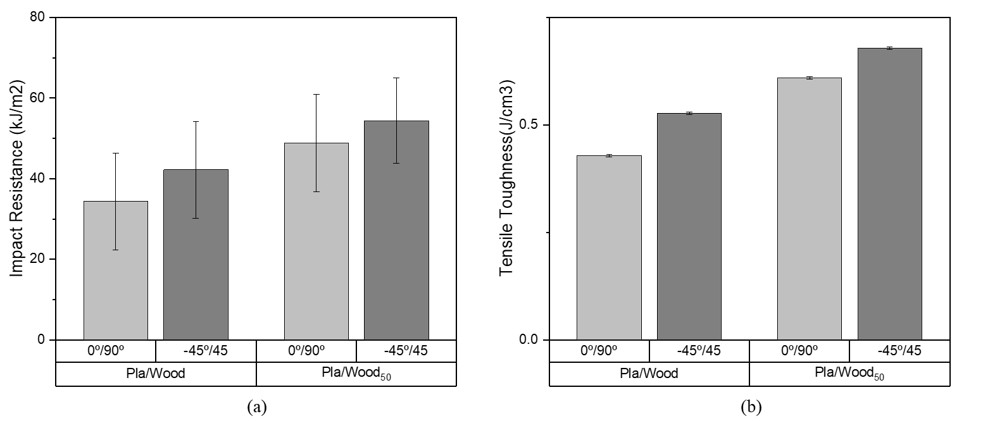
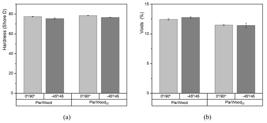
This study examines the effect of heat treatment at 50 °C on PLA/Wood composites produced by fused deposition modelling (FDM). The material consisted of PLA with 20 wt% recycled pine particles and was printed in two raster orientations (0°/90° and −45°/45°). Annealing was performed at 50 °C for 1 h, below the glass transition region, to promote molecular relaxation at interlayer regions while preserving dimensional stability. After treatment, the void content decreased from ~12.7% to ~11.4%, and Shore D hardness increased by ~2%. Tensile strength rose from 17.83 to 28.95 MPa (0°/90°) and from 16.55 to 27.58 MPa (−45°/45°). Flexural strength increased by up to 48%, and Charpy impact resistance increased from 34.36 to 48.86 kJ/m2 (0°/90°) and from 42.23 to 54.38 kJ/m2 (−45°/45°). Microscopy indicated reduced interlayer separation and more cohesive fracture paths after annealing. The results show that heat treatment at 50 °C improves mechanical performance in PLA/Wood without altering external geometry or compromising the bio-based reinforcement.
Keywords:
Additive Manufacturing; PLA/Wood Composite; Annealing Treatment; Mechanical Properties
 Thumbnail
 Thumbnail
 Thumbnail
 Thumbnail
 Thumbnail
 Thumbnail
 Thumbnail
 Thumbnail
 Thumbnail
 Thumbnail
 Thumbnail
 Thumbnail


 (a) Initial layer of sand positioning. (b) Specimen fully covered with sand inside the oven.