Poly(lactic acid) Films Reinforced with TiO2 and ZnO Nanoparticles: Thermal, Mechanical, Optical, and Phytotoxicity Assessment
Abstract
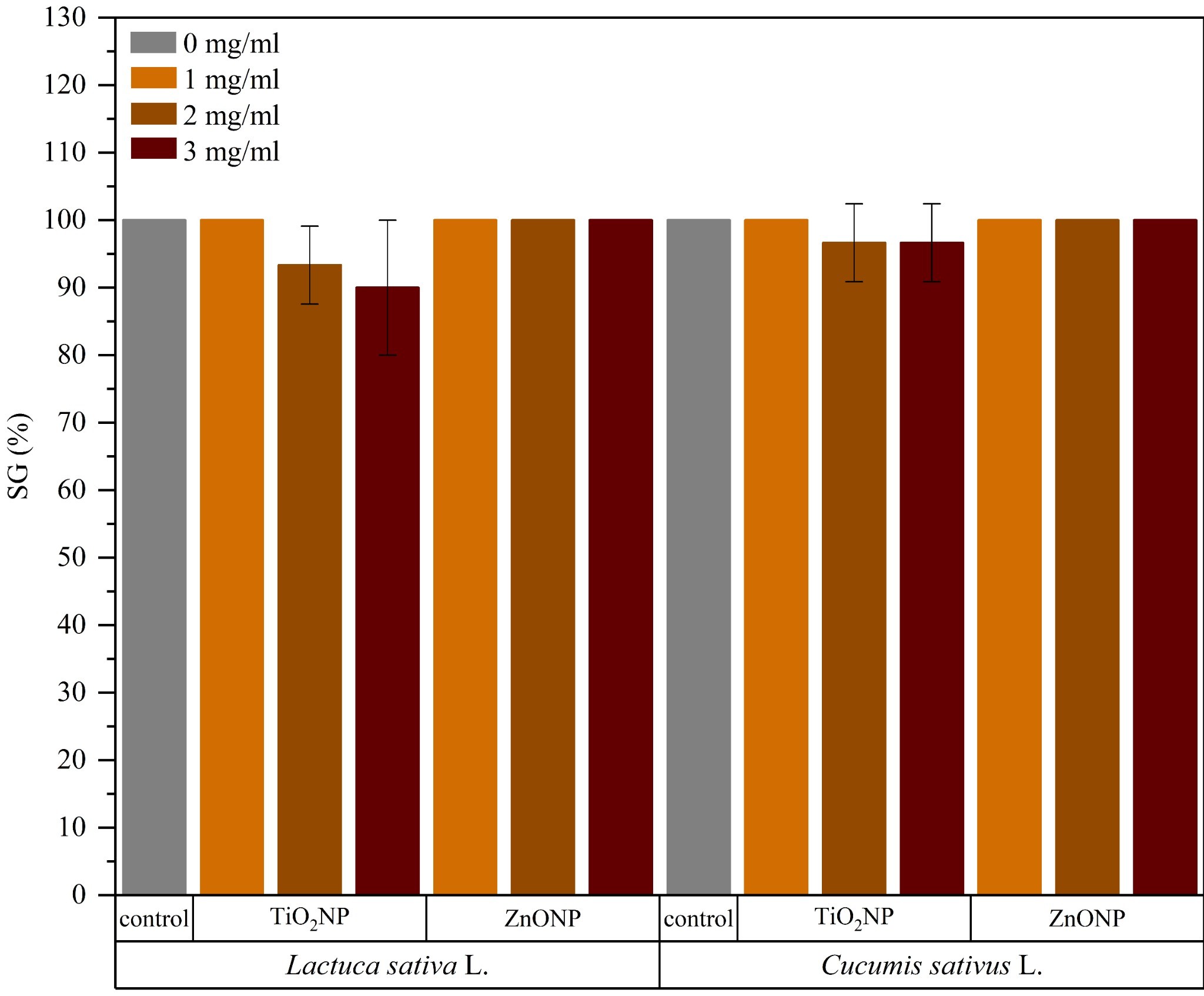
Poly(lactic acid) (PLA)-based films containing 0.5 and 1.5 wt% of TiO2 or ZnO nanoparticles were prepared by solvent casting and evaluated in terms of thermal, mechanical, optical, structural, and ecotoxicological performance, targeting food packaging applications. X-ray diffraction and scanning electron microscopy revealed that low nanoparticle contents promoted partial crystalline ordering and relatively homogeneous dispersion, whereas higher loadings led to agglomeration and reduced crystallinity. Thermogravimetric analysis showed that the incorporation of 0.5 wt% TiO2 increased the onset decomposition temperature of PLA from 303.3 to 322.8 °C. In contrast, higher nanoparticle contents and all ZnO-containing films exhibited reduced thermal stability and lower glass transition temperatures, with Tg decreasing from 51.3 °C (PLA) to 44.0 °C for PLA15ZnO. Nanoindentation demonstrated a significant increase in nanohardness for all nanocomposites, reaching improvements of up to ~27% compared to neat PLA. Optical analysis showed effective UV-shielding below 400 nm and preservation of visible-light transmittance above ~85% for films containing 0.5 wt% ZnO, whereas higher TiO2 contents induced pronounced opacity and color changes. Germination assays using lettuce and cucumber indicated concentration-dependent phytotoxic effects for TiO2, while ZnO showed neutral or slightly positive effects at low concentrations.
Keywords:
Poly(lactic acid); TiO2NPs. ZnONPs; Food Packaging; Phytotoxicity
 Thumbnail
 Thumbnail
 Thumbnail
 Thumbnail
 Thumbnail
 Thumbnail
 Thumbnail
 Thumbnail
 Thumbnail
 Thumbnail
 Thumbnail