Improving the Photoconductivity of a Fullerene-Based Oligomer with Polythiophenes
Abstract
Organic solar cells offer significant advantages over traditional inorganic solar cells, including their lightweight nature, ease of fabrication, low cost, and low energy investment. Recent advances have shown that oligo and poly(fullerene)s play an important role in both types of devices, either as additives or interlayers, significantly improving stability and charge extraction. There is considerable room for further progress in understanding the properties of these novel materials. Here, we examine OPCBMMB, an oligo(fullerene) based on PCBM, and study its changes in photoconductivity when combined with thiophenes. The OPCBMMB:P3HT and OPCBMMB:P3OT composites are formed from drop casting, with optical and electronic characterizations being performed. UV characterizations confirm a difference in macromolecular conformation of the P3HT and P3OT going from solution to film, as would be expected. More interesting is the great improvement in the films conductivities when studied under direct current when compared to pristine OPCBMMB. Differences arise due to the variations in thiophene alkyl chains. The combination of OPCBMMB:P3HT and OPCBMMB:P3OT also proved to be an effective combination of acceptor-donor, with a visible increase in conductivity when exposed to light. A fact that can be correlated to the UV spectra, which shows the blends have a strong interaction with visible light.
Keywords:
Photoconductivity; Fullerene-Based; Oligomers; Polythiophenes
1. Introduction
Among the many conjugated polymers that have emerged over the last forty years, polythiophenes remain some of the most successful due to their ease of synthesis, high solubility, relatively good stability, and excellent conductivity when doped1,2. Their ability to exhibit strong aromatic π-stacking interactions, with alkyl chains facilitating their solubility means that from their inception and still now they remain an important class of polymers.
The size of the side-chain is extremely important for their performance, since this directly influences the properties of the materials3. The length of the side chain influences the morphology and structure of the thin-films, changing their mechanical property from brittle to waxy as the side-chains extend. More interestingly, the side-chains change the orientation and spacing of the aromatic groups and as a consequence impact on their π-stacking, which in-turn significantly influences charge-transfer mechanisms and electrical properties.
Fullerenes constitute another important class of materials, and since their discovery as rapid electron absorbers from photo-excited polymers4,5, they have consistently demonstrated their relevance in photovoltaics and organic electronics. Indeed, very recent work has demonstrated that fullerenes are still of interest in organic photovoltaic devices (OPVs), where used in polymeric form in a tertiary mixture with non-fullerene acceptors and donor polymers, they can provide complementary absorption in the blue region and improve device stability6. Furthermore, they are also known to increase charge collection when used as interlayers in perovskite solar cells, also simultaneously increasing stability again when used in polymeric form7.
The incorporation of fullerenes into oligomers or polymers resolves one of its great disadvantages. Fullerenes tend to form aggregates in an uncontrolled manner, which means that their properties and applications are difficult to explore, since there is little or no control aggregation8. Fullerenes very quickly form large crystals which can break electronic devices by creating short-circuits, and separate out from mixtures, decreasing its ability to attract and absorb electrons. The incorporation of fullerene into polymeric structures results in a better control over their aggregation, greatly improved solubility in various organic solvents, and gives materials that are malleable and easier to manipulate.
Among the known fullerene derivatives, a material that has received a lot of attention is phenyl-C61-butyric acid methyl ester (PCBM), particularly in photovoltaic cells9,10 and gas sensors11,12. However, PCBM also presents a strong tendency to aggregate, resulting in films with a rough surface, with the formation of large agglomerates13,14.
The oligomer oligo{(phenyl-C61-butyric acid methyl ester)-alt-[1,4-bis(bromomethyl)-2,5-bis(octyloxy)benzene]} (OPCBMMB) is derived from PCBM and is capable of producing more homogeneous films than PCBM. It was shown to have very similar electronic and optical properties to PCBM. This was found to be due to there being quite a large part of unreacted PCBM still in the mixture (around 35%) but also because the PCBM was incorporated into the oligomer by way of a symmetrical addition which does not greatly change its optical absorptions. Most importantly, the oligomer was found to form much smoother films than those made from PCBM alone, even when using drop-casting, which does not favor the structural organization of the film11-13.
In this work we examine closely the impact of the addition of P3HT and P3OT to OPCBMMB to better understand the electrical and photo-electrical behaviors of these important classes of materials.
2. Methodology
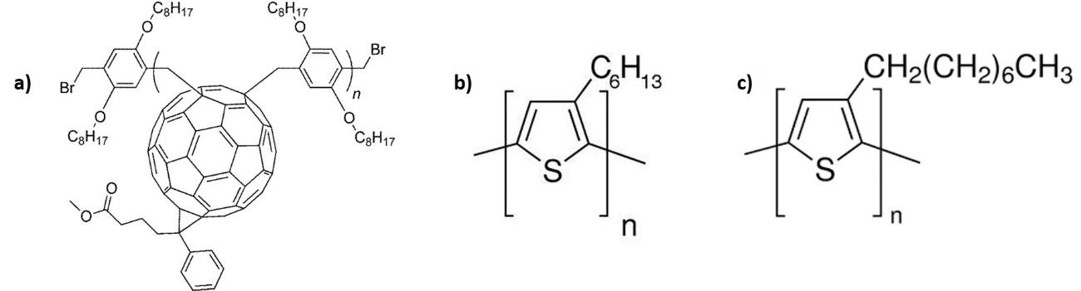
In this work, a fullerene derivative oligomer was studied, along with two polythiophene derivatives. The fullerene used was oligo{(phenyl-C61-butyric acid methyl ester)-alt-[1,4-bis(bromomethyl)-2,5-bis(octyloxy)benzene]} (OPCBMMB) and the two P3ATs were poly(3-hexylthiophene-2,5-diyl) (P3HT) and poly(2-octylthiophene-2,5-diyl) (P3OT). Both P3HT and P3OT were obtained commercially from Sigma Aldrich, while OPCBMMB was prepared as detailed by Ramanitra et al.15. The same material prepared in the referenced work is used here, and the reader is referred to that publication for full experimental details on material preparation and characterization. The OPCMMB was made by a relatively large scale atom transfer radical addition polymerization (ATRAP) of PCBM (3 g) with 1,4-bis(bromomethyl)-2,5-bis(octyloxy)benzene in the presence of CuBr and bipyridine. It was found to contain oligomers with 1 to 4 repeating units and about 35% unreacted PCBM. Figure 1 presents the chemical structures for the materials used in this study.

For optical characterization (UV-vis measurements), the films were deposited onto glass substrates. For electrical characterization in direct current and photoconductivity measurements, glass substrates with interdigitated gold electrodes (IDE/Au) with 50 digits were employed. The electrodes have each digit is 110 nm in height, 8 mm in length and 100 wide and the spacing between each digit is 100 . These IDEs are essential for this work, because each pair of digits amplifies the total current measured16, which facilitates the electrical characterization in materials with a low electrical conductivity, such as fullerenes and its derivatives.
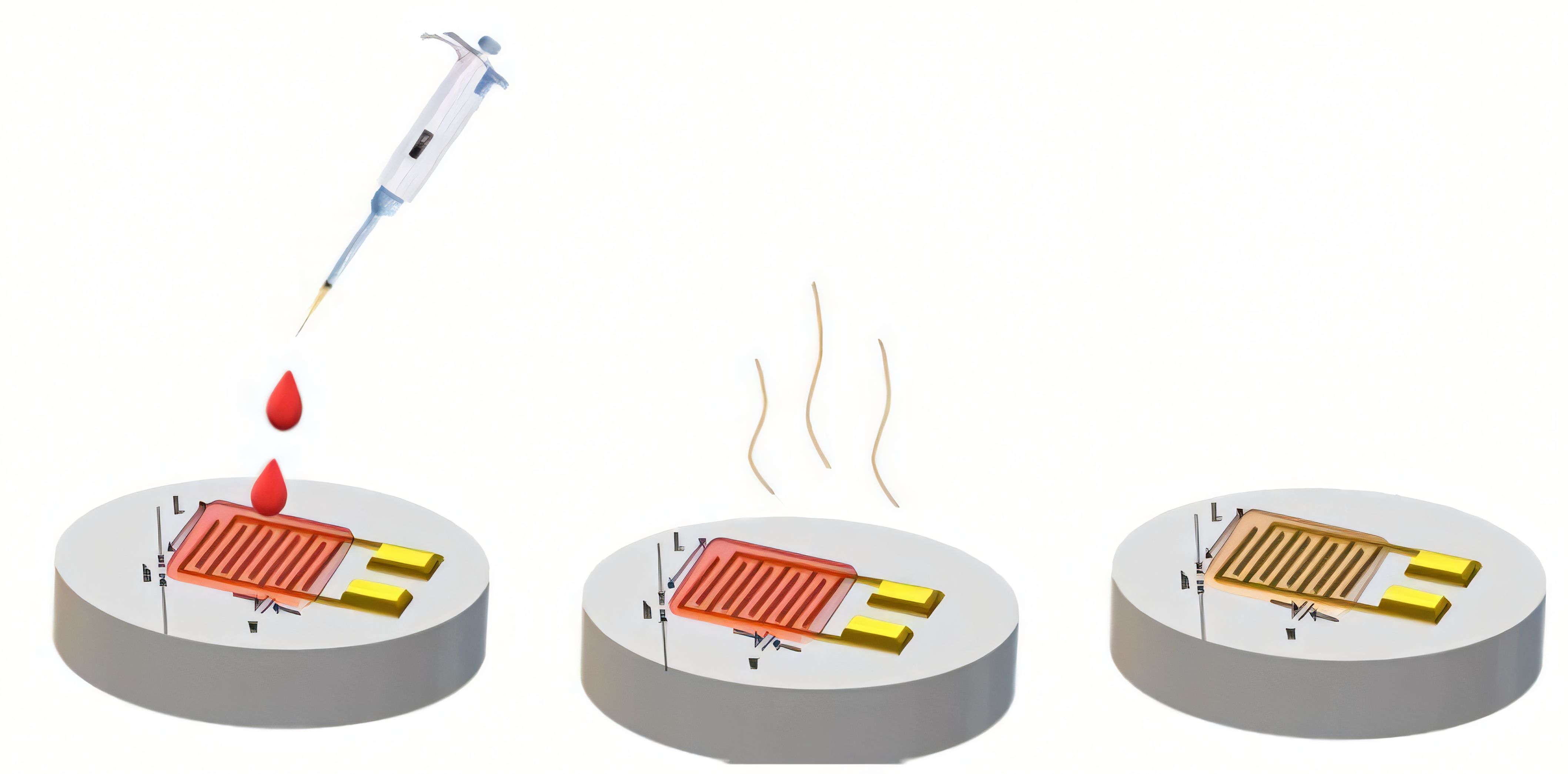
The drop casting deposition technique, employed in this work, shown in Figure 2, is one of the simplest deposition techniques from solution17. In this technique, the solution is dripped onto a horizontally stable substrate, aided by an electronic pipette. After the deposition, the solvent evaporates, allowing only the material to remain on the substrate, due to Van der Waals forces18.

However, this technique does not allow control over the film formation, facilitating the formation of agglomerates in the structure, which results in films with a heterogeneous surface. This also limits the control over the film's thickness, however, factors such as deposited volume and solution concentration can help to regulate the final film thickness, but with a low accuracy17-19.
For the film deposition, a volume of 0.2 mL of the solutions was spread onto different substrates. Solutions were prepared using chloroform as the solvent, with concentrations of 1 mg mL-1 and a ratio of 1:1 in mass for both OPCBMMB:P3HT and OPCBMMB:P3OT. The films were left to dry naturally at room temperature (22 ºC) for 24 h to ensure a complete evaporation of the solvent.
Solvent evaporation is one of the most important parts of this process, where we can choose to let it dry naturally or use a thermal process to accelerate the evaporation, however, disturbing the system during the evaporation can cause impacts on film morphology14,20.
By studying the processes of electronic transitions that happen within the ultraviolet-visible range, we can obtain important information about the materials, regarding the absorption in this spectrum, as well as obtaining information about the internal structural organization of a film. The UV-vis spectroscopy measurements were performed in the range 300 to 900 nm. Lower wavelengths were avoided due to glass opacity for ultraviolet light. The morphology of the films was studied by Atomic Force Microscopy (AFM) and profilometry, in order to observe the roughness and thickness of the samples.
Current versus Voltage (I versus V) measurements were performed on a Keithley Semiconductor Parameter Analyzer mod. 238, in a range from -10 to 10 V in steps of 0.5 V. To calculate the electrical conductivity and resistance, Ohm’s law equations were used, where the cell constant, for the IDE used, has a value of 5.1 m-1, as defined in previous works of the group, following Olthuis’ method21-23. The photoconductivity of the films were studied through Current versus time (I versus t) measurements, with a Keysight B2912A precision Source Measure Unit (SMU) and a solar simulator Oriel VERASOL, AM1.5. A constant voltage of 5 V was applied during the whole experiment and the experiment was carried in cycles of 10 minutes, alternating between a dark environment and the light incidence.
3. Results and Discussions
3.1. UV-vis absorption
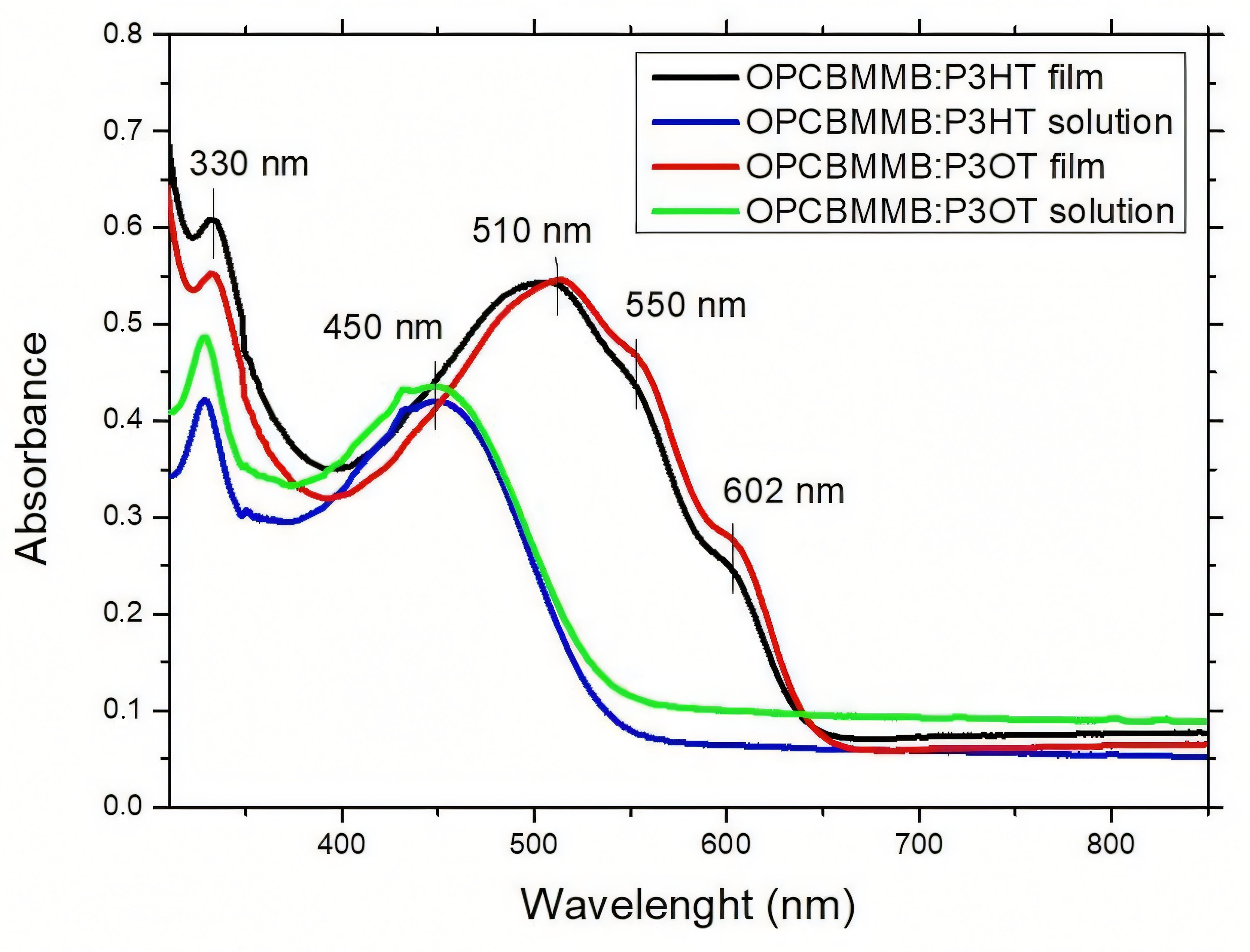
Figure 3 shows the UV-vis absorbance results obtained to the drop casting films and solutions of OPCBMMB:P3HT and OPCBMMB:P3OT, where we observe a peak in 333 nm, characteristic to fullerenes, corresponding to excited singlet transitions24.
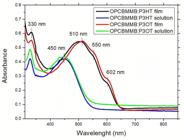
In both solutions, a peak at 450 nm is observed, corresponding to the thiophenes25. This peak is red-shifted in the film's spectra, which is related to a higher packing and ordering of the molecules when processed as thin films25. This packing results in the displacement containing the vibronic peaks and shoulders observed in the films, at ~512 nm, ~550 nm and ~602 nm26.
The higher energy peaks (~512 nm and ~550 nm) have contributions from an intrachain exciton, while the lowest energy peak (~602 nm) is related to interchain interactions, associated with the transitions from carbon atoms on the double bonds in the aromatic rings in the polythiophene structures27.
Furthermore, we highlight that the peaks observed in the mixed films are the same observed in pristine samples, as stated in previous works. The peak obtained at 333 nm is a characteristic peak obtained from fullerenes, related to excited singlet states14 and the peaks at 512 nm, 550 nm and 602 nm are also found in pristine P3HT and P3OT samples, as stated in previous works26,27.
3.2. Morphological characterization
Through the AFM study, shown in Figure 4, it is possible to obtain data about the film roughness (RMS), as well as observe the surface structure of the measured samples
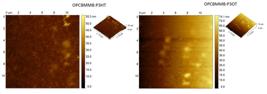
In both films, it is possible to observe the presence of a mostly smooth surface, with RMS measured on 3.56 nm for OPCBMMB:P3HT and 17.12 nm for OPCBMMB:P3OT, with few, but large aggregates, representing the brighter areas of the images. These randomly generated aggregates are a consequence of the drop casting technique employed at the deposition, which allows a very limited control over the morphology of the films.
In addition, profilometry measurements allowed us to estimate the thickness of both samples, obtaining the values of 115 nm for OPCBMMB:P3HT and 191 nm for OPCBMMB:P3OT. The thickness of the films is measured in order to ensure that the films completely cover the substrate’s interdigitated electrodes.
3.3. Electrical characterization in direct current
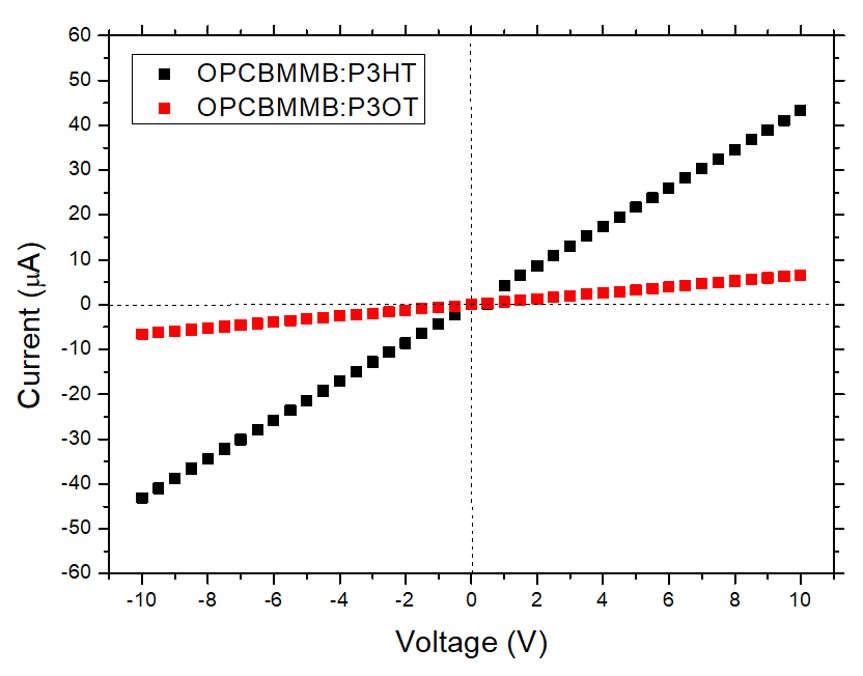
Figure 5 shows the electrical characterization performed in direct current on the drop-cast films, aiming to analyze their electrical properties. It's possible to observe the linear dependence of the electrical current versus applied voltage, indicating the absence of interface barrier between Au/active layer/Au, due to the electrode work function of ~5.1 – 5.4 eV and the HOMO of the fullerene:thiophene of 5.57 eV28,29.
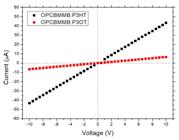
Applying the data obtained by this experiment in Ohm’s laws (and ) it is possible to estimate the films’ electrical resistance () and electrical conductivity (). The cell constant was obtained in previous works, as stated previously in the methodology section. The values obtained to the resistance and conductivity are shown in Table 1.
Pristine OPCBMMB films have a very low electrical conductivity, as stated in previous works, around 10-10 S m-113,25. This happens due to the PCBM present in the OPCBMMB structure, which often does not allow the creation of paths necessary to charge transport30. Examining the values of the mixtures in Table 1, around 10-5 S m-1 and 10-6 S m-1, for P3HT and P3OT, respectively, a strong increase in the conductivity were observed. This increase can be explained when we consider OPCBMMB being an acceptor and combining it with a donor material, such as the polythiophenes, contributes to the charge transport process. In addition, due to P3HT and P3OT having a high solubility in chloroform, their addition in the mixture with pristine OPCBMMB result in an extension in the conjugation length, which also provides a greater charge mobility to the film31.
Furthermore, the difference in conductivity values obtained in Table 1 can be attributed to the presence of different alkyl groups in the side chain of the polythiophene, since the size of the side chain influences the -stacking interactions of the thiophene rings, potentially altering the structure of the thin films deposited. These changes in the structure are capable of influencing the charge transfer mechanisms of the films, altering its electrical properties, with longer alkyl chains often resulting in lower conductivity values3.
3.4. Photoconductivity
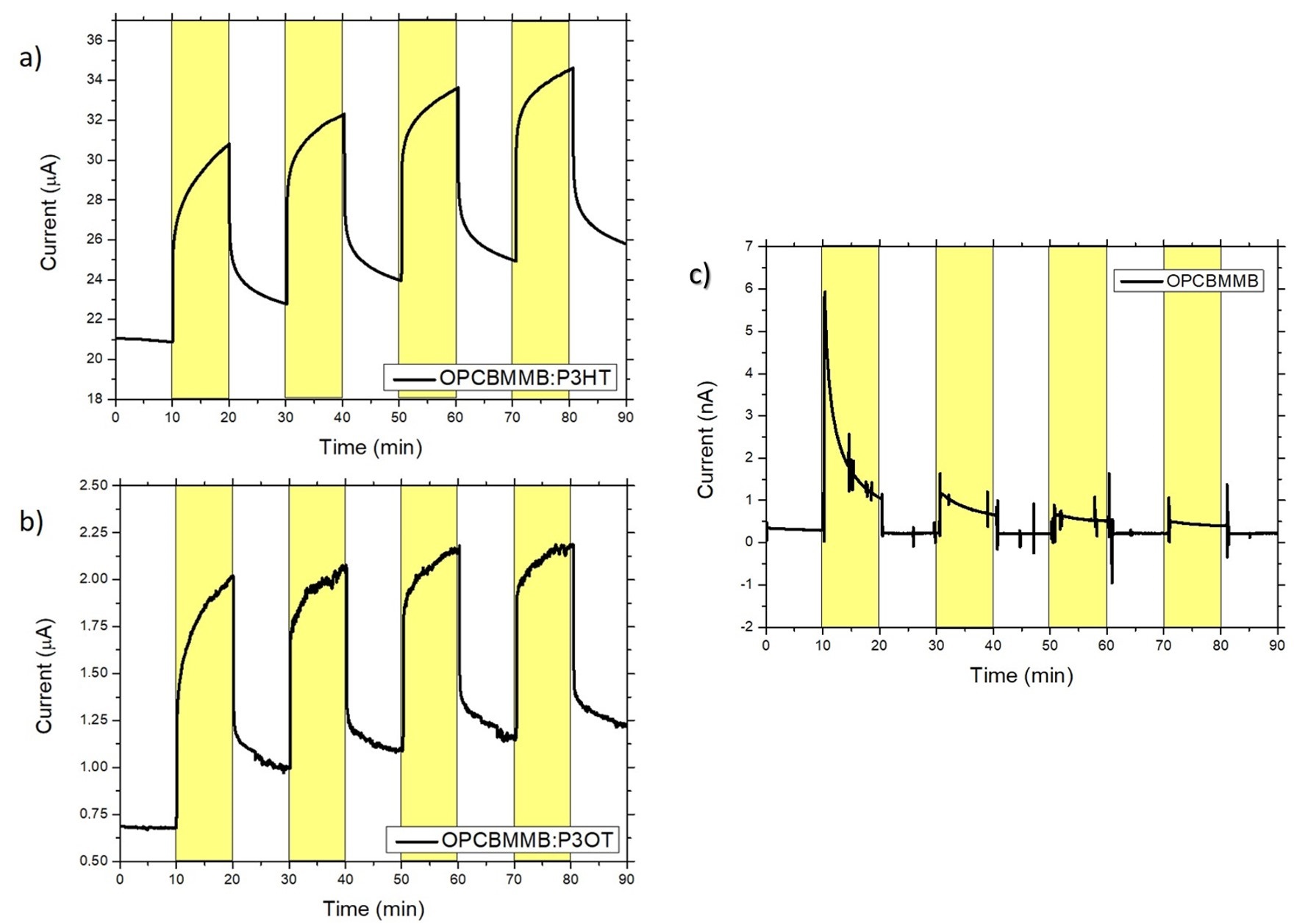
The drop casting films were also subjected to photoconductivity measurements, in order to evaluate their response when exposed to photon excitation. The results obtained are shown in Figure 6.

Photoconductivity results of the drop casting films; a) OPCBMMB:P3HT; b) OPCBMMB:P3OT: c) OPCBMMB.
The films were subjected to a constant voltage of 5 V throughout the experiment, initially in the dark and, in regular intervals of 10 minutes, the samples were exposed to light. These cycles were repeated in order to verify whether the responses were reproducible. The voltage of 5 V was chosen according to the electrical characterization in electrical current, as seen in Figure 5, at 5 V the curves show a considerable difference between the current values observed.
During the photoexcitation process, incident light can generate an electron-hole pair, linked by Coulomb attraction. The external electrical voltage applied throughout the experiment provides the energy necessary to dissociate the electron-hole pair, generating free charges32-35.
Comparing the photoconductivity curve obtained for the pristine OPCBMMB film, with the ones from the mixtures wields interesting results, in which is clear the increase in the order of magnitude of the photocurrent when the P3ATs are present.
Furthermore, it is noticeable that, in the pristine OPCBMMB film, there is a steady decrease in response to light throughout the experiment. Such behavior is not present in the films where the oligomer is mixed with the P3ATs, on the contrary, the mixture drop casting films show an increase in the photocurrent at each illumination cycle. Such results might indicate an increase in the charge carriers density, that can be attributed directly to the presence of the poly-thiophene derivatives in association with the oligomer, as seen in other cases for fullerene/poly-thiophene blends in the literature36.
The increase observed in the photocurrent may be attributed to the presence of poly-thiophenes in both films, since both P3HT and P3OT have a light absorption peak in the visible region (510 nm). Furthermore, literature has proven that mixed films of PCBM:P3HT are efficient in generating an elevated photocurrent25,37. Previous works from our group also showed that OPCBMMB and PCBM share various electronical properties, which is caused by the large portion of PCBM present in the OPCBMMB structure13,15. In addition the mixed OPCBMMB:P3AT films also revealed a much better current recovery at each cycle when compared to pristine P3AT, as stated previously in previous works38.
It is also possible to observe a difference between the current measured in DC conductivity and the photo response on the OPCBMMB:P3OT sample. This happens due to the low reproducibility between drop casting samples, since there is no control in the morphology of the films, often resulting in different samples with slightly different values.
4. Conclusions
This work describes the fabrication of mixed drop casting films of OPCBMMB:P3HT and OPCBMMB:P3OT in order to perform their characterization and verify their photoconductivity properties. The UV-vis results showed two major peaks in the films, at 333 nm, corresponding to the OPCBMMB and 510 nm, corresponding to the thiophenes. The DC electrical characterization showed that conductivity is largely improved when compared to pristine OPCBMMB samples, with OPCBMMB:P3HT films resulting in higher conductivity values. The polythiophenes in the samples are primarily responsible for the measured photocurrent, which correlates with the UV-vis results showing the thiophenes' interaction with visible light. Furthermore, an acceptor-donor pair such as fullerenes and polythiophenes are known for vastly improving their electronical properties when used together in devices.
5. References
- 1 Olivati CA. Estudo das propriedades elétricas e ópticas de dispositivos eletroluminescentes poliméricos [thesis]. São Carlos: Universidade de São Paulo; 2004.
- 2 Roncaselli LKM. Fabricação e caracterização elétrica de filmes nanoestruturados de derivados do politiofeno [dissertation]. Presidente Prudente: UNESP; 2016.
-
3 Liao F, Yin S, Toney MF, Subramanian V. Physical discrimination of amine vapor mixtures using polythiophene gas sensor arrays. Sens Actuators B Chem. 2010;150(1):254-63. http://doi.org/10.1016/j.snb.2010.07.006
» http://doi.org/10.1016/j.snb.2010.07.006 -
4 Günes S, Neugebauer H, Sariciftci NS. Conjugated polymer-based organic solar cells. Chem Rev. 2007;107(4):1324-38. http://doi.org/10.1021/cr050149z
» http://doi.org/10.1021/cr050149z -
5 Sariciftci NS, Smilowitz L, Heeger AJ, Wudl F. Photoinduced electron transfer from a conducting polymer to buckminsterfullerene. Science. 1992;258(5087):1474-6. http://doi.org/10.1126/science.258.5087.1474
» http://doi.org/10.1126/science.258.5087.1474 -
6 Yu H, Wang Y, Zou X, Yin J, Shi X, Li Y, et al. Improved photovoltaic performance and robustness of all-polymer solar cells enabled by a polyfullerene guest acceptor. Nat Commun. 2023;14(1):2323. http://doi.org/10.1038/s41467-023-37738-9
» http://doi.org/10.1038/s41467-023-37738-9 -
7 Yin J, Shi X, Wang L, Yan H, Chen S. High‐performance inverted perovskite solar devices enabled by a polyfullerene electron transporting material. Angew Chem Int Ed. 2022;61(52):e202210610. http://doi.org/10.1002/anie.202210610
» http://doi.org/10.1002/anie.202210610 -
8 Wong HC, Li Z, Tan CH, Zhong H, Huang Z, Bronstein H, et al. Morphological stability and performance of polymer-fullerene solar cells under thermal stress: the impact of photoinduced PC60BM oligomerization. ACS Nano. 2014;8(2):1297-308. http://doi.org/10.1021/nn404687s
» http://doi.org/10.1021/nn404687s -
9 Yang D, Zhang X, Wang K, Wu C, Yang R, Hou Y, et al. Stable efficiency exceeding 20.6% for inverted perovskite solar cells through polymer-optimized PCBM electron-transport layers. Nano Lett. 2019;19(5):3313-20. http://doi.org/10.1021/acs.nanolett.9b00936
» http://doi.org/10.1021/acs.nanolett.9b00936 -
10 Zhang C, Heumueller T, Gruber W, Almora O, Du X, Ying L, et al. Comprehensive investigation and analysis of bulk-heterojunction microstructure of high-performance PCE11:PCBM solar cells. ACS Appl Mater Interfaces. 2019;11(20):18555-63. http://doi.org/10.1021/acsami.8b22539
» http://doi.org/10.1021/acsami.8b22539 -
11 Chuang MY, Chen JN, Zan HW, Lu CJ, Meng HF. Modulated gas sensor based on vertical organic diode with blended channel for ppb-regime detection. Sens Actuators B Chem. 2016;230:223-30. http://doi.org/10.1016/j.snb.2016.02.030
» http://doi.org/10.1016/j.snb.2016.02.030 -
12 Park MS, Meresa AA, Kwon CM, Kim FS. Selective wet-etching of polymer/fullerene blend films for surface- and nanoscale morphology-controlled organic transistors and sensitivity-enhanced gas sensors. Polymers. 2019;11(10):1682. http://doi.org/10.3390/polym11101682
» http://doi.org/10.3390/polym11101682 -
13 Simõis AV, Borro MS, Medina ME, Riga LA Jr, Ferreira ND, Silva PL, et al. Fabrication and characterization of poly(fullerene) thin films for gas sensors. Polym Int. 2024;74(2):140-51. http://doi.org/10.1002/pi.6698
» http://doi.org/10.1002/pi.6698 -
14 Simõis AVS, Roncaselli LKM, Oliveira VJR, Medina MERS, Ramanitra HH, Stephen M, et al. Polyfullerene thin films applied as NH3 sensors. Mater Res. 2021;24(Suppl 1):e20210435. http://doi.org/10.1590/1980-5373-mr-2021-0435
» http://doi.org/10.1590/1980-5373-mr-2021-0435 -
15 Ramanitra HH, Dowland SA, Bregadiolli BA, Salvador M, Santos Silva H, Bégué D, et al. Increased thermal stabilization of polymer photovoltaic cells with oligomeric PCBM. J Mater Chem C Mater Opt Electron Devices. 2016;4(34):8121-9. http://doi.org/10.1039/C6TC03290G
» http://doi.org/10.1039/C6TC03290G -
16 Sheppard NF, Tucker RC, Wu C. Electrical conductivity measurements using microfabricated interdigitated electrodes. Anal Chem. 1993;65(9):1199-202. http://doi.org/10.1021/ac00057a016
» http://doi.org/10.1021/ac00057a016 - 17 Almeida LCP. Filmes finos multicamadas de polímeros condutores, nanotubos de carbono e fulerenos modificados para aplicação na conversão de energia solar [thesis]. Campinas: Universidade Estadual de Campinas; 2012. http://doi.org/10.47749/T/UNICAMP.2012.903098.
- 18 Castro SVF. Sensor voltamétrico para detecção de trinitrotolueno baseado em nanocompósito de óxido de grafeno reduzido e nanotubos de carbono [dissertation]. Uberlândia: Universidade Federal de Uberlândia; 2018.
-
19 Kanoun O, Müller C, Benchirouf A, Sanli A, Dinh T, Al-Hamry A, et al. Flexible carbon nanotube films for high performance strain sensors. Sensors. 2014;14(6):10042-71. http://doi.org/10.3390/s140610042
» http://doi.org/10.3390/s140610042 -
20 Kumar AKS, Zhang Y, Li D, Compton RG. A mini-review: how reliable is the drop casting technique? Electrochem Commun. 2020;121:106867. http://doi.org/10.1016/j.elecom.2020.106867
» http://doi.org/10.1016/j.elecom.2020.106867 - 21 Silva EAD. (2014). Efeito da adição de moléculas anfifílicas na formação de filmes Langmuir e Langmuir-Blodgett de derivados alquilados do politiofeno: aplicação em sensores [dissertation]. Presidente Prudente: UNESP; 2014.
-
22 Fabiano S, Braun S, Fahlman M, Crispin X, Berggren M. Effect of gate electrode work-function on source charge injection in electrolyte-gated organic field-effect transistors. Adv Funct Mater. 2014;24(5):695-700. http://doi.org/10.1002/adfm.201302070
» http://doi.org/10.1002/adfm.201302070 -
23 Olthuis W, Streekstra W, Bergveld P. Theoretical and experimental determination of cell constants of planar-interdigitated electrolyte conductivity sensors. Sens Actuators B Chem. 1995;24(1–3):252-6. http://doi.org/10.1016/0925-4005(95)85053-8
» http://doi.org/10.1016/0925-4005(95)85053-8 -
24 Cook S, Katoh R, Furube A. Ultrafast studies of charge generation in PCBM: P3HT blend films following excitation of the fullerene PCBM. J Phys Chem C. 2009;113(6):2547-52. http://doi.org/10.1021/jp8050774
» http://doi.org/10.1021/jp8050774 -
25 Roncaselli LKM, Silva EA, Braunger ML, Ramanitra HH, Stephen M, Citolino LVL, et al. Influence of solvents on the morphology of Langmuir and Langmuir-Schaefer films of PCBM and PCBM-based oligomers and polymers. Phys Chem Chem Phys. 2022;24(20):12442-56. http://doi.org/10.1039/D1CP05408B
» http://doi.org/10.1039/D1CP05408B -
26 Motaung DE, Malgas GF, Arendse CJ, Mavundla SE, Knoesen D. Structural and photo-physical properties of spin-coated poly(3-hexylthiophene) thin films. Mater Chem Phys. 2009;116(1):279-83. http://doi.org/10.1016/j.matchemphys.2009.03.028
» http://doi.org/10.1016/j.matchemphys.2009.03.028 -
27 Oliveira VJR, Citolino LVL, Camacho SA, Alessio P, Olivati CA. Langmuir-Schaefer films of regioregular polythiophene derivatives as VOCs sensors. Mater Chem Phys. 2018;217:421-6. http://doi.org/10.1016/j.matchemphys.2018.06.070
» http://doi.org/10.1016/j.matchemphys.2018.06.070 -
28 Hohertz D, Gao J. How electrode work function affects doping and electroluminescence of polymer light-emitting electrochemical cells. Adv Mater. 2008;20(17):3298-302. http://doi.org/10.1002/adma.200800068
» http://doi.org/10.1002/adma.200800068 - 29 Roncaselli LKM. Estudo e caracterização de filmes nanoestrurados de derivados de poli-fulerenos [thesis]. Presidente Prudente: UNESP; 2021.
-
30 Roncaselli LKM, Silva EA, Ramanitra HH, Stephen M, Simõis AVS, Bégué D, et al. Study of the effect of solvent on the conductivity of langmuir-schaefer films of Poly(Fullerene)s. Mater Res. 2021;24(Suppl 1):e20210028. http://doi.org/10.1590/1980-5373-mr-2021-0028
» http://doi.org/10.1590/1980-5373-mr-2021-0028 -
31 Liao HC, Tsao CS, Huang YC, Jao MH, Tien KY, Chuang CM, et al. Insights into solvent vapor annealing on the performance of bulk heterojunction solar cells by a quantitative nanomorphology study. RSC Advances. 2014;4(12):6246-53. http://doi.org/10.1039/c3ra45619f
» http://doi.org/10.1039/c3ra45619f -
32 Mihailetchi VD, Koster LJA, Hummelen JC, Blom PWM. Photocurrent generation in polymer-fullerene bulk heterojunctions. Phys Rev Lett. 2004;93(21):216601. http://doi.org/10.1103/PhysRevLett.93.216601
» http://doi.org/10.1103/PhysRevLett.93.216601 -
33 Savenije TJ, Kroeze JE, Wienk MM, Kroon JM, Warman JM. Mobility and decay kinetics of charge carriers in photoexcited PCBM/PPV blends. Phys Rev B Condens Matter Mater Phys. 2004;69(15):155205. http://doi.org/10.1103/PhysRevB.69.155205
» http://doi.org/10.1103/PhysRevB.69.155205 -
34 Chapman CT, Liang W, Li X. Ultrafast coherent electron-hole separation dynamics in a fullerene derivative. J Phys Chem Lett. 2011;2(10):1189-92. http://doi.org/10.1021/jz200339y
» http://doi.org/10.1021/jz200339y -
35 Paquin F, Rivnay J, Salleo A, Stingelin N, Silva C. Multi-phase semicrystalline microstructures drive exciton dissociation in neat plastic semiconductors. J Mater Chem C Mater Opt Electron Devices. 2015;3:10715-22. http://doi.org/10.1039/C5TC02043C
» http://doi.org/10.1039/C5TC02043C -
36 Ohkita H, Cook S, Astuti Y, Duffy W, Tierney S, Zhang W, et al. Charge carrier formation in polythiophene/fullerene blend films studied by transient absorption spectroscopy. J Am Chem Soc. 2008;130(10):3030-42. http://doi.org/10.1021/ja076568q
» http://doi.org/10.1021/ja076568q - 37 Sreejith S, Arun V, Sivasankari B, Karthika A, Gautami A, Ajayan J. A review on P3HT:PCBM material based organic solar cells. In: 2022 IEEE International Conference on Nanoelectronics, Nanophotonics, Nanomaterials, Nanobioscience & Nanotechnology (5NANO); 2022; Kottayam, India. Proceedings. New York: IEEE; 2022. p. 1-6.
- 38 Riga LA. Estudo da anisotropia óptica e elétrica de filmes finos derivados do politiofenos [dissertation]. Presidente Prudente: UNESP; 2024.