Compositional Influence on Martensitic Transformations in Ni-Ti Alloys by Molecular Dynamics
Abstract
Over the last decades, high-entropy refractory alloys with shape memory (SM) effect have been increasingly studied. However, identifying the optimal composition among the vast array of potential systems remains a significant challenge for the scientific community. In this work, Ni-Ti alloys are studied via molecular dynamics simulations to determine the range of martensitic phase transformations, with the goal of developing in the future medium- (MEA) and high-entropy alloys (HEA) that exhibit SM behavior. Virtual samples with compositions of Ni(100-x)Tix (45 < x < 55) were created using the LAMMPS software, in a system consisting of 2000 atoms that interacted under the modified embedded atom method (MEAM) interatomic potential. In addition, simulations were also performed on systems with sizes of 4000 and 8000 atoms to assess the effect of system size on the phase transformation behavior. The structural evolution and phase transformations were analyzed by applying heating and cooling rates of 1 K/ps, controlled by the isothermal-isobaric (NPT) ensemble. The compositional range, in atom percent, for martensitic transformations was found to be 47.5 to 52.5% nickel. Martensitic transformations are complex, showing either direct or two-step transformations. At lower temperatures, the phases R and B19’ can be formed as a function of Ni content. In several cases, at intermediate temperatures, the Ni4Ti3 compound forms and influences the phase transformation process. Also, the larger the system size, the lower the phases transformation temperatures.
Keywords:
Molecular dynamics; nitinol; shape memory alloys; martensitic transformations
1. Introduction
Modern technological and industrial development increasingly demands materials that can withstand severe conditions. Additionally, the search for new materials is crucial for the production of devices and machines with enhanced performance. The aeronautical, naval, automotive, oil and gas, mining, and biotechnology industries require materials that meet specific technical requirements. Among these requirements, mechanical resistance stands out, particularly in both static and dynamic conditions across a wide range of temperatures, along with various physical and chemical properties.
Over the past few decades, several crystalline materials have been explored, including shape memory alloys (SMA)1, medium entropy alloys (MEA), and high entropy alloys (HEA)2. HEAs are composed of multiple principal elements, typically five or more, in equiatomic or near-equiatomic ratios usually called as non-equiatomic alloys. These alloys exhibit a high degree of compositional complexity, which can result in a single-phase solid solution or, in some cases, multiple phases, where one phase has a simple solid solution matrix. The complex microstructure of HEAs allows for the achievement of excellent mechanical, physical, and chemical properties across a wide range of temperatures, from cryogenic to refractory conditions.
On the other hand, SMAs are widely known for their unique mechanical properties, such as the shape memory effect (SME) and superelasticity, which arise from martensitic phase transformations. The SME is the ability of a material to recover its pre-deformed shape when heated3. This occurs due to a reversible martensitic phase transformation from the austenite phase, with high crystallographic symmetry, to the martensite phase, which has lower symmetry. Furthermore, reversible martensitic transformations can be activated by both thermal and mechanical effects, making them particularly useful for applications that require high mechanical performance and the ability to recover from deformation.
Although several SMA systems exist, the most studied and explored on an industrial scale are the nitinol alloys4. These alloys are composed of Ni and Ti elements in equiatomic or near-equiatomic ratios and can be tuned to exhibit both SME and HEA behaviors by controlling their composition and stability through the addition of other alloying elements. Therefore, developing alloys that combine both characteristics has become one of the main challenges in materials science and technology. HEAs with SME show promise for a wide variety of applications in which materials must withstand extreme conditions while maintaining their functional properties. These applications include aerospace components, biomedical devices, and smart materials for actuators and sensors. In the aerospace industry, HEAs with SME can be used in components that need to recover from deformation caused by high stresses during operation. In the biomedical field, these alloys could be used in stents or other implants that need to adjust their shape after being placed in the body.
In general, ternary alloys can be considered precursors to MEAs, which typically contain four alloying elements. When additional elements are added, these alloys can form HEAs, which, in specific compositions —including non-equiatomic ones— can retain the SME. Among the systems based on the binary NiTi alloy, examples include TiNiFe5, TiNiHf6, TiNiCu7, and TiNiW8. Higher-order alloys, such as Ti20Zr15Hf15Ni25Cu259,10, Ti30Zr10Hf10Ni35Cu1511, Ti25Hf12.5Zr12.512, Ti45.2Hf5Ni44.8Cu5, Ti40.2Zr5Hf5Ni44.8Cu513, (TiZrHf)50Ni25Co10Cu1514,15, Cr20Mn20Fe20Co20Ni2016, and NiCuPdTiZrHf17, show reversible martensitic transformations, which are essential for SME. Alloys that meet the requirements of both HEA and SME are known as high entropy shape memory alloys (HESMA) and are being intensively studied. On the other hand, the Ti39.5Hf5Zr5Ni45.5Cu5 alloy13, despite exhibiting high entropy effects, does not demonstrate SME, highlighting the strong influence of chemical composition, particularly the Ni and Ti content.
Recent research has focused on enhancing the SME in HEAs by optimizing their composition and processing methods. Techniques such as alloying with additional elements, heat treatment, and thermo-mechanical processing have been explored to improve the transformation temperatures, cyclic stability, and mechanical properties of these alloys18. Additionally, researchers have been paying attention to developing HEAs that combine SME with other desirable properties, such as high strength, corrosion resistance, and wear resistance. This could lead to multifunctional materials capable of performing in a variety of demanding environments. On the other hand, although it is well known that most HEAs have compositions close to equiatomic ratios, properly determining the best composition to exhibit SME remains a significant challenge. Thus, this work aims to study, using classical molecular dynamics (MD), the range of compositions that exhibit martensitic transformation in the Ni-Ti system, with the goal of establishing a base system for the addition of other elements to increase its thermal and structural stability.
MD is a well-established atomistic simulation tool used to study various types of materials, biochemical phenomena, nanotechnology, and more. The method is based on classical mechanics and involves solving Newton's equations of motion to predict the trajectory of each particle in the system19. This approach enables the examination of dynamic processes and structural changes at the atomic level. The predictive ability of MD strongly depends on the interatomic potentials, which are mathematical functions used to describe the interactions between atoms in a system20. These potentials define how atoms influence each other through forces and energies, thereby guiding the system's evolution over time. Over the years, different types of potentials have been developed, and their use depends on the type of physical phenomena or materials being studied. For metallic materials, some types of embedded atom method (EAM) potentials are commonly used. In general, these potentials provide accurate predictions of the properties of metallic materials21, especially when the modified EAM potential is applied.
2. Computational Methodology
To understand the thermally induced martensitic phase transformation in Ni-Ti alloys, MD simulations were performed using LAMMPS22 for compositions in the range of 45 to 55 atomic percent of Ni and Ti. Since the system is composed of binary Ni-Ti alloys within a composition range where the cubic NiTi-B2 phase is stable at high temperatures, this structure was used to build the alloys for starting the simulations under consistent conditions. The modified embedded atom method (MEAM) potential, parameterized by Ko et al.23, that in its parameterization considered different intermetallic phases including the B19, R and Ni4Ti3. Initially, the simulation systems consisted of 2000 atoms organized in a box with the crystallographic axes a, b, and c aligned with the directions [100], [010], and [001], respectively. Periodic boundary conditions were applied in all three directions. After constructing the ideal systems, energy minimization was performed at 0 K, under the conjugate gradient (CG) method. The minimization aimed to relax the ideal atomic configuration to its lowest energy state by adjusting the atomic positions along conjugate directions derived from the energy gradient. After minimization, the system was heated to 50 K under the isothermal-isobaric (NPT) ensemble. In the second stage, the samples were subjected to cycles of heating and cooling in the temperature range of 50 to 800 K, at a rate of 1 K/ps, respectively. To better understand the process, Figure 1 presents a flowchart outlining the different steps followed in this study.

The post-processing analysis primarily involved plotting Potential Energy vs. Temperature (PE vs T), the length of the simulation box vs. temperature, and simulated X-ray diffraction (XRD) diffractograms at different temperatures to observe the type of phase formed, outside of equiatomic compositions.
It is worth noting that in the study of different physical phenomena by using classical MD simulation the size of the system plays a critical role in determining the accuracy, reliability, and physical relevance of the results. In general, a larger system size approximates better the behavior of macroscopic materials by reducing finite-size effects. However, due to the fact that martensitic transformation occurs very fast, the size of system has only a minor influence. Nevertheless, to prove this hypothesis additional simulations were also conducted for larger system consisting of 4000 and 8000 atoms, with the same initial crystallographic alignment and periodic boundary conditions. Also, the same protocol for both simulation and analyzes was applied.
3. Results and Discussion
This section presents the results for the different Ni-Ti alloys studied, focusing on the phase transformations observed in the PE vs. T curves during heating and cooling cycles. It is worthy note that in MD studies there are different tools such as common neighbor analysis (CNA)24, radial distribution function (RDF)25, and Ackland-Jones analysis (AJA)26, among others27-29, which are widely used to analyze phase transformations and are implemented in ovito that provide excellent facilities for its calculations. However, in this study, we focus on PE for the following reasons: PE directly reflects atomic interactions and provides an overall indication of the thermodynamic stability of a phase. While CNA, RDF, and AJA classify local atomic structures, PE trends can reveal phase transitions by showing when the system shifts to a lower energy state. Additionally, some phase transitions involve gradual atomic rearrangements rather than abrupt structural changes. CNA and AJA rely on well-defined local structures, which may not capture intermediate or transient phases, whereas PE can continuously monitor the transformation process. On the other hand, during heating or cooling, PE variations allow us to efficiently detect transformation temperatures. In contrast, CNA and RDF are more effective at identifying phases under static conditions, but they may not capture real-time atomic fluctuations during a dynamic simulation.
It should be noted that in MD, curves such as volume – temperature (V vs. T) is commonly used to study phase transitions. However, we observed that the V vs. T curves did not fully capture the various regions present in the PE vs. T curves. Therefore, we adopted the PE vs. T curves for our analysis.
In the other hand, considering that each phase of a material has a different arrangement of atoms, this can lead to variations in potential energy. Also, the system tends to evolve toward a phase with lower potential energy, as this is generally more stable, similar to thermodynamic behavior, where the most stable system tends to have the lowest Gibbs energy. By comparing the potential energies of different phases, we can predict which phase will be stable at a given temperature or composition.
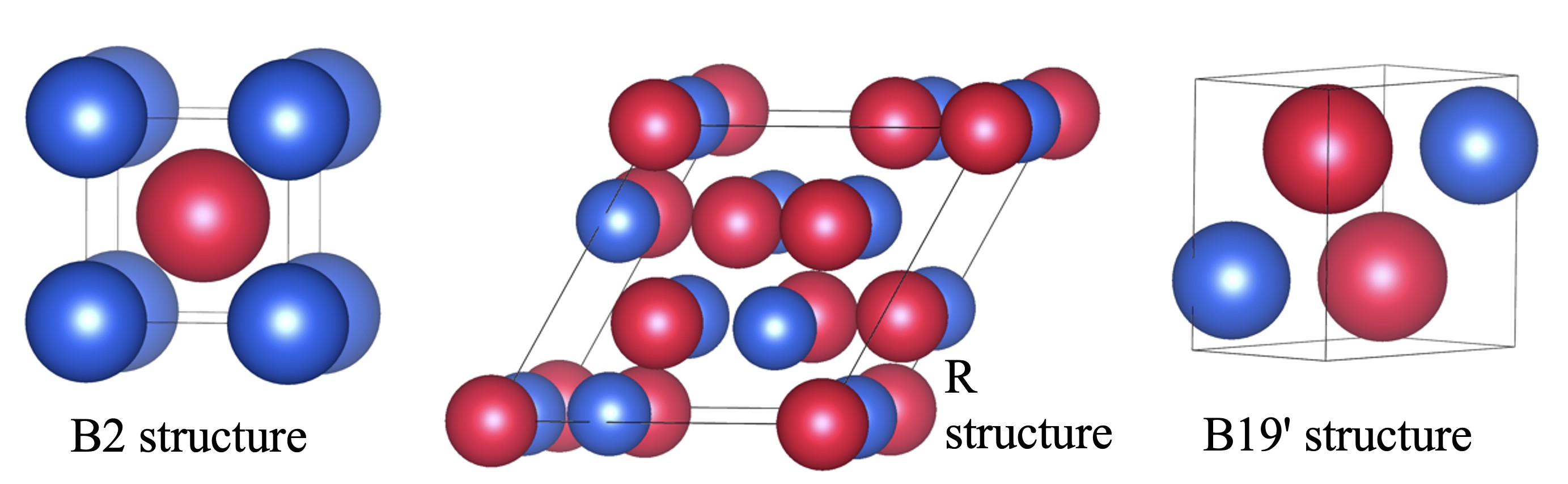
Furthermore, to better understand the phenomenology of phase transformations, curves showing the variation in the length of the simulation box are also presented. It is well known that in NiTi shape memory alloys, in addition to the austenitic phase (A), various variants of martensitic (M) phases can be found30. The most typical M-phases are the low-temperature monoclinic, B19', and the rhombohedral, R, phases31, as shown in Figure 2. Additionally, there is an orthorhombic phase, B19, which forms when certain third elements are added. Moreover, when fast cooling and heating are applied during processing, the metastable intermetallic compound Ni4Ti3 may form. This work investigates the formation of these different phases as a function of chemical composition under consistent processing conditions.

The Austenite B2, R and B19' martensite structures of NiTi alloys are shown, where red spheres represent Ni and blue spheres correspond to Ti.
It is worthy note that in MD, the cooling/heating rate dictates the kinetics and thermodynamics of physical phenomena. Slower rates favor equilibrium structures and accurate phase behavior, while faster rates induce non-equilibrium states, defects, or metastable phases. This reflects the competition between thermal energy input/removal and atomic relaxation timescales, a key factor in interpreting MD results in comparison to experimental observations. Furthermore, MD rates are extremely fast compared to experimental ones. This is due to the short simulation timescales, which are related to atomic vibration periods, along with limitations in heat transfer within macroscopic systems used in experimental studies. Thus, one can assume that the rates of 1K/ps used in this work are in good agreement with the higher rates used in macroscopic experimental tests of martensitic transformations.
3.1. Ni45Ti55 alloy
Figure 3a displays curves of PE vs. T during the heating (red) and cooling (dark blue) stages, within a temperature range of 100 to 800 K. Furthermore, within the scattered data, two nearly superimposed curves —shown in red and light blue— can be seen, obtained by applying Taubin’s filter31,32 to the data. It should be noted that the curves obtained with Taubin’s filter are more suitable for observing the material's behavior during phase transitions. Although the PE vs. T curves do not provide clear evidence of phase transitions, the change in the length of the simulation box, shown in the inset of Figure 3a, reveals a clear phase transition within the temperature range of 138 K to 175 K during heating and 133 K to 168 K during cooling. The phase transformation in this alloy occurs directly from the austenitic B2-phase to the metastable martensitic R-phase, with no evidence of other phases, as observed in the XRD patterns shown in Figure 3b.
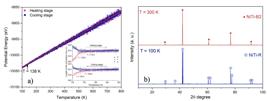
a) Potential energy vs. temperature during the heating and cooling stages, with an inset showing the evolution of the length of the simulation box. b) XRD patterns of the Ni45Ti55 alloy at two different temperatures, illustrating the B2 ↔ R martensitic phase transformation
It is well established that thermoelastic martensitic transformations are characterized by a small change in volume33, as well as by a thermal hysteresis observed in temperature values during heating and cooling cycles. Additionally, martensitic transformations can be a complex phenomenon, depending on the chemical composition and thermal history during processing. These transformations may involve one, two, or multiple stages34. For instance, several studies have shown the R-phase transformation occurring before the formation of the B19' phase. However, effective control of crystalline defects, such as grain size, dislocations, precipitation of Ni4Ti3, or mechanical stress35, can modify the mechanism of phase transformations.
In the Ni45Ti55 alloy, there is an almost imperceptible change in volume during the phase transition, but a little more accentuated change in the slope in PE v T curves is noted, although a clear thermal hysteresis is not observed. This phenomenon becomes more apparent in the changes in the length of the simulation box, where the x- and z-axes increase in size, while the y-axis shrinks. Also, the X-ray diffractogram at 100 K shows only the presence of the R-phase.
3.2. Ni47.5Ti52.5 alloy
The Taubin’s PE vs. T curves for the heating and cooling stages corresponding to the Ni47.5Ti52.5 alloy are shown in Figure 4a. Additionally, the evolution of the length of the simulation box is presented in the inset. Those curves exhibit a small but clearly visible thermal hysteresis in the temperature range from 190 to 223 K during heating, and from 175 to 210 K during cooling. At first glance, the visible change in the PE vs. T curves is due to the martensitic phase transformation that occurs, on cooling, from the austenitic B2-phase to the metastable martensitic R-phase. However, a more detailed analysis shows that the change in PE values is primarily due to the precipitation of the coherent Ni4Ti3 metastable intermetallic compound, which acts as a type of bridge between the austenite and martensitic phases. The XRD diffractogram at 150 K, shown in Figure 4b, reveals the presence of both the R- and Ni4Ti3- phases. It should be noted that upon cooling, as the material reaches the temperature of 210 K, the Ni4Ti3 begins to form, followed by the formation of the martensitic R-phase. Both phases form sequentially, and their proportions continue to change as the temperature decreases. Considering the intensity of the XRD peaks for both phases, the martensitic R-phase dominates in volume near 100 K, while the Ni4Ti3 phase remains present in small quantities. Additionally, the evolution of the volume fraction of both phases is reflected in the continuous change in the length of the simulation box. All axes show curves with a slight slope, rather than the horizontal line that would correspond to a material consisting of only a single structure.

a) PE vs. T curves during the heating and cooling stages, with an inset showing the evolution of the length of the simulation box. b) XRD diffractograms of the Ni47.5Ti52.5 alloy at two different temperatures, illustrating the martensitic phase transformation assisted by the Ni4Ti3 metastable compound.
3.3. Ni50Ti50 alloy
The equiatomic NiTi alloy is one of the most studied alloys by MD simulations. This alloy exhibits a distinctive behavior during heating and cooling, as shown in Figure 5a. During heating, the PE vs. T curves show a clear one-step martensitic transformation. However, during cooling at the same rate, a two-step transformation can be observed. This same behavior is evident in the curves corresponding to the change in the length of the simulation box, as shown in the inset of Figure 5a.

a) Potential energy vs. temperature during the heating and cooling stages, with an inset showing the evolution of the length of the simulation box. b) XRD patterns of the Ni50Ti50 alloy at three different temperatures during cooling, illustrating the martensitic phase transformation from B2 to B19', mediated by the Ni4Ti3 metastable compound (TSA, TFA, TSIC, TFIC, TSM, and TFM refer to the start and final temperatures of austenite, intermetallic compound, and martensite formation, respectively).
As mentioned earlier, there are several variants of martensitic phases. At low temperatures, the B19' phase is most likely to be present. However, at intermediate temperatures, it is unclear which type of martensitic (M) phase forms. It is worth noting that different experimental studies, conducted under various thermal treatment conditions, have reported the formation of the metastable R-phase before to the stable B19' martensite in near-equiatomic nitinol alloys36,37. This is typically referred to as a two-step martensitic phase transformation38. In this study, all samples were analyzed in a single cycle of heating and cooling, meaning that no thermal treatment was applied during processing. Therefore, to gain a clear understanding of whether the equiatomic NiTi alloy undergoes a two-step phase transition, XRD patterns at different temperatures should be analyzed.
Figure 5b shows the simulated XRD patterns at temperatures of 105 K, 175 K, and 350 K, obtained during the cooling stage. These patterns reveal the presence of the B2-phase at high temperatures and a mixture of Ni4Ti3 and B19' phases at 175 K and 105 K, respectively. It should be noted that based on the peak intensities of both phases, it can be inferred that at 175 K, the Ni4Ti3 compound has a significant fraction, but its proportion decreases at lower temperatures, while B19' becomes dominant. Furthermore, based on the PE vs. T curves, the first change in PE values during cooling is related to the formation of the Ni4Ti3 compound rather than the R-phase. This observation is in good agreement with experimental studies on similar alloys39,40, which have shown the influence of the Ni4Ti3 compound in martensitic transformation in Ni-Ti alloys. However, it differs from other studies regarding the mechanism of martensitic transformation in Ni-Ti alloys41, which have suggested that the transformation is completed by lattice distortion induced by simple shear.
It is important to note that atomistic studies are highly dependent on the interatomic potential used. Although the MEAM potential employed in our study is reported as one of the best for studying martensitic transformations, it can influence the results. Further studies using different interatomic potentials are necessary to achieve a clearer understanding of these alloys.
3.4. Ni52.5Ti47.5 alloy
It is worth noting that, in general, NiTi alloys exhibit complex behavior within the composition range close to the equiatomic ratio. Based on the results obtained in this study, it can be inferred that starting at 47.5 atom percent Ni, martensitic transformations are more likely to occur. Additionally, as the Ni content decreases, the martensitic transformation shifts from a single-step to a two-step process, and the transition mechanism also changes during heating and cooling. This physical phenomenon is clearly observed in both the PE vs. T curves and the evolution of the simulation box length during heating and cooling, as shown in Figures 6a and 6b, respectively.

a) Potential energy vs. temperature during the heating and cooling stages, with an inset showing the evolution of the edge length of the simulation box for the same alloy. b) Simulated XRD diffractograms at different temperatures during the heating stage.
A comparative analysis between Ni52.5Ti47.5 and Ni50Ti50 alloys reveals different behaviors during phase transformation in the heating and cooling stages. The equiatomic Ni50Ti50 alloy exhibits a two-step phase transformation only during cooling, while the Ni52.5Ti47.5 alloy undergoes a two-step transition in both heating and cooling stages, with a more pronounced change in PE during cooling. Furthermore, the phase transformation occurs from the B2 to the B19' structure, mediated by the Ni4Ti3 compound. It is important to note that in the low-temperature diffractogram, there are some peaks that were not identified because they do not match the B19'-phase. These peaks may correspond to variations of a metastable martensitic phase.
3.5. Ni55Ti45 alloy
As the Ni content increases, the phase transformation is inhibited, as seen in the PE vs. T curves (at a rate of 1 K/ps) in Figure 7a, where the heating and cooling curves overlap. In the inset of Figure 6a, it can be observed that the cubic simulation box changes its length with increasing temperature. That behavior is expected, as it results from the increase in atomic thermal vibrations with rising temperature. However, the B2-phase remains unchanged over the entire temperature range, as shown in the XRD diffractograms at two different temperatures in Figure 7b.

a) Potential energy vs. temperature during the heating and cooling stages of the Ni55Ti45 alloy. b) XRD diffractograms at low and high temperatures.
It is worth noting that the PE vs. T curves obtained at different rates in alloys with Ni content in the range of 45 to 52.5 at. % are very similar. However, the curves for the Ni55Ti45 alloy are quite different, exhibiting a complex behavior as the heating/cooling rate increases, which prevents a conclusive analysis.
On the other hand, the obtained results show that the phase transformations in Ni-Ti alloys are relatively complex, changing their behavior as a function of chemical composition. The PE, which is highly sensitive to phase transformations, in several cases cannot provide clear information about the phenomenology of these transformations. In such cases, the changes in the dimensions of the simulation box provide important insights into the systems. Our results indicate that the martensitic phase transformation begins with the direct formation of the R-phase at low Ni content and transitions to the formation of the B19’ phase, mediated by the Ni4Ti3 compound, at higher Ni levels, but still lower than 55 atomic percent. Furthermore, the Ni4Ti3 compound forms in a range of about 5%, acting as a transitional bridge between the austenitic and martensitic phases, including the R- or B19’ phases. Table 1 presents a summary of the phases formed during heating/cooling of the alloys.
Experimentally, Ni-Ti binary alloys with Ni content higher than 50.5 at.% undergo a B2–R phase transition, mediated by the precipitation of the metastable Ni4Ti3 compound, after aging treatment38. Our study did not consider thermal treatment; instead, it used a thermal cycle of heating and cooling. Therefore, it was not possible to observe the formation of the R-phase except in the Ni45Ti55 and Ni47.5Ti52.5 alloys. Our study predicts that, independently of the size of system, the optimal range to develop special alloys with medium or high entropy characteristics, combined with shape memory behavior, is between 45 and 52.5 atom percent of nickel.
On the other hand, simulations with a larger system size do not alter the types of phases formed in each alloy. However, the phase transformation temperatures are strongly influenced, as observed in the values presented in Table 2, which shows the phase transformation temperatures for the Ni50Ti50 alloy. The larger the system size, the lower the phase transformation temperatures.
4. Conclusions
This study investigated the structural changes in five different Ni-Ti alloys to observe martensitic transformations, focusing on monocrystalline samples.
Martensitic phase transformations in the Ni-Ti system are highly complex and strongly depend on alloy composition, temperature, and thermal cycling conditions.
Martensitic phase transformations can occur directly from the austenite B2-phase to the martensitic R-phase in Ni45Ti55 and Ni47.5Ti52.5 alloys.
The increase in Ni content led to formation of the Ni4Ti3 compound that acts as an intermediate to the formation of the martensitic R- or B19'- phases. However, higher Ni content inhibits the martensite transformations.
The results indicate that both the type of phase formed and the transformation temperatures depend strongly on the Ni content, which is consistent with experimental measurements.
This study provides an important basis for a better understanding of phase transformations in Ni-Ti alloys, offering a good starting point for the development of non-equiatomic medium and high entropy alloys through the addition of other elements to the binary range from Ni45Ti55 to Ni52.5Ti47.5 alloys.
5. Acknowledgments
The authors acknowledge the financial supports of FAPERJ (Grant E-26/010.100626, Processes SEI 260003/002235/2022 and 260003/001582/2022) and CNPq (Grant Nº 402751/2023-0). Also, this study was financed in part by the Coordenação de Aperfeiçoamento de Pessoal de Nível Superior – Brasil (CAPES) – Finance Code 001.
6. References
-
1 Rajput GS, Vora J, Prajapati P, Chaudhari R. Areas of recent developments for shape memory alloy: a review. Mater Today Proc. 2022;62:7194-8. http://doi.org/10.1016/j.matpr.2022.03.407
» http://doi.org/10.1016/j.matpr.2022.03.407 -
2 Krishna SA, Noble N, Radhika N, Saleh B. A comprehensive review on advances in high entropy alloys: fabrication and surface modification methods, properties, applications, and future prospects. J Manuf Process. 2024;109:583-606. http://doi.org/10.1016/j.jmapro.2023.12.039
» http://doi.org/10.1016/j.jmapro.2023.12.039 -
3 Lee JI, Tsuchiya K, Tasaki W, Oh HS, Sawaguchi T. A strategy of designing high entropy alloys with high temperature shape memory effect. Sci Rep. 2019;9(1):13140. http://doi.org/10.1038/s41598-019-49529-8
» http://doi.org/10.1038/s41598-019-49529-8 -
4 Dzogbewu TC, de Beer DJ. Additive manufacturing of NiTi shape memory alloy and its industrial applications. Heliyon. 2024;10(1):e23369. http://doi.org/10.1016/j.heliyon.2023.e23369
» http://doi.org/10.1016/j.heliyon.2023.e23369 -
5 Lee HC, Shen JJ, Chang YT, Wu CT, Chen CH. Evolutions of superelasticity and elastocaloric effect of Ti50Ni48Fe2 and aged-hardened Ni-rich Ti49.2Ni49.3Fe1.5 shape memory alloys under cyclic compressive deformation. J Alloys Compd. 2022;893:162352. http://doi.org/10.1016/j.jallcom.2021.162352
» http://doi.org/10.1016/j.jallcom.2021.162352 -
6 Hinte C, Barienti K, Steinbrucker J, Hartmann JM, Gerstein G, Herbst S, et al. The effect of increasing chemical complexity on the mechanical and functional behavior of NiTi-related shape memory alloys. Shap. Mem. Superelasticity. 2020;6(2):181-90. http://doi.org/10.1007/s40830-020-00284-0
» http://doi.org/10.1007/s40830-020-00284-0 -
7 Chen Y, Zhang X, Parvez MM, Newkirk JW, Liou F. Fabricating TiNiCu ternary shape memory alloy by directed energy deposition via elemental metal powders. Appl Sci. 2021;11(11):4863. http://doi.org/10.3390/app11114863
» http://doi.org/10.3390/app11114863 -
8 Oak S, Belwanshi V, Rane K, Bhole K, Kale B. Comparison of binary, ternary and quaternary shape memory alloys and techniques to enhance their mechanical properties: a focused review. Mater Today Proc. 2022;68:2199-209. http://doi.org/10.1016/j.matpr.2022.08.433
» http://doi.org/10.1016/j.matpr.2022.08.433 -
9 Li S, Cong D, Chen Z, Li S, Song C, Cao Y, et al. A high-entropy high-temperature shape memory alloy with large and complete superelastic recovery. Mater Res Lett. 2021;9(6):263-9. http://doi.org/10.1080/21663831.2021.1893233
» http://doi.org/10.1080/21663831.2021.1893233 -
10 Chang YT, Lee MH, Chu MW, Chen CH. Phase formations and microstructures of Ti20Zr15Hf15Ni35Cu15 high-entropy shape memory alloy under different aging conditions. Materials Today Advances. 2022;14:100223. http://doi.org/10.1016/j.mtadv.2022.100223
» http://doi.org/10.1016/j.mtadv.2022.100223 -
11 Chang YT, Lee MH, Chu MW, Hsu YT, Chen CH. Ti30Zr10Hf10Ni35Cu15 high-entropy shape memory alloy with tunable transformation temperature and elastocaloric performance by heat treatment. Materials Today Advances. 2023;20:100440. http://doi.org/10.1016/j.mtadv.2023.100440
» http://doi.org/10.1016/j.mtadv.2023.100440 -
12 Chang SH, Kao WP, Hsiao KY, Yeh JW, Lu MY, Tsai CW. High-temperature shape memory properties of Cu15Ni35Ti25Hf12.5Zr12.5 high-entropy alloy. J Mater Res Technol. 2021;14:1235-42. http://doi.org/10.1016/j.jmrt.2021.07.008
» http://doi.org/10.1016/j.jmrt.2021.07.008 -
13 Baradari S, Resnina N, Belyaev S, Nili-Ahmadabadi M. Martensitic phase transformation and shape memory properties of the as-cast NiCuTiHf and NiCuTiHfZr alloys. J Alloys Compd. 2021;888:161534. http://doi.org/10.1016/j.jallcom.2021.161534
» http://doi.org/10.1016/j.jallcom.2021.161534 -
14 Lee HC, Chen YJ, Chen CH. Effect of solution treatment on the shape memory functions of (TiZrHf)50Ni25Co10Cu15 high entropy shape memory alloy. Entropy. 2019;21(10):1027. http://doi.org/10.3390/e21101027
» http://doi.org/10.3390/e21101027 -
15 Chen CH, Chen YJ. Shape memory characteristics of (TiZrHf)50Ni25Co10Cu15 high entropy shape memory alloy. Scr Mater. 2019;162:185-9. http://doi.org/10.1016/j.scriptamat.2018.11.023
» http://doi.org/10.1016/j.scriptamat.2018.11.023 -
16 Lee JI, Tsuchiya K, Tasaki W, Oh HS, Sawaguchi T, Murakami H, et al. A strategy of designing high-entropy alloys with high-temperature shape memory effect. Sci Rep. 2019;9(1):13140. http://doi.org/10.1038/s41598-019-49529-8
» http://doi.org/10.1038/s41598-019-49529-8 -
17 Piorunek D, Frenzel J, Jons N, Somsen C, Eggeler G. Chemical complexity, microstructure and martensitic transformation in high entropy shape memory alloys. Intermetallics. 2020;122:106792. http://doi.org/10.1016/j.intermet.2020.106792
» http://doi.org/10.1016/j.intermet.2020.106792 -
18 van Humbeeck J. Shape memory alloys with high transformation temperatures. Mater Res Bull. 2012;47(10):2966-8. http://doi.org/10.1016/j.materresbull.2012.04.118
» http://doi.org/10.1016/j.materresbull.2012.04.118 -
19 Tuckerman ME, Martyna GJ. Understanding modern molecular dynamics: techniques and applications. J Phys Chem B. 2000;104(2):159-78. http://doi.org/10.1021/jp992433y
» http://doi.org/10.1021/jp992433y -
20 Müser MH, Sukhomlinov SV, Pastewka L. Interatomic potentials: achievements and challenges. Adv Phys X. 2022;7:2093129. http://doi.org/10.1080/23746149.2022.2093129
» http://doi.org/10.1080/23746149.2022.2093129 -
21 Chen X, Wang LF, Gao XY, Zhao YF, Lin DY, Chu WD, et al. Machine learning enhanced empirical potentials for metals and alloys. Comput Phys Commun. 2021;269:108132. http://doi.org/10.1016/j.cpc.2021.108132
» http://doi.org/10.1016/j.cpc.2021.108132 -
22 Thompson AP, Aktulga HM, Berger R, Bolintineanu DS, Brown WB, Crozier PS, et al. LAMMPS - a flexible simulation tool for particle-based materials modeling at the atomic, meso, and continuum scales. Comput Phys Commun. 2022;271:108171. http://doi.org/10.1016/j.cpc.2021.108171
» http://doi.org/10.1016/j.cpc.2021.108171 -
23 Ko WS, Grabowski B, Neugebauer J. Development and application of a Ni-Ti interatomic potential with high predictive accuracy of the martensitic phase transition. Phys Rev B Condens Matter Mater Phys. 2015;92(13):134107. http://doi.org/10.1103/PhysRevB.92.134107
» http://doi.org/10.1103/PhysRevB.92.134107 -
24 Honeycutt JD, Andersen HC. Molecular dynamics study of melting and freezing of small Lennard-Jones clusters. J Phys Chem. 1987;91(19):4950-63. http://doi.org/10.1021/j100303a014
» http://doi.org/10.1021/j100303a014 - 25 Allen MP, Tildesley DJ. Computer simulation of liquids. Oxford: Oxford University Press. 1987.
-
26 Ackland GJ, Jones AP. Applications of local crystal structure measures in classical and ab initio molecular dynamics. Phys Rev B Condens Matter Mater Phys. 2006;73(5):054104. http://doi.org/10.1103/PhysRevB.73.054104
» http://doi.org/10.1103/PhysRevB.73.054104 -
27 Steinhardt PJ, Nelson DR, Ronchetti M. Bond-orientational order in liquids and glasses. Phys Rev B Condens Matter. 1983;28(2):784-805. http://doi.org/10.1103/PhysRevB.28.784
» http://doi.org/10.1103/PhysRevB.28.784 -
28 Stillinger FH, Weber TA. Dynamics of structural transitions in liquids and glasses. Phys Rev A Gen Phys. 1983;28(4):2408-16. http://doi.org/10.1103/PhysRevA.28.2408
» http://doi.org/10.1103/PhysRevA.28.2408 -
29 Lazar EA, Lu J, Rycroft CH. Voronoi cell analysis: the shapes of particle systems. Am J Phys. 2022;90(6):469-80. http://doi.org/10.1119/5.0087591
» http://doi.org/10.1119/5.0087591 -
30 Cayron C. The correspondence theory and its application to NiTi shape memory alloys. Crystals. 2022;12(2):130. http://doi.org/10.3390/cryst12020130
» http://doi.org/10.3390/cryst12020130 -
31 Shilei Z, Kun Z, Fuwen W. Microstructure and phase transition characteristics of NiTi shape memory alloy. J Phys Conf Ser. 2020;1653(1):012045. http://doi.org/10.1088/1742-6596/1653/1/012045
» http://doi.org/10.1088/1742-6596/1653/1/012045 -
32 Balan R, Taubin G. 3D mesh geometry filtering algorithms for progressive transmission schemes. Comput Aided Des. 2000;32(13):825-46. http://doi.org/10.1016/S0010-4485(00)00069-5
» http://doi.org/10.1016/S0010-4485(00)00069-5 -
33 Mañosa L, Planes A. Elastocaloric effect in shape‑memory alloys. Shap. Mem. Superelasticity. 2024;10(2):89-98. http://doi.org/10.1007/s40830-024-00477-x
» http://doi.org/10.1007/s40830-024-00477-x -
34 Kim JI, Liu Y, Miyazaki S. Ageing-induced two-stage R-phase transformation in Ti–50.9 at.%. Acta Mater. 2004;52(2):487-99. http://doi.org/10.1016/j.actamat.2003.09.032
» http://doi.org/10.1016/j.actamat.2003.09.032 -
35 Wang X, Kustov S, Verlinden B, van Humbeeck J. Fundamental development on utilizing the R-phase transformation in NiTi shape memory alloys. Shap. Mem. Superelasticity. 2015;1(2):231-9. http://doi.org/10.1007/s40830-015-0007-2
» http://doi.org/10.1007/s40830-015-0007-2 -
36 Wang X, Verlinden B, van Humbeeck J. Effect of post-deformation annealing on the R-phase transformation temperatures in NiTi shape memory alloys. Intermetallics. 2015;62:43-9. http://doi.org/10.1016/j.intermet.2015.03.006
» http://doi.org/10.1016/j.intermet.2015.03.006 -
37 Zhang X, Sehitoglu H. Crystallography of the B2 → R → B19′ phase transformations in NiTi. Mater Sci Eng A. 2004;374(1-2):292-302. http://doi.org/10.1016/j.msea.2004.03.013
» http://doi.org/10.1016/j.msea.2004.03.013 -
38 Frenzel J, George EP, Dlouhy A, Somsen C, Wagner MFX, Eggeler G. Influence of Ni on martensitic phase transformations in NiTi shape memory alloys. Acta Mater. 2010;58(9):3444-58. http://doi.org/10.1016/j.actamat.2010.02.019
» http://doi.org/10.1016/j.actamat.2010.02.019 -
39 Zhu J, Wu HH, Wu Y, Wang H, Zhang T, Xiao H, et al. Influence of Ni4Ti3 precipitation on martensitic transformations in NiTi shape memory alloy: R phase transformation. Acta Mater. 2021;207:116665. http://doi.org/10.1016/j.actamat.2021.116665
» http://doi.org/10.1016/j.actamat.2021.116665 -
40 Hu L, Jiang S, Liu S, Zhang Y, Zhao Y, Zhao C. Transformation twinning and deformation twinning of NiTi shape memory alloy. Mater Sci Eng A. 2016;660:1-10. http://doi.org/10.1016/j.msea.2016.02.066
» http://doi.org/10.1016/j.msea.2016.02.066 -
41 Ma GF, Qin SJ, Shang JX, Wang FH, Chen Y. Atomistic study on the phase transformation in NiTi under thermal cycling. J Alloys Compd. 2017;705:218-25. http://doi.org/10.1016/j.jallcom.2017.02.094
» http://doi.org/10.1016/j.jallcom.2017.02.094