Evaluation of the Flow Table Method for Analyzing the Rheology of Concrete with Fibers
Abstract
The reinforcement of cementitious matrices with structural fibers in concrete production imposes restrictions on the workability of fresh concrete compared to that without fiber addition. Several international standards have sought to develop and evaluate better methods for this technology. In Brazil, the most recent standards have continued to analyze the workability of concrete using the traditional slump test method. This work, which investigated three different types of fibers in three different dosages, shows that the flow table method can be better used to measure the effect of different levels and types of structural fibers in concrete. The results showed that when plastic concrete receives the addition of fibers, its workability is little changed under energy, which is the principle of the flow method and the practical application using vibrators, but there is a loss of this property when measured using the traditional slump test method. When this workability was corrected using the slump test method, the water content of the concrete mixes increased. The comparative results showed that the analysis of the impact of structural fiber dosage by combining the two methods can support the development of concretes using only the slump test method.
Keywords:
Concrete; structural fibers; consistency; rheology
1. Introduction
The use of fibers to stiffen cementitious matrices is a technology that is widely used to reinforce concrete in various applications in the construction industry1. For example, structural fibers have also been widely used in the production of concrete for tunnel linings, together with the advancement of the NATM (New Austrian Tunneling Method) technique2.
The use of structural fibers in concrete considerably increases toughness, ductility, flexural strength, and shear strength. It reduces the formation of cracks and, consequently, their opening in highly stressed elements such as bridges and long spans of slabs. Fibers have good bonds with the cementitious matrix, thus providing excellent load transfer along the matrix-aggregate-fiber structure in concrete3, and studies have also explored the incorporation of high-performance fiber-reinforced concretes with advanced cementitious matrices for specialized applications such as tunnel linings and infrastructures under severe loading conditions4.
Combining different types of fibers can improve concrete performance. They are called hybrid fibers due to their combination in terms of shape, size, modulus of elasticity, and tensile strength5. For example, the combination of steel and polypropylene fibers increases resistance to cracking and improves the toughness of concrete5-7. In particular, steel fibers have been shown to significantly improve flexural behavior and crack control, even under conditions of low conventional reinforcement ratios8.
However, the material's improvements in mechanical behavior (hardened state) lead to losses in rheological behavior in terms of fluidity, one of the required properties of the so-called ‘workability’ characteristic in concrete technology. The yield stress and plastic viscosity increase with the increase in fiber content (concentration) in the concrete volume9. The biggest influencing factor is the orientation and volume of the fibers in each volume of concrete, followed by the type and shape of the fiber10.
Fibers can cause changes in concrete, both in the fresh and hardened state. By impairing workability and fluidity in fresh concrete, it is necessary to use superplasticising admixtures, so concretes with higher fiber contents and increased use of admixtures alter the cementitious matrix to improve fluidity11.
The addition of fibers to a granular structure such as concrete also alters the packing effects of the mixture. As a result, the fresh state changes significantly the longer the fiber is. In the hardened state, in plastic concretes that are compacted by vibration, this effect of greater granular spacing is mitigated. It is therefore clear to the concrete technologist why the greater the volume of concrete fibers, the greater the fine fraction of the concrete's granulometric skeleton12.
The efficiency of CRF in distributing stresses in the matrix is related to an increase in the composite's capacity to absorb energy. Reinforcement with discontinuous fibers controls the opening and propagation of cracks, modifying the mechanical behavior of the concrete after rupture, improving its toughness, i.e. its capacity to absorb energy, its impact resistance and its fatigue resistance. Compared to conventional concrete, CRF is more tenacious. However, for it to be effective, the fiber needs to interact well with the matrix. And the point that needs to be debated most by the technical community is the test method that best qualifies the influence of the fibers and the dosages that represent their application.
This paper looks at the impact of structural fibers on rheological behavior using two different methods: the slump test, which is the usual method for this application in Brazilian standards, and the spreading method under vibration energy using the Flow Table method. The trivial method of the slump test, when indicating workability under the deformation of the cone under its own weight, is influenced by the locking that the fibers provide. By using energy to allow flow to occur, the effect of workability can be better evaluated, as will be seen below.
2. Concrete Rheology
To understand the behavior of Portland Cement Concrete in its fresh state, it is important to understand its rheological properties. Given its importance, the development of studies and experimental procedures is growing to better understand its properties in its fresh state.
The behavior of concrete in its fresh state depends on the viscosity of the matrix and the amount of materials added to the matrix. According to Isaac Newton, the viscosity of a fluid is the resistance to sliding of its molecules due to internal friction. Therefore, the greater the degree of friction, the greater the viscosity of the material13.
The study of the flow and deformation of matter, analyzed in terms of the relationships between shear stress and deformation, is called rheology. The relationship between the stress to which a material is subjected and its deformation defines its rheological behavior14. To obtain these parameters, experimental tests must be performed using viscometers or rheometers15. The distribution of fibers plays a key role in enhancing strength and toughness through synergistic effects16, making the accurate assessment of fiber dispersibility and its influence on workability both theoretically relevant and practically valuable. As emphasized17 the rheological parameters such as yield stress and plastic viscosity are directly influenced by fiber characteristics, especially in mixtures where fibers reduce fluidity and increase internal friction.
2.1. Impact of fiber on concrete workability
A better understanding of the influence of fibers on the rheology of concrete is important so that fibers can be used effectively. Although fibers improve the brittle nature of the composite, they can hinder workability in the fresh state and understanding properties in the hardened state1.
The American Society for Testing and Materials18 defines workability as the energy required to manipulate fresh concrete without considerable loss of homogeneity. Another definition, given by the American Concrete Institute19, describes workability as the ease and homogeneity with which fresh concrete can be manipulated from mixing to finishing.
Fibers can have synergistic rheological and mechanical effects and optimized fiber combinations can enhance better mechanical performance while maintaining flow properties suitable for fiber-reinforced self-consolidating mortar20.
In fiber-reinforced concrete, workability decreases regardless of the content and type of fiber incorporated into the matrix. The addition of a high fiber content makes uniform distribution difficult; however, good distribution is necessary to achieve the benefits conferred by the fiber1.
The use of polypropylene (PP) fibers, for example, reduces the workability of concrete, as they increase viscosity and restrict the movement of the components of the concrete matrix. This behavior is also observed with the use of other types of fibers21.
A study carried out22 using PP microfibers showed an effect in reducing the slump of a concrete mix, due to the greater specific surface area of the fiber, which causes greater cohesion in the mix. A study with macrofibers showed a 40% reduction in the workability of the concrete mix, when inserted in dosages greater than 1%23.
Therefore, the use of fibers in concrete causes a significant reduction in workability24. As a result, we seek to develop dosages that present high spreadability and that use additives to improve their performance25. Thus, the importance of workability is quite clear; a concrete mix that cannot be easily poured will certainly not have the initially desired strength and durability characteristics26.
Workability is a complex property and directly linked to properties such as plasticity, consistency and water retention. Its rheological characteristics can interfere with the quality of the concrete during the mixing, transportation, application and finishing processes13.
2.2. Test methods for measuring the workability of concrete
Several test methods have been developed to measure the workability of fresh concrete. All of these methods depend on the implicit assumption that the number of constants in the set of variables is only one, so that workability can be expressed in terms of unit value. They are largely qualitative measures based on arbitrarily defined scales1.
Most technical standards specify different test methods for assessing workability, and the reason for this is that none of them can cover the wide variation in workability used in practice13.
In the fresh state of concrete, its various applications need to have distinct characteristics. There is a lack of a test that can globally measure workability on construction sites, and fluidity tests such as the slump test are adopted, where the value of this property is adopted for workability, which is inappropriate27. Despite the limitations of single-point tests, they continue to be used on a large scale for the specification and quality control of concrete in the fresh state1,17.
• Slump Test
The slump test is the only parameter generally measured, and even laboratory studies rarely provide additional information on the flow behavior of concrete. The rheometers usually used in laboratories to check rheological properties are sophisticated devices with a relatively high cost13.
Since fibers impart considerable stability to a fresh concrete mix, the cone slump test is not a good index of workability. For example, the introduction of a steel or glass fiber content of 1.5 volume to some concrete with a 200 mm slump is likely to reduce the slump of the mix to about 25 mm slump26.
The slump test is not suitable for measuring the consistency of a very fluid or very dry concrete mix26. Furthermore, it is not a good measure of workability although it is a good measure of the consistency or flow characteristics of plastic concrete. This test is not satisfactory for a measure of the rheological behavior of concrete; the main reason why it is popular is that it provides a simple and convenient test (Figure 1).

Procedure for performing the Slump test. Available at: http://docplayer.com.br/5348976-Materiais-de-construcao-tc-031.html.
• Flow Table – Graff ´s Table
Mortars and concretes can be characterized by the consistency table test, Flow Table, where it is possible to evaluate the consistency of the material according to its workability, however, this is insufficient for a more complete evaluation in the fresh state14.
The Flow Table test has the advantage of being dynamic and considers the system viscosity and yield stress. The test also qualitatively evaluates the tendency to segregation. However, the disadvantage of the method is that it does not reproduce practical application conditions of the material, for example, in the launching process, due to the impact by spreading under shear14.
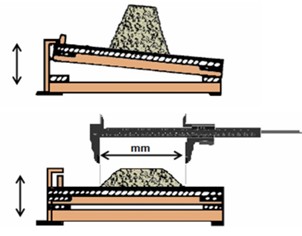
According to EN 12350-528, to carry out the test, after collecting the concrete in a period of less than 5 minutes, the truncated cone mold should be filled in two layers of approximately equal volume and compacted with ten evenly distributed blows with a socket. After removing the mold, the table should be suspended by the handle and released 15 times in 15 seconds, to produce compaction energy and cause the concrete to spread (Figure 2).

Procedure for performing the Scattering test on the Graff table. Available at: http://docplayer.com.br/5348976-Materiais-de-construcao-tc-031.html.
After removing the mold, the circumference dimensions of both sides of the spreading table must be measured. If the difference is greater than 40 mm, the test must be repeated. The consistency of the concrete is the arithmetic means of the measured diameters. The fluidity of concrete can be determined as the ratio between the consistency of the concrete divided by the diameter of the largest base of the truncated cone mold.
3. Materials and Methods
In order to allow an adequate interpretation of the workability of the concrete, through the consistency indices provided by the different proposed methods: (a) spreading on the Graff table by EN 12350-528 and (b) slumping of the cone by ABNT NBR 1688929, to evaluate the application of structural fibers, foreseeing the need to also determine the correlation in trivial concretes without the application of fibers in order to indicate the relationship between the test methods in concretes without the application of fibers in the matrix.
Initially, the reference concrete (base) was prepared with different water contents to obtain distinct values in the Slump Test and on the Flow Table, with the aim of establishing a correlation curve between the two methods.
The selection of steel (ST), glass (GL), and polypropylene (PP) fibers was based on their widespread use in industrial flooring, in accordance with common project specifications and manufacturer indications (Figure 3). These fibers represent the main categories of structural reinforcement for cementitious matrices, with each type offering distinct characteristics in terms of mechanical properties and interaction with the matrix. The study focused on these typologies due to their practical and commercial relevance in the civil construction sector, specifically for industrial floors30.

Fiber volume equivalent to a mass of 10 g: (a) glass fiber - GL; (b) steel fiber - ST and (c) polypropylene fiber - PP.
The structure of the concrete was also characteristic of the granular structure (aggregates) for application in pavements expected to meet class C35 – ABNT NBR 8953. For these concretes, polyfunctional chemical additives were adopted - normative classification of plasticizers based on.
The Fiber Reinforced Concrete (FRC) was initially produced with a water content adjusted to achieve a target slump of 140 mm. After this reference mix was established, fibers were incorporated, and the workability was evaluated using both the Slump Test and the Flow Table Test. Subsequently, the mixture's consistency was re-adjusted to restore the initial slump value of 140 mm through the addition of water. The workability was then re-evaluated using the same test methods.
4. Concrete Reference Mix
The concrete used for the study was developed based on the trivial specifications for concrete applied to polished floors. These specifications, indicated below, concern the amount of cement, water content, mortar content, among other premises. They follow the recommendation of cement designers for brazilian industrial floors, the amount of cement between 320 and 380 kg/m3.
Thus, Table 1 defines the base mix for the entire study. The reference concrete, to compose the correlation curve between the test methods – which did not receive fibers – had its consistency increased with the addition of water.
4.1. Dosage of fibers
The selection of fiber types was based on structural fibers commonly used in industrial flooring applications, with dosages reflecting practical usage in projects and following manufacturer technical guidelines. The fiber dosages were defined according to recommended minimum reinforcement levels and approaching the upper dosage limits for structural applications, considering the distinct densities and aspect ratios of each fiber type.
The fibers are composed of different materials: steel, glass, and polypropylene. Therefore, the densities prescribe values for incorporation into concrete. Table 2 below describes the values used in the work, and Table 3 presents the physical properties of fibers.
5. Results and Discussions
The fiber reinforced concrete mixes – FRC, were prepared with a water content of 185 liters/m3, thus obtaining slump within the expected range. Then, the indicated amount of fiber was added, and the initial slump was measured, demonstrating the loss of consistency obtained by each type and amount of fibers. Soon after, the concrete was re-dosed to the required slump (slump consistency) of 140 ± 10 mm, and then the measurement was again made using the Slump Test and Flow Table (Table 4).
5.1. Analysis of the consistency relationship using the Slump Test and Flow Table methods
Both methods aim to predict the level of workability through the deformation of a portion of concrete. In this work, the correlation analysis was reproduced in reference concrete in different consistencies to demonstrate that there is a good correlation between the workability measured by the Slump Test and the Flow Table Test.
The water content for the concrete was adjusted to 170, and 211 liters/m3, obtaining different results and, based on the results presented for traces 1, 2 and 3 of reference, the results of the Slump Test were plotted against those obtained for the Flow Table (Figure 4).

Consistency relationship between the Slump Test and Flow Table test methods – Fiberless concrete.
From the presentation of the Graph in the previous Figure, it is possible to validate the excellent correlation with R2 > 0.98 obtained in the tests of the reference concrete. This demonstrated that the fluidity of the paste/mortar can be measured and with regular growth in both methods the higher the water content of the composition.
5.2. Analysis of workability loss with fiber addition
All prepared concretes reached the required initial slump without the addition of fibers. Fibers were added and the consistency was measured again by the proposed methods, showing a reduction in workability in all cases.
The fibers cause an interlock that reduces consistency, especially when measured by the Slump Test method. In order to assess the influence of fiber type on workability, a statistical comparison was performed for both Slump (%) and Flow Table (%) test results, considering the variations in relation to the reference concrete. The analysis of variance (ANOVA) for Flow Table measurements indicated no statistically significant difference between fiber types at the 5% level (p = 0.085), although a trend of lower propagation was observed with glass fibers. Conversely, the ANOVA for Slump (%) revealed a statistically significant difference between fiber types (p = 0.033), confirming that the traditional slump test is more sensitive to fiber addition, particularly with polypropylene mixtures maintaining higher consistency levels even after fiber incorporation. The combined boxplot presented in Figure 5 illustrates these variations in relation to the control mix across both tests, highlighting the superior stability of Flow Table results when analyzing the rheological effects of fiber reinforcement, they were relativized from the reference concrete of the Sample Without Fibers - reference 1.
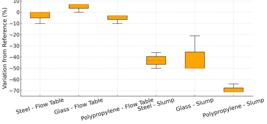
Consistency loss after the addition of different fiber contents and types, based on reference concrete 1.
After analyzing the values obtained, it can be stated that the addition of fiber content reduced the concrete slump, on average, by 43% for steel fibers, 40% for glass fibers and 69% for polypropylene fibers. Thus, it is clear to state that the structural glass fiber behaved similarly to the steel fiber in the loss of consistency by the Slump method, and the polypropylene fiber was the one that effectively reduced the consistency.
However, the variation in the Flow Table results was not significant and was considered typical variations within the test. This variation was therefore considered negligible, and it can be stated that, for this method, the workability was not altered.
As expected, the locking by the structural fibers conditioned to the concrete is easily noticeable at the yield stress required for the Slump Test method. However, when low energy is applied, such as when struck by the Flow Table plate, the mass is dispersed (densified). This shows that the workability of concrete, under the action of low energy, remains the same as that required for concrete without fibers.
The Flow Table test better simulates field conditions where vibratory compaction is applied, as it introduces dynamic impulses that mobilize horizontal flow and promote internal particle rearrangement, similar to in-situ vibration. In fiber-reinforced concrete, where fibers increase internal friction and restrict settlement, the Flow Table captures the mix’s ability to reorganize under movement more effectively than the static Slump Test, which measures only vertical displacement by gravity. Additionally, since the paste and mortar phases contain the same controlled and adequate water content, proper fluidity is maintained during vibration, allowing fibers and aggregates to realign under compaction. The experimental results confirm this: while the Slump Test exhibited significant reductions in workability with increasing fiber content, the Flow Table demonstrated smaller variations relative to the reference mix across all fiber types, reflecting the actual compaction behavior under field-like dynamic conditions.
5.3. Analysis of required water content after fiber addition
After the loss of consistency with the addition of fibers, the next step performed in the dosages was to return the FRC concrete to the slump median value of the dosage without fibers, which was 140 mm. It is common in the practice of supplying concrete with fibers, the adulteration of the concrete matrix with the addition of water to obtain (redosing) the initial slump30. This practice, as widely known in the technical field, induces concrete to a significant loss of mechanical strength and durability.
To obtain an initial slump of 140 mm (185 liters of the reference minus the initial water obtained from each mix), the amount of slump to be corrected was divided by the average water content (Figure 6).

Water content required per m3 for every 10 mm of slump to be corrected using the Slump Test method.
The steel FRC was the best rheologically, followed by the FRC with fiberglass and then by the polypropylene fiber with the worst performance, as it is considered better to the one that requires the least amount of water to obtain the initial slump (consistency) of 140 mm. Although superplasticizer can be used to adjust consistency, this study intentionally adopted water content correction to directly demonstrate the actual influence of fiber incorporation on water demand and its impact on axial compressive strength. To mitigate this increased water demand, it is recommended that water-reducing admixtures, such as superplasticizers, be incorporated from the mix design stage through to on-site production, serving as a supplementary corrective material to maintain workability.
5.4. Interaction between workability determination methods
Both methods express the tacit concept of workability in consistency values. The Slump Test requires that the mixture be more plastic than fluid to present greater settlement, thus demonstrating that the test value will be higher in line with greater ease of molding, and the Flow Table method also expresses itself in this direction.
However, while the settlement (value) of the Slump consistency is given by the collapse due to its own weight, the Flow Table uses the application of standardized energy to express a value after spreading the concrete fraction. It is in this difference that one can better evaluate the development of concretes with fibers in our national methodologies, since the locking generated by the structural fibers in the concrete matrix is clear.
Thus, the measure of workability expressed here only under the scope of moldability (densification) with energy (vibration), is compromised. The good plasticity of the paste or of the direct mortar fraction itself is “hidden”. The FRC already has in its design a matrix with obstacles to overcome in terms of fluidity.
In the graph in Figure 7, it is possible to evaluate the points of loss of plasticity of the concretes immediately after the addition of the fibers, with an original slump of 140 mm and a spread (flow) of 330 mm. And compare the workability obtained in the flow table after redosing and “return” to the initial slump.

Relationship between the Slump Test and Flow Table Test consistencies in the dosages after adding fibers and redosing to the slump 140 mm.
The relationship between Slump Test and Flow Table measurements for the different groups is illustrated in Figure 7. For the reference concrete without fibers, a strong linear correlation was observed (Flow Table = 1.5 × Slump + 145), indicating that in fiberless mixtures, consistency and flowability maintain a proportional behavior under both test methods. In contrast to fiber-reinforced concretes, the incorporation of fibers alters this relationship, introducing non-linearity and greater dispersion, particularly after dosage adjustments using superplasticizers to restore slump levels. The quadratic regression fitted to the complete dataset captures this behavior, reflecting the complex rheological interactions introduced by fibers and admixture effects on particle mobility during flow propagation. The Z-score analysis further highlights the increased variability in flowability observed in redosed mixtures compared to initial fiber mixes.
Evaluating the behavior of FRC under the interaction between workability and mechanical performance is essential due to the multidimensional influence of fiber type, content, and distribution17. The distinct responses between the two test methods may also reflect the microstructural effects observed in multi-scale fiber-reinforced systems, as discussed in others projects30.
Recent studies have also proposed global performance indicators to predict the combined effects of fibers on both strength and workability, further emphasizing the complexity of FRC systems31.
The consistency according to the Flow Table remained relatively the same with the addition of fibers, but according to the Slump Test analysis, workability was impaired. In fact, the addition of fibers, in any content or type, visually reduces the plasticity of the concrete. These compromises (makes difficult) phases such as transport by pressure and pumping in practice. However, when analyzing the Flow Table, it can be seen that the consistency of the paste was not “lost” and the spreading can be reproduced.
In assessing the average results, the incorporation of fibers reduced the slump by approximately 70 mm, requiring varying water contents to resume the reference slump according to the type and quantity of fibers.
The results demonstrate a good correlation between the test methods, indicating that the Flow Table method is suitable for use in FRC. The workability measured by the Slump Test can only be interpreted under the shear stress of the concrete fraction's own weight32. Since the macro fibers structure the matrix, they mean that to obtain the same consistency measurement, the concrete matrix (mortar/paste) must be considerably altered.
The above argument is tacitly known to the technical community. However, with only the slump test method, it was not possible to confirm that even with the addition of macro fibers, the workability from the point of view of the application of energy (vibration) does not suffer a reduction in the degree of densification.
The slump test is deficient in evaluating the behavior of concrete in its fresh state; this is even worse in special concretes32. The test is characterized as single-point because it provides only a single value under only one condition: shear rate.
The compressive strength results at 28 days for fiber-reinforced concretes adjusted to an initial slump of 140 mm are presented in Figure 8. The mixtures exhibited different water/cement ratios after water readjustment to achieve the target slump, reflecting the distinct influence of each fiber type on water demand. The reference mixture without fibers followed a clear exponential decay of compressive strength with increasing water/cement ratio, consistent with Abrams' law, as captured by the exponential regression (R2 = 1). Experimental studies have also demonstrated that fiber type strongly influences the mechanical and fresh-state properties of concrete when incorporated individually or in combination with other admixtures33.

For the fiber-reinforced mixtures, higher water/cement ratios were required to maintain the initial slump as fiber content increased, particularly for polypropylene fibers, which exhibited the highest water demand and lowest compressive strengths among the groups. Steel and glass fibers demonstrated intermediate behaviors, with moderate increases in water content and compressive strength reductions. These results emphasize that, although slump can be restored through water readjustment, the accompanying increase in water/cement ratio significantly compromises compressive strength, particularly for fiber types with higher surface area and lower stiffness, which intensify the internal friction and mixing energy required.
6. Conclusion
The proposed experimental program can be obtained as idealized. It is possible to develop the analyses as expected and previously explained. It can also be concluded that the test methods for determining consistency, Slump Test and Flow Table, have good correlation as indicated in the literature13,26,27,31.
The structural fibers affected the workability of the concrete when its consistency is measured by the Slump Test, due to the mechanical locking produced by the fibers, reducing the slump (flow) of the concrete cone.
When measuring workability under the application of energy (densification) that the Flow Table method confers, the tests carried out show that the CRF matrix has similar workability as concrete without the addition of fibers.
This study advances the current knowledge on fiber-reinforced concrete (FRC) by systematically evaluating and comparing the performance of the Flow Table and Slump Test methods for assessing workability. The findings demonstrate that the Flow Table test better simulates vibratory compaction, which is representative of field conditions, while being less sensitive to fiber-induced settlement restrictions. The results provide practical guidance for mix design adjustments and propose the incorporation of the Flow Table method into national standards such as ABNT NBR 16944:202134. Furthermore, the experimental data quantify the influence of fiber type and dosage on water demand, supporting more accurate mixture design strategies. The statistical analyses performed add robust numerical validation to these conclusions, offering a reliable reference for both research and practice in the design and control of FRC mixtures.
Finally, the results of this study indicate that the common practice of using only the slump test for quality control in construction is not fully effective when applied to fiber-reinforced concrete, as it tends to require higher water content to achieve the same consistency as fiber-free mixtures, regardless of fiber type or dosage. The use of superplasticizing is therefore recommended to maintain proper workability in FRC when the slump test remains the control method. However, it is important to recognize the limitations of both the slump and flow table methods, particularly for mixtures with very low consistency (dry mixes) or self-compacting concrete classes, where alternative rheological assessments may be more appropriate.
-
Data Availability
The entire data set supporting the results of this study was published in the article itself.
7. References
- 1 Graças DC. Evaluation of the Flow Table method for analyzing the rheology of concrete with fibers. Santa Barbara D'Oeste: UNIMEP; 2016. Scientific Initiation Report PIBIC/FAPIC.
- 2 Figueiredo AD, Helene PRL. Concreto projetado com fibras de aço para túneis. São Paulo: USP; 1997. (Boletim Técnico da Escola Politécnica da USP, 181).
-
3 Boulekbache B, Hamrat M, Chemrouk M, Amziane S. Flowability of fiber-reinforced concrete and its effect on the mechanical properties of the material. Constr Build Mater. 2010;24(9):1664-71. http://doi.org/10.1016/j.conbuildmat.2010.02.025
» http://doi.org/10.1016/j.conbuildmat.2010.02.025 - 4 Shivali RB, Wankhade RL, Goldar D. (2022). High performance FRC tunnel lining with alkali activator and cementitious materials. In: National conference on Advances in Construction Materials and Management; 2022 Dec; Singapore. Proceedings. Singapore: Springer Nature Singapore. pp. 463-470. https://doi.org/10.1007/978-981-99-2552-0_37
-
5 Sun L, Hao Q, Zhao J, Wu D, Yang F. Stress strain behavior of hybrid steel-PVA fiber reinforced cementitious composites under uniaxial compression. Constr Build Mater. 2018;188:349-60. http://doi.org/10.1016/j.conbuildmat.2018.08.128
» http://doi.org/10.1016/j.conbuildmat.2018.08.128 - 6 Melo FMC, Cruz ACAJ, Almeida VGO, Oliveira HA, Simplício, MAS. Influence of hybrid fibers (steel-polypropylene-glass) on concrete properties. In: 62nd Brazilian Concrete Congress – CBC2020; 2020 Sep. 1-4; Florianópolis. Proceedings. Florianópolis: IBRACON; 2020.
-
7 Liu F, Ding W, Qiao Y. Experimental investigation on the tensile behavior of hybrid steel-PVA fiber reinforced concrete containing fly ash and slag powder. Constr Build Mater. 2020;241:118000. http://doi.org/10.1016/j.conbuildmat.2020.118000
» http://doi.org/10.1016/j.conbuildmat.2020.118000 -
8 Yoo DY, Moon DY. Effect of steel fibers on the flexural behavior of RC beams with very low reinforcement ratios. Constr Build Mater. 2018;188:237-54. http://doi.org/10.1016/j.conbuildmat.2018.08.099
» http://doi.org/10.1016/j.conbuildmat.2018.08.099 - 9 Laskar AI, Talukdar S. Rheology of steel fiber reinforced concrete. Asian J Civ Eng. 2008;9(2):167-77.
- 10 Benaicha M, Jalbaud O, Hafidi AA, Burtschell Y. Rheological and mechanical characterization of fiber-reinforced self-compacting concrete. IJEIT. 2013;2(7):2277-3754.
-
11 Leite AM, Castro AL. Influence of the cementitious matrix on the behavior of fiber-reinforced concrete. Rev IBRACON Estrut Mater. 2020;13(3):543-62. http://doi.org/10.1590/s1983-41952020000300006
» http://doi.org/10.1590/s1983-41952020000300006 -
12 Martinie L, Rossi P, Roussel N. Rheology of fiber reinforced cementitious materials: classification and prediction. Cement Concr Res. 2010;40(2):226-34. http://doi.org/10.1016/j.cemconres.2009.08.032
» http://doi.org/10.1016/j.cemconres.2009.08.032 - 13 Reis JFA. Determination of rheological parameters of concrete through the modified truncated cone slump test: case study [dissertation]. Ilha Solteira: Unesp; 2008. 177 p.
- 14 Avila VGD. Evaluation in the fresh state of the influence of the addition of polypropylene fibers in mortars with replacement of portland cement by rice husk silica [trabalho de conclusão de curso]. Alegrete: Federal University of Pampa; 2022.
- 15 Oliveira MJD. Evaluation of the consolidation time of adhesive mortars through rheological methods [dissertation]. Santa Maria: Universidade Federal de Santa Maria; 2015.
-
16 Cao M, Mao Y, Khan M, Si W, Shen S. Different testing methods for assessing the synthetic fiber distribution in cement-based composites. Constr Build Mater. 2018;184:128-42. http://doi.org/10.1016/j.conbuildmat.2018.06.207
» http://doi.org/10.1016/j.conbuildmat.2018.06.207 -
17 Wang W, Shen A, Lyu Z, He Z, Nguyen KTQ. Fresh and rheological characteristics of fiber reinforced concrete: a review. Constr Build Mater. 2021;296:123734. http://doi.org/10.1016/j.conbuildmat.2021.123734
» http://doi.org/10.1016/j.conbuildmat.2021.123734 - 18 ASTM: American Society for Testing and Materials. C125: terminology relating to concrete and concrete aggregates. West Conshohocken: ASTM; 2024.
- 19 ACI: American Concrete Institute. 116R: cement and concrete terminology. Farmington Hills: ACI; 2020.
- 20 Mehdipoura I, Libre NA, Shekarchia M. Development of fiber reinforced SCM for sustainable construction. JSEG. 2011;1(1):1-8.
-
21 Pakravan HR, Ozbakkaloglu T. Synthetic fibers for cementitious composites: a critical and in-depth review of recent advances. Constr Build Mater. 2019;207:491-518. http://doi.org/10.1016/j.conbuildmat.2019.02.078
» http://doi.org/10.1016/j.conbuildmat.2019.02.078 -
22 Fallah S, Nematzadeh M. Mechanical properties and durability of high-strength concrete containing macro-polymeric and polypropylene fibers with nano-silica and silica fume. Constr Build Mater. 2017;132:170–187,. http://doi.org/10.1016/j.conbuildmat.2016.11.100
» http://doi.org/10.1016/j.conbuildmat.2016.11.100 -
23 Camille C, Kahagala Hewage D, Mirza O, Mashiri F, Kirkland B, Clarke T. Performance behaviour of macro-synthetic fibre reinforced concrete subjected to static and dynamic loadings for sleeper applications. Constr Build Mater. 2021;270:121469. http://doi.org/10.1016/j.conbuildmat.2020.121469
» http://doi.org/10.1016/j.conbuildmat.2020.121469 -
24 Vakili SE, Homami P, Esfahani MR. Effect of fibers and hybrid fibers on the shear strength of lightweight concrete beams reinforced with GFRP bars. Structures. 2019;20:290-7. http://doi.org/10.1016/j.istruc.2019.04.006
» http://doi.org/10.1016/j.istruc.2019.04.006 -
25 Cabral LMC, Lima RCP. Comportamento das fibras de aço, polipropileno e combinadas podem causar no estado fresco em concretos autoadensáveis. Braz J Dev. 2023;9(1):4930-40. http://doi.org/10.34117/bjdv9n1-338
» http://doi.org/10.34117/bjdv9n1-338 - 26 Mehta PK, Monteiro PJM. Concrete: structure, properties and materials. São Paulo: PINI, 2008.
- 27 Rodrigues, PPF. Industrial flooring manual: steel fibers and prestressed. São Paulo. PINI, 2010.
- 28 European Committee For Standardization. Testing fresh concrete – Part 5: flow table test (EN 12350-5:2019). Brussels: CEN, 2019.
- 29 ABNT: Associação Brasileira de Normas Técnicas. NBR16889 de 12/2020. Rio de Janeiro: ABNT; 2020.
-
30 Zhao C, Wang Z, Zhu Z, Guo Q, Wu X, Zhao R. Research on different types of fiber reinforced concrete in recent years: an overview. Constr Build Mater. 2023;365:130075. http://doi.org/10.1016/j.conbuildmat.2022.130075
» http://doi.org/10.1016/j.conbuildmat.2022.130075 -
31 Shende AM, Kadam AD, Pathan MG, Wankhade RL. Global performance indicator (GPI) approach to predict the steel fiber reinforced concrete strength with error analysis. HBRC Journal. 2024;20(1):123-37. http://doi.org/10.1080/16874048.2024.2305067
» http://doi.org/10.1080/16874048.2024.2305067 - 32 Santos DA, Sanches L, Romano CO, John VM, Pileggi R. Rheological characterization of self-compacting concrete: a critical analysis. In: 3rd International Symposium on Rheology of Cement Suspension such as Fresh Concrete; 2009; Reykjavik. Proceedings. Reykjavik: RILEM; 2009.
-
33 Pathan MG, Wankhade RL, Shende AM, Swaroop A, Mashaan N. Experimental analysis for performance of concrete with addition of steel fibres, SBR and polypropylene fibres. J Kej. 2022;34(3):429-45. http://doi.org/10.17576/jkukm-2022-34(3)-10
» http://doi.org/10.17576/jkukm-2022-34(3)-10 - 34 ABNT: Associação Brasileira de Normas Técnicas. ABNT NBR 16944:2021. Rio de Janeiro: ABNT; 2021.
Edited by
-
Associate Editor:
Eliana Muccillo.
-
Editor-in-Chief:
Luiz Antonio Pessan.
The entire data set supporting the results of this study was published in the article itself.