Effects of Ionizing Radiation on the Physicochemical Properties of Polyester Multifilaments
Abstract
Polyethylene Terephthalate (PET), known nationally as Polyester (PES), is the most used fiber in the textile sector and stands out compared to natural fibers and other synthetic fibers due to its constant rise in production and consumption. In the search for sustainability in the textile industry, ionizing radiation presents itself as an environmentally correct process for modifying the properties of polyester fiber, through the formation of reactive species. This work aims to analyze the influence of ionizing radiation on the physicochemical properties of PES microfiber textile multifilaments. The samples were analyzed for toughness and elongation resistance, Thermogravimetric analysis (TGA) and Fourier-transform infrared spectroscopy (FTIR). The Cobalt-60 gamma irradiation process was effective in altering the properties of the microfiber multifilament analyzed, thus exposing important information on the effects of radiation applied to the polyester textile microfiber to adapt it to the demands of the end consumer.
Keywords:
ionizing radiation; Polyethylene Terephthalate; tenacity; elongation; TGA; FTIR
1. Introduction
In the 1920s, the polymer concept served as the basis for the subsequent development of numerous products of synthetic origin obtained from petroleum, such as polyester. Due to its diversity, it is used in several sectors such as automotive, construction, packaging, medical equipment, and consumer products, among others1-3.
In the textile sector, numerous synthetic fibers were developed, such as polyethylene terephthalate (PET), known in Brazil as polyester (PES). It stands out among the fibers used in the textile industry, due to numerous factors that make them attractive in terms of cost-benefit, such as their diversity of application. It is used not only in the fashion and clothing sector, but as well as in the automobile sector in the manufacture of seat belts, seat covers, fabrics for door sides, and roof1-3.
The manufacture of continuous polyester yarns with finer individual filaments began in the 1970s in Japan. The filaments' titre ranged from 2.5 to 5.0 Den. With the evolution of the technologies of the filament extrusion, spinning and drawing processes, combined with the improvement in the quality of the polymers, it became possible to manufacture fibers with much finer titres. It was established that the limit for synthetic fiber to be considered a microfiber is that its yarn fineness be less than 1.2 dTex, reaching 0.3 dTex4. These types of filaments provide fabrics with a pleasant touch, as the smaller the diameter of the filaments, the better the touch, in addition to the increase in moisture transfer, allowing for drier and more comfortable clothing on hot days5, in addition to diapers that allow for an increase in the speed of urine evaporation6.
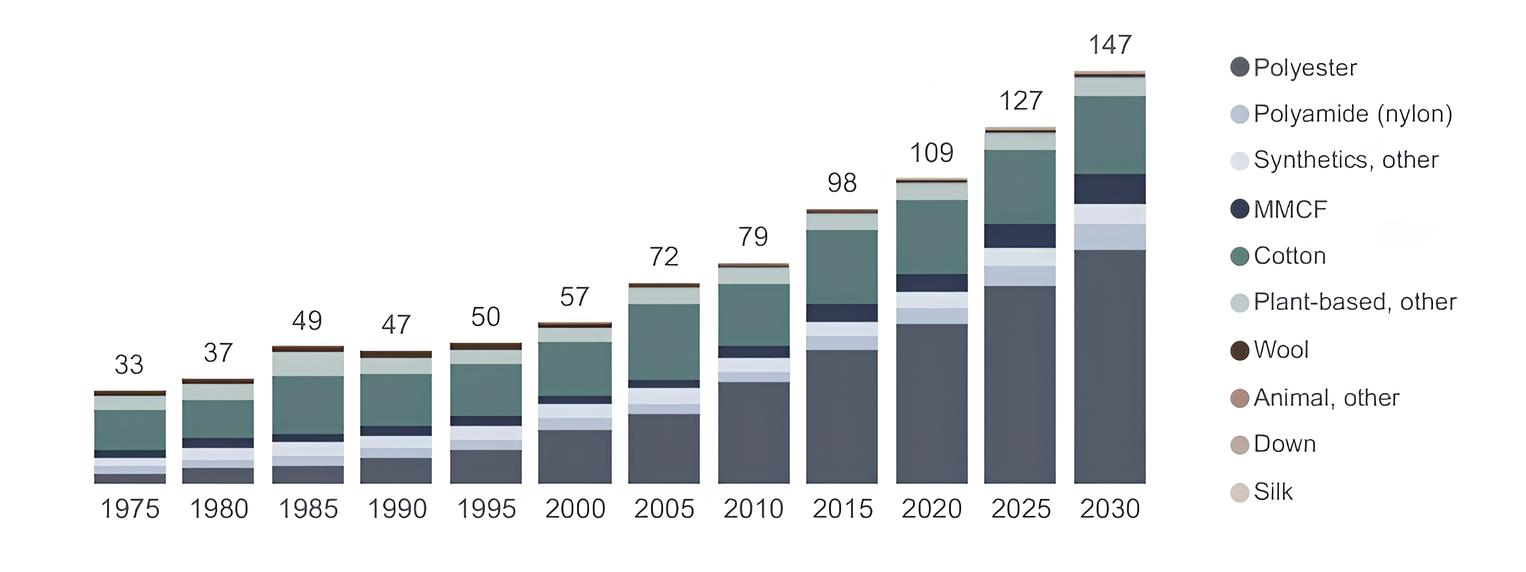
Synthetic fibers, from products obtained from petroleum, have dominated the fiber market since the mid-1990s when they surpassed cotton volumes7. This fiber category made up approximately 65% of global fiber production in 2022, with a total of 76 million tons. Of this amount, polyester made up around 54% of total global fiber production in 2022, with approximately 63.3 million tons produced (Figure 1).

Ionizing radiation applied to polymers is already widespread in the pharmaceutical, biochemical and medical sectors, with the massive use of polyethylene (PE) and polypropylene (PP). Payamara et al.9 subjected PP samples to the electron beam irradiation (EBI) process, with energy between 10 and 40 keV, and found changes in the polymer surface, resulting in improvements in the polymer's wettability, dyeability and printability. The EBI was also used in Thermoplastic Elastomer (TPE-E), Low Density Polyethylene (LDPE) and Polyamide 6 polymers, whose authors verified the increase in mechanical properties and thermal stability after irradiation using accelerated electrons from 0 to 198 kGy10.
In the textile sector, the process emerges as an clean alternative for several stages of production with an emphasis on chemical products used in the processing and improvement of substrates. Studies address the application of UV and microwave irradiation as a way to make PET more hydrophilic lastingly, as well as to promote an increased crystallinity, resistance to attraction, shrinkage and dyestuff absorption of the polymer11,12. Zhu et al.13 also investigated the effects of electron irradiation on PET, corroborating the relationship between increased dye absorption and the increase in the color intensity of the substrate, beyond the increase in the indices of fastness to light, friction, sweat and washing, at the optimal dose of 80 kGy.
Gamma radiation is highly penetrative and its interaction with polymers results in the formation of ionized and excited molecules that, through recombination or dissociation, produce free radicals. The production of free radicals results in cross-linking and degradation reactions that occur simultaneously, but always one of them to a greater extent and predominance14,15.
Due to its versatility, PET is the aim of numerous research studies such Martínez-Barrera et al.16, which researched the effects of gamma radiation on concrete containing 30% of the polymer, obtaining a 35% increase in deformation, 29% in the elasticity modulus and 10% in the compressive strength. Zhu et al.13 reported the difficulty of crosslinking PET at low radiation doses, and proposed the development of a composite from trimethylpropane (TMP) to increase the crosslinking sensitivity. The process was performed starting at 60 kGy, reaching the optimal dose at 200 kGy.
Advances in the textile sector include physical and chemical modifications of the surface and structure of fibers, yarns and fabrics. However, the effects of gamma radiation on polyester multifilaments have not been found in the literature. Studies that used this type of radiation in textiles were based on natural fibers or polyamide. Ahmad et al.17, observed an improvement in color resistance and fastness properties in cotton fabric subjected to Gamma irradiation with Cobalt-60, after dyeing with reactive dye Black 5. This fact was also noted by Chirila et al.18 when irradiating cotton and linen fabrics with doses between 5 kGy and 40 kGy, with Cobalt-60. Jamalzadeh and Sobkowicz19, described the effects of irradiation treatments on PET using an e-beam and gamma irradiation in the presence of air, showing that with an increasing irradiation dose, the thermal results show a constant Tg and a slight decrease in melting temperature (Tm).
Optimization of the properties of polymeric materials can be the result of irradiation crosslinking, which consists of cross-links between macromolecular chains. However, improvements are not achieved in all areas (mechanical, chemical, and thermal). Elmaaty et al.20, found an increase of 27% in tensile strength and 0.1% in elongation of PA6 fiber after irradiation with a dose of 198 kGy. Regarding thermomechanical analysis, an increase in temperature stability was found from 240 °C to 350 °C, when subjected to a dose of 99 kGy.
In this sense, the present work proposed to analyze the influence of ionizing radiation on the physical-chemical properties of PES textile multifilaments.
2. Materials and Methods
2.1. Yarn fineness
Samples of PES multifilament yarn (UNIFI Inc.®, 100% Polyester Standard, Brazil) were analyzed to confirm information about fineness, which is one of the most important characteristics of yarn and is directly related to its diameter. Figure 2 shows the PES multifilament (a) and the partially oriented yarn twisted (b).

The samples were separated into small portions of yarn using equipment for making balls of yarn known as a skein machine in unit lengths of 100 meters and weighed on an analytical balance. The yarn fineness calculation (Equation 1) was carried out using the test method for determining the yarn title recommended by NBR13214 (1994)21 in which, as it is a synthetic fiber, the fineness refers to the mass relating to 10,000 meters of wire or fiber, that is:
Therefore M: mass (g), K: constant (10,000), L: length (100 meters), F: fineness (dTex).
2.2. Irradiation process and physical analysis
Samples of PES multifilament were exposed to gamma ionizing radiation under room temperature, through the Cobalt-60 Multipurpose Irradiator (3 kGy.h-1), located at the Centro de Tecnologia das Radiações (CETER-IPEN). The analysis took place by comparing samples without treatment and those irradiated in different radiation doses: 50, 70, 90, 100, 130, 160, 180, and 200 kGy.
2.3. Tenacity and elongation assays
The characterization of tenacity and elongation at break was carried out using the STATIMAT 4U™ dynamometer equipment (Textechno®, Belgium), with a load cell of 100 N, mobile claw separation speed of 300 mm/min, and distance between the claws of 250 mm. Ten tests were carried out for each sample, following the ASTM D 3822 (2020)22 standard, in the Textile Spinning Laboratory at the College of Technology SENAI “Antoine Skaf”. The numerical data obtained were separated into groups based on the studied factors and performed using a one-way analysis of variance (one-way ANOVA), followed by Tukey tests within a significance level of p < 0.05 (5%).
2.4. Thermogravimetric analysis (TGA)
TGA was performed using the thermal analyzer equipment (SDT Q600, TA Instruments®, USA) on samples without irradiation and irradiated at doses of 50, 100, 130, and 200 kGy, at the IPEN-CNEN. The analysis was carried out in the atmosphere with Nitrogen (N2) at a constant flow of 100 mL min-1 and linear heating at a rate of 10 °C min-1 up to 550 °C.
2.5. Structural properties
Fourier-transform infrared spectroscopy (FTIR) was used to estimate the changes in gamma radiation-induced in the multifilament, especially the ashes content data, from the results of the TGA analyses. The analysis was performed with 0 and 100 kGy samples in a PerkinElmer Spectrum™ 3 Tri-Range FT-IR Spectrometer, with an ATR module. The spectra were obtained in the range between 4000 and 600 cm−1 with 64 scans and a resolution of 4 cm−1.
3. Results and Discussion
3.1. Yarn fineness
Table 1 shows the fineness of textile filaments and the data obtained for comparison of samples. The medium of nine values obtained was 85.16 ± 0.21 dTex and 74 filaments, will be considered as a microfiber multifilament.
3.2. Physical characterizations
Due to the fact the warp threads are exposed to friction and tension, resulting from the comb hitting the weft thread during weaving, for example, the elongation and resistance of the thread to breakage become important characteristics for a lower number of breaks, and the consequent increase in weaving efficiency. The figure below represents the relationships between absorbed dose and elongation and tenacity (Figure 3), of PES multifilament samples, and all data and statistical values are shown in Supplement S1.

Resistance graph to tenacity and elongation to radiation dose. Note: Different letters represent significative differences between groups according to Tukey tests.
The analysis resulted in a maximum thread tenacity of 47.35 cN tex-1, at a dose of 70 kGy. Among the other samples, the dose of 200 kGy proved to be less resistant, with a maximum force of 344 cN for rupture. Regarding stretching, all achieved a reduction of between 24% and 30%. Melo et al.23 also observed an increase in tenacity at intermediate doses and a lower resistance at a dose of 200 kGy.
In a study carried out in 1989, Fadel et al.24 when examining the effects of neutron fluences on the mechanical properties of polyester, found that the minimum value of tensile strength corresponded to a maximum value of elongation, but at fluences greater than 10 N cm2 -1, a slow decrease in both properties. The mechanical properties of PES have been associated with changes in the crystallinity of the fiber, in which the higher the irradiation doses, the greater the degree of crystallization, resulting in the rearrangement of molecules and the reduction of amorphous zones in the fiber25,26. Jeon et al.27 investigated that the tensile strength showed a slight increase up to 10 kGy, accompanied by higher elongation-at-break values in the low-dose region. This behavior is attributed to the increased content of aliphatic segments (PET), up to 200 kGy, these properties did not change significantly. In another study28, a 32% increase in tensile strength is observed at 80 kGy. However, beyond this dose, a slight decrease is noted, with a reduction of 11.7% along the machine direction compared to the unirradiated PET sample. These results from tenacity described it's following 0 and 70 kGy of PES multifilament samples irradiated.
3.3. Thermogravimetric analysis (TGA)
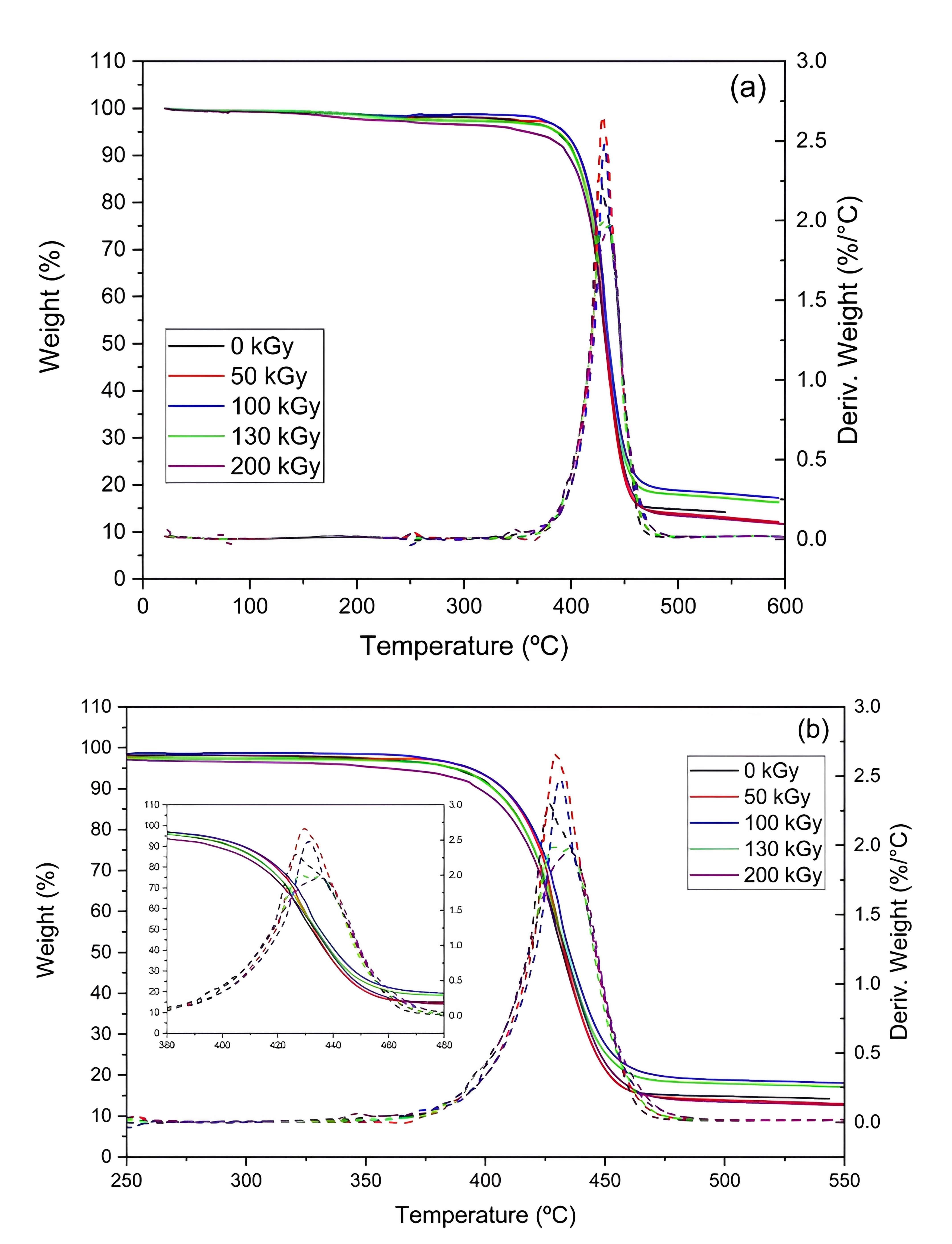
Figure 4 shows the TGA curves of the filaments analyzed with specific doses selected from mechanical tests performed previously. The thermogravimetric curves indicated that the untreated thread became unstable at 37 °C, with the beginning of the release of volatile substances. The 200 kGy doses showed the highest thermal stability, with an initial mass loss at 145 °C. In general, upon reaching 400 °C a single stage of mass loss was observed, indicating the beginning of the pyrolysis process, referring to decomposition in a nitrogen atmosphere, with stability around 500 °C. Yousef et al.14 also reported the complete degradation of PET fabric below 490 °C, attributing this characteristic to the amount of volatile matter, around 80% by weight.

Thermogravimetric analysis and derivative thermogravimetry of samples from 25 to 600 °C (a), and with zoomed-in region 250 to 550 °C (b) with degradation peaks detailed.
The Derivative Thermogravimetry (DTG) indicated a maximum degradation rate between 430 °C and 445 °C, the latter at a dose of 130 kGy. The samples initially showed greater resistance to thermal degradation as the radiation dose increased, especially from Tonset onwards in all samples (Table 2). The 100 kGy sample had a maximum temperature of 435.17 °C, while the sample irradiated at 130 kGy reached 436.50 °C for 50% mass loss, thus showing the highest relative percentage of thermally induced cross-linking. It was observed that there was an increase in the ash content in all the samples evaluated, where the highest value reached was 17.18% and the greatest difference to the non-irradiated sample was 4.58%. Jamalzadeh and Sobkowicz19 reported that irradiation up to 600 kGy does not significantly alter the thermal properties. In the case of gamma irradiation, PET crystallinity decreased up to 500 kGy, then increased up to 2000 kGy. However, at 4000 kGy, PET exhibited no crystallinity, likely due to structural disordering caused by the high irradiation dose. Finally, the compounds resulting from decomposition generated an average mass of waste of around 14%, a fact also observed by Yousef et al.14.
Temperature data was used to compare differences in initially lost mass weight properties for the multifilament in 5, 10, 50%, and ashes up to 600°C.
Researchers, evaluated and described that the crystallinity rate decreases after PET irradiation, indicating that gamma-ray exposure alters the polymer's crystalline regions. This suggests structural degradation of the sample, a common effect observed in polymers subjected to radiation29. Pramanik et al.28 related the dose of EB radiation up to 80 kGy, which doesn't change significantly the thermal properties, especially in the crystallinity. The observed decrease in both melting temperature and percent crystallinity after EB irradiation is attributed to the formation of slight crystal imperfections and a reduction in crystallite size.
3.4. Structural properties
Figure 5 and Table 3 show the FTIR spectra and peaks data detailed for comparison between non-irradiated and 100 kGy specimens. PET is recognized for its radiation resistance, primarily due to the presence of aromatic groups and ester linkages in its molecular backbone31. Several papers deal with the modification of PET under high energy irradiations31-35. The results show the irradiation difference after the irradiation process with peak changes in 1712.8 (C=O, stretching)34,35; 1241.6 (C-O, asymmetric stretching)32,34; 1093.7 (C-O, symmetric stretching)32; 1011.1 (aromatic ring vibrations)30 and 722.23 cm-1 (–CH2–, rocking vibrations)30. Compared to the PES pristine sample (0 kGy), only a slight change is observed in the intensity of the characteristic bonds in the irradiated sample, being this result reported previously32. Chikaoui33 reported that the absorption band at 1410.1 cm−1, attributed to the benzene ring—a structure known for its resistance to irradiation; and this analysis remained unchanged after exposure to 100 kGy with e-beam irradiation. The peaks described previously described the chemical structural modification of the PES polymer and in the 722.23 cm-1 peak30 (100 kGy) was observed an increase of 18.5% in the transmittance intensity (%), in comparison with 0 kGy specimen, showing the changes occurred promoted by aliphatic long chains (–CH2–) cross-link bonds by gamma radiation. These results are compatible with ashes data obtained from TGA analysis.

4. Conclusions
The Cobalt-60 gamma irradiation process was effective in altering the properties of the analyzed microfiber multifilament, obtaining yarns that were more resistant to breaking at intermediate doses, contributing to the increase in strength and consequently increased efficiency in weaving machines, and yarns with greater thermal stability and decomposition at higher temperatures. The TGA analysis shows a resistance degradation especially up to 100 kGy dose radiation, obtaining 17.18% of ash among the samples evaluated and a maximum of 4.58% in comparison with the 0 kGy sample. For the FTIR results the samples evaluated show changes induced by gamma radiation, with 18.5% more intensity spectra promoted by radiation cross-link bonds in the PES structure. Thus, exposing important information on the effects of radiation applied to the polyester textile microfiber to adapt it to the demands of the end consumer.
Supplementary material
The following online material is available for this article:
Supplement S1
5. Acknowledgments
The authors would like to thank the company Henkel for the FTIR analysis, SENAI for kindly providing the PES multifilament tests, Coordenação de Aperfeiçoamento de Pessoal de Nível Superior - CAPES and |Comissão Nacional de Energia Nuclear - CNEN for granting the research grants.
-
Data Availability
The entire dataset supporting the results of this study has been made available on SciELO Data and can be accessed at [https://doi.org/10.1590/1980-5373-MR-2025-0264].
6. References
-
1 Ahani M, Khatibzadeh M, Mohseni M. Studying the thermodynamic parameters of disperse dyeing of modified polyethylene terephthalate sheets using hyperbranched polymeric additive as a nanomaterial. J Ind Eng Chem. 2013;19(6):1956-62. http://doi.org/10.1016/j.jiec.2013.03.003
» http://doi.org/10.1016/j.jiec.2013.03.003 - 2 Manich AM, Bosch T, Carilla J, Ussman MH, Maillo J, Gacén J. Thermal Analysis and Differential Solubility of Polyester Fibers and Yarns. Text Res J. 2016;73(4):1-23. .
- 3 Silva RS, Bianchini VK. Estudo sobre custos ecológicos no tingimento de tecido utilizado em linha automativa. Rev Quím Têxt. 2021;141:6-17.
- 4 Guillén JG. Aspectos de las fibras química. Terrassa: Universitat Politècnica de Catalunya; 1990. p. 3.
-
5 Yang Y, Wang X, Liu Z, Zheng C, Lou L, Liu X, et al. Heat and moisture transfer in fabric consisting of fibers with low hygroscopicity. Text Res J. 2022;92(23-24):4764. http://doi.org/10.1177/00405175221105235
» http://doi.org/10.1177/00405175221105235 -
6 Wu D, Xiulong L, Wang Y. Effect of fit on heat and moisture transfer in disposable diapers for babies. Text Res J. 2023;93(21-22):4922-37. http://doi.org/10.1177/00405175231186183
» http://doi.org/10.1177/00405175231186183 -
7 Henry B, Laitala K, Klepp IG. Microfibres from apparel and home textiles: prospects for including microplastics in environmental sustainability assessment. Sci Total Environ. 2019;652:483-94. http://doi.org/10.1016/j.scitotenv.2018.10.166 PMid:30368178.
» http://doi.org/10.1016/j.scitotenv.2018.10.166 -
8 Textile Exchange. Materials market report [Internet]. 2024 [cited 2025 Jan 20]. Available from: https://textileexchange.org/
» https://textileexchange.org/ -
9 Payamara J, Shahidi S, Ghoranneviss M, Wiener J, Anvari A. Effect of electron irradiation on dye and printability of polypropylene (PP) fabrics: a novel method for decoration of PP fabrics. J Textil Inst. 2010;101(11):988-95. http://doi.org/10.1080/00405000903083278
» http://doi.org/10.1080/00405000903083278 -
10 Mizera A, Manas M, Holik Z, Manas D, Stanek M, Cerny J, et al. Properties of selected polymers after radiation cross-linking. Int J Math Comput Simul. 2012 [cited 2025 Jan 20];6(6):592-9. Available from: http://www.naun.org/multimedia/NAUN/mcs/16-599.pdf
» http://www.naun.org/multimedia/NAUN/mcs/16-599.pdf - 11 Shahidi S, Wiener J. Radiation effects in textile materials. In: Monteiro WA, editor. Radiation effects in materials. London: InTech; 2016.
-
12 Bhat NV, Kale MJ. Interaction of microwave radiation with polyester yarn to enhance its textile properties. Fibers Polym. 2012;13(7):936-42. http://doi.org/10.1007/s12221-012-0936-8
» http://doi.org/10.1007/s12221-012-0936-8 -
13 Zhu S, Shi M, Tian M, Qu L, Chen G. Effects of irradiation on polyethyleneterephthalate (PET) fibers impregnated with sensitizer. J Textil Inst. 2018;109(3):294-9. http://doi.org/10.1080/00405000.2017.1342216
» http://doi.org/10.1080/00405000.2017.1342216 -
14 Yousef S, Eimontas J, Striūgas N, Mohamed A, Ali Abdelnaby M. Pyrolysis kinetic behavior and thermodynamic analysis of PET nonwoven fabric. Materials. 2023;16(18):6079. http://doi.org/10.3390/ma16186079 PMid:37763357.
» http://doi.org/10.3390/ma16186079 - 15 Pino ES, Giovedi C. Radiação ionizante aplicada ao processamento de polímeros. Rev UNILUS Ens Pesq. 2006;5(3):7-10.
-
16 Martínez-Barrera G, Gencel O, Martínez-López M. Polyester polymer concrete modified by polyester fibers and gamma rays. Constr Build Mater. 2022;356:129278. http://doi.org/10.1016/j.conbuildmat.2022.129278
» http://doi.org/10.1016/j.conbuildmat.2022.129278 -
17 Ahmad BI, Adeel S, Nadeem R, Asghar T. Improvement of colour strength and colourfastness properties of gamma irradiated cotton using reactive black-5. Radiat Phys Chem. 2012;81(3):264-6. http://doi.org/10.1016/j.radphyschem.2011.10.019
» http://doi.org/10.1016/j.radphyschem.2011.10.019 -
18 Chirila L, Popescu A, Cutrubinis M, Stanculescu I, Moise V. The influence of gamma irradiation on natural dyeing properties of cotton and flax fabrics. Radiat Phys Chem. 2018;145:97-103. http://doi.org/10.1016/j.radphyschem.2017.12.017
» http://doi.org/10.1016/j.radphyschem.2017.12.017 -
19 Jamalzadeh M, Sobkowicz MJ. Review of the effects of irradiation treatments on poly(ethylene terephthalate). Polym Degrad Stabil. 2022;206:110191. http://doi.org/10.1016/j.polymdegradstab.2022.110191
» http://doi.org/10.1016/j.polymdegradstab.2022.110191 -
20 Elmaaty TA, Okubayashi S, Elsisi H, Abouelenin S. Electron beam irradiation treatment of textiles materials: a review. J Polym Res. 2022;29(4):117. http://doi.org/10.1007/s10965-022-02952-4
» http://doi.org/10.1007/s10965-022-02952-4 - 21 ABNT: Associação Brasileira de Normas Técnicas. ABNT NBR 13214: materiais têxteis: determinação do título de fios: método de ensaio. Rio de Janeiro: ABNT; 1994.
- 22 ASTM: American Society for Testing and Materials. ASTM D3822/D3822M-14: standard test method for tensile properties of single textile fibers. West Conshohocken: ASTM; 2020.
- 23 Melo CG, Andrade e Silva LG, Rosa JM, Pereira MCC. The influence of ionizing radiation on the physical properties of polyester multifilaments. In: 17º Congresso Brasileiro de Polímeros; 2023; Joinville, SC. Anais. São Carlos: ABPol; 2023. p. 2009-12.
-
24 Fadel MA, Tera FM, Abdel-Zaher N, El-Messiery MA. Possible control of the mechanical properties of nylon-6, dralon and polyester polymers by neutron irradiation. Polym Degrad Stabil. 1989;23(3):209-16. http://doi.org/10.1016/0141-3910(89)90095-5
» http://doi.org/10.1016/0141-3910(89)90095-5 -
25 Gisbert J, Bonet MA, Díaz P, Montava I, Monllor P. Electron beam effect on poly (ethylene terephthalate) fibres. Int J Cloth Sci Technol. 2012;24(4):211-20. http://doi.org/10.1108/09556221211232810
» http://doi.org/10.1108/09556221211232810 -
26 El-Zahhar AA, Yassien KM, El-Bakary MA. Study on the thermal and structural properties of gamma-irradiated polyethylene terephthalate fibers. J Polym Eng. 2020;40(2):129-35. http://doi.org/10.1515/polyeng-2019-0234
» http://doi.org/10.1515/polyeng-2019-0234 -
27 Jeon DH, Lee KH, Park HJ. The effects of irradiation on physicochemical characteristics of PET packaging film. Radiat Phys Chem. 2004;71(5):1059-64. http://doi.org/10.1016/j.radphyschem.2003.10.009
» http://doi.org/10.1016/j.radphyschem.2003.10.009 -
28 Pramanik NK, Katamgari I, Dey A, Bhardwaj YK, Alam T, Chattopadhyay SK, et al. Electron beam irradiation on monolayer plastic packaging films: studies on physico-mechanical and thermal properties. Packag Technol Sci. 2021;34(8):475-83. http://doi.org/10.1002/pts.2573
» http://doi.org/10.1002/pts.2573 -
29 Belkahla N, Saidi-Amroun N, Saidi M, Benaissa M. Influence of gamma radiation on electrical conduction of polyethylene terephthalate (PET) at ambient temperature. Int J Polym Anal Charact. 2013;18(1):15-24. http://doi.org/10.1080/1023666X.2012.723854
» http://doi.org/10.1080/1023666X.2012.723854 - 30 PerkinElmer. PerkinElmer's Spectrum™ instrument control and data management software 21 CFR part 11 compatible with NetPlus™ interface. London; 2020.
-
31 Caire-Maurisier F, Aymes-Chodur C, Jandard V, Bourrel A, Yagoubi N. Effects of electron beam sterilization on polyethylene terephthalate: physico-chemical modifications and formation of non-volatile organic extractables. Ann Pharm Fr. 2019;77(4):276-85. http://doi.org/10.1016/j.pharma.2019.02.001 PMid:31027756.
» http://doi.org/10.1016/j.pharma.2019.02.001 - 32 Ding C, Zhang J, Liu X, Zhang H, Feng X. Microstructural modifications in electron beam irradiated poly(ethylene terephthalate) fibrics. Adv Mat Res. 2012;415-417:1816-20.
-
33 Chikaoui K. Gamma rays irradiation effects in thin film polyethylene terephthalate Polymer. Radiat Phys Chem. 2019;162:18-22. http://doi.org/10.1016/j.radphyschem.2019.04.034
» http://doi.org/10.1016/j.radphyschem.2019.04.034 -
34 Zaharuddin IM, Zaid MHM, Harun MH, Yaakob Y, Ismail NB. Polyethylene terephthalate (PET) recycling: gamma irradiation impact on crystallinity, chemical structure and thermal stability. Appl Phys, A Mater Sci Process. 2025;131(3):171. http://doi.org/10.1007/s00339-025-08297-1
» http://doi.org/10.1007/s00339-025-08297-1 -
35 Vazirov RA, Shkuro AE, Buryndin VG, Zakharov PS, Shishlov OF, Vazirova EN. The effect of high-energy electron beam irradiation on the physicochemical properties of PET material. Radiat Phys Chem. 2025;227:112392. http://doi.org/10.1016/j.radphyschem.2024.112392
» http://doi.org/10.1016/j.radphyschem.2024.112392
Edited by
-
Associate Editor:
Walney Araújo
-
Editor-in-Chief:
Luiz Antonio Pessan
The entire dataset supporting the results of this study has been made available on SciELO Data and can be accessed at [https://doi.org/10.1590/1980-5373-MR-2025-0264].