 Chromosome level genome assembly of the World Health standards Leishmania (Viannia) guyanensis M4147 and L. (V.) shawi M8408 using a hybrid sequencing approach
Abstract
BACKGROUND The Leishmania (Viannia) subgenus contains important pathogens that cause a variety of different clinical forms of cutaneous leishmaniasis in the Americas. Their response to antimonial chemotherapy differs according to species. Having high-quality genomic resources of these species is a significant step towards investigating and understanding these factors.
OBJECTIVES This study aims to characterise the main genomic features of L. (V.) guyanensis strain MHOM/BR/75/M4147 and L. (V.) shawi strain MCEB/BR/84/M8408.
METHODS Genomes were sequenced combining short- and long-read sequencing platforms and assembled, scaffolded, and polished using Flye2, Ragtag, and Pilon, respectively. Annotations were performed using mainly similarity and profile search methods, and phylogenetic analyses were performed using the maximum likelihood (ML) and Bayesian inference approaches, using IQ-TREE and MrBayes, respectively.
FINDINGS De novo assembly produced genome sizes of 32.27 Mb for L. guyanensis and 32.41 Mb for L. shawi, and predicted 8,505 and 8,592 protein-coding genes, respectively. Phylogenetic analysis based on these assemblies confidently places L. guyanensis and L. shawi as the closest known relatives to L. panamensis within the Viannia clade.
MAIN CONCLUSIONS These genomes will increase the knowledge about the subgenus L. (Viannia) in the Americas and also represent valuable information for future comparative studies with other human pathogenic Leishmania spp.
Key words:
genome assembly;
Leishmania guyanensis
;
Leishmania shawi
; subgenus Viannia; phylogenomics
Leishmaniinae parasites of the subgenus Leishmania (Viannia) cause a wide range of cutaneous and mucosal leishmaniasis and are only found in Central and South America. The subgenus was created in 19871 and presently comprises nine species.2 There is some evidence that the severity of the pathology due to L. (V.) braziliensis and L. (V.) guyanensis in some geographical regions is associated with the presence of high Leishmania RNA virus 1 (LRV1) burden.3
Leishmania (V.) guyanensis (MHOM/BR/75/M4147) and L. (V.) shawi (MCEB/BR/84/M8408) are World Health Organization (WHO) standards and M8408 cultures are hapanotypes of the species. M8408 was isolated from a brown capuchin monkey (now classified as Sapajus apella) that was captured in 1984 in the Carajá Mountains of Pará state, Brazil. Both species are important pathogens and are the dominant species identified in man in some Amazonian regions.4
Leishmania (V.) guyanensis occurs in a vast region to the north of the Amazon River. In 2000, 100% of the cases from Manaus5,6 were caused by L. (V.) guyanensis, but 10 years later they represented 73% of the cases. In the Guiana Shield and the Guianas it is involved in 80-94% of the cases.6 L. (V.) shawi occurs in regions south of the Amazon River. In the Santarém microregion, it accounts for 26% of the cases,7 while another 17% were caused by guyanensis/shawi hybrids. L. (V.) shawi was not recorded in the Belém Metropolitan region,8 but in the past cases have been recorded in the southeastern regions of Pará State.9 Over time, the variations seen in species prevalence are most probably due to environmental changes that influence vector and reservoir host distribution.
Previous versions of draft assemblies generated using short reads for L. (V.) guyanensis have been published for strains LgCL085,10 MHOM/GF/2004/204-365,11 and MHOM/BR/75/M4147.12 In this study, we have sequenced, assembled and analysed chromosome-level genome assemblies of L. (V.) guyanensis and L. (V.) shawi. We analysed these Viannia species to identify key genomic features and establish their phylogenetic relationships.
MATERIALS AND METHODS
Whole-genome sequencing was performed using two technologies, Illumina (short reads) and Pacific Biosciences-PacBio (long reads), and genomes were assembled using a hybrid approach. Genomic DNA was extracted by the phenol-chloroform method from promastigote cultures in the log phase using standard methodologies.13 We also assessed the quality of the reads using Fastp v.0.20.1.14
Both genomes were assembled using a de novo approach, using only high-quality long reads and the Flye2 v.2.9 assembler,15 with option "genomeSize=35Mb". To elevate the draft Flye2 assemblies to pseudochromosome level, we performed scaffolding with Ragtag v.2.1.0.16 The L. (V.) braziliensis strain M2904 genome17 served as the reference, chosen because it is a close relative of our Viannia species18 and is itself correctly assembled into the 35 chromosomes, being one the most complete references to date. To polish (i.e., correct inconsistencies) in the final assemblies, we ran Pilon v.1.2419 using quality-filtered reads from the Illumina library, with the "--fix_all" option. The polishing cycle was repeated three times to minimise errors and produce a high-accuracy consensus sequence. kDNA was identified using BLASTN against a custom mitochondrial database (generated by collecting previously sequenced trypanosomatid mtDNA from several species). Telomeric repeats in the L. (V.) guyanensis and L. (V.) shawi genomes were systematically identified using the tidk v. 0.2.7 with the search module20 and using the canonical trypanosomatid motif ("TTAGGG"). Some telomeric regions were detected on only a subset of chromosomal ends [Supplementary data (Table I)], indicating incomplete reconstruction for these repeats in the assembly process. Assessment of assembly completeness was performed with BUSCO v. 5.3.1,21 using the lineage Euglenozoa DataBase release 10 (130 single-copy orthologs) and the "-m genome" option.
Furthermore, to conduct a comprehensive genome-wide comparison, we used the D-GENIES webtool v. 1.5.022 with both whole-genome assemblies. Gene structure prediction was performed using AUGUSTUS v.3.3.3, using the "intronless" option, except for three genes with introns that were manually annotated.23 The resulting protein sequences were annotated using InterProScan v. 5.63-95.0.24 Non-coding RNAs sequences were predicted and annotated using INFERNAL v.1.1.425 with Rfam v.14.926 database as a reference, along with tRNAscan-SE v.2.0.3.27
Genomic synteny was assessed using SyRI v.1.7.1.28 Single-copy orthologous genes (n = 3,962) were identified from all proteomes using OrthoFinder v. 2.5.4.29 The corresponding protein sequences were aligned using MUSCLE v. 3.8.31,30 and ambiguously aligned regions (gaps) were removed using TrimAl v. 1.4 with the "automated_1" option.31 The resulting alignments were concatenated into a supermatrix using FASconCAT-G v. 1.0.32 Phylogenies were reconstructed with both maximum likelihood (ML) and Bayesian inference (IB) approaches, employing IQ-TREE v. 2.0.433 and MrBayes v. 3.2.6,34 respectively. For the ML analysis, the optimal substitution model for each partition was selected by ModelFinder.35 Node support was assessed using bootstrap values (ML) and posterior probabilities (BI), with BI supports ≥ 0.95 considered robust. Trees were visualised and annotated in iTOL v. 5.4 (Available from: https://itol.embl.de/),36 accessed on 30/03/2025.
RESULTS
In the L. (V.) guyanensis M4147 strain, the Illumina NextSeq library consisted of 19,159,530 paired-end reads with a length of 131 bp, and the single-molecule real-time (SMRT) library PacBio platform produced 638,748 reads with an average size of 9,087 bp. In L. (V.) shawi, 20,703,763 paired-end reads of 131 bp in length were sequenced with Illumina NextSeq, and the SMRT library was generated with 160,534 reads of an average of 7,565 bp in length (Table I). In order to estimate features such as genome size (GS), heterozygosity, and repetitiveness independently of assembled sequences, Jellyfish v. 2.2.10 and GenomeScope 2.0 were used,37,38 with results shown in Fig. 1A and 1B.
The comparison of genomic read statistics between Leishmania (Viannia) guyanensis M4147 and L. (V.) shawi M8408 strain

comparison of genome profile between Leishmania (Viannia) guyanensis (A) and L. (V.) shawi (B). Results of genome size (GS) estimation of both genomes obtained by GenomeScope k-mer distribution using kmer length = 21 for short reads. len: inferred genome length (GS); uniq: % of the genome that is unique; het: overall rate of heterozygosity; dup: average rate of read duplications.
A dot plot showing macrosynteny between L. (V.) guyanensis and L. (V.) shawi is shown in [Supplementary data (Fig. 1)]. A detailed overview of the generated sequences, assembly statistics, and completeness values is shown in Table II. Table II shows a total of 8,505 and 8,592 protein-coding genes were annotated for L. (V.) guyanensis and L. (V.) shawi, respectively. Prediction of non-coding RNA (NCrna) genes revealed several types of RNAs that ranged from 321 to 354 sequences; detailed counts for each type are provide in Table II.
Assembly quality and gene prediction comparison among species of the Leishmania (Viannia) subgenus
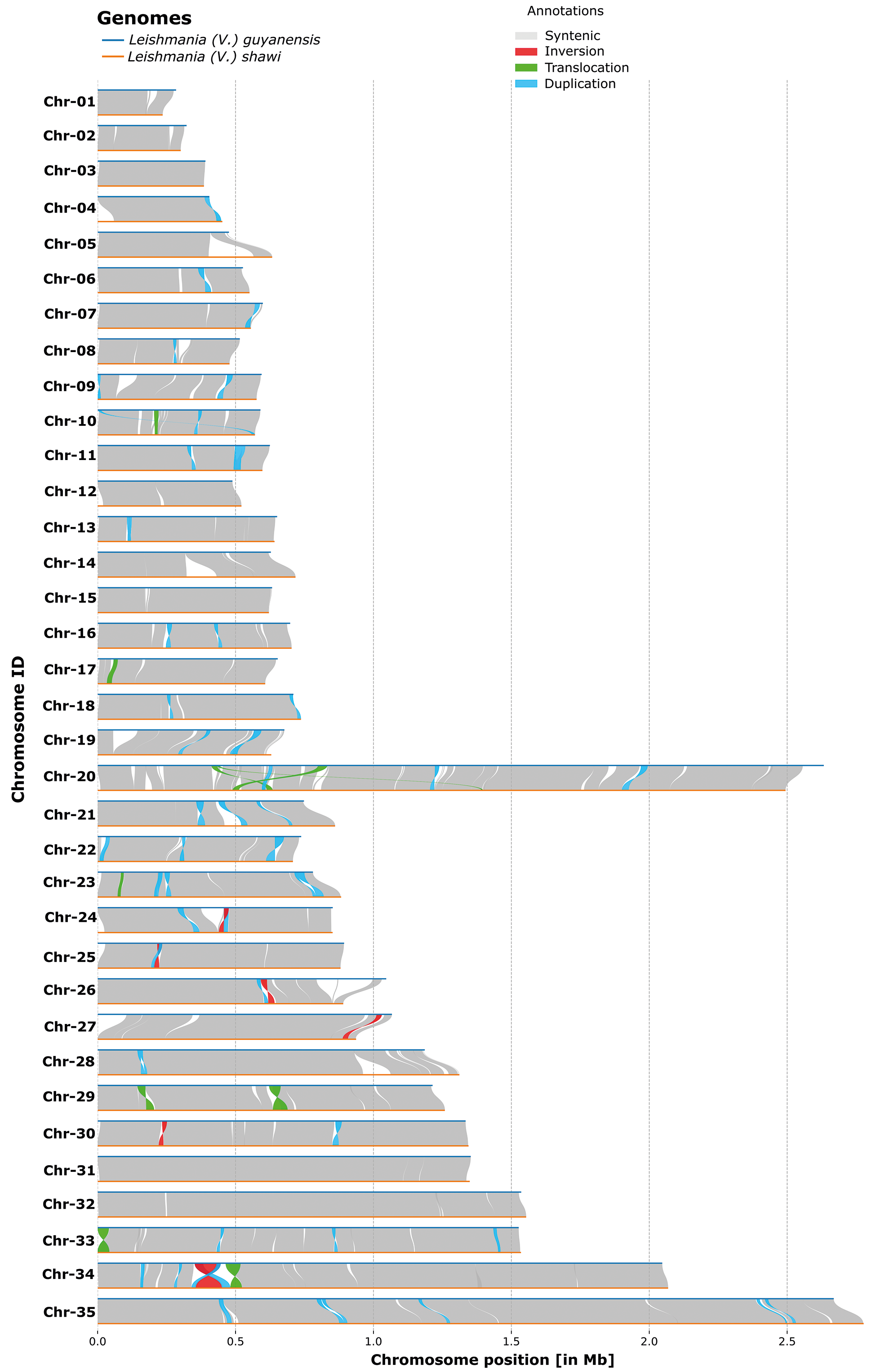
The level of synteny between the genomes of L. (V.) guyanensis (reference) and L. (V.) shawi (target) was assessed at the nucleotide level. The analysis revealed a strong collinearity and a minimum of rearrangement between the two species, with 231 syntenic regions detected (Fig. 2). Among these, 37 translocations and 11 inversions were identified. Additionally, 301 and 133 duplications were counted in L. (V.) guyanensis and L. (V.) shawi, respectively. SyRI-based variant calling detected 150,032 single-nucleotide differences and 54 tandem repeat sequences between the two genomes. While most chromosomes exhibited strong synteny (Fig. 2), structural variations were observed including inversions in chromosomes 24, 25, 26, 27, 30, and 34. Another chromosomal structural mutation observed was translocation, affecting chromosomes 10, 17, 20, 23, 29, 33, and 34. Despite the overall conservation across all 35 chromosomes, SyRI also revealed multiple structural rearrangements when comparing the genomes of L. guyanensis and L. shawi (Fig. 2). Additionally, chromosome copy number variation (CCNV) was estimated by read depth coverage (RDC) following the protocol detailed in Briggs et al.,39 which assumed that the genomes are diploid (2n). CCNV revealed that most chromosomes in L. (V.) guyanensis and L. (V.) shawi are predominantly diploid, except for chromosome 31, which exhibits copy numbers between trisomy and tetrasomy [Supplementary data (Fig. 2)].

structural variants assessed by SyRI between Leishmania (Viannia) guyanensis (top-reference) and L. (V.) shawi (bottom-query) genome assemblies. This figure displays the 35 chromosomes pair by pair, with synteny regions coloured in grey lines and structural rearrangements coloured as follows: duplications (sky blue), inversions (red), and translocations (green).

maximum-likelihood (ML) and Bayesian inference (BI) phylogenomic trees based on the supermatrix of 3,962 proteins encoded by single-copy genes. BI and ML methods yield identical topologies; both trees are shown. The values above branches are bootstrap values together with posterior probabilities (see Materials and Methods). The bar indicates number of substitutions per site.
To determine the phylogenetic position of L. (V.) guyanensis and L. (V.) shawi within the genus, we performed a phylogenomic analysis of 25 reference genomes, incorporating two outgroup taxa (Novymonas esmeralda and Endotrypanum monterogeii [Supplementary data (Table II)]. The resulting phylogeny (Fig. 3) robustly placed L. (V.) guyanensis and L. (V.) shawi within the Viannia subgenus, as expected. Their closest relative was L. (V.) panamensis. The outgroup species were positioned on early-diverging branches, with E. monterogeii exhibiting a long branch length indicative of its previously reported elevated evolutionary rate.40 The tree topology was strongly supported, with most nodes receiving 100% ML bootstrap support (Fig. 3).
DISCUSSION
Leishmaniasis poses a significant threat to human health, yet the genomic resources of its causative parasites are inadequately explored in Latin America. The isolates M4147 of L. (V.) guyanensis and M8408 of L. (V.) shawi are of paramount importance as WHO reference standards, since high-quality genomes are lacking for the two species. Existing assemblies are frequently highly fragmented, a limitation that propagates errors in fundamental genomic features including genome size, copy number analysis, repetitive element characterisation, and gene annotation.10,11,12 Therefore, generating complete and high-fidelity genomes for these strains is crucial to empower accurate comparative and functional studies across the Leishmania research field. In this study, we provide genome assemblies of L. (V.) guyanensis and L. (V.) shawi using a hybrid approach that produced significant improvements in contiguity and completeness, as indicated by high N50 values and complete BUSCO scores. The high quality of our assemblies is validated by their parity with the reference genomes of key Viannia species, L. (V.) braziliensis and L. (V.) panamensis.17,41
Our analysis of chromosomal somy revealed that while both species are predominantly diploid, they also exhibit consistent aneuploidy. Specifically, chromosome 31 appears to be present in supernumerary copy numbers. This finding aligns with prior reports of tetrasomy on chromosome 31 in other Leishmania species, including L. guyanensis42 and L. panamensis43 within the Viannia subgenus, as well as in L. donovani and L. major of the Leishmania subgenus.44,45 Aneuploidy is a well-documented driver of adaptive evolution in Leishmania, where changes in chromosome copy number are frequently associated with drug resistance,43,46 environmental adaptation,47 and virulence.48 Given these established links and the recurrent observation of chromosome 31 across diverse species, we hypothesise that this tetrasomy confers a significant selective advantage, likely by modulating gene dosage to certain cellular processes, such as an environment with oxidative stress.49
Based on an analysis of 25 whole genomes, our phylogenomic reconstruction indicates that L. (V.) guyanensis and L. (V.) shawi are the most recently diverged species within the Viannia clade. Both ML and BI methods consistently supported this phylogenetic placement, yielding congruent topologies. Although our tree is consistent with prior studies,20,49 the employment of 3,962 single-copy genes revealed only short branch length between these species, indicating very limited phylogenetic divergence. This similar pattern was also observed between L. (L.) infantum and L. (L.) chagasi.50
Due to this shallow genetic separation and ongoing taxonomic uncertainty regarding L. (V.) shawi, which has been proposed to belong to the L. (V.) guyanensis species complex alongside L. panamensis,18,51 we recommend that future investigations incorporate broader species sampling and complementary approaches such as phylogenetic networks or genome-wide single nucleotide polymorphisms (SNP) analysis. Hence, these methods could better resolve potential lack of evolutionary signals and clarify whether L. (V.) guyanensis and L. (V.) shawi represent distinct species or a single genetic lineage. Our present analysis cannot definitively resolve this question.
Although not fully telomere-to-telomere complete [Supplementary data (Table I)], the genome assemblies presented here are the most comprehensive currently available for these Leishmania species, offering a critical genomic resource for the study of their biology.
In summary, we present two newly sequenced chromosome-level genomes of L. (V.) guyanensis and L. (V.) shawi, along with their main analysis including assembly, annotations, synteny assessment, and phylogenomics analysis. We also identified a putative tetrasomy of chromosome 31 in both isolates. Furthermore, phylogenomic analysis confirms that these recently diverged species form a monophyletic clade with L. (V.) panamensis. These two high-quality genomes generated here enhance our understanding of Leishmania genome biology, providing valuable resources for future research of the Viannia subgenus.
SUPPLEMENTARY MATERIALS
Supplementary data
DATA AVAILABILITY
The raw sequence reads of Illumina and PacBio platforms are available under BioProject accession number PRJNA1167797. The Leishmania guyanensis and L. shawi genome assemblies are available under accession numbers JBIEOV000000000 and JBINZM000000000, respectively.
-
How to cite:
Túllume-Vergara PO, de Lima ACS, Gomes CMC, Lima BS, Brandão-Filho SP, Silveira FT, et al. Chromosome level genome assembly of the World Health standards Leishmania (Viannia) guyanensis M4147 and L. (V.) shawi M8408 using a hybrid sequencing approach. Mem Inst Oswaldo Cruz. 2026; 121: e250270.
-
Financial support:
CNPq (Grant/Award Numbers: 304565/2017-2, 307937/2021-6, 305607/2022-7 and 140430/2021-0 to JJS and POTV). This research was supported by FIOTEC VPGDI 015-FIO-19 and FAPESP 2014/50315-0 to ACSL, FTS and CMCG.
REFERENCES
- 1 Lainson R, Shaw JJ. Evolution. Classification and geographical distribution of Leishmania In: Peters W, Killick-Kendrick R, editors. The Leishmaniases in biology and medicine. Vol. 1. London: Academic Press; 1987. p. 1-120.
-
2 Kostygov AY, Karnkowska A, Votýpka J, Tashyreva D, Maciszewski K, Yurchenko V, et al. Euglenozoa: taxonomy, diversity and ecology, symbioses and viruses. Open Biol. 2021; 11(3): 200407. doi: 10.1098/rsob.200407.
» https://doi.org/10.1098/rsob.200407 -
3 Ives A, Ronet C, Prevel F, Ruzzante G, Fuertes-Marraco S, Schutz F, et al. Leishmania RNA virus controls the severity of mucocutaneous leishmaniasis. Science. 2011; 331(6018): 775-8. doi: 10.1126/science.1199326.
» https://doi.org/10.1126/science.1199326 -
4 Romero GAS, Ishikawa EA, Cupolillo E, Toaldo CB, Guerra MVF, Paes MG, et al. The rarity of infection with Leishmania (Viannia) braziliensis among patients from the Manaus region of Amazonas state, Brazil, who have cutaneous leishmaniasis. Ann Trop Med Parasitol. 2002; 96: 131-6. doi:10.1179/000349802125000745.
» https://doi.org/10.1179/000349802125000745 -
5 Camara-Coelho LI, Paes M, Guerra JA, Barbosa MG, Coelho C, Lima B, et al. Characterization of Leishmania spp. causing cutaneous leishmaniasis in Manaus, Amazonas, Brazil. Parasitol Res. 2011; 108: 671-7. doi:10.1007/s00436-010-2139-9.
» https://doi.org/10.1007/s00436-010-2139-9 -
6 Simon S, Nacher M, Carme B, Basurko C, Roger A, Adenis A, et al. Cutaneous leishmaniasis in French Guiana: revising epidemiology with PCR-RFLP. Trop Med Health. 2017; 45: 5. doi:10.1186/s41182-017-0045-x.1.
» https://doi.org/10.1186/s41182-017-0045-x.1 - 7 Jennings YL, de Souza AAA, Ishikawa EA, Shaw J, Lainson R, Silveira F. Phenotypic characterization of Leishmania spp. causing region, western Pará state, Brazil, reveals a putative hybrid parasite, Leishmania (Viannia) guyanensis x Leishmania (Viannia) shawi shawi Parasite. 2014; 21: 1-11.
-
8 Gonçalves LP, Santos TVD, Campos MB, Lima LVDR, Ishikawa EAY, Silveira FT, et al. Further insights into the eco-epidemiology of American cutaneous leishmaniasis in the Belem metropolitan region, Pará State, Brazil. Rev Soc Bras Med Trop. 2020; 53: e20200255. doi:10.1590/0037-8682-0255-2020.
» https://doi.org/10.1590/0037-8682-0255-2020 -
9 Shaw JJ, Ishikawa EA, Lainson R, Braga RR, Silveira FT. Cutaneous leishmaniasis of man due to Leishmania (Viannia) shawi Lainson, de Souza, Povoa, Ishikawa & Silveira, in Pará State, Brazil. Ann Parasitol Hum Com. 1991; 66: 243-6. doi:10.1051/parasite/1991666243.
» https://doi.org/10.1051/parasite/1991666243 - 10 Coughlan S, Taylor AS, Feane E, Sanders M, Schonian G, Cotton JA, et al. Leishmania naiffi and Leishmania guyanensis reference genomes highlight genome structure and gene evolution in the Viannia subgenus. R Soc Open Sci. 2018; 5(4): 172212.
- 11 Batra D, Lin W, Rowe LA, Sheth M, Zheng Y, Loparev V, et al. Draft genome sequence of French Guiana Leishmania (Viannia) guyanensis strain 204-365, assembled using long reads. Microbiol Resour Announc. 2018; 7(23): e01421-18.
- 12 Zakharova A, Albanaz ATS, Opperdoes FR, Škodová-Sveráková I, Zagirova D, Saura A, et al. Leishmania guyanensis M4147 as a new LRV1-bearing model parasite: phosphatidate phosphatase 2-like protein controls cell cycle progression and intracellular lipid content. PLoS Negl Trop Dis. 2022; 16(6): e0010510.
-
13 Vallejo GA, Guhl F, Chiari E, Macedo AM. Species specific detection of Trypanosoma cruzi and Trypanosoma rangeli in vector and mammalian hosts by polymerase chain reaction amplification of kinetoplast minicircle DNA. Acta Trop. 1999; 72(2): 203-12. doi: 10.1016/s0001-706x(98)00085-0.
» https://doi.org/10.1016/s0001-706x(98)00085-0 -
14 Chen S, Zhou Y, Chen Y, Gu J. fastp: an ultra-fast all-in-one FASTQ preprocessor. Bioinformatics. 2018; 34(17): i884-i90. doi: 10.1093/bioinformatics/bty560.
» https://doi.org/10.1093/bioinformatics/bty560 -
15 Kolmogorov M, Yuan J, Lin Y, Pevzner PA. Assembly of long, error-prone reads using repeat graphs. Nat Biotechnol. 2019; 37(5): 540-6. doi: 10.1038/s41587-019-0072-8.
» https://doi.org/10.1038/s41587-019-0072-8 -
16 Alonge M, Lebeigle L, Kirsche M, Jenike K, Ou S, Aganezov S, et al. Automated assembly scaffolding using RagTag elevates a new tomato system for high-throughput genome editing. Genome Biol. 2022; 23(1): 258. doi: 10.1186/s13059-022-02823-7.
» https://doi.org/10.1186/s13059-022-02823-7 -
17 González-de la Fuente S, Camacho E, Peiró-Pastor R, Rastrojo A, Carrasco-Ramiro F, Aguado B, et al. Complete and de novo assembly of the Leishmania braziliensis (M2904) genome. Mem Inst Oswaldo Cruz. 2019; 114: e180438. doi: 10.1590/0074-02760180438.
» https://doi.org/10.1590/0074-02760180438 -
18 Boité MC, Mauricio IL, Miles MA, Cupolillo E. New insights on taxonomy, phylogeny and population genetics of Leishmania (Viannia) parasites based on multilocus sequence analysis. PLoS Negl Trop Dis. 2012; 6(11): e1888. doi:10.1371/journal.pntd.0001888.
» https://doi.org/10.1371/journal.pntd.0001888 -
19 Walker BJ, Abeel T, Shea T, Priest M, Abouelliel A, Sakthikumar S, et al. Pilon: an integrated tool for comprehensive microbial variant detection and genome assembly improvement. PLoS One. 2014; 9(11): e112963. doi: 10.1371/journal.pone.0112963.
» https://doi.org/10.1371/journal.pone.0112963 -
20 Brown MR, de La Rosa PMG, Blaxter M. tidk: a toolkit to rapidly identify telomeric repeats from genomic datasets. Bioinformatics. 2025; 41(2): btaf049. doi: 10.1093/bioinformatics/btaf049.
» https://doi.org/10.1093/bioinformatics/btaf049 -
21 Seppey M, Manni M, Zdobnov EM. BUSCO: assessing genome assembly and annotation completeness. Methods Mol Biol. 2019; 1962: 227-45. doi: 10.1007/978-1-4939-9173-0_14.
» https://doi.org/10.1007/978-1-4939-9173-0_14 -
22 Cabanettes F, Klopp C. D-GENIES: dot plot large genomes in an interactive, efficient and simple way. PeerJ. 2018; 6: e4958. doi: 10.7717/peerj.4958.
» https://doi.org/10.7717/peerj.4958 - 23 Stanke M, Diekhans M, Baertsch R, Haussler D. Using native and syntenically mapped cDNA alignments to improve de novo gene finding. Bioinformatics. 2008; 24(5): 637-44.
- 24 Jones P, Binns D, Chang HY, Fraser M, Li W, McAnulla C, et al. InterProScan 5: genome-scale protein function classification. Bioinformatics. 2014; 30(9): 1236-40.
-
25 Nawrocki EP, Eddy SR. Infernal 1.1: 100-fold faster RNA homology searches. Bioinformatics. 2013; 29(22): 2933-5. doi: 10.1093/bioinformatics/btt509.
» https://doi.org/10.1093/bioinformatics/btt509 -
26 Kalvari I, Nawrocki EP, Ontiveros-Palacios N, Argasinska J, Lamkiewicz K, Marz M, et al. Rfam 14: expanded coverage of metagenomic, viral and microRNA families. Nucleic Acids Res. 2021; 49(D1): D192-D200. doi: 10.1093/nar/gkaa1047.
» https://doi.org/10.1093/nar/gkaa1047 -
27 Chan PP, Lin BY, Mak AJ, Lowe TM. tRNAscan-SE 2.0: improved detection and functional classification of transfer RNA genes. Nucleic Acids Res. 2021; 49(16): 9077-96. doi: 10.1093/nar/gkab688.
» https://doi.org/10.1093/nar/gkab688 -
28 Goel M, Sun H, Jiao WB, Schneeberger K. SyRI: finding genomic rearrangements and local sequence differences from whole-genome assemblies. Genome Biol. 2019; 20(1): 277. doi: 10.1186/s13059-019-1911-0.
» https://doi.org/10.1186/s13059-019-1911-0 -
29 Emms DM, Kelly S. OrthoFinder: phylogenetic orthology inference for comparative genomics. Genome Biol. 2019; 20(1): 238. doi: 10.1186/s13059-019-1832-y.
» https://doi.org/10.1186/s13059-019-1832-y -
30 Edgar RC. MUSCLE: a multiple sequence alignment method with reduced time and space complexity. BMC Bioinformatics. 2004; 5: 113. doi: 10.1186/1471-2105-5-113.
» https://doi.org/10.1186/1471-2105-5-113 -
31 Capella-Gutiérrez S, Silla-Martínez JM, Gabaldón T. trimAl: a tool for automated alignment trimming in large-scale phylogenetic analyses. Bioinformatics. 2009; 25(15): 1972-3. doi: 10.1093/bioinformatics/btp348.
» https://doi.org/10.1093/bioinformatics/btp348 -
32 Kück P, Longo GC. FASconCAT-G: extensive functions for multiple sequence alignment preparations concerning phylogenetic studies. Front Zool. 2014; 11(1): 81. doi: 10.1186/s12983-014-0081-x.
» https://doi.org/10.1186/s12983-014-0081-x -
33 Minh BQ, Schmidt HA, Chernomor O, Schrempf D, Woodhams MD, von Haeseler A, et al. IQ-TREE 2: new models and efficient methods for phylogenetic inference in the Genomic Era. Mol Biol Evol. 2020; 37(5): 1530-4. doi: 10.1093/molbev/msaa015. Erratum: Mol Biol Evol. 2020; 37(8): 2461. doi: 10.1093/molbev/msaa131.
» https://doi.org/10.1093/molbev/msaa015 -
34 Ronquist F, Teslenko M, van der Mark P, Ayres DL, Darling A, Höhna S, et al. MrBayes 3.2: efficient Bayesian phylogenetic inference and model choice across a large model space. Syst Biol. 2012; 61(3): 539-42. doi: 10.1093/sysbio/sys029.
» https://doi.org/10.1093/sysbio/sys029 -
35 Kalyaanamoorthy S, Minh BQ, Wong TKF, von Haeseler A, Jermiin LS. ModelFinder: fast model selection for accurate phylogenetic estimates. Nat Methods. 2017; 14(6): 587-9. doi: 10.1038/nmeth.4285.
» https://doi.org/10.1038/nmeth.4285 -
36 Letunic I, Bork P. Interactive tree of life (iTOL) v3: an online tool for the display and annotation of phylogenetic and other trees. Nucleic Acids Res. 2016; 44(W1): W242-5. doi: 10.1093/nar/gkw290.
» https://doi.org/10.1093/nar/gkw290 -
37 Marçais G, Kingsford C. A fast, lock-free approach for efficient parallel counting of occurrences of k-mers. Bioinformatics. 2011; 27(6): 764-70. doi: 10.1093/bioinformatics/btr011.
» https://doi.org/10.1093/bioinformatics/btr011 -
38 Ranallo-Benavidez TR, Jaron KS, Schatz MC. GenomeScope 2.0 and Smudgeplot for reference-free profiling of polyploid genomes. Nat Commun. 2020; 11(1): 1432. doi: 10.1038/s41467-020-14998-3.
» https://doi.org/10.1038/s41467-020-14998-3 -
39 Briggs EM, Marques CA, Reis-Cunha J, Black J, Campbell S, Damasceno J, et al. Next-generation analysis of trypanosomatid genome stability and instability. Methods Mol Biol. 2020; 2116: 225-62. doi: 10.1007/978-1-0716-0294-2_15.
» https://doi.org/10.1007/978-1-0716-0294-2_15 -
40 Tullume-Vergara PO, Caicedo KYO, Tantalean JFC, Serrano MG, Buck GA, Teixeira MMG, et al. Genomes of Endotrypanum monterogeii from Panama and Zelonia costaricensis from Brazil: expansion of multigene families in Leishmaniinae parasites that are close relatives of Leishmania spp. Pathogens. 2023; 12(12): 1409. doi: 10.3390/pathogens12121409.
» https://doi.org/10.3390/pathogens12121409 -
41 Llanes A, Restrepo CM, Del Vecchio G, Anguizola FJ, Lleonart R. The genome of Leishmania panamensis: insights into genomics of the L. (Viannia) subgenus. Sci Rep. 2015; 5: 8550. doi: 10.1038/srep08550.
» https://doi.org/10.1038/srep08550 -
42 Monte-Neto R, Laffitte MC, Leprohon P, Reis P, Frézard F, Ouellette M. Intrachromosomal amplification, locus deletion and point mutation in the aquaglyceroporin AQP1 gene in antimony resistant Leishmania (Viannia) guyanensis PLoS Negl Trop Dis. 2015; 9(2): e0003476. doi: 10.1371/journal.pntd.0003476.
» https://doi.org/10.1371/journal.pntd.0003476 -
43 Patino LH, Imamura H, Cruz-Saavedra L, Pavia P, Muskus C, Méndez C, et al. Major changes in chromosomal somy, gene expression and gene dosage driven by SbIII in Leishmania braziliensis and Leishmania panamensis Sci Rep. 2019; 9: 9485 doi:10.1038/s41598-019-45538-9.
» https://doi.org/10.1038/s41598-019-45538-9 -
44 Mukherjee A, Boisvert S, Monte-Neto RL, Coelho AC, Raymond F, Mukhopadhyay R, et al. Telomeric gene deletion and intrachromosomal amplification in antimony-resistant Leishmania. Mol Microbiol. 2013; 88(1): 189-202. doi: 10.1111/mmi.12178.
» https://doi.org/10.1111/mmi.12178 -
45 Rastrojo A, García-Hernández R, Vargas P, Camacho E, Corvo L, Imamura H, et al. Genomic and transcriptomic alterations in Leishmania donovani lines experimentally resistant to antileishmanial drugs. Int J Parasitol Drugs Drug Resist. 2018; 8(2): 246-64. doi: 10.1016/j.ijpddr.2018.04.002.
» https://doi.org/10.1016/j.ijpddr.2018.04.002 -
46 Ubeda JM, Légaré D, Raymond F, Ouameur AA, Boisvert S, Rigault P, et al. Modulation of gene expression in drug resistant Leishmania is associated with gene amplification, gene deletion and chromosome aneuploidy. Genome Biol. 2008; 9(7): R115. doi: 10.1186/gb-2008-9-7-r115.
» https://doi.org/10.1186/gb-2008-9-7-r115 -
47 Dumetz F, Imamura H, Sanders M, Seblova V, Myskova J, Pescher P, et al. Modulation of aneuploidy in Leishmania donovani during adaptation to different in vitro and in vivo environments and its impact on gene expression. mBio. 2017; 8(3): e00599-17. doi: 10.1128/mBio.00599-17.
» https://doi.org/10.1128/mBio.00599-17 -
48 Urrea DA, Duitama J, Imamura H, Álzate JF, Gil J, Muñoz N, et al. Genomic Analysis of Colombian Leishmania panamensis strains with different level of virulence. Sci Rep. 2018; 8(1): 17336. doi: 10.1038/s41598-018-35778-6.
» https://doi.org/10.1038/s41598-018-35778-6 -
49 Valdivia HO, Reis-Cunha JL, Rodrigues-Luiz GF, Baptista RP, Baldeviano GC, Gerbasi RV, et al. Comparative genomic analysis of Leishmania (Viannia) peruviana and Leishmania (Viannia) braziliensis BMC Genomics. 2015; 16(1): 715. doi: 10.1186/s12864-015-1928-z.
» https://doi.org/10.1186/s12864-015-1928-z -
50 Silveira FT, Sousa Junior EC, Silvestre RV, Costa-Martins AG, Pinheiro KC, Ochoa WS, et al. Whole-genome sequencing of Leishmania infantum chagasi isolates from Honduras and Brazil. Microbiol Resour Announc. 2021; 10(48): e0047121. doi: 10.1128/MRA.00471-21.
» https://doi.org/10.1128/MRA.00471-21 -
51 Coughlan S, Taylor AS, Feane E, Sanders M, Schonian G, Cotton JA, et al. Leishmania naiffi and Leishmania guyanensis reference genomes highlight genome structure and gene evolution in the Viannia subgenus. R Soc Open Sci. 2018; 5(4): 172212. doi: 10.1098/rsos.172212.
» https://doi.org/10.1098/rsos.172212
Edited by
-
Handling editor:
Elisa Cupolillo | https://orcid.org/0000-0002-0620-3250
FIRST REVIEW ROUND - REVIEWERS' COMMENTS
About the reviewerREVIEWER #1
I find the work of Tullume Vergara at al. an important addition to the growing list of well-assembled Leishmania genomes and I think it will benefit the community. Nevertheless, I do have a few suggestions on how to improve presentation to make it clearer (see below). In principal, it may be interesting to see 2 additional analyses, but they may go beyond the scope of this short communication: a) analysis of telomeres and sub-telomeric sequences; b) analysis of hybridization.
Comments:
1) Reference 2 is strange. Suggest doi:10.1098/rsob.200407.
2) Reference 3 is simply wrong.
3) How the 3 intron-containing genes were annotated in the "intronless" mode?
4) I suggest not to abbreviate the first word in a sentence: Leishmania instead of L.
REVIEWER #2
a) Adequacy of the abstract:
The abstract is concise and clearly states the objective, methods, and main outcome (chromosome-level assemblies of L. (V.) guyanensis and L. (V.) shawi).
b) Originality and importance of the contribution for the development of the field of study:
The study contributes valuable reference genomes for two WHO standard Leishmania strains, which are important for comparative and evolutionary studies in the Viannia subgenus. While similar genomes have been published previously, the chromosome-level assemblies using a hybrid approach represent an improvement in completeness and contiguity. The originality lies mainly in the technical achievement rather than in new biological discoveries. Expanding the discussion to include biological implications would enhance the manuscript's significance.
c) Methodology, results and discussion:
The methodology is appropriate, up-to-date, and well described, using current tools (Flye2, RagTag, Pilon, BUSCO, SyRI, GenomeScope). The assembly metrics are solid and the completeness values indicate high-quality genomes. The Results and Discussion are predominantly descriptive. The authors could better explore comparative genomic aspects, gene family differences, or functional annotations. The synteny and CNV analyses are mentioned but not fully interpreted in a biological context. Including a brief discussion on how structural variations or chromosome 31 aneuploidy relate to Leishmania adaptation or pathogenicity would make the work more impactful.
d) References:
The references are comprehensive and include all essential citations for tools and comparative studies.
e) Figures and tables:
The figures are of good quality and adequately illustrate the main results. The tables are clear and informative.
AUTHORS' RESPONSE TO THE REVIEWERS
Manuscript Number: MIOC-2025-0270
Dear Editor-in-Chief
We sincerely thank the editor and reviewers for their thorough and insightful review of our manuscript. We have carefully considered all comments and have made the necessary revisions to address the concerns raised. Below, we provide detailed responses to each comment.
Sincerely,
João Marcelo Pereira Alves
Reviewer 1
1) Reference 2 is strange. Suggest doi:10.1098/rsob.200407.
Thank you for this valuable suggestion. We have updated the citation to a more appropriate and recent reference. The reference in the introduction, line 40, has been replaced accordingly (reference 2. Kostygov et al., 2021).
2) Reference 3 is simply wrong.
We thank the reviewer for pointing this out. The reference has been corrected.
3) How the 3 intron-containing genes were annotated in the "intronless" mode?
We thank the reviewer for this important question. The three intron-containing genes were manually annotated based on similarity searches and profile-based methods, bypassing the "intronless" option for these specific cases. This has been clarified in the Methods section.
4) I suggest not to abbreviate the first word in a sentence: Leishmania instead of L.
We thank the reviewer for this suggestion and have revised the manuscript accordingly throughout the text.
Reviewer 2
a) Adequacy of the abstract:
We sincerely thank the reviewer for this positive and encouraging feedback on the manuscript.
b) Originality and importance of the contribution
Producing chromosome-level assemblies for L. (V.) guyanensis and L. (V.) shawi is valuable, especially using WHO reference strains. These genomes fill a gap in Viannia species and will support future comparative genomics, epidemiology, and drug-target exploration.
However, the manuscript focuses almost exclusively on generating and describing the assemblies. There is limited biological insight, in-depth comparative analysis, or interpretation of the structural variation detected.
Answer:
We sincerely thank the reviewer for this positive and encouraging feedback on the all manuscript.
c) Adequacy of methodology, results, and discussion
Methodology:
The sequencing and assembly pipeline is appropriate and uses standard, well-established tools (Flye, RagTag, Pilon, BUSCO, SyRI). Methods are described in sufficient detail, though some parameters (e.g., polishing iterations) could be clarified. Quality control and read statistics are presented clearly.
Answer:
We thank the reviewer for their valuable input. In response, we have made the following enhancements to strengthen the manuscript: Methodology: We employed a standardized pipeline with the most current assembly and annotation tools to ensure high-quality genome references, presented as a short communication for rapid community access. Their suggestion was added to line 92.
Results:
The results section mostly presents assembly statistics, BUSCO scores, read depth somy, and structural variants. These are useful, but the manuscript would benefit from:
A clearer rationale for choosing L. braziliensis as the scaffolding reference.
I suggest complementing Figure 2 with a circus plot.
A discussion of large-scale structural variation across species and its biological meaning.
More detailed analysis of multigene family content (briefly mentioned but not developed).
A stronger examination of chromosome 31 aneuploidy, a known feature in Viannia.
Answer:
We selected L. braziliensis strain M24904 as the reference genome because it is a well-characterized strain with a high-quality chromosome-level assembly. This strain has been widely used in comparative genomic studies, providing a reliable framework for analysis. Additionally, L. braziliensis is one of the closest phylogenetic relatives of L. shawi and L. guyanensis within the Viannia subgenus, making it an appropriate and biologically relevant reference for our study.
We have expanded the Discussion section to provide a more detailed interpretation of the key findings of this study. While some suggestions could not be incorporated due to time constraints and the specific scope of our manuscript, we have carefully considered the majority of the reviewer's comments and addressed them accordingly. In particular, we have revised and clarified relevant sections to resolve the concerns raised and improve the overall clarity of the manuscript.
Discussion:
The discussion is brief and fails to contextualize the findings within current knowledge of Leishmania genomics. As a research article, it requires deeper interpretation. As a genome-resource paper, it is acceptable, but it could still be strengthened.
Answer:
Also, we added a discussion section in our manuscript intent to fill some gaps in the first version: For example: Aneuploidy; We added a new subsection discussing aneuploidy in Leishmania, addressing chromosomal copy number variations and their biological implications. Phylogenomics; We incorporated a phylogenomics-based analysis to elucidate evolutionary relationships within the Viannia subgenus, filling a key knowledge gap (Materials and methods, and results).
d) References
References are generally adequate and include essential genomic and methodological citations.
A few points:
Reference (2) is to Wikipedia and should be replaced with an authoritative taxonomic source.
The manuscript would benefit from citing more recent papers on the Leishmania (Viannia) genome and comparative genomics studies.
Answer:
Thank you for this valuable suggestion. We have updated the citation to a more appropriate and recent reference. The reference in the introduction, line 40, has been replaced accordingly (reference 2. Kostygov et al., 2021).
Comments from the Editor:
For JBIEOV000000000.1 Leishmania guyanensis, for example, there appear to be 47 contigs (JBIEOV010000001–JBIEOV010000047), plus an additional ~30 kb sequence (CM124108) identified as kDNA. This structure does not align with the descriptions provided in the text or in the tables, and clarification is required.
It is also important to include transcriptomic evidence to support the gene annotation.
Answer:
We appreciate your careful review and for identifying the error in the count reported in our manuscript. We have corrected this issue accordingly and thank you for noting the discrepancy in the NCBI submission.
We did not perform transcriptomic sequencing, as it was beyond the scope and primary objectives of this study. However, we agree that incorporating transcriptomic data would significantly improve gene annotation quality and enhance the accuracy of gene family characterization. This is an important consideration for future work.
Although categorized as a Research Article, the manuscript reads more like a genome announcement or dataset description, with limited hypothesis-driven content or biological analysis. We encourage the authors to expand the discussion to better highlight biological relevance.
General answer:
Dear Editor, we sincerely thank you for your careful and constructive evaluation of our manuscript. Our primary aim was to provide a concise genome sequence report (Short Communication) for these medically important species, for which genomic resources remain limited—particularly in Latin America and Brazil. We believe that making these data available will help address an important gap and support future research in the region. Here is an example of "short-comunication" in MIOC journal: https://www.scielo.br/j/mioc/a/F6fxwygbnp3sXGHcBztcqLd/?format=html⟨=en. Also, we added a "discussion section" in our manuscript, with the intent to fill some gaps found in the first version.
- peer review recommendation: accept
REVIEWERS' COMMENTS
About the reviewerREVIEWER #1
No comments.
REVIEWER #2
No comments.
REVIEWER #3
No comments.
Comments from the Editor:
The manuscript can be approved in its current version.
- peer review recommendation: accept