 THE PRESENT PERFECT: A MISUNDERSTOOD TENSE FOR BRAZILIAN STUDENTS
Abstract
The aim of this essay is to help English teachers during their classes, when teaching the Present Perfect Tense. It is known that teachers and students feel it difficult to understand since there is not a verb tense like it in Portuguese. But it is possible to work with its correspondent Portuguese verb tenses and make it quite understood.
Palavras-chave:
Inglês; Ensino; Presente Perfect Tense
Resumo
É sabido que professores e estudantes sentem dificuldade em compreender o Present Perfect Tense, uma vez que não é um tempo verbal em português. Todavia, é possível trabalhar com tempos verbais correspondentes em português. O objetivo desse ensaio é ajudar os professores de inglês no ensino desse tempo verbal.
The present perfect is a tense which does not exist in the Portuguese Language. For its distinctive characteristics, The Brazilian students feel it difficult to be appropriately used, or they simply apply the simple past tense wrongly. Because of that, a comparative study between Portuguese and English past tenses are done here, in order to find a definition, and/or a pedagogical way to teach it, and have students memorizing /internalizing it.
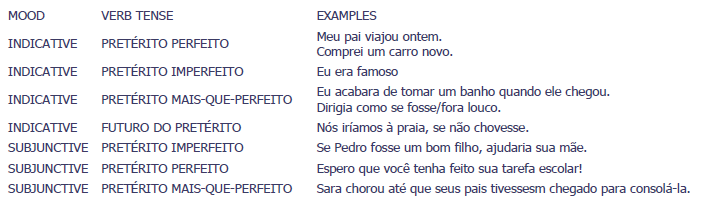
In the Portuguese language, ‘Pretérito (past) indicates a previous fact before someone speaks’ (Maia, 1994, p.131). In the Indicative Mood, it is divided into:
-
a) Pretérito Perfeito Simples: it is applied on concluded actions, in a definite period in the past;
-
b) Pretérito Perfeito composto: it is applied on actions that are repeated, or started in the past, and continued in the present;
-
c) Pretérito Imperfeito Simples: it is a past action, but not concluded; may be attached to another one in the simple past; it expresses an action in development, when another one happened/interrupted;
-
d) Pretérito Mais-Que-Perfeito Simples: it is applied on an action which occurred before another past action;
-
e) Pretérito Mais-Que-Perfeito Composto: used like the simple form;
-
f) Futuro do Pretérito: it indicates past processes for the mentioned past moment. In the Subjunctive Mood, there are:
-
a) Pretérito imperfeito: it indicates processes of not precise limits, before the moment in which one speaks, or writes;
-
b) Pretérito Perfeito: it occurs in a compound form, about previous actions, suggesting they were hopefully concluded when someone talks, or writes;
-
c) Pretérito Mais-Que-Perfeito: it occurs in a compound form, and is about a past action before another one also in the past.

Let’s analyse the past tenses in English:
-
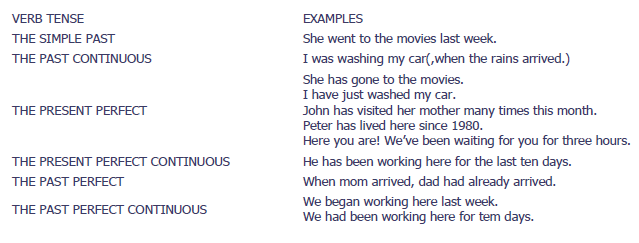
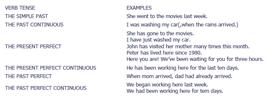
a) The Simple Past: it describes a past action in a definite/known period of time. It answers to the question ‘when did the action happen?’;
-
b) The Past Continuous: it describes an action that was happening in the past; an action that was occurring in the past, interrupted by a new one expressed in the Simple Past; an intention not realized;
-
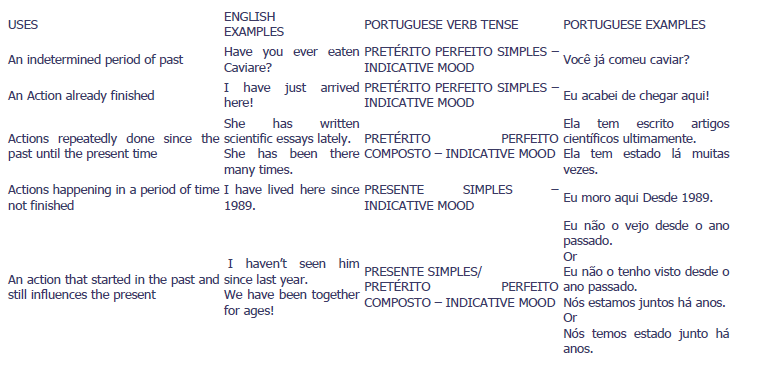
c) The Present Perfect: it indicates (1) an indetermined past; (2) an action already finished; (3) actions repeatedly done since the past until the present time; (4) actions happening in a period of time not finished/completed; (5) an action that started in the past and still influences the present;
-
d) The Present Perfect Continuous: it indicates an action started in the past - generally a determined past - and goes to the present. As the Present Perfect has the same function, the Present Perfect Continuous is the best option, when related to more recent situations. The Present perfect is for more permanent actions;
-
e) The Past Perfect: It is applied on an action that happened before another one also in the past;
-
f) *The past Perfect Continuous: it indicates an action being developed before a past one.
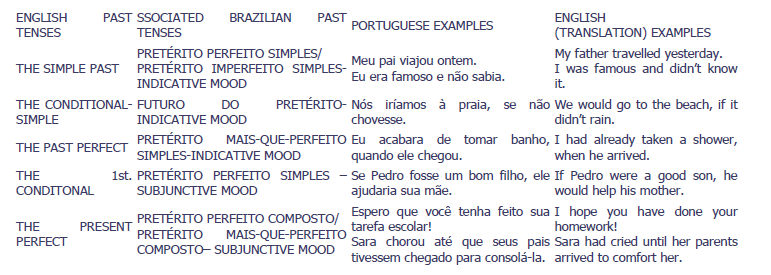
Now, that the Portuguese and English past tenses were separately analysed, a comparative chart among both languages and their pasts are drawn here to find out definitions, and/or similarities related to Portuguese and English past verb tenses.
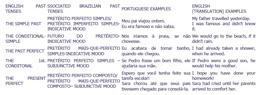
As we see, one of the results in the relations that can be done with the English Present perfect and the Brazilian past tenses are the Pretérito Perfeito and the Pretérito Perfeito Composto, in the Subjunctive Mood. But let’s use examples according to the previous definitons of the present perfect in this research to check if there is any other Portuguese related tense.

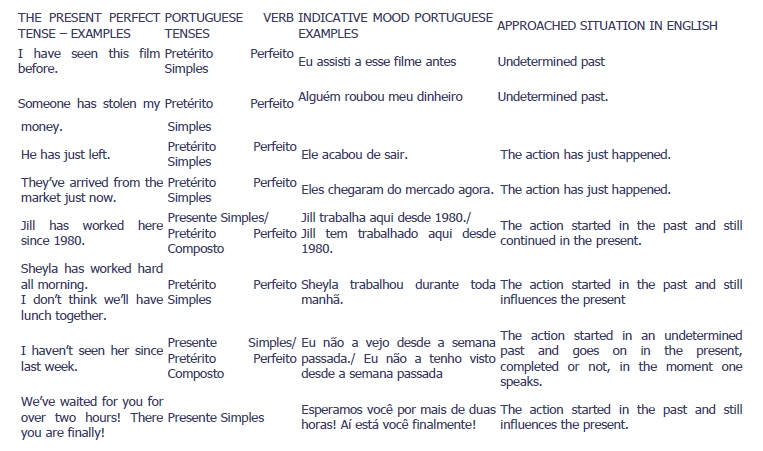
So, the Present Perfect tense can also be associated to the ‘Presente Simples and to the ‘Pretérito Perfeito Composto’ of the Indicative Mood in Portuguese language, as following:

The conclusion is that the Present perfect tense can be associated to the ‘Presente Simples’, the ‘Pretérito Perfeito Simples’, and the ‘Pretérito Perfeito Composto’ of the Indicative Mood, in The Portuguese Verb system, almost all the time.
The exceptions are for especial cases in the Subjunctive Mood, in the Portuguese Language, for structures as:
I hope you have done your homework! (Present Perfect)
Eu espero que você Tenha feito sua tarefa escolar! (Pretérito Perfeito) Sara had cried until her parents arrived to comfort her. (Present Perfect)
Sara chorou até que seus tivessem chegado para consolá-la. (Pretérito Mais-Que-Perfeito) Or
Sara chorou até que seus pais chegassem para consolá-la. (Pretérito Imperfeito/Subjunctive Mood)
The choice of the right tense depends on the semantic aspect of the structure. In order to make the Present Perfect understood, I suggest a comparison between both English and Portuguese structures to deal with the meaning of the speech. Only by that approach, Brazilian students will be able to internalize such a complex tense as the Present Perfect tense is.
REFERENCES
- 1 Collins Birmingham University International Language Database. English grammar. Great Britain: Collins Publishers/The University of Birmingham, 1990
- 2 André, Hildebrando A. de. Gramática moderna. São Paulo: Moderna, 1990
- 3 Faraco, Carlos Emílio & de Moura, Francisco Marto. Gramática: fonética e fonologia, morfologia, sintaxe, estilística. São Paulo: Ática, 1990.
- 4 Infante, Ulisses. Gramática: curso de gramática aplicada aos textos. São Paulo: Scipione, 1995.
- 5 Maia, João Domingues. Gramática: teoria e exercícios. São Paulo: Ática, 1994
- 6 Siqueira, Valter Lellis. O verbo inglês: teoria e prática. São Paulo: Ática,1991.
- 7 Steinberg, Martha. Morfologia inglesa: noções introdutórias. São Paulo: Ática, 1990
- 8 Thomson, A. J. & Martinet, A. V.. A pratical English grammar. Hong Kong: Oxford Press, 1991.