 Phenolic compounds involved in the inhibition of root and seedling regeneration in seeds of Eugenia pyriformis Cambess.
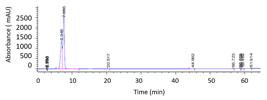
Eugenia pyriformis produces recalcitrant and monoembryonic seeds with high regenerative capacity, although the simultaneous formation of multiple roots is inhibited by chemical self-control. This study analyzed the phytochemical profile at different stages of development to investigate the regulatory role of phenols and tannins. Ethanolic extracts were purified by Solid Phase Extraction (SPE-C18) and analyzed by High-Performance Liquid Chromatography with Photodiode Array Detection (HPLC-PDA). The profiles revealed the predominance of hydrolyzable tannins and phenolic acids, notably gallic and ellagic acids. There was a progressive increase of gallic acid in the cotyledons during germination, with a peak at the seedling stage. Gallic acid acts as a chemical marker in the suppression of new meristems, preventing the protrusion of secondary roots while the primary structure is established, preserving the energy reserves of the seed.
Index terms:
gallic acid; germination self-control; recalcitrant seeds
 Thumbnail
 Thumbnail
 Thumbnail
 Thumbnail
 Thumbnail
 Thumbnail
 Thumbnail


