 Priming improves germination, antioxidant metabolism, and longevity of Guazuma ulmifolia Lam. seeds.
RESUMO:
O condicionamento é uma estratégia para melhorar a germinação, a uniformidade do lote e o vigor das sementes, sendo essencial para espécies como Guazuma ulmifolia utilizadas na restauração florestal. O uso de agentes condicionantes pode promover a germinação e ativar a resposta antioxidante. Este estudo avaliou os efeitos do condicionamento na germinação, emergência e metabolismo oxidativo de sementes de G. ulmifolia, bem como o impacto do armazenamento na viabilidade. O experimento foi conduzido em delineamento inteiramente casualizado com seis tratamentos: controle, hidrocondicionamento, ácido giberélico (GA₃), nitroprussiato de sódio (SNP), nitrato de potássio (KNO₃) e extrato aquoso de fumaça (ASE). Foram analisadas a atividade das enzimas antioxidantes (SOD e CAT) e os níveis de MDA e H₂O₂, e a viabilidade foi monitorada durante 12 meses de armazenamento. Os tratamentos com GA₃, SNP, KNO₃ e ASE aumentaram a germinação e a emergência, sendo o GA₃ o que mais reduziu o tempo para o estabelecimento das plântulas. O aumento da atividade de SOD e a redução do MDA indicaram menor degradação das membranas e maior proteção contra o estresse oxidativo. No entanto, o armazenamento pós-condicionamento não foi viável, sendo recomendado o uso imediato das sementes. Assim, o condicionamento melhora a germinação e a qualidade fisiológica de G. ulmifolia.
Termos para indexação:
ácido giberélico; condicionamento de sementes; armazenamento de sementes
ABSTRACT:
Seed priming is a strategy to improve germination, seed lot uniformity, and vigor, and is essential for species such as Guazuma ulmifolia used in forest restoration. The use of priming agents can promote germination and activate the antioxidant response. This study evaluated the effects of priming on germination, emergence, and oxidative metabolism of G. ulmifolia seeds, as well as the impact of storage on viability. The experiment was conducted in a completely randomized design with six treatments: control, hydropriming, gibberellic acid (GA₃), sodium nitroprusside (SNP), potassium nitrate (KNO₃), and aqueous smoke extract (ASE). The activity of antioxidant enzymes (SOD and CAT), MDA and H₂O₂ levels, and viability during 12 months of storage were analyzed. Treatments with GA₃, SNP, KNO₃, and ASE increased germination and emergence, with GA₃ being the most effective in reducing the time required for seedling establishment. Increased SOD activity and reduced MDA levels indicated lower membrane degradation and greater protection against oxidative stress. However, post-priming storage was not viable as it reduced longevity, making immediate sowing preferable. Thus, seed priming improves germination and the physiological quality of G. ulmifolia.
Index terms:
gibberellic acid; seed conditioning; seed storage
INTRODUCTION
The use of forest seeds is essential for the restoration of degraded ecosystems, contributing to conservation and sustainability, provided that they are of high quality and suitable for local conditions (Freire et al., 2022). Guazuma ulmifolia Lam. (Malvaceae), known as mutamba, occurs naturally in Latin America and is notable for its importance in the recovery of degraded areas (Pereira et al., 2020). However, its seeds show reduced viability, compromising both germination potential and seedling vigor (Paiva and Siqueira, 2008).
Studies in seed technology have sought strategies to increase germination potential and improve seedling establishment in the field. Seed priming is widely used to enhance seed quality and the performance of seed lots, promoting faster and more uniform germination (Bonome et al., 2017). However, the efficiency of priming depends on the method employed and the species studied, and its benefits may decline during storage due to reduced seed longevity of primed seeds. (Fernandes et al., 2021, Ren et al., 2023 ).
Water is essential for cell repair and the activation of germination, acting as a priming agent (Yan, 2017). In this context, the use of signaling molecules during priming has been shown to enhance stress tolerance in seeds. For example, sodium nitroprusside (SNP), a nitric oxide (NO) donor that induces enzymatic responses (Pires et al., 2016; Sadak et al., 2022), attenuates the effects of water deficit on soybean seedlings (Gavassi et al., 2019). Among these signaling molecules, growth regulators such as gibberellic acid stand out for their consistent effects on germination and seedling growth (Vishal et al., 2018; Shani et al., 2024). Additionally, potassium nitrate has been shown to stimulate seed germination, break dormancy, and enhance growth uniformity (Ribeiro et al., 2019). Similarly, compounds found in aqueous smoke extract activate gibberellin pathways, producing comparable effects and sharing characteristics with strigolactones, increasing germination potential (Fichino et al., 2016).
However, in many species, the benefits of priming may decline during storage. In general, primed seeds tend to be more sensitive and may gradually lose the benefits of the treatment, which reduces their longevity and limits the practical use of this technique in restoration programs (Tu et al., 2022).
Therefore, this study aimed to evaluate the effects of priming in Guazuma ulmifolia seeds on the germination, emergence, longevity, and seedling growth. As a hypothesis, it is expected that primed seeds will perform better than untreated ones.
MATERIAL AND METHODS
Seed source and storage
All experimental trials were conducted at the Forest Seed Laboratory and Forest Nursery, both in the Department of Forest Sciences, and at the Plant Growth and Development Laboratory in the Department of Plant Physiology at the Universidade Federal de Lavras (UFLA), Minas Gerais - Brazil. The Guazuma ulmifolia seeds, collected in 2016, with 72% of initial germination, were stored in a cold chamber (6-8 °C and ~40% RH, in polyethylene bags). The choice of an older seed lot was made to increase the chance that the effects of the treatments could be evidenced.
Experimental design and priming treatments
The seed priming experiment of Guazuma ulmifolia seeds was conducted in a completely randomized design (CRD) consisting of six treatments with four replications. The treatments consisted of control (unprimed seeds), hydropriming, gibberellic acid (GA₃, 1.5 μM), sodium nitroprusside (SNP, 1.0 μM), potassium nitrate (KNO₃, 1.0% w/v), and aqueous smoke extract (ASE, 0.4% v/v). The concentrations used for each priming agent were determined based on preliminary tests.
Dormancy breaking and priming procedure
Guazuma ulmifolia seeds exhibit physical dormancy and were immersed in sulfuric acid for 50 min, followed by washing in tap water and cleaning in a detergent solution before use (5 drops/100 mL of distilled water) (Brasil, 2013). After this procedure, the seeds were primed for 48 h at 10 °C in the dark in Petri dishes on germination paper. They were then washed with distilled water and dried (20 °C, 10% RH) in a container with silica gel. The seed moisture content was determined before and after priming using the oven method at 105 ± 3 °C for 24 h, according to Brasil (2025).
Germination test
The seeds were placed in Gerbox containers with moistened paper, with four replications of 25 seeds, and incubated in a germination chamber (25 °C, 12-hour photoperiod). The germination conditions and evaluation period were defined based on the Instructions for Analysis of Forest Species Seeds (Brasil, 2013). Germination was assessed daily (radicle protrusion), and after 21 days, normal and abnormal seedlings, dead seeds, and hard seeds were counted. The mean germination time (MGT) was calculated according to Santana and Ranal (2004).
Emergence test
Primed seeds were tested in a nursery, sown in seedbeds (80 × 200 cm) filled with washed sand, in randomized blocks and irrigated twice a day. Emergence was assessed daily. After 30 days, 40 seedlings per treatment were collected, washed, and digitalized using a camera in order to measure the shoot and root length using ImageJ software.
Biochemical analyses
For biochemical analyses, the seeds previously subjected to the different priming treatments (100 mg) were macerated in liquid nitrogen. For the analysis of hydrogen peroxide (H₂O₂), superoxide dismutase (SOD), and catalase (CAT), polyvinylpyrrolidone (PVPP) was used as an adsorbent. The samples were stored in an ultrafreezer (-80 °C) until analysis. Lipid peroxidation was quantified by determining malondialdehyde (MDA) levels, as described by Hodges et al. (1999). Hydrogen peroxide (H₂O₂) quantification was performed according to the protocol of Velikova et al. (2000).
The activity of the enzymatic antioxidant system, including superoxide dismutase (SOD) and catalase (CAT), was evaluated in dry seeds after priming. Enzyme extracts were prepared according to the protocol described by Biemelt et al. (1998). α-Amylase activity was quantified via a modified version of the 3,5-dinitrosalicylic acid method, as described by Miller (1959).
Storage test
For the storage test, after priming and drying, the seeds were placed in plastic tubes and stored in a freezer at -20 °C. Twelve samples were prepared for each treatment, each containing 100 seeds. A sample was taken monthly from each treatment for evaluation via the germination test.
Statistical analysis
Germination and biochemical data were analyzed in a completely randomized design (CRD), whereas nursery emergence was evaluated in a randomized block design (RBD) with four blocks containing all treatments. For germination, four replications of 25 seeds per treatment were used (n = 4), and five independent replications were used for biochemical analyses. In the storage assay, 12 tubes per treatment were prepared and evaluated monthly for 12 months. Data were tested for normality (Shapiro-Wilk) and homogeneity of variances (Bartlett), subjected to ANOVA, and means were compared by Tukey’s test (p ≤ 0.05), with no outlier exclusion. Pearson’s correlation and linear regression as a function of storage time were performed using R software (version 4.4.2) with the stats and agricolae packages.
RESULTS AND DISCUSSION
Changes in germination were observed after priming the seeds in the SNP, GA3, KNO3, and ASE solutions, which resulted in a significant increase in germination compared with that of the control (unprimed) and hydroprimed seeds. The percentage of normal seedlings also significantly differed, with seeds primed in the different solutions exhibiting a greater number of seedlings with complete and healthy essential structures (Figure 1).

Percentages of germination (radicle protrusion) and normal seedlings in Guazuma ulmifolia seeds after priming. Control (unprimed seeds), H2O (hydroprimed), SNP (sodium nitroprusside 1.0 μM), GA3 (gibberellic acid 1.5 μM), KNO3 (potassium nitrate 1.0%), and ASE (aqueous smoke extract 0.4%). Identical letters do not differ from each other in Tukey’s test at 5% probability. Bars indicate the standard deviation of the mean.
Priming with conditioning solutions significantly influenced the mean germination time of Guazuma ulmifolia seeds. Priming with GA₃ was the most effective treatment, promoting faster germination (Figure 2). During storage, seeds undergo a gradual and continuous process of deterioration, resulting in a decrease in their vigor (Sahu et al., 2017). With the onset of the soaking process during priming, a series of repairs occur at the cellular and structural levels that improve seed germination (Xu et al., 2020).

Mean germination time (MGT) of Guazuma ulmifolia seeds after priming. Control (unprimed seeds), H2O (hydroprimed), SNP (sodium nitroprusside 1.0 μM), GA3 (gibberellic acid 1.5 μM), KNO3 (potassium nitrate 1.0%), and ASE (aqueous smoke extract 0.4%). Identical letters do not differ from each other in Tukey’s test at 5% probability. Bars indicate the standard deviation of the mean.
The use of GA3, a molecule involved in plant growth and development, also controls seed germination, leaf expansion, stem elongation, and flowering (Magome et al., 2004). In studies with Arabidopsis seeds, a higher germination rate was observed in seeds primed with GA3 than in the control.
Studies with Helianthus annuus seeds have indicated that priming with GA3 and KNO3 improves germination and seedling growth and protects seeds from deterioration during aging (Kaia et al., 2024). In Passiflora quadrangulares seeds,Marostega et al. (2017) reported that KNO3 increased germination percentages.
When the formation of normal seedlings was analyzed, it was observed that the treatments with conditioners provided the best results. These findings indicate that, in addition to promoting germination, they also aid in the proper development of essential seedling structures. With respect to the mean germination time (MGT), a reduction in time was observed when the seeds were subjected to priming.
The results of the present study are corroborated by a study by Rau et al. (2021), where araçá seeds primed with gibberellic acid (GA3) presented a greater germination speed index (GSI) than did the control, which was also observed by Pereira et al. (2022) in sunflower seeds.
In the emergence tests, which were carried out in seedbeds, the results of the control and hydropriming were different from GA3, SNP, ASE and KNO3 treatments, respectively (Figure 3). Regarding the mean emergence time (MET), the use of GA3 also stood out from the other methods as the best treatment. The control and hydropriming had the highest values, indicating slower emergence (Figure 4).

Emergence of Guazuma ulmifolia seeds in seedbeds after priming. Control (unprimed seeds), H2O (hydroprimed), SNP (sodium nitroprusside 1.0 μM), GA3 (gibberellic acid 1.5 μM), KNO3 (potassium nitrate 1.0%), and ASE (aqueous smoke extract 0.4%). Identical letters do not differ from each other in Tukey’s test at 5% probability. Bars indicate the standard deviation of the mean.

Mean emergence time MET) of Guazuma ulmifolia seeds after priming. Control (unprimed seeds), H2O (hydroprimed), SNP (sodium nitroprusside 1.0 μM), GA3 (gibberellic acid 1.5 μM), KNO3 (potassium nitrate 1.0%), and ASE (aqueous smoke extract 0.4%). Identical letters do not differ from each other in Tukey’s test at 5% probability. Bars indicate the standard deviation of the mean
Rapid emergence after sowing is extremely beneficial, as it reduces the exposure time to adverse environmental conditions, favoring faster development and improving competitiveness against invasive plants (Decarli et al., 2019). This result is in agreement with the studies by Siadat et al. (2011), which indicated that immersing corn seeds in gibberellic acid was effective in increasing the emergence and growth of low-quality seeds.
Regarding seedling growth in the nursery, the use of conditioners enabled greater growth in the aboveground area than did the control and hydropriming (H₂O) methods. Gibberellic acid (GA₃) was the most efficient treatment (Figure 4). Similarly, compared with the other treatments, seed primed with GA3, SNP, or KNO3 resulted in longer roots (Figure 5). In the emergence tests, with data presented on shoot and root length, shows that priming, in addition to reducing germination time and standardizing this process, accelerates seedling growth.

Boxplot analysis of shoot (A) and root (B) growth of Guazuma ulmifolia seeds after priming. Control (unprimed seeds), H2O (hydroprimed), SNP (sodium nitroprusside 1.0 μM), GA3 (gibberellic acid 1.5 μM), KNO3 (potassium nitrate 1.0%), and ASE (aqueous smoke extract 0.4%). Identical letters do not differ from each other in Tukey’s test at 5% probability.
Gibberellins accelerate cell elongation by increasing cell wall expansion and causing water to enter cells (Ghannad et al., 2022). Other researchers have also reported a positive impact of priming in KNO₃ and GA₃ on germination and emergence attributes and initial growth in other crops under normal and stress conditions (Dhillon et al., 2021).
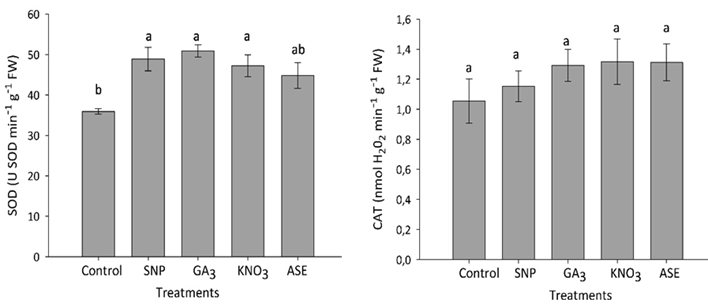
No significant changes in hydrogen peroxide H2O2 levels were detected between treatments. Compared with primed seeds, the contents of malondialdehyde (MDA) in the control were greater (Figure 6). Significant differences (p=0.05) were observed in the activity of superoxide dismutase (SOD). Priming of G. ulmifolia seeds with GA3, KNO3, or SNP resulted in higher enzyme activity; however, no differences in catalase activity were detected among the treatments (Figure 7). Alpha-amylase is an enzyme involved in seed germination. In this study, the activity of this enzyme significantly differed between treatments, with higher values for seeds primed in KNO₃ and GA₃ (Figure 8).

Malondialdehyde (MDA) and hydrogen peroxide (H₂O₂) contents in Guazuma ulmifolia seeds after priming. Control (unprimed seeds), H2O (hydroprimed), SNP (sodium nitroprusside 1.0 μM), GA3 (gibberellic acid 1.5 μM), KNO3 (potassium nitrate 1.0%), and ASE (aqueous smoke extract 0.4%). Identical letters do not differ from each other in Tukey’s test at 5% probability. Bars indicate the standard deviation of the mean.

Superoxide dismutase (SOD) and catalase (CAT) activity in Guazuma ulmifolia seeds after priming. Control (unprimed seeds), H2O (hydroprimed), SNP (sodium nitroprusside 1.0 μM), GA3 (gibberellic acid 1.5 μM), KNO3 (potassium nitrate 1.0%), and ASE (aqueous smoke extract 0.4%). Identical letters do not differ from each other in Tukey’s test at 5% probability. Bars indicate the standard deviation of the mean.

Alpha-amylase activity in Guazuma ulmifolia seeds after priming. Control (unprimed seeds), H2O (hydroprimed), SNP (sodium nitroprusside 1.0 μM), GA3 (gibberellic acid 1.5 μM), KNO3 (potassium nitrate 1.0%), and ASE (aqueous smoke extract 0.4%). Identical letters do not differ from each other in Tukey’s test at 5% probability. Bars indicate the standard deviation of the mean.
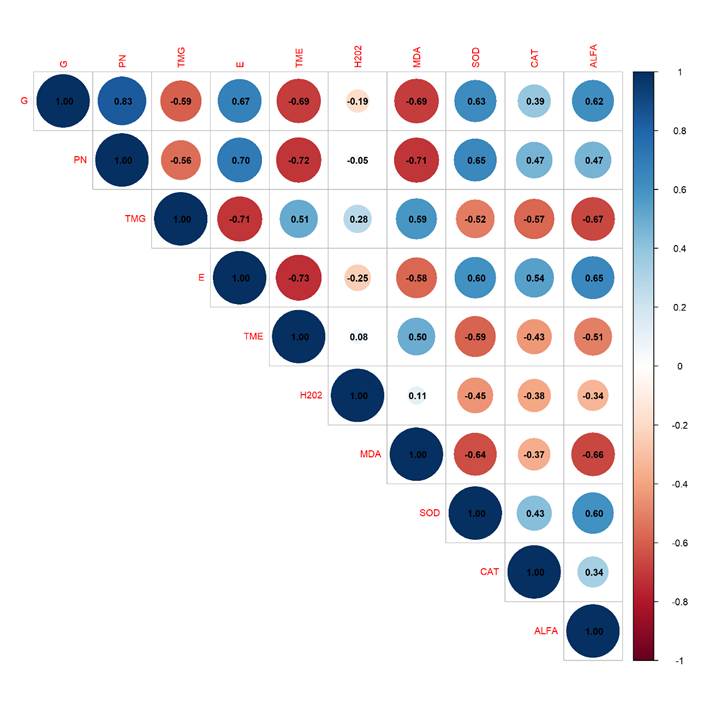
Pearson’s correlation (Figure 9) was used to assess the relationships between the physiological and biochemical data. The activity of SOD was positively correlated with germination (r = 0.63) and emergence (r = 0.60), indicating its favorable influence on these processes. On the other hand, the MDA content was negatively correlated with germination (r = -0.69), normal growth (r = -0.71), and emergence (r = -0.58), suggesting that high levels of this compound are associated with lower germination performance. Alpha-amylase was positively correlated with both germination (r = 0.62) and emergence (r = 0.65), reinforcing its importance for successful germination and seedling establishment. Studies indicate that the level of MDA, the end product of lipid peroxidation, is considered an effective indicator of peroxidation levels and membrane damage. This result can be attributed to the benefits of priming, which promotes morphological, physiological, and biochemical changes during seed imbibition (Ayala et al., 2014; Ebone et al., 2019).

Pearson correlation analysis of physiological and biochemical indices in seeds of Guazuma ulmifolia after priming. Control (unprimed seeds), H2O (hydroprimed), SNP (sodium nitroprusside 1.0 μM), GA3 (gibberellic acid 1.5 μM), KNO3 (potassium nitrate 1.0%), and ASE (aqueous smoke extract 0.4%).
Thus, the proposed priming methods were effective in reducing lipid peroxidation. As shown in Figure 9, MDA content was negatively correlated with germination (r = -0.69), normal seedlings (r = -0.71), and emergence (r = -0.58). Similarly, studies with Helianthus annuus and Hordeum vulgare seeds reported lower MDA levels and reduced oxidative damage in primed seeds (Pereira et al., 2022; Hessini et al., 2023). In the present study, SOD activity was negatively correlated with MDA (r = -0.60) and positively correlated with germination (r = 0.63) and emergence (r = 0.60), indicating its role in reducing lipid peroxidation and enhancing physiological performance.
Silva et al. (2019) and Bastos et al. (2023) reported higher superoxide dismutase (SOD) activity in Senna macranthera seeds treated with SNP and ASE, respectively, than in untreated seeds. In Plathymenia reticulata Benth., Pereira et al. (2010) also reported increased SOD activity in seeds treated with KNO₃ and SNP.
The higher alpha-amylase activity in seeds primed with GA₃ and KNO₃ is consistent with the findings of physiological analyses of germination, emergence, and TMG, which was also observed in Pearson’s correlation between enzyme activity and the variables germination (r = 0.62) and emergence (r = 0.65) and a significant negative correlation with TMG (r = -0.67).
The use of growth regulators, such as gibberellic acid and other compounds that induces alpha-amylase synthesis, can improve seed quality and increase germination rates. This enzyme acts in the hydrolysis of starch in the endosperm, providing the energy necessary for seedling development (Liu et al., 2018). Thus, this enzyme is crucial for the germination process, and its activity is directly associated with the physiological quality of seeds (Li et al., 2019).
On the basis of regression analyses with linear adjustments to identify specific behavior patterns (Figure 10), seed germination during storage (months) after different priming treatments (Hidropriming, SNP, GA₃, KNO₃, and ASE) gradually decreased, whereas that of the control remained stable throughout the period.

Linear regression analysis of the germination of Guazuma ulmifolia seeds after priming. Control (unprimed seeds), H2O (hydroprimed), SNP (sodium nitroprusside 1.0 μM), GA3 (gibberellic acid 1.5 μM), KNO3 (potassium nitrate 1.0%), and ASE (aqueous smoke extract 0.4%) stored for up to 12 months.
The reduction in longevity observed in primed seeds during storage has been widely reported in both agricultural crops and forest species. Seed priming advances metabolic processes associated with germination, including respiration and enzyme activation, which may accelerate deterioration during storage (Hussain et al., 2015).
Primed seeds often exhibit increased oxidative stress due to the accumulation of reactive oxygen species, leading to membrane damage and reduced viability over time (Wang et al., 2018). These physiological changes can compromise the storage potential of primed seeds, especially in species with inherently short longevity. According to Bruggink et al. (1999), a disadvantage of physiological priming is the reduction in the storage potential of seeds.
However, it is essential that these materials be stored long enough to ensure their commercialization. Based on the regression equations, at the end of 12 months of storage, all priming treatments reduced seed germination. This raises some relevant questions regarding the ideal storage conditions for primed seeds and possible variations among the different treatments used during priming.
CONCLUSIONS
Priming of Guazuma ulmifolia seeds with GA₃, KNO₃, SNP, and ASE improved germination and seedling emergence, with GA₃ being the most effective treatment by reducing germination and emergence time. Priming enhanced antioxidant activity and reserve mobilization but reduced seed longevity, indicating that primed seeds should be used immediately after treatment.
ACKNOWLEDGEMENTS
The authors are thankful for the financial support from the Brazilian agencies Coordenação de Aperfeiçoamento de Pessoal de Nível Superior (CAPES), Conselho Nacional de Desenvolvimento Científico e Tecnológico (CNPq) - Grant 301637/2025-3 (ACJ) and Grant 305104/2025-0 (JMRF), and Fundação de Amparo à Pesquisa do Estado de Minas Gerais (FAPEMIG).
REFERENCES
-
AYALA, A.; MUÑOZ, M.F.; ARGÜELLES, S. Lipid peroxidation: production, metabolism, and signaling mechanisms of malondialdehyde and 4-hydroxy-2-nonenal. Oxidative Medicine and Cellular Longevity, v.2014, 360438, 2014. https://doi.org/10.1155/2014/360438
» https://doi.org/https://doi.org/10.1155/2014/360438 -
BASTOS, L.L.S.; BORGES, E.E.L.; SOUZA, G.A.; ALMEIDA, L.S.; TORRES, F.T.P. Germination of Senna macranthera (DC. ex Collad.) H.S. Irwin & Barneby in response to heat and smoke. South African Journal of Botany, v.154, p.219-224, 2023. https://doi.org/10.1016/j.sajb.2023.01.032
» https://doi.org/https://doi.org/10.1016/j.sajb.2023.01.032 -
BIEMELT, S.; KEETMAN, U.; ALBRECHT, G. Re-aeration following hypoxia or anoxia leads to activation of the antioxidative defense system in roots of wheat seedlings. Plant Physiology, v.116, n.2, p.651-658, 1998. https://doi.org/10.1104/pp.116.2.651
» https://doi.org/https://doi.org/10.1104/pp.116.2.651 -
BONOME, L.T.S.; GUIMARÃES, R.M.; OLIVEIRA, J.A.; DOUSSEAU, S. Osmoconditioning of Urochloa brizantha seeds to reduce pelleting negative effects. Brazilian Journal of Agriculture, v.92, n.2, p.87-100, 2017. https://doi.org/10.37856/bja.v92i2.3197
» https://doi.org/https://doi.org/10.37856/bja.v92i2.3197 -
BRASIL. Regras para Análise de Sementes (RAS) Ministério da Agricultura e Pecuária - MAPA, Brasília, 2025. https://wikisda.agricultura.gov.br/pt-br/Laborat%C3%B3rios/Metodologia/Sementes/RAS_2025/Amostragem
» https://wikisda.agricultura.gov.br/pt-br/Laborat%C3%B3rios/Metodologia/Sementes/RAS_2025/Amostragem - BRASIL. Ministério da Agricultura, Pecuária e Abastecimento. Instruções para análise de sementes de espécies florestais Brasília: MAPA/ACS, 2013. 98p.
-
BRUGGINK, G.T.; OOMS, J.J.J.; VAN DER TOORN, P. Induction of longevity in primed seeds. Seed Science Research, v.9, n.1, p.49-53, 1999. https://doi.org/10.1017/S0960258599000057
» https://doi.org/https://doi.org/10.1017/S0960258599000057 -
DECARLI, L.; SOARES, C.M.; LUDWIG, M.P.; ROTHER, C.M.S. Industrial treatment of soybean seeds: physiological quality and crop performance. Brazilian Journal of Agricultural Sciences, v.14, n.3, 2019. https://doi.org/10.1590/2317-1545v41n1210486
» https://doi.org/https://doi.org/10.1590/2317-1545v41n1210486 -
DHILLON, B.S.; KUMAR, V.; SAGWAL, P.; KAUR, N.; MANGAT, G.S.; SINGH, S. Seed priming with potassium nitrate and gibberellic acid enhances the performance of dry direct seeded rice (Oryza sativa L.) in north-western India. Agronomy, v.11, 849, 2021. https://doi.org/10.3390/agronomy11050849
» https://doi.org/https://doi.org/10.3390/agronomy11050849 -
EBONE, L.A.; CAVERZAN, A.; CHAVARRIA, G. Physiological alterations in orthodox seeds due to deterioration processes. Plant Physiology and Biochemistry, v.145, p.34-42, 2019. https://doi.org/10.1016/j.plaphy.2019.10.028
» https://doi.org/https://doi.org/10.1016/j.plaphy.2019.10.028 -
FERNANDES, A.C.; FARIA, J.C.T.; FARIA, J.M.R.; PIRES, R.M.O.; CARVALHO, E.R.; SANTOS, H.O. Use of different conditioning agents and evaluation of the quality of two batches of annatto (Bixa orellana) seeds. Ciência Florestal, v.31, n.2, p.808-829, 2021. https://doi.org/10.5902/1980509844156
» https://doi.org/https://doi.org/10.5902/1980509844156 -
FICHINO, B.S.; DOMBROSKI, J.R.G.; PIVELLO, V.R.; FIDELIS, A. Does fire trigger seed germination in the neotropical savannas? Experimental test with six Cerrado species. Biotropica, v.48, p.181-187, 2016. https://doi.org/10.1111/btp.12276
» https://doi.org/https://doi.org/10.1111/btp.12276 -
FREIRE, J.M.; ROMANO, I.S.; SOUZA, M.V.S.C.; GAROFOLO, A.C.S.; SILVEIRA FILHO, T.B. Forest seedlings supply for restoration of the Atlantic Forest in Rio de Janeiro, Brazil. Floresta e Ambiente, v.29, n.3, e20210058, 2022. https://doi.org/10.1590/2179-8087-FLORAM-2021-0058
» https://doi.org/https://doi.org/10.1590/2179-8087-FLORAM-2021-0058 -
GAVASSI, M.A.; GAION, L.A.; MONTEIRO, C.C.; SANTOS, J.C.; CARVALHO, R.F. Seed priming with sodium nitroprusside attenuates the effects of water deficit on soybean seedlings. Comunicata Scientiae, v.10, n.1, p.176-184, 2019. https://doi.org/10.14295/cs.v10i1.2842.
» https://doi.org/https://doi.org/10.14295/cs.v10i1.2842 -
GHANNAD, R.; HAGHJOU, M.M.; RAZA, A.; HASANUZZAMAN, M. Induction of hydrolytic enzyme activities in dormant seeds of Dracocephalum kotschyi Boiss. causes improvement of germination and seedling vigor. Acta Physiologiae Plantarum, v.44, 48, 2022. https://doi.org/10.1007/s11738-022-03381-y
» https://doi.org/https://doi.org/10.1007/s11738-022-03381-y -
HODGES, D.M.; DELONG, J.M.; FORNEY, C.F.; PRANGE, R.K. Improving the thiobarbituric acid-reactive-substances assay for estimating lipid peroxidation in plant tissues containing anthocyanin and other interfering compounds. Plants, v.207, n.4, p.604-611, 1999. https://doi.org/10.1007/s004250050524
» https://doi.org/https://doi.org/10.1007/s004250050524 -
HESSINI, K.; ELLOUZI, H.; ZORRIG, W.; AMRAOUI, S.; OUESLATI, S.; ABDELLY, C.; RABHI, M.; SIDDIQUE, K.H.M. Seed priming with salicylic acid alleviates salt stress toxicity in barley by suppressing ROS accumulation and improving protective and defense systems. Antioxidants, v.12, n.9, 1779, 2023. https://doi.org/10.3390/antiox12091779.
» https://doi.org/https://doi.org/10.3390/antiox12091779 -
HUSSAIN, S.; ZHENG, M.; KHAN, F.; KHALIQ, A.; FAHAD, X.; PENG, S.; HUANG, J.; CUI, K.; NIE, L. Benefits of rice seed priming are offset permanently by prolonged storage and the storage conditions. Scientific Reports, v.5, 8101, 2015. https://doi.org/10.1038/srep08101
» https://doi.org/https://doi.org/10.1038/srep08101 -
KAYA, M.D.; ERGIN, N.; HARMANCI, P.; KULAN, E.G. Seed priming as a method of preservation and restoration of sunflower seeds. OCL - Oilseeds and fats, Crops and Lipids, v.31, 4, 2024. https://doi.org/10.1051/ocl/2024003
» https://doi.org/https://doi.org/10.1051/ocl/2024003 -
LI, Q.; YANG, U.; ZHANG, W.H. Higher endogenous bioactive gibberellins and α-amylase activity confer greater tolerance of rice seed germination to saline-alkaline stress. Environmental and Experimental Botany, v.162, p.357-363, 2019. https://doi.org/10.1016/j.envexpbot.2019.03.015
» https://doi.org/https://doi.org/10.1016/j.envexpbot.2019.03.015 -
LIU, L.; XIA, W.; LI, H.; ZENG, H.; WEI, B.; HAN, S.; YIN, C. Salinity inhibits rice seed germination by reducing α-amylase activity via decreased bioactive gibberellin. Frontiers in Plant Science, v.9, 275, 2018. https://doi.org/10.3389/fpls.2018.00275
» https://doi.org/https://doi.org/10.3389/fpls.2018.00275 -
MAGOME, H.; YAMAGUCHI, S.; HANADA, A.; KAMIYA, Y.; ODA, K. Dwarf and delayed-flowering 1, a novel Arabidopsis mutant deficient in gibberellin biosynthesis because of overexpression of a putative AP2 transcription factor. The Plant Journal, v.37, n.5, p.720-729, 2004. https://doi.org/10.1111/j.1365-313X.2003.01998.x
» https://doi.org/https://doi.org/10.1111/j.1365-313X.2003.01998.x -
MAROSTEGA, T.N.; LUZ, P.B.; TAVARES, A.R.; NEVES, L.G.; PAIVA SOBRINHO, S. Methods of breaking seed dormancy for ornamental passion fruit species. Ornamental Horticulture, v.23, p.72, 2017. https://doi.org/10.14295/oh.v23i1.982
» https://doi.org/https://doi.org/10.14295/oh.v23i1.982 - MILLER, G.L. Use of dinitrosalicylic acid reagent for determination of reducing sugar. Analytical Chemistry, v.31, n.3, p.426-428, 1959.
-
PAIVA, S.S.; SIQUEIRA, A.G. Morphological characterization of fruits, seeds, seedlings, and juvenile plants of mutamba (Guazuma ulmifolia Lam. - Sterculiaceae). Journal of Seed Science, v.30, n.1, p.114-120, 2008. https://doi.org/10.1590/S0101-31222008000100015
» https://doi.org/https://doi.org/10.1590/S0101-31222008000100015 -
PEREIRA, G.A.; ARRUDA, H.S.; MORAIS, D.R.; ARAUJO, N.M.P.; PASTORE, G.M. Mutamba (Guazuma ulmifolia Lam.) fruit as a novel source of dietary fiber and phenolic compounds. Food Chemistry, v.310, 125857, 2020. https://doi.org/10.1016/j.foodchem.2019.125857
» https://doi.org/https://doi.org/10.1016/j.foodchem.2019.125857 -
PEREIRA, A.A.S.; NERY, F.C.; FERREIRA, R.A.; SILVA, V.N.; BERNARDES, M.M.; SANTOS, H.O.; BICALHO, E.M. Can priming with ascorbic acid or nitric oxide improve the germinability of stored sunflower seeds? Journal of Seed Science , v.44, e202244001, 2022. https://doi.org/10.1590/2317-1545v44256600
» https://doi.org/https://doi.org/10.1590/2317-1545v44256600 - PEREIRA, B.L.C.; BORGES, E.E.L.; OLIVEIRA, A.C.; LEITE, H.G.; GONÇALVES, J.F.C. Influence of nitric oxide on the germination of seeds of Plathymenia reticulata Benth. with low vigor. Scientia Forestalis, v.38, n.88, p.629-636, 2010.
-
PIRES, R.M.O.; SOUZA, G.A.; CARDOSO, A.A.; DIAS, D.C.F.S.; BORGES, E.E.L. Action of nitric oxide in sesame seeds (Sesamum indicum L.) submitted to stress by cadmium. Journal of Seed Science , v.38, n.1, p.22-29, 2016. https://doi.org/10.1590/2317-1545v38n1154824
» https://doi.org/https://doi.org/10.1590/2317-1545v38n1154824 -
RAU, T.G.; RADAELLI, J.C.; WAGNER JÚNIOR, A.; CITADINO, I.; MOURA, G.C.; MAZARO, S.M. Benzylaminopurine and gibberellin in the germination process of yellow guava. Research, Society and Development, v.10, e49110515124, 2021. https://doi.org/10.33448/rsd-v10i5.15124
» https://doi.org/https://doi.org/10.33448/rsd-v10i5.15124 -
REN, M.; TAN, B.; XU, J.; YANG, Z.; ZHENG, H.; TANG, Q.; ZHANG, X.; WANG, W. Priming methods affected deterioration speed of primed rice seeds by regulating reactive oxygen species accumulation, seed respiration and starch degradation. Frontiers in Plant Science , v.14, 1267103, 2023. https://doi.org/10.3389/fpls.2023.1267103
» https://doi.org/https://doi.org/10.3389/fpls.2023.1267103 -
RIBEIRO, E.C.G.; REIS, R.G.E.; VILAR, C.C.; VILAR, F.C.M. Physiological quality of Urochloa brizantha seeds submitted to priming with calcium salts. Pesquisa Agropecuária Tropical, v.49, e55341, 2019. https://doi.org/10.1590/1983-40632019v4955341
» https://doi.org/https://doi.org/10.1590/1983-40632019v4955341 - SADAK, M.S. Nitric oxide and hydrogen peroxide as signaling molecules for better growth and yield of wheat plants exposed to water deficiency. Egyptian Journal of Chemistry, v.65, p.209-223, 2022.
-
SAHU, B.; SAHU, A.K.; THOMAS, V.; NAITHANI, S.C. Reactive oxygen species, lipid peroxidation, protein oxidation and antioxidant enzymes in dehydration of Pongamia pinnata seeds during storage. South African Journal of Botany , v.112, n.1, p.383-390, 2017. https://doi.org/10.1016/j.sajb.2017.06.030
» https://doi.org/https://doi.org/10.1016/j.sajb.2017.06.030 - SANTANA, D.G.; RANAL, M.A. Analysis of germination: a statistical approach Brasília: Editora da Universidade de Brasília, 2004. 247-248 p.
-
SHANI, E.; HEDDEN, P.; TAI-PING, S. Highlights in gibberellin research: a tale of the dwarf and the slender. Plant Physiology , v.195, n.1, p.111-134, 2024. https://doi.org/10.1093/plphys/kiae044
» https://doi.org/https://doi.org/10.1093/plphys/kiae044 - SIADAT, S.A.; MOOSAVI, S.A.; SHARAFI ZADEH, M.; FOTOUHI, F.; ZIREZADEH, M. Effects of halo and phytohormone seed priming on germination and seedling growth of maize under duration of accelerated aging treatment. African Journal of Agricultural Research, v.6, p.6453-6462, 2011.
-
SILVA, A.L.; PINHEIRO, D.T.; BORGES, E.E.L.; SILVA, L.J.; DIAS, D.C.F.S. Effect of cyanide by sodium nitroprusside (SNP) application on germination, antioxidative system and lipid peroxidation of Senna macranthera seeds under saline stress. Journal of Seed Science , v.41, p.86-96, 2019. https://www.scielo.br/j/jss/a/Xwt3nB3KVKhgbgmX4TZ8pxv/?lang=en
» https://www.scielo.br/j/jss/a/Xwt3nB3KVKhgbgmX4TZ8pxv/?lang=en -
TU, K.; CHENG, Y.; PAN, T.; WANG, J.; SUN, Q. Effects of seed priming on vitality and preservation of pepper seeds. Agriculture, v.12, 603, 2022. https://doi.org/10.3390/agriculture12050603
» https://doi.org/https://doi.org/10.3390/agriculture12050603 -
VELIKOVA, V.; IORDANOV, I.; EDREVA, A. Oxidative stress and some antioxidant systems in acid rain-treated bean plants: protective role of exogenous polyamines. Plant Science, v.151, n.1, p.59-66, 2000. https://doi.org/10.1016/S0168-9452(99)00197-1
» https://doi.org/https://doi.org/10.1016/S0168-9452(99)00197-1 -
VISHAL, B.; KUMAR, P. Regulation of seed germination and abiotic stresses by gibberellins and abscisic acid. Frontiers in Plant Science , v.9, 838, 2018. https://doi.org/10.3389/fpls.2018.00838
» https://doi.org/https://doi.org/10.3389/fpls.2018.00838 -
WANG, W.; HE, A.; PENG, S.; HUANG, J.; CUI, K.; NIE, L. The effect of storage condition and duration on the deterioration of primed rice seeds. Frontiers in Plant Science , v.9, 172, 2018. https://doi.org/10.3389/fpls.2018.00172.
» https://doi.org/https://doi.org/10.3389/fpls.2018.00172 -
XU, L.X.; XIN, X.; YIN, G.K.; LIU, X.J.; ZHANG, J.; LI, Y.; ZHOU, S.F.; WANG, W. Timing for antioxidant-priming against rice seed ageing: optimal only in non-resistant stage. Scientific Reports , v.10, 13294, 2020. https://doi.org/10.1038/s41598-020-70189-6
» https://doi.org/https://doi.org/10.1038/s41598-020-70189-6 -
YAN, M. Prolonged storage reduced the positive effect of hydropriming in Chinese cabbage seeds stored at different temperatures. South African Journal of Botany , v.111, p.313-315, 2017. https://doi.org/10.1016/j.sajb.2017.04.005.
» https://doi.org/https://doi.org/10.1016/j.sajb.2017.04.005