 Priming, drying and storage: effects on physiological quality and thermoinhibition of biofortified lettuce seeds
ABSTRACT:
Thermoinhibition of lettuce seeds causes losses in seedling production. Priming improves seed performance under stress; however, there are gaps regarding the duration of its effects after drying and storage, as well as methods that preserve tolerance to thermoinhibition. The objective of this study was to evaluate biofortified lettuce seeds subjected to priming, different drying methods and storage periods, in order to identify strategies that maintain the effects of the treatment. Seeds of the UFU 189#2#2#1 genotype were osmoprimed in PEG 6000 (-1.2 MPa) and subjected to the following methods: control, priming without drying (PRM), slow drying (SD), fast drying (FD), thermal shock followed by SD (TSSD) or FD (TSFD), and reduction of moisture content followed by SD (rSD) or FD (rFD). Drying was carried out at 25 °C (slow) and 32 °C (fast) for 48 hours. The seeds were stored for 0, 30 and 60 days. In a second trial, SD, FD, rSD, and rFD were evaluated for 12, 24, 36, and 48 hours. Moisture content, first germination count, germination, emergence, germination and emergence speed indices, and dry mass of seedlings were determined. Slow drying is more efficient in preserving the tolerance to thermoinhibition after storage. Tolerance is maintained after reduction of moisture content followed by SD or FD for up to 12 hours, with fast drying also being feasible up to 24 hours.
Index terms:
controlled drying; osmopriming; storability; thermodormancy
RESUMO:
A termoinibição das sementes de alface provoca perdas na produção de mudas. O priming melhora o desempenho das sementes sob estresse; entretanto, há lacunas quanto à duração de seus efeitos após a secagem e o armazenamento, bem como sobre métodos que preservem a tolerância à termoinibição. Objetivou-se avaliar sementes de alface biofortificada submetidas ao priming, a diferentes métodos de secagem e períodos de armazenamento, visando identificar estratégias que mantenham os efeitos do tratamento. Sementes do genótipo UFU 189#2#2#1 foram osmocondicionadas em PEG 6000 (-1,2 MPa) e submetidas aos métodos: testemunha, condicionadas sem secagem (Cond), secagem lenta (SL), secagem rápida (SR), choque térmico seguido de SL (CTSL) ou SR (CTSR), e redução do teor de água seguida de SL (rSL) ou SR (rSR). As secagens foram realizadas a 25 °C (lenta) e 32 °C (rápida) por 48 horas. As sementes foram armazenadas por 0, 30 e 60 dias. Em um segundo ensaio, avaliaram-se a SL, SR, rSL e rSR por 12, 24, 36 e 48 horas. Foram realizados o teor de água, primeira contagem, germinação, emergência, índices de velocidade de germinação e emergência, e massa seca de plântulas. A secagem lenta é mais eficiente na preservação da tolerância à termoinibição após o armazenamento. A tolerância é mantida após redução do teor de água seguida de SL ou SR por até 12 horas, sendo a secagem rápida também é viável até 24 horas.
Termos para indexação:
secagem controlada; osmocondicionamento; armazenabilidade; termodormência
INTRODUCTION
Climatic conditions, especially temperature during germination, directly influence the physiological quality of lettuce (Lactuca sativa L.) seed lots (Wang et al., 2015; Catão et al., 2023a; Queiroz et al., 2023). Temperatures above 30 °C can prevent germination, leading to thermoinhibition or even thermodormancy, due to the stiffening of the endosperm, which restricts radicle protrusion (Catão et al., 2018; Michael et al., 2023). Despite this behavior, there is genetic variability within the genus Lactuca, with materials that germinate at temperatures of up to 35 °C. Studies show that the Everglades cultivar (L. sativa) (Catão et al., 2014; Catão et al., 2016) and the US96UC23 accession (L. serriola) (Yoong et al., 2016) germinate at temperatures above 30 °C. Thus, the development of thermotolerant cultivars has high commercial potential, benefiting producers in hot regions or in the summer, in the production of both seedlings and seeds.
Commercial cultivars registered with tolerance to thermoinhibition (Brasil, 2025a), or biofortified cultivars, were not verified with the National Registry of Cultivars (RNC/MAPA). Thus, producers need to consider the thermal conditions of the production site in advance (Catão et al., 2022). In view of this genetic limitation and the direct influence of temperature on seed performance, technological strategies that increase tolerance to heat stress become essential.
Physiological conditioning (priming) is a strategy that consists of controlled hydration, allowing seeds to advance to Phases I and II of germination, without reaching the root protrusion of Phase III (Marcos-Filho, 2015). Priming methods vary according to the species, size, initial quality of the lot and the factors involved in the process, such as type of solution, water potential, temperature and oxygenation. This technique has been widely used to attenuate abiotic stresses and improve seed performance, with hydropriming, osmopriming, and matripriming being common (Janah et al., 2025; Khairilanwar et al., 2025). Despite the widely reported benefits, the maintenance of these effects over time is still a critical point, especially when considering the need for storage after priming.
In this context, the storage of primed seeds represents a challenge, as the beneficial effects of priming may not be maintained over time (Batista et al., 2020; Petronilio et al., 2021). The maintenance of these effects depends on factors such as the drying method and time. Information on the interaction between osmopriming, drying, storage and thermoinhibition tolerance in lettuce is still limited. A critical point is to understand how long the effects of priming remain active after drying and whether they are sufficient to allow germination at high temperatures (Dantas et al., 2021).
This study aimed to analyze the behavior of lettuce seeds subjected to priming, for different drying methods and storage periods, in addition to identifying appropriate procedures to maintain the effects of the treatment and tolerance to thermoinhibition.
MATERIAL AND METHODS
Lettuce seeds were produced at the Vegetable Experimental Station of the Universidade Federal de Uberlândia (UFU), Monte Carmelo campus (18°42’43.19” S; 47°29’55.8” W; 873 m altitude). The seeds come from the UFU’s Biofortified Lettuce Breeding Program, and all genealogy is stored in the “BG α BIOFORT” software with registration number BR512019002403-6 at INPI (Maciel et al., 2019).
The experiments were carried out at the Seed Laboratory of the Institute of Agrarian Sciences of the Universidade Federal de Uberlândia (UFU), Uberlândia, MG, Brazil. Seeds of the UFU 189#2#2#1 genotype, considered thermosensitive by Catão et al. (2023b), were osmoprimed in an aerated solution of PEG 6000 (polyethylene glycol) (-1.2 MPa), at 15 °C for 48 hours, with an 8-hour photoperiod (Nascimento and Cantliffe, 1999). After priming, the seeds were washed under running water to remove the osmopriming solution, and the excess was removed with the help of paper towels.
Then, the seeds were subjected to the drying methods: control (without priming and drying - CTR); priming without drying (PRM); slow drying (SD); fast drying (FD); thermal shock + slow drying (TSSD); thermal shock + fast drying (TSFD); reduction of moisture content + slow drying (rSD); and reduction of moisture content + fast drying (rFD).
For the application of thermal shock, the seeds were placed in airtight aluminum packages and kept in a water bath at 36 °C for 1 hour. The seeds that underwent the initial reduction of moisture content were weighed and remained under environmental conditions until the reduction of approximately 10% of their initial weight. Slow drying was performed in BOD chamber (containing silica gel inside), at a temperature of 25 °C and 50% RH, for 48 hours. Fast drying was carried out in an oven with forced air circulation at 32 °C and 45% RH for 48 hours. The relative humidity of each environment was monitored by means of a thermo-hygrometer (Brand: Minipa MT241). After drying, the seeds were put into paper packages and kept in a climate-controlled chamber at 15 °C and 55% RH, for 0 (zero), 30 and 60 days of storage.
After application of the treatments, the seeds were subjected to evaluations of physical and physiological quality, as follows:
Moisture content: evaluated before osmopriming, after osmopriming and after drying of the seeds. For each treatment, two samples of 0.2 g of seeds were evaluated by the oven method at 105 °C (Brasil, 2025b). The results were expressed as percentage.
First germination count and germination test: four replications of 50 seeds were sown on two sheets of blotting paper, moistened with distilled water, in the proportion of 2.5 times the weight of the dry substrate, in transparent plastic boxes (gerbox type). The seeds of all treatments were tested at temperatures of 20 °C and 35 °C, under a 12-hour photoperiod, to evaluate the tolerance to thermoinhibition. The evaluation consisted of two counts of normal seedlings: the first germination count at four days and the final germination count at seven days, with the results expressed as percentage (Brasil, 2025b).
Emergence test: conducted at the same temperatures (20 °C and 35 °C) used for seed germination. Four replications of 50 seeds sown in plastic gerbox boxes containing moistened sand (60% of the substrate retention capacity) were kept under a 12-hour photoperiod, and the number of normal seedlings on the fourth and seventh days after sowing was computed, calculating the initial and final percentage of emergence, respectively.
In the second trial, the seeds were also osmoprimed (Nascimento and Cantliffe, 1999). Four methods were chosen to evaluate the drying times, namely: slow drying (SD); fast drying (FD); reduction of moisture content + slow drying (rSD); and reduction of moisture content + fast drying (rFD). The drying times were 12, 24, 36 and 48 hours. Dried seeds (CTR) and seeds primed without drying (PRM) were also used to compose the treatments.
Slow drying, fast drying and reduction of the initial moisture content were carried out under the same conditions described above. After that, the seeds were subjected to the following evaluations:
First germination count and germination test: four replications of 50 seeds were sown on two sheets of blotting paper moistened with a volume of distilled water equivalent to 2.5 times the dry weight of the paper. The test was conducted at temperatures of 20 °C and 35 °C (to evaluate thermoinhibition), under a 12-hour photoperiod. The evaluations consisted of two counts: the first count at four days and the germination count at seven days, with the results expressed as percentage (Brasil, 2025b).
Germination speed index: performed simultaneously with the germination test, by computing the number of normal seedlings daily and at the same time. The index was calculated according to the formula proposed by Maguire (1962).
Emergence test: conducted at the same temperatures (20 °C and 35 °C) used in the germination test. Four replications of 50 seeds were sown in plastic gerbox boxes containing moistened sand (60% of the substrate retention capacity) maintained under a 12-hour photoperiod. The number of normal seedlings emerged on the fourth and seventh days was computed, calculating the initial and final emergence percentages.
Dry mass: normal seedlings from the germination test (20 °C and 35 °C) were subjected to drying at 65 °C for 72 hours in a forced air circulation oven (Krzyzanowski et al., 2020). After this period, the material was weighed on a 0.0001 g precision scale, and the results were expressed in milligrams.
The experimental design was completely randomized with four replications, and the data were subjected to the normality test (Kolmogorov-Smirnov with Lilliefors correction) and the homogeneity test (Levene). The first trial was analyzed in an 8 x 3 x 2 factorial scheme (drying methods x storage periods x temperature). The second trial was analyzed in a 4 x 4 + 2 factorial scheme (drying methods x drying times + primed seeds and dried seeds). Means were compared by the Scott-Knott test at 5% significance level, and the means of the variables of the additional treatments were compared with the means of each treatment by the Dunnet test (P<0.05) using R Studio Software (R Core Team, 2024).
RESULTS AND DISCUSSION
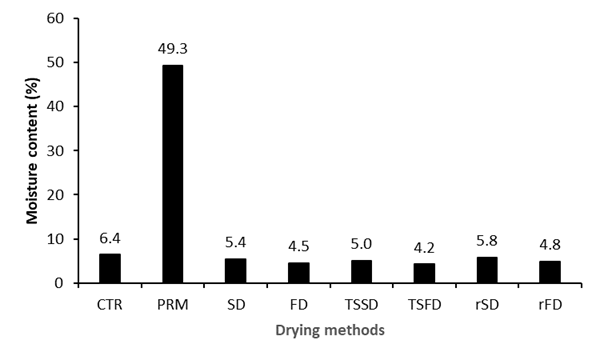
The moisture content of the seeds varied according to the drying method after priming (Figure 1). Seeds of the control had 6.4% moisture. After osmopriming, the moisture content reached 49.3%. Park et al. (2022) observed that the moisture content of lettuce seeds progressively increased from 9% to 45% after physiological priming, positioning them at the end of Phase II of the germination process, a stage characterized by the stabilization of water absorption and metabolic activation preparatory for root protrusion.
Moisture content (%) of biofortified lettuce seeds before osmopriming, after osmopriming and after drying. 1= control (seeds without priming - CTR); 2= seeds primed without drying (PRM); 3= slow drying (SD); 4= fast drying (FD); 5= thermal shock + slow drying (TSSD); 6= thermal shock + fast drying (TSFD); 7= reduction of moisture content + slow drying (rSD); and 8= reduction of moisture content + fast drying (rFD).
After drying, the moisture content of the seeds varied between 4.2% and 5.8%. The difference between the lowest and highest moisture content was 1.6%, ensuring reliability in the results of the evaluations of their physiological potential, as differences of up to 2% in moisture content are tolerated (Marcos-Filho, 2015).
Seeds subjected to slow drying had the moisture contents varying between 5.0 and 5.8%, while for the fast drying, the moisture content varied between 4.2% and 4.8%. Water, between 4% and 8%, is called Type I, being strongly associated with macromolecules, considered a structural constituent and does not have solvent properties, that is, it is considered constitution water (Marcos-Filho, 2015). This constitution water is more difficult to remove, as it is bound to the seed compounds through the Van der Waals forces (Fazeli-Nasab et al., 2022).
For the first germination count, there was a significant interaction between the factors: drying methods x germination temperatures, drying methods x storage, and germination temperatures x storage. It is possible to verify at 20 °C that there was lower vigor of the seeds subjected to fast drying (FD) and reduction of moisture content + fast drying (rFD) (Table 1). The response to dehydration in orthodox seeds is influenced by the drying rate as well as the desiccation tolerance of the vegetative tissues. Higher tolerance to desiccation is observed in seeds subjected to slow drying, presumably due to the time available for the induction and functioning of the protection mechanisms. Fast drying requires more time for repairs during rehydration (Gonçalves et al., 2015).
At 35 °C, the highest percentage of normal seedlings (32%) in the first count test was obtained in the treatment with seeds that were primed without drying (PRM). According to Park et al. (2022), lettuce seeds with hydration levels of 40% to 55% had significantly higher germination at high temperatures. Melo et al. (2021) also pointed out that in priming without drying, there is sufficient hydration control to allow the metabolic processes essential for germination. However, this procedure is difficult to adopt since the moisture content of the seeds needs to return to satisfactory levels for them to be stored later. The other drying methods were equal and statistically inferior.
In the comparison between temperatures of 20 °C and 35 °C in the first germination count test, reductions in vigor and percentage of normal seedlings were observed in all drying methods (Table 1). In the interaction between the drying methods and the storage, different responses were verified for the first germination count. At zero days of storage, the treatments control, priming without drying (PRM), slow drying (SD) and reduction of moisture content + slow drying (rSD) showed a higher percentage of normal seedlings. At 30 and 60 days of storage, seeds that were primed without drying (PRM) had higher vigor, evidenced by the first count of normal seedlings. In the other drying treatments, the physiological quality of the seeds was lower at these same storage times.
Table 2 shows a triple interaction between the factors for the germination variable (Table 2). At 20 °C, there was no difference between the treatments at the zero-storage time. However, at 30 days of storage, there was a lower percentage of normal seedlings in the fast drying (FD) treatment. There were higher percentages of germination at 60 days of storage in the treatments with priming without drying (PRM) and reduction of moisture content + slow drying (rSD). Melo et al. (2021) also found that the methods priming without drying (PRM) and reduction of moisture content + slow drying (rSD) showed higher germination percentages and germination speed in Urochloa ruziziensis seeds. This reinforces that the PRM and rSD methods maintained sufficient hydration control for the essential metabolic processes of germination.
Seeds primed and subjected to slow drying also stood out in terms of germination, as the benefits obtained with priming were maintained throughout storage (Table 2). Reis et al. (2013) found that eggplant seeds primed and those subjected to slow drying after priming showed the highest germination percentages, 96% and 97%, respectively. Priming promoted increments in the percentage of normal seedlings, indicating repair of seed damage.
Regardless of the storage period (zero, 30 and 60 days) at 35°C, seeds that were primed without drying (PRM) maintained the priming effects, resulting in a higher percentage of normal seedlings. Possibly, this occurred because the seeds absorbed water and were metabolically active, allowing the preparatory processes for germination to be initiated (Marcos-Filho, 2015) and allowing them to have thermoinhibition tolerance.
The effects of priming on primed seeds (PRM) and seeds subjected to reduction of moisture content + slow drying (rSD) were maintained throughout storage at 35 °C (Table 2). Seeds subjected to fast drying (FD), thermal shock + fast drying (TSFD) and reduction of moisture content + fast drying (rFD) after priming had the lowest germination percentages at 30 and 60 days of storage at 35 °C. Considering each treatment separately, at temperatures of 20 °C and 35 °C there was a decrease in the percentage of normal seedlings at all storage times. The beneficial effects acquired with priming can be reversed, depending on the drying method used (Melo et al. 2021), and are not viable even after seed storage. Seeds subjected to priming generally have lower tolerance to storage, since this treatment induces metabolic changes and makes them more susceptible to deterioration (Farooq et al., 2019).
There was a lower initial seedling emergence (43%) in the control at 20 °C (Table 3). At a temperature of 35 °C, it can be seen that the highest seedling emergence was obtained in the treatment with seeds that were primed without drying (PRM). There was a decrease in the initial emergence in comparison of temperatures (20 °C and 35 °C).
At seven days after sowing, the final emergence percentage was counted. At 20 °C, all treatments were statistically equal. This result indicates that, compared to the control, although there were no significant increases in seedling emergence after the treatments, the drying methods did not affect the final stand evaluated. However, at a temperature of 35 °C, seeds that were only primed (PRM) had a higher percentage of final seedling emergence (62%), against only 5% of emergence in the control. Climatic conditions influence the emergence of lettuce seedlings, since temperatures above 33 °C affect the speed of reorganization of cell membranes, altering seed metabolism and thus reducing seedling emergence (Park et al., 2022; Cavasin et al., 2023).
In the second trial, in the first germination count test, lettuce seeds had a lower physiological quality when subjected to the reduction of moisture content associated with slow drying for 48 hours, at a temperature of 20 °C (Table 4). For germination at 20 °C, a lower percentage of normal seedlings can also be observed with the reduction of moisture content + slow drying for 48 hours, differing from the additional treatments, dried seeds and primed seeds. Slow drying keeps orthodox seeds exposed to intermediate levels of moisture content for longer and therefore tends to trigger several reactions that can cause loss of viability (Dambros et al., 2024). Thus, an efficient drying process is one that, in addition to reducing moisture content, increases post-harvest conservation potential and preserves physical characteristics and technological properties of the seeds (Coelho et al., 2015).
Fast drying for 48 hours led to the highest germination speed index, hence the highest physiological quality of these seeds (Table 4). Possibly, this occurred because the seeds, when stressed by high temperatures, need to germinate faster. However, fast drying can be economically advantageous as it may result in a greater reduction in the number of recoverable cells compared to slow drying (O’Callaghan, 2016).
In the fast drying with 48 hours, there was lower initial and final seedling emergence, differing from the treatments dried seeds and primed seeds (Table 5). Greater emergence was observed in the rSD and rFD methods with 12 hours of drying. This result indicates that the drying methods did not impair the initial and final stand, even compared to the additional treatments, except for fast drying. Careful choice of the drying method to reduce the moisture content of the seeds after osmotic priming is of utmost importance to maintain the benefits achieved during priming (Silva et al. 2020). The results of drying, besides depending on the procedure adopted, also depend on the species and initial physiological potential of the seed lots. Armondes et al. (2016) observed that slow drying reduced the beneficial effects of priming on cabbage seeds.
Regarding the dry mass of seedlings, it was observed that the slow drying for 48 hours differed from the other drying times and methods, as well as from the additional treatment with primed seeds (Table 6). Wei et al. (2024) found that seed priming resulted in seedlings with larger leaf area and higher root and shoot dry mass, especially under heat stress conditions. When germination was carried out at 35 °C to test the tolerance to thermoinhibition, there was greater germination under reduction of moisture content + slow drying (rSD) for 12 hours, differing from the dried seeds (Table 7).
The rSD method did not differ from the reduction of moisture content + fast drying (rFD) for 12 hours, maintaining the priming effects. Germination speed index was higher in these drying methods (rSD and rFD), showing higher seed vigor. According to Catão et al. (2023b) and Queiroz et al. (2023), seeds need to have a higher germination speed to overcome thermoinhibition and to be able to develop and establish themselves. Seeds that were primed without drying (PRM) maintained the priming effects, obtaining high germination at 35 °C. As previously mentioned, Marcos-Filho (2015) stated that this result may be related to the fact that the seeds, after absorbing water, remain metabolically active, sustaining the preparatory processes for germination and, consequently, showing tolerance to thermoinhibition.
At a temperature of 35 °C, it is possible to verify lower initial and final seedling emergence with 48 hours of drying in the fast drying (FD) treatment, also differing from the additional treatments (Table 8).
In the evaluation of initial emergence, it was found that, after 12 hours of drying, the treatments with reduction of moisture content (rSD and rFD) had higher emergence percentages compared to slow drying (SD) and fast drying (FD). In addition, even with the extension of the drying time up to 48 hours, there was no reduction in seedling emergence at 35 °C in the treatments with reduction of moisture content (rSD and rFD).
In the comparison of the additional treatments, dried seeds and primed seeds, the final emergence percentage was 8% and 83%, respectively, at 35 °C. Priming promotes controlled hydration of the seeds, allowing the advance of the initial stages of germination and seedling emergence. This process contributes to attenuating thermoinhibition by artificially raising the maximum temperature at which germination can occur (Wei et al., 2024). However, this process is not only time-consuming and labor-intensive but also presents problems such as reduction in seed lifespan and damage to root tissues. Therefore, developing lettuce varieties that can germinate at high temperatures without the need for priming is the main current trend (Catão et al., 2023a; Wei et al., 2024).
There was greater allocation of reserves in the seedlings when seeds were subjected to slow drying (SD) for 36 and 48 hours, differing from the additional treatment of dried seeds (Table 9). The dry mass of seedlings with fast drying (FD) and reduction of moisture content + fast drying (rFD) for 24 hours also differed from the values obtained with dried seeds and primed seeds, respectively.
Primed seeds resulted in seedlings with greater dry mass accumulation, due to the metabolic processes that occur during priming, inducing a prolonged capacity for protein synthesis, which provides a more favorable metabolic balance, generating increases not only in germination, but also in seedling growth and biomass accumulation (Kissmann et al., 2013). However, even seeds primed under high temperatures can show denaturation of the enzyme endo-β-mannanase, which is related to the digestion of lettuce seed reserves (Cavasin et al., 2023). The restriction imposed by the endosperm and plant growth regulators also determines the germination of lettuce seeds under high temperature conditions (Park et al., 2022).
Thus, physiological priming promoted increments in the quality of biofortified lettuce seeds. It is also important to emphasize that the selection of effective drying methods and times is essential for maintaining tolerance to thermoinhibition.
CONCLUSIONS
Drying should preferably be carried out slowly, regardless of the previous reduction of moisture content, in order to preserve the tolerance to thermoinhibition after storage of primed lettuce seeds. The thermoinhibition tolerance of lettuce seeds is maintained after reduction of moisture content + slow and fast drying for 12 hours. Fast drying can be used as long as it does not exceed 24 hours.
ACKNOWLEDGEMENTS
The authors thank the Minas Gerais State Research Support Foundation (FAPEMIG) for financial support (project APQ-03076-21) and for granting a scholarship to the first author.
REFERENCES
-
ARMONDES, K.A.; DIAS, D.C.; MARTÍNEZ, P.A.; SILVA, L.J.; HILST, P.C. Condicionamento osmótico e desempenho de sementes de repolho com diferentes níveis de vigor. Horticultura Brasileira, v.34, n.3, p.428-434, 2016. https://doi.org/10.1590/S0102-05362016003020
» https://doi.org/https://doi.org/10.1590/S0102-05362016003020 -
BATISTA, T.B.; FERNANDEZ, G.J.; SILVA, T.A.; MAIA, J.; SILVA, E.A.A. Transcriptome analysis in osmo-primed tomato seeds with enhanced longevity by heat shock treatment. AoB PLANTS, v.12, n.5, plaa041, 2020. https://doi.org/10.1093/aobpla/plaa041
» https://doi.org/https://doi.org/10.1093/aobpla/plaa041 -
BRASIL. Ministério da Agricultura, Pecuária e Abastecimento. Registro Nacional de Cultivares RNC 2025a. Available at: http://sistemas.agricultura.gov.br/snpc/cultivarweb/cultivares_registradas.php
» http://sistemas.agricultura.gov.br/snpc/cultivarweb/cultivares_registradas.php -
BRASIL. Ministério da Agricultura, Pecuária e Abastecimento. Regras para análise de sementes Brasília: MAPA, 2025b. https://wikisda.agricultura.gov.br/pt-br/Laborat%C3%B3rios/Metodologia/Sementes/RAS_2025/Amostragem
» https://wikisda.agricultura.gov.br/pt-br/Laborat%C3%B3rios/Metodologia/Sementes/RAS_2025/Amostragem -
CATÃO, H.C.R.M.; CARDOSO, D.B.O.; MACIEL, G.M.; GOMES, L.A.A.; SIQUIEROLI, A.C.S.; NEVES, F.O.B.C. Artificial neural networks discriminate lettuce seeds with different levels of thermoinhibition. Journal of Seed Science, v.45, e202345016, 2023a. https://doi.org/10.1590/2317-1545v45255086.
» https://doi.org/https://doi.org/10.1590/2317-1545v45255086 -
CATÃO, H.C.R.M.; MACIEL, G.M.; GOMES, L.A.A.; SIQUIEROLI, A.C.S.; LUZ, J.M.Q.; CABRAL-NETO, L.D. Genetic dissimilarity for thermoinhibition in seeds of lettuce lines after defoliation. Acta Scientiarum. Agronomy, v.45, e56518, 2023b. https://doi.org/10.4025/actasciagron.v45i1.56518.
» https://doi.org/https://doi.org/10.4025/actasciagron.v45i1.56518 -
CATÃO, H.C.R.; GOMES, L.A.A.; AZEVEDO, A.M.; SIQUIEROLI, A.C.S.; MACIEL, G.M.; FREITAS, P.G. Early flowering, genetic dissimilarity and clustering of lettuce cultivars with thermoinhibition tolerant seeds. Horticultura Brasileira , v.40, n.1, p.39-47, 2022. https://doi.org/10.1590/s0102-0536-20220105
» https://doi.org/https://doi.org/10.1590/s0102-0536-20220105 -
CATÃO, H.C.R.M.; GOMES, L.A.A.; GUIMARÃES, R.M.; FONSECA, P.H.F.; CAIXETA, F.; GALVÃO, A.G. Physiological and biochemical changes in lettuce seeds during storage at different temperatures. Horticultura Brasileira , v.36, n.1, p.118-125, 2018. https://doi.org/10.1590/S0102-053620180120
» https://doi.org/https://doi.org/10.1590/S0102-053620180120 -
CATÃO, H.C.R.M.; GOMES, L.A.A.; GUIMARÃES, R.M.; FONSECA, P.H.F.; CAIXETA, F.; MARODIN, J.C. Physiological and isozyme alterations in lettuce seeds under different conditions and storage periods. Journal of Seed Science , v.38, n.4, p.305-313, 2016. https://doi.org/10.1590/2317-1545v38n4163863
» https://doi.org/https://doi.org/10.1590/2317-1545v38n4163863 -
CATÃO, H.C.R.M.; GOMES, L.A.A.; SANTOS, H.O.; GUIMARÃES, R.M.; FONSECA, P.H.F.; CAIXETA, F. Aspectos fisiológicos e bioquímicos da germinação de sementes de alface em diferentes temperaturas. Pesquisa Agropecuária Brasileira, v.49, n.4, p.316-322, 2014. https://doi.org/10.1590/S0100-204X2014000400010
» https://doi.org/https://doi.org/10.1590/S0100-204X2014000400010 -
CAVASIN, P.Y.; SANTOS, H.O.; OLIVEIRA, T.F.; PEREIRA, J.A.; GAMA, A.B.N.; PEREIRA, W.V.S. Endo-β-mannanase and superoxide dismutase as enzymatic markers for lettuce seeds thermotolerance. Journal of Seed Science , v.45, e202345008, 2023. https://doi.org/10.1590/2317-1545v45266112
» https://doi.org/https://doi.org/10.1590/2317-1545v45266112 -
COELHO, S.V.B.; FIGUEIREDO, M.A.; CLEMENTE, A.C.S.; COELHO, L.F.S.; ROSA, S.D.V.F. (2015). Alterações fisiológicas e bioquímicas em sementes de café secas em sílica gel e soluções salinas saturadas. Pesquisa Agropecuária Brasileira , v.50, n.6, p.483-491, 2015. https://doi.org/10.1590/S0100-204X2015000600007
» https://doi.org/https://doi.org/10.1590/S0100-204X2015000600007 -
DAMBROS, V.G.; LOPES, B.C.; CORRÊA, B.J.S.; SÁ, A.C.S.; SOARES, C.R.B.; FLORES, A.V.; OLIVEIRA, L. M. Tolerância à dessecação de sementes de Butia eriospatha (Mart. Ex Drude) Becc. Ciência Florestal, v.34, n.1, e67835, 2024. https://doi.org/10.5902/1980509867835
» https://doi.org/https://doi.org/10.5902/1980509867835 -
DANTAS, N.B.L.; BENEDITO, C.P.; OLIVEIRA, V.N.S.; SILVA, K.C.N.; RÊGO, A.L.B.; PEREIRA, K.T.O.; MEDEIROS, H.L.S. Condicionamento fisiológico em sementes de coentro (Coriandrum sativum L.).Brazilian Journal of Development, v.7, n.8, p.76554-76570, 2021. https://doi.org/10.34117/bjdv7n8-058
» https://doi.org/https://doi.org/10.34117/bjdv7n8-058 - FAROOQ, M.; ALAMRI, S.A.D.; REHMAN, A.; ALBUSAIDI, W.M.; WAHID, A.; ALGHAMDI, S.S.; BASRA, S.M.A.; SIDDIQUE, K.H.M. Seed priming: improving germination and seedling growth. In: Seed Enhancement: Principles and Practices, CRC Press: Boca Raton, FL, USA, 2019. p.125-142.
-
FAZELI-NASAB, B.; JAMI, R.; VAHABI, N.; REZAEI, A.; PIRI, R.; VALIZADEH, M. Desiccation tolerance in orthodox and recalcitrant seeds. In: SAHU, J.; VAISHNAV, A.; SINGH, H.B. (Eds.): Plant-microbe interactions: Harnessing next-generation molecular technologies for sustainable agriculture. CRC Press. 1st ed., 2022. p.18. https://doi.org/10.1201/9781003171416
» https://doi.org/https://doi.org/10.1201/9781003171416 -
GONÇALVES, L.H.N.; SANTOS, H.O.; VON PINHO, É.V.R.; ANDRADE, T.; VON PINHO, I.V.; PEREIRA, R. W. Physiological quality and expression of genes in seeds of Handroanthus serratifolius subjected to drying. Journal of Seed Science , v.37, n.2, p.102-110, 2015. https://doi.org/10.1590/2317-1545v37n2144303
» https://doi.org/https://doi.org/10.1590/2317-1545v37n2144303 -
JANAH, I.; ELHASNAOUI, A.; LAOUANE, R.B.; AIT-EL-MOKHTAR, M.; ANLI, M. Exploring seed priming as a strategy for enhancing abiotic stress tolerance in cereal crops.Stresses, v.5, n.2, 39, 2025. https://doi.org/10.3390/stresses5020039
» https://doi.org/https://doi.org/10.3390/stresses5020039 -
KHAIRILANWAR, K.A.; YI, S.J., BAKRI, M.D.I.; NAWI, I.H.M., AZMI; A.A.A.R.; AIK, C.K. Eco-friendly nanopriming: Zinc oxide nanoparticles derived from banana peel extract for improved germination of chili seeds. Journal of Seed Science , v.47, e202547006, 2025. https://doi.org/10.1590/2317-1545v47290750
» https://doi.org/https://doi.org/10.1590/2317-1545v47290750 -
KISSMANN, C.; SCALON, S.P.Q.; TEODÓSIO, T.K.C. Condicionamento das sementes e sombreamento na emergência e no crescimento de plantas de Bixa orellana L. Revista de Ciências Agrárias, v.36, n.1, p.48-56, 2013. https://doi.org/10.19084/rca.16284
» https://doi.org/https://doi.org/10.19084/rca.16284 - KRZYZANOWSKI, F.C.; FRANÇA-NETO, J.B.; GOMES-JUNIOR, F.G.; NAKAGAWA, J. Testes de vigor baseados em desempenho de plântulas. In: KRZYZANOWSKI, F.C.; VIEIRA, R.D.; FRANÇA-NETO, J.B.; MARCOS-FILHO, J. (Eds.) Vigor de sementes: conceitos e testes Londrina: Abrates, 2020. p.79-140.
- MACIEL, G.M.; SIQUIEROLI, A.C.S.; GALLIS, R.B.A.; PEREIRA, L.M.; SALES, V.F. Programa de computador BG a Biofort Depositante: Universidade Federal de Uberlândia. BR512019002403-6. 2019.
-
MAGUIRE, J.D. Speed of germination - aid in selection and evaluation for seedling emergence and vigor. Crop Science, v.2, n.2, p.176177, 1962. https://doi.org/10.2135/cropsci1962.0011183X000200020033x
» https://doi.org/https://doi.org/10.2135/cropsci1962.0011183X000200020033x - MARCOS-FILHO, J. Fisiologia de sementes de plantas cultivadas Londrina: Abrates , 2015. 659p.
-
MELO, G.M.; SANTOS, H.O.; OLIVEIRA, T.F.; CUNHA-NETO, A.R.; PEREIRA, A.A.S.; GUARALDO, M.M. S. Effect of priming and different types of drying on the physiological quality of Urochloa ruziziensis seeds. Journal of Seed Science , v.43, e202143021, 2021. https://doi.org/10.1590/2317-1545v43250046
» https://doi.org/https://doi.org/10.1590/2317-1545v43250046 -
MICHAEL, R.; BALI, S.; GODARA, R.; DOGRA, V. Endosperm: Thermal sensor and regulator of seed thermoinhibition. Trends in Plant Science, v.28, p.1201-1204, 2023. https://doi.org/10.1016/j.tplants.2023.06.017
» https://doi.org/https://doi.org/10.1016/j.tplants.2023.06.017 -
NASCIMENTO, W.M.; CANTLIFFE, D.J. Circumventing thermodormancy in lettuce. Acta Horticulturae, ISHS, 1999. 504p. https://doi.org/10.17660/ActaHortic.1999.504.16
» https://doi.org/https://doi.org/10.17660/ActaHortic.1999.504.16 -
O’CALLAGHAN, M. Microbial inoculation of seed for improved crop performance: issues and opportunities. Applied Microbiology and Biotechnology, v.100, p.5729-5746, 2016. https://doi.org/10.1007/s00253-016-7590-9
» https://doi.org/https://doi.org/10.1007/s00253-016-7590-9 -
PARK, J.I.; CHO, D.M.; OH, J.H.; CHO, J.S.; KANG, N.J. Improvement of germinability of lettuce seeds with drum-priming under high temperature condition.Horticulture, Environment, and Biotechnology, v.63, p.477-487, 2022. https://doi.org/10.1007/s13580-022-00423-9
» https://doi.org/https://doi.org/10.1007/s13580-022-00423-9 -
PETRONILIO, A.C.P.; BATISTA, T.B.; SILVA, E.A.A. Osmo-priming in tomato seeds down regulates genes associated with stress response and leads to reduction in longevity. Seed Science Research, v.31, n.3, p.211-216, 2021. https://doi.org/10.1017/S0960258521000179
» https://doi.org/https://doi.org/10.1017/S0960258521000179 -
QUEIROZ, D.A.; CAVASIN, P.Y.; SILVA, S.; CATÃO, H.C.R.M.; OLIVEIRA, C.L.; GOMES, L.A.A. Enviromental temperature and age of seeds in tolerance to thermoinhibition in lettuce genotypes. Revista Ceres, v.70, n.2, p.13-22, 2023. https://doi.org/10.1590/0034-737X202370020002
» https://doi.org/https://doi.org/10.1590/0034-737X202370020002 -
R CORE TEAM. R: A language and environment for statistical computing R Foundation for Statistical Computing, Vienna, Austria. 2024. https://www.R-project.org/
» https://www.R-project.org/ -
REIS, R.G.E.; GUIMARÃES, R.M.; PEREIRA, D.S.; CASTRO, M.B.; VIEIRA, A.R.; CARVALHO, M.L.M. Qualidade fisiológica de sementes de berinjela osmocondicionadas submetidas à secagem. Pesquisa Agropecuária Brasileira , v.48, n.11, p.1507-1516, 2013. https://doi.org/10.1590/S0100-204X2013001100012.
» https://doi.org/https://doi.org/10.1590/S0100-204X2013001100012 -
SILVA, B.M.C.; OLIVEIRA, D.E.C.; LIMA FARIAS, B.; COSTA, V.S.; FERREIRA, V.B.; NUNES, M.R.G.; RESENDE, O. Influência da secagem na qualidade fisiológica e coloração das sementes de feijão guandu. Research, Society and Development, v.9, n.7, e97597478, 2020. https://www.rsdjournal.org/index.php/rsd/article/view/4789
» https://www.rsdjournal.org/index.php/rsd/article/view/4789 -
WANG, Q.W.; BIN, Y.S.; ZHI, J.D.; YUE, W.; SHU, J.L.; IAN, M.M.; SONG, Q.S. Proteomic analysis of lettuce seed germination and thermoinhibition by sampling of individual seeds at germination and removal of storage proteins by polyethylene glycol fractionation. Plant Physiology, v.167, n.4, p. 1332-1350, 2015. https://pubmed.ncbi.nlm.nih.gov/25736209/
» https://pubmed.ncbi.nlm.nih.gov/25736209/ -
WEI, J.; ZHANG, Q.; ZHANG, Y.; YANG, L.; ZENG, Z.; ZHOU, Y.; CHEN, B. Advance in the thermoinhibition of lettuce (Lactuca sativaL.) seed germination.Plants, v.13, n.15, p.2051, 2024. https://doi.org/10.3390/plants13152051
» https://doi.org/https://doi.org/10.3390/plants13152051 -
YOONG, F.Y.; O’BRIEN, L.K.; TRUCO, M.J.; HUO, H.; SIDEMAN, R.; HAYES, R.; MICHELMORE, R.W.; BRADFORD, K.J. Genetic variation for thermotolerance in lettuce seed germination is associated with temperature-sensitive regulation of ethylene response factor (ERF1). Plant Physiology , v.170, n.1, p.472-488, 2016. https://doi.org/10.1104/pp.15.01251
» https://doi.org/https://doi.org/10.1104/pp.15.01251
Additional data will be made available by the authors upon reasonable request.