
 LIFESTYLE AMONG BRAZILIAN UNIVERSITY STUDENTS: A CROSS-SECTIONAL ANALYSIS ACCORDING TO THE TYPE OF INSTITUTION AND AREA OF STUDY
ABSTRACT
When the lifestyle (LS) of university students is marked by negative and risky choices, these individuals may be subject to the impairment of their quality of life and academic performance. The objective of this study was to evaluate the LS of Brazilian university students according to the type of institution and course area. Cross-sectional study, carried out in 2021 with university students from the five Brazilian regions, aged between 18 and 59 years. The Kruskal-wallis and Chi-square tests were used in the analyses, adopting a significance of 5% (p<0.05). The sample included 2.373 students (25,28 ± 7,18 years old, 68,2% women), of which 82,5% were from public higher education institutions. University students from public institutions presented a better lifestyle in the nutrition domain (0,008). University students from private institutions showed better LS in the introspection (<0,001) and work (0,013) domains. Among the course areas, the Health/Biological area presented the best score in the domains physical activity (<0,001), nutrition (0,006), cigarettes and drugs (0,008), introspection (0,003) and total score (<0,001). It is concluded that the best behaviors of university LS stand out for the low use of cigarettes, drugs and alcohol consumption, while the negative aspects are represented by low levels of physical activity and the difficulty dealing with behaviors such as hurry, anger and hostility.
Keywords:
Lifestyle; University students; Course areas
RESUMO
Quando o estilo de vida (EV) de estudantes universitários é marcado por escolhas negativas e de risco, estes indivíduos podem ficam sujeitos ao comprometimento de sua qualidade de vida e rendimento acadêmico. O objetivo deste estudo foi avaliar o EV de universitários brasileiros de acordo com o tipo de instituição e área de curso. Estudo transversal, realizado em 2021 com universitários das cinco regiões brasileiras, com idade entre 18 e 59 anos. Os testes Kruskal-wallis e Qui-quadrado foram utilizados nas análises, adotando-se a significância de 5% (p<0,05). A amostra contou com 2.373 estudantes (25,28 ± 7,18 anos, 68,2 % mulheres), dos quais 82,5% eram de instituições de ensino superior públicas. Os universitários de instituições públicas apresentaram melhor estilo de vida no domínio nutrição (0,008). Universitários de instituições privadas apresentaram melhor EV no domínio introspecção (<0,001) e trabalho (0,013). Dentre as áreas de curso, a área Saúde/Biológicas apresentou melhor escore nos domínios atividade física (<0,001), nutrição (0,006), cigarro e drogas (0,008), introspecção (0,003) e escore total (<0,001). Conclui-se que os melhores comportamentos do EV universitário destacam-se pelo baixo uso de cigarros, drogas e consumo de álcool, enquanto que os aspectos negativos são representados pelos baixos níveis de atividade física e pela dificuldade em lidar com comportamentos como pressa, raiva e hostilidade.
Palavras-chave:
Estilo de vida; Estudantes universitários; Áreas de curso
Introduction
A lifestyle (LS) characterized by a sedentary lifestyle, consumption of ultra-processed foods, smoking and high levels of stress negatively impacts the health of adults¹. Among young people aged 18 to 24, there is a high prevalence of overweight/obesity (35,7%), smoking (6,4%) and low consumption of fruits and vegetables, being the capitals of the north and northeast having the lowest rate compared to the capitals of the south and southeast¹.
It is estimated that in Brazil there are almost four million students enrolled in universities or colleges, considering public and private institutions2. This moment in life is also marked by greater demands and responsibilities regarding study, work, tasks, excessive self-demand, which can favor negative and risky choices related to lifestyle habits3. When contextualizing about negative habits, a study carried out with medical students in the northern region of Minas Gerais, Brazil, identified a high prevalence of inadequate consumption of fruits and vegetables (86,1%)((4)).
The consumption of alcoholic beverages has been a worrying factor in this population, especially among young men5. A healthier LS, mostly related to the physical and nutritional component, seems to positively influence the prevention of mental health problems in university students in the Brazilian public school system6. Moreover, the occurrence of depressive symptoms in university students is a reality, especially in the first two years of the course in men and women7. Factors linked to symptoms of depression in public university students in Brazil include: sleep duration (men and women), age >16 to <19 years (men), alcohol consumption and smoking (women)7.
Most of the studies on the LS of the Brazilian population usually investigate in isolation the indicators of physical activity, nutrition, consumption of alcoholic beverages, among other aspects, neglecting the LS “as a whole” (8),(9),(10. Furthermore, many studies focus on students from public schools4),(5),(11, disconsidering students from private schools. Finally, the studies are limited to a maximum of three regions of Brazil. Faced with this situation, it is necessary to investigate whether different parameters as the type of institution and different course areas affect the LS of university students, which can improve the compression of this scenario and thus better direct health policies and actions.
The objective of the present study is to evaluate the LS profile of Brazilian university students and compare it according to the type of institution (public and private) and course area (Health/Biological, Human, Exact and Multidisciplinary) of educational institutions higher education (HEIs) of the five regions of Brazil.
Methods
Characterization and design of the study
This is a descriptive cross-sectional study, of an applied nature, with a quantitative approach and non-probabilistic sampling, carried out in cooperation with HEIs in the five regions of Brazil, which were responsible for divulgation the study.
The study was approved by the Research Ethics Committee (CAEE 31849620.3.0000.5496) and all participants signed the Free and Informed Consent Form (FICF). Data collection ocurred between February and May 2021, a questionnaire being applied online and anonymously composed of several instruments, including the Fantastic Lifestyle questionnaire12. The research was disseminated through emails, publications on official pages of the HEIs and through social networks. Along with information about the study, there was a link to access the FICF and the study questionnaires.
Participants
The study included university students from the five regions of Brazil, aged between 18 and 59 years old, duly enrolled in an HEI in the country (public or private).
General characterization variables
University students were characterized by sex, age, height, body mass, Body Mass Index (BMI), university institution (public or private) and course area, defined as: 1) Health/Biological (health sciences and biological sciences), 2) Human (human sciences, social and applied sciences, linguistics, letters and arts), 3) Exact (Exact and earth sciences, engineering and agricultural sciences) and 4) Multidisciplinary (Biotechnology, Environmental Sciences, Material Sciences)13.
Instrument
The LS of university students was evaluated by the “Fantastic Lifestyle” questionnaire, translated and validated for the Brazilian population12, consisting of 25 questions, distributed among the domains: 1) Family and friends; 2) Physical activity; 3) Nutrition; 4) Cigarettes and drugs; 5) Alcohol; 6) Sleep, seat belts, stress and safe sex; 7) Type of behavior; 8) Introspection; 9) Work.
Of the 25 questions in the questionnaire, 23 have five answer options, with a score from zero (0) to four (4), and two dichotomous questions (0 and 4 for the first and second option). The higher the value assigned to each answer, the better the LS. With the sum of all points, the total LS score is calculated, as: Needs improvement (0 to 34 points), Regular (35 to 54 points), Good (55 to 69 points), Very good (70 to 84 points) and Excellent (85 to 100 points) (12.
Statistical analysis
Continuous variables were expressed as mean and standard deviation, median, interquartile range (25-75) and absolute and relative frequencies for categorical variables. Data normality was assessed using the Kolmogorov-Smirnov test. The Mann-Whitney and Kruskal-wallis U test, with post-hoc Dwass-Steel-Critchlow-Fligner pairwise comparisons were used to compare the LS domains between public and private institutions and between course areas. The Chi-Square test was used to analyze the association between institutions, course area and the LS score classification. Data analysis was performed using Jamovi software (version 2.3.2), adopting a significance of 5% (p<0,05).
Results
The sample included 2.373 university students (25,28 ± 7,18 years old, 68,2% women), of which 82,5% were from public HEIs. In relation to course areas, the highest percentage of students was concentrated in the Health/Biological area (42,4%) (Table 1).
The comparison between university students from public and private institutions was madeout based on the score of the nine domains and the total fantastic lifestyle score (Table 2). When comparing institutions, we found statistically significant differences for the domains of nutrition, introspection and work (p<0,05). In the total score, there was no difference between university students from public and private institutions and, in general, based on this score, the LS of university students was classified as “good” (55 to 69 points).
Table 3 presents the comparison of the nine LS domains between the course areas. In the family and friends domain, significant differences were found, with emphasis on the Exact area, which presented a lower score compared to the Multidisciplinary and Human areas (p=0,024). In physical activity, the Health/Biological area presented better scores than the Human and Exact areas (p<0,001). In the cigarette and drugs domain, the Human area had lower scores compared to the Health/Biological area (p=0,006). In the introspection domain, the Human and Exact areas presented lower scores compared to the Health/Biological areas (p=0,003), as well as for the total score (p<0,001). In the total score, despite the statistical difference in the Human and Exact areas compared to Health/Biologicals, the LS in all course areas obtained a “good” rating (55 to 69 points).
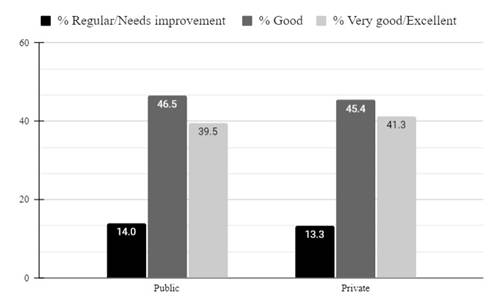
When comparing the classification of the total LS score between public and private institutions, no significant differences were identified (p=0,354). The largest proportion of university students classify their LS as “good”, followed by “very good/excellent”, regardless of the type of institution (Figure 1).
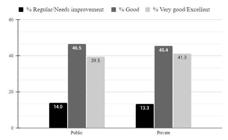
Classification of the total score according to the type of institution (public and private).
Figure 2 shows the LS score of university students according to the course areas, where we observed significant differences (p=0,009). Considering the classification of the total score, the areas of Exact, Multidisciplinary and Health/Biological respectively present the lowest percentage values in the classification “Very good/Excellent”, “good” and “Needs Improvement/Regular”.

Discussion
The main results observed that public institutions have a better lifestyle in the field of nutrition. On the other hand, private institutions present a better lifestyle in the introspection and work domain. Additionally, when comparing the areas of the courses, the Health/Biological area presents a better score in the areas of physical activity, nutrition, cigarettes and drugs, introspection and total score, when compared to the Human and Exact areas.
In the family and friends domain, there were no significant differences between the type of institution (public or private). Regarding course areas, there was a significant and positive difference for university students in the Multidisciplinary area. University life can certainly be made easier when students have the support of family and friends (14.
Regarding the domain of physical activity, there was no difference between university students from public or private institutions. Already among the course areas, differences were observed between the Health/Biological areas, compared to the Human and Exact areas. The physical activity domain presented the lowest score among the domains evaluated, indicating that university students had low levels of physical activity, independently of the type of institution and course area. This result can be explained, in part, by the period of social isolation experienced by students in the face of the COVID-19 pandemic. Although, studies with Brazilian and Portuguese university students previous to the pandemic period demonstrate reduced levels of physical activity ≥ 40%, indicating that many university students already had low levels of physical activity prior to the pandemic (15)-(16. Reduced levels of physical activity may be associated to the insertion of university students into the job market and academic internships, which may make physical activity more difficult. It has become common for professionals and/or students not to include physical activities in their daily lives, which can cause numerous health injuries (17.
In the nutrition domain, students from public universities and Health/Biological areas had higher scores, indicating positive nutritional behavior. It is highlighted that, in general, the nutritional behavior of university students from private institutions and other course areas can be considered “good”. Unlike our findings, another study observed the presence of inadequate eating habits in university students in Bahia, especially due to the increase in the consumption of fast foods and ultra-processed9.
In the cigarette and drugs domain, there was no difference between educational institutions. A difference was observed in university students in the Health/Biological area, indicating less use than students in other course areas. However, independently of the type of institution and course area, this domain presented the second best score, suggesting low adherence to the use of these substances by university students. Corroborating the findings of our study, a high percentage (91,8%) of university students in Piauí had low tobacco use, especially among students in the health area (18, following the historical trend of decline in the percentage of smokers in Brazil for both the genders (19. However, Pereira et al.20 identified greater use of tobacco and drugs among Minas Gerais students from different areas in the final years of their undergraduate studies.
The alcohol consumption domain presented the highest score, indicating low consumption, regardless of the type of educational institution and course area, with no differences between the categories. This result is relevant, as many behaviors related to excessive alcohol consumption can be harmful to health. A study with university students from a public institution observed that more than 20% of university students tend to drive after drinking alcohol and 16.8% have practiced binge-drinking (high alcohol consumption in a short period of time)3. In many cases, entering university life is associated with high alcohol intake in both sexes, which can lead to physical, social, legal and economic consequences (21.
In the domain related to sleep, wearing a seat belt, managing daily stress and practicing safe sex, university students showed “good” behavior, with no difference between educational institutions and areas studied. Results similar to our study were observed in university students from São Paulo studying Physiotherapy22, while university students studying Medicine in the same study and university students from Santa Catarina in the health sector showed more positive results23. The studies cited above highlight that university students with high academic performance care about health prevention, worrying about practicing safe sex and using seat belts.
The types of behavior domain presents the second lowest score, suggesting that a portion of university students have difficulty dealing with aspects related to hurry, anger and hostility, factors that can compromise the quality of life of these students. Moreover, there was no significant difference between institutions and course areas. It was observed in a study with university students from Paraná that more than 50% were in a hurry while 21% reported feeling angry and hostile (24. Medical students reported being in a hurry, feeling anger and hostility relatively frequently or almost always22),(25. The existence of these feelings may be related to the anxiety and anguish generated as a result of constant demands for high academic performance (23.
Regarding the introspection domain, significant and positive differences were observed among students from private institutions and from the Health/Biological areas. Based on the score, we believe that a portion of university students may have difficulty dealing with mental health issues (positive and optimistic thoughts, tension, disappointment, sadness, depression). Studies with university students from Brasília and Paraná corroborate our findings, as a portion of these university students presented a profile that disadvantages mental health26)-(27. These authors highlight that, in some cases, the academic development process has not been favoring to improving students' lifestyles. It is important to highlight that multifactorial aspects may be present in this context, where economic, social, academic, housing and other issues can impact the lives of students.
About the work/function domain, students from private institutions and university students in the Health/Biological areas showed greater satisfaction with their work/function. Although, this difference was not significant (P >0,05). In general, the university students in our study had a good relationship with their work/function. Other studies highlight that university students from different areas have a relationship with work that varies between good, very good and excellent16),(24, and those who need to move away from their area of training may experience less satisfaction with the profession exercised28, which can negatively impact quality of life.
When analyzing the total score, we found no significant differences between educational institutions. Among the course areas, the significant and positive difference included the Health/Biological area. It is important to highlight that independently of the type of institution and course area, university students had their lifestyle classified as “good” (55 to 69 points), corroborating the findings already presented in the literature (29.
Although the university students in our study had a good lifestyle based on the general score, 16,8% and 14,7% of the Exact and Human students, respectively, had a regular lifestyle that needed improvement. In another study, the percentage of university students who have an unhealthy lifestyle exceeds 20% (30. The Multidisciplinary area (45,6%) and Health/Biological (43,6%) presented the highest values for the very good/excellent classification. Another study identified that 40,9% of healthcare university students in Paraná have a lifestyle classified as very good/excellent (24. Normally, it is expected that university students in the health field show healthier behaviors, as they theoretically have more access to specific health knowledge.
The findings of this study stand out due to the low levels of physical activity and the difficulty in dealing with rush, anger and hostility among some of the university students in the study. This result is worrying, as it impacts physical and psychological aspects, and may favor the emergence of other negative and health-risk behaviors.
On the other hand, the use of cigarettes, drugs and alcohol consumption is reduced, directing to a healthier lifestyle. In that regard, it is important to maintain preventive efforts to avoid/minimize the consumption of these substances and their negative consequences for health, in addition to problems in the academic trajectory.
Given the limited number of studies that have been proposed to investigate the university lifestyle from a national perspective, we highlight this as one of the strong points of this study, as our investigation includes university students from public and private institutions in the five regions of the country. Another strong point refers to the duly validated instrument for analyzing the lifestyle of Brazilian adults. These characteristics provide a general idea of the Brazilian scenario regarding the university lifestyle. The results of this study favor the planning of programs and actions aimed at promoting health, whether by universities themselves or public policies, minimizing risk behaviors and enhancing positive aspects of the quality of life of this important portion of the Brazilian population.
On the other hand, the questionnaire was self-completed and retrospectively, allowing some results to be influenced by subjectivity and memory bias, which are limitations of our study. The data was collected during social isolation caused by the COVID-19 pandemic, whichever needs to be considered in the interpretation.
Conclusions
Brazilian university students from public and private HEIs and from the Health/Biological, Human, Exact and Multidisciplinary areas have a LS classified as good. The best behaviors of university LS are highlighted by the low use of cigarettes, drugs and alcohol consumption, while the negative aspects are represented by low levels of physical activity and the difficulty in dealing with behaviors such as hurry, anger and hostility. Finally, we suggest that studies be conducted that make it possible to analyze the effect of health interventions that aim to minimize behaviors that pose a risk to LS in Brazilian university students.
References
-
1 Ministério da Saúde (BR), Secretaria de Vigilância em Saúde, Departamento de Análise em Saúde e Vigilância de Doenças não Transmissíveis. Vigilância de fatores de risco e proteção para doenças crônicas por inquérito telefônico: estimativas sobre frequência e distribuição sociodemográfica de fatores de risco e proteção para doenças crônicas nas capitais dos 26 estados brasileiros e no Distrito Federal em 2021. Brasília: Ministério da Saúde; 2021[cited2023 apr. 23]. Available from: Available from: https://www.gov.br/saude/pt-br/centrais-de-conteudo/publicacoes/svsa/vigitel/vigitel-brasil-2021-estimativas-sobre-frequencia-e-distribuicao-sociodemografica-de-fatores-de-risco-e-protecao-para-doencas-cronicas/view
» https://www.gov.br/saude/pt-br/centrais-de-conteudo/publicacoes/svsa/vigitel/vigitel-brasil-2021-estimativas-sobre-frequencia-e-distribuicao-sociodemografica-de-fatores-de-risco-e-protecao-para-doencas-cronicas/view -
2 Instituto Nacional de Estudos e Pesquisas Educacionais Anísio Teixeira (BR). Censo da Educação Superior 2021: notas estatísticas. Brasília, DF: Inep; 2022 [cited2023 apr. 29]. Available from: https://download.inep.gov.br/publicacoes/institucionais/estatisticas_e_indicadores/notas_estatisticas_censo_da_educacao_superior_2021.pdf
» https://download.inep.gov.br/publicacoes/institucionais/estatisticas_e_indicadores/notas_estatisticas_censo_da_educacao_superior_2021.pdf -
3 Bomfim RA, Mafra MA, Gharib IM, De-Carli AD, Zafalon EJ. Fatores associados ao estilo de vida fantástico de universitários brasileiros-uma análise multinível. Rev CEFAC. 2017Set;19(5):601-610. DOI: 10.1590/1982-0216201719518716.
» https://doi.org/10.1590/1982-0216201719518716 -
4 Barbosa-Medeiros MR, de Pinho L, Rosa Rossi-Barbosa LA, Caldeira AP. Dietary risk behaviors for chronic non-communicable diseases in Brazilian medical students. Psychol Heal Medicine. 2022Sep;27(8):1693-1703. DOI:10.1080/13548506.2021.1916958.
» https://doi.org/10.1080/13548506.2021.1916958 -
5 Niedermeier M, Frühauf A, Kopp-Wilfling P, Rumpold G, Kopp M. Alcohol consumption and physical activity in Austrian college students - A cross-sectional study. Subst Use Misuse. 2018 Aug;53(10):1581-1590. DOI:10.1080/10826084.2017.1416406.
» https://doi.org/10.1080/10826084.2017.1416406 -
6 Martins BG, da Silva WR, Marôco J, Campos JA. Eating behavior of Brazilian college students: influences of lifestyle, negative affectivity, and personal characteristics. Percept Mot Skills. 2021Apr;128(2):781-799. DOI:10.1177/0031512520983082.
» https://doi.org/10.1177/0031512520983082 -
7 Fonseca LB, Pereira LP, Rodrigues PR, Muraro AP, Andrade AC, Pereira RA, et al. Incidence of depressive symptoms and its association with sociodemographic factors and lifestyle-related behaviors among Brazilian university students. Psychol Heal Medicine. 2022Jul;27(6):1311-1325. DOI:10.1080/13548506.2021.1874432.
» https://doi.org/10.1080/13548506.2021.1874432 -
8 Rosa MJ, de Almeida Brunheroti K, da Silva TP, Assumpção CO, Silva JJ, Barbosa LF. Nível de atividade física, qualidade de vida e fatores associados de estudantes universitários de Educação Física. RBPFEX. 2019May;13(81):86-91. [cited2023 may. 20]. Available from: Available from: https://repositorio.ufc.br/bitstream/riufc/62107/1/2019_art_mjrosa.pdf
» https://repositorio.ufc.br/bitstream/riufc/62107/1/2019_art_mjrosa.pdf -
9 Lima ER, Matos TB, dos Anjos LD, dos Santos CS, Brazil JM, da Mota Santana J, et al. Mudanças alimentares de universitários brasileiros durante a pandemia da COVID-19. RSD. 2022May;11(7):e10411729733-. DOI:10.33448/rsd-v11i7.29733.
» https://doi.org/10.33448/rsd-v11i7.29733 -
10 Mendonça AK, de Jesus CV, Lima SO. Fatores Associados ao Consumo Alcoólico de Risco entre Universitários da Área da Saúde Factors associated with high-risk alcohol consumption among health science undergraduate students. Rev bras educ médica. 2018Jan-Mar;42(1):202-213. DOI:10.1590/1981-52712018v42n1RB20170096.
» https://doi.org/10.1590/1981-52712018v42n1RB20170096 -
11 Sousa TF, Carvalho FO, Silva ED, Mussi FC, Fonseca SC, Silva DC, et al. What are the characteristics that influence the sitting time in university students? Rev bras cineantropom desem humano. 2022Mar;24: e84369. DOI:10.1590/1980-0037.2022v24e84369.
» https://doi.org/10.1590/1980-0037.2022v24e84369 -
12 Rodriguez Añez CR, Reis RS, Petroski EL. Versão brasileira do questionário “Estilo de Vida Fantástico”: tradução e validação para adultos jovens. Arq Bras Cardiol. 2008Ago;91(2):102-109. DOI:10.1590/S0066-782X2008001400006.
» https://doi.org/10.1590/S0066-782X2008001400006 -
13 CAPES, Ministério da Educação (BR). Tabela de Áreas de Conhecimento Avaliação [Internet]. 2022 [cited 2023 may. 26]. Available from: Available from: https://www.gov.br/capes/pt-br/acesso-a-informacao/acoes-e-programas/avaliacao/instrumentos/documentos-de-apoila-de-areas-de-conho-1/tabeecimento-avaliacao
» https://www.gov.br/capes/pt-br/acesso-a-informacao/acoes-e-programas/avaliacao/instrumentos/documentos-de-apoila-de-areas-de-conho-1/tabeecimento-avaliacao -
14 Teixeira MA, Castro GD, da Rosa Piccolo L. Adaptação à universidade em estudantes universitários: um estudo correlacional. Inter. Psicol. 2007Jul-ez;11(2): 211-220. DOI:10.5380/psi.v11i2.7466.
» https://doi.org/10.5380/psi.v11i2.7466 -
15 Peleias M, Tempski P, Paro HB, Perotta B, Mayer FB, Enns SC, et al. Leisure time physical activity and quality of life in medical students: results from a multicentre study. BMJ Open Sport Exerc Med. 2017Jun;3:e000213. DOI:10.1136/bmjsem-2016-000213.
» https://doi.org/10.1136/bmjsem-2016-000213 -
16 Fonseca RS, Escola J, Carvalho A, Loureiro A. Perfil de estilo de vida dos universitários: estudo comparativo entre uma universidade portuguesa e brasileira. JOIN2017. 2018:255. DOI:10.17346/se.vol22.254
» https://doi.org/10.17346/se.vol22.254 -
17 Costa HT, Lopes DT, Rabay AA, dos Santos RM, de Moura SK. Avaliação do nível de atividade física de estudantes de graduação da área de saúde. Diálogos em Saúde. 2019Mar 11;1(1). [cited2023 ago 10] Available from: https://periodicos.iesp.edu.br/dialogosemsaude/article/view/202
» https://periodicos.iesp.edu.br/dialogosemsaude/article/view/202 -
18 Guimarães MR, Batista AM, Santos IM, Vale MD, Moura IH, Silva AR. Estilo de vida e fatores associados entre estudantes universitários. Rev. enferm. UFPE on line. 2017:3228-35. DOI:10.5205/reuol.11135-99435-1-ED.1108sup201706
» https://doi.org/10.5205/reuol.11135-99435-1-ED.1108sup201706 -
19 Instituto Nacional de Câncer - INCA. Prevalência do tabagismo [Internet]. 2023 [cited2023 ago 12] Available from: Available from: https://www.gov.br/inca/pt-br/assuntos/gestor-e-profissional-de-saude/observatorio-da-politica-nacional-de-controle-do-tabaco/dados-e-numeros-do-tabagismo/prevalencia-do-tabagismo
» https://www.gov.br/inca/pt-br/assuntos/gestor-e-profissional-de-saude/observatorio-da-politica-nacional-de-controle-do-tabaco/dados-e-numeros-do-tabagismo/prevalencia-do-tabagismo -
20 Pereira AR, de Deus Pontual AA, Santos JL, Corradi-Webster CM. Uso de drogas entre universitários de uma universidade federal de Minas Gerais. Rev Valore. 2020;5:5023. DOI: https://doi.org/10.22408/reva502020434e-5023
» https://doi.org/10.22408/reva502020434e-5023 -
21 Rebouças EC, Pereira TN, Lisbôa DK, da Silva Almeida Filho RL. O binge drinking por universitários: perfil do estudante e fatores de risco e proteção. Revista Família, Ciclos de Vida e Saúde no Contexto Social. 2021Aug 9;9(4). DOI: https://doi.org/10.18554/refacs.v9i4.5002
» https://doi.org/10.18554/refacs.v9i4.5002 -
22 Tassini CC, Val GR, Candido SD, Bachur CK. Avaliação do estilo de vida em discentes universitários da área da saúde através do Questionário Fantástico. Int Jour Cardio Sciences. 2017Mar;30:117-22. DOI:10.5935/2359-4802.20170024
» https://doi.org/10.5935/2359-4802.20170024 -
23 Malafaia QS, Devalieri C, Schmitt MV, de Sousa CA. Relação entre estilo de vida e desempenho acadêmico. Rev Bras Promoç Saúde. 2019Dec 31;32:9719. DOI: https://doi.org/10.5020/18061230.2019.9719
» https://doi.org/10.5020/18061230.2019.9719 -
24 Bührer BE, Tomiyoshi AC, Furtado MD, Nishida FS. Análise da Qualidade e Estilo de Vida entre Acadêmicos de Medicina de uma Instituição do Norte do Paraná. Rev Bras Edu Médica. 2019Jan;43(1):39-46. DOI: https://doi.org/10.1590/1981-52712015v43n1RB20170143
» https://doi.org/10.1590/1981-52712015v43n1RB20170143 -
25 dos Reis Rabelo L, Bueno CD. Avaliação do estilo de vida dos estudantes universitários do curso de medicina do município de Marabá-PA Evaluation of the lifestyle of university students of medicine graduation in the municipality of Marabá-PA. Braz Jour Development. 2021 Jun, 7(6):62132-49. DOI: https://doi.org/10.34117/bjdv7n6-543
» https://doi.org/10.34117/bjdv7n6-543 -
26 Madeira FB. Habitus, estilo de vida e saúde em universitários de cursos da saúde. Tese Brasília, 2018. cited 2023 ago 24 Available from: Available from: http://icts.unb.br/jspui/handle/10482/41734
» http://icts.unb.br/jspui/handle/10482/41734 -
27 de Sousa TR, Prati SR. Análise sobre o estilo de vida e comportamentos de risco dos universitários de Educação Física. Research, Society and Development. 2021Apr 24;10(4):e58610414432-. DOI: http://dx.doi.org/10.33448/rsd-v10i4.14432
» https://doi.org/10.33448/rsd-v10i4.14432 -
28 Bardagi MP, Paradiso ÂC. Trajetória acadêmica e satisfação com a escolha profissional de universitários em meio de curso. Revista brasileira de orientação profissional. 2003Dec;4(1-2):153-66. [cited2023 ago 24] Available from: Available from: http://pepsic.bvsalud.org/scielo.php?script=sci_arttext&pid=S1679-33902003000100013
» http://pepsic.bvsalud.org/scielo.php?script=sci_arttext&pid=S1679-33902003000100013 -
29 Diniz GD, Vicente SA, Lima AA. Estudo comparativo do estilo de vida entre universidades de cursos da área da saúde e de outras áreas. Rev. Minas Gerais. 2018:1-7. DOI: http://dx.doi.org/10.5935/2238-3182.20180015
» https://doi.org/10.5935/2238-3182.20180015 -
30 Brito BJ, Gordia AP, Quadros TM. Estilo de vida de estudantes universitários: estudo de acompanhamento durante os dois primeiros anos do curso de graduação. Medicina(Ribeirão Preto). 2016Oct;49(4):293-302. DOI: https://doi.org/10.11606/issn.2176-7262.v49i4p293-302
» https://doi.org/10.11606/issn.2176-7262.v49i4p293-302

 Note: %: percentage values.Source: authors
 Note: Statistical difference: p=0.009 (Chi-square test); %: percentage values; *: lower percentage value in relation to Exact Sciences courses; ✝: lower percentage value in relation to courses in the Multidisciplinary area.Source: authors