
 IMPACT OF CORE MUSCLE TRAINING AND SUBMAXIMAL AEROBIC TRAINING ON BIOMOTOR ABILITIES IN COLLEGE MEN
ABSTRACT
Research has shown that engaging in core training and submaximal aerobic training are an effective means to improve the markers of motor fitness in college men. The drive of this investigation was to study the impact of core muscle training and submaximal aerobic training over lower back and hamstring flexibility, abdominal muscle strength and cardio respiratory endurance in college students. Forty five untrained male college students were arbitrarily allocated to core muscle training (CMT) (n=15), submaximal aerobic training (SAT) (n=15) and control group (CG) (15) and their age varied from 18 to 23 years. Each group executed their training for twelve weeks at three days a week. Before and after 12 weeks of intervention, LBHF, AMS and CRE were assessed. The ANOVA was used to examine pre and post training data among three groups. The outcomes showed that both the core muscle training and the submaximal aerobic training meaningfully (p = 0.00) enhanced over LBHF, denoted by the sit and reach distance, AMS characterized by the number of sit-ups and CRE signified by 12 min test once related to CG. Core muscle training produced better improvement over LBHF, AS and CRE than submaximal aerobic training.
Keywords:
core muscle training; submaximal aerobic training; LBHF; AMS and CRE
RESUMO
A pesquisa mostrou que o envolvimento no treinamento básico e no treinamento aeróbico submáximo são meios eficazes para melhorar os marcadores de aptidão motora em homens universitários. O objetivo desta investigação foi estudar o impacto do treinamento muscular central e do treinamento aeróbico submáximo na região lombar e na flexibilidade dos isquiotibiais, na força muscular abdominal e na resistência cardiorrespiratória em estudantes universitários. Quarenta e cinco universitários destreinados do sexo masculino foram alocados arbitrariamente em treinamento muscular central (CMT) (n=15), treinamento aeróbio submáximo (SAT) (n=15) e grupo controle (GC) (15) e suas idades variaram de 18 a 23 anos. anos. Cada grupo executou seu treinamento durante doze semanas, três dias por semana. Antes e após 12 semanas de intervenção foram avaliados LBHF, AMS e CRE. A ANOVA foi utilizada para examinar dados pré e pós-treinamento entre três grupos. Os resultados mostraram que tanto o treinamento muscular central quanto o treinamento aeróbio submáximo melhoraram significativamente (p = 0,00) em relação ao LBHF, denotado pela distância de sentar e alcançar, AMS caracterizado pelo número de abdominais e CRE significado pelo teste de 12 min, uma vez relacionado para CG. O treinamento muscular central produziu melhor melhora em relação ao LBHF, AS e CRE do que o treinamento aeróbico submáximo.
Palavras-chave:
treinamento muscular central; treinamento aeróbio submáximo; LBHF; AMS e CRE
Introduction
The strength of core muscle is vital requirement for various sports and daily tasks, such as sitting, standing, and walking in a straight-up position. In terms of anatomy, core is a box containing muscle with the abdominals in front, the paraspinals as well as gluteus muscle in the back, diaphragm in place of the top layer, at the bottom with the pelvic and the hip girdle muscles1.
The suggested goal of maintaining the emphasis on core training is to enhance athletic performance. Training muscles of the anatomical core has been proposed for prevention2 and management3 of low back pain. The stability of core denotes an ability of lumbopelvic stabilisers to keep the hip and trunk in a stable position during motion, whether it is static or dynamic, often surpassing strength4.A car's performance is only as good as its engine, and an athlete lacking a stable core produces less than maximum force, falling little of their healthy potential5. Submaximal exercises, performed at lower intensity than maximum, calculate response of HR and rate of O2 ingestion, and forecast most of O2 ingestion at the time of raising the load of exercises like bi-cycle ergometer, treadmill examinations, step assessments and the field tests6.
Aerobic exercise is defined by the ACSM as any activity that involves the use of big muscles, has a rhythmic quality, and can be sustained continuously7. By way of the name suggests, muscle corporations triggered by means of such kind of exercising on cardio metabolism to excerpt power in the shape of ATP from fatty acids, amino acids, and carbohydrates. Samples of cardio workout encompass walking, moderate pace jogging, hiking, doing cycle exercise, dancing, long distance running and swimming. The cardio capacity can easily access these enjoyable activities, described with the aid of the ACSM as the invention of the capability of cardiorespiratory device to furnish O2 and the potential of skeleton muscular tissues to make use of oxygen8.
We predicted that college men who performed CMT as opposed to SAT would exhibit greater improvements in fitness variables (such as LBHF, AMS, and CRE) based on the previously mentioned study findings. Notably, in college men, LBHF, AMS, and CRE are imperative for everyday activities, exhibit sports skills and prevention of injury.
Methods
Participants
In this experiment, fourty five (n = 45) college men involved with an average age of 21.3 ± 0.6 among the CMT group (CMTG), 21.3 ± 0.8 for SAT group (SATG) and 21.3 ± 0.7 for Control Group (CG). The subjects were employed from Coimbatore. Beforehand we commencing the experiment, we deliberate the required sample size for the training and control groups. Standards were set, comprising a type 1 error fraction of 0.05 and a statistical correctness of 80 percent.
45 college men were allocated randomized to the CMTG (n=15; chronological age = 21.3 ± 0.6 years; height = 174.3 ± 4.4 cm, body weight = 78.2 ± 5.9 kg), SATG (n=15; chronological age = 21.3 ± 0.8 years; height = 174.2 ± 4.3 cms; body weight = 78.1 ± 5.8 kg) and for active control group = (n=15; chronological age = 21.3 ± 0.7 years; height = 174.2 ± 4.3 cms; body weight = 78.2 ± 5.7 kg). All the members were characterized as college studying men with an experience of practicing 3 days of general physical activity per week of 3.0 ± 1.2 years. It was confirmed that each participant was in a state of maximum physical health, with no significant injuries to their muscles during the six months prior to the study. Participants who skipped more than 80% of the training sessions or two straight sessions were excluded from participating in the research study. Table 1 has the anthropometric information for three groups. The methods used adhered with the Helsinki Declaration (1964) and its subsequent amendments' ethical guidelines regarding human experimentation9.
Experimental Design
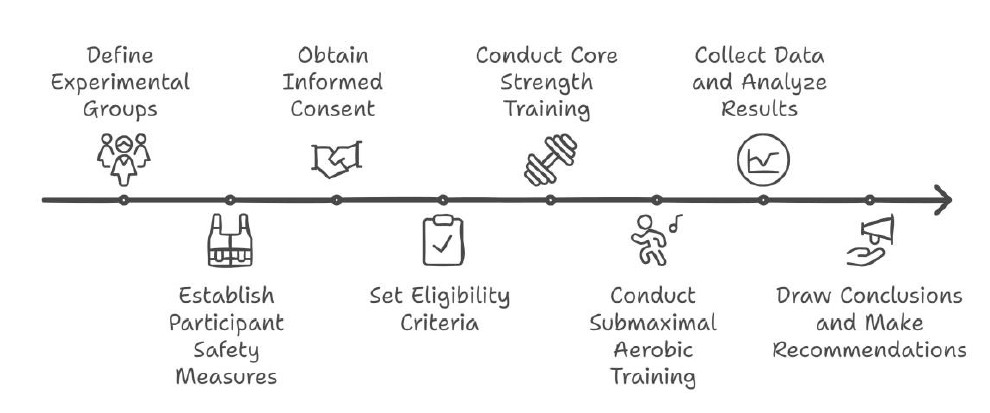
We utilized a research design with three groups to explore the findings of 12 weeks of core muscle training and submaximal aerobic training on biomotor fitness in college men. The subjects were arbitrarily assigned to CMT, SAT and CG. The treatment groups were given 60 minutes of respective training three days per week on Monday, Wednesday and Friday during the course of 12 weeks. The participants in the control group were allowed to involve in their regular fitness routine. These training sessions were overseen by the qualified fitness expert, who was conscious of the group distribution. Three orientation sessions were held two weeks before the first assessment to make sure participants were familiar with the tests and exercises used in the study. Throughout the intervention, the researchers used spoken instructions and demonstrations to ensure that the right technique was being used. A thorough range of assessments were carried out both prior to and after the training program, including Lower Back and Hamstring Flexibility (LBHF), Abdominal Muscle Strength (AMS) and Cardio Respiratory Endurance (CRE). Since the same testers conducted all test measurements, uniformity was preserved. The participant's assigned group was known to the evaluation professionals. Each assessment was completed in a span of two days.

Outcome Assessment
The intervention continued twelve weeks to bring significant variations in assessments of lower back and hamstring flexibility, abdominal muscle strength and cardio respiratory endurance were assessed using gold standardized examinations of Sit and Reach Test10, Sit-Ups Test11 and Cardio respiratory endurance12.
Sit and Reach Test
The sit and reach test designed to measure the lower back and hamstring flexibility, was administered according to the protocol explained by Balaji et al13. A device was used with a 25 cm mark, which is the same as the point at which the feet contact the box. The subjects were instructed to warm-up themselves. Additionally, they were told to "sit without shoes with their legs extended completely and their soles touch against the device's cross board. The palms of the hands facing downward, the knees completely stretched, and the inside edge of the sole positioned 2 centimetres from the scale. Then they were instructed to bend ahead, reaching as far forward as they could with their fingertips while pushing the moving marker along the scale without jerking. For about two seconds, they maintained their maximum flexion position. The same assessment was executed two times. The scores was not noted when their knees are bent. To the closest 0.5 cm, the greatest distance headed was recorded.
Sit-Ups Test
The sit ups assessment intended to evaluate the strength of abdominal muscles, was adhered based on the procedure clarified by Vanilson and Brand11. The target of the subjects in this test was to complete as many abdominal flexions in one minute. The participants were instructed to lie in supine position, crossed their elbows and kept their palms on their shoulders. Their soles of the feet placed on the ground with their knees together at 90 degrees. When they received the command, they raised their torso forward by performed hip flexion (raising upward) and touched their knees or thighs with crossed hands. The total number of reps accomplished in a minute was noted.
Cooper 12 Min Run Test
To calculate the endurance of the subjects Cooper 12 min run test was administerd12.
The test was conducted on a 400-meter track that had been marked on the ground. A few days prior to the test day, the subjects were given an opportunity to practice to acquaint them with the nature of the investigation. On the day of the experiment, the participants were instructed to stand at the beginning of start line. For duration of 12 minutes, the participants were instructed to run or walk as they could on a 400-meter track.
Experimental Protocol
Statistical analysis
The Shapiro-Wilk test was employed to evaluating the normality of the data. After this preliminary step, the effectiveness of the training program was investigated using the Analysis of Variance (ANOVA). The paired mean differences, if any, were evaluated using the post hoc Scheffe's test whenever the "F" ratio for post-interventions was determined to be significant. Effect size was determined using Cohen’s d (large: d > 0.8; moderate: d = 0.8to 0.5; small: d = 0.5 to 0.2; trivial: d < 0.2)14. To test the significance of the obtained "F" ratio, a confidence level of 0.05 was established.
Results
The results of CMT and SAT on bio motor abilities indicate clear differences among the three groups. Ensuring complete participation in the final assessments, every athlete attended more than 90% of the training sessions. Table 4 offers comprehensive interpretations of the information presented in this segment.
The obtained F value of pre training scores over LBHF, AMS and CRE were 0.17, 0.11 and 0.38 respectively. The numbers were less than the required p-value of 0.84, 0.90 and 0.68 according to the analysis of the pre-treatment figures. Therefore, it was determined at the 0.05 level of confidence that the pre-assessment value of CMTG, CSTG, and CG on LBHF, ASE, and CRE prior to respective training was not significant. Consequently, this attests to the effectiveness of the subjects' random allocation into three groups.
Additionally, it was discovered that the post-training scores on the chosen parameters had F values of 27.91, 50.63, and 123.91, respectively. Therefore, at the 0.05 level of confidence, the post-test mean values of the aforementioned parameters are statistically significant.
The effect of each group on LBHF, AMS and CRE were statistically significantly higher compared to the effect of the control group (p < 0.05). On LBHF, AMS and CRE the effect of CMTG greater than SATG.
For the control group (Table 6), there were no significant changes in the final measurement compared to the initial measurement of LBHF (d=0.05)
The pre-test and post-test compositions were measured by way of comparing all the research variables between and among groups to determine the mean values and the effect sizes. The CMTG group had a great improvement in their LBHF since its pre-test mean improved by 36.73 cm to 40.06 cm and the Cohen d effect size was 2.27 representing large. SATG group also had a significant increment of 36.60 cm to 38.60 cm (d = 1.40, large effect) against control group (CG) that depicted a very low alteration or none at all (36.40 cm to 36.33 cm, d = 0.05, small effect). In AMS, there was an increase of 22.13-25.20, (d = 3.26) in CMTG group and 22.00-24.60, (d = 3.25) in SATG group and both were large effects. In their turn, the control group was not changed much as it was at the pre-test (mean 22.07) and post-test (group mean of 22.00, d = 0.08) which bore a small effect. In CRE, the CMTG group showed a much significant gain of a d = 4.78 between 2166 and 2418 meters of which was considered as big effect size. SATG group also rose considerably to 2373 meters (d = 3.57, large effect) as well. The control group on the other hand showed a difference of slightly negative that is 2153 meters to 2140 meters (d = 0.33) which had a small effect size.
These findings thus demonstrated that LBHF, AMS, and CRE among training groups were meaningfully enhanced by CMT and SAT. Nevertheless, there were no appreciable variations in the gains made following intervention programs in CMTG and SAT in the number of LBHF (3.33 cm and 2 cm respectively), ASE (3.07 and 2.6 respectively) and the CRE (252 m and 211 m respectively).
Discussion
The primary goal of this exploration was to probe the influence of core muscle training and submaximal aerobic training on lower back & hamstring flexibility, abdominal muscle strength and cardio respiratory endurance in college students.
The outcomes are consistent with earlier research that showed a notable rise in LBHF, ASE and CRE. Compared to dynamic core training, core rigidity enhanced more after a six weeks of isometric program15,16. But there's also a chance that core training will help with other aspects of physical fitness. Identical to our research, school football players who received a ten weeks of core training witnessed improvements in strength and endurance of their core muscle17. Musculoskeletal flexibility is vital element of health. Further, flexibility is a noteworthy part of physical fitness to reach optimal musculoskeletal function18.
Using eight weeks core muscle training program enhanced the spinal ROM, flexibility, dynamic balance, lateral flexion, strength and endurance of the abdominal muscles, back muscles and muscles in the lower body of University men students. Junior swimmers experienced noticeable improvement of core strength due to Swiss ball core muscle exercises19. Following eight weeks core muscle training, men college players of various sports showed better improvements in core muscle endurance, balance and running economy20. Further, six weeks of core training benefitted in the improvement of enactment in 5000 m runners21.
When the body inhales oxygen that is approximately comparable to what is required, it is referred to as aerobic exercise or aerobic metabolism exercise. The workouts with low intensity, prolonged duration, with specific rhythm, and ease of transportation are characteristics of aerobic exercise.
Aerobic exercise has been shown in research to improve the haemodynamic state and foster neuroendocrine effects. These improvements can then be applied to heart rate, stroke volume, cardiac output and other functions related to heart, as well as symptoms like shortness of breath and improve one's capacity for care himself or herself in daily life22. Involving in aerobic exercises not only develops the abilities of bio motor fitness, and health but also an individual can afford expands lung capacity, develops respiratory function, enhances cardiac reserve function and boosts general physical fitness.
Limitations
The evaluation of performance outcomes was not done under the condition of assessor blinding, which can be considered one of the drawbacks of the present study. With both assessments and the administration of the training protocols performed by the same people, a possible presence of measurement bias is present, produced consciously or not in order to achieve the expected results within the experimental groups. It is worth noting that it should be considered that independent assessors work, blindly assessing the results, in future research, to increase objectivity and internal validity of the results.
Moreover, some other extraneous lifestyle factors including their diets, sleep hours, and exposure to other forms of physical exercise might not have been accounted during the study. These factors will have major impacts on biomotor capacities such as endurance, stiffness and flexibility producing confounding effects in the witnessed training effects. Despite the fact the study participants were advised in writing on the conduct of congruent routines, objective tracking is not possible and so completely attributing the enhancement of performance de facto to intervention is not possible. To overcome this comparison in future study, researchers may attempt to implement daily recordings, wearable activity monitor and proven food and sleep diaries to track the variables systematically.
Conclusion
To sum up, college men can improve their bio motor abilities through the use of CMT and SAT. The better improvements in selected parameters validate the wide-ranging benefits of method of this intervention. Future research should address the limitations of this study, but the findings offer important new understandings into how to apply SAT and CMT to college-aged men. The college men can be benefitted by following the CMT and SAT programme in terms of achieving and maintaining their fitness abilities to lead a healthy life.
Acknowledgements
A sincere thanks to the students assisting in this study and to the participants who devoted their time and effort.
References
-
1. Akuthota V, Ferreiro A, Moore T, Fredericson M. Core stability exercise principles. Curr Sports Med Rep. 2008 Jan;7(1):39–44. DOI: https://doi.org/10.1097/01.CSMR.0000308663.13278.69
» https://doi.org/10.1097/01.CSMR.0000308663.13278.69 -
2. McGill S. Core training: evidence translating to better performance and injury prevention. Strength Cond J. 2010 Jun;32(3):33–46. DOI: https://doi.org/10.1519/SSC.0b013e3181df4521
» https://doi.org/10.1519/SSC.0b013e3181df4521 -
3. Kumar S, Sharma VP, Negi MPS. Efficacy of dynamic muscular stabilization techniques (DMST) over conventional techniques in rehabilitation of chronic low back pain. J Strength Cond Res. 2009 Dec;23(9):2651–9. DOI: https://doi.org/10.1519/JSC.0b013e3181b3dde0
» https://doi.org/10.1519/JSC.0b013e3181b3dde0 -
4. Zazulak BT, Hewett TE, Reeves NP, Goldberg B, Cholewicki J. The effects of core proprioception on knee injury. Am J Sports Med. 2007 Mar;35(3):368–73. DOI: https://doi.org/10.1177/0363546506297909
» https://doi.org/10.1177/0363546506297909 -
5. Bliss LS, Teeple P. Core stability: the centerpiece of any training program. Curr Sports Med Rep. 2005 Jun;4(3):179–83. DOI: https://doi.org/10.1007/s11932-005-0064-y
» https://doi.org/10.1007/s11932-005-0064-y -
6. Koz M. İndirekt kalorimetri: oksijen tüketim hızı VO2. [Internet]. Available from: http://80.251.40.59/sports.ankara.edu.tr/koz/egzfizII/dayaniklilik.olcumu.pdf .
» http://80.251.40.59/sports.ankara.edu.tr/koz/egzfizII/dayaniklilik.olcumu.pdf -
7. Wahid A, Manek N, Nichols M, Kelly P, Foster C, Webster P, et al. Quantifying the association between physical activity and cardiovascular disease and diabetes: a systematic review and meta-analysis. J Am Heart Assoc. 2016 Aug 29;5(9). DOI: https://doi.org/10.1161/JAHA.115.002495 .
» https://doi.org/10.1161/JAHA.115.002495 - 8. American College of Sports Medicine. ACSM’s guidelines for exercise testing and prescription. Philadelphia: Lippincott Williams & Wilkins; 2013.
-
9. World Medical Association. World Medical Association Declaration of Helsinki: ethical principles for medical research involving human subjects. JAMA. 2013;310(20):2191–4. DOI: https://doi.org/10.1001/jama.2013.281053 .
» https://doi.org/10.1001/jama.2013.281053 -
10. Wells KF, Dillon EK. The sit and reach—A test of back and leg flexibility. Res Q Am Assoc Health Phys Educ Recreat. 1952 Mar;23(1):115–8. DOI: https://doi.org/10.1080/10671188.1952.10761965 .
» https://doi.org/10.1080/10671188.1952.10761965 -
11. Vanilson Batista Lemes, Brand C. Disclosing core strength: reliability and correlations before and after COVID-19 pandemic in plank and sit-ups tests. Sport sciences for health. 2023 DOI: https://doi.org/10.1007/s11332-023-01136-x
» https://doi.org/10.1007/s11332-023-01136-x -
12. Cooper KH. A means of assessing maximal oxygen intake. JAMA. 1968;203:201–4. DOI: https://doi.org/10.1001/jama.1968.03140030033008 .
» https://doi.org/10.1001/jama.1968.03140030033008 -
13. Balaji E, Murugavel K, Rajkumar M, Logeswaran S, Vijayasankar V, Devaraj C. The effect of a six-week course of Surya Namaskar practice on back flexibility and lumbar flexion in male college students. Phys Educ Theory Methodol. 2024 Feb 29;24(1):41–6. DOI: https://doi.org/10.17309/tmfv.2024.1.05
» https://doi.org/10.17309/tmfv.2024.1.05 -
14. Cohen J. Statistical power analysis for the behavioral sciences. 2nd ed. Hillsdale: Lawrence Erlbaum Associates; 1988. DOI: https://doi.org/10.4324/9780203771587 .
» https://doi.org/10.4324/9780203771587 -
15. Lee BCY, McGill SM. Effect of long-term isometric training on core/torso stiffness. J Strength Cond Res. 2015 Jun;29(6):1515–26. DOI: https://doi.org/10.1519/JSC.0000000000000740 .
» https://doi.org/10.1519/JSC.0000000000000740 - 16. McGill S. Low back disorders: evidence-based prevention and rehabilitation. 2nd ed. Champaign, IL: Human Kinetics; 2007.
-
17. Boyaci A, Tutar M. The effect of the quad-core training on core muscle strength and endurance. Int J Sports Sci. 2018;8:50–4. DOI: https://doi.org/10.5923/j.sports.20180802.02 .
» https://doi.org/10.5923/j.sports.20180802.02 -
18. Segal NA, Hein J, Basford JR. The effects of Pilates training on flexibility and body composition: an observational study. Arch Phys Med Rehabil. 2004 Dec;85(12):1977–81. DOI: https://doi.org/10.1016/j.apmr.2004.01.036 .
» https://doi.org/10.1016/j.apmr.2004.01.036 -
19. Marani IN, Subarkah A, Octrialin V. The effectiveness of core stability exercises on increasing core muscle strength for junior swimming athletes. Int J Hum Mov Sports Sci. 2020 Dec;8(6A):22–8. DOI: https://doi.org/10.13189/saj.2020.080704 .
» https://doi.org/10.13189/saj.2020.080704 -
20. Hung KC, Chung HW, Yu CCW, Lai HC, Sun FH. Effects of 8-week core training on core endurance and running economy. PLoS One. 2019 Mar 8;14(3):e0213158. DOI: https://doi.org/10.1371/journal.pone.0213158 .
» https://doi.org/10.1371/journal.pone.0213158 -
21. Sato K, Mokha M. Does core strength training influence running kinetics, lower-extremity stability, and 5000-m performance in runners? J Strength Cond Res. 2009 Jan;23(1):133–40. DOI: https://doi.org/10.1519/JSC.0b013e31818eb0c5 .
» https://doi.org/10.1519/JSC.0b013e31818eb0c5 -
22. Li S, Liang M, Gao D, Su Q, Laher I. Effects of aerobic and resistance training on diabetic heart function: roles of titin and collagen. Med Sci Sports Exerc. 2019 Jun;51(6 Suppl):328. DOI: https://doi.org/10.1249/01.MSS.0000561494.77044.F4 .
» https://doi.org/10.1249/01.MSS.0000561494.77044.F4
Edited by
-
Editor:
Carlos Herold Junior

 Source:The authors.