Multi-objective Optimization for Resource Allocation in Elastic Optical Networks: Integrating Spectrum and Power Assignment
Abstract
The increasing demand for bandwidth in modern communication networks has highlighted the need for efficient and dynamic resource allocation. Elastic Optical Networks address this challenge by enabling flexible spectrum and power assignment. This paper proposes an advanced resource allocation technique based on multi-objective optimization (MOO) to jointly optimize spectrum and power, mitigating nonlinear impairments and enhancing network performance. When a connection request arrives at the Call Admission Control, all possible frequency slot demands are generated by combining the requested bit rate with the available modulation formats. The Min Slot Continuity Capacity Loss (MSCL) heuristic selects routes and slot sets to minimize allocation capacity loss for each modulation level. From this process, a matrix of frequency slot combinations is built and subsequently explored by the MOO framework. The proposed method integrates the MSCL heuristic with power assignment to reduce spectrum fragmentation and select optimal power levels, thereby improving the optical signal-to-noise ratio. By jointly considering spectrum positioning, channel powers, amplified spontaneous emission noise, and nonlinear effects, the approach achieves significant performance gains. Simulation results demonstrate that the proposed method outperforms the Power and MSCL (P-MSCL) algorithm, achieving an approximately 11% reduction in blocking probability under a 180 Erlang load in the NSFNET topology with identical parameters.
Index Terms
Elastic Optical Networks; Physical Layer Impairments; Multi-objective Optimization; Power Assignment
I. Introduction
The increasing demand for bandwidth in modern communication networks, driven by the proliferation of data-intensive applications and services, has necessitated more efficient and dynamic resource allocation techniques. Elastic Optical Networks (EONs) have emerged as an effective solution to address this need, offering the necessary flexibility for adaptive spectrum and power allocation. However, effective resource management in EONs remains a complex challenge, primarily due to the intrinsic difficulty of the Power, Modulation, Routing, and Spectrum Allocation (PMRSA) problem, which is further exacerbated by physical layer impairments (PLIs) [1].
Traditional resource allocation strategies in EONs have predominantly focused on adaptive launch power control to optimize optical signal performance. While such approaches are essential for mitigating nonlinear effects and preserving transmission quality under diverse network conditions, a common limitation is that spectrum and power allocation are often treated as separate optimization problems. This disjoint approach can lead to suboptimal network performance, particularly under high-demand conditions and across heterogeneous network topologies, where nonlinear effects become more pronounced.
Under high traffic demand, spectral occupancy increases, resulting in a higher density of co-propagating channels. This, in turn, intensifies inter-channel nonlinear impairments, such as cross-channel interference (XCI) and four-wave mixing (FWM), which degrade signal quality and limit transmission reach. In contrast, under low-demand conditions, fewer channels are active, leading to reduced nonlinear interactions and less stringent constraints on power and spectrum allocation.
Network topology also plays a significant role in determining performance. In highly connected or mesh topologies, the availability of multiple routing paths can improve resource utilization; however, it may also increase the variability of link lengths and loading conditions, resulting in heterogeneous nonlinear interference accumulation. Conversely, simpler topologies, such as ring or linear configurations, exhibit more predictable interference patterns but provide less flexibility in resource allocation. Therefore, the interplay among traffic load, spectrum occupancy, and topology directly affects the severity of PLIs and the effectiveness of resource allocation strategies.
Recent studies have highlighted the need for integrated optimization frameworks that jointly address spectrum and power allocation in order to effectively reduce PLIs and enhance overall network efficiency, as in [2].
Given these challenges, a central research question emerges: how can the joint consideration of degrees of freedom — specifically, optical signal launch power and modulation level, routing, and spectrum — in transparent EONs with dynamic traffic profiles be exploited to develop a resource allocation strategy capable of significantly improving network performance, particularly in terms of blocking probability (BP)? This study aims to investigate this question by developing a unified framework for jointly optimizing spectrum and power allocation.
The main objective of this work is to propose a resource allocation strategy for EONs that considers multiple, often conflicting, objectives. These objectives include maximizing spectral efficiency, minimizing spectrum allocation capacity loss in links, and improving the Quality of Transmission (QoT) margin. Ultimately, the purpose is a substantial reduction in BP.
To achieve this objective, we developed an advanced resource-allocation technique for EONs using multi-objective optimization (MOO). This technique optimizes spectrum and power usage, aiming to mitigate PLIs and, consequently, enhance overall network performance. Our proposed method integrates the Min Slot Continuity Capacity Loss (MSCL) heuristic [3] with a dynamic power assignment strategy. The approach generates all possible combinations of frequency-slot demands from the available modulation levels, ensuring that the bit-rate requirements for each connection request are met. Through a multi-objective framework, these combinations are optimized to minimize spectrum usage while maximizing the Generalized Signal-to-Noise Ratio (GSNR). The implementation of this method aims to achieve significant improvements in spectral efficiency and PLI reduction due to nonlinearities (NLIs), through the optimization of bandwidth allocation, channel powers, and spectral positioning, as well as the reduction of amplified spontaneous emission (ASE) noise.
The employed methodology involves extensive simulations on two distinct network topologies to validate the effectiveness of the proposed technique. Notably, our approach demonstrated superior performance in reducing BP compared to recent methods, such as those referenced in [4] and [5]. More specifically, our results indicate that the proposed method outperforms the Power and MSCL (P-MSCL) algorithm [6] by approximately 11% in BP for a network load of 180 Erlangs in the NSFNET topology shown later, using the same parameter values. This quantitative result underscores the potential of our solution as a robust and innovative approach for future optical communication technologies.
In the subsequent sections of this paper, we present a literature review, detail the physical-layer model, the proposed methodology, the experimental setup, the results, and relevant discussions. We conclude with an analysis of the implications of our findings for the field of optical networks and offer suggestions for future research directions.
The remainder of this paper is organized as follows: Section II reviews the related work; Section III describes the physical-layer model; Section IV introduces the proposed approach; Section V details the methodology; Section VI presents and discusses the results; and Section VII concludes the paper and outlines future research directions.
II. Related Works
Efficient resource allocation in EONs is a fundamental requirement for supporting the growing bandwidth demand and ensuring the sustainability of future optical networks. This challenge arises from the complex interdependence among network parameters and PLIs, which directly affect QoT and BP. Recent studies have proposed different optimization strategies to address these issues, including the mitigation of nonlinear effects in multi-band environments and the use of artificial intelligence for dynamic resource management, as demonstrated in [7] and discussed in the review by Mata et al. (2018) [8]. Approaches more closely aligned with the one adopted in this work—namely, those that jointly explore multiple candidate solutions while accounting for physical layer effects remain less common.
Starting from a multi-objective optimization perspective, Hai et al. (2020) [9] investigated the RSNCA (Routing, Spectrum, and Network Coding Assignment) problem in EONs enabled with network coding. They proposed a priority-based multi-objective design aiming to maximize network throughput and, secondarily, minimize spectrum usage. The results demonstrated the effectiveness of network coding for throughput enhancement and the superiority of a multi-objective approach for optimizing spectral resource utilization, highlighting the importance of balancing multiple performance metrics.
Delving deeper into performance analysis and physical layer considerations, Rezaee et al. (2021) [10] conducted a performance analysis of QoT-aware control planes (GMPLS, GMPLS/PCE, and SDN) for EONs. The study considered NLI and ASE noises. The authors proposed an impairment-aware Routing and Spectrum Assignment (RSA) algorithm to ensure the required QoT, showing up to a 50% improvement in BP for the SDN control plane in specific traffic scenarios. Furthermore, they identified an optimal launch power of 0 dBm to minimize BP, underscoring the criticality of power management in NLI mitigation.
In the same year, Santos et al. (2021) [11] also focused on spectrum allocation, proposing the Sequential MSCL and Combined MSCL heuristics. These heuristics are adaptations of the MSCL algorithm for multi-route scenarios, considering capacity loss on each route sequentially or combined. The authors demonstrated the effectiveness of these approaches in improving BP compared to the FirstFit heuristic, highlighting the value of analyzing the allocation impact across multiple potential paths and laying the groundwork for more sophisticated spectrum allocation strategies.
Subsequently, in 2022, Vale et al. (2022) [5] explored the full integration of the physical layer into resource allocation decisions. Their work on the PRMLSA (Power, Routing, Modulation Level, and Spectrum Assignment) problem introduced routing strategies (SLA - Shortest and Least Allocated Path) and spectrum assignment (RBSA - Route-Based Spectrum Assignment) that depend on network state and route length, respectively. The incorporation of detailed physical-layer models and a simplified adaptive power assignment model (APAnoMem) resulted in significant reductions in BP, underscoring the importance of accounting for power spectral density and GSNR behavior for optimizing all-optical EONs.
In 2023, the mitigation of spectrum fragmentation, a chronic problem in dynamic EONs, was at the core of the work by Lira et al. (2023) [12]. Building on the MSCL algorithm, they proposed a generalized framework for designing spectrum-allocation heuristics that incorporates various network parameters, such as residual capacity and route hop count. The MPAO-Wj and MPAO-WLj heuristics, optimized via PSO, demonstrated a significant reduction in BP, evidencing that a more comprehensive evaluation of allocation impact on the network’s future state can lead to substantial improvements.
With the transition to multi-band networks and architectures such as filterless EONs, the explicit consideration of physical-layer effects has become even more critical. In 2024, Ghasrizadeh et al. (2024) [13] addressed the Q-TRMSA (QoT-aware tree selection, routing, modulation, and spectrum assignment) problem in filterless EONs operating over the C+L band. They incorporated detailed modeling of nonlinear effects, such as ISRS (Inter-channel Stimulated Raman Scattering) and Kerr. The comparison of different GSNR estimation methods highlighted the direct impact of modulation assignment and power management strategies on BP and spectral usage, emphasizing the trade-off between network performance and GSNR estimation accuracy.
Finally, for future generations of EONs, expanding to additional spectrum bands, such as C+L, also introduces CAPEX and spectral resource management challenges. Zheng et al. (2025) [2] investigated the RBSA (Routing, Band, and Spectrum Assignment) problem in C+L band EONs, proposing a hierarchical multi-objective ILP model to minimize CAPEX (via regenerator reduction) and, secondarily, C-band spectrum utilization. The developed PPTS-ABSA heuristic yielded near-optimal solutions with superior computational efficiency, demonstrating the feasibility of combining capacity expansion with cost containment and the preservation of high-quality spectrum resources.
Despite these advances, many heuristics still focus on a single candidate route-slot pair or fixed modulation assumptions. The P-MSCL strategy, whose basis was explored in Silva et al. (2024) [6], originally addressed this by selecting the slot set with the lowest capacity loss per route. The version proposed in this work, MOO P-MSCL, advances this idea by evaluating multiple candidate slot-sets-routes within a multi-objective optimization process, and dynamically assigning power based on GSNR constraints. This strategy increases the likelihood of successful allocation, further reducing BP while maintaining efficient spectrum use, thereby positioning MOO P-MSCL as a robust alternative among recent QoT- and PLI-aware approaches.
III. Physical Layer Model
The physical layer model is fundamental for accurately evaluating the performance of communication services in EONs. This section details the core components, resource allocation parameters, signal transmission characteristics, and performance metrics considered in this study.
A. Network Architecture and Fundamental Components
Transparent elastic optical networks are infrastructures composed of nodes interconnected by spans of optical fiber, which are segments extending between two nodes and forming an optical link. Each span is equipped with an optical amplifier to ensure robust light signal transmission, preventing degradation over the distance between network nodes. These amplifiers, typically Erbium-Doped Fiber Amplifiers (EDFAs), are crucial for compensating fiber attenuation and enabling long-haul transmission, thereby extending network reach and connectivity. The length of these spans may vary depending on the specific network topology, and thus, spans are considered fundamental units in the construction of optical networks [14]. The transparency aspect of EONs implies that signals remain in the optical domain from source to destination, without undergoing optical-electrical-optical (OEO) conversions at intermediate nodes, thereby reducing latency and operational costs.
B. Flexible Resource Allocation Parameters
EONs leverage flexible grid technology and sliceable bandwidth variable transponders (SBVTs) to adapt resource provisioning to demand. In this study, a set of bit rates and modulation levels is available to support diverse service requirements. Specifically, we consider:
representing the set of available bit rates, and
denoting the set of modulation formats (e.g., QPSK, 8QAM, 16QAM) that can be employed. The routing algorithm is configured to establish end-to-end optical connections, known as lightpaths, between a source and destination pair. Each lightpath represents an uninterrupted optical connection through the network, defined as:
where LPs,d is the set of possible physical paths (lightpaths) from source s to destination d. This flexibility in choosing bit rates, modulation formats, and routes is central to the efficiency of EONs.
C. Signal Transmission and Impairment Model
This study examines a coherent light-wave system employing dual polarization. Coherent detection offers significant advantages, including enhanced receiver sensitivity and the ability to compensate for various linear impairments in the electrical domain. We assume that chromatic dispersion (CD) and polarization mode dispersion (PMD) are perfectly compensated using digital signal processing (DSP) techniques, which are integral to modern coherent transceivers. These DSP capabilities enable sophisticated digital equalization, effectively mitigating linear impairments.
However, despite linear compensation, optical fiber transmission remains subject to nonlinear effects, particularly in high-power, multi-channel systems. The primary nonlinear effects considered in our model are self-channeling interference (SCI) and cross-channel interference (XCI). SCI refers to the nonlinear interaction of a channel with itself, while XCI describes the interference arising from interactions between different channels multiplexed in the fiber. These effects degrade the signal quality and limit the achievable transmission distance and data rates. Other nonlinear effects, such as Self-Phase Modulation (SPM), Cross-Phase Modulation (XPM), and Four-Wave Mixing (FWM), are implicitly captured within the generalized model’s coefficients.
D. GSNR as Performance Metric
Consequently, the received GSNR is utilized as one of the performance metrics to quantify the QoT for each channel. A higher GSNR generally indicates better signal quality and a lower bit error rate (BER). The GSNR for a given channel is calculated using the following semi-analytical model, which accounts for both noise and nonlinear interference:
where Pm represents the launch power of the m-th inserted channel. The coefficients a, b, and c are crucial for characterizing the impairments. Specifically, according to [15]:
-
The numerator Pm represents the input optical signal power of the channel being established, for which the GSNR is to be determined;
-
The denominator aP3m + bPm + c represents the total noise power, which can be decomposed into:
-
– Term aP3m: models NLIs which scales with the cube of the signal power such as SCI;
-
– Term bPm: represents noise terms that scale linearly with power, such as XCI;
-
– Term c: represents the constant ASE noise generated by optical amplifiers, which is independent of the input signal power.
-
These coefficients are defined by Eq. (3), Eq. (4), and Eq. (5) in [6], respectively, and their accurate estimation is vital for realistic network performance prediction.
E. Nyquist Wavelength Division Multiplexing (NWDM) and Gaussian Noise (GN) Model
The multiplexing technique used in this work is Nyquist Wavelength Division Multiplexing (NWDM). NWDM is characterized by its nearly rectangular optical spectrum, which enables high spectral efficiency by minimizing guard bands between adjacent channels. This characteristic significantly simplifies the calculation of the power spectral density (PSD) for individual channels, a key parameter in nonlinear interference modeling:
where Pm is the power of the m-th channel, and Δfm represents the channel bandwidth. The rectangular spectral shape of NWDM facilitates the derivation of a low-complexity version of the Gaussian Noise (GN) model for the output of an optical span. The GN model is widely adopted for its ability to estimate the nonlinear interference noise power in optical fiber systems by treating nonlinear distortions as additive Gaussian noise, thereby simplifying system design and optimization.
F. Optimal Launch Power Determination
Optimizing the launch power of optical channels is critical to maximize the GSNR and, consequently, the QoT, preventing either excessive noise (due to low power) or excessive nonlinear interference (due to high power). The power that results in the maximum possible GSNR for a given link state is calculated using the following expression:
An important observation from Eq. (6) is that the optimal launch power Pm,GSNRmax does not depend on the coefficient b. It implies that, under the assumptions of this model, the launch power that maximizes the GSNR is primarily influenced by the balance between accumulated ASE noise (represented by c) and the dominant nonlinear interference (represented by a), and is not significantly affected by specific linear or combined nonlinear effects captured by b. This simplification can be highly beneficial for real-time power optimization algorithms in dynamic EON environments.
IV. Proposal
This work aims to develop a resource allocation technique for EONs that uses MOO to optimize spectrum and power usage concurrently. This approach seeks to mitigate nonlinear physical layer effects and enhance overall network performance.
To achieve this, upon receiving a connection request at the Call Admission Control (CAC), all possible frequency slot demands are generated by considering the M available modulation levels (4-QAM to 64-QAM) for the requested bit rate. Subsequently, the MSCL heuristic is utilized to identify, for each of the k candidate routes, the set of frequency slots that yields the lowest capacity loss for the given demand and modulation level. This process results in a matrix where columns denote routes and rows represent the corresponding slot sets Si,j for each modulation level. This matrix then serves as input for an MOO formulation designed to minimize spectrum usage and maximize the GSNR.
We hypothesize that integrating the MSCL technique with power allocation within an MOO framework can significantly enhance network efficiency. Beyond selecting frequency slots to minimize capacity loss (i.e., spectrum fragmentation), the objective is to identify, from the selected slot sets, the one that, when combined with an optimal launch power, maximizes the GSNR while simultaneously minimizing spectrum usage.
GSNR maximization is pursued through several interdependent factors. SCI and XCI are inversely proportional to the channel bandwidth. Furthermore, XCI is directly proportional to the launch powers of co-propagating channels and depends on the spectral separation of channels along the route. Moreover, ASE noise accumulates along the optical path and is thus route-dependent. Therefore, a judicious selection and optimization of these parameters is expected to enhance network performance by mitigating PLIs.
A. Stages description
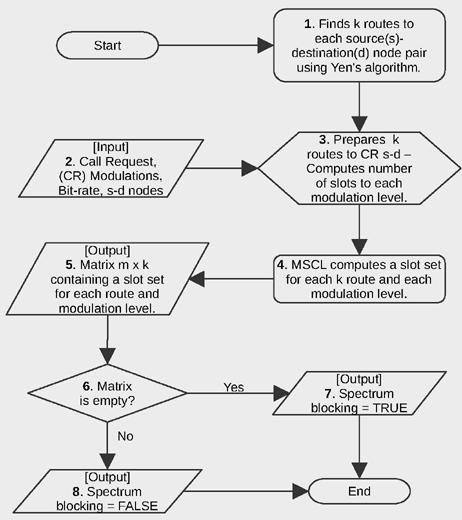
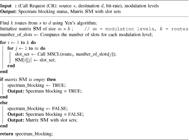
Fig. 1 illustrates this study’s proposed RSA procedure. Initially, k routes are generated between all pairs of source and destination nodes using Yen’s offline algorithm (step 1). When a connection request is received (step 2), the k corresponding routes for the source-destination pair LPs,d of that connection are identified. The required number of frequency slots for each modulation level in M is then calculated based on the connection request’s bit rate Rb (step 3). Subsequently (step 4), based on the slot requirements determined in step 3, the MSCL algorithm searches for the set of slots that yields the minimum capacity loss in the spectrum allocation for each route, considering each modulation level. Finally (step 5), an m × k matrix, denoted as SM, is generated. Its elements comprise sets of slots, with rows representing modulation levels and columns representing routes. If the SM matrix does not contain at least one valid set of frequency slots, the connection request is blocked due to insufficient available spectrum (step 6).
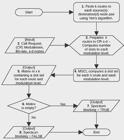
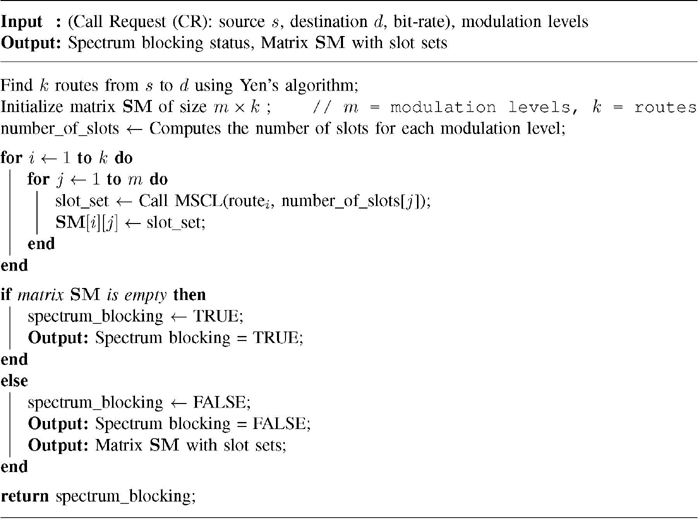
Alg. 1 presents the pseudocode describing the RSA algorithm illustrated in Fig. 1. The algorithm identifies k alternative routes using Yen’s algorithm and computes the spectral slots required for each route–modulation combination through the MSCL algorithm. It returns spectrum blocking = TRUE if no feasible configuration is found; otherwise, it returns FALSE.
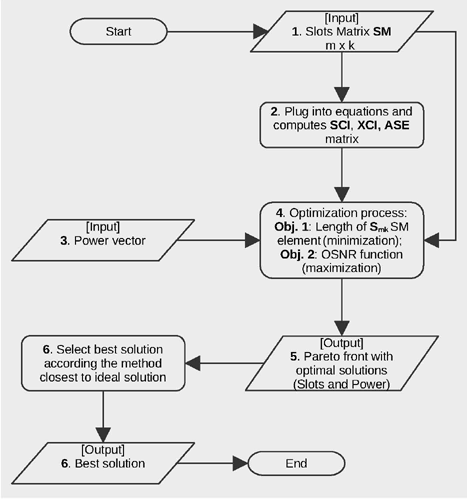
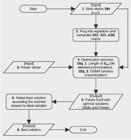
The subsequent phase is the MOO stage, which commences immediately after the RSA process. Fig. 2 outlines this optimization process, where the SM matrix generated in the previous step serves as its input (step 1). Each element of the SM matrix is then processed using Eq. (4) and Eq. (6). Subsequently (step 2), the SCI and XCI matrices are calculated, which share the same dimensions as SM due to their dependence on the selected route and modulation level. Concurrently, the ASE vector is computed, having dimensions corresponding to the SM columns, as it depends solely on the route. These calculated matrices and the vector elements are then used, element-wise, in Eq. (4) to determine the GSNR. The objective functions for this MOO are: (1) to maximize the GSNR (as derived from Eq. (4)), and (2) to minimize the number of frequency slots (i.e., spectrum usage) associated with each element of the SM matrix. Once the optimal variable values satisfying these objectives are determined, the precise route, spectrum, launch power, and modulation for the new connection can be defined. If no optimal power value can satisfy the minimum GSNR requirement for a given modulation, the connection request is blocked due to insufficient QoT.
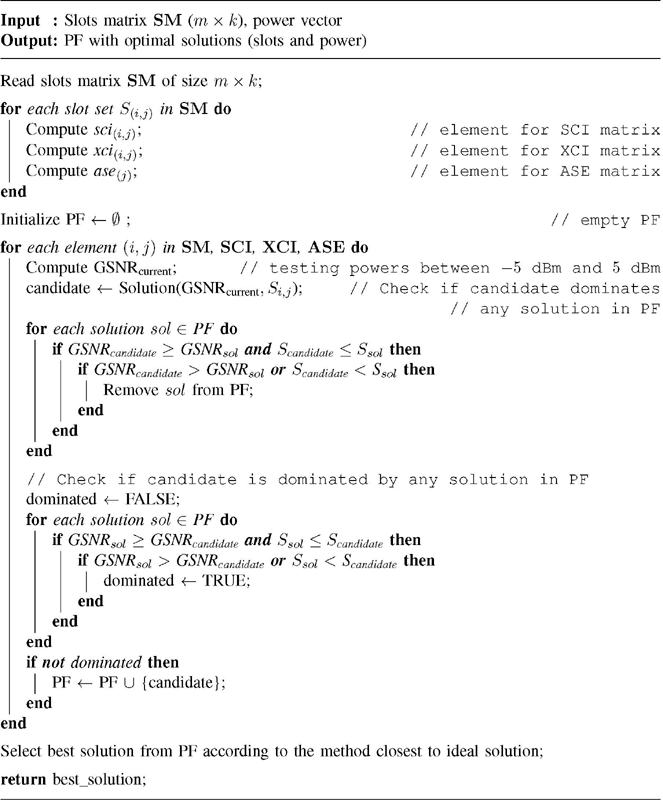
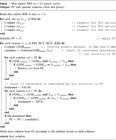
Alg. 2 presents the pseudocode describing the multi-objective optimization process illustrated in Fig. 2. The algorithm computes the SCI, XCI, and ASE matrices, tests different power levels, and optimizes two objectives: minimizing the number of allocated slots and maximizing the GSNR function. The output is a Pareto Front (PF) containing optimal solutions that represent different trade-offs between spectral efficiency and QoT.
B. General problem definition
The MOO problem task aims to minimize spectrum usage and maximize optical GSNR for each incoming call request while satisfying the QoT constraint. Then:
Decision variables:
-
Pch: Launch power of channel ch.
-
Si,j: Set of frequency slots allocated to channel ch.
-
Rj: Route allocated to channel ch.
-
Mi: Modulation level used for channel ch.
Objectives:
1) Minimization of channel spectrum usage:
where Si,j is the set of slots to be allocated to channel ch.
2) Maximization of GSNR:
where the coefficients scii,j, xcii,j, and asej are elements of XCI, SCI and ASE matrices.
Constraint: minimum QoT (GSNR lower bound):
C. Allocation strategy
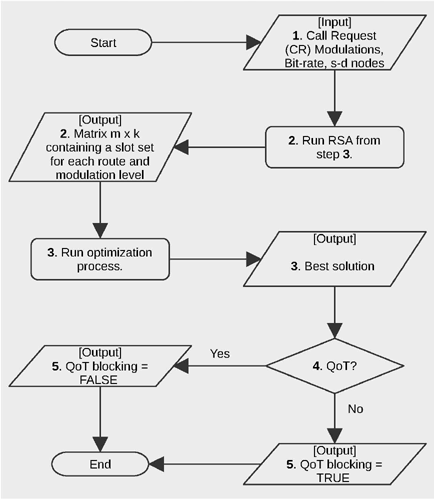
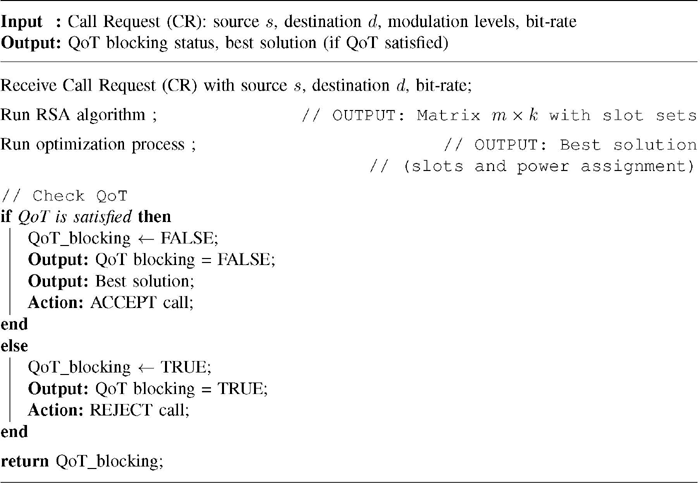
This phase, depicted in Fig. 3, operates within the Call Admission Control (CAC) framework. Upon receiving a call request, it is forwarded to the RSA phase, as illustrated in Fig. 1. In the RSA phase, provided no blocking occurs due to spectrum unavailability, an m × k matrix is generated. This matrix comprises sets of frequency slots, each associated with a specific route and modulation level.
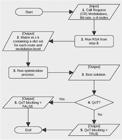
Subsequently, in the MOO phase, the slot matrix SM, along with the computed SCI and XCI matrices, and the ASE vector, serve as inputs for the objective function formulation. The optimization process then yields a set of optimal solutions that populate the PF. The best solution from this PF is subsequently selected using the shortest Euclidean distance method to the ideal solution. This selected solution is then used to determine the channel’s power configuration and establish the connection, provided that the achieved QoT exceeds the minimum required threshold and that existing channels can accommodate the insertion of the new channel.
Alg. 3 presents the pseudocode describing the CAC algorithm illustrated in Fig. 3. The algorithm integrates the RSA and MOO processes and validates the QoT of the selected solution. It returns QoT blocking = FALSE and accepts the connection request if the quality requirements are satisfied; otherwise, it returns QoT blocking = TRUE and rejects the request.

V. Methodology
We adopted an approach that optimizes spectrum and power usage to evaluate network performance in terms of BP, while accounting for PLI effects. In this context, MOO minimizes spectrum usage and maximizes the GSNR by optimizing power allocation and reducing SCI and XCI. Additionally, the MSCL algorithm generates candidate slot sets for selection during the optimization phase, aiming to reduce the loss of allocation capacity.
For this problem, a power vector is constructed by discretizing the power range, from zero to the maximum power (defined by Eq. (6)), into 100 discrete levels. These discrete power levels are then used to update the SCI and XCI and the ASE matrices, which are subsequently employed to evaluate the GSNR using Eq. (4). The non-dominated solutions derived from this optimization process are then used to construct the PF.
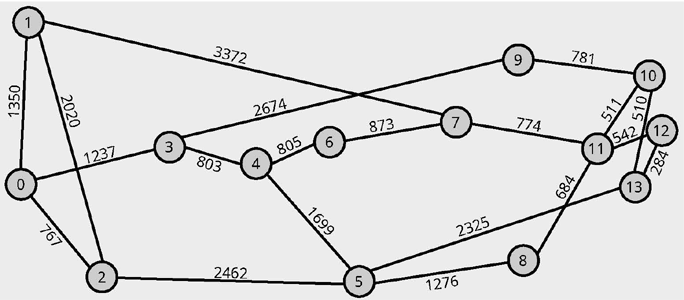
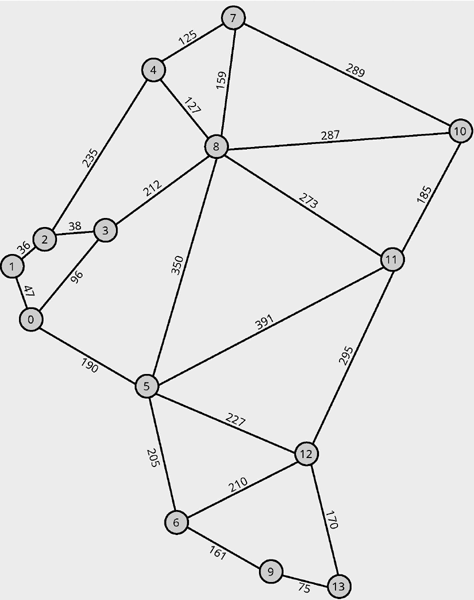
The topologies illustrated in Fig. 4 and Fig. 5 were chosen for their distinct characteristics, including the number of nodes and the lengths of links. The NSFNET topology features longer links, up to 3300 km, resulting in greater attenuation and PLIs. Conversely, the DT14 topology has significantly shorter links, thereby reducing the impact on the channels’ GSNR.
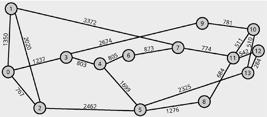
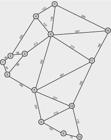
Table I summarizes the network parameters used in the simulation. Each fiber span was set to 80 km, with an attenuation coefficient of α = 0.2 dB/km. Consequently, fiber losses of 16 dB per span are balanced by amplifier gains.
For routing, a fixed alternative routing strategy was employed to select paths. This strategy directs traffic through a set of predetermined alternative paths, prioritized by shortest distance, aiming to minimize PLIs in the network.
Each simulation performed at least 106 call requests to ensure the statistical reliability of the results. In the context of call generation, the developed routine assumes that connections are generated dynamically and randomly, without forecasting future requests. This randomness encompasses several key aspects: (i) the origin node, (ii) the destination node, (iii) the bit rate, (iv) the arrival instant of the call request, and (v) its duration.
The arrival of connection requests is modeled as a Poisson process, reflecting the dynamic nature of communication traffic. The inter-arrival time between incoming calls follows an exponential distribution with a mean of 1/μ, where μ represents the average call request generation rate. The duration of each call is also modeled as an exponential distribution with mean H.
VI. Results and Discussion
This section presents results demonstrating a significant advancement over the previous study by Silva et al. (2024) [6], offering a deeper and more comprehensive understanding of the resource allocation problem in EONs. A comparative analysis of these results with those from the previous work validates the initial hypotheses and highlights the substantial improvements achieved by the new approach.
The prior work by Silva et al. (2024) [6] focused on implementing a heuristic algorithm for resource allocation in transparent EONs. This algorithm demonstrated significant efficiency in reducing BP, a major challenge in optical networks. The results indicated notable improvements in both spectrum utilization and GSNR. However, certain limitations were identified, particularly in high-traffic density scenarios.
A primary limitation was the method used to calculate the GSNR, which was defined as the maximum achievable GSNR on a given route at a particular instant. While functional, this approach did not yield an optimized PSD, resulting in suboptimal network resource utilization. In high-traffic scenarios, the absence of PSD optimization constrained overall system performance, hindering more efficient transmission capacity allocation and potentially further reducing BP and enhancing spectrum resource utilization.
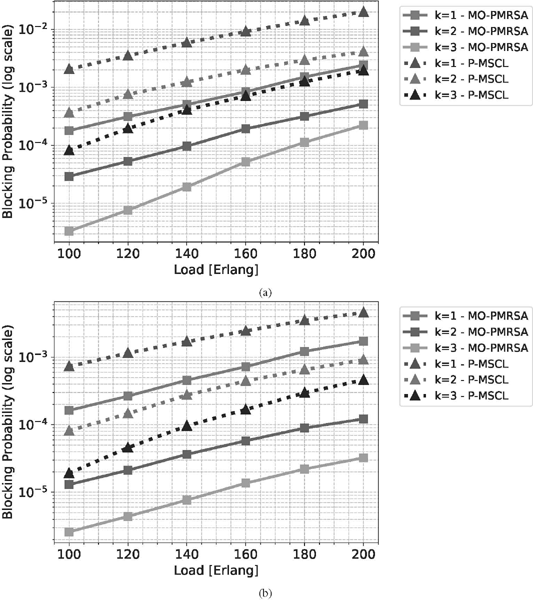
Fig. 6a presents a comparative analysis of the P-MSCL heuristic and the proposed MO-PMRSA technique in a long-link scenario, specifically for the NSFNET topology. The results indicate that MO-PMRSA achieves significantly better performance, which can be attributed to its dynamic optimization of both power and spectrum allocation, as well as to its improved ability to mitigate PLIs. As shown in Fig. 6a, P-MSCL with k=3 and MO-PMRSA with k=1 exhibit similar performance. This result suggests that MO-PMRSA is more efficient, as it attains performance comparable to that of P-MSCL while considering only one route in the selection process, whereas P-MSCL requires three.
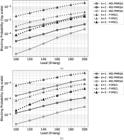
(a) MO-PMRSA vs P-MSCL result in NSFNET topology. (b) MO-PMRSA vs P-MSCL result in DT14 topology.
Conversely, in the DT14 network (Fig. 6b), the links are considerably shorter. It inherently leads to lower attenuation and reduced other degrading effects, thereby minimizing physical-layer penalties. Consequently, this enables the deployment of more advanced modulation schemes, which inherently utilize the available spectrum more efficiently and yield superior GSNR values. As a result, the network's spectral efficiency is enhanced, improving transmission capacity while simultaneously achieving better GSNR values, thereby bolstering network robustness.
As evinced by Fig. 6a and Fig. 6b, the principal advantage of MO-PMRSA resides in its capacity to effectively manage PLIs, which are particularly critical in long-link scenarios. The dynamic power adjustment facilitates more precise resource allocation, preventing both under-utilization and spectrum saturation, consequently enhancing network efficiency. By jointly optimizing power and spectrum, MO-PMRSA maximizes GSNR while minimizing PLIs, thereby ensuring transmission stability and QoT.
Beyond optimizing spectrum utilization, the MO-PMRSA technique ensures signal integrity by mitigating the adverse effects of physical impairments, which pose considerable challenges in networks with long links. Consequently, the algorithm significantly enhances network performance, ensuring more efficient and robust resource allocation.
Overall, the MO-PMRSA technique distinguishes itself by offering superior performance. Its approach, characterized by optimized dynamic adjustment of power and spectrum and a focus on mitigating NLIs, facilitates more efficient utilization of available resources. It ensures enhanced signal quality and a greater capacity to accommodate new channels, even in challenging long-link scenarios.
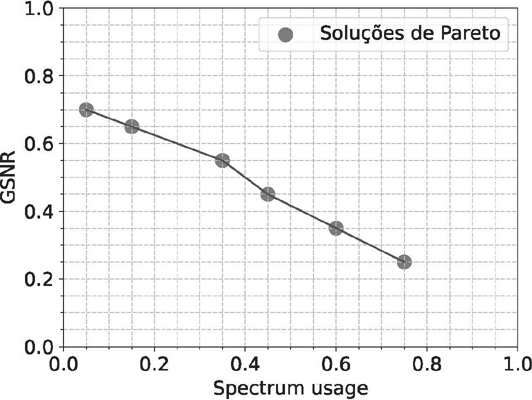
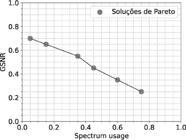
Fig. 7 illustrates a PF at a specific instant, corresponding to the arrival of a connection request in the NSFNET topology under a load of 180 Erlangs. The axes are normalized to the [0,1] interval to highlight the relative trade-off:
-
X-axis (spectrum usage): normalized fraction of spectrum usage (0 = worst; 1 = best);
-
Y-axis (GSNR): normalized generalized signal-to-noise ratio (0 = worst; 1 = best).
The distribution of points along the PF highlights the trade-off between spectrum usage and GSNR: as spectrum usage decreases (moving to the left), GSNR increases, because SCI (self-channel interference) and XCI (cross-channel interference) are inversely proportional to the channel bandwidth, and GSNR is inversely proportional to these interferences. All points are unique and non-dominated, representing distinct optimal solutions. The empty regions reflect infeasible or dominated solutions, inherent to the shape of the PF under high physical load.
The inverse relationship observed between spectrum usage and GSNR suggests that the underlying interference model accurately captures the expected behavior, thereby validating its ability to describe the optical system's performance.
This work employs a solution selection method, termed the "Closest to Ideal Solution", applied to the PF. To demonstrate the effectiveness of this selection approach, additional experiments were conducted by choosing solutions at the extremes of the PF, specifically those that prioritize individual objectives.
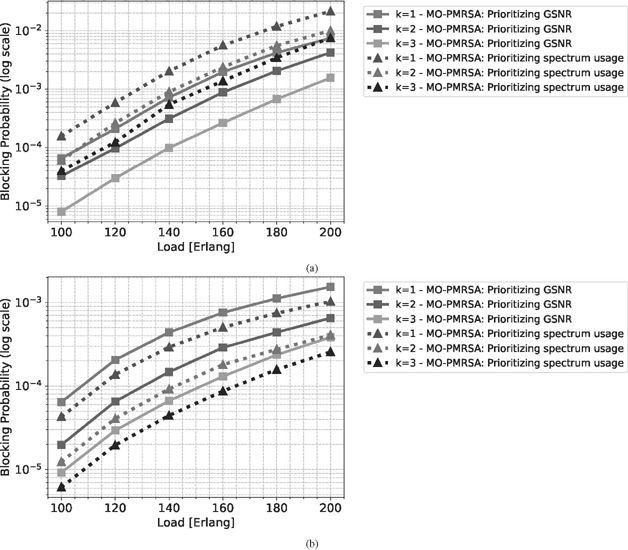
Fig. 8 presents the simulation results obtained for two topologies at the extremes of the PF. Selecting solutions at these extremes means prioritizing either the maximization of GSNR or the minimization of spectrum usage.
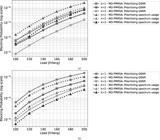
(a) MO-PMRSA's result with extreme solutions in NSFNET topology, (b) MO-PMRSA's result with extreme solutions in DT14 topology.
The results of the experiments conducted in long-link scenarios using the NSFNET topology are shown in Fig. 8a. While the results obtained are satisfactory, they are inferior compared to those yielded by the "Closest to Ideal Solution" selection method. This outcome arises because, despite all solutions on the PF being optimal with respect to the objective trade-offs, prioritizing one extreme excessively favors a single objective at the expense of the other. Such an imbalance typically results in a slight performance degradation compared to a more balanced solution.
For networks with shorter links, such as DT14 (Fig. 5), the performance of extreme solutions (Fig. 8b) on the PF tends to be similar. It can be attributed to several factors. In shorter links, penalties associated with signal attenuation, NLIs, and other degrading effects are significantly reduced. Consequently, the performance disparity arising from prioritizing a single objective becomes less pronounced, as both extreme solutions can maintain an acceptable QoT due to minimal signal degradation. Furthermore, shorter links enable more efficient power and spectrum allocation, rendering extreme solutions viable and leading to comparable performance levels.
The primary advantage of the "Closest to Ideal Solution" method is its ability to balance multiple conflicting objectives efficiently. By selecting the solution closest to the ideal point, this method ensures that no objective is excessively compromised, thereby delivering a more robust, balanced overall performance. In scenarios with shorter links and less severe PLIs, selecting extreme solutions can still yield acceptable performance. However, in longer links where interference and attenuation are significant, adopting extreme solutions leads to substantial QoT degradation.
Finally, although the proposed MO-PMRSA framework achieves a reduction of approximately 11% in BP compared to P-MSCL, this improvement comes with additional computational cost. Unlike P-MSCL, the proposed approach incorporates a multi-objective optimization stage that evaluates candidate solutions by jointly considering spectrum allocation, power levels, and QoT-related metrics. As a result, MO-PMRSA is expected to require more processing per connection request than P-MSCL. This tradeoff between improved blocking performance and higher computational effort is particularly relevant in dynamic network scenarios, where CAC must be performed within a limited time budget. Even though execution-time benchmarking was not the main focus of this work, the computational impact of the proposed framework should be further investigated in future studies.
VII. Conclusions
In this study, we proposed an advanced MOO technique for resource allocation in EONs. This technique integrates the MSCL heuristic for spectrum assignment with a refined power assignment strategy. The primary objective was to minimize spectrum usage and maximize the GSNR, comprehensively considering PLIs, including SCI, XCI, and ASE noise. We used a robust physical-layer model and an optimization process to identify the most suitable route, spectrum, modulation, and power combinations for each connection request.
The results of this work not only confirm but also significantly expand upon the findings of previous studies. They provide compelling new evidence of the effectiveness of heuristic and metaheuristic algorithms in high-demand scenarios and complex network topologies within EONs. Specifically, the MOO approach to resource allocation demonstrates greater efficiency and adaptability than conventional methods.
As demonstrated through comparative analysis, the proposed MO-PMRSA technique significantly outperforms other approaches, such as P-MSCL. Its superior performance is primarily due to its dynamic, optimized adjustment of both power and spectrum, as well as its enhanced ability to minimize NLIs. This dynamic adjustment is particularly crucial in long-haul scenarios, where physical-layer penalties are severe, enabling MO-PMRSA to effectively mitigate issues related to low GSNR and signal degradation caused by excessive or insufficient launch power.
Furthermore, the P-MSCL heuristic, by allocating intermediate power levels, offers a critical balance that facilitates new connections without compromising QoT. This balanced approach is especially relevant in topologies characterized by long links, where effective NLI control is paramount for efficient spectrum utilization. It thus provides a clear direction for addressing the inherent challenges associated with such network configurations.
Another salient advantage highlighted is the incorporation of MOO techniques, which enabled the simultaneous evaluation of multiple, often conflicting, performance criteria. This holistic approach yielded balanced solutions that concurrently optimized spectral efficiency and signal quality, thereby demonstrating a clear advantage in overall system performance.
The advancements presented in this work offer promising prospects for the future of optical networks, providing innovative solutions to the persistent challenges of resource management in increasingly complex and dynamic environments. The ability to dynamically adjust network parameters in response to varying traffic conditions and physical impairments not only improves operational efficiency but also significantly enhances the robustness and resilience of elastic optical networks. These advanced approaches have consistently demonstrated significant reductions in call BP and overall improvements in QoT.
In summary, this study’s results unequivocally indicate that adopting MOO techniques can fundamentally transform resource allocation in elastic optical networks. These techniques not only significantly enhance network efficiency and adaptability but also establish a clear pathway for addressing future challenges in resource management within evolving and increasingly complex communication infrastructures.
Acknowledgments
The authors would like to thank the National Council for Scientific and Technological Development (CNPq) and the Foundation for the Support of Science and Technology of the State of Pernambuco (FACEPE) for the support provided for the development of this research.
Data Availability
The data that support the findings of this study is available in https://github.com/sousergiosilva/JMOe2026.
REFERENCES
- 1 M. Jinno, “Elastic optical networking: roles and benefits in beyond 100-gb/s era,” Journal of Lightwave Technology, vol. 35, pp. 1116–1124, 2017.
- 2 W. Zheng, M. Yang, Y. Zheng, Y. Zhang, and K. Yang, “Joint routing, band, and spectrum assignment in c+l band elastic optical networks towards ultra-broadband era,” Computer Networks, vol. 267, pp. 111 373–111 385, 2025.
- 3 R. C. Almeida, A. F. Santos, K. D. R. Assis, H. Waldman, and J. F. Martins-Filho, “Slot assignment strategy to reduce loss of capacity of contiguous-slot path requests in flexible grid optical networks,” Electronics Letters, vol. 49, pp. 359–361, 2013.
- 4 V. A. C. Vale and R. C. Almeida, “Power, routing, modulation level and spectrum assignment in all-optical and elastic networks,” Optical Switching and Networking, vol. 32, pp. 14–24, 2019.
- 5 V. A. C. Vale, R. C. Almeida, and K. D. R. Assis, “Network-state-dependent routing and route-dependent spectrum assignment for prmlrsa problem in all-optical elastic networks,” Optical Switching and Networking, vol. 43, pp. 100 646– 100 659, 2022.
- 6 S. A. da Silva, C. J. A. Bastos-Filho, D. R. B. Araujo, and R. C. Almeida-Junior, “Strategy for resource allocation in elastic optical networks considering physical layer impairments and spectrum fragmentation,” Journal of Microwaves, Optoelectronics and Electromagnetic Applications, vol. 23, pp. 1–15, 2024.
- 7 K. K. Munasinghe, M. N. Dharmaweera, U. L. Wijewardhana, C. D. Alwis, and R. Parthiban, “Joint minimization of spectrum and power in impairment-aware elastic optical networks,” IEEE Access, vol. 9, pp. 43 349–43 363, 2021.
- 8 J. Mata, I. de Miguel, R. J. Duran, N. Merayo, S. K. Singh, A. Jukan, and M. Chamania, “Artificial intelligence (ai) methods in optical networks: A comprehensive survey,” Optical Switching and Networking, vol. 28, pp. 43–57, 2018.
- 9 D. T. Hai, L. H. Chau, and N. T. Hung, “A priority-based multiobjective design for routing, spectrum, and network coding assignment problem in network-coding-enabled elastic optical networks,” IEEE Systems Journal, vol. 14, no. 2, pp. 2358–2369, 2020.
- 10 A. Rezaee, O. A. Sheikhabad, and L. Beygi, “Quality of transmission-aware control plane performance analysis for elastic optical networks,” Computer Networks, vol. 187, pp. 107 755–107 766, 2021.
- 11 M. L. Santos, R. C. A. Jr., and D. R. B. Araujo, “Heuristicas para atribuicao de espectro em redes opticas elasticas baseadas em perda de capacidade sob multiplas rotas,” Anais do XXXIX Simposio Brasileiro de Telecomunicacoes e Processamento de Sinais, pp. 14–14, 2021.
- 12 C. J. Lira, R. C. Almeida Jr., and D. A. Chaves, “Spectrum allocation using multiparameter optimization in elastic optical networks,” Computer Networks, vol. 220, pp. 109 478–109 493, 2023.
- 13 M. S. Ghasrizadeh, F. Arpanaei, and H. Beyranvand, “Qot-aware tree selection, routing, modulation, and spectrum assignment for filterless eons over the c+l-band,” Journal of Optical Communications and Networking, vol. 16, no. 2, pp. 127–141, 2024.
- 14 R. Ramaswami, K. Sivarajan, and G. Sasaki, Optical networks: a practical perspective, 3rd ed. Elsevier, 2010.
- 15 P. Poggiolini, A. Carena, V. Curri, G. Bosco, and F. Forghieri, “Analytical modeling of nonlinear propagation in uncompensated optical transmission links,” IEEE Photonics Technology Letters, vol. 23, pp. 742–744, 2011.
-
Editor:
Carlos E. Capovilla
-
Associate Editor:
Guilherme S. da Rosa