
 EMPIRICAL ANALYSIS OF EXTENDED REALITY ADOPTION IN STEM EDUCATION: A FACULTY-CENTRIC STUDY USING STATISTICAL AND PREDICTIVE MODELLING
ABSTRACT
Extended Reality (XR) - a combination of virtual, augmented, and mixed reality technologies- is emerging as an innovative tool in STEM education. XR technologies provide faculty and students with engaging and interactive teaching and learning experiences. However, the factor that is relatively less researched, but directly influences the successful integration of XR in higher education, i. e., faculty adoption, is overlooked. This study analyzes the factors influencing university faculty’s adoption and integration of XR in STEM education by focusing on four-dimensional factors. The contextual factors review institutional support and infrastructure of the academic institutions, individual factors examine digital literacy levels, and experience with XR for STEM faculty, social factors review the influence of peer collaboration and student feedback, and technological features examine the usability of XR tools and privacy concerns for the faculty and student data. Using a faculty-centric approach, a survey of 500 STEM faculty members was conducted, and rigorous statistical analyses were employed, including independent t-tests, ANOVA, Chi-square tests, and multiple regression, to evaluate the impact of these factors. Results show that student feedback is the major factor influencing XR adoption, followed by institutional support and ease of use. Contrarily, data privacy concerns and digital literacy gaps are identified as major barriers to XR integration in STEM education. Based on the findings of the survey, the study outlines (1) the need for XR-based faculty training; (2) the need for increased institutional support; and (3) the need for user-centric design of XR tools as the main considerations to enable effective use of XR in higher education. The results emphasize the need to factor both technical and social aspects, facilitating a successful XR integration; thereby creating a foundation for potentially new and more interactive forms of pedagogy.
Keywords:
Extended Reality (XR); STEM education; faculty adoption; technology integration; predictive modelling; institutional support; data privacy
INTRODUCTION
Recent technological advancements, including artificial intelligence, gamification, mobile learning, etc., have transformed the higher educational ecosystem, enabling innovation in learning interaction and engagement (Pan & Mow, 2023). One of these technologies, Extended Reality (XR) - an umbrella term for virtual reality (VR), augmented reality (AR) and mixed reality (MR) - can create immersive and experiential learning experiences (Ajit, 2021).
XR enables students to visualize complex scientific concepts, simulate real-world experiments, and interact with educational content in ways that were previously unattainable in traditional classrooms (Doolani et al., 2020; Khlaif et. al., 2024). These capabilities make XR particularly valuable in STEM education, where bridging the gap between abstract concepts and practical applications is critical (Lai & Cheong, 2022; Guo et al., 2021).
In spite of its potential, the adoption of XR in higher education remains irregular, with faculty members playing a crucial role in its integration into curricula. While prior research has explored the technical and pedagogical benefits of XR, there is a notable gap in understanding the factors that influence faculty adoption of these technologies. Current research mainly explores the conditions of student outcomes or technical feasibility, and does not consider the views of educators who have the final decision to implement XR in the class (Hoyer et al., 2020; Salinas et al., 2022; Alnagrat et al., 2021; Meccawy, 2023). This gap is even more pronounced in STEM, where the technical nature of materials and the necessity for hands-on learning make XR adoption challenging. This study bridges the current research gap by evaluating the factors that determine the adoption of XR in STEM education by university faculty.
This research introduces a multi-dimensional framework (Table 1) that dives into several aspects:
-
Contextual Factors: How much support does the institution provide? What is the infrastructure quality?
-
Individual Factors: Are teachers digitally literate? Does the technology fit with how they like to teach?
-
Social Factors: What is the influence and support from colleagues or students?
-
Technological Features: Is the technology easy to use? How well does it protect data privacy?
These four dimensions, integrated, give a complete picture of all factors that make-or-break XR adoption.
The novelty of this study lies in its focus on faculty perspectives, combining real-world survey data with advanced statistical techniques to identify the main factors behind the adoption of XR in STEM education. Studies already done in the field of XR in education focused on qualitative methods, while this study takes a different approach by using quantitative tools - like independent t-tests, ANOVA, Chi-square tests, and multiple regression analysis - to thoroughly examine the factors influencing adoption.
This study is focused on the following research questions:
-
What is the role of contextual, individual, social, and technological factors in adopting XR for STEM education?
-
What are the factors that have the most significant impact on faculty willingness to use XR?
-
What challenges are preventing widespread XR adoption, and how can they be overcome?
By analyzing these research questions through the survey responses, the study provides valuable insights for educational institutions, faculties, XR technology engineers planning to enhance XR integration in STEM education.
The results highlight the need to address both technical hurdles and social dynamics to successfully bring XR into the classroom. Ultimately, this research paves the way for more creative and impactful teaching methods in STEM education.
Methodology
This research uses a quantitative approach to analyze the perspective of STEM faculty on the adoption of XR technologies in teaching pedagogy. A structured survey was designed and distributed to faculty members across multiple universities to identify the main institutional, individual, social, and technological factors that influence the willingness of faculty members to integrate XR tools into their teaching practices (Meccawy, 2023; Scherer et al., 2019; Xue et al., 2024).
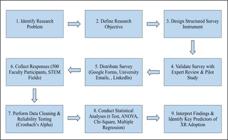
The survey focused on faculty perceptions, challenges, and readiness regarding XR adoption, particularly in the context of institutional support, digital literacy, pedagogical alignment, and data privacy concerns. A variety of statistical analyses were conducted, including t-tests, ANOVA, Chi-square tests, and multiple regression analysis, to assess the significance of these factors in predicting XR adoption intent (Makransky & Petersen, 2021; Ledger et al., 2022). The structured nature of the survey allowed for a rigorous, data-driven evaluation of the adoption landscape, providing general insights across different academic ranks and levels of XR familiarity (Guo et al., 2021; Upadhyay et al., 2024). Figure 1 explains the complete research methodology in detail.
The following sections describe the survey design, participant demographics, and data analysis procedures in detail.
Survey Design
The survey was designed based on validated instruments from prior studies on technology adoption, including the Technology Acceptance Model (TAM) and the Unified Theory of Acceptance and Use of Technology (UTAUT) (Scherer et al., 2019; Neves et al., 2025; Xue et al., 2024). A panel of three subject-matter experts reviewed the survey to ensure face validity and content validity. A pilot study was conducted with 20 faculty members to refine the clarity, wording, and response format of the survey items. Feedback from the pilot study was used to finalize the survey (Meccawy, 2023; Al-Rahmi et al., 2018).
The survey was structured around four key dimensions of XR adoption as depicted in Table 1, and sample questions in each dimension category are depicted in Table 2 (Guo et al., 2021; Upadhyay et al., 2024; Fernández-Cerero et al., 2024). Each dimension included multiple Likert-scale items (1 = strongly disagree, 5 = strongly agree), Yes/No questions, and open-ended responses to capture nuanced perspectives. The survey also included demographic questions about academic rank, teaching experience, and familiarity with XR technologies.
Survey Reliability and Validity
To conduct a reliability analysis of the survey, the internal consistency of the complete survey and individual dimensions were tested before circulating it to the participants using Cronbach’s Alpha (Al-Rahmi et al., 2018; Scherer et al., 2019). The overall Cronbach’s Alpha value for the survey was 0.87, indicating strong reliability. The reliability value for each dimension was as follows:
The values in Table 3 confirm that the survey items were reliable and consistent in measuring the intended constructs (Xue et al., 2024). To confirm the validity of the survey, subject-matter experts reviewed the survey and also pilot-tested it with a small faculty sample to ensure content validity (Meccawy, 2023; Al-Rahmi et al., 2018).
Participant Details
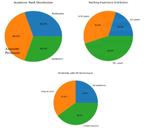
The targeted participants for the study were STEM faculty members across multiple universities in diverse geographic regions. The survey was distributed across various universities, and a total of 500 responses were collected. The sample included a balanced representation of academic ranks, teaching experience, and familiarity with XR technologies (Upadhyay et al., 2024). The demographic breakdown of the survey participants is presented in Figure 2.
Data Collection and Analysis
Data was collected via Google Forms and Qualtrics, distributed through university email lists, professional networks (e.g., LinkedIn, ResearchGate), and academic conferences. Follow-up reminders were sent after two weeks to encourage participation. Ethical considerations included voluntary participation, informed consent, anonymity, and approval from the Institutional Review Board (IRB).
The collected data were analysed using a combination of statistical methods:
-
Independent t-tests: To compare adoption intent between faculty with and without prior XR experience (Makransky & Petersen, 2021).
-
ANOVA: To examine variations in adoption intent across different academic ranks (Ledger et al., 2022).
-
Chi-square tests: To assess the relationship between faculty training and adoption intent (Guo et al., 2021).
-
Multiple Regression Analysis: To identify key predictors of XR adoption intent (Upadhyay et al., 2024).
-
Statistical significance was set at p < 0.05, and all analyses were conducted using SPSS 28.0.
Statistical Analyses
To rigorously evaluate the factors influencing faculty adoption of XR in STEM education, multiple statistical tests were conducted. Table 4 summarizes the statistical tests conducted to evaluate the factors affecting faculty adoption of XR in STEM education (Ledger et al., 2022; Makransky & Petersen, 2021).
Results and Discussion
Table 5 summarizes the key findings of the study, highlighting the factors affecting the XR adoption in STEM education from the faculty perspective. The findings are analyzed in detail as follows:
Institutional and Financial Support
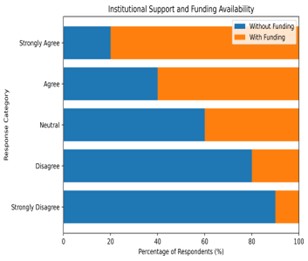
The survey results revealed mixed perceptions of institutional support for XR integration (Oakley et al., 2025; Cumberbatch et al., 2023). The mean rating for institutional support was 3.45 (SD = 1.22), indicating moderate levels of support were provided to the faculty members for the adoption of XR in the teaching and learning process. However, significant variability was observed, with 45% of respondents reporting inadequate funding and 40% citing a lack of policy guidance (Zolezzi et al., 2024; Mourtzis et al., 2023). These findings suggest that while some institutions are actively promoting XR adoption, others lag due to structural limitations. Figure 3a presents the relationship between institutional support and the availability of funding for XR adoption in academia. It analyzes the survey responses regarding the institutional support and funding for XR and depicts that there is a strong correlation between institutional support and funding availability (Zhao et al., 2023; Zatarain‐Cabada et al., 2023). As institutional support for XR in academia increases, the chances of receiving funding significantly improve. Among those faculty members who strongly agree that they have institutional support, 80% have received funding, whereas only 20% have not. Conversely, among those who strongly disagree, only 10% have received funding, while 90% have not.

The variability in institutional support highlights the importance of the Resource-Based View (RBV) theory, which emphasizes the role of organisational resources in technology adoption. Institutions that fail to provide adequate funding, infrastructure, and policy frameworks are unlikely to achieve successful XR integration (Boss et al., 2015; Hornbæk & Hertzum, 2017). This underscores the need for targeted investments in XR-ready labs, hardware, and training programs (Yi et al., 2023; Pellas et al., 2020).
Faculty Training and Digital Literacy
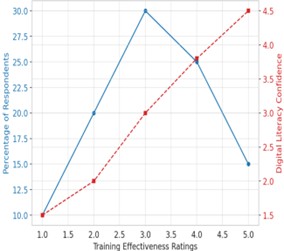
Figure 3 b represents the relationship between the effectiveness of faculty training and their confidence in digital literacy. Analysis of survey responses highlights the linear correlation between the effectiveness of higher Training with higher digital literacy. Faculty who rated the institutional training as "Very Effective" had the highest digital literacy confidence (~4.0), and those who found training to be "Very Ineffective" reported the lowest confidence (~2.0). Faculty training programs received a mean rating of 3.25 (SD = 1.18), indicating that there is room for improvement in the faculty training programs on the XR technologies (Makransky & Petersen, 2021; Pellas et al., 2020). Similarly, the digital literacy confidence was rated 3.50 (SD = 1.15), suggesting that while many faculty members are comfortable with digital tools, additional training is needed to bridge gaps in XR-specific skills.

These findings align with Bandura's Self-Efficacy Theory (Scherer, R. 2019), which posits that individuals' confidence in their abilities influences their willingness to adopt new technologies (Xue et al., 2024; Meccawy, 2023). The moderate ratings for training effectiveness and digital literacy suggest that institutions should invest in hands-on, practical training programs to enhance faculty confidence and competence in using XR tools (Pellas et al., 2020; Meccawy, 2023).
Social and Pedagogical Factors
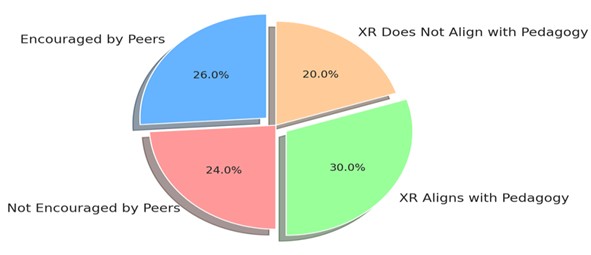
Survey questions related to social and pedagogical factors were designed to assess the extent of peer encouragement and XR's alignment with teaching philosophies. The survey responses demonstrated in Figure 3 c suggest that the peer collaboration was limited, with only 52% of respondents reporting encouragement from colleagues (Chen et al., 2022; Meccawy, 2023). Pedagogical alignment received a mean rating of 3.60 (SD = 1.10), indicating that 60% of faculty believe XR aligns with their pedagogy, while 40% do not (Oakley et al., 2025; Cumberbatch et al., 2023).

These findings suggest that there is a need for fostering a culture of innovation and collaboration to enhance XR adoption. According to Rogers' Diffusion of Innovation Theory (Al-Rahmi, et. al., 2018), peer influence plays a critical role in the adoption of new technologies (Neves et al., 2025; Zhao et al., 2023). Institutions should create platforms for faculty to share experiences, collaborate on XR projects, and learn from one another.
Technology and Data Security Concerns
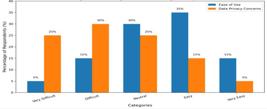
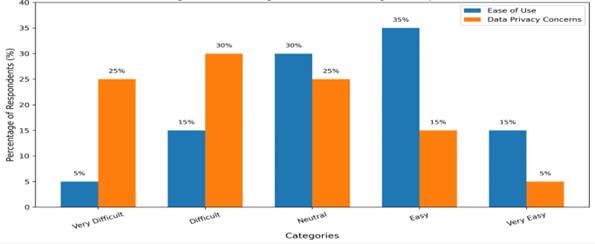
Technological factors analyse the usability of XR tools for faculty members and their concerns regarding data privacy. Survey responses were analyzed to reveal that the ease of use was rated 3.10 (SD = 1.30), with 48% of respondents describing XR tools as difficult to use, while the rest 52% considered the usability of XR as neutral, easy or very easy. Secondly, data privacy concerns were also prevalent among faculty members, with 55% of faculty expressing apprehensions about student data security (Radianti et al., 2020; Zolezzi et al., 2024). These findings are shown in Figure 3d .
The usability challenges align with Usability Theory (Hornbæk, K., & Hertzum, M., 2017), which emphasizes the importance of intuitive and user-friendly interfaces (Sırakaya & Alsancak Sırakaya, 2022; Ledger et al., 2022). The high level of data privacy concerns reflects the Protection Motivation Theory (Boss, S. R., Galletta, D. F., Lowry, P. B., Moody, G. D., & Polak, P., 2015), suggesting that faculty members may avoid adopting XR if they perceive risks to student data. To address these issues, developers should prioritise user-centred design and provide transparent information about data security measures.
Predictive Modelling of XR Adoption
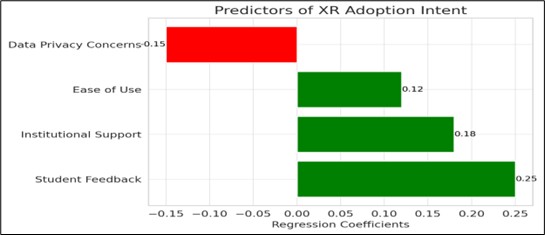
Multiple regression analysis identified the following predictors of XR adoption intent (Figure 3e ):
-
Student Feedback (+0.25): The strongest positive predictor, indicating that positive student experiences encourage faculty adoption (Al-Rahmi et al., 2018).
-
Institutional Support (+0.18): Positive correlation, highlighting the importance of organizational backing (Mourtzis et al., 2023; Neves et al., 2025).
-
Ease of Use (+0.12): Moderately positive, suggesting that user-friendly tools enhance adoption intent (Yi et al., 2023).
-
Data Privacy Concerns (-0.15): Negative correlation, underscoring the deterrent effect of security apprehensions (Zatarain‐Cabada et al., 2023; Pellas et al., 2020).

The regression results provide empirical evidence for the factors driving XR adoption (Neves et al., 2025; Al-Rahmi et al., 2018). The strong influence of student feedback and institutional support aligns with prior research on technology adoption in education. However, the negative impact of data privacy concerns highlights a critical barrier that must be addressed through robust security frameworks and clear communication (Pellas et al., 2020; Zatarain‐Cabada et al., 2023)
Conclusion
This study examined the key factors influencing the adoption of Extended Reality (XR) technologies in higher education, particularly among STEM faculty. By analyzing institutional support, faculty training, social and pedagogical influences, technological concerns, and predictive modelling, the research provides valuable insights into the current state of XR integration and the challenges that must be addressed for widespread adoption.
The findings highlight that while some institutions actively promote XR adoption, funding constraints and lack of policy guidance remain significant barriers. The strong correlation between institutional support and funding availability suggests that well-supported faculty are far more likely to receive necessary resources for XR integration. Additionally, faculty training programs play a crucial role in determining digital literacy confidence, with faculty who received high-quality training exhibiting greater confidence in using XR tools. This emphasizes the need for structured, hands-on training programs to enhance adoption rates.
Social and pedagogical factors also influence XR adoption, with peer collaboration remaining limited, as only 52% of faculty members reported receiving encouragement from colleagues. Despite this, 60% of faculty believe XR aligns with their pedagogy, suggesting that XR has significant potential to enhance teaching effectiveness if better faculty support networks and collaborative initiatives are established. On the technological front, usability challenges and data privacy concerns emerged as major deterrents. Faculty members with lower confidence in XR usability were less likely to integrate it into their teaching, while concerns over student data security discouraged adoption due to perceived risks.
The predictive modelling of XR adoption identified student feedback (+0.25) and institutional support (+0.18) as the strongest positive predictors of XR adoption, reinforcing the importance of student engagement and administrative backing. Conversely, data privacy concerns (-0.15) negatively impacted adoption intent, highlighting the need for improved security measures and transparent data protection policies. These findings suggest that for successful XR adoption in STEM education, institutions must enhance institutional support by establishing clear policies, providing consistent funding, and building XR-ready infrastructure. Investments in faculty training programs with hands-on experiences are essential to bridge digital literacy gaps and improve adoption rates. Encouraging peer collaboration and knowledge-sharing initiatives among faculty members can further accelerate XR integration, while improvements in user experience (UX) design and data security frameworks will address concerns that currently hinder adoption.
While this study provides valuable insights, future research should explore longitudinal studies to track XR adoption trends, comparative studies across disciplines, and student-centered perspectives on XR learning outcomes. Further examination of data security frameworks and their impact on faculty adoption is also necessary to develop more effective privacy protection strategies.
The integration of XR in higher education presents a transformative opportunity to enhance engagement, improve learning outcomes, and bridge the gap between theoretical and practical applications in STEM fields. However, overcoming barriers such as funding limitations, training gaps, and data security issues is crucial to ensuring widespread adoption. By addressing these challenges, institutions can pave the way for a more immersive, innovative, and technology-driven future in education.
Limitations and Future Work
This study provides useful insights into how faculty members adopt Extended Reality (XR) technologies in STEM education. However, there are areas that future research can explore further. For example, long-term studies could help understand how XR adoption changes over time and how faculty attitudes and institutional support evolve.
Future research could also compare XR adoption across different academic fields to see if STEM faculty face different challenges than those in other disciplines. Additionally, since this study focused on faculty perspectives, future studies could examine student experiences to understand how XR impacts learning outcomes and engagement. Improving predictive models with advanced data analysis techniques, such as machine learning, could help create better faculty training programs tailored to individual needs. As XR technology continues to develop, future studies could also look at new innovations, like AI-driven XR tools, and their role in education.
Lastly, data security and privacy remain important concerns. Future research could focus on how universities can better protect student data and build faculty confidence in using XR tools. Addressing these areas will help institutions make more informed decisions about integrating XR into education and maximizing its benefits for both faculty and students.
References:
-
Ajit, G. (2021). A Systematic Review of Augmented Reality in STEM Education. Studies of Applied Economics, 39(1). https://doi.org/10.25115/eea.v39i1.4280
» https://doi.org/10.25115/eea.v39i1.4280 -
Alnagrat, A. J. A., Ismail, R. C., & Idrus, S. Z. S. (2021). Extended Reality (XR) in Virtual Laboratories: A Review of Challenges and Future Training Directions. Journal of Physics: Conference Series, 1874(1), 012031. https://doi.org/10.1088/1742-6596/1874/1/012031
» https://doi.org/10.1088/1742-6596/1874/1/012031 -
Alnagrat, A. J. A., Ismail, R. C., & Idrus, S. Z. S. (2023). The importance of Extended Reality (XR) technologies in education during the Covid-19 pandemic: Implications and challenges 020057. https://doi.org/10.1063/5.0127818
» https://doi.org/10.1063/5.0127818 -
Al-Rahmi, W. M., Alias, N., Othman, M. S., Marin, V. I., & Tur, G. (2018). A model of factors affecting learning performance through the use of social media in Malaysian higher education. Computers & Education, 121, 59-72. https://doi.org/10.1016/j.compedu.2018.02.010
» https://doi.org/10.1016/j.compedu.2018.02.010 -
Boss, S. R., Lowry, P. B., Moody, G. D., & Polak, P. (2015). What Do Systems Users Have to Fear? Using Fear Appeals to Engender Threats and Fear that Motivate Protective Security Behaviors. MIS Quarterly, 39(4), 837-864. https://doi.org/10.25300/MISQ/2015/39.4.5
» https://doi.org/10.25300/MISQ/2015/39.4.5 -
Chen, X., Xie, H., & Li, Q. (2022). Vision, status, and topics of X Reality in Education. Computers & Education: X Reality , 1, 100001. https://doi.org/10.1016/j.cexr.2022.100001
» https://doi.org/10.1016/j.cexr.2022.100001 -
Cumberbatch, I., Olatunji, J., & Robila, S. A. (2023). Using Extended Reality Technology in Science Education. 2023 IEEE Long Island Systems, Applications and Technology Conference (LISAT) , 1-6. https://doi.org/10.1109/LISAT58403.2023.10179579
» https://doi.org/10.1109/LISAT58403.2023.10179579 -
Doolani, S., Wessels, C., Kanal, V., Sevastopoulos, C., Jaiswal, A., Nambiappan, H., & Makedon, F. (2020). A Review of Extended Reality (XR) Technologies for Manufacturing Training. Technologies, 8(4), 77. https://doi.org/10.3390/technologies8040077
» https://doi.org/10.3390/technologies8040077 -
Fernández-Cerero, J., Fernández-Batanero, J. M., & Montenegro-Rueda, M. (2024). Possibilities of Extended Reality in education. Interactive Learning Environments, 1-15. https://doi.org/10.1080/10494820.2024.2342996
» https://doi.org/10.1080/10494820.2024.2342996 -
Guo, X., Guo, Y., & Liu, Y. (2021). The Development of Extended Reality in Education: Inspiration from the Research Literature. Sustainability, 13(24), 13776. https://doi.org/10.3390/su132413776
» https://doi.org/10.3390/su132413776 -
Hornbæk, K., & Hertzum, M. (2017). Technology Acceptance and User Experience: A Review of the Experiential Component in HCI. ACM Transactions on Computer-Human Interaction, 24(5), 1-30. https://doi.org/10.1145/3127358
» https://doi.org/10.1145/3127358 -
Hoyer, W. D., Kroschke, M., Schmitt, B., Kraume, K., & Shankar, V. (2020). Transforming the Customer Experience through New Technologies. Journal of Interactive Marketing, 51(1), 57-71. https://doi.org/10.1016/j.intmar.2020.04.001
» https://doi.org/10.1016/j.intmar.2020.04.001 -
Khlaif, Z. N., Mousa, A., & Sanmugam, M. (2024). Immersive Extended Reality (XR) Technology in Engineering Education: Opportunities and Challenges. Technology, Knowledge and Learning, 29(2), 803-826. https://doi.org/10.1007/s10758-023-09719-w
» https://doi.org/10.1007/s10758-023-09719-w -
Lai, J. W., & Cheong, K. H. (2022). Adoption of Virtual and Augmented Reality for Mathematics Education: A Scoping Review. IEEE Access, 10, 13693-13703. https://doi.org/10.1109/ACCESS.2022.3145991
» https://doi.org/10.1109/ACCESS.2022.3145991 -
Ledger, S., Burgess, M., Rappa, N., Power, B., Wong, K. W., Teo, T., & Hilliard, B. (2022). Simulation platforms in initial teacher education: Past practice informing future potentiality. Computers & Education , 178, 104385. https://doi.org/10.1016/j.compedu.2021.104385
» https://doi.org/10.1016/j.compedu.2021.104385 -
Makransky, G., & Petersen, G. B. (2021). The Cognitive Affective Model of Immersive Learning (CAMIL): A Theoretical Research-Based Model of Learning in Immersive Virtual Reality. Educational Psychology Review, 33(3), 937-958. https://doi.org/10.1007/s10648-020-09586-2
» https://doi.org/10.1007/s10648-020-09586-2 -
Meccawy, M. (2023). Teachers’ prospective attitudes towards the adoption of extended reality technologies in the classroom: Interests and concerns. Smart Learning Environments, 10(1), 36. https://doi.org/10.1186/s40561-023-00256-8
» https://doi.org/10.1186/s40561-023-00256-8 -
Mourtzis, D., Angelopoulos, J., & Panopoulos, N. (2023). Extended Reality (XR) Applications for Engineering Education 5.0. SSRN Electronic Journal https://doi.org/10.2139/ssrn.4470086
» https://doi.org/10.2139/ssrn.4470086 -
Neves, C., Oliveira, T., Cruz-Jesus, F., & Venkatesh, V. (2025). Extending the unified theory of acceptance and use of technology for sustainable technologies context. International Journal of Information Management, 80, 102838. https://doi.org/10.1016/j.ijinfomgt.2024.102838
» https://doi.org/10.1016/j.ijinfomgt.2024.102838 -
Oakley, G., Dawson, V., & Pegrum, M. (2025). Using extended reality (XR) technologies to teach literacy in primary school science within a 5E instructional model. Research in Science & Technological Education, 1-17. https://doi.org/10.1080/02635143.2024.2446792
» https://doi.org/10.1080/02635143.2024.2446792 -
Pan, Y., & Mow, G. L. (2023). Study on the Impact of Gamified Teaching Using Mobile Technology on College Students’ Learning Engagement. International Journal of Emerging Technologies in Learning (iJET), 18(14), 66-77. https://doi.org/10.3991/ijet.v18i14.41207
» https://doi.org/10.3991/ijet.v18i14.41207 -
Pellas, N., Dengel, A., & Christopoulos, A. (2020). A Scoping Review of Immersive Virtual Reality in STEM Education. IEEE Transactions on Learning Technologies, 13(4), 748-761. https://doi.org/10.1109/TLT.2020.3019405
» https://doi.org/10.1109/TLT.2020.3019405 -
Radianti, J., Majchrzak, T. A., Fromm, J., & Wohlgenannt, I. (2020). A systematic review of immersive virtual reality applications for higher education: Design elements, lessons learned, and research agenda. Computers & Education , 147, 103778. https://doi.org/10.1016/j.compedu.2019.103778
» https://doi.org/10.1016/j.compedu.2019.103778 -
Salinas, D., Muñoz-La Rivera, F., & Mora-Serrano, J. (2022). Critical Analysis of the Evaluation Methods of Extended Reality (XR) Experiences for Construction Safety. International Journal of Environmental Research and Public Health, 19(22), 15272. https://doi.org/10.3390/ijerph192215272
» https://doi.org/10.3390/ijerph192215272 -
Scherer, R., Siddiq, F., & Tondeur, J. (2019). The technology acceptance model (TAM): A meta-analytic structural equation modeling approach to explaining teachers’ adoption of digital technology in education. Computers & Education , 128, 13-35. https://doi.org/10.1016/j.compedu.2018.09.009
» https://doi.org/10.1016/j.compedu.2018.09.009 -
Sırakaya, M., & Alsancak Sırakaya, D. (2022). Augmented reality in STEM education: A systematic review. Interactive Learning Environments, 30(8), 1556-1569. https://doi.org/10.1080/10494820.2020.1722713
» https://doi.org/10.1080/10494820.2020.1722713 -
Upadhyay, B., Chalil Madathil, K., Hegde, S., Anderson, D., Wooldridge, E., Presley, D., Perez, L., & Reid, B. (2024). Barriers Toward the Implementation of Extended Reality (XR) Technologies to Support Education and Training in Workforce Development Programs. Proceedings of the Human Factors and Ergonomics Society Annual Meeting, 68(1), 265-269. https://doi.org/10.1177/10711813241275080
» https://doi.org/10.1177/10711813241275080 -
Xue, L., Rashid, A. M., & Ouyang, S. (2024). The Unified Theory of Acceptance and Use of Technology (UTAUT) in Higher Education: A Systematic Review. Sage Open, 14(1), 21582440241229570. https://doi.org/10.1177/21582440241229570
» https://doi.org/10.1177/21582440241229570 -
Yi, Y., Wu, Y., & Luo, H. (2023). Visual Analysis of the Application Research of Extended Reality in Education Based on CiteSpace. 2023 5th International Conference on Computer Science and Technologies in Education (CSTE), 270-274. https://doi.org/10.1109/CSTE59648.2023.00054
» https://doi.org/10.1109/CSTE59648.2023.00054 -
Zatarain‐Cabada, R., Barrón‐Estrada, M. L., Cárdenas‐Sainz, B. A., & Chavez‐Echeagaray, M. E. (2023). Experiences of web‐based extended reality technologies for physics education. Computer Applications in Engineering Education, 31(1), 63-82. https://doi.org/10.1002/cae.22571
» https://doi.org/10.1002/cae.22571 -
Zhao, X., Ren, Y., & Cheah, K. S. L. (2023). Leading Virtual Reality (VR) and Augmented Reality (AR) in Education: Bibliometric and Content Analysis From the Web of Science (2018-2022). Sage Open, 13(3), 21582440231190821. https://doi.org/10.1177/21582440231190821
» https://doi.org/10.1177/21582440231190821 -
Ziker, C., Truman, B., & Dodds, H. (2021). Cross Reality (XR): Challenges and Opportunities Across the Spectrum. In J. Ryoo & K. Winkelmann (Eds.), Innovative Learning Environments in STEM Higher Education (pp. 55-77). Springer International Publishing. https://doi.org/10.1007/978-3-030-58948-6_4
» https://doi.org/10.1007/978-3-030-58948-6_4 -
Zolezzi, D., Iacono, S., Martini, L., & Vercelli, G. V. (2024). Comunicazione Digitale XR: Assessing the impact of extended reality technologies on learning. Computers & Education : X Reality , 5, 100077. https://doi.org/10.1016/j.cexr.2024.100077
» https://doi.org/10.1016/j.cexr.2024.100077

 Source: Author
 Source: Author
 Source: Author
 Source: Author
 Source: Author
 Source: Author
 Source: Author