Effects of exergames intervention on neuropsychiatric symptoms in older adults with neurocognitive disorders
ABSTRACT
Background: Exergames, active electronic games that integrate physical and cognitive tasks, have emerged as promising tools to enhance cognitive function and support the management of neurocognitive disorders (NCDs). By combining physical and cognitive stimulation, exergames may foster motivation, autonomy, and social connectedness, potentially alleviating neuropsychiatric symptoms (NPS).
Objective: This study aimed to investigate the effects of exercise interventions, with and without virtual reality, on NPS in older adults with NCDs.
Methods: Twenty-one participants with NCDs receiving care at the Institute of Psychiatry, Federal University of Rio de Janeiro, were randomly assigned to one of two groups: an experimental group (n = 11; 16 sessions, twice weekly, 50 minutes each; exercise incorporating exergames) or an active control group (n = 10; identical protocol without exergames). NPS were assessed before and after the intervention using the Neuropsychiatric Inventory (NPI).
Results: A significant group-by-time interaction was observed for total NPI scores (p < 0.001), indicating symptom improvement exclusively in the exergame group. Additionally, a main effect of time was found for the number of symptoms (p < 0.002), as well as for depression (p = 0.002), anxiety (p = 0.031), agitation (p = 0.019), and apathy (p = 0.019), reflecting overall reductions across both groups. No significant effects were observed for other domains.
Conclusion: Physical exercise, particularly when combined with virtual reality, represents a promising adjunctive intervention for alleviating NPS in older adults with NCDs. This finding holds clinical relevance, as these symptoms are especially challenging to manage pharmacologically and are a major source of caregiver burden. Exergames should be considered as a person-centered, goal-oriented approach to dementia rehabilitation.
KEYWORDS
Neurocognitive Disorders; Dementia; Exergames; Virtual Reality; Neuropsychiatric Symptoms
SUMÁRIO
Contexto: Os exergames, jogos eletrônicos ativos que integram tarefas físicas e cognitivas, surgiram como ferramentas promissoras para aprimorar a função cognitiva e apoiar o manejo de transtornos neurocognitivos (TNCs). Ao combinar estimulação física e cognitiva, os exergames podem promover motivação, autonomia e conexão social, potencialmente aliviando sintomas neuropsiquiátricos (SNP).
Objetivo: Este estudo teve como objetivo investigar os efeitos de intervenções com exercícios, com e sem realidade virtual, sobre os SNP em idosos com TNCs.
Métodos: Vinte e um participantes com TNCs em acompanhamento no Instituto de Psiquiatria da Universidade Federal do Rio de Janeiro foram aleatoriamente alocados em um dois grupos: um grupo experimental (n = 11; 16 sessões, duas vezes por semana, 50 minutos cada; exercícios incorporando exergames) ou um grupo controle ativo (n = 10; protocolo idêntico, porém sem exergames). Os SNP foram avaliados antes e depois da intervenção utilizando o Inventário Neuropsiquiátrico (NPI).
Resultados: Observou-se uma interação significativa entre grupo e tempo para os escores totais do NPI (p < 0,001), indicando melhora dos sintomas exclusivamente no grupo de exergames. Além disso, foi encontrado um efeito principal do tempo para o número de sintomas (p < 0,002), bem como para depressão (p = 0,002), ansiedade (p = 0,031), agitação (p = 0,019) e apatia (p = 0,019), refletindo reduções gerais em ambos os grupos. Não foram observados efeitos significativos para outros domínios.
Conclusão: O exercício físico, particularmente quando combinado com realidade virtual, representa uma intervenção adjuvante promissora para aliviar os sintomas neuropsiquiátricos em idosos com doenças crônicas não transmissíveis. Essa descoberta tem relevância clínica, visto que esses sintomas são especialmente difíceis de controlar farmacologicamente e representam uma importante fonte de sobrecarga para os cuidadores. Os exergames devem ser considerados como uma abordagem centrada na pessoa e orientada para objetivos na reabilitação da demência.
PALAVRAS-CHAVE
Transtornos neurocognitivos; Demência; Exergames; Realidade virtual; Sintomas neuropsiquiátricos
INTRODUCTION
The rising prevalence of dementia syndromes, or Neurocognitive Disorders (NCD), is closely linked to global population aging and further exacerbated by lifestyle factors and socioeconomic disparities (1). With increasing life expectancy, NCD have become an urgent public health concern, given their profound impact on autonomy, independence, and quality of life (2). Globally, more than 55 million people were living with NCD in 2019, a number projected to exceed 139 million by 2050 (3). Prevalence increases markedly with age, reaching up to 25% in individuals aged 85 years or older. In Brazil, there are an estimated 1.2 million diagnosed cases, with approximately 100,000 new cases annually (4). Beyond health consequences, dementia generates enormous economic costs, expected to rise from US$1.3 trillion in 2019 to US$2.8 trillion by 2030, with nearly half of these costs borne by informal caregivers (5). The Alzheimer's Disease International Report (2025) highlights the need to prioritize dementia rehabilitation through person-centered, goal-oriented, and collaborative approaches, implemented across diverse environmental settings and stages of the disease. Exercise is a well-established intervention shown to improve cognitive, motor, and functional performance in individuals with dementia (6). A recent network meta-review showed the importance of adopting a dual approach to managing cognitive impairment, integrating both cognitive and physical rehabilitation within the same intervention. Physical-cognitive rehabilitation emerged as the most effective nonpharmacological intervention for enhancing global cognition in patients with unspecified cognitive impairment and dementia (7).
Besides cognitive deficits and loss of functionality, Neuropsychiatric symptoms (NPS) are highly prevalent and strongly associated with disease severity (8). Approximately 90% of people with dementia will experience NPI symptoms, including depression, anxiety, agitation, apathy, psychosis, and sleep disorders, during dementia. These symptoms worsen functional decline, increase caregiver burden, and contribute to disability, hospitalization, and reduced life expectancy (9). While pharmacological treatments, such as cholinesterase inhibitors, may modestly slow cognitive decline, they are largely ineffective for NPS and frequently produce adverse effects (10). Consequently, there is growing emphasis on non-pharmacological strategies, including occupational therapy, cognitive stimulation, psychosocial support, and physical exercise (11). Aerobic and resistance training improve cognition, functionality, and mobility while reducing depression and fall risk (12,13). Dual-task exercises, which combine cognitive and motor demands, further enhance attention, processing speed, and executive function, potentially stimulating brain plasticity and slowing decline (14,15). Exergames, interactive video games requiring body movements, integrate physical activity with cognitive engagement in a playful and motivating environment. Unlike sedentary games, exergames demand motor coordination and physical effort, increasing adherence while simulating real-life tasks (13,16). By integrating physical, cognitive, and emotional stimulation, exergames may enhance motivation, autonomy, and social connectedness, potentially alleviating neuropsychiatric symptoms. These features position exergames as a promising person-centred, goal-oriented rehabilitation in dementia. This study aimed to investigate the effects of exercise (with or without virtual reality) on neuropsychiatric symptoms in older adults with NCD.
METHODS
This study is part of a larger randomized controlled trial with parallel group allocation aimed at investigating the effects of virtual reality program in functional and cognitive performance and biomarkers in older adults with mild cognitive decline and dementia (REBEC RBR-3bq4rg). The main study, approved by the local ethics committee (CEP: 02585018.0.3001.5263).
Participants and eligibility criteria
Participants were recruited from the general database of the Alzheimer's Disease Center (CDA) of the Institute of Psychiatry of the University of Brazil (IPUB), the psychiatric hospital of the Federal University of Rio de Janeiro (UFRJ), through the analysis of internal medical records. In addition, other professionals at the CDA were asked to refer their patients to this project. The enrolment, randomization, and final analysis procedures are shown in the CONSORT flow diagram (Figure 1).

The study population consisted of 21 elderly male and female individuals who met the following inclusion criteria: a) diagnosis of major or mild neurocognitive disorder; b) having a CDR 1.0 and 2.0; c) being a patient of the CDA/IPUB; d) being at least 60 years old; e) not having practiced physical exercise for at least 6 months; f) having a medical report attesting that the patient can practice physical exercise. The following exclusion criteria were considered: a) previous history of severe heart disease; b) musculoskeletal injuries that prevent exercise; c) visual impairment that prevents viewing games; d) severe cognitive decline, which does not respond to simple requests.
Experimental procedures
Interviews were scheduled with participants who accepted the invitation to confirm their eligibility based on the inclusion and exclusion criteria. If deemed eligible, patients and their caregivers were informed about the study procedures and provided written informed consent. The next stage took place at the National Institute of Cardiology, where participants underwent medical screening to obtain clearance for physical exercise. Each patient received a clinical evaluation conducted by a cardiologist, which included a detailed medical history, information about medication use, and the identification of additional risk factors for dementia and cardiovascular disease. After excluding any absolute contraindications to exercise testing, participants underwent a symptom-limited treadmill stress test following the ramp protocol (Inbramed®, Brazil). Before the test, they were instructed on how to use the Borg scale to report their perceived exertion during the procedure. Blood pressure was measured manually every two minutes using a sphygmomanometer (Riester®, Germany). In addition to the stress test, participants completed physical and cognitive assessments at both the beginning and the end of the study.
Neuropsychiatric Assessment
Neuropsychiatric symptoms were assessed using the Neuropsychiatric Inventory (NPI) (17). This instrument, considered the gold standard and demonstrating high test-retest reliability (r=0.79) (18), involves a structured interview conducted with the patient's closest family member or caregiver. The NPI addresses several categories of neuropsychiatric symptoms, including delusions, hallucinations, agitation, aggression, depression, dysphoria, anxiety, elation, euphoria, apathy, indifference, disinhibition, irritability, lability, sleep disorders, eating disorders, and other neuropsychiatric behaviors associated with NCD. Each symptom is evaluated based on its presence or absence, frequency, and severity, allowing for a detailed understanding of the patient's symptom profile. If a symptom is present, the numerical result for that category is calculated by multiplying the frequency score by the severity score, yielding a possible range of 1 to 12. The result is the sum of the scores across all categories, which can range from 0 to 144. Scores closer to 0 indicate a lower presence, frequency, and severity of neuropsychiatric symptoms, while scores closer to 144 indicate a greater presence, frequency, and severity of symptoms.
Physical Assessment
The anthropometric assessment comprised the collection of data by the research team, including body mass, height, and Body Mass Index (BMI). Handgrip strength was measured using a dynamometer (TAKEI®, Japan). Physical capacity was evaluated using two tests: 8-Foot Up and Go (Gait analysis); and 30-Second Chair Stand (Lower limb strength) (19).
Cognitive Assessment
Cognitive function was assessed using the Mini-Mental State Examination (MMSE) (20), employing the validated Portuguese version (21). This examination comprises 11 items that evaluate temporal and spatial orientation, immediate memory and word recall, calculation, naming, repetition, command execution, reading, writing, and visuomotor ability, with a maximum score of 30 points.
Dual-Task assessment
To assess the DT capacity, the 8-Foot Up and Go test was performed while simultaneously naming different animals (DT-Fluency). The dual-task cost (DTC) was also calculated to quantify the interference effect of the cognitive task on motor performance. DTC was computed using the following equation: [(dual-task time – single-task time) / dual-task time] × 100 (22).
Intervention
After the evaluations, the subjects were randomized into 2 groups. The allocation was performed using an Excel random number table: an experimental exergame group (EX) with 11 participants and an active control group (AC) with 10 participants. The intervention and assessment sessions took place in the CDA treatment rooms. The experimental group EX performed the exercises with virtual reality. Two familiarization sessions with the physical exercises were followed by 16 intervention sessions lasting approximately 50 minutes each and with a target intensity of 70% of each patient's Maximum Heart Rate (MHR). Vital signs, blood pressure (BP), and heart rate (HR) were measured at the beginning and end of each session, at the end of each exercise, and 5 minutes after the end. Exercise intensities were identified by monitoring HR with a Polar® H10 heart rate monitor connected via Bluetooth to the PolarFlow app. The equipment used for training with exergames was the Nintendo Wii®. The selected games belong to the Wii Fit Plus, Wii Sports and Wii EA Active packages. The following accessories were required to play the selected games: Wii Balance Board®, Nunchuck and Wii Motion. The image was projected onto a smooth, light-colored wall at the patient's eye level, with approximate dimensions of 70cm x 95cm, using a screen projector.
The following games were selected for this study (Table 1):
In game 1, Penguin Slide, the movement is: standing on the platform, the patient moves the center of gravity laterally to the right and left to catch as many fish as possible. In game 2, Free Step, where it is necessary to get on and off the Wii Balance Board®, a Nintendo® platform, according to the rhythm and movement of the avatar. Game 3, Free Run, consisted of a stationary walk or run, in which the execution of their movement projects the locomotion of their character in the virtual scenario. Later, in game 4, Boxing, the movements performed were extension and flexion of the upper limbs, simulating a boxing exercise on a virtual sandbag. After the two series of game 4, the participant started game 5, Dance, in which he performed dance movements with his upper limbs, according to the rhythm of the character's execution. Finally, game 6, Rowing Squat, was performed. In this game, the patient performs 15 squats on the Balance Board ®, using a chair to sit and stand up, and thus achieves a greater range of motion.
The group ACG performed physical exercises without the use of virtual reality. The movements were the same as those of the group EXG, with the same volume and target intensity (70% HR max), but the command came from a professional who accompanied the subject, without the use of the video game.
Statistical Analysis
A descriptive analysis of the demographic data was conducted. Shapiro-Wilk and Levene's tests were applied to verify normal distribution and homoscedasticity of the data, respectively. The demographic characteristics, NPI scores and all motor and cognitive variables were compared between groups (Active Control and Experimental groups) using Student's t-test (parametric variables), the Mann-Whitney U test (nonparametric variables), and the χ2 test (categorical variables) at baseline. The comparison of the total NPI score and neuropsychiatric symptoms was conducted between groups (Active group and Experimental group) and between time points (pre and post) using a two-way Analysis of Variance (ANOVA). For the analysis of symptom frequency within the sample, the Binomial test was applied. An effect size (ES) analysis was performed. ES was calculated as the difference of the two means (before intervention (M2) – after intervention (M1) divided by the pooled standard deviation (SDpooled) (ES=M2-M1/ SD). Cohen's coefficient was used to assess ES magnitude as small (>0.20), moderate (>0.50), or large (>0.80) (23). All statistical analyses were performed using JASP® version 0.19.1.0. The value of p≤0.05 was considered statistically significant.
RESULTS
The sample comprised 21 patients with Alzheimer's disease, with a mean age of 74.5 years (±8.3); 81% were women, 71.4% were classified as CDR 1, and 71.4% had more than eight years of education. There were no significant differences between groups for any demographic or clinical variable. Additional details are provided in Table 2.
The means and standard deviations of pre- and post-test battery scores for the intervention and control groups, as well as the corresponding statistical values (Table 3). There was a significant main effect for moment (pre x post) in NPI total score (F=17.88; p < 0.001) and the number of NPI symptoms (F=17.73; p < 0.001). No interaction and main effect for group were observed (Table 3). Similarly, analyses of individual NPI symptoms revealed significant pre-post improvements in both groups for Depression (F=11.72; p = 0.003), Anxiety (F=5.53; p = 0.03), Apathy (F=8.30; p = 0.01), and Agitation (F=5.22; p = 0.03). No significant interaction, and main effect for group and moment were found for Delusions, Hallucinations, Euphoria, Disinhibition, Irritability, Aberrant motor activity, Nocturnal aberrant activity, or Prandial aberrant activity. (Table 3).
Effect size analyses
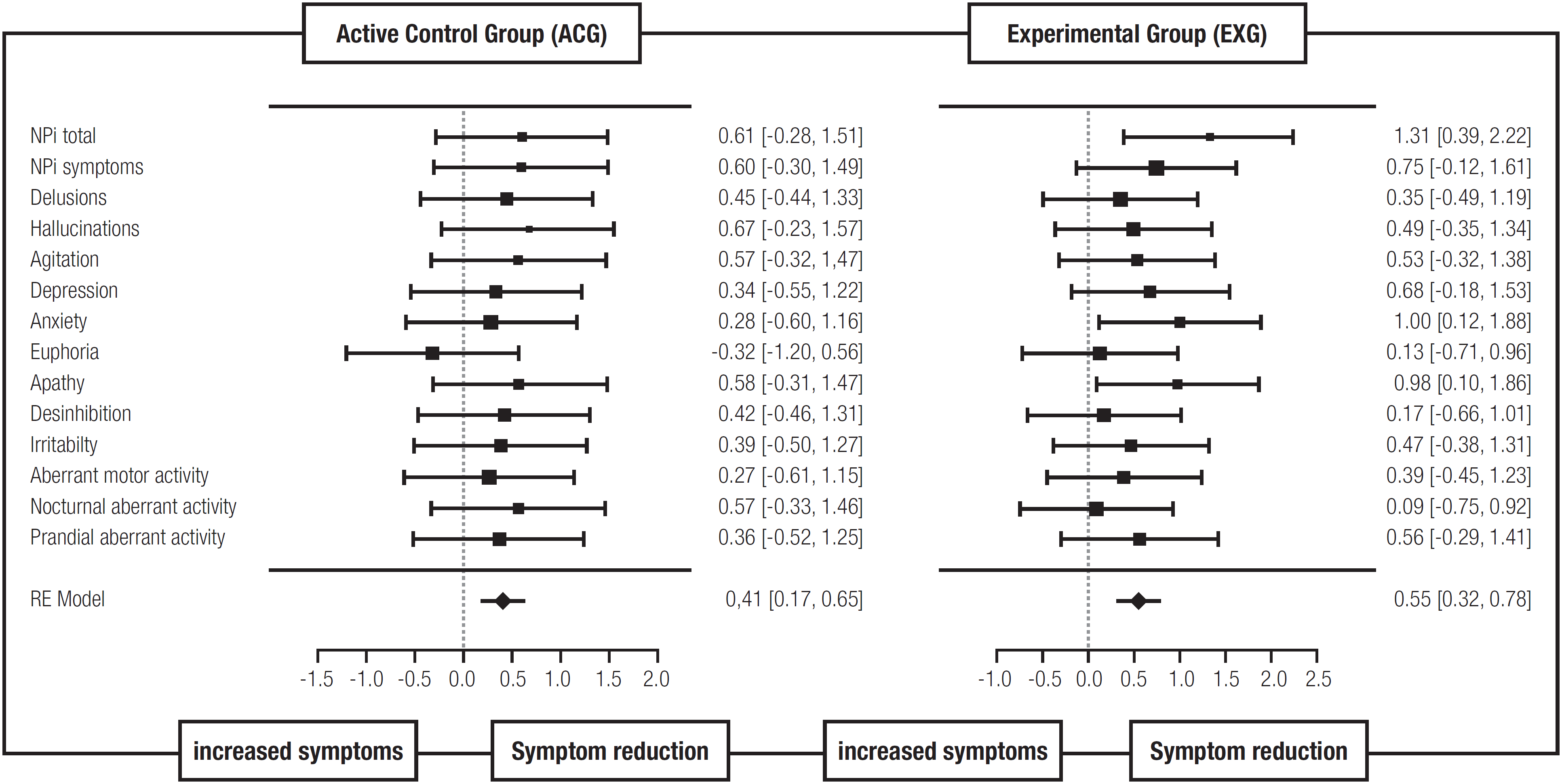
An effect size (ES) analysis was additionally performed in conjunction with traditional statistical tests to examine the impact of the intervention on neuropsychiatric symptoms across both groups and to determine the clinical significance of the findings. The ES analysis for the NPI variables results (Figure 2) has shown a better response in total ES for EXG in comparison with ACG. All the investigated variables in the EXG revealed greater effect size in favor of reduction of symptoms, with pre-post significant differences observed for the NPI total score (1.31; 95%CI, 0.39 to 2.22), Anxiety (1.00; 95%CI, 0.12 to 1.88) and Apathy (0.98; 95%CI, 0.10 to 1.86). In the Active Control Group, the only subitem for which a worse NPI score was detected was Euphoria (-0.32; 95%CI, −1.20 to 0.56).

Secondary analyses
In the secondary analyses, the only interaction between group x moment was in the dual-task (F=5.72; p= 0.027), showing an improvement only in the experimental group (exergames). Moreover, there was a significant main effect for moment (pre x post) in Chair Stand (F=17.42; p<001), showing an improvement in lower limb strength in both groups after interventions. However, no significant differences were found in other parameters (Dynamometry, 8-Foot Up and Go, DT Cost). Additional details are presented in Table 4.
DISCUSSION
This study aimed to investigate the effects of exercise (with or without virtual reality) on neuropsychiatric symptoms in older adults with NCDs. The main result was an improvement in total NPI score, number of symptoms, and reduction of depression, anxiety, agitation, and apathy. Although both groups reduce depression, anxiety, agitation and apathy, only motor-cognitive stimulation improved total NPI and dual-task performance. This finding is consistent with Lorenzo-García et al. (2024), who reported that physical-cognitive rehabilitation was the most effective non-pharmacological intervention for enhancing global cognition in patients with dementia (24).
In this sense, exergames present themselves as a promising alternative and an innovative therapeutic tool by offering a fun and safe way to exercise, providing an environment enriched by the unpredictability of the task that combines cognitive and physical stimulation in a positive emotional context (16,25,26). Patients with NCDs are at particularly high risk of low exercise adherence due to executive dysfunction and the presence of NPS, such as apathy. Thus, Padala et al. (2019) (27) showed that exergames can overcome some of the barriers to exercise and result in good adherence, making motivation more intrinsic and, thus, acting on apathy and emotional blunting. In this study, individuals in the exergames group became significantly less apathetic (-10.1 (-15.9 to −4.3); t (16) = −3.69; p = 0.002) after 12 weeks compared to individuals in the control group. This is in line with the results of other studies (6,26), suggesting an increase in motivation. This motivational impact should be considered in relation to the results obtained in the context of pharmacological interventions (26).
Although few studies have investigated the effect of exercise on a variety of neuropsychiatric symptoms in older adults with NCD, Swinnen et al. (2021) (13) found a reduction in depression symptoms in older adults with NCD after an exergame intervention. Other studies have found evidence of improvements in apathy and motivation (28,29). A systematic review with meta-analysis (30) investigated the effects of exergames in older adults with NCD and showed a significant overall improvement in depression with a large effect size (SMD = 1.46, 95% CI = −2.50, −0.43; p = 0.006). Despite high heterogeneity (I² = 91%), all studies demonstrated improvement in depression after the intervention. In people with NCDs, a systematic literature review (31) indicated that exergames may well be a viable intervention.
All those findings are in agreement with the results of this study. However, only a few controlled studies in that review investigated their effectiveness in NPS. Even so, positive results of interventions with exergames on motivation, program adherence and satisfaction have aroused increasing interest in the literature, with studies relating these results to improvements in NPS, mainly in depressive and anxious symptoms and apathy (13,26,28,29,32), corroborating the results of this study in reducing the number of NPS manifested, with a greater impact of the intervention on depressive and anxious symptoms, agitation and apathy.
The prevalence of behavioral symptoms within the study sample suggests that the absence of statistically significant findings for symptoms, such as delusions and hallucinations, may be attributed to the floor effect. This occurs when a large portion of participants score at the minimum possible value on a test, resulting in a concentration of results at the lower end of the scale. This makes it difficult to detect significant changes. Randomized controlled studies with larger samples and qualitative assessments are needed to strengthen these results.
Physical exercise modulates glucose metabolism, neurotransmitter function, and systemic inflammation, mechanisms increasingly linked to NPS, such as apathy, agitation, and anxiety in NCDs. It exerts anti-inflammatory and antioxidant effects on the brain, reducing amyloid and tau pathology and slowing neurodegeneration, particularly in Alzheimer's disease. Exercise also enhances cerebral blood flow, neurogenesis, and synaptic plasticity while regulating neurotransmitter release. Improving cardiovascular health and reducing metabolic risk factors protects against disease progression. These systemic and neurobiological effects likely explain the observed reduction in NPS across groups, as both engaged in physical activity.
Although very promising, the results of this study should be analyzed with caution due to its limitations. First, the small number of participants makes it difficult to generalize the results. Second, this study did not control for the effects of the interaction of a variety of hidden variables of NCD, such as leisure time, cognitive reserve, comorbidities, drug interactions, traumas, stress, physical fitness, and professional/personal achievement, which, according to recent studies, may be potential modulators of the pathologies and course of the disorder, as well as impairing the caregiver's observation and perception (33). Third, the fundamental heterogeneity of NCD itself, with limbic or hippocampal predominance, whether it is Alzheimer's, frontotemporal, vascular, or mixed, may be characterized by aggressive and rapid neurodegeneration or progressive and slower decline in functions. Further high-quality research with larger samples and a primary focus on neuropsychiatric symptoms is needed to corroborate these preliminary results.
CONCLUSION
Physical exercise, particularly when combined with virtual reality, represents a promising adjunctive intervention for alleviating NPS in older adults with NCDs, mainly depression, anxiety, agitation, and apathy. This finding holds clinical relevance, as these symptoms are especially challenging to manage pharmacologically and are a major source of caregiver burden. Exergames should be considered as a person-centered, goal-oriented approach to dementia rehabilitation.
Data availability statement
The data that support this study are not publicly available.
BIBLIOGRAPHIC REFERENCES
-
1 World Alzheimer Report 2025: Reimagining life with dementia - the power of rehabilitation. 2025 Sept 18 [cited 2025 Nov 11]; Available from: https://www.alzint.org/resource/world-alzheimer-report-2025/
» https://www.alzint.org/resource/world-alzheimer-report-2025/ -
2 Diagnostic and statistical manual of mental disorders: DSM-5TM, 5th ed. [Internet]. [cited 2025 Oct 30]. Available from: https://psycnet.apa.org/record/2013-14907-000
» https://psycnet.apa.org/record/2013-14907-000 -
3 Dementia [Internet]. [cited 2025 Nov 5]. Available from: https://www.who.int/news-room/fact-sheets/detail/dementia
» https://www.who.int/news-room/fact-sheets/detail/dementia -
4 Alves B/ O/ OM. Boletins Temáticos - 2022 | Biblioteca Virtual em Saúde MS [Internet]. [cited 2025 Nov 5]. Available from: https://bvsms.saude.gov.br/boletins-tematicos-2022/
» https://bvsms.saude.gov.br/boletins-tematicos-2022/ -
5 International AD. World Alzheimer Report 2023: Reducing Dementia Risk: Never too early, never too late. 2023 Sept 21 [cited 2025 Nov 5]; Available from: https://www.alzint.org/resource/world-alzheimer-report-2023/
» https://www.alzint.org/resource/world-alzheimer-report-2023/ - 6 López-Ortiz S, Valenzuela PL, Seisdedos MM, Morales JS, Vega T, Castillo-García A, et al. Exercise interventions in Alzheimer's disease: A systematic review and meta-analysis of randomized controlled trials. Ageing Res Rev. 2021 Dec 1;72:101479.
-
7 Efficacy of Nonpharmacological Interventions in Cognitive Impairment: Systematic Review And Network Meta-Analysis - The American Journal of Geriatric Psychiatry [Internet]. [cited 2025 Nov 11]. Available from: https://www.ajgponline.org/article/S1064-7481(24)00385-3/fulltext
» https://www.ajgponline.org/article/S1064-7481(24)00385-3/fulltext - 8 Geda YE, Roberts RO, Knopman DS, Petersen RC, Christianson TJH, Pankratz VS, et al. Prevalence of neuropsychiatric symptoms in mild cognitive impairment and normal cognitive aging: population-based study. Arch Gen Psychiatry. 2008 Oct;65(10):1193-8.
- 9 Mitchell SL, Teno JM, Kiely DK, Shaffer ML, Jones RN, Prigerson HG, et al. The clinical course of advanced dementia. N Engl J Med. 2009 Oct 15;361(16):1529-38.
-
10 Donepezil for dementia due to Alzheimer's disease - PubMed [Internet]. [cited 2025 Nov 5]. Available from: https://pubmed.ncbi.nlm.nih.gov/29923184/
» https://pubmed.ncbi.nlm.nih.gov/29923184/ - 11 Forbes D, Forbes SC, Blake CM, Thiessen EJ, Forbes S. Exercise programs for people with dementia. Cochrane Database Syst Rev. 2015 Apr 15;2015(4):CD006489.
- 12 Lamb SE, Mistry D, Alleyne S, Atherton N, Brown D, Copsey B, et al. Aerobic and strength training exercise programme for cognitive impairment in people with mild to moderate dementia: the DAPA RCT. Health Technol Assess Winch Engl. 2018 May;22(28):1-202.
- 13 Swinnen N, Vandenbulcke M, de Bruin ED, Akkerman R, Stubbs B, Firth J, et al. The efficacy of exergaming in people with major neurocognitive disorder residing in long-term care facilities: a pilot randomized controlled trial. Alzheimers Res Ther. 2021 Mar 30;13(1):70.
- 14 Pichierri G, Wolf P, Murer K, de Bruin ED. Cognitive and cognitive-motor interventions affecting physical functioning: a systematic review. BMC Geriatr. 2011 June 8;11:29.
- 15 De la Rosa A, Olaso-Gonzalez G, Arc-Chagnaud C, Millan F, Salvador-Pascual A, García-Lucerga C, et al. Physical exercise in the prevention and treatment of Alzheimer's disease. J Sport Health Sci. 2020 Sept;9(5):394-404.
- 16 Medeiros P de, Capistrano R, Zequinão MA, Silva SA da, Beltrame TS, Cardoso FL. EXERGAMES AS A TOOL FOR THE ACQUISITION AND DEVELOPMENT OF MOTOR SKILLS AND ABILITIES: A SYSTEMATIC REVIEW. Rev Paul Pediatr Orgao Of Soc Pediatr Sao Paulo. 2017;35(4):464-71.
- 17 Cummings JL, Mega M, Gray K, Rosenberg-Thompson S, Carusi DA, Gornbein J. The Neuropsychiatric Inventory: comprehensive assessment of psychopathology in dementia. Neurology. 1994 Dec;44(12):2308-14.
-
18 Neuropsychiatric Inventory [Internet]. [cited 2025 Nov 5]. Available from: https://www.apa.org/pi/about/publications/caregivers/practice-settings/assessment/tools/neuropsychiatric-inventory?utm_source=chatgpt.com
» https://www.apa.org/pi/about/publications/caregivers/practice-settings/assessment/tools/neuropsychiatric-inventory?utm_source=chatgpt.com -
19 RE R, CJ J. Development and validation of criterion-referenced clinically relevant fitness standards for maintaining physical independence in later years [Internet]. Vol. 53, The Gerontologist. 2013. Available from: https://www.ncbi.nlm.nih.gov/pubmed/22613940
» https://www.ncbi.nlm.nih.gov/pubmed/22613940 - 20 Folstein MF, Folstein SE, McHugh PR. "Mini-mental state". A practical method for grading the cognitive state of patients for the clinician. J Psychiatr Res. 1975 Nov;12(3):189-98.
-
21 SciELO Brasil - O Mini-Exame do Estado Mental em uma população geral: impacto da escolaridade O Mini-Exame do Estado Mental em uma população geral: impacto da escolaridade [Internet]. [cited 2025 Nov 5]. Available from: https://www.scielo.br/j/anp/a/Sv3WMxHYxDkkgmcN4kNfVTv/?lang=pt
» https://www.scielo.br/j/anp/a/Sv3WMxHYxDkkgmcN4kNfVTv/?lang=pt - 22 Manor B, Zhou J, Jor'dan A, Zhang J, Fang J, Pascual-Leone A. Reduction of Dual-task Costs by Noninvasive Modulation of Prefrontal Activity in Healthy Elders. J Cogn Neurosci. 2016 Feb;28(2):275-81.
- 23 Cohen J. Statistical Power Analysis for the Behavioral Sciences. 2nd ed. New York: Routledge; 2013. 567 p.
-
24 Effects of physical exercise interventions on balance, postural stability and general mobility in Parkinson's disease: a network meta-analysis - PubMed [Internet]. [cited 2025 Nov 11]. Available from: https://pubmed.ncbi.nlm.nih.gov/38298133/
» https://pubmed.ncbi.nlm.nih.gov/38298133/ -
25 Billis AS, Konstantinidis EI, Ladas AI, Tsolaki MN, Pappas C, Bamidis PD. Evaluating affective usability experiences of an exergaming platform for seniors. In: 2011 10th International Workshop on Biomedical Engineering [Internet]. Kos, Greece: IEEE; 2011 [cited 2025 Nov 5]. p. 1-4. Available from: http://ieeexplore.ieee.org/document/6079048/
» http://ieeexplore.ieee.org/document/6079048/ - 26 Robert P, Albrengues C, Fabre R, Derreumaux A, Pancrazi MP, Luporsi I, et al. Efficacy of serious exergames in improving neuropsychiatric symptoms in neurocognitive disorders: Results of the X-TORP cluster randomized trial. Alzheimers Dement N Y N. 2021;7(1):e12149.
-
27 P4-665: EXERCISE ADHERENCE IN EARLY ALZHEIMER’S DEMENTIA: WHAT ROLES DO EXECUTIVE FUNCTION AND APATHY PLAY? - Padala - 2019 - Alzheimer's & Dementia - Wiley Online Library [Internet]. [cited 2025 Nov 5]. Available from: https://alz-journals.onlinelibrary.wiley.com/doi/10.1016/j.jalz.2019.09.031
» https://alz-journals.onlinelibrary.wiley.com/doi/10.1016/j.jalz.2019.09.031 - 28 Rosenberg D, Depp CA, Vahia IV, Reichstadt J, Palmer BW, Kerr J, et al. Exergames for Subsyndromal Depression in Older Adults: A Pilot Study of a Novel Intervention. Am J Geriatr Psychiatry Off J Am Assoc Geriatr Psychiatry. 2010 Mar;18(3):221-6.
- 29 Karssemeijer EGA, Bossers WJR, Aaronson JA, Sanders LMJ, Kessels RPC, Olde Rikkert MGM. Exergaming as a Physical Exercise Strategy Reduces Frailty in People With Dementia: A Randomized Controlled Trial. J Am Med Dir Assoc. 2019 Dec;20(12):1502-1508.e1.
- 30 Cheung DSK, Tse HYJ, Wong DWC, Chan CY, Wan WL, Chu KK, et al. The Effects of Exergaming on the Depressive Symptoms of People With Dementia: A Systematic Review and Meta-Analysis. J Clin Nurs. 2025 May;34(5):1648-64.
- 31 van Santen J, Dröes RM, Holstege M, Henkemans OB, van Rijn A, de Vries R, et al. Effects of Exergaming in People with Dementia: Results of a Systematic Literature Review. J Alzheimers Dis JAD. 2018;63(2):741-60.
- 32 Padala KP, Padala PR, Lensing SY, Dennis RA, Bopp MM, Parkes CM, et al. Efficacy of Wii-Fit on Static and Dynamic Balance in Community Dwelling Older Veterans: A Randomized Controlled Pilot Trial. J Aging Res. 2017;2017:4653635.
- 33 Liyanage SI, Santos C, Weaver DF. The hidden variables problem in Alzheimer's disease clinical trial design. Alzheimers Dement N Y N. 2018;4:628-35.
Edited by
-
Handling Editor:
Marcia Cristina Dourado