Prevalence of depressive symptoms in patients with chronic kidney disease on hemodialysis
ABSTRACT
Objective The present study evaluated the prevalence of depression in patients with chronic kidney disease undergoing hemodialysis treatment.
Methods This cross-sectional, descriptive, and quantitative study was conducted in a medium-sized dialysis center in Belém, Pará. The sample was calculated with 40 patients, following predefined inclusion and exclusion criteria. Sociodemographic and clinical data were collected through questionnaires, and depression was assessed using the Beck Depression Inventory. The study was approved by the institutional ethics committee.
Results The study included 40 patients, with 55% male and 52.5% aged 40-59. Most had completed or partially completed high school, were single, and 42.5% had a monthly income of one minimum wage. The main comorbidities were hypertension (62.5%) and diabetes (32.5%). 62.5% of the patients showed some level of depressive symptoms, while 37.5% had no depressive signs. Most associated the onset of depression with the start of hemodialysis. No significant differences were found between those who underwent psychotherapy and those who didn’t. Patients in the public healthcare system scored higher in certain depressive domains.
Conclusion The presence of depressive symptoms in hemodialysis patients is linked to treatment burdens and life losses, highlighting the need for comprehensive, multidisciplinary care to improve their quality of life.
Renal Insufficiency Chronic; Renal Dialysis; Depression; Mental Health; Quality of Life
RESUMO
Objetivo O presente estudo avaliou a prevalência de depressão em pacientes com doença renal crônica em tratamento de hemodiálise.
Métodos Este estudo transversal, descritivo e quantitativo foi realizado em um centro de diálise de médio porte em Belém, Pará. A amostra foi calculada com 40 pacientes, seguindo critérios de inclusão e exclusão predefinidos. Dados sociodemográficos e clínicos foram coletados por meio de questionários, e a depressão foi avaliada usando o Inventário de Depressão de Beck. O estudo foi aprovado pelo comitê de ética institucional.
Resultados O estudo incluiu 40 pacientes, sendo 55% do sexo masculino e 52,5% com idade entre 40-59 anos. A maioria havia concluído ou parcialmente concluído o ensino médio, era solteira e 42,5% tinham renda mensal de um salário mínimo. As principais comorbidades foram hipertensão (62,5%) e diabetes (32,5%). 62,5% dos pacientes apresentaram algum nível de sintomas depressivos, enquanto 37,5% não apresentaram sinais de depressão. A maioria associou o início da depressão com o começo da hemodiálise. Não foram encontradas diferenças significativas entre os que faziam psicoterapia e os que não faziam. Pacientes do sistema público de saúde apresentaram escores mais altos em certos domínios depressivos.
Conclusão A presença de sintomas depressivos em pacientes em hemodiálise está ligada aos encargos do tratamento e perdas na vida, destacando a necessidade de um cuidado abrangente e multidisciplinar para melhorar sua qualidade de vida.
Insuficiência Renal Crônica; Diálise Renal; Depressão; Saúde Mental; Qualidade de Vida
INTRODUCTION
An interaction among lifestyle changes, genetics, socioeconomic factors, and population aging has contributed to the substantial increase in the prevalence of diabetes mellitus and systemic arterial hypertension, which are the main risk factors for the development of chronic kidney disease (CKD)1. In the current context, the increasingly high incidence and prevalence of CKD represent a global public health problem. In Brazil, it is estimated that about 8% to 10% of the adult population has CKD2.
Renal replacement therapies have significantly increased the life expectancy of chronic kidney patients, however, none of them are curative3. Furthermore, the quality of life of patients on hemodialysis is undeniably affected as they experience significant biopsychosocial losses that are deeply intertwined with the individual’s identity, such as routine, independence, employment, changes in body image, and various restrictions4.
In Brazil, hemodialysis is the most commonly used treatment for patients with advanced CKD, however, it creates a restricted and repetitive daily life, significantly limiting the patients’ routines, leading to sedentarism and decreased functionality, and directly impacting their quality of life5. Additionally, patients with chronic kidney disease are entirely dependent on the healthcare team, renal replacement therapy, and the support network that assists them6.
Previous studies conducted in Brazil reveal that adults with CKD have a high prevalence of depression, ranging from 20% to 40%. These patients, especially those undergoing dialysis therapy, have suicide rates up to 400 times higher than the general population4. Additionally, the loss of autonomy, caused by the difficulty in maintaining paid activities, can generate feelings of worthlessness and worsen depression, as confirmed by research on the emotional impact of CKD7.
Given this important aspect, the analysis of its psychological repercussions on patients with CKD has been utilized to inform quality of life assessments for these patients, considering it an extremely relevant factor in the renal therapeutic landscape4. Making this element fundamental in treatment means acknowledging the possibility of achieving a state of physical and mental well-being.
In Brazil, research on depression and chronic diseases is limited, highlighting the need to expand the literature to develop programs that promote early detection and appropriate treatment. Despite its high prevalence, depression in CKD is often overlooked, as healthcare professionals frequently interpret symptoms such as sadness and isolation as part of chronic diseases, failing to recognize the need for specific care4.
METHODS
It refers to a cross-sectional, descriptive, and quantitative study conducted at a medium-sized dialysis center focused on humanized renal therapy, which provides services to private insurance and the Unified Health System (SUS) in the city of Belém, Pará.
Participants
This service caters to approximately 170 patients requiring renal replacement therapy, supported by a multidisciplinary team and infrastructure for support. To obtain the specified population, a count of patients undergoing hemodialysis for at least 3 months in 2023 was conducted, totaling 164 patients. After obtaining this number, 65 patients were excluded from the sample size calculation based on exclusion criteria, resulting in 99 patients. Thus, the calculation for a population smaller than 100,000 was performed.
Where: N = sample; d = standard deviation of 1.96; p = success percentage of 50%; q = failure percentage of 50%; U = population set of 99 elements; and e = sample margin of error of 5%. For the sample calculation, a confidence level estimated at 95% will be adopted.
Individuals diagnosed with chronic kidney disease, aged 18 years or older, of both sexes, who had been on hemodialysis for at least three months and agreed to sign the Informed Consent Form (ICF) were included. Patients with severe psychiatric comorbidities that caused cognitive deficits and hindered the application of the instruments were excluded, as well as patients whose blood count suggested severe anemia (hemoglobin less than or equal to 8) with potential symptoms resembling depression. Therefore, the clinical symptoms commonly attributed to anemia are nonspecific and highly prevalent in non-anemic and anemic people, therefore, the diagnosis in patients with symptoms such as fatigue, lack of energy and concentration or dyspnea resembles depression. The exclusion of patients with severe anemia aims to reduce metabolic conditions that simulate depression.
To begin data collection, an analysis of the patients’ medical records was first conducted to identify those who met the inclusion criteria. After this, the participants were informed about the research objectives, and those who agreed to participate were asked to sign the ICF, which was kept in a separate envelope from the questionnaires to ensure the confidentiality of the research.
Instruments
The sociodemographic questionnaire was completed by researchers based on patients’ information, including age, sex, marital status, family income (in minimum wages), education level, time on hemodialysis (in years), comorbidities, and type of health insurance (private or public). Literate patients independently completed the Beck Depression Inventory (BDI), while illiterate or visually impaired patients received assistance to ensure accuracy. The BDI was selected due to its international relevance in assessing depressive symptoms.
Data collection took 20 to 40 minutes during hemodialysis sessions, with one researcher present to minimize disruptions, and was conducted from April to July 2023.
The BDI, developed by Aaron T. Beck and collaborators in 1961 at the University of Pennsylvania, assesses the severity of depressive symptoms. In Brazil, Gorenstein and Andrade (1996) validated the BDI at the University of São Paulo (USP), ensuring its cultural and psychometric adaptation. It is widely used in research and clinical practice.
The BDI includes 21 items scoring 0 to 3, classifying depression as follows: <10 (no depression), 10-18 (mild), 19-29 (moderate), and 30-63 (severe). An additional section explored the correlation between depression and hemodialysis through five questions about depressive symptoms’ onset, psychotropic use, and psychotherapy outcomes.These questions were: Did you start experiencing depressive symptoms after beginning hemodialysis treatment?; If you have a prior diagnosis of depression, have your symptoms worsened since starting hemodialysis treatment?; Do you use any psychotropic medication? If yes, which one(s)?; Do you undergo psychotherapy?; If you undergo psychotherapy, have you noticed an improvement in depressive symptoms since starting it?.
Data were organized in Excel 2010, and graphs and tables were created using Word, Excel, and GraphPad Prism 9.0. Statistical analyses were performed with Bioestat 5.5. Quantitative variables were summarized by minimum, maximum, mean, median, and standard deviation, while qualitative variables were expressed as frequency and percentage. The chi-square test or Fisher’s exact test assessed independence between categorical variables. The Student’s t-test or Mann-Whitney test compared numerical variables between two groups. Results with p ≤ 0.05 were deemed statistically significant.
Ethics statement
All subjects provided written informed consent, and the study protocol was approved by the institutional ethics committee and research involving human beings under CAAE 69718123.9.0000.5174, opinion nº 6.107.819.
RESULTS
A total of 40 patients were included in the study, of which 22 (55%) were male, 22 (55%) were aged 40 to 59 years, 21 (52.5%) had completed/incomplete high school, 21 (52.5%) were single, and 17 (42.5%) had a monthly family income of 1 minimum wage. The majority of these patients (67.5%) received care through the SUS, and only 13 (32.5%) through private insurance. It was also found that 90% of these patients had the underlying disease for more than 12 months, and 82.5% had been undergoing hemodialysis for the same period. The main comorbidities found among the participants were systemic arterial hypertension (SAH) in 62.5% and diabetes mellitus (DM) in 32.5%. Other comorbidities such as Hepatitis B and congenital diseases were reported by 5% of the interviewees, and the remaining individuals could not specify the underlying disease.
According to the BDI classification, 15 individuals (37.5%) showed no depressive signs (BDI score of 0-9 points), while 62.5% exhibited some degree of depressive symptoms. Only 3 patients showed indications of severe depression, meaning they scored 30 points or more on the BDI (Figure 1).
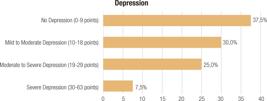
Classification of the BDI of patients undergoing hemodialysis at the dialysis center from April to July 2023, Belém, Pará, Brazil.
Most of the respondents (67.5%) associated the onset of depressive symptoms with the start of hemodialysis treatment. Of the total, 40% were undergoing psychotherapy, and 87.5% of these patients reported improvement in depressive symptoms with psychological support (Table 1). However, when comparing patients who were undergoing psychotherapy to those who were not, there were no significant differences in BDI scores (p=0.485).
Table 2 shows the scores for each question in the questionnaire. It can be observed that, in this group of patients on hemodialysis, the mean total score was 14.1 ± 9.0 points, representing a mean of mild to moderate depressive symptoms in the sample. Furthermore, the highest means were found in the domains of lack of energy (1.3 points), insomnia (1.3 points), irritability (1.2 points), concern about health (1.1 points), fatigue (1.0 points), and weight loss (1.0 points), reflecting the greater significance of these domains in determining depressive symptoms in the sample.
When comparing the presence of depressive symptoms based on the sociodemographic and clinical characteristics of the patients, no statistically relevant differences were found. However, regarding the types of health insurance, patients under the SUS (Unified Health System) had significantly higher scores in the domains of pessimism (p=0.033), crying (p=0.028), and weight loss (p=0.028). A higher overall BDI-score was observed in patients who reported the onset of depressive symptoms after starting hemodialysis compared to those who did not report this (p=0.005) (Table 3).
DISCUSSION
The sociodemographic profile of the interviewed patients indicates that most of them are men, single, aged between 40 and 59 years, with completed or incomplete high school education, and a family income of one minimum wage, enrolled in the SUS (Unified Health System). When analyzing the incidence of depression indicators considering the demographic characteristics of the patients, no statistically significant disparities were observed. However, when examining the type of health insurance plan, patients linked to the SUS showed considerably higher scores in some domains.
These data support the evidence that individuals who are more susceptible, both physically and emotionally, to the consequences of chronic diseases are those who have more unfavorable living conditions, such as low monthly income and less family support to cope with illness8,9. It is also known that the prevalence of patients on hemodialysis can change over time, and advancements in healthcare and health awareness can alter the ratio according to gender. However, according to the Ministry of Health, there is still a prevalence of the male sex, which is consistent with the data obtained in this study.
Regarding the clinical data collected, the most common comorbidities among patients are SAH and DM. Both conditions are cited in the national literature as the main causes of Chronic Kidney Disease, based on the cardiorenal risk arising from SAH and the metabolic disturbances related to defects in insulin action or secretion caused by DM10.
The results indicate a high prevalence of depression among patients, with 62.5% showing symptoms, mostly of mild to moderate severity8,11. This aligns with current literature highlighting significant depressive symptoms in these patients. Compared to the general population, depression scores are three to four times higher in those with CKD and two to three times higher than in individuals with other chronic diseases12. The condition’s origins can be linked to the stressors of hemodialysis, which involves not only chronic pain but also physical and social changes, adjustments to daily routines, and various losses, leading to reduced quality of life13,14.
In the present study, there was no significant association between the duration of dialysis and depression. That is, although most patients reported the onset of symptoms after starting hemodialysis treatment, in most cases, this condition does not progress over time. This result, like in other studies, indicates that the highest probability of patients developing depression is in the early stages of hemodialysis, due to the adjustment period to the sudden changes in their routines associated with the rigorous treatment15.
Despite initial difficulties, patients gradually develop coping strategies, viewing hemodialysis as a viable life option. In the study11, 87.5% of those who underwent psychotherapy reported symptom improvement. However, there was no significant difference in BDI-scores when comparing these patients to those who did not receive psychotherapy. This suggests two possibilities: patients may have a distorted self-perception that hinders accurate assessments of their condition, or they may have improved from a more severe prior state, indicating that earlier BDI-assessments could have yielded much higher scores.
There is also significant symptomatology underlying a depressive condition. Although feelings of sadness or emptiness are common in depressive states, not all individuals describe this sadness, as it is a subjective feeling. In the case of the current study, the three most prevalent symptoms among patients were: lack of energy, insomnia, and irritability. Many patients, for example, mention that they are unable to work as well as they did before or that they need to exert much more effort than before to perform an activity. This is closely related to the sensation of extreme fatigue or lack of energy, expressed by the complaint of intense fatigue present in these individuals16.
In the present study, difficulty sleeping was observed as one of the most recurrent factors among patients, a result that is similar to that found in a study with patients on hemodialysis, where those with poorer sleep quality showed higher scores indicative of depression17. One possible reason, already mentioned in some research, is the impact of biochemical indicators, such as levels of hemoglobin, urea, and phosphorus18.
Another recurring item was irritability, present in more than 69% of patients, consistent with another study that reported this symptom in 46.8% of patients. In addition to the limiting factors imposed by hemodialysis already mentioned, it can be inferred that sleep deprivation may also contribute to triggering this symptom. This is because poor sleep quality causes, among other pathophysiological mechanisms, impairments in serotonergic and dopaminergic functioning, significantly influencing the emotional reactivity of patients, which highlights the severity of the indicators of depression and other emotional disorders in this population11,19.
The study found a strong association between patients’ perceptions of the onset of depressive symptoms and their BDI-scores, highlighting the need for the multidisciplinary team to pay close attention to these reports. Despite its prevalence, depression is often underdiagnosed and undertreated in CKD, with many healthcare professionals viewing symptoms like sadness and isolation as natural aspects of chronic illness. Therefore, prioritizing the quality of life for dialysis patients is crucial, as it is linked to better prognosis and increased survival, as supported by literature20.
This study has some limitations that should be considered. The lack of detailed statistical analyses and the absence of a control group limit the generalizability of the findings. The sample, primarily composed of SUS patients, may not represent other populations. Additionally, the reliance on self-reported data through the BDI introduces subjectivity, and the potential influence of biochemical variables, such as hemoglobin and phosphorus levels, was not directly analyzed. The study’s cross-sectional design also prevents conclusions about the progression of depressive symptoms over time, emphasizing the need for longitudinal studies to address these gaps.
CONCLUSIONS
Depressive symptoms in hemodialysis patients are closely linked to the physical and psychological burden of treatment and the various losses they experience over time. Assessing these symptoms is crucial, as they directly impact quality of life, prognosis, and treatment adherence. Therefore, a multidisciplinary approach is essential to improve or maintain their quality of life. This study emphasizes the importance of evaluating depressive symptoms in this population, highlighting their effect on quality of life and outcomes. In clinical practice, the findings suggest that a focus on mental health within a multidisciplinary approach is key to improving care, treatment adherence, and overall outcomes for chronic kidney disease patients.
ACKNOWLEDGMENT
I would like to thank the Universidade do Estado do Pará for its invaluable support throughout the development of this study. The structure and resources offered by the institution, combined with the continuous encouragement of academic research, were fundamental for carrying out this work.
REFERENCES
-
1 Alencar SBV, de Lima FM, Dias LDA, Dias VDA, Lessa AC, Bezerra JM et al. Depression and quality of life in older adults on hemodialysis. Braz J Psychiatry. 2020 Apr;42(2):195-200. doi: 10.1590/1516-4446-2018-0345
» https://doi.org/10.1590/1516-4446-2018-0345 -
2 Elezi B, Abazaj E, Zappacosta B, Hoxha M. Anxiety and depression in geriatric hemodialysis patients: factors that influence the border of diseases. Front Psychol. 2023 Nov 24;14:1281878. doi: 10.3389/fpsyg.2023.1281878
» https://doi.org/10.3389/fpsyg.2023.1281878 -
3 Ferreira MMM, Pereira LTC. Qualidade de vida de pacientes renais crônicos terminais em uso de terapia renal substitutiva. Rev Enf Contemp [Internet]. 26º out 2020 [cited 23 oct 2024];9(2):265-78. Available from: https://www5.bahiana.edu.br/index.php/enfermagem/article/view/2962
» https://www5.bahiana.edu.br/index.php/enfermagem/article/view/2962 -
4 Nogueira GA, Costa ABAL, Lucas GNC, Pereira GA, Filgueira LMA, Silva Júnior GB. Depressão em pacientes com doença renal crônica em hemodiálise e transplante renal [Internet]. Rev Soc Bras Clin Med. 2021[cited 23 oct 2024];19(3):[jul/set]. Available from: https://www.sbcm.org.br/ojs3/index.php/rsbcm/article/view/833
» https://www.sbcm.org.br/ojs3/index.php/rsbcm/article/view/833 -
5 Fraser SDS, Phillips T. Quality of life in people with chronic kidney disease: focusing on modifiable risk factors. Curr Opin Nephrol Hypertens. 2024 Nov 1;33(6):573-582. doi: 10.1097/MNH.0000000000001013
» https://doi.org/10.1097/MNH.0000000000001013 -
6 Dasgupta I, Bagnis CI, Floris M, Furuland H, Zurro DG, Gesualdo L et al.; European Anaemia of aCKD Alliance. Anaemia and quality of life in chronic kidney disease: a consensus document from the European Anaemia of CKD Alliance. Clin Kidney J. 2024 Jul 4;17(8):sfae205. doi: 10.1093/ckj/sfae205
» https://doi.org/10.1093/ckj/sfae205 -
7 Adejumo OA, Edeki IR, Sunday Oyedepo D, Falade J, Yisau OE, Ige OO et al. Global prevalence of depression in chronic kidney disease: a systematic review and meta-analysis. J Nephrol. 2024 Jul 2. doi: 10.1007/s40620-024-01998-5
» https://doi.org/10.1007/s40620-024-01998-5 -
8 Santos LSC, Silva EO, Ribeiro NS, Devezas AMLO, Rocha ABL. Patients' perception of quality of life and hemodialysis chronic kidney disease. Arq Med Hosp Fac Cienc Med Santa Casa São Paulo. 2022;67. doi:10.26432/1809-3019.2022.67.005
» https://doi.org/10.26432/1809-3019.2022.67.005 -
9 Huang J, Mao Y, Zhao X, Liu Q, Zheng T. Association of anxiety, depression symptoms and sleep quality with chronic kidney disease among older Chinese. Medicine (Baltimore). 2023 Oct 27;102(43):e35812. doi: 10.1097/MD.0000000000035812
» https://doi.org/10.1097/MD.0000000000035812 -
10 Silva TK da. Diabetes mellitus and arterial hypertension in patients with chronic renal failure on dialysis: An integrative review. RSD [Internet]. 2021Jun.8 [cited 2024Oct.22];10(6):e53410616121. Available from: https://rsdjournal.org/index.php/rsd/article/view/16121
» https://rsdjournal.org/index.php/rsd/article/view/16121 -
11 Pretto CR, Rosa MBCD, Dezordi CM, Benetti SAW, Colet CF, Stumm EMF. Depression and chronic renal patients on hemodialysis: associated factors. Rev Bras Enferm. 2020;73 Suppl 1:e20190167. Portuguese, English. doi: 10.1590/0034-7167-2019-0167
» https://doi.org/10.1590/0034-7167-2019-0167 -
12 Zhu N, Virtanen S, Xu H, Carrero JJ, Chang Z. Association between incident depression and clinical outcomes in patients with chronic kidney disease. Clin Kidney J. 2023 May 26;16(11):2243-2253. doi: 10.1093/ckj/sfad127
» https://doi.org/10.1093/ckj/sfad127 -
13 Xu W, Chen Z, Zhang Y, Zhao J, Huang W, Guo X et al. Mapping the global research landscape on depression for patients with chronic kidney disease: a bibliometric and visualized analysis from 2006 to 2022. Front Pharmacol. 2024 Jul 17;15:1388641. doi: 10.3389/fphar.2024.1388641
» https://doi.org/10.3389/fphar.2024.1388641 -
14 Bahall M, Legall G, Lalla C. Correction: Depression among patients with chronic kidney disease, associated factors, and predictors: a cross-sectional study. BMC Psychiatry. 2023 Nov 27;23(1):881. doi: 10.1186/s12888-023-05383-7. Erratum for: BMC Psychiatry. 2023 Oct 10;23(1):733. doi: 10.1186/s12888-023-05249-y
» https://doi.org/10.1186/s12888-023-05383-7 -
15 Yang H, Qi L, Pei D. Effect of psychosocial interventions for depression in adults with chronic kidney disease: a systematic review and meta-analysis. BMC Nephrol. 2024 Jan 10;25(1):17. doi: 10.1186/s12882-023-03447-0
» https://doi.org/10.1186/s12882-023-03447-0 -
16 Carvalho GDL, Kacinskas G, Abreu MVS, Anacleto GMC, Araujo BB. Comparação entre estresse, ansiedade, depressão e exercício físico em professores universitários. Revista Científica UMC [Internet]. 27º de outubro de 2023 [citado 23º de outubro de 2024];8(2):e080200009. Disponível em: https://seer.umc.br/index.php/revistaumc/article/view/1872
» https://seer.umc.br/index.php/revistaumc/article/view/1872 -
17 Bhasin AA, Molnar AO, McArthur E, Nash DM, Busse JW, Cooper R et al. Mental health and addiction service utilization among people living with chronic kidney disease. Nephrol Dial Transplant. 2024 Jun 28;39(7):1115-1124. doi: 10.1093/ndt/gfad240
» https://doi.org/10.1093/ndt/gfad240 -
18 Zhang S, Xu Y, Xia Y. The efficacy and safety of sertraline in maintenance hemodialysis patients with depression: A randomized controlled study. J Affect Disord. 2024 May 1;352:60-66. doi: 10.1016/j.jad.2024.02.002
» https://doi.org/10.1016/j.jad.2024.02.002 -
19 Santos-Coelho FM. Impacto da privação de sono sobre cérebro, comportamento e emoções. Med Int Méx. 2020;36(Supl. 1):S17-S19. http://doi.org/10.24245/mim. v36id.3777
» http://doi.org/10.24245/mim. v36id.3777 -
20 Bulbul E, Namoglu SS. The frailty in older hemodialysis patients and associations with depression, functional status, dialysis adequacy. Ther Apher Dial. 2024 Oct;28(5):727-734. doi: 10.1111/1744-9987.14164
» https://doi.org/10.1111/1744-9987.14164