 Nonwoven Polypropylene Coated Poly(caprolactone) and Poly(1-vinylpyrrolidone-co-vinyl acetate) Electrospun Membranes for Improved Filtration Performance
Abstract
Air pollution can expose the population to severe respiratory problems. Fibrous filters, such as those obtained by electrospinning nanofibers, have the potential to improve the filtration performance of standard filters. The aim of this work was to produce and evaluate the electrospinning of poly(caprolactone) (PCL) and poly(1-vinylpyrrolidone-co-vinyl acetate) (P(VP-co-VAc)) on a nonwoven polypropylene (PP) substrate. The insertion of Methylene Blue (MB) is supported for photodynamic effects. P(VP-co-VAc) and PCL were electrospun on the substrate at fixed times. Filtration performance was determined by measuring pressure drop and aerosol particle and collection efficiency. The photosensitive activity was evaluated by the indirect uric acid decay method. P(VP-co-VAc) did not maintain the fiber structure and formed nanoprotrusion filters. PCL should have its electrospinning parameters improved. MB provided the fiber with photosensitive characteristics for up to 60 min. With improvements in electrospinning parameters and together with MB, the filters have great potential for use in mask coatings.
Keywords:
filter; photodynamic inactivation; photosensitivity material
Introduction
Air filters have the primary function of removing suspended particles in the air, which can have porous or fibrous characteristics. Porous filters are produced by creating holes in solid materials; such materials generally have low porosity (< 30%). Due to the small pore size, the filtration efficiency is high, with a significant pressure drop, making it a disadvantage for filtration systems that require low-pressure drops.1, 2 On the other hand, fibrous filters are formed by interconnected micrometric fibers, which form a thick physical barrier with an average porosity of > 70% but with deficient filtration performance due to the very high fiber diameter, making it impossible to use for capturing fine particles.3 In front of this issue, electrospinning is an alternative for improving fibrous filter performance by producing nanoscale fibers.3, 4
Electrospinning is a technique widely used to obtain polymer fibers by continuous electrostatic forces, with the most varied polymers and complements, to produce material with high-performance and functionality.5, 6, 7 An essential process for electrospinning is the so-called Taylor cone, a hemispherical cone formed at the tip of the capillary due to the applied voltage. When the applied voltage is greater than the surface tension, jet solution or multiple jets are ejected from the cone.8 The instability of this cone can result in deformed fibers or even the formation of the electrospray process (polymer nanospheres).9 Other vital factors for electrospinning are the viscosity of the polymer solution, applied voltage, conductivity, and volatility of the solvent.10 Environmental factors such as high humidity and temperature are also crucial for the formation of smooth and uniform fibers.11
The success of electrospun polymeric matrices is due to the high filtration potential compared to other materials, as the ultrafine fibers, together with the large surface area and fine porosity, can be more efficient in the permeation of undue agents.12 Furthermore, in the case of masks for the medical field, electrospinning can provide even greater reinforcement. In addition to the pure polymer, the most diverse drugs or medicinal plants can be inserted into the polymeric solution to be spun to provide inherent properties.13
Even so, filtering media can be used to reduce the passage of impurities with hierarchical topologies, such as nanoprotrusions. The nanoprotrusions are responsible for providing a fibrous surface with a three-dimensional structure capable of maintaining a balance between filtration efficiency and pressure drop.14 Liu et al.15 developed polyethylene/polypropylene spun-bond filters composed of polytetrafluoroethylene nanoparticles on the surface of the fibers. The results demonstrated exceptional filtration performance, with high filtration efficiency, low-pressure drop, and dust retention capabilities superior to common filters. Wang et al.16 added SiO2 nanoparticles to the surface of electrospun polyacrylonitrile (PAN) fibers and observed an increase in surface area and positive data related to filtration.
The polymers chosen for electrospinning are poly(caprolactone) (PCL) and poly(1-vinylpyrrolidone-co-vinyl acetate) (P(VP-co-VAc)). PCL is a synthetic biopolymer with known applications in packaging, medical implants, and drug delivery.17 Its electrospinning for air filters has already been reported with great success by Ferreira et al.18 and Tian et al.19 P(VP-co-VAc) is a synthetic polymer with high solubility that is widely applied in the pharmaceutical industry due to its high adhesiveness. Its electrospinning is still considered novel, with only one study reported by Martins et al.20 for quercitin drug delivery.
For broader applicability, nanofibers can be functionalized with various components. A well-detailed functionalization in the literature21 is the joining nanofibers with photosensitive agents, photodynamic therapy, and/or photodynamic inactivation of microorganisms. This technique is based on the union of photosensitive agents (photosensitizers, PS), light, and oxygen in the environment to produce reactive species for the death of microorganisms or cells.22 When combined with electrospinning, it can provide surfaces with disinfecting power when illuminated at the appropriate wavelength.23
Methylene Blue (MB) is a photosensitizer of the phenothiazines class with low toxicity, and when absorbing light at the appropriate wavelength, it can form singlet oxygen (1O2).24 Against SARS-CoV-2 (severe acute respiratory syndrome coronavirus-2) (coronavirus disease 2019, COVID-19), it has already been reported25 as an agent for reducing viral load and improving the reorganization of immunity. Thus, its applicability as a decontamination agent embedded in masks has already been reported with great success against Murine norovirus26 and swine coronavirus.27 Its electrospinning for air filters has not yet been reported.
In this work, we seek to design a polypropylene (PP) nonwoven spun-bond coated with poly(caprolactone) or poly(1-vinylpyrrolidone-co-vinyl acetate) electrospun matrices for improved filtration performance. Due to the results already reported for PCL in masks and seeking advanced applicability, MB was inserted only into PCL to study possible photodynamic properties.
Experimental
Material
Poly(caprolactone, PCL, molecular weight (MW) = 60.000 g mol−1), poly(1-vinylpyrrolidone-co-vinyl acetate, (P(VP-co-VAc), MW = 50000 g mol−1), ethanol (EtOH, ≥ 99.5%, anhydrous), chloroform (CHCl3, ≥ 99%, anhydrous), sodium chloride (NaCl, 99%), uric acid (99%) and Methylene Blue (MB, MW = 319.85 g mol−1) were purchased from Sigma-Aldrich (São Paulo, Brazil). Polypropylene (PP) nonwoven spun-bond (60 g m−2) was purchased at a local store (Maringá, Brazil).
Electrospun solutions and parameters
PCL 10% (m v−1) was dissolved in chloroform, at room temperature, in a completely sealed bottle for approximately 8 h. An amount of 0.8% (m m−1) of MB was added to a PCL solution 10% (m v−1) and left under magnetic stirring at room temperature for approximately 8 h until complete miscibility. The electrospinning parameters used for the pure PCL solutions and those containing MB were: 23 kV, flow rate of 1 mL h−1, distance between the collector of 15 cm, needle diameter of 0.8 × 25 mm, ambient temperature of 26 ± 4 °C, and relative humidity of 30%.
The P(VP-co-VAc) was prepared as described by Martins et al.20 The P(VP-co-VAc) 35% (m v−1) solutions were prepared in a mixture of EtOH (v v−1) and distilled water (v v−1) in the ratio of 97:3. The electrospinning parameters were: flow rate of 1.5 mL h−1, voltage of 16 kV, collector target distance of 12 cm, needle diameter of 0.8 × 25 mm, ambient temperature of 26 ± 4 °C, and relative humidity of 30%.
Filter preparation
The PP nonwoven spun-bond was cut into 10 cm2 sizes and glued to the metal collector plate with double-phase tape. For pure PLC and PLC containing MB, the deposition times were set at 20 min; this filter has been designated as PP/PCL and PP/PCL/MB. For P(VP-co-VAc), the times were 10 and 20 min, forming filters designated PP/P(VP-co-VAc)_10 and PP/P(VP-co-VAc)_20 respectively.
Characterization
The surface morphology of the polymer matrices was evaluated by scanning electron microscopy (SEM). The equipment used was the QUANTA series 250 line (FEI, Massachusetts, USA). To make the samples electrically conductive, they were deposited on double-sided carbon adhesive tape and metalized with gold to a thickness of 30 nm. Images were obtained by applying an electron-accelerating voltage ranging from 12 to 20 kV at different magnifications. The average diameter was measured using ImageJ28 software and 100 fibers.
Permeability was carried out in triplicate using the experimental unit described by Bortolassi et al.19 Measurements were taken at ambient temperature and pressure. The flow rate varied from 0.2 to 10 L min−1, and the pressure drop was measured with a digital manometer TSI (Shoreview, USA) connected to the filtration line. The filtration area was 5.2 cm2 and the analysis was performed in triplicate. With this, it was possible to obtain the straight line and the permeability constant (k1) from the Darcy equation (equation 1):
where L represents the thickness of the filter medium, μ is the viscosity of the fluid (1.74 × 10⁻⁵ Pa s−1, density (ρ) = 1.10 kg m−3), k1 is the permeability constant of the filter medium, vs is the surface velocity, and ∆P represents the pressure drop. The medium thickness (L) for the filter is PP = 0.23 ± 0.00 mm, PP/P(VP-co-VAc)_10 = 0.25 mm ± 0.00 mm, PP/P(VP-co-VAc)_20 = 0.27 ± 0.01 mm, PP/PCL = 0.28 ± 0.01 mm, and PP/PCL/MB = 0.26 ± 0.01 mm.
Filtration performance of nanofiber filters
The same system described previously was used for the filtration tests. The filtration area was 5.3 cm2 and filtration velocity was 4.8 cm s−1, with a flow rate of 1500 mL min−1. A 5 g L−1 of sodium chloride (NaCl, ρ = 2.16 g cm−3) solution was used to generate particle diameters ranging from 7 to 300 nm. The collection efficiency (E) was measured using a TSI differential mobility analyzer and ultrafine particle counter (model 3776, Shoreview, USA). Filtration efficiency was calculated by equation 2:
where C0 is the average of the total particles counted before, and Ce is the average of the total particles counted after filtration. The analysis was performed in triplicate.
Photosensitive characteristic
The photosensitive characteristic of the electrospun matrices was analyzed as previously described by our research group,30 using an indirect uric acid decay method.31 The PP/PCL/MB was added to the bottom of a 1.0 cm long quartz cuvette with four polished faces. The device was irradiated with a red LED (light emitting diode), and the kinetics of uric acid oxidation were monitored at 292 nm using a Varian UV-Vis spectrophotometer (model Cary 50, Agilent, USA) for 120 min.
Results and Discussion
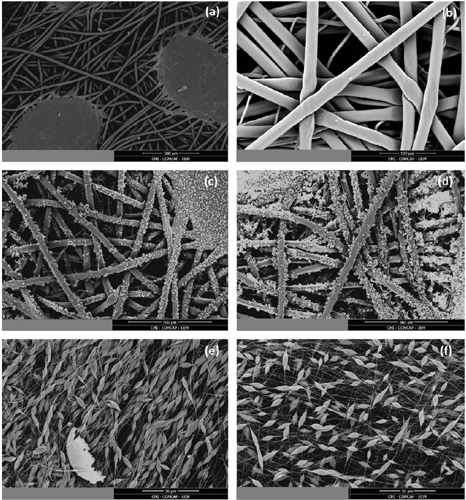
The morphology of spun-bonded PP filters is shown in Figures 1a and 1b. The average size of the fiber for the support was 23.55 ± 4.19 µm. Spun-bonded technology produces fibrous, nonwoven membranes with an average pore size of 110.8 µm.32 The electrospinning of P(VP-co-VAc) at different times is shown in Figures 1c and 1d, and the formation of fibers on the PP filter is not observed. However, the polymeric portion of P(VP-co-VAc) in PP exhibits a nanoprotrusion surface morphology. This occurs because P(VP-co-VAc) fibers are highly soluble in water and also at room temperature. Martins et al.20 in a single study on the electrospinning of P(VP-co-VAc), reported the difficulty in producing fibers due to their hydrophilicity and the very pronounced loss of the fibrous characteristic. In solution, the authors observed the complete dissolution of the electrospun membranes in approximately 30 s and the loss of fibrous characteristics when stored outside a desiccator. However, the filter media with nanoprotrusions are extensively studied and prepared by doping with nanoparticles that adhere to the fiber of the filtration support.33

SEM images: (a) and (b) PP filters, (c) PP/P(VP-co-VAc)_10, (d) PP/P(VP-co-VAc)_20, (e) PP/PCL and (f) PP/PCL/MB.
For PCL electrospun matrices, the superimposition of the electrospun material on PP is observed. For PP/PCL (Figure 1e), the average diameter for the fibers formed was 0.656 ± 0.022 µm, but prominent bead formation is observed. Fiber formation performance was improved compared to PCL electrospinning without the support. The neutral character of PP and the low contact with the grounding system may destabilize the Taylor cone due to residual charge. Qin and Wu34 described that the collector for electrospinning can interfere with the diameter and formation of fibers. Janů et al.35 indicated a surface modification by plasma for electrospinning of PCL on PP support. The addition of MB (Figure 1f) to the solution promotes the formation of fibers with an average diameter of 0.538 ± 0.038 µm. The less pronounced formation of beads for the addition of MB is related to an improvement in the stability of the Taylor cone due to the cationic character of MB in the solution. Contreras et al.36 also observed direct results in their work due to the electrostatic repulsion of MB in the PCL solution and, consequently, in the electrospun fibers.
Due to the use of organic solvent, the possibility of attack and disruption of the support surfaces by the residual solvent reaching the collector along with the fibers was evaluated. The SEM images of the support surface after PCL electrospinning are shown in Figure 2.

No damage was observed to the PP support for the two solution configurations evaluated, with the porous and fibrous structure still being maintained. Furthermore, it is possible to observe that for PP/PCL (Figure 2a), the formation of pronounced imperfections occurs throughout the entire deposition layers, with clusters of beads, and it is almost not possible to observe fibers at the magnification presented (1000×). For PP/PCL/MB (Figure 2b) at the same magnification (1000×), the significant presence of beads is also noted, but with the formation of more evident fibers. This fact corroborates the data for PCL presented in Figures 1e and 1f.
Filtration performance
The filtration tests were evaluated for PP/P(VP-co-VAc)_10, PP/P(VP-co-VAc)_20, PP/PCL, and PP/PCL/MB to elucidate the behavior of PP filters containing a layer of electrospun membranes and nanoprotrusion. One of the essential characteristics of filters is their pressure drop, that is, the ease of air passage.37 The pressure drop shows different effects for the filter media, as shown in Figure 3. The pressure drop is reduced in the two deposition times evaluated for filters containing P(VP-co-VAc) nanoprotrusion (Figure 3a). Wang et al.16 also observed a reduction in the pressure drops of electrospun polyacrylonitrile (PAN) with incorporated silica nanoparticles (SiO2 NPs), which resulted in greater air penetration with the new topography on the filter surfaces.
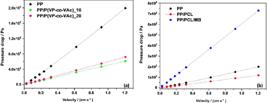
Pressure drop vs. velocity for (a) P(VP-co-VAc) nanoprotrusion and (b) PCL electrospun membranes.
The pressure drop is significantly increased for electrospun PP/PCL/MB membranes (Figures 3b). This data can be explained by the reduction in empty spaces after the fiber layers are deposited in the PP matrix, thus reducing the flow behind the membrane. Bortolassi et al.29 found similar data in the electrospinning of polyacrylonitrile (PAN) to a fibrous substrate of polyethylene terephthalate (PET).
For fibrous membranes, the Darcy coefficient of permeability (DCP) is observed between 1−13 and 10−9 m2, and the angular coefficient of the curve is obtained with the µ/k1 ratio.38 The DPC was obtained by the angular coefficient from the linear adjustment of the curves in Figure 3 and shown in Table 1. For all tested filters, permeability is in the expected range for fibrous filters. As a highlight, the data obtained demonstrate that PP/PCL/MB presents a decrease in the permeability coefficient, which can lead to resistance to the passage of particles and their retention with greater ease.
Table 2 compares thickness, pressure drop, and Darcy permeability data for surgical masks, N95, and electrospun matrices applied to filtration. The data found in this work, when compared with the literature, can be considered very similar and within what is expected for the material produced. Furthermore, it is worth mentioning that the greater pressure drop when compared to the surgical mask and the N95 is due to the more closed structure of the nanofibers.39
Collection efficiency
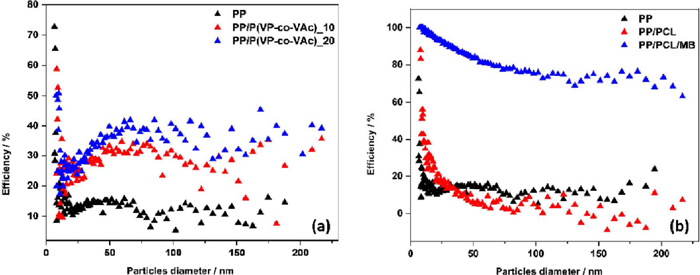
The collection efficiency for studied filters is shown in Figure 4. The PP filters demonstrated the lowest collection efficiency and a diffusional type collection mechanism. Filtering mechanism diffusion is concerned; this pathway is a type of filtering that occurs with particles smaller than 0.1 µm, where these particles follow the airflow quickly by random movement of molecules (Brownian movement) and get involved in the fiber surface.2, 46 These data are following those demonstrated by Zhu et al.47 which describes a low efficiency of spun-bonded nanoparticles between 0.1-0.5 µm due to the micrometer-scale pore size.

Collection efficiency for (a) P(VP-co-VAc) nanoprotrusion and (b) PCL electrospun membranes.
Unlike permeability, where only the air passage was evaluated, filtration efficiency has as its distinguishing feature the formation of aerosols, which, in this case, can collide with the nanoprotrusions. A slight improvement in collection efficiency was observed for nanoprotrusion (Figure 4a) arising from the deposition of P(VP-co-VAc) on the PP surface. The increase in efficiency demonstrated with increasing diameter indicates an impaction-type filtration mechanism. For interception filtration, particles can follow aerodynamics (thus, low inertia); however, when they get close to the fiber, the adhesion forces can trap them.2, 48 Wang et al.16 also observed a relationship with a slight increase in the filtration efficiency of polyacrylonitrile fibers with silica nanoparticles (SiO2) on their surface when compared to the substrate. The correlation of pressure drops and filtration efficiency for this work was also identical to those we found. Lower pressure drops provided a greater filtration efficiency for the membranes with nanoprotrusions, explained by the formation of a more simplified fiber geometry and a more pronounced air passage.
For PCL electrospun membranes, the efficiency has significant values for PP/PCL/MB (Figure 4b). Bortolassi et al.29 also observed an increase in the collection efficiency of electrospun membranes on the support, explained by the deposition of nanofibrous layers. The authors also observed a directly proportional effect between efficiency and pressure drop.
Photosensitivity
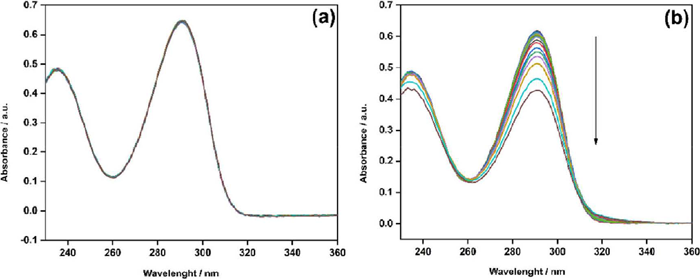
Aiming for an advanced application, PP/PCL/MB had its photosensitive characteristics investigated. Uric acid (UA) is considered an excellent probe for determining photosensitivity, as it is regarded as a scavenger of reactive species from the environment. When reactive species in the medium interact with UA, the product formed degrades UA, and the absorption of the 292 nm band is reduced.31 For the illuminated filters, UA degradation is observed in Figure 5 and confirms the formation of reactive species. MB is characterized by being a chromophore with a phenothiazine structure with absorption at wavelengths of 630 to 680 nm. In the presence of molecular oxygen, reactive oxygen species are formed.49 Contreras et al.36 and Czapka et al.50 also observed the formation of reactive species originating from MB-inserted electrospun nanofibers.

Variation in the electron absorption spectra of uric acid for the (a) dark PP/PCL/MB and (b) illuminated PP/PCL/MB.
The kinetic profile for Figure 5 shown in Figure 6 demonstrates that in the dark, PP/PCL/MB have a constant absorption. A rapid degradation is observed in the first few minutes of lighting and lasts up to 120 min. These results are considered promising for this type of segment. Furthermore, the formation of reactive species in the medium confirms the presence of MB in the fibers and the maintenance of their physical properties even on a solid substrate for a satisfactory time with just a few minutes of deposition on PP.

The long-term photosensitive characteristic of MB inserted into nanofibers is due to its uniform distribution throughout the material. Sun et al.,51 when electrospinning PCL/MB, observed the presence of nitrogen from the MB structure uniformly distributed throughout the material, as evaluated by X-ray photoelectron spectroscopy (XPS). Czapka et al.,50 when performing UV-Vis spectroscopy and Fourier transform infrared (FTIR) spectroscopy on cellulose acetate and MB membranes, observed the presence of MB on the surface, evenly distributed, with an absorption spectrum similar to that of free MB in solution. Furthermore, FTIR revealed the interaction between the polymer and the photosensitizer.
These results demonstrate the potential of photodynamic therapy (PDT) for possible applicability as a material for disinfection. Jiang et al.52 sprayed an erythrosine photosensitizer solution on mask surfaces and with lighting them for 25 min, achieved a reduction in the transmissible gastroenteritis virus by 99.999%. This is in line with what we previously reported.53 Sun et al.54 sprayed tetrathiocyclophane hexafluorophosphate (TTCP-PF6) on face masks and observed singlet oxygen inactivation of influenza A virus H1N1 and Streptococcus pneumoniae (S. pneumoniae) pathogens with 10 min of illumination. In both jobs, filtration efficiency is maintained. The addition of electrospun fibers on filters can bring additional benefits in terms of particle retention, as previously proposed by us53 to improve personal protective equipment (PPE). Therefore, the proposed material with the insertion of MB could make the surface of filters self-cleaning, as exemplified in Figure 7.

Conclusions
Due to the low filtration efficiency of PP, electrospinning can be used to improve particle retention. Electrospinning of P(VP-co-VAc) on the PP substrate provided the formation of nanoprotrusions. Numerous beds were observed for pure and MB-containing filters for electrospinning of PCL; therefore, the electrospinning parameters need to be improved. The pressure drops for filters coated with electrospun membranes were more significant than that of nanoprotrusions due to the formation of more layers on the PP support. Following these data, permeability was lower for the electrospun filters. The particle collection and the retention efficiency were improved for the two types of materials produced (nanoprotrusion or fibers), highlighting PP/PCL/MB and P(VP-co-VAc)_20.
Suitable filters require two essential characteristics: high collection efficiency and low-pressure drop.
Therefore, when comparing lower pressure drops and higher efficiency, materials containing nanoprotrusions would be more suitable as filter media, but still with low particle retention. For PP with the insertion of PCL fibers, the filtration excellence parameters were not obtained. Due to the different characteristics of the materials, it is also not possible to compare and define the best filter, requiring additional studies.
The photosensitivity of the material was confirmed by the electrospun filter functionalized with MB for up to 120 min of illumination. These results indicate the production of reactive species capable of inactivating microorganisms for a long time. In the future, based on optimal electrospinning data containing MB on the surface of PP filters, anti-infective power tests could be carried out to verify the dual function of the material proposed here: filtration and disinfection.
Acknowledgments
The authors would like to thank Núcleo de Pesquisa em Sistemas Fotodinâmicos e Nanomedicina (NUPESP-UEM), Grupo Interdisciplinar de Pesquisa em Fotoquímica e Eletroquímica Ambiental (GIP/FEA-Unioeste) and Complexo de Centrais de Apoio à Pesquisa (COMCAP-UEM) for allowing the use of necessary equipment. A. R. S. R. acknowledges Coordenação de Aperfeiçoamento de Pessoal de Nível Superior (CAPES, Brazil) for her PhD fellowship.
References
-
1 Printsypar, G.; Bruna, M.; Griffiths, I. M.; J. FluidMech. 2018, 861, 484. [Crossref]
» Crossref - 2 Hutten, I. M.; Handbook of Nonwoven Fitter Media; Elsevier: Oxford, 2016, ch. 2.
- 3 Wang, Y.; Zhao, X.; Jiao, X.; Chen, D. In Fittering Media by Etectrospinning; Focarete, M. L.; Gualandi, C.; Ramakrishna, S., eds.; Springer International Publishing: Switzerland, 2018, p. 47.
-
4 Chen, M.; Li, X.; Cai, W.; Han, X.; Zhou, C.; Zheng, K.; Duan, R.; Zhao, Y.; Shao, M.; Wang, W.; Zheng, K.; Feng, B.; Shi, X.; Chin. Chem. Lett. 2024, 110712. [Crossref]
» Crossref - 5 Ramakrishna, S.; Fujihara, K.; Teo, W. E.; Lim, T. C.; Ma, Z.; An Introduction to Etectrospinning and Nanofibers; World Scientific Publishing Co.: New Jersey, 2005.
-
6 Naeimirad, M.; Zadhoush, A.; Kotek, R.; Neisiany, R. E.; Khorasani, S. N.; Ramakrishna, S.; J. Appt. Potym. Sci. 2018, 135, 46265. [Crossref]
» Crossref -
7 Pereao, O.; Uche, C.; Bublikov, P. S.; Bode-Aluko, C.; Rossouw, A.; Vinogradov, I. I.; Nechaev, A. N.; Opeolu, B.; Petrik, L.; Mater. Today Chem. 2021, 20, 100416. [Crossref]
» Crossref -
8 He, J. H.; Resutts Phys. 2020, 17, 103096. [Crossref]
» Crossref -
9 Huang, S.; Mansouri, J.; Le-Clech, P.; Leslie, G.; Tang, C. Y.; Fane, A. G.; J. Membr. Sci. 2022, 646, 120248. [Crossref]
» Crossref -
10 Yang, J.; Zhao, X.; Zhang, W.; Ren, K.; Luo, X.; Cao, J.; Zheng, S.; Li, W.; Wu, X.; Angew. Chem. 2023, 135, e202300258. [Crossref]
» Crossref -
11 Ibrahim, H. M.; Klingner, A.; Potym. Test. 2020, 90, 106647. [Crossref]
» Crossref -
12 Baji, A.; Agarwal, K.; Oopath, S. V.; Potymers 2020, 12, 492. [Crossref]
» Crossref -
13 Balachandar, V.; Mahalaxmi, I.; Kaavya, J.; Vivekanandhan, G.; Ajithkumar, S.; Arul, N.; Singaravelu, G.; Kumar, N. S.; Devi, S. M.; Riv. Eur. Sci. Med. Farmacot. 2020, 24, 3422. [Crossref]
» Crossref -
14 Li, Y.; Yin, X.; Yu, J.; Ding, B.; Composites Commun. 2019, 15, 6. [Crossref]
» Crossref -
15 Liu, J.; Zhou, Y.; Zhu, B.; Zhang, X.; Zhang, H.; Jin, X.; Zhang, K. Q.; Sep. Purif. Technot. 2023, 327, 124943. [Crossref]
» Crossref -
16 Wang, N.; Si, Y.; Wang, N.; Sun, G.; El-Newehy, M.; Al-Deyab, S. S.; Ding, B.; Sep. Purif. Technot. 2014, 126, 44. [Crossref]
» Crossref -
17 Mohamed, R. M.; Yusoh, K.; Adv. Mater. Res. 2015, 1134, 249. [Crossref]
» Crossref -
18 Ferreira, C. A. M.; Guerreiro, S. F. C.; Valente, J. F. A.; Patrício, T. M. F.; Alves, N.; Mateus, A.; Dias, J. R.; Potymers 2022, 14, 3329. [Crossref]
» Crossref -
19 Tian, G.; Huang, Z.; Wang, H.; Cui, C.; Zhang, Y.; Appt. Ctay Sci. 2022, 223, 106512. [Crossref]
» Crossref -
20 Martins, L. M.; Fraga, G. N.; Pellá, M. C. G.; Pinto, F. A. C.; de Souza, F.; Colombari Neto, J.; Rossin, A. R. S.; Caetano, J.; Dragunski, D. C.; Process Biochem. 2022, 122, 8. [Crossref]
» Crossref -
21 Simplicio, F. I.; Maionchi, F.; Hioka, N.; Quim. Nova 2002, 25, 801. [Crossref]
» Crossref -
22 Pellosi, D. S.; Tessaro, A. L.; Moret, F.; Gaio, E.; Reddi, E.; Caetano, W.; Quaglia, F.; Hioka, N.; J. Photochem. Photobiot., A 2016, 314, 143. [Crossref]
» Crossref -
23 Plíštil, L.; Henke, P.; Kubát, P.; Mosinger, J.; Photochem. Photobiot. Sci. 2014, 13, 1321. [Crossref]
» Crossref -
24 Tardivo, J. P.; Del Giglio, A.; de Oliveira, C. S.; Gabrielli, D. S.; Junqueira, H. C.; Tada, D. B.; Severino, D.; Turchiello, R. F.; Baptista, M. S.; Photodiagn. Photodyn. Ther. 2005, 2, 175. [Crossref]
» Crossref -
25 Schikora, D.; Hepburn, J.; Plavin, S. R.; Health, L.; Am. J. Virot. Dis. 2020, 2, 1. [Link] accessed in March 2025
» Link -
26 Wielick, C.; Fries, A.; Dams, L.; Razafimahefa, R. M.; Heyne, B.; Harcourt, B. H.; Lendvay, T. S.; Willaert, J. F.; de Jaeger, S.; Haubruge, E.; Thiry, E.; Ludwig-Begall, L. F.; Am. J. Infect. Controt 2022, 50, 871. [Crossref]
» Crossref -
27 Lendvay, T. S.; Xu, J.; Chen, J.; Clark, T.; Cui, Y.; Am. J. Infect. Controt 2022, 50, 857. [Crossref]
» Crossref - 28 Rasband, W.; Image J, version 2.0.0-rc-3; National Institutes of Health, USA, 2014.
-
29 Bortolassi, A. C. C.; Nagarajan, S.; Lima, B. A.; Guerra, V. G.; Aguiar, M. L.; Huon, V.; Soussan, L.; Cornu, D.; Miele, P.; Bechelany, M.; Mater. Sci. Eng. 2019, 102, 718. [Crossref]
» Crossref -
30 Rossin, A. R. S.; Caetano, J.; Zanella, H. G.; Bariccatti, R. A.; Gaffo, L.; Muniz, E. C.; Caetano, W.; Stolf, S. F.; Dragunski, D. C.; J. Therm. Anat. Catorim. 2022, 147, 4579. [Crossref]
» Crossref -
31 Gerola, A. P.; Semensato, J.; Pellosi, D. S.; Batistela, V. R.; Rabello, B. R.; Hioka, N.; Caetano, W.; J. Photochem. Photobiot., A 2012, 232, 14. [Crossref]
» Crossref -
32 Yuan, R. F.; Wang, Y. Y.; Zhu, C. Y.; Adv. Mater. Res. 2012, 601, 99. [Crossref]
» Crossref -
33 Lu, T.; Cui, J.; Qu, Q.; Wang, Y.; Zhang, J.; Xiong, R.; Ma, W.; Huang, C.; ACS Appt. Mater. Interfaces 2021, 13, 23293. [Crossref]
» Crossref -
34 Qin, X.; Wu, D.; J. Therm. Anat. Catorim. 2012, 107, 1007. [Crossref]
» Crossref -
35 Janů, L.; Dvořáková, E.; Polášková, K.; Buchtelová, M.; Ryšánek, P.; Chlup, Z.; Kruml, T.; Galmiz, O.; Nečas, D.; Zajíčková, L., L.; Potymers 2023, 15, 1686. [Crossref]
» Crossref -
36 Contreras, A.; Raxworthy, M. J.; Wood, S.; Schiffman, J. D.; Tronci, G.; ACS Appt. Bio Mater. 2019, 2, 4258. [Crossref]
» Crossref -
37 Chaudhuri, J.; Baukelmann, A.; Boettcher, K.; Ehrhard, P.; Eur. J. Mech. B Fluids 2019, 76, 115. [Crossref]
» Crossref -
38 Stanishevsky, A.; Tchernov, J.; J. Non-Cryst. Solids 2019, 525, 119653. [Crossref]
» Crossref -
39 Bonfim, D. P. F.; Cruz, F. G. S.; Bretas, R. E. S.; Guerra, V. G.; Aguiar, M. L.; Polymers 2021, 13, 1166. [Crossref]
» Crossref -
40 Monjezi, M.; Jamaati, H.; Med. Eng. Phys. 2021, 98, 36. [Crossref]
» Crossref -
41 Mukhametzanov, I. T.; Grinshpun, S. A.; Zaripov, S. K.; Gilfanov, A. K.; Aerosol Air Qual. Res. 2016, 16, 2428. [Crossref]
» Crossref -
42 Bortolassi, A. C. C.; Guerra, V. G.; Aguiar, M. L.; Sep. Purif. Technol. 2017, 175, 79. [Crossref]
» Crossref -
43 Santos, R. P. O.; Hao, J.; Innocentini, M. D. M.; Frollini, E.; Savastano Jr., H.; Rutledge, G. C.; Sep. Purif. Technol. 2023, 311, 123358. [Crossref]
» Crossref -
44 da Mata, G. C.; Morais, M. S.; de Oliveira, W. P.; Aguiar, M. L.; Environ. Sci.: Nano 2023, 10, 2185. [Crossref]
» Crossref -
45 de Almeida, D. S.; Martins, L. D.; Muniz, E. C.; Rudke, A. P.; Squizzato, R.; Beal, A.; de Souza, P. R.; Bonfim, D. P. F.; Aguiar, M. L.; Gimenes, M. L.; Process Saf. Environ. Prot. 2020, 144, 177. [Crossref]
» Crossref -
46 Lee, K. W.; Liu, B. Y. H.; Aerosol Sci. Technol. 1982, 1, 147. [Crossref]
» Crossref -
47 Zhu, M.; Han, J.; Wang, F.; Shao, W.; Xiong, R.; Zhang, Q.; Pan, H.; Yang, Y.; Samal, S. K.; Zhang, F.; Huang, C.; Macromol. Mater. Eng. 2017, 302, 1600353. [Crossref]
» Crossref - 48 Liu, B. Y.; Rubow, K. L.; Air Filtration by Fibrous Media; ASTM International: West Conshohocken, PA, 1986.
-
49 Lim, D. J.; Polymers 2021, 13, 3955. [Crossref]
» Crossref -
50 Czapka, T.; Winkler, A.; Maliszewska, I.; Kacprzyk, R.; Energies 2021, 14, 2598. [Crossref]
» Crossref -
51 Sun, J.; Fan, Y.; Zhang, P.; Zhang, X.; Zhou, Q.; Zhao, J.; Ren, L.; J. Colloid Interface Sci. 2020, 559, 197. [Crossref]
» Crossref -
52 Jiang, Y.; Fu, Y.; Xu, X.; Guo, X.; Wang, F.; Xu, X.; Huang, Y. W.; Shi, J.; Shen, C.; Environ. Int. 2023, 177, 107994. [Crossref]
» Crossref -
53 Rossin, A. R. S.; Spessato, L.; Cardoso, F. S. L.; Caetano, J.; Caetano, W.; Radovanovic, E.; Dragunski, D. C.; Polym. Bull. 2023, 81, 1957. [Crossref]
» Crossref -
54 Sun, J.; Bai, Y.; Yu, E. Y.; Ding, G.; Zhang, H.; Duan, M.; Huang, P.; Zhang, M.; Jin, H.; Kwok, R. T.; Li, Y.; Shan, G. G.; Tang, B. Z.; Wang, H.; Biomaterials 2022, 291, 121898. [Crossref]
» Crossref
Edited by
-
Editor handled this article:
Brenno A. D. Neto (in-Chief)