 The Suitability of Chemically Modified Starch-Based Antimicrobial Coatings for Post-Harvest Strawberry Preservation
Abstract
Biodegradable coatings can improve fruit storage, but physical and chemical interactions might impair performance. This work coated strawberries with a blend based on cassava starch (native, oxidized, or acetylated), gelatin, sorbitol, and two antimicrobial agents (calcium propionate and potassium permanganate) to evaluate potential downsides of exposure to an acidic environment. The coatings varied in thickness (0.124-0.160 nm), opacity (1.37-4.61), solubility (29-55%), and color. Mass loss analysis indicated limited efficiency (the 10% threshold was reached within 48 h) in strawberries due to potential hydrolysis reaction. Soluble solids, titratable acidity, harvest index, and vitamin C concentration confirmed that hydrolysis under acidic conditions strongly impaired acetylated starch coating performance, performing worse than the control group. Further studies are needed to evaluate coating behavior in non-acidic fruits and under different pH conditions.
Keywords:
antimicrobial agent; biodegradable film; cassava starch; hydrolysis reaction; addition-elimination reaction
Introduction
Biodegradable films and coatings are intended to extend the shelf life of food products, providing a barrier against damage by forming layers of edible material on the surface of the food or placed between its components.1 They can slow down the migration of moisture, the loss of volatile compounds, the rate of respiration, and changes in the texture of the product, improving the condition of the food without undesirable effects, and can also be used for the incorporation and/or controlled release of antioxidants, vitamins, nutraceuticals, and antimicrobial agents.2-4
Starch is one of the main reserve compounds of all higher plants, occurring mainly in seeds, tubers, rhizomes, and bulbs. It is made up of a mixture of two polysaccharides called amylose and amylopectin, the proportions of which vary according to their origin.5 Amylose is the main part of starch responsible for its film-forming capacity.6 Biodegradable films produced from cassava starch as the main raw material are an excellent option since this material is easy to find, low cost, and also due to its properties,7 which are mainly biodegradable. Despite these advantages, films and coatings based only on starch often display impaired mechanical performances due to the strong hydrogen interactions formed between starch chains.7,8 The film-forming properties of starch can be improved by blending it with proteins and plasticizers.9
Gelatine is an abundant and low-cost film-former widely blended with starch for film production and coating purposes due to its capacity to create a barrier capable of decreasing the migration of oxygen, moisture, and oil.10,11 Its most outstanding characteristics are its solubility in water and its ability to form heat-resistant gels.
The plasticizer is a small, low-volatile molecule with a chemical nature similar to that of the polymer used to make the film. It often increases the free volume between starch chains,7,12 creates a barrier to gases and vapors,13 and increases flexibility,14 extensibility, and distensibility besides decreasing mechanical resistance.15
Besides, decreasing the respiratory process that convert a premature fruit into a rotten one, films and coatings also aim at preventing microbial growth.16 Antimicrobial agents are also incorporated to the blends to provide additional protection against biological threats.17 Potassium permanganate is a caustic alkali (KMnO4) that oxidizes organic matter, so it is not a medicine, but a broad-spectrum oxidizing and disinfecting agent. Its use in food packaging goes back at least 50 years.18 Despite the outstanding properties, KMnO4 is toxic to humans upon ingestion.19 Hence, the addition of such a compound to food packaging-intended purposes must be done carefully. Propionic acid and its salts such as calcium propionate (Ca(C2H5COO))2, in their undissociated form, are effective against the development of molds, but not very effective against bacteria and yeasts. They act by altering the permeability of the cell membrane of the microorganisms and the activity of intracellular enzymes in various ways.20
The formation of biodegradable films based on starch, gelatine and plasticizers could be an excellent option for packaging minimally processed fruit and vegetables that have a short shelf life. The addition of antimicrobial agents may be a good option as a way of reducing microbiological growth, verifying their effect on the characteristics of the films formed and on the preservation of minimally processed post-harvest fruits. Nevertheless, most published articles overlook the fruit-coating interaction either because the coating cannot be chemically altered by the fruit or because the fruit does not lead to pH values that suits the occurrence of chemical reactions. For acidic fruits like strawberries, on the other hand, the acidic pH might have direct effect on the performance of the coating.
This way, this work assessed how suitable for fruit coating the different types of starch would be. The produced films and coatings were based on three types of cassava starches: native, which is not very prone to hydrolysis, oxidized, not easily hydrolysable, and acetylated, easily hydrolysable. The starches were blended with gelatin and sorbitol for improved mechanical performance, and combined with calcium propionate and potassium permanganate for additional antimicrobial protection. Strawberries were chosen as the model fruit as they establish an acidic environment by losing fresh mass. Establishing if the loss of fresh mass would impair the performance of the coatings was the main goal of this work.
Experimental
Materials
Native (weight-average molecular weight (Mw) = 1.43 × 10⁶ Da; number-average molecular weight (Mn) = 225,883 Da, Mw/Mn = 6.32), acetylated (acetylation degree = 87%; Mw = 1.51 × 10⁶ Da; Mn = 191,798 Da, Mw/Mn = 7.86), and oxidized (oxidation degree = 0.07%; Mw = 1.37 × 10⁶ Da; Mn = 163,770 Da, Mw/Mn = 8.37) cassava starches were supplied by AVEBE Guairá Amidos LTDA. Bovine gelatin (bloom gel strength of 150-220 g) was acquired from Biotec Reagentes Analíticos. Sorbitol was acquired from QEEL - Química Especializada Erich LTDA. Potassium permanganate (KMnO4) was acquired from Labsynth. Calcium propionate (Ca(C2H5COO)2) was purchased from Fluka Analytical. All the reactants were used as received.
Preparation of the polymeric solution
The experiment started by preparing two separate dispersions. The starch dispersions (native (NSt), oxidized (OxSt), or acetylated (AcSt)) were prepared by dispersing 3.0 g of starch in 100 mL of distilled water. The dispersion was heated in a water bath (85 ºC) until completely gelatinized. Sorbitol (10% m m-1 of the starch mass) was added to the dispersion immediately after gelatinization, and the dispersion was manually stirred for homogenization.
The second dispersion was prepared by 10.0 g of gelatin in 100 mL of distilled water for 1 h,21 followed by heating in a water bath at approximately 85 ºC until completely solubilized. Sorbitol (5% m m-1 of the gelatin mass) was also added to this dispersion immediately after gelatinization, and the dispersion was also manually stirred for homogenization. The dispersions were combined in a single beaker to produce the polymeric solution.
Some of the experiments involved films containing antimicrobial agents. In these cases, after being combined in the same beaker, potassium permanganate, and calcium propionate were added to the polymeric solution (both in the amount of 0.018% m m-1 of the starch mass).22
The physical-chemical characterization was performed using the polymeric solution in the form of a film, produced using the casting technique. Aliquots of 10 mL of the polymeric solutions were transferred into Teflon plates (diameter of 7 cm) and dried in an oven at 40 °C for 48 h. Once dried, the films were removed from the Teflon plates and stored in a dissector (temperature (T) ca. 25 °C). Meanwhile, for the in vivo performance assays, the polymeric solution was cooled to room temperature; the fruit was directly immersed in the solution (for 30 s) and hung to dry and form a coating.
The samples (regardless of being used as coatings or films) were named xStGelAy, in which St, Gel, and A stand for starch, gelatin, and antimicrobial agents (KMnO4 and Ca(C2H5COO)2), respectively; “x” specifies the type of starch in question (N = native, Ac = acetylated, or Ox = oxidized), while y specifies the amount of antimicrobial agent added to the blend (y = 0 or 3%).
Characterization of the films
Thickness
The thickness of the films was measured using a Mitutoyo micrometer. The thickness determined was the average of five random measurements (n = 5) on different parts of the film.23 The results are expressed by mean ± standard deviation (SD).
Water solubility (WS)
The water solubility of the films was determined in triplicate (n = 3) using an adapted method.24 Samples of the films were cut into 2 cm2 pieces and the initial percentage of dry matter of each sample was determined in an oven at 105 ºC for 24 h (DM0). After the first weighing, the samples were immersed in beakers containing 25 mL of distilled water, and shaken slowly and periodically for 24 h. After this period, the samples were removed and dried (105 ºC for 24 h) to determine the mass of the remaining non-dissolved film (DM24).9,25 The water solubility was determined using equation 1, and the results are expressed by (mean ± SD).
Opacity
The opacity of the films was determined by analysis in a FEMTO 700 Plus spectrophotometer in triplicate (n = 3) of the absorbance at a wavelength of 450 nm (Aλ) and calculated according to the equation 2, in which “z” refers to the thickness of the film.23 The results are expressed by (mean ± SD).
Colorimetry
The transparency of the films was determined using a colorimeter (model CR 400 Konica Minolta). The analytical data produced from this measure (L*) refers to the shift from completely light (100) to completely dark (0).26
Characterization of the coating
Strawberries (Dover cultivar) were purchased in commercial plantations directly from farms in the city of Umuarama, Paraná, Brazil. They were harvested in the morning and produced according to the usual cultural practices in the region. These include drip irrigation and planting beds protected by plastic to prevent the soil from drying out, weed invasion, and fruit damage.
Fruit selection took into account color, regular surface, and homogeneous size, as well as the absence of rot and physical damage. Also, the strawberries were picked at the stage of commercial ripeness.
Coating stage
The strawberries were immersed in a solution of water and sodium hypochlorite (0.01%) for 30 min. This step was performed before the fruit coating. After these 30 min, the fruit was removed from the solution and hung to dry at room temperature (T ca. 25 °C). The coating step was performed by dipping the fruit into the filmogenic solution prepared as described in “Preparation of the polymeric solution” sub-section. After one minute, they were removed from the solution and hung for 24 h to dry completely. The control group was immersed in distilled water1 for the same period.2
Mass loss
The fruits were initially separated and identified so that the analysis could always be carried out on the same individuals. The statistical design was entirely casualized in a 3 × 5 factorial design (treatment × storage time) with 15 treatments, and the fruits were stored under room temperature (T ca. 25 °C) and relative humidity conditions (R.H. ca. 70%).
The analyses were carried out with 1 measurement per fruit and 6 fruits per treatment. The fruits were weighed individually using a Mark 210A Class I model 6K analytical balance. The mass loss was calculated using equation 325 and expressed as a percentage loss compared to the initial mass. In the equation 3, m1 and mt refer to the mass at the first day and at a day t.
Juice extraction
All the destructive analyses but firmness, which employed the whole fruit for the perforations, were evaluated using strawberry juice extracted by grinding using a Walita Billy model RI 1340 hand-held fruit processor (mixer).
The statistical design was entirely casualized in a 3 × 5 factorial schema (treatment × storage time) with 15 treatments, 3 replicates and 3 fruits per plot.
Soluble solids (SS)
The determination of the grade of soluble solids in the strawberries used in the experiments was performed using a Quimis Iso 9002 refractometer (model Q-109B Optech).
The measure was performed in triplicate (n = 3) for each treatment. For that, 0.05 mL of strawberry juice was placed in the equipment prism. The results are expressed by (mean ± SD), in degrees of Brix (°B).
Titratable acidity (TA)
The titratable acidity was determined in triplicate (n = 3), by titrating the strawberry juice (samples of 1 mL) with a 0.01 mol L-1 sodium hydroxide (NaOH) solution until reaching pH 8.1.27 The analysis was standardized by using a pH meter (Tecnal TEC-2).
The results were expressed as the percentage (%) of citric acid per 100 g of fruit by neutralizing the solution,28 and they were calculated using equation 4, in which the terms V and c refer to the volume (mL) and the concentration, respectively, of the NaOH solution required to reach pH 8.1; P is the volume, in mL, of strawberry juice utilized; MM is the molar mass of citric acid (MM = 192 g mol-1), and n is the number of ionizable hydrogens from citric acid (n = 3).
Harvest index
The SS and TA results were used to determine the harvest index of each fruit. This determination was performed by dividing the SS by the TA values.25 The results are expressed by (mean ± SD).
Vitamin C
For vitamin C analysis, 5 mL of strawberry juice were diluted in a mixture of 50 mL of distilled water, 10 mL of 20% sulfuric acid solution, 1 mL of 10% potassium iodide solution and 1 mL of 1% soluble starch solution. This solution was then titrated with 0.002 mol L-1 potassium iodate solution until it turned blue.29 The titration was performed in triplicate (n = 3).
The vitamin C concentration was calculated using equation 5. In it, V and P respectively refer to the volume of iodide used in the titration and the volume of strawberry juice; F refers to correction factor (F = 0.8806 for KIO3 0.002 M),
Firmness
Fruit firmness was assessed using an Instrutherm model PTR-100 penetrometer with a 7.9 mm diameter pressure device. The strawberry was pierced on the side of the medial region of its expanded receptacle, always so that the tip of the pressure device was perpendicular to the fruit, thus exerting a uniform force until its outer surface was ruptured. The analyses were carried out in triplicate (n = 3) using one perforation per fruit, with three fruits per treatment group.
The firmness was obtained in kgf and multiplied by the constant 9.80 to obtain the data in Newton (N), as described by Tzoumaki et al.30 with some modifications.
Statistical analysis
Data were analyzed using Minitab19 (Minitab Inc., State College, PA, USA, 2019) through analysis of variance (ANOVA) followed by Tukey’s test (LSD) to compare means at a 95% confidence level (p < 0.05). The experimental design was completely randomized in a 3 × 5 factorial scheme (treatment × storage time), with results expressed as mean ± standard deviation. Groupings were indicated by letters, where means not sharing the same letter were considered statistically different.
Results and Discussion
Physical-chemical characterization
Thickness, solubility, and opacity are some examples of parameters that affect the efficiency of biodegradable films used for minimally processed fruit and vegetables. Therefore, the effectiveness of the starch-based blends evaluated in this work was assessed in terms of these parameters. Table 1 portrays the obtained results and the respective statistical comparison results.
Thickness
The thickness determines how effective a film is in preserving the fruit from external damage,31 particularly transportation and the numerous handling steps prior to their consumption.32 In this study, the thickness varied from (0.124 ± 0.012) nm (AcStGelA0) to (0.160 ± 0.003) nm (AcStGelA3). Alone, these results confirm that the type of starch influences the thickness of a film, as acetylated starch led to the thinner films while oxidized starch formed thicker ones. It also suggests that the antimicrobial agent contributed to increased thickness. The physical interactions formed between the polymers and the antimicrobial agents would inevitably increase the distance between adjacent polymer chains. It, therefore, justifies the higher thickness observed for the antimicrobial agent-containing films.
Most matrices were statistically equal at some point (Table 1), suggesting similar behaviors for native and acetylated starch. Even though the experimental conditions were not adequate for chemical reactions, the incorporation of Ca(C2H5COO)2 inevitably introduced reactive species capable of reacting with functional groups from AcSt and OxSt. As a negatively charged compound with a mild basicity, Ca(C2H5COO)2 could not react with NSt, but may interact with carbonyl-containing starches due to the electrophilic character of the carbon atom from the carbonyl group.33 Figure S1 (Supplementary Information (SI) section) presents a mechanistic suggestion for this reaction.
For AcSt (Figure S1b), the addition-elimination reaction with Ca(C2H5COO)2 would lead to the initial formation of an unstable tetrahedral intermediate, followed by the collapse of this intermediate as the double bond with oxygen is restored. This restoration of the C=O bond would force the elimination of one of the groups bonded to the tetrahedral intermediate. In this case, the elimination reaction could either restore AcSt to its original structure (product A) or eliminate the acetyl group, forming a new non-modified starch unit (product B).
For OxSt, the addition-elimination reaction depicted in Figure S1c would either restore OxSt to its original structure (product D) or lead to the opening of the glucose unit that composes this modified starch (product E). In the latter, the extent of the reaction could improve or impair the chain packing. The results from Table 1 suggest that, in this work, if occurred, the reaction had very little effect on the thickness of the OxStGelAy films, especially because the films containing or not the antimicrobial agents were statistically equal at 95%. As per the AcStGelAy films, the same cannot be said.
The other antimicrobial agent, KMnO4, probably did not react with the starches used in this work because this oxidizing agent requires the addition of catalysts like hydroxide anions (OH-) to force the precipitation of MnO2.33
Solubility
Solubility is another factor that guides the application of biofilm as packaging for food products.25 Although complete solubilization in water can be advantageous in some cases, highly soluble films are not suitable for foods that release water. Therefore, for fruit such as strawberries, films with low solubility are often the best option because the water loss during the ripening stage should not compromise the barrier properties of the film.
For the films analyzed in this work, this parameter ranged from (29.39 ± 0.68) (NStGelA3) to (55.33 ± 0.86)% (NStGelA0), being the antimicrobial agent-containing films the loss soluble ones (Table 1). Two aspects must be considered to explain these results. First, blending starch with gelatin weakens the strong intermolecular hydrogen bonds, replacing long-range interactions with shorter ones and increasing solubility in aqueous environments. Second, the addition of salt like calcium propionate can counteract this effect. Upon dissociation or hydrolysis, propionic acid forms hydrogen bonds with starch chains, reducing their affinity for water and therefore decreasing solubility. As per KMnO4, a previous research34 indicated that it does not affect the solubility of starch-based films.
The solubility values achieved in this work for the native starch-based films varied similarly to the ones reported by Pellá et al.,35 who achieved values ranging from (27.50 ± 0.01) to (45.12 ± 0.01)% depending on the starch:casein:gelatin ratio. Considering the acetylated-based films, the solubility values achieved in this work were considerably smaller than the values reported by Francisco et al.,36 where blends with hydroxyethyl cellulose (HEC) depicted solubility values ranging from (51.50 ± 0.21) to (61.24 ± 0.05)%.
Considering the solubility results achieved in this work, the films AcStGelAy and NStGelA3 would probably be the most suitable ones for fruit that continue advancing on the ripening process after harvest.
Opacity
The opacity values ranged from 1.37 (OxStGelA0) to 4.61 (OxStGelA3), with the films lacking antimicrobial agents displaying the lowest opacity values (Table 1). It suggests that the antimicrobial agents-free films were more transparent likely due to structure changes. Film opacity also increases due to the loss of the granular structure of starch and crystallinity during gelatinization.37 Statistical comparisons indicated significant differences at 95% for all samples, confirming that both starch modification and antimicrobial agent addition significantly affect opacity.
The values obtained in this work were lower than the ones reported by Davanço et al.,10 whose gelatin-based films with surfactants (sodium dodecyl sulfate surfactant (SDS) and Tween 80) displayed opacities ranging between 6.45 and 9.77.
Colorimetry
After being coated with the biodegradable film, the color of the fruit might change. Colorimetry is the science used to analyze human perception of color.38 Therefore, measurements of this parameter were used to evaluate the color of the films. Regardless of the experimental condition or the thickness of the film, the L* values were close to 95, being statistically equal at 95% significance.
The obtained results suggest that, despite having different opacity values, the overall tonality of the films was very similar. It is a positive result especially because the fruits should still be packaged in a way that allows consumers to see through the package, maintaining the visual appeal of the fruits.
Efficiency of the coating on strawberries
Besides being used as films for the physical-chemical evaluations, the efficiency of the polymeric blend in preserving strawberries was determined using the blends as coatings. In this case, as mentioned in the Experimental section (“Coating stage” sub-section), instead of exposing the polymeric dispersion to an oven-drying period, the fruits were submersed in the solution and hung to dry at room conditions, forming a thin layer on the surface of the fruit.
The following sections will present the results obtained for the blends while acting as coatings in terms of mass loss, texture, total titratable acidity (TA), soluble solids (SS), ripening index (H), vitamin C, and color variation (colorimetry measures).
Mass loss
Even though strawberries are non-climacteric fruit, they are highly perishable due to mechanical stress and moisture loss.39,40 The literature estimates that strawberries are still suitable for consumption after losing 10% of their fresh mass.41 Therefore, the coatings produced in this work were evaluated in terms of efficiency in preserving the fresh mass of the coated strawberries. Figure 1 depicts the mass loss behavior throughout four days of storage under room temperature and humidity, highlighting the mark of 10% of mass loss (dotted line in the graph).
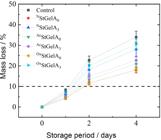
The percentage of mass loss of strawberries, coated and non-coated with the xStGelAy blends, throughout four days of storage under room temperature and room humidity. The dotted line in the graph highlights the 10 %-mass loss mark that indicates that strawberries are no longer suitable for consumption.
Mass loss followed the same tendency for all treatments, with the control fruits consistently losing more mass then coated fruits (Figure 1). Nevertheless, all fruits had lost more than the 10% threshold within 48 h. Table 2 provides the quantitative comparison between the blends throughout the storage period, showing that the coatings with antimicrobial agents generally retained more mass than the antimicrobial agents-containing ones. The OxStGelA3 coating was statistically similar to the control, indicating limited effectiveness.
The mean mass loss displayed by the coated and non-coated strawberry throughout 4 days of storage under room temperature and humidity
Two hypothesis provide possible explanations for the observed behaviors. First, the water molecules released from the fruit can escape through the polymeric structure, acting as a plasticizing agent by reducing starch-starch interactions. It could also inflict conformational changes to the polymeric chains. It justifies the behaviors observed from day 1 to day 2. Nevertheless, by the fourth day, the fruits had already lost more than 20% of their fresh mass (Table 3), and the water-driven plasticizing effect diminished, leading to a more brittle coating.
The mean variation of firmness, titratable acidity, soluble solids, harvest index, and vitamin C displayed by the coated and non-coated strawberry throughout 6 days of storage under room temperature and humidity
The second hypothesis acknowledges the fact that, by “wetting” the coating as water escapes through the polymeric network, the coatings were probably exposed to an acidic environment. Considering that (i) the strawberry pulp has a pH of ca. 3.5,42 (ii) ester bonds hydrolyze at pH < 4.0,33,43,44 and (iii) the addition of the antimicrobial agents led to the formation of additional ester bonds (as discussed in “Physical-chemical characterization” sub-section), the modified starch chains were probably hydrolyzed, yielding native starch as the outcome product.
Even though the fruits coated with AcStGelA3 lost more fresh mass than those coated with AcStGelA0, it is still not possible to attribute the difference to one factor alone. Nevertheless, since mass loss affects sugar content, acidity, texture, and nutritional quality, it remains a critical measure of coating performance. Based on these results, the blend based on acetylated starch was chosen for further evaluation. This choice was made because this modified starch contained the highest number of potentially hydrolysable bonds, which would make it a good candidate for evaluating the hydrolysis hypothesis. Furthermore, acetylated starch led to less bubbly films, which is appealing for the casting method, and tends to form more homogeneous coatings/films.
Firmness
Fruit firmness often decreases during storage as starch degrades into sugars,45 and mass is lost through respiration.46Table 3 portrays the firmness variation results, determined by texture analysis, along with the statistical comparisons. The control group softened as the storage period increased, as expected for plant tissue. The AcStGelAy-coated fruit, on the other hand, displayed a more prominent texture variation within the first two days compared to the control group.
As mentioned before, water released during ripening can change the structure of the coating as well as compromise its integrity.47 The fruits coated with AcStGel0 displayed a firmness 30.9% lower on day 2 compared to day 1. As per the fruits coated with AcStGel3, the firmness was 21.0% lower within the same period. Meanwhile, the firmness of the control group was very similar to day 1, being even statistically equal at 95%. The overall performance of the modified starch-based coatings was very similar to the NStGelAy ones. It strongly suggests the synergistic effect between conformation and functional group changes. However, from the fourth day on, all coatings displayed firmness increases while the control group kept experiencing firmness decreases. It was probably a result of the acidic pH of the medium combined with potential chemical reactions, as mentioned before.
The statistical comparisons indicated some significant differences (at 95%) between the treatments within a same storage day, like on day 2 (lower-case letters). Nonetheless, the overall firmness variation was only statistically different (upper-case letters) when comparting the results for days 2, 4, and 6.
Titratable acidity (TA)
Acidity strongly influences the taste and aroma of fruit, and pH also affects oxidative browning of plant tissues by modulating polyphenoloxidase activity, which decreases by over 50% at lower pH.48 During ripening, organic acids usually decline due to their metabolization for respiration or conversion to sugars,49 causing TA to decrease.35,50 Titratable acidity analyses, therefore, determine the acidity variation as the fruit undergoes ripening.
The results from Table 3 suggest some deviation of the expected behavior, described in the paragraph above, for the coated fruit. It applies for the coatings AcStGelAy and OxStGelA0. Figure S2 (SI section) provides a visual aid for the data comparison. Besides the water-plasticizing effect and the potential hydrolysis reactions, these observed TA variations throughout storage may be related to the biochemical processes of respiratory metabolism, which both synthesizes and consumes acid from the carbon skeleton.50 Furthermore, the coatings must likely affect the metabolic dynamics as well, adding yet another variable to this equation.
The results also suggest that the coating OxStGelA3 led to the expected behavior in terms of TA. Although the antimicrobial agent might have, somehow, affected the properties of the coating in a positive way, the positive effect was not very extent, as this sample was statistically equal to the control group, and it they remained statistically equal throughout the entire experiment.
The statistical comparisons once again suggested overall lack of significant differences (at 95%) among the different treatments on different days (upper-case letters). However, the coated fruit were almost statistically equal throughout the entire assessed period. It suggests that neither one of the coatings would be really effective in slowing down the ripening process in terms of TA (Table 2).
The TA variations from this work are similar to the ones reported by Saleem et al.51 Their chitosan/ascorbic acid-based coating slowed down the ripening process. The authors did not report any TA increases, suggesting that their fruit did not reach senescence within the 15-day experiment. Nonetheless, their fruit were placed inside clamshell clear polyethylene terephthalate (PET) boxes, and stored at (4 ± 1) °C. Meanwhile, the results from the present work refer to the data acquired under room temperature, explaining why the fruit reached senescence within two days.
Soluble solids (SS)
Strawberries, like most fruit, continue respiration after harvest, consuming soluble sugars and promoting a decrease in SS over time.52 The results from Table 3 (graphically depicted in Figure S2c) suggest that all treatments but OxStGelA3 reached senescence on day two, as SS decreased from this day onwards.
The samples coated with OxStGelA3 only presented SS increases on day 6, suggesting this was the senescence day. Such an intriguing behavior suggests that, even though OxStGelA3 was not very effective in preventing mass losses and acidity increases, it still slowed down the conversion of sugars into acids due to the metabolic process.
Pinzon et al.53 also observed higher SS values for the control group compared to the fruit coated with a coating based on banana starch and chitosan, produced using different percentages of aloe vera gel. Their results indicated that the higher the aloe vera gel content, the higher the crosslinking degree. It consequently decreased the permeability to water vapor, leading to a more homogeneous ripening of the fruit. Such a behavior was not achieved in the present work, suggesting that the structural changes caused by the release of moisture content impaired the ability of the coating to slow down the ripening process.
Harvest index (HI)
The ratio of total soluble solids to total titratable acidity yields the harvest index (HI), which is considered a criterion for evaluating fruit flavor, as well as being indicative of the level of ripeness.32 All treatments underwent an increase in this parameter from the fourth to the sixth day, corroborating the SS and TA results. Overall, all fruit would be equally appropriate for consumption, displaying overlookable flavor variations. However, the fruit coated with NStGelA0 would probably be the most suitable ones for consumption in terms of sugar content/acidity balance while the AcStGelA0 would be less sweet and sourer.
Vitamin C
The nutritional importance of fruit and vegetables is attributed to their vitamin and mineral content,54 being vitamin C particularly important to humans. This reducing substance is easily oxidized when exposed to heat, light and oxygen, and can also be lost during the handling of products, being relatively stable in an acidic environment.55
The results suggest that the vitamin C content of the control group reached its maximum on day 4 while the coated fruits reached their maximum only on day 6 (Table 3 and Figure S2d). This increase is mainly related to water loss and enhanced ascorbate peroxidase activity during the ripening process.56 Statistical analyses showed no significant differences in overall vitamin C content among the treatments, suggesting that, under the employed conditions, the coatings did not markedly slowed ripening. Nonetheless, they still managed to preserve some nutrients for a longer period.
Piechowiak et al.56 produced a biodegradable coating that was capable of preventing the decrease of the vitamin C content. The authors attributed this ability to the presence of cinnamon oil in the coatings, which decreases the oxidative stress caused by the ripening process.
The results presented in “Efficiency of the coating on strawberries” sub-section confirm that the use of the acetylated starch-based blend as a coating for strawberries leads to a poor performance that is aggravated by the potentially occurrence of hydrolysis reactions besides the conformation changes caused by the loss of moisture during the ripening process. Although the oxidized starch avoids hydrolysis reactions, its performance was not very different from the acetylated starch either. Hence, it is safe to say that these particular blends are not suitable for strawberries or any other fruit that yields an acidic environment. Nevertheless, they were still capable of preserving some of the nutrients from the fruit, like vitamin C, and decreasing mass loss. Hence, they slightly improved the quality of the fruit.
Given the toxicity of KMnO4, its addition to food packages must be done with caution. Literature reports state that intoxication occurs when the concentration is as high as 142.9 mg kg-1,57 which would be the equivalent of a 70 kg person intaking 10 g of KMnO4.58 The films produced in this work had 0.54 mg of KMnO4 per 3 g of starch. Hence, 1 kg of coating would have 180 mg of KMnO4. Even though this concentration falls above the toxic concentration mentioned before, it is unlikely that one person would consume such a high amount of coating, especially because the blend would still have gelatin and sorbitol in its composition, considerably increasing the amount of coating. Such high amount would allow the coating of a considerable number of fruits. Therefore, we are inclined to believe that the coatings would be harmless to human beings. Nevertheless, only further analyses in this regard would be able to confirm this hypothesis. Such analyses are prospects of this work.
Conclusions
This study evaluated starch-based coatings-native, oxidized, and acetylated-blended with gelatin, sorbitol, and antimicrobial agents (calcium propionate and potassium permanganate) as biodegradable films for strawberries. The films differed in thickness (0.124-0.160 nm), opacity (1.37-4.61), solubility (29-55%), and color, yet all appeared initially suitable for coating, prompting mass-loss experiments.
Mass loss results showed that non-coated strawberries lost more fresh mass than the other ones, but all coatings were only partially effective, with fruits exceeding the 10% threshold within 48 h. Acetylated starch coatings were most susceptible to hydrolysis, as reflected in firmness, titratable acidity, soluble solids, harvest index, and vitamin C analyses, indicating impaired ripening. Oxidized starch coatings avoided hydrolysis but offered only marginal improvement. All antimicrobial-containing coatings were thicker, making them more prone to water-plasticizing effects, which influenced texture and barrier properties.
These findings highlight that starch-based coatings are not universally suitable. Poor performance can arise from hydrolysis, water-plasticizing, and surface reactions, particularly in acidic fruits like strawberries. Although the coatings slightly reduced mass loss and preserved some nutrients, their overall effectiveness was limited. Future work should explore the fruit-coating interface in detail, test these blends on non-acidic fruits, and optimize formulations to improve hydrolytic stability and barrier performance.
Supplementary Information
Supplementary information is available free of charge at http://jbcs.sbq.org.br, as PDF file.
Supplementary PDF
Acknowledgments
The authors acknowledge CNPq, CAPES, Fundação Araucária, Unioeste and Unipar for the financial support and fellowships that made this research possible.
Data Availability Statement
All data are available in the text.
References
-
1 Del-Valle, V.; Hernández-Muñoz, P.; Guarda, A.; Galotto, M. J.; Food Chem. 2005, 91, 751. [Crossref]
» Crossref -
2 Durango, A. M.; Soares, N. F. F.; Andrade, N. J.; Food Control 2006, 17, 336. [Crossref]
» Crossref -
3 Cuq, B.; Gontard, N.; Cuq, J.-L.; Guilbert, S.; J. Food Sci. 1996, 61, 580. [Crossref]
» Crossref -
4 Rojas-Graü, M. A.; Avena-Bustillos, R. J.; Olsen, C.; Friedman, M.; Henika, P. R.; Martín-Belloso, O.; Pan, Z.; McHugh, T. H.; J. Food Eng. 2007, 81, 634. [Crossref]
» Crossref -
5 do Amaral, L. I. V.; Gaspar, M.; Costa, P. M. F.; Aidar, M. P. M.; Buckeridge, M. S.; Hoehnea 2007, 34, 425. [Crossref]
» Crossref -
6 Mali, S.; Grossmann, M. V. E.; Garcia, M. A.; Martino, M. N.; Zaritzky, N. E.; Carbohydr. Polym. 2002, 50, 379. [Crossref]
» Crossref -
7 Souza, A. C.; Benze, R.; Ferrão, E. S.; Ditchfield, C.; Coelho, A. C. V.; Tadini, C. C.; LWT - Food Sci. Technol. 2012, 46, 110. [Crossref]
» Crossref -
8 Larotonda, F. D. S.; Matsui, K. N.; Soldi, V.; Laurindo, J. B.; Braz. Arch. Biol. Technol. 2004, 47, 477. [Link]
» Link -
9 Ryu, S. Y.; Rhim, J. W.; Roh, H. J.; Kim, S. S.; LWT 2002, 35, 680. [Crossref]
» Crossref -
10 Davanço, T.; Tanada-Palmu, P.; Grosso, C.; Ciência Tecnol. Aliment. 2007, 27, 408. [Crossref]
» Crossref -
11 Moraes, I. C.; da Silva, G. G. D.; de Carvalho, R. A.; Habitante, A. M. Q. B.; Bergo, P. V. A.; Sobral, P. J. A.; Ciência Tecnol. Aliment. 2008, 28, 738. [Crossref]
» Crossref -
12 Parra, D. F.; Tadini, C. C.; Ponce, P.; Lugão, A. B.; Carbohydr. Polym. 2004, 58, 475. [Crossref]
» Crossref -
13 Hamdani, S. S.; Li, Z.; Rolland, E.; Mohiuddin, M.; Rabnawaz, M.; J. Appl. Polym. Sci. 2023, 140, e53440. [Crossref]
» Crossref -
14 Haque, A. N. M. A.; Naebe, M.; J. Cleaner Prod. 2021, 303, 126983. [Crossref]
» Crossref -
15 Mali, S.; Eiras Grossmann, M. V.; Yamashita, F.; Semina: Ciênc. Agrár. 2010, 31, 137. [Crossref]
» Crossref -
16 El-Sayed, S. M.; Youssef, A. M.; Sustainable Food Technol. 2023, 1, 215. [Crossref]
» Crossref -
17 Khalid, S.; Naeem, M.; Talha, M.; Hassan, S. A.; Ali, A.; Maan, A. A.; Bhat, Z. F.; Aadil, R. M.; Packag. Technol. Sci. 2024, 37, 167. [Crossref]
» Crossref -
18 Forsyth, F. R.; Eaves, C. A.; Lockhart, C. L.; Can. J. Plant Sci. 1967, 47, 717. [Crossref]
» Crossref - 19 UNECE; Globally Harmonized System of Classification and Labelling of Chemicals (GHS), 4th ed.; United Nations: New York and Geneva, 2003.
-
20 Fisher, K.; Phillips, C.; Trends Food Sci. Technol. 2008, 19, 156. [Crossref]
» Crossref -
21 Bertan, L. C.; Tanada-Palmu, P. S.; Siani, A. C.; Grosso, C. R. F.; Food Hydrocoll. 2005, 19, 73. [Crossref]
» Crossref -
22 Yamashita, F.; Nakagawa, A.; Veiga, G. F.; Mali, S.; Grossmann, M. V. E.; Braz. J. Food Technol. 2005, 8, 335. [Crossref]
» Crossref -
23 Cho, S. Y.; Park, J.-W. W.; Batt, H. P.; Thomas, R. L.; LWT-Food Sci. Technol. 2007, 40, 418. [Crossref]
» Crossref -
24 Gontard, N.; Duchez, C.; Cuq, J.; Guilbert, S.; Int. J. Food Sci. Technol. 1994, 29, 39. [Crossref]
» Crossref -
25 Fakhouri, F. M.; Fontes, L. C. B.; Gonçalves, P. V. M.; Milanez, C. R.; Steel, C. J.; Collares-Queiroz, F. P.; Ciência Tecnol. Aliment. 2007, 27, 369. [Crossref]
» Crossref -
26 Conti, J. H.; Minami, K.; Tavares, F. C. A.; Hortic. Bras. 2002, 20, 419. [Link]
» Link -
27 Bender, R. J.; Pezzi, E.; de Leão, M. L.; Casali, M. E.; Acta Sci., Agron. 2010, 32, 285. [Link]
» Link - 28 Association of Official Analytical Chemists (AOAC); Official Methods of Analysis of the Association of Official Analytical Chemistry; AOAC International: Arlington, USA, 2005.
- 29 Zenebon, O.; Pascuet, N. S.; Métodos Físico-Químicos para Análise de Alimentos; Instituto Adolfo Lutz: São Paulo, Brazil, 2005, p. 1018.
-
30 Tzoumaki, M. V.; Biliaderis, C. G.; Vasilakakis, M.; Food Chem. 2009, 117, 55. [Crossref]
» Crossref -
31 Silva, O. A.; Pellá, M. G.; Pellá, M. G.; Caetano, J.; Simões, M. R.; Bittencourt, P. R. S.; Dragunski, D. C.; Int. J. Biol. Macromol. 2019, 128, 290. [Crossref]
» Crossref -
32 Henrique, C. M.; Cereda, M. P.; Sarmento, S. B. S.; Ciência Tecnol. Aliment. 2008, 28, 231. [Crossref]
» Crossref - 33 Solomons, T. W. G.; Fryhle, C. B.; Snyder, S. A.; Organic Chemistry, 12th ed.; John Wiley & Sons, Inc.: Hoboken, USA, 2016.
-
34 Mali, S.; Sakanaka, L. S.; Yamashita, F.; Grossmann, M. V. E.; Carbohydr. Polym. 2005, 60, 283. [Crossref]
» Crossref -
35 Pellá, M. C. G.; Silva, O. A.; Pellá, M. G.; Beneton, A. G.; Caetano, J.; Simões, M. R.; Dragunski, D. C.; Food Chem. 2020, 309, 125764. [Crossref]
» Crossref -
36 Francisco, C. B.; Pellá, M. G.; Silva, O. A.; Raimundo, K. F.; Caetano, J.; Linde, G. A.; Colauto, N. B.; Dragunski, D. C.; Int. J. Biol. Macromol. 2020, 152, 272. [Crossref]
» Crossref -
37 da Silva, W. A.; Pereira, J.; de Carvalho, C. W. P.; Ferrua, F. Q.; Ciênc. Agrotec. 2007, 31, 154. [Crossref]
» Crossref -
38 Rolle, L.; Guidoni, S.; Oeno One 2007, 41, 193. [Crossref]
» Crossref -
39 Given, N. K.; Venis, M. A.; Gierson, D.; Planta 1988, 174, 402. [Crossref]
» Crossref -
40 Gol, N. B.; Patel, P. R.; Rao, T. V. R.; Postharvest Biol. Technol. 2013, 85, 185. [Crossref]
» Crossref -
41 Silva, P. A.; de Abreu, C. M. P.; Asmar, S. A.; Corrêa, A. D.; Acta Sci. Technol. 2013, 35, 777. [Crossref]
» Crossref -
42 Gonçalves, G. A. S.; Resende, N. S.; Carvalho, E. E. N.; de Resende, J. V.; Vilas Boas, E. V. B.; J. Food Process. Preserv. 2018, 42, e13317. [Crossref]
» Crossref - 43 Bruice, P. Y.; Organic Chemistry, 8th ed.; Pearson: Upper Saddle River, USA, 2017.
- 44 Vollhardt, K. P. C.; Schore, N. E.; Organic Chemistry: Structure and Function, 7th ed.; W. H. Freeman: New York, USA, 2014.
-
45 Vila, M. T. R.; Lima, L. C. O.; Vilas Boas, E. V. B.; Doll Hojo, E. T.; Rodrigues, L. J.; de Paula, N. R. F.; Ciênc. Agrotec. 2007, 31, 1435. [Crossref]
» Crossref -
46 Viña, S. Z.; Mugridge, A.; García, M. A.; Ferreyra, R. M.; Martino, M. N.; Chaves, A. R.; Zaritzky, N. E.; Food Chem. 2007, 103, 701. [Crossref]
» Crossref - 47 Rabello, M.; Aditivação de Polímeros; Artliber: São Paulo, Brazil, 2000.
-
48 Junqueira, M. S.; Soares, N. F. F.; Reis, R. C.; Carneiro, J. D. S.; Benicio, R. T.; Yokota, S. R. C.; Semina: Cienc. Agrar. 2009, 30, 613. [Crossref]
» Crossref -
49 Ferreira, S. M. R.; de Freitas, R. J. S.; Lazzari, E. N.; Cienc. Rural 2004, 34, 329. [Crossref]
» Crossref - 50 Chitarra, M. I. F.; Chitarra, A. B.; Pós-Colheita de Frutas e Hortaliças: Fisiologia e Manuseio; Universidade Federal de Lavras: Lavras, Brazil, 2005, p. 783.
-
51 Saleem, M. S.; Anjum, M. A.; Naz, S.; Ali, S.; Hussain, S.; Azam, M.; Sardar, H.; Khaliq, G.; Canan, İ.; Ejaz, S.; Int. J. Biol. Macromol. 2021, 189, 160. [Crossref]
» Crossref -
52 Soares, F. D.; Pereira, T.; Marques, M. O. M.; Monteiro, A. R.; Food Chem. 2007, 100, 15. [Crossref]
» Crossref -
53 Pinzon, M. I.; Sanchez, L. T.; Garcia, O. R.; Gutierrez, R.; Luna, J. C.; Villa, C. C.; Int. J. Food Sci. Technol. 2020, 55, 92. [Crossref]
» Crossref -
54 Yamashita, F.; Benassi, M. T.; Kieckbusch, T. G.; Braz. J. Food Technol. 1999, 2, 127. [Crossref]
» Crossref -
55 Brunini, M. A.; de Oliveira, A. L.; Salandini, C. A. R.; Bazzo, F. R.; Ciência Tecnol. Aliment. 2004, 24, 378. [Crossref]
» Crossref -
56 Piechowiak, T.; Skóra, B.; J. Sci. Food Agric. 2023, 103, 2389. [Crossref]
» Crossref -
57 Cevik, S. E.; Yesil, O.; Ozturk, T. C.; Guneysel, O.; Clin. Pract. 2012, 2, e32. [Crossref]
» Crossref -
58 Álvarez-Hernández, M. H.; Martínez-Hernández, G. B.; Avalos Belmontes, F.; Castillo-Campohermoso, M. A.; Contreras-Esquivel, J. C.; Artés-Hernández, F.; Food Eng. Rev. 2019, 11, 159. [Crossref]
» Crossref
Edited by
-
Editor handled this article:
Andrea R. Chaves (Executive)