 Photovoltaic versus Conventional Electrocoagulation for the Removal of Acetylsalicylic Acid: Efficiency, Zeta Potential and Economic Evaluation
Abstract
Acetylsalicylic acid (ASA) is a persistent pharmaceutical contaminant whose low biodegradability demands more efficient treatment alternatives. This study compares conventional electrocoagulation (EC-Conv) and photovoltaic-powered electrocoagulation (PV-EC) for ASA removal under identical operational conditions. PV-EC achieved higher and more stable removal efficiencies (78-85%) than EC-Conv (65-75%), maintaining zeta potential (ζ) within the optimal range for colloidal destabilization (-1.0 to -2.0 mV) and promoting the formation of macroflocs (> 10,000 nm). Response-surface analysis confirmed that slightly negative ζ values enhance particle aggregation, whereas values near 0 mV reduce process efficiency. Operational indicators showed clear advantages for PV-EC, including lower energy consumption (≤ 1.3 vs. 5.5 kWh m-3), reduced electrode dissolution (≤ 0.04 vs. 0.16 kg m-3), and substantially lower operating costs (≤ 0.73 vs. 3.13 R$ m-3). Overall, the results demonstrate that solar-powered electrocoagulation is a more efficient, economical, and sustainable alternative for ASA removal, reinforcing its potential for decentralized and large-scale applications in the treatment of pharmaceutical contaminants.
Keywords:
solar electrocoagulation; pharmaceutical contaminants; acetylsalicylic acid; zeta potential; macrofloc formation; operational costs
Introduction
The presence of emerging contaminants (ECs) in aquatic environments has become an increasing global concern due to their persistence, bioaccumulation potential, and adverse effects on ecosystems and human health.1 These substances include pharmaceuticals, hormones, surfactants, personal-care products, and detergents.2-6 Among them, acetylsalicylic acid (ASA), widely used as an analgesic and anti-inflammatory drug, is frequently detected in surface and groundwater systems as a consequence of its incomplete removal during conventional wastewater treatment.7,8
Traditional treatment technologies often exhibit limitations such as high energy demand, excessive sludge generation, and low efficiency for removing pharmaceutical compounds.9-12 In this context, electrocoagulation (EC)-an electrochemical process in which coagulant species are generated in situ through controlled dissolution of metal electrodes-has emerged as an effective and versatile alternative for water and wastewater treatment.13-16 The efficiency of EC is strongly dependent on operational parameters including pH, current density, reaction time, and applied voltage.17
Moreover, the analysis of zeta potential (ζ) and particle-size distribution provides essential information on colloidal destabilization and floc formation, thereby contributing to a deeper understanding of aggregation mechanisms and facilitating process optimization.18
The innovative aspect of the present study lies in the integration of a photovoltaic (PV) system as an alternative power source for EC. A parallel comparison between conventional EC and photovoltaic-powered EC was carried out to evaluate not only the removal efficiency of ASA but also the electrochemical behavior-ζ-potential evolution and particle-size growth-as well as the economic feasibility of both configurations.
Despite recent advances, there is still a lack of comprehensive studies comparing the electrochemical, mechanistic, and economic performance of conventional and photovoltaic EC under identical operational conditions. In particular, few works simultaneously evaluate removal efficiency, ζ-potential evolution, particle-size distribution, energy consumption, electrode dissolution, and operating cost for the removal of a specific pharmaceutical such as ASA. This gap limits the understanding of how the naturally modulated current supplied by photovoltaic systems influences colloidal dynamics, floc structure, and overall process performance.
In this context, the results obtained in the present work not only assess the potential of photovoltaic EC as a sustainable, economical, and energy-efficient alternative but also provide experimental evidence that helps bridge existing knowledge gaps regarding pharmaceutical removal mechanisms under solar-powered operation.
Experimental
Reagents and solutions
Acetylsalicylic acid (ASA, analytical grade, ≥ 99%) was obtained from Adria Pharmaceutical Company (São Paulo, Brazil) and used as a model pharmaceutical contaminant without further purification. Sodium chloride (NaCl, Vetec, Brazil, ≥ 99.5%) was employed as the supporting electrolyte. All aqueous solutions were prepared using ultrapure water (resistivity 18.2 MΩ cm) produced by a Millipore Milli-Q system. The physicochemical characteristics of acetylsalicylic acid are summarized in Table 1.
Physicochemical characteristics of pure acetylsalicylic acid (ASA), used as the model pharmaceutical contaminant in this study, including its zeta potential measured in aqueous medium at room temperature (25 ± 2 °C)
Analytical methods
The concentration of ASA was determined by UV-Vis spectrophotometry (Hach DR 5000, USA) at λ = 230 nm, using a 1 cm quartz cell. The calibration curve was constructed in the concentration range of 0.000 0.016 mg L-1 of ASA, yielding the regression model:
where A is absorbance and C is ASA concentration (mg L-1), with determination coefficient r2 = 0.9994.
The removal efficiency (R, in percentage) was calculated by:
where Ci and Cf are the initial and final ASA concentrations (mg L-1), respectively.
Zeta potential (ζ, mV) and hydrodynamic diameter (nm) were measured with a Malvern Zetasizer Nano ZS (Malvern Instruments, UK) equipped with a 4 mW He Ne laser (λ = 633 nm, scattering angle = 173°). Prior to measurements, samples were filtered (0.45 µm). Current (A) and voltage (V) were monitored using a digital multimeter (Minipa ET-2042C, Brazil)
Electrocoagulation system
The EC experiments were conducted in a batch reactor with an effective volume of 2.0 L. Four aluminum plates (99.5% purity, dimensions: 7.5 × 4.0 × 0.3 cm) were used as electrodes (anode and cathode). The interelectrode distance was varied between 1 and 2 cm according to the experimental condition. Direct current was supplied either by a conventional power source (Bliuecase MPL-3203M, Brazil), capable of providing voltages of 5 and 11 V, or by a photovoltaic system composed of a Siemens SP-75 solar panel (75 Wp, 12 V) connected in parallel. Magnetic stirring was performed using a Thelga stirrer with a magnetic bar to ensure continuous mixing throughout the EC process, which favored a homogeneous distribution of coagulant species, enhancing colloidal destabilization and floc formation.
When an electric current is supplied either from a conventional power source or from a photovoltaic system, the fundamental electrochemical behavior remains essentially the same. Electrocoagulation begins with the anodic oxidation of the sacrificial aluminum electrode, which releases active coagulant cations (Al3+) into the solution, as shown in equation 3. These metal ions subsequently undergo hydrolysis to form monomeric and polymeric hydroxylated species responsible for in situ coagulation (equation 4). Simultaneously, hydroxide ions and hydrogen bubbles are generated at the cathode through water reduction, contributing both to coagulant formation and to the flotation of flocs (equation 5). The main anodic and cathodic reactions can be summarized as follows:
The hydroxides formed, principally Al(OH)3(s), act as highly efficient coagulants due to their large surface area and strong adsorptive capacity. The overall removal mechanism can be described in six stages:
(i) generation of hydroxide ions at the cathode (equation 5);
(ii) formation of monomeric and polymeric aluminum hydroxyl species through hydrolysis of Al3+ (equation 4);
(iii) neutralization of the surface charge of dissolved contaminants, suspended particles and emulsions;
(iv) aggregation and coagulation of the neutralized particles through floc formation;
(v) sedimentation of the denser flocs via sweep coagulation;
(vi) flotation of flocs induced by hydrogen bubbles generated at the cathode, facilitating separation at the solution surface (equation 5).
The PV-driven experiments were performed at the campus of the Universidade Tecnológica Federal do Paraná, Londrina (UTFPR-LD, Paraná, Brazil; 23°18’36.6”S, 51°09’46.1”W; approximate altitude 610 m).
Initially, EC was carried out using conventional electrical energy in order to optimize the operational variables, namely initial pH, reaction time, and applied current. The process performance was assessed in terms of the removal efficiency of dissolved ASA, determined by UV spectrophotometry. In each run, 4.0 L of synthetic wastewater were treated under varying experimental conditions. The applied current was adjusted by varying the voltage between 5 and 11 V. Subsequently, EC experiments were performed using solar photovoltaic energy as the power source.
Experimental design and statistical analysis
To evaluate the influence of the experimental parameters on the removal of ASA by the EC process, the experimental data were analyzed using Statistica software (v. 12.0, StatSoft Inc., USA) through the response surface methodology (RSM). This methodology comprises a set of mathematical and statistical tools used to model systems in which one or more independent variables affect a response of interest, with the aim of optimizing that response.20,21
Factorial designs are particularly useful for quantifying the individual influence of each variable and identifying potential interaction effects, thus providing a solid statistical basis for process optimization.22,23
In the first experimental design, corresponding to the EC system powered by conventional electrical energy, a full 33 factorial design was applied, evaluating three levels (-1, 0, and +1) for pH, reaction time, current intensity, and initial ASA concentration. Each experimental condition was performed in triplicate, totaling 27 runs, as presented in Table 2.
Design variables and experimental results of the electrocoagulation process for acetylsalicylic acid (ASA) using conventional electrical energy at 11 V showing the independent variables (initial concentration of ASA, solution pH, and applied current) and the response variables, (including absorbance, residual ASA concentration, removal efficiency, and zeta potential (ζ))
Similarly, in the EC system powered by solar photovoltaic energy, the same 33 factorial design was implemented under identical variable combinations, also with 27 runs performed in triplicate (Table 3).
Design variables and experimental results of the electrocoagulation process for acetylsalicylic acid (ASA) using solar photovoltaic energy at 11 V, listing the independent variables, (initial concentration of ASA, solution pH, and applied current) and the response variables (including absorbance, residual ASA concentration, removal efficiency, and zeta potential (ζ))
The obtained data were fitted using second-order polynomial regression models, incorporating all main effects and two-factor interaction terms. The significance of the models and individual coefficients was evaluated by analysis of variance (ANOVA) at a 95% confidence level (p < 0.05). Model adequacy and predictive capability were assessed using the coefficient of determination (R2) and the F-statistic.
Finally, three-dimensional response surface plots were generated to visualize the combined effects of the factors and identify the optimal operating conditions for maximizing ASA removal efficiency in both EC systems. This approach has been widely applied in optimization studies of electrochemical processes and water treatment systems.24
A full factorial design (33) with triplicates was employed (27 runs). Independent variables were: (i) initial pH = 7.0 9.5; (ii) reaction time = 10-30 min; (iii) applied voltage = 11 V.
For each condition, ASA removal, ζ-potential, and hydrodynamic diameter were evaluated.
Energy and electrode consumption
Specific energy consumption (E, kWh m-3) was calculated as:
where U is voltage (V), I is current (A), t is electrolysis time (h), and V is treated volume (m3).
Electrode dissolution (m, kg m-3) was estimated according to Faraday’s law (equation 7):
where M = 26.98 g mol-1 (Al molar mass), z = 3, and F = 96 485 C mol-1.
The operational cost (Co, R$ m-3) was obtained as:
where a = electricity tariff (R$ kW h-1) and b = aluminum cost (R$ kg-1).
Artificial intelligence (AI) tools (ChatGPT, OpenAI, USA) were used exclusively to assist in grammar checking and language editing of this article. All experimental procedures, data analysis, scientific interpretations, and conclusions were performed by the authors.
Results and Discussion
Residual acetylsalicylic acid concentration during electrocoagulation using conventional and photovoltaic energy sources
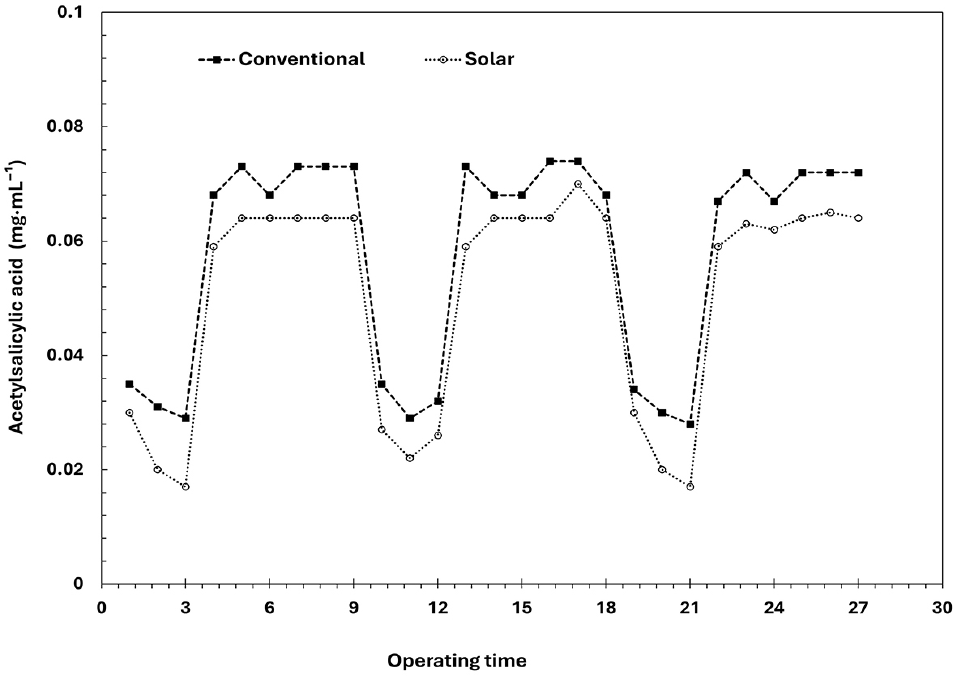
Figure 1 shows the evolution of the residual concentration of ASA during 27 EC trials operated under conventional and photovoltaic energy supply. In both systems, a characteristic cyclic pattern was observed, with pronounced decreases in the initial stages of each cycle followed by subsequent stabilization.
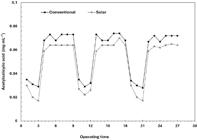
Residual concentration of acetylsalicylic acid (ASA) during 27 electrocoagulation trials using conventional and photovoltaic (PV) power systems (11 V).
This behavior reflects the natural sequence of formation, consumption, and partial depletion of aluminum hydroxide species responsible for in situ coagulation, a trend previously reported for EC applied to pharmaceutical contaminants in complex aqueous matrices.25,26
In the early phases of each cycle (0-3, 9-12, and 18 21 min), both systems exhibited a significant reduction in ASA concentration, attributed to the rapid generation of Al(OH)3(s) and other amorphous hydroxides with high adsorptive capacity.27 However, the photovoltaic system consistently showed lower residual concentrations, reaching values < 0.02 mg mL-1 in run 20. This indicates a more gradual and stable dosing of coagulant species, resulting from the natural modulation of the current generated by the solar panel, which prevents episodes of overdosing or supersaturation of aluminum species.28-30
In contrast, the conventional system - operated under fixed current-exhibited more pronounced fluctuations in the intermediate stages of the process (4-8, 13-17, and 22 27 min), as well as slightly higher residual concentrations (0.03 mg mL-1). These oscillations have been associated with localized pH variations, accumulation of soluble species such as Al(OH)4-, and anodic passivation phenomena, which can induce temporary restabilization of colloidal particles and reduce instantaneous treatment efficiency.
Throughout the experiment, the photovoltaic system maintained smaller variation amplitudes and consistently lower residual concentrations, indicating a more stable coagulation process and reduced susceptibility to floc breakage. Recent studies31 have shown that fluctuating currents induced by solar irradiance promote the formation of denser and more compact flocs, improving clarification and minimizing re-stabilizing species in solution.
Overall, the results indicate that although both systems are effective for ASA removal, the photovoltaic electrocoagulation system exhibits a more uniform kinetic profile, lower variability between cycles, and a chemically more balanced and energy-efficient coagulant dosing. These observations align with recent investigations highlighting the operational advantages of solar-powered EC systems in the treatment of pharmaceutical and emerging organic contaminants.
Removal efficiency of acetylsalicylic acid by conventional and solar electrocoagulation
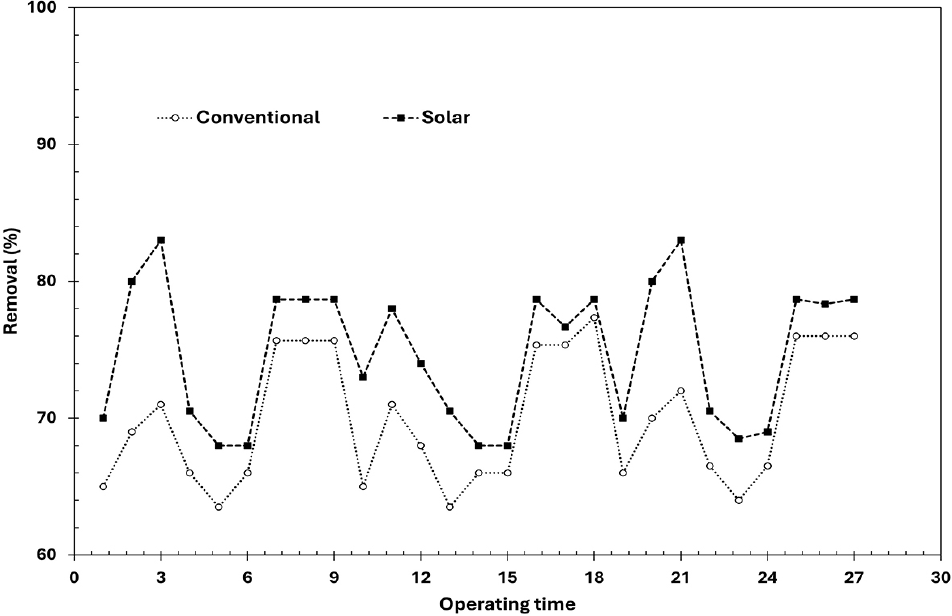
Figure 2 presents the comparison of removal efficiency of ASA obtained over 27 EC assays operated under conventional and solar-powered conditions.
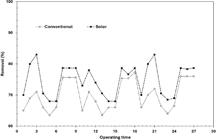
Comparison of acetylsalicylic acid (ASA) removal efficiency between conventional and solar-powered electrocoagulation systems (27 runs, 11 V).
Both systems achieved efficiencies above 65% throughout the experimental period; however, the photovoltaic system consistently exhibited superior performance, with peak values ranging from 80-85% during the most effective cycles (assays 3, 11, and 21). In contrast, the conventional system showed slightly lower efficiencies, typically around 72-75%.
The lower data dispersion observed for the solar-driven system indicates greater operational stability, attributed to the continuous and modulated generation of coagulant species under a naturally fluctuating solar-based electrical supply. This behavior promotes a gradual and well-balanced dosing of Al(OH)3(s) and other amorphous hydroxides, preventing episodes of overdosing or underdosing of coagulant species - conditions reported as critical for maintaining high removal efficiencies in EC processes.
During the early stages of each cycle (0-3, 9-12, and 18 21 min), the photovoltaic system reached removal peaks of 80-85%, significantly surpassing the values obtained under constant-current operation. This improvement is associated with the smoothing effect of the solar-modulated current, which enhances the formation of denser and more compact flocs and minimizes the temporary re-stabilization of colloidal particles. Similar behaviors have been reported in recent studies demonstrating that intermittent or fluctuating currents can improve floc structure and stability.32
Conversely, the conventional EC system, operated at fixed current, exhibited more pronounced fluctuations, particularly noticeable around 6-7 min, 13-14 min, and 23-24 min. These transient reductions in efficiency are attributed to the sensitivity of the system to local pH variations, accumulation of soluble species such as Al(OH)4-, and anodic passivation phenomena, all of which can promote floc breakage or colloidal re-stabilization.33,34
During the intermediate stages of each cycle (4-8, 13-17, and 22-27 min), both profiles showed a tendency toward stabilization. However, the photovoltaic system maintained higher values with lower dispersion (75-80%), while the conventional system exhibited broader variability (65-74%), evidencing lower operational robustness. This behavior has been associated with a more homogeneous formation of coagulant species under variable-current conditions, which enhances process stability against fluctuations in organic load and pH.
The overall superiority of the photovoltaic system is consistent with previous findings on the treatment of emerging organic contaminants, where solar-modulated currents were shown to produce larger flocs with improved settling characteristics and reduced fragmentation.35 These effects enhance both sweep-flocculation and subsequent solid-liquid separation, explaining the sustained higher efficiencies observed in this study.
Response surfaces of zeta potential (ζ)
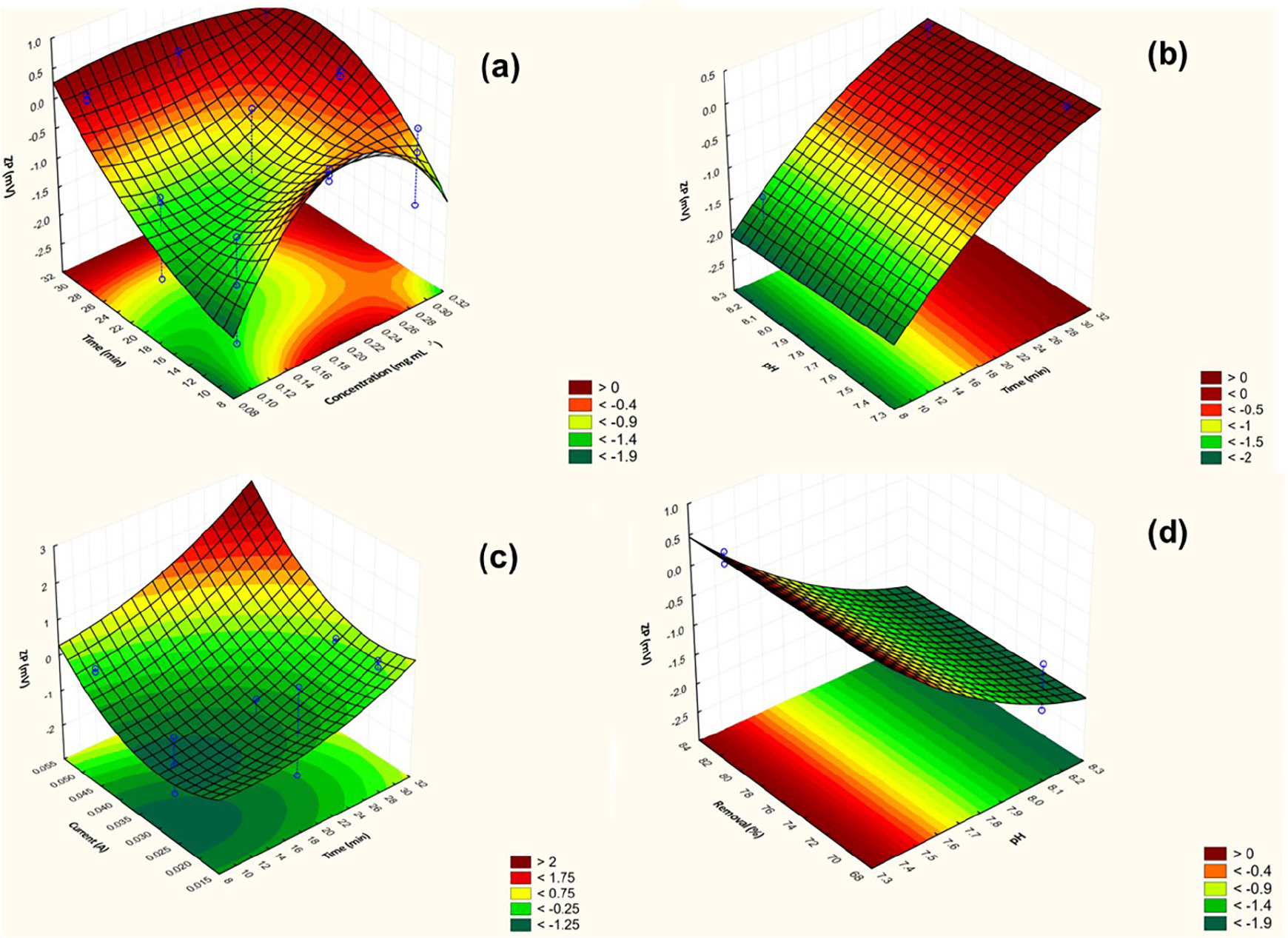
Figures 3a-3d present the response surfaces of zeta potential (ζ) as a function of the main operational variables of the EC process, including initial ASA concentration, reaction time, pH, current density, and removal efficiency. Overall, these surfaces highlight the central role of ζ in colloidal destabilization, showing that the regions of best performance are consistently associated with values near surface neutrality (approximately -1.0 to -2.0 mV), in agreement with recent reports36 on EC applied to pharmaceutical and emerging organic contaminants.
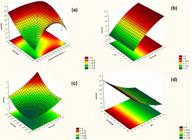
Response surfaces of ζ-potential during electrocoagulation of acetylsalicylic acid (ASA): (a) concentration × time; (b) pH × time; (c) current × time; (d) pH × removal.
Figure 3a shows that, at intermediate reaction times (10 20 min) and moderate ASA concentrations (< 0.20 mg mL-1), the ζ potential reaches values close to -2 mV, favoring colloidal destabilization and floc formation. This behavior agrees with previous literature, which reports that slightly negative ζ values are optimal for promoting coagulation.37 The response surface displays a marked curvature toward more negative ζ values as reaction time increases, especially at low initial contaminant concentrations. This trend suggests a greater availability of electroactive aluminum hydroxides-mainly amorphous Al(OH)3(s)-capable of neutralizing colloidal surface charges. At higher initial ASA concentrations, longer reaction times are required to reach the minimum-repulsion region (ζ = -2 mV), which reflects an increased coagulant demand, consistent with previous findings on colloidal destabilization kinetics.38
Figure 3b shows that under near-neutral pH conditions (7.3-7.7) and reaction times of 10-25 min, ζ remains around -2 mV. However, under alkaline conditions (pH > 8.0) and extended times (> 30 min), ζ shifts toward 0 mV, reflecting the predominance of soluble Al(OH)4- species, which reduce the availability of amorphous aluminum hydroxides. The optimal regions identified (-1.5 to -2.0 mV) correspond to the maximum adsorptive efficiency of Al(OH)3(s), a behavior widely documented for EC systems using aluminum electrodes operated under slightly acidic or neutral pH conditions.39
Figure 3c reveals that excessively high current densities shift the ζ potential toward less negative or even positive values, indicating colloidal restabilization due to overdosing of Al3+. Regions where ζ remains between -1.25 and -2.0 mV correspond to intermediate current densities (0.025-0.040 A), where coagulant production is more controlled. The response surface also indicates that reaction time acts as a stabilizing factor, as longer periods promote floc maturation, reduce the dispersion of surface charge, and improve destabilization efficiency.
Figure 3d illustrates the combined influence of zeta potential (ζ), pH, and removal efficiency, showing that removal values above 78% coincide with ζ = -2 mV. Regions of high removal efficiency (> 75%) consistently correspond to ζ values between -1.0 and -1.9 mV, indicating that the zone near surface neutrality represents the optimal interval for aggregation and macrofloc formation. In contrast, less negative ζ values (-0.5 to 0 mV) are associated with lower removals, suggesting that colloidal particles retain sufficient electrostatic repulsion to hinder the development of stable flocs. This behavior is consistent with mechanisms recently described for EC applied to emerging organic contaminants, where the efficiency of the process strongly depends on the proximity to the isoelectric point of the system.
Zeta-potential distributions
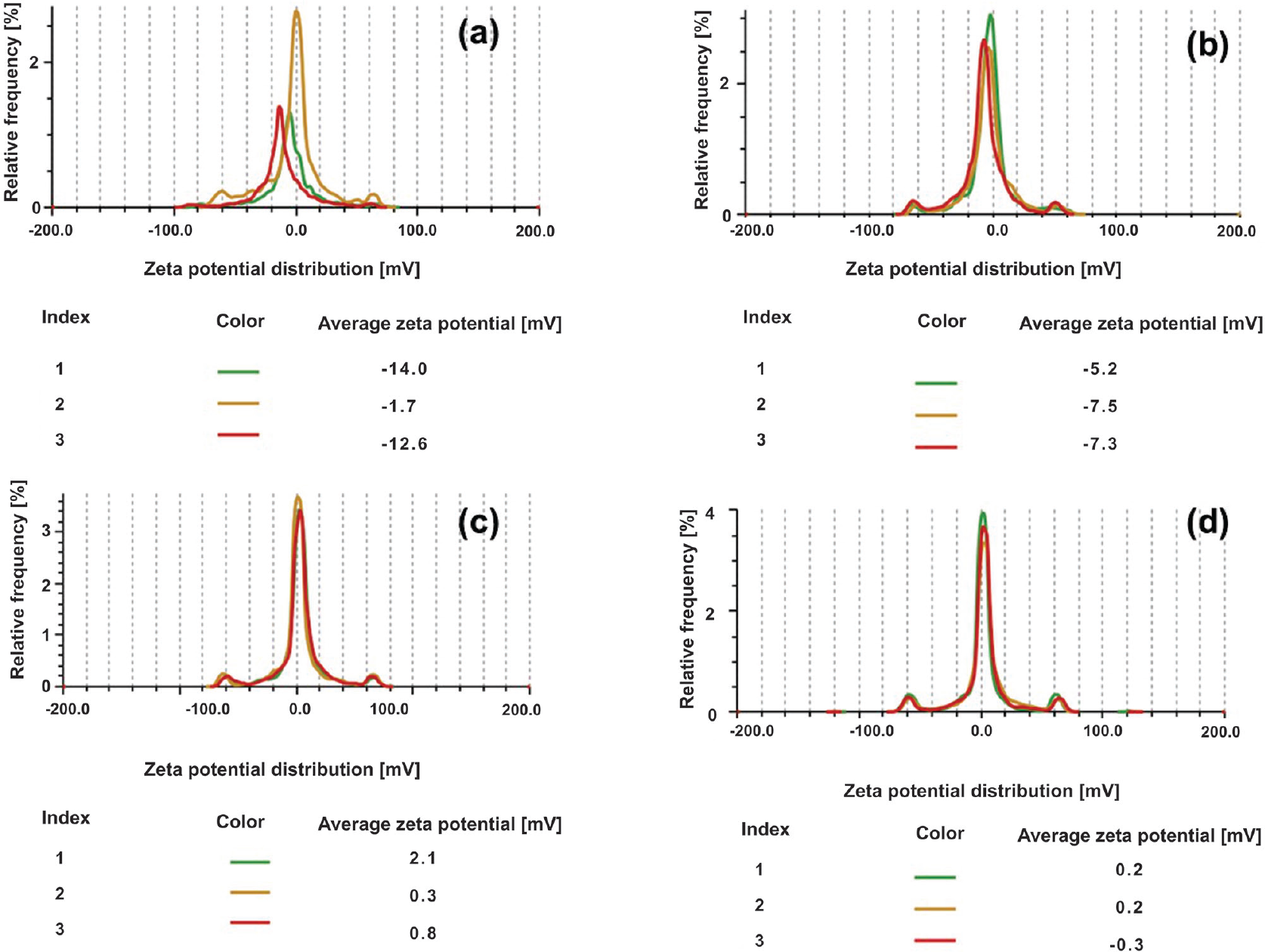
Figures 4a-4d show the frequency distributions of zeta potential (ζ) under different operational conditions of the EC process. Taken together, the plots reveal that the system progresses through a well-defined sequence of colloidal stability states, ranging from high electrostatic repulsion to the vicinity of the minimum-repulsion region, where large and stable flocs are formed. This evolution is consistent with widely documented mechanisms for EC systems using aluminum electrodes.40
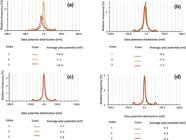
Zeta potential distribution of acetylsalicylic acid (ASA) under different experimental conditions: (a) initial solution before electrocoagulation; (b) showing partial surface charge neutralization; (c) with zeta potential values close to zero, indicating optimal colloidal destabilization; and (d) showing effective coagulation and stable floc formation.
Figure 4a exhibits distributions centered at highly negative ζ values (-14.0, -12.6, and -1.7 mV). The most negative curves reflect a strongly colloidal system characterized by intense surface repulsion that inhibits particle aggregation. Such conditions are typical of early stages of the process, when the effective coagulant dose is still insufficient or soluble aluminum species dominate, contributing little to charge neutralization.
Figure 4b shows he distributions shift toward less negative ζ values (-5.2, -7.5, and -7.3 mV), indicating progression toward partial charge neutralization. This shift suggests an increased production of electroactive hydroxylated species, especially amorphous Al(OH)3(s), which reduces electrostatic repulsion. At this stage, colloids begin to enter the critical region where interparticle attraction surpasses repulsion, favoring the formation of mesoscopic flocs.
Figure 4c shows ζ distributions centered at slightly positive values (2.1, 0.3, and 0.8 mV), indicating a surface charge inversion. This condition is typically associated with transient overdosing of Al3-, a phenomenon described as “colloidal restabilization by overcharging”. Although aggregation may be less efficient due to the presence of net positively charged particles, this stage does not necessarily represent a deterioration of the process; rather, it may reflect the natural oscillation between charge neutralization and sweep flocculation driven by amorphous precipitates.
Figure 4d presents ζ distributions centered near neutrality (0.2, 0.2, and -0.3 mV), indicating that the system has reached the minimum-repulsion region, or the vicinity of the isoelectric point. This condition is optimal for the formation of dense, stable, and sedimentable macroflocs, which explains the high removal efficiencies observed in this stage.
Particle-size evolution
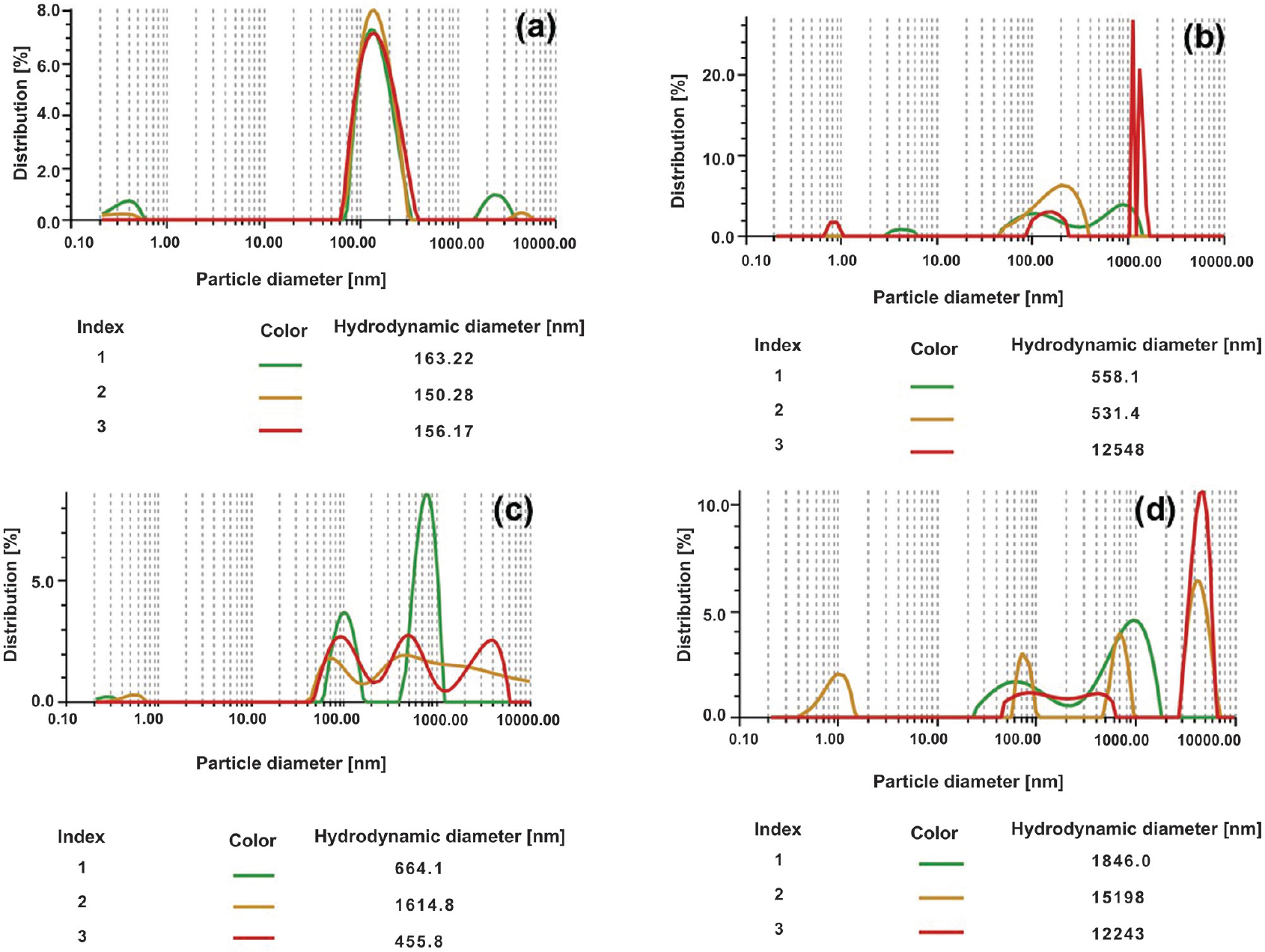
Figures 5a-5d show the evolution of particle size throughout the different stages of the EC process, allowing the identification of the transition from dispersed nanoparticles to large macroflocs characteristic of the final stage. This sequence clearly represents the three classical phases of aluminum coagulation-flocculation: (i) colloidal destabilization, (ii) microflocculation, and (iii) macrofloc formation or sweep flocculation. These patterns have been widely described in recent studies involving EC applied to pharmaceuticals and emerging organic contaminants.41,42
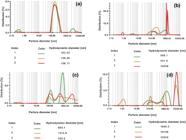
Particle size distribution (hydrodynamic diameter) of acetylsalicylic acid (ASA) suspensions under different experimental conditions: (a) initial solution before electrocoagulation; (b), showing the onset of particle aggregation; (c) indicating the formation of larger aggregates; and (d) characterized by the presence of large flocs and a broad size distribution.
Figure 5a exhibits distributions in the 150-163 nm range, corresponding to small colloidal particles and initial microflocs. The presence of a single narrow peak indicates that the system remains in the early aggregation stage, where charge neutralization has begun but the flocs have not yet reached mesoscopic sizes. The small peak near 10,000 nm suggests the onset of larger-scale aggregation, likely due to the capture of particles by amorphous aluminum hydroxides.
Figure 5b shows broader peaks and multimodal distributions. Particle diameters begin to reach 531 558 nm, indicating the formation of mesoscopic flocs. A pronounced peak around 12,548 nm reflects the presence of consolidated macroflocs at this stage. This behavior is typical of the interval where ζ approaches the minimum-repulsion region (-1 to -2 mV), which enhances effective particle-particle collisions. The coexistence of nanoparticles and macroflocs suggests a dynamic process in which some aggregates continue to grow while others are only beginning to destabilize.
Figure 5c reveals pronounced polydispersity, with peaks at 455.8, 664.1, and 1614.8 nm. This distribution indicates strong aggregation activity and internal restructuring of flocs. The wide variety of diameters is characteristic of systems where coagulant availability is sufficient to promote interparticle collision, but structural heterogeneity persists in amorphous hydroxide surfaces. The complex distributions observed are consistent with the sweep flocculation mechanism, in which Al(OH)3(s) precipitates entrap colloidal particles within their growing structure.
Figure 5d shows distributions dominated by large macroflocs. Hydrodynamic diameters range from 12,243 to 15,198 nm, with well-defined peaks, indicating entry into the final flocculation stage. This phase corresponds to the transition toward ζ values very close to zero (-0.3 to +0.2 mV), a condition that favors floc consolidation and low susceptibility to breakage. Particle sizes on the order of 10-20 μm agree with recent reports on EC applied to pharmaceutical contaminants and industrial wastewater, where larger flocs exhibit more efficient settling behavior and enable higher removal efficiencies.
Energy, electrode consumption, and operational cost
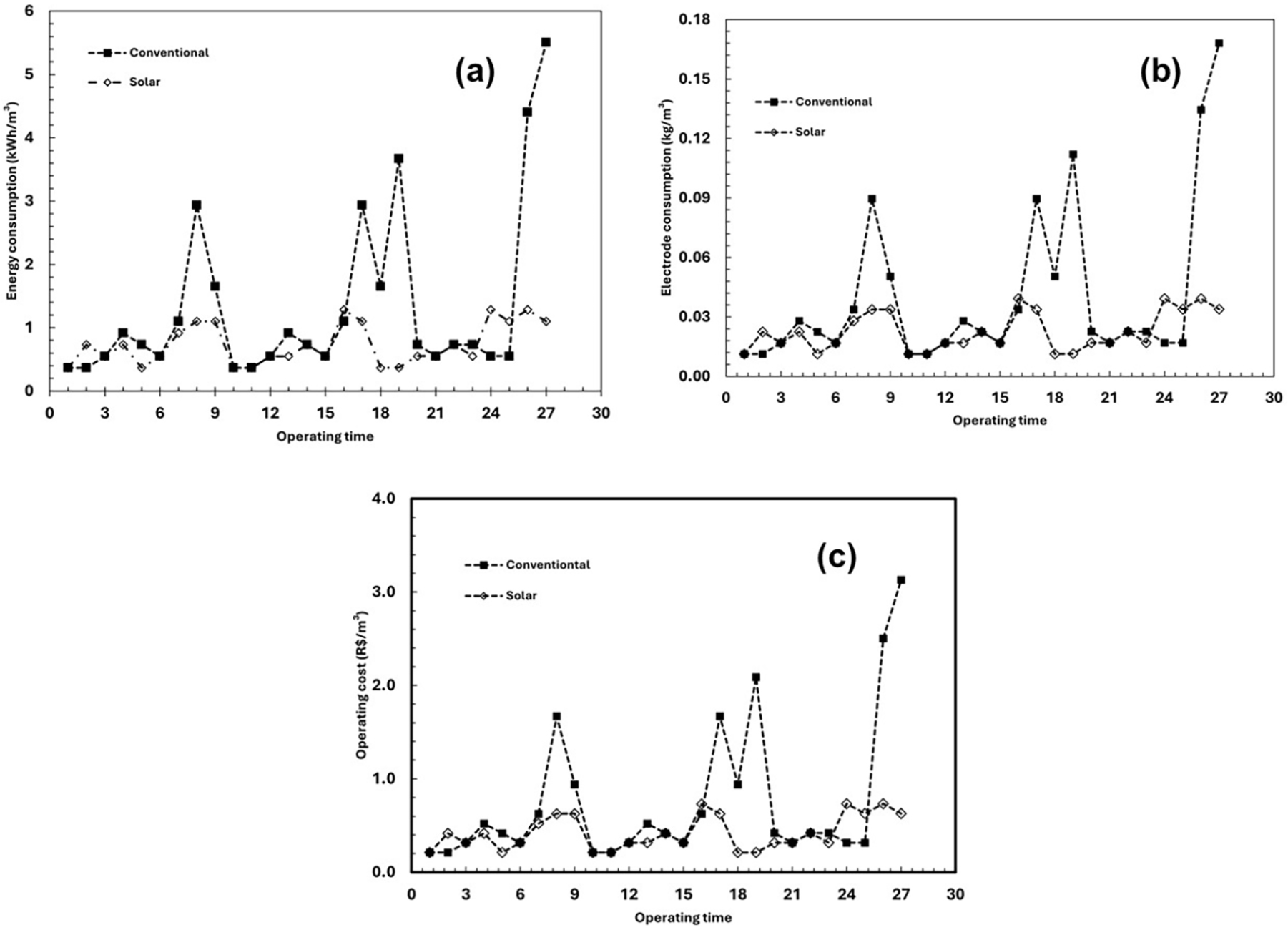
A comparative analysis of Table 4 reveals that the photovoltaic system consistently achieved lower energy consumption, lower electrode dissolution, and lower operating costs under the more demanding experimental conditions. This trend is particularly evident in tests 8, 17, 19, 24, 26 and 27, where the conventional system exhibited sharp increases in energy use (2.934 5.502 kWh m-3), electrode consumption (0.0896-0.1680 kg m-3), and operational cost (R$ 1.669-3.130). In contrast, the solar-powered system maintained substantially lower values in the same runs, with energy demands ranging only from 0.368 to 1.285 kWh m-3, electrode dissolution between 0.0113 and 0.0393 kg m-3, and operating costs remaining below R$ 0.732.
Energy consumption, electrode dissolution, and operational cost for conventional and solar-powered electrocoagulation (27 runs, 11 V), comparing results of specific energy consumption, electrode dissolution, and operational cost for both conventional and solar-powered EC systems, expressed per cubic meter of treated solution
These differences highlight the stabilizing effect of the naturally modulated current generated by the photovoltaic source. Instead of supplying a constant and sometimes excessive current-as occurs in the conventional system-the fluctuating solar input provides a smoother and more gradual generation of Al(OH)3 and related coagulant species. This mitigates overstressing of the electrodes, reduces anodic passivation, and limits unnecessary dissolution of aluminum, especially at high current settings. Such behavior is consistent with the mechanistic interpretation provided for removal efficiency and zeta potential, where PV-EC demonstrated more stable floc formation and fewer episodes of colloidal restabilization.
Figures 6a-6c compare the operational performance of conventional electrocoagulation (EC-Conv) and photovoltaic-powered electrocoagulation (EC-Solar) in terms of energy consumption, electrode dissolution, and operating cost. Overall, the results demonstrate clear advantages for the solar-powered system, which exhibits greater operational stability and substantially lower resource demand. These findings agree with recent studies evaluating EC coupled to photovoltaic energy systems.43,44
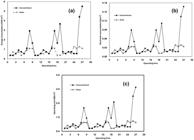
Comparison between conventional and solar electrocoagulation systems: (a) energy consumption (kWh m-3), (b) electrode consumption (kg m-3), and (c) operating cost (R$ m-3) during 27 experimental runs.
Figure 6a reveals marked differences between the two configurations. While EC-Conv shows recurrent peaks ranging from 3.0 to 5.5 kWh m-3, EC-Solar maintains consistently lower values, typically between 0.2 and 1.2 kWh m-3 throughout most of the operation.
These peaks in EC-Conv are a direct consequence of a constant electrical supply, which forces the system to operate under high current densities even when they are not required. This behavior leads to excessive aluminum dosing and low instantaneous energy efficiency, a phenomenon previously documented.45,46
In contrast, EC-Solar benefits from a naturally modulated current governed by irradiance, which reduces instantaneous power input, prevents electrical overloads, and produces a more stable energy profile. Similar patterns have been reported in studies demonstrating that photovoltaic operation can reduce energy demand by 40 80% compared with conventional EC.47
Figure 6b shows that the conventional system reaches electrode consumption values between 0.08 and 0.15 kg m-3, with recurrent peaks attributed to overcurrent conditions and periodic anodic passivation-depassivation cycles. These fluctuations can accelerate aluminum corrosion through non-uniform electrochemical mechanisms.
Conversely, EC-Solar operates predominantly in the range of 0.02-0.04 kg m-3, representing a 60-75% reduction in dissolved aluminum mass. The lower electrochemical aggressiveness of the solar system is attributed to the natural attenuation of current, which prevents rapid passive-layer formation and promotes a more uniform and stable dissolution of the aluminum electrodes.
Consequently, the operating cost (Figure 6c) was significantly lower for EC-Solar, ranging from 0.20 to 0.73 R$ m-3, whereas EC-Conv reached values as high as 3.10 R$ m-3 during high-current events. This substantial difference underscores the economic benefit of photovoltaic-driven EC systems, in which both energy consumption and electrode dissolution are minimized, resulting in lower overall costs and enhanced sustainability.
The reduced operational variability observed in the solar configuration reinforces the hypothesis that photovoltaic integration provides a more stable current supply, thereby improving process efficiency, robustness, and long-term reliability.
Future studies should focus on the development and optimization of continuous-flow reactors powered by solar energy, as these configurations have shown greater hydraulic stability, reduced hydraulic retention times, and improved contaminant removal compared with batch systems. Recent advances in continuous EC reactors, flow-modulated designs, and hybrid EC-flotation units support the potential of this approach for large-scale applications.48,49
Scaling PV-EC to pilot and industrial levels is essential, particularly for effluents with variable composition (municipal, pharmaceutical, agro-industrial). The literature highlights the need to assess long-term operation under fluctuating irradiance, optimize electrode geometry, and improve energy-management strategies.50
Coupling PV-EC with adsorption, membrane filtration, advanced oxidation processes, or biological treatments may enhance removal efficiencies, reduce sludge generation, and improve overall energy performance. Solar-driven hybrid systems have already shown synergistic effects in the treatment of dyes, pharmaceuticals, and industrial wastewaters.51-53
Further research combining ζ-potential monitoring, advanced floc characterization scanning electron microscopy (SEM) , dynamic light scattering (DLS), and computational fluid dynamics (CFD) simulations would provide deeper insight into coagulation-flocculation mechanisms and hydrodynamic behavior in large-scale C-PV-EC systems.
Overall, future efforts should focus on integrating continuous operation, mechanistic understanding, and real-scale validation to consolidate photovoltaic electrocoagulation as a robust and sustainable technology for the treatment of contaminated waters.
Conclusions
The results of this study confirm that EC using aluminum electrodes is an effective alternative for the removal of ASA; however, its performance depends critically on the type of electrical supply employed. The comparison between conventional EC and photovoltaic-powered EC revealed significant differences in removal efficiency, colloidal stability, and overall operational behavior.
Photovoltaic EC exhibited consistently higher removal efficiencies (78-85%) and lower inter-cycle variability, attributed to the natural modulation of current generated by solar irradiance, which promotes a more balanced dosing of aluminum hydroxide species and prevents overdosing and recurrent colloidal restabilization.
Zeta-potential analysis confirmed that maximum efficiency was achieved within the minimum-repulsion region (-1.0 to -2.0 mV), a condition attained more consistently under photovoltaic operation. The evolution of particle size revealed a clear transition from nanoparticles to macroflocs (>10 000 nm), with greater floc consolidation in the solar-powered system.
From an operational standpoint, photovoltaic EC markedly reduced energy consumption (60-75%), electrode dissolution (50-70%), and operating costs (0.20 0.73 R$ m-3, compared with up to 3.10 R$ m-3 for conventional EC), highlighting its economic and environmental advantages.
Overall, the findings demonstrate that photovoltaic-powered electrocoagulation provides a more favorable balance of removal efficiency, operational stability, and cost, establishing it as a sustainable alternative for decentralized treatment of emerging pharmaceutical contaminants. The integration of mechanistic analysis, response-surface modeling, and operational indicators strengthens the robustness of the proposed approach and validates the technical and economic superiority of the photovoltaic system over conventional operation.
Although the present study demonstrates the technical feasibility and operational advantages of photovoltaic-assisted electrocoagulation (PV-EC) for the removal of acetylsalicylic acid, several research opportunities remain that could further strengthen the applicability and scalability of the process.
Acknowledgments
Falcón acknowledges the scholarship granted by CNPq (Brazil). The authors express their gratitude to the Multiuser Laboratory of the Londrina Campus (LabMult-LD), Federal University of Technology - Paraná (UTFPR-Londrina), for analytical support.
Data Availability Statement
The data supporting the findings of this study are included within the article. Additional information is available from the corresponding author upon reasonable request.
References
-
1 Hube, S.; Wu, B.; Sci. Total Environ. 2021, 779, 146545. [Crossref]
» Crossref -
2 Ajala, O. J.; Tijani, J. O.; Salau, R. B.; Abdulkareem, A. S.; Aremu, O. S.; Results Eng. 2022, 16, 100671. [Crossref]
» Crossref -
3 Bracamontes-Ruelas, A. R.; Ordaz-Diaz, L. A.; Bailón-Salas, A. M.; Ríos-Saucedo, J. C.; Reyes-Vidal, Y.; Reynoso-Cuevas, L.; Processes 2022, 10, 1041. [Crossref]
» Crossref -
4 Bracamontes-Ruelas, R.; Irigoyen-Campuzano, J. R.; Torres-Castañon, L. A.; Reynoso-Cuevas, L. In Wastewater Treatment and Sludge Management Systems-The Gutter-to-Good Approaches; Taşeli, B. K.; Jacob-Lopes, E.; Zepka, L. Q.; Deprá, M. C., eds.; IntechOpen: Croatia, 2024, p. 1-19. [Crossref]
» Crossref -
5 Camargo-Perea, A. L.; Rubio-Clemente, A.; Peñuela, G. A.; Water 2020, 12, 1068. [Crossref]
» Crossref -
6 Cusioli, L. F.; Quesada, H. B.; Castro, A. L. B. P.; Gomes, R. G.; Bergamasco, R.; Chemosphere 2020, 247, 125852. [Crossref]
» Crossref -
7 Agunbiade, F. O.; Moodley, B.; Environ. Toxicol. Chem. 2016, 35, 36. [Crossref]
» Crossref -
8 Praveenkumarreddy, Y.; Vimalkumar, K.; Ramaswamy, B. R.; Kumar, V.; Singhal, R. K.; Basu, H.; Gopal, C. M.; Vandana, K. E.; Bhat, K.; Udayshankar, H. N.; Balakrishna, K.; Emerging Contam. 2021, 7, 43. [Crossref]
» Crossref -
9 Ramo, A.; Del Cacho, E.; Sánchez-Acedo, C.; Quílez, J.; Sci. Total Environ. 2017, 580, 1007. [Crossref]
» Crossref -
10 Cusioli, L. F.; Quesada, H. B.; de Brito Portela Castro, A. L.; Gomes, R. G.; Bergamasco, R.; Chemosphere 2020, 247, 125852. [Crossref]
» Crossref -
11 Quesada, H. B.; Baptista, A. T. A.; Cusioli, L. F.; Seibert, D.; Bezerra, C. O.; Bergamasco, R.; Chemosphere 2019, 222, 766. [Crossref]
» Crossref -
12 Shahedi, A.; Darban, A. K.; Taghipour, F.; Jamshidi-Zanjani, A.; Curr. Opin. Electrochem. 2020, 22, 154. [Crossref]
» Crossref -
13 Hendaoui, K.; Trabelsi-Ayadi, M.; Ayari, F.; Chin. J. Chem. Eng. 2021, 29, 242. [Crossref]
» Crossref -
14 Sadaf, S.; Roy, H.; Fariha, A.; Rahman, T. U.; Tasnim, N.; Jahan, N.; Sokan-Adeaga, A. A.; Safwat, S. M.; Islam, M. S.; J. Water Process Eng. 2024, 62, 105409. [Crossref]
» Crossref -
15 Qian, W.; Zhichuan, J. X.; J. Mater. Chem. A 2024, 41, 27974. [Crossref]
» Crossref -
16 Ruiqi, W.; Huancheng, T.; Ruitao, Y.; Jingduo, Z.; Water Sci. Technol. 2024, 89, 2763. [Crossref]
» Crossref -
17 Khan, S. U.; Khalid, M.; Hashim, K.; Jamadi, M. H.; Mousazadeh, M.; Basheer, F.; Farooqi, I. H.; Sustainability 2023, 15, 1708. [Crossref]
» Crossref -
18 Zaroual, Z.; Chainet, E.; El Ghachtouli, S.; Azzi, M.; World J. Eng. Res. Technol. 2023, 5, 551564. [Crossref]
» Crossref -
19 Fijałkowski, Ł.; Skubiszewska, M.; Grześk, G.; Koech, F. K.; Nowaczyk, A.; Molecules 2022, 27, 8412. [Crossref]
» Crossref -
20 Matra, K.; Lerkmahalikit, Y.; Prasertkulsak, S.; Kongdee, A.; Pomthong, R.; Thongson, S.; Theepharaksapan, S.; Water 2025, 17, 3003. [Crossref]
» Crossref -
21 Akhtar, A.; Suleman, M. S.; Gillani, S. M. A.; Aslam, Z.; ChemBioEng Rev. 2024, 11, 136. [Crossref]
» Crossref -
22 Bani-Melhem, K.; Alnaief, M.; Al-Qodah, Z.; Al-Shannag, M.; Elnakar, H.; AlJbour, N.; Alu’datt, M.; Alrosan, M.; Ezelden, E.; Appl. Water Sci. 2025, 15, 114. [Crossref]
» Crossref -
23 Meetiyagoda, T. A. O. K.; Yo, Z.; Matsunaga, E.; Fujino, T.; Water Conserv. Sci. Eng. 2025, 10, 49. [Crossref]
» Crossref -
24 Jamrah, A.; Al-Zghoul, T. M.; Al-Qodah, Z.; Al-Karablieh, E.; Water 2025, 17, 1697. [Crossref]
» Crossref -
25 Suhartana, S.; Purwanto, P.; Darmawan, A.; Widhiarih, T.; J. Southwest Jiaotong Univ. 2022, 57, 1. [Crossref]
» Crossref -
26 Etafo, N. O.; Adekanmi, D. G.; Awobifa, O. S.; Parga-Torres, J. R.; Ibarra-Herrera, L. A.; Awobifa, O. A.; Discovery Civil Eng. 2025, 2, 103. [Crossref]
» Crossref -
27 Zahedi, S.; Dolatabadi, M.; Zahedi, M. J.; Asadipour, A.; Ahmadzadeh, S.; Appl. Water Sci. 2025, 15, 2634. [Crossref]
» Crossref -
28 Muniasamy, S. K.; Gameda, T. T.; Mallaian, L. S.; Rengaraju, I.; Segaran, J.; Periyasamy, Y.; Murugesan, P.; Subramanian, S.; Adv. Mater. Sci. Eng. 2022, 2022, 5389340. [Crossref]
» Crossref -
29 Al-Qodah, Z.; Al-Zghoul, T. M.; Jamrah, A.; Environ. Sci. Pollut. Res. 2024, 31, 20434. [Crossref]
» Crossref -
30 Al-Zghoul, T. M.; Al-Qodah, Z.; Al-Jamrah, M.; Water 2023, 15, 980. [Crossref]
» Crossref -
31 Wu, H.; Shi, Z.; Sun, B.; Zheng, B.; Shah, K. J.; Lin, S.; Chemosphere 2024, 363, 142773. [Crossref]
» Crossref -
32 Marmanis, D.; Emmanouil, C.; Fantidis, J. G.; Thysiadou, A.; Marmani, K.; Sustainability 2022, 14, 4323. [Crossref]
» Crossref -
33 Dong, W.; Gu, X.; Shu, Y.; Cao, D.; Yu, J.; Abdel-Fatah, M. A.; Fu, H.; J. Water Process Eng. 2022, 47, 102703. [Crossref]
» Crossref -
Sharma, G.; Choi, J.; Shon, H. K.; Phuntsho, S.; Desalin. Water Treat. 2011, 32, 381. [Crossref]
» Crossref -
35 Medrano-Hurtado, Z. Y.; Medina-Aguirre, J. C.; Marcelo Medrano, H.; Castillón-Barraza, A.; Zamora Alarcón, R.; Casillas-Lamadrid, M. E.; Jumilla-Corral, A. A.; Mayorga Ortiz, P.; Rev. Mex. Ing. Quim. 2022, 21, 213. [Crossref]
» Crossref -
36 Bajpai, M.; Katoch, S. S.; Kadier, A.; Singh, A.; Environ. Sci. Pollut. Res. 2022, 29, 15252. [Crossref]
» Crossref -
37 Kobya, M.; Demirbas, E.; Sahin, O.; Desalination Water Treat. 2012, 46, 366.[Crossref]
» Crossref -
38 Yazıcı Karabulut, B.; Molecules 2025, 18, 3779. [Crossref]
» Crossref -
39 Liu, Y.; Bai, W.; Wei, J.; Qiao, Z.; Du, S.; Ultrason. Sonochem. 2025, 121, 107558. [Crossref]
» Crossref -
40 Hunter, R. J.; Zeta Potential in Colloid Science; Elsevier: Amsterdam, 1981, p. 11-58. [Crossref]
» Crossref -
41 Zhu, D.; Dou, J.; Ping, L.; Hong, Y.; Chen, C.; Yuan, C.; Li, Q.; Luo, W.; Chi, X.; J. Sep. Sci. 2025, 48, e70253. [Crossref]
» Crossref -
42 Öztürk, K.; Kaplan, M.; Çalış, S.; Int. J. Pharm. 2024, 666, 124799. [Crossref]
» Crossref -
43 Çetinkaya, A. Y.; Environ. Monit. Assess. 2025, 197, 224. [Crossref]
» Crossref -
44 Barakat, M. M. M.; Abdel-Fatah, A. A.; Hassan, H.; Sci. Rep. 2025, 15, 14462. [Crossref]
» Crossref -
45 Muryanto, M.; Sari, A. A.; Pertiwi, S.; Prasetyo, D. A.; Sudarno, S.; Presipitasi 2021, 18, 338. [Crossref]
» Crossref -
46 Mao, R.; Zhao, Y.; Cotterill, S.; Water 2023, 15, 1455. [Crossref]
» Crossref -
47 Lin, X.; Gong, J.; Li, H.; Zhang, H.; Yu, Y.; Tan, W.; Environ. Eng. Res. 2023, 28, 596. [Crossref]
» Crossref -
48 Phu, T. K. C.; Nguyen, P. L.; Phung, T. V. B.; iScience 2025, 28, 111965. [Crossref]
» Crossref -
49 Sadaf, S.; Roy, H.; Fariha, A.; Rahman, T. U.; Tasnim, N.; Jahan, N.; Sokan-Adeaga, A. A.; Safwat, S. M.; Islam, M. S.; J. Water Process Eng. 2024, 62, 105409. [Crossref]
» Crossref -
50 Al-Ajmi, F.; Al-Marri, M.; Almomani, F.; Water 2025, 17, 23. [Crossref]
» Crossref -
51 Jo, S.; Kadam, R.; Jang, H.; Seo, D.; Park, J.; Energies 2024, 17, 5863. [Crossref]
» Crossref -
52 Chuquimbalqui-Marina, D.; Azabache-Aliaga, Y. D.; Ordóñez Ruiz, K. M.; Bardalez-Tuesta, C. M.; Rev. Amaz. Cienc. Ambient. Ecol. 2025, 4, e802. [Crossref]
» Crossref -
53 Patel, S. K.; Shukla, S. C.; Natarajan, B. R.; Asaithambi, P.; Dwivedi, H. K.; Sharma, A.; Singh, D.; Nasim, M.; Raghuvanshi, S.; Sharma, D.; Sen, S.; Dubey, S.; Prajapati, A. K.; Desalin. Water Treat. 2025, 321, 100915.[Crossref]
» Crossref
Edited by
-
Editor handled this article:
Cristiane Luísa Jost (Associate)