 Nanoemulsion of Kefiran and Coriander (Coriandrum sativum L.) Essential Oil: Chemical and Technological Aspects
Abstract
Food contamination is a public health problem, and the search for natural additives to increase food stability and safety is challenging. This research aimed to study nanoemulsions produced with coriander essential oil and kefiran, an exopolysaccharide extracted from kefir grains. The composition of coriander essential oil was evaluated, revealing linalool as the main component. An experimental design consisting of six trials was conducted. The NE2 formulation (0.5% kefiran and 1.5% coriander essential oil) exhibited smaller particle size, monodispersity, a lower centrifugal stability coefficient, and higher absolute zeta potential values (> 30 mV), indicating high electrical stability. Morphology, thermal stability, and toxicity tests were performed. The minimum bactericidal concentration was determined and applied to commercial cheese. Thermal stability tests demonstrated an increase in the stability of NE2 compared to its individual components, and it was also proven to be non-toxic. The concentration of 25% m v-1 was identified as the minimum bactericidal concentration and was applied to commercial cheese.
Keywords:
nanotechnology; essential oil; biopolymer; antimicrobial
Introduction
Contamination by foodborne pathogens and spoilage, considered economic and public health problems,1 combined with consumer demand for less processed foods, points to the addition of natural agents with antimicrobial potential, such as essential oils.2,3 Essential oils are aromatic compounds extracted from various plants and can be used as natural antioxidant and antimicrobial substances.4
Coriandrum sativum L. leaves and seeds are used in folk medicine and as flavoring agents in food production.5,6 Coriander leaf oil contains a variety of phytochemicals. (E)-2-Decenal and (E)-2-dodecenal are abundant components.7 However, the application of essential oils has limitations due to their high volatility and intense aroma. Emulsification is an efficient technique for preserving bioactives in essential oils.8
The development of nanoemulsions (NE) with stable characteristics becomes a viable option due to the lipophilic nature of essential oils.9 Emulsions consist of two immiscible liquids mixed in a dispersion system using emulsifiers or stabilizers, thermodynamically unstable due to gravitational forces, interparticle repulsive and attractive forces, flow forces and molecular forces. Emulsions with droplet sizes between 100 and 500 nm can be classified as nanoemulsion or microemulsion (>100 nm), differing mainly in thermodynamic stability and manufacturing methods.10 Nanoemulsions can be distinguished by their structure: oil-in-water (O/W), water-in-oil (W/O), W/O/W, and O/W/O.11
The physical stability and bioavailability of active substances encapsulated in nanoemulsions are highly improved by avoiding phenomena such as destabilization, cream formation, sedimentation, coalescence, and flocculation.12 Nanoemulsions, which are kinetically stable liquid-in-liquid dispersions with droplet sizes on the order of 100 nm, offer several advantages. First, their smaller droplet size facilitates faster digestion in the gastrointestinal tract, thereby increasing the bioavailability of encapsulated hydrophobic active ingredients. Additionally, nanoemulsions exhibit a higher loading capacity, allowing for the incorporation of more bioactive compounds per unit mass in the release system. Notably, essential oils, which are inherently hydrophobic, can be transformed into colloidal dispersions to enhance their applicability as antimicrobials.11
Essential oil nanoemulsions are fabricated from an essential oil, a ripening inhibitor, an emulsifier, and water, but other components can be incorporated,11 e.g., exopolysaccharides such as kefiran (KFR) produced from kefir grains. Kefir grains are constituted of a protein-polysaccharide matrix.13 Remarkably, kefiran exhibits antibacterial, probiotic, and film-forming properties. Additionally, it serves as a potential drug carrier and thickening agent.14 Another significant feature is its emulsifying capability, contributing to emulsion stability. This effect occurs due to factors like its low molecular weight, the presence of lipophilic groups and protein content within its structure.15
Ricotta is a cheese that is an excellent substrate for undesirable microorganisms due to contamination after processing, as it undergoes high temperatures during manufacture.16 The use of KFR and coriander essential oil (CEO) nanoemulsion can be a promising system for food preservation. This study aimed to evaluate the physical stability, microscopic aspect, toxicity evaluation, antimicrobial activity, and application in ricotta cheese of nanoemulsion based on coriander essential oil and kefiran.
Experimental
Materials
Kefiran was extracted from milk kefir grains (molecular weight (Mw) = 106 g mol-1) (Figure S1, Supplementary Information (SI) section) and the essential oil from coriander leaves was purchased from Emporio Lazslo Co. (Minas Gerais, Brazil). All reagents used were of analytical grade. Tween 80, Span 80, Tween 20, and oleic acid were purchased from Sigma-Aldrich (Sigma Aldrich Co., St. Louis, MO, USA). Deionized water from the Milli-Q Water Purification System (Millipore Co., Bedford, MA, USA) was used to prepare all formulations.
Gas chromatography-mass spectrometry (GC-MS) of coriander essential oil
The composition of CEO was analyzed by a Shimadzu QP-2010 plus instrument (Shimadzu Corporation, Kyoto, Japan). Helium 5.0 carrier gas (99.999% purity) was used at a flow rate of 1.0 mL per min. The column used was Equit-5 (5% phenyl and 95% polydimethylsiloxane) with 30 m length 25 mm diameter and 25 urn liquid film thickness. The temperature programming started at 60 up to 246 ºC at a rate of 3 ºC min-1, totaling 62 min. The detector voltage used was 70 eV with a mass range from 30 to 500 m/z. The temperature of the ionization source and interface was set to 240 ºC. The injector temperature was set to 220 ºC with a 1:10 split injection mode. The injection volume was 1 µL. Identification of the compounds was performed by similarity with the mass spectra of the NIST library. For analysis, a 10 µL aliquot of each of the samples is dissolved in 990 µL of 1:1 dichloromethane/hexane chromatographic grade.
Extraction of kefiran
Kefir grains were obtained from cultures in the city of Fortaleza (Ceará, Brazil). The grains were kept under cooling and reactivated by successive cultures in ultra-high temperature milk. The kefir grains, washed with portions of milk, were inoculated in a 1:10 ratio at room temperature. The grains were separated by filtration through a sanitized plastic sieve from the fermented product after 24 h for complete activation.17 Kefir grains were weighed and diluted in water (1:10), and the mixture was placed in a microwave oven at high power for 4 min, with one-minute intervals for homogenization. The mixture was centrifuged at 7711 g for 15 min at room temperature. The polysaccharide in the supernatant was precipitated by adding two volumes of cold absolute ethanol and left to cool overnight. Afterwards, a centrifugation at 7711 g for 15 min at 4 ºC was performed (Hettich®, Universal 320, Kirchlengern, Westphalia, Germany). The sediment was dissolved in heated water (80 ºC) and the precipitation procedure was done in triplicate. The precipitate was dissolved in heated distilled water and freeze-dried.18
Gel permeation chromatography to kefiran polysaccharide
The molar mass was estimated by gel permeation chromatography (GPC), using a Shimadzu LC-10AD Chromatograph with a refractive index detector (Model RID-10A, Kyoto, Japan) at 40 ºC. The Chromatograph was equipped with an Ultrahydrogel linear column (7.8 mm × 300 mm) and used a flow rate of 1 mL min1. The analysis was carried out with 20 µL of polysaccharide solution 0.1% (m v-1), dissolved in ultrapure water, and 0.1 mol L-1 of sodium nitrate was used as eluent. All the solutions were filtered in cellulose acetate membranes (Sigma-Aldrich, St. Louis, USA). A calibration curve of pullulan was used as standard, with different molecular weights (range: 5.9 × 10³ to 7.88 × 10⁵ g mol-1).19
Fourier transform infrared (FTIR) spectroscopy to kefiran polysaccharide
The analysis was carried out on PerkinElmer equipment, model 16 PC (USA). The freeze-dried kefiran samples were mixed with potassium bromide and pressed into a transparent tablet. Transmission spectra were acquired on the spectrometer using 50 scans, a resolution of 4 cm-1 and a wavenumber range between 4000 and 400 cm-1 (Figure S2, SI section).
Preparation of nanoemulsions of kefiran and coriander essential oil
The formulations were prepared using 3 × 2 factorial planning (Table S1, SI section). In the experimental design, the independent variables used were the concentration of KFR and CEO, and the dependent variables were mean particle diameter (Z), polydispersity index (PDI) and zeta potential (ζ). Six samples (NE1: KFR 0.5%; CEO 0.5%; NE2: KFR 0.5%; CEO 1.5%; NE3: KFR 1.0%; CEO 0.5%; NE4: KFR 1.0%; CEO 1.5%; NE5: KFR 1.5%; CEO 0.5%; NE6: KFR 1.5%; CEO 1.5%) and two controls (NE-KFR (KFR 1.5%-CEO 0.0%) and NE-CEO (KFR 0.0%-CEO 1.5%) were formulated. The polysaccharide was dispersed in water, under heating (50 ºC) on a plate. Afterwards, the organic phase (OP) was placed under dripping, which was left under stirring for 30 min. The emulsions were then sonicated (Branson Sonifier® W-450-Digital, USA) with pulse regime of 2 s on and 1 s off for 2 min (½” tip) with an amplitude of 70%.20 The oil phase (OP) consisted of oleic acid (OA) with a hydrophilic-lipophilic balance (HLB) of 17 and coriander essential oil (CEO) with an HLB of 14 (details on the value determination can be found in the SI section). The surfactant used was Tween 20, which has an HLB of 16.7, at a ratio of 1:5 (surfactant to oil phase). The surfactant was chosen considering the HLB values of the OA and CEO (available in the SI section) and their proportions within the OP (calculated by equation 1).
where OP is organic phase, HLBOP is hydrophilic-lipophilic balance of organic phase, HLBCEO is hydrophilic lipophilic balance of essential oil, [oleic acid] and [CEO] corresponds to the concentration of oleic acid and coriander essential oil, respectively.
Storage stability of nanoemulsions of kefiran and coriander essential oil
The stability of the nanoemulsions was observed at room temperature and evaluated at 1, 7, 15, and 30 days. Mean particle diameter (Z), polydispersity index (PDI), and zeta potential (ζ) were determined by dynamic light scattering (DLS) (Zetasizer NanoZS, Malvern Instruments Ltd, Malvern, Worcestershire, UK).21 Ultra-pure water was used as dispersant to avoid multiple scattering as well as scattering and droplet interaction effects.
Determination of centrifugal stability coefficient (Ke) and turbidity (T)
The nanoemulsions were diluted 50 times in ultrapure water and then centrifuged at 3427 g for 20 min and their absorbance measured (A1). An aliquot of the subnatant (denser layer) was collected and its absorbance was measured (A). The absorbance was measured at the wavelength of 500 nm.22 The stability coefficient was calculated according to equation 2.
where A and A1 were the absorbance values of the diluted nanoemulsion before and after centrifugation, respectively. The lower the Ke indicates the higher the emulsion stability.
Turbidity (T) was calculated according to equation 3, where V and 1 were dilution factor and cuvette path length, respectively.
Characterization of nanoemulsion of kefiran and coriander essential oil
Transmission electron microscopy (TEM)
The morphologies of the nanoemulsions were evaluated by transmission electron microscopy (TEM) using a Zeiss EM 900 transmission electron microscope (Carl Zeiss SMT, Germany) with a voltage acceleration of 80 kV. One drop of each nanoemulsion was deposited directly onto a carbon-coated copper grid and subjected to vacuum drying.
Thermogravimetric analysis (TGA)
Shimadzu DTG-60H differential thermogravimetric/thermal analysis equipment (Japan) was employed to analyze the thermal degradation profiles. The samples were heated from 25 to 800 ºC at a rate of 10 ºC min-1 in a nitrogen atmosphere at a flow rate of 40 mL min-1. Weight loss (%) and derivative (% ºC-1) were then determined as a function of temperature.
Non-clinical safety evaluation of nanoemulsions in adult zebrafish
Zebrafish (Danio rerio)
Adult zebrafish (Danio rerio), wild, both sexes, aged 60-90 days, size 3.5 ± 0.5 cm and weight 0.4 ± 0.1 g, obtained from Agroquímica: Comércio de Produtos Veterinários LTDA, a supplier in Fortaleza (Ceará, Brazil) were used. Groups of 50 fish were acclimated for 24 h in glass aquaria (40 × 20 × 25 cm), containing dechlorinated water (ProtecPlus® antichlorine) and air pumps with submerged filters, at 25 ºC and pH 7.0, with a 14:10 h light/dark cycling. The fish received food (Spirulina®) ad libitum 24 h before the experiments. After the experiments, the animals were sacrificed by immersion in ice water (2-4 ºC) for 10 min until the loss of opercular movements.23
All experimental procedures were approved by the Ethics Committee on Animal Use of the Federal University of Ceará, under protocol No. 1806202101. The tests with zebrafish were performed based on methodologies proposed by Magalhães et al.24 On the day of the experiments, fish were randomly selected, transferred to a wet sponge, treated with the test or control samples, by oral route (p.o.).25 The animals were then individually placed in glass beakers (250 mL) containing 150 mL of aquarium water for resting. For oral treatments, a 20 µL variable automatic pipette with sterile tips was used.
Locomotor activity (open field test)
The open field test was performed to assess whether the motor coordination of the animals was altered, either by sedation and/or muscle relaxation.26 Initially, animals (n = 6 per group) were treated with 20 µL, orally, of NE2, or NE-KFR, or NE-CEO and vehicle (20 µL; p.o.). A group of untreated animals was included (Naive). After 1 h of the treatments, the animals were added to glass Petri dishes (10 × 15 cm), containing the same aquarium water, marked with four quadrants. Analyzed locomotor activity was carried out by counting the number of line crossings (LC) individually for 0-5 min.
Acute toxicity 96 h
The acute toxicity study was performed against adult zebrafish (Danio rerio) according to methodologies proposed by OECD27 and Huang et al.28 Animals (n = 6 per group) were treated with 20 µL, orally, of NE2, or NE-KFR, or NE-CEO and vehicle (20 µL; p.o.) and left to stand so that the mortality rate could be analyzed. The vehicle group was used as control. After 96 h of treatment, the number of dead fish in each group was noted and the lethal concentration capable of killing 50% of the animals (LC50) was determined using the Trimmed Spearman-Karber mathematical method with 95% confidence interval.29
Antimicrobial activity of nanoemulsions of kefiran and coriander essential oil
The strains of Salmonella enteritidis IAL-1132, Staphylococcus aureus ATCC-27664 and Escherichia coli ATCC-25922 were grown on trypticase soya agar (TSA, Difco, Sparks, USA). The strain of Listeria monocytogenes ATCC-19115 was grown on the same medium but supplemented with 0.1% yeast extract. The strains were incubated at 35 ºC for 24 h in BOD (biochemical oxygen demand, Quimis, model Q316-M26) and after this period colonies of each microorganism were isolated. The incubation in TSA at 35 ºC for 24 h to reach a final bacterial concentration of approximately 108 colony forming units (CFU) mL-1 for each microorganism. Serial dilutions were then made (10-1 to 10-7) to obtain a bacterial suspension of 105 CFU mL-1. The following NE2 concentrations were used (mL of NE per 100 g of solution): 50; 25; 12.5; 6.25, and 3.125, prepared with sterile distilled water. The following controls were used: inoculum, culture medium and sterile distilled water. To assess the viability of the microorganism, the culture medium and the antimicrobial solutions at the concentrations tested were inoculated. The plates were then incubated at 35 ± 1 ºC for 24 h. After this period, an aliquot of 100 µL of each concentration of the antimicrobial solutions tested was spread on the surface of the plates (Spread plate) containing the TSA medium. The plates were then incubated at 35 ºC for 24 h in the BOD.30
The concentration of the antimicrobial solution that did not grow on the plates was classified as the minimum bactericidal concentration (MBC). MBC was used to apply it to ricotta cheese. 2.5 mL of NE2 were added to 10 g of cheese, which was then stored at ± 5 ºC. Samples of the cheese were taken, diluted (10-5, 10-6 and 10-7), and plated on TSA at four different times (t1 = 0 h, t2 = 1 h, t3 = 24 h and t4 = 48 h); for mesophilic counting the plates were incubated at 35 ºC for 24 h.
Statistical analysis
Statistical analysis of the data was performed using Statistica v. 10.0 software (Statsoft, Tulsa, USA).31 Data were analyzed using analysis of variance (one-way ANOVA) in conjunction with post-hoc Tukey's test at a 95% significance level (p < 0.05). For the toxicological tests, the results were expressed as values of the mean ± standard deviation (SD) of the mean for each group of 6 animals and all analysis results were treated with GraphPad Prism v. 6.0 software (GraphPad Software, San Diego, CA, USA).32
Results and Discussion
Gas chromatography with mass spectrometry (GC-MS) of coriander essential oil
The main CEO components (Table 1) were linalool (78.64%) and 8-methyl-1-decene (11.56%). The higher concentration of the bioactive agent linalool in the coriander leaves essential oil may justify its employment as a preservative in foods, due to its proven effects such as antibacterial,33,34 and antioxidant activities.35
Linalool was the most abundant monoterpene found in CEO, constituting approximately 72.00% of the oil.36 Essential oil extracted from coriander seeds originating from Iran identified 27 compounds, representing 90.95% of the total composition, and among the dominant monoterpenoids, linalool was the major component reported.2
Storage stability of nanoemulsions of kefiran and coriander essential oil
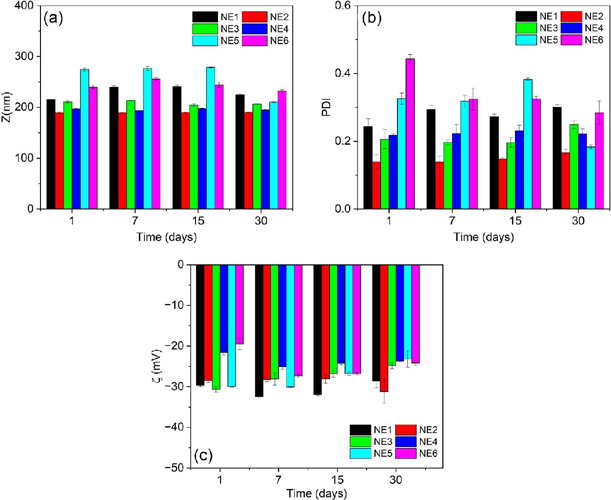
The prepared nanoemulsions showed droplet sizes (Z) ranging between 189.4 and 278.5 nm (Figure 1a). On the first day of storage, the variations in Z showed sizes between 189.9 nm (NE2) and 274.4 nm (NE4).

(a) Average droplet size (Z), (b) polydispersity index (PDI) and (c) zeta potential (ζ) of kefiran (KFR) and coriander essential oil (CEO) nanoemulsions during the 30-days stability evaluation. NE1: KFR 0.5%; CEO 0.5%; NE2: KFR 0.5%; CEO 1.5%; NE3: KFR 1.0%; CEO 0.5%; NE4: KFR 1.0%; CEO 1.5%; NE5: KFR 1.5%; CEO 0.5%; NE6: KFR 1.5%; CEO 1.5%.
The analysis of variance revealed that the concentrations of kefiran significantly influenced the variables related to particle size, polydispersity index, and zeta potential. These effects observed not only for kefiran but also for coriander essential oil, which serves as the organic phase. Notably, the NE2 test yielded the most favorable results when evaluating these parameters after 30 days of stability. The bioavailability of lipophilic components is inversely proportional to the particle size. Therefore, the smaller the droplet size, the higher the water solubility of lipophilic components below the critical point due to an increase in Laplace pressure.37,38 The droplet size is a critical parameter for the optical and physicochemical properties of emulsions, such as stability and drug release performance, and smaller droplet sizes are associated with better performance.39 The lowest polysaccharide concentration applied in formulation NE2 provided smaller average particle size compared to the other prepared nanoemulsion formulations. Polysaccharides are susceptible to intermolecular aggregation in water, which can lead to increased particle size in nanoemulsions, which probably occurred with the assays elaborated with higher KFR concentrations.40 However, it was observed that samples with the same polysaccharide concentration showed a reduction in particle size when the concentration of CEO was increased and concentration of OA was decreased, as occurred in samples NE2, NE4, and NE6. Similar results were observed in other research, where increasing the coconut oil concentration in nanoemulsions led to an increase in particle size.41 All assays related to average particle size showed no significant difference (p > 0.05) between the initial and final storage times, except for NE5. This result is important as it ensures that the nanoemulsions produced in this study provide long-term kinetic stability for commercial applications. The high storage stability of nanoemulsions with smaller droplet sizes is mainly attributed to the fact that the rate of cream formation is proportional to the square of the droplet diameter. Thus, a reduction in droplet size decreases the gravitational separation rate.38
The PDI is evaluated to determine the quality of the emulsification process. Emulsions with PDI values less than 0.10 are considered highly monodisperse, values between 0.10 and 0.40 are moderately polydisperse, and values greater than 0.40 are categorized as highly polydisperse.42 In this study, the PDI values of the nanoemulsions ranged from 0.138 (NE2) to 0.443 (NE6) (Figure 1b). The NE5 and NE6 formulations showed higher indexes, being considered the most polydisperse. However, a decrease in PDI values for these nanoemulsions was observed during the stability period studied, and the values at the initial and final times were significantly different (p < 0.05). The results indicate that higher concentrations of polysaccharides directly impact the PDI, with tests NE5 and NE6 exhibiting the highest values. This phenomenon can be attributed to the increased viscosity resulting from the addition of more polysaccharides. The elevated viscosity attenuates the propagation of ultrasonic waves near the microdroplet surface, which is responsible for droplet rupture. Consequently, this effect leads to higher coalescence rates, contributing to an increase in the PDI.39 The samples NE2, NE3, and NE4 showed no significant difference (p > 0.05) in PDI values during the 30-days stability period. They were considered stable and moderately polydisperse.
The higher the absolute value of zeta potential, the greater the electrical stability of the nanoemulsion. Conversely, lower values indicate a tendency of the nanoemulsion to coagulate or flocculate, resulting in instability.43 The produced nanoemulsions showed zeta potential values ranging from –32.43 mV (NE1) to –19.50 mV (NE6) (Figure 1c). This can be attributed to the presence of dissociable compounds in CEO and the adsorption of negative ions on the droplet surfaces.44 NE1 and NE2 samples exhibited higher absolute values (> 30 mV), indicating greater stability. However, all nanoemulsions formulated in this study presented values greater than 19 mV, which is sufficient for good electrokinetic stability. According to another study,45 any zeta potential charge with a magnitude greater than 30 mV (regardless of sign) indicates optimal stability for any nanosystem. Additionally, a zeta potential above 15 mV provides sufficient electrokinetic stability for nanoemulsions.
Centrifugal stability coefficient and turbidity of nanoemulsions of kefiran and coriander essential oil
NE2 and NE4 formulations showed the lowest coefficients (Table 2) and were not significantly different (p > 0.05).
Centrifugal stability coefficients (Ke) and turbidity (T) of kefiran (KFR) and coriander essential oil (CEO) nanoemulsions
The accelerated stability based on centrifugal force was tested to determine the feasibility of long-term storage and the instability underlying mechanism.4 The Ke value is inversely proportional to emulsion stability. The stability of the O/W emulsion, in terms of flocculation, coalescence, and creaminess, is strongly affected by the presence of polysaccharides. Upon analyzing the effects of varying the concentrations of kefiran and coriander essential oil on centrifugal stability, both factors had significant implications for the obtained values. Specifically, increasing the oil concentration led to enhanced centrifugal stability, whereas the addition of polysaccharides resulted in decreased stability. The authors46 observed that the increase of acacia gum resulted in a decrease in the emulsion stability, confirming the same profile obtained in the data in this study.
The turbidity characteristics of the NE5 and NE6 samples showed higher values (Table 2), indicating a correlation with the average particle sizes. Changes in turbidity suggest variations in particle size, dispersion, and concentration. In an unstable emulsion, particle size and concentration change over time due to coagulation and coalescence. The turbidity of suspensions containing very large particles varies inversely with particle size.46
Characterization of nanoemulsion of kefiran and coriander essential oil
Transmission electron microscopy (TEM)
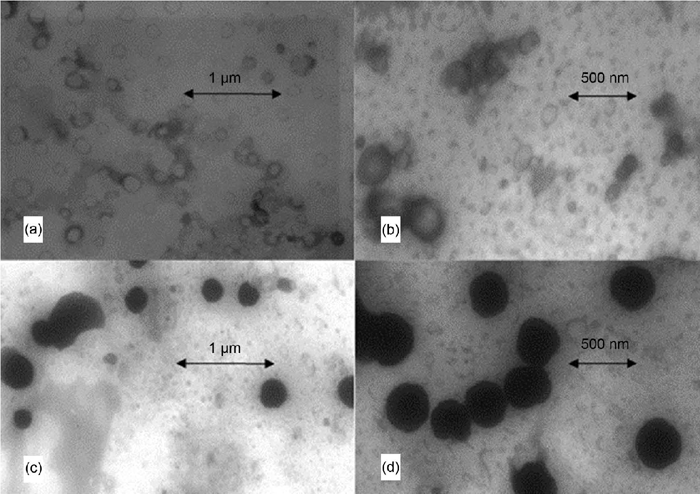
TEM images (Figure 2) demonstrated the morphological structure of the NE2 formulation and confirmed its spherical morphology, with particle sizes approximately similar to those found in DLS (189.9 nm). The polysaccharide used in the analyzed nanoemulsion did not show aggregate formation. Both NE-KFR and NE-CEO controls showed no spherical configurations.

Transmission electron microscopy images of kefiran (KFR) and coriander essential oil (CEO) nanoemulsions. (a) NE-KFR (KFR-15 mg mL-1; CEO-0 mg mL-1); (b) NE-CEO (KFR-0 mg mL-1; CEO-15 mg mL-1); (c) and (d) NE2 (KFR- 5 mg mL-1; CEO-15 mg mL-1).
Thermogravimetric analysis (TGA)
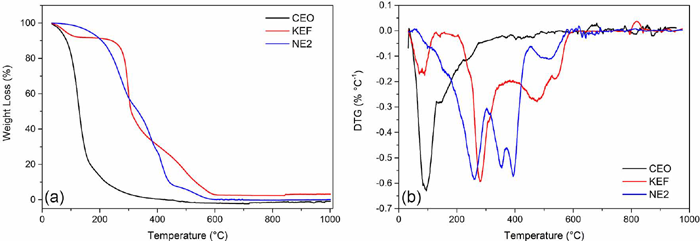
The thermal stability of the NE2 nanoemulsion was estimated using TGA techniques. Figure 3 shows the thermograms and mass variation derivatives of NE2, CEO and KFR.

(a) Thermogravimetric analysis of coriander essential oil (CEO), kefiran (KEF) and nanoemulsions of kefiran and coriander essential oil (CEO), (b) Derivative thermogravimetry of coriander essential oil (CEO), kefiran (KEF) and nanoemulsions of kefiran and coriander essential oil (CEO).
It can be observed that approximately 77% of the mass degradation of CEO happens in the range of 25 to 200 ºC (with a maximum peak at 95 ºC), which occurs at higher temperatures for the polysaccharide and NE2 (with maximum peaks at 280 and 260 ºC, respectively). This loss of mass in coriander essential oil around 25 ºC is generally related to volatile compounds. The curve for coriander essential oil shows few events, probably because linalool (77%) is the majority component of this oil, as also found by Micic et al.47 There is an initial mass loss for kefiran at temperatures close to 80 ºC, which is related to the dehydration (first event) of the polysaccharide chains.48 Events occurring at 280 and 475 ºC are related to the polymeric degradation of the polysaccharide structure.49 NE2 has greater stability, losing mass at higher temperatures than its separate compounds. The first event was at 260 ºC, related to the loss of essential oil in the emulsion micelles, while the other events at 350-390 ºC and 520 ºC can be attributed to the degradation of the polysaccharide chain, followed by the decomposition of the Tween 20 emulsifier.50 Based on the results visualized in the thermograms, it can be concluded that the formulated nanoemulsion has high thermal stability, protecting the bioactive compounds of coriander essential oil.
Non-clinical safety evaluation of nanoemulsions in adult zebrafish (Danio rerio)
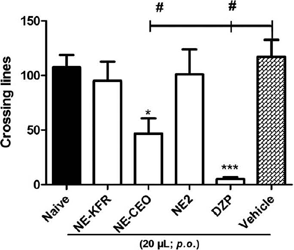
The tests were performed on sample NE2, which showed better in stability and microbial evaluation, and on controls NE-KFR and NE-CEO. NE-CEO control sample caused sedative effect and/or locomotor impairment in the animals, due to the group presenting locomotor activity (LA) being significantly different (p ≥ 0.05) among the other sample groups, as well as compared to Naive and vehicle (Figure 4).
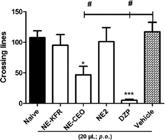
Effect of test samples (NE-KFR, NE-CEO and NE2) on locomotor activity of adult zebrafish (Danio rerio) in the Open Field Test (0-5 min). Naive: untreated animals; p.o.: oral administration. Values represent the mean ± standard error of the mean for 6 animals per group. ANOVA followed by Tukey's test.
When this sample was compared to the diazepam control, no significant difference was found between the groups, indicating that the sample showed similar behavior to the drug, causing sedation. In a study51 using coriander seeds, the aqueous extract of seeds showed anxiolytic activity, sedative and muscle relaxant effects compared to diazepam. This can be explained by some phytochemicals in coriander seed constituents, such as linalool.52
NE-KFR and NE2 samples presented the best physical stability and antimicrobial activity, showing no alteration in the locomotor system of the animals after oral administration, and did not differ from the Naive and control groups. Currently, several studies are using Danio rerio (zebrafish) as an animal model to evaluate the non-clinical safety of new pharmaceutical and food products. One study53 assessed the safety of encapsulated essential oil from Siparuna guianensis and reported that the samples, when exposed to zebrafish embryos, were considered safe. Evaluating the safety of curcumin nanoparticles, the authors found no change in the locomotor activity of the animals, characterizing the evaluated samples as safe.54 Adult zebrafish were used as model animals to evaluate the acute toxicity of the test samples (NE-KFR, NE-CEO and NE2) in this work (Table 3).
NE-KFR and NE2 samples were considered safe because they did not show toxicity to zebrafish within 96 h of analysis. On the other hand, the NE-CEO sample showed 5 deaths after 96 h of analysis, representing 83% mortality in the group, and therefore was not considered safe for application in food.
Antimicrobial activity of nanoemulsions of kefiran and coriander essential oil
The minimum bactericidal concentration tests showed that NE2 was effective against strains of Staphylococcus aureus and Listeria monocytogenes, Gram-positive microorganisms that are known to cause food-borne illnesses. The minimum concentration found for the nanoemulsion studied was 25% m v-1 for both strains. In general, Gram-negative bacteria are more resistant to essential oils because they have a hydrophilic surface on their cell wall (presence of lipopolysaccharides), limiting the distribution of hydrophobic compounds.55
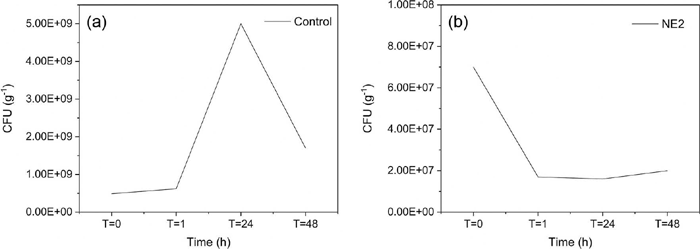
Another study56 tested kefiran with different types of extraction and observed an antimicrobial effect against Gram-positive and Gram-negative strains, but the test was carried out with the pure polymer. Exopolysaccharides have the ability to interact efficiently with Gram-negative and Gram-positive bacteria, damaging the respiratory chain and cell division.57 The main purpose of combining kefiran and coriander essential oil is to stabilize the essential oil compounds, increasing their physical and thermal stability. NE2 was applied at a concentration of 25% m nr-1 to commercial ricotta and the total mesophile count was carried out over four periods (Figure 5). The cheese treated with the nanoemulsion maintained a mesophile count of approximately 107 CFU g-1.

Mesophilic count (CFU g-1) in ricotta without NE2 (control) (a) and with NE2 (NE2) (b) at 0, 1, 24 and 48 h.
In a study carried out by Rofeal and Abdelmalek58 using gelatine and xanthan with an active ingredient from Echinacea purpurea to preserve ricotta, no positive effect was observed on the shelf life of the cheese, due to the polysaccharides not having antibacterial functional groups in their structures, which is not the case with kefiran. In general, high concentrations of essential oil are needed to inhibit microbial growth, but combinations with other techniques or compounds can be used to reduce the required dose of essential oil59 or make it more stable.
Conclusions
The KFR and CEO nanoemulsions had an average particle size characteristic of nanoemulsions and moderate polydispersity. The physical stability of the systems was obtained, with the NE2 nanoemulsion standing out as having greater physical stability and thermal stability when compared to its isolated components. The nanoemulsion showed antimicrobial activity against Escherichia coli and Listeria monocytogenes, pathogens relevant to food manufacturing. It is effective in extending the shelf life of ricotta cheese. The formulated nanoemulsion shows no toxicity. Finally, the other formulations studied are also interesting because they represent stable systems, safe and biodegradable materials, with potential application as a natural preservative in food processing.
Supplementary Information
Supplementary information (molar mass and infrared spectrum of the polysaccharide kefiran, experimental plan used to formulate the nanoemulsions and study of the hydrophilic-lipophilic balance of coriander essential oil) is available free of charge at http://jbcs.sbq.org.br as PDF file.
Acknowledgments
The authors gratefully acknowledge the analytical support of the Laboratory of Food Microbiology (UFC), Trace Analysis Laboratory (UFC), and Empresa Agroindústria Tropical. This study was financed in part by the Coordenação de Aperfeiçoamento de Pessoal de Nível Superior - Brasil (CAPES) - Finance Code 001. PROEX 23038.000509/2020-82. N. M. P. S. Ricardo would like to thank CNPq for the financial support throughout the Project No. 309795/2021-4.
References
-
1 Jamah, S. N.; Assadpour, E.; Feng, J.; Jafari, S. M.; Adv. Colloid Interface Sci. 2021, 295, 102504. [Crossref]
» Crossref -
2 Sourmaghi, M. H. S.; Kiaee, G.; Golfakhrabadi, F.; Jamalifar, H.; Khanavi, M.; J. Food Sei. Technol. 2015, 52, 2452. [Crossref]
» Crossref -
3 Lu, W.; Chen, M.; Cheng, M.; Yan, X.; Zhang, R.; Kong, R.; Wang, J.; Wang, X.; Food Packag. Shelf Life 2021, 29, 100691. [Crossref]
» Crossref -
4 Chen, Z.; Shi, J.; Yang, X.; Nan, B.; Liu, Y.; Wang, Z.; Int. Dairy J. 2015, 43, 15. [Crossref]
» Crossref -
5 Mandai, S.; Mandai, M.; Asian Pac. J. Trop. Biomed. 2015, 5, 421. [Crossref]
» Crossref -
6 Duman, F.; Kaya, M.; Int. J. Biol. Macromol. 2016, 92, 125. [Crossref]
» Crossref -
7 Eyres, G.; Dufour, J. P.; Hallifax, G.; Sotheeswaran, S.; Marriott, P. J.; J. Sep. Sci. 2005, 28, 1061. [Crossref]
» Crossref -
8 Martin-Pinero, M. J.; Ramirez, P.; Mufioz, J.; Alfaro, M. C.; Colloids Surf, B 2019, 173, 486. [Crossref]
» Crossref -
9 da Silva, B. D.; do Rosário, D. K. A.; Weitz, D. A.; Conte-Junior, C. A.; Trends Food Sci. Technol. 2022, 121, 1. [Crossref]
» Crossref -
10 Lu, W.; Kelly, A. L.; Miao, S.; Trends Food Sei. Technol. 2016, 47, 1. [Crossref]
» Crossref -
11 McClements, D. J.; Prog. Lipid Res. 2021, 81, 101081. [Crossref]
» Crossref -
12 Singh, Y.; Meher, J. G.; Raval, K.; Khan, F. A.; Chaurasia, M.; Jain, N. K.; Chourasia, M. K.; J. Control. Release 2017, 252, 28. [Crossref]
» Crossref -
13 Tan, K. X.; Chamundeswari, V. N.; Loo, S. C J.; RSC Adv. 2020, 10, 25339. [Crossref]
» Crossref -
14 de Carvalho, A. P. A.; Conte-Junior, C. A.; Trends Food Sci. Technol. 2021, 116, 370. [Crossref]
» Crossref -
15 Shao, P.; Feng, J.; Sun, P.; Xiang, N.; Lu, B.; Qiu, D.; Food Res. Int. 2020, 137, 109376. [Crossref]
» Crossref -
16 Mangione, G.; Caccamo, M.; Natalello, A.; Licitra, G.; J. Dairy Sci. 2023, 106, 3807. [Crossref]
» Crossref -
17 Rimada, P. S.; Abraham, A. G.; Int. Dairy J. 2006, 16, 33. [Crossref]
» Crossref -
18 Rimada, P. S.; Abraham, A. G.; J. Dairy Res. 2001, 68, 653. [Crossref]
» Crossref -
19 da Silva, A. C. C.; de Almeida, R. R.; da Cruz Sousa, A. C.; Martinez, F. N. A.; Denardin, J. C.; de Morais, S. M.; Ricardo, N. M. P. S.; Int. J. Biol. Macromol. 2021, 168, 722. [Crossref]
» Crossref -
20 Pereira, S. A.; dos Santos, S. B. E.; Rodrigues, F. A. M.; Fechine, L. M. U. D.; Vieira, f. G. P.; Denardin, J. C.; Araneda, E.; Ribeiro, M. E. N. P.; Gramosa, N. V.; Ricardo, N. M. P. S.; Mater. Lett. 2020, 274, 127983. [Crossref]
» Crossref -
21 Abbas, S.; Bashari, M.; Akhtar, W.; Li, W. W.; Zhang, X.; Ultrason. Sonochem. 2014, 21, 1265. [Crossref]
» Crossref -
22 Xu, J.; Mukherjee, D.; Chang, S. K. C.; Food Chem. 2018, 240, 1005. [Crossref]
» Crossref -
23 Conselho Nacional de Controle de Experimentação Animal (CONCEA); Resolução Normativa No. 37, 2018, Diretrizes da Prática de Eutanásia, https://antigo.mctic.gov.br/mctic/export/sites/institucional/legislacao/Arquivos/Anexo_Res_Norm_37_2018_CONCEA_Pratica_Eutanasia.pdf accessed in September 2024.
» https://antigo.mctic.gov.br/mctic/export/sites/institucional/legislacao/Arquivos/Anexo_Res_Norm_37_2018_CONCEA_Pratica_Eutanasia.pdf -
24 Magalhães, F. E. A.; de Sousa, C. Á. P. B.; Santos, S. A. A. R.; Menezes, R. B.; Batista, F. L. A.; Abreu, Â. O.; de Oliveira, M. V.; Moura, L. F. W G.; Raposo, R. D. S.; Campos, A. R.; Zebrafish 2017, 14, 422. [Crossref]
» Crossref -
25 Collymore, C.; Rasmussen, S.; Tolwani, R. J.; J. Vis. Exp. 2013, 1. [Crossref]
» Crossref -
26 Ahmad, F.; Richardson, M. K.; Behav. Processes 2013, 92, 88. [Crossref]
» Crossref -
27 OECD; Test No. 203: Fish, Acute Toxicity Test; OECD, p. 9. 203, 1992. [Link] accessed in September 2024
» Link -
28 Huang, M.; Chang, A.; Choi, M.; Zhou, D.; Anania, F. A.; Shin, C. H.; Hepatology 2014, 60, 1753. [Crossref]
» Crossref -
29 Arellano-Aguilar, O.; Solis-Angeles, S.; Serrano-García, L.; Morales-Sierra, E.; Mendez-Serrano, A.; Montero-Montoya, R.; J. FisheriesSciences.com 2015, 9, 52. Link] accessed in September 2024
» Link -
30 Ferreira, M. J. G.; Dias, F. G. B.; dos Santos, S. M.; de Aquino, N. C.; de Oliveira, E. S.; Cunha, F. E. T.; da Silva, L. M. R.; de Figueiredo, E. A. T.; Sci. Plena 2021, 17, 057201. [Crossref]
» Crossref - 31 Statistica, StatSoft, Inc; Oklahoma, USA, 2011.
- 32 GraphPad Prism, 6.0; San Diego, USA, 2007.
-
33 Klein, G.; Rüben, C.; Upmann, M.; Curr. Microbiol. 2013, 67, 200. [Crossref]
» Crossref -
34 Wei, J.-N.; Liu, Z.-H.; Zhao, Y.-P.; Zhao, L. L.; Xue, T.-K.; Lan, Q.-K.; Food Chem. 2019, 286, 260. [Crossref]
» Crossref -
35 Duarte, A.; Luís, Â.; Oleastro, M.; Domingues, F. C.; Food Control 2016, 61, 115. [Crossref]
» Crossref -
36 Msaada, K.; BenTaarit, M.; Hosni, K.; Hammami, M.; Marzouk, B.; Sci. Hortic. 2009, 122, 116. [Crossref]
» Crossref -
37 Acosta, E.; Curr. Opin. Colloid Interface Sci. 2009, 14, 3. [Crossref]
» Crossref -
38 McClements, D. J.; Soft Matter 2012, 8, 1719. [Crossref]
» Crossref -
39 Sharma, N.; Kaur, G.; Khatkar, S. K.; LWT 2021, 141, 110962. [Crossref]
» Crossref -
40 Li, M.; Ding, J.; Tao, Y.; Shi, B.; Chen, J. H.; Int. J. Polym. Sci. 2019, 2019, ID 7841836. [Crossref]
» Crossref -
41 Kotta, S.; Mubarak Aldawsari, H.; Badr-Eldin, S. M.; Alhakamy, N. A.; Md, S.; Food Chem. 2021, 357, 129721. [Crossref]
» Crossref -
42 Artiga-Artigas, M.; Lanjari-Pérez, Y.; Martín-Belloso, O.; Food Chem. 2018, 266, 466. [Crossref]
» Crossref -
43 Schreiner, T. B.; Santamaria-Echart, A.; Ribeiro, A.; Peres, A. M.; Dias, M. M.; Pinho, S. P.; Barreiro, M. F.; Molecules 2020, 25, 1538. [Crossref]
» Crossref -
44 Bonilla, J.; Atarés, L.; Vargas, M.; Chiralt, A.; Food Hydrocoll. 2012, 26, 9. [Crossref]
» Crossref -
45 Laxmi, M.; Bhardwaj, A.; Mehta, S.; Mehta, A.; Artif. Cells, Nanomed., Biotechnol. 2015, 43, 334. [Crossref]
» Crossref -
46 Mirhosseini, H.; Tan, C. P.; Aghlara, A.; Hamid, N. S. A.;Yusof, S.; Chern, B. H.; Carbohydr. Polym. 2008, 73, 83. [Crossref]
» Crossref -
47 Micić, D.; Ostojić, S.; Pezo, L.; Blagojević, S.; Pavlić, B.; Zeković, Z.; Đurović, S.; Ind. Crops Prod. 2019, 138, 111438. [Crossref]
» Crossref -
48 Saraiva, M. M.; Campelo, M. S.; Câmara Neto, J. F.; Gonzaga, M. L. C.; Bastos, M. S. R.; Soares, S. A.; Ricardo, N. M. P. S.; Cerqueira, G. S.; Leitão, R. F. C.; Ribeiro, M. E. N. P.; Int. J. Biol. Macromol. 2023, 244, 125278. [Crossref]
» Crossref -
49 de Oliveira Filho, J. G.; Silva, C. O.; Egea, M. B.; de Azeredo, H. M. C.; Mattoso, L. H. C.; Int. J. Biol. Macromol. 2023, 246, 125648. [Crossref]
» Crossref -
50 Hasssanzadeh, H.; Alizadeh, M.; Bari, M. R.; IET Nanobiotechnol. 2018, 12, 647. [Crossref]
» Crossref -
51 Sahoo, S.; Brijesh, S.; J. Funct. Foods 2020, 68, 103884. [Crossref]
» Crossref -
52 Emamghoreishi, M.; Khasaki, M.; Aazam, M. F.; J. Ethnopharmacol. 2005, 96, 365. [Crossref] [http://www.ncbi.nlm.nih.gov/pubmed/15619553 PubMed]
» Crossref -
53 Moura, W. S.; Oliveira, E. E.; Haddi, K.; Corrêa, R. F. T.; Piau, T. B.; Moura, D. S.; Santos, S. F.; Grisolia, C. K.; Ribeiro, B. M.; Aguiar, R. W. S.; Ind. Crops Prod. 2021, 162, 113289. [Crossref]
» Crossref -
54 Coradini, K.; de Andrade, D. F.; Altenhofen, S.; Reolon, G. K.; Nery, L. R.; Silva, N. E.; Vianna, M. R. M. R.; Bonan, C. D.; Beck, R. C.R.; J. Drug Delivery Sci. Technol. 2021, 66, 102781. [Crossref]
» Crossref -
55 Javidi, Z.; Hosseini, S. F.; Rezaei, M.; LWT-Food Sci. Technol. 2016, 72, 251. [Crossref]
» Crossref -
56 Hasheminya, S. M.; Dehghannya, J.; Mater. Chem. Phys. 2020, 243, 122645. [Crossref]
» Crossref -
57 Abinaya, M.; Vaseeharan, B.; Divya, M.; Vijayakumar, S.; Govindarajan, M.; Alharbi, N. S.; Khaled, J. M.; Al-Anbr, M. N.; Benelli, G.; Environ. Sci. Pollut. Res. 2018, 25, 18604. [Crossref]
» Crossref -
58 Rofeal, M.; Abdelmalek, F.; Sustainable Chem. Pharm. 2023, 36, 101322. [Crossref]
» Crossref -
59 Fraňková, A.; Marounek, M.; Mozrová, V.; Weber, J.; Klouček, P.; Lukešová, D.; Foodborne Pathog. Dis. 2014, 11, 795. [Crossref]
» Crossref
Edited by
-
Editor handled this article:
Hector Henrique F. Koolen (Associate)