 Chemotaxonomic Analysis of Diterpenes in Four Euphorbiaceae Genera: A Path to New Cytotoxic Agents
Abstract
The Euphorbiaceae family is renowned for its diverse array of compounds, primarily diterpenes, which exhibit multiple biological activities. In Brazil, the genera Jatropha, Cnidoscolus, Sapium, and Stillingia are predominantly found in the Northeast region. Despite their significant pharmacological potential, the chemical profiles of these species remain underexplored. In this context, chemotaxonomic is a tool to identify potential markers and bioactive structures within a given taxon. In order to analyze the chemical patterns among the diterpenes present in the four selected Euphorbiaceae genera, Phylogenetic Reconstruction and Self-Organizing Maps (SOMs) were applied. Two data sets were constructed: one containing 308 diterpenes structures and their 363 botanical occurrences, and a genetic data set encompassing ribulose-1,5-bisphosphate carboxylase/oxygenase (RuBisCO) sequences of the selected species. The reconstruction exhibits a close relationship between Jatropha and Cnidoscolus, although it was not able to distinguish Sapium and Stillingia. In other hand, SOMs classified the diterpenes in two groups: the first containing benzene-derived compounds and the second encompassing mainly the tigliane-type, which stands out as a chemical signature. Both groups contain substances with significant cytotoxic activity. This study may guide the discovery of new cytotoxic compounds and provide new insights into the systematics of the Euphorbiaceae family.
Keywords:
terpenoids; caatinga; semiarid; neural networks
Introduction
Characterized by a pantropical occurrence, the Euphorbiaceae family comprises approximately 8,000 species and 340 genera. This family is a notable producer of diterpenes, with over 1,000 substances classified into 30 scaffolds these compounds represent one of the main classes isolated from this group of plants. The structural diversity of these compounds can be attributed to the high degree of functionalization and rearrangements among the rings, conferring significant potential for the study of biological activities.1-3
In Brazil, it is estimated that 1,000 species and 65 genera of Euphorbiaceae occur, primarily in the Northeast region, with a large portion distributed in the Caatinga.4 Euphorbia is one of the main and extensively studied taxon in this family. However, within the semi-arid region, other smaller genera with significant biodiversity, economic, and medicinal potential also stand out. These include numerous species of Jatropha, Cnidoscolus, Stillingia, and Sapium that remain unexplored from chemical, genetic, and pharmacological perspectives.
The traditional use of crude extracts and the analysis of isolated diterpenes from species classified into these genera indicate remarkable cytotoxic activity against many tumor cell lines. Compounds such as ingenol derivatives and resiniferatoxin have been used as molecular models to the development of new anticancer drugs. Additionally, they exhibit antimicrobial, antiviral, anti-inflammatory, and anti-Leishmania potential, among other properties.5-7 Species such as Sapium sebiferum and Jatropha curcas are also widely investigated for biodiesel production.8 Another common feature in this group of plants is their taxonomic complexity; for a long time, the distinction between Jatropha and Cnidoscolus remained unresolved.9,10
Among the traditional methods for exploring natural compounds with potential bioactivity is chemotaxonomy. Increasingly, metabolomic investigations, in conjunction with chemometrics and computational algorithms, have yielded substantial advancements in this field.11 At the same pace, molecular techniques have emerged as fundamental components in plant taxonomy.12 Hence, the association of analytical and molecular data in the study of secondary metabolites within a specific taxon has been currently applied.13,14
Despite advancements, circumscribing certain Euphorbiaceae genera has proven to be an endeavor task. Considering the presence of these species in the Caatinga, their chemical diversity, biological activities and the challenges surrounding their botanical classification, the present study aims to employ the chemotaxonomic approach to identify potential markers, by computer aided analysis, and phylogenetic reconstruction among the selected genera.
Methodology
Database composition
The chemical dataset was assembled based on references focused on the isolation and structural characterization of diterpenes via nuclear magnetic resonance (NMR) from the four selected genera: Jatropha, Cnidoscolus, Sapium, and Stillingia. The literature search was conducted through Science Direct, PubMed, SciFinder, and Google Scholar. Specific search terms such as “diterpenes”, “secondary metabolites”, “chemical profile”, “Euphorbiaceae”, and “terpenoids” were employed independently and in combination with the name of each genus, on the title and abstract fields. A total of 89 references were included in this study, ranging from 1970 to 2024. All gathered data will be accessible through the SistematX tool.15
To construct the genetic dataset, representative sequences of the ribulose-1,5-bisphosphate carboxylase/oxygenase large subunit (rbcL) gene from the selected Euphorbiaceae genera were obtained from GenBank.
Phylogenetic reconstruction
After compiling gene sequences, they were aligned using the MAFFT software16 optimized for accurate global alignment (option “G-INS-i”). The resulting alignment was used to infer an approximately-maximum-likelihood phylogenetic tree using the FastTree 2.1.11 software17 with the generalized time-reversible (GTR) as substitution model. The resulting tree was rooted and visualized using FigTree v1.4.4 software.18
Self-organizing maps (SOM)
Generating molecular descriptors
To enable the analysis of chemical pattern of compounds, all diterpenes structures were converted into Simplified Molecular Input Line Entry System (SMILES) codes using Knime software.19 Then, SMILES codes were converted into custom canonical representations in Structure-Data File (SDF) format. The compiled structures, corresponding to botanical occurrences were then subjected to the generation of descriptors using alvaDesc software.20 Molecular descriptors are the results of the application of mathematical functions on a well-defined representation of the chemical structures. They encode quantitative representations of different physicochemical and molecular properties,21,22 which were utilized for subsequent analyses. The alvaDesc could calculate 5,666 molecular descriptors related to several theoretical approaches, the descriptors are classified into 33 logical blocks. Besides, alvaDesc carries out the calculation of three different molecular fingerprints. In the current work “Constitutional indices” and “Ring descriptors” were considered most informative to identify chemical patterns along the structures of chemical dataset, which resulted in 85 molecular descriptors.
Obtaining SOM
The calculated molecular descriptors were employed as input data for the SOM Toolbox 2.0 software.23 The dataset, consisting of the molecular descriptors, was presented to the SOM neural network without any prior adjustments. Subsequently, the data group was partitioned based on the regions defined by the weight vectors on the SOM map during each training stage. To ensure the robustness and statistical accuracy, validation of the predictive model is an essential step. A 5-fold cross-validation of the self-organized maps was performed, splitting 80% of the data for training set and 20% for test, each subset retains the same proportion of each class as the original dataset. Details of each measurement are depicted in Table 1.
Results and Discussion
Designed to elucidate evolutionary relationships based on the relative recency of common ancestry, phylogenetic reconstruction methods have greatly benefited from advancements in molecular biology and sequencing technologies. These advancements have led to new techniques for inferring phylogenies from macromolecular data. In this context, the construction of phylogenetic trees using protein-coding sequences has emerged as a viable alternative to use, e.g., intergenic or noncoding deoxyribonucleic acid (DNA) sequences. Protein sequences offer many advantages, including higher conservation levels. Furthermore, proteins play essential roles in the biological processes of organisms.12,24,25
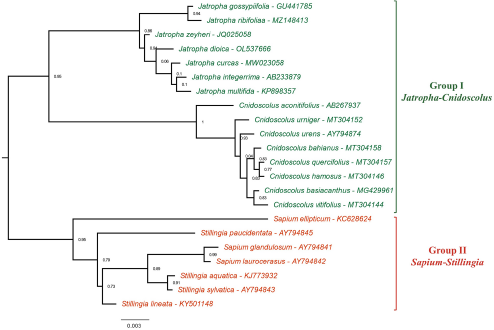
In the present study, sequences of ribulose-1,5 bisphosphate carboxylase/oxygenase, commonly known as “RuBisCO”, were utilized. RuBisCO is a crucial enzyme that catalyzes the fixation of CO2 during photosynthesis, facilitating the synthesis of organic compounds. Despite minor evolutionary variations observed in the RuBisCO (rca) gene, it maintains highly conserved among higher plants and remains an important phylogenetic tracer.26 Figure 1 depicts the maximum-likelihood phylogenetic tree resulting from comparative analysis of RuBisCO sequences across the four genera of Euphorbiaceae investigated in this study.

Phylogenetic tree comprising selected genera of Euphorbiacea family. The groups Jatropha-Cnidoscolus and Sapium-Stillingia are indicated by green and red, respectively. The maximum-likelihood phylogenetic tree was generated with Euphorbiaceae RuBisCO sequences retrieved from GenBank (shown in parenthesis) using FastTree software.17 The resulting tree was rooted and visualized using FigTree.18
The results of the phylogenetic reconstruction yielded insightful observations regarding the relationships among the four groups. Particularly noteworthy was the close ancestral relationship observed between Jatropha and Cnidoscolus, suggesting a robust genetic affinity. Morphologically, in 1962, Miller and Webster27 used differences in petiolar steles to segregate the genus Jatropha from the Cnidoscolus. Genetic relations in Euphorbiaceae still gathers attention from scientific community, even after establishment of Angiosperm Phylogeny Group (APG) system which supports the distinction in two genera.4,28 These discoveries enhanced our understanding of this taxonomic group and contributes to the debate surrounding the generic circumscription of these taxa, dating back to Linnaeus. It was not until the latter half of the 20th century that Cnidoscolus was consistently recognized as a distinct genus. Moreover, recent studies29 have highlighted that Cnidoscolus is indigenous to the New World, with concentrated occurrences in arid areas of Mexico and Brazil. In contrast, Jatropha displays a widespread distribution across diverse regions.
Regarding Sapium and Stillingia, phylogenetic analysis based on RuBisCO was unable to distinguish them, grouping both genera together. This unexpected result suggests a deeper genetic similarity beyond morphological traits. It emphasizes the need for further investigation using different genetic sequences, to identify more precise markers for distinguishing Sapium and Stillingia. Despite our findings aligning with previous publications highlighting the challenging systematic classification within the Hippomaneae tribe (Euphorbiaceae), systematic studies on these two groups remain limited.30
The exploration of chemical space represented by natural products has greatly facilitated the discovery of lead compounds and pharmaceuticals. Among the methodologies used to compile extensive molecular datasets, knowledge-driven approaches are particularly notable. These methods integrate chemical and taxonomic information derived from published literature, either through systematic reviews or by focusing on specific genera or families. The incorporation of computational algorithms with phylogenetic patterns in medicinal plants has proven to be a valuable predictive tool for identifying potential chemical markers and hotspots for drug discovery.31-33
Self-Organized Maps (SOM), introduced in the 1990s, as an automated method for data analysis,34 have become an invaluable tool in exploring chemical space. They are widely applied in medicinal chemistry and natural product drug discovery.35,36 A key advantage of SOM is their ability to analyze multidimensional information while preserving essential topological and metric relationships within datasets.37 This feature is particularly beneficial for identifying structural similarities and efficiently grouping them into clusters. Hence, SOM have demonstrated some advantages compared to traditional multivariate statistical classification methods.
In chemotaxonomy, SOM have proven effective in identifying patterns among compounds which are specific to particular groups of plants.38,39 Molecular descriptors are employed as input data, elucidating the physicochemical properties of substances within the chemical dataset. In this study, we compiled 308 diterpenes from four genera of the Euphorbiaceae family. An important feature of this dataset is its botanical occurrences, which indicate the presence of the same compounds across different species, as detailed in Table 2.
Botanical information and occurrence of diterpenes in the Euphorbiaceae genera considered in this study
The data presented in Table 2 facilitated the construction of a SOM of diterpenes, which were subsequently categorized based on their chemical similarities. The resulting SOM are depicted in Figure 2. The most effective mathematical model achieved an accuracy rate of 94%, successfully classifying the compounds into two distinct groups: the first comprising Jatropha and Cnidoscolus, and the second encompassing Sapium and Stillingia. Models that achieve hit rates exceeding 70% are considered to exhibit excellent performance,39 all cross-validation tests yielded hit rates exceeding 90%, as shown in in Table 1. These findings align with molecular analyses, highlighting significant chemical similarities within their respective groups.

SOMs of diterpenes descriptors from Euphorbiaceae. The Unified Distance Matrix (U-matrix) is represented in grayscale (a). The groups Jatrophas-Cnidoscolus, Sapium-Stillingia are indicated by green and red, respectively (b). Alongside there is a PCA of the correlation matrix used to generate the SOM, which visualizes the distribution of the descriptors features in e high-dimensional space, the same colors were used to characterize each group (c).
In the context of representing a SOM, the U-matrix is commonly used. In Figure 2a, lighter colors indicate closer proximity between neurons in the input space, while darker areas represent boundaries that separate clusters, specifically the diterpenes in our study. This matrix synthesizes information from all descriptors used as input data. An advantage of using SOM is their ability to preserve the topology of data distribution, resembling a geographical map. However, the final representation often undergoes dimensionality reduction to facilitate visualization of data distribution, as depicted in Figure 2b.
Here, different colors enable recognition of two distinct groups classified by similarities among diterpene chemical features. Meanwhile, Figure 2c illustrates the data topology via principal component analysis (PCA), calculated from the training set using eigenvectors and their values.
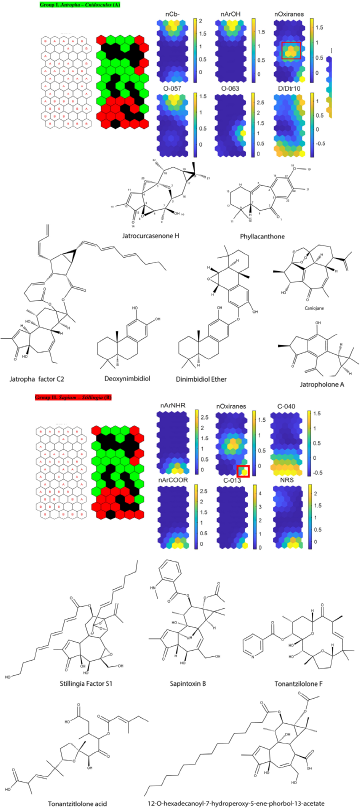
Upon interpreting the maps, primary descriptors and the compounds contributing most to clustering were analyzed, identifying typical patterns and substances among the four selected genera. Each descriptor, represented as a hit map alongside the U-matrix, provides valuable insights into the chemical space occupied by Euphorbiaceae diterpenes. Thirteen descriptors were identified as particularly informative, with the identified compounds shown in Figure 3.
Heat maps resulting from the SOM analysis showcasing selected molecular descriptors of diterpene scaffolds considered for this study. On the left side, there is a representation of U-matrix, the letters associated to the genus Jatropha-Cnidosculos (group I-A), and Stillingia-Sapium (group II-B) represent the distribution of input data in U-matrix space, evidencing the clusters formed by similarities in diterpene structures. On the right side, each colored figure represents a molecular descriptor; the yellow color in the heat maps displayed high level of the characteristics encoded by each specific molecular features. The association of both maps led to compound structures that contribute to discriminate each cluster.
The results demonstrate a high chemical diversity of diterpenes found among the analyzed genera of Euphorbiaceae. One prominent class of compounds identified is casbene derivatives, distinguished by a macrocyclic ring structure and unique carbon scaffolds. These specialized diterpenes are typically confined to specific plant families. Therefore, analysis of descriptors provides insights into the chemical profiles of diterpenes within the selected four Euphorbiaceae genera.
Descriptors associated with benzene rings indicate the presence of aromatic moieties in diterpenes, particularly within group II. Examples include phyllacantone (bis-nor-benzocycloheptane), dinimbidiol (podonocarpane), and jatropholone A (jatropholone). These descriptors also highlight the occurrence of dinimbidiol ether, a dimer featuring a unique chemical structure. Isolated from the roots of C. souzae, this compound forms through a rare phenoxyether linkage, a substance type uncommon in nature.40 Furthermore, in group I, descriptors indicating the presence of epoxide/oxirane moieties facilitated the identification of lathyranes, exemplified by jatrocurcusenone H. Peroxide groups were also noted in the descriptor analysis, leading to the identification of canijoane, a rhamnofolane.
In contrast, group II exhibited a higher prevalence of tigliane diterpenes, isolated from species of both, Sapium and Stillingia genera. This is in contrast to group I, where few compounds of this class were found, primarily represented by jatropha factors featuring a distinctive substitution pattern at positions C-13 and C-17, as depicted in Figure 3. Additionally, descriptors associated with the presence of aromatic nitrogen and amines were exclusively identified in group II, leading to the discovery of sapintoxins A-C and tonantzitlolone F, a rare flexibilene in nature. Another noteworthy finding from the descriptors is the significant degree of oxidation observed in these compounds. Biosynthetically related to tiglianes, the presence of daphnane diterpenes was also noted in this group.
In addition to the genetic similarities observed between genera, despite the clear chemical differences between the two groups demonstrated by SOM, the disparity in the number of compounds reported especially in Cnidoscolus and Stillingia restricts broader conclusions about the role of diterpenes in systematic contexts. Nevertheless, the results evidence the gap in our knowledge concerning these plant groups and highlight the necessity for extensive investigations into their chemical composition. Moreover, the reclassification of some species may generate bias in data extracted from the literature and reflects over the composition of datasets. In view of the current scenario, the application of modern techniques, such as metabolomics combined with dereplication via mass spectrometry or NMR analyses, alongside chemometrics, can significantly enhance our comprehension of the chemical space within these species.41,42 This approach may lead to the discovery of numerous compounds with potential bioactivity from the Euphorbiaceae species, especially those found in the Brazilian semi-arid region.
Macrocyclic diterpenes found in the Euphorbiaceae family represent a vast array of molecules with unique scaffolds useful to inspire the development of innovative drugs. Among them, they are also renowned for their cytotoxic activity, demonstrated in vitro and in vivo models, in some cases exhibiting potency at nanomolar ranges, such as tonantzitlolone, an activator of TRPC (transient receptor potential canonical) channels of the 1, 4 and 5 types or DD1, a daphnane diterpenoid, highly potent importin-β1 inhibitor in castration-resistant prostate cancer.43-45
Regarding to their mechanisms, literature describes that diterpenes are able to promote apoptosis by activating p53 and inhibiting Bcl-2/Bcl-xl, reduce cell proliferation via mTORC1 and CREB, and induce autophagy and ferroptosis by disrupting PI3K/AKT and increasing lipid peroxidation, respectively. Increased reactive oxygen species (ROS) production further aids in cancer cell death.46 Furthermore, some classes such as jatrophanes and lathyranes were shown to be inhibitors of P-glycoprotein.47,48 Additionally, tiglianes modulate Protein Kinase C (PKC) isoforms, an important target due to its role in carcinogenesis.49,50 Compounds such as phyllacanthone, found in Cnidosculos species, have shown activity against resistant melanoma cell lines, acting on tubulin depolymerization, mechanism similar to highly effective vinca alkaloids.51 These data highlight a chemical pattern associated with different classes of macrocyclic diterpenes along the four selected genera as well as their bioactive potential face to specific molecular targets of interest in therapeutics.
Despite their remarkable potential, several limitations remain in the study of macrocyclic diterpenes. First, most bioactive compounds are isolated in small quantities, and their diterpene cores consist of complex cyclic structures with multiple asymmetric centers, rendering chemical synthesis a challenging task. Furthermore, for the majority of these scaffolds, structure-activity relationship (SAR) data have not yet been elucidated, and information regarding their toxicity is often absent in the literature.52,53 Nonetheless, modern techniques have significantly contributed to overcoming these challenges, enabling the reinvestigation of classically described compounds and the discovery of novel mechanisms of action. Among these approaches are isolation guided by advanced analytical techniques, enzyme-mediated synthesis, and chemoproteomics, all of which have expanded the horizons of diterpene research within the Euphorbiaceae family.54-56
Conclusions
This study offers an in-depth analyses of diterpenes found in four genera within the Euphorbiaceae family: Jatropha, Cnidoscolus, Sapium, and Stillingia. By combining phylogenetic reconstruction with computer-aided analysis, a chemotaxonomic investigation was conducted to compare the studied taxa. This approach allowed the identification of the intrinsic features between the groups, revealing many bioactive frameworks. Interestingly, a close molecular and chemical profile was noted across the genera, which led the distinction of only two groups. The first, comprising Jatropha and Cnidoscolus, exhibited a diverse array of compounds, while the second encompassing the other two, Sapium and Stillingia, were distinguished by the presence of phorbol esters, which emerged as a distinct chemical signature. Additionally, the compounds identified in both groups are capable of modulating the activity of important molecular targets in cancer therapeutics. In group I, jatrophanes and lathyranes are associated with P-glycoprotein modulation, while in group II, tigliane and daphnane have been described acting over PKC pathways. These results provide molecular patterns in each group and their biological activities. The creation of a comprehensive database containing 308 diterpenes and their respective 363 botanical occurrences serves as a valuable resource for future research on Euphorbiaceae species and their compounds across multiple scientific disciplines.
Acknowledgments
The authors thank the National Institutes of Science and Technology Program (INCT-Rennofito, No. 465536/2014-0) and CAPES finance code 001 for research financial supported.
References
-
1 Mendes, E.; Ramalhete, C.; Duarte, N.; Int. J. Mol. Sci. 2023, 25, 147. [Crossref]
» Crossref -
2 Cheng, Y.; Qin, D.; Novel Plant Natural Product Skeletons; Springer Nature: Berlin, Germany, 2024. [Crossref]
» Crossref -
3 Zhao, H.; Sun, L.; Kong, C.; Mei, W.; Dai, H.; Xu, F.; Huang, S.; J. Ethnopharmacol. 2022, 298, 115574. [Crossref]
» Crossref -
4 Secco, R. S.; Cordeiro, I.; de Senna-Vale, L.; de Sales, M. F.; de Lima, L. R.; Medeiros, D.; Sá Haiad, B. de; de Oliveira, A. S.; Caruzo, M. B. R.; Carneiro-Torres, D.; Bigio, N. C.; Rodriguesia 2012, 63, 227. [Crossref]
» Crossref -
5 Cavalcante, N. B.; Santos, A. D. C.; Almeida, J. R. G. S.; Chem. Biol. Interact. 2020, 318, 108976. [Crossref]
» Crossref -
6 He, Q.; Zhang, L.; Li, T.; Li, C.; Song, H.; Fan, P.; J. Ethnopharmacol. 2021, 277, 114206. [Crossref]
» Crossref -
7 de Oliveira-Júnior, R. G.; Ferraz, C. A. A.; de Oliveira, A. P.; Araújo, C. S.; Oliveira, L. F. S.; Picot, L.; Rolim, L. A.; Rolim-Neto, P. J.; Almeida, J. R. G. S.; Phytomedicine 2018, 50, 137. [Crossref]
» Crossref -
8 Coutinho, D. J. G.; Barbosa, M. O.; de Souza, R. J. C.; da Silva, A. S.; da Silva, S. I.; de Oliveira, A. F. M.; Renewable Energy 2016, 91, 275. [Crossref]
» Crossref -
9 Athiê-Souza, S. M.; de Melo, A. L.; da Silva, M. J.; de Sales, M. F.; Kew Bull. 2019, 74, 45. [Crossref]
» Crossref -
10 Maya-Lastra, C. A.; Steinmann, V. W.; Phytotaxa 2018, 346, 1. [Crossref]
» Crossref -
11 Gomes, P. W. P.; Mannochio-Russo, H.; Schmid, R.; Zuffa, S.; Damiani, T.; Quiros-Guerrero, L. M.; Caraballo-Rodríguez, A. M.; Zhao, H. Z.; Yang, H.; Xing, S.; Charron-Lamoureux, V.; Chigumba, D. N.; Sedio, B. E.; Myers, J. A.; Allard, P. M.; Harwood, T. V.; Tamayo-Castillo, G.; Kang, K. B.; Defossez, E.; Koolen, H. H. F.; da Silva, M. N.; Silva, C. Y. Y.; Sergio Rasmann, S.; Walker, T. W. N.; Glauser, G.; Chaves-Fallas, J. N.; David, B.; Kim, H.; Lee, K. H.; Kim, M. J.; Choi, W. J.; Keum, Y. S.; de Lima, E. J. S. P.; Medeiros, L. S.; Bataglion, G. A.; Costa, E. V.; da Silva, F. M. A.; Carvalho, A. R. V.; Reis, J. D. E.; Pamplona, S.; Jeong, E.; Lee, K.; Kim, G. J.; Kil, Y. S.; Nam, J. W.; Choi, H.; Han, Y. K.; Park, S. Y.; Lee, K. Y.; Hu, C.; Dong, Y.; Sang, S.; Morrison, C. R.; Borges, R. M.; Teixeira, A. M.; Lee, S. Y.; Lee, B. S.; Jeong, S. Y.; Kim, K. H.; Rutz, A.; Gaudry, A.; Bruelhart, E.; Kappers, I. F.; Karlova, R.; Meisenburg, M.; Berdaguer, R.; Tello, J. S.; Henderson, D.; Cayola, L.; Wright, S. J.; Allen, D. N.; Anderson-Teixeira, K. J.; Baltzer, J. L.; Lutz, J. A.; McMahon, S. M.; Parker, G. G.; Parker, J. D.; Northen, T. R.; Bowen, B. P.; Pluskal, T.; van der Hooft, J. J. J.; Carver, J. J.; Bandeira, N.; Pullman, B. S.; Wolfender, J.-L.; Kersten, R. D.; Wang, M.; Dorrestein, P. C.; bioRxiv 2024. [Crossref]
» Crossref -
12 Kapli, P.; Yang, Z.; Telford, M. J.; Nat. Rev. Genet. 2020, 21, 428. [Crossref]
» Crossref -
13 Zidorn, C.; Phytochemistry 2019, 163, 147. [Crossref]
» Crossref -
14 Ramos, Y. J.; Gouvêa-Silva, J. G.; Machado, D. B.; Felisberto, J. S.; Pereira, R. C.; Sadgrove, N. J.; Moreira, D. L.; Rev. Bras. Farmacogn. 2023, 33, 49. [Crossref]
» Crossref -
15 SistematX, http://www.sistematx.ufpb.br, accessed in February 2025.
» http://www.sistematx.ufpb.br - 16 Katoh, K.; MAFFT, version 7; Research Institute for Microbial Diseases, Japan, 2014.
- 17 Price, M. N.; Dehal, P. S.; Arkin, A. P.; FastTree, version 2.1; Lawrence Berkeley National Lab., USA, 2010.
- 18 Rambaut, A.; Figtree, v1.4.4; University of Edinburgh, UK, 2007.
- 19 Berthold, M.; KNIME, version 4.3.2; Knime, CH, 2004.
- 20 Alvadesc, v2.0.016; Alvascience, Italy, 2018.
-
21 Fernández-Torras, A.; Comajuncosa-Creus, A.; Duran-Frigola, M.; Aloy, P.; Curr. Opin. Chem. Biol. 2022, 66, 102090. [Crossref]
» Crossref -
22 Todeschini, R.; Consonni, V.; Molecular Descriptors for Chemoinformatics; Wiley: New Jersey, USA, 2009. [Crossref]
» Crossref - 23 Alhoniemi, E.; Himberg, J.; Parviainen, J.; Vesanto, J.; SOM Tool Box, version 2.0; Helsinki University of Technology, Finland, 2012.
-
24 De Bruyn, A.; Martin, D. P.; Lefeuvre, P.; Methods Mol. Biol. 2014, 1115, 257. [Crossref]
» Crossref -
25 Harrison, C. J.; Langdale, J. A.; Plant J. 2006, 45, 561. [Crossref]
» Crossref -
26 Nagarajan, R.; Gill, K. S.; Plant Mol. Biol. 2018, 96, 69. [Crossref]
» Crossref -
27 Miller, K. I.; Webster, G. L.; Brittonia 1962, 14, 174. [Crossref]
» Crossref -
28 Thakur, H. A.; Patil, D. A.; J. Exp. Sci. 2011, 2, 37. [Crossref]
» Crossref -
29 Maya‐Lastra, C. A.; Steinmann, V. W.; Taxon 2019, 68, 692. [Crossref]
» Crossref -
30 Sakugawa, G. C.; Cordeiro, I.; Pscheidt, A. C.; Rossi, M. L.; Martinelli, A. P.; da Luz, C. F. P.; Grana 2021, 60, 424. [Crossref]
» Crossref -
31 Domingo-Fernández, D.; Gadiya, Y.; Mubeen, S.; Healey, D.; Norman, B. H.; Colluru, V.; J. Cheminf. 2023, 15, 107. [Crossref]
» Crossref -
32 Ernst, M.; Saslis-Lagoudakis, C. H.; Grace, O. M.; Nilsson, N.; Simonsen, H. T.; Horn, J. W.; Rønsted, N.; Sci. Rep. 2016, 6, 30531. [Crossref]
» Crossref -
33 Allard, P.-M.; Gaudry, A.; Quirós-Guerrero, L.-M.; Rutz, A.; Dounoue-Kubo, M.; Walker, T. W. N.; Defossez, E.; Long, C.; Grondin, A.; David, B.; Wolfender, J.-L.; Gigascience 2022, 12, 124. [Crossref]
» Crossref -
34 Kohonen, T.; Neurocomputing 1998, 21, 1. [Crossref]
» Crossref -
35 Mullowney, M. W.; Duncan, K. R.; Elsayed, S. S.; Garg, N.; van der Hooft, J. J. J.; Martin, N. I.; Meijer, D.; Terlouw, B. R.; Biermann, F.; Blin, K.; Durairaj, J.; Gorostiola González, M.; Helfrich, E. J. N.; Huber, F.; Leopold-Messer, S.; Rajan, K.; de Rond, T.; van Santen, J. A.; Sorokina, M.; Balunas, M. J.; Beniddir, M. A.; van Bergeijk, D. A.; Carroll, L. M.; Clark, C. M.; Clevert, D.-A.; Dejong, C. A.; Du, C.; Ferrinho, S.; Grisoni, F.; Hofstetter, A.; Jespers, W.; Kalinina, O. V.; Kautsar, S. A.; Kim, H.; Leao, T. F.; Masschelein, J.; Rees, E. R.; Reher, R.; Reker, D.; Schwaller, P.; Segler, M.; Skinnider, M. A.; Walker, A. S.; Willighagen, E. L.; Zdrazil, B.; Ziemert, N.; Goss, R. J. M.; Guyomard, P.; Volkamer, A.; Gerwick, W. H.; Kim, H. U.; Müller, R.; van Wezel, G. P.; van Westen, G. J. P.; Hirsch, A. K. H.; Linington, R. G.; Robinson, S. L.; Medema, M. H.; Nat. Rev. Drug Discovery 2023, 22, 895. [Crossref]
» Crossref -
36 Xiao, Y.-D.; Clauset, A.; Harris, R.; Bayram, E.; Santago, P.; Schmitt, J. D.; J. Chem. Inf. Model. 2005, 45, 1749. [Crossref]
» Crossref -
37 Kohonen, T.; Neural Networks 2013, 37, 52. [Crossref]
» Crossref -
38 Menezes, R. P. B.; Sessions, Z.; Muratov, E.; Scotti, L.; Scotti, M. T.; J. Braz. Chem. Soc. 2021, 32, 2061. [Crossref]
» Crossref -
39 de Souza, T. A.; Lins, F. S. V.; Lins, J. S.; Alves, A. F.; Cibulski, S. P.; Brito, T. A. M.; Abreu, L. S.; Scotti, L.; Scotti, M. T.; da Silva, M. S.; Tavares, J. F.; Phytochem. Rev. 2024, 23,1027. [Crossref]
» Crossref -
40 García-Sosa, K.; Aldana-Pérez, R.; Moo, R. V. E.; Simá-Polanco, P.; Peña-Rodríguez, L. M.; Nat. Prod. Commun. 2017, 12, 1391. [Crossref]
» Crossref -
41 Vitale, G. A.; Geibel, C.; Minda, V.; Wang, M.; Aron, A. T.; Petras, D.; Nat. Prod. Rep. 2024, 41, 885. [Crossref]
» Crossref -
42 Borges, R. M.; Teixeira, A. M.; Front. Nat. Prod. 2024, 3, 1359151. [Crossref]
» Crossref -
43 Rubaiy, H. N.; Ludlow, M. J.; Siems, K.; Norman, K.; Foster, R.; Wolf, D.; Beutler, J. A.; Beech, D. J.; Br. J. Pharmacol. 2018, 175, 3361. [Crossref]
» Crossref -
44 Alves, A. L. V.; da Silva, L. S.; Faleiros, C. A.; Silva, V. A. O.; Reis, R. M.; Nat. Prod. Commun. 2022, 17, 1. [Crossref]
» Crossref -
45 Huang, J.-L.; Yan, X.-L.; Li, W.; Fan, R.-Z.; Li, S.; Chen, J.; Zhang, Z.; Sang, J.; Gan, L.; Tang, G.-H.; Chen, H.; Wang, J.; Yin, S.; J. Am. Chem. Soc. 2022, 144, 17522. [Crossref]
» Crossref -
46 Ma, C.; Gao, L.; Song, K.; Gu, B.; Wang, B.; Pu, W.; Chen, H.; Biomol. Biomed. 2024, 25, 1. [Crossref]
» Crossref -
47 Fattahian, M.; Ghanadian, M.; Ali, Z.; Khan, I. A.; Phytochem. Rev. 2020, 19, 265. [Crossref]
» Crossref -
48 Vela, F.; Ezzanad, A.; Hunter, A. C.; Macías-Sánchez, A. J.; Hernández-Galán, R.; Pharmaceuticals 2022, 15, 780. [Crossref]
» Crossref -
49 Wang, H.-B.; Wang, X.-Y.; Liu, L.-P.; Qin, G.-W.; Kang, T.-G.; Chem. Rev. 2015, 115, 2975. [Crossref]
» Crossref -
50 He, S.; Li, Q.; Huang, Q.; Cheng, J.; Cancers 2022, 14, 1104. [Crossref]
» Crossref -
51 de Oliveira-Júnior, R. G.; Ferraz, C. A. A.; de Oliveira, A. P.; Araújo, E. C. C.; Prunier, G.; Beaugeard, L.; Groult, H.; Picot, L.; de Alencar Filho, E. B.; El Aouad, N.; Rolim, L. A.; Almeida, J. R. G. S.; Chem. Biol. Interact. 2022, 355, 109849. [Crossref]
» Crossref -
52 Atanasov, A. G.; Zotchev, S. B.; Dirsch, V. M.; Supuran, C. T.; Nat. Rev. Drug Discovery 2021, 20, 200. [Crossref]
» Crossref -
53 Mafu, S.; Zerbe, P.; Phytochem. Rev. 2018, 17, 113. [Crossref]
» Crossref -
54 Hu, Z.; Liu, X.; Tian, M.; Ma, Y.; Jin, B.; Gao, W.; Cui, G.; Guo, J.; Huang, L.; Med. Res. Rev. 2021, 41, 2971. [Crossref]
» Crossref -
55 Das, D. D.; Sharma, N.; Chawla, V.; Chawla, P. A.; Crit. Rev. Anal. Chem. 2024, 54, 2984. [Crossref]
» Crossref -
56 de Souza, T. A.; Pereira, L. H. A.; Alves, A. F.; Dourado, D.; Lins, J. S.; Scotti, M. T.; Scotti, L.; Abreu, L. S.; Tavares, J. F.; Silva, M. S.; Pharmaceuticals 2024, 17, 1399. [Crossref]
» Crossref
Edited by
-
Editor handled this article:
Paula Homem-de-Mello (Executive)