 High Selective N-Acylhydrazones Silver(I) Complexes against Tuberculosis
Abstract
In the present work, synthesis, characterization, and biological assays of seven N-acylhydrazones derivatives of isoniazid and their corresponding silver(I) complexes are described. The compounds were characterized by elemental analysis, infrared (IR) and 1H, 13C and 1H-15N nuclear magnetic resonance (NMR) spectroscopic measurements, and molar conductivity over 48 h assays. Density functional theory (DFT) studies also were employed in order to structural elucidation of the seven silver(I) complexes. All the synthesized silver complexes have shown minimum inhibitory concentration (MIC90) values against Mycobacterium tuberculosis - MtbH37Rv (ATCC 27294) lower than 7.421 mg L-1. The AgIZBEN complex showed the most promising anti-tuberculosis action, with MIC90 of 0.956 mg L-1 and selectivity index (SI) = 29.3 while the AgIZpAN showed SI higher than 460 and MIC90 of 1.077 mg L-1. The free acylhydrazones derivatives also showed SI higher than 20.
Keywords:
N-acylhydrazones; silver complexes; tuberculosis; high selectivity index
Introduction
In 2024, despite significant advancements made in recent years in fighting tuberculosis (TB), this disease continues to pose a major challenge to public health due to its high potential to cause widespread morbidity and mortality. In fact, infection rates have notably accelerated following the pandemic caused by severe acute respiratory syndrome coronavirus (SARS-CoV-2).1 TB is a disease caused by the single infectious agent Mycobacterium tuberculosis (Mtb), which is transmitted via aerosol from a person with an active lung infection.2
Standard treatment for TB consists of using four first-line medications: isoniazid (INH), rifampicin (RIF), pyrazinamide (PZA) and ethambutol (EMB).3 Despite the fact that TB is an avoidable disease and current therapy is effective in its bacteriological action, data on the transmission of active TB in the population still cause concern. According to the World Health Organization (WHO),4 TB has sickened around 10 million people per year. The emergence of multidrug-resistant (MDR) and even extensively drug resistant (XDR) strains is the cause for worldwide concern in the control of TB. The necessity to use different medications and the minimum time to complete treatment are one of the main reasons why patients do not complete the procedures, favoring the emergence of strains resistant to conventional treatment.4-6
Different types of compounds have been studied to find an improved form of treatment, aiming to suppress barriers such as drug resistance, side effects, and therapy time. Therefore, compounds derived from INH have been used over the years due to their high bactericidal activity (0.02-0.2 mg L-1), low cost, high bioavailability, and narrow spectrum of action, among other characteristics.7-9
Silver and its ions possess excellent antimicrobial properties; however, the rapid release of silver(I) ions or metallic silver into the bloodstream can lead to severe toxicity. Nevertheless, it has been shown that combining silver(I) ions with different compounds can enhance its antimicrobial activity while simultaneously reducing the undesirable effects of silver ions.10,11 N-Acylhydrazones derived from INH have shown interesting results regarding their bacteriological action in recent years, especially when this group is coordinated to transition metal ions, such as silver(I).12-16 In 2021, our research group published a work showing that N-acylhydrazones derived from INH coordinated to silver(I) ions showed greater efficiency in anti-Mtb action than the organic molecules used as ligands, even against clinical MDR Mtb strains.17
In this paper, synthesis and characterization of seven N-acylhydrazones, obtained by reacting INH with benzaldehyde (IZBEN), o-anisaldehyde (IZoAN), m-anisaldehyde (IZmAN), p-anisaldehyde (IZpAN), o-nitrobenzaldehyde (IZoNIT), m nitrobenzaldehyde (IZmNIT), and p-nitrobenzaldehyde (IZpNIT), as well as their respective silver(I) complexes are presented. Besides the analytical, spectroscopic, and structural studies, biological assays were performed to evaluate the activity of the compounds against standard MtbH37Rv and the results are reported here for the first time.
Experimental
Materials and methods
The starting compounds INH (99%), o-anisaldehyde (97%), m-anisaldehyde (98%), p-anisaldehyde (97%), o-nitrobenzaldehyde (98%), m-nitrobenzaldehyde (96%), p-nitrobenzaldehyde (98%), and silver nitrate (98%) were purchased from Sigma-Aldrich Co. and used without further purification. Elemental analyses of C, H and N were performed on CHNS-O EA 1110 Analyzer, CE Instruments. The infrared (IR) spectra were recorded on Bruker ALPHA FT IR spectrophotometer in the range 4000-400 cm-1 and samples were prepared as KBr pellets. 13C{1H}, 1H and 1H-15N nuclear magnetic resonance (NMR) data for all samples were recorded on Bruker Avance III 500 MHz. Tetramethylsilane was used as the internal standard. The NMR samples were prepared in deuterated dimethyl sulfoxide solutions ((CD3)2SO). Conductivity measurements were performed using a HMCDB-150 HIGH MED conductivity meter. Dimethylsulfoxide (DMSO) solutions at 1.0 × 10⁻³ mol L-1 of compounds were used.
DFT studies
The density functional theory (DFT) using the ωB97XD method was employed in order to propose the molecular structure of the seven synthesized silver(I) complexes.18 For the H, C, N, and O atoms, the 6-31+G(d,p) basis set was utilized, whereas the CEP-31G basis set with the compact effective pseudopotential (CEP) was applied for the Ag atom.19-23
All structures were optimized to their minimum energy configurations, and no negative frequencies were observed, thereby confirming their attainment of energy minima. All calculations were conducted using the Gaussian 16 program,24 and the molecular structures were constructed with the GaussView software.25
Antibacterial assays
Determination of minimal inhibitory concentration (MIC)
The IZBEN, IZoAN, IZmAN, IZpAN, IZoNIT, IZmNIT and IZpNIT compounds, their AgI complexes and the standard drugs used as experimental control (moxifloxacin, RIF and ofloxacin), were solubilized in DMSO and the antibiotics amikacin, INH, and streptomycin were solubilized in water and filtered at 0.22 μm to ensure sterility.
All stock solutions were prepared at 1.0 g L-1 and diluted according to the standardized concentrations in the assay (the range used was 25 to 0.098 mg L-1) in 96-well microplates at the volume of 100 μL (serial dilution 1:2). To determine MIC90, the REMA (Resazurin Microtiter Plate Assay) method was used.26 Mtb H37Rv (ATCC 27294) was cultured in 7H9 culture medium supplemented with OADC (oleic acid, albumin, dextrose and catalase) for 7 10 days at 37 °C until turbidity of 1 Mcfarland scale reached (densitometer DEN1, Biosan, wavelength = 565 ± 15 nm) and then diluted in the same culture medium to achieve the concentration of 2 × 10⁵ colony forming units (CFU) mL-1 for use in the experiment. Finally, 100 μL of the inoculums were added to 100 μL of the drug, diluted at different concentrations. Plates were incubated at 37 °C for seven days. After this incubation period, 30 μL of the 0.01% resazurin solution in sterile distilled water was added to all wells of the microplate and incubated for 24 h at 37 °C. Resazurin is an oxidoreduction indicator able to indicate cell viability. Plate readings were taken after 24 h at a wavelength of 530/570 nm (emission/excitation) in a spectrophotometer (Cytation 5 Cell Imaging Multi-Mode Reader). Fluorescence readings indicate bacterial growth, where the positive control is 100% growth and the negative control is 0% growth. MIC90 is defined as the lowest concentration of the drug able to inhibit 90% growth of the inoculum compared to the positive control. The experiments were performed in biological triplicate and the outcomes are presented in the form of the mean obtained from the results and the standard deviation.
In vitro cytotoxic activity assays
In the cytotoxicity assays, MRC-5 cells (ATCC® CCL 171™, 4 passages) were thawed and cultured in Dulbecco’s modified Eagle’s medium (DMEM) medium enriched with 10% fetal bovine serum and supplemented with 50 mg L-1 gentamicin sulfate and 2 mg L-1 amphotericin B. The cells were maintained in culture flasks and incubated at 37 °C in a 5% CO2 atmosphere until reaching confluence. Following this, the cells were detached using trypsin and seeded at a density of 106 cells mL-1 in 96-well microplates, where they were incubated for 24 h under the same conditions to promote cell adhesion. After 24 h, the compounds were administered in serial dilutions to the plates, and these were incubated for an additional 24 h in media free from antibiotics and antifungals. Finally, 50 μL of 0.01% resazurin (dissolved in sterile distilled water) was added, and after 3 h, fluorescence was measured using the Synergy H1 reader (Biotek®). The IC50 value was determined as the lowest concentration of the compound that maintained 50% cell viability.27
Selectivity index (SI)
The selectivity index (SI) was calculated by dividing the half-maximal inhibitory concentration (IC50) value by the MIC90 value. The SI indicates the relative selectivity of a compound in killing the microorganism without causing cellular damage, and values above 10 are considered promising.27
Synthesis
Synthesis of N-acylhydrazones
The general procedures to obtain the N-acylhydrazones and their respective silver(I) complexes are shown in Scheme 1 and detailed procedures were described in the Supplementary Information section.

General procedures to obtain N-acylhydrazones from INH and aldehydes and silver(I) complexes from synthesized N-acylhydrazones.
(E)-N’-(Benzylidene)isonicotinohydrazide (IZBEN)
Yield 66%; melting point (mp): 170-171 °C; molecular weight (MW) 225.24 g mol-1; anal. calc. for C13H11N3O: C 69.3, H 4.92, N 18.7, found: C 69.7, H 5.0, N 18.7; selected IR bands (KBr) ν / cm-1 3197 ν(NH), 3023 ν(C-H), 1689 ν(C=O), 1596 ν(C=N), 1567 (νCNH + νC=N), 1283 ν(C-N), 681 ν(Py); 1H NMR (500 MHz, DMSO-d6) δ 12.07 (s, 1H, NH), 8.79 (dd, 2H, J 4.6, 1.4, H1), 8.48 (s, 1H, H5), 7.83 (dd, 2H, J 4.5, 1.5, H2), 7.76 (dd, 2H, J 7.3, 1.7, H7 and H11), 7.49-7.45 (m, 3H, H8, H10, and H9); 13C{1H} NMR (125 MHz, DMSO-d6) δ 161.66 (C4), 150.36 (C1), 149.07 (C5), 140.49 (C3), 134.04 (C6), 130.43 (C9), 128.92 (C7 and C11), 127.30 (C8 and C10), 121.55 (C2).
(E)-N’-(2-Methoxybenzylidene)isonicohydrazide (IZoAN)
A colorless crystalline solid was obtained in 47% yield; mp: 190-192 °C; MW 255.27 g mol-1; anal. calc. for C14H13N3O2: C 65.9, H 5.13, N 16.5, found: C 65.3, H, 5.21, N, 16.2; selected IR bands (KBr) ν / cm-1 3195 ν(NH), 3020 ν(C-H), 1650 ν(C=O), 1600 ν(C=N), 1551 (νCNH + νC-N), 1253 ν(C-N), 685 ν(Py); 1H NMR (500 MHz, DMSO-d6) δ 12.07 (s, 1H, NH), 8.83 (s, 1H, H5), 8.78 (dd, 2H, J 4.5, 1.5, H1), 7.89 (dd, 1H, J 7.7, 1.6, H11), 7.85 (dd, 1H, J 4.5, 1.6, H2), 7.44-7.41 (m, 1H, H9), 7.10 (d, 1H, J 8.0, H8), 7.02 (t, 1H, J 7.5, H10), 3.86 (s, 3H, OCH3); 13C{1H} NMR (125 MHz, DMSO-d6) δ 161.53 (C4), 158.00 (C7), 150.38 (C1), 144.63 (C5), 140.50 (C3), 132.03 (C9), 125.72 (C11), 121.61 (C10), 122.06 (C2), 120.88 (C6), 111.96 (C8), 55.77 (OCH3).
(E)-N’-(3-Methoxybenzylidene)isonicohydrazide (IZmAN)
A colorless crystalline solid was obtained in 41% yield; mp: 188-189 °C; MW 255.27 g mol-1; anal. calc. for C14H13N3O2: C 65.9, H 5.13, N 16.5, found: C 65.8, H 5.18, N 16.4; selected IR bands (KBr) ν / cm-1 3184 ν(NH), 3003 ν(C-H), 1678 ν(C=O), 1599 ν(C=N), 1549 (νCNH + νC-N), 1273 ν(C-N), 688 ν(Py); 1H NMR (500 MHz, DMSO-d6) δ 12.09 (s, 1H, NH), 8.78 (dd, 2H, J 4.5, 1.4, H1), 8.44 (s, 1H, H5), 7.82 (dd, 1H, J 4.4, 1.6, H2), 7.38 (t, 1H, J 8.0, H10), 7.31 (m, 2H, H7 and H11), 7.03 (ddd, 1H, J 8.2, 2.5, 0.9, H9), 3.81 (s, 3H, OCH3); 13C{1H} NMR (125 MHz, DMSO-d6) δ 161.78 (C4), 159.63 (C8), 150.40 (C1), 149.05 (C5), 140.51 (C3), 135.49 (C6), 130.08 (C10), 121.60 (C2), 120.32 (C11), 116.62 (C9), 111.45 (C7), 55.25 (OCH3).
(E)-N’-(4-Methoxybenzylidene)isonicohydrazide mono-hydrated (IZpAN)
A colorless crystalline solid was obtained in 50% yield; mp: 140-141 °C; MW 273.29 g mol-1; anal. calc. for C14H13N3O2·H2O: C 61.5, H 5.53, N 15.4, found: C 61.4, H 5.71, N 15.2; selected IR bands (KBr) ν / cm-1 3196 ν(NH) 3196, 3024 ν(C-H), 1691 ν(C=O), 1598 ν(C=N), 1565 (νCNH + νC-N), 1283 ν(C-N), 681 ν(Py); 1H NMR (500 MHz, DMSO-d6) δ 11.96 (s, 1H, NH), 8.75 (dd, 2H, J 4.5, 1.6, H1), 8.37 (s, 1H, H5), 7.79 (dd, 2H, J 4.5, 1.6, H2), 7.70 (d, 2H, J 8.8, H7, and H11), 7.02 (d, 2H, J 8.8, H8, and H10), 3.79 (s, 3H, OCH3); 13C{1H} NMR (125 MHz, DMSO-d6) δ 161.89 (C4), 161.39 (C9), 150.54 (C1), 149.39 (C5), 140.85 (C3), 129.29 (C7 and C11), 126.72 (C6), 121.80 (C2), 114.60 (C8 and C10), 55.58 (OCH3).
(E)-N’-(2-Nitrobenzylidene)isonicohydrazide monohydrated (IZoNIT)
A colorless crystalline solid was obtained in 60% yield; mp: 232-234 °C; MW 270.24 g mol-1; anal. calc. for C13H10N4O3: C 57.8, H 3.73, N 20.3, found: C 58.1, H 3.58, N 20.8; selected IR bands (KBr) ν / cm-1 3195 ν(NH), 2996 ν(C-H), 1667 ν(C=O), 1576 ν(C=N)aliphatic, 1521 ν(C=N)pyridine ring, 1302 ν(C-N)aliphatic, 1353 ν(NO2)sym, 684 ν(Py); 1H NMR (500 MHz, DMSO-d6) δ 12.42 (s, 1H, NH), 8.86 (s, 1H, H5), 8.78 (dd, 2H, J 4.5, 1.5, H1), 8.12 (dd, 1H, J 7.8, 1.0, H11), 8.07 (dd, 1H, J 8.2, 0.8, H8), 7.83 (dd, 1H, J 4.5, 1.5, H2), 7.80 (dd, 1H, J 7.8, 1.0, H10), 7.68 (m, 1H, H9); 13C{1H} NMR (125 MHZ, DMSO-d6) δ 162.25 (C4), 150.54 (C1), 148.46 (C7), 144.71 (C5), 140.23 (C3), 134.03 (C10), 131.21 (C9), 128.60 (C11), 128.34 (C6), 124.91 (C8), 121.80 (C2).
(E)-N’-(3-Nitrobenzylidene)isonicohydrazidemonohydratate (IZmNIT)
A colorless crystalline solid was obtained in 65% yield; mp: 297-299 °C; MW 288.25 g mol-1; anal. calc. for C13H10N4O3·H2O: C 54.2, H 4.20, N 19.4, found: C 53.8, H 4.17, N 18.7; selected IR bands (KBr) ν / cm-1 3204 ν(NH), 3036 ν(C-H), 1669 ν(C=O), 1579 ν(C=N)aliphatic, 1528 ν(C=N)pyridine ring, 1302 ν(C-N)aliphatic, 1358 ν(NO2)sym, 688 ν(Py); 1H NMR (500 MHZ, DMSO-d6) δ 12.33 (s, 1H, NH), 8.80 (dd, 2H, J 4.5, 1.5, H1), 8.57 (s, 1H, H5), 8.56 (d, 1H, J 1.8, H7), 8.28 (ddd, 1H, J 8.1, 2.5, 0.8, H11), 8.18 (d, 1H, J 7.8, H9), 7.83 (dd, 2H, J 4.4, 1.5, H2), 7.76 (t, 1H, J 8.0, H10); 13C{1H} NMR (125 MHZ, DMSO-d6) δ 162.45 (C4), 150.85 (C1), 148.71 (C8), 147.09 (C5), 140.65 (C3), 136.34 (C6), 133.99 (C11), 131.00 (C10), 125.04 (C9), 122.05 (C2), 121.63 (C7).
(E)-N’-(4-Nitrobenzylidene)isonicohydrazide (IZpNIT)
A colorless crystalline solid was obtained in 60% yield; mp: 279-281 °C; MW 270.24 g mol-1; anal. calc. for C13H10N4O3: C 57.8, H 3.73, N 20.7, found: C 58.0, H 3.48, N 20.4; selected IR bands (KBr) ν / cm-1 3161 ν(NH), 2982 ν(C-H), 1681 ν(C=O), 1552 ν(C=N)aliphatic, 1506 ν(C=N)pyridine ring, 1271 ν(C-N)aliphatic, 1332 ν(NO2)sym, 683 ν(Py); 1H NMR (500 MHz, DMSO-d6) δ 12.36 (s, 1H, NH), 8.80 (dd, 2H, J 4.7, 1.4, H1), 8.56 (s, 1H, H5), 8.31 (d, 2H, J 8.8, H8 and H10), 8.02 (d, 1H, J 8.8, H7 and H11), 7.84 (dd, 2H, J 4.5, 1.5, H2); 13C{1H} NMR (125 MHz, DMSO-d6) δ 162.04 (C4), 150.42 (C1), 148.07 (C9), 146.52 (C5), 140.32 (C3), 140.19 (C6), 128.24 (C8 and C10), 124.12 (C2), 121.59 (C7 and C11).
Synthesis of silver(I) complexes
The experimental procedures of AgI complexes were described in the Supplementary Information section.
[AgNO3(C13H11N3O)] (AgIZBEN)
Yield 41.6%; mp: 170-171 °C; MW 395.12 g mol-1; anal. calc. for [AgNO3(C13H11N3O)]: C 39.5, H 2.81, N 14.2, found: C 40.2, H 3.11, N 14.4; selected IR bands (KBr) ν / cm-1 3197 ν(NH), 3023 ν(C-H), 1689 ν(C=O), 1596 ν(C=N), 1560 (νCNH + νC=N), 1386 ν(NO3-)as, 1283 ν(C-N), 681 ν(Py); 1H NMR (500 MHz, DMSO-d6) δ 12.14 (s, 1H, NH), 8.80 (dd, 2H, J 4.6, 1.5, H1), 8.49 (s, 1H, H5), 7.87 (dd, 2H, J 4.5, 1.6, H2); 7.76 (dd, 2H, J 7.3, 1.8, H7 e H11), 7.48-7.45 (m, 3H, H8, H10, and H9); 13C{1H} NMR (125 MHz, DMSO-d6) δ 161.79 (C4), 150.99 (C1), 149.71 (C5), 141.12 (C3), 134.04 (C6), 130.78 (C9), 129.14 (C7and C11), 127.56 (C8, C10), 122.15 (C2).
[Ag(C14H13N3O2)]NO3 (AgIZoAN)
Yield 60%; mp: 250-252 °C; MW 425.14 g mol-1; anal. calc. for [Ag(C14H13N3O2)]NO3: C 39.5, H 3.08, N 13.2, found: C 40.4, H 3.31, N 13.5; selected IR bands (KBr) ν / cm-1: 3225 ν(NH), 3078 ν(C-H), 1650 ν(C=O), 1596 ν(C=N), 1549 (νCNH + νC-N), 1300 ν[N-O(NO3)]sym, 1253 ν(C-N), 697 ν(Py); 1H NMR (500 MHz, DMSO-d6) δ 12.17 (s, 1H, NH), 8.84 (s, 1H, H5), 8.79 (dd, 1H, J 4.5, 1.6, H1) 7.91 (dd, 2H, J 4.4, 1.7, H2), 7.90 (dd, 1H, J 7.7, 1.7, H11), 7.46-7.43 (m, 1H, H9), 7.12 (d, 1H, J 8.1, H8), 7.03 (t, 1H, J 7.5, H10), 3.86 (s, 3H, OCH3); 13C{1H} NMR (125 MHz, DMSO-d6) δ 161.37 (C4), 158.09 (C7), 150.99 (C1), 145.14 (C5), 141.06 (C3), 132.24 (C9), 125.75 (C11), 122.12 (C2), 121.89 (C10), 120.91 (C6), 112.02 (C8), 55.83 (OCH3).
[AgNO3(C14H13N3O2)] (AgIZmAN)
Yield 60%; mp: 234-236 °C; MW 425.14 g mol-1; anal. calc. for [AgNO3(C14H13N3O2)]: C 39.5, H 3.08, N 13.2, found: C 40.1, H 3.13, N 12.8; selected IR bands (KBr) ν / cm-1 3154 ν(NH), 3009 ν(C-H), 1644 ν(C=O), 1609 ν(C=N), 1562 (νCNH + νC-N), 1373 ν[N-O(NO3)]sym, 1290 ν(C-N), 681 ν(Py); 1H NMR (500 MHz, DMSO-d6) δ 12.24 (s, 1H, NH), 8.78 (dd, 2H, J 4.7, 1.3, H1), 8.44 (s, 1H, H5), 7.90 (m, 2H, H2), 7.38 (t, 1H, J 7.8, H10), 7.33 (m, 2H, H7 and H11), 7.03 (ddd, 1H, J 9.3, 4.5, 1.0, H9), 3.79 (s, 3H, OCH3); 13C{1H} NMR (125 MHz, DMSO-d6) δ 161.99 (C4), 159.81 (C8), 151.30 (C1), 149.90 (C5), 141.35 (C3), 135.43 (C6), 130.36 (C10), 122.41 (C2), 120.64 (C11), 117.03 (C9), 111.70 (C7), 55.51 (OCH3).
[AgNO3(C14H13N3O2)2]H2O (AgIZpAN)
Yield 67%; mp: 227-229 °C; MW 698.43 g mol-1; anal. calc. for [AgNO3(C14H13N3O2)2]H2O: C 48.1, H 4.04, N 14.0, found: C 48.7, H 4.01, N 14.1; selected IR bands (KBr) ν / cm-1 3196 ν(NH), 3025 ν(C-H), 1695 ν(C=O), 1596 ν(C=N), 1565 (νCNH + νC-N), 1381 ν[N-O(NO3)]sym, 1281 ν(C-N), 684 ν(Py); 1H NMR (500 MHz, DMSO-d6) δ 12.02 (s, 2H, NH), 8.79 (dd, 4H, J 4.5, 1.6, H1), 8.42 (s, 2H, H5), 7.87 (dd, 4H, J 4.5, 1.6, H2), 7.71 (d, 4H, J 8.8, H7 and H11), 7.03 (d, 4H, J 8.8, H8 and H10), 3.81 (s, 6H, OCH3); 13C{1H} NMR (125 MHz, DMSO-d6) δ 161.29 (C4), 161.18 (C9), 150.71 (C1), 149.25 (C5), 140.99 (C3), 129.01 (C7, C11), 126.43 (C6), 121.85 (C2), 114.44 (C8 and C10), 55.36 (OCH3).
[AgNO3(C13H10N4O3)] (AgIZoNIT)
The yellow crystalline solid was obtained in 54% yield; mp: 232-234 °C; MW 440.11 g mol-1; anal. calc. for [AgNO3(C13H10N4O3)]: C 35.5, H 2.29, N 15.9, found: C 34.9, H 2.21, N 16.6; selected IR bands (KBr) ν / cm-1 3195 ν(NH), 3020 ν(C-H), 1651 ν(C=O), 1560 ν(C=N)aliphatic, 1524 ν(C=N)pyridine ring, 1301 ν(C-N)aliphatic, 1349 ν(NO2)sym, 684 ν(Py); 1H NMR (500 MHz, DMSO-d6) δ 12.49 (s, 1H, NH), 8.88 (s, 1H, H5), 8.80 (d, 2H, J 5.5, H1), 8.12 (dd, 1H, J 7.9, 0.8, H11), 8.10 (dd, 1H, J 8.2, 0.7, H8), 7.91 (dd, 1H, J 4.6, 1.4, H2), 7.83 (m, 1H, H10), 7.71 (m, 1H, H9); 13C{1H} NMR (125 MHz, DMSO-d6) δ 161.92 (C4), 151.03 (C1), 148.41 (C7), 144.98 (C5), 140.74 (C3), 134.02 (C10), 131.23 (C9), 128.54 (C11), 128.31 (C6), 124.87 (C8), 122.20 (C2).
[AgNO3(C13H10N4O3)2] (AgIZmNIT)
The pale yellow crystalline solid was obtained in 42% yield; mp: 297-299 °C; MW 710.36 g mol-1; anal. calc. for [AgNO3(C13H10N4O3)2]: C 44.0, H 2.84, N 17.7, found: C 43.6, H 2.88, N 17.3%; selected IR bands (KBr) ν / cm-1 3207 ν(NH), 3033 ν(C-H), 1669 ν(C=O), 1579 ν(C=N)aliphatic, 1528 ν(C=N)pyridine ring, 1383 ν(NO3-), 1302 ν(C-N)aliphatic, 1348 ν(NO2)sym, 688 ν(Py); 1H NMR (500 MHz, DMSO-d6) δ 12.37 (s, 1H, NH), 8.81 (dd, 2H, J 4.5, 1.5, H1), 8.58 (s, 1H, H5), 8.57 (m, 1H, H7), 8.28 (ddd, 1H, J 8.2, 2.2, 0.7, H11), 8.18 (d, 1H, J 7.8, H9), 7.88 (dd, 2H, J 4.6, 1.4, H2), 7.77 (t, 1H, J 8.0, H10); 13C{1H} NMR (125 MHz, DMSO-d6) δ 161.83 (C4), 150.66 (C1), 148.26 (C8), 146.71 (C5), 140.49 (C3), 135.87 (C6), 133.58 (C11), 130.55 (C10), 124.60 (C9), 121.83 (C2), 121.14 (C7).
[AgNO3(C13H10N4O3)2] (AgIZpNIT)
The green crystalline solid was obtained in 45% yield; mp: 279-281 °C; MW 710.36 g mol-1; anal. calc. for [AgNO3(C13H10N4O3)2]: C 44.0, H 2.84, N 17.7, found: C 44.5, H 3.01, N 18.4; selected IR bands (KBr) ν / cm-1 3184 ν(NH), 2999 ν(C-H), 1683 ν(C=O), 1561 ν(C=N)aliphatic, 1510 ν(C=N)pyridine ring, 1386 ν(NO3-), 1273 ν(C-N)aliphatic, 1338 ν(NO2)sym, 688 ν(Py); 1H NMR (500 MHz, DMSO-d6) δ 12.39 (s, 2H, NH), 8.81 (dd, 4H, J 4.4, 1.3, H1), 8.57 (s, 2H, H5), 8.31 (d, 4H, J 8.8, H8 and H10), 8.02 (d, 4H, J 8.9, H7 and H11), 7.87 (dd, 4H, J 4.4, 1.6, H2); 13C{1H} NMR (125 MHz, DMSO-d6) δ 162.04 (C4), 150.42 (C1), 148.08 (C9), 146.53 (C5), 140.32 (C3), 140.18 (C6), 128.24 (C8 and C10), 124.12 (C2), 121.59 (C7 and C11).
Results and Discussion
Conductivity measurements
The molar conductivities of complexes AgIZBEN, AgIZoAN, AgIZmAN, AgIZpAN, AgIZoNIT, AgIZmNIT, AgIZpNIT were obtained in 1 × 10⁻³ mol L-1 DMSO solutions over time, it means, 0, 2, 4, 6, 24, and 48 h. The conductivity data indicate that the complexes remain stable for 48 h. The average conductivity data fall in the range from 1.20 to 56.4 μS cm2 mol-1. The molar conductivity of AgIZoAN, 56.4 μS cm2 mol-1, is the typical value for a 1:1 electrolyte compound.28 On the other hand, the complex AgIZpNIT showed a low molar conductivity of 1.20 μS cm2 mol-1. Therefore, in the AgIZpNIT case, the nitrate anion is still present in the inner-coordination sphere of the complex, probably in the chelate mode (O,O’), as occurs in some non-electrolyte metal complexes containing NO3- ions.29 The values found for AgIZBEN, AgIZmAN, AgIZpAN, AgIZoNIT and AgIZmNIT were lower than the conductivity level associated to 1:1 electrolytes in DMSO solution, but were also too high for non-electrolyte compounds. Some metal complexes containing NO3- ions as counter ions or even coordinated to the metal ion as monodentate ligands have been reported with similar conductivity values as those found for AgIZBEN, AgIZmAN, AgIZpAN, AgIZoNIT and AgIZmNIT complexes, supporting that the nitrate ions present in their crystal structures could be partially dissociated in solution.29-31 Complete data of molar conductivity is described in the Supplementary Information section.
IR spectroscopy
The spectra of silver complexes are very similar to ones of free N-acylhydrazones. The ν(N-H) vibration band of amide group is observed in the range 3204-3161 cm-1 for ligands and in 3225-3154 cm-1 for the complexes. The ν(C-H) vibration band of aromatic ring is noted in the range 3036-2982 cm-1 for ligands and 3078-2999 cm-1 for the complexes. The stretching ν(C=O) is observed about 1691-1667 cm-1 in the spectra of the ligands and in the range 1695-1644 cm-1 in the respective complexes. The ν(C=N) absorption in 1600-1552 cm-1 range present in the spectra of the ligands appears between 1609 1560 cm-1 range in the IR spectra of silver(I) complexes. For the compounds that have nitro group, the symmetric stretching ν(NO2) band was assigned in the range 1358-1332 cm-1 in the spectra of the ligands and in 1349-1338 cm-1 for the complexes. The M-L bands such as ν(Ag-N), could not be observed, since these bands appear at low energies as well low intensities and, probably, were overlapped by the organic moiety vibration bands.
The presence of the nitrate ion could be confirmed in all silver(I) complexes by the presence of asymmetric stretching mode of (N-O), since a strong band appears in the range 1386-1300 cm-1 in all silver(I) complexes spectra. All Fourier-transformed infrared spectra of the free ligands and their respective silver(I) complexes are depicted in the Supplementary Information section.
1H and 13C{1H} NMR analysis and 1H-15N heteronuclear multiple bond correlation (HMBC) maps
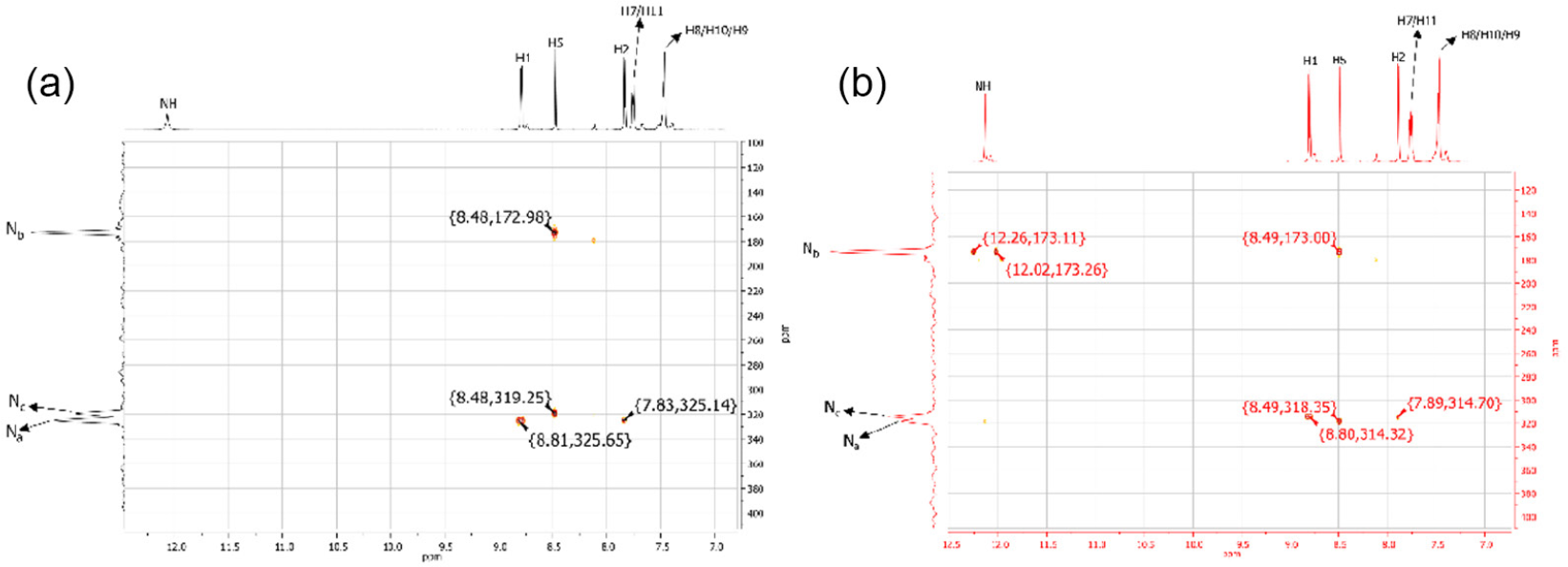
The 13C and 1H NMR spectra as well 1H-15N maps of silver(I) complexes were analyzed in comparison to NMR spectra of the free ligands. The 15N NMR signals were obtained by the HMBC experiments. The 1H NMR spectra of IZBEN and AgIZBEN are shown in Figure 1 and the 1H-15N NMR maps are presented in Figure 2. The feasible assignments of 1H and 13C signals of NMR spectra were presented in the Tables 1 and 2. Also in the Table 2, the 13C NMR data of IZpAN/AgIZpAN and IZpNIT/AgIZpNIT are described. The 1H-15N maps were obtained for IZBEN, IZpAN, IZmNIT and for their silver(I) and those data were described in the Table 3. Unfortunately, even after many experimental efforts and time machine the 1H-15N NMR data were not possible to IZoAN, IZmAN, IZoNIT and IZpNIT and to their AgI complexes. A complete data of 1H and 13C NMR spectra and 1H-15N maps of the free acylhydrazones ligands and their respective silver(I) complexes are presented in the Supplementary Information section. It is possible to spot in all 1H spectra of silver(I) the presence of hydrogen atom from an acyl group (-CO-NH-), supporting that the acylhydrazone ligands are coordinated to AgI ions as neutral ligands. The 1H-15N NMR data, see Table 3, confirm that the N-acylhydrazone ligands have been bonded to silver(I) ion by the nitrogen atom of the pyridine group since significant changes have been observed on the pyridine nitrogen after the ligand being coordinated to silver(I) ions. It is worth highlighting a trend in the 13C NMR data where AgI complexes with molar ratio 1:1 ligand:metal and conductivity between 40 to 59 (µS cm2 mol-1), it means, AgIZBEN, AgIZoAN, AgIZmAN and AgIZoNIT complexes, the carbon atoms of pyridine moiety (C1, C2 and C3), shifted to downfield (+). The same trend was observed for the carbon atoms from aldehyde portion, expected for AgIZoNIT, where C7-C11 have shifted to upfield in the range -0.01 to -0.05 ppm. For the complexes AgIZpAN and AgIZmNIT, with 2:1 (L:M) and conductivity values of 22.4 and 30.1 µS cm2 mol-1, the carbon numbered C7-C11 (aldehyde moiety) shifted to upfield (-) about -0.20 to -0.50 ppm. In the specific case of AgIZpNIT, 2:1 (L:M) and typical non-electrolyte complex, the carbon atoms did not change or changed about ± 0.01 ppm.
13C{1H} NMR (125 MHz, DMSO-d6) assignments for IZBEN, IZpAN and IZpNIT compounds and their silver(I) complexes


Molecular structure proposition
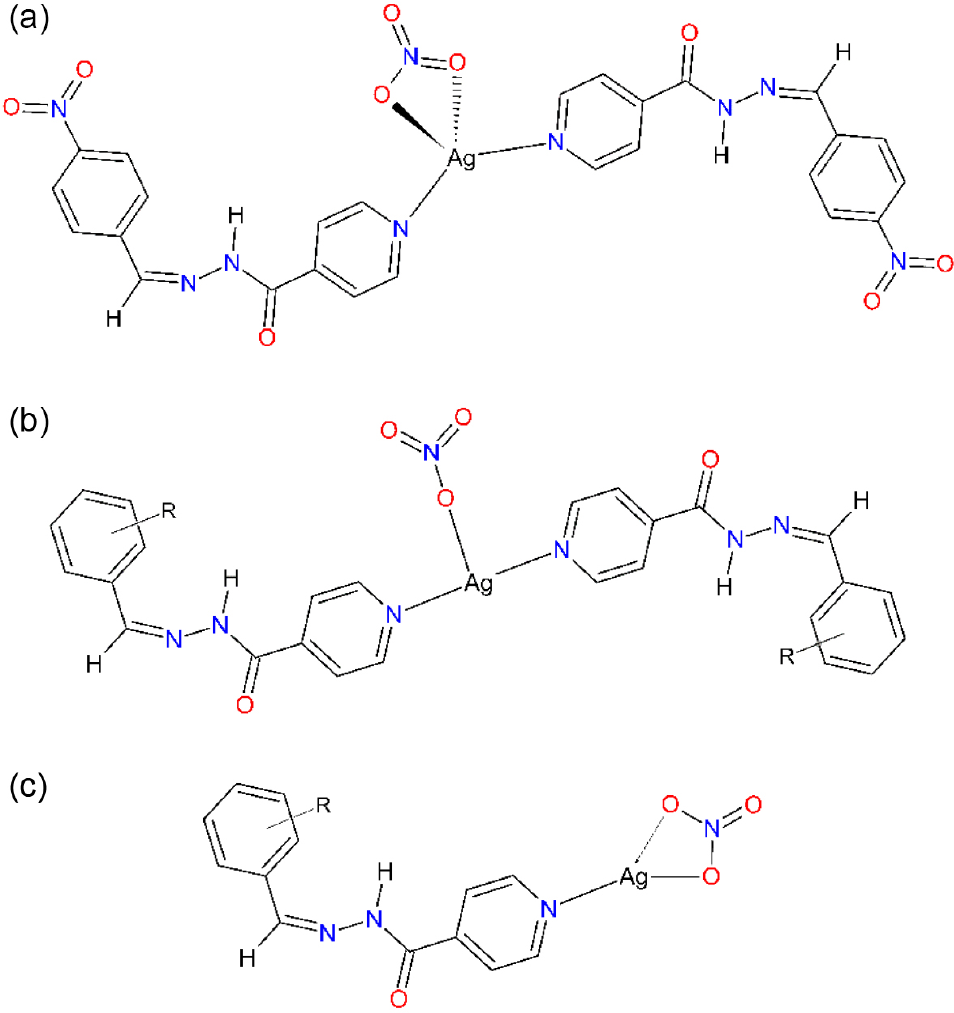
The molecular structure of silver(I) complexes based on analytical, spectroscopic data and DFT studies as well related crystal structures recently published are depicted in the Figure 3.17 Based on the analytical data, the complexes AgIZpAN, AgIZmNIT and AgIZpNIT have molar proportion of 2:1 (L:M) while AgIZBEN, AgIZoAN, AgIZmAN and AgIZoNIT crystallize on 1:1 (L:M) proportion. Since AgIZpNIT is typical non-electrolyte complex in DMSO solution, the nitrate ions should be bonded to silver(I) ions as chelate mode, Figure 3a. The DFT outcomes for AgIZpNIT show bond lengths of 2.259 and 2.261 Å for the two N-Ag bonds. For AgIZpNIT, the NO3- is coordinated to AgI ions in bidentate mode presenting bond lengths of 2.536 and 2.492 Å.

Proposed molecular structure of silver(I) complexes, (a) AgIZpNIT, (b) AgIZpAN for R = p-OCH3 and AgIZmNIT for R = m-NO2, (c) AgIZBEN for R = H, AgIZoAN for R = o-OCH3, AgIZmAN, for R = m-OCH3, AgIZoNIT for R = o-NO2.
The conductivity data of complexes AgIZmNIT and AgIZpAN suggested that NO3- ions are free in solution and by DFT the NO3- ions appear in monodentate form, where only one oxygen of NO3- ion binds to silver(I) ion. The Ag-O bond lengths were 2.408 and 2.425 Å for the AgIZmNIT and AgIZpAN complexes, respectively, Figure 3b. The AgIZpAN and AgIZmNIT complexes also presented Ag-N bond lengths with values of 2.21 Å.
For complexes 1:1 molar ratio and 1:1 electrolytes, it means, AgIZBEN, AgIZoAN, AgIZmAN and AgIZoNIT complexes, the proposed molecular structure is described in the Figure 3c. The DFT results for these complexes show that the Ag-N bonds present values of 2.19 Å. The NO3- ion is coordinated with AgI ions, where an Ag-O bond is frontal to the AgI ion with bond lengths about 2.20 Å and another one Ag-O bond presents bond lengths nearly 0.3 Å greater and not frontal for all complexes. These results indicate that the NO3- ion in 1:1 complexes act as bidentate ligand with one O-Ag bond is weaker than another one. Finally, it is possible to observe that the simulation results corroborate the experimental data for the formation of the complex structures. Furthermore, the drawn of individual silver(I) complexes were depicted in the Supplementary Information section.
Antibacterial and cytotoxicactivity assays
The N-acylhydrazone compounds and their silver(I) complexes have been evaluated against MtbH37Rv ATCC 27294 and the excellent results of MIC90 are listed in Table 4. The complexation of N-acylhydrazones to the silver(I) ion resulted in the enhancement of the biological activity for all compounds. In general, the synthesized silver(I) complexes have shown high activity against Mtb, mainly AgIZBEN, AgIZoNIT, AgIZpAN and AgIZpNIT (0.956, 1.054, 1.077, and 1.421 mg L-1, respectively), showing values that could be comparable to streptomycin (MIC = 1.00 mg L-1) and ethionamide (MIC = 0.63 1.25 mg L-1), which are considered second-line drugs. The AgI complexes reported here have better MIC90 and SI values than silver sulfadiazine (AgSD), a primarily market compound used to prevent and treat infections in secondand third-degree burns and also simple silver salt (silver nitrate) AgNO3, which has acute toxicity, since its SI is very low, about 0.03.
The cytotoxicity (IC50) results for the AgIZpAN, AgIZpNIT, and AgIZoAN show very low values (see Table 4), comparing to RIF (IC50 = 156 mg L-1).18 The selectivity index (SI) for each compound was determined as the ratio of IC50 to MIC90 (Table 4). The AgIZpAN and AgIZpNIT complexes have shown SI > 464 and 229, respectively, which indicate very promising new TB drug candidates.
Conclusions
In conclusion, 14 compounds were analyzed by analytical methods, spectroscopic techniques, such as 1H and 13C, 1H-15N maps, IR, as well by elemental analysis and conductivity over time (0 to 48 h). The AgIZpNIT, AgIZpAN and AgIZmNIT showed the 1:2 (M:L) molar ratio, while the other ones 1:1. The biological evaluation presented here confirm that silver(I) complexes derived from N-acylhydrazones represent a novel and promising approach to treat TB. The evaluations of the synthesized compounds demonstrate that the AgIZpAN and AgIZpNIT complexes not only exhibit superior anti-TB activity, with MIC of 1.077 and 1.421 mg L-1, respectively, but also feature exceptionally high selectivity indices, exceeding 200, which indicate that the silver(I) complexes are more active and less toxic compared to some conventional treatments anti-tuberculosis currently in use. Beyond broadening our understanding of the therapeutic applications of silver compounds, this study also lays a solid foundation for further research that could position these complexes at the forefront of TB treatment.
Supplementary Information
Supplementary data are available free of charge at http://jbcs.sbq.org.br as PDF file.
Data Availability Statement
All data are available in the text.
Acknowledgments
This work was supported by Universidade Federal de Juiz de Fora (UFJF) and for grants from FAPEMIG, CNPq, FAPESP (No. 2023/17727-2, 2021/10265-8, Cancer Theranostics Innovation Center (CancerThera)), Centros de Pesquisa, Inovação e Difusão (CEPID) and Pró-Reitoria de Pesquisa/UNESP; Coordenação de Aperfeiçoamento de Pessoal de Nível Superior - Brasil (CAPES) - Finance Code 001.
References
-
1 Silva, A. P. B.; Roque-Borda, C. A.; Canales, C. S. C.; Primo, L. M. D. G.; Silva, I. C.; Ribeiro, C. M.; Chorilli, M.; da Silva, P. B.; Silva, J. L.; Pavan, F. R.; Diseases 2023, 11, 150. [Crossref]
» Crossref -
2 Amaral, T. C.; Glanzmann, N.; da Silva, A. D.; Pereira, G. M.; Corbi, P. P.; Canales, C. S. C.; Pavan, F. R.; D’Oliveira, K. A.; Cuin, A.; J. Mol. Struct. 2024, 1300, 137234. [Crossref]
» Crossref -
3 Canales, C. S. C.; Cazorla, J. M.; Torres, A. H. F.; Filardi, E. T. M.; Di Filippo, L. D.; Costa, P. I.; Roque-Borda, C. A.; Pavan, F. R.; Pharmaceutics 2023, 15, 2409. [Crossref]
» Crossref -
4 World Health Organization (WHO); Global Tuberculosis Report 2024; https://www.who.int/publications/i/item/9789240101531, accessed in May 2025.
» https://www.who.int/publications/i/item/9789240101531 -
5 Acharya, B.; Acharya, A.; Gautam, S.; Ghimire, S. P.; Mishra, G.; Parajuli, N.; Sapkota, B.; Mol. Biol. Rep. 2020, 47, 4065. [Crossref]
» Crossref -
6 Canales, C. S. C.; Pavan, A. R.; dos Santos, J. L.; Pavan, F. R.; Expert Opin. Drug Discovery 2024, 19, 471. [Crossref]
» Crossref -
7 Oliveira, J. R. S.; Shiguemoto, C. Y. K.; das Neves, A. R.; Moreira, F. M. F.; Gomes, G. B.; Perdomo, R. T.; Barbosa, S. L.; Guerreiro Jr., P. G.; Croda, J.; Baroni, A. C. M.; J. Braz. Chem. Soc. 2020, 31, 1284. [Crossref]
» Crossref -
8 Basso, L. A.; Schneider, C. Z.; Santos, A. J. A. B.; dos Santos Jr., A. A.; dos Campos, M. M.; Souto, A. A.; Santos, D. S.; J. Braz. Chem. Soc. 2010, 21, 1384. [Crossref]
» Crossref -
9 Coimbra, E. S.; Santos, J. A.; Lima, L. L.; Machado, P. A.; Campos, D. L.; Pavan, F. R.; Silva, A. D.; J. Braz. Chem. Soc. 2016, 27, 2161. [Crossref]
» Crossref -
10 Zanvettor, N. T.; Abbehausen, C.; Lustri, W. R.; Cuin, A.; Masciocchi, N.; Corbi, P. P.; J. Mol. Struct. 2015, 1082, 180. [Crossref]
» Crossref -
11 Nakahata, D. H.; Lustri, W. R.; Cuin, A.; Corbi, P. P.; J. Mol. Struct. 2016, 1125, 609. [Crossref]
» Crossref -
12 Lone, M. S.; Mubarak, M. M.; Nabi, S. A.; Wani, F. R.; Amin, S.; Nabi, S.; Kantroo, H. A.; Samim, M.; Shafi, S.; Ahmad, S.; Ahmad, Z.; Rizvi, S. O.; Javed, K.; Med. Chem. Res. 2023, 32, 808. [Crossref]
» Crossref -
13 Sampiron, E. G.; Calsavara, L. L.; Baldin, V. P.; Montaholi, D. C.; Leme, A. L. D.; Namba, D. Y.; Olher, V. G. A.; Caleffi Ferraciolli, K. R.; Cardoso, R. F.; Siqueira, V. L. D.; Vandresen, F.; Scodro, R. B. L.; Tuberculosis 2023, 141, 102363. [Crossref]
» Crossref -
14 Wagh, Y. B.; Dalal, K. S.; Padvi, S. A.; Terdale, S. S.; Dalal, D. S.; Mahulikar, P. P.; Polycyclic Aromat. Compd. 2023, 43, 421. [Crossref]
» Crossref -
15 Socea, L. I.; Barbuceanu, S. F.; Pahontu, E. M.; Dumitru, A. C.; Nitulescu, G. M.; Sfetea, R. C.; Apostol, T. V.; Molecules 2022, 27, 8719. [Crossref]
» Crossref -
16 Hecel, A.; Kolkowska, P.; Krzywoszynska, K.; Szebesczyk, A.; Rowinska-Zyrek, M.; Kozlowski, H.; Curr. Med. Chem 2019, 26, 624. [Crossref]
» Crossref -
17 dos Santos, P. V. P.; Ribeiro, C. M.; Pavan, F. R.; Corbi, P. P.; Bergamini, F. R. G.; Carvalho, M. A.; D’oliveria, K. A.; Cuin, A.; J. Mol. Struct. 2021, 1234, 130193. [Crossref]
» Crossref -
18 Chai, J.-D.; Head-Gordon, M.; J. Chem. Phys. 2008, 128, 084106. [Crossref]
» Crossref -
19 Petersson, G. A.; Bennett, A.; Tensfeldt, T. G.; Al-Laham, M. A.; Shirley, W. A.; Mantzaris, J.; J. Chem. Phys. 1988, 89, 2193. [Crossref]
» Crossref -
20 Petersson, G. A.; Al-Laham, M. A.; J. Chem. Phys. 1991, 94, 6081. [Crossref]
» Crossref -
21 Stevens, W. J.; Basch, H.; Krauss, M.; J. Chem. Phys. 1984, 81, 6026. [Crossref]
» Crossref -
22 Cundari, T. R.; Stevens, W. J.; J. Chem. Phys. 1993, 98, 5555. [Crossref]
» Crossref -
23 Stevens, W. J.; Krauss, M.; Basch, H.; Jasien, P. G.; Can. J. Chem. 1992, 70, 612. [Crossref]
» Crossref - 24 Frisch, M. J.; Trucks, G. W.; Schlegel, H. B.; Scuseria, G. E.; Robb, M. A.; Cheeseman, J. R.; Scalmani, G.; Barone, V.; Petersson, G. A.; Nakatsuji, H.; Li, X.; Caricato, M.; Marenich, A. V.; Bloino, J.; Janesko, B. G.; Gomperts, R.; Mennucci, B.; Hratchian, H. P.; Ortiz, J. V.; Izmaylov, A. F.; Sonnenberg, J. L.; Williams-Young, D.; Ding, F.; Lipparini, F.; Egidi, F.; Goings, J.; Peng, B.; Petrone, A.; Henderson, T.; Ranasinghe, D.; Zakrzewski, V. G.; Gao, J.; Rega, N.; Zheng, G.; Liang, W.; Hada, M.; Ehara, M.; Toyota, K.; Fukuda, R.; Hasegawa, J.; Ishida, M.; Nakajima, T.; Honda, Y.; Kitao, O.; Nakai, H.; Vreven, T.; Throssell, K.; Montgomery Jr., J. A.; Peralta. J. E.; Ogliaro, F.; Bearpark, M. J.; Heyd, J. J.; Brothers, E. N.; Kudin, K. N.; Staroverov, V. N.; Keith, T. A.; Kobayashi, R.; Normand, J.; Raghavachari, K.; Rendell, A. P.; Burant, J. C.; Iyengar, S. S.; Tomasi, J.; Cossi, M.; Millam, J. M.; Klene, M.; Adamo, C.; Cammi, R.; Ochterski, J. W.; Martin, R. L.; Morokuma, K.; Farkas, O.; Foresman, J. B.; Fox, D. J.; Gaussian 16, Revision C.02, Gaussian, Inc., Wallingford CT, 2016.
- 25 Dennington, R.; Keith, T. A.; Millam, J. M.; GaussView, version 5, Gaussian Inc., Pittsburgh, 2009.
-
26 Palomino, J. C.; Martin, A.; Camacho, M.; Guerra, H.; Swings, J.; Portaels, F.; Antimicrob. Agents Chemother. 2002, 46, 2720. [Crossref]
» Crossref -
27 Pavan, F. R.; Maia, P. I. S.; Leite, S. R. A.; Deflon, V. M.; Batista, A. A.; Sato, D. N.; Franzblau, S. G.; Leite, C. Q. F.; Eur. J. Med. Chem. 2010, 45, 1898. [Crossref]
» Crossref -
28 Geary, W. J.; Coord. Chem. Rev. 1971, 7, 81. [Crossref]
» Crossref -
29 Santos, A. F.; Ferreira, I. P.; Pinheiro, C. B.; Santos, V. G.; Lopes, M. T. P.; Teixeira, L. R.; Rocha, W. R.; Rodrigues, G. L. S.; Beraldo, H.; ACS Omega 2018, 3, 7027. [Crossref]
» Crossref -
30 Avaji, P. G.; Patil, S. A.; J. Coord. Chem 2008, 61, 2570. [Crossref]
» Crossref -
31 Rocha, C. S.; Bomfim Filho, L. F. O.; de Souza, A. E.; Diniz, R.; Denadai, Â. M. L.; Beraldo, H.; Teixeira, L. R.; Polyhedron 2019, 170, 723. [Crossref]
» Crossref -
32 D’Oliveira, K. A.; Glanzmann, N.; da Silva, A. D.; Bruzeguini, C. E. T.; Ribeiro, M. A.; Canales, C. S. C.; Roque-Borda, C. A.; Pavan, F. R.; Corbi, P. P.; Masciocchi, N.; Cuin, A.; J. Braz. Chem. Soc. 2025, 36, e-20250048. [Crossref]
» Crossref
Edited by
-
Editor handled this article:
Brenno A. D. Neto (Editor-in-Chief)