 Profile of Nandrolone-Based Anabolic Steroids Confiscated by Federal Police of Foz do Iguaçu, Paraná, Brazil
Abstract
Anabolic steroids are often consumed by both amateur and professional sports practitioners with the aim of improving their performance and for the rapid gain of muscle mass. Nandrolone is one of the main steroids consumed and is, frequently, acquired illegally or from dubious sources, and this raises serious concerns regarding the quality of the products. This work sought to qualitatively and quantitatively evaluates oily, nandrolone-based anabolic steroids confiscated by the Federal Police Department, in the triple border (Paraguay-Brazil-Argentina, PY-BR-AR). For the quantitative study, we conducted a methodological validation analysis based on the application of solvent extraction and GC-MS (gas chromatography-mass spectrometry). A total of 40 samples of nandrolone steroids (as described on the label) were thoroughly investigated. The results obtained showed that 90% of the samples analyzed contained the active ingredient but 67.5% of these samples exhibited concentrations below the values indicated on the label; these products are thus considered to be of low quality and their consumption may pose serious risks to the consumers. The findings of this study point to the importance of enforcing regulatory controls on the sale of anabolic steroids with a view to inhibiting the consumption of counterfeit drugs that can pose serious risks to the health of consumers.
Keywords:
nandrolone; oily anabolic steroids; smuggled drugs; GC-MS; analytical method validation
Introduction
Anabolic steroids or anabolic-androgenic steroids (AAS) (also referred to as steroid hormones) are drugs that are produced synthetically from the testosterone molecule.1 These drugs are consumed based on medical prescription for the treatment of a wide range of health problems including anemia of chronic kidney disease or osteoporosis in women but are considered the major drugs of abuse widely consumed by athletes as a way of improving muscle gain or athletic performance.2,3
The use of anabolic steroids without medical prescription or recommendation has been found to be mainly responsible for serious and chronic injuries, and in some cases, the cause of sudden death of bodybuilders.4,5 To obtain physical changes in a rapid manner with good muscle definition, bodybuilders and other gym goers end up consuming anabolic steroids acquired illegally in the black market.6 Although the widespread consumption of anabolic steroids had initially been massively stimulated among athletes worldwide by the desire to exhibit superior performance in sports competitions, current surveys have shown that approximately 75% of the consumers of anabolic steroids are ordinary people who are solely seeking aesthetic gains.7 The non-therapeutic consumption of anabolic steroids or their consumption without medical prescription has become widespread mainly among young men. In order to optimize the response to anabolic steroids, it has been found that they combine different active ingredients along with other drugs such as diuretics and tamoxifen, with a view to controlling the adverse effects of the drugs.8
Legal access to anabolic steroids is quite difficult in Brazil; the commercialization of these drugs is regulated by the Ordinance 344/98 of the National Health Surveillance Agency (ANVISA).9 Anabolic steroids are part of the C5 list of drugs which can only be commercialized under special medical control regulation. With regard to human consumption, this group of drugs can only be sold upon the presentation and retention of medical prescription with a copy issued by a medical professional or a dentist.
According to the data reports released by ANVISA,9 there has been a sharp rise in the adulteration of pharmaceutical products, such as anabolic steroids, in Brazil, and this has become a huge problem worldwide. According to the FDA (Food Drug Administration)10 between 2016 and 2021, more than 130 federal inspection operations were conducted in the USA targeted at hampering the commercialization of counterfeit products acquired mainly through the internet. In Brazil, the States located in the South and Southeastern regions of the country are the regions most dramatically affected by the illegal trade of counterfeit products; this can be attributed to the vulnerability of the borders, like the Paraná border, which is a triple border (shared by three countries, Brazil, Paraguay, and Argentina), and the Santa Catarina border, which is shared by Brazil and Argentina.
With regard to smuggled and counterfeit drugs, anabolic steroids occupy the first place (70%) in the ranking of the drugs confiscated by the Federal Police of Foz do Iguaçu, followed by supplements (9%) and medicines (9.5%) for erectile dysfunction (6.7%), between 2019 and 2024, and Paraná was the State with the highest cases of confiscation, followed by São Paulo and Santa Catarina.11 Data reports from the National Criminal Institute of the Federal Police Department show that on average, one third of the anabolic steroids confiscated in Brazil are declared to have been acquired from Paraguay, a country that shares a border with Brazil. These same data reports also show that nandrolone was one of the main active ingredients that were declared on the labels of the anabolic steroids confiscated by the Police; this compound was the third most declared active ingredients in the anabolic steroids, second in line to stanozolol and testosterone along with its esters. When it comes to undeclared substances on the label, nandrolone was found to be the second most undeclared compound (on the labels of the anabolic steroids confiscated by the Police) among the lots.12
Nandrolone is a synthetic analog of testosterone; its use was widely detected among many athletes during the Sydney 2000 Olympic games. The detection of the presence of nandrolone among the Olympic athletes led to heated debate in sports organizations worldwide regarding the concentration levels of nandrolone metabolite considered acceptable, once the presence of this anabolic steroid has been regarded as a contaminant in nutritional supplements and it is produced endogeneously in low concentration levels.13 Nandrolone was first synthesized in 1950; the compound can mainly be found in pharmaceutical formulations in the form of esters such as decanoate and phenylpropionate.14 The molecule is obtained by removing the methyl group in the testosterone C-19, and this gives rise to myotrophic potential similar to testosterone though with lower androgenic effect due to its reduced affinity with the receptors.15 The abusive use of nandrolone has been found to provoke a wide range of adverse effects among consumers; these include the production of inflammatory cytokines, oxidative stress, and changes in protein synthesis and apoptosis which lead to severe damages to the cardiovascular, endocrine, reproductive, and musculoskeletal systems, as well as to the kidney and liver of the consumers.3
It is quite common to find counterfeit injectable ampoules produced in oily formulations of nandrolone; in most cases, these formulations may contain testosterone esters especially testosterone enanthate, which is actually used in the drug formulations in place of the compound described on the label.16 Apart from the risks inherent to the active ingredients, including irreversible chronic disorders and behavioral, systematic and metabolic changes, which may result in the suddent death of consumers, the consumption of illegal drugs also leads to a rise in sanitation risks, and this poses serious concerns to ANVISA and other health authorities.17,18
In line with the principles of analytical chemistry, there have been significant improvements in the diversification of methods and equipment used in the analysis and quantification of anabolic steroids; analytical chemistry plays an important role when it comes to the analysis of purity and quality of pharmaceutical products.19,20 It should be noted, however, that the vast majority of methods developed and tested in the literature have been largely directed toward the analysis of biological matrices with a view to diagnose doping and evaluating the users of anabolic steroids; in this sense, there are very few reports related to the analysis of the pharmaceutical quality of anabolic steroids.
In this context, the present study sought to quantitatively and qualitatively evaluate oily anabolic steroids, nandrolone ester-based (as stated on the labels) confiscated by the Federal Police Department of Foz do Iguaçu, Paraná, during the period between 2019 and 2022. For the quantification analysis, the analytical method validation was conducted using solvent extraction and gas chromatography coupled to mass spectrometry.
Experimental
Samples
In the present study, we performed a thorough analysis of a total of 40 samples of oily anabolic steroids, nandrolone ester-based (as stated on the labels), confiscated by the Federal Police Department (DPF) of Foz do Iguaçu, Paraná, between 2019 and 2022, under border operations targeted at the prevention of smuggling and illegal trade of drugs. The samples were stored in vials and kept in the refrigerator at 20 °C up to the moment of analysis.
Liquid-liquid extraction
An amount of 50.0 µL of the sample was mixed by vortexing for 1 min with 150.0 µL of 102 µg mL-1 of sibutramine (CAS No. 84485-00-7, (±)-dimethyl-1 [1 (4 chlorophenyl)-cyclobutyl]-N,N,3-trimethylbutan-1-amine, Fiocruz, INCQS, Brazil) as internal standard (IS), and 800.0 µL of a mixture of ethyl acetate (EA)/acetonitrile (ACN) (1:1, v/v) with HPLC (high performance liquid chromatograpy)-grade (Sigma-Aldrich, São Paulo, Brazil,) in 1.5 mL microcentrifuge tubes. The tubes were kept frozen at -20 °C for a day. After the freezing period, an amount of 120 µL of the supernatant was transfered to a new 1.5 mL microcentrifuge tube, where an amount of 880.0 µL of EA/ACN solvent solution (1:1) was added to the tube. The sample preparation was performed in triplicate. Sibutramine was chosen as IS because it presents a high degree of purity, thermal stability under the analysis conditions and, mainly, because it presents the same elution behavior as the oily anabolic steroids examined in terms of running time.
Method validation
The validation of the quantification method was performed in line with the DOQ-CGCRE-008 regulatory guidelines by INMETRO21 (Instituto Nacional de Metrologia, Normalização e Qualidade Industrial) through the determination of the following parameters: selectivity, linearity, homoscedasticity, limit of detection (LOD), limit of quantification (LOQ), recovery rate and precision.
Analytical curve
For quantification of the samples and construction of the analytical curve, we employed the following lyophilized analytical standard: 8R, 9S, 10R, 13S, 14S, 17S-17 hydroxy-13-methyl-2,6,7,8,9,10,11,12,14,15,16,17-dodecahydro-1H-cyclopenta[a] phenanthren-3-one (nandrolone decanoate, CAS No. 360-7-3, Dr. Ehrenstorfer, Wesel, Germany), which was diluted with HPLC-grade EA/ACN (1:1, v/v), giving rise to a final stock solution concentration of 10 mg mL-1. The analytical curve was constructed based on the stock solution and with the addition of 150 µL of IS, taking the following concentrations into account: 200, 250, 300, 350, 400, and 450 µg mL-1. A second analytical curve was constructed at the same concentrations in the matrix to evaluate selectivity. The matrix consisted of a mixture of samples without nandrolone decanoate in proportions of 50 µL of the mix sample with 950 µL of a mixture of EA/ACN (1:1, v/v).
Chromatography analysis
The analysis of the anabolic steroids was conducted using gas chromatograph system model 7890A, (Agilent Technologies, Santa Clara, USA), coupled to spectrometer Inert XL MSD with triple-axis detector model 5975C, from Agilent Technologies, with automatic injector (Agilent Technologies 7683B series) operated in electronic impact mode of 70 eV. The separation of the anabolic steroids was performed using HP-5MS column 5% phenyl methyl silox (30 m × 0.25 mm × 0.25 μm; Sigma-Aldrich, São Paulo, Brazil) under the following conditions: helium gas employed as carrier gas at flow rate of 0.8 mL min 1; injection volume of 1 µL and injection velocity of 70 µL µs 1; temperature 60 °C up to 150 °C at 40 °C min-1 (1 min), and up to 315 °C at 4 °C min-1 (20 min). Data collection was conducted using the selected ion monitoring (SIM) method in mass spectrometer (MS) (Table 1).
Statistical analysis of the data collected
The BioEstat program22 (developed by the Federal University of Pará, Brazil) was used to carry out the statistical analyses. The Student’s t-test was used to compare the angular coefficients of the calibration curves in the matrix and in the solvent.
Results and Discussion
Method validation
Selectivity
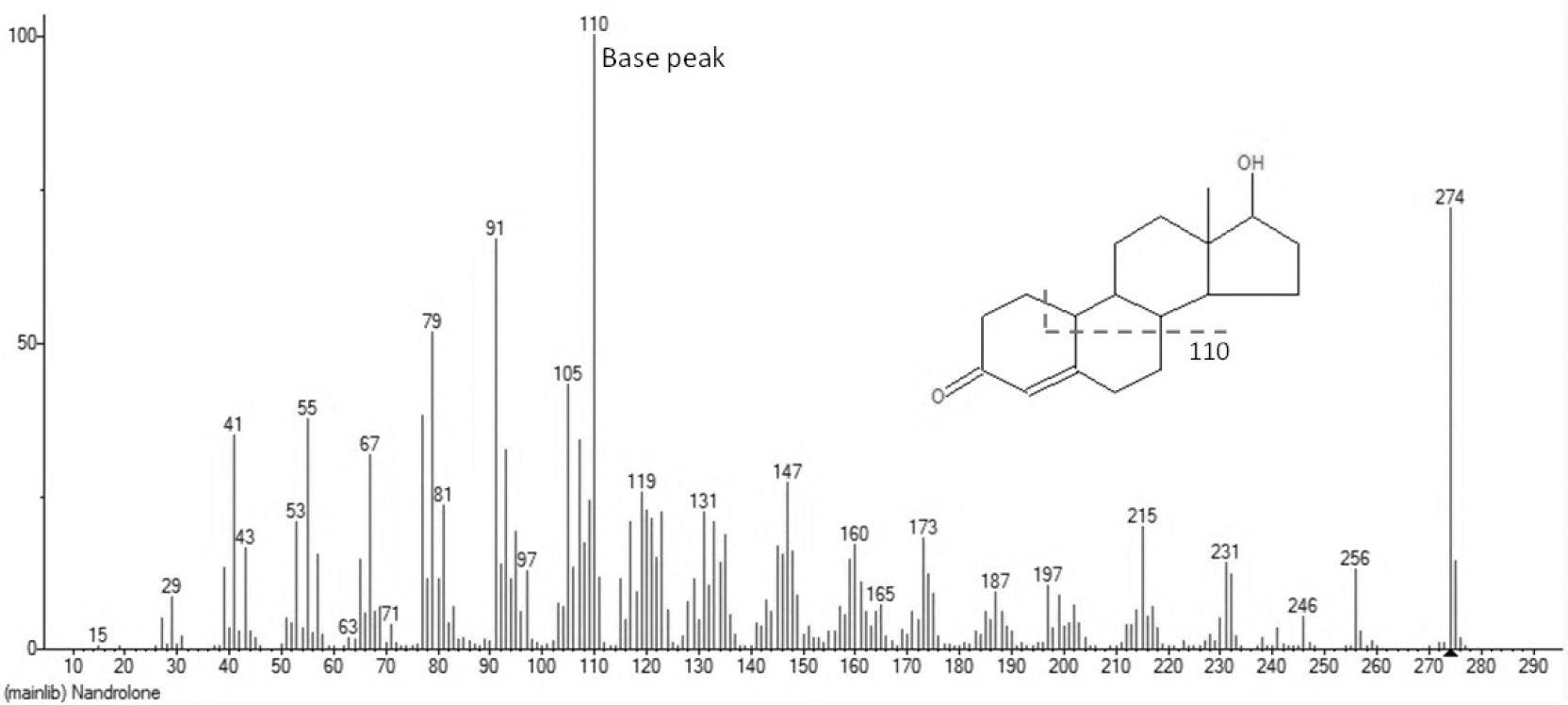
The identification and quantification of the nandrolone esters involved the monitoring of the base peak at m/z 110, corresponding to the nandrolone molecule, irrespective of the esters that constitute the molecule, as can be observed in Figure 1. The chromatography method was applied in order to avoid any co-elution of the nandrolone esters and any other active ingredient that is not described on the label, thus allowing the quantification of the samples and rendering the method effectively selective (Figure 2).


Total ion chromatogram of a sample doped with nandrolone decanoate at 200 µg mL-1 (47.77 min) and sibutramine as internal standard (IS) (15.70 min).
The results obtained from the Student’s t-test showed that the slopes of the analytical curves for the solvent and the matrix (matrix α1 = 0.0185; solvent α1 = 0.0178) did not exhibit any statistical difference at the 90% confidence level (Figure 3); the t value obtained was 1.431, while the critical t value was 1.691. Looking at Figure 3, one will observe that although the slopes are equivalent, the solvent exhibits lower signal levels for each concentration, and this leads to relatively lower LOD and LOQ compared to the matrix. Therefore, considering that there is no difference in sensitivities between matrix and pure solvent and considering that the curve in the pure solvent has lower LOD and LOQ values, we chose to continue with the analysis of the other validation parameters in the solvent.

Analytical curve of nandrolone decanoate in the solvent ethyl acetate/acetonitrile (1:1, v/v) (y = 0.0178x - 2.5119) and in the matrix (y = 0.0185x - 2.1388).
Linearity, relative standard deviation, homo/heteroscedasticity and recovery analyses
The analysis of the linearity of the analytical curve was conducted in sextuplicates using six concentration levels (200, 250, 300, 350, 400, and 450 µg mL-1). The dispersion of residues observed in the graph pointed to a homoscedastic system which is evidenced by the random distribution of the residues around the zero line (Figure S1, Supplementary Information (SI) section). Table 2 shows the linearity results (r and R2), recovery rate in 3 levels (low, medium, and high), LOD and LOQ, as well as the relative standard deviation (RSD) of all the levels.
Validation parameters of the LLE-GC-MS method for measuring nandrolone in oily anabolic samples
The LOD and LOQ values obtained were 50.97 and 72.77 µg mL-1, respectively. As can be noted, the LOD and LOQ values obtained in our study were lower than those reported by Neves and Caldas23 who obtained nandrolone concentration limits of 1,2800 µg mL-1 (1.28 mg mL-1) for oily ampoules. It is worth noting that although Pellegrini et al.24 obtained a much lower LOQ for liquid samples (20 µg mL-1) through the application of a mixture of solvents based on chloroform/isopropanolol (1:1, v/v), when one considers the levels of concentration in mg mL-1 employed in commercial ampoules, it is clear that the LOD and LOQ values obtained in our present study are effectively great.
The recovery rates obtained in our present study were 94.6, 90.5, and 93.6% for low (200 µg mL-1), medium (300 µg mL-1), and high (450 µg mL-1) concentration levels; these recovery values are in line with the regulations established by INMETRO,21 the values stipulated range from 90 to 107%.
To determine the level of precision of the method, intra-day repeatability analysis was conducted; this involved calculating the relative standard deviation (RSD) for the six concentration levels of the analytical curve. The RSD values obtained ranged between 0.3 to 4.7%. These RSD values are within the values recommended by INMETRO;21 the guidelines of INMETRO consider RSD values of up to 5.3% acceptable for the concentration levels investigated in this study.
Analysis of the samples
Firstly, all samples were analyzed qualitatively. The initial analysis of anabolic steroids was carried out by evaluating the packaging, in which the product labels were compared, and the chemical analysis was subsequently carried out by GC-MS in scan mode to produce forensic reports.
Based on the information available on the product labels, it was found that the products were produced in 3 different countries, Paraguay (26), India (6), Mexico (5) and of unknown origin (3), with a total of 7 companies (Table 3). The oily excipients had some differences in their characteristics, including different viscosity, density and color. The color of the products is derived from the addition of dyes during the manufacturing process (green, red, blue), and this allows one to distinguish one brand or product from another.
Levels of nandrolone esters measured in samples of anabolic steroids seized in the city of Foz do Iguaçu-PR (Brazil) from 2019 to 2022
In the initial analysis by GC-MS, the following was observed: (i) 2 samples (5%) had no anabolic steroids in their composition (samples 1 and 2), both from the same company and without declared origin; (ii) 2 samples (5%), with different company and origin, contained anabolic steroids that did not match the description on the label (samples 8 and 16); and (iii) 36 samples (90%) contained anabolic steroids that were described on the label. In the aforementioned samples (ii), we detected the presence of drostanolone (m/z 149). The nandrolone esters stated on the labels were phenylpropionate and decanoate (Table 3), with the latter being the most prevalent, representing 80% of the samples (32 samples).
Only a single sample did not have producer and country information (sample 3, Table 3), probably being smuggled for labeling in Brazil. However, this sample had a content (95.9 ± 0.03 mg mL-1) very close to that declared (100 mg mL-1). Two samples did not have information about the country of origin, but were from the same producer, both without the active ingredient (samples 1 and 2, Table 3). All samples from Mexico (numbers 4 to 8), from the same producer, showed adulterations, four with lower concentrations (ranging from 132.7 to 137.7 mg mL-1) than half of what was labeled (300 mg mL-1) and one without active ingredient (sample 8). There were three different Indian producers, and four of the six samples were adulterated, with levels below the labeled level (samples 9, 10, 12 and 13). In the samples from Paraguay, 5 of the 26 had concentrations very close to those declared (samples 20, 21, 22, 26, 34 and 40). The Paraguayan samples were predominantly from the same company, except for sample 15.
The results of this study showed that only 22.5% of the anabolic steroids seized (9 samples, numbers 3, 11, 14, 20, 21, 22, 26, 34 and 40, Table 3) had concentrations very close to those labeled (up to 6% variability), and 67.5% of the samples (27 samples) did not contain the concentration of active ingredient stated on the labels. In fact, all of these samples exhibited active ingredient concentrations lower than the values stated on the labels; 9 of which varied from 30 to 50% of the declared quantity (the samples numbered 4, 5, 6, 7, 10, 18, 19, 25 and 41), 16 varied from 51 to 70% (samples 9, 12, 15, 17, 23, 24, 27, 28, 29, 30, 33, 35, 36, 37, 38 and 39), and only 2 with 73.6 and 75.7% of the active ingredient (32 and 13, respectively) (Table 3).
In a study23 also carried out in Brazil, 158 ampoules of anabolic steroids seized by the Police in Brazil between 2011 and 2016 were evaluated. The results revealed that nonconformities were found in 65% of the samples, 41% without the active ingredient and only 5.7% with concentrations lower than indicated. In Germany, Krug et al.25 also found a similar percentage of samples (57%) with non-conformities, with 55% of these samples containing anabolic steroids that were not stated on the label. In another study26 carried out in Switzerland, the authors evaluated 49 ampoules of nandrolone decanoate, where 77% (33 samples) exhibited concentrations lower than the amounts stated on the labels. However, in a large study7 conducted using meta-analysis based on the review of 19 articles related to the control of counterfeit products, the findings showed that the smuggled substances largely come in subconcentration levels in 67% of the products on average. In general, we can see a great deal of variability in the profiles of seized samples, which is natural, given all the variability of seizures, such as the country of seizure and the origin of the samples. However, the nonconformities are similar, with predominant samples with concentrations below those declared and without the active ingredient.
It is evident that this kind of product adulteration is driven by an economic motive, where the illegal manufacturer seeks to reduce the concentration of active ingredients in the products in order to make significant profits. Interestingly, when one considers the problem of adulteration in a more harmful scenario, it is evidently a relief to observe that there were no samples containing active ingredient concentrations higher than the values stated on the labels, as this would pose even greater risks; including hepatotoxicity, water retention, gynecomastia, and the development of prostate tumors, to the health of the consumers.27
Conclusions
The results obtained from the validation of the LLE GC MS-based quantification method used for oily samples containing nandrolone esters were considered satisfactory in terms of the evaluated parameters; which included linearity, selectivity, relative standard deviation, recovery rate, LOD and LOQ, based on current regulatory guidelines. In addition to being highly selective, the sample preparation procedure carried out by liquid-liquid extraction made the technique simple and easy to implement, very suitable for carrying out routine analyses.
The results of this study showed that the production of anabolic ampoules containing nandrolone esters, confiscated by the Federal Police at the triple border (Foz do Iguaçu, PR, Brazil) were not suitable, being adulterated on purpose or because they did not have adequate quality control. Probably, analyzing the profile of nonconformities, where 67.5% of the samples were below the level indicated on the label, these adulterations were intentional. The adulterations found also do not appear to be associated with the origin or a specific brand, indicating that this practice is widespread and aimed solely at profit.
This study serves as a warning to the general public regarding the purchase of counterfeit products and the possible risks that they pose to consumer health; clearly, there is no way to control and guarantee the reliability, quality, and efficacy of products purchased illegally.
Supplementary Information
Supplementary information is available free of charge at http://jbcs.sbq.org.br as PDF file.
Acknowledgments
The authors are sincerely grateful to UNILA Researchers’ Integration Program (Public Notice No. 80/2019/PRPPG) and to Foz do Iguaçu Regional Federal Police Department of Paraná, Brazil, for providing us with the samples and their laboratory facilities for the conduct of this study as part of the Technical Cooperation Agreement established with Federal University of Latin American Integration (UNILA).
References
-
1 Fragkaki, A. G.; Angelis, Y. S.; Koupparis, M.; Kakoulidou, A. T.; Kokotos, G.; Georgakopoulos, C.; Steroids 2009, 74, 172. [Crossref]
» Crossref -
2 Kahal, A.; Allem, R.; Zahzeh, T.; Oulmane, S.; Tafroukhte, Z.; Steroids 2020, 155, 108574. [Crossref]
» Crossref -
3 Patanè, F. G.; Liberto, A.; Maglitto, A. N. M.; Malandrino, P.; Esposito, M.; Amico, F.; Cocimano, G.; Rosi, G. L.; Condorelli, D.; Di Nunno, N.; Montana, A.; Medicina 2020, 56, 606. [Crossref]
» Crossref -
4 Christou, G. A.; Christou, K. A.; Nikas, D. N.; Goudevenos, J. A.; Eur. J. Prev. Cardiol. 2016, 23, 1785. [Crossref]
» Crossref -
5 Albano, G. D.; Amico, F.; Cocimano, G.; Liberto, A.; Maglietta, F.; Esposito, M.; Rosi, G. L.; Di Nunno, N.; Salerno, M.; Montana, A.; Healthcare 2021, 9, 97. [Crossref]
» Crossref -
6 Coopman, V.; Cordonnier, J.; Ann. Toxicol. Anal. 2012, 24, 73. [Crossref]
» Crossref -
7 Magnolini, R.; Falcato, L.; Cremonesi, A.; Schori, D.; Bruggmann, P.; BMC Public Health 2022, 22, 1371. [Crossref]
» Crossref -
8 Baker, J. S.; Graham, M.; Davies, B.; J. R. Soc. Med. 2006, 99, 331. [Crossref]
» Crossref -
9 Agência Nacional de Vigilância Sanitária (ANVISA); Portaria SVS/MS 344, de 12 de maio de 1998, Aprova o Regulamento Técnico sobre Substâncias e Medicamentos Sujeitos a Controle Especial; Diário Oficial da União (DOU), Brasília, Brazil, 1998. [Link] accessed in October 2024
» Link -
10 White, C. M.; Ann. Pharmacother. 2022, 56, 1333. [Crossref]
» Crossref -
11 Hurtado, R. L.; Lasmar, M. C.; Cad. Saúde Pública 2014, 30, 891. [Crossref]
» Crossref -
12 Neves, D. B. J.; Marcheti, R. G. A.; Caldas, E. D.; Forensic Sci. Int. 2013, 228, e81. [Crossref]
» Crossref -
13 Abbott, A.; Nature 2000, 407, 124. [Crossref]
» Crossref -
14 Wu, C.; Kovac, J. R.; Curr. Urol. Rep. 2016, 17, 72. [Crossref]
» Crossref - 15 Thieme, D.; Hemmersbach, P.; Doping in Sports, 1st ed.; Springer: Berlin, Heidelberg, 2009.
-
16 Kozlik, P.; Tircova, B.; Steroids 2016, 115, 34. [Crossref]
» Crossref -
17 Ames, J.; Souza, D. Z.; Rev. Saude Publica 2012, 46, 154. [Crossref]
» Crossref -
18 Nieschlag, E.; Vorona, E.; Rev. Endocr. Metab. Disord. 2015, 16, 199. [Crossref]
» Crossref -
19 Venkatesan, P.; Valliappan, K.; J. Pharm. Sci. Res. 2014, 6, 254. [Link] accessed in October 2024
» Link -
20 Tircova, B.; Bosakova, Z.; Kozlik, P.; Drug Test. Anal. 2019, 11, 355. [Crossref]
» Crossref -
21 DOQ-CGCRE-008: Orientação sobre Validação de Métodos Analíticos, Instituto Nacional de Metrologia, Normalização e Qualidade Industrial (INMETRO): Rio de Janeiro, 2020. [Link] accessed in October 2024
» Link - 22 BioEstat, version 5.0; Instituto Mamirauá, Tefé, AM, Brazil, 2014.
-
23 Neves, D. B. J.; Caldas, E. D.; Forensic Sci. Int. 2017, 275, 272. [Crossref]
» Crossref -
24 Pellegrini, M.; Rotolo, M. C.; Di Giovannadrea, R.; Pacifici, R.; Pichini, S.; Ann. Toxicol. Anal. 2012, 24, 67. [Crossref]
» Crossref -
25 Krug, O.; Thomas, A.; Walpurgis, K.; Piper, T.; Sigmund, G.; Schänzer, W.; Laussmann, T.; Thevis, M.; Eur. J. Clin. Pharmacol. 2014, 70, 1303. [Crossref]
» Crossref -
26 Weber, C.; Krug, O.; Kamber, M.; Thevis, M.; Subst. UseMisuse 2017, 52, 742. [Crossref]
» Crossref -
27 Cunha, T. S.; Cunha, N. S.; Moura, M. J. C. S.; Marcondes, F. K.; Rev. Bras. Cienc. Farm. 2004, 40, 165. [Crossref]
» Crossref
Edited by
-
Editor handled this article:
Ivo M. Raimundo Jr. (Associate)