 Sorption of Imidacloprid and Hexazinone to Polyethylene Microplastics
Abstract
Polyethylene (PE) is among the most abundant plastic contaminant in the environment and has been shown to have high pesticide sorption efficiencies. However, few studies focused on hydrophilic pesticides and real water matrices, with few comparing the interaction differences with naturally occurring sorbents. Herein, we studied the interaction between imidacloprid and hexazinone and PE microplastics (MP) in ultrapure water, spring water, river water, and seawater, evidencing the reduction in the sorption capacities in real water matrices. The lower sorption to a natural sorbent, a sandy soil, demonstrates the potential role of PE MP contamination to increase the sediment retention of these two hydrophilic molecules. The desorption after the dilution of the aqueous solution demonstrated the reversibility of the interaction. This study highlights the importance of including hydrophilic molecules in MP impact studies, as well as real water matrices and natural sorbents, for a better understanding of MP pollution impacts.
Keywords:
environmental fate; water matrices; pesticide
Introduction
Pesticides are products widely used to prevent the action of harmful organisms in agriculture and livestock. They have different fates after their application depending on their physicochemical characteristics, degradability, and the characteristics of the environment.1 For instance, persistent hydrophilic molecules tend to reach ground and surface water, because they are more soluble in water and are more easily carried in the process of leaching or runoff. Environmental characteristics also play an important role in transport within compartments. Soils with high content of clay and organic matter tend to retain more contaminants than a sandy soil, since higher surface area and the presence of more molecular interaction sites delay contaminant migration.1 Based on the fate of the pesticide molecules, different target or non-target organisms might be affected as described by Pathak et al.2 Imidacloprid (log KOW = 0.6, n-octanol/water partition coefficient) is a hydrophilic insecticide widely applied in soy, corn and cotton crops that affects bees as non-target organisms at a toxic dose of 5 ng per bee.3 It has already been described in surface water in concentrations as high as 2.6 µg L-1 in São Paulo, Brazil.4,5 Hexazinone (log KOW = 1.1) is an herbicide applied in sugar cane crops and has been found in concentrations higher than 1 µg L-1 in Lake Victoria South Basin, Kenya,6 and up to 0.02 µg L-1 in groundwaters in the city of Porto Alegre, Southern Brazil.7 It causes toxicity to green algae, which are non-target organisms, at concentrations as low as 1 µg L-1.8
Recently, studies about the interaction of pesticides with microplastics (MP) have raised a new concern about whether the presence and increase of MP in the environment are altering the already known fate of pesticides.9-12 MPs are plastic particles of 1 to 1,000 µm that can work as a sorbent of contaminants.13 Among the numerous MP materials, polyethylene (PE) has been described as one of the most abundant in the environment. A review of 81 occurrence studies in Latin America reported PE as the major material found in ecosystems.14 PE was also described in most of the studies listed in a review of MP in freshwater sediment.15
It is known that PE MP can interact with pesticides, however, most studies focus on more hydrophobic molecules.10,12,16-18 Little is known about the interaction of less hydrophobic pesticides (with log KOW lower than 2) and PE MP. These compounds are more likely to reach water bodies at higher concentrations; therefore, a change in the fate of these chemicals (e.g., accumulation in sediment) due to their interactions with MP may indicate a point of attention, as non-target organisms might be affected. Few studies demonstrated the sorption of hydrophilic pesticides to PE MP. Wang et al.11 described the sorption capacity of carbendazim (log KOW = 1.5) and dipterex (log KOW = 0.4) as about 10 and 30 µg g-1. Li et al.19 identified the sorption capacity for imidacloprid (log KOW = 0.6) as about 3 µg g-1. However, none described this interaction in real water matrices, where a mixture of organic matter, ions and other particles are present, potentially impacting the level of removal of these pesticides from solution.20 As described for more hydrophobic molecules, the presence of organic matter and salt can either increase or decrease the interaction of the molecules with the MP. Dias et al.21 reported lower sorption of progesterone and testosterone onto polyamide MP in seawater than in surface water, groundwater, or ultrapure water. The authors discussed that the higher concentration of salt in seawater could compete for sorption sites and affect the surface charge of the sorbent. On the other hand, atrazine showed higher sorption efficiency in seawater, possibly due to the salting-out effect. Madeira et al.20 described how humic acid at concentrations higher than 5 mg L-1 interact with PE MP, reducing the sorption capacity for fipronil and its degradation products.
Few studies aimed to compare the sorption of pesticides between MP and naturally occurring sorbents. Such studies elucidate potential contributions and impacts of MP pollution to the retention and migration of these molecules in the environment. For instance, Wu et al.22 investigated the PE MP-driven differences in the migration of 20 pesticides in a sandy soil column. The soil containing PE MP anticipated the breakthrough of the hydrophobic molecules. They hypothesize that the addition of PE MP dilutes the soil organic matter content that has high surface area and sorption capacity. Hüffer et al.12 found that the sorption of atrazine and 4-(2,4-dichlorophenoxy) butyric acid was higher in the studied soil than to PE MP. Fatema and Farenhorst23 compared the sorption of 2,4-dichlorophenoxyacetic acid (2,4-D), atrazine, glyphosate and dichlorodiphenyltrichloroethane (DDT) to different natural sorbents and MP. More studies are necessary to understand the impacts of MP pollution in the environment.
Environmentally relevant studies are of utmost importance, but there is still a gap in the literature for research with real matrices. To the best of our knowledge, this study is the first report of the interactions in real water matrices between PE MP and imidacloprid and hexazinone, which are widely used pesticides that have been found as contaminants in surface water in relatively high concentrations.4-6 This study provides a realistic assessment of the fate of these pesticides in natural waters. Pioneeringly, our group compared the sorption of imidacloprid and hexazinone with the sorption to a natural sorbent. It was selected sand, which is also a low sorption capacity sorbent for hydrophilic pesticides. In this case, a higher sorption to PE MP than to a natural sorbent would be critical, as it results in a decrease in the mobility of compounds that are expected to easily leach. Our study also included a dilution effect experiment, exploring oscillations in contaminant concentrations that happen in the environment. Our results help fill the gap in the current knowledge about the interactions between MP and less hydrophobic compounds under environmentally relevant conditions.
Experimental
Chemicals
Analytical standards of imidacloprid (purity of 99.9%) and hexazinone (purity of 99.9%) (Sigma-Aldrich, St. Louis, U.S.) were used to prepare stock solutions in methanol HPLC grade (Merck KGaA, Darmstadt, Germany) at 500 mg L-1. Ultrapure water (resistivity 18.2 MΩ cm at 25 °C) was obtained from a purification system Synergy UV (Merck KGaA, Darmstadt, Germany). Acetonitrile HPLC grade (Merck, Darmstadt, Germany; Avantor, Radnor, U.S.) was used as mobile phase.
Instrumental method development
A high-performance liquid chromatography (HPLC) LC-10ATVP coupled to a diode-array detector (DAD) SPD-10AVP (Shimadzu, Kyoto, Japan) was used with an injector 7725I (Rheodyne, Bensheim, Germany). The chromatographic column was a Zorbax Eclipse XDB-C18 (4.6 mm of diameter, 150 mm of length, particle size of 5 µm, and 80 Å of pore size) (Agilent, Santa Clara, U.S.) at room temperature. The final method used an 8-min isocratic elution of 70% water and 30% acetonitrile at 1.0 mL min-1. Imidacloprid was detected at 269 nm and hexazinone at 246 nm.
Method validation
The procedures for method validation are described in the Supplementary Information (SI) sub-section “Analytical and sorption method validation”. The assessed figures of merit included selectivity, limit of detection, limit of quantification, linearity, accuracy, within-run precision, solution stability and filter assessment.
Analytical curve
Work solutions were prepared from the stock solutions at 5 mg L-1 in ultrapure water. Then, calibration solutions were prepared from work solutions in ultrapure water at the following concentrations: 5, 25, 50, 100, 150 and 200 µg L-1. They were injected in triplicate.
Sorbents
PE MP of average molar mass of 3,000,000 to 6,000,000 (ultra-high molecular weight PE) were purchased from Sigma-Aldrich (St. Louis, U.S.). The sandy soil was collected from São Sebastião beach (São Paulo, Brazil) with location coordinates available in the SI sub-section “Geographic coordinates of sampling sites”.
Sorbents characterization
Characterization of sorbents is described in the SI sub-section “Sorbents characterization”.
Environmental water samples
Grab water samples were collected on different sites of the Pedras Creek that runs through urbanized and farm areas of Campinas city (São Paulo State, Brazil) and flows out to the Anhumas Creek where a sample was also collected. Spring water was collected in the source of Pedras Creek in Campinas. A grab water sample was also collected from São Sebastião beach (São Paulo State, Brazil) to access possible influences of a higher salinity water matrix. All location coordinates are available in the SI sub-section “Geographic coordinates of sampling sites”.
Sorption study
An indirect method was used to determine sorption of analytes to PE MP and sand, i.e., sorption was calculated by the difference of analytes concentration in solution before and after contact with the sorbent. Batch sorption experiments were conducted at room temperature (18 22 °C). 30 mg of sorbent were weighed in 8-mL transparent glass test tubes with polytetrafluoroethylene (PTFE) lids in triplicate for each contact time. A 50 µg L-1 solution of imidacloprid and hexazinone prepared by dilution of work solutions in each of the aqueous matrices was then added to each one of the test tubes. For the sorption isotherm experiment, initial concentrations varied from 25 to 120 µg L-1. During the contact time with the sorbents, the tubes were shaken in a roto-torque agitator making sure that turbulence in the solution enabled the contact of solution with the particles, especially for the buoyant MP. The contact time for the isotherm was 96 h. After the contact time, the whole content of each test tube was transferred to a syringe attached to a PTFE syringe filter with pore size of 0.22 µm. The content was filtered to a glass autosampler vial and analyzed in the HPLC. Sorption capacity (qt) for each sample was calculated according to equation 1.
In which, V is the volume of solution, ms the mass of sorbent, C0 the initial concentration of analyte in solution, Ci the concentration of analyte in solution after time t. The sorption exploratory experiment with different types of sorbents is described in the SI sub-section “Exploratory sorption efficiencies of imidacloprid and hexazinone to different sorbents”. Fitting to models were performed using OriginPro 2026 software.24
Quality control and quality assurance
A positive control with no sorbent was included to each contact time to monitor possible losses of analytes from solution for reasons other than the sorption to sorbents (e.g., sorption to tubes or degradation of analytes). Each batch experiment had a negative control containing the matrix and the sorbents, where no analytes were added. The negative control was used to verify the selectivity of the chromatographic method. Each instrumental injection list contained a blank injection at the beginning and at the end, and every four samples to check for any carry-over effects.
Dilution effect
3 mL of a 50 µg L-1 solution of imidacloprid and hexazinone prepared in ultrapure water (matrix 1) were mixed for 96 h in test tubes containing 30 mg of PE MP to enable the sorption equilibrium to be reached (triplicate). Then, 3 mL of matrix 2 (ultrapure water or river water) were added to the test tube to evaluate the behavior of the pesticides to change in matrix conditions (pesticide concentration and matrix composition). The pesticide concentration in solution was analyzed after an additional 96 h of mixing. In experiment 1, ultrapure water was used as matrix 2. In experiments 2 and 3, water from Anhumas Creek was used as matrix 2, with total organic carbon (TOC) concentrations of 14.5 and 10.2 mg L-1, respectively. The pesticide amount was expressed as a ratio of the pesticide mass in solution (mi) relative to the initial pesticide mass in solution (m0). The details about the quality controls for this experiment are described in the SI sub-section “Dilution effect quality controls”. Briefly, they included sorption control, stability control, dilution control, negative control and negative dilution control.
Results and Discussion
Method development
Method development resulted in a fast chromatographic run capable of simultaneously quantifying both analytes in a single injection. The method validation demonstrated linearity, accuracy, precision, selectivity and robustness of the method (SI sub-section “Analytical and sorption method validation”, Table S2, and Figures S1-S8).
Exploratory sorption experiment
There are not many studies describing the sorption of hydrophilic pesticides to MP. As preliminary screening, a variety of plastic materials and natural sorbents removal efficiency were tested in ultrapure water (Figure S9, SI section). Imidacloprid and hexazinone presented comparable tendencies of sorption among the different sorbents. Among the non-plastic sorbents, a sorption efficiency of 100% was observed for activated carbon (final solution concentrations below limit of detection) while close to zero sorption values were observed for both sand and soil. The presence of numerous interacting groups on activated carbon facilitates this interaction with organic contaminants. Another important factor is the difference in surface area. While activated carbon had a surface area of 728 m2 g-1, soil had a surface area of 16.8 m2 g-1 and sand of 1.7 m2 g-1. Among the polymers tested, PE MP with a surface area of 21.4 m2 g-1 had the highest sorption efficiencies (7.8 and 16.8%). A theoretical study identified the solvation energy favors the interaction between imidacloprid and PE MP, because it increases the polarity of the particle.25 These interactions were further investigated here elucidating the sorption kinetics in ultrapure water and in environmentally relevant matrices.
Sorption to PE MP
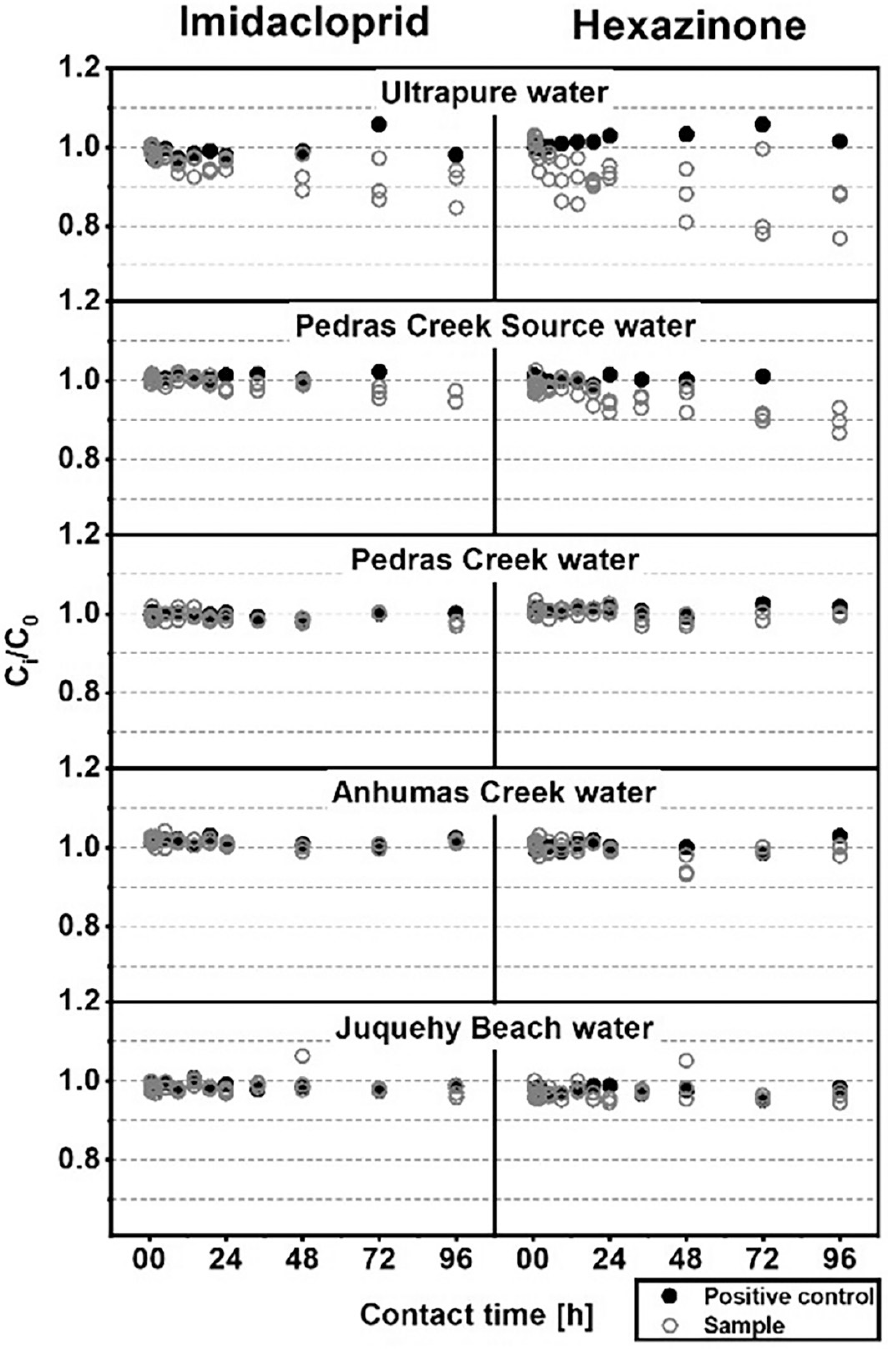
The sorption kinetics experiments were first conducted in ultrapure water to describe the interaction of imidacloprid and hexazinone onto PE MP (Figure 1). It was observed the decrease in Ci/C0 ratios as contact times increased, demonstrating the mass transfer of the pesticides from solution to the MP. The Ci/C0 ratios of the positive controls of approximately 1.0 indicate insignificant loss of analytes to the test tubes, or by degradation. The following sorption kinetics experiments were conducted in environmentally aqueous matrices (spring water, river water and sea water). The interaction was comparably less than in ultrapure water, as observed by Ci/C0 ratios closer to the positive controls, indicating that there was less mass transfer of pesticides from solution to MP for the same contact times.
Sorption kinetics of imidacloprid and hexazinone onto PE MP in different aqueous matrices. Values shown are the ratio between the concentration of analyte after the time of contact and the initial concentration (Ci/C0).
In spring water, there is still a slight sorption tendency observed for both pesticides. However, in river water, with higher total organic carbon load (Table S3, SI section), the drop in pesticide concentration in solution is no longer evident. The interaction of analytes to sorbents can be positively or negatively influenced by the presence of components from natural waters. While a few studies reported a significant increase in sorption,26,27 other studies described a reduction of interaction.19,20,28 A layer of organic matter can be rapidly adsorbed to the surface of MP and reduce the interaction with contaminants.20,29 Madeira et al.20 used density functional theory (DFT) and conformer-rotamer ensemble sampling tool (CREST) to elucidate lower contaminants sorption to PE MP in the presence of organic matter. The findings demonstrated that humic acid can quickly make CH-π interactions with the surface of PE MP, competing with other contaminants. Yao et al.29 reported a decrease in dissolved organic matter in solution after 72 h of contact with PE MP, and Raman spectroscopy of the particles surface evidenced the presence of several organic matter signals. This interpretation is further supported by the behavior of PE MP observed in the present study.
In ultrapure water, PE MP rapidly accumulated on the surface of the solution after mixing of the tube. In a humic acid solution, PE MP took longer to emerge to the air-water interface (Figure S10, SI section). The effect of ionic strength was studied by Li et al.19 They described the decrease in imidacloprid sorption to PE MP as the concentration of NaCl increased in solution. It indicates a similar trend for organic matter, where competition effects play a role in the level of interaction of the pesticide with the particle.
Li et al.19 also studied the sorption at different pH, with higher pH resulting in higher sorption. However, our tested matrices did not show this trend. Ultrapure water with the higher pH (8.4) indeed had the highest sorption capacity, but the sorption in spring water with the lowest pH (6.0) did not have the lowest sorption capacity. This does not mean that the pH does not play a role in the interaction of pesticides to PE MP, but that these interactions, in fact, depend on a combination of factors, including the pesticide functional groups and pKa, ionic strength, and the presence of organic matter. In general, these results suggest that pristine PE MP will likely have a higher sorption capacity of imidacloprid and hexazinone in less complex matrices.
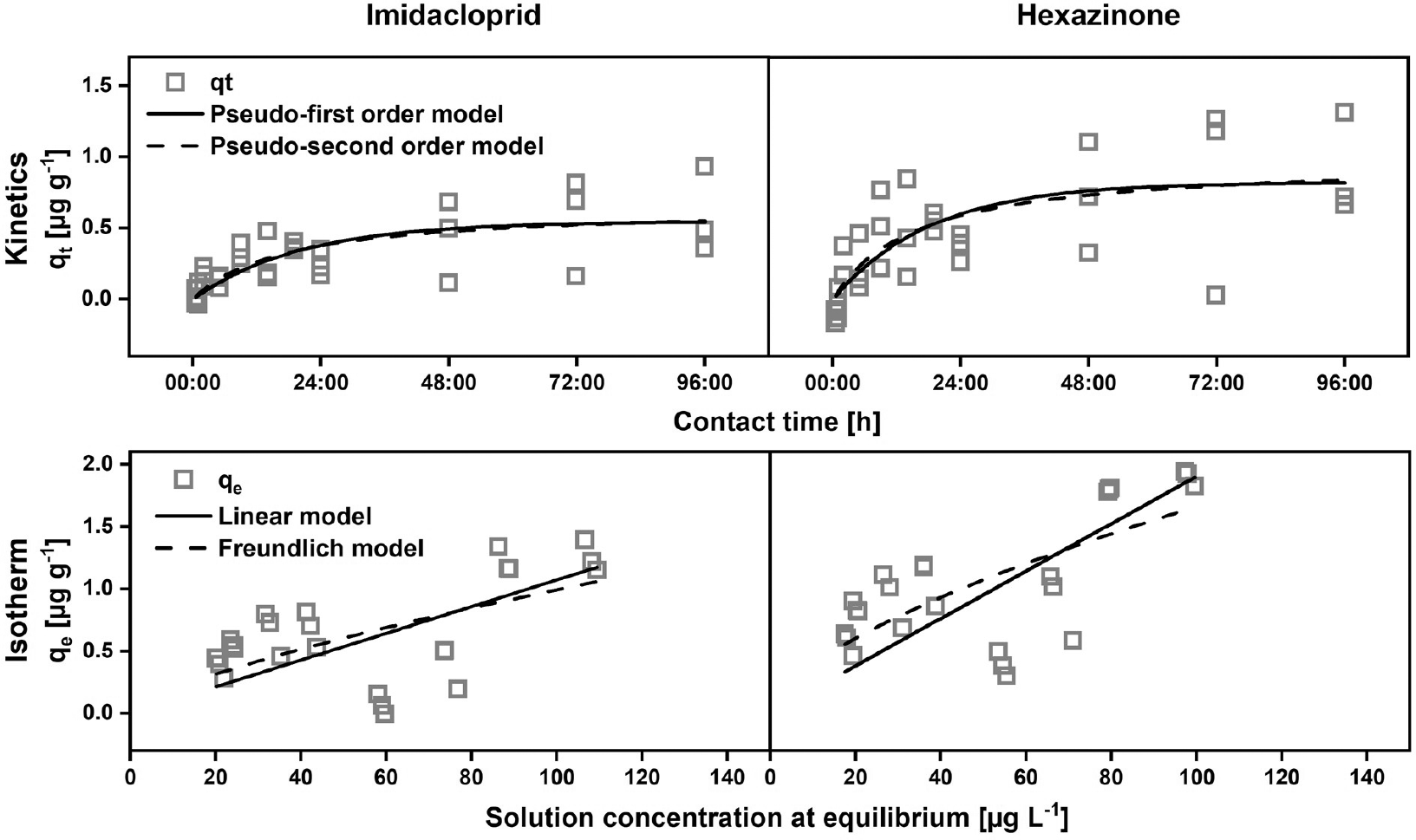
The sorption kinetics for imidacloprid and hexazinone in ultrapure water reached apparent equilibrium in 96 h (Figure 2). The highest sorption capacities observed for imidacloprid and hexazinone were 0.9 and 1.3 µg g-1. The low sorption efficiency hindered the identification of an appropriate kinetic model. Pseudo-first-order, pseudo-second-order, and Elovich models had determination coefficients of approximately 0.5. Other metrics, such as residual sum of squares (RSS), root mean square error (RMSE), and reduced chi-square (χ2) (Table S4, SI section), indicated that the Elovich model provided the best overall fit, implying a heterogeneous sorption process on a rough MP surface and a wide particle-size distribution. This sorption behavior was previously identified in printing dyes with PE MP.30 A study conducted in temperature-aged PE MP identified a much higher sorption capacity (327.75 µg g-1) for imidacloprid in ultrapure water.28 The formation of oxygen-containing groups on the surface of the particles increases the hydrophilicity and the interaction with hydrophilic compounds.
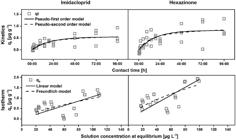
Kinetics and isotherm models of sorption of imidacloprid and hexazinone onto PE MP in ultrapure water.
The linear isotherm with intercept zero provided the best fit, with determination coefficients of 0.8 and 0.9 (Table S5, SI section). This linear model is a good approximation for low and narrow range of concentrations. It demonstrates that the ratio between the pesticide in solution and sorbed to the MP remains constant for the studied concentration range.31 The isotherm Kd values obtained for imidacloprid (0.011 L g-1) and hexazinone (0.019 L g-1) to PE MPs are low when compared to the sorption of more hydrophobic molecules (Figure S11, SI section). The point of zero charge of an ultra-high molecular weight PE MP was described as lower than 3.32 At the pH of the studied matrices, PE MP is then negatively charged, while imidacloprid and hexazinone have zero charge with imidacloprid in the zwitterion form. This hinders the potential for electrostatic interactions with hexazinone, while it enables interactions with imidacloprid. Da Silva et al.25 described by theoretical studies that Van der Waals forces are the interactions governing the interaction between imidacloprid and PE MP.
The interactions of these pesticides with natural sorbents were also evaluated to determine whether they were similarly weak. Sand was a reasonable natural sorbent for this assessment, as it is known for its low surface area and sorption capacity. The sandy soil sorption kinetics and isotherm were studied in ultrapure water. However, Ci/C0 ratios of both samples and controls were similar throughout the experiment, suggesting that the collected sandy soil has a lower sorption capacity than the PE MP.
Herein, the particle characteristics might have played a role in these differences. Optical microscopy of the particles (Figure S12, SI section) showed PE MP had a rougher surface in comparison to sand particles. The rough surface of PE MP, evidenced in SEM images (Figure S13, SI section), along with the smaller particle size (Figure S14, SI section), results in a higher surface area for interaction with the pesticides. Leiva et al.33 described Kd of 8 × 10⁻⁵ to 2 × 10⁻³ L g-1 for imidacloprid in a Florida sandy soil, which is up to 138-fold lower than the value obtained for PE MP in our study. Another study described hexazinone sorption capacities varying from 8 × 10⁻⁵ to 2 × 10⁻⁴ L g-1 in Brazilian sandy loam soils,34 which is up to 238-fold lower than the value obtained for PE in our study. Even though the comparison of sorption between studies may be difficult given different experimental conditions, this indicates PE MP sorption capacity may be higher than that of a sandy soil.
Future studies should adjust the method parameters to allow the determination of both Kd in the same experimental setup or mimic soil contamination in the experiment. For example, Wu et al.35 observed that the presence of PE (as plastic mulch film) enhanced the imidacloprid adsorption capacity of a soil.
Another study identified that the presence of 1% PE MP in a sandy soil increased the leaching rate of diuron, terbuthylazine, flufenacet, propazine, and thiacloprid, but did not have any significant effect on the retention of other 15 pesticides, including imidacloprid, in a column experiment.22 These differences between studies may be due to the divergence of contact times, particle characteristics, the solution composition, and temperature.
Dilution effect
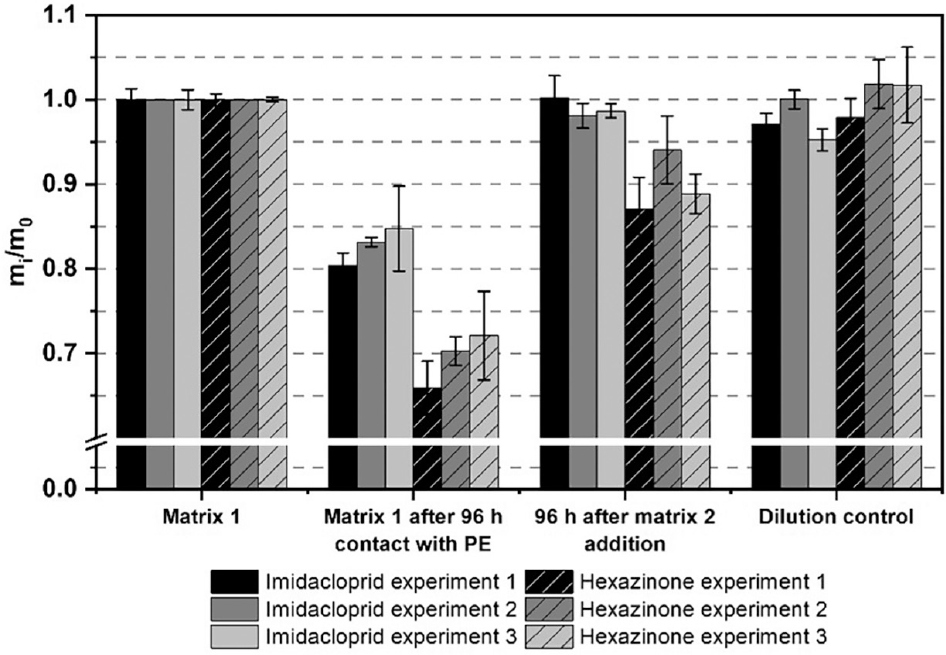
The dilution effect (Figure 3) demonstrated that the interaction of both imidacloprid and hexazinone with PE MP can be undone. Imidacloprid and hexazinone concentrations in solution initially drop due to the sorption to PE MP. After the dilution with matrix 2, the pesticides moved back to the aqueous phase. This phenomenon is most likely to happen due to the dilution of pesticides rather than to competition with organic matter or salts, considering that this effect was observed with ultrapure water as well. Although amounts transferred to and from the PE MP were low, this environmentally relevant experiment gives valuable information about the possible fate of imidacloprid and hexazinone in real-world situations. For instance, a stream of water can have changes in contaminant concentrations, or particles can be naturally (i.e., stream water flow) or artificially (i.e., in dredging) carried to new environments. The finding aligns with theoretical studies conducted by da Silva et al.25 in which they suggest the interaction between imidacloprid and PE MP governed by physisorption more than chemisorption. This demonstrates the low chemical stability of this interaction.
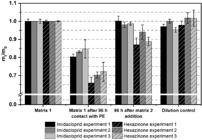
Amount of pesticide in solutions during the dilution effect experiment. Matrices 2 in experiment 1-3 were ultrapure water, river water with TOC at 14.5 mg L-1, and river water with TOC at 10.2 mg L-1, respectively.
Limitations of the study
Although this study contributed to a deeper understanding of interactions between hydrophilic pesticides and PE MP in environmentally relevant conditions, there are limitations of the study. Even though the relevance of pristine MP research is still acknowledged, especially for mechanistic studies in which controlled and reproducible conditions are required, it should be noted that in the environment, these particles are mostly aged, fouled and/or oxidized. The use of pristine MP could limit environmental applicability by possibly underestimating sorption capacity.
The liquid-to-solid ratio used in this study was chosen to enable the quantification of sorption, but it is important to note that it is higher than environmentally reported concentrations of MP contamination. It is undeniable that this study can be useful to understand the impacts of PE MP on soil and sediment. However, caution should be taken when drawing conclusions from the comparison to one sand sample. In addition, the decrease in pesticide concentrations in solution was not observed in the experiment with sand, and as a consequence, we could not obtain a value for the sorption capacity. Future experiments should use a lower liquid-to-solid ratio or even perform column studies to enable quantification of sorption.
Lastly, it is worth acknowledging that the assessment of hydrophilic pesticides with weak sorption to PE MP and low sorption efficiencies is challenging. Slight variations highly impacted the assessment of the mechanism of sorption, contributing to the difficulty of obtaining a good fit.
Moreover, because pristine PE MPs are very hydrophobic, achieving adequate mixing with the solution is challenging. This could have contributed to the variations observed between replicates.
Conclusions
As the efforts to understand the impacts of MP pollution develop, it is important to include approaches that represent environmental conditions as closely as possible. This study demonstrated that the sorption of two hydrophilic pesticides, imidacloprid and hexazinone, is impacted by the type of matrix applied in the experiment, with sorption decreasing in more complex matrices. Even with low sorption capacities to PE MP, both pesticides still have a higher affinity for the pristine polymer than for natural sorbents, indicating that sorption to MPs may alter pesticide retention in soil and sediments. The dilution effect emulates changes in contaminant concentrations that occur in the environment which could potentially aid in the prediction of the fate of these compounds in such situations.
The findings indicate that for hydrophilic compounds, partitioning into the aqueous phase is primarily governed by the physicochemical characteristics of the water body, and the magnitude of their transport requires more comprehensive investigation. The environmental risks posed by the co-occurrence of pesticides and MP in natural ecosystems extend well beyond their direct interactions, involving a complex dynamic with soils, water, and sediments.
Supplementary Information
Supplementary Information (method validation, sorbents characterization, quality controls, sample information, sorption coefficients comparison, sorption efficiency with other sorbents, kinetics and isotherm models statistics metrics) is available free of charge at http://jbcs.sbq.org.br, as PDF file.
Supplementary PDF
Acknowledgments
The authors thank LIMicro (RRID:SCR_024633), LIFQ (RRID:SCR_027389), and LISpec (RRID:SCR_027391) from CEMUIQ-UNICAMP for technical support, and Dr Giovani Archanjo+ Brotto for his availability. This study was financed in part by the CAPES (Brazil), Finance Code 001, process No. 88887.667971/2022-00. The authors are also thankful to INCTAA (CNPq grant 465768/2014-8, and FAPESP grant 2014/50951-4) and FAPESP (grants 2021/12484-9, 2022/12104-4, 2024/11107-5, and 2024/02189-8).
Data Availability Statement
The data supporting the findings of this study are available within the article and its Supplementary Information section.
References
-
1 Gavrilescu, M.; Eng. Life Sci. 2005, 5, 497. [Crossref]
» Crossref -
2 Pathak, V. M.; Verma, V. K.; Rawat, B. S.; Kaur, B.; Babu, N.; Sharma, A.; Dewali, S.; Yadav, M.; Kumari, R.; Singh, S.; Mohapatra, A.; Pandey, V.; Rana, N.; Cunill, J. M.; Front. Microbiol. 2022, 13, 962619. [Crossref]
» Crossref -
3 Suchail, S.; Guez, D.; Belzunces, L. P.; Environ. Toxicol. Chem. 2000, 19, 1901. [Crossref]
» Crossref -
4 Madeira, C. L.; Acayaba, R. D.; Santos, V. S.; Villa, J. E. L.; Jacinto-Hernández, C.; Azevedo, J. A. T.; Elias, V. O.; Montagner, C. C.; Chemosphere 2023, 341, 139954. [Crossref]
» Crossref -
5 Santos, V. S.; Vidal, C.; Bisinoti, M. C.; Moreira, A. B.; Montagner, C. C.; Sci. Total Environ. 2024, 932, 173025. [Crossref]
» Crossref -
6 Kandie, F. J.; Krauss, M.; Beckers, L.-M.; Massei, R.; Fillinger, U.; Becker, J.; Liess, M.; Torto, B.; Brack, W.; Sci. Total Environ. 2020, 714, 136748. [Crossref]
» Crossref -
7 Stefano, P. H. P.; Roisenberg, A.; Santos, M. R.; Dias, M. A.; Montagner, C. C.; Chemosphere 2022, 299, 134395. [Crossref]
» Crossref -
8 Peterson, H.; Aquat. Toxicol. 1997, 39, 111. [Crossref]
» Crossref -
9 Concha-Graña, E.; Moscoso-Pérez, C. M.; López-Mahía, P.; Muniategui-Lorenzo, S.; Sci. Total Environ. 2022, 848, 157703. [Crossref]
» Crossref -
10 Cui, N.; Wang, P.; Xu, N.; Environ. Technol. 2023, 44, 3937. [Crossref]
» Crossref -
11 Wang, T.; Yu, C.; Chu, Q.; Wang, F.; Lan, T.; Wang, J.; Chemosphere 2020, 244, 125491. [Crossref]
» Crossref -
12 Hüffer, T.; Metzelder, F.; Sigmund, G.; Slawek, S.; Schmidt, T. C.; Hofmann, T.; Sci. Total Environ. 2019, 657, 242. [Crossref]
» Crossref -
13 International Organization for Standardization (ISO); ISO 24187:2023 Principles for the Analysis of Microplastics Present in the Environment; ISO: Geneva, Switzerland, 2023. [Link] accessed in June 2026
» Link -
14 Fernandes, A.; Bertoldi, C.; Lara, L.; Stival, J.; Alves, N.; Cabrera, P.; Grassi, M.; J. Braz. Chem. Soc. 2022, 33, 303. [Crossref]
» Crossref -
15 Yang, L.; Zhang, Y.; Kang, S.; Wang, Z.; Wu, C.; Sci. Total Environ. 2021, 754, 141948. [Crossref]
» Crossref -
16 Wang, F.; Gao, J.; Zhai, W.; Liu, D.; Zhou, Z.; Wang, P.; J. Hazard. Mater. 2020, 394, 122517. [Crossref]
» Crossref -
17 Gong, W.; Jiang, M.; Han, P.; Liang, G.; Zhang, T.; Liu, G.; Environ. Pollut. 2019, 254, 112927. [Crossref]
» Crossref -
18 Bakir, A.; Rowland, S. J.; Thompson, R. C.; Mar. Pollut. Bull. 2012, 64, 2782. [Crossref]
» Crossref -
19 Li, H.; Wang, F.; Li, J.; Deng, S.; Zhang, S.; Chemosphere 2021, 264, 128556. [Crossref]
» Crossref -
20 Madeira, C. L.; Cho, J.; Boisseau Gomez, R. D.; Montagner, C. C.; ACS EST Water 2025, 5, 3710. [Crossref]
» Crossref -
21 Dias, M. A.; Batista, P. R.; Ducati, L. C.; Montagner, C. C.; Chemosphere 2023, 318, 137949. [Crossref]
» Crossref -
22 Wu, S.; Böhme, A.; Ulrich, N.; Chen, Z.; Schäffer, A.; Jahnke, A.; J. Hazard. Mater. 2025, 494, 138511. [Crossref]
» Crossref -
23 Fatema, M.; Farenhorst, A.; J. Soils Sediments 2022, 22, 1876. [Crossref]
» Crossref - 24 OriginLab Corporation; OriginPro, version 2026; OriginLab Corporation, Northampton, MA, United States, 2026.
-
25 Da Silva, L. P.; De Oliveira, C. L. C. G.; Correia, A. N.; De Lima Neto, P.; Monteiro, N. K. V.; ACS Omega 2025, 10, 18029. [Crossref]
» Crossref -
26 Morishita, K. N.; Lee, H.; Han, C.; Niu, X.-Z.; ACS EST Water 2025, 5, 1344. [Crossref]
» Crossref -
27 Kothawala, D. N.; Köhler, S. J.; Östlund, A.; Wiberg, K.; Ahrens, L.; Water Res. 2017, 121, 320. [Crossref]
» Crossref -
28 Wu, H.; Yuan, Q.; Chen, B.; Kong, Q.; Huang, S.; Cheng, L.; Wang, S.; Lian, J.; Desalin. Water Treat. 2025, 321, 100931. [Crossref]
» Crossref -
29 Yao, S.; Li, X.; Wang, T.; Jiang, X.; Song, Y.; Arp, H. P. H.; Environ. Sci. Technol. 2023, 57, 8139. [Crossref]
» Crossref -
30 Tubić, A.; Vujić, M.; Gvoić, V.; Agbaba, J.; Vasiljević, S.; Cveticanin, L.; Vukelić, Ð.; Prica, M.; Dyes Pigm. 2023, 209, 110884. [Crossref]
» Crossref -
31 Limousin, G.; Gaudet, J.-P.; Charlet, L.; Szenknect, S.; Barthès, V.; Krimissa, M.; Appl. Geochem. 2007, 22, 249. [Crossref]
» Crossref -
32 McDougall, L.; Thomson, L.; Brand, S.; Wagstaff, T. A.; Lawton, L. A.; Petrie, B.; Sci. Total Environ. 2022, 808, 152071. [Crossref]
» Crossref -
33 Leiva, J. A.; Nkedi-Kizza, P.; Morgan, K. T.; Qureshi, J. A.; J. Agric. Food Chem. 2015, 63, 4915. [Crossref]
» Crossref -
34 Chitolina, G. M.; Mendes, K. F.; Almeida, C. S.; Alonso, F. G.; Junqueira, L. V.; Tornisielo, V. L.; Planta Daninha 2020, 38, e020217734. [Crossref]
» Crossref -
35 Wu, C.; Pan, S.; Shan, Y.; Ma, Y.; Wang, D.; Song, X.; Hu, H.; Ren, X.; Ma, X.; Cui, J.; Ma, Y.; Environ. Res. 2022, 214, 114133. [Crossref]
» Crossref
Edited by
-
Editor handled this article:
Josué Carinhanha Caldas Santos (Associate)