
 Selection of Routing Metrics and Service Channel Characteristics of ad hoc Network for UAV swarm
ABSTRACT
This paper introduces a new method for synthesizing guidance laws for anti-tank guided missiles (ATGM) to intercept maneuvering tank targets. It utilizes a nonlinear relative model in the two-dimensional horizontal plane and optimal error dynamics (OED) theory. The nonlinear relative model simplifies the problem of targeting a moving target into attacking a stationary target, making the guidance law synthesis task easier. The selection of OED allows for the design of a guidance command that ensures the zero effort miss (ZEM) error decreases to zero within a finite time, ensuring successful target interception. The paper also introduces an exponential decay weighting function of remaining time-to-go to optimize the distribution of command accelerations throughout the guidance process, thereby reducing initial command requirements and converging acceleration commands towards zero at the end time. The synthesized guidance laws are derived based on the nonlinear relative model and OED without making any small-angle linearization assumptions, allowing them to address various nonlinear scenarios. Numerical simulations illustrate the proposed guidance law’s performance.
Keywords
Anti-tank guided missile; Guidance law; Optimal error dynamics; Nonlinear relative model
INTRODUCTION
Unmanned aerial vehicles (UAV) have found widespread use in the civilian sector, from light displays to monitoring industrial facilities and conducting search and rescue operations (Arkin 2015; Kostin and Bogatov 2019; Sivakumar and Tyj 2021). In the last decade, swarm technologies have been actively developed: combining UAV into groups (“swarm”) to perform a common operational task, for example, monitoring the condition of critical infrastructure facilities. A UAV swarm is an ad hoc network that supports a dynamically changing network configuration (Phadke and Medrano 2022; Ragab et al. 2021). In the scientific and technical literature, such networks are called flying ad hoc network (FANET) (Bekmezci et al. 2013; Elfaham et al. 2016; Sahingoz 2014), so, in the future we will use this abbreviation in relation to UAV swarm communication network. Table 1 shows a comparative evaluation of FANET with similar self-organizing networks with other mobile subscribers: mobile ad hoc network (MANET) and vehicular ad hoc network (VANET) (Tareque et al. 2015).
There are various approaches to solving the problem of constructing FANET, for example, networks of UAV (Bok and Tuchelmann 2011), distributed aerial sensor networks (Rohde et al. 2010), UAV ad hoc networks (Cai et al. 2013), unmanned aeronautical ad hoc networks (Shirani et al. 2012), and others (Sahingoz 2013). One of the current challenges of swarm technology is the development of routing protocols that quickly adapt to frequent and unpredictable changes in the network topology. The success of solving this problem largely depends on the choice of a set of routing metrics: parameters on the basis of which the route is selected. In relation to radio networks, in addition to the main metric (signal power), and others ones are also used: channel load, noise level, and others (Borges et al. 2009; Campista et al. 2008; Elshaikh et al. 2012; Wang et al. 2021).
There is a large number of publications in the scientific and technical literature devoted to the development of routing protocols in self-organizing networks; a detailed review of which is given in Leonov (2017). Recently, many new approaches to solving these problems have appeared. For example, in Madridano et al. (2020), the issues of adapting UAV swarm to changes in environmental conditions or technical malfunctions of individual members of the swarm are considered. The work of Li et al. (2019) describes a method for planning the route of a swarm of UAV with implementation on the robot operating system (ROS) platform. Issues of planning UAV routes using the Deep-Sarsa algorithm, built on the basis of a neural network and allowing building a route avoiding obstacles, are considered in Luo et al. (2018), Małecki et al. (2021), and Wu et al. 2022). In Kaur et al. (2021), a modification of the well-known firefly algorithm (Yang 2010) is proposed, aimed at reducing the number of transitions between FANET network nodes based on the Gauss Markov mobility model. Issues of optimizing UAV swarm routes based on the genetic algorithm and its modifications are discussed in Haghighi et al. (2020). A large number of publications in the scientific and technical literature are devoted to the problems of using artificial intelligence to control the routing of a swarm of UAV; a detailed review of which is given in Puente-Castro et al. (2022).
The list of publications on this topic is not limited to these works; due to the limited scope of the article, the authors did not set themselves the task of reviewing new approaches to organizing routing in FANET. However, despite their diversity, these protocols typically use various variations of the algorithm for finding the shortest route distance with reference to the network topology and location of network nodes. The class of such algorithms includes the following (Jacquet et al. 2001; Ogier et al. 2004; Perkins and Belding 1999; Rathi and Singh 2015; Razgulyaev 2008):
-
Distance vector algorithm, in which each node has complete information about the network topology but collects routing information only from neighboring (adjacent) nodes;
-
Link state routing algorithm, in which periodic distribution of information about the state of connections with neighboring nodes is carried out;
-
Source-based routing algorithm, in which the choice of route is determined by the sending node, while the packet contains the full route to the recipient node.
Despite the large number of publications on assessing the effectiveness of various routing protocols, the issues of analyzing the behavior of FANET in conditions of non-stationarity that arise when the network structure changes remain practically unexplored. Considering the fact that in FANET the movement of UAV relative to each other occurs with high intensity (which is confirmed by the data in the table above), solving this problem is an urgent scientific and technical problem. This work, which is a development of the article by Borodin et al. (2017), is devoted to studying the behavior of FANET in stationary and transient modes and assessing the influence of routing metrics (nodal and channel), characteristics of the service channel, traffic intensity, and energy parameters of communication channels on the efficiency of its functioning.
The relevance of the task of choosing routing metrics and options for organizing a service channel is due to the fact that:
-
Routing metrics are indicators that can be measured and on the basis of which an optimal route can be built (indicators of route optimality can be different parameters: network delay, number of hops, route cost, etc.);
-
Distribution of routing information, on the basis of which the route for transmitting information from the source to the recipient is built, is carried out via a service channel; therefore the efficiency of updating routing information in network nodes largely depends on the choice of the option for organizing the service channel.
The study of the influence of the type of routing metrics on network characteristics (primarily network delay) in conditions of non-stationary network behavior during the restructuring of the network structure is of great scientific and practical interest. As noted above, the scientific and technical literature has quite fully studied the behavior of FANET with dynamic routing a stationary mode, for example, Borodin et al. (2024). However, the authors are not aware of any publications that have studied the transient mode of operation of FANET when the network topology changes (the number of UAV and/or their relative position), which determines the relevance and novelty of the results obtained in this article.
The research was carried out within the framework of a grant from the Russian Science Foundation for the development of control models in heterogeneous networks, and the proposed approach is applicable to almost any mobile subscriber. The choice of UAV as a mobile subscriber is due to the fact that they are widely used in traditional areas such as logistics, environmental and industrial monitoring, search and rescue operations, etc. (Arkin 2015; Kostin and Bogatov 2019; Sivakumar and Tyj 2021). In addition, UAV have recently found applications in completely new areas: monitoring crop diseases, landslides, mountain ranges, etc. (Ahmadi et al. 2022; Yun 2023). At the same time, the introduction of ground, surface, and underwater unmanned vehicles is progressing at a high pace. The authors believe that their proposed approach, with minimal changes, can be adapted to assess the efficiency of routing for these mobile subscribers, taking into account the characteristics of radio wave propagation, the presence of opaque and partially transparent screens, the use of other multiple access methods, etc. In addition, according to the authors, the results obtained can be used to organize dynamic flow control in an integrated communication network with UAV (Chechin et al. 2023).
The material is presented in the following sequence:
-
Theoretical basis, which provides the main calculated relations;
-
Methodology, which describes the FANET network structure model, organization of the routing process in it, and service channel model;
-
Results, in which there are modeling results, influence of metrics, options for organizing the service channel, and energy of communication channels on the characteristics of a network with dynamic routing is assessed;
-
Discussion, in which a mechanism for combined transmission of metrics data in information packages is proposed and analyzed.
THEORETICAL BASIS
As a telecommunications network that supports communication between UAV in a group, we will consider a radio network with packet switching and random access using the slotted ALOHA protocol (Abramson 1970; Black 1987; Roberts 1975). To assess the efficiency of such a network, we will use the average time it takes to transmit a packet over the network from outgoing node A to incoming node B. We will also assume that communication between nodes is carried out via a two-channel radio link, which contains:
-
Information channel designed to transmit target information;
-
Service channel intended for sending routing information about the state of nodes (node metrics) or about the state of communication channels between nodes (channel metrics).
As an information channel, we will consider a half-duplex channel with time multiplexing and random access using the slotted ALOHA protocol. Networks with random access are characterized by the appearance of collisions of simultaneously transmitted packets, and a handshake mechanism is used to control the network when a collision occurs. In this case, the channel is divided into a sequence of slots, the duration of which is sufficient to transmit one information packet and transmit a positive response receipt from the destination node. If a receipt is not received, the sending node decides that a collision has occurred and retransmits the packet.
To calculate the probability of packet distortion due to mutual overlaps, we will use the following model. Let each node radiate a signal isotropically, meaning it has an antenna with a spherical radiation pattern and the signal is radiated equally in all directions, at wavelength λ, and the radiation power is equal to Рrec. Then, at a distance r from the node, the signal power will be equal to (Pestryakov and Kuzenkov 1985):
The input of the receiver of node B receives a useful signal from node А (transmitting packets for node B), as well as signals from other nodes that interfere with the useful signal. We will also assume that additional noise of power Рns is received at the input of the receiver of node B.
The total interference power at the input of the receiver of node B is equal to:
where Рsк and hк are, respectively, the signal power from the K-th node and the signal-to-noise ratio at the point under consideration, while the summation occurs over all nodes transmitting their packets simultaneously with node A.
Let rs be the radius of the service area of an arbitrary node. Let us denote by hs the signal-to-noise ratio at the boundary of the node’s service area.
Then, Eq. 1 can be written in the following form:
where Рсs is the signal power at the border of the service area.
Substituting Eq. 2 into Eq. 3 we get:
Thus, the signal-to-interference ratio for receiving node B is:
The last expression uses the following notation: hB is the signal/noise ratio (potential) at the considered point in space (at the input of the receiver of node B), rАB is distance from node A to the considered point in space (node B), and rKB is the distance from the transmitting node to the considered point in space (node B).
The found potential value can be used to determine the probability of packet collision under the condition of simultaneous emission of several nodes. Particularly with optimal signal reception with an active pause and known parameters, the probability of bit distortion is equal to (Pestryakov and Kuzenkov 1985):
where
We will consider the bit distortions in the packet to be independent, and we will assume that code error correction methods are not used. Then the probability Qpack of distortion of a packet containing L bits will be equal to:
Thus, the mutual overlap of several packets due to their simultaneous transmission by different sources leads to distortion of the received packet with probability Qpack<1. In traditional random access models, it is assumed that when packets overlap, distortion occurs with probability one. Taking into account the parameters of the radio channel, the location of sources, and recipients of information packets allows for a more accurate determination of the characteristics of the network. This result will be used further when modeling routing processes to calculate the probability of packet distortion at the boundary of the node’s adjacency region.
METHODOLOGY
Due to the fact that an analytical study of the characteristics of FANET is not possible, and the use of well-known modeling packages (GPSS, OPNET, NS2, and others) does not fully account for its features, the authors improved the simulation model for sensor networks (Borodin et al. 2023), taking into account the speed of movement of subscribers, their number and location in space, energy of channels, intensity of network traffic, routing algorithms, and a number of other parameters (options for organizing a service channel and distributing metric information).
One of the important points when developing a FANET simulation model is the choice of a mobility model that describes the movement of mobile subscribers and how their location changes over time. The UAV swarm simulation model was based on a mobility model based on random walk (Chiang and Shenoy 2004; Zhang et al. 2015). This model is characterized by such parameters such as random walk, random waypoint, and random direction. In other words, the mobile node moves from its current location to a new location, randomly choosing a direction. Random walk is a memory-less mobility pattern, which in some cases leads to unrealistic movements, such as sharp turns. Therefore, when developing the UAV swarm model, the principle of collision avoidance, first proposed by Craig William Reynolds (1987), was additionally used.
The following basic assumptions were used in the modeling:
-
Communication between UAV is carried out using a radio network with packet switching and random access using the slotted ALOHA protocol;
-
All UAV have a limited power transmitter, so the service radius (the maximum distance at which data exchange between UAV is possible) is also limited;
-
Routing is carried out by each UAV based on the routing information contained in its local adjacency matrix (AM);
-
Local matrices are updated using information transmitted from neighboring UAV via the service data channel;
-
Route selection is based on routing metrics;
-
Routing matrices are updated dynamically when the network topology changes;
-
The speed of movement of UAV was chosen in such a way that the time between adjacent moments of change in the network topology was greater than the time for updating the adjacency matrices.
Below is a brief description of this model, as well as the routing algorithm and the service channel model.
Network structure model
The process of modeling the network structure is carried out as follows:
-
The area where nodes are located (square, cube, etc.) of the unit area (volume) is determined;
-
Then the coordinates of each node are randomly formed within the location area.
To determine routes, we introduce the concept of an adjacency area (service area). The adjacency region of node A contains those nodes for which the probability of distortion of a packet transmitted by node A does not exceed a specified value. We will call nodes located in the service area of a node adjacent to this node. In a route, neighboring nodes are always adjacent.
When modeling the movement of nodes, the coordinates of each node receive small random increments. The degree of similarity between the original and displaced network topologies is the relative number of changed links between nodes.
The network structure model is represented as a square AM (Liu et al. 2008) with the dimension NxN, where N is the number of nodes in the network. Element M(k,m) of this matrix is a multicomponent quantity and determines, particularly, the adjacency of nodes m and k, the distance between nodes, coordinates of nodes, value of the node metric, and communication channel between nodes. Each node contains its own local AM, the elements of which reflect the amount of information available to a particular node. Routing is performed by each node using its own local AM, which gradually updates its contents as metric information is transmitted.
Organization of the routing process
Routing is carried out based on the routing information received by each node from neighboring nodes via the service data channel. The routing task is to determine the sequences of relay nodes for packet transmission and select the optimal sequence.
When forming a packet, node A, which is the source of information, writes into the packet the number of node B, which is the recipient of the information. Next, before transmitting the packet, node A, using its local AM, determines the list of shortest (i.e., containing the minimum number of relay nodes) routes to node B and for each route determines the value of its metric. After this, the route whose metric has an extreme (usually minimum) value is selected. If there are several routes with the same metrics, then one route is selected randomly. The address of transit node C (the first node of the selected route), to which this packet is sent, is written into the packet. After receiving the packet, node C compares the end node address and its own address:
-
If the node that received the packet is transit (i.e., the addresses do not match), then the packet is queued and awaits transmission, then the routing process is repeated;
-
If the addresses match, this means that node C is the final node of the route (node B) of this packet, so, node C removes the packet from the network.
Next, the following nodal metrics characterizing the state of the node are analyzed:
-
“queue”: total length of the queue of nodes included in the selected route;
-
“load”: total load of nodes included in the route;
-
“number of repetitions”: total number of repeated transmissions of packets by nodes included in the route;
-
“distortion probability”: probability of packet distortion along the route;
-
“queue1”: queue length of the first network node along the route (node C);
-
“load1”: load of the first network node along the route (node C);
-
“number of repetitions1”: number of repeated transmissions of the first network node along the route (node C);
-
“random selection”: random number of the relay node (node C).
Service channel model
We consider the following two options for organizing a service channel through which metric information about the state of nodes and the state of channels is sent.
In the first option, the exchange of such routing information is carried out by nodes over a dedicated (for example, frequency) service channel, which is allocated a certain share of Dsl from the total channel capacity. This exchange is carried out simultaneously with the transmission of information packets. For example, if the channel capacity is C, then the service channel capacity is CDsl, and the information channel capacity is С(1-Dsl). As shown by experiments with a simulation model, for a wide range of network parameters, the optimal value of Dsl is approximately 5%.
In the second option, the entire channel capacity is allocated for the transmission of routing information, but at the same time, the transmission of information packets is periodically interrupted for a time interval Тob, during which the routing information is updated. The repetition period is chosen equal to Тpb = Тob/Dsl.
Distribution of metric information about the state of nodes is carried out in a cyclic mode sequentially by all network nodes. In the first option, such distribution is carried out in parallel with the transmission of information packets; in the second option, it occurs only in designated time intervals.
Let the sequence {А1, А2, А3, … , АN} determine the order in accordance with which nodes Ai transmit metric information, while at the initial moment t0 of the network operation, each node has only information about its own state. At time t0 of the first routing information update cycle, node А1 transmits the current metric state to all adjacent nodes. Then, at subsequent moments of time (cycles) of the first cycle t1 , t2 , …, tN-1 the corresponding nodes (A2, A3,…AN) transmit to all adjacent nodes information about their own state and information about the state received at the time of transmission from other nodes. In the second and subsequent cycles, each node transmits only information from the nodes that arrived during the time between the current and previous transmission. Each node transmits state data to new nodes.
The algorithm for sending metric information about the state of channels between nodes, as well as sending information about the network structure, has much in common with the previous algorithm and is as follows. In the first cycle, each node A generates a reference signal, which arrives at the corresponding clocks to all available nodes B. We assume that the received signal can be used to estimate the characteristics of the corresponding communication channel between nodes A and B (for example, the distance between nodes). Thus, each node accumulates information about the characteristics of the channels connecting it to other nodes. This information is transmitted to other nodes in the next transmission cycle for this node. To reduce the amount of transmitted information in clock cycles in the following cycles, each node transmits only the information that was received during the time between the current and previous transmission.
RESULTS
Service channel modeling results
When carrying out the modeling, the following parameters were used as characteristics of the service channel:
-
Share of Dsl from the total packet transmission rate (channel capacity);
-
Time tр for sending metrics to all network nodes.
Preliminary studies have shown that for a wide range of changes in the initial data, the optimal value of Dsl ≈ 5%. Therefore, this Dsl value was used in further modeling.
During the modeling, it was assumed that the metric is encoded in one byte, and the transmission of metric information is carried out in standard IP packets with a service part size of 28 bytes. It was also accepted that when transmitting routing information, the volume of the packet is equal to the volume of the information packet.
Because the main results of modeling the service channel are presented in a fairly complete form in Borodin et al. (2015), this article presents only the main conclusions from the experimental results. One of these important results is the fact that the amount of information transmitted (and therefore the time of distribution) about the state:
-
All nodes (channel metrics) are proportional to the square of the number of nodes in the network;
-
Channels (channel metrics) are proportional to the cube of the number of nodes in the network.
For practically important cases (for example, when the number of nodes is several dozen or more), the transmission time of channel metrics is several tens or hundreds of windows (slots). This means that distribution can only be carried out if the entire information channel is provided, i.e., when using the second option for organizing a service channel.
Thus, the organization of the service channel significantly depends on the choice of metrics used. The transmission of routing information simultaneously with the transmission of information packets is advisable when its volumes are relatively small, for example, when sending node tags. If there is a large amount of routing information, it is necessary to use interruption in the transmission of information packets.
In radio networks, routing is primarily based on calculating the energy of communication channels between nodes, so, it is necessary to at least have information about the distance between nodes or their coordinates. Distribution of coordinates can be performed simultaneously with the distribution of other nodal metrics and takes relatively little time.
If the nodes do not have technical means that allow them to determine their coordinates, then it is necessary to send out the channel parameters, namely the distances between the nodes. In this case, the volume of routing information increases N times and to distribute it, it is necessary to forcibly interrupt the transmission of information packets for the time required to distribute the corresponding information.
Assessing the influence of metrics and energy of communication channels on the characteristics of a network with dynamic routing
Before moving on to the modeling results, we introduce the following notation that will be used in the text and graphics:
-
Тс is the average time of packet transmission over the network from source to recipient, normalized by slot duration;
-
q is the probability of packet distortion at the boundary of the node’s adjacency region (distortion only from noise is taken into account without considering collisions from other nodes);
-
G is the total traffic of all network nodes: the average number of packets transmitted per slot (window);
-
N is the number of network nodes;
-
h is the value of the channel potential (signal-to-noise ratio) at the boundary of the area located from the most distant node;
-
Dn is the degree of difference between the original and shifted network structures (relative number of changed channels between nodes);
-
t is the network operating time (modeling time), normalized to the slot duration.
Since the efficiency of information exchange in FANET is one of the main characteristics, when carrying out modeling, the greatest interest is in studying the influence of metrics and energy of communication channels on the time of packet transmission over the network. As noted above, this work considers two classes of metrics: node metrics, containing information about the state of network nodes, and channel metrics, containing information about the state of channels between network nodes.
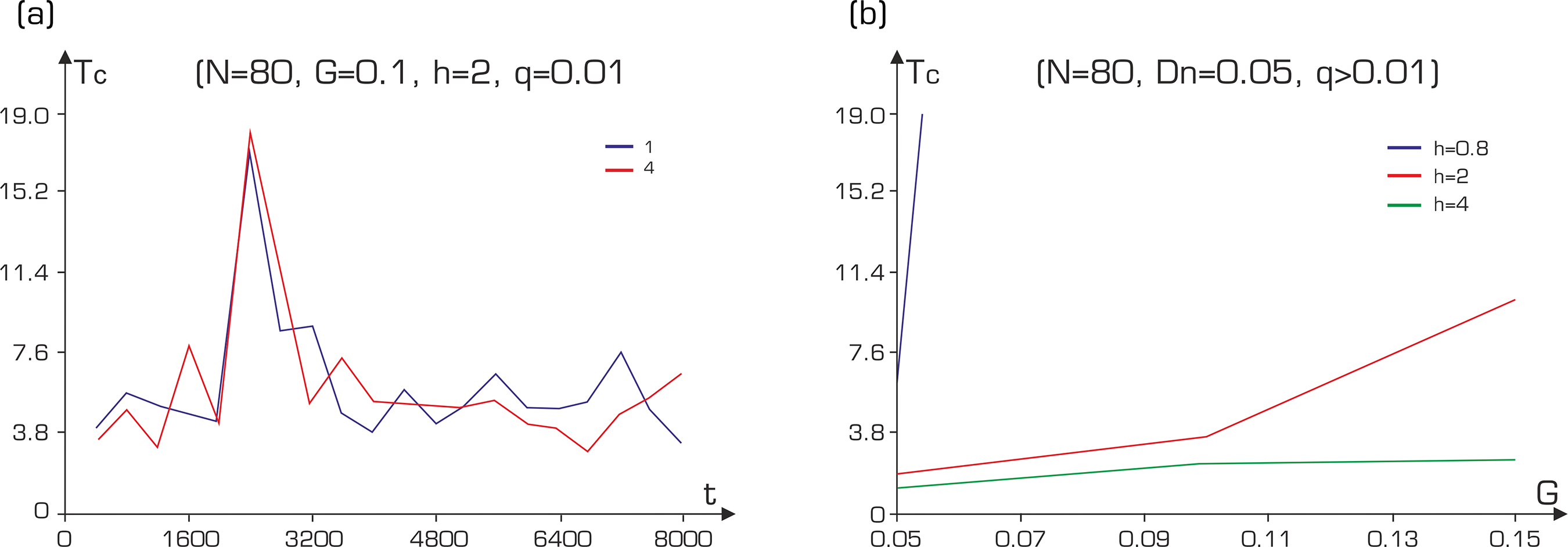
In Figs. 1–3, there are the dependences of the average time of packet transmission over the network for the case of sending nodal metrics for the following parameter values specified in the technical specifications of the grant: N = 80; G = 0.1;q = 0.003-0.1; h = 0.8-4.

Dependence of normalized network transmission time on the type of routing metric: (a) channels with low energy; (b) channels with high energy.

Dependence of the normalized network transmission time on the operating time for various types of metrics: (a) channels with low energy; (b) channels with high energy.

In Fig. 1, there are graphs of the dependence of Tc on the channel energy for various metrics, where the following notations are adopted: 0 – “queue”; 1 – “queue1”; 2 – “loading”; 3 – “loading1”; 4 – “random selection”; and 5 – “probability of distortion”. As it follows from the given dependencies, with increasing channel energy (increasing h), the time for transmitting packets over the network decreases. This also reduces the degree of dependence of network efficiency on the type of routing metric. For channels with low energy (Fig. 1a), the difference between the maximum and minimum transmission time is 150-200%, and with higher energy (Fig. 1b) it is about 20%.
The effectiveness of most of the presented metrics significantly depends on the channel parameters. If we combine the modeling results, it turns out that for a wide range of changes in channel characteristics, subject to the above restrictions, the optimal metric is “queue1” (the length of the queue in the first network node along the route). With other sets of initial data, this metric often turned out to be the best.
To clarify the nature of the impact of metrics on network efficiency, the dependences of operating efficiency on time were determined. In Fig. 2 there is the dependence of the packet transmission time over the network depending on the operating time, while the operating interval from approximately 1,000 (t = 1,000) to 8,000 slots (t = 8,000) was selected for analysis. At the same time, two modes of transmitting information about the network structure are considered: the interruption mode (Fig. 2a) and the continuous mode, in which the transmission of service information is carried out simultaneously with the transmission of information packets (Fig. 2b). The gradation of the graphs is explained by statistical errors in the tests.
From the graphs shown in Fig. 2a, it follows that at the moment the structure changes, the network moves from a stationary state to a non-stationary one. While in this state, information about the new network structure is exchanged between nodes and the packets that have accumulated during this time are dissolved. Then the network returns to a stationary state.
With the accepted initial data, the influence of the metric on the average time of packet transmission over the network in stationary sections is insignificant, while the difference in metrics mainly manifests itself in the section where the network structure changes.
If the transmission of routing information occurs over a dedicated service channel in parallel with the transmission of information packets, then transient processes caused by the restructuring of the network structure are less noticeable (Fig. 2b).
As the potential of radio channels decreases, the efficiency of the network also decreases; in particular, the time of packet transmission increases. This conclusion is illustrated in Fig. 3, which shows the dependence of Tc on the energy potential for various values of probability q for the “queue1” metric.
The parameters of the radio channel affect the transmission time only at relatively low values of the potential and probability of packet distortion at the boundary of the adjacency region. As the signal-to-noise ratio increases, this dependence decreases and at a certain value (for the examples under consideration at h > 2), it practically disappears. The obtained result can be explained by the occurrence of additional traffic, which loads the network and leads to a deterioration in its performance. If we increase the potential or expand the area of contiguity of nodes (increasing the probability q), then the number of relays will decrease, and in the limit, we will obtain a network in which all nodes are adjacent. In such a network, there is no additional traffic, as a result of which its characteristics reach the maximum possible value.
Let us now consider the behavior of the network when transmitting channel metrics when the routing information contains parameters of communication channels between nodes. As it was noted earlier, a similar situation arises if each node can only determine the distance to other nodes.
In Fig. 4, there are typical dependences of the average delay time of packets in the network on the operating time for various types of metrics.

From the modeling results, it follows that the network characteristics when transmitting channel metrics do not differ qualitatively from the option of transmitting nodal metrics (Fig. 2). In stationary sections, when the network structure does not change (t < 1,600, t > 4,500), the influence of metrics on its characteristics is practically absent. Their influence on the packet transmission time is manifested mainly in non-stationary operating mode when restructuring the network structure (1,600 < t < 4,500).
DISCUSSION
Analysis of the results shows that the sharp decrease in the efficiency of FANET operation is mainly caused by long-term (hundreds or more slots) interruptions in its operation. To eliminate the interruption, the authors propose one of the possible solutions to this problem: a mechanism for combined transmission of metrics data, including channel metrics.
The essence of the combined transmission of metrics is that the transmission of metrics is carried out in an information package. When the network structure changes, only the addresses of adjacent nodes are recorded in AM of each node. Distribution of information about adjacent nodes is carried out in the usual way by interrupting the functioning of the network, while each node A, using its local matrix, determines the route to destination node B. If node B is adjacent, then the packet is transmitted directly to this node. If node B is not adjacent, then node A determines a route to node B, selects adjacent node C and addresses the packet to that node. Previously, metric information about node A and the communication channel between nodes A and B (or C) is recorded in it. Thus, when a packet is transmitted, all nodes that received the packet also receive information about the state of the nodes through which the packet passed and the corresponding channels. This information is recorded in each node’s local AM. The use of the mechanism of combined transmission of metrics data described above leads to the fact that in the process of transmitting information packets, the local adjacency matrices of nodes are gradually filled.
Typical characteristics of network transmission time for the combined method using additionally two different metrics (“random selection” and “queue1”) are shown in Fig. 5, from which it follows that both metrics provide almost identical network characteristics. This statement, as shown by the modeling results, is also true for other types of metrics.

Characteristics of the combined method of transmitting routing information: (a) random selection; (b) queue1.
Comparison with the results obtained earlier shows that when distributing metric information about channels, the combined transmission method is significantly more effective than the interrupt transmission method, while its characteristics are comparable to those of separate transmission of node parameters. The results obtained show that the combined method is an effective means of distributing routing information, especially with low traffic and relatively high energy levels of communication channels.
As directions for further research on the topic of the article, the authors consider it relevant to solve the following problems:
-
Analysis of FANET characteristics with other radio access protocols (CSMA/CD, CSMA/CA);
-
Assessment of the impact on the network characteristics of the speed of movement of nodes;
-
Study of network characteristics with heterogeneous traffic;
-
Influence of environmental conditions on network characteristics;
-
Influence on the characteristics of the network of external organized interference.
CONCLUSION
This paper analyzes the influence of the choice of routing metrics and the method of organizing the service channel on the efficiency of a self-organizing radio communication network of UAV swarm. The results of the studies showed that the organization of the service channel significantly depends on the choice of routing metrics used, among which the authors considered the following:
-
Nodal metrics characterizing the state of the node;
-
Channel metrics characterizing the state of communication channels between nodes.
In the case of node metrics, the volume of transmitted information (and, accordingly, time of their distribution) is proportional to the square of the number of nodes in the network, and, in the case of channel metrics, it is proportional to the cube of the number of nodes in the network. Thus, the smallest amount of sent routing information corresponds to the case of nodal metrics. However, in a number of cases, it is necessary to transmit channel metrics along with the state of the nodes, which leads to a significant increase in the volume of transmitted information.
The option for organizing a service channel depends on the volume of transmitted routing information. When the volume is small (for example, when transmitting nodal metrics), a dedicated channel can be used through which routing information is sent simultaneously with the transmission of information packets. If the volume of data is large (for example, when transmitting channel metrics), it is necessary to interrupt the transmission of information packets while routing information is being sent.
It is shown that the influence of routing metrics is most critical in conditions of non-stationary network behavior, particularly during the restructuring of the network structure. In stationary sections, there is a weak dependence of the network’s efficiency on the type of metrics.
To increase the efficiency of the network when transmitting channel metrics, the authors proposed a variant of the combined mode, in which the transmission of metrics is carried out in an information packet. As the results of simulation modeling have shown, the combined method provides high efficiency over a wide range of changes in traffic and channel energy.
ACKNOWLEDGEMENTS
Not applicable.
-
FUNDING
Russian Science FoundationGrant No: 23-69-10084
-
Peer Review History: Single Blind Peer Review.
DATA AVAILABILITY STATEMENT
All data sets were generated or analyzed in the current study.
REFERENCES
-
Abramson N (1970) The ALOHA system – Another alternative for computer communications. Association for Computing Machinery. https://doi.org/10.1145/1478462.1478502
» https://doi.org/10.1145/1478462.1478502 -
Ahmadi P, Mansor S, Farjad B, Ghaderpour E (2022) Unmanned aerial vehicle (UAV)-based remote sensing for early-stage detection of Ganoderma. Rem Sens 14(5):1239. https://doi.org/10.3390/rs14051239
» https://doi.org/10.3390/rs14051239 - Arkin W (2015) Unmanned: drones, data, and illusion of perfect warfire. New York: Brown and Company.
-
Bekmezci I, Sahingoz OK, Temel S (2013) Flying ad-hoc networks (FANETs): a survey. Ad Hoc Netw 11(3):1254-1270. https://doi.org/10.1016/j.adhoc.2012.12.004
» https://doi.org/10.1016/j.adhoc.2012.12.004 - Black U (1987) Computer networks: protocols, standards and interfaces. New York: Prentice-Hall.
- Bok PB, Tuchelmann Y (2011) Context-aware QoS control for wireless mesh networks of UAVs. Paper presented 2011 Proceedings of 20th International Conference on Computer Communications and Networks. IEEE Communications Society; Lahaina, USA.
- Borges VCM, Pereira D, Curado M, Monteiro E (2009) Routing metric for interference and channel diversity in multi-radio wireless mesh networks. Paper presented 2009 8th International Conference ADHOC-NOW. University of Murcia; Murcia, Spain.
-
Borodin V, Kolesnichenko V, Kovalkina N (2024) Assessment of indicators for updating adjacency matrix of self-organizing flying ad hoc network. J Aerosp Technol Manag 16:e1124. https://doi.org/10.1590/jatm.v16.1331
» https://doi.org/10.1590/jatm.v16.1331 - Borodin VV, Petrakov AM, Shevtsov VA (2015) Analysis of the efficiency of data transmission in the communication network of a group of unmanned aerial vehicles. Trudy MAI 81:27.
- Borodin VV, Petrakov AM, Shevtsov VA (2017) Routing in fault-tolerant adaptive networks. Telecommun 10:20-24.
-
Borodin VV, Kolesnichenko VE, Shevtsov VA (2023) Analysis of the efficiency of various receipting multiple access methods with acknowledgement in IoT networks. Invent 8(4):105. https://doi.org/10.3390/inventions8040105
» https://doi.org/10.3390/inventions8040105 -
Cai MYK, Yu FR, Li J, Zhou Y, Lamont L (2013) Medium access control for unmanned aerial vehicle (UAV) ad-hoc networks with full-duplex radios and multipacket reception capability. IEEE Trans Veh Technol 62(1):390-394. https://doi.org/10.1109/TVT.2012.2211905
» https://doi.org/10.1109/TVT.2012.2211905 -
Campista M, Pedro E, Moraes IM, Costa LHMK, Duarte OCMB, Passos D, Albuquerque CV, Muchluat-Saade DC (2008) Routing metrics and protocols for wireless mesh networks. IEEE Network 22(1):6-12. 10.1109/MNET.2008.4435897
» https://doi.org/10.1109/MNET.2008.4435897 -
Chechin GV, Kalyagin MY, Kolesnichenko VE, Zamkovoi AA (2023) Organization of communication with the unmanned aerial vehicle in a combined data transmission network. J Aerosp Technol Manag 15:e2923. https://doi.org/10.1590/jatm.v15.1311
» https://doi.org/10.1590/jatm.v15.1311 -
Chiang KH, Shenoy N (2004) A 2-D random-walk mobility model for location-management studies in wireless networks. IEEE Trans Veh Technol 53(2):413-424. https://doi.org/10.1109/TVT.2004.823544
» https://doi.org/10.1109/TVT.2004.823544 - Elfaham M, Ragab A, Hashad A (2016) FANET cloud computing. International Journal of Computer Science and Information Security 14(10):88.
- Elshaikh M, Fadzil MFM, Kamel N, Isa CMNC (2012) Weighted signal-to-noise ratio average routing metric for dynamic sequence distance vector routing protocol in mobile ad-hoc networks. Paper presented 2012 8th International Colloquium on Signal Processing and its Applications. Universiti Teknologi MARA Malaysia; Shah Alam, Malaysia.
-
Haghighi H, Sadati SH, Dehghan SM, Karimi J (2020) Hybrid form of particle swarm optimization and genetic algorithm for optimal path planning in coverage mission by cooperated unmanned aerial vehicles. J Aerosp Technol Manag 12:e4320. https://doi.org/10.5028/jatm.v12.1169
» https://doi.org/10.5028/jatm.v12.1169 - Jacquet P, Muhlethaler P, Clausen T, Laouiti A, Qayyum A, Viennot L (2001) Optimized link state routing protocol for ad hoc networks. Paper presented 2001 Proceedings IEEE International Multi Topic Conference (IEEE INMIC 2001). Lahore University of Management Sciences; Lahore, Pakistan.
- Kaur M, Singh A, Verma S, Kavita NZJ, Talib MN (2021) FANET: efficient routing in flying ad hoc networks (FANETs) using firefly algorithm. Paper presented 2021 Intelligent Computing and Innovation on Data Science. Lincoln University; Petaling Jaya, Malaysia.
- Kostin AS, Bogatov NV (2019) The market of unmanned aerial vehicles in Russia and the world. Current trends and development prospects. Syst Anal Log 4(22):65-72.
-
Leonov A (2017) Applying bio-inspired algorithms to routing problem solution in FANET. Bull South Ural Stat 17(2):5-23. https://doi.org/10.14529/ctcr170201
» https://doi.org/10.14529/ctcr170201 -
Li Y, Chen M, Dou Z, Zheng X, Cheng Y, Mebarki A (2019) A review of cellular automata models for crowd evacuation. Phys A Stat Mech Appl 526:120752. https://doi.org/10.1016/j.physa.2019.03.117
» https://doi.org/10.1016/j.physa.2019.03.117 - Liu Z, Kim J, Lee B, Kim C (2008) A routing protocol based on adjacency matrix in ad hoc mobile networks. Paper presented 2008 International Conference on Advanced Language Processing and Web Information Technology. IEEE Computer Society; Washington D.C., USA.
- Luo W, Tang Q, Fu C, Eberhard P (2018) Deep-Sarsa based multi-UAV path planning and obstacle avoidance in a dynamic environment. Paper presented 2018 Advances in Swarm Intelligence: 9th International Conference. ICSI; Shanghai, China.
-
Madridano A, Al-Kaff A, Gomez DM, Escalera A (2020) 3D trajectory planning method for UAVs swarm in building emergencies. Sens 20(3):642. https://doi.org/10.3390/s20030642
» https://doi.org/10.3390/s20030642 - Małecki K, Kamiński M, Wąs J (2021) A multi-cell cellular automata model of traffic flow with emergency vehicles: effect of a corridor of life. Paper presented 2021 International Conference on Computational Science. AGH University of Krakow; Krakow, Poland.
-
Ogier RG, Templin FL, Lewis MG (2004) Topology dissemination based on reverse-path forwarding (TBRPF). RFC 3684 [accessed Dec 18 2023]: https://www.rfc-editor.org/rfc/rfc3684
» https://www.rfc-editor.org/rfc/rfc3684 - Perkins C, Belding E (1999) Ad-hoc on-demand distance vector routing. Paper presented 1999 Proceedings 2nd IEEE Workshop on Mobile Computing Systems and Applications (WMCSA-99). IEEE; New Orleans, USA.
- Pestryakov VB, Kuzenkov VD (1985) Radio engineering systems. Moscow: Radio and Communications.
-
Phadke A, Medrano FA (2022) Towards resilient UAV swarms – A breakdown of resiliency requirements in UAV swarms. Drones 6(11):340. https://doi.org/10.3390/drones6110340
» https://doi.org/10.3390/drones6110340 -
Puente-Castro A, Rivero D, Pazos A, Fernandez-Blanco E (2022) A review of artificial intelligence applied to path planning in UAV swarms. Neural Computing and Applications 34:153-170. https://doi.org/10.1007/s00521-021-06569-4
» https://doi.org/10.1007/s00521-021-06569-4 - Ragab AR, Ale Isaac MS, Luna MA, Pena PF (2021) Unmanned aerial vehicle swarming. Paper presented 2021 International Conference on Engineering and Emerging Technologies (ICEET’2021). Higher School of Economics; Moscow, Russia.
- Rathi B, Singh EF (2015) Performance analysis of distance vector and link state routing protocols. Int J Comput Sci Trends Technol 3(4):23-32.
- Razgulyaev L (2008) Promising mobile adaptive information transmission networks for the US Army. For Milit Rev 1:35-39.
-
Reynolds CW (1987) Flocks, herds, and schools: a distributed behavioral model. Comp Graph 21(4):25-34. https://doi.org/10.1145/37401.37406
» https://doi.org/10.1145/37401.37406 -
Roberts L (1975) ALOHA packet system with and without slots and capture. Comput Commun Rev 5(2):28-42. https://doi.org/10.1145/1024916.1024920
» https://doi.org/10.1145/1024916.1024920 - Rohde S, Goddemeier N, Daniel K, Wietfeld C (2010) Link quality dependent mobility strategies for distributed aerial sensor networks. Paper presented 2010 IEEE Globecom Workshops. IEEE; Miami, USA.
- Sahingoz OK (2013) Mobile networking with UAVs: opportunities and challenges. Paper presented 2013 International Conference on Unmanned Aircraft Systems. IEEE; Atlanta, USA.
-
Sahingoz OK (2014) Networking models in flying ad-hoc networks (FANETs): concepts and challenges. J Intell Robot Syst 74(1-2):513-527. https://doi.org/10.1007/s10846-013-9959-7
» https://doi.org/10.1007/s10846-013-9959-7 - Shirani R, St-Hilaire M, Kunz T, Zhou Y, Li J, Lamont L (2012) Combined reactive-geographic routing for unmanned aeronautical ad-hoc networks. Paper presented 2012 8th International Wireless Communications and Mobile Computing Conference. Universitat Politècnica de Catalunya; Barcelona, Spain.
-
Sivakumar M, Tyj NM (2021) A literature survey of unmanned aerial vehicle usage for civil applications. J Aerosp Technol Manag 13:23. https://doi.org/10.1590/jatm.v13.1233
» https://doi.org/10.1590/jatm.v13.1233 - Tareque MH, Hossain MS, Atiquzzaman M (2015) On the routing in flying ad hoc networks. Paper presented 2015 Federated Conference on Computer Science and Information Systems. IEEE; Lodz, Poland.
- Wang Y, Yan Z, Yang M, Li B (2021) Survey of routing metric in wireless mesh networks. Paper presented 2021 Smart Grid and Internet of Things: 4th EAI International Conference. EAI Technology Inc.; TaiChung, Taiwan.
-
Wu X, Liu X, Zhang D, Zhang J, He J, Xu X (2022) Simulating mixed land-use change under multi-label concept by integrating a convolutional neural network and cellular automata: a case study of Huizhou, China. GISci Remote Sens 59(1):609-632. https://doi.org/10.1080/15481603.2022.2049493
» https://doi.org/10.1080/15481603.2022.2049493 -
Yang XS (2010) Firefly algorithm, stochastic test functions and design optimisation. Int J Bio-Inspir Com 2(2):78-84. https://doi.org/10.1504/IJBIC.2010.032124
» https://doi.org/10.1504/IJBIC.2010.032124 -
Yun L, Zhang X, Zheng Y, Wang D, Hua L (2023) Enhance the accuracy of landslide detection in UAV images using an improved Mask R-CNN Model: a case study of Sanming, China. Sensors 23(9):4287. https://doi.org/10.3390/s23094287
» https://doi.org/10.3390/s23094287 -
Zhang J, Fu L, Tian X, Cui Y, Wang X (2015) Analysis of random walk mobility models with location heterogeneity. IEEE Trans Parallel Distrib Syst 26:2657-2670. https://doi.org/10.1109/TPDS.2014.2361458
» https://doi.org/10.1109/TPDS.2014.2361458
Edited by
-
Section editor: Alison Moraes https://orcid.org/0000-0002-6493-1694

 Source: Elaborated by the authors.
 Source: Elaborated by the authors.
 Source: Elaborated by the authors.
 Source: Elaborated by the authors.
 Source: Elaborated by the authors.