 Fostering a culture of science outreach through the Fogg behavior model
ABSTRACT
Science outreach in the environmental third sector faces challenges that go beyond translating knowledge into an accessible language, requiring strategic approaches to engage with the public, especially through social media. This study aimed to understand the perspectives of environmental professionals regarding science outreach in their fields of work. This nationwide survey conducted across Brazil was carried out through an online questionnaire. The results revealed that structural and cultural challenges, such as the lack of institutional support, are the main obstacles faced by different professional profiles. The findings were applied to the Fogg Behavior Model (FBM), to identify strategies to overcome these barriers and encourage the practice of science outreach among professionals and institutions, thereby expanding the reach and social impact of environmental research.
Keywords
Science Popularization; Third Sector; Environment; Behavior Model
RESUMO
A divulgação científica (DC) no terceiro setor ambiental enfrenta desafios que vão além da tradução do conhecimento para uma linguagem acessível, exigindo abordagens estratégicas para dialogar com o público geral, sobretudo nas mídias sociais. Este estudo teve como objetivo compreender a perspectiva de profissionais da área ambiental sobre a DC em suas áreas de atuação. A pesquisa, de abrangência nacional, foi realizada por meio de questionário online. Os resultados revelaram que desafios estruturais e culturais, como a falta de incentivo institucional, são os principais desafios enfrentados pelos diferentes perfis profissionais. Os resultados foram aplicados no Modelo de Comportamento de Fogg (Fogg Behavior Model – FBM), que permitiu identificar estratégias para superar esses obstáculos e incentivar a prática da DC entre os profissionais e instituições, ampliando o alcance e o impacto social das pesquisas ambientais.
Palavras-chave
Divulgação Científica; Terceiro Setor; Meio Ambiente; Modelo de Comportamento
RESUMEN
La divulgación científica (DC) en el tercer sector ambiental enfrenta desafíos que van más allá de la traducción del conocimiento a un lenguaje accesible, requiriendo enfoques estratégicos para dialogar con el público general, especialmente en las redes sociales. Este estudio tuvo como objetivo comprender la perspectiva de profesionales del área ambiental sobre la DC en sus áreas de actuación. La encuesta de alcance nacional fue realizada mediante un cuestionario en línea. Los resultados revelaron que los desafíos estructurales y culturales, como la falta de incentivo institucional, son los principales obstáculos enfrentados por los diferentes perfiles profesionales. Los resultados se aplicaron al Modelo de Comportamiento de Fogg (Fogg Behavior Model – FBM), lo que permitió identificar estrategias para superar estos obstáculos e incentivar la práctica de la DC entre profesionales e instituciones, ampliando así el alcance y el impacto social de las investigaciones ambientales.
Palabras clave
Divulgación Científica; Tercer Sector; Medio Ambiente; Modelo de Comportamiento
Introduction
The science democratization process can be driven by a variety of agents, including scientists, research organizations, governmental entities, formal and informal learning spaces, and the media (MARANDINO, ISZLAJI, & CONTIE, 2015). In this context, science outreach emerges as an essential component of scientific activity, considered as an ethical element and essential part of the scientific development process (PRAIA et al., 2007), as it fosters greater societal participation in socio-environmental and policy decisions (DANTAS & DECCACHE-MAIA, 2020).
Science outreach (SO) can be defined as the methods, techniques, and communication channels used to present scientific and technological information to a non-specialized audience (BUENO, 2009), also referred to as “lay public”. There are ongoing debates regarding the conceptualization of science outreach, as it traditionally assumes science must be translated for the lay public through approaches that often lack effective dialogical interaction with society (MENDES & MARICATO, 2020). The advent of the internet has brought significant changes to science communication, where the classic sender-receiver model of traditional media (newspapers, radio, and television broadcasters) has opened the way for digital social media.
Digital social media can be conceptualized as social interactions promoted through an organized digital environment connected to the internet. In these environments, there are specific virtual interfaces (such as Instagram and LinkedIn) that aggregate human profiles (or managed by humans) sharing common interests on specific topics (ZENHA, 2018). Thus, social media enables more personalized, decentralized, instantaneous, and non-linear communication (MENDES & MARICATO, 2020).
Therefore, SO can be divided into two periods: before the internet, when it relied exclusively on communication channels maintained by a few and distributed to millions of people; and after the internet, when communication channels began to be maintained by millions of people and distributed to specific niches (BARBOSA & SOUSA, 2017). In the case of social media, the accessibility of platforms has enabled scientists to share research and engage in dialogue with society (FERREIRA, 2017).
Although social media are allies of science communicators (MASSARANI e ROCHA, 2018), they also raise concerns about the quality, social use, and reliability of the information shared (LEMOS & LÈVY, 2012). The circulation of false information has been amplified through digital platforms such as Instagram, Facebook, and X, often operating beyond regulations or editorial standards (SANTAELLA, 2020). Moreover, the massive volume of data and the speed at which it is generated make information quickly outdated, leading to a constant cycle of renewal and discard (MELO, DO PRADO, & DA SILVA, 2023).
As a result of this rapid informational obsolescence, there is insufficient time for critical analysis or thorough verification, allowing incorrect or misleading information to spread widely before it can be corrected or debunked (when possible), thereby fostering the advancement of pseudoscience (BARBOZA, 2023).
Thus, fostering active dialogue between science and society through SO activities can help reduce vulnerability to misinformation (DANTAS & DECCACHE-MAIA, 2020). Governments and scientific institutions play a central role in understanding and developing tools to combat this phenomenon (TOFFOLI, 2019), enabling the public to comprehend basic scientific explanations and develop rational thinking (EPSTEIN, 2012).
On the other hand, the challenge of engaging the public on social media shows that SO is far from a trivial task. Even though some scientists recognize public communication of science as an appropriate use of time and financial resources (LEWENSTEIN, 2003), there are several barriers that prevent this communication from occurring effectively. The most recurrent challenges are: linguistic skills that scientists are not always familiar with (BUENO, 2010; EPSTEIN, 2012) to enable the interpretation, understanding, and assimilation of scientific content by non-specialized audiences (PILT, 2023); the massive amount of information and topics available on the internet, which compete for users’ attention (BUENO, 2010); the inherent complexity of scientific topics, which often involve terminology and concepts that are difficult for non-experts to explain and traduce (MASSARANI & ALMEIDA, 2005); and the emphasis on evidence-based persuasion, which may fail to capture the interest of broader audiences (EPSTEIN, 2012), especially when there is no clear connection to their everyday realities (BUENO, 2010).
Furthermore, Ghilardi (2016) highlights the prejudice from a portion of the academic community that belittles or dismisses the relevance of their colleagues' efforts in science outreach. Even professionals that are active in social media recognize that these activities require significant dedication without assured immediate returns in funding or academic recognition (MANNINO, 2021). This underscores the need to scale up formal incentives that recognize SO in researchers' academic and professional trajectories, such as the "Science Education and Popularization" program by the National Council for Scientific and Technological Development – CNPq (BRASIL, 2021).
In this context, SO is typically relegated to the back burner (Ghilardi, 2016), sparking debate about the ideal profile of a science communicator: while some argue this task should fall to journalists and specialized communicators, others believe scientists themselves—as knowledge holders—should take it on, particularly given their social duty to share publicly funded knowledge (Guimarães, 2001).
Objective and Methodology
The primary objective of this study was to understand the opinions and perspectives of environmental professionals regarding SO in their fields of work. To this end, an online questionnaire comprising both open-ended and closed-ended questions was distributed to Brazilian researchers and professionals currently working or previously employed at non-governmental organizations in the environmental sector. Responses were collected from all participants aged 18 or older, nationwide (Brazil), between August and October 2024. Distribution was conducted via WhatsApp, email, and Instagram using the snowball sampling method.
The analysis of both literature and questionnaire results revealed that cultural and behavioral factors played a crucial role in professionals' dedication (or lack thereof) to SO. This finding highlighted the need to better understand how these factors can be addressed to strengthen SO within the scientific community. In turn, this led to identifying behavioral sciences as a promising approach for examining the barriers and motivations that influences professionals' behavior, thereby enabling targeted interventions to promote science communication beyond academic circles.
Results
The questionnaire received responses from 46 individuals with varying years of experience in the environmental field, as detailed alongside the following charts.
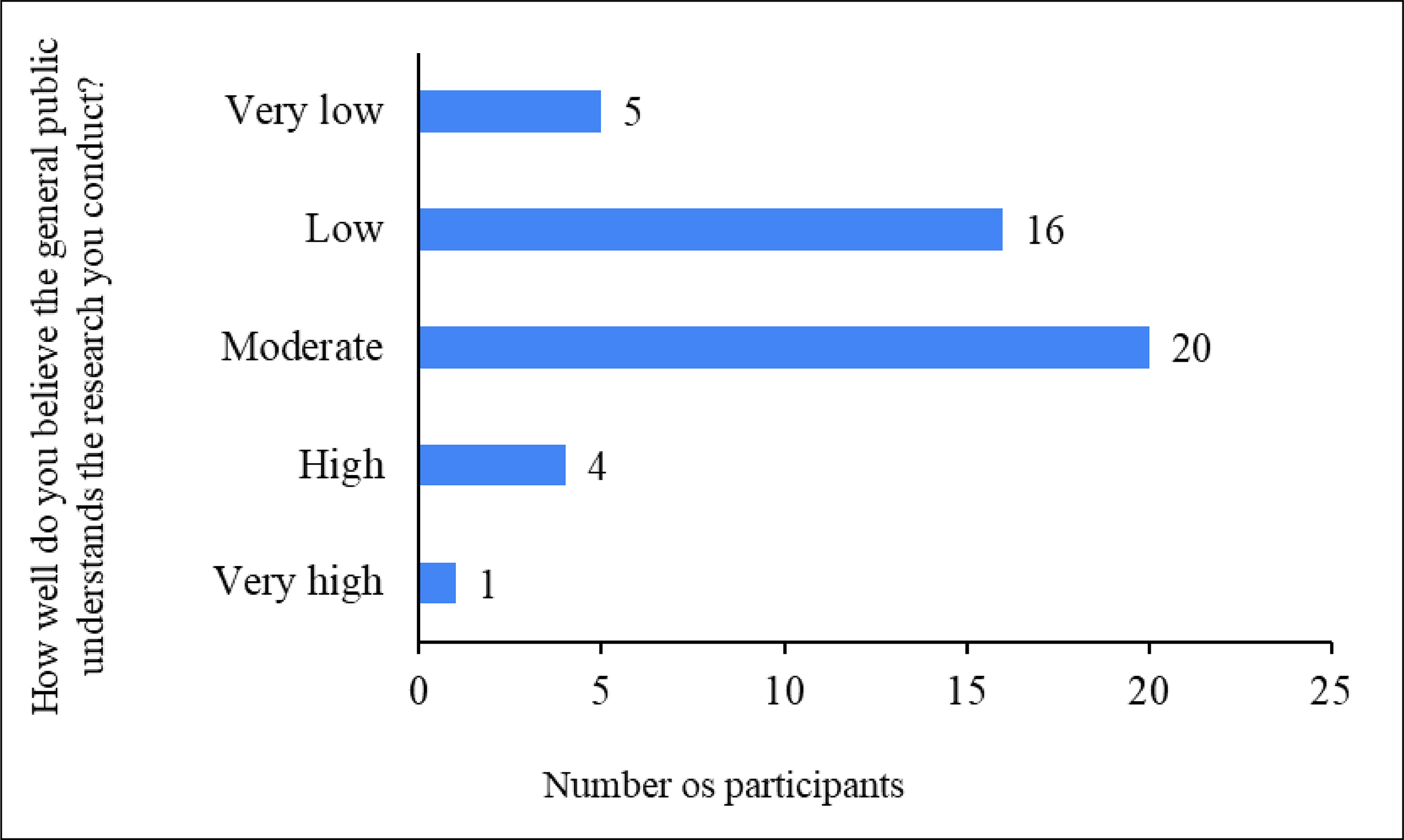
How does the non-specialized public assimilate the research conducted by professionals?
Responses were divided between "moderate" and "low" to "very low" (Chart 1), with only 11% of participants believing their research is satisfactorily understood (high and very high).

What are the biggest challenges you face in making your work accessible and understandable to people without backgrounds in science?
Each participant could select up to three options. The top three challenges selected were: limited time for SO (57%), indicating competing priorities; lack of resources to produce accessible materials (e.g., videos, infographics) (54%); and lack of specific training/skills (40%) (Chart 2). Notably, these three most frequent responses all relate to infrastructure needs or outreach (time, resources, training). Less common responses cited specific skill gaps for communication and lack of public interest.

Main challenges identified by respondents in making their work accessible and understandable to non-scientifically audiences.
Do you receive specific training or support in science communication from the organizations you work for?
More than half of participants (53%) reported not receiving organizational support for communicating their work to broader and/or non-specialized audiences. The participants expressed interest in such support.

Participants' responses regarding science communication training/support provided by the organizations they work for.
Have you ever participated in specific training on using social media for science outreach?
The vast majority of respondents (80%) reported never having participated in specific courses or training on using social media for science outreach, despite expressing interest (Chart 4).

All participants with over 20 years of experience reported never having participated in courses specifically aimed at this purpose but expressed interest in doing so (Chart 5).

Respondents interest in training for science outreach on social media according to years of experience in the environmental field.
Have you ever used social media to promote or disseminate projects?
Most survey professionals (78%) have used social media to communicate their projects. The data suggests that longer professional experience correlates with higher social media usage rates among participants (Chart 6), likely due to accumulated opportunities over time. The only exception is professionals with over 20 years of experience, as 100% expressed interest in social media training for outreach to non-specialized audiences (Chart 5).

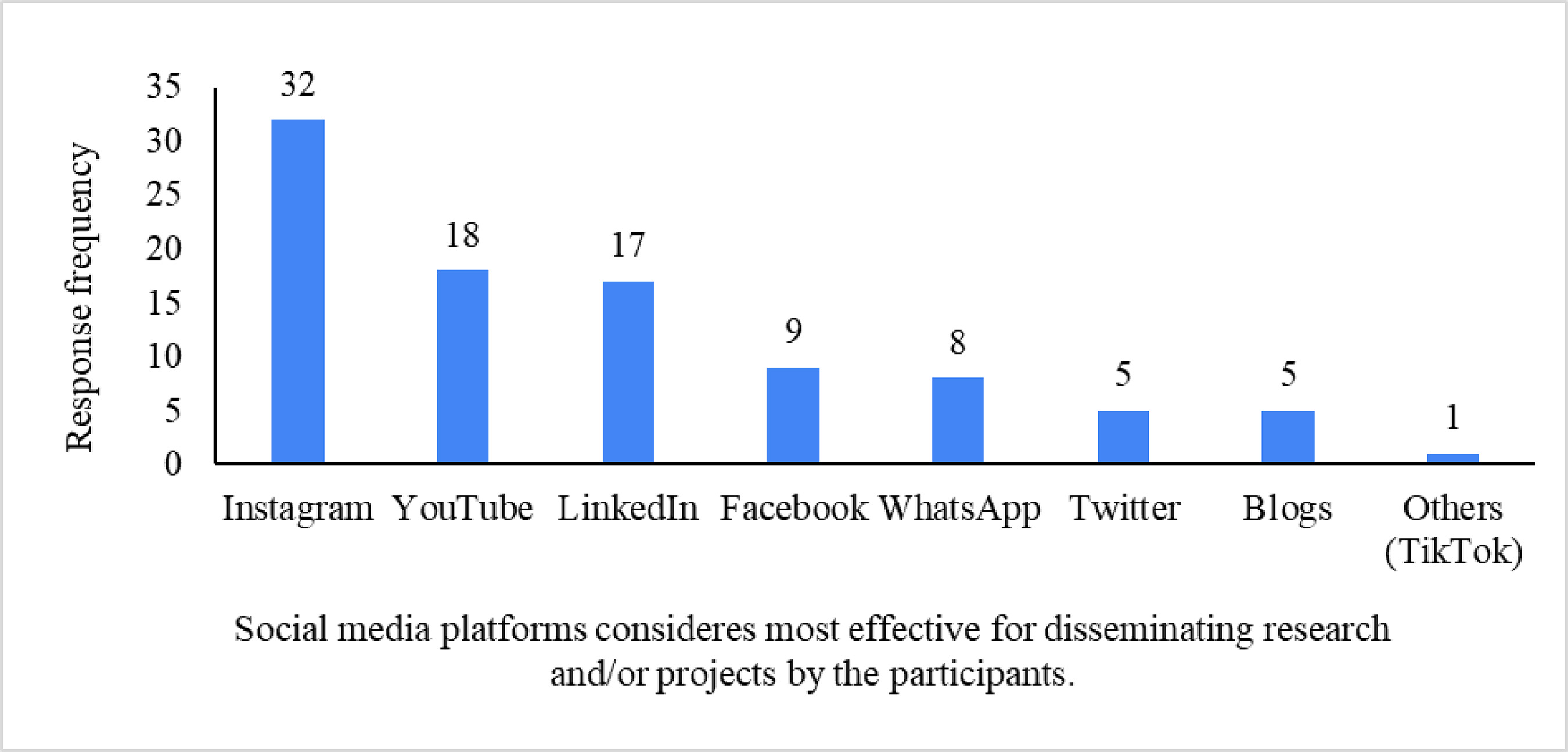
Which platforms do you consider most effective for disseminating your research and/or projects?
Each participant could choose up to three platforms they considered most effective for disseminating their research and/or projects. Instagram received 70% of the votes, followed by YouTube with 40% and LinkedIn with 36% (Chart 7). It´s important to consider that 27 participants (59% of the total) did not respond to this question.

Social media platforms that participants consider most effective for disseminating their research and/or projects.
How frequently do you use social media to communicate your research to non-specialized audiences?
Nearly 40% of participants reported rarely using social media to communicate their work and research to non-specialized audiences (Chart 8); nearly one-quarter (24%) did not respond to the question.

Frequency of social media use by participants to communicate research/projects to non-specialized audiences.
Does the feedback you receive through social media contribute to improving your research or communication techniques?
The most frequent responses were "Occasionally" (26%) and "Rarely" (23%). Most who reported "Occasionally" also indicated rarely using social media to communicate their work to non-specialized audiences (Chart 9).

Participants' opinions on how social media feedback contributes to improving their research or communication techniques.
Do you believe it is necessary to adapt vocabulary and approach when communicating science, depending on the audience?
Nearly all respondents (98%) agreed on the importance of adapting messages for lay/non-specialized audiences (Chart 10).

Participants' opinions on adapting language and approach for science communication by audience.
Has the dissemination of your research ever been misinterpreted or distorted?
Only 16% of respondents reported experiencing distortions or misinterpretations of their research, while the remainder reported never encountering such issues or being unsure if misinterpretation occurred (Chart 11).

How do you usually communicate your research to non-scientific audiences?
Each participant could select up to three tactics most used to communicate research to non-specialized audiences, plus an open-ended response option (Table 1). Over half of responses (52%) identified social media as the primary dissemination method. Presentations and lectures at community events followed (44%), suggesting appreciation for closer audience engagement through workshops and seminars (35%).
Frequency of the strategies most used by respondents to communicate research to non-specialized audiences.
How do you think organizations could improve scientific research communication to non-specialized audiences?
Responses (Table 2) primarily focused on training for science communication (60%) and fostering partnerships with schools/universities (53%). Both may be interconnected, as a more consistente and structured SO within educational institutions could cultivate stronger science communication culture in scientific careers.
The strategic use of social media ranked third (51%), reflecting respondents' interest in developing this skill. Audiovisual resources followed (42%), suggesting recognition of formats that better communicate technical information to broader audiences. Collaboration with influencers (40%) indicates participants recognize the potential for increased research visibility and public acceptance of scientific content. Events (lectures, workshops, seminars) received 22%, while direct public interaction (digital/physical) garnered only 11%.
Finally, more integrated strategies were also mentioned, though less frequently: incorporating communication from project inception through final evaluation (9%), promoting citizen science (2%), and embedding science communication in project management cycles (2%).
Frequency of responses on how organizations can improve scientific research communication to the general public.
How do you evaluate the effectiveness of the communication techniques used to disseminate your research?
Participant evaluations were categorized as "low," "moderate," and "high" based on response prevalence (Table 3), revealing patterns in perceptions of employed techniques. Non-fitting responses were grouped as "Challenges identified." Among those reporting low or moderate effectiveness, "time limitation" recurred, as in "I can't dedicate time to this," "I can't meet this demand," or "Time constraint for dissemination investment". This suggests that SO is considered a secondary task compared to other professional demands.
Participants' responses regarding the degree of effectiveness they attribute to projects and research disseminated to non-specialized audiences.
Another factor identified was the difficulty of translating complex topics into more accessible and engaging formats for non-scientists, including research results. The absence of methods to evaluate the effectiveness of dissemination strategies, as well as identifying the target audience to tailor communication accordingly, also emerged in responses.
Scientific jargon and channels aimed at peers were also mentioned as limitations to reaching the general public. Regarding the effective strategies mentioned by the participants, visual resources like photos and storymaps stood out, alongside direct engagement actions with non-specialized audiences through community events, lectures, field classes, and interviews. Publishing adapted texts on the organization's website was also mentioned as a way for researchers to practice simplifying technical language into more accessible formats, since the websites are usually aimed at a broader audience.
Behavioral strategies to stimulate science outreach and the Fogg Behavior Model
Analysis of both literature and participant responses reveals a cultural gap hindering scientists' dedication to science outreach. Without adequate prompts, dissemination becomes a secondary priority, consequently leading to insufficient technical knowledge (e.g., linguistic skills, audience adaptation) for effective engagement. Thus, we prioritized strategies to enable professionals to reach that stage, guiding our exploration of behavioral models.
Among the behavioral models analyzed in the literature, the Fogg Behavior Model (FBM) was selected to apply the questionnaire results from environmental professionals, as presented in the results section. This choice was driven by its focus on skills and motivations—identified as most relevant by research participants, which are central elements of this model. The FBM posits that three elements are required for behavior to occur: motivation, ability, and prompt (Fogg, 2019), with 'behavior (B) occurring when motivation (M), ability (A), and a prompt (P) converge simultaneously', as shown in the graph below (Figure 1).

Motivation reflects how motivated or engaged a person is to perform the action; ability reflects how capable they are of executing it; and prompt is what triggers the action at that moment. These three pillars are interdependent, requiring simultaneous occurrence for the model to succeed.
Figure 1 graph shows that if motivation (M) is high, only a small prompt (P) is sufficient to achieve the desired behavior (B), even if the action requires greater ability (A). However, if any of these factors are absent or too weak, the behavior does not occur. The green line represents the threshold for behavior: if the equation result is above the line, the action occurs; if below, it does not. The prompt (P) triggers the action. There are three types of prompts: facilitator (when motivation is high, but ability is low), spark (when ability is high, but motivation is low), and signal (when both ability and motivation are high) (Figure 2). A facilitator might be a tool that simplifies action execution; a signal, a reminder for an individual who is already sufficiently motivated and capable; and a spark, an incentive to prompt action when ability is sufficient, but motivation is low.

Graph demonstrating the three types of prompts to apply for behavior to occur, according to the Fogg Behavior Model.
FBM’s application to promote a culture of Science Outreach
Questionnaire responses showed that 'ability (A)' was a crucial factor in professionals' opinions. For example, although 98% of respondents believe that adapting scientific language for accessible communication is essential, reports such as 'I have difficulty summarizing my research results and conclusions,' 'I haven't yet managed to translate it into non-scientific language,' and 'Challenge: having indicators to measure dissemination reach' demonstrate this skill gap persists. Additionally, although 80% of participants have never received social media science communication training, they expressed interest in such opportunities. Training was also the most voted suggestion for improving institutional science communication.
Thus, applying the research results to the FBM, we obtain (figure 3):
Motivation (M): high, as professionals demonstrated interest in training for science communication on social media.
Ability (A): low, as despite this interest, lack of necessary skills was a recurrent report.
Figure 3: Fogg Behavior Model graph adapted to the research results on motivations and abilities of the interviewed professionals.
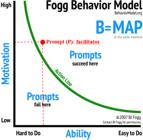
Considering the interest in improving science communication to the public alongside the lack of technical knowledge to do so, the most appropriate prompt is the 'facilitator.' As skills remain low, resources are needed to make the behavior easier to perform.
A feasible example of a facilitator prompt that could be tested is providing pre-formatted social media post templates from institutions to researchers. These templates could include step-by-step guidance on sharing their research on social networks. This would simplify posting their research, reducing barriers such as time constraints and uncertainty about communication format, while gradually building their skills.
Discussion and conclusion
The results show that the most recurrent point in the interviewees' opinions was the lack of time to dedicate to science communication (DC), suggesting it is not a priority compared to other professional demands. The other two most frequent reports refer to the lack of resources and specific skills to create communication materials, which corroborates the lack of prioritization of SO in institutions.
The lack of a clear definition of the target audience, combined with the absence of methods to evaluate whether strategies for disseminating their research and projects are effective, was highlighted as a relevant factor among participants. This gap hinders identifying areas for improvement for more efficient disclosure (LEWENSTEIN, 2003), requiring deeper analysis and a more strategic communication approach — which is not feasible given the low priority and lack of incentives for SO in institutions and academia.
Instagram was considered the most effective platform for science communication (DC), both participants who already use it consistently (over 50% of responses) and overall (70% of responses). However, adapting language and formats requires skills that scientific professionals often lack (BUENO, 2010; EPSTEIN, 2012), plus it demands time and effort for an activity rarely recognized by the academic and scientific community (MANNINO, 2021).
Given this, we note that structural and cultural challenges are the main factors limiting scientific professionals' involvement in disseminating their projects. Structural challenges arise from limited resources (funding and tools) and time constraints; cultural challenges, from lack of institutional recognition and academic prejudice viewing science communication as low-prestige work often delegated to specialized communication professionals.
These barriers intertwine, creating a vicious cycle: lack of recognition and low prestige generate less interest in science communication, which in turn prevents institutional incentives and adequate structural development. Therefore, for science communication to gain scale, the scientific community itself must overcome this cultural barrier. Recognizing the challenges involved in this paradigm shift, we applied a behavior model to support strategies that can foster a science communication culture in institutions.
The FBM was the chosen model, as discussed in the introduction, to which we applied the research results to identify which types of prompts are most likely to encourage science communication practices in institutions. As indicated, the facilitator prompt would be most appropriate — something more specific and pragmatic, such as the social media templates example, gradually introducing the habit of science disclosure more subtly, or even training, as suggested by the respondents themselves.
Final considerations
The findings of this study can serve as a basis for researchers and institutions to develop more effective science communication strategies both within and beyond the academic community, responding to the growing demand from funding agencies for transparent and socially impactful communication. By expanding the reach and relevance of research, such strategies not only facilitate accountability and transparency of science investments but also strengthen the social role of research by promoting public access to scientific information.
PLAGIARISM CHECK
ETHICAL APPROVAL
INCLUSIVE LANGUAGE
DECLARATION OF GENERATIVE AI AND AI-ASSISTED TECHNOLOGIES IN THE WRITING PROCESS
HOW TO CITE
REVIEWERS
FUNDING
XML EDITING AND MARKUP
DATA AVAILABILITY
All data supporting this article are contained within the text.
References
-
BARBOSA, Cristiane; SOUSA, Jorge Pedro. Comunicação da ciência e redes sociais: um olhar sobre o uso do Facebook na divulgação científica. Cibercultura: circum-navegações em redes transculturais de conhecimento, arquivos e pensamento. Centro de Estudos de Comunicação e Sociedade. Universidade do Minho, Portugal, 2017. Disponível em https://core.ac.uk/display/229420747 Acesso em 10 mai. 2023.
» https://core.ac.uk/display/229420747 -
BARBOZA, Eduardo Fernando Uliana. Comunicação científica e pseudociência: um desafio epistemológico. Revista Anhanguera, 2023. Disponível em:https://unigoias.com.br/wp-content/uploads/Artigo-2-6.pdf Acesso em 24 fev. 2024.
» https://unigoias.com.br/wp-content/uploads/Artigo-2-6.pdf -
BRASIL. Conselho Nacional de Desenvolvimento Científico e Tecnológico. O CNPq e a divulgação científica, 2021. Disponível em: https://www.gov.br/cnpq/pt-br/assuntos/popularizacao-da-ciencia/o-cnpq-e-a-divulgacao-cientifica Acesso em: 25 março 2025.
» https://www.gov.br/cnpq/pt-br/assuntos/popularizacao-da-ciencia/o-cnpq-e-a-divulgacao-cientifica - BUENO, Wilson da Costa. Jornalismo Científico: revisando o conceito. In.: VICTOR, Cilene et al. Jornalismo Científico e Desenvolvimento Sustentável. São Paulo: All Print Editora, 2009.
-
BUENO, Wilson Costa. Comunicação científica e divulgação científica: aproximações e rupturas conceituais. Informação & Informação, Londrina, v. 15, n. esp., p. 1-12, 2010. Disponível em: https://ojs.uel.br/revistas/uel/index.php/informacao/article/view/6585 Acesso em: 05 dez. 2022.
» https://ojs.uel.br/revistas/uel/index.php/informacao/article/view/6585 -
DANTAS, L. F. S.; DECCACHE-MAIA, E. Divulgação Científica no combate às Fake News em tempos de Covid-19. Research, Society and Development, v. 9, n. 7, p. e797974776-e797974776, 2020. Disponível em: https://rsdjournal.org/index.php/rsd/article/view/4776 Acesso em: 17 jan. 2023.
» https://rsdjournal.org/index.php/rsd/article/view/4776 -
EPSTEIN, I. Comunicação da ciência: rumo a uma teoria da divulgação científica. Organicom, [S. l.], v. 9, n. 16-17, p. 18-38, 2012. DOI: 10.11606/issn.2238-2593.organicom.2012.139126. Disponível em: https://www.revistas.usp.br/organicom/article/view/139126 Acesso em: 5 set. 2023.
» https://doi.org/10.11606/issn.2238-2593.organicom.2012.139126» https://www.revistas.usp.br/organicom/article/view/139126 -
FERREIRA, Adjalme Dias et al. Efeitos positivos gerados pelos parques urbanos: o caso do Passeio Público da Cidade do Rio de Janeiro. 2008. Disponível em: https://app.uff.br/riuff/bitstream/handle/1/17160/ADFerreira.pdf?sequence=1 Acesso em 29 mai. 2023.
» https://app.uff.br/riuff/bitstream/handle/1/17160/ADFerreira.pdf?sequence=1 -
GHILARDI, Aline. O preconceito acadêmico com os divulgadores. Colecionadores de Ossos, 19 maio 2016. Disponível em: https://www.blogs.unicamp.br/colecionadores/2016/05/19/o-preconceito-academico-com-os-divulgadores/ Acesso em: 20 set. 2024.
» https://www.blogs.unicamp.br/colecionadores/2016/05/19/o-preconceito-academico-com-os-divulgadores/ - LEMOS, André; LÉVY, Pierre. O futuro da Internet: em direção a uma cibercultura planetária. São Paulo: Paulus, 2012.
-
LEWENSTEIN, Bruce V. Models of public communication of science and technology. 2003. Disponível em https://ecommons.cornell.edu/items/601f5747-d07a-4a52-a61d-d2fa8a7235bd Acesso em 30 de jun. 2024.
» https://ecommons.cornell.edu/items/601f5747-d07a-4a52-a61d-d2fa8a7235bd -
MANNINO, I. et al. QUEST project outputs. Dublin: Science & Society Research Group, Trinity College Dublin, 2021. Disponível em: < https://openaccess.city.ac.uk/id/eprint/26156/>. Acesso em 26 set. 2024.
» https://openaccess.city.ac.uk/id/eprint/26156/ -
MASSARANI, Luisa; ROCHA, Mariana. Ciência e mídia como campo de estudo: uma análise da produção científica brasileira. Intercom: Revista brasileira de ciências da comunicação, v. 41, p. 33-49, 2018. Disponível em:< https://www.scielo.br/j/interc/a/grf6vFcvz3tbfKkdxrpv9JN/>. Acesso em 13 out. 2024.
» https://www.scielo.br/j/interc/a/grf6vFcvz3tbfKkdxrpv9JN/ -
MASSARANI, Luísa.; ALMEIDA, Carla de. Participação pública em Ciência e Tecnologia: influenciar nas decisões e, sobretudo, manter a sociedade informada e engajada. História, Ciências, Saúde – Manguinhos, 2005. Disponível em: < https://www.redalyc.org/articulo.oa?id=386137981013>. Acesso em 17 de out 2020.
» https://www.redalyc.org/articulo.oa?id=386137981013 -
MELO, Willian Lima; DO PRADO, Marcos Aparecido Rodrigues; DA SILVA, Taynara Cristina. O interesse sobre fake news pela ciência da informação: uma análise dos artigos científicos indexados na Brapci. Logeion: Filosofia da Informação, v. 10, p. 611-633, 2023. Disponível em: https://revista.ibict.br/fiinf/article/download/6659/6393?inline=1 Acesso em 13 de janeiro de 2024.
» https://revista.ibict.br/fiinf/article/download/6659/6393?inline=1 -
MENDES, Marina M.; MARICATO, João de M. Das apresentações públicas às redes sociais: apontamentos sobre divulgação científica na mídia brasileira. Comunicação & Informação, Goiânia, Goiás, 2020. Disponível em: https://revistas.ufg.br/ci/article/view/49959 Acesso em: 10 dez. 2022.
» https://revistas.ufg.br/ci/article/view/49959 -
POPULARIZAÇÃO DA CIÊNCIA E TECNOLOGIA DA AMÉRICA LATINA E DO CARIBE (REDPOP-UNESCO), v. 14, p. 1-6, 2015. Disponível em:< http://www.geenf.fe.usp.br/v2/wp-content/uploads/2015/08/A-divulgacao-da-ciencia-por-meio-da-midia-analise-textual-de-websites.pdf>. Acesso em 02 fev. 2024.
» http://www.geenf.fe.usp.br/v2/wp-content/uploads/2015/08/A-divulgacao-da-ciencia-por-meio-da-midia-analise-textual-de-websites.pdf - PRAIA, João; GIL-PÉREZ, Daniel; VILCHES, Amparo. O papel da natureza da ciência na educação para a cidadania. Ciência & Educação, v. 13, n. 02, p. 141-156, 2007.
-
SANTAELLA, Lucia. A pós-verdade é verdadeira ou falsa? Editora estação das letras e cores, 2020. Disponível em:<https://books.google.com.br/books/about/A_P%C3%B3s_Verdade_%C3%A9_Verdadeira_ou_Falsa.html?id=cfWADwAAQBAJ&redir_esc=y>. Acesso em 02 fev. 2024.
» https://books.google.com.br/books/about/A_P%C3%B3s_Verdade_%C3%A9_Verdadeira_ou_Falsa.html?id=cfWADwAAQBAJ&redir_esc=y -
ZENHA, Luciana. Redes sociais online: o que são as redes sociais e como se organizam? Caderno de Educação, n. 49, p. 19-42, 2018. Disponível em: <https://www.researchgate.net/publication/323642463_12_-_Redes_sociais_online_o_que_sao_as_redes_sociais_e_como_se_organizam_revisado_com_palavras_chave>. Acesso em 12 de dez. 2025.
» https://www.researchgate.net/publication/323642463_12_-_Redes_sociais_online_o_que_sao_as_redes_sociais_e_como_se_organizam_revisado_com_palavras_chave

 Source: Author elaboration from own research data (2025).
 Source: Author elaboration from own research data (2025).
 Source: Author elaboration from own research data (2025).
 Source: Author elaboration from own research data (2025).
 Source: Author elaboration from own research data (2025).
 Source: Author elaboration from own research data (2025).
 Source: Author elaboration from own research data (2025).
 Source: Author elaboration from own research data (2025).
 Source: Author elaboration from own research data (2025).
 Source: Author elaboration from own research data (2025).
 Source: Author elaboration from own research data (2025).
 Source:
  Source:
  Source: