
 BEHAVIOR AND SKILLS IN INFORMATION AND COMMUNICATION: a coparison between two models
ABSTRACT
Studies that address the behavior of searching, sharing and using information and knowledge have been one of the main objects of investigation today. There are several new demonstrative, predictive or prescriptive models that present varied perspectives on Information and Knowledge Management. However, there is little research dedicated to comparing the relationships between models to understand disparities or convergences, which represent a gap to be addressed. Given this context, the proposed objective is to compare the adherence between two different theoretical models, both validated by empirical tests that evaluate the processes of identifying needs, searching and using information and knowledge. Regarding the methodology for carrying out this endeavor, a qualitative approach was chosen, using the content analysis technique. As for the results, the models analyzed present particularities of approach and methods, however there are significant convergences. We can conclude that the models developed have a high level of conceptual basis and potential for replicability. Despite the distinctions between the models studied, the alignment of the indicators listed by both is evident and the research leaves a legacy for discussions and expansion of debates with a view to providing new paradigms for understanding phenomena linked to infocommunication issues.
Keywords
Communication; Information; Infocommunication; Model; Infocommunicational Behavior
RESUMO
Os estudos que abordam o comportamento de busca, compartilhamento e uso da informação e do conhecimento tem sido um dos principais objetos de investigação na atualidade. Diversos são os novos modelos demonstrativos, preditivos ou prescritivos que apresentam perspectivas variadas da Gestão da Informação e do Conhecimento. No entanto poucas são as pesquisas que se dedicam a comparar as relações entre os modelos para a compreensão das disparidades ou convergências, o que representa uma lacuna a ser enfrentada. Diante desse contexto, o objetivo proposto é de se comparar a aderência entre dois modelos teóricos distintos, ambos validados por testes empíricos que avaliam os processos de identificação das necessidades, busca e uso da informação e do conhecimento. Em relação à metodologia para a realização dessa empreitada, foi escolhida a abordagem qualitativa, com uso da técnica de análise de conteúdo. Quanto aos resultados, os modelos analisados apresentam particularidades de abordagem e métodos, entretanto existem convergências significativas. Pode-se concluir que os modelos analisados possuem alto nível de embasamento conceitual e potencial para replicabilidade. Apesar das distinções entre os modelos estudados, fica evidente o alinhamento dos indicadores elencados por ambos e a pesquisa deixa um legado para as discussões e ampliação dos debates com vistas a proporcionar novos paradigmas para a compreensão de fenômenos ligados às questões infocomunicacionais.
Palavras-chave
Comunicação; Informação; Infocomunicação; Modelo; Comportamento Infocomunicacional
RESUMEN
Los estudios que abordan el comportamiento de buscar, compartir y utilizar información y conocimiento han sido uno de los principales objetos de investigación en la actualidad. Existen varios modelos demostrativos, predictivos o prescriptivos nuevos que presentan perspectivas variadas sobre la Gestión de la Información y el Conocimiento. Sin embargo, hay poca investigación dedicada a comparar las relaciones entre modelos para comprender disparidades o convergencias, lo que representa una brecha por abordar. Ante este contexto, el objetivo propuesto es comparar la adherencia entre dos modelos teóricos diferentes, ambos validados mediante pruebas empíricas que evalúan los procesos de identificación de necesidades, búsqueda y uso de información y conocimiento. En cuanto a la metodología para la realización de este empeño, se optó por un enfoque cualitativo, utilizando la técnica del análisis de contenido. En cuanto a los resultados, los modelos analizados presentan particularidades de enfoque y métodos, sin embargo existen convergencias significativas. Se puede concluir que los modelos analizados tienen un alto nivel de base conceptual y potencial de replicabilidad. A pesar de las distinciones entre los modelos estudiados, la alineación de los indicadores enumerados por ambos es evidente y la investigación deja un legado para discusiones y ampliación de debates con miras a proporcionar nuevos paradigmas para comprender los fenómenos vinculados a las cuestiones de infocomunicación.
Palabras clave
Comunicación; Información; Infocomunicación; Modelo; Comportamiento infocomunicacional
Introduction
Infocommunication Skills are based on the ability to manage information and interact with others through communication (Borges, 2018). In other words, they can generally be translated as the individual's ability to search for and use information, and models can, based on conceptual theoretical foundations, outline and represent information management flows through interactive processes (Lima and Pereira, 2024).
On the one hand, as Braga's (2000) model points out, information has taken on increasing importance in recent years and is characterized as fundamental in discovery, the introduction of new technologies to explore opportunities, and to support planning. Choo (2003) alludes that information encompasses the individual's experience in its entirety in a dynamic cognitive and perceptive process, determining a context in which information can be used in the manner and to the extent that it is useful. On the other hand, referring to Communication, Borges (2018) warns that in postmodern society, content sharing practices, constant connectivity, and social participation are strongly linked to behavior and the ability to relate and interact with others, especially on digital platforms and media.
Considering Information and Communication as intrinsic elements of both the needs and uses of information behavior, Borges (2018) conceptually and systematically structured the constructs of Infocommunication Skills, then categorized these constructs into indicators and proposed an assessment tool.
Given this context, the objective of this article is to analyze whether the indicators proposed and empirically tested by Borges (2018) adhere to the theoretical model formulated by Pereira (2011). The relevance of this research is based on the strong influence that cognitive, emotional, and situational factors exert on individuals’ information search and use needs in decision-making.
Although several emerging studies have applied Borges's (2018) Infocommunication Skills indicators in different contexts, notably Daher Junior (2019), Borges and Sousa (2019), and Marzal and Martínez Cardama (2020). Therefore, Borges's (2018) model was selected for analysis due to its applicability in empirical tests and the significant number of citations.
Similarly, the integrative model proposed by Pereira (2011) was chosen for comparison and analysis due to its empirical replicability observed in several studies over the last decade. To understand the influences of information behavior on decision-making, researchers have repeatedly used this model, including Ohtoshi (2013), Cavalcante et al. (2017), Schreiber and Froehlich (2020), Campos, Alves, and Berti (2021), and Lima (2024). However, no analysis of the adherence between the two models has been identified to date, which makes the proposed research unique.
This article is structured in sections and begins with the introduction, followed by the development, which is subdivided into two subsections. The first presents the model by Borges (2018) and the second addresses the model developed by Mafra Pereira (2011). The third section presents the methodology, the fourth presents the results of the comparison between the models, and the fifth section draws conclusions, concluding with a list of references used.
Development
Information has become increasingly important in recent years (Braga, 2000), and the needs and uses of information are influenced by cognitive, emotional, and situational factors in information behavior (Pereira, 2010).
According to Wilson (2000, p. 49), information behavior is a broad behavior, "[...] related to the sources and channels of information, including the active and passive search for information, and its use." "Active" search is defined as when the individual seeks information intentionally, and "passive" when there is no intentional search, but both can influence decisions.
For Wilson (2000, p. 49), information search behavior is characterized by "[...] the search for information to satisfy a need or objective." Along these lines, Choo (2003) presents a model in which information search and use are governed by interaction with the environment, so that information is processed, used, and constituted by individuals' cognitive needs and emotional reactions.
Based on Brenda Dervin's approach, Pereira (2010, p. 181) warns that emotional reactions are experiential, as information also requires meaning, because "the individual continually moves in time and space [...], taking steps through their experiences." And that "With each movement, a new step is taken, and the individual creates meaning for their actions and the environment that surrounds them." (Pereira, 2010, p. 181)
For Scarpelli and Lima (2019), competencies are directly related to an individual's knowledge, skills, and attitudes, aligned with a goal. In this sense, Borges (2018) already emphasized the importance of "information" and "communication" as essential competencies.
Therefore, Infocommunication Competencies consist of an individual's ability to "manage information" through the search and use of information to solve problems, as well as the ability to "communicate efficiently" by establishing relationship networks for dialogue and negotiation (Borges; Sousa, 2019).
For Borges (2018), Infocommunication Competencies are dimensions that result in metacognitive skills that are not limited to knowing how to do something but also involve deciding when and the motivations for why to do something. Choo (2003) states that the topic is transdisciplinary and generates important debates that can result in models for analyzing information search and use.
Presentation of the Borges Model (2018)
After Borges (2018) defined Infocommunication Skills, eight "information skills" and a series of indicators for content consumption, management, and production were categorized (Table 1). Seven "communication skills" and a series of indicators for interaction and relationships were also categorized (Table 2).
Therefore, these categories and indicators of information competencies presented in Tables 1 and 2 will be listed as critical factors for subsequent analysis of the models' adherence, as follows:
Access, as an information competency, refers to technical skills for consuming information. Its indicators are linked to the perception of everyday issues, whether professional, academic, personal, or otherwise.
Comprehension is the ability to grasp the meanings of information, including iconic language.
Analysis represents the analytical skills of dealing with informational content, considering criteria that determine the main information and supplementary information.
Synthesis consists of the ability to compare different pieces of information, synthesizing the main ideas of the retrieved information.
Management is the organization of information for current or future use, and the perception of informational volatility.
Evaluation is the questioning and critical evaluation of information and messages that result in decision-making based on the identification of purposes, interests, and intentions, considering the veracity of the information. Production is the ability to integrate, connect, describe, or even remix diverse content, integrating diverse information formats.
Creation involves taking the initiative to create content or even adding critical, evaluative understanding based on sociocultural aspects and ideological issues, establishing relationships between codes and media in the formation of interrelated and systematized knowledge.
Establishing and maintaining communication with others is the appropriate skill for the communication channel and language used in the recipient's context.
Distribution consists of effectively disseminating content by identifying the means, channels, and tools to convey a message according to the context.
Participation is the ability to participate interactively and critically in participatory media environments, considering the different ideas that may arise and knowing how to consider appropriate spaces and tools.
Developing social networks is the skill for developing healthy social relationships in digital environments, based on respect for diversity and affirmation of identity.
Privacy, ethics, and intellectual property are fundamental issues in changing technology environments.
Collaboration translates into the skill of generating knowledge and working collaboratively. Its prerequisites include fulfilling individual tasks agreed upon in collective projects and participating positively in learning environments from multiple perspectives.
Lifelong learning demonstrates the ability to connect teaching and research strategies with learning processes linked to lifelong goals, whether personal, professional, or even academic. Based on the above, the 15 (fifteen) Infocommunication Competencies described above, worked together and considering the methodological procedures outlined in the next section, will serve as a comparative basis for the intended analysis.
It is also worth noting that Borges (2018) drew on several studies to develop the indicators contained in the listed competencies. The list of authors who have worked on informational competencies and their current indicators can be seen in the evolutionary analysis of research trends and scientific productivity worldwide presented by Dudziak (2010).
Presentation of Pereira's (2011) model
Pereira's (2011, p. 144) proposal was to develop an integrative model based on "information behavior for strategic decisions," which involves identifying the information needs for decision-making and recording the decision-making process.
Structured based on three models: Dervin (1992), Kuhlthau (1993), and Choo (2003), Pereira (2011) tested and validated the integrative model through empirical studies in Brazilian SMEs. Pereira's (2011) model presents a timeline process and is divided into three structuring stages: (1) the "pre-decision" stage, (2) the "decision itself" stage, and (3) the "post-decision" stage. This includes eight steps intended to better align with the way strategic decisions are or can be made by SME managers and how the process model is structured, considering phases, routines, and cycles (Figure 1).

The integrative model presented in Figure 1 is theoretical and conceptual and aims to demonstrate the information flow in the processes of searching for and using information for strategic decisions, using interdisciplinary concepts from Information Science and Management.
Regarding the decision-making process in the field of Management, the model presents three distinct stages, always present in a strategic decision, based on a procedural decision-making model. Regarding the field of Information Science, the steps of each stage are subdivided: the first stage, "pre-decision," is subdivided into four steps, the second stage is represented by the "decision" step, and the last three steps are represented by the "post-decision" stage. Namely:
-
In step 1, the reason/need for making the decision is linked to the "situation," that is, the context, and indicates stops for finding answers, directions, connections, or creating ideas. (Pereira, 2011);
-
In step 2, information needed to decide, what to look for: This corresponds to the "Gaps": what information the individual needs to seek to decide what to do, which direction to follow, and what informational connections are necessary for frameworks or the creation of new ideas. This step emphasizes "initiation," understood as the stage of recognizing the informational need (Pereira, 2011);
-
In the step 3, where to look for this information (sources) functions as a bridge, characterized as an informational search process in which sources are used to obtain support or confirmation for decisions. In this step, the search for information aims to clarify and understand the problem and the path to solving it, a step in which "selection" and "exploration" are highlighted (Pereira, 2011); In step 4, the informational content obtained, what was achieved, consists of the use of the information or the help obtained from the information. The main categories of this step are the clarifications or situational meanings found, the understanding achieved to solve the problem in its specific aspects, the tools used to find directions and paths, and the confirmation of the support obtained, at which point the "formulation" leads to the focal point for possible solutions (Pereira, 2011);
-
In step 5, decision, the focus is on the ability to recognize in the information obtained what is considered, or what most influences decision-making, a moment in which what was heard, the experiences perceived or lived, the learning throughout the process, and intuition are evaluated (Pereira, 2011);
-
In step 6, how the decision is implemented, is a "post-decision" moment, involving adopting a posture of putting into practice the decisions arising from the previous steps (Pereira, 2011); In step 7, how the decision is evaluated, this is the moment when the results of the implemented decision are obtained and evaluated, typically perceived through reports or perceptions of positive results (Pereira, 2011);
-
In step 8, how the decision is recorded, this is the moment of formalization, where decisions are recorded. This can occur in various ways, whether physically, electronically, or even tacitly. However, it is worth noting that there is also the possibility that, even if the decision is not recorded, it may be considered for subsequent decisions (Pereira, 2011).
Methodology
For Minayo (1998), methodology is an instrumental approach; more than that, it is a means of conducting investigations using appropriate instruments throughout a process. Therefore, this research is characterized by a trajectory-based content analysis approach divided into two stages.
In the first stage, Borges's (2018) work was read in full, and following the precepts of Bardin's (1997) content analysis technique, the main elements were identified. According to Bardin (1997), content analysis techniques examine a work and produce inferences by outlining the recording units throughout the process. This research identified 15 recording units that are identified as Infocommunication Competencies structured based on a series of assessment indicators.
In this stage, the research used a qualitative approach, as the content analysis employed was based on the identification and cognitive interpretation of the 15 infocommunication competencies. It is also worth noting that, although specific techniques are employed, this stage is based on subjective analysis of a descriptive nature. Gil (2002) points out that in this type of subjective process, descriptions and inferences are presented so that the reader understands the guiding cognitive process.
The analysis of Pereira's (2011) integrative model was also qualitative, examining the cognitive dimensions of meaning creation based on Dervin (1992), the emotional dimensions of a constructivist information search process developed by Kuhlthau (1993), and the situational dimensions of added value and information use developed by Choo (2003).
After identifying and interpreting the Infocommunicational Competencies and the dimensions of information behavior presented by Borges (2018) and Pereira (2011), the second stage of the research began, which consisted of demonstrating the results graphically, specifying the degree of relationship between the analyzed models. To this end, according to Gil (2002), this approach is based on quantification, which allows for mathematical representations of relationships.
In summary, the first stage is qualitative, involving the reading, interpretation, survey, and subjective analysis of the models. The second stage is demonstrative, seeking to present quantifiable relationships and visual representation. This relationship aimed to determine the level of adherence between the presented models, compare them, and demonstrate their commonalities.
Results
After analyzing the models' aspects from a broader perspective, Borges's (2018) model focuses on infocommunication competencies, and the results indicate that "The indicators, based on the conceptual framework, proved to be adequate for understanding contemporary infocommunication behavior [...]" (Borges, 2018, p. 1). Pereira's (2011) model, on the other hand, emphasizes the analysis based on information behavior.
The importance of aspects related to identifying information needs and the respective processes of searching, sharing, and using information and knowledge in organizations is unquestionable today, especially in the current economic, political, and social context of globalization, intense competition, and accelerated technological development. (Pereira, 2011, p. 14).
In addition to informational behavior, the communication issue is also considered by Pereira (2011, p.37), who states that “communication routines” gather and distribute information as part of the decision-making process and consist of the exploration, investigation, and dissemination of information. Therefore, it is clear that both models aim, in their proposals, to understand issues linked to individual behavior regarding the need to search for and use information, taking into account aspects of both information and communication. It is also noteworthy that Pereira (2010), as well as Borges (2018), cite a range of studies raised by Dudziak (2010) in an evolutionary analysis of the theme. The commonality between the models expands even further under the lens of empirical testing, because although Borges's (2018) model is predominantly quantitative, "The indicators, based on the conceptual structure, [...]" (Borges, 2018, p. 1), were converted into questions, "[...] whose answers provided evidence of their competencies in terms of information and communication." (Borges, 2018, p. 1).
Pereira's (2011) tests were qualitative, with a semi-structured survey and guiding questions considering the conceptual structure and timeline analysis. "The timeline interview research method proved to be relevant [...]" (Pereira, 2011, p. 89). In other words, both models developed questions and objectives based on extensive literature for measuring and achieving results.
When verifying the adherence between the models, it was observed that almost all of the criteria raised by Borges (2018) simultaneously adhere to one or more of Pereira's (2011) criteria. The correlation of only one of them is sufficient for the item analyzed to be considered adherent:
-
Access: yes. This refers to knowing how to use specialized sources for information searches and establishing them based on preferences and filters. This step aims at informational search in which sources are used to obtain support or confirmation for decisions.
-
Comprehension: yes. The ability to grasp the meanings of information. The main characteristics are the clarifications or situational meanings found, the understanding achieved to solve the problem in its specific aspects.
-
Analysis: yes. Analytical skills in working with informational content. Recognizing in the information obtained what is considered, or what most influences, decision-making.
-
Synthesis: yes. The ability to compare and contrast different pieces of information. A time to evaluate information, what was heard, and perceived or lived experiences.
-
Management: yes. Organization of information for current or future use. It involves adopting a stance of choice and implementing the decisions arising from previous steps.
-
Evaluation: yes. Questioning and critical evaluation of information and messages that result in decision-making based on the identification of purposes, interests, and intentions. A time when the results of the implemented decision are obtained and evaluated.
-
Production: yes. The ability to legally integrate, link, describe, or even remix different content, giving or increasing visibility to specific information. Production of new knowledge based on information for decision-making, information exchange in the media used, such as virtual communities, online discussion groups, in-person groups, meetings, and others that favor the production of new information and ideas.
-
Creation: yes. Initiative to create content or even add critical understanding and value based on sociocultural aspects and ideological issues. Linked to the "situation," that is, the context, and indicates stops to find answers, directions, connections, or create ideas.
-
Establish and maintain communication: yes. Competence to establish and maintain communication with others, adapting the communication channel and language to the recipient's context. Sources of information used are personal, internal, and external, as well as uncited sourcesspontaneously; means of communication used and form of information presentation;
-
Distribution: yes. Effective distribution and dissemination of content by identifying the means, channels, and tools to convey a message according to the context. These are addressed in communication routines that gather and distribute information as part of the decision-making process;
-
Participation: yes. Participate interactively and critically in participatory media environments. Participate in communication media used, such as virtual communities and online discussion groups.
-
Develop social networks: yes. Develop healthy social relationships in digital environments. Activate networks for internal and external personal sources, as well as those not mentioned, such as potential trade associations, fairs and events, suppliers, customers, and those arising from the internet;
-
Privacy, ethics, and intellectual property: not specifically addressed. Issues of personal privacy, information ethics, and intellectual property in changing technology environments. Pereira (2011) does not specifically address these issues in the study;
-
Collaboration: yes. Generate knowledge and work collaboratively to capture, develop, and disseminate it. Communication methods used include virtual communities, online discussion groups, in-person groups, meetings, and others;
-
Lifelong learning: yes. Connect teaching and research strategies with learning processes linked to lifelong goals. After identifying needs, conducting research, and analyzing information, the learning generated throughout the process generates factors that influence decision-making and remain as a basis for future insights.
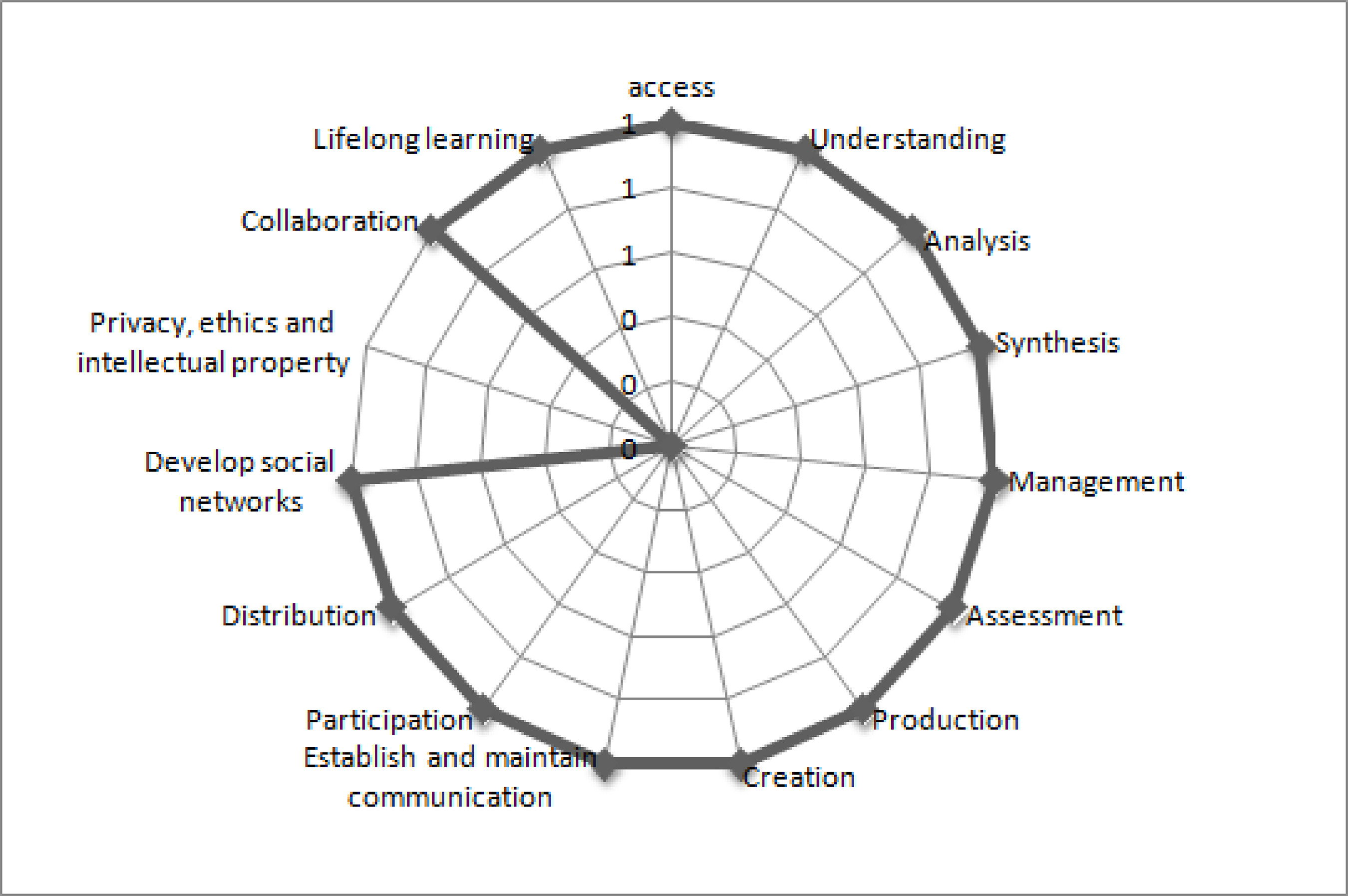
Through the analysis, the 15 (fifteen) “indicators” of infocommunicational skills from Borges (2018) were contrasted with the 8 (eight) “steps” outlined to measure informational behavior for decision-making in the Pereira (2011) model, and the result was displayed in Graph 1, which demonstrates the adherence between the indicators and steps on a scale of 0 and 1, where 1 (one) represents adherence (outer end of the graph) and 0 (zero) indicates the lack of adherence (center of the graph).

Thus, the models are consistent in their indicators and steps described for measuring infocommunication skills and information behavior in information search and use needs. The exception is the privacy, ethics, and intellectual property indicator, which is not specifically addressed in Pereira's (2011) integrative model. This result indicates that 14 of the 15 indicators presented have some commonality. In percentage terms, the adherence between the models is 93.33%, according to this research's criteria.
Final Considerations
The analysis, the subject of this research, is a partial result of Lima's (2024) thesis and was motivated by expanding the author's understanding of information, communication, and knowledge flows in digital environments. Several similar models were evaluated at this stage of the thesis. It is also worth noting that one of the proposals for future studies presented by Pereira (2011) suggests conducting new studies to verify the presented assumptions. Thus, analyzing the relationship between models served the purpose of testing whether the assumptions are consistent with another model, as well as expanding the debate and providing new paradigms for understanding the phenomenon.
To further understand individual competencies and behavior in response to information search and use needs, the models were selected based on their perceived citation volume and the topic. The research effort employed here demonstrates alignment between the models, with 93.33 percentage points of agreement. This result demonstrates a certain degree of maturity in the listed indicators. Although the tests employed different approachesBorges (2018) used a structured research instrument and Pereira (2011) used a semi-structured, more open-ended instrument, following a timeline and a flexible interview guide,most of the indicators were similar. Therefore, one model was based on the objectivity of the competencies that shape behavior, and the other on the subjectivity of the cognitive, emotional, and situational factors of behavior. Both were based on relevant foundations of the same theoretical theme for the development of the criteria.
The similarity between the models does not eliminate the need for new analyses and new instruments for empirical testing, since the literature points to a characteristic of interdisciplinarity and aspects of continuous social, political, economic, and cultural change, which affect the forms and means of communication, especially issues related to privacy, ethics, and intellectual property, which are becoming increasingly evident. The research has limitations regarding the aspects of the models analyzed, which, because they follow different designs, may not be inferable enough to assert that one model or another is assertive or relevant. It is true, however, that the consistency between the indicators demonstrates that both resulted in quite comprehensive tools when compared.
Furthermore, the comparison between models that encompass the needs of information search and use and communication constitutes a vast field with open avenues for further research. As suggestions for further studies, it would be interesting to address models that contemplate other structures or methodological procedures, whether similar or distinct, or even the combination of models that result in new analyses and applications, especially those that address issues involving ethics, privacy, and intellectual property in the information and communication arena.
-
Article submitted for similarity verification
-
Funding
This study was funded by the Brazilian agency National Council for Scientific and Technological Development (CNPq) for the scholarships and financial support granted. Financial code 001 – process 150423/2024-1.
-
Funding:
CNPq
-
XML Editing and Markup:
IR Publicações
-
Double-blind review system
-
How to cite:
LIMA, L. C., PEREIRA, F. C. M., and CABRAL, J. V. L. Information and Communication Behavior and Competencies: A Comparison Between Two Models. São Paulo: INTERCOM - Brazilian Journal of Communication Sciences, v. 48, e2025117. https://doi.org/10.1590/1809-58442025117en.
-
INTERCOM Journal encourages data sharing but, in observance of ethical guidelines, does not require disclosure of any means of identifying research subjects, preserving their privacy. The practice of open data aims to enable reproducibility of results and ensure unrestricted transparency of published research outcomes, without requiring the identity of research subjects.
Data Availability
All data supporting this article are included in the body of the text.
References
- BARDIN, L. (2010). Análise de conteúdo (1977). Lisboa (Portugal): Edições, 70, 225.
-
BORGES, Jussara. Competências infocomunicacionais: estrutura conceitual e indicadores de avaliação. Informação & Sociedade, v. 28, n. 1, 2018. Disponível em: https://www.proquest.com/openview/cc84385cd04b912950570af858a63fdc/1?pq-origsite=gscholar&cbl=2030753. Acesso em: 02 jul. 2024
» https://www.proquest.com/openview/cc84385cd04b912950570af858a63fdc/1?pq-origsite=gscholar&cbl=2030753 -
BORGES, Jussara; SOUSA, Daniel dos Santos. Design educacional para a promoção de competências infocomunicacionais na educação online. Educação, Cultura e Comunicação, v. 10, n. 20, 2019. Disponível em: http://fatea.br/seer3/index.php/ECCOM/article/view/1058 Acesso em: 02 jul. 2021
» http://fatea.br/seer3/index.php/ECCOM/article/view/1058 -
BRAGA, Ascenção. A gestão da informação. Millenium, 2000. Disponível em: https://repositorio.ipv.pt/handle/10400.19/903 Acesso em: 02 jul. 2024
» https://repositorio.ipv.pt/handle/10400.19/903 -
CAMPOS, Eric Duarte; ALVES, Sirlene Siqueira; BERTI, Ilemar Christina Lansoni Wey. Comportamento informacional do agente decisor na escolha do curso superior na Faculdade de Paraíso do Norte–PR. Monumenta-Revista Científica Multidisciplinar, v. 2, n. 1, p. 118-130, 2021. Disponível em: https://revistaunibf.emnuvens.com.br/monumenta/article/view/80 Acesso em: 02 jul. 2024
» https://revistaunibf.emnuvens.com.br/monumenta/article/view/80 -
CAVALCANTE, Ricardo Bezerra et al. Comportamento informacional de gestores da rede Hiperdia Minas. Perspectivas em Ciência da Informação, v. 22, p. 33-55, 2017. Disponível em: https://www.scielo.br/j/pci/a/SzhW4YxbP9xzxphFjYXXNMr/abstract/?lang=pt Acesso em: 02 jul. 2024
» https://www.scielo.br/j/pci/a/SzhW4YxbP9xzxphFjYXXNMr/abstract/?lang=pt - CHOO, C. W. A Organização do Conhecimento: como as organizações usam a informação para criar significado, construir conhecimento e tomar decisões São Paulo: SENAC, 2003.
-
DAHER JUNIOR, Me Francisco. TÍTULO: Competências infocomunicacionais e protagonismo juvenil: convergências possíveis para o desenvolvimento local 2019. Disponível em: https://l1nq.com/xft7c Acesso em: 02 jul. 2024
» https://l1nq.com/xft7c -
DERVIN, Brenda. From the mind's eye of the user: The sense-making qualitative-quantitative methodology. Sense-making methodology reader, 1992. Disponível em: https://ci.nii.ac.jp/naid/10020996723/ Acesso em: 02 jul. 2024
» https://ci.nii.ac.jp/naid/10020996723/ -
DUDZIAK, Elisabeth Adriana. Alfabetización en la información: análisis de la evolución de las tendencias de investigación y productividad científica en.. Informação & Informação; v. 15, n. 2 (2010); 1-22, v. 24, n. 2, p. 22-1. Disponível em: https://brapci.inf.br/index.php/res/v/34917 Acesso em: 02 jul. 2024
» https://brapci.inf.br/index.php/res/v/34917 - GIL, A. C. (2002). Como elaborar projetos de pesquisa (Vol. 4, p. 175). São Paulo: Atlas.
-
KUHLTHAU, Carol C. A principle of uncertainty for information seeking. Journal of documentation, 1993. Disponível em: https://www.emerald.com/insight/content/doi/10.1108/eb026918/full/html Acesso em: 02 jul. 2024
» https://www.emerald.com/insight/content/doi/10.1108/eb026918/full/html -
LIMA, Leandro C. Gestão da informação e do conhecimento em redes sociais virtuais: proposição de um modelo explicativo para busca de informação e geração de conhecimento para lidar com o autismo. 2024. Tese (doutorado) – Universidade Federal de Minas Gerais, Programa de Pós-Graduação em Gestão e Organização do Conhecimento, Belo Horizonte, MG. Disponível em: http://hdl.handle.net/1843/69364 Acesso em: 10 ago. 2024
» http://hdl.handle.net/1843/69364 -
LIMA, L. C.; PEREIRA, F. C. M. . CONTEXTO CAPACITANTE E BA: construindo a representação gráfica de um modelo de Gestão do Conhecimento. Fórum de Pesquisas Discentes do Programa de Pós-Graduação em Gestão e Organização do Conhecimento (FORPED PPGGOC), [S. l.], v. 5, n. 5, 2024. DOI: 10.5281/zenodo.11175409. Disponível em: https://forped.eci.ufmg.br/revista/forped/article/view/166 Acesso em: 1 jul. 2025.
» https://doi.org/10.5281/zenodo.11175409» https://forped.eci.ufmg.br/revista/forped/article/view/166 -
MARZAL, Miguel Ángel; MARTÍNEZ-CARDAMA, Sara. Clasificación de la investigación académica en Metaliteracy. Revista Española de Documentación Científica, v. 43, n. 4, p. e279-e279, 2020. Disponível em: https://redc.revistas.csic.es/index.php/redc/article/view/1305 Acesso em: 02 jul. 2024
» https://redc.revistas.csic.es/index.php/redc/article/view/1305 - MINAYO, M. C. S. O desafio do conhecimento: pesquisa qualitativa em saúde 5. ed. São Paulo: Hucitec, 1998.
-
OHTOSHI, Paulo Hideo. O comportamento informacional: estudo com especialistas em segurança da informação e criptografia integrantes da RENASIC/COMSIC 2013. Disponível em: https://repositorio.unb.br/handle/10482/14394 Acesso em: 02 jul. 2024
» https://repositorio.unb.br/handle/10482/14394 -
PEREIRA, Frederico Cesar Mafra. Necessidades e usos da informação: a influência dos fatores cognitivos, emocionais e situacionais no comportamento informacional de gerentes. Perspectivas em Ciência da informação, v. 15, p. 176-194, 2010. Disponível em: https://www.scielo.br/j/pci/a/LKnvCSs5JXLw5qBb4nk7BHN/abstract/?lang=ptJ Acesso em: 02 jul. 2024
» https://www.scielo.br/j/pci/a/LKnvCSs5JXLw5qBb4nk7BHN/abstract/?lang=ptJ -
PEREIRA, Frederico Cesar Mafra. Comportamento informacional na tomada de decisão: proposta de Modelo Integrativo 2011. Disponível em: https://repositorio.ufmg.br/handle/1843/BUOS-8PGLKJ Acesso em: 02 jul. 2024
» https://repositorio.ufmg.br/handle/1843/BUOS-8PGLKJ -
SCARPELLI, Renato Marcio; LIMA, Leandro Cearenço. Competências individuais: um estudo sobre a importância do indivíduo como diferencial competitivo nas organizações. Revista Conbrad. v. 3, n. 3, p. 83-99, 2019. Disponível em: https://l1nq.com/lU4L4 Acesso em: 02 jul. 2024
» https://l1nq.com/lU4L4 -
SCHREIBER, Dusan; FROEHLICH, Cristiane. O PROCESSO DE REPOSICIONAMENTO ESTRATÉGICO EM UMA EMPRESA FAMILIAR DO RIO GRANDE DO SUL. Revista Alcance, v. 27, n. 1, p. 47-62, 2020. Disponível em: https://www.redalyc.org/jatsRepo/4777/477762769006/477762769006.pdf Acesso em: 02 jul. 2024
» https://www.redalyc.org/jatsRepo/4777/477762769006/477762769006.pdf -
WILSON, Thomas D. Human information behavior. Informing science, v. 3, n. 2, p. 49-56, 2000. Disponível em: http://inform.nu/Articles/Vol3/v3n2p49-56.pdf Acesso em: 02 jul. 2024.
» http://inform.nu/Articles/Vol3/v3n2p49-56.pdf
Edited by
-
Editors Responsible for Reception, Desk Review, and Evaluation:
Ana Paula Goulart de Andrade (UFRRJ) and Jorge Carlos Felz Ferreira (UFJF)
-
Editor-in-Chiefs:
Dr. Marialva BarbosaFederal University of Rio de Janeiro, UFRJDr. Sonia Virginia MoreiraState University of Rio de Janeiro, UERJ
-
Executive Editors:
Dr. Jorge C. Felz FerreiraFederal University of Juiz de Fora, UFJFDr. Ana Paula Goulart de AndradeFederal Rural University of Rio de Janeiro, UFRRJ
-
Associate Editor:
Dr. Sandro Torres de AzevedoFederal University of Rio de Janeiro, UFRJ

 Source:
  Source: dados da pesquisa, 2024