
 Prognostic Value of the 6-Minute Walk Test and Clinical Characteristics of Patients With Transthyretin Amyloid Cardiomyopathy
Abstract
Background: In transthyretin amyloid cardiomyopathy (ATTR-CM), the assessment of functional capacity is of great importance. A distance < 300m covered in the 6-minute walk test (6MWT) is linked to a poorer prognosis in heart failure (HF) patients. However, in ATTR-CM, this association is not well-established, particularly among its various presentations and variants.
Objectives: To evaluate functional capacity and, the prognostic value of the 6MWT in patients with ATTR-CM and to identify their clinical characteristics according to the type of ATTR-CM.
Methods: This was a retrospective, single-center study that included patients with a confirmed diagnosis of ATTR-CM who performed the 6MWT. Median follow-up was 19 months (8 – 29). The significance level was set at P < 0.05.
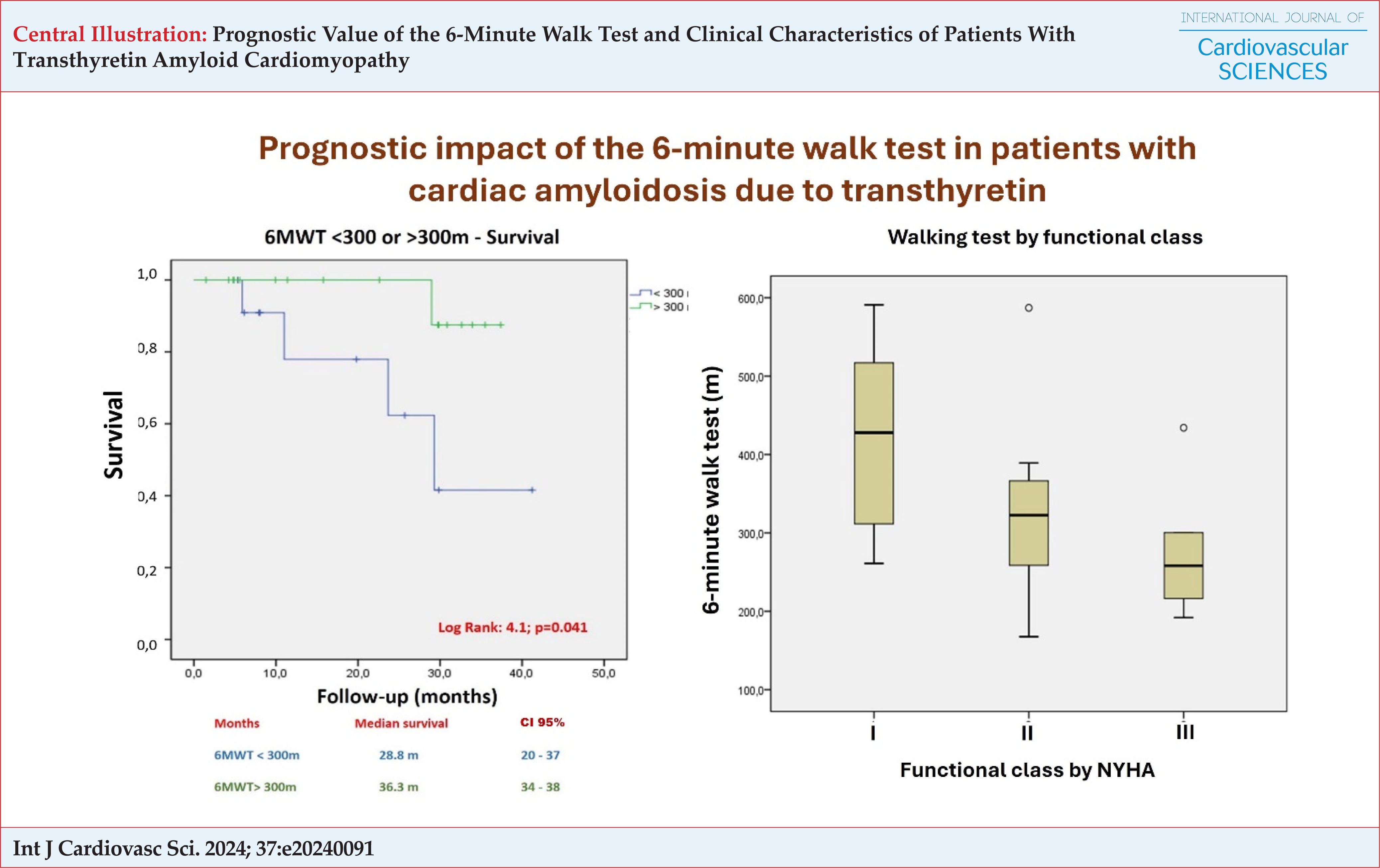
Results: A total of 32 patients were analyzed; 59.4% had the hereditary form (ATTRh), of which 63.2% were Val142Ile. Mean left ventricular ejection fraction (LVEF) was lower in the ATTRh group when compared to the wild-type form (ATTRwt) [42 ±11 versus 52± 9 %; p = 0.029]. Median distance walked in the 6MWT was 328 m (269 – 397; IQR) in ATTRwt and 304 m (246 – 387; IQR) in ATTRh, with no difference between groups (p = 0.833). In patients with a distance <300 m in the 6MWT, survival was lower (28.8 vs 36.3 months; p = 0.041).
Conclusions: A distance <300 m walked in the 6MWT was linked to shorter event-free survival in patients with ATTR-CM. Functional capacity of most patients was very low, and no differences were observed in the distance covered between the wild-type form and the hereditary form of ATTR.
Keywords:
Amyloidosis; Prealbumin; Heart Failure; Walk Test
Introduction
Transthyretin amyloid cardiomyopathy (ATTR-CM) is a condition characterized by the accumulation of amyloid material, derived from transthyretin (TTR) polymers, within the heart. TTR is one of the five amyloidogenic proteins known to affect cardiac function.1,2 There are two recognized forms of this condition: the wild-type form (ATTRwt) and the hereditary or variant form (ATTRh). Over 140 variants of the hereditary form have been identified, with the Val50Met variant being the most prevalent, primarily manifesting as a neurological disorder.1,2 Conversely, variants such as Val142Ile are predominantly associated with cardiac pathology.1,3 Recent efforts have focused on standardizing assessment protocols for ATTR, aiming to elucidate the natural progression of the disease.2,4 Although establishing specialized centers for the diagnosis and treatment of ATTR is crucial, it is even more important to conduct research that delineates the various clinical and phenotypic presentations of the disease. Such studies are essential because manifestations can vary significantly depending on the type of ATTR and, in the case of ATTRh, the specific mutation involved. This underscores the need for further research to clarify these variations.
Despite the availability of multiple scales and tests for assessing risk and prognosis in patients with heart failure (HF), the 6-minute walk test (6MWT) is among the most widely used clinical tools due to its practicality and significant prognostic value.4,5 It is well established that less than 300 meters covered during the 6MWT is indicative of an unfavorable prognosis.5,6 However, there is a paucity of information regarding the utility of the 6MWT in patients with ATTR, particularly concerning the differences between various forms and variants of the disease. A previous case report highlighted a reduced walking distance in patients undergoing liver transplantation compared to normal controls.7 In addition, some studies on patients with AL amyloidosis have used the 6MWT to assess those with cardiac involvement,5,8 however, the correlation between functional class (FC) and 6MWT results in these patients remains insufficiently explored in the literature.9
Therefore, the objective of this study is to evaluate the functional capacity and analyze the prognostic value of the 6MWT in patients with ATTR-CM, as well as to identify the clinical characteristics associated with different types of ATTR.
Materials and Methods
This is a unicentric, descriptive, and retrospective study that included patients diagnosed with ATTR-CM from 2020 to 2023 at a cardiac referral center in São Paulo, Brazil. Patient follow-up was conducted by reviewing medical records at our outpatient clinic. After performing the 6MWT, patients were followed up in the amyloidosis unit of our institution for subsequent consultations and therapeutic adjustments according to institutional protocols. The 6MWT was performed according to the American Thoracic Society Statement Guidelines,10 and patients’ functional capacity was evaluated according to the classification published by Dourado et al.,11 which is adapted by age, sex and compared with cardiopulmonary exercise testing.11
A composite primary outcome of all-cause mortality and cardiovascular readmissions was defined, and later correlated between a 6MWT distance of less than 300 meters. Only patients aged 18 years or older, in whom the diagnosis of ATTR amyloidosis with cardiac involvement had been confirmed, were included.
Confirmation criteria included amyloid deposits in cardiac tissue with positive Congo red staining or technetium scintigraphy (99m Tc-pyrophosphate [PYP-Tc]) showing grade 2 or 3 cardiac uptake in the absence of an abnormal free light chain ratio. Exclusion criteria included patients who did not perform or complete the 6MWT due to contraindications such as a resting heart rate greater than 120 beats per minute, systolic blood pressure above 180 mmHg, diastolic blood pressure above 100 mmHg, or inability to walk.
Socio-demographic data, clinical history, and laboratory, genetic tests, and imaging studies’ results for the specified period were collected from the institution's medical records. The 6MWT was conducted in the clinical research unit, in a corridor with cones marking 30-meter intervals. All tests were supervised by trained staff. Patients with ATTRh amyloidosis were subdivided into two groups: one with the Val142Ile mutation and the other with different mutations (Tables 1 and 2).
Baseline characteristics of the 32 patients with transthyretin amyloidosis (ATTR) by type of disease (hereditary and wild-type)
Statistical analysis
The sample size was determined by convenience. Continuous variables with a normal distribution were described as mean and standard deviation (± SD), while continuous variables with a non-normal distribution were described as median and interquartile range (IQR). Categorical variables were expressed as absolute (n) and relative (%) frequencies. The Kolmogorov-Smirnov test was performed to evaluate the normality of the sample. Comparisons of parametric variables were performed using the independent Student's t-test, while non-parametric variables were compared using the Mann-Whitney U test. Fisher's exact test or the chi-square test was used for categorical variables. The significance level adopted in the statistical analysis was 5%. For comparison of three groups, the Kruskal-Wallis test for medians was used and if there was a statistically significant difference the post hoc test was applied. Correlations were calculated using Spearman's correlation coefficient. Univariate and multivariate Cox regression analyses were performed to identify predictors of mortality, and survival analysis was conducted using the Kaplan-Meier method. Statistical analyses were performed using SPSS software, version 22 (IBM, Armonk, NY).
Results
Out of a total of 37 patients with ATTR-CM, 32 underwent the 6MWT, of whom 90.6% were male, with a mean age of 72 ± 9 years. Most patients had the ATTRh form (59%), with the Val142Ile mutation being the most frequent (63.2%). Most patients were classified as NYHA II in terms of FC . Atrial fibrillation (AF) was more common in the ATTRwt form. Regarding medication use, beta-blockers and vasodilators were infrequently prescribed, while most patients were on diuretics, as expected. Median Nt-ProBNP levels were elevated in both groups, reflecting the severity of the condition in this population. The interventricular septum (IVS) and posterior wall (PW) diameters were 16±2 mm and 15,5 mm, respectively, with a global longitudinal strain of −10 ± 3% (Table 1). No differences were observed between the ATTRh and ATTRwt groups for these variables.
When comparing baseline characteristics by type of ATTR-CM, significant differences were observed in the proportion of black patients, NYHA FC, left ventricular ejection fraction (LVEF), presence of AF, and right ventricular (RV) dysfunction, as shown in Table 1. The distance covered in the 6MWT was not statistically different between the two groups. Regarding echocardiographic variables, LVEF was lower, and RV systolic dysfunction was more prevalent in the ATTRh group compared to the ATTRwt group (Table 1).
When comparing different mutations, including Val142Ile versus other mutations (Val50Met, T80A, Ile88Leu), no significant differences were observed (Table 2). It is noteworthy that the distance covered was shorter as FC worsened (Figure 1). Analysis of FC by groups revealed a statistically significant difference in the 6MWT, with a greater median distance covered in the NYHA I group compared to the NYHA II and III groups [427 (294-539) vs 347 (272-376) vs 216 (203-279) m]. No differences were found in other variables (Table 3). A correlation analysis between the 6MWT and different NYHA FC groups showed a moderate, statistically significant negative correlation [-0.513 (-0.758 to −0.207); p=0.003]. Regarding FC, most patients with ATTR-CM had a very low capacity (84.4%), and only two patients (6.3%) had a regular capacity (Table 4).

Dispersion of the distance covered in the 6MWT by patients with transthyretin amyloidosis by NYHA FC (left) and by disease type (right)
During a median follow-up of 19 months (range 8-29 months), a difference in event-free survival was observed when comparing 6MWT results. In univariate analysis of pre-specified variables, the 6MWT, both as a continuous and dichotomous variable (<300 vs >300 meters), was a predictor of the primary outcome [HR 0.976 (0.958–0.995)] and [HR 5.770 (1.148–29.006)], respectively. Patients who covered less than 300 meters in the 6MWT had lower event-free survival compared to those who covered more than 300 meters (28.8% vs. 36.3%) (Figure 2). In univariate analysis of other variables, age [HR = 1.037 (0.935–1.149)], LVEF [HR = 0.958 (0.883–1.038)], FC [HR = 2.644 (0.564–12.403)], and ProBNP [HR of 1.000 (1.000–1.000)] were not statistically significant.

Kaplan-Meier curve of the patients with transthyretin amyloidosis in relation to the distance traveled (> 300 and < 300 m)
Discussion
The importance of studies on rare diseases, such as amyloidosis, becomes evident, especially considering advances in the diagnosis and treatment, and the need for useful and reproducible assessment tools. Understanding the prevalence of ATTR type, particularly its hereditary variant, is a crucial step towards achieving therapeutic targets, given the population heterogeneity regarding the mutations involved. In this study, we highlight that the 6MWT had prognostic value in our patient cohort; specifically, survival free from events was lower when the distance walked was less than 300 meters (Central Illustration). Besides, FC of most patients was very low. Additionally, no significant differences in walking distance were observed between different forms of cardiac ATTR or between different mutations. Among other findings, we demonstrated a significant correlation of 6MWT with FC in this population, with the Val142Ile variant being the most prevalent.

The Val142Ile variant is the most common in ATTR-CM, and even more predominant among Afro-descendant patients.12 There is an estimated prevalence of 0.3% in the general population, representing 88% of all variants in ATTRh cases.13 In black populations, the prevalence estimates range from 2% to 4%.12 In our patient cohort, 28% were of Black race, all presenting the Val142Ile variant. Comparatively, the global prevalence is 6%, as reported in the THAOS study.14 Other studies, except for a French cohort study, showed even lower prevalence rates.12,15-17
Heterogeneous evidence exists when analyzing prognosis between amyloidosis types, ATTRh, and ATTRwt. For example, in the ATTR-ACT study, patients with ATTRh (58% with Val142Ile) had unfavorable outcomes compared to ATTRwt patients.18 However, it is important to note that at the study outset, ATTRh patients already presented more severe conditions and walked shorter distances in the 6MWT. When compared with our population, albeit small, we found no difference in walking distance based on the type of cardiac amyloidosis. Nevertheless, across the entire cohort, it is evident that regardless of amyloidosis type, those walking less than 300 meters initially had lower survival free from mortality and hospitalizations.
As mentioned earlier, in HF patients, it is well-established that walking less than 300 meters in the 6MWT is associated with unfavorable prognosis.7,8 This test has played a significant role in amyloidosis studies, serving as an outcome measure in all current therapies for the disease.18,19 However, there is a lack of information on the utility of the 6MWT in ATTR-CM patients, especially regarding differences between subtypes and variants. Some studies indicate a reduced walking distance compared to normal patients.9 Additionally, the 6MWT has shown prognostic value in AL amyloidosis patients; for instance, Pulido et al.5 reported that AL patients with cardiac involvement walked a significantly shorter distance, 368 m vs. 420 m in those without cardiac involvement.8 Similarly, Cohen et al.8 demonstrated the correlation of 6MWT with FC, in which walking more than 350 m was associated with better survival.10 Thus, our results may encourage larger and prospective studies to establish a cutoff value for this tool that is easily applicable in this entity, thereby stratifying the prognosis of these patients and intervening earlier.
This study has several limitations. Firstly, since it was a retrospective study, the 6MWT was measured only at the study's onset, without assessment of a post-treatment 6MWT or correlation with peak oxygen consumption (VO2 peak). Additionally, some patients were referred to our center after prior treatment elsewhere. The study sample was small; however, given the rare nature of the disease reporting the clinical and epidemiological characteristics of our population is paramount. The convenience sampling in this study represents a partial sample of the ATTR-CM population of patients studied at our institution, not reflecting the true scenario of the ATTR-CM population but rather a selected subgroup with better prognosis capable of performing the 6MWT. Another limitation is that data were obtained from electronic medical records without data verification for inter- and intra-observer agreement. Finally, some patients had peripheral nervous system involvement, which may have influenced the analysis.
Conclusions
The 6MWT proves to be a simple and objective measure of exercise FC, correlated with NYHA class and survival in patients with ATTR-CM. When the walked distance was less than 300 meters, a lower rate of event-free survival was observed, with no differences found in the walked distance between ATTR forms or different ATTRh mutations. FC of most patients was very low.
-
Sources of Funding
There were no external funding sources for this study.
-
Study Association
This study is not associated with any thesis or dissertation work.
-
Ethics Approval and Consent to Participate
This article does not contain any studies with human participants or animals performed by any of the authors.
References
-
1 Kittleson MM, Ruberg FL, Ambardekar AV, Brannagan TH, Cheng RK, Clarke JO, et al. 2023 ACC Expert Consensus Decision Pathway on Comprehensive Multidisciplinary Care for the Patient with Cardiac Amyloidosis: A Report of the American College of Cardiology Solution Set Oversight Committee. J Am Coll Cardiol. 2023;81(11):1076-126. doi: 10.1016/j.jacc.2022.11.022.
» https://doi.org/10.1016/j.jacc.2022.11.022 -
2 Simões MV, Fernandes F, Marcondes-Braga FG, Scheinberg P, Correia EB, Rohde LEP, et al. Position Statement on Diagnosis and Treatment of Cardiac Amyloidosis - 2021. Arq Bras Cardiol. 2021;117(3):561-98. doi: 10.36660/abc.20210718.
» https://doi.org/10.36660/abc.20210718 -
3 Garcia-Pavia P, Domínguez F, Gonzalez-Lopez E. Transthyretin Amyloid Cardiomyopathy. Med Clin. 2021;156(3):126-34. doi: 10.1016/j.medcli.2020.06.064.
» https://doi.org/10.1016/j.medcli.2020.06.064 -
4 Vita GL, Stancanelli C, Gentile L, Barcellona C, Russo M, Di Bella G, et al. 6MWT Performance Correlates with Peripheral Neuropathy but Not with Cardiac Involvement in Patients with Hereditary Transthyretin Amyloidosis (hATTR). Neuromuscul Disord. 2019;29(3):213-20. doi: 10.1016/j.nmd.2018.11.002.
» https://doi.org/10.1016/j.nmd.2018.11.002 -
5 Pulido V, Doros G, Berk JL, Sanchorawala V. The Six-minute Walk Test in Patients with AL Amyloidosis: A Single Centre Case Series. Br J Haematol. 2017;177(3):388-94. doi: 10.1111/bjh.14586.
» https://doi.org/10.1111/bjh.14586 -
6 Giannitsi S, Bougiakli M, Bechlioulis A, Kotsia A, Michalis LK, Naka KK. 6-minute Walking Test: A Useful Tool in the Management of Heart Failure Patients. Ther Adv Cardiovasc Dis. 2019;13:1753944719870084. doi: 10.1177/1753944719870084.
» https://doi.org/10.1177/1753944719870084 -
7 Tomás MT, Santa-Clara MH, Monteiro E, Baynard T, Carnero EÁ, Bruno PM, et al. Body Composition, Muscle Strength, Functional Capacity, and Physical Disability Risk in Liver Transplanted Familial Amyloidotic Polyneuropathy Patients. Clin Transplant. 2011;25(4):E406-14. doi: 10.1111/j.1399-0012.2011.01436.x.
» https://doi.org/10.1111/j.1399-0012.2011.01436.x -
8 Cohen OC, Sathyanath A, Petrie A, Ravichandran S, Law S, Manwani R, et al. Prognostic Importance of the 6 Min Walk Test in Light Chain (AL) Amyloidosis. Heart. 2022;108(20):1616-22. doi: 10.1136/heartjnl-2021-320703.
» https://doi.org/10.1136/heartjnl-2021-320703 -
9 Yap J, Lim FY, Gao F, Teo LL, Lam CS, Yeo KK. Correlation of the New York Heart Association Classification and the 6-Minute Walk Distance: A Systematic Review. Clin Cardiol. 2015;38(10):621-8. doi: 10.1002/clc.22468.
» https://doi.org/10.1002/clc.22468 -
10 ATS Committee on Proficiency Standards for Clinical Pulmonary Function Laboratories. ATS Statement: Guidelines for the Six-minute Walk Test. Am J Respir Crit Care Med. 2002;166(1):111-7. doi: 10.1164/ajrccm.166.1.at1102.
» https://doi.org/10.1164/ajrccm.166.1.at1102 -
11 Dourado VZ, Nishiaka RK, Simões MSMP, Lauria VT, Tanni SE, Godoy I, et al. Classification of Cardiorespiratory Fitness Using the Six-minute Walk Test in Adults: Comparison with Cardiopulmonary Exercise Testing. Pulmonology. 2021;27(6):500-8. doi: 10.1016/j.pulmoe.2021.03.006.
» https://doi.org/10.1016/j.pulmoe.2021.03.006 -
12 Chandrashekar P, Alhuneafat L, Mannello M, Al-Rashdan L, Kim MM, Dungu J, et al. Prevalence and Outcomes of p. Val142Ile TTR Amyloidosis Cardiomyopathy: A Systematic Review. Circ Genom Precis Med. 2021;14(5):e003356. doi: 10.1161/CIRCGEN.121.003356.
» https://doi.org/10.1161/CIRCGEN.121.003356 -
13 Pueyo CL, Arregui MÁA, Gutierrez AG, Juana EB, Guillén SM. Estimating the Prevalence of Allelic Variants in the Transthyretin Gene by Analysing Large-scale Sequencing Data. Eur J Hum Genet. 2019;27(5):783-91. doi: 10.1038/s41431-019-0337-1.
» https://doi.org/10.1038/s41431-019-0337-1 -
14 Dispenzieri A, Coelho T, Conceição I, Waddington-Cruz M, Wixner J, Kristen AV, et al. Clinical and Genetic Profile of Patients Enrolled in the Transthyretin Amyloidosis Outcomes Survey (THAOS): 14-Year Update. Orphanet J Rare Dis. 2022;17(1):236. doi: 10.1186/s13023-022-02359-w.
» https://doi.org/10.1186/s13023-022-02359-w -
15 Rapezzi C, Quarta CC, Obici L, Perfetto F, Longhi S, Salvi F, et al. Disease Profile and Differential Diagnosis of Hereditary Transthyretin-related Amyloidosis with Exclusively Cardiac Phenotype: An Italian Perspective. Eur Heart J. 2013;34(7):520-8. doi: 10.1093/eurheartj/ehs123.
» https://doi.org/10.1093/eurheartj/ehs123 -
16 Jang MA, Lee GY, Kim K, Kim SJ, Kim JS, Lee SY, et al. Asp58Ala is the Predominant Mutation of the TTR Gene in Korean Patients with Hereditary Transthyretin-related Amyloidosis. Ann Hum Genet. 2015;79(2):99-107. doi: 10.1111/ahg.12101.
» https://doi.org/10.1111/ahg.12101 -
17 Auer-Grumbach M, Rettl R, Ablasser K, Agis H, Beetz C, Duca F, et al. Hereditary ATTR Amyloidosis in Austria: Prevalence and Epidemiological Hot Spots. J Clin Med. 2020;9(7):2234. doi: 10.3390/jcm9072234.
» https://doi.org/10.3390/jcm9072234 -
18 Rapezzi C, Elliott P, Damy T, Nativi-Nicolau J, Berk JL, Velazquez EJ, et al. Efficacy of Tafamidis in Patients with Hereditary and Wild-type Transthyretin Amyloid Cardiomyopathy: Further Analyses from ATTR-ACT. JACC Heart Fail. 2021;9(2):115-23. doi: 10.1016/j.jchf.2020.09.011.
» https://doi.org/10.1016/j.jchf.2020.09.011 -
19 Maurer MS, Kale P, Fontana M, Berk JL, Grogan M, Gustafsson F, et al. Patisiran Treatment in Patients with Transthyretin Cardiac Amyloidosis. N Engl J Med. 2023;389(17):1553-65. doi: 10.1056/NEJMoa2300757.
» https://doi.org/10.1056/NEJMoa2300757
Edited by
-
Editor responsible for the review: Marcus Vinicius Simões

 ATTR: transthyretin amyloidosis; NYHA: New York Heart Association.

 Prognostic impact of the six-minute walk test in patients with ATTR-CM