 Treatment Adherence and Cardiometabolic Goals in Patients with Coronary Artery Disease in the North Region of Brazil
Abstract
Background: Patients with coronary artery disease (CAD) are categorized by cardiovascular risk depending on associated risk factors and events, requiring more rigorous treatment goals.
Objective: To investigate treatment adherence, using the Morisky–Green test, and achievement of metabolic goals at a tertiary public hospital in Belém, Pará, Brazil.
Methods: This observational, cross-sectional, and analytical study was conducted with a sample of 106 patients with CAD at very high cardiovascular risk, treated in the outpatient clinic of a tertiary care hospital. The following data were collected over a 4-month period: demographic information, medication adherence (Morisky–Green test), modifiable risk factors, and laboratory parameters (lipids, blood glucose, blood pressure, heart rate, and abdominal circumference). Associations were assessed using chi-square test or G test, and correlations were analyzed using Spearman's test, adopting a significance level of 5% (p < 0.05).
Results: Treatment adherence analysis showed an adherence rate of 16.0%. Low-density lipoprotein (LDL) -cholesterol levels were above the target of 50 mg/dL in 72.6% of patients, and normal blood glucose was achieved in 75.5%. Education level was the only epidemiological variable associated with therapeutic non-adherence (p = 0.0130). Regarding financial aspects, only 9.4% reported persistent difficulty in purchasing medications; among those reporting difficulty, high-potency statins were the most frequently cited (58.6%).
Conclusions: Education level was shown to be a determining factor in understanding treatment, impacting adherence. Laboratory tests revealed significant deficiencies in lipid control, reinforcing the need for clinical optimization. Difficulties in accessing statins and low medication adherence underscore the importance of educational interventions and multidisciplinary approaches for better management of CAD.
Keywords:
Coronary Artery Disease; Treatment Adherence and Compliance; Risk Factors
Introduction
Cardiovascular diseases are the leading cause of death in Brazil and worldwide. Although mortality has decreased in high-income countries over recent years, it has been increasing in individuals under 60 years of age in low- and middle-income countries.1–3
In Brazil, approximately 20% of deaths in individuals over 30 years of age are due to ischemic heart disease. In 2023, according to Cardiovascular Statistics – Brazil, coronary artery disease (CAD) remained one of the leading causes of death in Brazil, with age-standardized estimates of approximately 67.1 deaths per 100,000 inhabitants in 2021.4 According to the Brazilian Society of Cardiology, CAD was the leading cause of death in all Brazilian federative units, including the state of Pará. There are, however, fewer studies and less data available in Pará, possibly associated with underreporting in a large territory.5
Given the recognized severity of CAD, studies such as Framingham and INTERHEART aimed to identify measurable risk factors associated with changes in the prognosis of CAD and directly implicated in the genesis, progression, and occurrence of future cardiovascular events.6–8 The 2008 Global Cardiovascular Risk is designed to organize information from the main guidelines and protocols to predict the occurrence of events such as CAD, stroke, peripheral artery disease, and heart failure over 10 years.9

Risk factors are classified as modifiable or non-modifiable. The former include lipid levels, systemic arterial hypertension, diabetes, smoking, physical activity, obesity, alcohol consumption, and psychosocial factors. Non-modifiable risk factors include heredity, sex (with higher prevalence in men depending on the age group), and age (given the tendency for the disease to appear in age groups above 45 years for men and 55 years for women).10,11
In patients with CAD, proper care of modifiable risk factors is fundamental to reducing major cardiovascular events such as reinfarction, stenosis, stent thrombosis, and mortality from cardiovascular causes.12 Evidence such as that from the COURAGE trial has indicated comparable efficacy between intensive medical strategies combined with lifestyle changes and percutaneous intervention. Even so, a large proportion of patients do not demonstrate good adherence to proposed treatment.13,14
It is therefore necessary to investigate treatment adherence and the achievement of goals established by national guidelines, especially in areas where data on the situation in the Brazilian state of Pará are lacking. Accordingly, the objective of the study was to investigate medication adherence and control of metabolic goals in patients with very high-risk CAD treated at a tertiary public referral hospital in Belém, Pará.
Methods
This observational, cross-sectional, and analytical study included patients diagnosed with CAD and followed up at the CAD outpatient clinic of a tertiary care hospital in the Brazilian state of Pará. Considering that approximately 36 patients were seen per week at the CAD outpatient clinic, totaling 576 patients over a 4-month period, the sample size was calculated using the finite population formula, as shown in Figure 1, resulting in a final sample size of 106 patients.

Data collection was carried out by trained undergraduate students between March 2023 and June 2023, using a structured four-part form. The first part covered basic patient identification, including sex, age, and type of intervention (coronary artery bypass grafting, percutaneous coronary intervention, or medical treatment). Subsequently, a semi-structured interview addressing medication adherence was conducted, based on an adaptation of the Morisky–Green test. This test was chosen because it has been validated in Brazil, consists of four objective questions, and is therefore easy to apply in high-demand outpatient settings at a low cost. Patients were classified as non-adherent if they answered "yes" to any of the four questions, which addressed aspects such as potentially forgetting to take medications, confusion in medication use, interruption of treatment when feeling better or worse, or reporting adverse effects. This interview was complemented by a graded scale with a financial component. Financial difficulties in purchasing medications were assessed by means of a structured self-report question, with responses categorized as never, sometimes, and always, aiming to identify patients’ perception of economic barriers to pharmacological treatment access. The third part of the form addressed modifiable factors related to CAD, such as diet, smoking cessation, and physical activity. Finally, laboratory and clinical data obtained from medical records were analyzed to verify whether the therapeutic goals stipulated in the guidelines were being achieved.15,16 The established goals were as follows: low-density lipoprotein (LDL)-cholesterol < 50 mg/dL, blood pressure between 120/60 mmHg and 130/80 mmHg, abdominal circumference < 102 cm for men and < 88 cm for women, fasting blood glucose between 70 and 136 mg/dL, random blood glucose < 200 mg/dL, heart rate < 70 bpm, and complete smoking cessation.
The study included patients diagnosed with CAD, treated at a cardiology outpatient clinic of a public referral hospital, provided they were under active follow-up, were over 18 years of age, and demonstrated adequate clinical conditions to understand the interview. Patients with cognitive deficits, significant communication impairments, decompensated comorbidities that would make care unfeasible, and patients without updated laboratory tests in their medical records were excluded.
The study followed the ethical principles of research involving human participants and received approval from the local Research Ethics Committee under opinion number: 6.161.327. All participants were informed of study objectives and procedures and signed a free and informed consent form.
Statistical analysis
Sample characteristics were entered into a Microsoft® Excel® 2016 spreadsheet. Descriptive statistics were used to present the results in tables and graphs. Categorical variables were presented as absolute and relative frequencies.
Analytical statistics included the G test and chi-square goodness-of-fit test to verify whether the frequency distributions observed in the sample differed significantly from expected distributions. Spearman's correlation coefficient was calculated to assess the association between treatment adherence and epidemiological variables.
Descriptive and analytical statistics were obtained using Bioestat 5.4 software. For hypothesis testing, a significance level of α = 0.05 (or 5%) was adopted.
Results
The sample consisted of 106 patients with a statistically significant predominance of male patients (73.6%; p < 0.0001). The most prevalent age ranges were 50 to 59 years (31.1%) and 60 to 69 years (32.1%), also showing a significant difference between groups. Regarding education level, a wide variation was observed, ranging from illiterate patients (5.7%) to patients with complete higher education (3.8%); incomplete primary education was the most frequent category (29.2%), as shown in Table 1. Regarding the type of CAD treatment, the majority of patients underwent percutaneous coronary intervention (57.5%), followed by coronary artery bypass grafting (34.0%) and medical treatment (10.4%), with a statistically significant difference between groups.
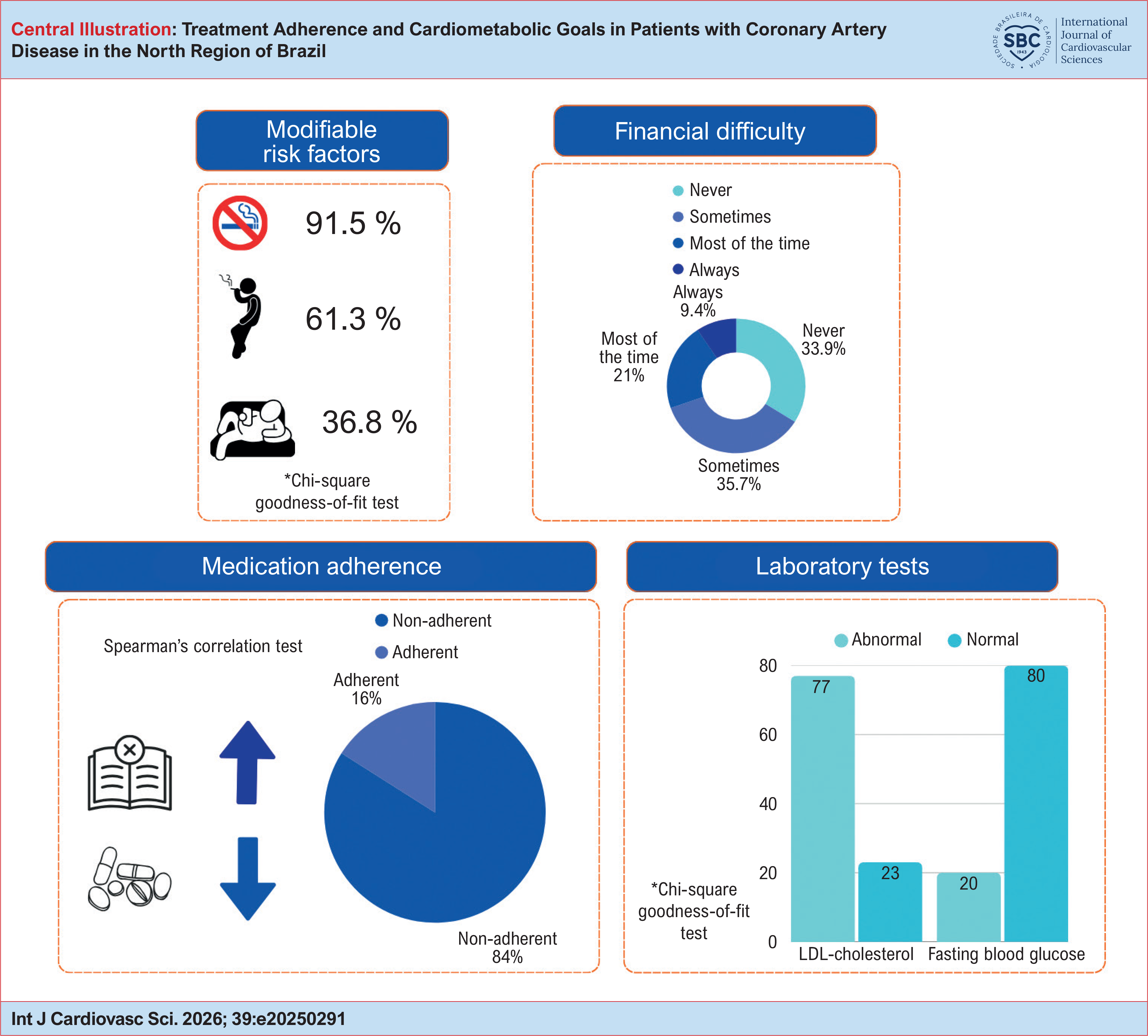
With respect to modifiable risk factors, a statistically significant majority of the sample reported that they were not current smokers (91.5%); it is important to note, however, that a statistically significant proportion also stated that they had been smokers in the past (61.3%). Among patients who smoked, the majority reported consuming 20 to 29 pack-years (23.1%), followed by the group consuming between 10 and 19 packs annually (21.5%), as shown in Table 2.
A statistically significant majority of patients (73.6%) did not receive nutritional follow-up. Regarding physical activity, there was a significant difference in weekly frequency, with the largest proportion reporting that they never engaged in physical activity (36.8%).
In adherence analysis, 42.5% of patients reported that they sometimes (37.7%) or most of the time (4.7%) forgot to take their daily medications. Confusion regarding medication use was less frequent (19.8%). When asked about perceived effectiveness, a statistically significant majority of patients reported that the medications worked well (84.9%), followed by those reporting fair effectiveness (13.2%). A small proportion reported medication-related discomfort (10.4%); among these, enalapril was the most cited (45.5%), as shown in Table 3.
Patient profile according to the adapted Morisky–Green criteria for medication adherence, HCGV, 2023
An adherence rate of 16.0% was observed in the sample, with a statistically significant non-adherence rate of 84.0%, as shown in the Central Illustration.
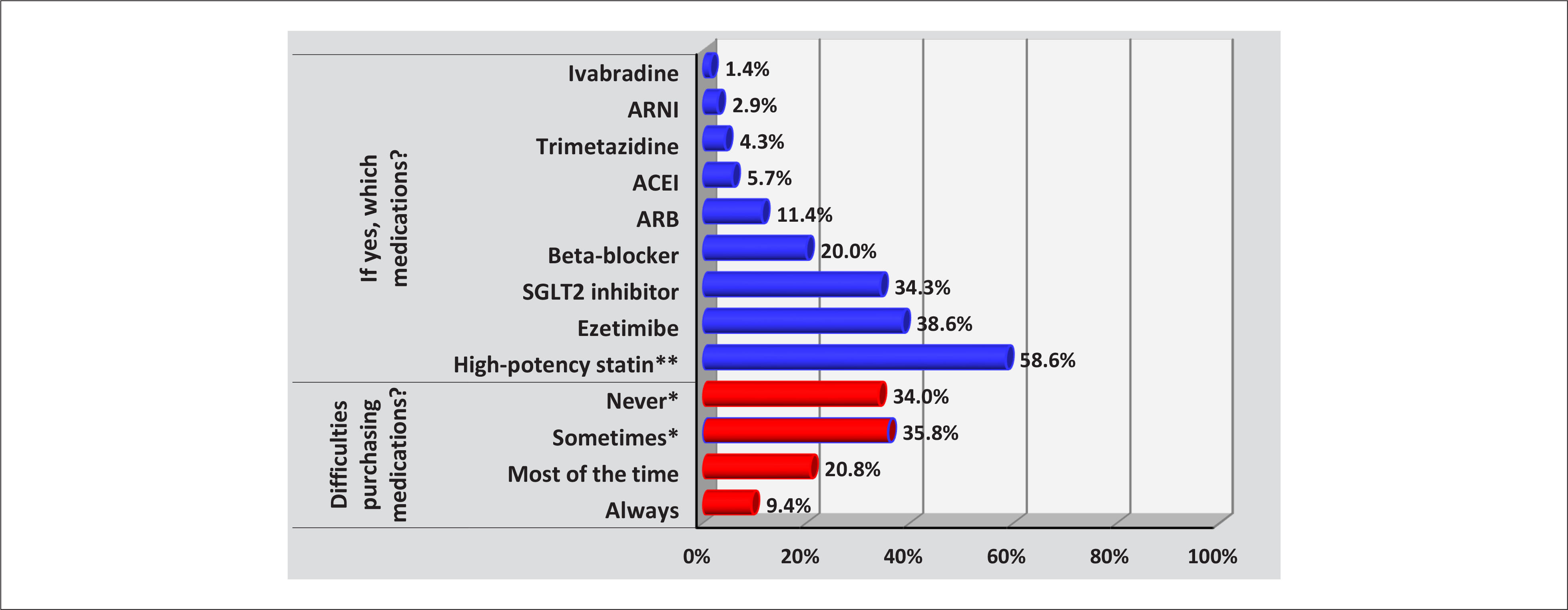
Most participants responded never or sometimes, when asked if they faced difficulties in purchasing their monthly medications. The most frequent response was sometimes (35.8%), followed by never (34.0%). Among those who reported difficulty, the most frequently reported medication was high-potency statins (58.6%), as shown in Figure 2.
Frequency of difficulties in purchasing medication and associated drug classes, HCGV, 2023. Source: Study protocol. *p = 0.0002, Chi-square goodness-of-fit test; †p < 0.0001, G test for goodness-of-fit. ACEI: angiotensin converting enzyme inhibitor; ARB: angiotensin receptor blocker; ARNI: angiotensin receptor–neprilysin inhibitor; SGLT2: sodium–glucose cotransporter 2.
Laboratory analysis revealed a statistically significant proportion of patients with abnormal LDL-cholesterol (72.6%). Fasting blood glucose showed normal levels in 75.5% of patients, also statistically significant. On the other hand, no statistically significant differences were observed in HDL-cholesterol, triglycerides, blood pressure, heart rate, and abdominal circumference, as shown in Table 4.
Correlations between treatment adherence and epidemiological variables were investigated. As shown in Table 5, a statistically significant association was only found for education level.
Discussion
This study confirms a predominance of male patients in the rates of individuals affected by CAD, reaching approximately 70% of the total study population. This fact is consistent with national research, such as Cardiovascular Statistics – Brazil 2023, where the prevalence of CAD per 100,000 inhabitants was twice as high among men than women.17
This discrepancy is complex and multifactorial. Risk factors for traditional cardiovascular diseases are more prevalent among men, reflecting sociocultural conditions that reinforce behaviors in this group.18 This generates a vicious cycle, wherein early exposure to certain habits, such as smoking, physical inactivity, and excessive alcohol consumption, promotes the development of conditions such as obesity, systemic arterial hypertension, and hypercholesterolemia; finally, the sum of these new factors and their accumulation over the years promotes CAD.19
Regarding education level, the most predominant group consists of patients with incomplete primary education. This finding is consistent with other national studies, where education levels are related to socioeconomic conditions, interfering with understanding of the importance of preventive measures for cardiovascular diseases and the ability to perform recommended lifestyle change tasks and the acquisition of resources to carry them out.20,21
Nonetheless, Brazilian studies have assessed the presence of risk factors in professors at private universities, since they theoretically have a higher level of understanding of the health–disease process. A study in the state of Bahia demonstrated that up to 70% of professors had elevated body mass index, and more than half had abnormal LDL-cholesterol.22 They also had increased levels of physical and emotional stress, which were assessed as indirect factors, such as excessive workload, number of jobs, and leisure time/physical exercise; therefore, it is likely that lifestyle habits and socioeconomic conditions explain the observed results.23
In assessment of modifiable risk factors, smoking has been strongly associated with worse clinical outcomes in patients with CAD. In this study, the majority of participants (approximately 60%) were former smokers. Studies have shown that smokers have a 70% greater chance of developing CAD compared to non-smokers.24 Nonetheless, former smokers remain at an increased risk of developing CAD compared to those who have never smoked.
Regarding other modifiable risk factors, both nutritional follow-up and physical activity presented alarming results, with 73% of patients reporting that they did not receive nutritional follow-up and only 43% engaging in regular physical exercise. This low adherence is consistent with other studies, for instance, a Brazilian registry highlighting that 90.8% of patients with heart problems remain inactive, notwithstanding trends toward increased hours of physical activity in recent years.25,26 Regarding dietary adherence, a literature review revealed that only 54.2% of people follow dietary guidance. However, those who adhere to these recommendations demonstrate better control of blood glucose, weight, and lipid profile.27
When assessing the outcome of medication adherence using the adapted Morisky–Green test criteria, only 16% of participants were adherent to medication therapy. This situation is also reflected in international studies, which have shown that approximately 30% of patients with prior acute myocardial infarction do not maintain medication adherence after hospital discharge for a period exceeding 6 months, and this number may reach 50% within the first year.28,29
A study conducted in Brazil with a sample of 35,000 patients who had a previous event (acute myocardial infarction or stroke), with an indication for the use of high-potency statins, found that only 6.7% were using statins, and only 0.6% were using high-potency statins.9 Similar to the literature, our study found that high-potency statins were the most frequently mentioned medication among patients with financial difficulties, indicating a significant economic barrier to treatment adherence.
Although the Morisky–Green test is the most widely used in Brazil, there are limits to its application. One intrinsic limitation is the fact that it is based on self-report, running the risk of underestimating behavioral, socioeconomic, and structural components of treatment adherence. Complementary methods, such as pill counting, pharmaceutical dispensing records, or more comprehensive scales, could provide a more accurate and comprehensive assessment of medication adherence, especially for more vulnerable populations.30
Even though 65.8% of patients reported not having financial difficulties in purchasing monthly medications, among those who mentioned budgetary limitations, approximately 58% reported difficulty in obtaining high-potency statins. This finding is corroborated by national data from Brazil. A 2022 study by Boing, published in Cadernos de Saúde Pública found that 44% of users of the Brazilian Unified Health System were unable to obtain medications, representing an 8% increase in recent years.31 It is estimated that approximately 60% of patients are unable to obtain specific medications due to lack of availability within the public system. This context is even more severe in low-income populations, where medication expenses can account for up to 80% of family income, twice the national average.32
Given the high rate of non-adherence to treatment observed due to socioeconomic barriers to accessing medication, the present study evaluated the achievement of clinical goals present in current guidelines. The results showed a low proportion of patients with LDL-cholesterol within the target range (< 50 mg/dL), achieved by only 27.4 % of participants. This is similar to the value found by Bernardi et al.32 in patients after acute myocardial infarction. Underestimation of cardiovascular risk, lack of knowledge about treatment goals, and overemphasis on non-pharmacological interventions, such as diet and aerobic/anaerobic exercise, may be among the factors that explain this unsatisfactory result.33,34
In contrast, fasting blood glucose showed a more favorable profile. Approximately 75% of patients presented adequate levels, similar to the literature, which points to the possibility of preventing type 2 diabetes in patients with controlled risk, even after cardiovascular events.35 This finding should be interpreted with caution, however. Fasting blood glucose is only a momentary assessment of glucose metabolism, which may not adequately reflect chronic glycemic control, especially in patients with CAD at extremely high cardiovascular risk. Current guidelines recommend glycated hemoglobin (HbA1c) as the gold standard for assessment of long-term metabolic control, due to its greater stability and correlation with cardiovascular outcomes. The lack of HbA1c in this study, due to the systematic unavailability of this test in the analyzed medical records, constitutes an important methodological limitation and may lead to an underestimation of actual glycemic control. Therefore, future studies should prioritize the inclusion of HbA1c as a central parameter for monitoring this group's metabolic status.
The association between treatment adherence and epidemiological variables, such as education level, has been widely debated in the literature. A study by Soares et al.35 found that, among elderly patients, those with higher education levels understand their health more clearly, which is associated with greater treatment adherence, even with a greater number of medications, corroborating the results found in this study (p = 0.0130). The results thus reinforce the value of education and indicate the need to investigate other socioeconomic and cultural determinants associated with treatment.
This study has certain methodological limitations and limitations arising from the data, which warrant discussion. Firstly, the observational and cross-sectional design does not allow for the establishment of causal relationships, only associative inferences, thus limiting the interpretation of specific results from the perspective of causality. Furthermore, the interviewed population came from a single center, which is a reference center in the cardiology sector. This may introduce selection bias, and the results may not be extrapolated to similar populations assisted by other health services.
Assessment of financial barriers was based on self-reporting, without the aid of standardized economic instruments, which may introduce individual perception bias and limit the objective quantification of the financial impact. Nevertheless, this approach obtained the patients’ direct experience in situations of social vulnerability, which are frequently experienced in highly complex public services. Future studies can use standardized tools to assess the effects of the financial burden of treatment, such as economic burden scales or catastrophic health expenditure indicators, which ensure more rigorous and comparable analyses across different socioeconomic contexts.
With respect to data collection, the use of the Morisky–Green test may represent a limitation, as it depends on subjective responses from patients, which may be influenced by desire to please the researcher, embarrassment, or memory lapses. Finally, assessment of financial burden was equally subjective, thus limiting complete assessment of its impact on this population.
Conclusion
This study found low treatment adherence among patients at a cardiology referral center in the Brazilian Amazon region, according to the Morisky–Green test, representing a significant obstacle to achieving national therapeutic goals, especially in LDL-cholesterol control. The difficulty in reaching this parameter directly impacts cardiovascular morbidity and mortality. Among the associated factors, low educational level was statistically associated with non-adherence, in the context of a predominantly male and vulnerable population. Although the majority of participants did not report financial difficulties, patients with lower income encountered difficulties in accessing high-potency statins, possibly due to prolonged titration and high cost. This study supported the creation of the pharmacy outpatient clinic, which allowed for systematic monitoring of medication regimens previously performed only at the physician's office. This is currently reinforced by a multidisciplinary team, aiming to promote understanding of the importance of these medications and improve long-term adherence. Associated with this are patient-centered educational interventions, such as simplified monitoring and treatment goal-setting tools, which could facilitate understanding of the health–disease process and encourage a more active role in self-care, allowing for monitoring of relevant clinical and laboratory parameters. The combination of these strategies with nutritional follow-up and encouragement of regular physical activity is a promising proposal for a multidisciplinary approach to controlling modifiable risk factors and reducing future cardiovascular events.
-
Sources of Funding
There were no external funding sources for this study.
-
Study Association
This study is not associated with any thesis or dissertation work.
-
Ethics Approval and Consent to Participate
This study was approved by the Ethics Committee of the Fundação Pública Estadual Hospital das Clínicas Gaspar Vianna under the protocol number 6.161.327. All procedures involving human participants were conducted in accordance with the ethical standards outlined in the 1975 Declaration of Helsinki and its later amendments. Informed consent was obtained from all participants prior to their inclusion in the study.
-
Use of Artificial Intelligence
The authors did not use any artificial intelligence tools in the development of this work.
Availability of Research Data
All datasets supporting the results of this study are available upon request from the corresponding author.
References
-
1 World Health Organization. Cardiovascular diseases (CVDs) [Internet]. Geneva: WHO; 2023 [cited 2025 May 19]. Available from: https://www.who.int/news-room/fact-sheets/detail/cardiovascular-diseases-(cvds)
» https://www.who.int/news-room/fact-sheets/detail/cardiovascular-diseases-(cvds) -
2 Roth GA, Mensah GA, Johnson CO, Addolorato G, Ammirati E, Baddour LM, et al. Global Burden of Cardiovascular Diseases and Risk Factors, 1990-2019: Update from the GBD 2019 Study. J Am Coll Cardiol. 2020;76(25):2982-3021. doi: 10.1016/j.jacc.2020.11.010.
» https://doi.org/10.1016/j.jacc.2020.11.010 -
3 GBD 2019 Diseases and Injuries Collaborators. Global burden of 369 Diseases and Injuries in 204 Countries and Territories, 1990-2019: A Systematic Analysis for the Global Burden of Disease Study 2019. Lancet. 2020;396(10258):1204-22. doi: 10.1016/S0140-6736(20)30925-9.
» https://doi.org/10.1016/S0140-6736(20)30925-9 -
4 Oliveira GMM, Brant LCC, Polanczyk CA, Malta DC, Biolo A, Nascimento BR, et al. Cardiovascular Statistics - Brazil 2023. Arq Bras Cardiol. 2024;121(2):e20240079. doi: 10.36660/abc.20240079.
» https://doi.org/10.36660/abc.20240079 -
5 Virdis A. Endothelial Dysfunction in Obesity: Role of Inflammation. High Blood Press Cardiovasc Prev. 2016;23(2):83-5. doi: 10.1007/s40292-016-0133-8.
» https://doi.org/10.1007/s40292-016-0133-8 - 6 Dawber TR. The Framingham Study: The Epidemiology of Atherosclerotic Disease. Cambridge: Harvard University Press; 1980.
-
7 Visseren FLJ, Mach F, Smulders YM, Carballo D, Koskinas KC, Bäck M, et al. 2021 ESC Guidelines on Cardiovascular Disease Prevention in Clinical Practice. Eur Heart J. 2021;42(34):3227-337. doi: 10.1093/eurheartj/ehab484.
» https://doi.org/10.1093/eurheartj/ehab484 -
8 Morisky DE, Green LW, Levine DM. Concurrent and Predictive Validity of a Self-Reported Measure of Medication Adherence. Med Care. 1986;24(1):67-74. doi: 10.1097/00005650-198601000-00007.
» https://doi.org/10.1097/00005650-198601000-00007 -
9 Almeida RN, Rosa MM, Nauman GAL, Silva VES, Moreira AS, Silva MLA, et al. The Use of the Morisky-Green Test in Adherence to Anti-Hypertensive Treatment: Early Detection in Primary Health Care. Rev Arq Cient IMMES. 2020;3(1):132-41. doi: 10.5935/2595-4407/rac.immes.v3n1p132-141.
» https://doi.org/10.5935/2595-4407/rac.immes.v3n1p132-141 -
10 Brasil. Ministério da Saúde. Diretrizes para o Cuidado das Pessoas com Doenças Crônicas na Atenção Primária à Saúde [Internet]. Brasília: Ministério da Saúde; 2022 [cited 2025 May 19]. Available from: https://www.gov.br/saude/pt-br/assuntos/saude-de-a-a-z/d/doencas-cronicas-nao-transmissiveis-dcnt
» https://www.gov.br/saude/pt-br/assuntos/saude-de-a-a-z/d/doencas-cronicas-nao-transmissiveis-dcnt -
11 Boden WE, O’Rourke RA, Teo KK, Hartigan PM, Maron DJ, Kostuk WJ, et al. Optimal Medical Therapy with or without PCI for Stable Coronary Disease. N Engl J Med. 2007;356(15):1503-16. doi: 10.1056/NEJMoa070829.
» https://doi.org/10.1056/NEJMoa070829 -
12 Lucca MB, Fuchs FC, Almeida AS, Wainstein MV, Fuchs FD, Fuchs SC. Secondary Pharmacological Prevention of Coronary Artery Disease among Patients Submitted to Clinical Management, Percutaneous Coronary Intervention, or Coronary Artery Bypass Graft Surgery. Arq Bras Cardiol. 2023;120(2):e20220403. doi: 10.36660/abc.20220403.
» https://doi.org/10.36660/abc.20220403 -
13 World Health Organization. Adherence to Long-Term Therapies: Evidence for Action – Update [Internet]. Geneva: WHO; 2022 [cited 2025 Jan 10]. Available from: https://www.paho.org/sites/default/files/WHO-Adherence-Long-Term-Therapies-Eng-2003.pdf
» https://www.paho.org/sites/default/files/WHO-Adherence-Long-Term-Therapies-Eng-2003.pdf -
14 Précoma DB, Oliveira GMM, Simão AF, Dutra OP, Coelho OR, Izar MCO, et al. Updated Cardiovascular Prevention Guideline of the Brazilian Society of Cardiology - 2019. Arq Bras Cardiol. 2019;113(4):787-891. doi: 10.5935/abc.20190204.
» https://doi.org/10.5935/abc.20190204 -
15 Barroso WKS, Rodrigues CIS, Bortolotto LA, Mota-Gomes MA, Brandão AA, Feitosa ADM, et al. Brazilian Guidelines of Hypertension - 2020. Arq Bras Cardiol. 2021;116(3):516-658. doi: 10.36660/abc.20201238.
» https://doi.org/10.36660/abc.20201238 -
16 Oliveira GMM, Brant LCC, Polanczyk CA, Malta DC, Biolo A, Nascimento BR, et al. Cardiovascular Statistics - Brazil 2021. Arq Bras Cardiol. 2022;118(1):115-373. doi: 10.36660/abc.20211012.
» https://doi.org/10.36660/abc.20211012 -
17 Santos FBD, Schneider BC, Valença MS, Peter NB, Muniz LC. Behavioral Risk Factors for Cardiovascular Diseases in Adolescents from the Rural Area of a Municipality in Southern Brazil. Cad Saude Publica. 2021 Mar 12;37(2):e00241119. doi: 10.1590/0102-311X00241119.
» https://doi.org/10.1590/0102-311X00241119 -
18 Silva AG, Souza JB, Gomes CS, Silva TPR, Sá ACMGM, Malta DC. Multiple Behavioral Risk Factors for Non-Communicable Diseases among the Adolescent Population in Brazil: The Analysis Derived from the Brazilian National Survey of School Health 2019. BMC Pediatr. 2024;24(1):122. doi: 10.1186/s12887-024-04601-9.
» https://doi.org/10.1186/s12887-024-04601-9 -
19 Victor A, Gotine ARM, Mahoche M, Vasco MD, Xavier SP, Rondo P, et al. Association between Educational Level and Premature Death from Cardiovascular Diseases in Adults in Brazil. Res Soc Dev. 2022;11(15):e108111536025. doi: 10.33448/rsd-v11i15.36025.
» https://doi.org/10.33448/rsd-v11i15.36025 -
20 Barreto J, Silva JCQE, Sposito AC, Carvalho LS. The Impact of Education on All-Cause Mortality Following St-Segment Elevation Myocardial Infarction (STEMI): Results from the Brazilian Heart Study. Arq Bras Cardiol. 2021;117(1):5-12. doi: 10.36660/abc.20190854.
» https://doi.org/10.36660/abc.20190854 -
21 Santana ÁGC, Mendes KG, Silva CMV, Costa JSP, Andrade RM, Barbosa HL, et al. Risk Factors for Coronary Artery Disease in Faculty of a Private College from the Interior of Bahia. Rev Epidemiol Controle Infecç. 2019;9(3):200-6. doi: 10.17058/reci.v9i3.13198.
» https://doi.org/10.17058/reci.v9i3.13198 -
22 Facci MGD, Urt SC, Barros ATF. Readapted teacher: precariousness of teaching and illness. Psicol Esc Educ. 2018;22(2):281-90. doi: 10.1590/2175-3539201802175546.
» https://doi.org/10.1590/2175-3539201802175546 -
23 Al Rifai M, DeFilippis AP, McEvoy JW, Hall ME, Acien AN, Jones MR, et al. The Relationship between Smoking Intensity and Subclinical Cardiovascular Injury: The Multi-Ethnic Study of Atherosclerosis (MESA). Atherosclerosis. 2017;258:119-30. doi: 10.1016/j.atherosclerosis.2017.01.021.
» https://doi.org/10.1016/j.atherosclerosis.2017.01.021 - 24 Zanin J, Nunes AP, Zanchim MC, Kümpel DA. Quality of Patients’ Diet with Cardiovascular Diseases Attended in a High Complexity Hospital. BRASPEN J. 2018;33(3):282-9.
-
25 Silva EA, Moreira NF, Muraro AP, Souza APA, Ferreira MG, Rodrigues PRM. Simultaneity of Health Risk Behaviors and Associated Factors in the Brazilian Population: Data from the National Health Survey - 2013. Cad Saúde Colet. 2022;30(2):297-307. doi: 10.1590/1414-462X202230020499.
» https://doi.org/10.1590/1414-462X202230020499 -
26 Estrela KCA, Alves ACC, Gomes TT, Isosaki M, et al. Adherence to Nutritional Orientations: A Literature Review. Demetra. 2017;12(1):249-74. doi: 10.12957/demetra.2017.22407.
» https://doi.org/10.12957/demetra.2017.22407 -
27 Piña IL, Di Palo KE, Brown MT, Choudhry NK, Cvengros J, Whalen D, et al. Medication Adherence: Importance, Issues and Policy: A Policy Statement from the American Heart Association. Prog Cardiovasc Dis. 2021;64:111-20. doi: 10.1016/j.pcad.2020.08.003.
» https://doi.org/10.1016/j.pcad.2020.08.003 -
28 Rodriguez F, Maron DJ, Knowles JW, Virani SS, Lin S, Heidenreich PA. Association of Statin Adherence with Mortality in Patients with Atherosclerotic Cardiovascular Disease. JAMA Cardiol. 2019;4(3):206-213. doi: 10.1001/jamacardio.2018.4936.
» https://doi.org/10.1001/jamacardio.2018.4936 -
29 Hospital Israelita Albert Einstein. Real World Evidence Study of Statin Use in Brazil (RWE-Statins) [Internet]. Bethesda: ClinicalTrials.gov; 2021 [cited 2025 May 19]. Available from: https://clinicaltrials.gov/ct2/show/NCT05285085
» https://clinicaltrials.gov/ct2/show/NCT05285085 -
30 Boing AC, Andrade FB, Bertoldi AD, Peres KGA, Massuda A, Boing AF. Prevalence Rates and Inequalities in Access to Medicines by Users of the Brazilian Unified National Health System in 2013 and 2019. Cad Saude Publica. 2022;38(6):e00114721. doi: 10.1590/0102-311XPT114721.
» https://doi.org/10.1590/0102-311XPT114721 -
31 Carrança T. Como Falta de Medicamentos no SUS empurra 10 Milhões de Brasileiros à Pobreza por Ano [Internet]. São Paulo: BBC News Brasil; 2022. Available from: https://www.bbc.com/portuguese/brasil-63137412
» https://www.bbc.com/portuguese/brasil-63137412 -
32 Bernardi A, Olandoski M, Erbano LO, Guarita-Souza LC, Baena CP, Faria-Neto JR. Achievement of LDL-Cholesterol Goals after Acute Myocardial Infarction: Real-World Data from the City of Curitiba Public Health System. Arq Bras Cardiol. 2022;118(6):1018-25. doi: 10.36660/abc.20210328.
» https://doi.org/10.36660/abc.20210328 -
33 Cesena F. Achievement of LDL-Cholesterol Targets: Why do We Fail, and How Can We Improve? Arq Bras Cardiol. 2022;118(6):1026-7. doi: 10.36660/abc.20220288.
» https://doi.org/10.36660/abc.20220288 -
34 Faludi AA, Izar MCO, Saraiva JFK, Bianco HT, Chacra APM, Bertoluci MC, et al. Diretriz Brasileira Baseada em Evidências sobre Prevenção de Doenças Cardiovasculares em Pacientes com Diabetes: Posicionamento da Sociedade Brasileira de Diabetes (SBD), da Sociedade Brasileira de Cardiologia (SBC) e da Sociedade Brasileira de Endocrinologia e Metabologia (SBEM). Arq Bras Cardiol. 2017;109(6 Suppl 1):1-31. doi: 10.5935/abc.20170188.
» https://doi.org/10.5935/abc.20170188 -
35 Soares CR, Fukujima MM, Costa PCP, Neves VR, Rosa AS, Okuno MFP. Adesão e Barreiras à Terapêutica Medicamentosa: Relação com o Risco de Queda em Idosos. Texto Contexto Enferm. 2022;31:e20200552. doi: 10.1590/1980-265X-TCE-2020-0552.
» https://doi.org/10.1590/1980-265X-TCE-2020-0552
Edited by
-
Editor responsible for the review:
Fernando Costa