 Efficacy of Cardiac Myosin Inhibitors in Symptomatic Hypertrophic Cardiomyopathy: An Updated Meta-Analysis and Systematic Review
Abstract
Background: This study evaluates the efficacy of cardiac myosin inhibitors (CMI), which appear to be an innovative alternative for hypertrophic cardiomyopathy (HCM), a disease lacking highly effective pharmacologic treatments.
Objective: To provide updated efficacy data on CMI (aficamten or mavacamten) in symptomatic HCM.
Materials and methods: We searched PubMed, Embase, and Cochrane databases for randomized controlled trials comparing CMI to placebo in symptomatic HCM, reporting: (1) New York Heart Association (NYHA) functional class improvement; (2) change from baseline in Kansas City Cardiomyopathy Questionnaire clinical summary score (KCCQ-CSS); (3) percent change from baseline in left ventricular outflow tract (LVOT) gradient at rest and after Valsalva maneuver; and (4) serious adverse events. Heterogeneity was examined with I2 statistics, and p values < 0.05 indicated sta tistical significance. Continuous endpoints were analyzed using pooled mean difference (MD), and binary endpoints were analyzed using odds ratios (OR), both with 95% confidence intervals (CI).
Results: We included six RCTs with 826 patients, 443 of whom received CMI. Compared to placebo, NYHA class improvement was more frequent in patients receiving CMI (OR: 4.10; 95% CI: 2.79 to 6.02; p < 0.00001), with significant differences in KCCQ-CSS change (MD: 7.15; 95% CI: 4.21 to 10.10; p < 0.00001), as well as in LVOT gradient change at rest (MD: −38.25; 95% CI: −46.76 to −29.74; p < 0.00001) and after Valsalva maneuver (MD: −46.49; 95% CI: −54.70 to −38.27; p < 0.00001). There were no significant differences in serious adverse events (OR: 0.64; 95% CI: 0.31 to 1.31; p = 0.22).
Conclusion: CMI shows greater efficacy than placebo in treating symptomatic HCM.
Keywords:
Cardiac Myosins; Manobra de Valsalva; Hypertrophic Cardiomyopathy
Introduction
Hypertrophic cardiomyopathy (HCM) is one of the most common cardiovascular diseases with an intrinsically genetic basis,1,2 classified as autosomal dominant according to the Mendelian model of inheritance.3,4 The primary feature of HCM is left ventricular hypertrophy of various morphologies, in the absence of other causes that could explain the condition.5 It can lead to both heart failure and physical impairment at any age and is often associated with sudden cardiac death among young people and professional athletes.6,7
The current treatment for HCM includes pharmacological options and septal reduction therapies, such as surgical myectomy and alcohol septal ablation. While pharmacological treatment aims to provide symptom relief, there is insufficient data to suggest that it modifies the natural course of the disorder. In general, non-vasodilating beta blockers are considered first-line therapy for HCM. Non-dihydropyridine calcium channel blockers, such as verapamil and diltiazem, are reasonable alternatives to beta blockers. For patients who do not respond to these treatments, advanced options such as disopyramide or further septal reduction are typically the next steps.8,9 Established pharmacological approaches have limitations, including limited clinical efficacy. Thus, cardiac myosin inhibitors (CMI), aficamten and mavacamten, have emerged as alternative treatments for HCM. This class of drugs works by reversibly inhibiting the binding of cardiac myosin to actin through allosteric modulation and has been associated with improvements in exercise capacity, left ventricular outflow tract (LVOT) obstruction, and New York Heart Association (NYHA) functional class, as well as a reduction in the frequency of invasive therapies such as septal reduction.10
Recently, a phase 3 randomized controlled trial (RCT) investigated the efficacy of aficamten for symptomatic obstructive hypertrophic cardiomyopathy (oHCM).11 The study included a significantly larger number of patients randomized to receive aficamten or placebo along with standard therapy as a treatment strategy for HCM. Therefore, we aimed to conduct an updated systematic review and meta-analysis of RCTs to compare the effectiveness of CMI versus placebo in a larger population, as well as to examine secondary outcomes, which individual studies might have less power to address. A summary of the study is presented in the Central Illustration.
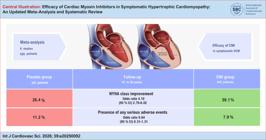
CI: confidence interval; CMI: cardiac myosin inhibitors; HCM: hypertrophic cardiomyopathy; NYHA: New York Heart Association.
Methods
This systematic review and meta-analysis was performed in line with recommendations from the Cochrane Collaboration Handbook for Systematic Review of Interventions version 6.412 and the Preferred Reporting Items for Systematic Reviews and Meta-Analyses (PRISMA) statement guidelines.13 The prespecified study protocol was registered on May 29, 2024, on the International Prospective Register of Systematic Reviews (PROSPERO), under the identification number CRD42024547886.
Eligibility criteria
Inclusion in this meta-analysis was restricted to studies that met all of the following eligibility criteria: (1) RCTs comparing CMI to placebo; (2) inclusion of patients with symptomatic obstructive or non-obstructive HCM; and (3) reporting at least one of the clinical outcomes of interest. We excluded: (1) observational and retrospective studies, reviews, and expert commentaries; (2) animal studies; (3) studies that did not report outcomes of interest; and (4) studies with different interventions. There were no restrictions regarding the size of the study population or the duration of follow-up.
Search strategy and data extraction
We conducted a systematic search in PubMed, Embase, and the Cochrane Central Register of Controlled Trials. The search was performed with no date restrictions in May 2024. The following terms were used: ("cardiac myosin inhibitor" OR Aficamten OR CK-274 OR Mavacamten OR MYK-461 OR Camzyos) AND (HCM OR oHCM OR HOCM OR "Hypertrophic cardiomyopathy" OR "Cardiomyopathy, hypertrophic" OR "Cardiomyopathy, hypertrophic" OR "cardiomyopathies, hypertrophic" OR "Hypertrophic Cardiomyopathies") (Supplementary Table 1). Additionally, the references of included studies and prior systematic reviews and meta-analyses were evaluated for additional studies. Two authors (P.F. and G.A.) independently extracted the data, following predefined search criteria and quality assessment methods.
Endpoints and subgroup analysis
The primary outcomes of interest were: (1) improvement of at least one NYHA functional class; (2) mean change from baseline in the Kansas City Cardiomyopathy Questionnaire clinical summary score (KCCQ-CSS); (3) mean percent change from baseline in LVOT gradient at rest and after Valsalva maneuver. Other pre-defined outcomes included mean change from baseline in left ventricular ejection fraction (LVEF) and peak oxygen uptake. Safety outcomes were assessed through the analysis of adverse events, including sudden cardiac arrest, atrial fibrillation, and congestive heart failure. Additionally, a subgroup analysis was conducted including only patients with symptomatic oHCM.
Assessment of risk of bias within studies
We evaluated the risk of bias in included studies using version 2 of the Cochrane risk of bias tool for randomized trials (RoB 2).14 The risk of bias assessment was performed by two authors independently (P.F. and G.A.), with disagreements resolved by consensus. Each study was rated as having "high risk", "low risk" or "some concerns" for each of the five domains: selection bias, performance bias, detection bias, attrition bias (loss of patients), and reporting bias (Supplementary Table 2).
Sensitivity analysis
We conducted a sensitivity analysis to ensure the robustness of our results and investigate potential sources of heterogeneity. A leave-one-out sensitivity analysis was performed, where each study was sequentially omitted to assess the impact on results and heterogeneity.
Statistical analysis
Odds ratios (OR) with 95% confidence intervals (CI) were calculated to compare treatment effects for categorical outcomes, while continuous outcomes were compared using mean differences (MD). In studies where the standard deviation (SD) was not reported, we estimated it using the methods described by Luo et al.15 and Wan et al.16 or the Review Manager calculator.17 For continuous endpoints, we used the generic inverse variance method, whereas the Mantel–Haenszel statistic was used for binary endpoints. We employed the DerSimonian and Laird random-effects model to compute pooled results for all outcomes, considering study design differences, as advised by the Cochrane guidelines, and p values < 0.05 were considered to indicate statistical significance.
We assessed heterogeneity with the I2 statistic. Heterogeneity was defined as low (I2 = 0% to 25%), moderate (I2 = 26% to 50%), or high (I2 > 50%).
Furthermore, we performed a pre-specified subgroup analysis, including only patients with symptomatic oHCM. We regarded a p value of <0.05 as indicating statistical significance when assessing subgroup interactions, based on the Cochrane guidelines. We used the generic inverse variance approach to analyze continuous subgroup data, whereas the Mantel–Haenszel statistic was used for binary endpoints. A leave-one-out sensitivity analysis was conducted using R version 4.4.1, with meta (version 7.0.0) and metafor (version 4.6.0) packages.18–20 All the other statistical analyses were performed using Review Manager software (RevMan Web).17
Results
Study selection and baseline characteristics
As shown in Figure 1, 994 studies were identified. After eliminating duplicate records and applying exclusion criteria based on title/abstract review, 22 articles underwent a thorough inclusion and exclusion criteria assessment. Of those, we included six RCTs11,21–25 involving a total of 826 patients, of whom 443 (53.6%) received CMI and 383 (46.4%) received placebo. The main reasons for exclusion were the type of study, absence of results of interest, and different interventions. The duration of follow-up across the studies ranged from 10 to 30 weeks. The baseline characteristics of the included studies are summarized in Table 1.

Preferred Reporting Items for Systematic Reviews and Meta-Analyses (PRISMA) flow diagram of study screening and selection.
Pooled analyses of all studies
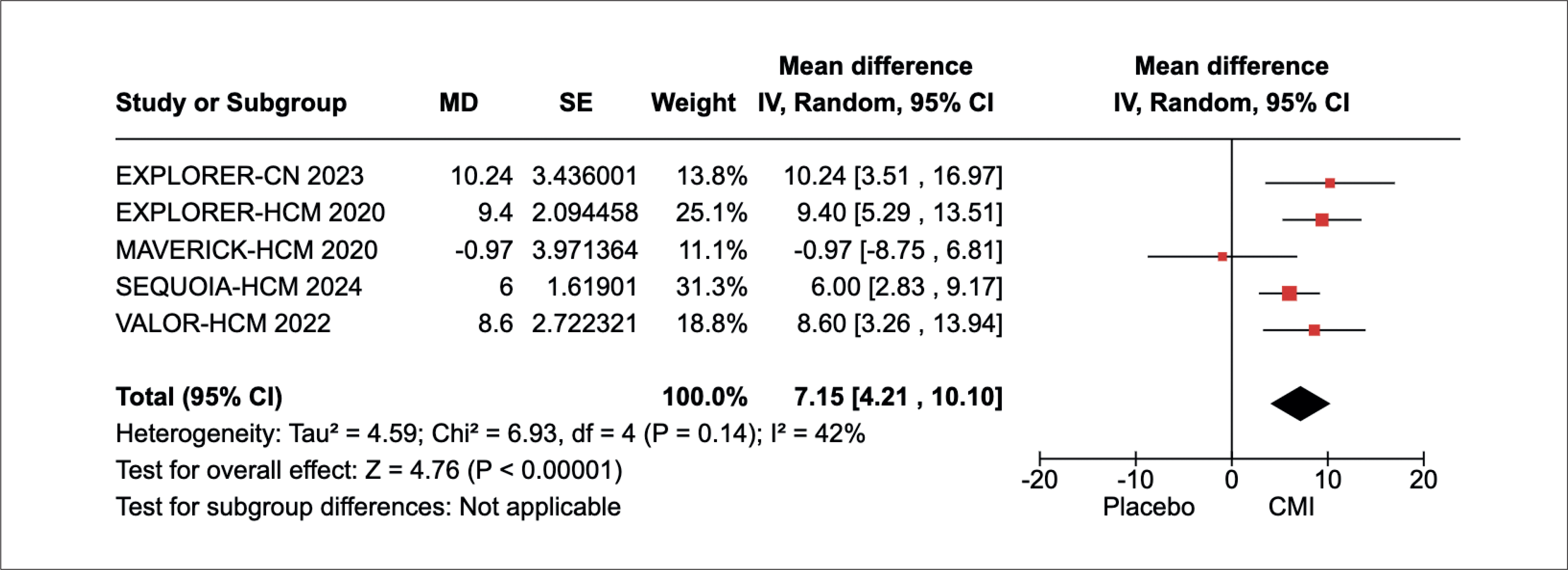
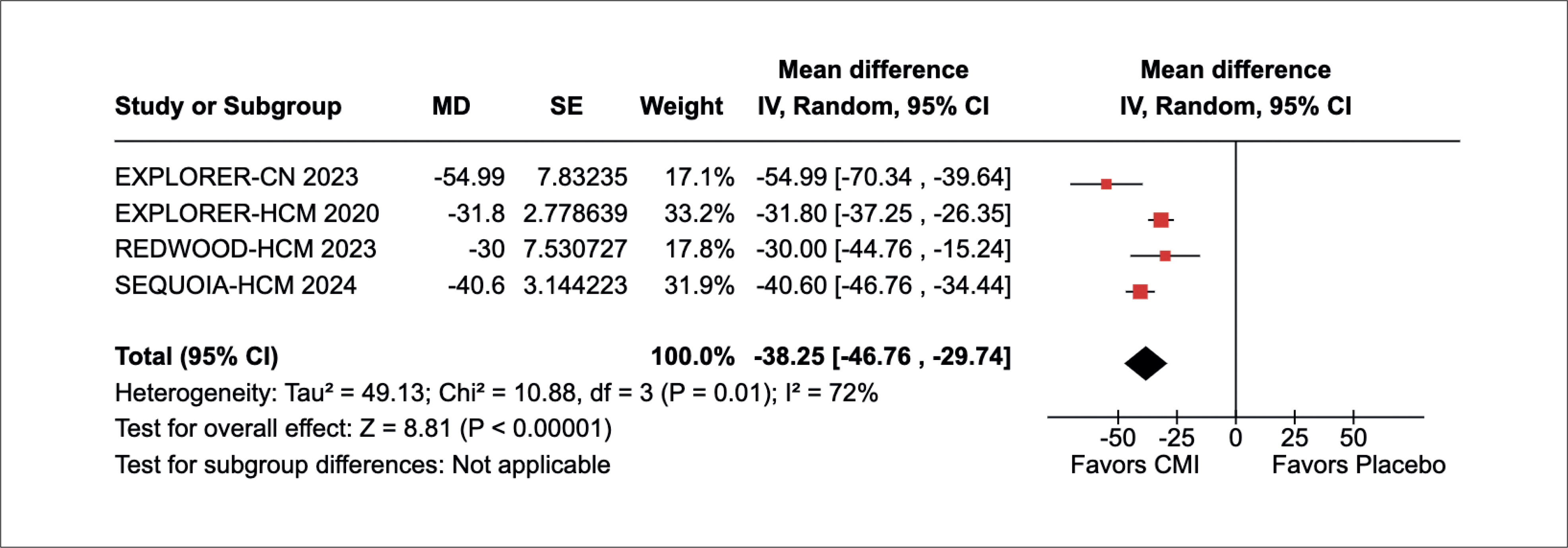
Improvement of at least one NYHA functional class was significantly more frequent in patients who received CMI compared to those in the placebo group (Figure 2). Additionally, there was a significant difference in the mean change from baseline in the KCCQ-CSS between the CMI group compared to the placebo group (Figure 3). Mean LVOT values also showed more significant reductions in the CMI group compared to the placebo group, both after the Valsalva maneuver (Figure 4) and at rest (Figure 5).

Proportion of patients with improvement in NYHA functional class in the CMI and placebo groups. CI: confidence interval; CMI: cardiac myosin inhibitor.

Mean change from baseline in KCCQ-CSS scores in the CMI and placebo groups. CI: confidence interval; CMI: cardiac myosin inhibitor; MD: mean difference; SE: standard error.

Mean LVOT values in the CMI and placebo groups after the Valsalva maneuver. CI: confidence interval; CMI: cardiac myosin inhibitor; MD: mean difference; SE: standard error.

Mean LVOT values in the CMI and placebo groups at rest. CI: confidence interval; CMI: cardiac myosin inhibitor; MD: mean difference; SE: standard error.
Regarding secondary outcomes, there was a difference in peak oxygen consumption between the CMI and placebo groups (Figure 6). Additionally, mean LVEF values showed a reduction in the mean percentage change in the CMI group compared to the placebo group (Figure 7).

Peak oxygen consumption in the CMI and placebo groups. CI: confidence interval; CMI: cardiac myosin inhibitor; SD: standard deviation.

Mean percent change in left ventricular ejection fraction in the CMI and placebo groups. CI: confidence interval; CMI: cardiac myosin inhibitor; SD: standard deviation.
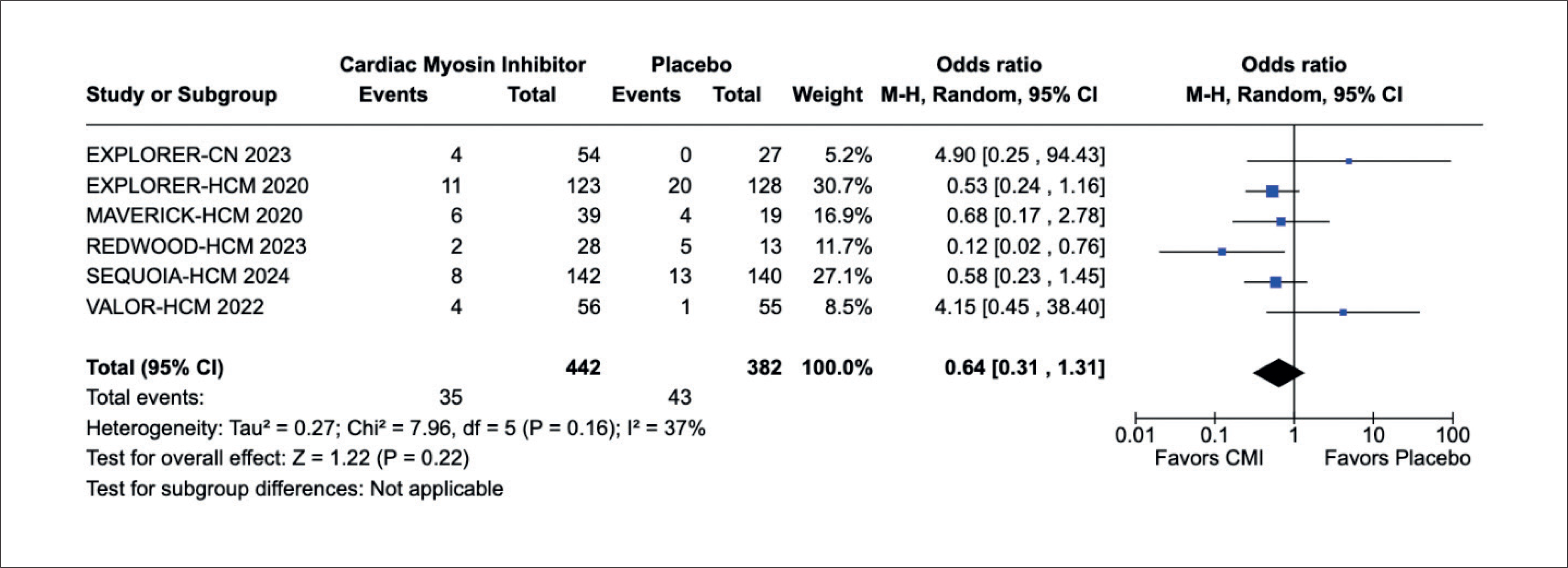
Regarding the presence of any serious adverse events, there were no statistically significant differences between the CMI and placebo groups (Figure 8).

Incidence of serious adverse events in the CMI and placebo groups. CI: confidence interval; CMI: cardiac myosin inhibitor.
Sensitivity analysis
Improvement of at least one NYHA functional class
After conducting the sensitivity analyses, the heterogeneity was resolved by excluding the MAVERICK-HCM study,23 which raised some bias concerns. The exclusion of any of the studies did not present significant changes in the effect estimate (Supplementary Figure 1).
Change from baseline in KCCQ-CSS
Sensitivity analyses were carried out for change from baseline in KCCQ-CSS. The heterogeneity was resolved after the removal of the MAVERICK-HCM trial.23 The analysis revealed no changes in statistical significance (Supplementary Figure 2).
Change from baseline in LVOT after Valsalva maneuver
A sensitivity analysis was conducted for change from baseline in LVOT after the Valsalva maneuver. Moderate heterogeneity was observed after the removal of the EXPLORER-CN study21 and also after the omission of the EXPLORER-HCM trial.22 However, the analysis did not present excessive changes in the effect estimate (Supplementary Figure 3).
Change from baseline LVOT at rest
Sensitivity analyses were carried out for change from baseline LVOT at rest to investigate potential sources of heterogeneity. Omitting any of the studies did not reduce the heterogeneity of this outcome low or moderate (Supplementary Figure 4).
Subgroup analyses
A subgroup analysis was conducted including only patients with symptomatic obstructive HCM. This analysis was performed by excluding only the MAVERICK-HCM study,23 as it was the only one among the six selected RCTs that included a population of patients with symptomatic non-obstructive HCM. Therefore, in practice, the combined analysis of all studies for the outcomes that were not cited or were insufficiently reported in MAVERICK23 already counted as a specific analysis of patients with symptomatic oHCM. As a result, only two outcomes were included in this subgroup analysis: (1) improvement of at least one NYHA classification; and (2) change from baseline in KCCQ-CSS. (Supplementary Figure 5 and Supplementary Figure 6).
Risk of bias
Most studies were considered to have a low risk of bias for all analyzed domains (randomization, deviation from intended interventions, missing outcome data, measurement of outcomes, and selection of the reported results). We judged the studies EXPLORER-CN21 and MAVERICK-HCM23 to have some concerns regarding bias in the domain of randomization (Supplementary Table 1). These studies presented notable disparities in baseline characteristics, raising concerns about the randomization process and therefore the validity of results. We observed a discrepancy between the intervention (CMI) and control (placebo) groups in the population classified in NYHA classes II and III. Regarding NYHA functional class II, in the EXPLORER-CN trial 44 (81.5%) patients were part of the CMI group and 18 (66.7%) of the placebo group, whereas in MAVERICK-HCM, 33 (82.5%) corresponded to the intervention group and 13 (68.4%) to the control group. Regarding NYHA class III, in EXPLORER-CN, 10 (18.5%) patients were randomized to the CMI group and 9 (33.3%) to the placebo group, whereas in MAVERICK-HCM 7 (17.5%), corresponded to the intervention group and 6 (31.6%) to the control group. We attribute this discrepancy in baseline characteristics to the small sample size in both studies.
Discussion
In this systematic review and meta-analysis, 994 studies were initially identified, with six RCTs11,21–25 involving 826 patients ultimately included. Of these patients, 443 received CMI and 383 received placebo. The analysis revealed significant improvements in the CMI group compared to the placebo group in NYHA functional class, mean change in KCCQ-CSS, and reductions in LVOT values both at rest and after the Valsalva maneuver. Sensitivity analyses confirmed these findings, with the exclusion of specific studies resolving heterogeneity issues. A subgroup analysis for patients with symptomatic oHCM supported these outcomes. The risk of bias was generally low. The findings suggest that CMI is effective in improving clinical outcomes without increasing serious adverse events compared to placebo.
A significant improvement in NYHA functional class was observed in the intervention group, with 59.1% of CMI patients achieving at least a one-point improvement compared to 26.4% in the placebo group. Additionally, a 7.5-point difference in mean change from baseline was observed between the groups, favoring the CMI-treated group. Improvements included enhanced physical and social function, and better self-efficacy in disease management, suggesting the efficacy of CMI in improving clinical outcomes in HCM. These findings align with existing literature; for example, in a RCT published in 2020,22 all 123 patients receiving mavacamten showed improvement in NYHA class and a significant increase in KCCQ-CSS compared to 128 patients on placebo.
In HCM, LVOT obstruction is a critical marker of disease severity, influencing the risk of heart failure, myocardial ischemia, and arrhythmias. LVOT obstruction impedes blood flow from the left ventricle to the aorta, increasing left ventricular filling pressures and exacerbating symptoms.26,27 Monitoring LVOT values at rest and during maneuvers like the Valsalva maneuver is essential for assessing obstruction severity and treatment efficacy. This meta-analysis demonstrated that CMI significantly reduced mean LVOT values compared to placebo. At rest, the MD was −38.25 mmHg, and after the Valsalva maneuver, it was −46.49 mmHg. In a RCT involving 112 patients with oHCM referred for septal reduction therapy, mavacamten demonstrated a mean reduction of 37.2 mm Hg in the LVOT gradient compared to the control.25 These combined results indicate that CMI effectively decreases LVOT obstruction, improving cardiac function and reducing HCM-related symptoms. Consequently, addressing LVOT obstruction is crucial for optimizing HCM management.
In line with earlier studies,11,21–25 no statistically significant differences in serious adverse events were observed between the CMI and placebo groups, with rates of 7.9% (35/442) for CMI and 11.2% (43/382) for placebo. A 2023 meta-analysis11 similarly found no significant differences between mavacamten and placebo in the incidence of ≥ 1 serious adverse event, atrial fibrillation, or nonsustained ventricular tachycardia, supporting a favorable safety profile. Heitner and colleagues further reported a 23.8% incidence of atrial fibrillation among aficamten-treated oHCM patients, including five total events in which three were intermittent atrial fibrillation and two resolved independently, and one patient with paroxysmal atrial fibrillation discontinued the trial.28,29 No sustained arrhythmias or QT prolongation occurred, highlighting limited arrhythmic risk. The MAVERICK-HCM trial also observed atrial fibrillation/flutter among participants with a history of atrial fibrillation in both mavacamten and placebo groups, all of whom recovered without sequelae.23 Additionally, a previous systematic review reported a slight increase in treatment-emergent adverse events with mavacamten (risk ratio: 1.14; 95% CI: 1.03 to 1.26) but no significant difference in severe adverse events, including atrial fibrillation, when compared to placebo (risk ratio: 0.87; 95% CI: 0.45 to 1.69).30 Collectively, these findings reinforce that aficamten and mavacamten do not significantly increase the risk of serious arrhythmias, supporting their safe use in oHCM treatment. The observed results were not dose-dependent. All included studies employed structured protocols for titrating CMI doses, starting at low levels and gradually increasing based on parameters such as LVOT gradient and LVEF. Doses were adjusted according to echocardiographic and pharmacokinetic targets to achieve effective gradient reduction while minimizing risks, particularly reduced LVEF.
This systematic review and meta-analysis has some limitations. The relatively short treatment period (10 to 30 weeks) may affect the assessment of long-term outcomes. Notably, substantial heterogeneity persisted in the analysis of baseline changes in LVOT at rest, despite sensitivity analysis. Additionally, three studies lacked objective data on functional capacity, primarily measured by peak oxygen uptake with cardiopulmonary exercise testing, limiting the comprehensive assessment of the impact of pharmacological therapy on cardiopulmonary reserve. The lack of a formal assessment of publication bias can be seen as a limitation, even though a test for funnel plot asymmetry would likely be underpowered due to the small number of studies included in this analysis.31–33 Longer-duration RCTs and studies with objective functional capacity data are crucial for evaluating survival benefits, long-term cardiovascular outcomes, and the impact on cardiopulmonary capacity.
Conclusion
This systematic review and meta-analysis indicated that the CMI aficamten and mavacamten provide superior efficacy over placebo in enhancing NYHA functional class and reducing LVOT obstruction in patients with symptomatic HCM. Additionally, these inhibitors improve quality of life, as reflected by KCCQ-CSS scores, and exhibit a safety profile similar to that of placebo, with comparable rates of serious adverse events.
-
Sources of funding
There were no external funding sources for this study.
-
Study association
This study is not associated with any thesis or dissertation work.
-
Ethics approval and consent to participate
This article does not contain any studies with human participants or animals performed by any of the authors.
-
Use of Artificial Intelligence
The authors did not use any artificial intelligence tools in the development of this work.
Data Availability Statement
The underlying content of the research text is contained within the manuscript.
References
-
1 Sakellaropoulos SG, Steinberg BS. Hypertrophic Cardiomyopathy: A Cardiovascular Challenge Becoming a Contemporary Treatable Disease. Cardiol Res. 2023;14(4):243-9. doi: 10.14740/cr1514.
» https://doi.org/10.14740/cr1514 -
2 Semsarian C, Ingles J, Maron MS, Maron BJ. New Perspectives on the Prevalence of Hypertrophic Cardiomyopathy. J Am Coll Cardiol. 2015;65(12):1249-54. doi: 10.1016/j.jacc.2015.01.019.
» https://doi.org/10.1016/j.jacc.2015.01.019 -
3 Akhtar M, Elliott P. The Genetics of Hypertrophic Cardiomyopathy. Glob Cardiol Sci Pract. 2018;2018(3):36. doi: 10.21542/gcsp.2018.36.
» https://doi.org/10.21542/gcsp.2018.36 -
4 Kim KH, Pereira NL. Genetics of Cardiomyopathy: Clinical and Mechanistic Implications for Heart Failure. Korean Circ J. 2021;51(10):797-836. doi: 10.4070/kcj.2021.0154.
» https://doi.org/10.4070/kcj.2021.0154 -
5 Marian AJ, Braunwald E. Hypertrophic Cardiomyopathy: Genetics, Pathogenesis, Clinical Manifestations, Diagnosis, and Therapy. Circ Res. 2017;121(7):749-70. doi: 10.1161/CIRCRESAHA.117.311059.
» https://doi.org/10.1161/CIRCRESAHA.117.311059 -
6 Shen H, Dong SY, Ren MS, Wang R. Ventricular Arrhythmia and Sudden Cardiac Death in Hypertrophic Cardiomyopathy: From Bench to Bedside. Front Cardiovasc Med. 2022;9:949294. doi: 10.3389/fcvm.2022.949294.
» https://doi.org/10.3389/fcvm.2022.949294 -
7 Maron BJ, Maron MS. Hypertrophic Cardiomyopathy. Lancet. 2013;381(9862):242-55. doi: 10.1016/S0140-6736(12)60397-3.
» https://doi.org/10.1016/S0140-6736(12)60397-3 -
8 Maron BJ, Desai MY, Nishimura RA, Spirito P, Rakowski H, Towbin JA, et al. Management of Hypertrophic Cardiomyopathy: JACC State-of-the-Art Review. J Am Coll Cardiol. 2022;79(4):390-414. doi: 10.1016/j.jacc.2021.11.021.
» https://doi.org/10.1016/j.jacc.2021.11.021 -
9 Ommen SR, Ho CY, Asif IM, Balaji S, Burke MA, Day SM, et al. 2024 AHA/ACC/AMSSM/HRS/PACES/SCMR Guideline for the Management of Hypertrophic Cardiomyopathy: A Report of the American Heart Association/American College of Cardiology Joint Committee on Clinical Practice Guidelines. J Am Coll Cardiol. 2024;83(23):2324-405. doi: 10.1016/j.jacc.2024.02.014.
» https://doi.org/10.1016/j.jacc.2024.02.014 -
10 Yassen M, Changal K, Busken J, Royfman R, Schodowski E, Venkataramany B, et al. The Efficacy of Cardiac Myosin Inhibitors versus Placebo in Patients with Symptomatic Hypertrophic Cardiomyopathy: A Meta-Analysis and Systematic Review. Am J Cardiol. 2024;210:219-24. doi: 10.1016/j.amjcard.2023.10.059.
» https://doi.org/10.1016/j.amjcard.2023.10.059 -
11 Maron MS, Masri A, Nassif ME, Barriales-Villa R, Arad M, Cardim N, et al. Aficamten for Symptomatic Obstructive Hypertrophic Cardiomyopathy. N Engl J Med. 2024;390(20):1849-61. doi: 10.1056/NEJMoa2401424.
» https://doi.org/10.1056/NEJMoa2401424 -
12 Higgins JPT, Thomas J, Chandler J, Cumpston M, Li T, Page MJ, editors. Cochrane Handbook for Systematic Reviews of Interventions. Version 6.4 (Updated August 2023) [Internet]. London: Cochrane; 2023 [cited 2026 Apr 9]. Available from: https://training.cochrane.org/handbook
» https://training.cochrane.org/handbook -
13 Page MJ, McKenzie JE, Bossuyt PM, Boutron I, Hoffmann TC, Mulrow CD, et al. The PRISMA 2020 Statement: An Updated Guideline for Reporting Systematic Reviews. Syst Rev. 2021;10(1):89. doi: 10.1186/s13643-021-01626-4.
» https://doi.org/10.1186/s13643-021-01626-4 -
14 Sterne JAC, Savović J, Page MJ, Elbers RG, Blencowe NS, Boutron I, et al. RoB 2: A Revised Tool for Assessing Risk of Bias in Randomised Trials. BMJ. 2019;366:l4898. doi: 10.1136/bmj.l4898.
» https://doi.org/10.1136/bmj.l4898 -
15 Luo D, Wan X, Liu J, Tong T. Optimally Estimating the Sample Mean from the Sample Size, Median, Mid-Range, and/or Mid-Quartile Range. Stat Methods Med Res. 2018;27(6):1785-805. doi: 10.1177/0962280216669183.
» https://doi.org/10.1177/0962280216669183 -
16 Wan X, Wang W, Liu J, Tong T. Estimating the Sample Mean and Standard Deviation from the Sample Size, Median, Range and/or Interquartile Range. BMC Med Res Methodol. 2014;14:135. doi: 10.1186/1471-2288-14-135.
» https://doi.org/10.1186/1471-2288-14-135 -
17 Cochrane Collaboration. Review Manager (RevMan) [Computer Program] [Internet]. London: Cochrane; [cited 2026 Apr 9]. Available from: https://documentation.cochrane.org/x/1iiSBg
» https://documentation.cochrane.org/x/1iiSBg -
18 Tian Z, Li L, Li X, Wang J, Zhang Q, Li Z, et al. Effect of Mavacamten on Chinese Patients with Symptomatic Obstructive Hypertrophic Cardiomyopathy: The EXPLORER-CN Randomized Clinical Trial. JAMA Cardiol. 2023;8(10):957-65. doi: 10.1001/jamacardio.2023.3030.
» https://doi.org/10.1001/jamacardio.2023.3030 -
19 Olivotto I, Oreziak A, Barriales-Villa R, Abraham TP, Masri A, Garcia-Pavia P, et al. Mavacamten for Treatment of Symptomatic Obstructive Hypertrophic Cardiomyopathy (EXPLORER-HCM): A Randomised, Double-Blind, Placebo-Controlled, Phase 3 Trial. Lancet. 2020;396(10253):759-69. doi: 10.1016/S0140-6736(20)31792-X.
» https://doi.org/10.1016/S0140-6736(20)31792-X -
20 Ho CY, Mealiffe ME, Bach RG, Bhattacharya M, Choudhury L, Edelberg JM, et al. Evaluation of Mavacamten in Symptomatic Patients with Nonobstructive Hypertrophic Cardiomyopathy. J Am Coll Cardiol. 2020;75(21):2649-60. doi: 10.1016/j.jacc.2020.03.064.
» https://doi.org/10.1016/j.jacc.2020.03.064 -
21 Maron MS, Masri A, Choudhury L, Olivotto I, Saberi S, Wang A, et al. Phase 2 Study of Aficamten in Patients with Obstructive Hypertrophic Cardiomyopathy. J Am Coll Cardiol. 2023;81(1):34-45. doi: 10.1016/j.jacc.2022.10.020.
» https://doi.org/10.1016/j.jacc.2022.10.020 -
22 Desai MY, Owens A, Geske JB, Wolski K, Naidu SS, Smedira NG, et al. Myosin Inhibition in Patients with Obstructive Hypertrophic Cardiomyopathy Referred for Septal Reduction Therapy. J Am Coll Cardiol. 2022;80(2):95-108. doi: 10.1016/j.jacc.2022.04.048.
» https://doi.org/10.1016/j.jacc.2022.04.048 -
23 Elliott PM, Gimeno JR, Tomé MT, Shah J, Ward D, Thaman R, et al. Left Ventricular Outflow Tract Obstruction and Sudden Death Risk in Patients with Hypertrophic Cardiomyopathy. Eur Heart J. 2006;27(16):1933-41. doi: 10.1093/eurheartj/ehl041.
» https://doi.org/10.1093/eurheartj/ehl041 -
24 Maron MS, Olivotto I, Betocchi S, Casey SA, Lesser JR, Losi MA, et al. Effect of Left Ventricular Outflow Tract Obstruction on Clinical Outcome in Hypertrophic Cardiomyopathy. N Engl J Med. 2003;348(4):295-303. doi: 10.1056/NEJMoa021332.
» https://doi.org/10.1056/NEJMoa021332 -
25 Ismayl M, Abbasi MA, Marar R, Geske JB, Gersh BJ, Anavekar NS. Mavacamten Treatment for Hypertrophic Cardiomyopathy: A Systematic Review and Meta-Analysis of Randomized Controlled Trials. Curr Probl Cardiol. 2023;48(1):101429. doi: 10.1016/j.cpcardiol.2022.101429.
» https://doi.org/10.1016/j.cpcardiol.2022.101429 -
26 Heitner SB, Jacoby D, Lester SJ, Owens A, Wang A, Zhang D, et al. Mavacamten Treatment for Obstructive Hypertrophic Cardiomyopathy: A Clinical Trial. Ann Intern Med. 2019;170(11):741-8. doi: 10.7326/M18-3016.
» https://doi.org/10.7326/M18-3016 -
27 Memon A, Larik MO, Khan Z, Urooj M, Irfan A, Kumari B, et al. Efficacy and Safety of Mavacamten in Treatment of Hypertrophic Cardiomyopathy: A Systematic Review and Meta-Analysis. Future Sci OA. 2023;9(10):FSO898. doi: 10.2144/fsoa-2023-0059.
» https://doi.org/10.2144/fsoa-2023-0059 -
28 Terrin N, Schmid CH, Lau J, Olkin I. Adjusting for Publication Bias in the Presence of Heterogeneity. Stat Med. 2003;22(13):2113-26. doi: 10.1002/sim.1461.
» https://doi.org/10.1002/sim.1461 -
29 Sterne JA, Egger M. Funnel Plots for Detecting Bias in Meta-Analysis: Guidelines on Choice of Axis. J Clin Epidemiol. 2001;54(10):1046-55. doi: 10.1016/s0895-4356(01)00377-8.
» https://doi.org/10.1016/s0895-4356(01)00377-8 -
30 Saveleva E, Selinski S. Meta-Analyses with Binary Outcomes: How Many Studies Need to be Omitted to Detect a Publication Bias? J Toxicol Environ Health A. 2008;71(13):845-50. doi: 10.1080/15287390801985844.
» https://doi.org/10.1080/15287390801985844 -
31 R Core Team. R: A Language and Environment for Statistical Computing [computer program] [Internet]. Vienna: R Foundation for Statistical Computing; 2024 [cited 2026 Apr 9]. Available from: https://www.r-project.org/
» https://www.r-project.org/ -
32 Balduzzi S, Rücker G, Schwarzer G. How to Perform a Meta-Analysis with R: A Practical Tutorial. Evid Based Ment Health. 2019;22(4):153-60. doi: 10.1136/ebmental-2019-300117.
» https://doi.org/10.1136/ebmental-2019-300117 -
33 Viechtbauer W. Conducting Meta-Analyses in R with the Metafor Package. J Stat Soft. 2010;36(3):1-48. doi: 10.18637/jss.v036.i03.
» https://doi.org/10.18637/jss.v036.i03
Edited by
-
Editor responsible for the review:
Ricardo Mourilhe-Rocha