 Spontaneous Multivessel Coronary Artery Dissection: Case Report
Abstract
Spontaneous coronary artery dissection (SCAD) is a rare condition that can cause acute myocardial infarction (AMI), especially in young women without risk factors for coronary artery disease. Diagnosis is made by cardiac catheterization, and treatment varies from conservative to surgical approaches, depending on the severity. We report the case of a woman with a history of AMI who underwent initial catheterization without requiring percutaneous coronary intervention due to the absence of an obstructive lesion. Subsequently, the patient presented episodes of angina, and a new catheterization was performed, which revealed dissection in the left anterior descending and right coronary arteries. Given the lack of spontaneous resolution of the dissection, which was initially unilateral and progressed to bilateral, the patient underwent myocardial revascularization with mammary artery and saphenous vein bypass grafts. The objective of this study is to document a case of SCAD and to describe its characteristics, diagnosis, and therapeutic management.
Keywords
Aortic Dissection; Acute Coronary Syndrome; Myocardial Infarction
Introduction
Spontaneous coronary artery dissection (SCAD) is a rare cause of acute coronary syndrome (ACS), acute myocardial infarction (AMI), and sudden death. It is non-atherosclerotic and, in spite of its impact, underdiagnosed.1 According to the European Heart Journal, 0.2% of all cases of AMI are related to SCAD, and it is currently the most frequent cause of AMI in women under 50 years of age.2 SCAD can be considered multifactorial, as it is associated with factors such as fibromuscular dysplasia, hormonal therapy, pregnancy, smoking, and collagen diseases.3 Diagnosis is made by means of cardiac catheterization. Treatment depends on the patient's condition, the severity of the dissection, and the number of arteries affected, ranging from clinical intervention to stent implantation or myocardial revascularization.1 However, conservative treatment is the most commonly applied approach. It is hoped that this case report will assist studies regarding better management of patients with SCAD.
Case report
We report the case of I.B., a 49-year-old, white, female patient from Santa Catarina, Brazil. She sought care at the emergency room in the second half of 2018, presenting unstable angina and a history of previous AMI, having undergone catheterization in the city of Curitiba, Paraná, according to information provided by the patient. We did not have access to the report or images from this exam, and intervention was not required. During this visit in 2018, a new catheterization was performed, showing a thrombus in the left anterior descending and right coronary arteries. Rivaroxaban was associated with the medication she was already using (carvedilol), and she was referred for follow-up with a cardiologist. She had a transthoracic echocardiogram from the previous year, which showed segmental systolic and diastolic dysfunction grade III with the presence of a thrombus in the apex of the left ventricle and tricuspid regurgitation.
Regarding her personal history, she had undergone nephrectomy and embolectomy with a Fogarty catheter in 2014. She also reported regular use of oral contraceptives and smoking at the time of treatment. Regarding family history, her mother had myocardial infarction at the age of 65 years, as did her siblings around the ages of 30 and 40 years.
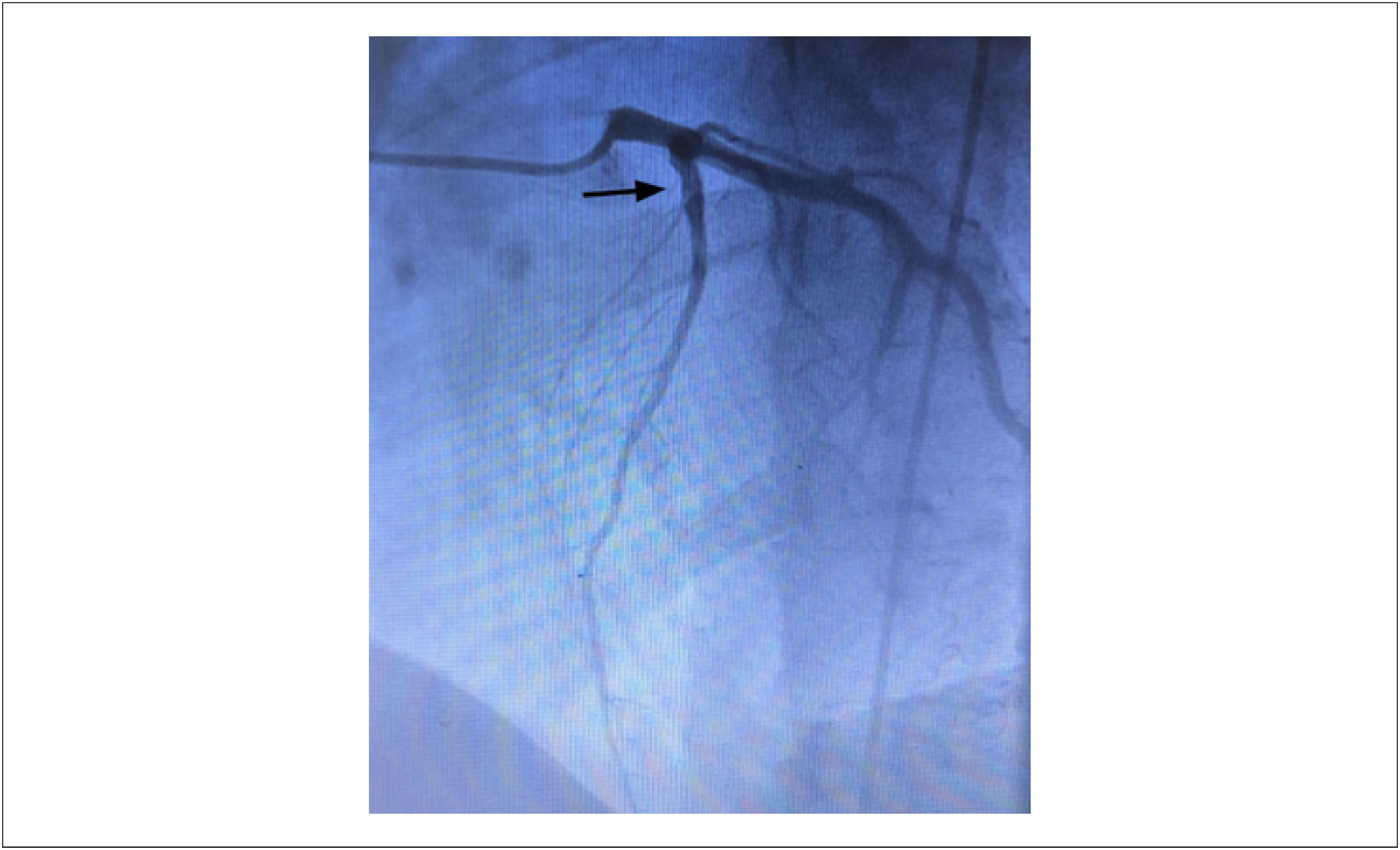
Six months later, in 2019, she returned to the emergency room with dyspnea upon minimal exertion and was admitted for follow-up with a cardiologist. At that time, she was taking acetylsalicylic acid, furosemide, spironolactone, enalapril, isosorbide mononitrate, atorvastatin, carvedilol, rivaroxaban, and sertraline. A new catheterization was performed, showing a significant lesion in the proximal right coronary artery, with an obstruction degree assessed at 80% to 90%, in addition to an image of dissection in the proximal left anterior descending artery (Figure 1), with impaired flow to this coronary artery. A new echocardiogram was performed, leading to the conclusion of left ventricular overload and severely reduced systolic function with ejection fraction of 40%. Functional examination (scintigraphy) was subsequently requested in order to assess myocardial viability in the infarction area. Two months later, the patient returned for the examination, and surgical treatment was indicated.

There was no information available regarding investigation of thrombophilia, given that the patient had low adherence to treatment and was undergoing follow-up irregularly. The patient did not continue with the treatment proposed at the time.
At the end of 2020, when she returned to the cardiac surgery outpatient clinic, new preoperative exams and a new catheterization were requested, showing chronic dissection in the left anterior descending artery and an image suggestive of a new dissection, this time in right coronary artery (Figure 2), in addition to an 80% luminal reduction in the proximal third of both vessels. In early 2021, the patient underwent myocardial revascularization surgery, with 2 grafts, left internal mammary artery for the left anterior descending artery and saphenous vein bypass for the right coronary artery. The procedure was free of complications, and the patient arrived at the cardiac intensive care unit intubated and without receiving vasoactive medications, progressing in the first hours with the need for low-dose intravenous nitroprusside. On the third day in the intensive care unit, the patient complained of nausea and chest pain, with subfebrile temperature, tending toward hypotension. Laboratory tests revealed significant anemia, with a 5-point drop in hematocrit, without leukocytosis or deviation. She received transfusion with 1 unit of red blood cell concentrate, and her oral medications were readjusted to prevent hypotension. On the fourth day in the intensive care unit, she was hemodynamically stable. The chest drain was removed, she was transferred to the ward. Two days later, she was discharged from the hospital, and an outpatient return visit was requested for follow-up.

Discussion
SCAD is a rare event and an important cause of AMI in women with few risk factors. It occurs due to a non-traumatic, non-iatrogenic separation of the coronary artery wall, and the left anterior descending artery is the most affected. Most patients who present with this disease normally do not demonstrate any risk factors for coronary artery disease. A study conducted in patients with SCAD showed that one or more predisposing factors may be involved, for example, fibromuscular dysplasia, multiparity, connective tissue disorders, and hormonal therapy.4 In the general population, SCAD is the cause of ACS in 0.2% of cases; however, this estimate probably does not reflect the true incidence of the disease, as it tends to be underdiagnosed.2
The clinical manifestation is typical of ACS, and chest pain is the most common presentation, as in the case reported. Nonetheless, other symptoms may be present, such as arm and neck pain, dyspnea, nausea, and vomiting. In addition to these, patients may have AMI with ST-segment elevation, intense effort preceding the event, and postpartum status.4-6 A prospective multicenter study on SCAD conducted with the support of the Interventional Cardiology Association of the Spanish Society of Cardiology compared 39 men and 279 women, with similar ages in both groups, and revealed that men more frequently presented ventricular arrhythmias as the initial symptom compared to women.7
Diagnosis of SCAD should be suspected in patients under 50 years of age, especially women, who present with AMI or cardiac arrest and who do not manifest coronary artery disease or cardiovascular risk factors.3 Diagnosis is confirmed by means of cardiac catheterization, which should be performed as early as possible. Based on this examination, the disease can be characterized, according to the classification proposed by Saw, as type 1 (appearance of contrast in the arterial wall); type 2 (long, diffuse stenosis, which may vary from mild to complete occlusion, with predominantly in mid to distal segments), which was present in the case reported; and type 3 (focal or tubular stenosis similar to atherosclerosis, requiring intravascular ultrasound to differentiate the cause), type 2 being found in 67% of cases.5-8
Angiographic characteristics have shown significant differences between the sexes. Men are less likely to have tortuosity in the coronary arteries. Patterns such as the "inverted radish" morphology and termination of the SCAD before the lateral branch are more common in men, whereas the "stick insect" and "dotted line" morphologies appeared more frequently in women.7
Conservative treatment is the most commonly applied approach, and more invasive treatments are reserved for cases in which patients are hemodynamically unstable, have dissection of the left anterior descending artery, or are at high risk of ongoing ischemia.3 Medical treatment for SCAD includes dual antiplatelet therapy and betablockers. Betablockers reduce the recurrence of SCAD, and the use of dual antiplatelet therapy should be recommended for all patients, clopidogrel being the antiplatelet agent of choice, as it poses a lower risk of bleeding compared to ticagrelor and prasugrel.4,9 Angiotensin-converting enzyme inhibitors are indicated if there is systolic dysfunction or hypertension, and statins are indicated in cases of dyslipidemia or atherosclerotic disease.8
With respect to the case described, myocardial revascularization was performed, given that patients who present AMI with symptoms of ongoing ischemia or hemodynamic instability should be considered for percutaneous coronary intervention or myocardial revascularization.4 At the time when dissection of the first vessel (left anterior descending artery) was diagnosed, there were not many studies on the subject. However, a more careful evaluation of the case is currently recommended, awaiting a possible spontaneous resolution of the dissection or beginning with conservative treatment, reserving invasive management as a last option.
This patient was admitted as spontaneous dissection, as the dissections did not occur due to a history of trauma, fibromuscular dysplasia, hormonal therapy, pregnancy, or collagen diseases; the patient had a prior history of smoking. We encountered the challenge of not having access to the images from the first examination performed in the city of Curitiba. The images from 2018, 2019, and 2020 were performed by different professionals, using different equipment; however, we did not obtain the images for retrospective analysis. Iatrogenic dissection was ruled out, as the dissections began far from the catheter positioning.
The estimated short- and long-term risks of recurrence of SCAD are highly relevant and concerning for patients. After hospital discharge, adverse cardiovascular effects are relatively common, including angina, recurrent AMI, recurrent SCAD, unplanned revascularization, congestive heart failure, stroke, and death.3 The patient in this case did not report any adverse effects following hospital discharge. Her condition is stable, and she is in follow-up to date.
Although the medical community's knowledge of this condition has increased in recent years, large gaps in knowledge still need to be addressed in order to provide better results in the diagnosis and treatment of these patients, given that relatively little is understood about this disease.
-
Sources of Funding
There were no external funding sources for this study.
-
Study Association
This study is not associated with any thesis or dissertation work.
-
Ethics Approval and Consent to Participate
This study was approved by the Ethics Committee of the Centro Universitário para o Desenvolvimento do Alto Vale do Itajaí under the protocol number 5.046.275. All the procedures in this study were in accordance with the 1975 Helsinki Declaration, updated in 2013. Informed consent was obtained from all participants included in the study.
-
Use of Artificial Intelligence
The authors did not use any artificial intelligence tools in the development of this work.
Availability of Research Data and Other Materials
The underlying content of the research text is contained within the manuscript.
References
- 1 Dambroso D, Pere MB, Andrigue KCK, Passos EB. Acute Myocardial Infarction by Coronary Dissection: Case Report. Arq Catarin Med. 2020;49(1):103-10.
-
2 Adlam D, Alfonso F, Maas A, Vrints C; Writing Committee. European Society of Cardiology, Acute Cardiovascular Care Association, SCAD Study Group: A Position Paper on Spontaneous Coronary Artery Dissection. Eur Heart J. 2018;39(36):3353-68. doi: 10.1093/eurheartj/ehy080.
» https://doi.org/10.1093/eurheartj/ehy080 -
3 Hayes SN, Kim ESH, Saw J, Adlam D, Arslanian-Engoren C, Economy KE, et al. Spontaneous Coronary Artery Dissection: Current State of the Science: A Scientific Statement from the American Heart Association. Circulation. 2018;137(19):523-57. doi: 10.1161/CIR.0000000000000564.
» https://doi.org/10.1161/CIR.0000000000000564 -
4 Saw J, Aymong E, Sedlak T, Buller CE, Starovoytov A, Ricci D, et al. Spontaneous Coronary Artery Dissection: Association with Predisposing Arteriopathies and Precipitating Stressors and Cardiovascular Outcomes. Circ Cardiovasc Interv. 2014;7(5):645-55. doi: 10.1161/CIRCINTERVENTIONS.114.001760.
» https://doi.org/10.1161/CIRCINTERVENTIONS.114.001760 -
5 Tweet MS, Hayes SN, Pitta SR, Simari RD, Lerman A, Lennon RJ, et al. Clinical Features, Management, and Prognosis of Spontaneous Coronary Artery Dissection. Circulation. 2012;126(5):579-88. doi: 10.1161/CIRCULATIONAHA.112.105718.
» https://doi.org/10.1161/CIRCULATIONAHA.112.105718 -
6 Saw J. Coronary Angiogram Classification of Spontaneous Coronary Artery Dissection. Catheter Cardiovasc Interv. 2014;84(7):1115-22. doi: 10.1002/ccd.25293.
» https://doi.org/10.1002/ccd.25293 -
7 Alvarado T, García-Guimaraes M, Nogales JM, Jimenez-Kockar M, Macaya F, Alfonso F. Spontaneous Coronary Artery Dissection: Are there Differences between Men and Women? Arq Bras Cardiol. 2023;120(1):e20210550. doi: 10.36660/abc.20210550.
» https://doi.org/10.36660/abc.20210550 -
8 Gilhofer TS, Saw J. Spontaneous Coronary Artery Dissection: Update 2019. Curr Opin Cardiol. 2019;34(6):594-602. doi: 10.1097/HCO.0000000000000671.
» https://doi.org/10.1097/HCO.0000000000000671 -
9 Lindholm D, Varenhorst C, Cannon CP, Harrington RA, Himmelmann A, Maya J, et al. Ticagrelor vs. Clopidogrel in Patients with Non-ST-Elevation Acute Coronary Syndrome with or without Revascularization: Results from the PLATO Trial. Eur Heart J. 2014;35(31):2083-93. doi: 10.1093/eurheartj/ehu160.
» https://doi.org/10.1093/eurheartj/ehu160
Edited by
-
Editor responsible for the review:
Claudio Tinoco Mesquita